Terminology – Who Cares?
Jill Fifoot Sales & Marketing Director
     Fifoot,
TCUK, 22nd September 2010
Terminology – Who Cares?

•   Introduction – About LIT
•   Why did we choose Terminology?
•   Some definitions
•   What do YOU think?
•   Why manage Terminology?
•   LIT Client Survey
•   Key findings
•   Recommendations
•   Q&A
About LIT

• Over 20 years experience: established in 1989 as
  specialist technical translators

• Offi
  Offices in UK (Cheshire), F
          i     (Ch hi ) France, G Germany, and ad
  worldwide network of professional translators with
  extensive sector knowledge

• High-tech clients in manufacturing and service
  industries

         30 million words handled so far this year
Some definitions…


• Glossary: A list of terms containing explanations

• Terminology: A collection of words that have special
  meaning in a given subject field

• Terminolog Management The activity of
  Terminology Management:            acti it
  systematically collecting, processing and presenting
  words that have a special meaning in a given subject
  field

• T
  Termbase: A database containing t
        b       d t b     t i i terminology and
                                    i l       d
  related information
Why did we choose Terminology?


• Terminology management is a common constant
                              common,
  challenge for our clients
• There is no easy way to tackle it
• Terminology affects all areas of the business:
  It positions your company brand and products in the
                    company,
  market
• Th challenge of managing t
  The h ll       f        i terminology i present
                                   i l     is   t
  from source creation through to translation
• I
  Inconsistent terminology can cause confusion for
        i t tt     i l                    f i f
  your customers and for your translators
• For example…
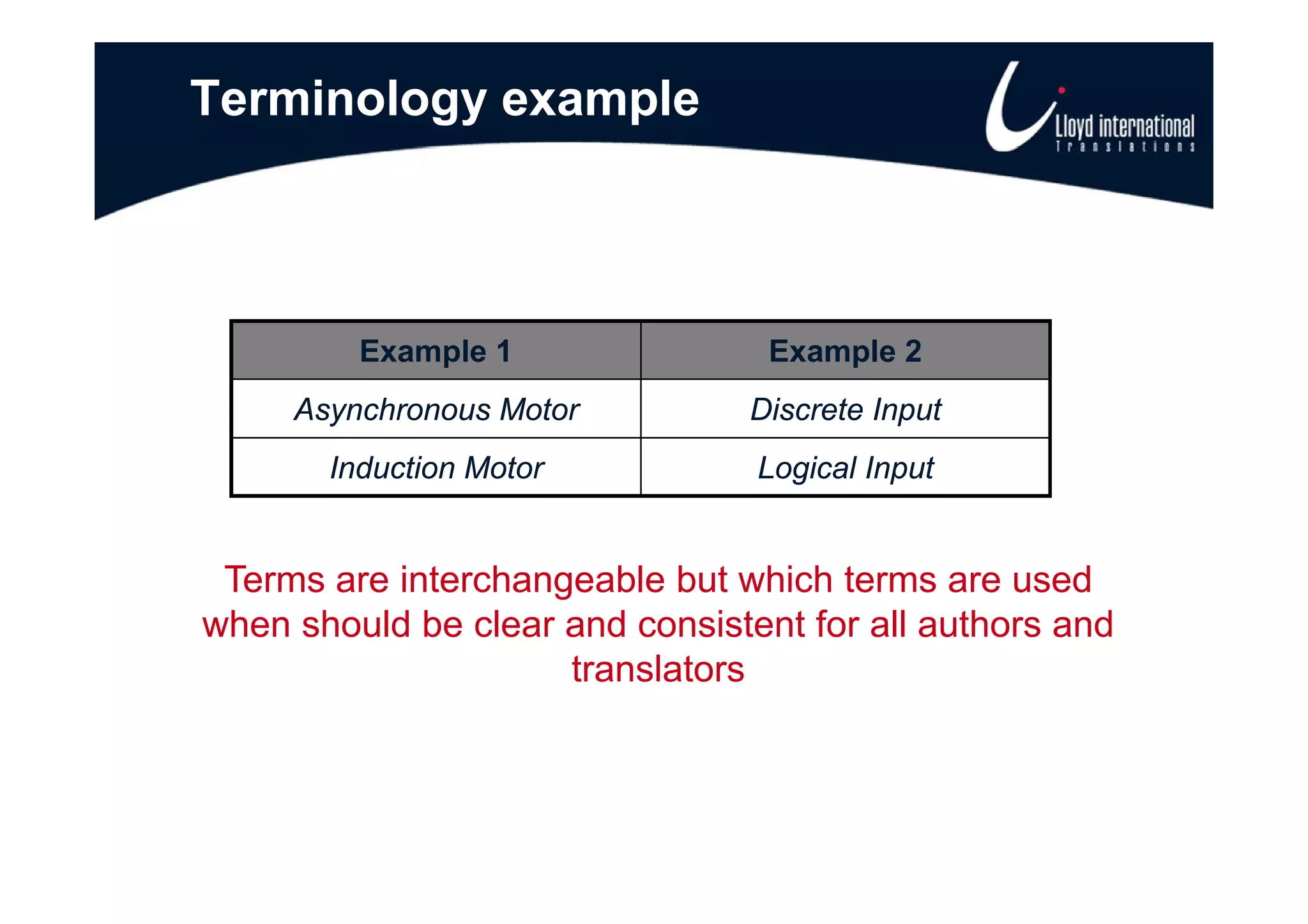
Terminology example


         Example 1                Example 2
     Asynchronous Motor          Discrete Input
       Induction
       Ind ction Motor           Logical Inp t
                                         Input


 Terms are interchangeable b t which t
 T         i t h        bl but hi h terms are used   d
when should be clear and consistent for all authors and
                     translators
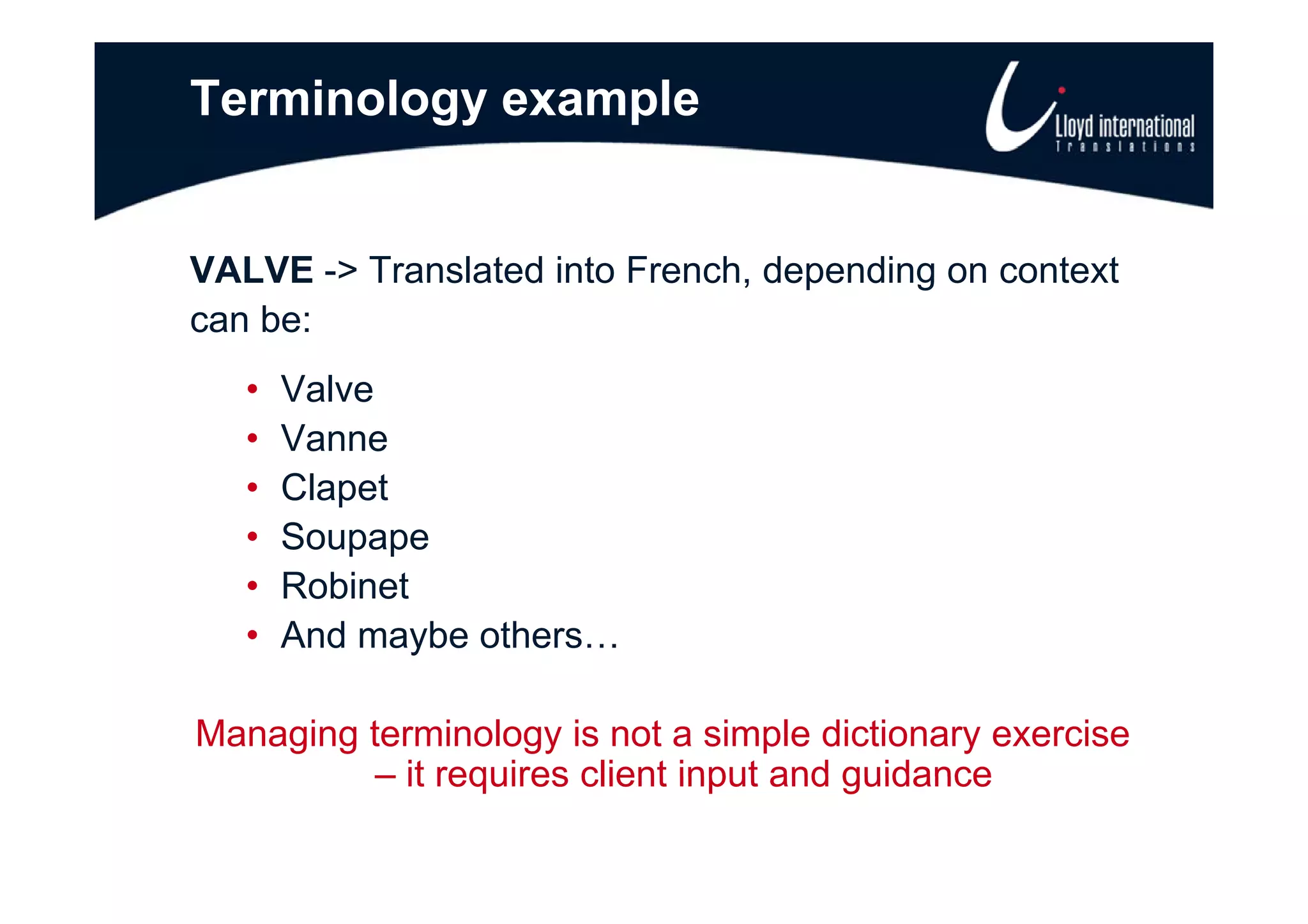
Terminology example


VALVE -> Translated into French, depending on context
can be:
   •   Valve
   •   Vanne
   •   Clapet
   •   Soupape
   •   Robinet
   •   And maybe others…

Managing terminology is not a simple dictionary exercise
          – it requires client input and guidance
Why Manage Terminology?


       CONSISTENCY
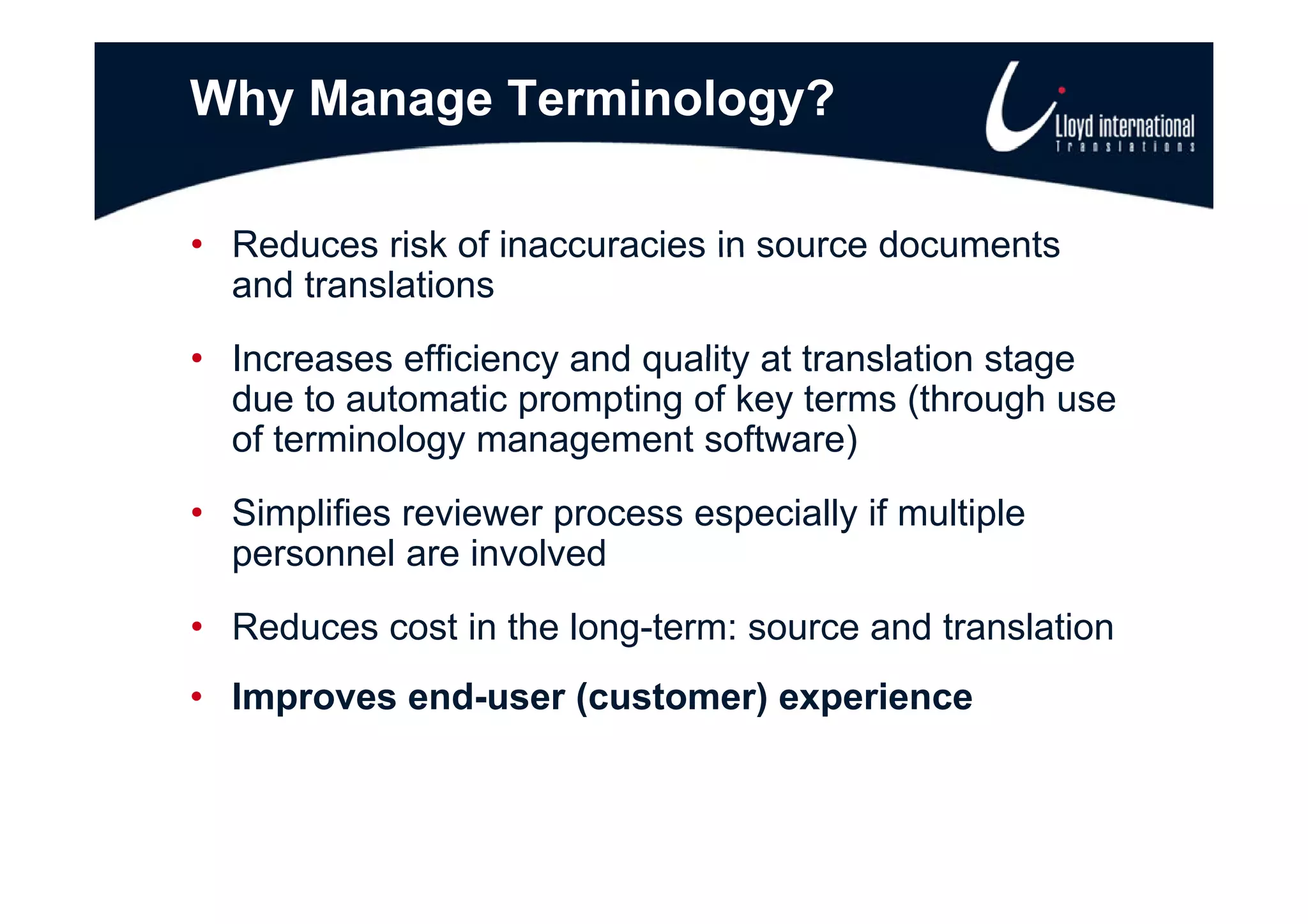
Why Manage Terminology?

• Reduces risk of inaccuracies in source documents
  and translations
• Increases efficiency and quality at translation stage
  due to automatic prompting of key terms (through use
  of terminology management software)
• Simplifies reviewer process especially if multiple
  p
  personnel are involved
• Reduces cost in the long-term: source and translation
• Improves end-user (customer) experience
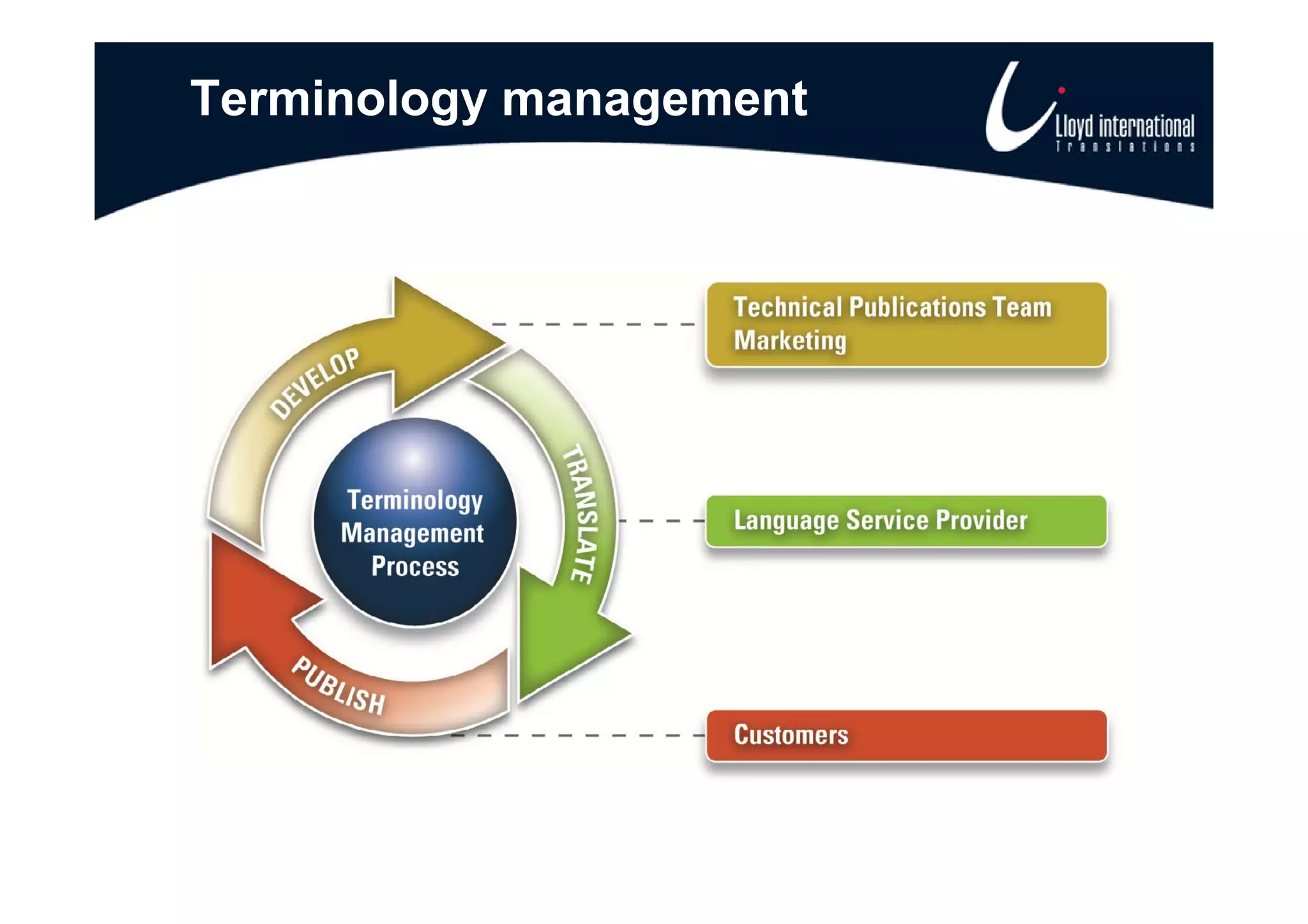
Terminology management
What do you think?


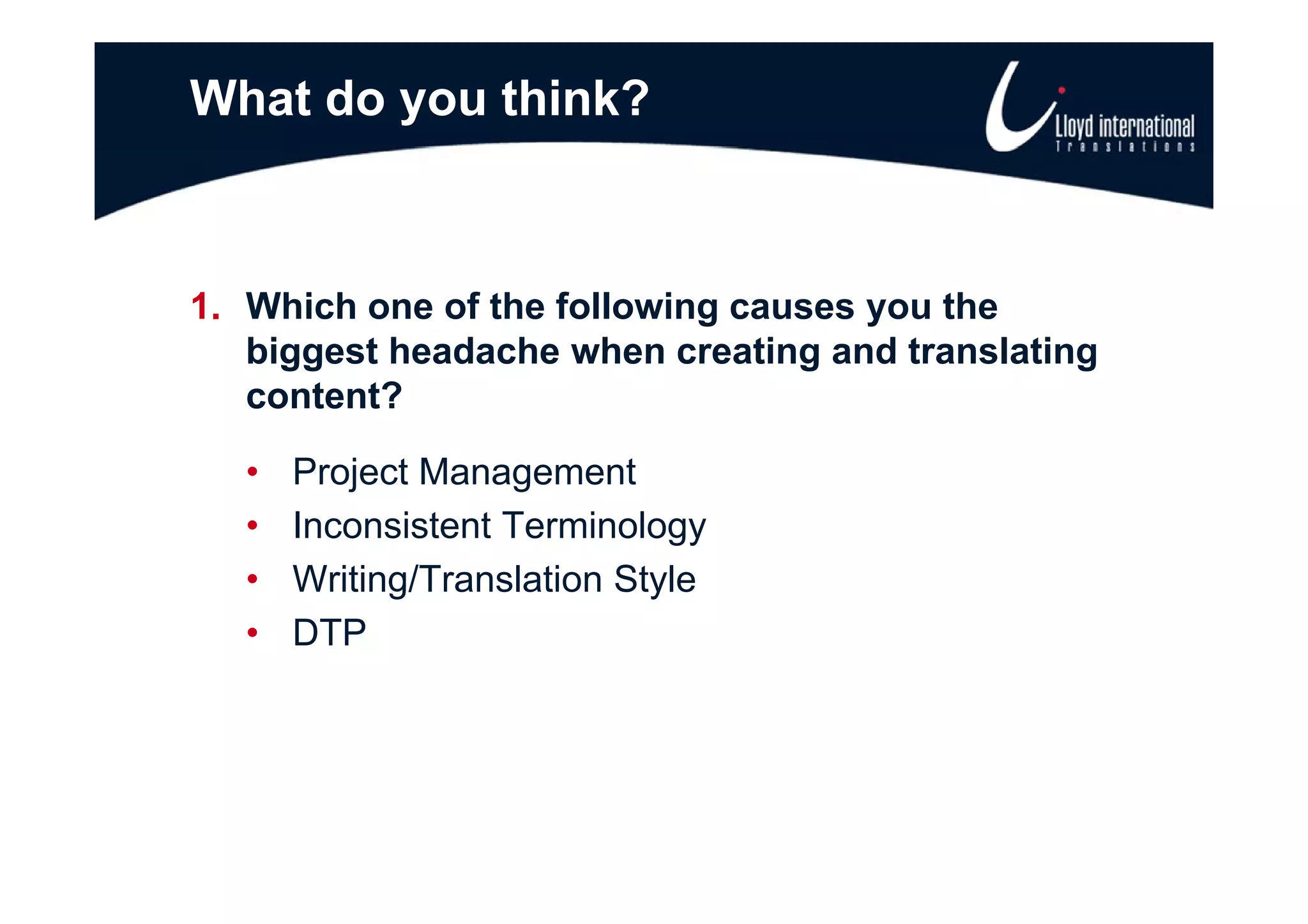
1. Which one of the following causes you the
   biggest headache when creating and translating
   content?

   •   Project Management
       P j tM              t
   •   Inconsistent Terminology
   •   Writing/Translation St l
       W iti /T      l ti Style
   •   DTP
What do you think?


 2. Who has a process in place for managing
                 terminology?
What do you think?


 3. If language terminology databases were freely
         available online, would you use them?
Lloyd International Translations
 Client Survey on Terminology
     Conducted July 2010
LIT Client Survey: Key Objectives


• What importance, if any, do our clients attach to
  terminology and terminology management?

• What are the benefits of terminology management?

• Wh i currently managing t
  Who is         tl   i terminology and h
                            i l       d how are
  they doing it?

• What is the role of the language service provider?

• What technical solutions are our clients aware of?
LIT Client Survey 2010

• LIT surveyed over 20 international clients, medium-
            y                               ,
  large sized enterprises

• Respondents spanned a variety of industries including
  electrical engineering, heavy plant equipment, print
  technology, IT
           gy,

• All respondents held team lead/managerial positions
  within the field of technical communications

• 95% of respondents employed their own in-house
  technical publications team

• Main sou ce languages were English, French a d
   a source a guages e e       g s , e c and
  German
Key Findings

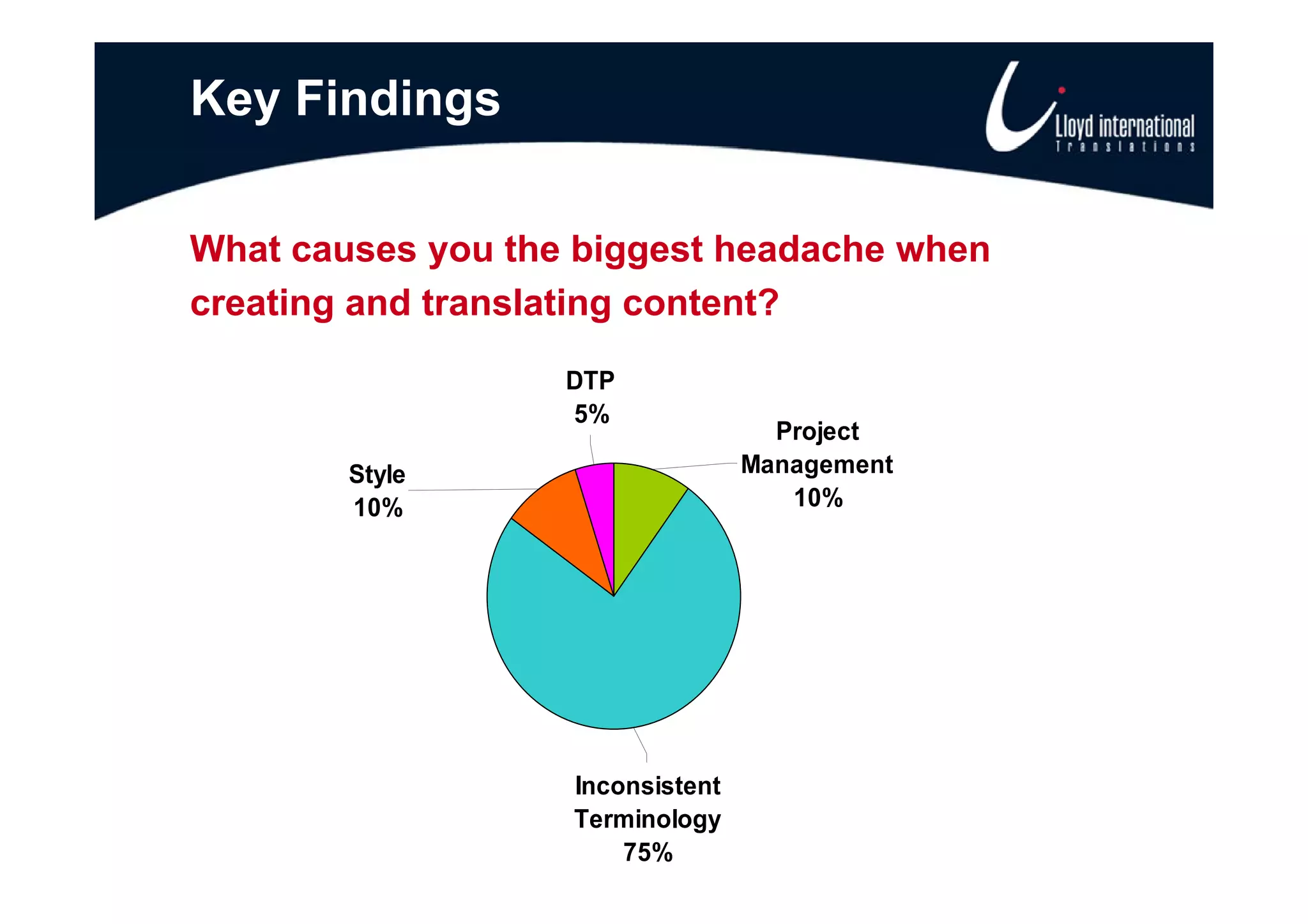
What causes you the biggest headache when
creating and translating content?
                   DTP
                   5%
                                    Project
        Style                     Management
        10%                          10%


                   Inconsistent
                   I     i t t
                   Terminology
                       75%
Key Findings

General Opinion on Terminology

• 100% agreed or strongly agreed that managing
  terminology of th source content is a very important
  t    i l      f the            t ti        i    t t
  part of the overall authoring process

• 90% agreed or strongly agreed that consistent
  terminology in the source content is a challenge for
  technical authors

• 90% indicated that terminology management within
  translation projects is crucial for successful technical
  communications
Key Findings

What are the benefits of managing terminology?

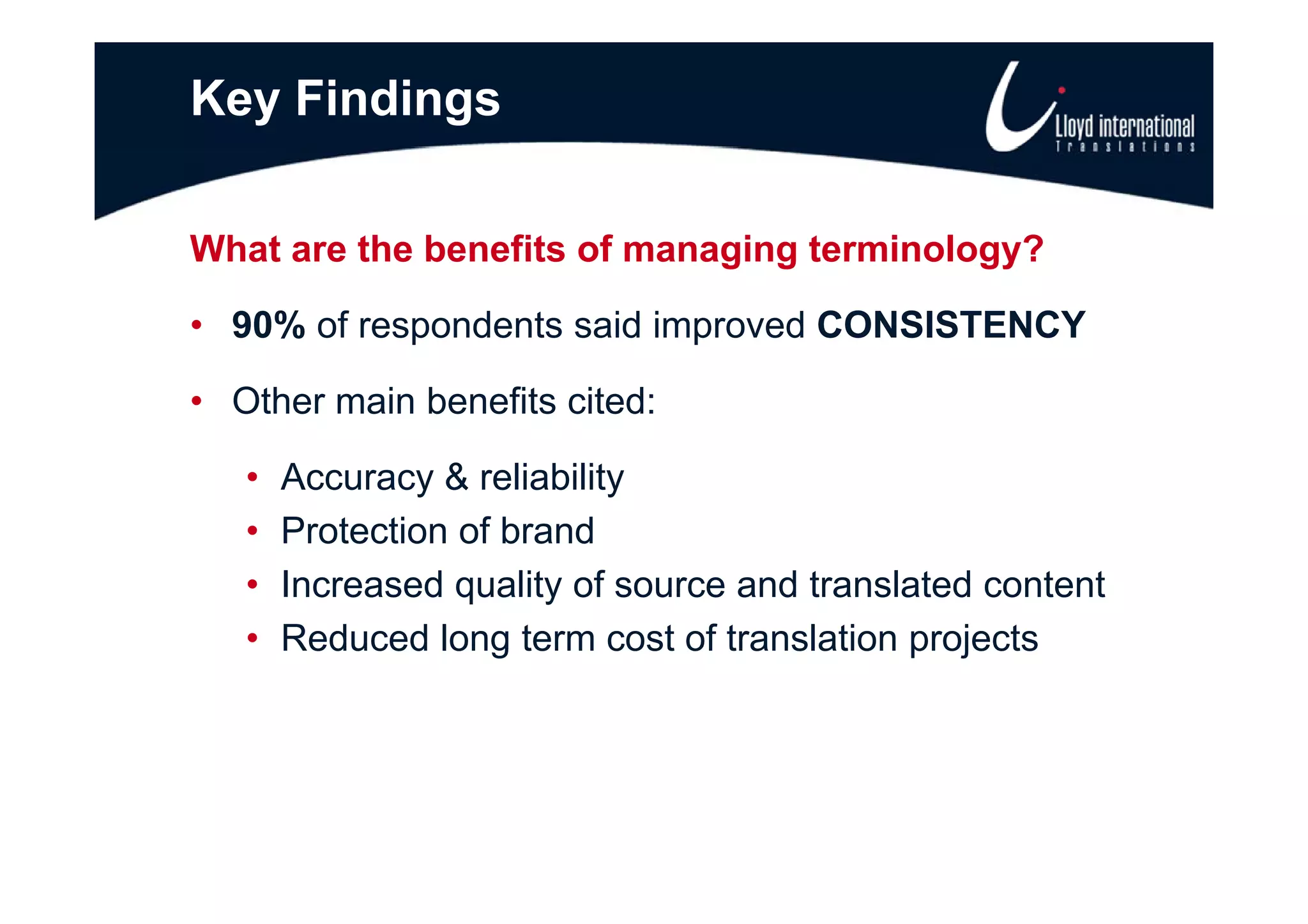
• 90% of respondents said improved CONSISTENCY

• Other main benefits cited:

   •   Accuracy & reliability
   •   Protection of brand
   •   Increased quality of source and translated content
   •   Reduced long term cost of translation projects
Key Findings

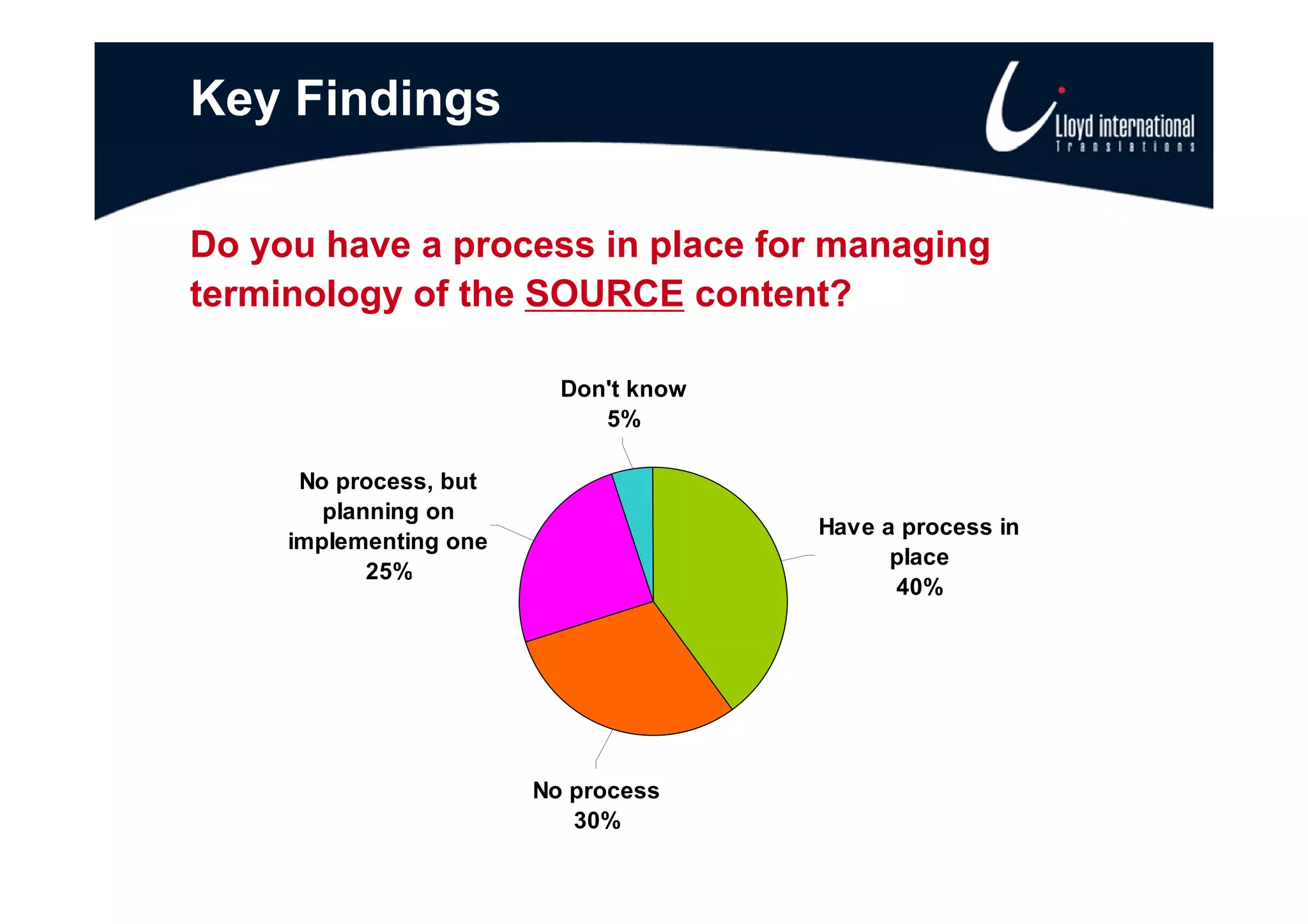
Do you have a process in place for managing
terminology of the SOURCE content?

                          Don't know
                             5%

      No process, but
        planning on
                                       Have a process in
     implementing one
                                             p
                                             place
            25%
                                             40%


                        No process
                           30%
Key Findings

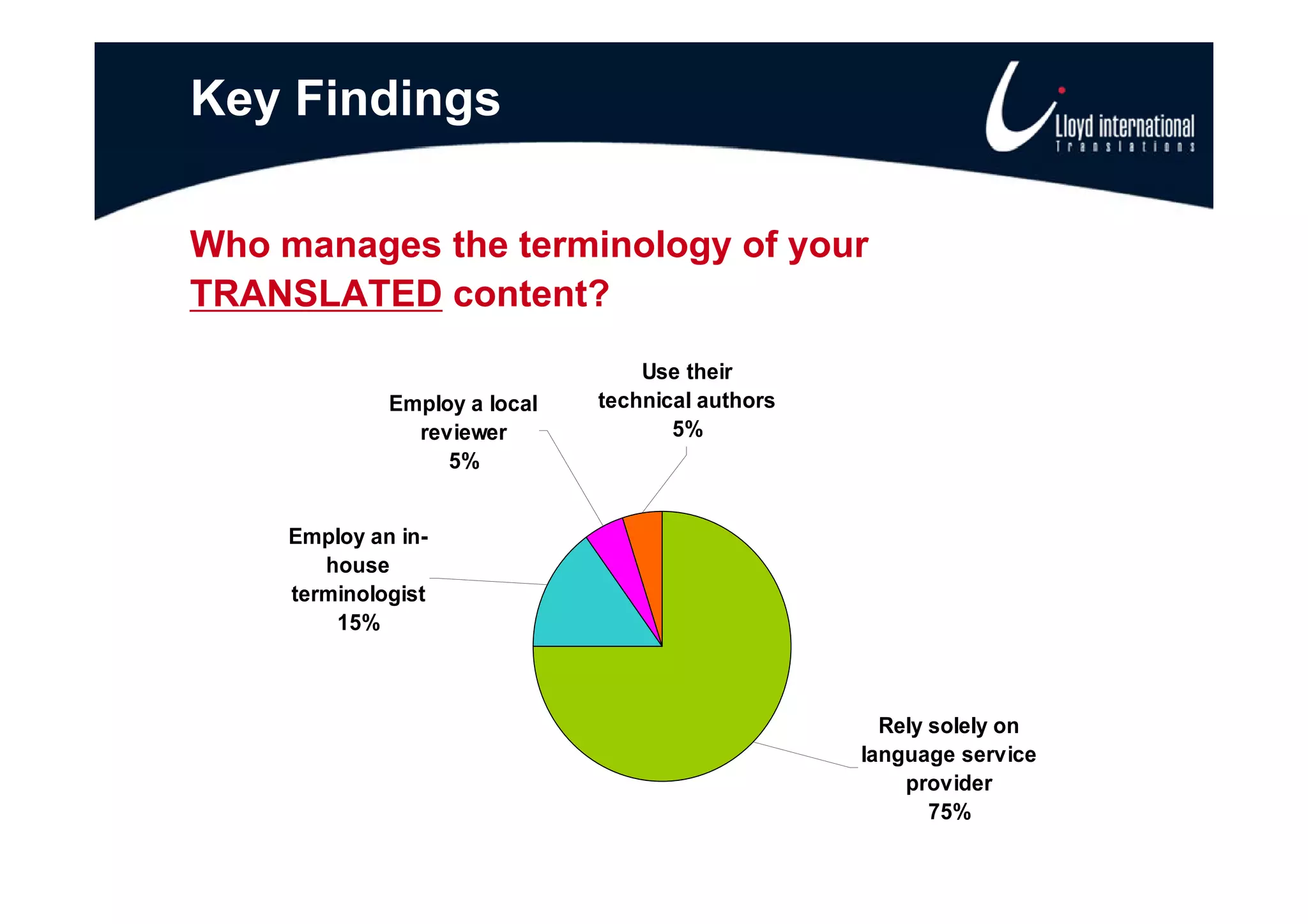
Who manages the terminology of your
TRANSLATED content?
                                   Use their
              Employ a local   technical authors
                reviewer              5%
                   5%


     Employ an in-
        house
     terminologist
         15%


                                                     Rely solely on
                                                   language service
                                                       provider
                                                            id
                                                          75%
Key Findings

Managing Terminology & Technology

•   95% of respondents were aware that there are technology tools
    available to help manage terminology

•   65% could name specific technology tools: the main tools mentioned
    were Acrolinx IQ™ Terminology Manager (for source content
    authoring) and SDL MultiTerm™, Across crossTerm™ and STAR
    TermStar ™ for foreign language terminology management
    T    St      f f i l            t   i l                  t

•   If free translation language terminology databases were available
    online, 75% of respondents would use them (depending on time and
    resource availability)
Client quotes...


• “..each technical author wants to use his/her own
  terms!”

• “95% of translation issues are due to the way the text
  is written in the source”
                    source
Follow-up
    F ll
Recommendations
for Consideration
Recommendations

• Manage terminology from source through to translation by
  identifying your business critical terms

• Introduce terminology management into the product
  development cycle

• T kl terminology project b project: t t involve other
  Tackle t  i l       j t by    j t try to i  l    th
  departments – START SMALL!

• Agree key terms with your language service provider so they
  can generate target language termbases

• Get management buy-in
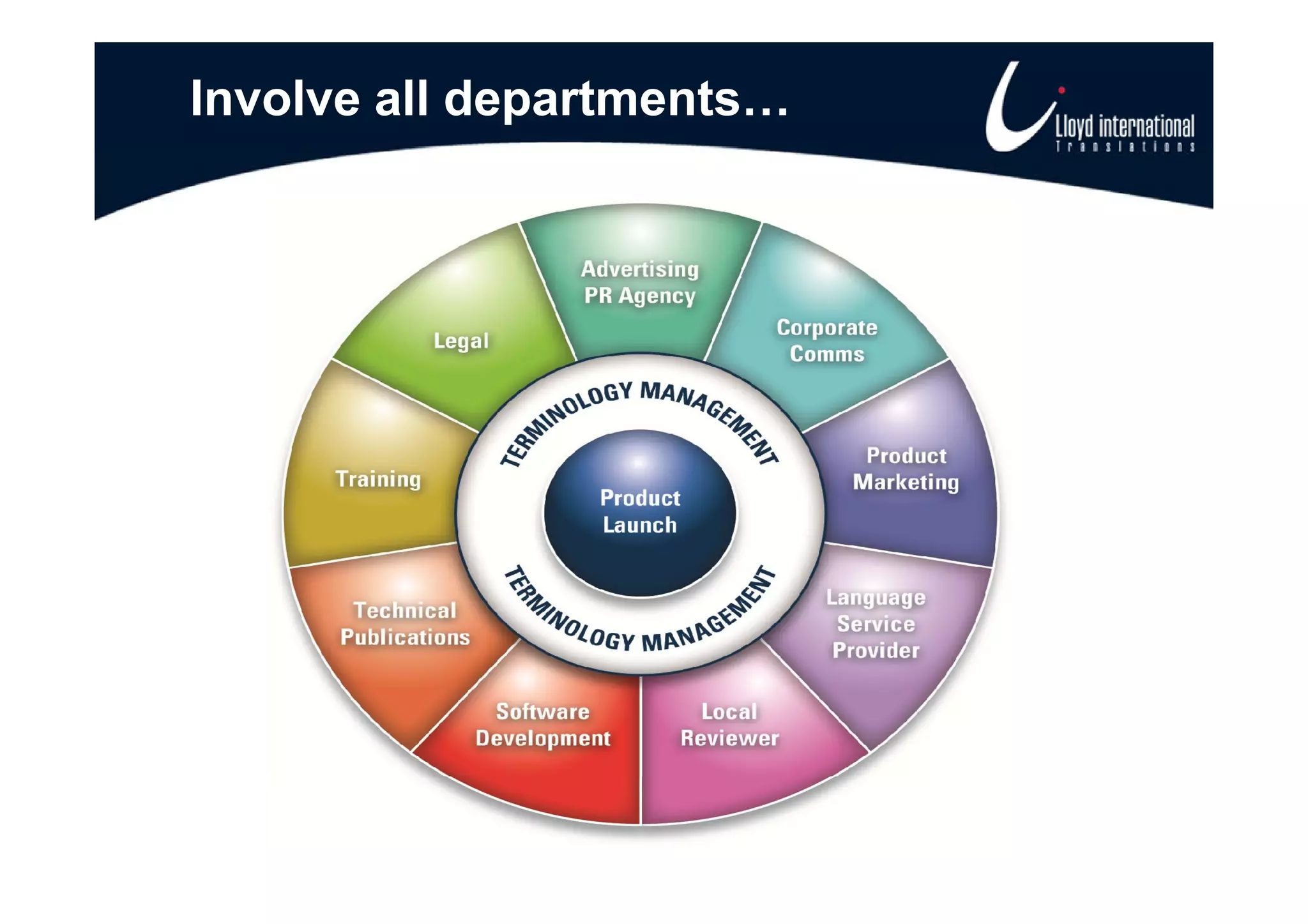
Involve all departments…
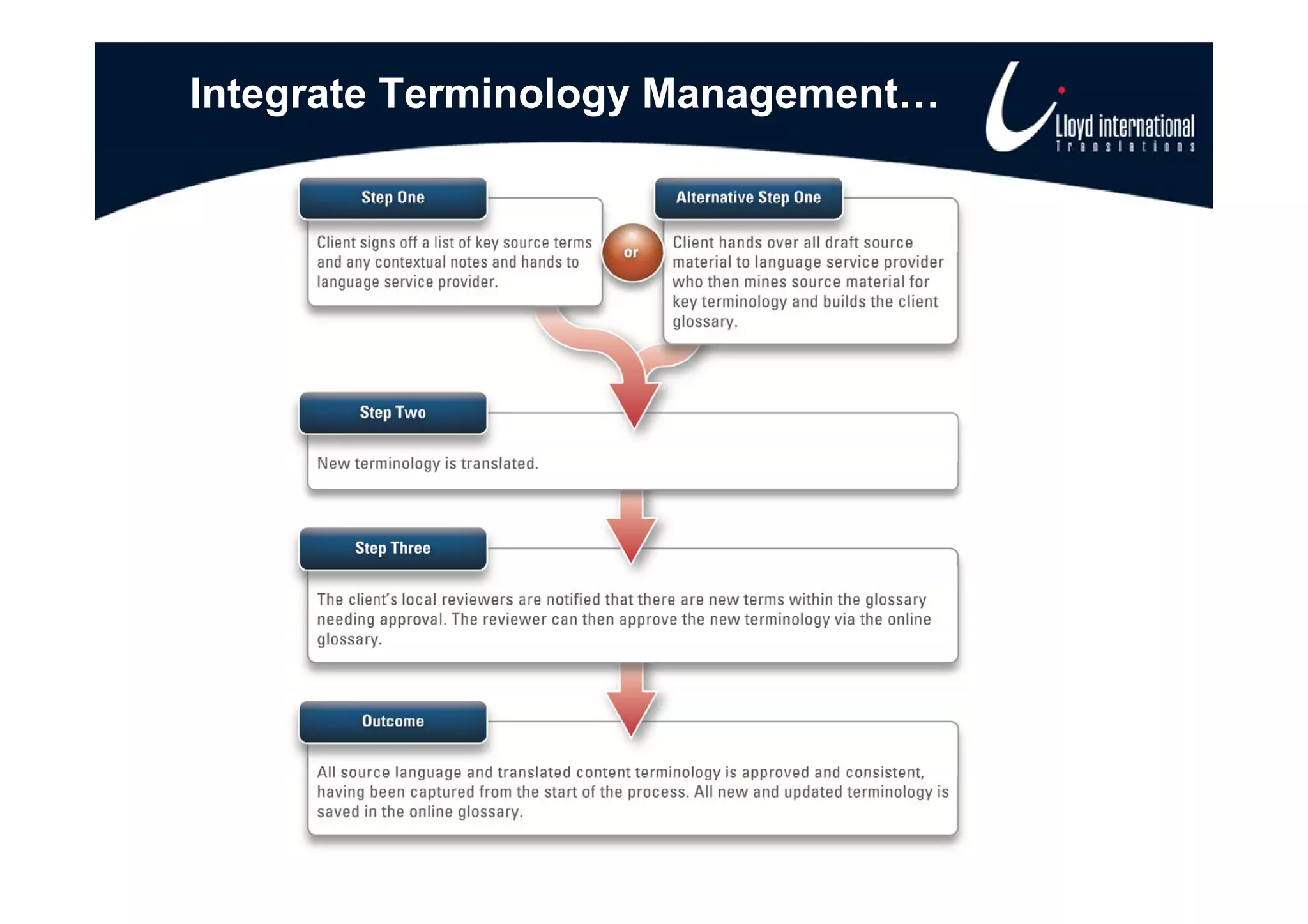
Integrate Terminology Management…
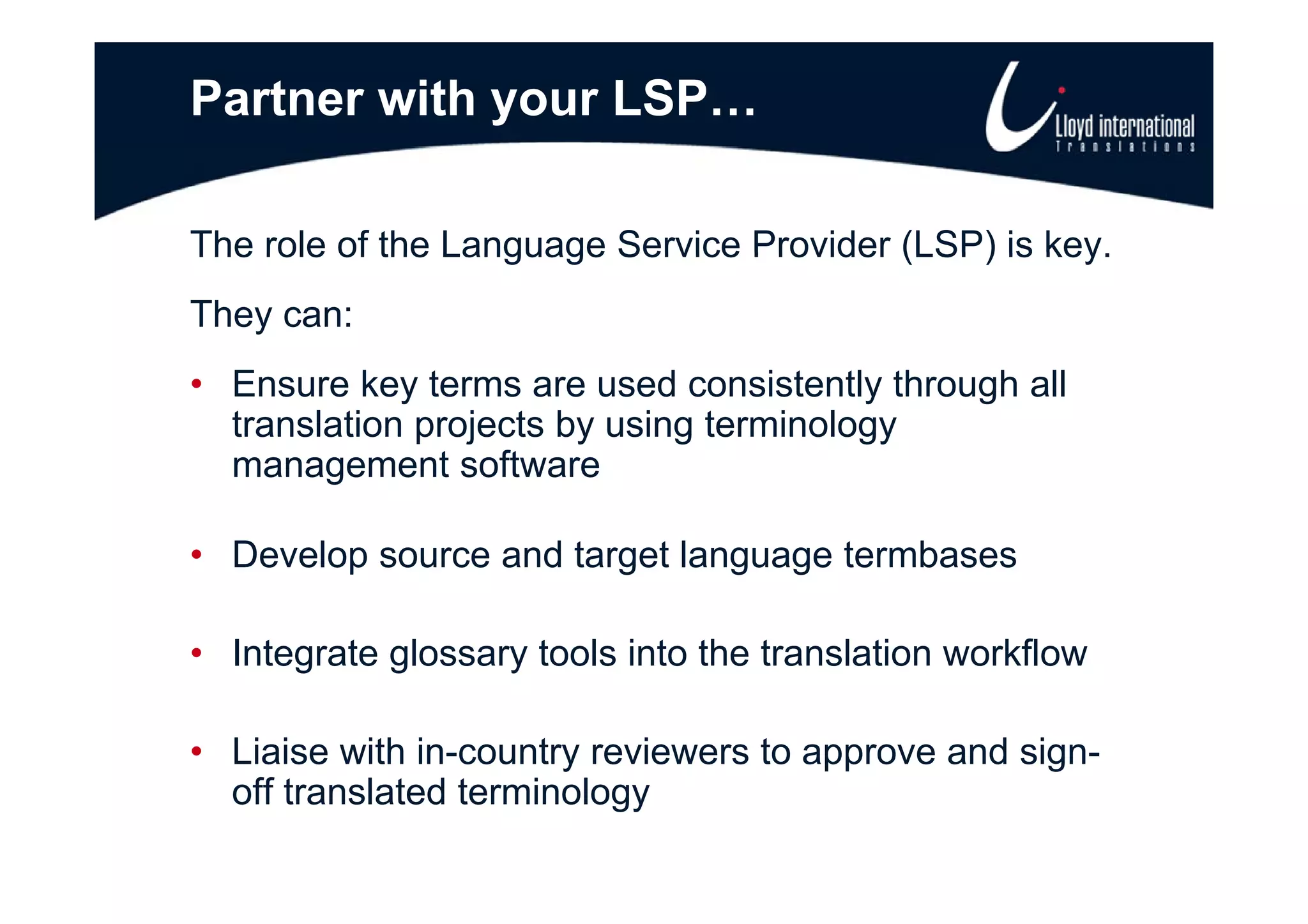
Partner with your LSP…

The role of the Language Service Provider (LSP) is key
                                                   key.
They can:
• Ensure key terms are used consistently through all
  translation projects by using terminology
  management software

• Develop source and target language termbases

• Integrate g
      g     glossary tools into the translation workflow
                   y

• Liaise with in-country reviewers to approve and sign-
  off translated terminology
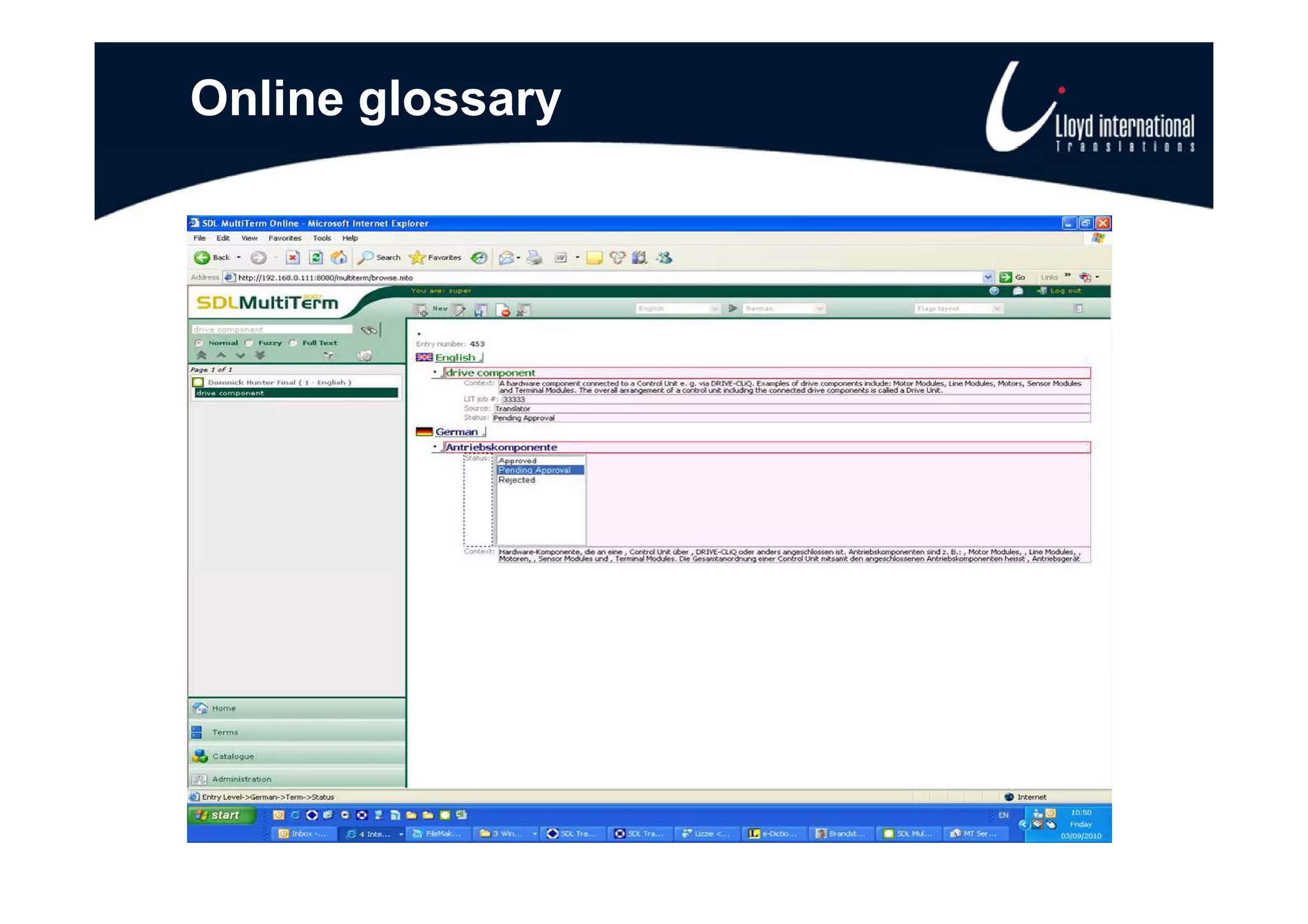
Online glossary
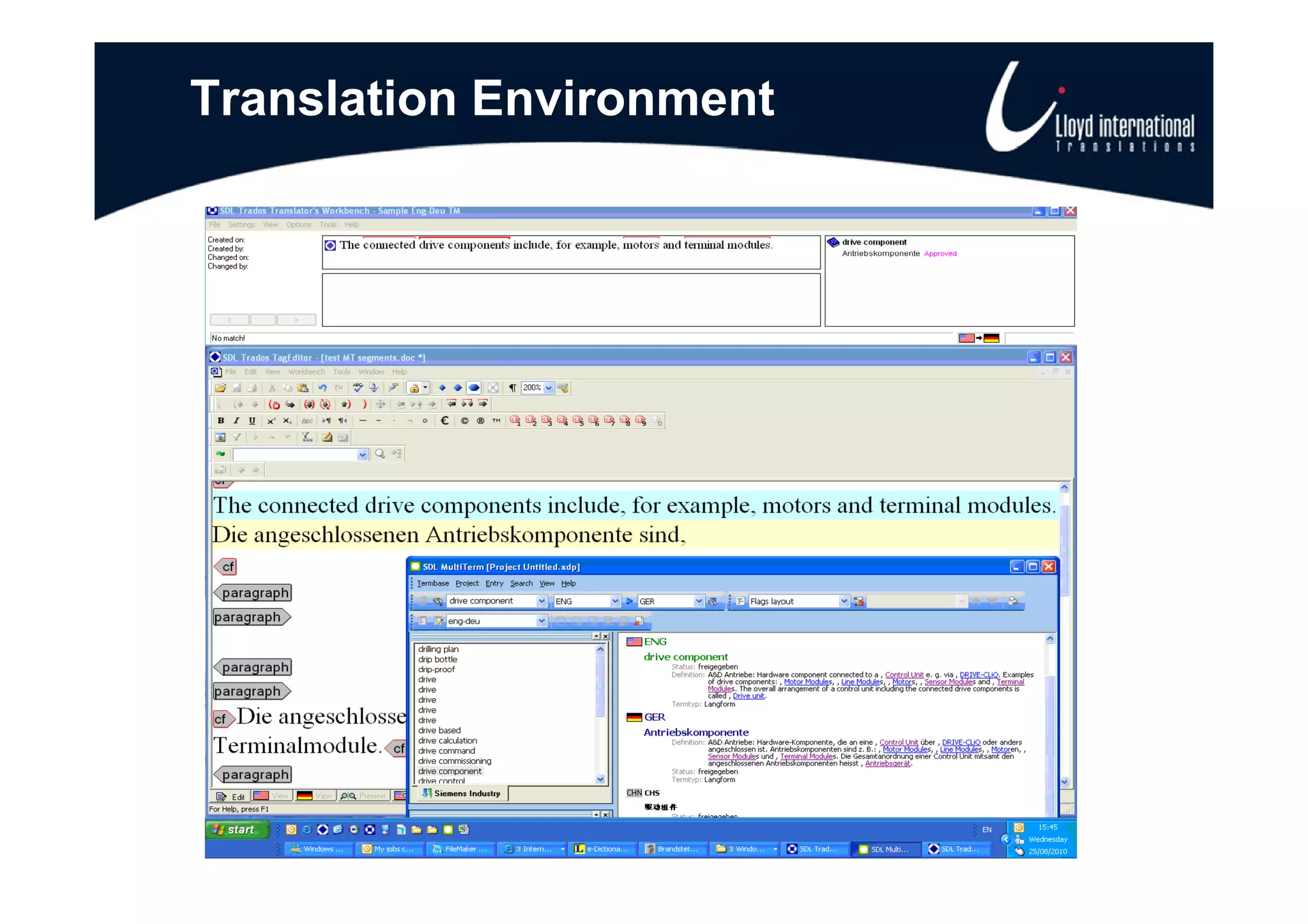
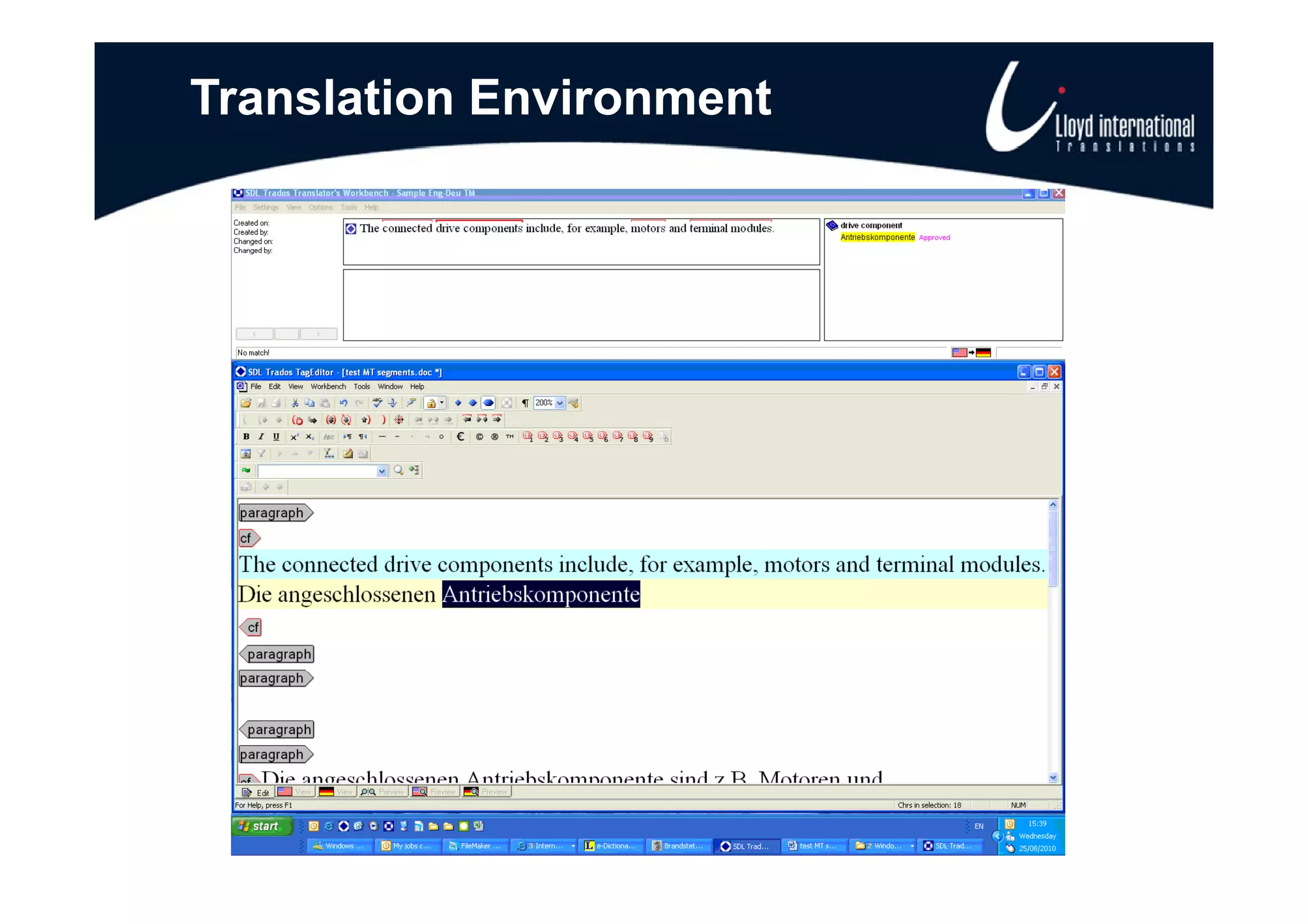
Translation Environment


    INSERT GRAPHIC HERE: demonstrating
           terminology management
                    gy     g
Wise words from a terminology specialist…


Uwe Muegge one of Europe’s leading terminologists
     Muegge,          Europe s        terminologists,
recently delivered a GALA webinar on the subject of
terminology. He suggests organisations consider three
          gy       gg       g
things:
• Terminology Management enables your organisation
  to speak with one voice
• Terminology Management allows communicators
  within an organisation to get it right first time
• A proactive Terminology M
          ti T     i l      Management policy results
                                       t li       lt
  in increased productivity and improved quality
  assurance
Finally….

• Managing foreign language terminology is a
  challenge for most organisations
• Helping companies to manage terminology is a
  growth area in the translation industry
• All organisations use specific terms within their
  content
• Moving towards a centralised online approach means
  clients can have better access to and control of their
  terminology
Any questions?


Thank you

Terminology Presentation by Lloyd International Translations for TCUK 2010

  • 1.
    Terminology – WhoCares? Jill Fifoot Sales & Marketing Director Fifoot, TCUK, 22nd September 2010
  • 2.
    Terminology – WhoCares? • Introduction – About LIT • Why did we choose Terminology? • Some definitions • What do YOU think? • Why manage Terminology? • LIT Client Survey • Key findings • Recommendations • Q&A
  • 3.
    About LIT • Over20 years experience: established in 1989 as specialist technical translators • Offi Offices in UK (Cheshire), F i (Ch hi ) France, G Germany, and ad worldwide network of professional translators with extensive sector knowledge • High-tech clients in manufacturing and service industries 30 million words handled so far this year
  • 4.
    Some definitions… • Glossary:A list of terms containing explanations • Terminology: A collection of words that have special meaning in a given subject field • Terminolog Management The activity of Terminology Management: acti it systematically collecting, processing and presenting words that have a special meaning in a given subject field • T Termbase: A database containing t b d t b t i i terminology and i l d related information
  • 5.
    Why did wechoose Terminology? • Terminology management is a common constant common, challenge for our clients • There is no easy way to tackle it • Terminology affects all areas of the business: It positions your company brand and products in the company, market • Th challenge of managing t The h ll f i terminology i present i l is t from source creation through to translation • I Inconsistent terminology can cause confusion for i t tt i l f i f your customers and for your translators • For example…
  • 6.
    Terminology example Example 1 Example 2 Asynchronous Motor Discrete Input Induction Ind ction Motor Logical Inp t Input Terms are interchangeable b t which t T i t h bl but hi h terms are used d when should be clear and consistent for all authors and translators
  • 7.
    Terminology example VALVE ->Translated into French, depending on context can be: • Valve • Vanne • Clapet • Soupape • Robinet • And maybe others… Managing terminology is not a simple dictionary exercise – it requires client input and guidance
  • 8.
  • 9.
    Why Manage Terminology? •Reduces risk of inaccuracies in source documents and translations • Increases efficiency and quality at translation stage due to automatic prompting of key terms (through use of terminology management software) • Simplifies reviewer process especially if multiple p personnel are involved • Reduces cost in the long-term: source and translation • Improves end-user (customer) experience
  • 10.
  • 11.
    What do youthink? 1. Which one of the following causes you the biggest headache when creating and translating content? • Project Management P j tM t • Inconsistent Terminology • Writing/Translation St l W iti /T l ti Style • DTP
  • 12.
    What do youthink? 2. Who has a process in place for managing terminology?
  • 13.
    What do youthink? 3. If language terminology databases were freely available online, would you use them?
  • 14.
    Lloyd International Translations Client Survey on Terminology Conducted July 2010
  • 15.
    LIT Client Survey:Key Objectives • What importance, if any, do our clients attach to terminology and terminology management? • What are the benefits of terminology management? • Wh i currently managing t Who is tl i terminology and h i l d how are they doing it? • What is the role of the language service provider? • What technical solutions are our clients aware of?
  • 16.
    LIT Client Survey2010 • LIT surveyed over 20 international clients, medium- y , large sized enterprises • Respondents spanned a variety of industries including electrical engineering, heavy plant equipment, print technology, IT gy, • All respondents held team lead/managerial positions within the field of technical communications • 95% of respondents employed their own in-house technical publications team • Main sou ce languages were English, French a d a source a guages e e g s , e c and German
  • 17.
    Key Findings What causesyou the biggest headache when creating and translating content? DTP 5% Project Style Management 10% 10% Inconsistent I i t t Terminology 75%
  • 18.
    Key Findings General Opinionon Terminology • 100% agreed or strongly agreed that managing terminology of th source content is a very important t i l f the t ti i t t part of the overall authoring process • 90% agreed or strongly agreed that consistent terminology in the source content is a challenge for technical authors • 90% indicated that terminology management within translation projects is crucial for successful technical communications
  • 19.
    Key Findings What arethe benefits of managing terminology? • 90% of respondents said improved CONSISTENCY • Other main benefits cited: • Accuracy & reliability • Protection of brand • Increased quality of source and translated content • Reduced long term cost of translation projects
  • 20.
    Key Findings Do youhave a process in place for managing terminology of the SOURCE content? Don't know 5% No process, but planning on Have a process in implementing one p place 25% 40% No process 30%
  • 21.
    Key Findings Who managesthe terminology of your TRANSLATED content? Use their Employ a local technical authors reviewer 5% 5% Employ an in- house terminologist 15% Rely solely on language service provider id 75%
  • 22.
    Key Findings Managing Terminology& Technology • 95% of respondents were aware that there are technology tools available to help manage terminology • 65% could name specific technology tools: the main tools mentioned were Acrolinx IQ™ Terminology Manager (for source content authoring) and SDL MultiTerm™, Across crossTerm™ and STAR TermStar ™ for foreign language terminology management T St f f i l t i l t • If free translation language terminology databases were available online, 75% of respondents would use them (depending on time and resource availability)
  • 23.
    Client quotes... • “..eachtechnical author wants to use his/her own terms!” • “95% of translation issues are due to the way the text is written in the source” source
  • 24.
    Follow-up F ll Recommendations for Consideration
  • 25.
    Recommendations • Manage terminologyfrom source through to translation by identifying your business critical terms • Introduce terminology management into the product development cycle • T kl terminology project b project: t t involve other Tackle t i l j t by j t try to i l th departments – START SMALL! • Agree key terms with your language service provider so they can generate target language termbases • Get management buy-in
  • 26.
  • 27.
  • 28.
    Partner with yourLSP… The role of the Language Service Provider (LSP) is key key. They can: • Ensure key terms are used consistently through all translation projects by using terminology management software • Develop source and target language termbases • Integrate g g glossary tools into the translation workflow y • Liaise with in-country reviewers to approve and sign- off translated terminology
  • 29.
  • 30.
  • 31.
    Translation Environment INSERT GRAPHIC HERE: demonstrating terminology management gy g
  • 32.
    Wise words froma terminology specialist… Uwe Muegge one of Europe’s leading terminologists Muegge, Europe s terminologists, recently delivered a GALA webinar on the subject of terminology. He suggests organisations consider three gy gg g things: • Terminology Management enables your organisation to speak with one voice • Terminology Management allows communicators within an organisation to get it right first time • A proactive Terminology M ti T i l Management policy results t li lt in increased productivity and improved quality assurance
  • 33.
    Finally…. • Managing foreignlanguage terminology is a challenge for most organisations • Helping companies to manage terminology is a growth area in the translation industry • All organisations use specific terms within their content • Moving towards a centralised online approach means clients can have better access to and control of their terminology
  • 34.