Transitive Closure of a
Directed Graph
Transitive Closure
• Transitive closure is a fundamental concept in graph theory that
helps identify all possible paths between pairs of vertices in a
directed graph.
• Transitive closure reveals all possible paths between nodes in a
directed graph.
• It provides a comprehensive view of the reachability relationships
within the graph.
• It is essential for uncovering how entities are interconnected, aiding
in efficient pathfinding and navigation.
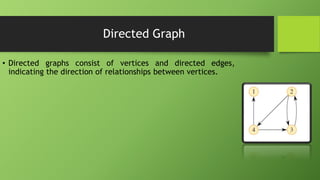
Directed Graph
• Directed graphs consist of vertices and directed edges,
indicating the direction of relationships between vertices.
Floyd-Warshall Algorithm
• Floyd-Warshall algorithm as one method to compute transitive
closure.
• This algorithm is highly efficient and can handle graphs with both
positive and negative edge weights, making it a versatile tool for
solving a wide range of network and connectivity problems.
• The Floyd-Warshall algorithm, which runs in 𝜃(V3) time.
Algorithm
1. FLOYD-WARSHALL (w,n)

Transitive Closure of Direct Graph .pptx

  • 1.
    Transitive Closure ofa Directed Graph
  • 2.
    Transitive Closure • Transitiveclosure is a fundamental concept in graph theory that helps identify all possible paths between pairs of vertices in a directed graph. • Transitive closure reveals all possible paths between nodes in a directed graph. • It provides a comprehensive view of the reachability relationships within the graph. • It is essential for uncovering how entities are interconnected, aiding in efficient pathfinding and navigation.
  • 3.
    Directed Graph • Directedgraphs consist of vertices and directed edges, indicating the direction of relationships between vertices.
  • 4.
    Floyd-Warshall Algorithm • Floyd-Warshallalgorithm as one method to compute transitive closure. • This algorithm is highly efficient and can handle graphs with both positive and negative edge weights, making it a versatile tool for solving a wide range of network and connectivity problems. • The Floyd-Warshall algorithm, which runs in 𝜃(V3) time.
  • 5.