1
MODULE-4
2
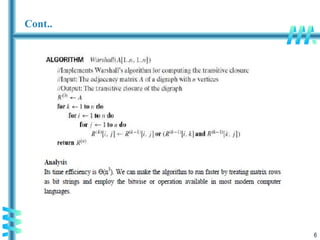
Transitive Closure using Warshall’s Algorithm
Warshall’s algorithm for computing the transitive closure of a
directed graph and Floyd’s algorithm for the all-pairs shortest-
paths problem. These algorithms are based on essentially the
same idea: exploit a relationship between a problem and its
simpler rather than smaller version
Transitive Closure using Warshall’s Algorithm,
Definition: The transitive closure of a directed graph with n
vertices can be defined as the n × n boolean matrix T = {tij}, in
which the element in the ith row and the jth column is 1 if there
exists a nontrivial path (i.e., directed path of a positive length)
from the ith vertex to the jth vertex; otherwise, tij is 0
3
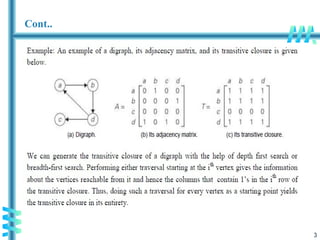
Cont..
4
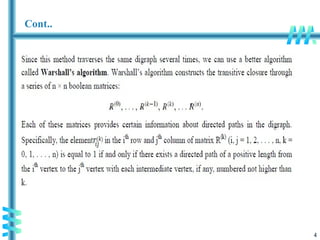
Cont..
5
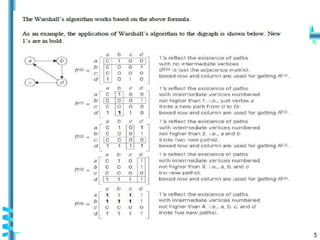
Cont..
6
Cont..
7
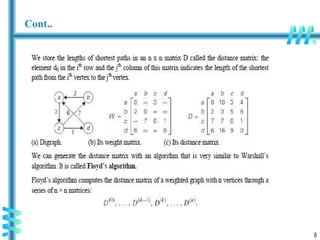
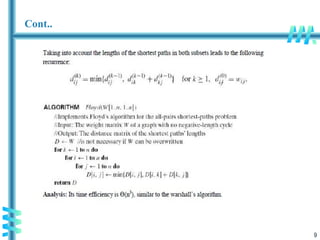
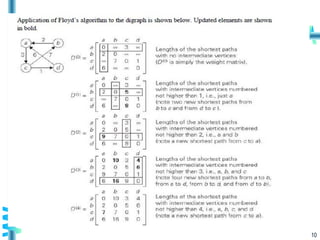
All Pairs Shortest Paths using Floyd's Algorithm
All Pairs Shortest Paths using Floyd's Algorithm,
Problem definition: Given a weighted connected graph
(undirected or directed), the all-pairs shortest paths problem asks
to find the distances—i.e., the lengths of the shortest paths - from
each vertex to all other vertices.
Applications: Solution to this problem finds applications in
communications, transportation networks, and operations
research. Among recent applications of the all-pairs shortest-path
problem is pre-computing distances for motion planning in
computer games.
8
Cont..
9
Cont..
10
Cont..
11
Prims Algorithm
A spanning tree of an undirected connected graph is its
connected acyclic subgraph (i.e., a tree) that contains all the
vertices of the graph.
If such a graph has weights assigned to its edges, a minimum
spanning tree is its spanning tree of the smallest weight,
where the weight of a tree is defined as the sum of the
weights on all its edges.
The minimum spanning tree problem is the problem of
finding a minimum spanning tree for a given weighted
connected graph.
12
Cont..
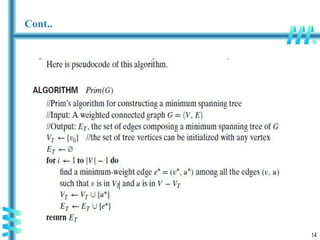
Prim’s algorithm constructs a minimum spanning tree through a
sequence of expanding subtrees.
The initial subtree in such a sequence consists of a single vertex
selected arbitrarily from the set V of the graph’s vertices.
On each iteration, the algorithm expands the current tree in the
greedy manner by simply attaching to it the nearest vertex not
in that tree. (By the nearest vertex, we mean a vertex not
in the tree connected to a vertex in the tree by an edge of the
smallest weight. Ties can be broken arbitrarily.)
13
Cont..
The algorithm stops after all the graph’s vertices have been
included in the tree being constructed. Since the algorithm
expands a tree by exactly one vertex on each of its iterations,
the total number of such iterations is n − 1, where n is the
number of vertices in the graph.
14
Cont..
15
Cont..
PRIMS Algorithm:
Example Problem and Solution: refer your class notes
and solved problem
16
Kruskal’s Algorithm
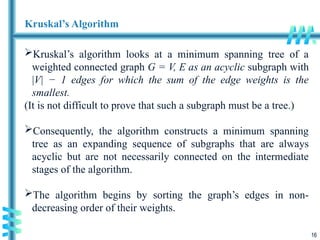
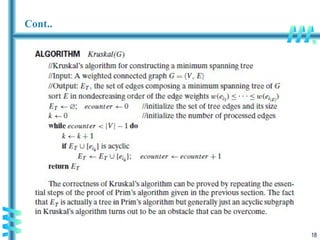
Kruskal’s algorithm looks at a minimum spanning tree of a
weighted connected graph G = V, E as an acyclic subgraph with
|V| − 1 edges for which the sum of the edge weights is the
smallest.
(It is not difficult to prove that such a subgraph must be a tree.)
Consequently, the algorithm constructs a minimum spanning
tree as an expanding sequence of subgraphs that are always
acyclic but are not necessarily connected on the intermediate
stages of the algorithm.
The algorithm begins by sorting the graph’s edges in non-
decreasing order of their weights.
17
Cont..
Then, starting with the empty subgraph, it scans this sorted list,
adding the next edge on the list to the current subgraph if such an
inclusion does not create a cycle and simply skipping the edge
otherwise.
18
Cont..
19
Cont..
Kruskals Algorithm:
Example Problem and Solution: refer your class notes
and solved problem
20
Dijkstra’s Algorithm (single-source shortest-paths
algorithm)
There are several well-known algorithms for finding shortest
paths, including Floyd’s algorithm for the more general all-pairs
shortest-paths problem discussed.
Here, we consider the best-known algorithm for the single-
source shortest-paths problem, called Dijkstra’s algorithm.4
This algorithm is applicable to undirected and directed graphs
with nonnegative weights only. Since in most applications this
condition is satisfied, the limitation has not impaired the
popularity of Dijkstra’s algorithm.
Dijkstra’s algorithm finds the shortest paths to a graph’s vertices
in order of their distance from a given source. First, it finds the
shortest path from the source.
21
Cont..
to a vertex nearest to it, then to a second nearest, and so on. In
general, before its ith iteration commences, the algorithm has
already identified the shortest paths to i − 1 other vertices nearest
to the source.
 These vertices, the source, and the edges of the shortest paths
leading to them from the source form a subtree Ti of the given
Graph
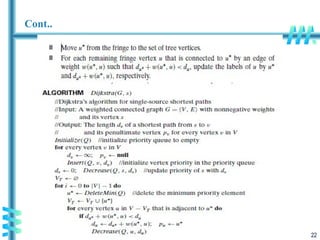
Afterwehave identified a vertex u to be added to the tree,
∗
weneed to perform two operations:
22
Cont..
23
Cont..
Dijkstra Algorithm:
Example Problem and Solution: refer your class notes
and solved problem
24
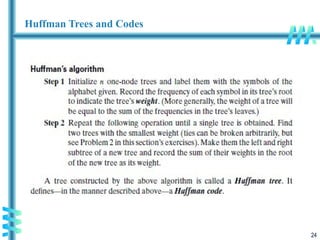
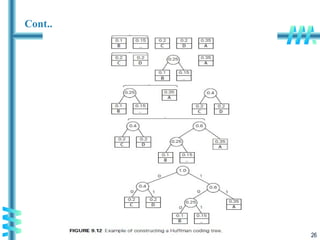
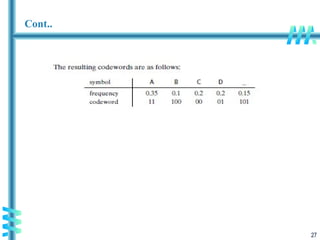
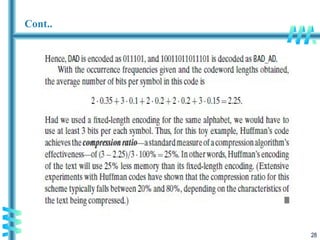
Huffman Trees and Codes
25
Cont..
26
Cont..
27
Cont..
28
Cont..
29
Cont..
Huffman Tree and coding:
Example Problem and Solution: refer your class notes
and solved problem

Prims Algorithm, Kruskals algorithm, Dijkstra’s Algorithm

  • 1.
  • 2.
    2 Transitive Closure usingWarshall’s Algorithm Warshall’s algorithm for computing the transitive closure of a directed graph and Floyd’s algorithm for the all-pairs shortest- paths problem. These algorithms are based on essentially the same idea: exploit a relationship between a problem and its simpler rather than smaller version Transitive Closure using Warshall’s Algorithm, Definition: The transitive closure of a directed graph with n vertices can be defined as the n × n boolean matrix T = {tij}, in which the element in the ith row and the jth column is 1 if there exists a nontrivial path (i.e., directed path of a positive length) from the ith vertex to the jth vertex; otherwise, tij is 0
  • 3.
  • 4.
  • 5.
  • 6.
  • 7.
    7 All Pairs ShortestPaths using Floyd's Algorithm All Pairs Shortest Paths using Floyd's Algorithm, Problem definition: Given a weighted connected graph (undirected or directed), the all-pairs shortest paths problem asks to find the distances—i.e., the lengths of the shortest paths - from each vertex to all other vertices. Applications: Solution to this problem finds applications in communications, transportation networks, and operations research. Among recent applications of the all-pairs shortest-path problem is pre-computing distances for motion planning in computer games.
  • 8.
  • 9.
  • 10.
  • 11.
    11 Prims Algorithm A spanningtree of an undirected connected graph is its connected acyclic subgraph (i.e., a tree) that contains all the vertices of the graph. If such a graph has weights assigned to its edges, a minimum spanning tree is its spanning tree of the smallest weight, where the weight of a tree is defined as the sum of the weights on all its edges. The minimum spanning tree problem is the problem of finding a minimum spanning tree for a given weighted connected graph.
  • 12.
    12 Cont.. Prim’s algorithm constructsa minimum spanning tree through a sequence of expanding subtrees. The initial subtree in such a sequence consists of a single vertex selected arbitrarily from the set V of the graph’s vertices. On each iteration, the algorithm expands the current tree in the greedy manner by simply attaching to it the nearest vertex not in that tree. (By the nearest vertex, we mean a vertex not in the tree connected to a vertex in the tree by an edge of the smallest weight. Ties can be broken arbitrarily.)
  • 13.
    13 Cont.. The algorithm stopsafter all the graph’s vertices have been included in the tree being constructed. Since the algorithm expands a tree by exactly one vertex on each of its iterations, the total number of such iterations is n − 1, where n is the number of vertices in the graph.
  • 14.
  • 15.
    15 Cont.. PRIMS Algorithm: Example Problemand Solution: refer your class notes and solved problem
  • 16.
    16 Kruskal’s Algorithm Kruskal’s algorithmlooks at a minimum spanning tree of a weighted connected graph G = V, E as an acyclic subgraph with |V| − 1 edges for which the sum of the edge weights is the smallest. (It is not difficult to prove that such a subgraph must be a tree.) Consequently, the algorithm constructs a minimum spanning tree as an expanding sequence of subgraphs that are always acyclic but are not necessarily connected on the intermediate stages of the algorithm. The algorithm begins by sorting the graph’s edges in non- decreasing order of their weights.
  • 17.
    17 Cont.. Then, starting withthe empty subgraph, it scans this sorted list, adding the next edge on the list to the current subgraph if such an inclusion does not create a cycle and simply skipping the edge otherwise.
  • 18.
  • 19.
    19 Cont.. Kruskals Algorithm: Example Problemand Solution: refer your class notes and solved problem
  • 20.
    20 Dijkstra’s Algorithm (single-sourceshortest-paths algorithm) There are several well-known algorithms for finding shortest paths, including Floyd’s algorithm for the more general all-pairs shortest-paths problem discussed. Here, we consider the best-known algorithm for the single- source shortest-paths problem, called Dijkstra’s algorithm.4 This algorithm is applicable to undirected and directed graphs with nonnegative weights only. Since in most applications this condition is satisfied, the limitation has not impaired the popularity of Dijkstra’s algorithm. Dijkstra’s algorithm finds the shortest paths to a graph’s vertices in order of their distance from a given source. First, it finds the shortest path from the source.
  • 21.
    21 Cont.. to a vertexnearest to it, then to a second nearest, and so on. In general, before its ith iteration commences, the algorithm has already identified the shortest paths to i − 1 other vertices nearest to the source.  These vertices, the source, and the edges of the shortest paths leading to them from the source form a subtree Ti of the given Graph Afterwehave identified a vertex u to be added to the tree, ∗ weneed to perform two operations:
  • 22.
  • 23.
    23 Cont.. Dijkstra Algorithm: Example Problemand Solution: refer your class notes and solved problem
  • 24.
  • 25.
  • 26.
  • 27.
  • 28.
  • 29.
    29 Cont.. Huffman Tree andcoding: Example Problem and Solution: refer your class notes and solved problem