




"Transitional Justice in Tunisia: for a
participatory and consensual process."
After 23 years of dictatorship even more, Tunisia has
experienced the revolution of 14 January 2011.
Indeed Ben Ali presided Tunisia (1987-2011) after a
coup he led against President Habib Bourguiba (1959-
1987), during these two periods, many abuses of
human rights were innumerable under a hegemonic
and absolute policy.
With the fall of the Ben Ali regime, there was the
release of a process of a democratic transition holder
of promise of free elections, respect for individual
liberties and the introduction, Moreover, of the
concept of transitional justice.
In general, post-authoritarian and post-conflict
situation of a country generates a culture of distrust
with the legal institutions, political and security level of
society, and it is quite legitimate especially that these
institutions favored abuses against human rights,
oppression and corruption.
Transitional reforms are the solution, but must be
effective and sustainable, as long as it’s structurally
general and profound.
Ordinary justice, no longer sufficient, raised
consciousness about the need for other mechanisms
to ensure a viable future for torn societies; this is
where the process of transitional justice comes in
hand.
The definition adopted by the United Nations
in the Report of the Secretary-General
submitted to the Security Council
“transitional justice is the full range of
various processes and mechanisms
implemented by a company to try to cope
with massive abuses committed in the past,
in order to establish accountability, serve
justice and achieve reconciliation”
Violations of human rights in Tunisia has
been through crimes, killings, torture,
disappearances, transfers and rape,
corruption,socio-economic crimes, etc ...
These crimes have gone unpunished as a
whole, thus creating frustration and
humiliation for the victims.
Transitional justice is based mainly on five
steps:
- Search for the truth
- Accountability of perpetrators
- Repair (morally and physically) of victims
- Institutional Reform
- Reconciliation.
Consistency of transitional justice enhances
the effectiveness and credibility of the reform
effort.
But to be accepted, Transitional Justice in
Tunisia must come from a consensus.


To achieve this goal, a national dialogue,
was launched to bring together the
different actors of the civil society around
transitional justice and create a clear vision
on the matter.
In 2004, the United Nations Secretary-
General mentioned that “The most
successful transitional justice experiences
owe a large part of their success to the
quality and quantity of public and victim
consultation carried out”
Public Consultations : « Transitional
Justice Visions and percpectives ».
I/ national dialogues
1/ Creation of the technical
commission
2/The conduct of national dialogues
II/Regional Dialogues
1/Creation of sectorial commissions
2/ The conduct of regional dialogues
National dialogue on Transitional Justice in
Tunisia is done through public consultation
both nationally (I) and regionally (II)
I / The public consultation at the national
level:
While the process of transitional justice has been
introduced since the date of January 14, it was
characterized by the absence of an integrated
strategy for transitional justice for many reasons.
Just after the elections of 23 October 2012, there
was the creation of the Ministry of Human Rights
and Transitional Justice.
The latter is responsible for the development of a
set of choices to correct and repair the damage of
the past to the human rights based on
accountability, establishing responsibility then
reconciliation
To do this, a national dialogue on transitional
justice was launched April 14, 2012, in the
presence of the three Presidencies, following
several recommendations which have
emerged.
Among these recommendations, it was
decided at an open day on 28 April 2012,
creating a technical committee for national
dialogue on transitional justice (1)whose
mission is to organize consultations (2).
1/ The creation of the commission of the national
                    dialogue on JT

The technical commission was created by a
decree of the Minister of DHJT October 9, 2012,
the commission's duties;
- The organization of the national dialogue on
transitional justice
- Organizing public consultations
- Choice members of sectorial committees
- Collection of the results of the national
dialogue and the final report
- Preparation of the draft law on transitional
justice
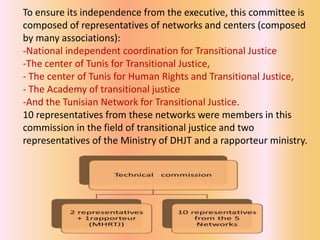
To ensure its independence from the executive, this committee is
composed of representatives of networks and centers (composed
by many associations):
-National independent coordination for Transitional Justice
-The center of Tunis for Transitional Justice,
- The center of Tunis for Human Rights and Transitional Justice,
- The Academy of transitional justice
-And the Tunisian Network for Transitional Justice.
10 representatives from these networks were members in this
commission in the field of transitional justice and two
representatives of the Ministry of DHJT and a rapporteur ministry.
2/ The conduct of national dialogues


Public consultation should aim actors of civil society.

This is why the Commission organized an open day entitled
"Transitional Justice: visions and conceptions "according to a
precise timetable:
- On August 9, 2012 with political parties
- On 16 August with professional groups and unions
- On 25 August with associations specializing in human rights
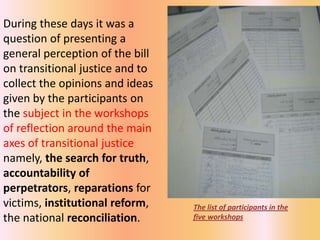
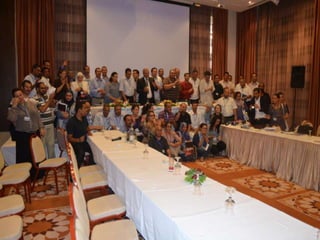
During these days it was a
question of presenting a
general perception of the bill
on transitional justice and to
collect the opinions and ideas
given by the participants on
the subject in the workshops
of reflection around the main
axes of transitional justice
namely, the search for truth,
accountability of
perpetrators, reparations for
victims, institutional reform,   The list of participants in the
the national reconciliation.     five workshops
II / The public consultation at the
           regional level
Although Decree No. 2012-22 establishing the Ministry of
Human Rights and Transitional Justice and fixing its powers,
assigned to the base to this ministry to manage the public
consultation ,the involvement of civil society and the call that
the project of transitional justice becomes independent, not
only led to the creation of the technical commission but also
the enlargement of the commission, which according to the
ministerial decree is there to organize the national dialogue in
regions, to select and train the leaders of regional dialogues
(1)and organize the regional consultations (2) on transitional
justice
1/ the creation of sectorial committees
  Indeed, the purpose of holding a series of meetings at the
                       regional level targets:
- Victims of violations indifferent regions.
- The components of civil society associations and
organizations
- All citizens regardless of regional and political affiliations
in the form of a plenary session in the morning, it will include
an overview of transitional justice and reflection workshops
in the afternoon on the steps From process of transitional
justice.
Following these 24 regional consultations, a report will be
prepared each day to formulate the ideas expressed by their
interests and recommendations for JT.
2/ the conduct of the regional consultations
• Because the victim is the focus of transitional justice, we
  see that the victims were strongly represented at the
  regional consultations.
• These consultations have sometimes deviated to
  hearings and listening audiences because these victims
  are thirsty to express and their testimonies are very
  heavy to carry, especially when the machine transitional
  justice has not yet been started.
• And since the purpose of these meetings is to provide an
  opportunity for those affected by violations to express
  their opinions freely to determine their needs and rights,
  surveys were distributed in order to interrogate citizens
  about mechanisms and processes of transitional justice.
• Public opinion surveys are very common in transitional
  justice consultations.
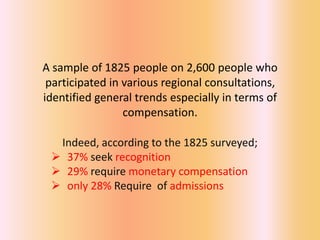
A sample of 1825 people on 2,600 people who
 participated in various regional consultations,
identified general trends especially in terms of
                 compensation.

  Indeed, according to the 1825 surveyed;
  37% seek recognition
  29% require monetary compensation
  only 28% Require of admissions
Finally we can notice that, the Tunisian model of
transitional justice focus on three major points

-The first one deals with the Axes of the national
dialogue:
 Axe I: to uncover the truth and save collective memory,
Axe II: material and moral reparation and rehabilitation
of the victims,
Axe III: Addressing the culture of impunity and to
devote a culture of accountability and top law,
Axe IV: guarantees not to do it again and institutional
reform,
Axe V: reconciliation.
The second one is to realize general objectives:
-Activating dialogue between the different actors and
performers in the course of transitional justice to deepen and
understand the concepts and mechanisms of transitional
justice
-the consolidation of awareness with the importance of the
success of transitional justice as a condition for the success of
the democratic transition in Tunisia
-working on the awareness of people to deepen the concept
of transitional justice in the society so as to ensure no return
to tyranny .
And the third point is to realize Specific objectives:
- To seek a clear vision and a consensus for the draft
Basic Law for Transitional Justice,
- Compilation of the results of national dialogues and
open days to be formulated in the form of a general
perception of the draft law on transitional justice,
- Provide an opportunity for those affected by
violations to express their views freely to determine
their needs
- Seeking to ensure a strong local sense of belonging to
the transitional justice approach
- Seeking to ensure the participation of civil society in
shaping the course of transitional justice.
-keep the project away from political affiliation.
Tunisie, Dans Nos Cœurs .
MERCI pour Votre
  Attention.


           Héla Boujneh

Transitional Justice in Tunisia, The Consultative Process

  • 1.
    "Transitional Justice inTunisia: for a participatory and consensual process."
  • 2.
    After 23 yearsof dictatorship even more, Tunisia has experienced the revolution of 14 January 2011. Indeed Ben Ali presided Tunisia (1987-2011) after a coup he led against President Habib Bourguiba (1959- 1987), during these two periods, many abuses of human rights were innumerable under a hegemonic and absolute policy. With the fall of the Ben Ali regime, there was the release of a process of a democratic transition holder of promise of free elections, respect for individual liberties and the introduction, Moreover, of the concept of transitional justice.
  • 3.
    In general, post-authoritarianand post-conflict situation of a country generates a culture of distrust with the legal institutions, political and security level of society, and it is quite legitimate especially that these institutions favored abuses against human rights, oppression and corruption. Transitional reforms are the solution, but must be effective and sustainable, as long as it’s structurally general and profound. Ordinary justice, no longer sufficient, raised consciousness about the need for other mechanisms to ensure a viable future for torn societies; this is where the process of transitional justice comes in hand.
  • 5.
    The definition adoptedby the United Nations in the Report of the Secretary-General submitted to the Security Council “transitional justice is the full range of various processes and mechanisms implemented by a company to try to cope with massive abuses committed in the past, in order to establish accountability, serve justice and achieve reconciliation”
  • 7.
    Violations of humanrights in Tunisia has been through crimes, killings, torture, disappearances, transfers and rape, corruption,socio-economic crimes, etc ... These crimes have gone unpunished as a whole, thus creating frustration and humiliation for the victims.
  • 8.
    Transitional justice isbased mainly on five steps: - Search for the truth - Accountability of perpetrators - Repair (morally and physically) of victims - Institutional Reform - Reconciliation. Consistency of transitional justice enhances the effectiveness and credibility of the reform effort.
  • 9.
    But to beaccepted, Transitional Justice in Tunisia must come from a consensus. To achieve this goal, a national dialogue, was launched to bring together the different actors of the civil society around transitional justice and create a clear vision on the matter.
  • 10.
    In 2004, theUnited Nations Secretary- General mentioned that “The most successful transitional justice experiences owe a large part of their success to the quality and quantity of public and victim consultation carried out”
  • 11.
    Public Consultations :« Transitional Justice Visions and percpectives ». I/ national dialogues 1/ Creation of the technical commission 2/The conduct of national dialogues II/Regional Dialogues 1/Creation of sectorial commissions 2/ The conduct of regional dialogues
  • 12.
    National dialogue onTransitional Justice in Tunisia is done through public consultation both nationally (I) and regionally (II)
  • 13.
    I / Thepublic consultation at the national level: While the process of transitional justice has been introduced since the date of January 14, it was characterized by the absence of an integrated strategy for transitional justice for many reasons. Just after the elections of 23 October 2012, there was the creation of the Ministry of Human Rights and Transitional Justice. The latter is responsible for the development of a set of choices to correct and repair the damage of the past to the human rights based on accountability, establishing responsibility then reconciliation
  • 14.
    To do this,a national dialogue on transitional justice was launched April 14, 2012, in the presence of the three Presidencies, following several recommendations which have emerged. Among these recommendations, it was decided at an open day on 28 April 2012, creating a technical committee for national dialogue on transitional justice (1)whose mission is to organize consultations (2).
  • 15.
    1/ The creationof the commission of the national dialogue on JT The technical commission was created by a decree of the Minister of DHJT October 9, 2012, the commission's duties; - The organization of the national dialogue on transitional justice - Organizing public consultations - Choice members of sectorial committees - Collection of the results of the national dialogue and the final report - Preparation of the draft law on transitional justice
  • 16.
    To ensure itsindependence from the executive, this committee is composed of representatives of networks and centers (composed by many associations): -National independent coordination for Transitional Justice -The center of Tunis for Transitional Justice, - The center of Tunis for Human Rights and Transitional Justice, - The Academy of transitional justice -And the Tunisian Network for Transitional Justice. 10 representatives from these networks were members in this commission in the field of transitional justice and two representatives of the Ministry of DHJT and a rapporteur ministry.
  • 17.
    2/ The conductof national dialogues Public consultation should aim actors of civil society. This is why the Commission organized an open day entitled "Transitional Justice: visions and conceptions "according to a precise timetable: - On August 9, 2012 with political parties - On 16 August with professional groups and unions - On 25 August with associations specializing in human rights
  • 18.
    During these daysit was a question of presenting a general perception of the bill on transitional justice and to collect the opinions and ideas given by the participants on the subject in the workshops of reflection around the main axes of transitional justice namely, the search for truth, accountability of perpetrators, reparations for victims, institutional reform, The list of participants in the the national reconciliation. five workshops
  • 20.
    II / Thepublic consultation at the regional level Although Decree No. 2012-22 establishing the Ministry of Human Rights and Transitional Justice and fixing its powers, assigned to the base to this ministry to manage the public consultation ,the involvement of civil society and the call that the project of transitional justice becomes independent, not only led to the creation of the technical commission but also the enlargement of the commission, which according to the ministerial decree is there to organize the national dialogue in regions, to select and train the leaders of regional dialogues (1)and organize the regional consultations (2) on transitional justice
  • 21.
    1/ the creationof sectorial committees Indeed, the purpose of holding a series of meetings at the regional level targets: - Victims of violations indifferent regions. - The components of civil society associations and organizations - All citizens regardless of regional and political affiliations in the form of a plenary session in the morning, it will include an overview of transitional justice and reflection workshops in the afternoon on the steps From process of transitional justice. Following these 24 regional consultations, a report will be prepared each day to formulate the ideas expressed by their interests and recommendations for JT.
  • 22.
    2/ the conductof the regional consultations • Because the victim is the focus of transitional justice, we see that the victims were strongly represented at the regional consultations. • These consultations have sometimes deviated to hearings and listening audiences because these victims are thirsty to express and their testimonies are very heavy to carry, especially when the machine transitional justice has not yet been started. • And since the purpose of these meetings is to provide an opportunity for those affected by violations to express their opinions freely to determine their needs and rights, surveys were distributed in order to interrogate citizens about mechanisms and processes of transitional justice. • Public opinion surveys are very common in transitional justice consultations.
  • 23.
    A sample of1825 people on 2,600 people who participated in various regional consultations, identified general trends especially in terms of compensation. Indeed, according to the 1825 surveyed;  37% seek recognition  29% require monetary compensation  only 28% Require of admissions
  • 25.
    Finally we cannotice that, the Tunisian model of transitional justice focus on three major points -The first one deals with the Axes of the national dialogue: Axe I: to uncover the truth and save collective memory, Axe II: material and moral reparation and rehabilitation of the victims, Axe III: Addressing the culture of impunity and to devote a culture of accountability and top law, Axe IV: guarantees not to do it again and institutional reform, Axe V: reconciliation.
  • 26.
    The second oneis to realize general objectives: -Activating dialogue between the different actors and performers in the course of transitional justice to deepen and understand the concepts and mechanisms of transitional justice -the consolidation of awareness with the importance of the success of transitional justice as a condition for the success of the democratic transition in Tunisia -working on the awareness of people to deepen the concept of transitional justice in the society so as to ensure no return to tyranny .
  • 27.
    And the thirdpoint is to realize Specific objectives: - To seek a clear vision and a consensus for the draft Basic Law for Transitional Justice, - Compilation of the results of national dialogues and open days to be formulated in the form of a general perception of the draft law on transitional justice, - Provide an opportunity for those affected by violations to express their views freely to determine their needs - Seeking to ensure a strong local sense of belonging to the transitional justice approach - Seeking to ensure the participation of civil society in shaping the course of transitional justice. -keep the project away from political affiliation.
  • 28.
  • 29.
    MERCI pour Votre Attention. Héla Boujneh