Innovation: Mapping the winds
of creative destruction
W. Abernathy & K. Clark

Carlos Hidalgo
Radu Irava
Aman Kalsi
Ferry Ignasius

Challenge the future

1
Content
1. Introduction
2. Transilience Map
3. Innovations
4. Users Inflluence
5. Management Relevance
6. Conclusions

Challenge the future

2
Introduction
• Conservative Scale
• Innovations serve to enhance the value or applicability of the
firm’s existing competence.

• Radical Scale
• The effect of innovation is disruptive and destructive.

Challenge the future

3
Introduction
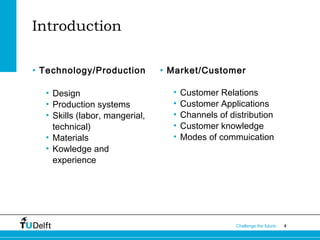
• Technology/Production
• Design
• Production systems
• Skills (labor, mangerial,
technical)
• Materials
• Kowledge and
experience

• Market/Customer
•
•
•
•
•

Customer Relations
Customer Applications
Channels of distribution
Customer knowledge
Modes of commuication

Challenge the future

4
Transilience Map
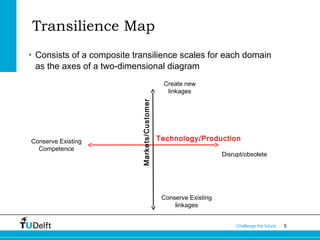
• Consists of a composite transilience scales for each domain
as the axes of a two-dimensional diagram

Conserve Existing
Competence

Markets/Customer

Create new
linkages

Technology/Production
Disrupt/obsolete

Conserve Existing
linkages
Challenge the future

5
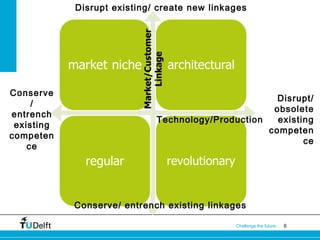
Disrupt existing/ create new linkages

Conserve
/
entrench
existing
competen
ce

Disrupt/
obsolete
Technology/Production
existing
competen
ce

Conserve/ entrench existing linkages
Challenge the future

6
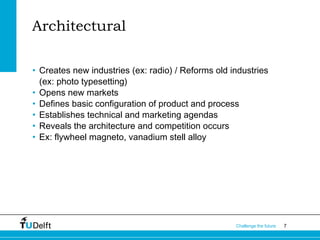
Architectural
• Creates new industries (ex: radio) / Reforms old industries
(ex: photo typesetting)
• Opens new markets
• Defines basic configuration of product and process
• Establishes technical and marketing agendas
• Reveals the architecture and competition occurs
• Ex: flywheel magneto, vanadium stell alloy

Challenge the future

7
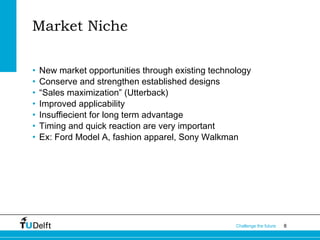
Market Niche
•
•
•
•
•
•
•

New market opportunities through existing technology
Conserve and strengthen established designs
“Sales maximization” (Utterback)
Improved applicability
Insuffiecient for long term advantage
Timing and quick reaction are very important
Ex: Ford Model A, fashion apparel, Sony Walkman

Challenge the future

8
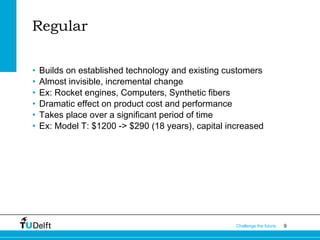
Regular
•
•
•
•
•
•

Builds on established technology and existing customers
Almost invisible, incremental change
Ex: Rocket engines, Computers, Synthetic fibers
Dramatic effect on product cost and performance
Takes place over a significant period of time
Ex: Model T: $1200 -> $290 (18 years), capital increased

Challenge the future

9
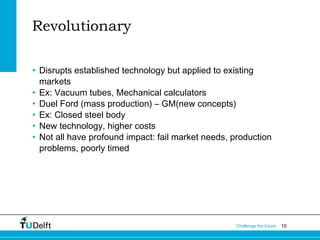
Revolutionary
• Disrupts established technology but applied to existing
markets
• Ex: Vacuum tubes, Mechanical calculators
• Duel Ford (mass production) – GM(new concepts)
• Ex: Closed steel body
• New technology, higher costs
• Not all have profound impact: fail market needs, production
problems, poorly timed

Challenge the future

10
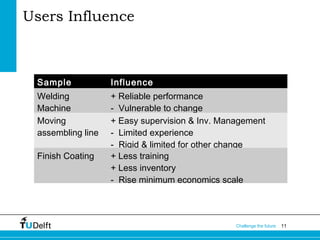
Users Influence

Sample

Influence

Welding
Machine
Moving
assembling line

+ Reliable performance
- Vulnerable to change
+ Easy supervision & Inv. Management
- Limited experience
- Rigid & limited for other change
+ Less training
+ Less inventory
- Rise minimum economics scale

Finish Coating

Challenge the future

11
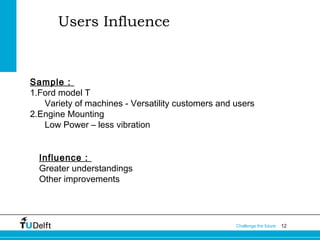
Users Influence

Sample :
1.Ford model T
Variety of machines - Versatility customers and users
2.Engine Mounting
Low Power – less vibration
Influence :
Greater understandings
Other improvements

Challenge the future

12
Users Influence
-

New technical concept
Changes from market demand
Government policy

Sample : CHRYSLER
1920 – 1939
: Focus on architecture & revolutionary innovation
had passed Ford in Market share
1940s
: Focus on regular & niche innovation
its market share decline
1950-1960s
: inefficient & not innovative
Influence : Reversal development

Challenge the future

13
Managerial Implication
•

•

•

•

•

New way of assessing different kinds of innovation is
'Transilience map‘
Architectural innovation – Creative synthesis about the user
needs and new technological needs.
Niche Creation - Timing is the essence of management.
Regular Mode - Methodical planning and consistency to ensure
technological progress, engineering improvements and
continued process development.
Revolutionary Innovation - There needs to be a technological
push.
Challenge the future

14
Conclusion
Transilience map requires further study.
The need to examine the impact of innovation on market
structure during periods of transition.
A balance between different innovations at the same firm.

Challenge the future

15

Transilience map & analysis

  • 1.
    Innovation: Mapping thewinds of creative destruction W. Abernathy & K. Clark Carlos Hidalgo Radu Irava Aman Kalsi Ferry Ignasius Challenge the future 1
  • 2.
    Content 1. Introduction 2. TransilienceMap 3. Innovations 4. Users Inflluence 5. Management Relevance 6. Conclusions Challenge the future 2
  • 3.
    Introduction • Conservative Scale •Innovations serve to enhance the value or applicability of the firm’s existing competence. • Radical Scale • The effect of innovation is disruptive and destructive. Challenge the future 3
  • 4.
    Introduction • Technology/Production • Design •Production systems • Skills (labor, mangerial, technical) • Materials • Kowledge and experience • Market/Customer • • • • • Customer Relations Customer Applications Channels of distribution Customer knowledge Modes of commuication Challenge the future 4
  • 5.
    Transilience Map • Consistsof a composite transilience scales for each domain as the axes of a two-dimensional diagram Conserve Existing Competence Markets/Customer Create new linkages Technology/Production Disrupt/obsolete Conserve Existing linkages Challenge the future 5
  • 6.
    Disrupt existing/ createnew linkages Conserve / entrench existing competen ce Disrupt/ obsolete Technology/Production existing competen ce Conserve/ entrench existing linkages Challenge the future 6
  • 7.
    Architectural • Creates newindustries (ex: radio) / Reforms old industries (ex: photo typesetting) • Opens new markets • Defines basic configuration of product and process • Establishes technical and marketing agendas • Reveals the architecture and competition occurs • Ex: flywheel magneto, vanadium stell alloy Challenge the future 7
  • 8.
    Market Niche • • • • • • • New marketopportunities through existing technology Conserve and strengthen established designs “Sales maximization” (Utterback) Improved applicability Insuffiecient for long term advantage Timing and quick reaction are very important Ex: Ford Model A, fashion apparel, Sony Walkman Challenge the future 8
  • 9.
    Regular • • • • • • Builds on establishedtechnology and existing customers Almost invisible, incremental change Ex: Rocket engines, Computers, Synthetic fibers Dramatic effect on product cost and performance Takes place over a significant period of time Ex: Model T: $1200 -> $290 (18 years), capital increased Challenge the future 9
  • 10.
    Revolutionary • Disrupts establishedtechnology but applied to existing markets • Ex: Vacuum tubes, Mechanical calculators • Duel Ford (mass production) – GM(new concepts) • Ex: Closed steel body • New technology, higher costs • Not all have profound impact: fail market needs, production problems, poorly timed Challenge the future 10
  • 11.
    Users Influence Sample Influence Welding Machine Moving assembling line +Reliable performance - Vulnerable to change + Easy supervision & Inv. Management - Limited experience - Rigid & limited for other change + Less training + Less inventory - Rise minimum economics scale Finish Coating Challenge the future 11
  • 12.
    Users Influence Sample : 1.Fordmodel T Variety of machines - Versatility customers and users 2.Engine Mounting Low Power – less vibration Influence : Greater understandings Other improvements Challenge the future 12
  • 13.
    Users Influence - New technicalconcept Changes from market demand Government policy Sample : CHRYSLER 1920 – 1939 : Focus on architecture & revolutionary innovation had passed Ford in Market share 1940s : Focus on regular & niche innovation its market share decline 1950-1960s : inefficient & not innovative Influence : Reversal development Challenge the future 13
  • 14.
    Managerial Implication • • • • • New wayof assessing different kinds of innovation is 'Transilience map‘ Architectural innovation – Creative synthesis about the user needs and new technological needs. Niche Creation - Timing is the essence of management. Regular Mode - Methodical planning and consistency to ensure technological progress, engineering improvements and continued process development. Revolutionary Innovation - There needs to be a technological push. Challenge the future 14
  • 15.
    Conclusion Transilience map requiresfurther study. The need to examine the impact of innovation on market structure during periods of transition. A balance between different innovations at the same firm. Challenge the future 15

Editor's Notes

  • #2 {"3":"Conservative Scale: Solve Problems, Eliminate failures, attract customers\nRadical scale: impose new requirements, make obsolete, create new markets\n"}