Innovation Renaissance: Defining, Debunking, and
Demystifying Creativity John E. Ettlie download pdf
https://ebookmass.com/product/innovation-renaissance-defining-debunking-
and-demystifying-creativity-john-e-ettlie/
Visit ebookmass.com today to download the complete set of
ebook or textbook!
We believe these products will be a great fit for you. Click
the link to download now, or visit ebookmass.com
to discover even more!
Demystifying Global Macroeconomics 3rd Edition John E.
Marthinsen
https://ebookmass.com/product/demystifying-global-macroeconomics-3rd-
edition-john-e-marthinsen/
Managing Change, Creativity and Innovation 3rd Edition,
(Ebook PDF)
https://ebookmass.com/product/managing-change-creativity-and-
innovation-3rd-edition-ebook-pdf/
Creativity, Innovation, and Change Across Cultures David
D. Preiss
https://ebookmass.com/product/creativity-innovation-and-change-across-
cultures-david-d-preiss/
Cases in Strategic Management: Creativity and Innovation
Perspective Sanjay Dhir
https://ebookmass.com/product/cases-in-strategic-management-
creativity-and-innovation-perspective-sanjay-dhir/
Innovation in Esotericism from the Renaissance to the
Present Georgiana D. Hedesan
https://ebookmass.com/product/innovation-in-esotericism-from-the-
renaissance-to-the-present-georgiana-d-hedesan/
Explaining Creativity: The Science of Human Innovation 3rd
Edition R. Keith Sawyer
https://ebookmass.com/product/explaining-creativity-the-science-of-
human-innovation-3rd-edition-r-keith-sawyer/
Design Thinking and Innovation Metrics: Powerful Tools to
Manage Creativity, OKRs, Product, and Business Success
Michael Lewrick
https://ebookmass.com/product/design-thinking-and-innovation-metrics-
powerful-tools-to-manage-creativity-okrs-product-and-business-success-
michael-lewrick/
Bishop John Vitez and Early Renaissance Central Europe:
The Humanist Kingmaker Tomislav Mati■
https://ebookmass.com/product/bishop-john-vitez-and-early-renaissance-
central-europe-the-humanist-kingmaker-tomislav-matic/
Byzantine and Renaissance Philosophy Peter Adamson
https://ebookmass.com/product/byzantine-and-renaissance-philosophy-
peter-adamson/
INNOVATION RENAISSANCE
Innovation is not easy. Understanding the liability of newness but the potential for great-
ness is the central theme of this work. Innovation Renaissance explores and debunks the
myths that have arisen from the proliferation of misleading and often confusing popular
press treatments of creativity and innovation. Examples include the notion that successful
entrepreneurs are winners because they are innovative—whereas creativity and busi-
ness start-up acumen are not the same, and are rarely paired—or the idea of disruptive
technology, which has now become the buzzword equivalent to radical new technology
products or services, despite the fact that new technologies tend to offer simple, limited-
capability products or services to satisfy overlooked customer demand. The popularity of
open innovation has spawned assumptions, like the idea that crowdsourcing will increase
the number of truly new ideas—but in fact the more novel these ideas, the less likely they
are to be adopted by incumbent firms because they are less familiar.
Starting by defining innovation and the theories that have arisen surrounding it, Ettlie
considers individual creativity and innovativeness,radical innovation,new products,new ser-
vices,process innovation,and information technology.There is special emphasis on neglected
topics such as the dark side of the innovation process—the unintended consequences of new
ventures. Finally, the last chapter of the book summarizes a prescriptive model of the inno-
vation process and attempts to answer the question: what causes innovation? Three major
constructs are explored: leadership, enhancing capabilities, and integration.
This informative and unique text is designed as a resource for postgraduate students,
academics, and professionals deeply committed to understanding and working through
the innovation process. The book includes an introduction to the subject before moving
on to an in-depth study of emerging evidence and topics in the field.
John E. Ettlie is executive education professor at the Saunders College of Business,
Rochester Institute of Technology, USA. He earned his PhD at Northwestern University
and has held appointments since then at the University of Illinois Chicago, De Paul
University, and the University of Michigan. He has been ranked among the top ten leading
scholars in innovation management globally.
INNOVATION
RENAISSANCE
Defining, Debunking, and
Demystifying Creativity
John E. Ettlie
First published 2020
by Routledge
2 Park Square, Milton Park, Abingdon, Oxon OX14 4RN
and by Routledge
52 Vanderbilt Avenue, New York, NY 10017
Routledge is an imprint of the Taylor & Francis Group, an informa business
© 2020 John E. Ettlie
The right of John E. Ettlie to be identified as author of this work has
been asserted by him in accordance with sections 77 and 78 of the
Copyright, Designs and Patents Act 1988.
All rights reserved. No part of this book may be reprinted or reproduced
or utilised in any form or by any electronic, mechanical, or other
means, now known or hereafter invented, including photocopying and
recording, or in any information storage or retrieval system, without
permission in writing from the publishers.
Trademark notice: Product or corporate names may be trademarks
or registered trademarks, and are used only for identification and
explanation without intent to infringe.
British Library Cataloguing-in-Publication Data
A catalogue record for this book is available from the British Library
Library of Congress Cataloging-in-Publication Data
Names: Ettlie, John E., author.
Title: Innovation renaissance : defining, debunking, and demystifying
creativity / John E. Ettlie.
Description: Abingdon, Oxon ; New York, NY : Routledge, 2020. |
Includes bibliographical references and index.
Identifiers: LCCN 2019038506 (print) | LCCN 2019038507 (ebook) | ISBN
9781138392151 (hbk) | ISBN 9781138392175 (pbk) | ISBN
9780429402326 (ebk)
Subjects: LCSH: Technological innovations--History. | Creative
ability--History. | Entrepreneurship--History.
Classification: LCC HC79.T4 E88 2020 (print) | LCC HC79.T4 (ebook) |
DDC
658.4/063--dc23
LC record available at https://lccn.loc.gov/2019038506
LC ebook record available at https://lccn.loc.gov/2019038507
ISBN: 978-1-138-39215-1 (hbk)
ISBN: 978-1-138-39217-5 (pbk)
ISBN: 978-0-429-40232-6 (ebk)
Typeset in Bembo
by Lumina Datamatics Limited
CONTENTS
Preface vii
1 Introduction 1
2 Defining, debunking, and demystifying innovation 9
3 Radical innovation 30
4 Theories of innovation 43
5 New products 57
6 New services 77
7 Process innovation 91
8 Information technology 117
9 Creativity and innovation 131
10 The dark side of the innovation process 140
vi Contents
11 Innovation renaissance 148
12 Innovation by design 154
Index 173
PREFACE
The idea for this book is the result of the confluence of several strong profes-
sional and personal influences. First, and perhaps foremost, my former editor,
Sharon Golan, has never given up on me as the current custodian of my first two
textbooks in the field. But she knew and I knew all along that just a third edi-
tion of my text was not the best use of our joint efforts. I use cases and readings
in my innovation classes, which are refreshed for every new semester and every
new executive program. Even with digital printing, this makes the concept of a
textbook seem archaic.
Second, and very importantly, my colleagues have pushed me, perhaps at
times unknowingly, in the direction of this book. It is shorter than a textbook,
and is focused on the enduring answers to the most important question in our
field today: so what?
Some of these notable influences include Andy Hoffman’s iconoclastic notion
that senior scholars in any field ought to be obligated to stand back and ask: what
does this all mean? The alternative is to continue pursuit of a junior scholar
research agenda, one article after one small article. Time lags alone, between
actual defensible contributions and publication, probably mandate a publication
agenda shift for tenured faculty and senior researchers. I have been at this for 40+
years, so I’m overdue in that respect.
Another recent and primary professional influence that brought me to the
brink of shifting priorities in my writing queue came from Nada Sanders.
Her presentation at Morgan Swink’s conference at TCU in June of 2015 on
innovative supply chains was a wake-up call for me. Our recent paper with
the same title as this book was the result of that meeting and association. That
paper is a modest road map for changing the way we approach our innova-
tion research philosophies and methodologies. The current orthodoxy has led to
gross mistakes in the top journals of our field. These errors have resulted from
viii Preface
a closed-form approach to science, which is discipline-bound, and myopic in
attendance to details that no longer serve the purpose they were initially adopted
to correct. We have reached a troubling plateau of irrelevance, especially because
of the eclectic nature of innovation studies and its management, which uniquely
challenges single-discipline approaches to complex problems.
Another primary source of my deflection to a new writing regimen were two
emails from colleagues responding to my draft paper on a very risky research
topic related to creativity: the power of the nocturnal versus diurnal thought
process in changing a person’s innovation intentions. My interest in the dream
state was rekindled by Veronica Tonya and her work on creativity and dreams,
but until my sabbatical at RIT I did not have the time or the patience to seriously
pursue the project. Feedback on the first draft of my paper “Dreams Become
You,” from Rick Bagozzi, made me believe in this unorthodox project and gave
me guidance going forward. Rick continues to be a great mentor and provider
of detailed feedback on our work, for which we are most appreciative. Then
there was that meeting with Sharon Golan, my editor in May. That was the final
straw. The mantra began as a drum beat in my head: be honest, be bold, and try
to answer big questions, not just a series of small questions. I am in debt to Sophia
Levine, her nice replacement as editor, for continuing this tradition of able guid-
ance through to the end of this project. In the end, we agreed to be focused on
foreshadowing the future, not preoccupied with the past.
My current and recent co-authors continue to make me believe that there
is hope that we can go beyond the titles of articles and conference presenta-
tions that promise the world and deliver very, very small improvements on
the past: Peter Gianiodis, Rajendran Murthy, and Tingting Yang and Morgan
Swink; Nada Sanders, Celine Abecassis-Moedas, Don Wilson, Chris Tucci,
Ron Hira, Charlie Vance and Ken Groves; Jose Urbina, Steve Rosenthal,
Sandy Rothenberg, Matthew Kubarek, Jorge Elsenbach, Paul Pavlou, Francisco
Veloso, Muammer Ozer, Vic Perotti, Mark Cotteleer, and Dan Joseph; Mohan
Subramaniam, Kannan Sethuraman, Mike Johnson, Germain Boer, and Joan
Penner-Hahn.
The very words “innovation” and “creativity,” and their cousins like
“disruptive technology” and “open innovation,” have been hijacked by the pop-
ular press, the trade publications, and CEOs in cheerleading pronouncements at
the beginning of annual reports everywhere. In part, this book is an attempt to
repatriate the terms associated with true novelty. The myth is spreading that all
individuals, all groups, and all companies are or can be innovative is real. That
myth stops here. Innovation is a rare and difficult achievement. Much of the first
part of the book is devoted to debunking “common” knowledge on this subject,
which simply doesn’t agree with the facts.
So the idea of the book was clear: make your view of the innovation world
easily available to a wide audience of readers. In the book, I have taken the
enduring themes, models, empirical findings, and conclusions of my work,
often co-authored, which have accumulated almost five decades of research on
Preface ix
innovation and its management. I have my students to thank for continuing to
challenge my world view, week in and week out, on every possible aspect of the
innovation process. Chapter 12 came about as a direct result of a suggestion of one
my students who had the courage to ask after a 14-week semester: what causes
innovation? I am deeply indebted to Al Rubenstein and Gil Krulee, my mentors
at Northwestern, for encouraging me to become involved in research in the field,
and colleagues like Bob O’Keefe for making it a reality. Reviews of earlier drafts
of the book helped immensely, especially comments from Phil Anderson, Karen
Schnatterly, Dave Welemon, Don Wilson, Mary Tripsas, and Carsten Dreher.
My student editors, Brad Boise, Kate Ferguson, and my professional editor,
Pat Scanlon, and my graduate research assistants, Arjun Ruhatiya, Nahn Do and
Sri Velamuri, as well as my undergraduate research assistant, Danny Keirsbilck,
all deserve a special round of applause, because they were there at the finish line
to help me break the tape. Holly Yates, helped with some challenging tables
and figures that needed to be redone. My life partner, Gail Hunsberger, will
finally see light at the end of this tunnel, and my daughter, Gretchen Ettlie,
took the cover art to heart and produced a perfect cover for the theme of the
book. Without Gretchen, this book would never had made it to print since she
organized and did most of the permission work. Leigh Onorato, Gail’s daughter,
proofed the entire book draft. The project was a unique family affair.
My father, Joseph, lives on in these pages; he knew what questions to ask.
I hope my answers matter. My time in his employ working in his machine-tool
business, specifically installing a part called the historically, third-ever numeri-
cally controlled boring bar, would ultimately inspire my most important career
research stream. Like Susanne Langer, he had a knack for asking great questions.
I am still struggling to answer some of those questions after all these years.
Without him, none of this would have happened. Nor can I ever forget the sup-
port of my persevering mother, Catherine, for her inspiration all along. Alas, the
mistakes that remain, by omission or commission, are mine alone.
John E. Ettlie
Oceanside, California and Rochester, New York
Visit https://ebookmass.com today to explore
a vast collection of ebooks across various
genres, available in popular formats like
PDF, EPUB, and MOBI, fully compatible with
all devices. Enjoy a seamless reading
experience and effortlessly download high-
quality materials in just a few simple steps.
Plus, don’t miss out on exciting offers that
let you access a wealth of knowledge at the
best prices!
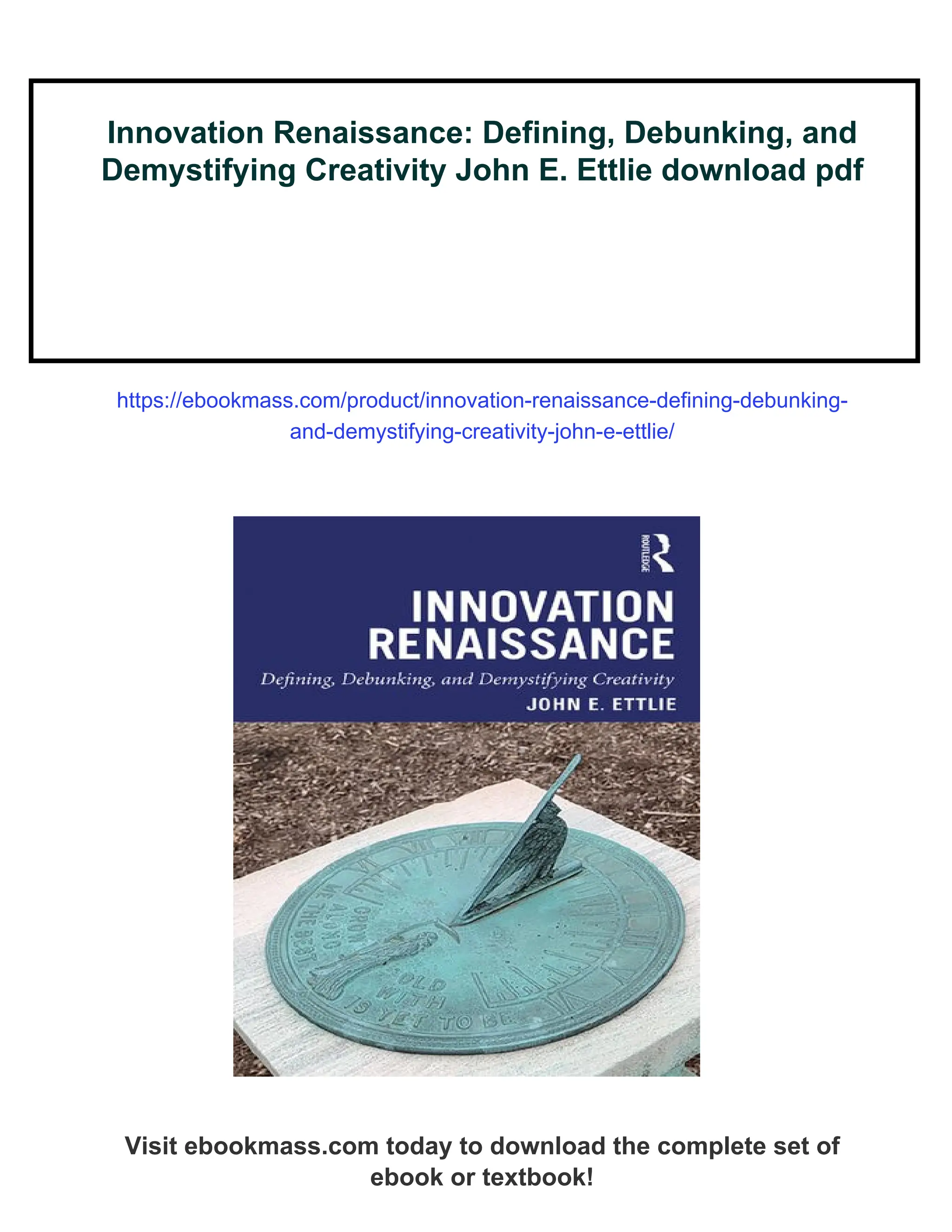
The house my father built, circa 1958.
In 2010, the McKinsey Global Survey (N = 2,240) results on innovation and
commercialization reported the following sobering statistics: “84% of execu-
tives say innovation is extremely or very important to their companies’ growth
strategy”; however, only 10% of respondents say their corporate venture capital
is effective, 13% say their global centers of innovation are effective, and 13% are
satisfied with outsourcing R&D and innovation to another organization or geo-
graphical location.1
It appears that little has changed since 2010. In 2013, the PwC survey reported
that “three-quarters of CEOs regard innovation as at least equally important to
operational effectiveness.”2 Further, “93% of executives indicate that organic
growth through innovation will drive the greater proportion of their revenue
growth.”3
Similarly, the 2016 Deloitte survey4 on digital technologies (see Chapters 7
and 8) found similar CEO concerns:
• “87% of respondents believe digital technologies will disrupt their industry
to a great or moderate extent, but only 44% agree or strongly agree that their
company is adequately preparing.”5
• “Companies that are more digitally advanced…place a strong emphasis on
innovation and are over twice as likely to be investing in innovation than are
early-stage entities—87% versus 38%.”6
• “Digitally maturing companies also take a longer-term view of strategy
compared to early-stage companies (50% versus 34%).”7
• “Digitally maturing companies also place a premium on leadership. More
than 70% of respondents from digitally maturing organizations say their
leaders have sufficient knowledge and ability to lead the company’s digital
strategy versus 22% of early-stage business respondents.”8
1
INTRODUCTION
2 Introduction
There is an additional Deloitte survey on boards of directors and radical technol-
ogy that is quite useful, in particular for both Chapters 3 and 5, but the results
are consistent with these other C-level opinions: innovation is challenging and
sought after with difficulty.
Digital manufacturing is an evolutionary development merging enterprise
resource planning (ERP), design-thinking concepts, product data management,
logistics, and even marketing concepts. In other words, it offers complete inte-
gration of the value-added chain, more or less controlled by or directed from a
major link in this chain, typically a multinational enterprise (MNE) or global
manufacturer like Microsoft, Toyota, or Siemens.9 Here are some examples of
the digital manufacturing challenges continued in Chapter 7.
The headline in the Economist10 read: “Amp my ride” and the subheading
read: “In its biggest deal yet, Samsung bets on connected cars as a driving force”
(running headline: Samsung buys Hartman). This was another established and
well-known multinational corporation leaping into unaligned diversification,
based on current convergent mobility trends. Although Samsung was not the first
to “converge,” they are hardly the most “unaligned.” Google, Apple (“Project
Titan”), Xiaomi (Chinese smartphone maker), and all of the major automobile
and on-demand ride companies like Uber and Lyft are already on the dance
floor, with more arrivals at the mobility ball surely to arrive soon.
Samsung paid $8 billion for Hartman, which is a company known for internet
audio, information technology, and security systems, located in Stamford, CT.
This sector is one of the gateways to autonomous vehicles. Samsung has already
invested in Vinli and nuTonomy, both of which make software for connected
cars. Samsung supplies lithium-ion batteries for cars through its affiliate Samsung
SDI. Samsung’s earlier (late 1990s) entry into automobile OE went under and
was ultimately purchased by the French company Renault.
Samsung’s smartphone division recently suffered a major setback due to
exploding batteries in its recent Galaxy Note phone offering. This, coupled
with the convergence trends in mobility, illustrates two important themes of this
book. First, discontinuous change in innovation management, such as the con-
vergence occurring in the personal transportation industry, occurs infrequently
and challenges even the best of incumbents, as well as new entrant firms (start-
ups and otherwise). Second, radical change takes a long time to stabilize and is
extremely challenging.
A recent article in the Harvard Business Review11 argues that the greater the
industry investment in R&D, the greater the unfolding uncertainty. An under-
standing of the amount of uncertainty ahead and one’s ability to manage that
uncertainty in different ways is essential to success. For example, the authors
show medical equipment has 8.2% R&D/sales and 90.7% revenue volatility,
whereas precious metals have a 0.1% R&D ratio and 40.7% revenue volatility.
These industry differences are significant.
This type of recurring discontinuous change involves both new products and
new process innovations, including new information technology changes. Each
Introduction 3
one of these elements requires a different set of technology orchestration skills and
is based on different economic and strategic theories that are recurring with per-
petual themes and paradigms. This is the Innovation Renaissance: the understand-
ing of lasting and accumulated knowledge in the innovation field. This book is
devoted to sharing these enduring lessons of technological change and debunking
and exposing the shortfall of most popular treatments of this sea change. The obfus-
cation that has resulted in the popular press to try to make “easy to understand”
sense of current trends has, for the most part, done more harm than good.
The faster things change, the more mistakes are made in the popular press in
trying to understand these recurring themes. In the first Industrial Revolution,
a very similar convergence occurred in the making of the textile industry in
England. Simple machines to convert cotton cloth eventually were combined
and integrated into more complex, but more efficient factory systems, requiring
fewer “hands.” No one person, firm, or enterprise had the complete answer, and
the solution often morphed to meet the context. The Industrial Revolution in
America was powered by water, not steam. Herein lays the plausible explanation
of why simple treatments of sea change end up being confusing. Understanding
technological change is not the purview of one discipline of engineering, or even
one field of science. Sociology has as much to contribute to our understanding
of technological trajectories as physics. It is ultimately not the technology itself
but the understanding and implementation of technology in society that matter
most. Clayton Christensen has often correctly said that when an industry like
health care is disrupted, everyone is better off.12 Medical research and treatment
can concentrate on the most difficult health issues like cancer. Emerging fields
of science and medicine can concentrate on delivering large-scale health care to
many, many more needy patients. Disruptive technology is probably among the
most misused terms applied in the popular press, all the way up to and including
annual reports today. The singular important purpose of this book is to debunk
these simplified pronouncements that contribute to the confusion and replace
platitudes with enduring, theory-based empirical research that has been applied
over and over for the betterment of everyone.
Where have we been? Where are we going?
It would be difficult to argue that what has persisted in any field of inquiry
is independent of the state-of-the-art comparisons. Therefore, it is necessary
to review assessments of the technology and innovation management-applied
research field as well as practitioner reports of challenges. A selection of both are
included here with one caveat: it is very difficult to predict where a field is going
based on what informed opinion suggests is the state-of-the-art and to chronicle
the past contributions in any domain related to the innovation process.
Nonetheless, boldly we go forward. Perhaps the most recent review of
the management of technology field, as of this writing, is the special issue of
Production and Operations Management.13 In spite of the comprehensive coverage
4 Introduction
of topics in this special issue, the editors rightfully admit that a field as eclec-
tic as technology management “…focuses on the entire gamut of issues that
arise as firms transform newly developed scientific or technological knowledge
into new products, services, and business models to impact the marketplace.”14
Therefore, it would not be possible to cover the entire field but rather a sampling
based, in part, on editors’ solicitations and choices of topics by contributors.
The range of topics and experience of authors is impressive in this special
issue. Creativity, ideation, organizational learning, value chains, information
technology, co-production, digital goods, and new product development are all
featured prominently. For the most part, the articles all beg to be read, depend-
ing upon your own particular interests in the field. Further, the issue has a noble
objective: to focus attention on “multidisciplinary knowledge on management
of technology.” The consequences of not taking this view are many. One docu-
mented case in Ettlie and Sanders15 is the absence of manufacturing scope con-
siderations in flexible innovation theory development.
The articles generally do a good job of reviewing where we have been but fall
short, for the reason stated earlier, on where we are going, which is what lead
researchers are grappling with right now. Good journals only publish new ideas,
which are yet to be determined. So-called “gaps” in knowledge rarely produce
breakthroughs in knowledge. This is easy to evaluate by just examining the
theory section of this book or any book on the subject.
Focus first on the limitations of the special issue as they relate to the present
volume. Ken Kahn16 has published a concise introduction to the subject whereby
innovation is really one of three things: outcome, process, and mind-set. Nearly
all the contributions that appear in journals and the trade press focus on strong
appropriation conditions,17 where knowledge is protected or potentially protect-
able by secure intellectual property acquisition, like patents, and the focus is
almost exclusively on outcomes. The current volume is targeting the interface
between product and operations management and management of technology,
but most operations and information technology are adopted from outside the
firm. Without deep understanding of weak appropriation conditions, and with
only one article focused on the implementation of information technology,18 the
result is a very large piece of the intellectual pie being absent from this special
issue. This exact topic (managing production and operations under conditions
of weak appropriation) is featured in Chapters 7 and 8. Managing under weak
appropriation conditions is quite different from managing under strong appro-
priation conditions. The paradox of standardization and innovation taken up
by several of the special issue authors should have been rigorously addressed by
contributions in this regard.
The special issue addresses many interfaces but conspicuous by its absence is
the marketing discipline and function of the firm. Errors of omission could have
been avoided if this path had been taken. A prime example is the fine contribution
by Loch19 on creativity and risk taking. Loch devotes much of his contribution to
behavioral issues in the stage-gate process and project management, but only one
Introduction 5
reference to Robert Cooper is cited and no references to the marketing literature
appear. His review of the stage-gate process and its shortcomings relative to the
novelty of the technology involved20 has actually been addressed in marketing lit-
erature. For example, Ettlie and Elsenbach21 hypothesized that the stage-gate pro-
cess was more suited to incremental rather than radical product technology in new
product development projects. Using a sample of 72 new products in the automotive
industry, the authors replicated the general finding in the marketing literature that
60% of new products are commercially successful once launched and that the stage-
gate process is modified 30% of the time in firms. What they found was that firms
modify the stage-gate to improve the efficiency of the new product development
process while not significantly sacrificing product novelty, or new-to-the-world
or new-to-the-industry technology. There was no significant variance in the new
product development (NPD) process by novelty; in fact, firms do quite well with
radical technology projects managed by stage-gate and virtual teams.
Another example of a missed opportunity for want of marketing contribu-
tions is the discussion of competition in the marketplace and decisions to share
information of a co-operative nature having an impact on competitor behavior.22
The entire body of marketing literature on signaling behavior was excluded from
this treatment.23
Finally, placing emphasis on understanding managing risk to achieve success
excludes a better understanding of the unintended negative consequences of the
innovative process. This topic is taken up in depth later.
We begin the journey in the next chapter by attempting to set aside the con-
fusion about what entrepreneurship has to do with technological innovation:
very little, it turns out. We are not talking about what should be the relation-
ship between innovation and entrepreneurship, but what the relationship is.
As it turns out, only a relatively small percentage of entrepreneurial start-ups
are high technology. Elon Musk is the rare, celebrated exception to the rule.
Further, the trend is toward new business models that emphasize social entre-
preneurship, or doing well by doing good—a societal disruption that is way
overdue.
The other issue addressed in the next chapter is the misuse of terms intro-
duced by scholars and then misinterpreted by casual readers and applied for their
own purposes. Disruptive technology is not radical technology—actually it is
just the opposite. Innovation and creativity are not the same but are often used
interchangeably. Innovation is typically the commercialization of a creative idea.
Open innovation is not working more with suppliers or other entities outside
the firm in order to reduce spending on R&D. Finally, and perhaps most impor-
tantly, innovation is not the proven, fast route to becoming rich. Innovation
doesn’t always pay, and being first is risky. R&D investments do not guarantee
successful products and services. Chapter 2 is meant to be a serious challenge to
the ongoing pirating of the innovation and creativity fields of study by those who
publish glib, half-baked, typically incorrect, and misleading statements about an
important academic and applied combination of disciplines.
6 Introduction
In subsequent chapters, radical technology (Chapter 3) is explored, and the
rare birth of a new-to-the-world product is examined. Not only is radical inno-
vation uncommon, it takes a long time to emerge, and often there is great societal
resistance to what is truly new and different.
Chapter 4 introduces theories of innovation, but the chapter is not meant to
be a comprehensive treatment of the subject. The remarkable theoretical devel-
opments that are emerging are discussed, as well as several important empirical
studies. This includes: disruptive technology, dynamic capabilities, open innova-
tion (in its various forms), and organizational ambidexterity.
In Chapter 5, state-of-the-art and enduring principles of new product devel-
opment are covered. In Chapter 6, new services take center stage, including
many of the new disruptive entrants like Uber and Airbnb.
Chapter 7 features the beginning of the centerpiece of the book: success-
ful adoption of new process technology and enduring advantageous models
of synchronous innovation. This theme is applied and echoed in Chapter 8,
which covers the efficacious adoption of information technology. The theme of
these two chapters is the unique theoretical lens of the simultaneous enactment
of technological and organizational innovation. Adoption of technology has
taken a back seat to the more popular new product and service introduction as
a result of strong appropriation models, which occupy much of the economic,
R&D, and marketing literature. The operations management and information
technology disciplines have taken an unfortunate low status in the technology
management literature when the resources needed to sustain these adoptions
are often greater than new product investments. A new product plant might
require $1 billion to procure. Billions of dollars, euros, and so on are spent on
new production and information systems every year in the modern and emerg-
ing economic world.
Chapter 9 addresses the misconceptions concerning creativity and innovation
introduced here. We conclude this individual and group-focused chapter with a
bold prediction that the day may come when creativity enhancement will not be
dominated by waking exercises to promote an individual’s ability to advance
new ideas, and will take its place alongside a better understanding of the dream
state and subconscious creativity enhancement.
In Chapter 10, we revisit the important emerging topic of the dark side of the
innovation process: the unintended, negative consequences of innovating.
Chapter 11 is the summary chapter where the book is encapsulated and illus-
trated by capstone-type cases that currently exemplify the overriding purpose of
the book: to debunk the superficial treatment of the innovation subject with a
durable and sustainable understanding of the causes and consequences, intended
and otherwise, of technological change.
Chapter 12, is the marquee chapter that focuses on vital questions: what causes
innovation? What can we do about it? This is the only prescriptive chapter in
the book, which boils recommendations down to just three things: leadership,
capabilities, and integration.
Introduction 7
How to use this book
If you have read this far, you probably don’t need to be convinced of the impor-
tance of the subject. Some of the topics here have been dealt with before, includ-
ing by me. You can skip those if you are in a hurry or know most of this content
already. So, go directly to Chapter 2 to see my take on how the field of innovation
studies has been pirated by folks who only want to skip stones on the surface of the
water and have not taken time to understand the depth and nuances of the field.
Then proceed to Chapter 9 and see some truly novel ideas about creativ-
ity, especially our own work on the dream state and innovation. Then read
Chapter 10 on the dark side of the innovation process—an emerging topic—and
then skip to Chapter 12, where there is actually some advice that should work for
any situation, strong or weak appropriation. In the end, Chapters 2, 9, 10, and 12
are the new legacy of this volume; the rest takes care of itself.
Notes
1 Capozzi, M. M., Gregg, B., & Howe, A. (2010). Innovation and commercialization.
New York: McKinsey & Company.
2 PWC. (2013). Business models: Back to basics. PricewaterhouseCoopers, London.
Retrieved from www.pwc.com/mx/es/gobierno-corporativo/archivo/2013-07-articulo-
business-model.pdf
3 Ibid., p. 5.
4 Thanks to Mark Cotteleer for providing early access at the time of this writing to
their survey results.
Kane, G. C., Palmer, D., Phillips, A. N., Kiron, D., & Buckley, N. (2016). Aligning
the organization for its digital future. MIT Sloan Management Review, 58(1), 7–8.
5 Ibid., p. 6 (Deloitte).
6 Ibid., p. 10 (Deloitte).
7 Ibid., p. 9 (Deloitte).
8 Ibid., p. 11 (Deloitte).
9 Lee, C., Leem, C. S., & Hwang, I. (2011). PDM and ERP integration methodol-
ogy using digital manufacturing to support global manufacturing. The International
Journal of Advanced Manufacturing Technology, 53(1–4), 399–409. https://doi.org/10.1007/
s00170-010-2833-x.
10 The Economist (2016). Samsung buys Hartman. The Economist. November 19, 2016,
pp. 57–58.
11 Dyer, J. et al. (2014). Leading your team into the unknown. Harvard Business Review,
December 2014 Issue.
12 Christensen, C., & Hwang, J. (2008). Disruptive innovation in health care delivery:
A framework for business-model innovation. Health Affairs, 27(5), 1329–1335.
13 Gaimon, C., Hora, M., & Ramachandran, K. (2017). Towards building multidisci-
plinary knowledge on management of technology: An introduction to the special
issue. Production and Operations Management, 26, 567–578. doi:10.1111/poms.12668.
14 Ibid.
15 Ettlie, J. E., & Sanders, N. R. (2017). Discipline boundaries in innovation stud-
ies: Operations management and allied fields. Journal of Strategic Innovation and
Sustainability, 12(1), 41–54.
16 Kahn, K. B. (2018). Understanding innovation. Business Horizons, 61, 453–460.
17 Teece, D. J. (2006). Reflections on “profiting from innovation.” Research Policy, 35(8),
1131–1146.
8 Introduction
18 Schoenherr, T., Bendoly, E., Bachrach, D. G., & Hood, A. C. (2017). Task inter-
dependence impacts on reciprocity in IT implementation teams: Bringing out the
worst in US, or driving responsibility? Production and Operations Management, 26(4),
667–685. doi:10.1111/poms.12671.
19 Loch, C. H. (2017). Creativity and risk taking aren’t rational: Behavioral operations in
MOT. Production and Operations Management, 26, 591–604. doi:10.1111/poms.12666.
20 Ibid., pp. 594–595.
21 Ettlie, J. E., & Elsenbach, J. M. (2007). Modified stage-gate regimes in new product
development. Journal of Product Innovation Management, 24(1), 20–33.
22 Ibid (Gaiman).
23 Heil, O., & Robertson, T. S. (1991). Toward a theory of competitive market signal-
ing: A research agenda. Strategic Management Journal, 12(6), 403–418.
Perhaps the supreme irony of any article,book,or publication on innovation today is
that this subject has become so popular that we are drowning in misinformation and
partial understanding: a little knowledge can be fatal when it comes to technological
innovation.There are several dimensions to the debunking process in this chapter, all
popular or misunderstood, or misrepresented and buried ideas that are inconvenient
to writers. Entrepreneurship is one such subject. Benchmarking is another, along
with“radical”innovation,which is extremely rare.The dark side of innovation is also
introduced in this chapter and taken up later as a separate subject in its own chapter.
Entrepreneurship is not what you might think it is, especially as it applies to
high technology entrepreneurship. Just a few statistics to get started and then
we’ll launch into the back story. The following statistics that are referenced from
several sources by Mansfield1 might be surprising to most readers:
• 9% of all businesses close each year, and only 8% are opened or restarted.
• Slightly more than 50% of small businesses fail during the first four years.
• The leading cause of business failure: incompetence (46%) followed by lack
of experience (30%).
• Having two founders instead of one increases the odds of raising money by
30%, and these start-ups have a threefold growth potential.
• Start-up success varies significantly by industry: finance, insurance, and real
estate have a 58% probability of still operating after four years.
• Small-business accounting, tax preparation, bookkeeping, and payroll services
have an 18.4% net profit margin; while specialized design services have only
an 11.4% net profit margin.
• Not a single high-technology small business is in the top 12 of most-profitable
small businesses. Previously successful founders of a business have a 30%
chance of next success while only 18% of first-time entrepreneurs succeed.
2
DEFINING, DEBUNKING, AND
DEMYSTIFYING INNOVATION
Visit https://ebookmass.com today to explore
a vast collection of ebooks across various
genres, available in popular formats like
PDF, EPUB, and MOBI, fully compatible with
all devices. Enjoy a seamless reading
experience and effortlessly download high-
quality materials in just a few simple steps.
Plus, don’t miss out on exciting offers that
let you access a wealth of knowledge at the
best prices!
Exploring the Variety of Random
Documents with Different Content
CHAPTER XI. THE PLAGUE OF THE
SOLDIER
INTRODUCTION TO "ONE WHO STICKETH
CLOSER THAN A BROTHER."
"HELLO Si; goin' for a soljer, ain't ye?"
"You bet!"
"Wall, you'd better b'lieve its great fun; it's jest a picnic all the
time! But, say, Si, let's see yer finger-nails!"
"I'd like ter know what finger-nails 's got to do with soljerin'!" said
Si. "The 'cruitin' ossifer 'n' the man 't keeps the doctor shop made
me shuck myself, 'n' then they 'xamined my teeth, 'n' thumped me in
the ribs, 'n' rubbed down my legs, 'n' looked at my hoofs, same 's if
'I'd bin a hoss they wuz buyin', but they didn't say nothin' 'bout my
finger-nails."
"You jest do 's I tell ye; let 'em grow, 'n' keep 'em right sharp. Ye'll
find plenty o' use fer 'em arter a while, 'n' 'twont be long, nuther. I
know what I'm talkin' 'bout; I've been thar!"
This conversation took place a day or two before Si bade farewell
to his mother and sister Marier and pretty Annabel and left the
peaceful precincts of Posey County to march away with the 200th
Ind. for that awful place vaguely designated as "the front!" He had
promptly responded to the call, and his name was near the top of
the list of Company Q.
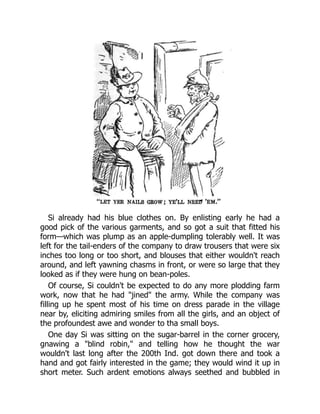
Si already had his blue clothes on. By enlisting early he had a
good pick of the various garments, and so got a suit that fitted his
form—which was plump as an apple-dumpling tolerably well. It was
left for the tail-enders of the company to draw trousers that were six
inches too long or too short, and blouses that either wouldn't reach
around, and left yawning chasms in front, or were so large that they
looked as if they were hung on bean-poles.
Of course, Si couldn't be expected to do any more plodding farm
work, now that he had "jined" the army. While the company was
filling up he spent most of his time on dress parade in the village
near by, eliciting admiring smiles from all the girls, and an object of
the profoundest awe and wonder to tha small boys.
One day Si was sitting on the sugar-barrel in the corner grocery,
gnawing a "blind robin," and telling how he thought the war
wouldn't last long after the 200th Ind. got down there and took a
hand and got fairly interested in the game; they would wind it up in
short meter. Such ardent emotions always seethed and bubbled in
the swelling breasts of the new troops when they came down to
show the veterans just how to do it.
One of the town boys who had been a year in the service, had got
a bullet through his arm in a skirmish, and was at home on furlough,
came into the store, and then took place the dialog between him
and Si that opens this chapter.
Si wondered a good deal what the veteran meant about the
finger-nails. He did not even know that there existed in any nature a
certain active and industrious insect which, before he had been in
the army a great while, would cause his heart to overflow with
gratitude to a beneficent Providence for providing him with nails on
his fingers.
When the 200th left Indiana all the boys had, of course, brand-
new outfits right from Uncle Sam's great one-price clothing house.
Their garments were nice and clean, their faces well washed, and
their hair yet showed marks of the comb. At Louisville they stuck up
their noses, with a lofty consciousness of superiority, at the sight of
Buell's tanned and ragged tramps, who had just come up on the
gallop from Tennessee and northern Alabama.
If the new Hoosier regiment had been quartered for a while in
long-used barracks, or had pitched its tents in an old camp, Si would
very soon have learned, in the school of experience, the delightful
uses of finger-nails. But the 200th stayed only a single night in
Louisville and then joined the procession that started on the chase
after the rebel army. It generally camped on new ground, and under
these circumstances the insect to which allusion has been made did
not begin its work of devastation with that suddenness that usually
marked its attack upon soldiers entering the field. But he never
failed to "git there" sooner or later, and it was more frequently
sooner than later.
One afternoon, when a few days out on this march, a regiment of
Wisconsin veterans bivouacked next to the 200th Ind. The strange
antics as they threw off their accouterments attracted Si's attention.
"Look a' thar," he said to Shorty. "What 'n name of all the prophets
's them fellers up to?"
"Seems like they was scratchin' theirselves!"
"I s'pose that's on account of the dust 'n' sweat," said Si.
"It's a mighty sight worse 'n that!" replied Shorty, who knew more
about these things than Si did. "I reckon we'll all be doin' like they
are 'fore long."
Si whistled softly to himself as he watched the Wisconsin boys.
They were hitching and twisting their shoulders about, evidently
enjoying the friction of the clothing upon their skins. There was a
general employment of fingers, and often one would be seen getting
come other fellow to scratch his back around where he couldn't
reach himself. If everybody was too busy to do this for him he would
back up to a tree and rub up and down against the bark.
Life has few pleasures that can equal the sensations of delightful
enjoyment produced in those days, when graybacks were plenty, by
rubbing against a tree that nicely fitted the hollow of the back, after
throwing off one's "traps" at the end of a day's march.
Directly the Wisconsin chaps began to scatter into the woods. Si
watched them as they got behind the trees and threw off their
blouses and shirts. He thought at first that perhaps they were going
in swimming, but there was no stream of water at hand large
enough to justify this theory in explanation of their nudity. As each
man set down, spread his nether garment over his knees and
appeared to be intently engaged, with eyes and fingers. Si's curiosity
was very much excited.
"Looks 's if they wuz all mendin' up their shirts and sewin' on
buttons," said Si, "Guess it's part o' their regular drill, ain't it,
Shorty?"
Shorty laughed at Si's ignorant simplicity. He knew what those
veterans were doing, and he knew that Si would have to come to it,
but he didn't want to shock his tender sensibilities by telling him of
it.
"Them fellers ain't sewin' on no buttons. Si," he replied; "they're
skirmishin'."
"Skirmishin'!" exclaimed Si, opening his eyes very wide. "I haint
seen any signs o' rebs 'round here, 'n' there aint any shootin' goin'
on, 'nless I've lost my hearin'. Durned if 't aint the funniest
skirmishin' I ever hearn tell of!"
"Now, don't ax me nuthin' more 'bout it, Si," said Shorty. "All I'm
goin' to tell ye is that the longer ye live the more ye'll find things
out. Let's flax 'round 'n' git supper!"
A little while after, as Si was squatting on the ground holding the
frying-pan over the fire, he saw a strange insect vaguely wandering
about on the sleeve of his blouse. It seemed to be looking for
something, and Si became interested as he watched it traveling up
and down his arm. He had never seen one like it before, and he
thought he would like to know what it was. He would have asked
Shorty, but his comrade had gone to the spring for water. Casting his
eye around he saw the Captain, who chanced to be sauntering
through the camp.
The Captain of Co. Q had been the Principal of a seminary in
Posey County, and was looked upon with awe by the simple folk as a
man who knew about all that was worth knowing. Si thought he
might be able to tell him all about the harmless's-looking little
stranger.
So he put down his frying-pan and stepped up to the Captain,
holding out his arm and keeping his eye on the insect so that he
shouldn't get away.
"Good evenin', Cap.," said Si, touching his hat, and addressing him
with that familiar disregard of official dignity that characterised the
average volunteer, who generally felt that he was just as good as
anybody who wore shoulder straps.
"Good evening, Klegg," said the Captain, returning the salute.
"Say, Cap, you've been ter collidge 'n' got filled up with book-
larnin'; p'raps ye kin tell me what kind o' bug this is. I'm jest a little
bit curious to know."
And Si pointed to the object of his inquiry that was leisurely
creeping toward a hole in the elbow of his outer garment.
"Well, Josiah," said the Captain, after a brief inspection, "I
presume I don't know quite as much as some people think I do; but
I guess I can tell you something about that insect. I never had any
of them myself, but I've read of them."
"Never had 'em himself," thought Si. "What 'n the world does ha
mean?" And Si's big eyes opened with wonder and fear at the
thought that whatever it was he had "got 'em."
"I suppose," continued the Captain, "you would like to know the
scientific name?"
"I reck'n that'll do 's well 's any."
"Well, sir, that is a Pediculus. That's a Latin word, but it's his
name."
"Purty big name fer such a leetle bug, ain't it, Perfessor?"
observed Si. "Name's big enough for an el'fant er a 'potamus."
"It may seem so, Klegg; but when you get intimately acquainted
with him I think you will find that his name isn't any too large for
him. There is a good deal more of him than you think."
The young soldier's eyes opened still wider.
"I was going on to tell you," continued the Captain, "that there are
several kinds of Pediculi—we don't say Pediculuses. There is the
Pediculus Capitis—Latin again—but it means the kind that lives on
the head. I presume when you were a little shaver your mother now
and then harrowed your head with a fine-tooth comb?"
"Ya-as" said Si; "she almost took the hide off sometimes, an' made
me yell like an Injun."
"Now, Klegg, I don't wish to cause you unnecessary alarm, but I
will say that the head insect isn't a circumstance to this one on your
arm. As you would express it, perhaps, he can't hold a candle to
him. This fellow is the Pediculus Corporis!"
"I s'pose that means they eats up Corporals!" said Si.
"I do not think the Pediculus Corporis confines himself exclusively
to Corporals, as his name might indicate," said the Captain, laughing
at Si's literal translation and his personal application of the word. "He
no doubt likes a juicy and succulent Corporal, but I don't believe he
is any respecter of persons. That's my opinion, from what I've heard
about him. It is likely that I 'will be able to speak more definitely,
from experience, after a while. Corporis means that he is the kind
that pastures on the human body. But there's one thing more about
this fellow, some call him Pediculus Vestimenti; that is because he
lives around in the clothing."
"But we don't wear no vests," said Si, taking a practical view of
this new word; "nothin' but blouses, 'n' pants, 'n' shirts."
"You are too literal, Klegg. That word means any kind of clothes.
But I guess I've told you as much about him as you care to know at
present. If you want any more information, after two or three
weeks, come and see me again. I think by that time you will not find
it necessary to ask any more questions."
Si went back to his cooking, with the Pediculus still on his arm. He
wanted to show it to Shorty. The Captain's profound explanation,
with its large words, was a little too much for Si. He did not yet
clearly comprehend the matter, and as he walked thoughtfully to
where Shorty was "bilin'" the coffee he was trying to get through his
head what it all meant.
"Hello, Si," said Shorty; "whar ye bin? What d'ye mean, goin' off
'n' leavin' yer sowbelly half done?"
"Sh-h!" replied Si. "Ye needn't git yer back up about it. Bin talkin'
to the Cap'n. Shorty, look at that 'ere bug!"
And Si pointed to the object of the Captain's lecture on natural
history that was still creeping on his arm. Shorty slapped his thigh
and burst into a loud laugh.
"Was that what ye went to see the Cap'n 'bout?" he asked as soon
as he could speak.
"Why—ya-as," replied Si, somewhat surprised at Shorty's
unseemly levity. "I saw that thing crawlin' round, 'n' I was a-
wonderin' what it was, fer I never seen one afore. I knowed Cap was
a scolard, 'n' a perfesser, 'n' all that 'n' I 'lowed he c'd tell me all
about it. So I went 'n' axed him."
"What'd he tell ye?"
"He told me lots o' big, heathenish words, 'n' said this bug was a
ridiculous, or suthin' like that."
"'Diculus be blowed!" said Shorty, "The ole man was a'stuffin' ye.
I'll tell ye what that is, Si," he added solemnly, "that's a grayback!"
"A grayback!" said Si. "I've hearn 'em call the Johnnies graybacks,
but I didn't know 's there was any other kind."
"I reck'n 'twont be long, now, till yer catches on ter the meanin' ol
what a grayback is. Ye'll know all 'bout it purty sudden. This ain't the
first one I ever seen."
Si was impressed, as he had often been before, by Shorty's
superior wisdom and experience.
"See here. Si," Shorty continued, as his eye suddenly lighted up
with a brilliant thought, "I guess I kin make ye understand what a
grayback is. What d'ye call that coat ye've got on?"
"Why, that's a fool question; it's a blouse, of course!"
"Jesso!" said Shorty. "Now, knock off the fust letter o' that word,
'n' see what ye got left!"
Si looked at Shorty as if he thought his conundrums were an
indication of approaching idiocy. Then he said, half to himself:
"Let's see! Blouse—blouse—take off the 'b' 'n' she spells l-o-u-s-e,
louse! Great Scott, Shorty, is that a louse?"
"That's jest the size of it. Si. Ye'll have millions of 'em 'fore the
war's over 'f they don't hurry up the cakes."
Si looked as if he would like to dig a hole in the ground, get into it,
and have Shorty cover him up.
"Why didn't the Cap'n tell me it was that? He said suthin' about
ridiculus corporalis, and I thought he was makin' fun o' me. He said
these bugs liked to eat fat Corporals.'
"I reck'n that's so," replied Shorty; "but they likes other people
jest as well—even a skinny feller like me. They lunches off'n privits,
'n' Corp'rils, 'n' Kurnals, 'n' Gin'rals, all the same. They ain't satisfied
with three square meals a day, nuther; they jest eats right along all
the time 'tween regular meals. They allus gits hungry in the night,
too, and chaws a feller up while he sleeps. They don't give ye no
show at all. I rayther think the graybacks likes the ossifers best if
they could have their ch'ice, 'cause they's fatter 'n the privits; they
gits better grub."
Si fairly turned pale as he contemplated the picture so graphically
portrayed by Shorty. The latter's explanation was far more effectual
in letting the light in upon Si's mind than the scientific disquisition of
the "Perfesser." He had now a pretty clear idea of what a "grayback"
was. Whatever he lacked to make his knowledge complete was soon
supplied in the regular way. But Si was deeply grieved and shocked
at what Shorty had told him. It was some minutes before he said
anything more.
"Shorty," he said, with a sadness in his tone that would almost
have moved a mule to tears, "who'd a-thought rd ever git as low
down 's this, to have them all-fired graybacks, 's ye call 'em, crawlin'
over me. How'd mother feel if she knew about 'em. She wouldn't
sleep a wink fer a month!"
"Ye'll have to come to it. Si. All the soljers does, from the Major-
Gin'rals down to the tail-end of the mule-whackers. Ye mind them
'Sconsin chaps we was lookin' at a little bit ago?"
"Yes," said Si.
"Well, graybacks was what ailed 'em. The fellers with their shirts
on their knees was killin' 'em off. That's what they calls 'skirmishin'.
There's other kinds o' skirmishing besides fitin' rebels! Ye'd better git
rid of that one on yer arm, if he hasn't got inside already; then
there'll be one less of 'em."
Si found him after a short search, and proposed to get a chip,
carry him to the fire and throw him in.
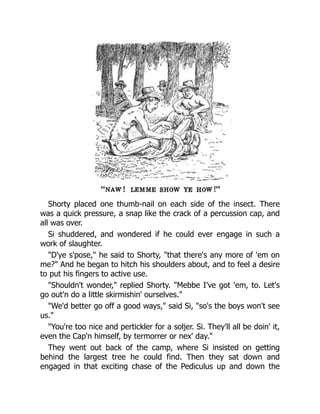
"Naw!" said Shorty in disgust, "that's no way. Lemme show yer
how!"
Shorty placed one thumb-nail on each side of the insect. There
was a quick pressure, a snap like the crack of a percussion cap, and
all was over.
Si shuddered, and wondered if he could ever engage in such a
work of slaughter.
"D'ye s'pose," he said to Shorty, "that there's any more of 'em on
me?" And he began to hitch his shoulders about, and to feel a desire
to put his fingers to active use.
"Shouldn't wonder," replied Shorty. "Mebbe I've got 'em, to. Let's
go out'n do a little skirmishin' ourselves."
"We'd better go off a good ways," said Si, "so's the boys won't see
us."
"You're too nice and pertickler for a soljer. Si. They'll all be doin' it,
even the Cap'n himself, by termorrer or nex' day."
They went out back of the camp, where Si insisted on getting
behind the largest tree he could find. Then they sat down and
engaged in that exciting chase of the Pediculus up and down the
seams of their garments, so familiar to all who wore either the blue
or the gray. Thousands of nice young men who are now preachers
and doctors and lawyers and statesmen, felt just as bad about it at
first as Si did.
"Shorty," said Si, as they slowly walked back to eat their supper,
which had been neglected in the excitement of the hour, "before Co.
Q left Posey County to jine the rigiment a feller 't was home on
furlow told me ter let my finger-nails grow long 'n' sharp. He said I'd
need 'em. I didn't know what he meant then, but I b'lieve I do now."
CHAPTER XII. A WET NIGHT
THE DEPRAVITY OF AN ARMY TENT REVEALS
ITSELF.
NIGHT threw her dark mantle over the camp of the 200th Ind.
The details of guard and picket had been made. Videts, with
sleepless eye and listening ear, kept watch and ward on the
outposts, while faithful sentries trod their beats around the great
bivouac. All day the army had marched, and was to take the road
again at an early hour in the morning. Supper had been eaten, and
the tired soldiers were gathered around the campfires that gleamed
far and near through the darkness.
"Si," said Shorty to his chum as they sat on a log beside the dying
embers, "how d'ye like soldierin', as fur as ye've got?"
"It's purty hard business," said Si, reflectively, "an' I s'pose we
haint seen the worst on it yet, either, from what I've hearn tell. Pity
the men that got up this war can't be made to do all the trampin' 'n'
fitin'. An' them fellers up in old Injjeanny that come 'round makin'
such red-hot speeches to git us boys to 'list, wouldn't it be fun to see
'em humpin' 'long with gun 'n' knapsack, 'n' chawin' hardtack, 'n'
stan'in' guard nights, 'n' pourin' water on their blisters, 'n' pickin'
graybacks off their shirts, 'n' p'leecin' camp, 'n' washin' their own
clothes?"
"I think we'd enj'y seein' 'em do all that," said Shorty, laughing at
the picture Si had drawn. "I reckon most of 'em 'd peter out purty
quick, and I'd like to hear what sort o' speeches they'd, make then. I
tell ye, Si, there's a big diff'rence 'tween goin' yerself an' tellin' some
other feller to go."
"Mebbe they'll git to draftin' after a while," observed Si, "'n' if they
do I hope that'll ketch em!"
"Wall, we're in fur it, anyway," said Shorty. "Let's take down the
bed 'n' turn in!"
It didn't take long to complete the arrangements for the night.
They spread their "gum" blankets, or ponchos, on the ground, within
the tent, and on these their wool blankets, placed their knapsacks at
the head for pillows, and that was all. It was warmer than usual that
evening, and they stripped down to their nether garments.
"Feels good once in a while," said Si, "to peel a feller's clothes oft,
'n' sleep in a Christian-like way. But, Great Scott! Shorty, ain't this
ground lumpy? It's like lying on a big washboard. I scooted all over
the country huntin' fer straw to-night. There wasn't but one little
stack within a mile of camp. Them derned Ohio chaps gobbled every
smidgin of it. They didn't leave enuff to make a hummin'-bird's nest.
The 200th Ind. 'll git even with 'em some day."
So Si and Shorty crept in between the blankets, drew the top one
up to their chins, and adjusted their bodily protuberances as best
they could to fit the ridges and hollows beneath them.
"Now, Si," said Shorty, "don't ye git to fitin' rebels in yer sleep and
kick the kiver off, as ye did last night."
As they lay there their ears caught the music of the bugles
sounding the "tattoo." Far and near floated through the clear night
air the familiar melody that warned every soldier not on duty to go
to bed. Next to the 200th Ind. lay a regiment of wild Michigan
veterans, who struck up, following the strains of the bugles:
Say, oh Dutch'y, will ye fight mit Si-gel?
Zwei glass o' la-ger, Yaw! Yaw! Yaw!!!
Will yet fight to help de bul-ly ea-gle?
Schweitzer-ksse und pret-zels,
Hur-raw! raw! raw!
During the night there came one of those sudden storms that
seemed to be sent by an inscrutable Providence especially to give
variety to the soldier's life.
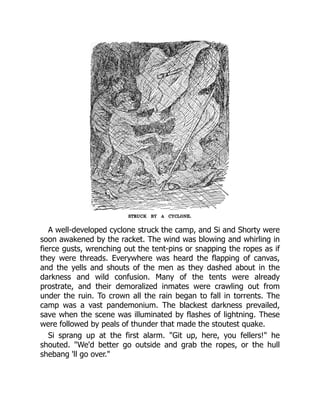
A well-developed cyclone struck the camp, and Si and Shorty were
soon awakened by the racket. The wind was blowing and whirling in
fierce gusts, wrenching out the tent-pins or snapping the ropes as if
they were threads. Everywhere was heard the flapping of canvas,
and the yells and shouts of the men as they dashed about in the
darkness and wild confusion. Many of the tents were already
prostrate, and their demoralized inmates were crawling out from
under the ruin. To crown all the rain began to fall in torrents. The
camp was a vast pandemonium. The blackest darkness prevailed,
save when the scene was illuminated by flashes of lightning. These
were followed by peals of thunder that made the stoutest quake.
Si sprang up at the first alarm. "Git up, here, you fellers!" he
shouted. "We'd better go outside and grab the ropes, or the hull
shebang 'll go over."
There was not a moment to spare. Si dashed out into the storm
and darkness, followed by his comrades. Seizing the ropes, some of
which were already loosened, they braced themselves and hung on
for dear life, in the drenching rain, their hair and garments
streaming in the wind.
Si's prompt action saved the tent from the general wreck. The fury
of the storm was soon past. Si and his comrades, after driving the
pins and securing the ropes, re-entered the tent, wet and shivering
for the mercury had gone down with a tumble, or rather it would
have done so had they been supplied with thermometers. But the
scanty costume in which Si found himself afforded a weather
indicator sufficiently accurate for all practical purposes.
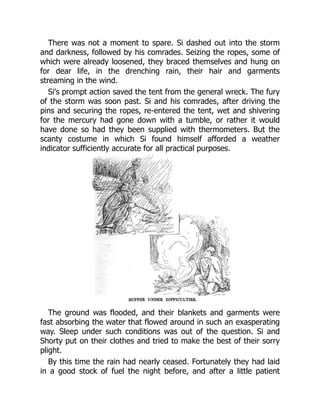
The ground was flooded, and their blankets and garments were
fast absorbing the water that flowed around in such an exasperating
way. Sleep under such conditions was out of the question. Si and
Shorty put on their clothes and tried to make the best of their sorry
plight.
By this time the rain had nearly ceased. Fortunately they had laid
in a good stock of fuel the night before, and after a little patient
effort they succeeded in getting a fire started. Around this the boys
hovered, alternately warming their calves and shins.
"This is a leetle more'n I bargained fer," said Si. Then, taking a
philosophical view of the case, he added, "but there's one good
thing about it, Shorty, we'll be all fixed for mornin', an' we won't
have to get up when they sound the revel-lee. The buglers kin jest
bust theirselves a-blowin' fer all I keer!"
In this way the soldiers spent the remainder of the night. Before
daybreak the blast of a hundred bugles rang out, but there was little
need for the reveille.
Breakfast was soon over, and in the gray dawn of that murky
morning the long column went trailing on its way. The weather gave
promise of a sloppy day, and the indications were fully verified. A
drizzling rain set in, and continued without cessation. The boys put
their heads through the holes in their ponchos, from the corners of
which the water streamed. With their muskets at a "secure" they
sloshed along through the mud, hour after hour. In spite of their
"gums" the water found its way in at the back of the neck and
trickled down their bodies. Their clothes became saturated, and they
were altogether about as miserable as it is possible for mortals to
be.
It seemed to Si that the maximum of discomfort had been
reached. He had experienced one thing after another during the few
weeks since he left home, and he thought each in turn was worse
than the last, and about as bad as it could be. But Si learned a good
deal more before he graduated. All through the long, dreary day the
soldiers plodded on. There was little comfort to be derived from the
"rest," for the ground was soaked with water.
"Why didn't we think of it, Shorty," said Si, "'n' make it part o' the
bargain' when we 'listed that we were to have umbrellers. These
gum things don't amount to shucks, nohow, to keep the rain off. I
sh'd think Uncle Sam might do that much for us!"
"I reckon our clothes 'll be purty well washed by the time we git
out o' this mess," said Shorty.
"Feels that way," said Si; "but how about the bilin'? A cold bath
jest refreshes them pesky little varmints, 'n' makes 'em livelier 'n
ever. Say, Shorty, ye didn't write home anything 'bout our havin'
graybacks, did ye?"
"No, not yet; but I was thinkin' I'd tell 'em 'bout it one o' these
days."
"Well, Shorty, I ain't going to tell my folks; it 'd jest make my
mother feel awful to know I was that way. And sister Maria, and—"
Si was thinking aloud, and was going to say "Annabel," but he
checked himself. That name was not to be mentioned in other ears.
But he was afraid she would go back on him if she knew, all about it.
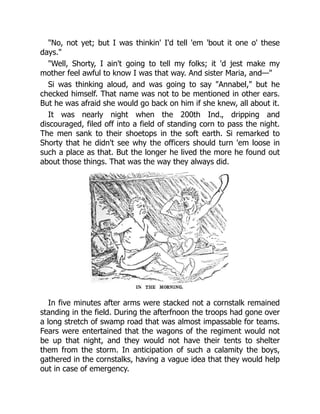
It was nearly night when the 200th Ind., dripping and
discouraged, filed off into a field of standing corn to pass the night.
The men sank to their shoetops in the soft earth. Si remarked to
Shorty that he didn't see why the officers should turn 'em loose in
such a place as that. But the longer he lived the more he found out
about those things. That was the way they always did.
In five minutes after arms were stacked not a cornstalk remained
standing in the field. During the afterfnoon the troops had gone over
a long stretch of swamp road that was almost impassable for teams.
Fears were entertained that the wagons of the regiment would not
be up that night, and they would not have their tents to shelter
them from the storm. In anticipation of such a calamity the boys,
gathered in the cornstalks, having a vague idea that they would help
out in case of emergency.
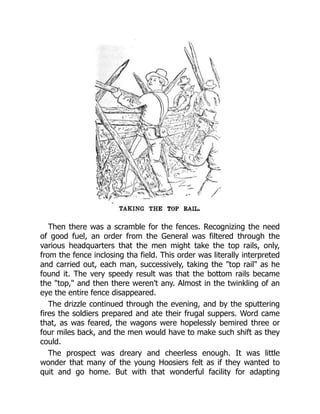
Then there was a scramble for the fences. Recognizing the need
of good fuel, an order from the General was filtered through the
various headquarters that the men might take the top rails, only,
from the fence inclosing tha field. This order was literally interpreted
and carried out, each man, successively, taking the "top rail" as he
found it. The very speedy result was that the bottom rails became
the "top," and then there weren't any. Almost in the twinkling of an
eye the entire fence disappeared.
The drizzle continued through the evening, and by the sputtering
fires the soldiers prepared and ate their frugal suppers. Word came
that, as was feared, the wagons were hopelessly bemired three or
four miles back, and the men would have to make such shift as they
could.
The prospect was dreary and cheerless enough. It was little
wonder that many of the young Hoosiers felt as if they wanted to
quit and go home. But with that wonderful facility for adapting
themselves to circumstances that marked the volunteer soldiers,
they set about the work of preparing for the night. No one who has
not "been there" can imagine how good a degree of comfort—
comparatively speaking, of course—it was possible to reach, with
such surroundings, by the exercise of a little patience, ingenuity and
industry.
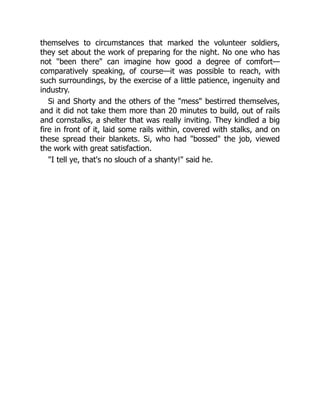
Si and Shorty and the others of the "mess" bestirred themselves,
and it did not take them more than 20 minutes to build, out of rails
and cornstalks, a shelter that was really inviting. They kindled a big
fire in front of it, laid some rails within, covered with stalks, and on
these spread their blankets. Si, who had "bossed" the job, viewed
the work with great satisfaction.
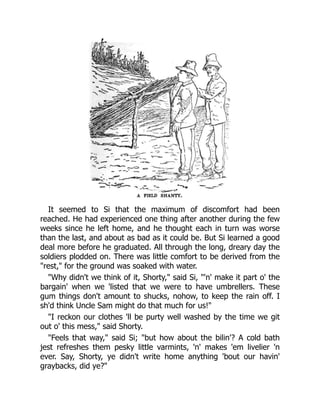
"I tell ye, that's no slouch of a shanty!" said he.
CHAPTER XIII. SI "STRAGGLED"
AND THE OTHER BOYS MADE IT MIGHTY
LOVELY FOR HIM.
ONE day while Buell was chasing Bragg, two or three weeks after
leaving Louisville, the army was pushing forward at a gait that made
the cavalry ahead trot half the time to keep out of the way of the
infantry. The extraordinary speed that day was due to the fact that
there were no rebels in sight. Half a dozen ragged troopers with
shotguns, a mile away, would have caused the whole army to halt,
form line-of-battle, and stay thera the rest of the day.
The tanned veterans didn't mind the marching. They stretched
their legs and went swinging along with a happy-go-lucky air, always
ready for anything that might turn up. But it was rough on the new
troops, just from home. It taxed their locomotive powers to the
utmost limit.
The boys of the 200th Ind. started out bravely. Their fresh, clean
faces, new uniforms, and shiny accouterments contrasted strongly
with those of the weather-beaten soldiers of '61. You could tell a
"tenderfoot" as far as you could see him.
They trudged along in fair shape for an hour or two. Before
starting in the morning strict orders had been read to the regiment
forbidding straggling, for any reason, under the most terrifying pains
and penalties.
"Them fellers that's been in the service longer 'n we have think
they're smart," said Si Klegg, as he and Shorty plodded on, both
already a little blown. "Well show 'em that we can hoof it jest as fast
as they can, and jest as fur in a day!"
"Seems to me we're git'n over the ground party lively to-day,"
replied Shorty, who was in a grumbling mood. "Wonder if the Gin'ral
thinks we're bosses! I'm a little short o' wind, and these pesky
gunboats are scrapin' the bark off'n my feet; but I'll keep up or
bust."
Though e spirit of these young patriots was willing, the flesh was
weak. It wasn't long till Si began to limp. Now and then a groan
escaped his lips as a fresh blister "broke." But Si clinched his teeth,
humped his back to ease his shoulders from the weight of his
knapsack, screwed up his courage, and tramped on over the stony
pike. He thought the breathing spells were very short and a long
way apart.
Si's knapsack had experienced the universal shrinkage, as told in a
previous chapter of our hero's martial career. He still had, however, a
good many things that he thought he couldn't spare, but which he
found later he could very well get along without.
By noon the 200th began to show signs of going to pieces. The
column stretched out longer and longer, like a piece of India-rubber.
The ranks looked thin and ragged. Lame and foot-sore, with wo-
begone faces, their bodies aching in every bone and tendon, and
overcome with a weariness that no one can realize unless he has
"been there," the men dropped out one by one and threw
themselves into the fence-corners to rest. The officers stormed and
drew their swords in vain. Nature—that is, the nature of a new
soldier—could endure no more. The ambulances were filled to their
utmost, but these would not hold a twentieth part of the crippled
and suffering men.
"How're ye gittin' on, Shorty?" said Si, as he and his comrade still
struggled along.
"Fair to middlin'," replied Shorty. "I'm goin' to try and pull
through!"
"I thought I could," said Si, "but I'm 'bout played out! I am, fer a
fact! I guess ef I rest a bit I'll be able to ketch up after a while."
Si didn't know till he found out by experience how hard it was to
"ketch up" when a soldier once got behind on the march. Si was too
fat for a good roadster, but it didn't take a great while to work off his
surplus flesh. Shorty was tall and slim, mostly bone—one of the sort
that always stood the marching best, crept up to the Orderly and
told him that he would have to stop and puff a while and give his
blisters a rest. He'd pull up with Co. Q in an hour or so.
"Better not, Si" said the Orderly; "ye know it's agin orders, and the
rear-guard 'll punch ye with their bay'net's if they catch ye
stragglin'."
But Si concluded that if he must die for his country it would be
sweeter to do so by having a bayonet inserted in his vitals, and then
it would be all over with at once, than to walk himself to death.
So he gradually fell back till he reached the tail of the company.
Watching his opportunity, he left the ranks, crept into a clump of
bushes, and lay down, feeling as if he had been run through a grist-
mill. Soon the rear-guard of the 200th came along, with fixed
bayonets, driving before them like a flock of frightened sheep a
motley crowd of limping, groaning men, gathered up by the
roadside.
Si lay very still, hoping to escaoe discovery; but the keen eye of
the officer detected the blue heap among the bushes.
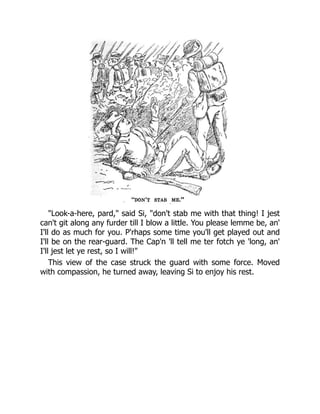
"Bring that man out!" said he sternly to one of the guards.
Poor Si scarcely dare to breathe. He hoped the man would think
he was dead, and therefore no longer of any account. But the soldier
began to prod him with his bayonet, ordering him to get up and
move on.
"Look-a-here, pard," said Si, "don't stab me with that thing! I jest
can't git along any furder till I blow a little. You please lemme be, an'
I'll do as much for you. P'rhaps some time you'll get played out and
I'll be on the rear-guard. The Cap'n 'll tell me ter fotch ye 'long, an'
I'll jest let ye rest, so I will!"
This view of the case struck the guard with some force. Moved
with compassion, he turned away, leaving Si to enjoy his rest.
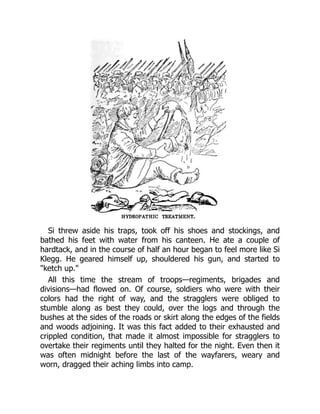
Si threw aside his traps, took off his shoes and stockings, and
bathed his feet with water from his canteen. He ate a couple of
hardtack, and in the course of half an hour began to feel more like Si
Klegg. He geared himself up, shouldered his gun, and started to
"ketch up."
All this time the stream of troops—regiments, brigades and
divisions—had flowed on. Of course, soldiers who were with their
colors had the right of way, and the stragglers were obliged to
stumble along as best they could, over the logs and through the
bushes at the sides of the roads or skirt along the edges of the fields
and woods adjoining. It was this fact added to their exhausted and
crippled condition, that made it almost impossible for stragglers to
overtake their regiments until they halted for the night. Even then it
was often midnight before the last of the wayfarers, weary and
worn, dragged their aching limbs into camp.
Si started forward briskly, but soon found it was no easy matter to
gain the mile or so that the 200th Ind. was now ahead of him. It
was about all he could do to keep up with the fast-moving column
and avoid failing still further to the rear. Presently the bugles
sounded a halt for one of the hourly rests.
"Now," said Si to himself, "I'll have a good chance to git along
tor'd the front. The soljers 'll all lie down in the fence corners an'
leave the road clear. I'll jest git up an' dust!"
The sound of the bugles had scarcely died away when the pike
was deserted, and on either side, as far as the eye could reach, the
prostrate men that covered the ground mingled in a long fringe of
blue.
Si got up into the road and started along the lane between these
lines of recumbent soldiers. His gait was a little shaky, for the
blisters on his feet began to give evidence of renewed activity. He
trudged pluckily along, limping some in spite of himself, but on the
whole making very good headway.
Pretty soon he struck a veteran regiment from Illinois, the
members of which were sitting and lying around in all the
picturesque and indescribable postures which the old soldiers found
gave them the greatest comfort during a "rest." Then they
commenced—that is, it was great sport for the Sucker boys, though
Si did not readily appreciate the humorous features of the scene.
"What rigiment is this?" asked Si, timidly.
"Same old rijiment!" was the answer from half a dozen at once. A
single glance told the swarthy veterans that the fresh-looking youth
who asked this conundrum belonged to one of the new regiments,
and they immediately opened their batteries upon him:
"Left—left-=left!"
"Hayfoot—strawfoot! Hayfoot—strawfoot!" keeping time with Si's
somewhat irregular steps.
"Hello, there, you! Change step and you'll march easier!"
"Look at that 'ere poor feller; the only man left alive of his
regiment! Great Cesar, how they must have suffered! Say, what
rijiment did you b'long to?"
"Paymaster's comin', boys, here's a chap with a pay-roll round his
neck!" Si had put on that morning the last of the paper collars he
had brought from home.
"You'd better shed that knapsack, or it'll be the death of ye!"
"I say, there, how's all the folks to home?"
"How d'ye like it as far as you've got, any way?"
"Git some commissary and pour into them gunboats!"
"Second relief's come, boys; we can all go home now."
"Grab a root!"
"Hep—hep—hep!"
"How'd ye leave Mary Ann?"
Si had never been under such a fire before. He stood it as long as
he could, and 'then he stopped.
"Halt!" shouted a chorus of voices. "Shoulder—Arms!" "Order—
Arms!"
By this time Si's wrath was at the boiling point. Casting around
him a look of defiance, he exclaimed:
"You cowardly blaggards; I can jest lick any two of ye, an' I'll dare
ye to come on. If the 200th Ind. was here we'd clean out the hull
pack of ye quicker'n ye can say scat!"
This is where Si made a mistake. He ought to have kept right on
and said nothing. But Si had to find out all these things by
experience, as the rest of the boys did.
All the members took a hand in the game. They just got right up
and yelled, discharging at Si a volley of expletives and pointed
remarks that drove him to desperation. Instinctively he brought up
his gun.
"Load in nine times—Load!" shouted a dozen of the Illinois
tramps.
If Si's gun had been loaded he would have shot somebody,
regardless of consequences. Thinking of his bayonet, he jerked it
quickly from its scabbard.
"Fix—Bay'net!" yelled the ragged veterans.
And he did, though it was more from the promptings of his own
hostile feelings than in obedience to the orders.
"Charge—Bay'net!"
Si had completely lost control of himself in his overpowering rage.
With blood in his eye, he came to, a charge, glancing fiercely from
one side of the road to the other, uncertain where to begin the
assault.
Instantly there was a loud clicking all along the line. The Illinois
soldiers, almost to a man, fixed their bayonets. Half of them sprang
to their feet, and all aimed their shining points at the poor young
Hoosier patriot, filling the air with shouts of derision.
It was plain, even to Si in his inflamed state of mind, that the odds
against him were too heavy.
"Unfix—Bay'net!" came from half the regiment.
Si concluded he had better get out of a bad scrape the best way
he could. So he took off his bayonet and put it back in its place. He
shouted words of defiance to his tormentors, but they could not be
heard in the din.
"Shoulder—Arms!" "Right—Face!" "Right shoulder shift—Arms!"
"Forward—March!" These commands came in quick succession from
the ranks amidst roars of laughter.
Si obeyed the orders and started off.
"Left—left—left!"
"Hayfoot—strawfoot!"
Forgetting his blisters. Si took the double-quick while the mob
swung their caps and howled with delight.
Si didn't "ketch up" with the 200 Ind. until after it had gone into
camp. Shorty had a quart of hot coffee waiting for him.
"Shorty," said Si as they sat by the fire,—"I'm goin' to drop dead in
my tracks before I'll fall out again."
"Why, what's the matter?"
"Oh, nothin'; only you jest try it," said Si.
Had it not been for the "fun" the soldiers had in the army to
brighten their otherwise dark and cheerless lives, they would all
have died. Si was a true type of those who had to suffer for the
good of others until they learned wisdom in the school of
experience.
CHAPTER XIV. SI AND THE MULES
ONE DAY'S RICH EXPERIENCE AS COMPANY
TEAMSTER.
"I'VE GOT to have a man to drive team for a few days," said the
Orderly of Co. Q of the 200th Ind. one morning at roll-call. "The
teamster's sick and I'm goin' to send him to the hospital to-day."
The Orderly-Sergeant of Co. Q was a wily fellow. All Orderly-
Sergeants have to be. If they are not naturally, they learn it very
quickly, or lose the little diamond on their sleeves, if not all their
stripes. The man who undertakes to manage 60 or 75 stalwart, high-
spirited young Americans through all their moods and tenses, and
every kind of weather, has to be as wise as a serpent, though not
necessarily as harmless as a dove. Therefore, the Orderly-Sergeant
didn't tell the boys what ailed the teamster. The fact was that the
heels of the "off=wheeler" caught the teamster in the pit of the
stomach and doubled him up so badly that he wouldn't be fit for
duty for a week. It was worse than the green-corn colic.
"'Tisn't every man," continued the Orderly, "that's gifted with fust-
class talent fur drivin' team. I'd like to find the best man to steer
them animals, an' if there's a real sientifick mule-whacker in this
comp'ny let him speak up an' I'll detail him right off. It'll be a soft
thing fur somebody; them mules are daises."
Somehow they didn't all speak at once. The company had only
had the team two or three weeks, but the boys were not dull of
hearing, and ominous sounds had come to them from the rear of the
camp at all hours of the night—the maddening "Yeehaw-w-w!" of the
long-eared brutes, and the frantic ejaculations of the teamster,
spiced with oaths that would have sent a shudder through "our army
in Flanders."
So they did not apply for the vacant saddle with that alacrity
which might have been expected, when so good a chance was
offered for a soldier to ride and get his traps carried on a wagon.
Whenever an infantryman threw away such an opportunity it is safe
to assume that there was some good reason for it.
But the idea of riding for a few days and letting his blisters get
well was too much for Si Klegg. Besides, he thought if there was any
one thing he could do better than another it was driving a team. He
had been doing it on his father's farm all his life. It is true, he didn't
know much about mules, but he imagined they were a good deal
like horses.
"I'm your man!" spoke up Si cheerfully.
"All right," said the Orderly. "Company, Right—Face! Break ranks—
March!"
"There ain't any trouble about it!" Si said to Shorty as they walked
back to the tent. "I reckon it's easy enough to manage mules if you
go at 'em right. It'll be just fun for me to drive team. And say.
Shorty, I'll carry all your traps on my wagon. That'll be a heap
better'n totin' 'em!"
Si gathered up his outfit and started to enter upon his new sphere
of usefulness.
"Shall I take my gun and bay'net along?" he asked the Orderly.
"Guess you'd better; they might come handy!" replied the Orderly,
as he thought of the teamster's disastrous encounter with the "off-
wheeler."
After Shorty had eaten his breakfast he thought he would go back
to the tent and see how Si was getting on. With thoughtful care Si
had fed his mules before appeasing his own appetite, and Shorty
found him just waiting for his coffee to cool a bit.
"Why, them 'ere mules is jist as gentle'n' peaceful-like ez so many
kittens. Look at 'em, Shorty!" and Si pointed with a proud and
gratified air to where the six "daisies" were standing, three on each
side of the wagon-pole, with their noses in the feed-box, quietly
munching their matutinal rations, and whisking their paint-brush tails
about in evident enjoyment.
Indeed, to look at those mules one who was ignorant of the
peculiar characteristics of the species would not have thought that
beneath those meek exteriors there were hearts filled with the
raging fires of total depravity. Shorty thought how it would be, but
he didn't say anything. He was sure that Si would find out about it
soon enough.
The brigade to which the 200th Ind. belonged was to march in the
rear of the long procession that day. This was lucky for Si, as it gave
him an hour or two more than he would otherwise have had to get
hitched up. But all the same he thought he would begin early, so as
to be on hand with his team in good time.
"Want any help?" asked Shorty.
"No," said Si; "I can hitch 'em up slick's a whistle. I can't see why
so many makes sich a fuss 'bout handlin' mules."
Shorty lighted his cob pipe and sat down on a stump to watch Si.
"Kinder think there'll be a circus!" he said to himself.
Si got up from his coffee and hardtack, and addressed himself to
the business of the hour. It proved to be just as much as he could
attend to. When Si poured half a bushel of corn into the feed box it
was all very nice, and the animals rubbed their heads against him to
give expression to their grateful emotions. But when it came to
putting on the harness, that was quite a different thing. The mere
touch of a strap was enough to stimulate into baleful activity all the
evil passions of mule-nature.
"Now, Pete and Jim and Susan, we must git ready to pull out!"
said Si to his charge, in a familiar, soothing tone, preliminary to
getting down to business. It was his evident desire to maintain the
friendly relations that he thought he had already established. At the
first rattle of the harness Pete and Susan and the rest, moved by a
common impulse, laid back their ears and began to bray, their heels
at the same time showing symptoms of impatience.
"Whoa, there—whoa!" exclaimed Si, in a conciliatory way, as he
advanced with a bridle in his hand toward one of the big wheelers,
whose ears were flapping about like the fans of a windmill.
Si imprudently crept up from the rear. A flank movement would
have been better. As soon as he had got fairly within range the mule
winked viciously, lowered his head, and let fly both heels. Si was a
spry boy, and a quick dodge saved him from the fate of his
predecessor. One of the heels whizzed past his ear with the speed of
a cannon ball, caught his hat, and sent it spinning through the air.
Shorty, who was whittling up a piece of Kentucky twist to recharge
his pipe, laughed till he rolled off the stump all in a heap. A few of
the other boys had stayed out to see the fun, and were lounging
around the outskirts of the corral. "Go for 'em, Si!" they shouted.
Si was plucky, and again advanced with more caution. This time
he was successful, after a spirited engagement, in getting the bridle
on. He thought he would ride him down to the creek for water, and
this would give him a chance to get acquainted with him, as it were.
He patted the animal's neck, called him pet names, and gently
stroked his stubby mane. Alas, Si didn't know then what an utter
waste of material it was to give taffy to an army mule.
With a quick spring Si vaulted upon the back of the mule. He
started off in good shape, waving his hand exultingly to the boys
with the air of a General who has just won a great battle.
Welcome to our website – the perfect destination for book lovers and
knowledge seekers. We believe that every book holds a new world,
offering opportunities for learning, discovery, and personal growth.
That’s why we are dedicated to bringing you a diverse collection of
books, ranging from classic literature and specialized publications to
self-development guides and children's books.
More than just a book-buying platform, we strive to be a bridge
connecting you with timeless cultural and intellectual values. With an
elegant, user-friendly interface and a smart search system, you can
quickly find the books that best suit your interests. Additionally,
our special promotions and home delivery services help you save time
and fully enjoy the joy of reading.
Join us on a journey of knowledge exploration, passion nurturing, and
personal growth every day!
ebookmasss.com

Innovation Renaissance: Defining, Debunking, and Demystifying Creativity John E. Ettlie

  • 1.
    Innovation Renaissance: Defining,Debunking, and Demystifying Creativity John E. Ettlie download pdf https://ebookmass.com/product/innovation-renaissance-defining-debunking- and-demystifying-creativity-john-e-ettlie/ Visit ebookmass.com today to download the complete set of ebook or textbook!

  • 2.
    We believe theseproducts will be a great fit for you. Click the link to download now, or visit ebookmass.com to discover even more! Demystifying Global Macroeconomics 3rd Edition John E. Marthinsen https://ebookmass.com/product/demystifying-global-macroeconomics-3rd- edition-john-e-marthinsen/ Managing Change, Creativity and Innovation 3rd Edition, (Ebook PDF) https://ebookmass.com/product/managing-change-creativity-and- innovation-3rd-edition-ebook-pdf/ Creativity, Innovation, and Change Across Cultures David D. Preiss https://ebookmass.com/product/creativity-innovation-and-change-across- cultures-david-d-preiss/ Cases in Strategic Management: Creativity and Innovation Perspective Sanjay Dhir https://ebookmass.com/product/cases-in-strategic-management- creativity-and-innovation-perspective-sanjay-dhir/
  • 3.
    Innovation in Esotericismfrom the Renaissance to the Present Georgiana D. Hedesan https://ebookmass.com/product/innovation-in-esotericism-from-the- renaissance-to-the-present-georgiana-d-hedesan/ Explaining Creativity: The Science of Human Innovation 3rd Edition R. Keith Sawyer https://ebookmass.com/product/explaining-creativity-the-science-of- human-innovation-3rd-edition-r-keith-sawyer/ Design Thinking and Innovation Metrics: Powerful Tools to Manage Creativity, OKRs, Product, and Business Success Michael Lewrick https://ebookmass.com/product/design-thinking-and-innovation-metrics- powerful-tools-to-manage-creativity-okrs-product-and-business-success- michael-lewrick/ Bishop John Vitez and Early Renaissance Central Europe: The Humanist Kingmaker Tomislav Mati■ https://ebookmass.com/product/bishop-john-vitez-and-early-renaissance- central-europe-the-humanist-kingmaker-tomislav-matic/ Byzantine and Renaissance Philosophy Peter Adamson https://ebookmass.com/product/byzantine-and-renaissance-philosophy- peter-adamson/
  • 6.
    INNOVATION RENAISSANCE Innovation isnot easy. Understanding the liability of newness but the potential for great- ness is the central theme of this work. Innovation Renaissance explores and debunks the myths that have arisen from the proliferation of misleading and often confusing popular press treatments of creativity and innovation. Examples include the notion that successful entrepreneurs are winners because they are innovative—whereas creativity and busi- ness start-up acumen are not the same, and are rarely paired—or the idea of disruptive technology, which has now become the buzzword equivalent to radical new technology products or services, despite the fact that new technologies tend to offer simple, limited- capability products or services to satisfy overlooked customer demand. The popularity of open innovation has spawned assumptions, like the idea that crowdsourcing will increase the number of truly new ideas—but in fact the more novel these ideas, the less likely they are to be adopted by incumbent firms because they are less familiar. Starting by defining innovation and the theories that have arisen surrounding it, Ettlie considers individual creativity and innovativeness,radical innovation,new products,new ser- vices,process innovation,and information technology.There is special emphasis on neglected topics such as the dark side of the innovation process—the unintended consequences of new ventures. Finally, the last chapter of the book summarizes a prescriptive model of the inno- vation process and attempts to answer the question: what causes innovation? Three major constructs are explored: leadership, enhancing capabilities, and integration. This informative and unique text is designed as a resource for postgraduate students, academics, and professionals deeply committed to understanding and working through the innovation process. The book includes an introduction to the subject before moving on to an in-depth study of emerging evidence and topics in the field. John E. Ettlie is executive education professor at the Saunders College of Business, Rochester Institute of Technology, USA. He earned his PhD at Northwestern University and has held appointments since then at the University of Illinois Chicago, De Paul University, and the University of Michigan. He has been ranked among the top ten leading scholars in innovation management globally.
  • 8.
  • 9.
    First published 2020 byRoutledge 2 Park Square, Milton Park, Abingdon, Oxon OX14 4RN and by Routledge 52 Vanderbilt Avenue, New York, NY 10017 Routledge is an imprint of the Taylor & Francis Group, an informa business © 2020 John E. Ettlie The right of John E. Ettlie to be identified as author of this work has been asserted by him in accordance with sections 77 and 78 of the Copyright, Designs and Patents Act 1988. All rights reserved. No part of this book may be reprinted or reproduced or utilised in any form or by any electronic, mechanical, or other means, now known or hereafter invented, including photocopying and recording, or in any information storage or retrieval system, without permission in writing from the publishers. Trademark notice: Product or corporate names may be trademarks or registered trademarks, and are used only for identification and explanation without intent to infringe. British Library Cataloguing-in-Publication Data A catalogue record for this book is available from the British Library Library of Congress Cataloging-in-Publication Data Names: Ettlie, John E., author. Title: Innovation renaissance : defining, debunking, and demystifying creativity / John E. Ettlie. Description: Abingdon, Oxon ; New York, NY : Routledge, 2020. | Includes bibliographical references and index. Identifiers: LCCN 2019038506 (print) | LCCN 2019038507 (ebook) | ISBN 9781138392151 (hbk) | ISBN 9781138392175 (pbk) | ISBN 9780429402326 (ebk) Subjects: LCSH: Technological innovations--History. | Creative ability--History. | Entrepreneurship--History. Classification: LCC HC79.T4 E88 2020 (print) | LCC HC79.T4 (ebook) | DDC 658.4/063--dc23 LC record available at https://lccn.loc.gov/2019038506 LC ebook record available at https://lccn.loc.gov/2019038507 ISBN: 978-1-138-39215-1 (hbk) ISBN: 978-1-138-39217-5 (pbk) ISBN: 978-0-429-40232-6 (ebk) Typeset in Bembo by Lumina Datamatics Limited

  • 10.
    CONTENTS Preface vii 1 Introduction1 2 Defining, debunking, and demystifying innovation 9 3 Radical innovation 30 4 Theories of innovation 43 5 New products 57 6 New services 77 7 Process innovation 91 8 Information technology 117 9 Creativity and innovation 131 10 The dark side of the innovation process 140
  • 11.
    vi Contents 11 Innovationrenaissance 148 12 Innovation by design 154 Index 173
  • 12.
    PREFACE The idea forthis book is the result of the confluence of several strong profes- sional and personal influences. First, and perhaps foremost, my former editor, Sharon Golan, has never given up on me as the current custodian of my first two textbooks in the field. But she knew and I knew all along that just a third edi- tion of my text was not the best use of our joint efforts. I use cases and readings in my innovation classes, which are refreshed for every new semester and every new executive program. Even with digital printing, this makes the concept of a textbook seem archaic. Second, and very importantly, my colleagues have pushed me, perhaps at times unknowingly, in the direction of this book. It is shorter than a textbook, and is focused on the enduring answers to the most important question in our field today: so what? Some of these notable influences include Andy Hoffman’s iconoclastic notion that senior scholars in any field ought to be obligated to stand back and ask: what does this all mean? The alternative is to continue pursuit of a junior scholar research agenda, one article after one small article. Time lags alone, between actual defensible contributions and publication, probably mandate a publication agenda shift for tenured faculty and senior researchers. I have been at this for 40+ years, so I’m overdue in that respect. Another recent and primary professional influence that brought me to the brink of shifting priorities in my writing queue came from Nada Sanders. Her presentation at Morgan Swink’s conference at TCU in June of 2015 on innovative supply chains was a wake-up call for me. Our recent paper with the same title as this book was the result of that meeting and association. That paper is a modest road map for changing the way we approach our innova- tion research philosophies and methodologies. The current orthodoxy has led to gross mistakes in the top journals of our field. These errors have resulted from
  • 13.
    viii Preface a closed-formapproach to science, which is discipline-bound, and myopic in attendance to details that no longer serve the purpose they were initially adopted to correct. We have reached a troubling plateau of irrelevance, especially because of the eclectic nature of innovation studies and its management, which uniquely challenges single-discipline approaches to complex problems. Another primary source of my deflection to a new writing regimen were two emails from colleagues responding to my draft paper on a very risky research topic related to creativity: the power of the nocturnal versus diurnal thought process in changing a person’s innovation intentions. My interest in the dream state was rekindled by Veronica Tonya and her work on creativity and dreams, but until my sabbatical at RIT I did not have the time or the patience to seriously pursue the project. Feedback on the first draft of my paper “Dreams Become You,” from Rick Bagozzi, made me believe in this unorthodox project and gave me guidance going forward. Rick continues to be a great mentor and provider of detailed feedback on our work, for which we are most appreciative. Then there was that meeting with Sharon Golan, my editor in May. That was the final straw. The mantra began as a drum beat in my head: be honest, be bold, and try to answer big questions, not just a series of small questions. I am in debt to Sophia Levine, her nice replacement as editor, for continuing this tradition of able guid- ance through to the end of this project. In the end, we agreed to be focused on foreshadowing the future, not preoccupied with the past. My current and recent co-authors continue to make me believe that there is hope that we can go beyond the titles of articles and conference presenta- tions that promise the world and deliver very, very small improvements on the past: Peter Gianiodis, Rajendran Murthy, and Tingting Yang and Morgan Swink; Nada Sanders, Celine Abecassis-Moedas, Don Wilson, Chris Tucci, Ron Hira, Charlie Vance and Ken Groves; Jose Urbina, Steve Rosenthal, Sandy Rothenberg, Matthew Kubarek, Jorge Elsenbach, Paul Pavlou, Francisco Veloso, Muammer Ozer, Vic Perotti, Mark Cotteleer, and Dan Joseph; Mohan Subramaniam, Kannan Sethuraman, Mike Johnson, Germain Boer, and Joan Penner-Hahn. The very words “innovation” and “creativity,” and their cousins like “disruptive technology” and “open innovation,” have been hijacked by the pop- ular press, the trade publications, and CEOs in cheerleading pronouncements at the beginning of annual reports everywhere. In part, this book is an attempt to repatriate the terms associated with true novelty. The myth is spreading that all individuals, all groups, and all companies are or can be innovative is real. That myth stops here. Innovation is a rare and difficult achievement. Much of the first part of the book is devoted to debunking “common” knowledge on this subject, which simply doesn’t agree with the facts. So the idea of the book was clear: make your view of the innovation world easily available to a wide audience of readers. In the book, I have taken the enduring themes, models, empirical findings, and conclusions of my work, often co-authored, which have accumulated almost five decades of research on
  • 14.
    Preface ix innovation andits management. I have my students to thank for continuing to challenge my world view, week in and week out, on every possible aspect of the innovation process. Chapter 12 came about as a direct result of a suggestion of one my students who had the courage to ask after a 14-week semester: what causes innovation? I am deeply indebted to Al Rubenstein and Gil Krulee, my mentors at Northwestern, for encouraging me to become involved in research in the field, and colleagues like Bob O’Keefe for making it a reality. Reviews of earlier drafts of the book helped immensely, especially comments from Phil Anderson, Karen Schnatterly, Dave Welemon, Don Wilson, Mary Tripsas, and Carsten Dreher. My student editors, Brad Boise, Kate Ferguson, and my professional editor, Pat Scanlon, and my graduate research assistants, Arjun Ruhatiya, Nahn Do and Sri Velamuri, as well as my undergraduate research assistant, Danny Keirsbilck, all deserve a special round of applause, because they were there at the finish line to help me break the tape. Holly Yates, helped with some challenging tables and figures that needed to be redone. My life partner, Gail Hunsberger, will finally see light at the end of this tunnel, and my daughter, Gretchen Ettlie, took the cover art to heart and produced a perfect cover for the theme of the book. Without Gretchen, this book would never had made it to print since she organized and did most of the permission work. Leigh Onorato, Gail’s daughter, proofed the entire book draft. The project was a unique family affair. My father, Joseph, lives on in these pages; he knew what questions to ask. I hope my answers matter. My time in his employ working in his machine-tool business, specifically installing a part called the historically, third-ever numeri- cally controlled boring bar, would ultimately inspire my most important career research stream. Like Susanne Langer, he had a knack for asking great questions. I am still struggling to answer some of those questions after all these years. Without him, none of this would have happened. Nor can I ever forget the sup- port of my persevering mother, Catherine, for her inspiration all along. Alas, the mistakes that remain, by omission or commission, are mine alone. John E. Ettlie Oceanside, California and Rochester, New York

  • 15.
    Visit https://ebookmass.com todayto explore a vast collection of ebooks across various genres, available in popular formats like PDF, EPUB, and MOBI, fully compatible with all devices. Enjoy a seamless reading experience and effortlessly download high- quality materials in just a few simple steps. Plus, don’t miss out on exciting offers that let you access a wealth of knowledge at the best prices!
  • 16.
    The house myfather built, circa 1958.
  • 17.
    In 2010, theMcKinsey Global Survey (N = 2,240) results on innovation and commercialization reported the following sobering statistics: “84% of execu- tives say innovation is extremely or very important to their companies’ growth strategy”; however, only 10% of respondents say their corporate venture capital is effective, 13% say their global centers of innovation are effective, and 13% are satisfied with outsourcing R&D and innovation to another organization or geo- graphical location.1 It appears that little has changed since 2010. In 2013, the PwC survey reported that “three-quarters of CEOs regard innovation as at least equally important to operational effectiveness.”2 Further, “93% of executives indicate that organic growth through innovation will drive the greater proportion of their revenue growth.”3 Similarly, the 2016 Deloitte survey4 on digital technologies (see Chapters 7 and 8) found similar CEO concerns: • “87% of respondents believe digital technologies will disrupt their industry to a great or moderate extent, but only 44% agree or strongly agree that their company is adequately preparing.”5 • “Companies that are more digitally advanced…place a strong emphasis on innovation and are over twice as likely to be investing in innovation than are early-stage entities—87% versus 38%.”6 • “Digitally maturing companies also take a longer-term view of strategy compared to early-stage companies (50% versus 34%).”7 • “Digitally maturing companies also place a premium on leadership. More than 70% of respondents from digitally maturing organizations say their leaders have sufficient knowledge and ability to lead the company’s digital strategy versus 22% of early-stage business respondents.”8 1 INTRODUCTION
  • 18.
    2 Introduction There isan additional Deloitte survey on boards of directors and radical technol- ogy that is quite useful, in particular for both Chapters 3 and 5, but the results are consistent with these other C-level opinions: innovation is challenging and sought after with difficulty. Digital manufacturing is an evolutionary development merging enterprise resource planning (ERP), design-thinking concepts, product data management, logistics, and even marketing concepts. In other words, it offers complete inte- gration of the value-added chain, more or less controlled by or directed from a major link in this chain, typically a multinational enterprise (MNE) or global manufacturer like Microsoft, Toyota, or Siemens.9 Here are some examples of the digital manufacturing challenges continued in Chapter 7. The headline in the Economist10 read: “Amp my ride” and the subheading read: “In its biggest deal yet, Samsung bets on connected cars as a driving force” (running headline: Samsung buys Hartman). This was another established and well-known multinational corporation leaping into unaligned diversification, based on current convergent mobility trends. Although Samsung was not the first to “converge,” they are hardly the most “unaligned.” Google, Apple (“Project Titan”), Xiaomi (Chinese smartphone maker), and all of the major automobile and on-demand ride companies like Uber and Lyft are already on the dance floor, with more arrivals at the mobility ball surely to arrive soon. Samsung paid $8 billion for Hartman, which is a company known for internet audio, information technology, and security systems, located in Stamford, CT. This sector is one of the gateways to autonomous vehicles. Samsung has already invested in Vinli and nuTonomy, both of which make software for connected cars. Samsung supplies lithium-ion batteries for cars through its affiliate Samsung SDI. Samsung’s earlier (late 1990s) entry into automobile OE went under and was ultimately purchased by the French company Renault. Samsung’s smartphone division recently suffered a major setback due to exploding batteries in its recent Galaxy Note phone offering. This, coupled with the convergence trends in mobility, illustrates two important themes of this book. First, discontinuous change in innovation management, such as the con- vergence occurring in the personal transportation industry, occurs infrequently and challenges even the best of incumbents, as well as new entrant firms (start- ups and otherwise). Second, radical change takes a long time to stabilize and is extremely challenging. A recent article in the Harvard Business Review11 argues that the greater the industry investment in R&D, the greater the unfolding uncertainty. An under- standing of the amount of uncertainty ahead and one’s ability to manage that uncertainty in different ways is essential to success. For example, the authors show medical equipment has 8.2% R&D/sales and 90.7% revenue volatility, whereas precious metals have a 0.1% R&D ratio and 40.7% revenue volatility. These industry differences are significant. This type of recurring discontinuous change involves both new products and new process innovations, including new information technology changes. Each
  • 19.
    Introduction 3 one ofthese elements requires a different set of technology orchestration skills and is based on different economic and strategic theories that are recurring with per- petual themes and paradigms. This is the Innovation Renaissance: the understand- ing of lasting and accumulated knowledge in the innovation field. This book is devoted to sharing these enduring lessons of technological change and debunking and exposing the shortfall of most popular treatments of this sea change. The obfus- cation that has resulted in the popular press to try to make “easy to understand” sense of current trends has, for the most part, done more harm than good. The faster things change, the more mistakes are made in the popular press in trying to understand these recurring themes. In the first Industrial Revolution, a very similar convergence occurred in the making of the textile industry in England. Simple machines to convert cotton cloth eventually were combined and integrated into more complex, but more efficient factory systems, requiring fewer “hands.” No one person, firm, or enterprise had the complete answer, and the solution often morphed to meet the context. The Industrial Revolution in America was powered by water, not steam. Herein lays the plausible explanation of why simple treatments of sea change end up being confusing. Understanding technological change is not the purview of one discipline of engineering, or even one field of science. Sociology has as much to contribute to our understanding of technological trajectories as physics. It is ultimately not the technology itself but the understanding and implementation of technology in society that matter most. Clayton Christensen has often correctly said that when an industry like health care is disrupted, everyone is better off.12 Medical research and treatment can concentrate on the most difficult health issues like cancer. Emerging fields of science and medicine can concentrate on delivering large-scale health care to many, many more needy patients. Disruptive technology is probably among the most misused terms applied in the popular press, all the way up to and including annual reports today. The singular important purpose of this book is to debunk these simplified pronouncements that contribute to the confusion and replace platitudes with enduring, theory-based empirical research that has been applied over and over for the betterment of everyone. Where have we been? Where are we going? It would be difficult to argue that what has persisted in any field of inquiry is independent of the state-of-the-art comparisons. Therefore, it is necessary to review assessments of the technology and innovation management-applied research field as well as practitioner reports of challenges. A selection of both are included here with one caveat: it is very difficult to predict where a field is going based on what informed opinion suggests is the state-of-the-art and to chronicle the past contributions in any domain related to the innovation process. Nonetheless, boldly we go forward. Perhaps the most recent review of the management of technology field, as of this writing, is the special issue of Production and Operations Management.13 In spite of the comprehensive coverage
  • 20.
    4 Introduction of topicsin this special issue, the editors rightfully admit that a field as eclec- tic as technology management “…focuses on the entire gamut of issues that arise as firms transform newly developed scientific or technological knowledge into new products, services, and business models to impact the marketplace.”14 Therefore, it would not be possible to cover the entire field but rather a sampling based, in part, on editors’ solicitations and choices of topics by contributors. The range of topics and experience of authors is impressive in this special issue. Creativity, ideation, organizational learning, value chains, information technology, co-production, digital goods, and new product development are all featured prominently. For the most part, the articles all beg to be read, depend- ing upon your own particular interests in the field. Further, the issue has a noble objective: to focus attention on “multidisciplinary knowledge on management of technology.” The consequences of not taking this view are many. One docu- mented case in Ettlie and Sanders15 is the absence of manufacturing scope con- siderations in flexible innovation theory development. The articles generally do a good job of reviewing where we have been but fall short, for the reason stated earlier, on where we are going, which is what lead researchers are grappling with right now. Good journals only publish new ideas, which are yet to be determined. So-called “gaps” in knowledge rarely produce breakthroughs in knowledge. This is easy to evaluate by just examining the theory section of this book or any book on the subject. Focus first on the limitations of the special issue as they relate to the present volume. Ken Kahn16 has published a concise introduction to the subject whereby innovation is really one of three things: outcome, process, and mind-set. Nearly all the contributions that appear in journals and the trade press focus on strong appropriation conditions,17 where knowledge is protected or potentially protect- able by secure intellectual property acquisition, like patents, and the focus is almost exclusively on outcomes. The current volume is targeting the interface between product and operations management and management of technology, but most operations and information technology are adopted from outside the firm. Without deep understanding of weak appropriation conditions, and with only one article focused on the implementation of information technology,18 the result is a very large piece of the intellectual pie being absent from this special issue. This exact topic (managing production and operations under conditions of weak appropriation) is featured in Chapters 7 and 8. Managing under weak appropriation conditions is quite different from managing under strong appro- priation conditions. The paradox of standardization and innovation taken up by several of the special issue authors should have been rigorously addressed by contributions in this regard. The special issue addresses many interfaces but conspicuous by its absence is the marketing discipline and function of the firm. Errors of omission could have been avoided if this path had been taken. A prime example is the fine contribution by Loch19 on creativity and risk taking. Loch devotes much of his contribution to behavioral issues in the stage-gate process and project management, but only one
  • 21.
    Introduction 5 reference toRobert Cooper is cited and no references to the marketing literature appear. His review of the stage-gate process and its shortcomings relative to the novelty of the technology involved20 has actually been addressed in marketing lit- erature. For example, Ettlie and Elsenbach21 hypothesized that the stage-gate pro- cess was more suited to incremental rather than radical product technology in new product development projects. Using a sample of 72 new products in the automotive industry, the authors replicated the general finding in the marketing literature that 60% of new products are commercially successful once launched and that the stage- gate process is modified 30% of the time in firms. What they found was that firms modify the stage-gate to improve the efficiency of the new product development process while not significantly sacrificing product novelty, or new-to-the-world or new-to-the-industry technology. There was no significant variance in the new product development (NPD) process by novelty; in fact, firms do quite well with radical technology projects managed by stage-gate and virtual teams. Another example of a missed opportunity for want of marketing contribu- tions is the discussion of competition in the marketplace and decisions to share information of a co-operative nature having an impact on competitor behavior.22 The entire body of marketing literature on signaling behavior was excluded from this treatment.23 Finally, placing emphasis on understanding managing risk to achieve success excludes a better understanding of the unintended negative consequences of the innovative process. This topic is taken up in depth later. We begin the journey in the next chapter by attempting to set aside the con- fusion about what entrepreneurship has to do with technological innovation: very little, it turns out. We are not talking about what should be the relation- ship between innovation and entrepreneurship, but what the relationship is. As it turns out, only a relatively small percentage of entrepreneurial start-ups are high technology. Elon Musk is the rare, celebrated exception to the rule. Further, the trend is toward new business models that emphasize social entre- preneurship, or doing well by doing good—a societal disruption that is way overdue. The other issue addressed in the next chapter is the misuse of terms intro- duced by scholars and then misinterpreted by casual readers and applied for their own purposes. Disruptive technology is not radical technology—actually it is just the opposite. Innovation and creativity are not the same but are often used interchangeably. Innovation is typically the commercialization of a creative idea. Open innovation is not working more with suppliers or other entities outside the firm in order to reduce spending on R&D. Finally, and perhaps most impor- tantly, innovation is not the proven, fast route to becoming rich. Innovation doesn’t always pay, and being first is risky. R&D investments do not guarantee successful products and services. Chapter 2 is meant to be a serious challenge to the ongoing pirating of the innovation and creativity fields of study by those who publish glib, half-baked, typically incorrect, and misleading statements about an important academic and applied combination of disciplines.
  • 22.
    6 Introduction In subsequentchapters, radical technology (Chapter 3) is explored, and the rare birth of a new-to-the-world product is examined. Not only is radical inno- vation uncommon, it takes a long time to emerge, and often there is great societal resistance to what is truly new and different. Chapter 4 introduces theories of innovation, but the chapter is not meant to be a comprehensive treatment of the subject. The remarkable theoretical devel- opments that are emerging are discussed, as well as several important empirical studies. This includes: disruptive technology, dynamic capabilities, open innova- tion (in its various forms), and organizational ambidexterity. In Chapter 5, state-of-the-art and enduring principles of new product devel- opment are covered. In Chapter 6, new services take center stage, including many of the new disruptive entrants like Uber and Airbnb. Chapter 7 features the beginning of the centerpiece of the book: success- ful adoption of new process technology and enduring advantageous models of synchronous innovation. This theme is applied and echoed in Chapter 8, which covers the efficacious adoption of information technology. The theme of these two chapters is the unique theoretical lens of the simultaneous enactment of technological and organizational innovation. Adoption of technology has taken a back seat to the more popular new product and service introduction as a result of strong appropriation models, which occupy much of the economic, R&D, and marketing literature. The operations management and information technology disciplines have taken an unfortunate low status in the technology management literature when the resources needed to sustain these adoptions are often greater than new product investments. A new product plant might require $1 billion to procure. Billions of dollars, euros, and so on are spent on new production and information systems every year in the modern and emerg- ing economic world. Chapter 9 addresses the misconceptions concerning creativity and innovation introduced here. We conclude this individual and group-focused chapter with a bold prediction that the day may come when creativity enhancement will not be dominated by waking exercises to promote an individual’s ability to advance new ideas, and will take its place alongside a better understanding of the dream state and subconscious creativity enhancement. In Chapter 10, we revisit the important emerging topic of the dark side of the innovation process: the unintended, negative consequences of innovating. Chapter 11 is the summary chapter where the book is encapsulated and illus- trated by capstone-type cases that currently exemplify the overriding purpose of the book: to debunk the superficial treatment of the innovation subject with a durable and sustainable understanding of the causes and consequences, intended and otherwise, of technological change. Chapter 12, is the marquee chapter that focuses on vital questions: what causes innovation? What can we do about it? This is the only prescriptive chapter in the book, which boils recommendations down to just three things: leadership, capabilities, and integration.
  • 23.
    Introduction 7 How touse this book If you have read this far, you probably don’t need to be convinced of the impor- tance of the subject. Some of the topics here have been dealt with before, includ- ing by me. You can skip those if you are in a hurry or know most of this content already. So, go directly to Chapter 2 to see my take on how the field of innovation studies has been pirated by folks who only want to skip stones on the surface of the water and have not taken time to understand the depth and nuances of the field. Then proceed to Chapter 9 and see some truly novel ideas about creativ- ity, especially our own work on the dream state and innovation. Then read Chapter 10 on the dark side of the innovation process—an emerging topic—and then skip to Chapter 12, where there is actually some advice that should work for any situation, strong or weak appropriation. In the end, Chapters 2, 9, 10, and 12 are the new legacy of this volume; the rest takes care of itself. Notes 1 Capozzi, M. M., Gregg, B., & Howe, A. (2010). Innovation and commercialization. New York: McKinsey & Company. 2 PWC. (2013). Business models: Back to basics. PricewaterhouseCoopers, London. Retrieved from www.pwc.com/mx/es/gobierno-corporativo/archivo/2013-07-articulo- business-model.pdf 3 Ibid., p. 5. 4 Thanks to Mark Cotteleer for providing early access at the time of this writing to their survey results. Kane, G. C., Palmer, D., Phillips, A. N., Kiron, D., & Buckley, N. (2016). Aligning the organization for its digital future. MIT Sloan Management Review, 58(1), 7–8. 5 Ibid., p. 6 (Deloitte). 6 Ibid., p. 10 (Deloitte). 7 Ibid., p. 9 (Deloitte). 8 Ibid., p. 11 (Deloitte). 9 Lee, C., Leem, C. S., & Hwang, I. (2011). PDM and ERP integration methodol- ogy using digital manufacturing to support global manufacturing. The International Journal of Advanced Manufacturing Technology, 53(1–4), 399–409. https://doi.org/10.1007/ s00170-010-2833-x. 10 The Economist (2016). Samsung buys Hartman. The Economist. November 19, 2016, pp. 57–58. 11 Dyer, J. et al. (2014). Leading your team into the unknown. Harvard Business Review, December 2014 Issue. 12 Christensen, C., & Hwang, J. (2008). Disruptive innovation in health care delivery: A framework for business-model innovation. Health Affairs, 27(5), 1329–1335. 13 Gaimon, C., Hora, M., & Ramachandran, K. (2017). Towards building multidisci- plinary knowledge on management of technology: An introduction to the special issue. Production and Operations Management, 26, 567–578. doi:10.1111/poms.12668. 14 Ibid. 15 Ettlie, J. E., & Sanders, N. R. (2017). Discipline boundaries in innovation stud- ies: Operations management and allied fields. Journal of Strategic Innovation and Sustainability, 12(1), 41–54. 16 Kahn, K. B. (2018). Understanding innovation. Business Horizons, 61, 453–460. 17 Teece, D. J. (2006). Reflections on “profiting from innovation.” Research Policy, 35(8), 1131–1146.
  • 24.
    8 Introduction 18 Schoenherr,T., Bendoly, E., Bachrach, D. G., & Hood, A. C. (2017). Task inter- dependence impacts on reciprocity in IT implementation teams: Bringing out the worst in US, or driving responsibility? Production and Operations Management, 26(4), 667–685. doi:10.1111/poms.12671. 19 Loch, C. H. (2017). Creativity and risk taking aren’t rational: Behavioral operations in MOT. Production and Operations Management, 26, 591–604. doi:10.1111/poms.12666. 20 Ibid., pp. 594–595. 21 Ettlie, J. E., & Elsenbach, J. M. (2007). Modified stage-gate regimes in new product development. Journal of Product Innovation Management, 24(1), 20–33. 22 Ibid (Gaiman). 23 Heil, O., & Robertson, T. S. (1991). Toward a theory of competitive market signal- ing: A research agenda. Strategic Management Journal, 12(6), 403–418.
  • 25.
    Perhaps the supremeirony of any article,book,or publication on innovation today is that this subject has become so popular that we are drowning in misinformation and partial understanding: a little knowledge can be fatal when it comes to technological innovation.There are several dimensions to the debunking process in this chapter, all popular or misunderstood, or misrepresented and buried ideas that are inconvenient to writers. Entrepreneurship is one such subject. Benchmarking is another, along with“radical”innovation,which is extremely rare.The dark side of innovation is also introduced in this chapter and taken up later as a separate subject in its own chapter. Entrepreneurship is not what you might think it is, especially as it applies to high technology entrepreneurship. Just a few statistics to get started and then we’ll launch into the back story. The following statistics that are referenced from several sources by Mansfield1 might be surprising to most readers: • 9% of all businesses close each year, and only 8% are opened or restarted. • Slightly more than 50% of small businesses fail during the first four years. • The leading cause of business failure: incompetence (46%) followed by lack of experience (30%). • Having two founders instead of one increases the odds of raising money by 30%, and these start-ups have a threefold growth potential. • Start-up success varies significantly by industry: finance, insurance, and real estate have a 58% probability of still operating after four years. • Small-business accounting, tax preparation, bookkeeping, and payroll services have an 18.4% net profit margin; while specialized design services have only an 11.4% net profit margin. • Not a single high-technology small business is in the top 12 of most-profitable small businesses. Previously successful founders of a business have a 30% chance of next success while only 18% of first-time entrepreneurs succeed. 2 DEFINING, DEBUNKING, AND DEMYSTIFYING INNOVATION
  • 26.
    Visit https://ebookmass.com todayto explore a vast collection of ebooks across various genres, available in popular formats like PDF, EPUB, and MOBI, fully compatible with all devices. Enjoy a seamless reading experience and effortlessly download high- quality materials in just a few simple steps. Plus, don’t miss out on exciting offers that let you access a wealth of knowledge at the best prices!
  • 27.
    Exploring the Varietyof Random Documents with Different Content
  • 28.
    CHAPTER XI. THEPLAGUE OF THE SOLDIER INTRODUCTION TO "ONE WHO STICKETH CLOSER THAN A BROTHER." "HELLO Si; goin' for a soljer, ain't ye?" "You bet!" "Wall, you'd better b'lieve its great fun; it's jest a picnic all the time! But, say, Si, let's see yer finger-nails!" "I'd like ter know what finger-nails 's got to do with soljerin'!" said Si. "The 'cruitin' ossifer 'n' the man 't keeps the doctor shop made me shuck myself, 'n' then they 'xamined my teeth, 'n' thumped me in the ribs, 'n' rubbed down my legs, 'n' looked at my hoofs, same 's if 'I'd bin a hoss they wuz buyin', but they didn't say nothin' 'bout my finger-nails." "You jest do 's I tell ye; let 'em grow, 'n' keep 'em right sharp. Ye'll find plenty o' use fer 'em arter a while, 'n' 'twont be long, nuther. I know what I'm talkin' 'bout; I've been thar!" This conversation took place a day or two before Si bade farewell to his mother and sister Marier and pretty Annabel and left the peaceful precincts of Posey County to march away with the 200th Ind. for that awful place vaguely designated as "the front!" He had promptly responded to the call, and his name was near the top of the list of Company Q.
  • 29.
    Si already hadhis blue clothes on. By enlisting early he had a good pick of the various garments, and so got a suit that fitted his form—which was plump as an apple-dumpling tolerably well. It was left for the tail-enders of the company to draw trousers that were six inches too long or too short, and blouses that either wouldn't reach around, and left yawning chasms in front, or were so large that they looked as if they were hung on bean-poles. Of course, Si couldn't be expected to do any more plodding farm work, now that he had "jined" the army. While the company was filling up he spent most of his time on dress parade in the village near by, eliciting admiring smiles from all the girls, and an object of the profoundest awe and wonder to tha small boys. One day Si was sitting on the sugar-barrel in the corner grocery, gnawing a "blind robin," and telling how he thought the war wouldn't last long after the 200th Ind. got down there and took a hand and got fairly interested in the game; they would wind it up in short meter. Such ardent emotions always seethed and bubbled in
  • 30.
    the swelling breastsof the new troops when they came down to show the veterans just how to do it. One of the town boys who had been a year in the service, had got a bullet through his arm in a skirmish, and was at home on furlough, came into the store, and then took place the dialog between him and Si that opens this chapter. Si wondered a good deal what the veteran meant about the finger-nails. He did not even know that there existed in any nature a certain active and industrious insect which, before he had been in the army a great while, would cause his heart to overflow with gratitude to a beneficent Providence for providing him with nails on his fingers. When the 200th left Indiana all the boys had, of course, brand- new outfits right from Uncle Sam's great one-price clothing house. Their garments were nice and clean, their faces well washed, and their hair yet showed marks of the comb. At Louisville they stuck up their noses, with a lofty consciousness of superiority, at the sight of Buell's tanned and ragged tramps, who had just come up on the gallop from Tennessee and northern Alabama.
  • 31.
    If the newHoosier regiment had been quartered for a while in long-used barracks, or had pitched its tents in an old camp, Si would very soon have learned, in the school of experience, the delightful uses of finger-nails. But the 200th stayed only a single night in Louisville and then joined the procession that started on the chase after the rebel army. It generally camped on new ground, and under these circumstances the insect to which allusion has been made did not begin its work of devastation with that suddenness that usually marked its attack upon soldiers entering the field. But he never failed to "git there" sooner or later, and it was more frequently sooner than later. One afternoon, when a few days out on this march, a regiment of Wisconsin veterans bivouacked next to the 200th Ind. The strange antics as they threw off their accouterments attracted Si's attention. "Look a' thar," he said to Shorty. "What 'n name of all the prophets 's them fellers up to?" "Seems like they was scratchin' theirselves!" "I s'pose that's on account of the dust 'n' sweat," said Si. "It's a mighty sight worse 'n that!" replied Shorty, who knew more about these things than Si did. "I reckon we'll all be doin' like they are 'fore long." Si whistled softly to himself as he watched the Wisconsin boys. They were hitching and twisting their shoulders about, evidently enjoying the friction of the clothing upon their skins. There was a general employment of fingers, and often one would be seen getting come other fellow to scratch his back around where he couldn't reach himself. If everybody was too busy to do this for him he would back up to a tree and rub up and down against the bark. Life has few pleasures that can equal the sensations of delightful enjoyment produced in those days, when graybacks were plenty, by rubbing against a tree that nicely fitted the hollow of the back, after throwing off one's "traps" at the end of a day's march. Directly the Wisconsin chaps began to scatter into the woods. Si watched them as they got behind the trees and threw off their
  • 32.
    blouses and shirts.He thought at first that perhaps they were going in swimming, but there was no stream of water at hand large enough to justify this theory in explanation of their nudity. As each man set down, spread his nether garment over his knees and appeared to be intently engaged, with eyes and fingers. Si's curiosity was very much excited. "Looks 's if they wuz all mendin' up their shirts and sewin' on buttons," said Si, "Guess it's part o' their regular drill, ain't it, Shorty?" Shorty laughed at Si's ignorant simplicity. He knew what those veterans were doing, and he knew that Si would have to come to it, but he didn't want to shock his tender sensibilities by telling him of it. "Them fellers ain't sewin' on no buttons. Si," he replied; "they're skirmishin'." "Skirmishin'!" exclaimed Si, opening his eyes very wide. "I haint seen any signs o' rebs 'round here, 'n' there aint any shootin' goin' on, 'nless I've lost my hearin'. Durned if 't aint the funniest skirmishin' I ever hearn tell of!" "Now, don't ax me nuthin' more 'bout it, Si," said Shorty. "All I'm goin' to tell ye is that the longer ye live the more ye'll find things out. Let's flax 'round 'n' git supper!" A little while after, as Si was squatting on the ground holding the frying-pan over the fire, he saw a strange insect vaguely wandering about on the sleeve of his blouse. It seemed to be looking for something, and Si became interested as he watched it traveling up and down his arm. He had never seen one like it before, and he thought he would like to know what it was. He would have asked Shorty, but his comrade had gone to the spring for water. Casting his eye around he saw the Captain, who chanced to be sauntering through the camp. The Captain of Co. Q had been the Principal of a seminary in Posey County, and was looked upon with awe by the simple folk as a man who knew about all that was worth knowing. Si thought he
  • 33.
    might be ableto tell him all about the harmless's-looking little stranger. So he put down his frying-pan and stepped up to the Captain, holding out his arm and keeping his eye on the insect so that he shouldn't get away. "Good evenin', Cap.," said Si, touching his hat, and addressing him with that familiar disregard of official dignity that characterised the average volunteer, who generally felt that he was just as good as anybody who wore shoulder straps. "Good evening, Klegg," said the Captain, returning the salute. "Say, Cap, you've been ter collidge 'n' got filled up with book- larnin'; p'raps ye kin tell me what kind o' bug this is. I'm jest a little bit curious to know." And Si pointed to the object of his inquiry that was leisurely creeping toward a hole in the elbow of his outer garment. "Well, Josiah," said the Captain, after a brief inspection, "I presume I don't know quite as much as some people think I do; but I guess I can tell you something about that insect. I never had any of them myself, but I've read of them." "Never had 'em himself," thought Si. "What 'n the world does ha mean?" And Si's big eyes opened with wonder and fear at the thought that whatever it was he had "got 'em." "I suppose," continued the Captain, "you would like to know the scientific name?" "I reck'n that'll do 's well 's any." "Well, sir, that is a Pediculus. That's a Latin word, but it's his name." "Purty big name fer such a leetle bug, ain't it, Perfessor?" observed Si. "Name's big enough for an el'fant er a 'potamus."
  • 34.
    "It may seemso, Klegg; but when you get intimately acquainted with him I think you will find that his name isn't any too large for him. There is a good deal more of him than you think." The young soldier's eyes opened still wider. "I was going on to tell you," continued the Captain, "that there are several kinds of Pediculi—we don't say Pediculuses. There is the Pediculus Capitis—Latin again—but it means the kind that lives on the head. I presume when you were a little shaver your mother now and then harrowed your head with a fine-tooth comb?" "Ya-as" said Si; "she almost took the hide off sometimes, an' made me yell like an Injun." "Now, Klegg, I don't wish to cause you unnecessary alarm, but I will say that the head insect isn't a circumstance to this one on your arm. As you would express it, perhaps, he can't hold a candle to him. This fellow is the Pediculus Corporis!" "I s'pose that means they eats up Corporals!" said Si. "I do not think the Pediculus Corporis confines himself exclusively to Corporals, as his name might indicate," said the Captain, laughing
  • 35.
    at Si's literaltranslation and his personal application of the word. "He no doubt likes a juicy and succulent Corporal, but I don't believe he is any respecter of persons. That's my opinion, from what I've heard about him. It is likely that I 'will be able to speak more definitely, from experience, after a while. Corporis means that he is the kind that pastures on the human body. But there's one thing more about this fellow, some call him Pediculus Vestimenti; that is because he lives around in the clothing." "But we don't wear no vests," said Si, taking a practical view of this new word; "nothin' but blouses, 'n' pants, 'n' shirts." "You are too literal, Klegg. That word means any kind of clothes. But I guess I've told you as much about him as you care to know at present. If you want any more information, after two or three weeks, come and see me again. I think by that time you will not find it necessary to ask any more questions." Si went back to his cooking, with the Pediculus still on his arm. He wanted to show it to Shorty. The Captain's profound explanation, with its large words, was a little too much for Si. He did not yet clearly comprehend the matter, and as he walked thoughtfully to where Shorty was "bilin'" the coffee he was trying to get through his head what it all meant. "Hello, Si," said Shorty; "whar ye bin? What d'ye mean, goin' off 'n' leavin' yer sowbelly half done?" "Sh-h!" replied Si. "Ye needn't git yer back up about it. Bin talkin' to the Cap'n. Shorty, look at that 'ere bug!" And Si pointed to the object of the Captain's lecture on natural history that was still creeping on his arm. Shorty slapped his thigh and burst into a loud laugh. "Was that what ye went to see the Cap'n 'bout?" he asked as soon as he could speak. "Why—ya-as," replied Si, somewhat surprised at Shorty's unseemly levity. "I saw that thing crawlin' round, 'n' I was a- wonderin' what it was, fer I never seen one afore. I knowed Cap was
  • 36.
    a scolard, 'n'a perfesser, 'n' all that 'n' I 'lowed he c'd tell me all about it. So I went 'n' axed him." "What'd he tell ye?" "He told me lots o' big, heathenish words, 'n' said this bug was a ridiculous, or suthin' like that." "'Diculus be blowed!" said Shorty, "The ole man was a'stuffin' ye. I'll tell ye what that is, Si," he added solemnly, "that's a grayback!" "A grayback!" said Si. "I've hearn 'em call the Johnnies graybacks, but I didn't know 's there was any other kind." "I reck'n 'twont be long, now, till yer catches on ter the meanin' ol what a grayback is. Ye'll know all 'bout it purty sudden. This ain't the first one I ever seen." Si was impressed, as he had often been before, by Shorty's superior wisdom and experience. "See here. Si," Shorty continued, as his eye suddenly lighted up with a brilliant thought, "I guess I kin make ye understand what a grayback is. What d'ye call that coat ye've got on?" "Why, that's a fool question; it's a blouse, of course!" "Jesso!" said Shorty. "Now, knock off the fust letter o' that word, 'n' see what ye got left!" Si looked at Shorty as if he thought his conundrums were an indication of approaching idiocy. Then he said, half to himself: "Let's see! Blouse—blouse—take off the 'b' 'n' she spells l-o-u-s-e, louse! Great Scott, Shorty, is that a louse?" "That's jest the size of it. Si. Ye'll have millions of 'em 'fore the war's over 'f they don't hurry up the cakes." Si looked as if he would like to dig a hole in the ground, get into it, and have Shorty cover him up. "Why didn't the Cap'n tell me it was that? He said suthin' about ridiculus corporalis, and I thought he was makin' fun o' me. He said these bugs liked to eat fat Corporals.'
  • 37.
    "I reck'n that'sso," replied Shorty; "but they likes other people jest as well—even a skinny feller like me. They lunches off'n privits, 'n' Corp'rils, 'n' Kurnals, 'n' Gin'rals, all the same. They ain't satisfied with three square meals a day, nuther; they jest eats right along all the time 'tween regular meals. They allus gits hungry in the night, too, and chaws a feller up while he sleeps. They don't give ye no show at all. I rayther think the graybacks likes the ossifers best if they could have their ch'ice, 'cause they's fatter 'n the privits; they gits better grub." Si fairly turned pale as he contemplated the picture so graphically portrayed by Shorty. The latter's explanation was far more effectual in letting the light in upon Si's mind than the scientific disquisition of the "Perfesser." He had now a pretty clear idea of what a "grayback" was. Whatever he lacked to make his knowledge complete was soon supplied in the regular way. But Si was deeply grieved and shocked at what Shorty had told him. It was some minutes before he said anything more. "Shorty," he said, with a sadness in his tone that would almost have moved a mule to tears, "who'd a-thought rd ever git as low down 's this, to have them all-fired graybacks, 's ye call 'em, crawlin' over me. How'd mother feel if she knew about 'em. She wouldn't sleep a wink fer a month!" "Ye'll have to come to it. Si. All the soljers does, from the Major- Gin'rals down to the tail-end of the mule-whackers. Ye mind them 'Sconsin chaps we was lookin' at a little bit ago?" "Yes," said Si. "Well, graybacks was what ailed 'em. The fellers with their shirts on their knees was killin' 'em off. That's what they calls 'skirmishin'. There's other kinds o' skirmishing besides fitin' rebels! Ye'd better git rid of that one on yer arm, if he hasn't got inside already; then there'll be one less of 'em." Si found him after a short search, and proposed to get a chip, carry him to the fire and throw him in.
  • 38.
    "Naw!" said Shortyin disgust, "that's no way. Lemme show yer how!"
  • 39.
    Shorty placed onethumb-nail on each side of the insect. There was a quick pressure, a snap like the crack of a percussion cap, and all was over. Si shuddered, and wondered if he could ever engage in such a work of slaughter. "D'ye s'pose," he said to Shorty, "that there's any more of 'em on me?" And he began to hitch his shoulders about, and to feel a desire to put his fingers to active use. "Shouldn't wonder," replied Shorty. "Mebbe I've got 'em, to. Let's go out'n do a little skirmishin' ourselves." "We'd better go off a good ways," said Si, "so's the boys won't see us." "You're too nice and pertickler for a soljer. Si. They'll all be doin' it, even the Cap'n himself, by termorrer or nex' day." They went out back of the camp, where Si insisted on getting behind the largest tree he could find. Then they sat down and engaged in that exciting chase of the Pediculus up and down the
  • 40.
    seams of theirgarments, so familiar to all who wore either the blue or the gray. Thousands of nice young men who are now preachers and doctors and lawyers and statesmen, felt just as bad about it at first as Si did. "Shorty," said Si, as they slowly walked back to eat their supper, which had been neglected in the excitement of the hour, "before Co. Q left Posey County to jine the rigiment a feller 't was home on furlow told me ter let my finger-nails grow long 'n' sharp. He said I'd need 'em. I didn't know what he meant then, but I b'lieve I do now."
  • 41.
    CHAPTER XII. AWET NIGHT THE DEPRAVITY OF AN ARMY TENT REVEALS ITSELF. NIGHT threw her dark mantle over the camp of the 200th Ind. The details of guard and picket had been made. Videts, with sleepless eye and listening ear, kept watch and ward on the outposts, while faithful sentries trod their beats around the great bivouac. All day the army had marched, and was to take the road again at an early hour in the morning. Supper had been eaten, and the tired soldiers were gathered around the campfires that gleamed far and near through the darkness. "Si," said Shorty to his chum as they sat on a log beside the dying embers, "how d'ye like soldierin', as fur as ye've got?" "It's purty hard business," said Si, reflectively, "an' I s'pose we haint seen the worst on it yet, either, from what I've hearn tell. Pity the men that got up this war can't be made to do all the trampin' 'n' fitin'. An' them fellers up in old Injjeanny that come 'round makin' such red-hot speeches to git us boys to 'list, wouldn't it be fun to see 'em humpin' 'long with gun 'n' knapsack, 'n' chawin' hardtack, 'n' stan'in' guard nights, 'n' pourin' water on their blisters, 'n' pickin' graybacks off their shirts, 'n' p'leecin' camp, 'n' washin' their own clothes?" "I think we'd enj'y seein' 'em do all that," said Shorty, laughing at the picture Si had drawn. "I reckon most of 'em 'd peter out purty quick, and I'd like to hear what sort o' speeches they'd, make then. I tell ye, Si, there's a big diff'rence 'tween goin' yerself an' tellin' some other feller to go." "Mebbe they'll git to draftin' after a while," observed Si, "'n' if they do I hope that'll ketch em!"
  • 42.
    "Wall, we're infur it, anyway," said Shorty. "Let's take down the bed 'n' turn in!" It didn't take long to complete the arrangements for the night. They spread their "gum" blankets, or ponchos, on the ground, within the tent, and on these their wool blankets, placed their knapsacks at the head for pillows, and that was all. It was warmer than usual that evening, and they stripped down to their nether garments. "Feels good once in a while," said Si, "to peel a feller's clothes oft, 'n' sleep in a Christian-like way. But, Great Scott! Shorty, ain't this ground lumpy? It's like lying on a big washboard. I scooted all over the country huntin' fer straw to-night. There wasn't but one little stack within a mile of camp. Them derned Ohio chaps gobbled every smidgin of it. They didn't leave enuff to make a hummin'-bird's nest. The 200th Ind. 'll git even with 'em some day." So Si and Shorty crept in between the blankets, drew the top one up to their chins, and adjusted their bodily protuberances as best they could to fit the ridges and hollows beneath them. "Now, Si," said Shorty, "don't ye git to fitin' rebels in yer sleep and kick the kiver off, as ye did last night." As they lay there their ears caught the music of the bugles sounding the "tattoo." Far and near floated through the clear night air the familiar melody that warned every soldier not on duty to go to bed. Next to the 200th Ind. lay a regiment of wild Michigan veterans, who struck up, following the strains of the bugles: Say, oh Dutch'y, will ye fight mit Si-gel? Zwei glass o' la-ger, Yaw! Yaw! Yaw!!! Will yet fight to help de bul-ly ea-gle? Schweitzer-ksse und pret-zels, Hur-raw! raw! raw! During the night there came one of those sudden storms that seemed to be sent by an inscrutable Providence especially to give variety to the soldier's life.
  • 43.
    A well-developed cyclonestruck the camp, and Si and Shorty were soon awakened by the racket. The wind was blowing and whirling in fierce gusts, wrenching out the tent-pins or snapping the ropes as if they were threads. Everywhere was heard the flapping of canvas, and the yells and shouts of the men as they dashed about in the darkness and wild confusion. Many of the tents were already prostrate, and their demoralized inmates were crawling out from under the ruin. To crown all the rain began to fall in torrents. The camp was a vast pandemonium. The blackest darkness prevailed, save when the scene was illuminated by flashes of lightning. These were followed by peals of thunder that made the stoutest quake. Si sprang up at the first alarm. "Git up, here, you fellers!" he shouted. "We'd better go outside and grab the ropes, or the hull shebang 'll go over."
  • 44.
    There was nota moment to spare. Si dashed out into the storm and darkness, followed by his comrades. Seizing the ropes, some of which were already loosened, they braced themselves and hung on for dear life, in the drenching rain, their hair and garments streaming in the wind. Si's prompt action saved the tent from the general wreck. The fury of the storm was soon past. Si and his comrades, after driving the pins and securing the ropes, re-entered the tent, wet and shivering for the mercury had gone down with a tumble, or rather it would have done so had they been supplied with thermometers. But the scanty costume in which Si found himself afforded a weather indicator sufficiently accurate for all practical purposes. The ground was flooded, and their blankets and garments were fast absorbing the water that flowed around in such an exasperating way. Sleep under such conditions was out of the question. Si and Shorty put on their clothes and tried to make the best of their sorry plight. By this time the rain had nearly ceased. Fortunately they had laid in a good stock of fuel the night before, and after a little patient
  • 45.
    effort they succeededin getting a fire started. Around this the boys hovered, alternately warming their calves and shins. "This is a leetle more'n I bargained fer," said Si. Then, taking a philosophical view of the case, he added, "but there's one good thing about it, Shorty, we'll be all fixed for mornin', an' we won't have to get up when they sound the revel-lee. The buglers kin jest bust theirselves a-blowin' fer all I keer!" In this way the soldiers spent the remainder of the night. Before daybreak the blast of a hundred bugles rang out, but there was little need for the reveille. Breakfast was soon over, and in the gray dawn of that murky morning the long column went trailing on its way. The weather gave promise of a sloppy day, and the indications were fully verified. A drizzling rain set in, and continued without cessation. The boys put their heads through the holes in their ponchos, from the corners of which the water streamed. With their muskets at a "secure" they sloshed along through the mud, hour after hour. In spite of their "gums" the water found its way in at the back of the neck and trickled down their bodies. Their clothes became saturated, and they were altogether about as miserable as it is possible for mortals to be.
  • 46.
    It seemed toSi that the maximum of discomfort had been reached. He had experienced one thing after another during the few weeks since he left home, and he thought each in turn was worse than the last, and about as bad as it could be. But Si learned a good deal more before he graduated. All through the long, dreary day the soldiers plodded on. There was little comfort to be derived from the "rest," for the ground was soaked with water. "Why didn't we think of it, Shorty," said Si, "'n' make it part o' the bargain' when we 'listed that we were to have umbrellers. These gum things don't amount to shucks, nohow, to keep the rain off. I sh'd think Uncle Sam might do that much for us!" "I reckon our clothes 'll be purty well washed by the time we git out o' this mess," said Shorty. "Feels that way," said Si; "but how about the bilin'? A cold bath jest refreshes them pesky little varmints, 'n' makes 'em livelier 'n ever. Say, Shorty, ye didn't write home anything 'bout our havin' graybacks, did ye?"
  • 47.
    "No, not yet;but I was thinkin' I'd tell 'em 'bout it one o' these days." "Well, Shorty, I ain't going to tell my folks; it 'd jest make my mother feel awful to know I was that way. And sister Maria, and—" Si was thinking aloud, and was going to say "Annabel," but he checked himself. That name was not to be mentioned in other ears. But he was afraid she would go back on him if she knew, all about it. It was nearly night when the 200th Ind., dripping and discouraged, filed off into a field of standing corn to pass the night. The men sank to their shoetops in the soft earth. Si remarked to Shorty that he didn't see why the officers should turn 'em loose in such a place as that. But the longer he lived the more he found out about those things. That was the way they always did. In five minutes after arms were stacked not a cornstalk remained standing in the field. During the afterfnoon the troops had gone over a long stretch of swamp road that was almost impassable for teams. Fears were entertained that the wagons of the regiment would not be up that night, and they would not have their tents to shelter them from the storm. In anticipation of such a calamity the boys, gathered in the cornstalks, having a vague idea that they would help out in case of emergency.
  • 48.
    Then there wasa scramble for the fences. Recognizing the need of good fuel, an order from the General was filtered through the various headquarters that the men might take the top rails, only, from the fence inclosing tha field. This order was literally interpreted and carried out, each man, successively, taking the "top rail" as he found it. The very speedy result was that the bottom rails became the "top," and then there weren't any. Almost in the twinkling of an eye the entire fence disappeared. The drizzle continued through the evening, and by the sputtering fires the soldiers prepared and ate their frugal suppers. Word came that, as was feared, the wagons were hopelessly bemired three or four miles back, and the men would have to make such shift as they could. The prospect was dreary and cheerless enough. It was little wonder that many of the young Hoosiers felt as if they wanted to quit and go home. But with that wonderful facility for adapting
  • 49.
    themselves to circumstancesthat marked the volunteer soldiers, they set about the work of preparing for the night. No one who has not "been there" can imagine how good a degree of comfort— comparatively speaking, of course—it was possible to reach, with such surroundings, by the exercise of a little patience, ingenuity and industry. Si and Shorty and the others of the "mess" bestirred themselves, and it did not take them more than 20 minutes to build, out of rails and cornstalks, a shelter that was really inviting. They kindled a big fire in front of it, laid some rails within, covered with stalks, and on these spread their blankets. Si, who had "bossed" the job, viewed the work with great satisfaction. "I tell ye, that's no slouch of a shanty!" said he.
  • 50.
    CHAPTER XIII. SI"STRAGGLED" AND THE OTHER BOYS MADE IT MIGHTY LOVELY FOR HIM. ONE day while Buell was chasing Bragg, two or three weeks after leaving Louisville, the army was pushing forward at a gait that made the cavalry ahead trot half the time to keep out of the way of the infantry. The extraordinary speed that day was due to the fact that there were no rebels in sight. Half a dozen ragged troopers with shotguns, a mile away, would have caused the whole army to halt, form line-of-battle, and stay thera the rest of the day. The tanned veterans didn't mind the marching. They stretched their legs and went swinging along with a happy-go-lucky air, always ready for anything that might turn up. But it was rough on the new troops, just from home. It taxed their locomotive powers to the utmost limit. The boys of the 200th Ind. started out bravely. Their fresh, clean faces, new uniforms, and shiny accouterments contrasted strongly with those of the weather-beaten soldiers of '61. You could tell a "tenderfoot" as far as you could see him. They trudged along in fair shape for an hour or two. Before starting in the morning strict orders had been read to the regiment forbidding straggling, for any reason, under the most terrifying pains and penalties. "Them fellers that's been in the service longer 'n we have think they're smart," said Si Klegg, as he and Shorty plodded on, both already a little blown. "Well show 'em that we can hoof it jest as fast as they can, and jest as fur in a day!"
  • 51.
    "Seems to mewe're git'n over the ground party lively to-day," replied Shorty, who was in a grumbling mood. "Wonder if the Gin'ral thinks we're bosses! I'm a little short o' wind, and these pesky gunboats are scrapin' the bark off'n my feet; but I'll keep up or bust." Though e spirit of these young patriots was willing, the flesh was weak. It wasn't long till Si began to limp. Now and then a groan escaped his lips as a fresh blister "broke." But Si clinched his teeth, humped his back to ease his shoulders from the weight of his knapsack, screwed up his courage, and tramped on over the stony pike. He thought the breathing spells were very short and a long way apart. Si's knapsack had experienced the universal shrinkage, as told in a previous chapter of our hero's martial career. He still had, however, a good many things that he thought he couldn't spare, but which he found later he could very well get along without. By noon the 200th began to show signs of going to pieces. The column stretched out longer and longer, like a piece of India-rubber. The ranks looked thin and ragged. Lame and foot-sore, with wo- begone faces, their bodies aching in every bone and tendon, and overcome with a weariness that no one can realize unless he has "been there," the men dropped out one by one and threw themselves into the fence-corners to rest. The officers stormed and drew their swords in vain. Nature—that is, the nature of a new soldier—could endure no more. The ambulances were filled to their utmost, but these would not hold a twentieth part of the crippled and suffering men. "How're ye gittin' on, Shorty?" said Si, as he and his comrade still struggled along. "Fair to middlin'," replied Shorty. "I'm goin' to try and pull through!" "I thought I could," said Si, "but I'm 'bout played out! I am, fer a fact! I guess ef I rest a bit I'll be able to ketch up after a while."
  • 52.
    Si didn't knowtill he found out by experience how hard it was to "ketch up" when a soldier once got behind on the march. Si was too fat for a good roadster, but it didn't take a great while to work off his surplus flesh. Shorty was tall and slim, mostly bone—one of the sort that always stood the marching best, crept up to the Orderly and told him that he would have to stop and puff a while and give his blisters a rest. He'd pull up with Co. Q in an hour or so. "Better not, Si" said the Orderly; "ye know it's agin orders, and the rear-guard 'll punch ye with their bay'net's if they catch ye stragglin'." But Si concluded that if he must die for his country it would be sweeter to do so by having a bayonet inserted in his vitals, and then it would be all over with at once, than to walk himself to death. So he gradually fell back till he reached the tail of the company. Watching his opportunity, he left the ranks, crept into a clump of bushes, and lay down, feeling as if he had been run through a grist- mill. Soon the rear-guard of the 200th came along, with fixed bayonets, driving before them like a flock of frightened sheep a motley crowd of limping, groaning men, gathered up by the roadside. Si lay very still, hoping to escaoe discovery; but the keen eye of the officer detected the blue heap among the bushes. "Bring that man out!" said he sternly to one of the guards. Poor Si scarcely dare to breathe. He hoped the man would think he was dead, and therefore no longer of any account. But the soldier began to prod him with his bayonet, ordering him to get up and move on.
  • 53.
    "Look-a-here, pard," saidSi, "don't stab me with that thing! I jest can't git along any furder till I blow a little. You please lemme be, an' I'll do as much for you. P'rhaps some time you'll get played out and I'll be on the rear-guard. The Cap'n 'll tell me ter fotch ye 'long, an' I'll jest let ye rest, so I will!" This view of the case struck the guard with some force. Moved with compassion, he turned away, leaving Si to enjoy his rest.
  • 54.
    Si threw asidehis traps, took off his shoes and stockings, and bathed his feet with water from his canteen. He ate a couple of hardtack, and in the course of half an hour began to feel more like Si Klegg. He geared himself up, shouldered his gun, and started to "ketch up." All this time the stream of troops—regiments, brigades and divisions—had flowed on. Of course, soldiers who were with their colors had the right of way, and the stragglers were obliged to stumble along as best they could, over the logs and through the bushes at the sides of the roads or skirt along the edges of the fields and woods adjoining. It was this fact added to their exhausted and crippled condition, that made it almost impossible for stragglers to overtake their regiments until they halted for the night. Even then it was often midnight before the last of the wayfarers, weary and worn, dragged their aching limbs into camp.
  • 55.
    Si started forwardbriskly, but soon found it was no easy matter to gain the mile or so that the 200th Ind. was now ahead of him. It was about all he could do to keep up with the fast-moving column and avoid failing still further to the rear. Presently the bugles sounded a halt for one of the hourly rests. "Now," said Si to himself, "I'll have a good chance to git along tor'd the front. The soljers 'll all lie down in the fence corners an' leave the road clear. I'll jest git up an' dust!" The sound of the bugles had scarcely died away when the pike was deserted, and on either side, as far as the eye could reach, the prostrate men that covered the ground mingled in a long fringe of blue. Si got up into the road and started along the lane between these lines of recumbent soldiers. His gait was a little shaky, for the blisters on his feet began to give evidence of renewed activity. He trudged pluckily along, limping some in spite of himself, but on the whole making very good headway. Pretty soon he struck a veteran regiment from Illinois, the members of which were sitting and lying around in all the picturesque and indescribable postures which the old soldiers found gave them the greatest comfort during a "rest." Then they commenced—that is, it was great sport for the Sucker boys, though Si did not readily appreciate the humorous features of the scene. "What rigiment is this?" asked Si, timidly. "Same old rijiment!" was the answer from half a dozen at once. A single glance told the swarthy veterans that the fresh-looking youth who asked this conundrum belonged to one of the new regiments, and they immediately opened their batteries upon him: "Left—left-=left!" "Hayfoot—strawfoot! Hayfoot—strawfoot!" keeping time with Si's somewhat irregular steps. "Hello, there, you! Change step and you'll march easier!"

  • 56.
    "Look at that'ere poor feller; the only man left alive of his regiment! Great Cesar, how they must have suffered! Say, what rijiment did you b'long to?" "Paymaster's comin', boys, here's a chap with a pay-roll round his neck!" Si had put on that morning the last of the paper collars he had brought from home. "You'd better shed that knapsack, or it'll be the death of ye!" "I say, there, how's all the folks to home?" "How d'ye like it as far as you've got, any way?" "Git some commissary and pour into them gunboats!" "Second relief's come, boys; we can all go home now." "Grab a root!" "Hep—hep—hep!" "How'd ye leave Mary Ann?" Si had never been under such a fire before. He stood it as long as he could, and 'then he stopped. "Halt!" shouted a chorus of voices. "Shoulder—Arms!" "Order— Arms!" By this time Si's wrath was at the boiling point. Casting around him a look of defiance, he exclaimed: "You cowardly blaggards; I can jest lick any two of ye, an' I'll dare ye to come on. If the 200th Ind. was here we'd clean out the hull pack of ye quicker'n ye can say scat!" This is where Si made a mistake. He ought to have kept right on and said nothing. But Si had to find out all these things by experience, as the rest of the boys did.
  • 57.
    All the memberstook a hand in the game. They just got right up and yelled, discharging at Si a volley of expletives and pointed remarks that drove him to desperation. Instinctively he brought up his gun. "Load in nine times—Load!" shouted a dozen of the Illinois tramps. If Si's gun had been loaded he would have shot somebody, regardless of consequences. Thinking of his bayonet, he jerked it quickly from its scabbard. "Fix—Bay'net!" yelled the ragged veterans. And he did, though it was more from the promptings of his own hostile feelings than in obedience to the orders. "Charge—Bay'net!" Si had completely lost control of himself in his overpowering rage. With blood in his eye, he came to, a charge, glancing fiercely from one side of the road to the other, uncertain where to begin the assault. Instantly there was a loud clicking all along the line. The Illinois soldiers, almost to a man, fixed their bayonets. Half of them sprang to their feet, and all aimed their shining points at the poor young Hoosier patriot, filling the air with shouts of derision.
  • 58.
    It was plain,even to Si in his inflamed state of mind, that the odds against him were too heavy. "Unfix—Bay'net!" came from half the regiment. Si concluded he had better get out of a bad scrape the best way he could. So he took off his bayonet and put it back in its place. He shouted words of defiance to his tormentors, but they could not be heard in the din. "Shoulder—Arms!" "Right—Face!" "Right shoulder shift—Arms!" "Forward—March!" These commands came in quick succession from the ranks amidst roars of laughter. Si obeyed the orders and started off. "Left—left—left!" "Hayfoot—strawfoot!" Forgetting his blisters. Si took the double-quick while the mob swung their caps and howled with delight. Si didn't "ketch up" with the 200 Ind. until after it had gone into camp. Shorty had a quart of hot coffee waiting for him. "Shorty," said Si as they sat by the fire,—"I'm goin' to drop dead in my tracks before I'll fall out again." "Why, what's the matter?" "Oh, nothin'; only you jest try it," said Si. Had it not been for the "fun" the soldiers had in the army to brighten their otherwise dark and cheerless lives, they would all have died. Si was a true type of those who had to suffer for the good of others until they learned wisdom in the school of experience.
  • 59.
    CHAPTER XIV. SIAND THE MULES ONE DAY'S RICH EXPERIENCE AS COMPANY TEAMSTER. "I'VE GOT to have a man to drive team for a few days," said the Orderly of Co. Q of the 200th Ind. one morning at roll-call. "The teamster's sick and I'm goin' to send him to the hospital to-day." The Orderly-Sergeant of Co. Q was a wily fellow. All Orderly- Sergeants have to be. If they are not naturally, they learn it very quickly, or lose the little diamond on their sleeves, if not all their stripes. The man who undertakes to manage 60 or 75 stalwart, high- spirited young Americans through all their moods and tenses, and every kind of weather, has to be as wise as a serpent, though not necessarily as harmless as a dove. Therefore, the Orderly-Sergeant didn't tell the boys what ailed the teamster. The fact was that the heels of the "off=wheeler" caught the teamster in the pit of the stomach and doubled him up so badly that he wouldn't be fit for duty for a week. It was worse than the green-corn colic. "'Tisn't every man," continued the Orderly, "that's gifted with fust- class talent fur drivin' team. I'd like to find the best man to steer them animals, an' if there's a real sientifick mule-whacker in this comp'ny let him speak up an' I'll detail him right off. It'll be a soft thing fur somebody; them mules are daises." Somehow they didn't all speak at once. The company had only had the team two or three weeks, but the boys were not dull of hearing, and ominous sounds had come to them from the rear of the camp at all hours of the night—the maddening "Yeehaw-w-w!" of the long-eared brutes, and the frantic ejaculations of the teamster, spiced with oaths that would have sent a shudder through "our army in Flanders."
  • 60.
    So they didnot apply for the vacant saddle with that alacrity which might have been expected, when so good a chance was offered for a soldier to ride and get his traps carried on a wagon. Whenever an infantryman threw away such an opportunity it is safe to assume that there was some good reason for it. But the idea of riding for a few days and letting his blisters get well was too much for Si Klegg. Besides, he thought if there was any one thing he could do better than another it was driving a team. He had been doing it on his father's farm all his life. It is true, he didn't know much about mules, but he imagined they were a good deal like horses. "I'm your man!" spoke up Si cheerfully. "All right," said the Orderly. "Company, Right—Face! Break ranks— March!" "There ain't any trouble about it!" Si said to Shorty as they walked back to the tent. "I reckon it's easy enough to manage mules if you go at 'em right. It'll be just fun for me to drive team. And say. Shorty, I'll carry all your traps on my wagon. That'll be a heap better'n totin' 'em!" Si gathered up his outfit and started to enter upon his new sphere of usefulness.
  • 61.
    "Shall I takemy gun and bay'net along?" he asked the Orderly. "Guess you'd better; they might come handy!" replied the Orderly, as he thought of the teamster's disastrous encounter with the "off- wheeler." After Shorty had eaten his breakfast he thought he would go back to the tent and see how Si was getting on. With thoughtful care Si had fed his mules before appeasing his own appetite, and Shorty found him just waiting for his coffee to cool a bit. "Why, them 'ere mules is jist as gentle'n' peaceful-like ez so many kittens. Look at 'em, Shorty!" and Si pointed with a proud and gratified air to where the six "daisies" were standing, three on each side of the wagon-pole, with their noses in the feed-box, quietly munching their matutinal rations, and whisking their paint-brush tails about in evident enjoyment. Indeed, to look at those mules one who was ignorant of the peculiar characteristics of the species would not have thought that beneath those meek exteriors there were hearts filled with the raging fires of total depravity. Shorty thought how it would be, but he didn't say anything. He was sure that Si would find out about it soon enough. The brigade to which the 200th Ind. belonged was to march in the rear of the long procession that day. This was lucky for Si, as it gave him an hour or two more than he would otherwise have had to get hitched up. But all the same he thought he would begin early, so as to be on hand with his team in good time. "Want any help?" asked Shorty. "No," said Si; "I can hitch 'em up slick's a whistle. I can't see why so many makes sich a fuss 'bout handlin' mules." Shorty lighted his cob pipe and sat down on a stump to watch Si. "Kinder think there'll be a circus!" he said to himself. Si got up from his coffee and hardtack, and addressed himself to the business of the hour. It proved to be just as much as he could attend to. When Si poured half a bushel of corn into the feed box it was all very nice, and the animals rubbed their heads against him to
  • 62.
    give expression totheir grateful emotions. But when it came to putting on the harness, that was quite a different thing. The mere touch of a strap was enough to stimulate into baleful activity all the evil passions of mule-nature. "Now, Pete and Jim and Susan, we must git ready to pull out!" said Si to his charge, in a familiar, soothing tone, preliminary to getting down to business. It was his evident desire to maintain the friendly relations that he thought he had already established. At the first rattle of the harness Pete and Susan and the rest, moved by a common impulse, laid back their ears and began to bray, their heels at the same time showing symptoms of impatience. "Whoa, there—whoa!" exclaimed Si, in a conciliatory way, as he advanced with a bridle in his hand toward one of the big wheelers, whose ears were flapping about like the fans of a windmill. Si imprudently crept up from the rear. A flank movement would have been better. As soon as he had got fairly within range the mule winked viciously, lowered his head, and let fly both heels. Si was a spry boy, and a quick dodge saved him from the fate of his predecessor. One of the heels whizzed past his ear with the speed of a cannon ball, caught his hat, and sent it spinning through the air. Shorty, who was whittling up a piece of Kentucky twist to recharge his pipe, laughed till he rolled off the stump all in a heap. A few of the other boys had stayed out to see the fun, and were lounging around the outskirts of the corral. "Go for 'em, Si!" they shouted. Si was plucky, and again advanced with more caution. This time he was successful, after a spirited engagement, in getting the bridle on. He thought he would ride him down to the creek for water, and this would give him a chance to get acquainted with him, as it were. He patted the animal's neck, called him pet names, and gently stroked his stubby mane. Alas, Si didn't know then what an utter waste of material it was to give taffy to an army mule. With a quick spring Si vaulted upon the back of the mule. He started off in good shape, waving his hand exultingly to the boys with the air of a General who has just won a great battle.
  • 63.
    Welcome to ourwebsite – the perfect destination for book lovers and knowledge seekers. We believe that every book holds a new world, offering opportunities for learning, discovery, and personal growth. That’s why we are dedicated to bringing you a diverse collection of books, ranging from classic literature and specialized publications to self-development guides and children's books. More than just a book-buying platform, we strive to be a bridge connecting you with timeless cultural and intellectual values. With an elegant, user-friendly interface and a smart search system, you can quickly find the books that best suit your interests. Additionally, our special promotions and home delivery services help you save time and fully enjoy the joy of reading. Join us on a journey of knowledge exploration, passion nurturing, and personal growth every day! ebookmasss.com