Transformation techniques
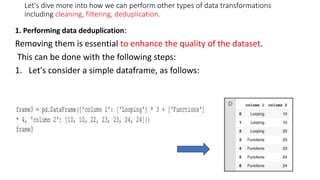
Let's dive more into how we can perform other types of data transformations
including cleaning, filtering, deduplication.
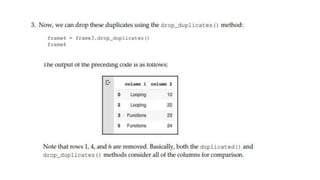
1. Performing data deduplication:
Removing them is essential to enhance the quality of the dataset.
This can be done with the following steps:
1. Let's consider a simple dataframe, as follows:
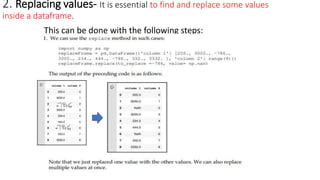
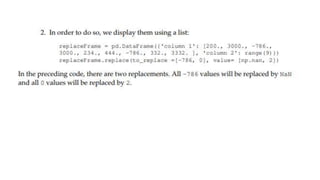
2. Replacing values- It is essential to find and replace some values
inside a dataframe.
This can be done with the following steps:
3.Handling missing data
• Whenever there are missing values, a NaN value is used, which
indicates that there is no value specified for that particular index.
• There could be several reasons why a value could be NaN:
• When data is retrieved from an external source and there are some
incomplete values in the dataset.
• It can also happen when we join two different datasets and some values are
not matched.
• Missing values due to data collection errors.
• When the shape of data changes, there are new additional rows or columns
that are not determined.
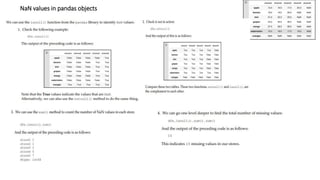
NaN values in pandas objects
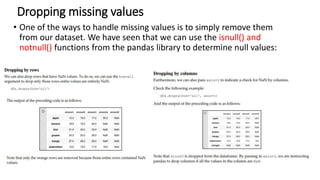
Dropping missing values
• One of the ways to handle missing values is to simply remove them
from our dataset. We have seen that we can use the isnull() and
notnull() functions from the pandas library to determine null values:
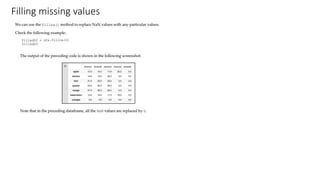
Filling missing values
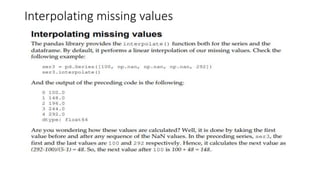
Interpolating missing values
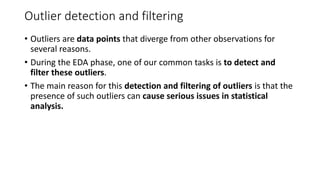
Outlier detection and filtering
• Outliers are data points that diverge from other observations for
several reasons.
• During the EDA phase, one of our common tasks is to detect and
filter these outliers.
• The main reason for this detection and filtering of outliers is that the
presence of such outliers can cause serious issues in statistical
analysis.
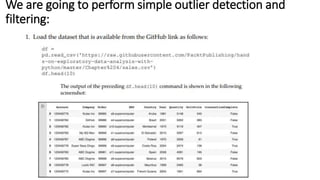
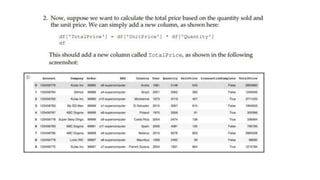
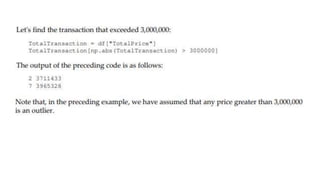
We are going to perform simple outlier detection and
filtering:
Grouping Datasets
• During data analysis, it is often essential to cluster or group data
together based on certain criteria.
• For example, an e-commerce store might want to group all the sales
that were done during the New year period
• These grouping concepts occur in several parts of data analysis
groupby() method
• During the data analysis phase, categorizing a dataset into multiple
categories or groups is often essential.
• The pandas groupby function is one of the most efficient and time-
saving features for doing this.
• Groupby provides functionalities that allow us to split-apply-combine
throughout the dataframe; that is, it can be used for
splitting, applying, and combining dataframes.
https://www.w3schools.com/python/pandas/trypython.asp?filename=demo
_ref_df_groupby
• The pandas groupby method performs two essential functions:
 It splits the data into groups based on some criteria.
 It applies a function to each group independently.
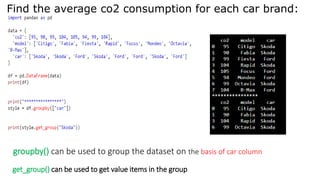
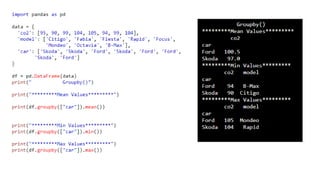
Find the average co2 consumption for each car brand:
import pandas as pd
data = {
'co2': [95, 90, 99, 104, 105, 94, 99, 104],
'model': ['Citigo', 'Fabia', 'Fiesta', 'Rapid',
'Focus', 'Mondeo’, 'Octavia', 'B-Max'],
'car': ['Skoda', 'Skoda', 'Ford', 'Skoda', 'Ford’,
'Ford', 'Skoda’, 'Ford’]
}
df = pd.DataFrame(data)
print(df)
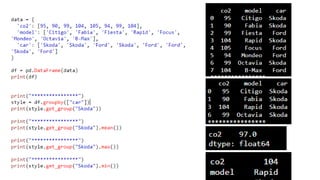
Find the average co2 consumption for each car brand:
groupby() can be used to group the dataset on the basis of car column
get_group() can be used to get value items in the group
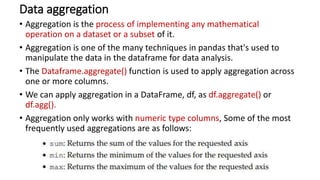
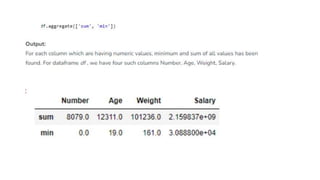
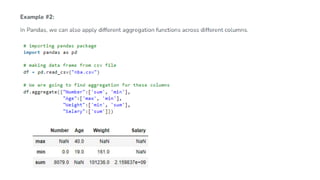
Data aggregation
• Aggregation is the process of implementing any mathematical
operation on a dataset or a subset of it.
• Aggregation is one of the many techniques in pandas that's used to
manipulate the data in the dataframe for data analysis.
• The Dataframe.aggregate() function is used to apply aggregation across
one or more columns.
• We can apply aggregation in a DataFrame, df, as df.aggregate() or
df.agg().
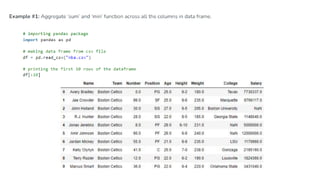
• Aggregation only works with numeric type columns, Some of the most
frequently used aggregations are as follows:
Transformation techniques.pptx

Transformation techniques.pptx

  • 1.
  • 2.
    Let's dive moreinto how we can perform other types of data transformations including cleaning, filtering, deduplication. 1. Performing data deduplication: Removing them is essential to enhance the quality of the dataset. This can be done with the following steps: 1. Let's consider a simple dataframe, as follows:
  • 5.
    2. Replacing values-It is essential to find and replace some values inside a dataframe. This can be done with the following steps:
  • 7.
    3.Handling missing data •Whenever there are missing values, a NaN value is used, which indicates that there is no value specified for that particular index. • There could be several reasons why a value could be NaN: • When data is retrieved from an external source and there are some incomplete values in the dataset. • It can also happen when we join two different datasets and some values are not matched. • Missing values due to data collection errors. • When the shape of data changes, there are new additional rows or columns that are not determined.
  • 8.
    NaN values inpandas objects
  • 9.
    Dropping missing values •One of the ways to handle missing values is to simply remove them from our dataset. We have seen that we can use the isnull() and notnull() functions from the pandas library to determine null values:
  • 10.
  • 11.
  • 12.
    Outlier detection andfiltering • Outliers are data points that diverge from other observations for several reasons. • During the EDA phase, one of our common tasks is to detect and filter these outliers. • The main reason for this detection and filtering of outliers is that the presence of such outliers can cause serious issues in statistical analysis.
  • 13.
    We are goingto perform simple outlier detection and filtering:
  • 16.
    Grouping Datasets • Duringdata analysis, it is often essential to cluster or group data together based on certain criteria. • For example, an e-commerce store might want to group all the sales that were done during the New year period • These grouping concepts occur in several parts of data analysis
  • 17.
    groupby() method • Duringthe data analysis phase, categorizing a dataset into multiple categories or groups is often essential. • The pandas groupby function is one of the most efficient and time- saving features for doing this. • Groupby provides functionalities that allow us to split-apply-combine throughout the dataframe; that is, it can be used for splitting, applying, and combining dataframes.
  • 18.
    https://www.w3schools.com/python/pandas/trypython.asp?filename=demo _ref_df_groupby • The pandasgroupby method performs two essential functions:  It splits the data into groups based on some criteria.  It applies a function to each group independently.
  • 19.
    Find the averageco2 consumption for each car brand: import pandas as pd data = { 'co2': [95, 90, 99, 104, 105, 94, 99, 104], 'model': ['Citigo', 'Fabia', 'Fiesta', 'Rapid', 'Focus', 'Mondeo’, 'Octavia', 'B-Max'], 'car': ['Skoda', 'Skoda', 'Ford', 'Skoda', 'Ford’, 'Ford', 'Skoda’, 'Ford’] } df = pd.DataFrame(data) print(df)
  • 20.
    Find the averageco2 consumption for each car brand: groupby() can be used to group the dataset on the basis of car column get_group() can be used to get value items in the group
  • 23.
    Data aggregation • Aggregationis the process of implementing any mathematical operation on a dataset or a subset of it. • Aggregation is one of the many techniques in pandas that's used to manipulate the data in the dataframe for data analysis. • The Dataframe.aggregate() function is used to apply aggregation across one or more columns. • We can apply aggregation in a DataFrame, df, as df.aggregate() or df.agg(). • Aggregation only works with numeric type columns, Some of the most frequently used aggregations are as follows: