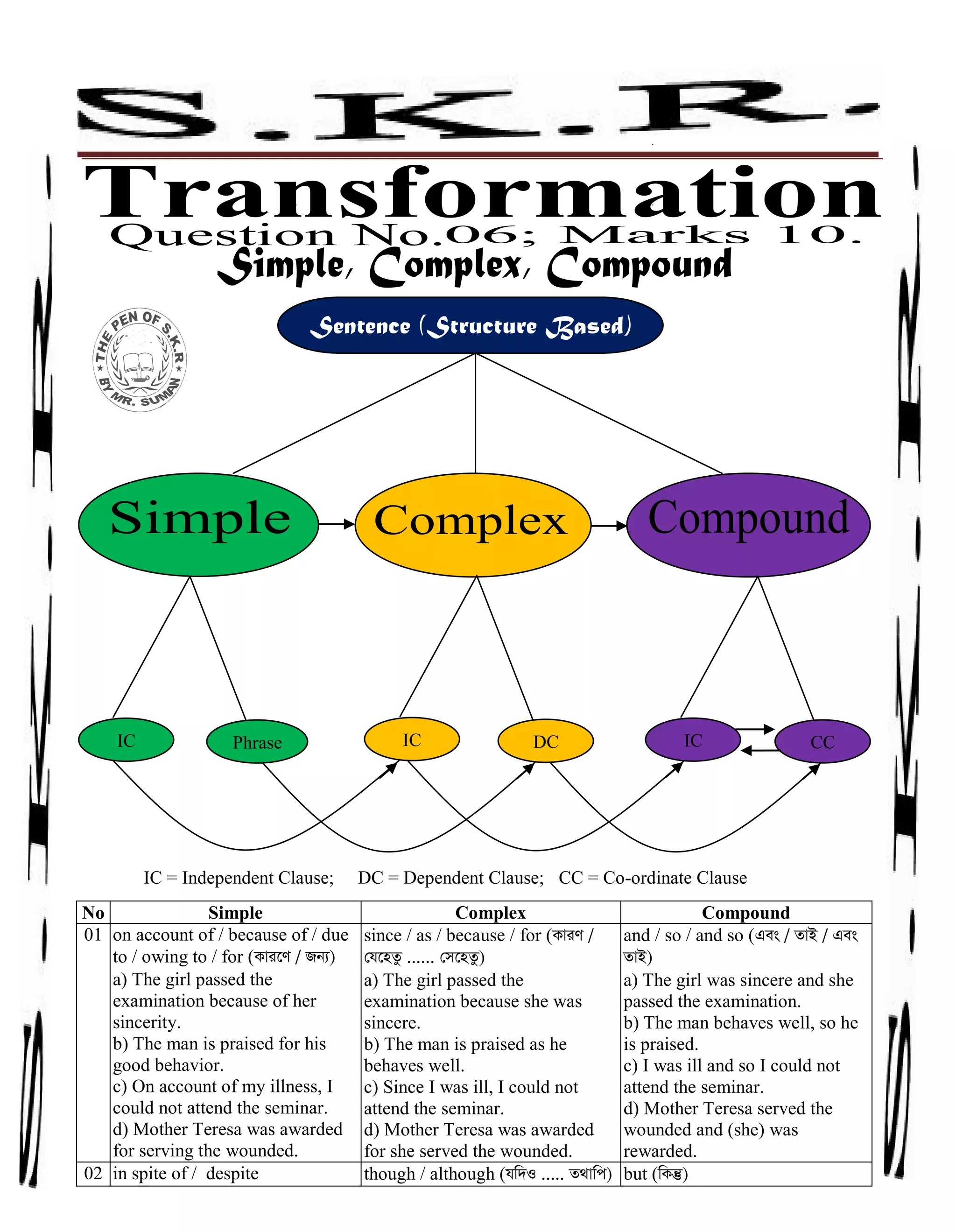
Simple, Complex, Compound
TransformationQuestion No.06; Marks 10.
IC = Independent Clause; DC = Dependent Clause; CC = Co-ordinate Clause
No Simple Complex Compound
01 on account of / because of / due
to / owing to / for (Kvi‡Y / Rb¨)
a) The girl passed the
examination because of her
sincerity.
b) The man is praised for his
good behavior.
c) On account of my illness, I
could not attend the seminar.
d) Mother Teresa was awarded
for serving the wounded.
since / as / because / for (KviY /
†h‡nZz ...... †m‡nZz)
a) The girl passed the
examination because she was
sincere.
b) The man is praised as he
behaves well.
c) Since I was ill, I could not
attend the seminar.
d) Mother Teresa was awarded
for she served the wounded.
and / so / and so (Ges / ZvB / Ges
ZvB)
a) The girl was sincere and she
passed the examination.
b) The man behaves well, so he
is praised.
c) I was ill and so I could not
attend the seminar.
d) Mother Teresa served the
wounded and (she) was
rewarded.
02 in spite of / despite though / although (hw`I ..... Z_vwc) but (wKš‘)
Simple Complex Compound
IC Phrase IC DC IC CC
Sentence (Structure Based)
a) In spite of her having
intelligence, the lady could not
succeed.
b) The student appeared at the
exam despite his sickness.
a) Though the lady had
intelligence, she could not
succeed.
b) The student appeared at the
exam although he was sick.
a) The lady had intelligence but
she could not succeed.
b) The student was sick but (he)
appeared at the exam.
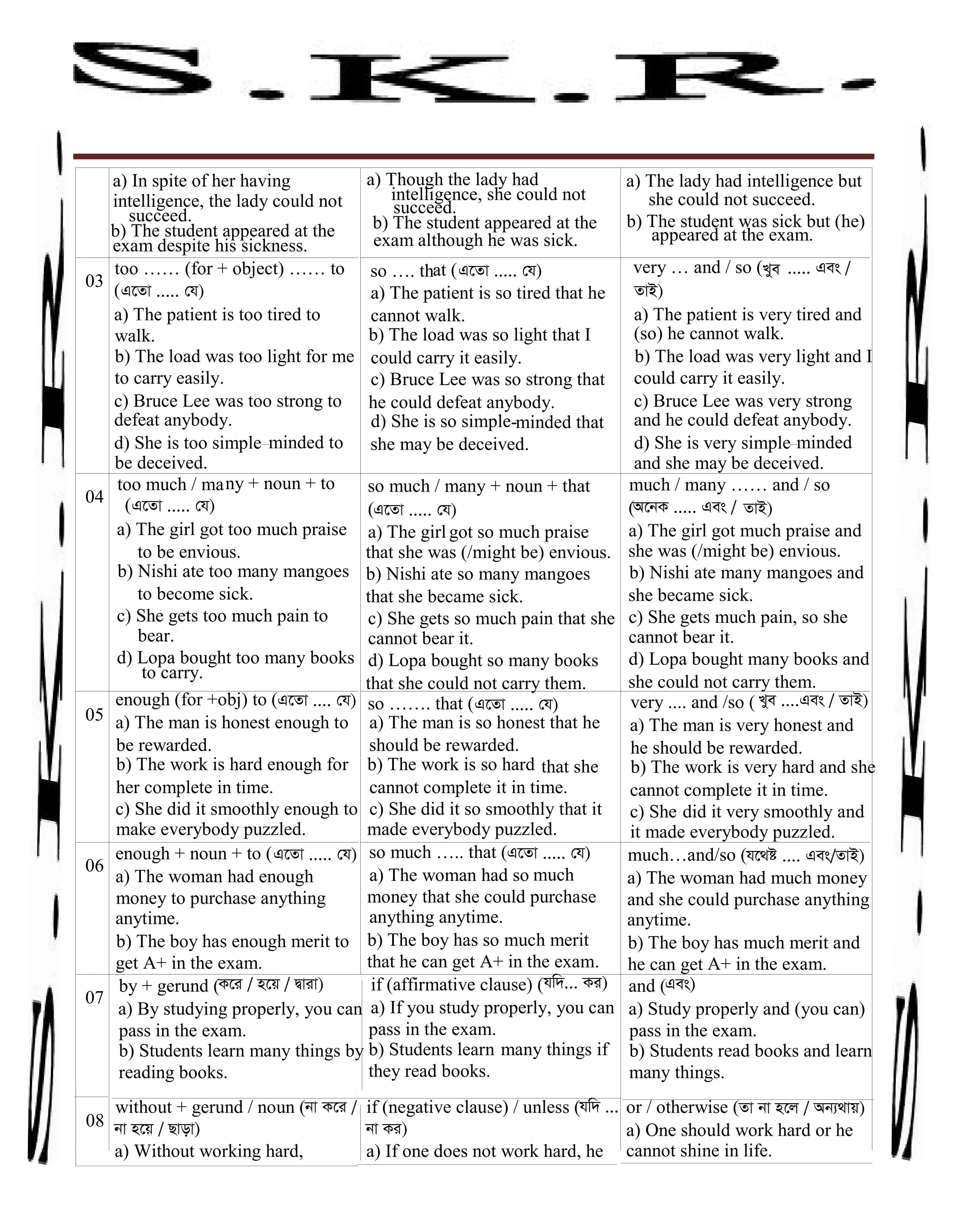
03
too …… (for + object) …… to
(G‡Zv ..... †h)
a) The patient is too tired to
walk.
b) The load was too light for me
to carry easily.
c) Bruce Lee was too strong to
defeat anybody.
d) She is too simple-
minded to
be deceived.
so …. that (G‡Zv ..... †h)
a) The patient is so tired that he
cannot walk.
b) The load was so light that I
could carry it easily.
c) Bruce Lee was so strong that
he could defeat anybody.
d) She is so simple-minded that
she may be deceived.
very … and / so (Lye ..... Ges /
ZvB)
a) The patient is very tired and
(so) he cannot walk.
b) The load was very light and I
could carry it easily.
c) Bruce Lee was very strong
and he could defeat anybody.
d) She is very simple-
minded
and she may be deceived.
04
too much / many + noun + to
(G‡Zv ..... †h)
a) The girl got too much praise
to be envious.
b) Nishi ate too many mangoes
to become sick.
c) She gets too much pain to
bear.
d) Lopa bought too many books
to carry.
so much / many + noun + that
(G‡Zv ..... †h)
a) The girl got so much praise
that she was (/might be) envious.
b) Nishi ate so many mangoes
that she became sick.
c) She gets so much pain that she
cannot bear it.
d) Lopa bought so many books
that she could not carry them.
much / many …… and / so
(A‡bK ..... Ges / ZvB)
a) The girl got much praise and
she was (/might be) envious.
b) Nishi ate many mangoes and
she became sick.
c) She gets much pain, so she
cannot bear it.
d) Lopa bought many books and
she could not carry them.
05
enough (for +obj) to (G‡Zv .... †h)
a) The man is honest enough to
be rewarded.
b) The work is hard enough for
her complete in time.
c) She did it smoothly enough to
make everybody puzzled.
so ……. that (G‡Zv ..... †h)
a) The man is so honest that he
should be rewarded.
b) The work is so hard that she
cannot complete it in time.
c) She did it so smoothly that it
made everybody puzzled.
very .... and /so ( Lye ....Ges / ZvB)
a) The man is very honest and
he should be rewarded.
b) The work is very hard and she
cannot complete it in time.
c) She did it very smoothly and
it made everybody puzzled.
06
enough + noun + to (G‡Zv ..... †h)
a) The woman had enough
money to purchase anything
anytime.
b) The boy has enough merit to
get A+ in the exam.
so much ….. that (G‡Zv ..... †h)
a) The woman had so much
money that she could purchase
anything anytime.
b) The boy has so much merit
that he can get A+ in the exam.
much…and/so (h‡_ó .... Ges/ZvB)
a) The woman had much money
and she could purchase anything
anytime.
b) The boy has much merit and
he can get A+ in the exam.
07
by + gerund (K‡i / n‡q / Øviv)
a) By studying properly, you can
pass in the exam.
b) Students learn many things by
reading books.
if (affirmative clause) (hw`... Ki)
a) If you study properly, you can
pass in the exam.
b) Students learn many things if
they read books.
and (Ges)
a) Study properly and (you can)
pass in the exam.
b) Students read books and learn
many things.
08
without + gerund / noun (bv K‡i /
bv n‡q / Qvov)
a) Without working hard,
if (negative clause) / unless (hw` ...
bv Ki)
a) If one does not work hard, he
or / otherwise (Zv bv n‡j / Ab¨_vq)
a) One should work hard or he
cannot shine in life.
nobody can shine in life.
b) You can’t get respect from
others without being honest.
c) Success won’t come without
your sincerity.
cannot shine in life.
b) You can’t get respect from
others if you are not honest.
c) Success won’t come if you are
not sincere.
b) Be honest otherwise you can’t
get respect from others.
c) Be sincere or success won’t
come. / You should be sincere or
success won’t come.
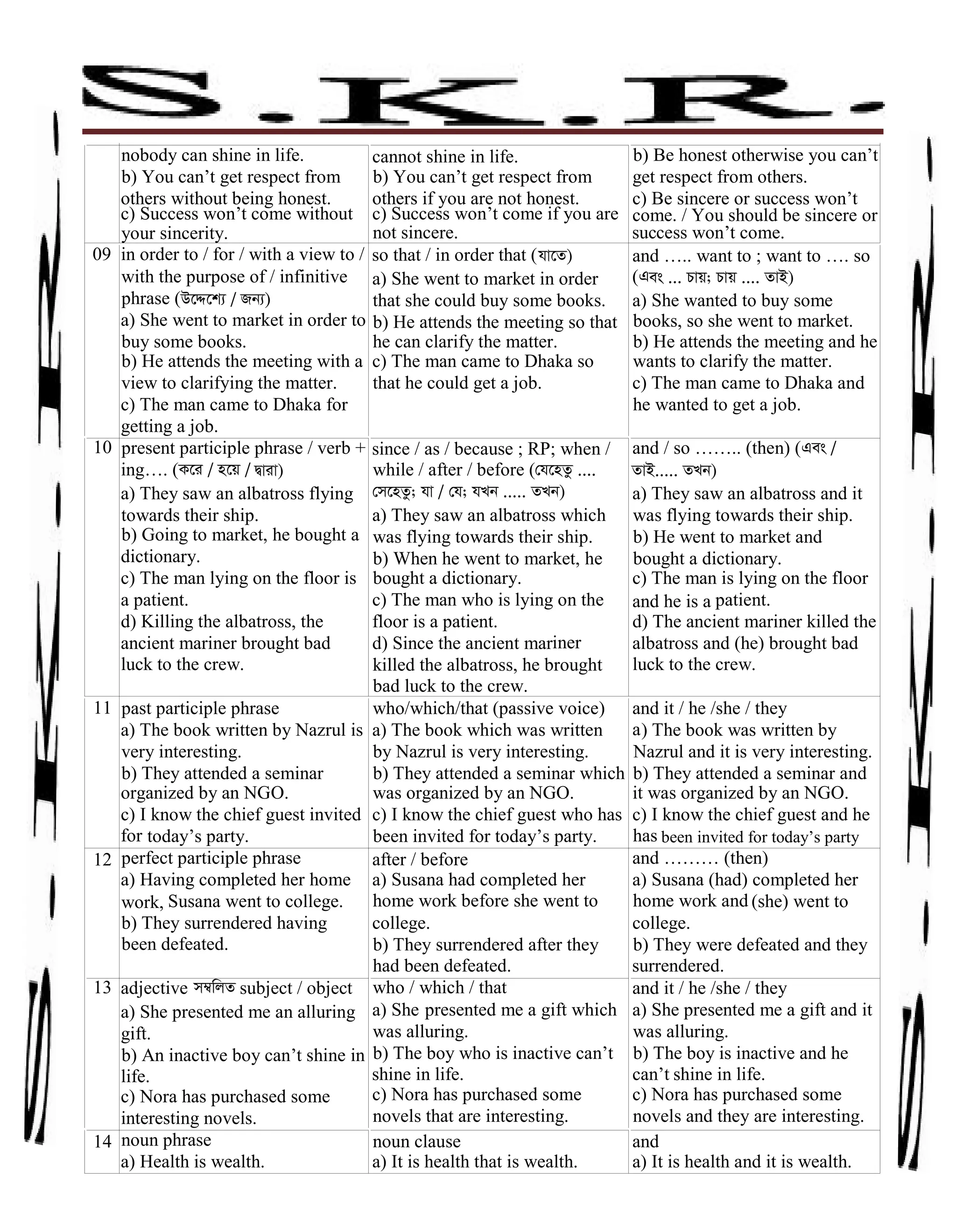
09 in order to / for / with a view to /
with the purpose of / infinitive
phrase (D‡Ï‡k¨ / Rb¨)
a) She went to market in order to
buy some books.
b) He attends the meeting with a
view to clarifying the matter.
c) The man came to Dhaka for
getting a job.
so that / in order that (hv‡Z)
a) She went to market in order
that she could buy some books.
b) He attends the meeting so that
he can clarify the matter.
c) The man came to Dhaka so
that he could get a job.
and ….. want to ; want to …. so
(Ges ... Pvq; Pvq .... ZvB)
a) She wanted to buy some
books, so she went to market.
b) He attends the meeting and he
wants to clarify the matter.
c) The man came to Dhaka and
he wanted to get a job.
10 present participle phrase / verb +
ing…. (K‡i / n‡q / Øviv)
a) They saw an albatross flying
towards their ship.
b) Going to market, he bought a
dictionary.
c) The man lying on the floor is
a patient.
d) Killing the albatross, the
ancient mariner brought bad
luck to the crew.
since / as / because ; RP; when /
while / after / before (†h‡nZz ....
†m‡nZz; hv / †h; hLb ..... ZLb)
a) They saw an albatross which
was flying towards their ship.
b) When he went to market, he
bought a dictionary.
c) The man who is lying on the
floor is a patient.
d) Since the ancient mariner
killed the albatross, he brought
bad luck to the crew.
and / so …….. (then) (Ges /
ZvB..... ZLb)
a) They saw an albatross and it
was flying towards their ship.
b) He went to market and
bought a dictionary.
c) The man is lying on the floor
and he is a patient.
d) The ancient mariner killed the
albatross and (he) brought bad
luck to the crew.
11 past participle phrase
a) The book written by Nazrul is
very interesting.
b) They attended a seminar
organized by an NGO.
c) I know the chief guest invited
for today’s party.
who/which/that (passive voice)
a) The book which was written
by Nazrul is very interesting.
b) They attended a seminar which
was organized by an NGO.
c) I know the chief guest who has
been invited for today’s party.
and it / he /she / they
a) The book was written by
Nazrul and it is very interesting.
b) They attended a seminar and
it was organized by an NGO.
c) I know the chief guest and he
has been invited for today’s party.
12 perfect participle phrase
a) Having completed her home
work, Susana went to college.
b) They surrendered having
been defeated.
after / before
a) Susana had completed her
home work before she went to
college.
b) They surrendered after they
had been defeated.
and ……… (then)
a) Susana (had) completed her
home work and (she) went to
college.
b) They were defeated and they
surrendered.
13 adjective m¤^wjZ subject / object
a) She presented me an alluring
gift.
b) An inactive boy can’t shine in
life.
c) Nora has purchased some
interesting novels.
who / which / that
a) She presented me a gift which
was alluring.
b) The boy who is inactive can’t
shine in life.
c) Nora has purchased some
novels that are interesting.
and it / he /she / they
a) She presented me a gift and it
was alluring.
b) The boy is inactive and he
can’t shine in life.
c) Nora has purchased some
novels and they are interesting.
14 noun phrase
a) Health is wealth.
noun clause
a) It is health that is wealth.
and
a) It is health and it is wealth.
b) Her information proved right.
c) Everybody knows her
birthplace.
b) What she informed proved
right.
c) Everybody knows where she
was born.
b) She informed something and
it proved right.
c) It was her birthplace and
everybody knows it.
15 at the time / age of; in the month
/ year of; at, in, on, after, before
BZ¨vw` Øviv mgq wb‡`©k Ki‡j
a) Jerry came to the orphanage
at the age of four.
b) He goes to school at 10:00
a.m.
c) Bangladesh became
independent in 1971.
d) He got puzzled at her arrival.
e) The lady goes out after her
husband’s return.
when / while / after / before
a) Jerry came to the orphanage
when he was four.
b) 10:00 a.m. is the time when he
goes to school. / It is 10:00 a.m.
when he goes to school.
c) 1971 was the year / It was
1971 when Bangladesh became
independent.
d) He got puzzled when she
arrived.
e) The lady goes out after her
husband returns.
and …….. (then)
a) Jerry came to the orphanage
and he was four then.
b) It is 10:00 a.m. and he goes to
school then.
c) It was 1971 and then
Bangladesh became
independent.
d) She arrived and at that he got
puzzled. / She arrived and so he
got puzzled.
e) The lady’s husband returns
and she goes out (then).
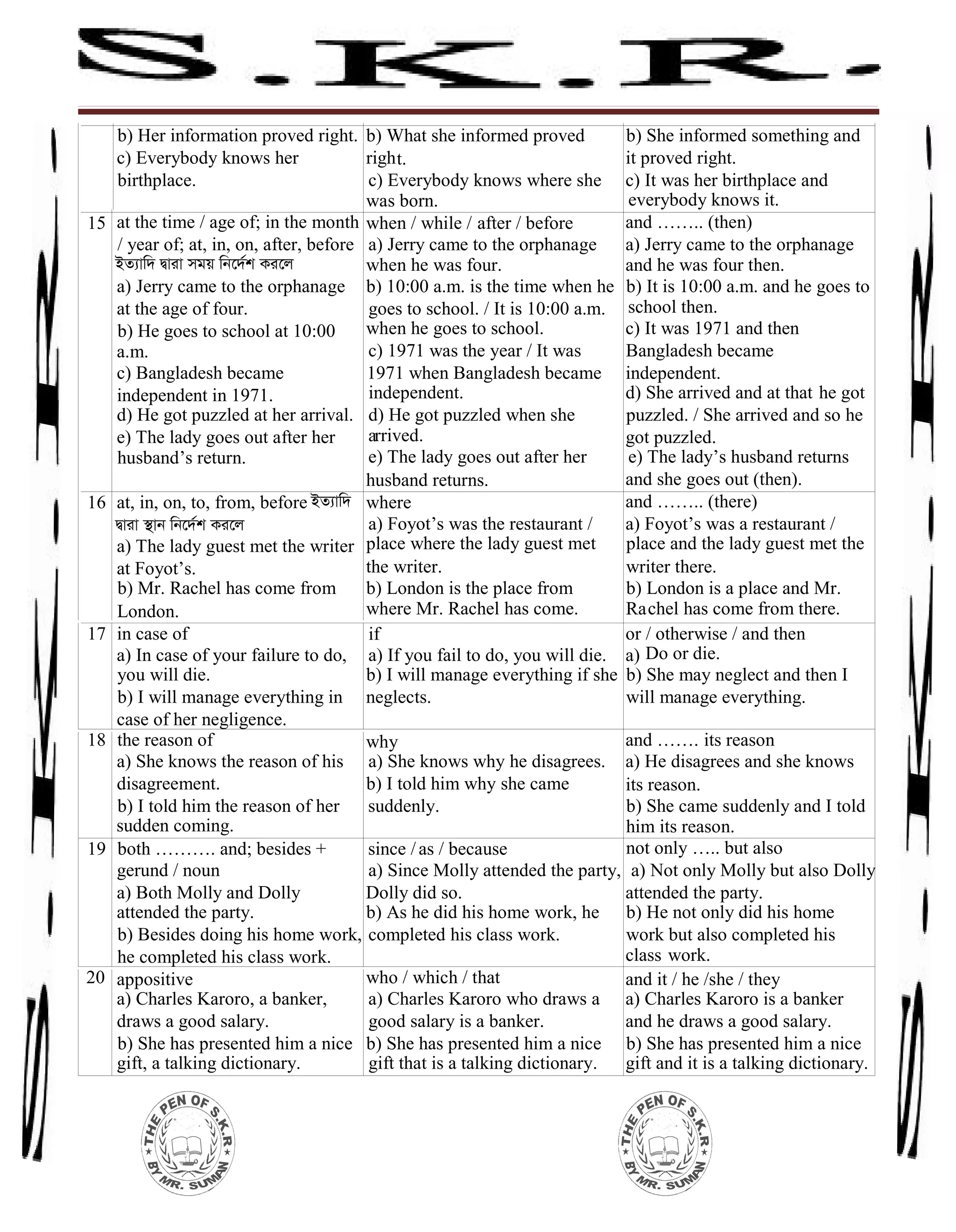
16 at, in, on, to, from, before BZ¨vw`
Øviv ¯’vb wb‡`©k Ki‡j
a) The lady guest met the writer
at Foyot’s.
b) Mr. Rachel has come from
London.
where
a) Foyot’s was the restaurant /
place where the lady guest met
the writer.
b) London is the place from
where Mr. Rachel has come.
and …….. (there)
a) Foyot’s was a restaurant /
place and the lady guest met the
writer there.
b) London is a place and Mr.
Rachel has come from there.
17 in case of
a) In case of your failure to do,
you will die.
b) I will manage everything in
case of her negligence.
if
a) If you fail to do, you will die.
b) I will manage everything if she
neglects.
or / otherwise / and then
a) Do or die.
b) She may neglect and then I
will manage everything.
18 the reason of
a) She knows the reason of his
disagreement.
b) I told him the reason of her
sudden coming.
why
a) She knows why he disagrees.
b) I told him why she came
suddenly.
and ……. its reason
a) He disagrees and she knows
its reason.
b) She came suddenly and I told
him its reason.
19 both ………. and; besides +
gerund / noun
a) Both Molly and Dolly
attended the party.
b) Besides doing his home work,
he completed his class work.
since / as / because
a) Since Molly attended the party,
Dolly did so.
b) As he did his home work, he
completed his class work.
not only ….. but also
a) Not only Molly but also Dolly
attended the party.
b) He not only did his home
work but also completed his
class work.
20 appositive
a) Charles Karoro, a banker,
draws a good salary.
b) She has presented him a nice
gift, a talking dictionary.
who / which / that
a) Charles Karoro who draws a
good salary is a banker.
b) She has presented him a nice
gift that is a talking dictionary.
and it / he /she / they
a) Charles Karoro is a banker
and he draws a good salary.
b) She has presented him a nice
gift and it is a talking dictionary.
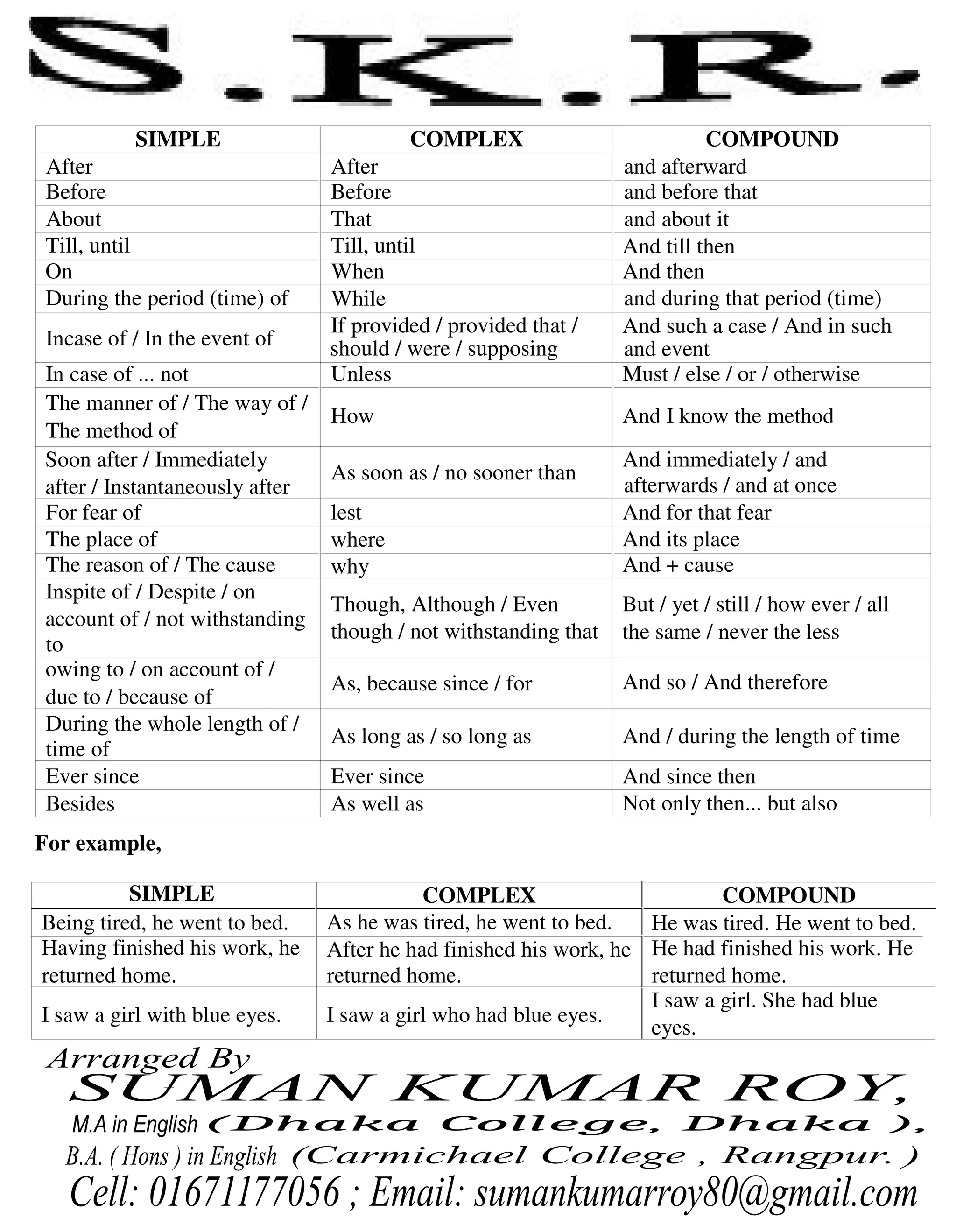
Not only then... but alsoAs well asBesides
And since thenEver sinceEver since
And / during the length of timeAs long as / so long as
time of
During the whole length of /
And so / And thereforeAs, because since / for
due to / because of
owing to / on account of /
the same / never the less
But / yet / still / how ever / all
though / not withstanding that
Though, Although / Even
to
account of / not withstanding
Inspite of / Despite / on
And + causewhyThe reason of / The cause
And its placewhereThe place of
And for that fearlestFor fear of
afterwards / and at once
And immediately / and
As soon as / no sooner than
after / Instantaneously after
Soon after / Immediately
And I know the methodHow
The method of
The manner of / The way of /
Must / else / or / otherwiseUnlessIn case of ... not
and event
And such a case / And in such
should / were / supposing
If provided / provided that /
Incase of / In the event of
and during that period (time)WhileDuring the period (time) of
And thenWhenOn
And till thenTill, untilTill, until
and about itThatAbout
and before thatBeforeBefore
and afterwardAfterAfter
COMPOUNDCOMPLEXSIMPLE
eyes.
I saw a girl. She had blue
I saw a girl who had blue eyes.I saw a girl with blue eyes.
returned home.
He had finished his work. He
returned home.
After he had finished his work, he
returned home.
Having finished his work, he
He was tired. He went to bed.As he was tired, he went to bed.Being tired, he went to bed.
COMPOUNDCOMPLEXSIMPLE
For example,
Cell: 01671177056 ; Email: sumankumarroy80@gmail.com
(Carmichael College , Rangpur. )B.A. ( Hons ) in English
(Dhaka College, Dhaka ),M.A in English
SUMAN KUMAR ROY,_
Arranged By

Transformation of Sentences for HSC, SSC Students

  • 1.
    Simple, Complex, Compound TransformationQuestionNo.06; Marks 10. IC = Independent Clause; DC = Dependent Clause; CC = Co-ordinate Clause No Simple Complex Compound 01 on account of / because of / due to / owing to / for (Kvi‡Y / Rb¨) a) The girl passed the examination because of her sincerity. b) The man is praised for his good behavior. c) On account of my illness, I could not attend the seminar. d) Mother Teresa was awarded for serving the wounded. since / as / because / for (KviY / †h‡nZz ...... †m‡nZz) a) The girl passed the examination because she was sincere. b) The man is praised as he behaves well. c) Since I was ill, I could not attend the seminar. d) Mother Teresa was awarded for she served the wounded. and / so / and so (Ges / ZvB / Ges ZvB) a) The girl was sincere and she passed the examination. b) The man behaves well, so he is praised. c) I was ill and so I could not attend the seminar. d) Mother Teresa served the wounded and (she) was rewarded. 02 in spite of / despite though / although (hw`I ..... Z_vwc) but (wKš‘) Simple Complex Compound IC Phrase IC DC IC CC Sentence (Structure Based)
  • 2.
    a) In spiteof her having intelligence, the lady could not succeed. b) The student appeared at the exam despite his sickness. a) Though the lady had intelligence, she could not succeed. b) The student appeared at the exam although he was sick. a) The lady had intelligence but she could not succeed. b) The student was sick but (he) appeared at the exam. 03 too …… (for + object) …… to (G‡Zv ..... †h) a) The patient is too tired to walk. b) The load was too light for me to carry easily. c) Bruce Lee was too strong to defeat anybody. d) She is too simple- minded to be deceived. so …. that (G‡Zv ..... †h) a) The patient is so tired that he cannot walk. b) The load was so light that I could carry it easily. c) Bruce Lee was so strong that he could defeat anybody. d) She is so simple-minded that she may be deceived. very … and / so (Lye ..... Ges / ZvB) a) The patient is very tired and (so) he cannot walk. b) The load was very light and I could carry it easily. c) Bruce Lee was very strong and he could defeat anybody. d) She is very simple- minded and she may be deceived. 04 too much / many + noun + to (G‡Zv ..... †h) a) The girl got too much praise to be envious. b) Nishi ate too many mangoes to become sick. c) She gets too much pain to bear. d) Lopa bought too many books to carry. so much / many + noun + that (G‡Zv ..... †h) a) The girl got so much praise that she was (/might be) envious. b) Nishi ate so many mangoes that she became sick. c) She gets so much pain that she cannot bear it. d) Lopa bought so many books that she could not carry them. much / many …… and / so (A‡bK ..... Ges / ZvB) a) The girl got much praise and she was (/might be) envious. b) Nishi ate many mangoes and she became sick. c) She gets much pain, so she cannot bear it. d) Lopa bought many books and she could not carry them. 05 enough (for +obj) to (G‡Zv .... †h) a) The man is honest enough to be rewarded. b) The work is hard enough for her complete in time. c) She did it smoothly enough to make everybody puzzled. so ……. that (G‡Zv ..... †h) a) The man is so honest that he should be rewarded. b) The work is so hard that she cannot complete it in time. c) She did it so smoothly that it made everybody puzzled. very .... and /so ( Lye ....Ges / ZvB) a) The man is very honest and he should be rewarded. b) The work is very hard and she cannot complete it in time. c) She did it very smoothly and it made everybody puzzled. 06 enough + noun + to (G‡Zv ..... †h) a) The woman had enough money to purchase anything anytime. b) The boy has enough merit to get A+ in the exam. so much ….. that (G‡Zv ..... †h) a) The woman had so much money that she could purchase anything anytime. b) The boy has so much merit that he can get A+ in the exam. much…and/so (h‡_ó .... Ges/ZvB) a) The woman had much money and she could purchase anything anytime. b) The boy has much merit and he can get A+ in the exam. 07 by + gerund (K‡i / n‡q / Øviv) a) By studying properly, you can pass in the exam. b) Students learn many things by reading books. if (affirmative clause) (hw`... Ki) a) If you study properly, you can pass in the exam. b) Students learn many things if they read books. and (Ges) a) Study properly and (you can) pass in the exam. b) Students read books and learn many things. 08 without + gerund / noun (bv K‡i / bv n‡q / Qvov) a) Without working hard, if (negative clause) / unless (hw` ... bv Ki) a) If one does not work hard, he or / otherwise (Zv bv n‡j / Ab¨_vq) a) One should work hard or he cannot shine in life.
  • 3.
    nobody can shinein life. b) You can’t get respect from others without being honest. c) Success won’t come without your sincerity. cannot shine in life. b) You can’t get respect from others if you are not honest. c) Success won’t come if you are not sincere. b) Be honest otherwise you can’t get respect from others. c) Be sincere or success won’t come. / You should be sincere or success won’t come. 09 in order to / for / with a view to / with the purpose of / infinitive phrase (D‡Ï‡k¨ / Rb¨) a) She went to market in order to buy some books. b) He attends the meeting with a view to clarifying the matter. c) The man came to Dhaka for getting a job. so that / in order that (hv‡Z) a) She went to market in order that she could buy some books. b) He attends the meeting so that he can clarify the matter. c) The man came to Dhaka so that he could get a job. and ….. want to ; want to …. so (Ges ... Pvq; Pvq .... ZvB) a) She wanted to buy some books, so she went to market. b) He attends the meeting and he wants to clarify the matter. c) The man came to Dhaka and he wanted to get a job. 10 present participle phrase / verb + ing…. (K‡i / n‡q / Øviv) a) They saw an albatross flying towards their ship. b) Going to market, he bought a dictionary. c) The man lying on the floor is a patient. d) Killing the albatross, the ancient mariner brought bad luck to the crew. since / as / because ; RP; when / while / after / before (†h‡nZz .... †m‡nZz; hv / †h; hLb ..... ZLb) a) They saw an albatross which was flying towards their ship. b) When he went to market, he bought a dictionary. c) The man who is lying on the floor is a patient. d) Since the ancient mariner killed the albatross, he brought bad luck to the crew. and / so …….. (then) (Ges / ZvB..... ZLb) a) They saw an albatross and it was flying towards their ship. b) He went to market and bought a dictionary. c) The man is lying on the floor and he is a patient. d) The ancient mariner killed the albatross and (he) brought bad luck to the crew. 11 past participle phrase a) The book written by Nazrul is very interesting. b) They attended a seminar organized by an NGO. c) I know the chief guest invited for today’s party. who/which/that (passive voice) a) The book which was written by Nazrul is very interesting. b) They attended a seminar which was organized by an NGO. c) I know the chief guest who has been invited for today’s party. and it / he /she / they a) The book was written by Nazrul and it is very interesting. b) They attended a seminar and it was organized by an NGO. c) I know the chief guest and he has been invited for today’s party. 12 perfect participle phrase a) Having completed her home work, Susana went to college. b) They surrendered having been defeated. after / before a) Susana had completed her home work before she went to college. b) They surrendered after they had been defeated. and ……… (then) a) Susana (had) completed her home work and (she) went to college. b) They were defeated and they surrendered. 13 adjective m¤^wjZ subject / object a) She presented me an alluring gift. b) An inactive boy can’t shine in life. c) Nora has purchased some interesting novels. who / which / that a) She presented me a gift which was alluring. b) The boy who is inactive can’t shine in life. c) Nora has purchased some novels that are interesting. and it / he /she / they a) She presented me a gift and it was alluring. b) The boy is inactive and he can’t shine in life. c) Nora has purchased some novels and they are interesting. 14 noun phrase a) Health is wealth. noun clause a) It is health that is wealth. and a) It is health and it is wealth.
  • 4.
    b) Her informationproved right. c) Everybody knows her birthplace. b) What she informed proved right. c) Everybody knows where she was born. b) She informed something and it proved right. c) It was her birthplace and everybody knows it. 15 at the time / age of; in the month / year of; at, in, on, after, before BZ¨vw` Øviv mgq wb‡`©k Ki‡j a) Jerry came to the orphanage at the age of four. b) He goes to school at 10:00 a.m. c) Bangladesh became independent in 1971. d) He got puzzled at her arrival. e) The lady goes out after her husband’s return. when / while / after / before a) Jerry came to the orphanage when he was four. b) 10:00 a.m. is the time when he goes to school. / It is 10:00 a.m. when he goes to school. c) 1971 was the year / It was 1971 when Bangladesh became independent. d) He got puzzled when she arrived. e) The lady goes out after her husband returns. and …….. (then) a) Jerry came to the orphanage and he was four then. b) It is 10:00 a.m. and he goes to school then. c) It was 1971 and then Bangladesh became independent. d) She arrived and at that he got puzzled. / She arrived and so he got puzzled. e) The lady’s husband returns and she goes out (then). 16 at, in, on, to, from, before BZ¨vw` Øviv ¯’vb wb‡`©k Ki‡j a) The lady guest met the writer at Foyot’s. b) Mr. Rachel has come from London. where a) Foyot’s was the restaurant / place where the lady guest met the writer. b) London is the place from where Mr. Rachel has come. and …….. (there) a) Foyot’s was a restaurant / place and the lady guest met the writer there. b) London is a place and Mr. Rachel has come from there. 17 in case of a) In case of your failure to do, you will die. b) I will manage everything in case of her negligence. if a) If you fail to do, you will die. b) I will manage everything if she neglects. or / otherwise / and then a) Do or die. b) She may neglect and then I will manage everything. 18 the reason of a) She knows the reason of his disagreement. b) I told him the reason of her sudden coming. why a) She knows why he disagrees. b) I told him why she came suddenly. and ……. its reason a) He disagrees and she knows its reason. b) She came suddenly and I told him its reason. 19 both ………. and; besides + gerund / noun a) Both Molly and Dolly attended the party. b) Besides doing his home work, he completed his class work. since / as / because a) Since Molly attended the party, Dolly did so. b) As he did his home work, he completed his class work. not only ….. but also a) Not only Molly but also Dolly attended the party. b) He not only did his home work but also completed his class work. 20 appositive a) Charles Karoro, a banker, draws a good salary. b) She has presented him a nice gift, a talking dictionary. who / which / that a) Charles Karoro who draws a good salary is a banker. b) She has presented him a nice gift that is a talking dictionary. and it / he /she / they a) Charles Karoro is a banker and he draws a good salary. b) She has presented him a nice gift and it is a talking dictionary.
  • 5.
    Not only then...but alsoAs well asBesides And since thenEver sinceEver since And / during the length of timeAs long as / so long as time of During the whole length of / And so / And thereforeAs, because since / for due to / because of owing to / on account of / the same / never the less But / yet / still / how ever / all though / not withstanding that Though, Although / Even to account of / not withstanding Inspite of / Despite / on And + causewhyThe reason of / The cause And its placewhereThe place of And for that fearlestFor fear of afterwards / and at once And immediately / and As soon as / no sooner than after / Instantaneously after Soon after / Immediately And I know the methodHow The method of The manner of / The way of / Must / else / or / otherwiseUnlessIn case of ... not and event And such a case / And in such should / were / supposing If provided / provided that / Incase of / In the event of and during that period (time)WhileDuring the period (time) of And thenWhenOn And till thenTill, untilTill, until and about itThatAbout and before thatBeforeBefore and afterwardAfterAfter COMPOUNDCOMPLEXSIMPLE eyes. I saw a girl. She had blue I saw a girl who had blue eyes.I saw a girl with blue eyes. returned home. He had finished his work. He returned home. After he had finished his work, he returned home. Having finished his work, he He was tired. He went to bed.As he was tired, he went to bed.Being tired, he went to bed. COMPOUNDCOMPLEXSIMPLE For example, Cell: 01671177056 ; Email: sumankumarroy80@gmail.com (Carmichael College , Rangpur. )B.A. ( Hons ) in English (Dhaka College, Dhaka ),M.A in English SUMAN KUMAR ROY,_ Arranged By