
Transfer Learning for Real-World
Applications using Deep Learning
Deep Learning on Steroids with the
Power of Knowledge Transfer!
Conducted by: Rahat Yasir
Microsoft MVP - AI
AI Engineer, Intact Financial Corp
Outline
• Session Agenda:
• Transfer Learning
• Strategies
• Type of transfer learning
• Transfer learning process
• Limitations and advantages
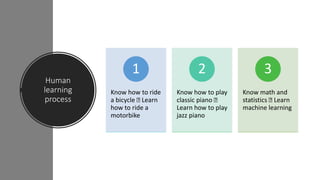
Human
learning
process
Know how to ride
a bicycle ⮫ Learn
how to ride a
motorbike
1
Know how to play
classic piano ⮫
Learn how to play
jazz piano
2
Know math and
statistics ⮫ Learn
machine learning
3
Motivation for
Transfer
Learning
• Transfer learning is the idea of
overcoming the isolated learning
paradigm and utilizing knowledge
acquired for one task to solve related
ones.
Artificial General Intelligence
– Instead of AI
• Given the craze for True Artificial General
Intelligence, transfer learning is something
which data scientists and researchers believe
can further our progress towards AGI –
Andrew NG
• After supervised learning — Transfer Learning
will be the next driver of ML commercial
success- Andrew NG
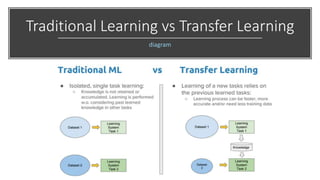
Traditional Learning vs Transfer Learning
diagram
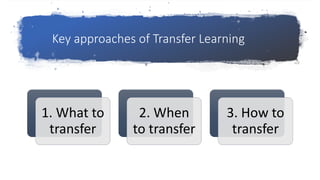
Key approaches of Transfer Learning
1. What to
transfer
2. When
to transfer
3. How to
transfer
Transfer
Learning
Strategies
1. Inductive Transfer learning: Same
domain but different tasks.
2. Unsupervised Transfer Learning:
Source and target domains are
similar but tasks are different.
3. Transductive Transfer Learning:
Corresponding domains are different
but tasks are similar.
Transfer
Learning
Approaches
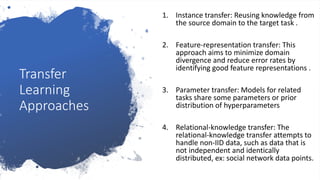
1. Instance transfer: Reusing knowledge from
the source domain to the target task .
2. Feature-representation transfer: This
approach aims to minimize domain
divergence and reduce error rates by
identifying good feature representations .
3. Parameter transfer: Models for related
tasks share some parameters or prior
distribution of hyperparameters
4. Relational-knowledge transfer: The
relational-knowledge transfer attempts to
handle non-IID data, such as data that is
not independent and identically
distributed, ex: social network data points.
Transfer Learning
for Deep Learning
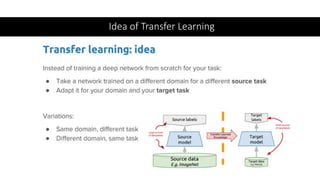
Idea of Transfer Learning
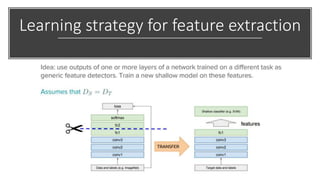
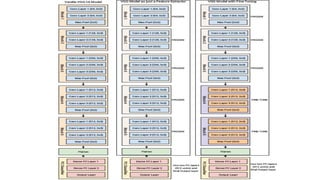
Learning strategy for feature extraction
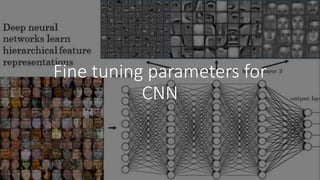
Fine tuning parameters for
CNN
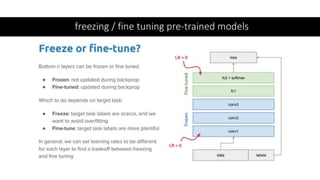
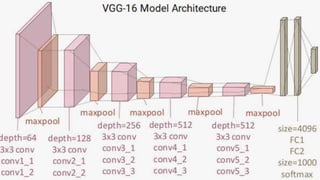
freezing / fine tuning pre-trained models
Existing pre-
trained model use
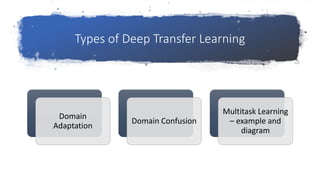
Types of Deep Transfer Learning
Domain
Adaptation
Domain Confusion
Multitask Learning
– example and
diagram
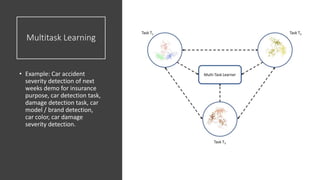
Multitask Learning
• Example: Car accident
severity detection of next
weeks demo for insurance
purpose, car detection task,
damage detection task, car
model / brand detection,
car color, car damage
severity detection.
One-shot Learning
Zero-shot Learning
Applications of Transfer
Learning
• Transfer Learning for NLP
• Transfer Learning on Audio Data
• Transfer Learning for Generative Deep
Learning
• More complex Computer Vision problems
like Image Captioning
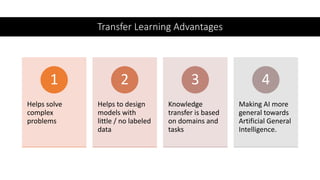
Transfer Learning Advantages
Helps solve
complex
problems
1
Helps to design
models with
little / no labeled
data
2
Knowledge
transfer is based
on domains and
tasks
3
Making AI more
general towards
Artificial General
Intelligence.
4
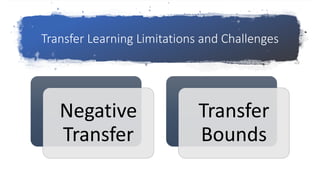
Transfer Learning Limitations and Challenges
Negative
Transfer
Transfer
Bounds
Thank You
Q &A

Transfer learning with real world applications in deep learning

  • 1.
    Transfer Learning forReal-World Applications using Deep Learning Deep Learning on Steroids with the Power of Knowledge Transfer! Conducted by: Rahat Yasir Microsoft MVP - AI AI Engineer, Intact Financial Corp
  • 2.
    Outline • Session Agenda: •Transfer Learning • Strategies • Type of transfer learning • Transfer learning process • Limitations and advantages
  • 3.
    Human learning process Know how toride a bicycle ⮫ Learn how to ride a motorbike 1 Know how to play classic piano ⮫ Learn how to play jazz piano 2 Know math and statistics ⮫ Learn machine learning 3
  • 4.
    Motivation for Transfer Learning • Transferlearning is the idea of overcoming the isolated learning paradigm and utilizing knowledge acquired for one task to solve related ones.
  • 5.
    Artificial General Intelligence –Instead of AI • Given the craze for True Artificial General Intelligence, transfer learning is something which data scientists and researchers believe can further our progress towards AGI – Andrew NG • After supervised learning — Transfer Learning will be the next driver of ML commercial success- Andrew NG
  • 6.
    Traditional Learning vsTransfer Learning diagram
  • 7.
    Key approaches ofTransfer Learning 1. What to transfer 2. When to transfer 3. How to transfer
  • 8.
    Transfer Learning Strategies 1. Inductive Transferlearning: Same domain but different tasks. 2. Unsupervised Transfer Learning: Source and target domains are similar but tasks are different. 3. Transductive Transfer Learning: Corresponding domains are different but tasks are similar.
  • 9.
    Transfer Learning Approaches 1. Instance transfer:Reusing knowledge from the source domain to the target task . 2. Feature-representation transfer: This approach aims to minimize domain divergence and reduce error rates by identifying good feature representations . 3. Parameter transfer: Models for related tasks share some parameters or prior distribution of hyperparameters 4. Relational-knowledge transfer: The relational-knowledge transfer attempts to handle non-IID data, such as data that is not independent and identically distributed, ex: social network data points.
  • 10.
  • 11.
  • 12.
    Learning strategy forfeature extraction
  • 13.
  • 14.
    freezing / finetuning pre-trained models
  • 15.
  • 16.
    Types of DeepTransfer Learning Domain Adaptation Domain Confusion Multitask Learning – example and diagram
  • 17.
    Multitask Learning • Example:Car accident severity detection of next weeks demo for insurance purpose, car detection task, damage detection task, car model / brand detection, car color, car damage severity detection.
  • 18.
  • 19.
  • 20.
    Applications of Transfer Learning •Transfer Learning for NLP • Transfer Learning on Audio Data • Transfer Learning for Generative Deep Learning • More complex Computer Vision problems like Image Captioning
  • 23.
    Transfer Learning Advantages Helpssolve complex problems 1 Helps to design models with little / no labeled data 2 Knowledge transfer is based on domains and tasks 3 Making AI more general towards Artificial General Intelligence. 4
  • 24.
    Transfer Learning Limitationsand Challenges Negative Transfer Transfer Bounds
  • 25.