Transactions in HBase
Andreas Neumann
ApacheCon Big Data May 2017
anew at apache.org
@caskoid
Goals of this Talk
- Why transactions?
- Optimistic Concurrency Control
- Three Apache projects: Omid, Tephra, Trafodion
- How are they different?
2
Transactions in noSQL?
History
• SQL: RDBMS, EDW, …
• noSQL: MapReduce, HDFS, HBase, …
• n(ot)o(nly)SQL: Hive, Phoenix, …
Motivation:
• Data consistency under highly concurrent loads
• Partial outputs after failure
• Consistent view of data for long-running jobs
• (Near) real-time processing
3
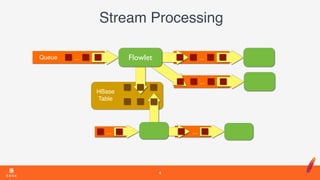
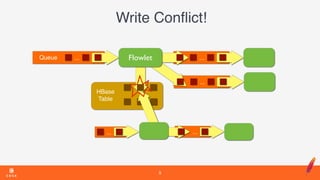
Stream Processing
4
HBase
Table
...Queue ...
...
Flowlet
... ...
HBase
Table
...Queue ...
...
Flowlet
... ...
Write Conflict!
5
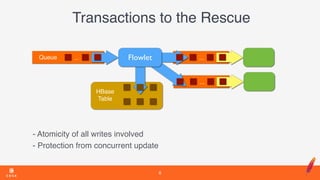
Transactions to the Rescue
6
HBase
Table
...Queue ...
...
Flowlet
- Atomicity of all writes involved
- Protection from concurrent update
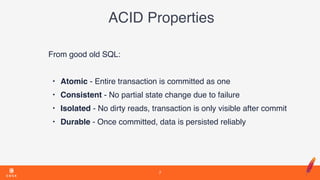
ACID Properties
From good old SQL:
• Atomic - Entire transaction is committed as one
• Consistent - No partial state change due to failure
• Isolated - No dirty reads, transaction is only visible after commit
• Durable - Once committed, data is persisted reliably
7
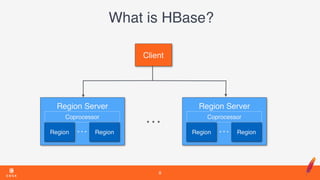
What is HBase?
8
…
Client
Region Server
Region Region…
Coprocessor
Region Server
Region Region…
Coprocessor
What is HBase?
9
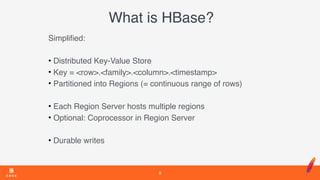
Simplified:
• Distributed Key-Value Store
• Key = <row>.<family>.<column>.<timestamp>
• Partitioned into Regions (= continuous range of rows)
• Each Region Server hosts multiple regions
• Optional: Coprocessor in Region Server
• Durable writes
ACID Properties in HBase
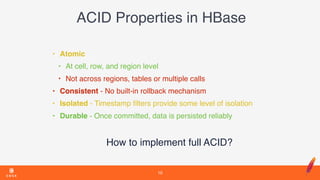
• Atomic
• At cell, row, and region level
• Not across regions, tables or multiple calls
• Consistent - No built-in rollback mechanism
• Isolated - Timestamp filters provide some level of isolation
• Durable - Once committed, data is persisted reliably
How to implement full ACID?
10
Implementing Transactions
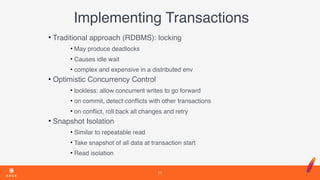
• Traditional approach (RDBMS): locking
• May produce deadlocks
• Causes idle wait
• complex and expensive in a distributed env
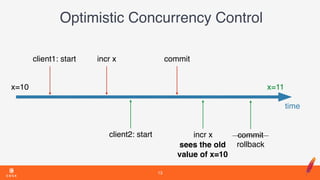
• Optimistic Concurrency Control
• lockless: allow concurrent writes to go forward
• on commit, detect conflicts with other transactions
• on conflict, roll back all changes and retry
• Snapshot Isolation
• Similar to repeatable read
• Take snapshot of all data at transaction start
• Read isolation
11
Optimistic Concurrency Control
12
time
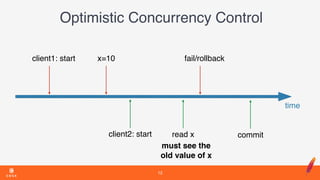
x=10client1: start fail/rollback
client2: start read x commit
must see the
old value of x
Optimistic Concurrency Control
13
time
incr xclient1: start commit
client2: start incr x commit
x=10
rollback
x=11
sees the old 

value of x=10
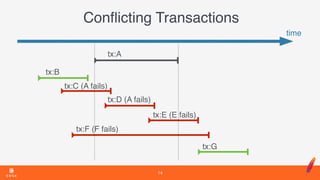
Conflicting Transactions
14
time
tx:A
tx:B
tx:C (A fails)
tx:D (A fails)
tx:E (E fails)
tx:F (F fails)
tx:G
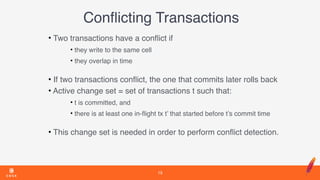
Conflicting Transactions
• Two transactions have a conflict if
• they write to the same cell
• they overlap in time

• If two transactions conflict, the one that commits later rolls back
• Active change set = set of transactions t such that:
• t is committed, and
• there is at least one in-flight tx t’ that started before t’s commit time

• This change set is needed in order to perform conflict detection.
15
HBase Transactions in Apache
16
Apache Omid (incubating)
(incubating)
(incubating)
In Common
• Optimistic Concurrency Control must:
• maintain Transaction State:
• what tx are in flight and committed?
• what is the change set of each tx? (for conflict detection, rollback)
• what transactions are invalid (failed to roll back due to crash etc.)
• generate unique transaction IDs
• coordinate the life cycle of a transaction
• start, detect conflicts, commit, rollback
• All of { Omid, Tephra, Trafodion } implement this
• but vary in how they do it
17
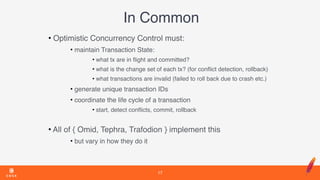
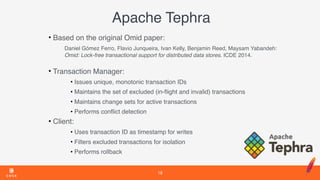
Apache Tephra
• Based on the original Omid paper:
Daniel Gómez Ferro, Flavio Junqueira, Ivan Kelly, Benjamin Reed, Maysam Yabandeh:

Omid: Lock-free transactional support for distributed data stores. ICDE 2014.

• Transaction Manager:
• Issues unique, monotonic transaction IDs
• Maintains the set of excluded (in-flight and invalid) transactions
• Maintains change sets for active transactions
• Performs conflict detection
• Client:
• Uses transaction ID as timestamp for writes
• Filters excluded transactions for isolation
• Performs rollback
18
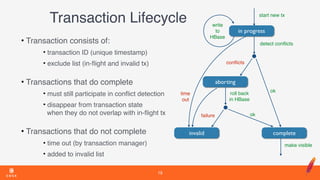
Transaction Lifecycle
19
in progress
start new tx
write
to
HBase
aborting
conflicts
invalid
failure
roll back
in HBase
ok
time
out
detect conflicts
ok
complete
make visible
• Transaction consists of:
• transaction ID (unique timestamp)
• exclude list (in-flight and invalid tx)

• Transactions that do complete
• must still participate in conflict detection
• disappear from transaction state

when they do not overlap with in-flight tx

• Transactions that do not complete
• time out (by transaction manager)
• added to invalid list
Apache Tephra
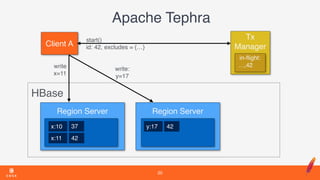
20
Tx

ManagerClient A
HBase
Region Server
x:10 37
write 

x=11
x:11 42
Region Server
write: 

y=17
y:17 42
in-flight:
…
start()

id: 42, excludes = {…}
,42
HBase
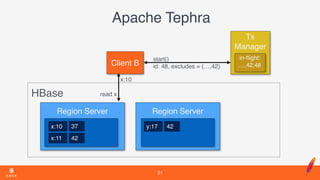
Apache Tephra
21
Tx

Manager
read x
Client B
x:10
Region Server
x:10 37
x:11 42
Region Server
y:17 42
in-flight:
…,42
start()

id: 48, excludes = {…,42} ,48
Region Server
HBase
Region Server
x:10 37 y:17 42
Apache Tephra
22
Tx

ManagerClient A
x:11 42
roll back
commit()

conflict
x:10 37
in-flight:
…,42
in-flight:
…
make

visible
HBase
Apache Tephra
23
Region Server
x:10 37
x:11 42
Region Server
y:17 42
read x
x:11
Tx

ManagerClient A
in-flight:
…,42
commit()

success
in-flight:
…Client C start()

id: 52, excludes: {…}
in-flight:
…,52
Apache Tephra
24
…
Client
Region Server
Region Region…
Coprocessor
Region Server
Region Region…
Coprocessor
HBase
Tx

Manager
Tx id generation
Tx lifecycle

rollback
Tx state
lifecycle

transitions
data

operations
Apache Tephra
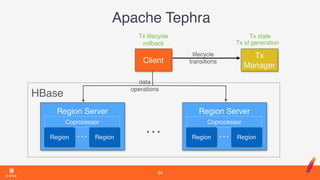
• HBase coprocessors
• For efficient visibility filtering (on region-server side)
• For eliminating invalid cells on flush and compaction
• Programming Abstraction
• TransactionalHTable:
• Implements HTable interface
• Existing code is easy to port
• TransactionContext:
• Implements transaction lifecycle
25
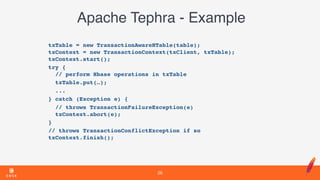
Apache Tephra - Example
txTable = new TransactionAwareHTable(table);

txContext = new TransactionContext(txClient, txTable);

txContext.start();
try {

// perform Hbase operations in txTable
txTable.put(…);
...
} catch (Exception e) {
// throws TransactionFailureException(e)

txContext.abort(e);
}
// throws TransactionConflictException if so

txContext.finish();
26
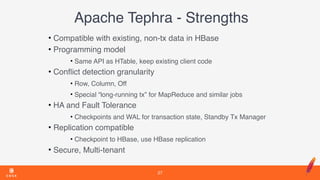
Apache Tephra - Strengths
• Compatible with existing, non-tx data in HBase
• Programming model
• Same API as HTable, keep existing client code
• Conflict detection granularity
• Row, Column, Off
• Special “long-running tx” for MapReduce and similar jobs
• HA and Fault Tolerance
• Checkpoints and WAL for transaction state, Standby Tx Manager
• Replication compatible
• Checkpoint to HBase, use HBase replication
• Secure, Multi-tenant
27
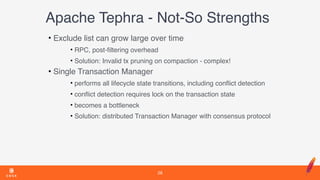
Apache Tephra - Not-So Strengths
• Exclude list can grow large over time
• RPC, post-filtering overhead
• Solution: Invalid tx pruning on compaction - complex!
• Single Transaction Manager
• performs all lifecycle state transitions, including conflict detection
• conflict detection requires lock on the transaction state
• becomes a bottleneck
• Solution: distributed Transaction Manager with consensus protocol
28
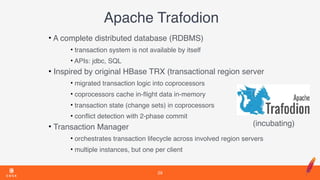
Apache Trafodion
• A complete distributed database (RDBMS)
• transaction system is not available by itself
• APIs: jdbc, SQL
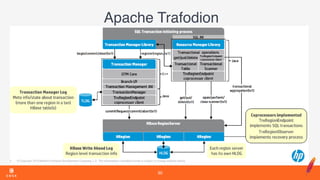
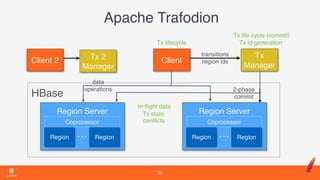
• Inspired by original HBase TRX (transactional region server
• migrated transaction logic into coprocessors
• coprocessors cache in-flight data in-memory
• transaction state (change sets) in coprocessors
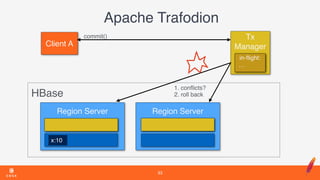
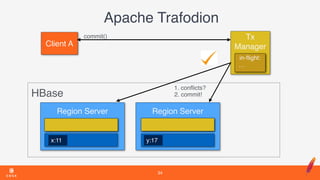
• conflict detection with 2-phase commit
• Transaction Manager
• orchestrates transaction lifecycle across involved region servers
• multiple instances, but one per client
29
(incubating)
Apache Trafodion
30
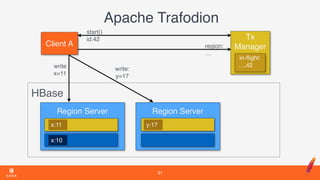
Apache Trafodion
31
Tx

ManagerClient A
HBase
Region Server
x:10
Region Server
in-flight:
…
start()

id:42
,42
write: 

y=17
y:17
write 

x=11
x:11
region:

…
,42
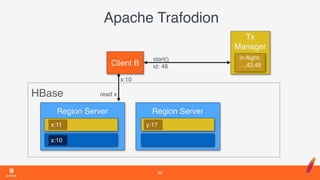
Apache Trafodion
32
Tx

Manager
read x
Client B
x:10
in-flight:
…,42
start()

id: 48 ,48
HBase
Region Server
x:10
Region Server
x:11 y:17
HBase
Apache Trafodion
33
Tx

ManagerClient A
1. conflicts?
commit()

in-flight:
…,42
in-flight:
…
Region Server
x:10
Region Server
x:11 y:17
2. roll back
HBase
Apache Trafodion
34
Tx

ManagerClient A
1. conflicts?
commit()

in-flight:
…,42
in-flight:
…
Region Server
x:10
Region Server
x:11 y:17
2. commit!
x:11 y:17
HBase
Apache Trafodion
35
Client
Region Server
Region Region…
Coprocessor
Region Server
Region Region…
Coprocessor
Tx

Manager
Tx id generation
conflicts
Tx state
Tx life cycle (commit)
transitions

region ids
2-phase

commit
data

operations
Tx lifecycle
In-flight data
Client 2 Tx 2
Manager
Apache Trafodion
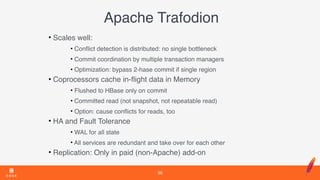
• Scales well:
• Conflict detection is distributed: no single bottleneck
• Commit coordination by multiple transaction managers
• Optimization: bypass 2-hase commit if single region
• Coprocessors cache in-flight data in Memory
• Flushed to HBase only on commit
• Committed read (not snapshot, not repeatable read)
• Option: cause conflicts for reads, too
• HA and Fault Tolerance
• WAL for all state
• All services are redundant and take over for each other
• Replication: Only in paid (non-Apache) add-on
36
Apache Trafodion - Strengths
• Very good scalability
• Scales almost linearly
• Especially for very small transactions
• Familiar SQL/jdbc interface for RDB programmers
• Redundant and fault-tolerant
• Secure and multi-tenant:
• Trafodion/SQL layer provides authn+authz
37
Apache Trafodion - Not-So Strengths
• Monolithic, not available as standalone transaction system
• Heavy load on coprocessors
• memory and compute
• Large transactions (e.g., MapReduce) will cause Out-of-memory
• no special support for long-running transactions
38
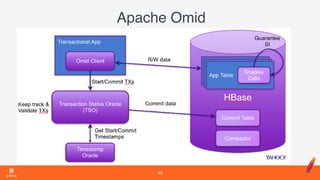
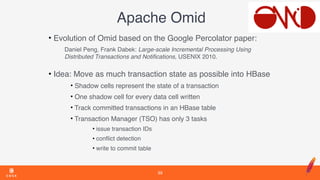
Apache Omid
• Evolution of Omid based on the Google Percolator paper:
Daniel Peng, Frank Dabek: Large-scale Incremental Processing Using
Distributed Transactions and Notifications, USENIX 2010.

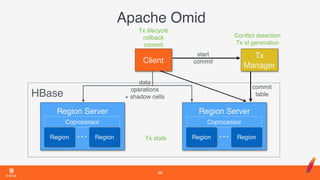
• Idea: Move as much transaction state as possible into HBase
• Shadow cells represent the state of a transaction
• One shadow cell for every data cell written
• Track committed transactions in an HBase table
• Transaction Manager (TSO) has only 3 tasks
• issue transaction IDs
• conflict detection
• write to commit table
39
Apache Omid
40
Apache Omid
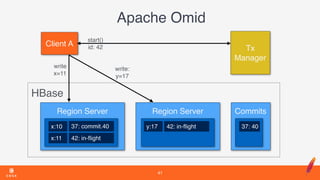
41
Tx

Manager
Client A
start()

id: 42
HBase
Region Server
x:10 37: commit.40
write 

x=11
x:11 42: in-flight
Region Server Commits

37: 40
write: 

y=17
y:17 42: in-flight
HBase
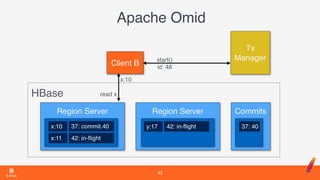
Apache Omid
42
Tx

Managerstart()

id: 48
read x
Client B
x:10
Region Server
x:10 37: commit.40
x:11 42: in-flight
Region Server
y:17
Commits

37: 4042: in-flight
Region Server
HBase
Region Server
x:10 37: commit.40 y:17 42: in-flight
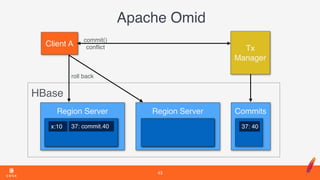
Apache Omid
43
Tx

Manager
Client A
Commits

37: 40
x:11 42: in-flight
roll back
commit()

conflict
x:10 37: commit.40
HBase
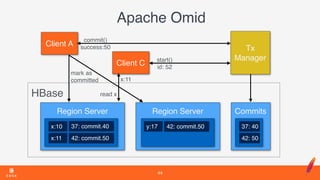
Apache Omid
44
Region Server
Tx

Manager
Client A
Client C start()

id: 52
x:10 37: commit.40
x:11 42: in-flight
Region Server
y:17
Commits

37: 4042: in-flight
mark as

committed
42: commit.50
42: commit.50
read x
x:11
commit()

success:50
42: 50
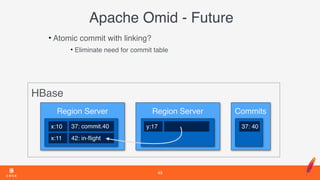
Apache Omid - Future
• Atomic commit with linking?
• Eliminate need for commit table
45
HBase
Region Server
x:10 37: commit.40
x:11 42: in-flight
Region Server Commits

37: 40y:17
HBase
Apache Omid
46
Client
Region Server
Region Region…
Coprocessor
Region Server
Region Region…
Coprocessor
Tx

Manager
Tx id generation
Conflict detection
start

commit
data

operations

+ shadow cells
Tx state
Tx lifecycle

rollback
commit
commit

table
Apache Omid - Strengths
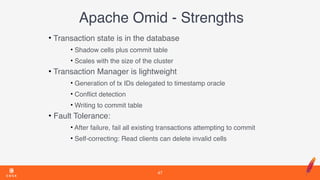
• Transaction state is in the database
• Shadow cells plus commit table
• Scales with the size of the cluster
• Transaction Manager is lightweight
• Generation of tx IDs delegated to timestamp oracle
• Conflict detection
• Writing to commit table
• Fault Tolerance:
• After failure, fail all existing transactions attempting to commit
• Self-correcting: Read clients can delete invalid cells
47
Apache Omid - Not So Strengths
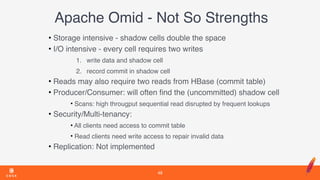
• Storage intensive - shadow cells double the space
• I/O intensive - every cell requires two writes
1. write data and shadow cell
2. record commit in shadow cell
• Reads may also require two reads from HBase (commit table)
• Producer/Consumer: will often find the (uncommitted) shadow cell
• Scans: high througput sequential read disrupted by frequent lookups
• Security/Multi-tenancy:
• All clients need access to commit table
• Read clients need write access to repair invalid data
• Replication: Not implemented
48
Summary
49
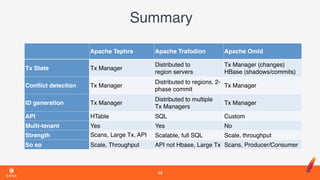
Apache Tephra Apache Trafodion Apache Omid
Tx State Tx Manager
Distributed to 

region servers
Tx Manager (changes)
HBase (shadows/commits)
Conflict detection Tx Manager
Distributed to regions, 2-
phase commit
Tx Manager
ID generation Tx Manager
Distributed to multiple
Tx Managers
Tx Manager
API HTable SQL Custom
Multi-tenant Yes Yes No
Strength Scans, Large Tx, API
 Scalable, full SQL Scale, throughput
So so Scale, Throughput API not Hbase, Large Tx Scans, Producer/Consumer
Links
Join the community:
50
Apache Omid (incubating)

http://omid.apache.org/
(incubating)

http://trafodion.apache.org/
(incubating)

http://tephra.apache.org/
Thank you
… for listening to my talk.
Credits:
- Sean Broeder, Narendra Goyal (Trafodion)
- Francisco Perez-Sorrosal (Omid)
51
Questions?

Transaction in HBase, by Andreas Neumann, Cask

  • 1.
    Transactions in HBase AndreasNeumann ApacheCon Big Data May 2017 anew at apache.org @caskoid
  • 2.
    Goals of thisTalk - Why transactions? - Optimistic Concurrency Control - Three Apache projects: Omid, Tephra, Trafodion - How are they different? 2
  • 3.
    Transactions in noSQL? History •SQL: RDBMS, EDW, … • noSQL: MapReduce, HDFS, HBase, … • n(ot)o(nly)SQL: Hive, Phoenix, … Motivation: • Data consistency under highly concurrent loads • Partial outputs after failure • Consistent view of data for long-running jobs • (Near) real-time processing 3
  • 4.
  • 5.
  • 6.
    Transactions to theRescue 6 HBase Table ...Queue ... ... Flowlet - Atomicity of all writes involved - Protection from concurrent update
  • 7.
    ACID Properties From goodold SQL: • Atomic - Entire transaction is committed as one • Consistent - No partial state change due to failure • Isolated - No dirty reads, transaction is only visible after commit • Durable - Once committed, data is persisted reliably 7
  • 8.
    What is HBase? 8 … Client RegionServer Region Region… Coprocessor Region Server Region Region… Coprocessor
  • 9.
    What is HBase? 9 Simplified: •Distributed Key-Value Store • Key = <row>.<family>.<column>.<timestamp> • Partitioned into Regions (= continuous range of rows) • Each Region Server hosts multiple regions • Optional: Coprocessor in Region Server • Durable writes
  • 10.
    ACID Properties inHBase • Atomic • At cell, row, and region level • Not across regions, tables or multiple calls • Consistent - No built-in rollback mechanism • Isolated - Timestamp filters provide some level of isolation • Durable - Once committed, data is persisted reliably How to implement full ACID? 10
  • 11.
    Implementing Transactions • Traditionalapproach (RDBMS): locking • May produce deadlocks • Causes idle wait • complex and expensive in a distributed env • Optimistic Concurrency Control • lockless: allow concurrent writes to go forward • on commit, detect conflicts with other transactions • on conflict, roll back all changes and retry • Snapshot Isolation • Similar to repeatable read • Take snapshot of all data at transaction start • Read isolation 11
  • 12.
    Optimistic Concurrency Control 12 time x=10client1:start fail/rollback client2: start read x commit must see the old value of x
  • 13.
    Optimistic Concurrency Control 13 time incrxclient1: start commit client2: start incr x commit x=10 rollback x=11 sees the old 
 value of x=10
  • 14.
    Conflicting Transactions 14 time tx:A tx:B tx:C (Afails) tx:D (A fails) tx:E (E fails) tx:F (F fails) tx:G
  • 15.
    Conflicting Transactions • Twotransactions have a conflict if • they write to the same cell • they overlap in time
 • If two transactions conflict, the one that commits later rolls back • Active change set = set of transactions t such that: • t is committed, and • there is at least one in-flight tx t’ that started before t’s commit time
 • This change set is needed in order to perform conflict detection. 15
  • 16.
    HBase Transactions inApache 16 Apache Omid (incubating) (incubating) (incubating)
  • 17.
    In Common • OptimisticConcurrency Control must: • maintain Transaction State: • what tx are in flight and committed? • what is the change set of each tx? (for conflict detection, rollback) • what transactions are invalid (failed to roll back due to crash etc.) • generate unique transaction IDs • coordinate the life cycle of a transaction • start, detect conflicts, commit, rollback • All of { Omid, Tephra, Trafodion } implement this • but vary in how they do it 17
  • 18.
    Apache Tephra • Basedon the original Omid paper: Daniel Gómez Ferro, Flavio Junqueira, Ivan Kelly, Benjamin Reed, Maysam Yabandeh:
 Omid: Lock-free transactional support for distributed data stores. ICDE 2014.
 • Transaction Manager: • Issues unique, monotonic transaction IDs • Maintains the set of excluded (in-flight and invalid) transactions • Maintains change sets for active transactions • Performs conflict detection • Client: • Uses transaction ID as timestamp for writes • Filters excluded transactions for isolation • Performs rollback 18
  • 19.
    Transaction Lifecycle 19 in progress startnew tx write to HBase aborting conflicts invalid failure roll back in HBase ok time out detect conflicts ok complete make visible • Transaction consists of: • transaction ID (unique timestamp) • exclude list (in-flight and invalid tx)
 • Transactions that do complete • must still participate in conflict detection • disappear from transaction state
 when they do not overlap with in-flight tx
 • Transactions that do not complete • time out (by transaction manager) • added to invalid list
  • 20.
    Apache Tephra 20 Tx
 ManagerClient A HBase RegionServer x:10 37 write 
 x=11 x:11 42 Region Server write: 
 y=17 y:17 42 in-flight: … start()
 id: 42, excludes = {…} ,42
  • 21.
    HBase Apache Tephra 21 Tx
 Manager read x ClientB x:10 Region Server x:10 37 x:11 42 Region Server y:17 42 in-flight: …,42 start()
 id: 48, excludes = {…,42} ,48
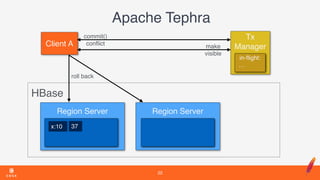
  • 22.
    Region Server HBase Region Server x:1037 y:17 42 Apache Tephra 22 Tx
 ManagerClient A x:11 42 roll back commit()
 conflict x:10 37 in-flight: …,42 in-flight: … make
 visible
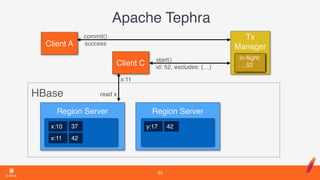
  • 23.
    HBase Apache Tephra 23 Region Server x:1037 x:11 42 Region Server y:17 42 read x x:11 Tx
 ManagerClient A in-flight: …,42 commit()
 success in-flight: …Client C start()
 id: 52, excludes: {…} in-flight: …,52
  • 24.
    Apache Tephra 24 … Client Region Server RegionRegion… Coprocessor Region Server Region Region… Coprocessor HBase Tx
 Manager Tx id generation Tx lifecycle
 rollback Tx state lifecycle
 transitions data
 operations
  • 25.
    Apache Tephra • HBasecoprocessors • For efficient visibility filtering (on region-server side) • For eliminating invalid cells on flush and compaction • Programming Abstraction • TransactionalHTable: • Implements HTable interface • Existing code is easy to port • TransactionContext: • Implements transaction lifecycle 25
  • 26.
    Apache Tephra -Example txTable = new TransactionAwareHTable(table);
 txContext = new TransactionContext(txClient, txTable);
 txContext.start(); try {
 // perform Hbase operations in txTable txTable.put(…); ... } catch (Exception e) { // throws TransactionFailureException(e)
 txContext.abort(e); } // throws TransactionConflictException if so
 txContext.finish(); 26
  • 27.
    Apache Tephra -Strengths • Compatible with existing, non-tx data in HBase • Programming model • Same API as HTable, keep existing client code • Conflict detection granularity • Row, Column, Off • Special “long-running tx” for MapReduce and similar jobs • HA and Fault Tolerance • Checkpoints and WAL for transaction state, Standby Tx Manager • Replication compatible • Checkpoint to HBase, use HBase replication • Secure, Multi-tenant 27
  • 28.
    Apache Tephra -Not-So Strengths • Exclude list can grow large over time • RPC, post-filtering overhead • Solution: Invalid tx pruning on compaction - complex! • Single Transaction Manager • performs all lifecycle state transitions, including conflict detection • conflict detection requires lock on the transaction state • becomes a bottleneck • Solution: distributed Transaction Manager with consensus protocol 28
  • 29.
    Apache Trafodion • Acomplete distributed database (RDBMS) • transaction system is not available by itself • APIs: jdbc, SQL • Inspired by original HBase TRX (transactional region server • migrated transaction logic into coprocessors • coprocessors cache in-flight data in-memory • transaction state (change sets) in coprocessors • conflict detection with 2-phase commit • Transaction Manager • orchestrates transaction lifecycle across involved region servers • multiple instances, but one per client 29 (incubating)
  • 30.
  • 31.
    Apache Trafodion 31 Tx
 ManagerClient A HBase RegionServer x:10 Region Server in-flight: … start()
 id:42 ,42 write: 
 y=17 y:17 write 
 x=11 x:11 region:
 … ,42
  • 32.
    Apache Trafodion 32 Tx
 Manager read x ClientB x:10 in-flight: …,42 start()
 id: 48 ,48 HBase Region Server x:10 Region Server x:11 y:17
  • 33.
    HBase Apache Trafodion 33 Tx
 ManagerClient A 1.conflicts? commit()
 in-flight: …,42 in-flight: … Region Server x:10 Region Server x:11 y:17 2. roll back
  • 34.
    HBase Apache Trafodion 34 Tx
 ManagerClient A 1.conflicts? commit()
 in-flight: …,42 in-flight: … Region Server x:10 Region Server x:11 y:17 2. commit! x:11 y:17
  • 35.
    HBase Apache Trafodion 35 Client Region Server RegionRegion… Coprocessor Region Server Region Region… Coprocessor Tx
 Manager Tx id generation conflicts Tx state Tx life cycle (commit) transitions
 region ids 2-phase
 commit data
 operations Tx lifecycle In-flight data Client 2 Tx 2 Manager
  • 36.
    Apache Trafodion • Scaleswell: • Conflict detection is distributed: no single bottleneck • Commit coordination by multiple transaction managers • Optimization: bypass 2-hase commit if single region • Coprocessors cache in-flight data in Memory • Flushed to HBase only on commit • Committed read (not snapshot, not repeatable read) • Option: cause conflicts for reads, too • HA and Fault Tolerance • WAL for all state • All services are redundant and take over for each other • Replication: Only in paid (non-Apache) add-on 36
  • 37.
    Apache Trafodion -Strengths • Very good scalability • Scales almost linearly • Especially for very small transactions • Familiar SQL/jdbc interface for RDB programmers • Redundant and fault-tolerant • Secure and multi-tenant: • Trafodion/SQL layer provides authn+authz 37
  • 38.
    Apache Trafodion -Not-So Strengths • Monolithic, not available as standalone transaction system • Heavy load on coprocessors • memory and compute • Large transactions (e.g., MapReduce) will cause Out-of-memory • no special support for long-running transactions 38
  • 39.
    Apache Omid • Evolutionof Omid based on the Google Percolator paper: Daniel Peng, Frank Dabek: Large-scale Incremental Processing Using Distributed Transactions and Notifications, USENIX 2010.
 • Idea: Move as much transaction state as possible into HBase • Shadow cells represent the state of a transaction • One shadow cell for every data cell written • Track committed transactions in an HBase table • Transaction Manager (TSO) has only 3 tasks • issue transaction IDs • conflict detection • write to commit table 39
  • 40.
  • 41.
    Apache Omid 41 Tx
 Manager Client A start()
 id:42 HBase Region Server x:10 37: commit.40 write 
 x=11 x:11 42: in-flight Region Server Commits
 37: 40 write: 
 y=17 y:17 42: in-flight
  • 42.
    HBase Apache Omid 42 Tx
 Managerstart()
 id: 48 readx Client B x:10 Region Server x:10 37: commit.40 x:11 42: in-flight Region Server y:17 Commits
 37: 4042: in-flight
  • 43.
    Region Server HBase Region Server x:1037: commit.40 y:17 42: in-flight Apache Omid 43 Tx
 Manager Client A Commits
 37: 40 x:11 42: in-flight roll back commit()
 conflict x:10 37: commit.40
  • 44.
    HBase Apache Omid 44 Region Server Tx
 Manager ClientA Client C start()
 id: 52 x:10 37: commit.40 x:11 42: in-flight Region Server y:17 Commits
 37: 4042: in-flight mark as
 committed 42: commit.50 42: commit.50 read x x:11 commit()
 success:50 42: 50
  • 45.
    Apache Omid -Future • Atomic commit with linking? • Eliminate need for commit table 45 HBase Region Server x:10 37: commit.40 x:11 42: in-flight Region Server Commits
 37: 40y:17
  • 46.
    HBase Apache Omid 46 Client Region Server RegionRegion… Coprocessor Region Server Region Region… Coprocessor Tx
 Manager Tx id generation Conflict detection start
 commit data
 operations
 + shadow cells Tx state Tx lifecycle
 rollback commit commit
 table
  • 47.
    Apache Omid -Strengths • Transaction state is in the database • Shadow cells plus commit table • Scales with the size of the cluster • Transaction Manager is lightweight • Generation of tx IDs delegated to timestamp oracle • Conflict detection • Writing to commit table • Fault Tolerance: • After failure, fail all existing transactions attempting to commit • Self-correcting: Read clients can delete invalid cells 47
  • 48.
    Apache Omid -Not So Strengths • Storage intensive - shadow cells double the space • I/O intensive - every cell requires two writes 1. write data and shadow cell 2. record commit in shadow cell • Reads may also require two reads from HBase (commit table) • Producer/Consumer: will often find the (uncommitted) shadow cell • Scans: high througput sequential read disrupted by frequent lookups • Security/Multi-tenancy: • All clients need access to commit table • Read clients need write access to repair invalid data • Replication: Not implemented 48
  • 49.
    Summary 49 Apache Tephra ApacheTrafodion Apache Omid Tx State Tx Manager Distributed to 
 region servers Tx Manager (changes) HBase (shadows/commits) Conflict detection Tx Manager Distributed to regions, 2- phase commit Tx Manager ID generation Tx Manager Distributed to multiple Tx Managers Tx Manager API HTable SQL Custom Multi-tenant Yes Yes No Strength Scans, Large Tx, API
 Scalable, full SQL Scale, throughput So so Scale, Throughput API not Hbase, Large Tx Scans, Producer/Consumer
  • 50.
    Links Join the community: 50 ApacheOmid (incubating)
 http://omid.apache.org/ (incubating)
 http://trafodion.apache.org/ (incubating)
 http://tephra.apache.org/
  • 51.
    Thank you … forlistening to my talk. Credits: - Sean Broeder, Narendra Goyal (Trafodion) - Francisco Perez-Sorrosal (Omid) 51 Questions?