Shivji Kumar Jha
Navigating Transactions
ACID Complexity in Modern Databases
1
Data Platforms & OSS
• Databases, streams, app architecture
• Loves open source software (OSS)
• And communities (meetups)
• Regular speaker ( talk # 23)
• Sta
ff
Engineer at Nutanix
Shivji Kumar Jha
https://www.linkedin.com/in/shivjijha
https://youtube.com/@ShivjiKumarJha
https://t.me/theDbShots
2
• Transactions & ACID
• Implementing Transactions
• Distributed transactions
• Cloud scale databases
Contents
3
Transactions
4
Transactions
Historical Perspective
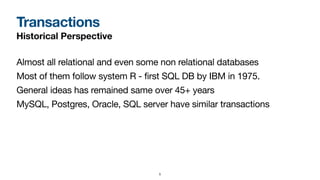
Almost all relational and even some non relational databases
Most of them follow system R - first SQL DB by IBM in 1975.
General ideas has remained same over 45+ years
MySQL, Postgres, Oracle, SQL server have similar transactions
5
Transactions
Historical Perspective
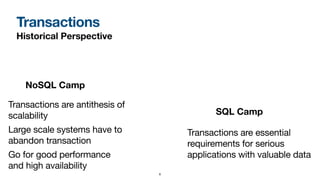
Transactions are antithesis of
scalability
Large scale systems have to
abandon transaction
Go for good performance
and high availability
6
Transactions are essential
requirements for serious
applications with valuable data
NoSQL Camp
SQL Camp
Transactions
Historical Perspective
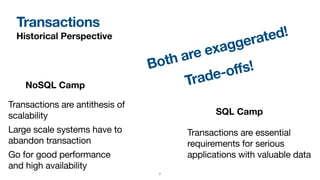
Transactions are antithesis of
scalability
Large scale systems have to
abandon transaction
Go for good performance
and high availability
7
Transactions are essential
requirements for serious
applications with valuable data
NoSQL Camp
SQL Camp
Both are exaggerated!
Trade-offs!
8
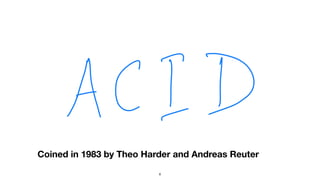
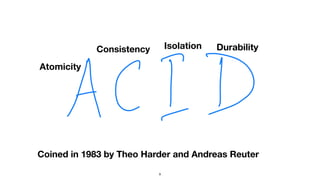
Coined in 1983 by Theo Harder and Andreas Reuter
Atomicity
Consistency Isolation Durability
9
Coined in 1983 by Theo Harder and Andreas Reuter
The slippery slope!
In practice, one database’s implementation of ACID does not equal
another’s implementation
For example, a lot of ambiguity in meaning of “isolation”
Devil is in details!
When a system claims ACID, unclear what guarantees it provides
ACID has unfortunately become a marketing term
Transactions
10
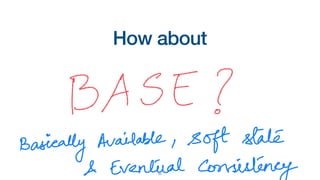
How about
11
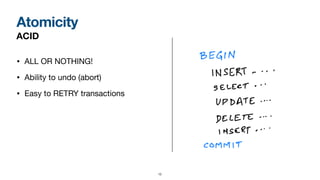
• ALL OR NOTHING!
• Ability to undo (abort)
• Easy to RETRY transactions
12
Atomicity
ACID
Are retries really safe with transactions?
13
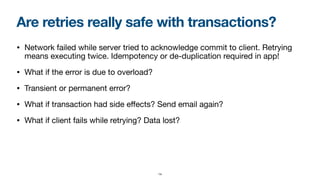
Are retries really safe with transactions?
• Network failed while server tried to acknowledge commit to client. Retrying
means executing twice. Idempotency or de-duplication required in app!
• What if the error is due to overload?
• Transient or permanent error?
• What if transaction had side e
ff
ects? Send email again?
• What if client fails while retrying? Data lost?
14
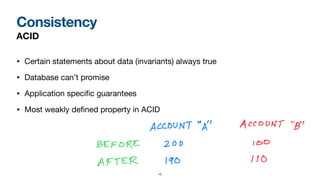
• Certain statements about data (invariants) always true
• Database can’t promise
• Application speci
fi
c guarantees
• Most weakly de
fi
ned property in ACID
15
Consistency
ACID
Isolation
ACID
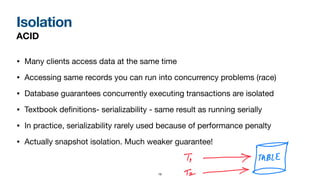
• Many clients access data at the same time
• Accessing same records you can run into concurrency problems (race)
• Database guarantees concurrently executing transactions are isolated
• Textbook de
fi
nitions- serializability - same result as running serially
• In practice, serializability rarely used because of performance penalty
• Actually snapshot isolation. Much weaker guarantee!
16
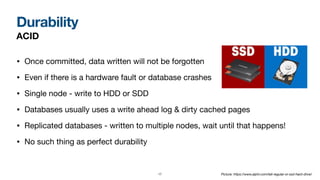
• Once committed, data written will not be forgotten
• Even if there is a hardware fault or database crashes
• Single node - write to HDD or SDD
• Databases usually uses a write ahead log & dirty cached pages
• Replicated databases - written to multiple nodes, wait until that happens!
• No such thing as perfect durability
ACID
Durability
17 Picture: https://www.alphr.com/tell-regular-or-ssd-hard-drive/
Implementing Transactions
18
Implementing Transactions
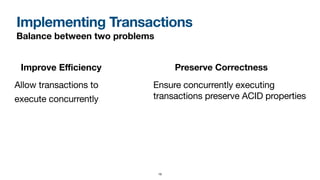
Balance between two problems
Improve E
ffi
ciency Preserve Correctness
Allow transactions to
execute concurrently
Ensure concurrently executing
transactions preserve ACID properties
19
Implementing Transactions
Balance between two problems
Improve E
ffi
ciency Preserve Correctness
Allow transactions to
execute concurrently
Ensure concurrently executing
transactions preserve ACID properties
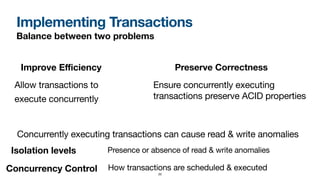
Concurrently executing transactions can cause read & write anomalies
Isolation levels
Concurrency Control
Presence or absence of read & write anomalies
How transactions are scheduled & executed
20
21
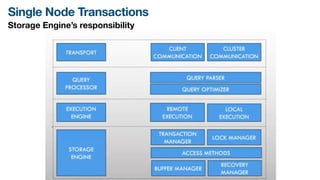
Single Node Transactions
Storage Engine’s responsibility
Distributed Transactions
22
What if multiple nodes are
involved in a Transaction?
23
Send a commit request to each node & independently commit?
24
25
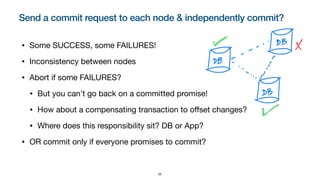
Send a commit request to each node & independently commit?
• Some SUCCESS, some FAILURES!
• Inconsistency between nodes
• Abort if some FAILURES?
• But you can’t go back on a committed promise!
• How about a compensating transaction to o
ff
set changes?
• Where does this responsibility sit? DB or App?
• OR commit only if everyone promises to commit?
Atomic Commitment
26
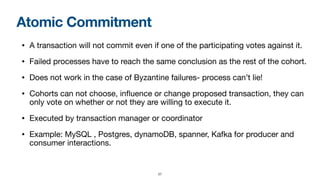
Atomic Commitment
• A transaction will not commit even if one of the participating votes against it.
• Failed processes have to reach the same conclusion as the rest of the cohort.
• Does not work in the case of Byzantine failures- process can’t lie!
• Cohorts can not choose, in
fl
uence or change proposed transaction, they can
only vote on whether or not they are willing to execute it.
• Executed by transaction manager or coordinator
• Example: MySQL , Postgres, dynamoDB, spanner, Kafka for producer and
consumer interactions.
27
Two Phase Commit
,
28
Two Phase Commit
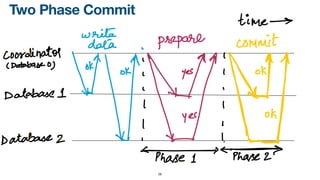
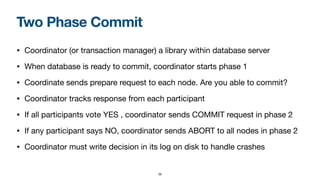
• Coordinator (or transaction manager) a library within database server
• When database is ready to commit, coordinator starts phase 1
• Coordinate sends prepare request to each node. Are you able to commit?
• Coordinator tracks response from each participant
• If all participants vote YES , coordinator sends COMMIT request in phase 2
• If any participant says NO, coordinator sends ABORT to all nodes in phase 2
• Coordinator must write decision in its log on disk to handle crashes
29
Two Phase Commit
,
Crash (
fi
re)
30
Coordinator Failures
Two Phase Commit
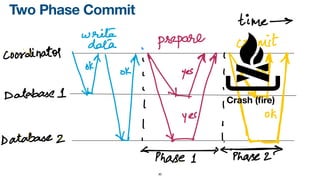
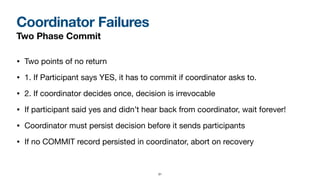
• Two points of no return
• 1. If Participant says YES, it has to commit if coordinator asks to.
• 2. If coordinator decides once, decision is irrevocable
• If participant said yes and didn’t hear back from coordinator, wait forever!
• Coordinator must persist decision before it sends participants
• If no COMMIT record persisted in coordinator, abort on recovery
31
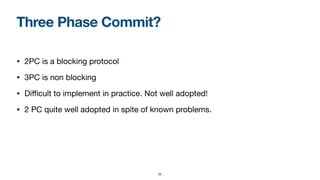
Three Phase Commit?
• 2PC is a blocking protocol
• 3PC is non blocking
• Di
ffi
cult to implement in practice. Not well adopted!
• 2 PC quite well adopted in spite of known problems.
32
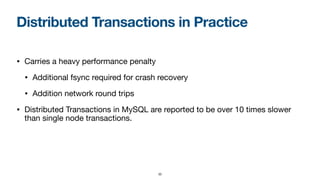
Distributed Transactions in Practice
• Carries a heavy performance penalty
• Additional fsync required for crash recovery
• Addition network round trips
• Distributed Transactions in MySQL are reported to be over 10 times slower
than single node transactions.
33
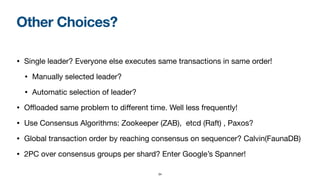
Other Choices?
• Single leader? Everyone else executes same transactions in same order!
• Manually selected leader?
• Automatic selection of leader?
• O
ffl
oaded same problem to di
ff
erent time. Well less frequently!
• Use Consensus Algorithms: Zookeeper (ZAB), etcd (Raft) , Paxos?
• Global transaction order by reaching consensus on sequencer? Calvin(FaunaDB)
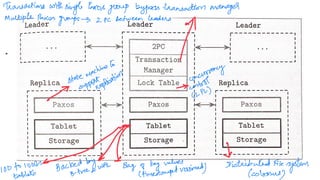
• 2PC over consensus groups per shard? Enter Google’s Spanner!
34
Transactions in Modern Databases
35
Amazon Aurora
36
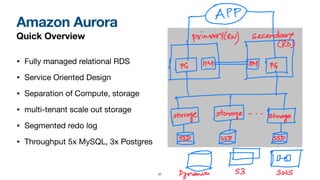
Quick Overview
• Fully managed relational RDS
• Service Oriented Design
• Separation of Compute, storage
• multi-tenant scale out storage
• Segmented redo log
• Throughput 5x MySQL, 3x Postgres
Amazon Aurora
37
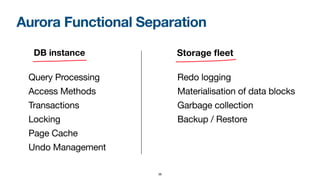
Aurora Functional Separation
DB instance
Query Processing
Access Methods
Transactions
Locking
Page Cache
Undo Management
Storage
fl
eet
Redo logging
Materialisation of data blocks
Garbage collection
Backup / Restore
38
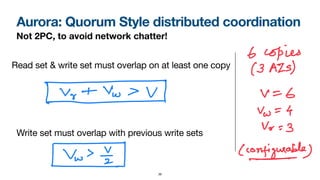
Aurora: Quorum Style distributed coordination
Not 2PC, to avoid network chatter!
Read set & write set must overlap on at least one copy
Write set must overlap with previous write sets
39
Amazon DynamoDB
40
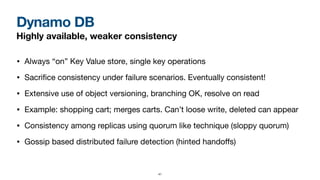
Dynamo DB
Highly available, weaker consistency
• Always “on” Key Value store, single key operations
• Sacri
fi
ce consistency under failure scenarios. Eventually consistent!
• Extensive use of object versioning, branching OK, resolve on read
• Example: shopping cart; merges carts. Can’t loose write, deleted can appear
• Consistency among replicas using quorum like technique (sloppy quorum)
• Gossip based distributed failure detection (hinted hando
ff
s)
41
Dynamo DB
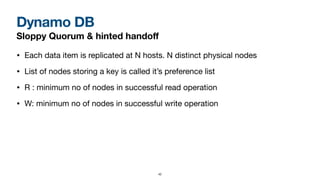
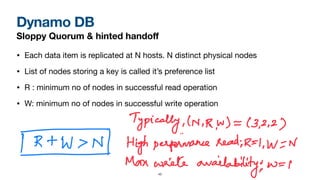
Sloppy Quorum & hinted hando
f
• Each data item is replicated at N hosts. N distinct physical nodes
• List of nodes storing a key is called it’s preference list
• R : minimum no of nodes in successful read operation
• W: minimum no of nodes in successful write operation
42
Dynamo DB
Sloppy Quorum & hinted hando
f
• Each data item is replicated at N hosts. N distinct physical nodes
• List of nodes storing a key is called it’s preference list
• R : minimum no of nodes in successful read operation
• W: minimum no of nodes in successful write operation
43
44
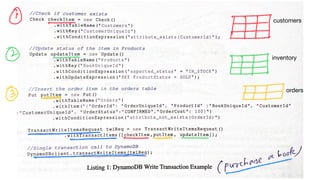
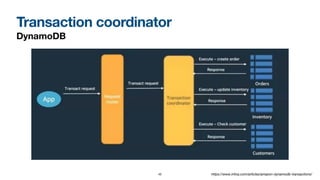
customers
inventory
orders
Transaction coordinator
DynamoDB
45 https://www.infoq.com/articles/amazon-dynamodb-transactions/
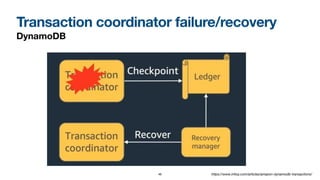
Transaction coordinator failure/recovery
DynamoDB
46 https://www.infoq.com/articles/amazon-dynamodb-transactions/
Google Spanner
47
Spanner
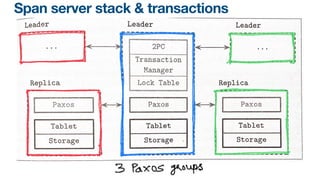
Google’s globally distributed SQL* database
• Also inspiration for cockroachDB and yugabyteDB
• Tables with rows, columns and versioned values
• Supports transactions and SQL based query language
• Replication con
fi
gs dynamically controlled at
fi
ne grain by apps - which data-
centre’s to use, how far from users(read latency), how far are replicas (write
latency), how many replicas
• Clients automatically failover between replicas
• Data dynamically moved between data-centres to balance resources
48
49
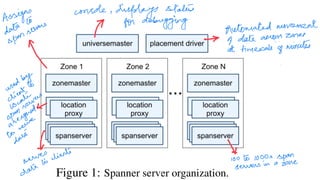
Span server stack & transactions
50
51
References
• Designing Data-Intensive Applications ( Chapter 7 & 9) By Martin Kleppmann
• Database Internals (Chapter 5 & 13 ) By Alex Petrov
52
Books
• Amazon Aurora: Design considerations for high throughput cloud native relational databases
• Amazon Aurora: On avoiding distributed consensus….
• Dynamo: Amazon’s highly available key value store
• Distributed Transactions at scale in Amazon DynamoDB
• Spanner : Google’s Globally Distributed Database
Whitepapers
https://www.infoq.com/articles/amazon-dynamodb-transactions/
Blog
Questions?
Staying in touch:
https://www.linkedin.com/in/shivjijha
https://youtube.com/@ShivjiKumarJha
https://www.slideshare.net/shiv4289/presentations
https://t.me/theDbShots
53

Navigating Transactions: ACID Complexity in Modern Databases- Mydbops Open Source Database Meetup 15

  • 1.
    Shivji Kumar Jha NavigatingTransactions ACID Complexity in Modern Databases 1
  • 2.
    Data Platforms &OSS • Databases, streams, app architecture • Loves open source software (OSS) • And communities (meetups) • Regular speaker ( talk # 23) • Sta ff Engineer at Nutanix Shivji Kumar Jha https://www.linkedin.com/in/shivjijha https://youtube.com/@ShivjiKumarJha https://t.me/theDbShots 2
  • 3.
    • Transactions &ACID • Implementing Transactions • Distributed transactions • Cloud scale databases Contents 3
  • 4.
  • 5.
    Transactions Historical Perspective Almost allrelational and even some non relational databases Most of them follow system R - first SQL DB by IBM in 1975. General ideas has remained same over 45+ years MySQL, Postgres, Oracle, SQL server have similar transactions 5
  • 6.
    Transactions Historical Perspective Transactions areantithesis of scalability Large scale systems have to abandon transaction Go for good performance and high availability 6 Transactions are essential requirements for serious applications with valuable data NoSQL Camp SQL Camp
  • 7.
    Transactions Historical Perspective Transactions areantithesis of scalability Large scale systems have to abandon transaction Go for good performance and high availability 7 Transactions are essential requirements for serious applications with valuable data NoSQL Camp SQL Camp Both are exaggerated! Trade-offs!
  • 8.
    8 Coined in 1983by Theo Harder and Andreas Reuter
  • 9.
    Atomicity Consistency Isolation Durability 9 Coinedin 1983 by Theo Harder and Andreas Reuter
  • 10.
    The slippery slope! Inpractice, one database’s implementation of ACID does not equal another’s implementation For example, a lot of ambiguity in meaning of “isolation” Devil is in details! When a system claims ACID, unclear what guarantees it provides ACID has unfortunately become a marketing term Transactions 10
  • 11.
  • 12.
    • ALL ORNOTHING! • Ability to undo (abort) • Easy to RETRY transactions 12 Atomicity ACID
  • 13.
    Are retries reallysafe with transactions? 13
  • 14.
    Are retries reallysafe with transactions? • Network failed while server tried to acknowledge commit to client. Retrying means executing twice. Idempotency or de-duplication required in app! • What if the error is due to overload? • Transient or permanent error? • What if transaction had side e ff ects? Send email again? • What if client fails while retrying? Data lost? 14
  • 15.
    • Certain statementsabout data (invariants) always true • Database can’t promise • Application speci fi c guarantees • Most weakly de fi ned property in ACID 15 Consistency ACID
  • 16.
    Isolation ACID • Many clientsaccess data at the same time • Accessing same records you can run into concurrency problems (race) • Database guarantees concurrently executing transactions are isolated • Textbook de fi nitions- serializability - same result as running serially • In practice, serializability rarely used because of performance penalty • Actually snapshot isolation. Much weaker guarantee! 16
  • 17.
    • Once committed,data written will not be forgotten • Even if there is a hardware fault or database crashes • Single node - write to HDD or SDD • Databases usually uses a write ahead log & dirty cached pages • Replicated databases - written to multiple nodes, wait until that happens! • No such thing as perfect durability ACID Durability 17 Picture: https://www.alphr.com/tell-regular-or-ssd-hard-drive/
  • 18.
  • 19.
    Implementing Transactions Balance betweentwo problems Improve E ffi ciency Preserve Correctness Allow transactions to execute concurrently Ensure concurrently executing transactions preserve ACID properties 19
  • 20.
    Implementing Transactions Balance betweentwo problems Improve E ffi ciency Preserve Correctness Allow transactions to execute concurrently Ensure concurrently executing transactions preserve ACID properties Concurrently executing transactions can cause read & write anomalies Isolation levels Concurrency Control Presence or absence of read & write anomalies How transactions are scheduled & executed 20
  • 21.
    21 Single Node Transactions StorageEngine’s responsibility
  • 22.
  • 23.
    What if multiplenodes are involved in a Transaction? 23
  • 24.
    Send a commitrequest to each node & independently commit? 24
  • 25.
    25 Send a commitrequest to each node & independently commit? • Some SUCCESS, some FAILURES! • Inconsistency between nodes • Abort if some FAILURES? • But you can’t go back on a committed promise! • How about a compensating transaction to o ff set changes? • Where does this responsibility sit? DB or App? • OR commit only if everyone promises to commit?
  • 26.
  • 27.
    Atomic Commitment • Atransaction will not commit even if one of the participating votes against it. • Failed processes have to reach the same conclusion as the rest of the cohort. • Does not work in the case of Byzantine failures- process can’t lie! • Cohorts can not choose, in fl uence or change proposed transaction, they can only vote on whether or not they are willing to execute it. • Executed by transaction manager or coordinator • Example: MySQL , Postgres, dynamoDB, spanner, Kafka for producer and consumer interactions. 27
  • 28.
  • 29.
    Two Phase Commit •Coordinator (or transaction manager) a library within database server • When database is ready to commit, coordinator starts phase 1 • Coordinate sends prepare request to each node. Are you able to commit? • Coordinator tracks response from each participant • If all participants vote YES , coordinator sends COMMIT request in phase 2 • If any participant says NO, coordinator sends ABORT to all nodes in phase 2 • Coordinator must write decision in its log on disk to handle crashes 29
  • 30.
  • 31.
    Coordinator Failures Two PhaseCommit • Two points of no return • 1. If Participant says YES, it has to commit if coordinator asks to. • 2. If coordinator decides once, decision is irrevocable • If participant said yes and didn’t hear back from coordinator, wait forever! • Coordinator must persist decision before it sends participants • If no COMMIT record persisted in coordinator, abort on recovery 31
  • 32.
    Three Phase Commit? •2PC is a blocking protocol • 3PC is non blocking • Di ffi cult to implement in practice. Not well adopted! • 2 PC quite well adopted in spite of known problems. 32
  • 33.
    Distributed Transactions inPractice • Carries a heavy performance penalty • Additional fsync required for crash recovery • Addition network round trips • Distributed Transactions in MySQL are reported to be over 10 times slower than single node transactions. 33
  • 34.
    Other Choices? • Singleleader? Everyone else executes same transactions in same order! • Manually selected leader? • Automatic selection of leader? • O ffl oaded same problem to di ff erent time. Well less frequently! • Use Consensus Algorithms: Zookeeper (ZAB), etcd (Raft) , Paxos? • Global transaction order by reaching consensus on sequencer? Calvin(FaunaDB) • 2PC over consensus groups per shard? Enter Google’s Spanner! 34
  • 35.
  • 36.
  • 37.
    Quick Overview • Fullymanaged relational RDS • Service Oriented Design • Separation of Compute, storage • multi-tenant scale out storage • Segmented redo log • Throughput 5x MySQL, 3x Postgres Amazon Aurora 37
  • 38.
    Aurora Functional Separation DBinstance Query Processing Access Methods Transactions Locking Page Cache Undo Management Storage fl eet Redo logging Materialisation of data blocks Garbage collection Backup / Restore 38
  • 39.
    Aurora: Quorum Styledistributed coordination Not 2PC, to avoid network chatter! Read set & write set must overlap on at least one copy Write set must overlap with previous write sets 39
  • 40.
  • 41.
    Dynamo DB Highly available,weaker consistency • Always “on” Key Value store, single key operations • Sacri fi ce consistency under failure scenarios. Eventually consistent! • Extensive use of object versioning, branching OK, resolve on read • Example: shopping cart; merges carts. Can’t loose write, deleted can appear • Consistency among replicas using quorum like technique (sloppy quorum) • Gossip based distributed failure detection (hinted hando ff s) 41
  • 42.
    Dynamo DB Sloppy Quorum& hinted hando f • Each data item is replicated at N hosts. N distinct physical nodes • List of nodes storing a key is called it’s preference list • R : minimum no of nodes in successful read operation • W: minimum no of nodes in successful write operation 42
  • 43.
    Dynamo DB Sloppy Quorum& hinted hando f • Each data item is replicated at N hosts. N distinct physical nodes • List of nodes storing a key is called it’s preference list • R : minimum no of nodes in successful read operation • W: minimum no of nodes in successful write operation 43
  • 44.
  • 45.
  • 46.
    Transaction coordinator failure/recovery DynamoDB 46https://www.infoq.com/articles/amazon-dynamodb-transactions/
  • 47.
  • 48.
    Spanner Google’s globally distributedSQL* database • Also inspiration for cockroachDB and yugabyteDB • Tables with rows, columns and versioned values • Supports transactions and SQL based query language • Replication con fi gs dynamically controlled at fi ne grain by apps - which data- centre’s to use, how far from users(read latency), how far are replicas (write latency), how many replicas • Clients automatically failover between replicas • Data dynamically moved between data-centres to balance resources 48
  • 49.
  • 50.
    Span server stack& transactions 50
  • 51.
  • 52.
    References • Designing Data-IntensiveApplications ( Chapter 7 & 9) By Martin Kleppmann • Database Internals (Chapter 5 & 13 ) By Alex Petrov 52 Books • Amazon Aurora: Design considerations for high throughput cloud native relational databases • Amazon Aurora: On avoiding distributed consensus…. • Dynamo: Amazon’s highly available key value store • Distributed Transactions at scale in Amazon DynamoDB • Spanner : Google’s Globally Distributed Database Whitepapers https://www.infoq.com/articles/amazon-dynamodb-transactions/ Blog
  • 53.