A SEMINAR ON
TRANS FATTY ACIDS
BY
CHUKWUEKWU WISDOM EMMANUEL
FNS/BCH/14/13173
DEPARTMENT OF BIOCHEMISTRY,
FACULTY OF LIFE SCIENCES,
AMBROSE ALLI UNIVERSITY,
EKPOMA, EDO STATE.
UNDER THE SUPERVISION OF:
PROF. M.A AZEKE.
JANUARY, 2018.
INTRODUCTION
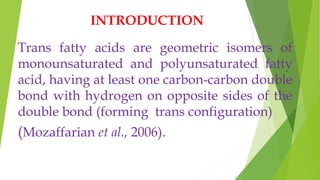
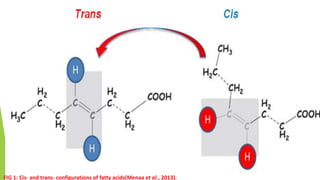
Trans fatty acids are geometric isomers of
monounsaturated and polyunsaturated fatty
acid, having at least one carbon-carbon double
bond with hydrogen on opposite sides of the
double bond (forming trans configuration)
(Mozaffarian et al., 2006).
FIG 1: Cis- and trans- configurations of fatty acids(Menaa et al., 2013).
PRODUCTION OF TRANS FATTY
ACIDS
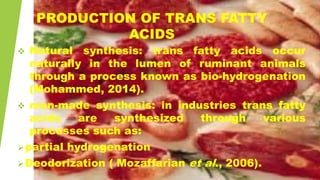
 Natural synthesis: trans fatty acids occur
naturally in the lumen of ruminant animals
through a process known as bio-hydrogenation
(Mohammed, 2014).
 man-made synthesis: in industries trans fatty
acids are synthesized through various
processes such as:
partial hydrogenation
Deodorization ( Mozaffarian et al., 2006).
WHAT FOOD CONTAINS TRANS FATTY
ACIDS ?
Examples of food products which contains
TFA includes the followings:
 Margarine
 Vegetable oil
 Fast food
 Pizzas
 Doughnut
 Dessert
 Preservatives (Mozaffarian et al., 2006).
EFFECTS OF TRANS FATTY ACIDS
High risk of cardiovascular diseases
Cancer
Obesity
Diabetes
Systemic Inflammation (Zapolska et al., 2010).
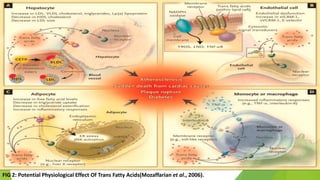
FIG 2: Potential Physiological Effect Of Trans Fatty Acids(Mozaffarian et al., 2006).
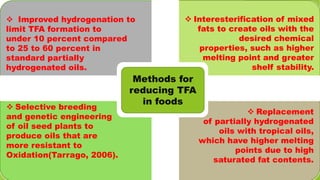
 Interesterification of mixed
fats to create oils with the
desired chemical
properties, such as higher
melting point and greater
shelf stability.
 Replacement
of partially hydrogenated
oils with tropical oils,
which have higher melting
points due to high
saturated fat contents.
 Improved hydrogenation to
limit TFA formation to
under 10 percent compared
to 25 to 60 percent in
standard partially
hydrogenated oils.
 Selective breeding
and genetic engineering
of oil seed plants to
produce oils that are
more resistant to
Oxidation(Tarrago, 2006).
Methods for
reducing TFA
in foods
CONCLUSION
Though trans fatty acid have been of great
importance in the manufacturing of several
foods, However it has been found to be
associated with various health implications
which are greatly detrimental to humans but
with modern approaches the effect of trans
fatty acid have reduced drastically.
THANKS
FOR
LISTENING

trans fatty acids 1

  • 1.
    A SEMINAR ON TRANSFATTY ACIDS BY CHUKWUEKWU WISDOM EMMANUEL FNS/BCH/14/13173 DEPARTMENT OF BIOCHEMISTRY, FACULTY OF LIFE SCIENCES, AMBROSE ALLI UNIVERSITY, EKPOMA, EDO STATE. UNDER THE SUPERVISION OF: PROF. M.A AZEKE. JANUARY, 2018.
  • 2.
    INTRODUCTION Trans fatty acidsare geometric isomers of monounsaturated and polyunsaturated fatty acid, having at least one carbon-carbon double bond with hydrogen on opposite sides of the double bond (forming trans configuration) (Mozaffarian et al., 2006).
  • 3.
    FIG 1: Cis-and trans- configurations of fatty acids(Menaa et al., 2013).
  • 4.
    PRODUCTION OF TRANSFATTY ACIDS  Natural synthesis: trans fatty acids occur naturally in the lumen of ruminant animals through a process known as bio-hydrogenation (Mohammed, 2014).  man-made synthesis: in industries trans fatty acids are synthesized through various processes such as: partial hydrogenation Deodorization ( Mozaffarian et al., 2006).
  • 5.
    WHAT FOOD CONTAINSTRANS FATTY ACIDS ? Examples of food products which contains TFA includes the followings:  Margarine  Vegetable oil  Fast food  Pizzas  Doughnut  Dessert  Preservatives (Mozaffarian et al., 2006).
  • 6.
    EFFECTS OF TRANSFATTY ACIDS High risk of cardiovascular diseases Cancer Obesity Diabetes Systemic Inflammation (Zapolska et al., 2010).
  • 7.
    FIG 2: PotentialPhysiological Effect Of Trans Fatty Acids(Mozaffarian et al., 2006).
  • 8.
     Interesterification ofmixed fats to create oils with the desired chemical properties, such as higher melting point and greater shelf stability.  Replacement of partially hydrogenated oils with tropical oils, which have higher melting points due to high saturated fat contents.  Improved hydrogenation to limit TFA formation to under 10 percent compared to 25 to 60 percent in standard partially hydrogenated oils.  Selective breeding and genetic engineering of oil seed plants to produce oils that are more resistant to Oxidation(Tarrago, 2006). Methods for reducing TFA in foods
  • 9.
    CONCLUSION Though trans fattyacid have been of great importance in the manufacturing of several foods, However it has been found to be associated with various health implications which are greatly detrimental to humans but with modern approaches the effect of trans fatty acid have reduced drastically.
  • 10.