LEARNING &
DEVELOPMENT
Learning as a
management skill /
Learning and
developing your staff
TOPICS
What should be the Learning Module?
A Systematic Approach to Learning
A Learning Assessment
2
SALES PROCESS
Lead Generation
Qualifying
Demonstrating Value
Convincing
Closing
Customer Retention
3
SALES TRAINING TOPICS
Concept Selling
Sales Methodology
Sales Skill
4
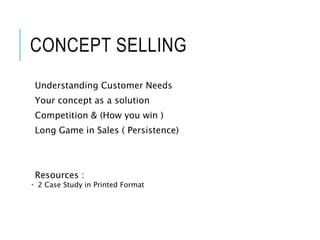
CONCEPT SELLING
Understanding Customer Needs
Your concept as a solution
Competition & (How you win )
Long Game in Sales ( Persistence)
Resources :
 2 Case Study in Printed Format
5
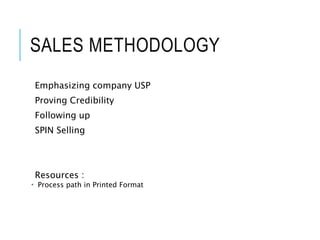
SALES METHODOLOGY
Emphasizing company USP
Proving Credibility
Following up
SPIN Selling
Resources :
 Process path in Printed Format
6
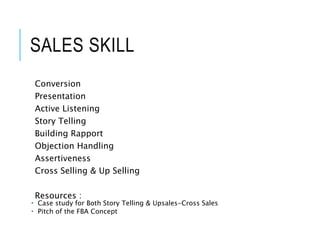
SALES SKILL
Conversion
Presentation
Active Listening
Story Telling
Building Rapport
Objection Handling
Assertiveness
Cross Selling & Up Selling
Resources :
 Case study for Both Story Telling & Upsales-Cross Sales
 Pitch of the FBA Concept
7
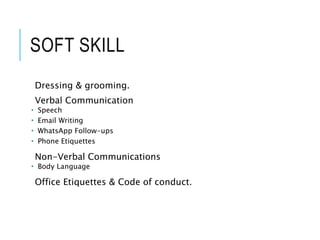
SOFT SKILL
Dressing & grooming.
Verbal Communication
 Speech
 Email Writing
 WhatsApp Follow-ups
 Phone Etiquettes
Non-Verbal Communications
 Body Language
Office Etiquettes & Code of conduct.
8
SALES AUTOMATION &
SOFTWARE
CRM & It’s Importance
Follow-up Scheduling
Excel Tips & Tricks
Google Form Training
Google Sheet
Basic Presentation Skill
Online Listing Portals ( Just Dial, India Mart & Google My
Business )
Social media Branding.
9
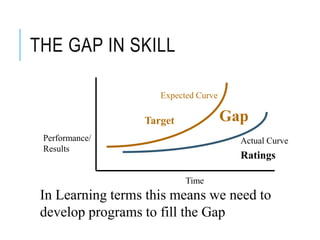
THE GAP IN SKILL
10
Performance/
Results
Time
Expected Curve
Actual Curve
Gap
In Learning terms this means we need to
develop programs to fill the Gap
Target
Ratings
LEARNING NEEDS
The reasons for not making the benchmark
achievement.
Not enough resources
Poor market
Poor staff skills
Operational constraints
11
FIVE PRINCIPLES OF LMS
Participation: involve trainees, learn by doing
Repetition: repeat ideas & concepts to help people learn
Relevance: learn better when material is
meaningful and related
Transference: to real world using simulations
Feedback: ask for it and adjust Learning
methods to audience.
12
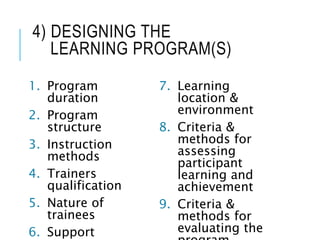
4) DESIGNING THE
LEARNING PROGRAM(S)
1. Program
duration
2. Program
structure
3. Instruction
methods
4. Trainers
qualification
5. Nature of
trainees
6. Support
7. Learning
location &
environment
8. Criteria &
methods for
assessing
participant
learning and
achievement
9. Criteria &
methods for
evaluating the 13
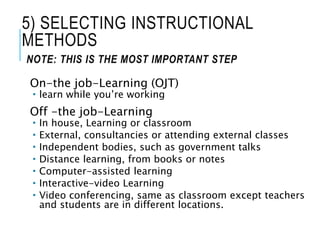
5) SELECTING INSTRUCTIONAL
METHODS
NOTE: THIS IS THE MOST IMPORTANT STEP
On-the job-Learning (OJT)
 learn while you’re working
Off -the job-Learning
 In house, Learning or classroom
 External, consultancies or attending external classes
 Independent bodies, such as government talks
 Distance learning, from books or notes
 Computer-assisted learning
 Interactive-video Learning
 Video conferencing, same as classroom except teachers
and students are in different locations.
14
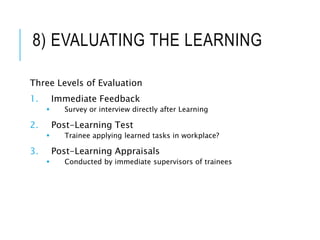
8) EVALUATING THE LEARNING
Three Levels of Evaluation
1. Immediate Feedback
 Survey or interview directly after Learning
2. Post-Learning Test
 Trainee applying learned tasks in workplace?
3. Post-Learning Appraisals
 Conducted by immediate supervisors of trainees
15

TrainingDevelopment382.ppt

  • 1.
    LEARNING & DEVELOPMENT Learning asa management skill / Learning and developing your staff
  • 2.
    TOPICS What should bethe Learning Module? A Systematic Approach to Learning A Learning Assessment 2
  • 3.
    SALES PROCESS Lead Generation Qualifying DemonstratingValue Convincing Closing Customer Retention 3
  • 4.
    SALES TRAINING TOPICS ConceptSelling Sales Methodology Sales Skill 4
  • 5.
    CONCEPT SELLING Understanding CustomerNeeds Your concept as a solution Competition & (How you win ) Long Game in Sales ( Persistence) Resources :  2 Case Study in Printed Format 5
  • 6.
    SALES METHODOLOGY Emphasizing companyUSP Proving Credibility Following up SPIN Selling Resources :  Process path in Printed Format 6
  • 7.
    SALES SKILL Conversion Presentation Active Listening StoryTelling Building Rapport Objection Handling Assertiveness Cross Selling & Up Selling Resources :  Case study for Both Story Telling & Upsales-Cross Sales  Pitch of the FBA Concept 7
  • 8.
    SOFT SKILL Dressing &grooming. Verbal Communication  Speech  Email Writing  WhatsApp Follow-ups  Phone Etiquettes Non-Verbal Communications  Body Language Office Etiquettes & Code of conduct. 8
  • 9.
    SALES AUTOMATION & SOFTWARE CRM& It’s Importance Follow-up Scheduling Excel Tips & Tricks Google Form Training Google Sheet Basic Presentation Skill Online Listing Portals ( Just Dial, India Mart & Google My Business ) Social media Branding. 9
  • 10.
    THE GAP INSKILL 10 Performance/ Results Time Expected Curve Actual Curve Gap In Learning terms this means we need to develop programs to fill the Gap Target Ratings
  • 11.
    LEARNING NEEDS The reasonsfor not making the benchmark achievement. Not enough resources Poor market Poor staff skills Operational constraints 11
  • 12.
    FIVE PRINCIPLES OFLMS Participation: involve trainees, learn by doing Repetition: repeat ideas & concepts to help people learn Relevance: learn better when material is meaningful and related Transference: to real world using simulations Feedback: ask for it and adjust Learning methods to audience. 12
  • 13.
    4) DESIGNING THE LEARNINGPROGRAM(S) 1. Program duration 2. Program structure 3. Instruction methods 4. Trainers qualification 5. Nature of trainees 6. Support 7. Learning location & environment 8. Criteria & methods for assessing participant learning and achievement 9. Criteria & methods for evaluating the 13
  • 14.
    5) SELECTING INSTRUCTIONAL METHODS NOTE:THIS IS THE MOST IMPORTANT STEP On-the job-Learning (OJT)  learn while you’re working Off -the job-Learning  In house, Learning or classroom  External, consultancies or attending external classes  Independent bodies, such as government talks  Distance learning, from books or notes  Computer-assisted learning  Interactive-video Learning  Video conferencing, same as classroom except teachers and students are in different locations. 14
  • 15.
    8) EVALUATING THELEARNING Three Levels of Evaluation 1. Immediate Feedback  Survey or interview directly after Learning 2. Post-Learning Test  Trainee applying learned tasks in workplace? 3. Post-Learning Appraisals  Conducted by immediate supervisors of trainees 15