Welcome to a training on
Financial
Accounting
By: Biniam Berhie
&
Mesele Getachew
Objectives
 The major objective of this training is to
acquaint participants with the basic
understanding of financial accounting.
Specific objectives
 Understand the basic concepts of accounting
 FASB
 Financial Statements
 Basic assumptions, principles and concepts
 Accrual and cash basis of accounting
 Accounting equation
 Practice the major stages of accounting
process
Expectations
Ethical conducts and rules of the training

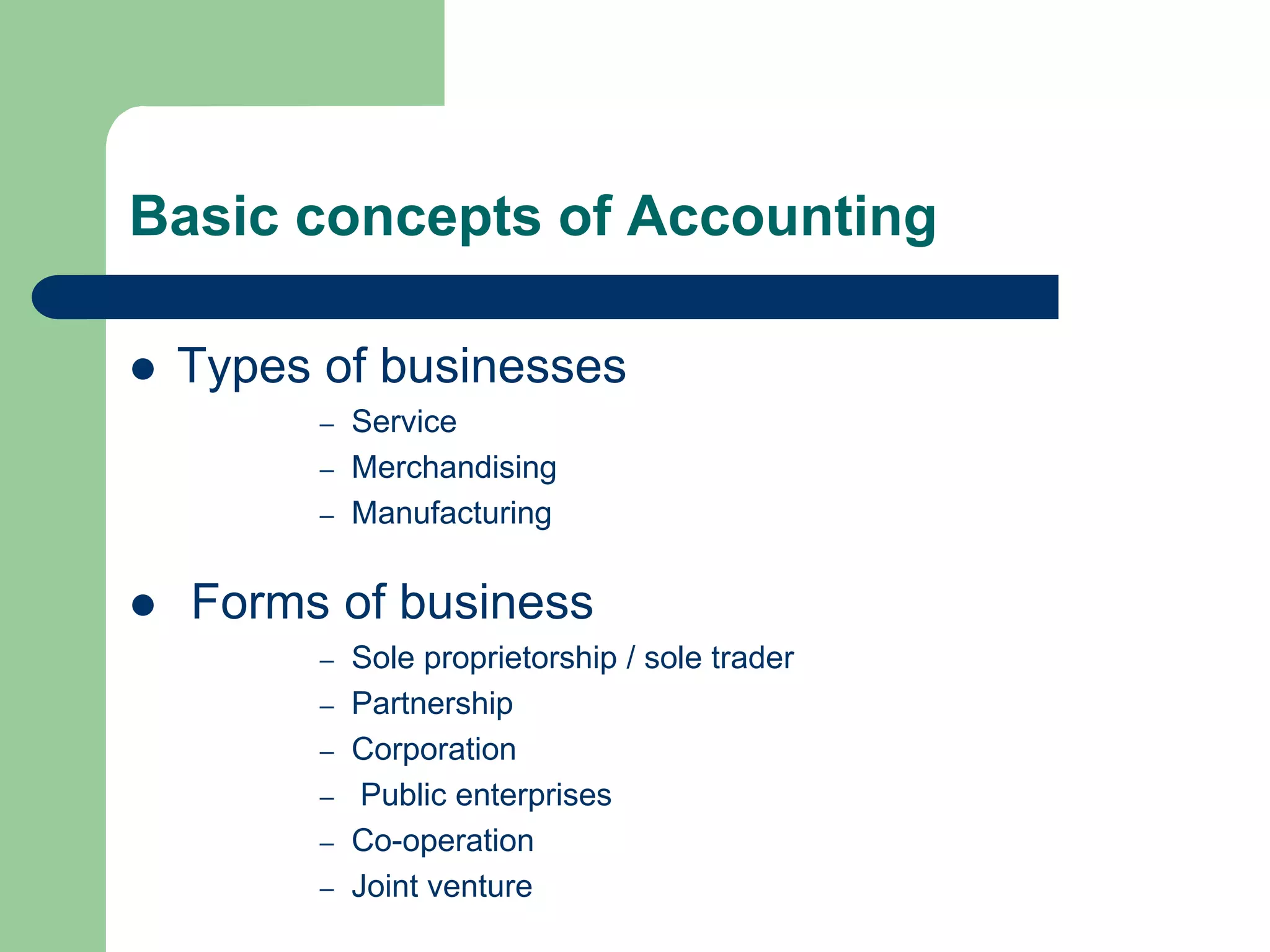
Basic concepts of Accounting
 Types of businesses
– Service
– Merchandising
– Manufacturing
 Forms of business
– Sole proprietorship / sole trader
– Partnership
– Corporation
– Public enterprises
– Co-operation
– Joint venture
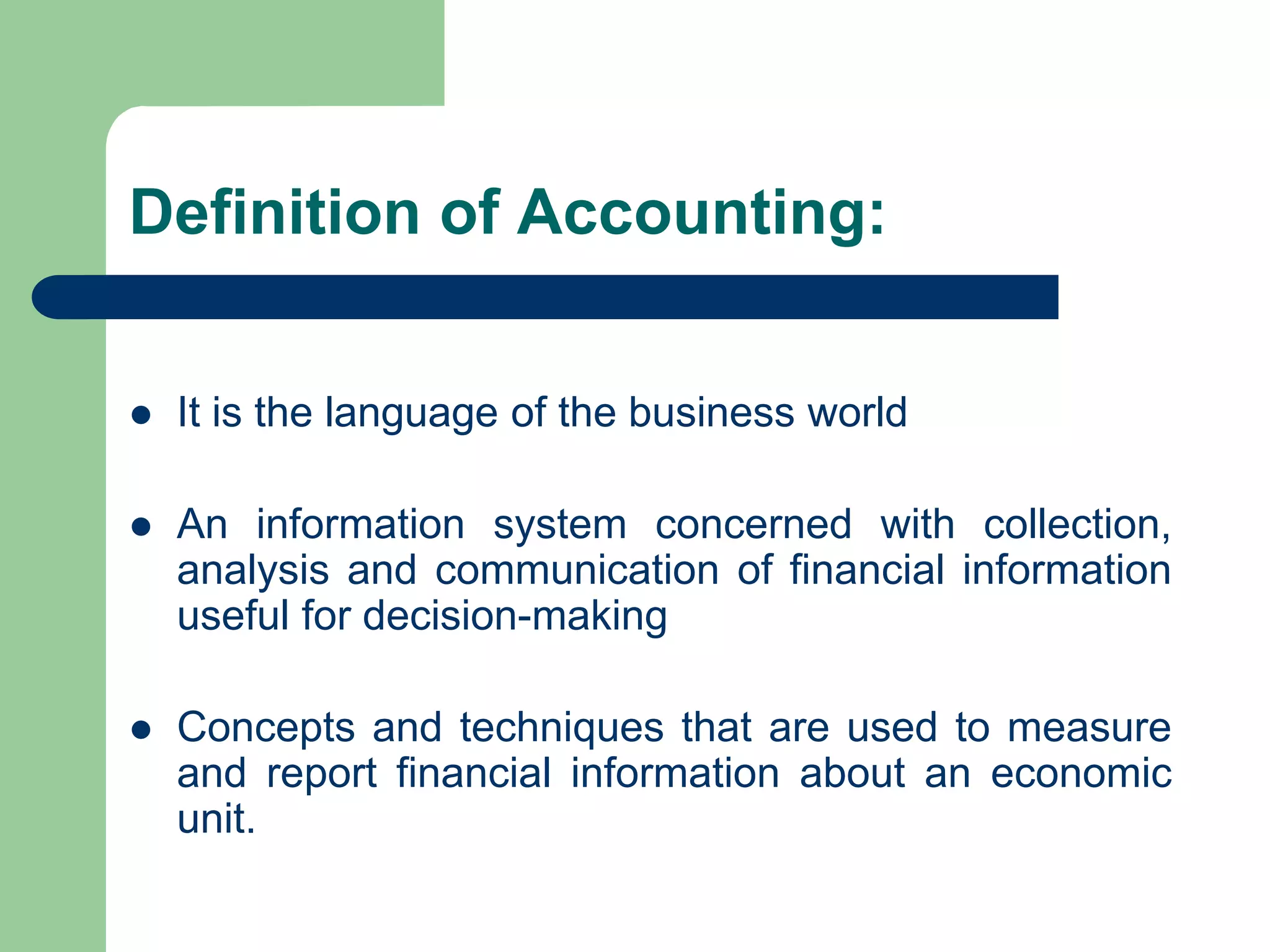
Definition of Accounting:
 It is the language of the business world
 An information system concerned with collection,
analysis and communication of financial information
useful for decision-making
 Concepts and techniques that are used to measure
and report financial information about an economic
unit.
Complete of the definition
– Identifying
– Analysing and measuring
– Recording
– Classification
– Summarising
– Reporting
– Interpreting
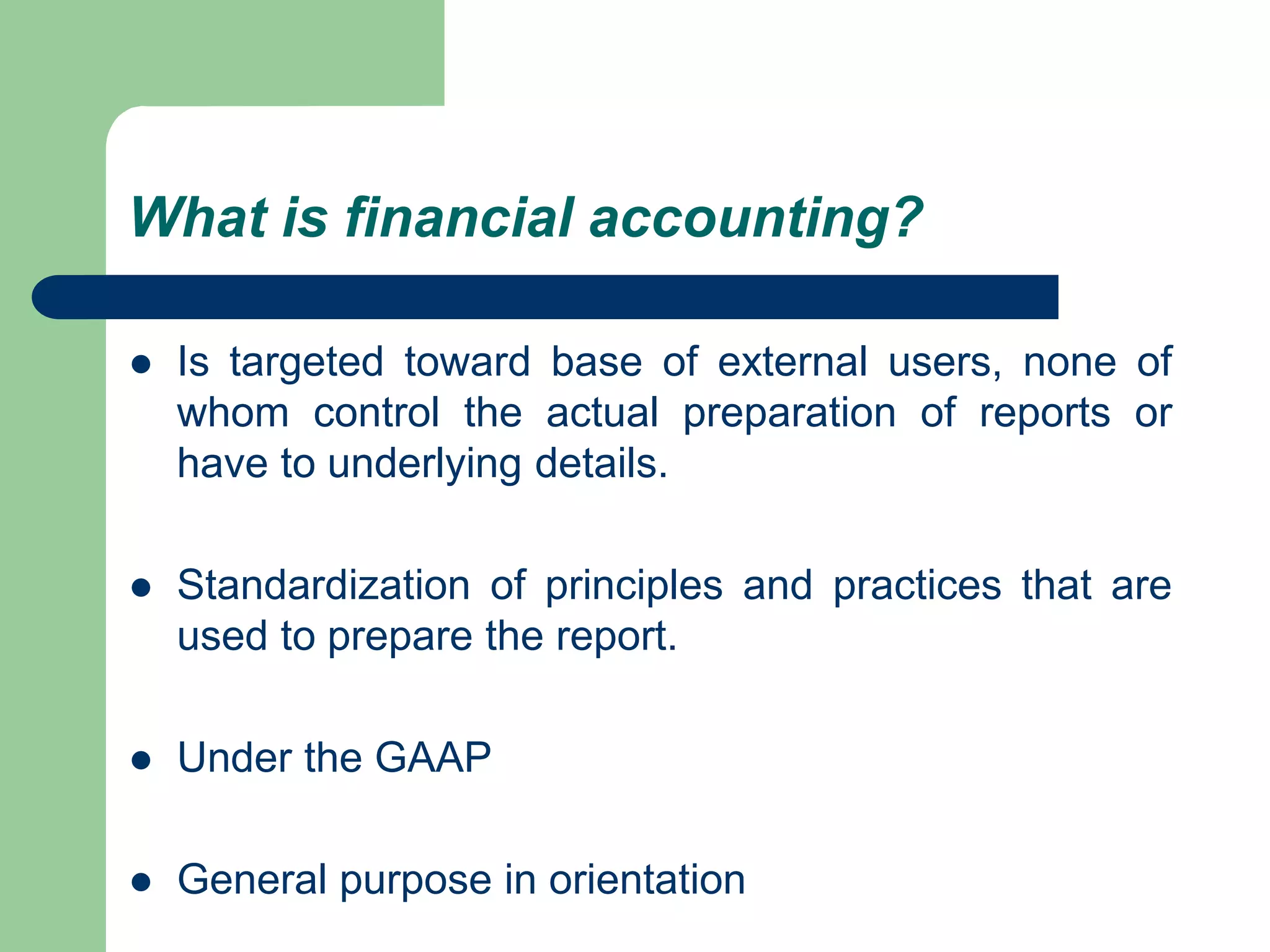
What is financial accounting?
 Is targeted toward base of external users, none of
whom control the actual preparation of reports or
have to underlying details.
 Standardization of principles and practices that are
used to prepare the report.
 Under the GAAP
 General purpose in orientation
What is management accounting?
 to serve the specific needs of management
 charged with planning, controlling, and
decision making
 desire specified reports, budget costing data,
and other details that are generally not
reported on external basis
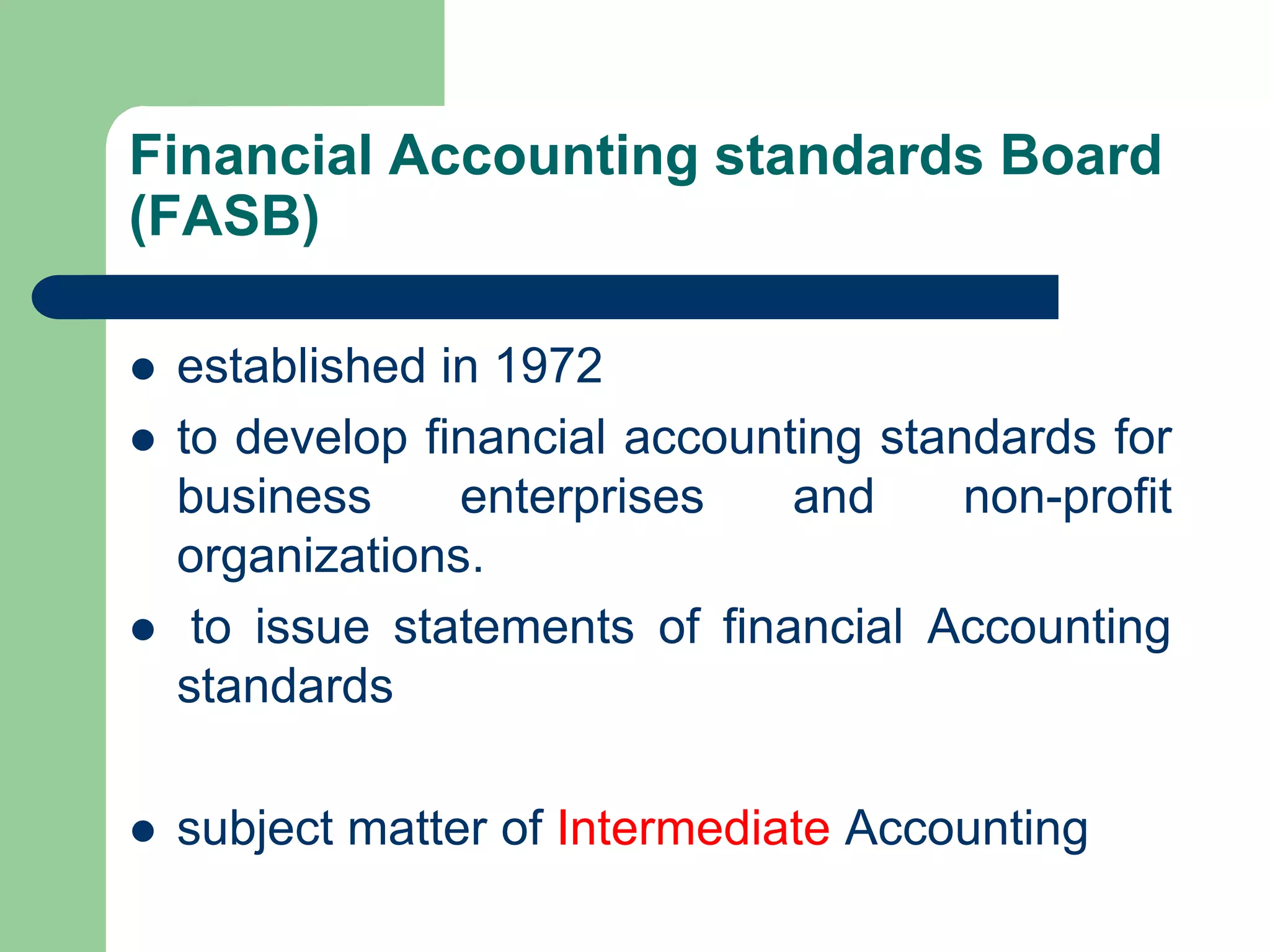
Financial Accounting standards Board
(FASB)
 established in 1972
 to develop financial accounting standards for
business enterprises and non-profit
organizations.
 to issue statements of financial Accounting
standards
 subject matter of Intermediate Accounting
Elements of Financial Statements
 Asset (current, plant machinery and
equipment, intangibles, long-term
investment, others)
 Liability (current and non-current)
 Equity /investment by the government and
distribution to the government/
Elements (cont…)
 Revenue (sales, income, others)
 Expense (utility, rent, dep’n, salary, interest,
wage, supplies, tax, etc)
 Gain (revenue>expense)
 Loss (revenue<expense)
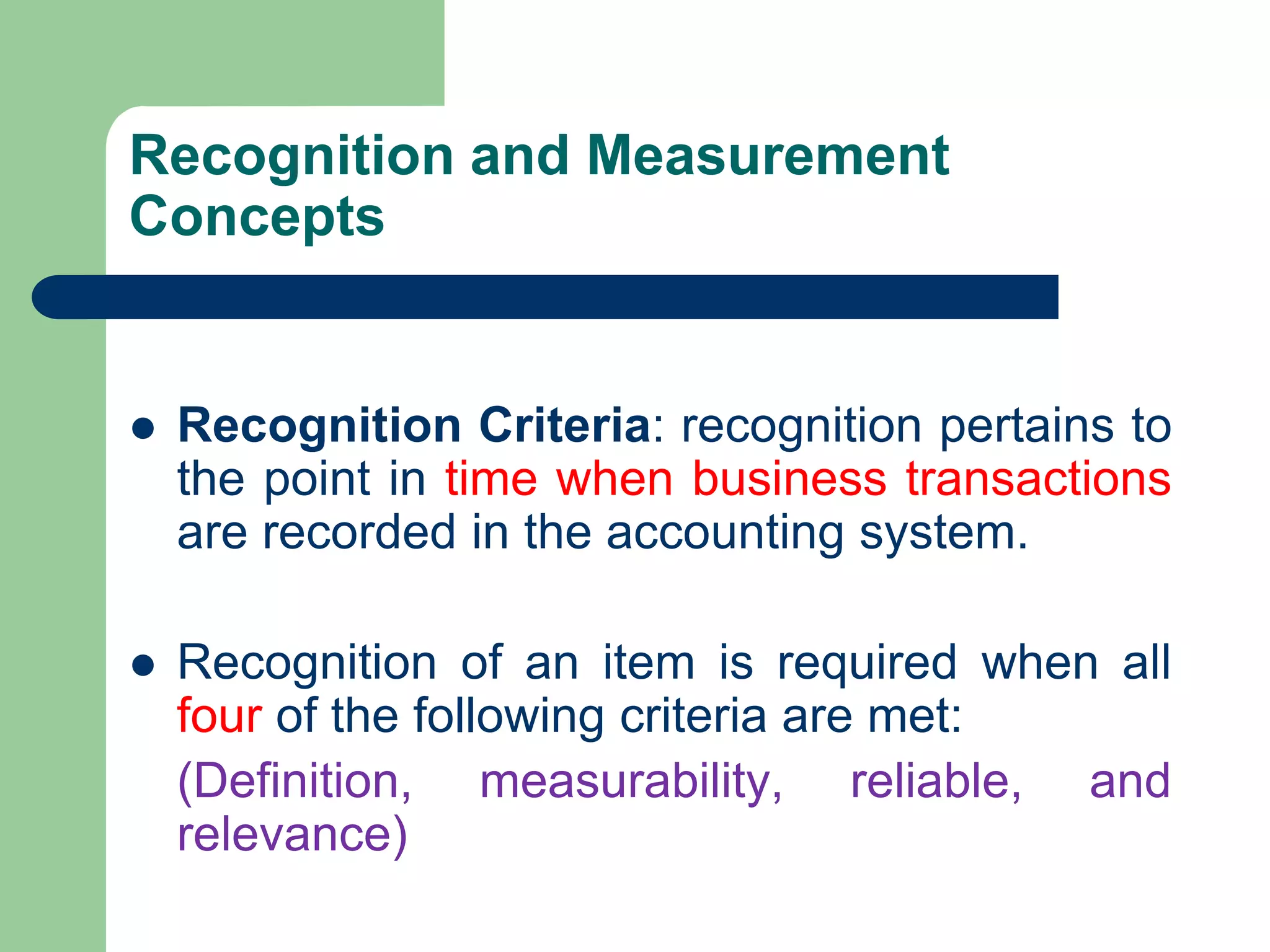
Recognition and Measurement
Concepts
 Recognition Criteria: recognition pertains to
the point in time when business transactions
are recorded in the accounting system.
 Recognition of an item is required when all
four of the following criteria are met:
(Definition, measurability, reliable, and
relevance)
Basic Assumptions
 Business entity Assumption
 Going – Concern (Continuity)
 Unit–of–measure Assumption
 Time – period Assumption
Basic Principles
 The cost principle
 The revenue realization principle
 The matching Principle
 Full – Disclosure Principle
Constraints
 Cost –Benefit Constraint
 Materiality Constraint
 Industry peculiarities
 Conservatism
Cash Basis of Accounting
 It is an accounting system based on the
timing of cash payments and receipts.
 Financial statements prepared under the
cash basis of accounting do not represent
the financial position or operating results of
an enterprise in conformity with GAAP since
it is not compatible with the matching
principle.
Modified cash
 Under the modified cash basis of accounting,
which is mostly used for income tax purpose,
the entire cost of property having an
economic life of more than one year may not
be deduced in the year of acquisition.
 Expenses paid after the year in which
incurred are deductible only in the year paid.
Revenue is reported in the year received.
Accrual Basis of Accounting
 is a system of accounting that requires an
event that alters the economic status of a
firm as represented in its financial statements
be recorded (recognized) in the period in
which the event occurs rather than in the
period when cash changes hands.
Accrual basis (cont…)
 revenues are reported in the income
statement when they are earned
 expenses are reported in the income
statement when they are incurred
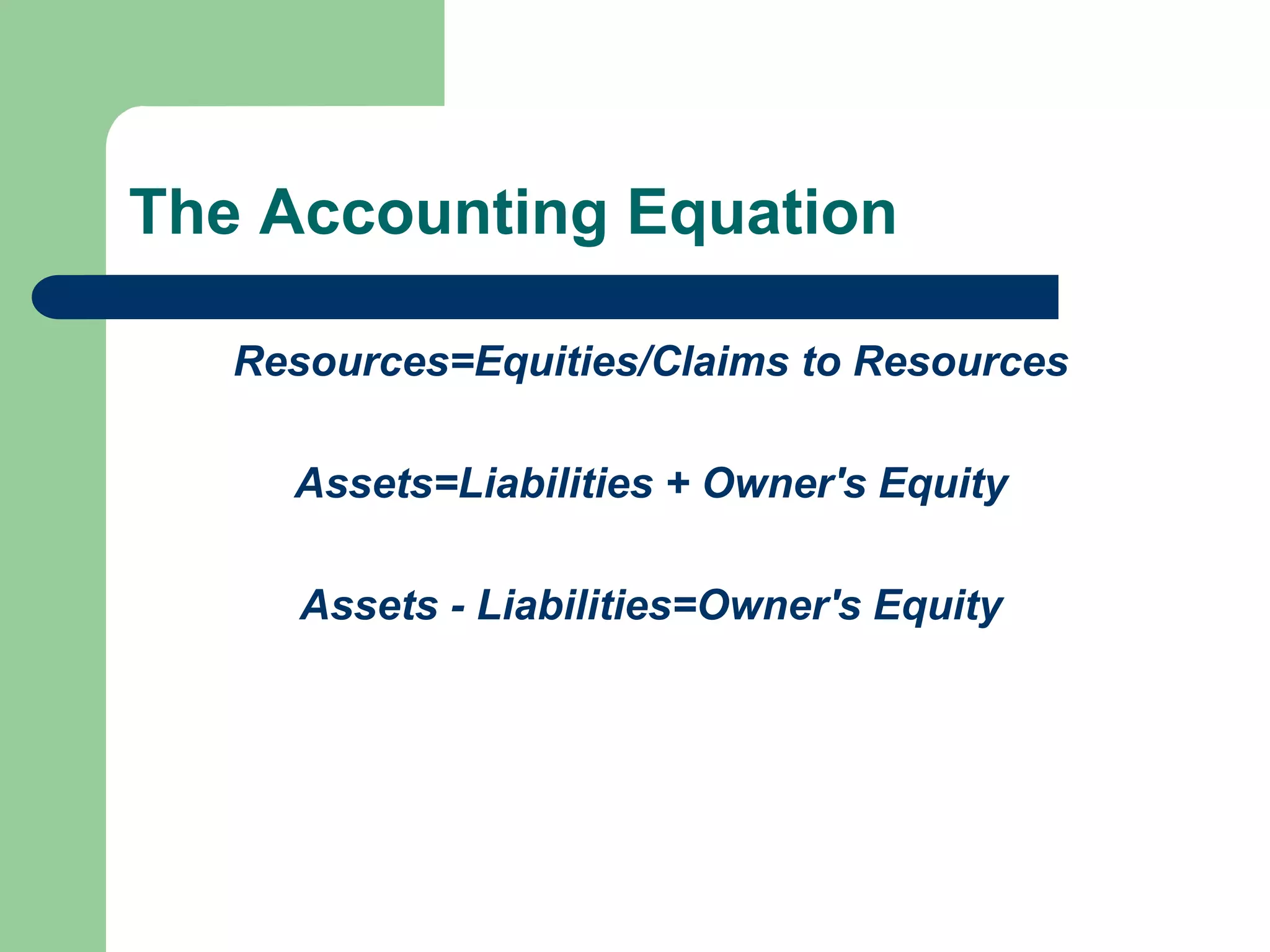
The Accounting Equation
Resources=Equities/Claims to Resources
Assets=Liabilities + Owner's Equity
Assets - Liabilities=Owner's Equity
Business Transactions and the
Accounting Equation
 Collections of resources
 Consumptions of goods and services
Financial Statements
 Income statement (statement of profit and
loss) – revenue and expenses
 Statement of change in owner's equity
 Balance sheet (Statement of financial
position)
– Formats - Report format and
Account format
Financial Statements (Cont…)
 Statement of Cash flow
Elements – cash flow from operation
- cash flow from investing
- cash flow from financing
End of Part one
Thank you very much
for your undivided
attention and
participation

Training on Financial Accounting Part I.ppt

  • 1.
    Welcome to atraining on Financial Accounting By: Biniam Berhie & Mesele Getachew
  • 2.
    Objectives  The majorobjective of this training is to acquaint participants with the basic understanding of financial accounting.
  • 3.
    Specific objectives  Understandthe basic concepts of accounting  FASB  Financial Statements  Basic assumptions, principles and concepts  Accrual and cash basis of accounting  Accounting equation  Practice the major stages of accounting process
  • 4.
  • 5.
    Ethical conducts andrules of the training 
  • 6.
    Basic concepts ofAccounting  Types of businesses – Service – Merchandising – Manufacturing  Forms of business – Sole proprietorship / sole trader – Partnership – Corporation – Public enterprises – Co-operation – Joint venture
  • 7.
    Definition of Accounting: It is the language of the business world  An information system concerned with collection, analysis and communication of financial information useful for decision-making  Concepts and techniques that are used to measure and report financial information about an economic unit.
  • 8.
    Complete of thedefinition – Identifying – Analysing and measuring – Recording – Classification – Summarising – Reporting – Interpreting
  • 9.
    What is financialaccounting?  Is targeted toward base of external users, none of whom control the actual preparation of reports or have to underlying details.  Standardization of principles and practices that are used to prepare the report.  Under the GAAP  General purpose in orientation
  • 10.
    What is managementaccounting?  to serve the specific needs of management  charged with planning, controlling, and decision making  desire specified reports, budget costing data, and other details that are generally not reported on external basis
  • 11.
    Financial Accounting standardsBoard (FASB)  established in 1972  to develop financial accounting standards for business enterprises and non-profit organizations.  to issue statements of financial Accounting standards  subject matter of Intermediate Accounting
  • 12.
    Elements of FinancialStatements  Asset (current, plant machinery and equipment, intangibles, long-term investment, others)  Liability (current and non-current)  Equity /investment by the government and distribution to the government/
  • 13.
    Elements (cont…)  Revenue(sales, income, others)  Expense (utility, rent, dep’n, salary, interest, wage, supplies, tax, etc)  Gain (revenue>expense)  Loss (revenue<expense)
  • 14.
    Recognition and Measurement Concepts Recognition Criteria: recognition pertains to the point in time when business transactions are recorded in the accounting system.  Recognition of an item is required when all four of the following criteria are met: (Definition, measurability, reliable, and relevance)
  • 15.
    Basic Assumptions  Businessentity Assumption  Going – Concern (Continuity)  Unit–of–measure Assumption  Time – period Assumption
  • 16.
    Basic Principles  Thecost principle  The revenue realization principle  The matching Principle  Full – Disclosure Principle
  • 17.
    Constraints  Cost –BenefitConstraint  Materiality Constraint  Industry peculiarities  Conservatism
  • 18.
    Cash Basis ofAccounting  It is an accounting system based on the timing of cash payments and receipts.  Financial statements prepared under the cash basis of accounting do not represent the financial position or operating results of an enterprise in conformity with GAAP since it is not compatible with the matching principle.
  • 19.
    Modified cash  Underthe modified cash basis of accounting, which is mostly used for income tax purpose, the entire cost of property having an economic life of more than one year may not be deduced in the year of acquisition.  Expenses paid after the year in which incurred are deductible only in the year paid. Revenue is reported in the year received.
  • 20.
    Accrual Basis ofAccounting  is a system of accounting that requires an event that alters the economic status of a firm as represented in its financial statements be recorded (recognized) in the period in which the event occurs rather than in the period when cash changes hands.
  • 21.
    Accrual basis (cont…) revenues are reported in the income statement when they are earned  expenses are reported in the income statement when they are incurred
  • 22.
    The Accounting Equation Resources=Equities/Claimsto Resources Assets=Liabilities + Owner's Equity Assets - Liabilities=Owner's Equity
  • 23.
    Business Transactions andthe Accounting Equation  Collections of resources  Consumptions of goods and services
  • 24.
    Financial Statements  Incomestatement (statement of profit and loss) – revenue and expenses  Statement of change in owner's equity  Balance sheet (Statement of financial position) – Formats - Report format and Account format
  • 25.
    Financial Statements (Cont…) Statement of Cash flow Elements – cash flow from operation - cash flow from investing - cash flow from financing
  • 26.
    End of Partone Thank you very much for your undivided attention and participation