Horror Film Trailer Overview 
In this overview on horror film trailers, I will be discussing the conventions and traditional structures 
that take place within these short clips and present on how they will have an effect on the audience 
watching them. 
When watching a horror trailer, they will often contain a magnitude of differentiating elements and 
conventions in order to bring forth a truly effective trailer that’s not only scary, but also explanatory 
as well, without giving away too much information that could potentially spoil the entire film for the 
audience. Conventions in horror are very much significant and are absolutely necessary in 
establishing the specific genre that the film is centred around, although having a bit of absence of 
some features will not alter the effectiveness that the trailer depicts. Therefore, it is not always 
compulsory to bombard the trailer with every single conventional element in order to give it more of 
an effect upon the audience. 
They achieve this while also having to make sure that the trailer will be available for airing either on 
television, online video streaming sites, or in the cinema branch out and reach the targeted audience 
as widely as possible. The content in a horror trailer may be dependent on what format it is being 
played upon, for instance, a TV spot trailer may have less frightening content in order for it to be 
shown on television during the daytime so that it doesn’t disturb young children, whilst an online 
trailer will have more as it is not restricted. 
The trailers viewed follow an understandable structure when it comes to narrative, incorporating 
heavy use of Todorov’s Narrative Theory. These all begin with an equilibrium set in motion, 
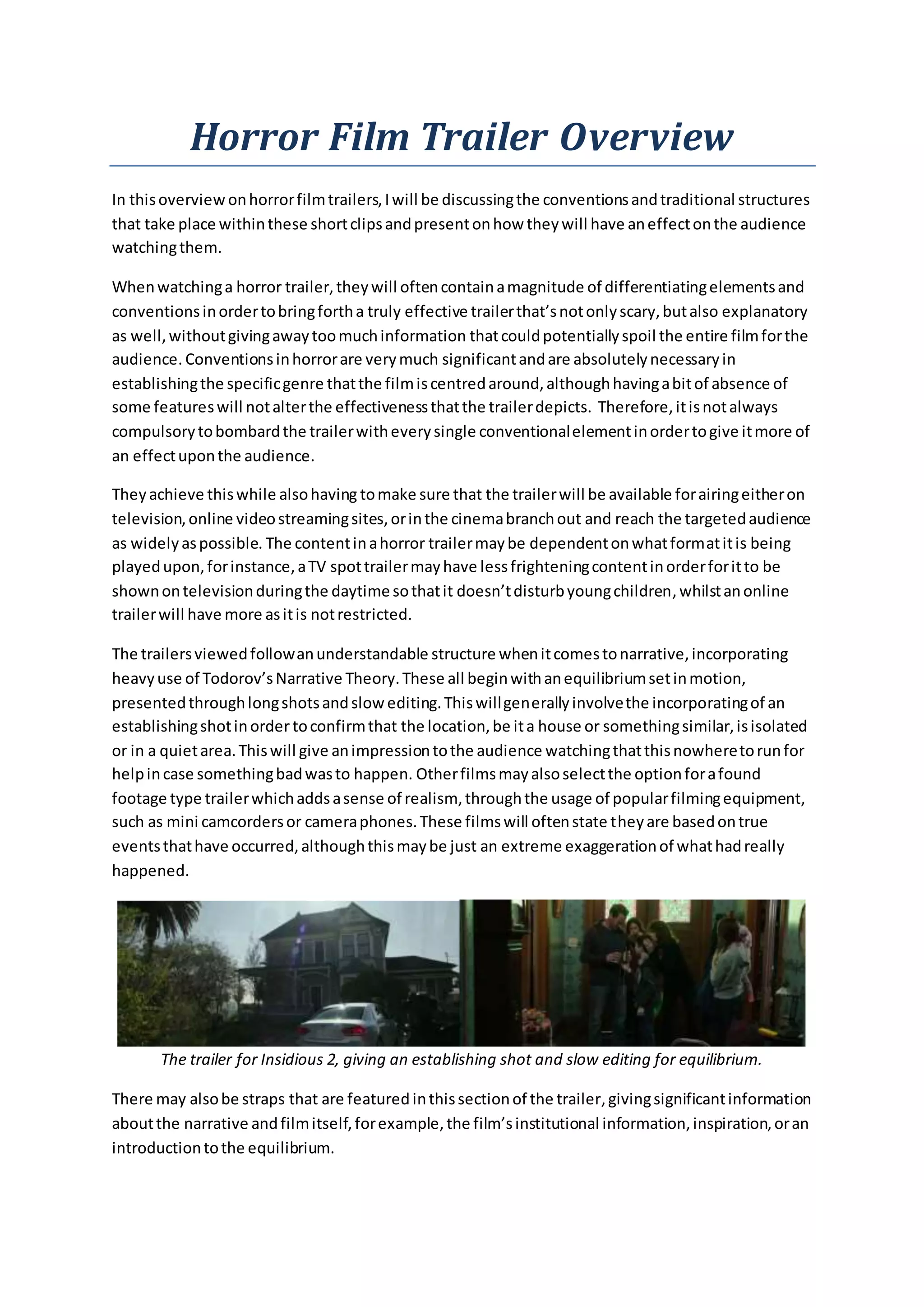
presented through long shots and slow editing. This will generally involve the incorporating of an 
establishing shot in order to confirm that the location, be it a house or something similar, is isolated 
or in a quiet area. This will give an impression to the audience watching that this nowhere to run for 
help in case something bad was to happen. Other films may also select the option for a found 
footage type trailer which adds a sense of realism, through the usage of popular filming equipment, 
such as mini camcorders or camera phones. These films will often state they are based on true 
events that have occurred, although this may be just an extreme exaggeration of what had really 
happened. 
The trailer for Insidious 2, giving an establishing shot and slow editing for equilibrium. 
There may also be straps that are featured in this section of the trailer, giving significant information 
about the narrative and film itself, for example, the film’s institutional information, inspiration, or an 
introduction to the equilibrium.
Then all of a sudden, there is an interruption and the tone of music changes to something more 
eerie, along with contrapuntal sounds to indicate to the audience that something is not quite right. 
The acknowledgement of this disruption usually will lead to the trailer’s pace being picked up; 
shorter shots and faster editing becoming apparent, jump scares now beginning to crop out a lot. 
This builds up the tension within the trailer, making the audience feel uncomfortable and reflecting 
upon the characters’ feelings (as seen in Sinister’s trailer). As with some trailers, one shot may 
feature a character being totally oblivious to the danger that is unknowing to them. 
The intensity of the trailer is then presented by shots from some of the film’s most impactful and 
scariest scenes. This is a fast montage of shots which showcase a reaction to the disruption a 
number of disturbing scenes. It is often preceded by a scene with a period of long silence, right 
before a jump scare is inserted to create a kick start to the montage of terror. Content that is being 
featured will include various clips of conventions such as characters screaming and cowering in 
terror, the possessed being contorted in a frightening fashion, scenes of exorcisms being performed 
to rid a person of being taken over by a demon or vengeful spirit, along with damage being made 
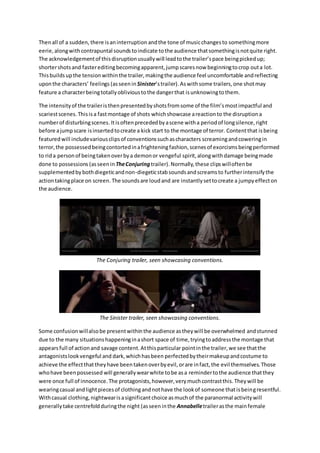
done to possessions (as seen in The Conjuring trailer). Normally, these clips will often be 
supplemented by both diegetic and non-diegetic stab sounds and screams to further intensify the 
action taking place on screen. The sounds are loud and are instantly set to create a jumpy effect on 
the audience. 
The Conjuring trailer, seen showcasing conventions. 
The Sinister trailer, seen showcasing conventions. 
Some confusion will also be present within the audience as they will be overwhelmed and stunned 
due to the many situations happening in a short space of time, trying to address the montage that 
appears full of action and savage content. At this particular point in the trailer, we see that the 
antagonists look vengeful and dark, which has been perfected by their makeup and costume to 
achieve the effect that they have been taken over by evil, or are in fact, the evil themselves. Those 
who have been possessed will generally wear white to be as a reminder to the audience that they 
were once full of innocence. The protagonists, however, very much contrast this. They will be 
wearing casual and light pieces of clothing and not have the look of someone that is being resentful. 
With casual clothing, nightwear is a significant choice as much of the paranormal activity will 
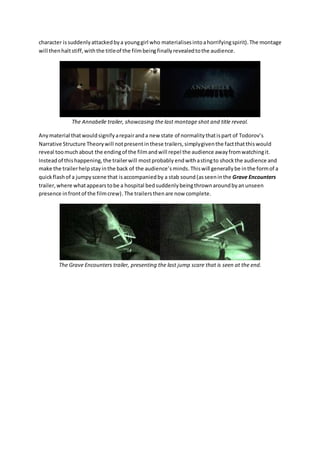
generally take centrefold during the night (as seen in the Annabelle trailer as the main female
character is suddenly attacked by a young girl who materialises into a horrifying spirit). The montage 
will then halt stiff, with the title of the film being finally revealed to the audience. 
The Annabelle trailer, showcasing the last montage shot and title reveal. 
Any material that would signify a repair and a new state of normality that is part of Todorov’s 
Narrative Structure Theory will not present in these trailers, simply given the fact that this would 
reveal too much about the ending of the film and will repel the audience away from watching it. 
Instead of this happening, the trailer will most probably end with a sting to shock the audience and 
make the trailer help stay in the back of the audience’s minds. This will generally be in the form of a 
quick flash of a jumpy scene that is accompanied by a stab sound (as seen in the Grave Encounters 
trailer, where what appears to be a hospital bed suddenly being thrown around by an unseen 
presence in front of the film crew). The trailers then are now complete. 
The Grave Encounters trailer, presenting the last jump scare that is seen at the end.

Horror Film Trailer Overview

  • 1.
    Horror Film TrailerOverview In this overview on horror film trailers, I will be discussing the conventions and traditional structures that take place within these short clips and present on how they will have an effect on the audience watching them. When watching a horror trailer, they will often contain a magnitude of differentiating elements and conventions in order to bring forth a truly effective trailer that’s not only scary, but also explanatory as well, without giving away too much information that could potentially spoil the entire film for the audience. Conventions in horror are very much significant and are absolutely necessary in establishing the specific genre that the film is centred around, although having a bit of absence of some features will not alter the effectiveness that the trailer depicts. Therefore, it is not always compulsory to bombard the trailer with every single conventional element in order to give it more of an effect upon the audience. They achieve this while also having to make sure that the trailer will be available for airing either on television, online video streaming sites, or in the cinema branch out and reach the targeted audience as widely as possible. The content in a horror trailer may be dependent on what format it is being played upon, for instance, a TV spot trailer may have less frightening content in order for it to be shown on television during the daytime so that it doesn’t disturb young children, whilst an online trailer will have more as it is not restricted. The trailers viewed follow an understandable structure when it comes to narrative, incorporating heavy use of Todorov’s Narrative Theory. These all begin with an equilibrium set in motion, presented through long shots and slow editing. This will generally involve the incorporating of an establishing shot in order to confirm that the location, be it a house or something similar, is isolated or in a quiet area. This will give an impression to the audience watching that this nowhere to run for help in case something bad was to happen. Other films may also select the option for a found footage type trailer which adds a sense of realism, through the usage of popular filming equipment, such as mini camcorders or camera phones. These films will often state they are based on true events that have occurred, although this may be just an extreme exaggeration of what had really happened. The trailer for Insidious 2, giving an establishing shot and slow editing for equilibrium. There may also be straps that are featured in this section of the trailer, giving significant information about the narrative and film itself, for example, the film’s institutional information, inspiration, or an introduction to the equilibrium.
  • 2.
    Then all ofa sudden, there is an interruption and the tone of music changes to something more eerie, along with contrapuntal sounds to indicate to the audience that something is not quite right. The acknowledgement of this disruption usually will lead to the trailer’s pace being picked up; shorter shots and faster editing becoming apparent, jump scares now beginning to crop out a lot. This builds up the tension within the trailer, making the audience feel uncomfortable and reflecting upon the characters’ feelings (as seen in Sinister’s trailer). As with some trailers, one shot may feature a character being totally oblivious to the danger that is unknowing to them. The intensity of the trailer is then presented by shots from some of the film’s most impactful and scariest scenes. This is a fast montage of shots which showcase a reaction to the disruption a number of disturbing scenes. It is often preceded by a scene with a period of long silence, right before a jump scare is inserted to create a kick start to the montage of terror. Content that is being featured will include various clips of conventions such as characters screaming and cowering in terror, the possessed being contorted in a frightening fashion, scenes of exorcisms being performed to rid a person of being taken over by a demon or vengeful spirit, along with damage being made done to possessions (as seen in The Conjuring trailer). Normally, these clips will often be supplemented by both diegetic and non-diegetic stab sounds and screams to further intensify the action taking place on screen. The sounds are loud and are instantly set to create a jumpy effect on the audience. The Conjuring trailer, seen showcasing conventions. The Sinister trailer, seen showcasing conventions. Some confusion will also be present within the audience as they will be overwhelmed and stunned due to the many situations happening in a short space of time, trying to address the montage that appears full of action and savage content. At this particular point in the trailer, we see that the antagonists look vengeful and dark, which has been perfected by their makeup and costume to achieve the effect that they have been taken over by evil, or are in fact, the evil themselves. Those who have been possessed will generally wear white to be as a reminder to the audience that they were once full of innocence. The protagonists, however, very much contrast this. They will be wearing casual and light pieces of clothing and not have the look of someone that is being resentful. With casual clothing, nightwear is a significant choice as much of the paranormal activity will generally take centrefold during the night (as seen in the Annabelle trailer as the main female
  • 3.
    character is suddenlyattacked by a young girl who materialises into a horrifying spirit). The montage will then halt stiff, with the title of the film being finally revealed to the audience. The Annabelle trailer, showcasing the last montage shot and title reveal. Any material that would signify a repair and a new state of normality that is part of Todorov’s Narrative Structure Theory will not present in these trailers, simply given the fact that this would reveal too much about the ending of the film and will repel the audience away from watching it. Instead of this happening, the trailer will most probably end with a sting to shock the audience and make the trailer help stay in the back of the audience’s minds. This will generally be in the form of a quick flash of a jumpy scene that is accompanied by a stab sound (as seen in the Grave Encounters trailer, where what appears to be a hospital bed suddenly being thrown around by an unseen presence in front of the film crew). The trailers then are now complete. The Grave Encounters trailer, presenting the last jump scare that is seen at the end.