By Josh Naughton
 SUB-GENRES ENSURE THAT HORROR CAN 
AND WILL MULTIPLY IN ITS COMPLEXITIES 
AND EVOLVE ALONG WITH HUMAN FEARS. 
- William Cook (Horror author) 
 FILMS MADE POST-2000 TESTIFY TO THE 
BROADNESS OF THE HORROR CATEGORY. 
- Peter Hutchings (The Horror Film)
 These films normally have an antagonist who is a masked killer, usually psychotic, who 
commits lots of gruesome, gore-filled deaths. The victims are normally those are teenage, 
who drink, and have casual sex. The final female survives until the end. 
 The first girl to die gives the film its meaning and sets the tone by making the audience 
known that this clearly a slasher film and that the killer has come to start their killings. This 
character is often a girl who is sexually active and almost always goes off to have sexual 
intercourse but ends up being slaughtered by the killer. 
 The murderer’s identity is often unknown and only revealed at the end of the film. This can 
be achieved by a mask, creative lighting and camera techniques. They are most likely to be 
a man and their weapon of choice is commonly a sharp object and handheld. 
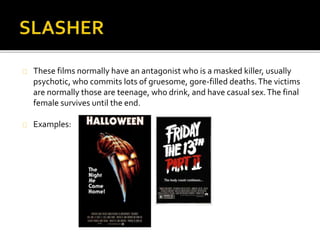
An example of the slasher genre is Friday The 13th. 
The film’s narrative involves camp counsellors who are stalked and murdered one by one by an 
unknown assailant while trying to reopen a summer camp that was the site of a child's 
drowning.
 The antagonist has a monstrous, twisted mind, but looks ‘normal’. Their mind will scare the 
audience and be the main source of where the horror is coming from. Plot twists are also 
often used. Characters may commonly face internal battles with subconscious desires such 
as romantic lust and the desire to kill too. 
 The settings in a psychological horror film are that of big houses, forests, woodland areas, 
warehouses, schools, and hospitals and so on. These will create a sense of realism for the 
target audience as they, on some level, have been in these settings. This increases the fear, 
as the audiences will then start to picture themselves in these situations. 
 Flashbacks may play a dominant part in the film and they take the audience back to see 
exactly why the killer is disturbed and to explain what had happened to them in their lives 
which has lead them to become mentally challenged. 
 There is also less physical harm and bloody gore visible for the viewers to see and instead 
create discomfort in the viewer by exposing common psychological vulnerabilities and 
fears. 
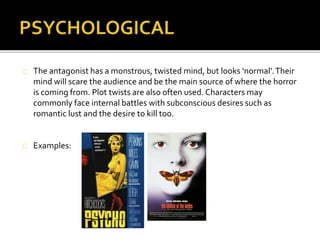
An example of the pyschological genre is The Shining. 
The film’s narrative involves a family heading to an isolated hotel for the winter 
where an evil and spiritual presence influences the father into violence.
 Supernatural horror films have a tendency to have themes including gods or goddesses, 
ghosts, apparitions, spirits, miracles, and other similar ideas or depictions of extraordinary 
phenomena that is taking place within the movie. Narratives focus upon the presence of 
something not human that can not be easily controlled or defeated. 
 The characters are depicted as being caring, loving and nurtured people, who are 
considered by the audience to be completely harmless. This is to contrast against the 
aggressive hauntings. Often the characters are haunted in themselves by something in 
their past that is troubling them. 
 The spirits’ past is an important factor for the build up and pace increase. The character will 
often find a disjointed series of clues as to who this person was, why they died and what 
they can do to dispose of them as quickly as possible. 
 Locations for this type of horror film generally involve the action taking place in a suburban 
setting, generally a vacant house that has not been used in quite some time. 
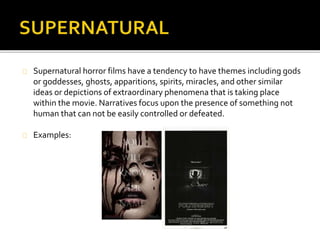
An example of the supernatural genre is Poltergeist. 
The film’s narrative involves a young family who are visited by ghosts in their home. At first the ghosts 
appear friendly, but then they turn nasty and start to terrorise the family before they "kidnap" the 
youngest daughter.
 Possession horror movies have the plot revolving around a person, most notably a female, 
who becomes possessed by a demonic entity. An exorcism is performed to try and rid the 
victim of the spirit. The victim may have their skin turn pale white, eyes diluted, and scars 
marked all over their body. 
 Religious imagery is quite significant due to presence of demons and evil spirits with thin 
films. This is frequent in many possession films because of the audiences are frightened of 
the unknown. What they do not know exists or is physically present. 
 The possession may begin when a spirit is unleashed from an object, preferably a box. The 
specified object is supposed to seem ordinary, however it turns out to possess an evil 
demon that is trapped inside. 
 Another convention is the loss of colour in the iris to signify the loss of soul. This is effective 
as eye colour says a lot about a person's personality, therefore the loss of this suggests 
someone's identity has been lost. 
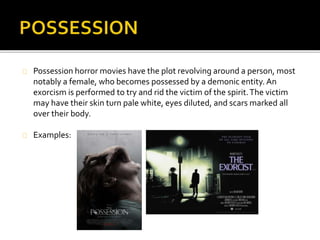
An example of the possession genre is The Exorcist. 
The film’s narrative involves a teenage girl who is suddenly possessed by a mysterious 
entity. Her mother then desperately seeks the help of two priests to save her daughter.
 Gothic horror comes from the popularity of Gothic fiction and novels from the 1800s 
onwards. This genre typically combines the elements of wild and desolate landscapes, an 
atmosphere of doom and gloom, wicked tyrants and malevolent witches, along with the 
use of a spine chilling plot. 
 The narratives are flesh creeping and spine chilling, to stir up fears and anxieties that are 
attractive yet dangerous at the same time. These are feelings that we don’t acknowledge 
on in everyday life but are repressed. The narratives are intended to create an emotional 
response from the audience, not an intellectual or moral one. 
 The settings are often dark and dangerous locations, such as abandoned graveyards, 
forests and untamed places. This is to give a strong sense of mystery for the film. 
 Plots often enclose a family mystery, ancient prophecies or revenge. Notions of inherited 
curses or terrible family mysteries are common; often, the protagonist must overcome an 
ancestral curse to restore the world to order. 
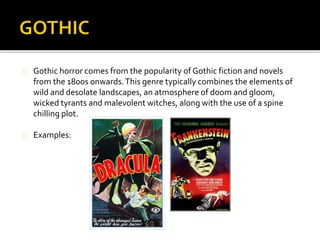
An example of the gothic horror genre is Dracula. 
The film’s narrative involves the ancient vampire Count Dracula arriving in England and beginning to prey upon the 
virtuous young Mina.
 A monster film centres upon a large scale struggle between human beings and a 
monster(s). The monster usually serves as a villain, and the film portrays a hero or heroine 
that ultimately saves the world from the monster, by the end of the film. 
 Most films of this particular genre portray the monster as either being a prehistoric 
creature that has suddenly reawakened, born out of radioactivity from nuclear testing, or 
from outer space. It will then be seen attacking a major city such as New York or Tokyo, with 
normal efforts from the army or police force being unable to stop it. 
 A majority of monster horror films will have a sequel produced, in order to show that the 
monster is still out there on the loose and has yet to be fully stopped. 
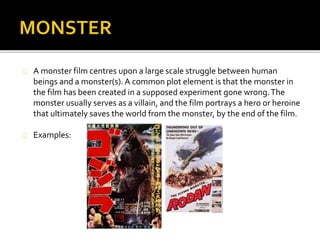
An example of the monster genre is Godzilla. 
The film’s narrative involves a giant dinosaur-like beast, that 
awakes from undersea hibernation by the usage of atomic-bomb 
testing, and starts to attack Tokyo.
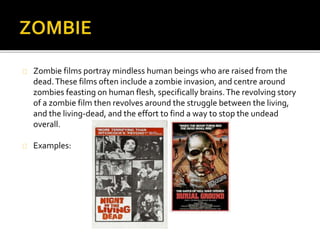
 Zombie films portray mindless human beings who are raised from the dead. These films 
often include a zombie invasion, and centre around zombies feasting on human flesh, 
specifically brains. The revolving story of a zombie film then revolves around the struggle 
between the living, and the living-dead, and the effort to find a way to stop the undead 
overall. 
 These films are designed to cause panic to the audience, while depicting scenes of 
isolation, broken down societies, and plenty of gore. They normally conclude in a shocking 
ending, although the lead protagonist, however, does normally survive the onslaught up 
until the end of the film. 
 The stereotypical characters such as children, coward or betrayer crop up to become the 
protagonist's other roadblocks to his ultimate goal of survival. Rarely is there a 
authoritative leader due to the character's prone reaction of panicking and or arguing 
between themselves. 
An example of the zombie genre is Zombie. 
The film’s narrative involves strangers looking for a woman's father who arrive at a 
tropical island where a doctor desperately searches for the cause and cure of a 
recent epidemic of the undead.

Sub-Genres of Horror

  • 1.
  • 2.
     SUB-GENRES ENSURETHAT HORROR CAN AND WILL MULTIPLY IN ITS COMPLEXITIES AND EVOLVE ALONG WITH HUMAN FEARS. - William Cook (Horror author)  FILMS MADE POST-2000 TESTIFY TO THE BROADNESS OF THE HORROR CATEGORY. - Peter Hutchings (The Horror Film)
  • 3.
     These filmsnormally have an antagonist who is a masked killer, usually psychotic, who commits lots of gruesome, gore-filled deaths. The victims are normally those are teenage, who drink, and have casual sex. The final female survives until the end.  The first girl to die gives the film its meaning and sets the tone by making the audience known that this clearly a slasher film and that the killer has come to start their killings. This character is often a girl who is sexually active and almost always goes off to have sexual intercourse but ends up being slaughtered by the killer.  The murderer’s identity is often unknown and only revealed at the end of the film. This can be achieved by a mask, creative lighting and camera techniques. They are most likely to be a man and their weapon of choice is commonly a sharp object and handheld. An example of the slasher genre is Friday The 13th. The film’s narrative involves camp counsellors who are stalked and murdered one by one by an unknown assailant while trying to reopen a summer camp that was the site of a child's drowning.
  • 4.
     The antagonisthas a monstrous, twisted mind, but looks ‘normal’. Their mind will scare the audience and be the main source of where the horror is coming from. Plot twists are also often used. Characters may commonly face internal battles with subconscious desires such as romantic lust and the desire to kill too.  The settings in a psychological horror film are that of big houses, forests, woodland areas, warehouses, schools, and hospitals and so on. These will create a sense of realism for the target audience as they, on some level, have been in these settings. This increases the fear, as the audiences will then start to picture themselves in these situations.  Flashbacks may play a dominant part in the film and they take the audience back to see exactly why the killer is disturbed and to explain what had happened to them in their lives which has lead them to become mentally challenged.  There is also less physical harm and bloody gore visible for the viewers to see and instead create discomfort in the viewer by exposing common psychological vulnerabilities and fears. An example of the pyschological genre is The Shining. The film’s narrative involves a family heading to an isolated hotel for the winter where an evil and spiritual presence influences the father into violence.
  • 5.
     Supernatural horrorfilms have a tendency to have themes including gods or goddesses, ghosts, apparitions, spirits, miracles, and other similar ideas or depictions of extraordinary phenomena that is taking place within the movie. Narratives focus upon the presence of something not human that can not be easily controlled or defeated.  The characters are depicted as being caring, loving and nurtured people, who are considered by the audience to be completely harmless. This is to contrast against the aggressive hauntings. Often the characters are haunted in themselves by something in their past that is troubling them.  The spirits’ past is an important factor for the build up and pace increase. The character will often find a disjointed series of clues as to who this person was, why they died and what they can do to dispose of them as quickly as possible.  Locations for this type of horror film generally involve the action taking place in a suburban setting, generally a vacant house that has not been used in quite some time. An example of the supernatural genre is Poltergeist. The film’s narrative involves a young family who are visited by ghosts in their home. At first the ghosts appear friendly, but then they turn nasty and start to terrorise the family before they "kidnap" the youngest daughter.
  • 6.
     Possession horrormovies have the plot revolving around a person, most notably a female, who becomes possessed by a demonic entity. An exorcism is performed to try and rid the victim of the spirit. The victim may have their skin turn pale white, eyes diluted, and scars marked all over their body.  Religious imagery is quite significant due to presence of demons and evil spirits with thin films. This is frequent in many possession films because of the audiences are frightened of the unknown. What they do not know exists or is physically present.  The possession may begin when a spirit is unleashed from an object, preferably a box. The specified object is supposed to seem ordinary, however it turns out to possess an evil demon that is trapped inside.  Another convention is the loss of colour in the iris to signify the loss of soul. This is effective as eye colour says a lot about a person's personality, therefore the loss of this suggests someone's identity has been lost. An example of the possession genre is The Exorcist. The film’s narrative involves a teenage girl who is suddenly possessed by a mysterious entity. Her mother then desperately seeks the help of two priests to save her daughter.
  • 7.
     Gothic horrorcomes from the popularity of Gothic fiction and novels from the 1800s onwards. This genre typically combines the elements of wild and desolate landscapes, an atmosphere of doom and gloom, wicked tyrants and malevolent witches, along with the use of a spine chilling plot.  The narratives are flesh creeping and spine chilling, to stir up fears and anxieties that are attractive yet dangerous at the same time. These are feelings that we don’t acknowledge on in everyday life but are repressed. The narratives are intended to create an emotional response from the audience, not an intellectual or moral one.  The settings are often dark and dangerous locations, such as abandoned graveyards, forests and untamed places. This is to give a strong sense of mystery for the film.  Plots often enclose a family mystery, ancient prophecies or revenge. Notions of inherited curses or terrible family mysteries are common; often, the protagonist must overcome an ancestral curse to restore the world to order. An example of the gothic horror genre is Dracula. The film’s narrative involves the ancient vampire Count Dracula arriving in England and beginning to prey upon the virtuous young Mina.
  • 8.
     A monsterfilm centres upon a large scale struggle between human beings and a monster(s). The monster usually serves as a villain, and the film portrays a hero or heroine that ultimately saves the world from the monster, by the end of the film.  Most films of this particular genre portray the monster as either being a prehistoric creature that has suddenly reawakened, born out of radioactivity from nuclear testing, or from outer space. It will then be seen attacking a major city such as New York or Tokyo, with normal efforts from the army or police force being unable to stop it.  A majority of monster horror films will have a sequel produced, in order to show that the monster is still out there on the loose and has yet to be fully stopped. An example of the monster genre is Godzilla. The film’s narrative involves a giant dinosaur-like beast, that awakes from undersea hibernation by the usage of atomic-bomb testing, and starts to attack Tokyo.
  • 9.
     Zombie filmsportray mindless human beings who are raised from the dead. These films often include a zombie invasion, and centre around zombies feasting on human flesh, specifically brains. The revolving story of a zombie film then revolves around the struggle between the living, and the living-dead, and the effort to find a way to stop the undead overall.  These films are designed to cause panic to the audience, while depicting scenes of isolation, broken down societies, and plenty of gore. They normally conclude in a shocking ending, although the lead protagonist, however, does normally survive the onslaught up until the end of the film.  The stereotypical characters such as children, coward or betrayer crop up to become the protagonist's other roadblocks to his ultimate goal of survival. Rarely is there a authoritative leader due to the character's prone reaction of panicking and or arguing between themselves. An example of the zombie genre is Zombie. The film’s narrative involves strangers looking for a woman's father who arrive at a tropical island where a doctor desperately searches for the cause and cure of a recent epidemic of the undead.