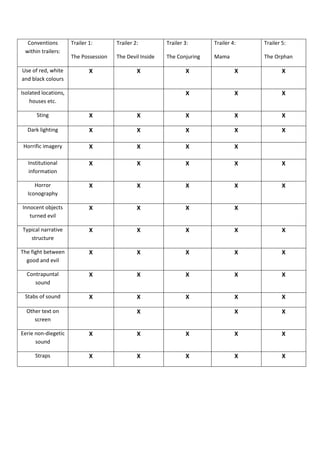
Conventions
within trailers:
Trailer 1:
The Possession
Trailer 2:
The Devil Inside
Trailer 3:
The Conjuring
Trailer 4:
Mama
Trailer 5:
The Orphan
Use of red, white
and black colours
X X X X X
Isolated locations,
houses etc.
X X X
Sting X X X X X
Dark lighting X X X X X
Horrific imagery X X X X
Institutional
information
X X X X X
Horror
Iconography
X X X X X
Innocent objects
turned evil
X X X X
Typical narrative
structure
X X X X X
The fight between
good and evil
X X X X X
Contrapuntal
sound
X X X X X
Stabs of sound X X X X X
Other text on
screen
X X X
Eerie non-diegetic
sound
X X X X X
Straps X X X X X
Trailer Overviews:
The Possession, The Conjuring, The Devil Inside, Mama, The Orphan
The five trailers presented have been designed to successfully promote and advertise films
within the supernatural/possession sub-genre. When comparing them with one another I was
able to identify several repeated codes and conventions they crop up again and again within
each of them. All five of the trailers feature typical horror trailer conventions. Typical
conventions that the audience would typically expect to see within any film such as the film
name which we identify to be shown at the end of the trailer as well as the date of release
etc. The structure in which the narrative is set is another general convention that is
necessary for a successful and effective trailer; this includes a slow paced start as the
audience’s are presented with the normality of the family life, for example, the audience get
to see the characters and setting within the film which always tends to be right at the start of
the film which is the equilibrium. Audience are then made aware of a disruption to the
normality and order of the typical family lifestyle, which is when we start to see the trailer
pick up pace as we see the characters react to the disruption and a fast montage of edits
follow creating tension and excitement with a sting at the end. This narrative structure is
particularly relevant in, The Conjuring’ Trailer where we see Ed and Lorraine Warren
contacting spirits. The audience are then told about the profession in which Ed and Lorraine
are in as we see them giving a lecture about what they do. Some of the cases they have
studied are presented which allows the audience to gain an insight into their story, which is
then followed by someone contacting them for help. A fast montage of edits is portrayed as
the spirit attacks and torments the family. Dramatically coming to a climax as the audience
are left with the sting, the audience are lured into a false sense of security, when we do not
see the expected spirit in the mirror or behind Lorraine but when she puts it down a horrific
figure appears in front of her and she screams pushing the audience to the edge of their
seats. Also in the Mama trailer we see the family welcoming the two young girls into a new
home; differently compared to most horror trailers the audience are given the idea straight
away that there is something not quite right with these girls as they act strange. But the
audience are made to believe that they will be okay in the end. But things then begin to get
worse and ‘Mama’ is all the audience know as to why the girls are the way they are. The fast
montage and cuts through the surrounding scenes in mama allow the tension to rise and to
build up the scare factor for the audience. We then see the characters react to this disruption
as the girlfriend of the uncle is trying to find out who ‘Mama’ really is and why she has control
over the girls.
Another general convention is horror iconography; this can be anything that signifies the
horror genre. For example, in The Possession trailer we see Em being brought through on
an X-ray machine, as the cuts get quicker, the camera keeps going back and forth between
Em’s X-ray and the other plots within the trailer. Until the audience are finally shown that
there is some type of evil demonic being living within her which allows the audience to
correlate the films as supernatural/possession. Extreme close-ups are used to present the
possessed characters within the trailer as it allows the audience to see their emotions and
facial expressions, for example, in The Devil Inside we’re presented with a close-up of a man
becoming possessed as his colleagues try and help fight this spirit out from within him, he
has a loss of colour in his iris and his eyes appear to be rolling to the back of his head as
they are twitching. This is an effective camera shot as it allows the audience to engage with
the characters and feel sympathy for them, and also make the action on screen seem more
realistic. Close-ups are also used to show emotion, for example, in The Orphan as Esther
seems to be going off the rails and become aggressive and angry which allows the audience
to become frightened of what they think to be an innocent child. The adoption at the
beginning of the trailer allows the trailer to become more realistic as the audience are
overwhelmed by this heart warming moment adopting a child who needs a loving home. But
this is then shattered for the audience within about 20 seconds as they soon learn that there
is something evil and strange about her. In addition to this we see other repeated
conventions, in all of the trailers such as the dark shadows and lighting which are used to
intensify the fear, reinforcing the idea that the audience should fear the dark, which then also
enhances the isolation of the characters and makes the audience feel as if there is no hope
for them either and they begin to believe that these made up beings could actually be real. It
constantly keeps audiences on the edge of their seat’s as evil often lurks in dark places
which create a fear of the unknown as the audience don’t know what may be lurking in every
corner. Another repeated convention these trailers share is eerie and unnerving non-diegetic
sounds, this is a common convention of this particular sub-genre which deals with spirits and
demons. We as the audience don’t know what demons or spirits sound like so any sound
that sounds unearthly or inhuman scares us. These types of sounds are usually intensified to
heighten the fear factor and often compliment the action. For example these unnerving
sounds is in The Devil Inside trailer at the end when Maria is thrown off the bench during her
exorcism, there’s a stab sound followed by a distorted roar type sound suggesting a battle
between her and the demon where we can see the demon winning. Also, before this the
demon controlling Maria says “Go burn”, the audience are able to tell this is a demon
because there’s a pitch change within her voice, it’s extremely low which doesn’t sound
human, her iris also changes colour. This is a common convention within the possession
sub-genre as the loss of colour in the iris shows the loss of the victim’s soul signifying that
the character is possessed. This convention is also shown in The Possession during the fast
montage of edits; after the bible flies out of the father’s hand, the victim then screams, this
sound is intensified and the audience can see her iris colour change to white again allowing
the audience to relate this to possession. Throughout the normality and disruption of the
trailer, the audience are presented with slow fades and eye line matches to allow the
audience to feel as part of the action and let the clips flow continuously. Establishing shots
are presented in all the trailers at the very beginning which sets the scene and let the
audience acknowledge the stock location within the film. For example this happens a lot in
The Devil Inside as we are able to see the home in which the murders took place as well as
the mental institute in which Maria is being held. In the same way The Orphan allows the
audience to see the adoption home where Esther is stayed and the audience are then
shown the Establishing shot of their family home. Each one of trailers all use straps to
effectively portray the narrative; these straps usually contain gripping pieces of text that not
only create fear for the audiences but also intrigues them, which makes them want to watch
the movie and find out more about the narrative. There are many straps shown in The Devil
Inside trailer, such as ‘Science versus Religion’ and the same within Mama such as ‘A
mother’s love never dies’ and ‘They’ve come home’ which is followed on by ‘But not alone’
which increases the scare factor and is like a pun as it rhymes and carries on from the strap
before. The separation of these straps are effective as the audience what to see more to
know more about the narrative and what the film is about and the secrets that it holds. Each
one of the five trailers is effective in portraying the sub genre of supernatural/possession and
appeal to their target audience.

Trailer overviews

  • 1.
    Conventions within trailers: Trailer 1: ThePossession Trailer 2: The Devil Inside Trailer 3: The Conjuring Trailer 4: Mama Trailer 5: The Orphan Use of red, white and black colours X X X X X Isolated locations, houses etc. X X X Sting X X X X X Dark lighting X X X X X Horrific imagery X X X X Institutional information X X X X X Horror Iconography X X X X X Innocent objects turned evil X X X X Typical narrative structure X X X X X The fight between good and evil X X X X X Contrapuntal sound X X X X X Stabs of sound X X X X X Other text on screen X X X Eerie non-diegetic sound X X X X X Straps X X X X X
  • 2.
    Trailer Overviews: The Possession,The Conjuring, The Devil Inside, Mama, The Orphan The five trailers presented have been designed to successfully promote and advertise films within the supernatural/possession sub-genre. When comparing them with one another I was able to identify several repeated codes and conventions they crop up again and again within each of them. All five of the trailers feature typical horror trailer conventions. Typical conventions that the audience would typically expect to see within any film such as the film name which we identify to be shown at the end of the trailer as well as the date of release etc. The structure in which the narrative is set is another general convention that is necessary for a successful and effective trailer; this includes a slow paced start as the audience’s are presented with the normality of the family life, for example, the audience get to see the characters and setting within the film which always tends to be right at the start of the film which is the equilibrium. Audience are then made aware of a disruption to the normality and order of the typical family lifestyle, which is when we start to see the trailer pick up pace as we see the characters react to the disruption and a fast montage of edits follow creating tension and excitement with a sting at the end. This narrative structure is particularly relevant in, The Conjuring’ Trailer where we see Ed and Lorraine Warren contacting spirits. The audience are then told about the profession in which Ed and Lorraine are in as we see them giving a lecture about what they do. Some of the cases they have studied are presented which allows the audience to gain an insight into their story, which is then followed by someone contacting them for help. A fast montage of edits is portrayed as the spirit attacks and torments the family. Dramatically coming to a climax as the audience are left with the sting, the audience are lured into a false sense of security, when we do not see the expected spirit in the mirror or behind Lorraine but when she puts it down a horrific figure appears in front of her and she screams pushing the audience to the edge of their seats. Also in the Mama trailer we see the family welcoming the two young girls into a new home; differently compared to most horror trailers the audience are given the idea straight away that there is something not quite right with these girls as they act strange. But the audience are made to believe that they will be okay in the end. But things then begin to get worse and ‘Mama’ is all the audience know as to why the girls are the way they are. The fast montage and cuts through the surrounding scenes in mama allow the tension to rise and to build up the scare factor for the audience. We then see the characters react to this disruption as the girlfriend of the uncle is trying to find out who ‘Mama’ really is and why she has control over the girls. Another general convention is horror iconography; this can be anything that signifies the horror genre. For example, in The Possession trailer we see Em being brought through on an X-ray machine, as the cuts get quicker, the camera keeps going back and forth between Em’s X-ray and the other plots within the trailer. Until the audience are finally shown that there is some type of evil demonic being living within her which allows the audience to correlate the films as supernatural/possession. Extreme close-ups are used to present the possessed characters within the trailer as it allows the audience to see their emotions and facial expressions, for example, in The Devil Inside we’re presented with a close-up of a man becoming possessed as his colleagues try and help fight this spirit out from within him, he
  • 3.
    has a lossof colour in his iris and his eyes appear to be rolling to the back of his head as they are twitching. This is an effective camera shot as it allows the audience to engage with the characters and feel sympathy for them, and also make the action on screen seem more realistic. Close-ups are also used to show emotion, for example, in The Orphan as Esther seems to be going off the rails and become aggressive and angry which allows the audience to become frightened of what they think to be an innocent child. The adoption at the beginning of the trailer allows the trailer to become more realistic as the audience are overwhelmed by this heart warming moment adopting a child who needs a loving home. But this is then shattered for the audience within about 20 seconds as they soon learn that there is something evil and strange about her. In addition to this we see other repeated conventions, in all of the trailers such as the dark shadows and lighting which are used to intensify the fear, reinforcing the idea that the audience should fear the dark, which then also enhances the isolation of the characters and makes the audience feel as if there is no hope for them either and they begin to believe that these made up beings could actually be real. It constantly keeps audiences on the edge of their seat’s as evil often lurks in dark places which create a fear of the unknown as the audience don’t know what may be lurking in every corner. Another repeated convention these trailers share is eerie and unnerving non-diegetic sounds, this is a common convention of this particular sub-genre which deals with spirits and demons. We as the audience don’t know what demons or spirits sound like so any sound that sounds unearthly or inhuman scares us. These types of sounds are usually intensified to heighten the fear factor and often compliment the action. For example these unnerving sounds is in The Devil Inside trailer at the end when Maria is thrown off the bench during her exorcism, there’s a stab sound followed by a distorted roar type sound suggesting a battle between her and the demon where we can see the demon winning. Also, before this the demon controlling Maria says “Go burn”, the audience are able to tell this is a demon because there’s a pitch change within her voice, it’s extremely low which doesn’t sound human, her iris also changes colour. This is a common convention within the possession sub-genre as the loss of colour in the iris shows the loss of the victim’s soul signifying that the character is possessed. This convention is also shown in The Possession during the fast montage of edits; after the bible flies out of the father’s hand, the victim then screams, this sound is intensified and the audience can see her iris colour change to white again allowing the audience to relate this to possession. Throughout the normality and disruption of the trailer, the audience are presented with slow fades and eye line matches to allow the audience to feel as part of the action and let the clips flow continuously. Establishing shots are presented in all the trailers at the very beginning which sets the scene and let the audience acknowledge the stock location within the film. For example this happens a lot in The Devil Inside as we are able to see the home in which the murders took place as well as the mental institute in which Maria is being held. In the same way The Orphan allows the audience to see the adoption home where Esther is stayed and the audience are then shown the Establishing shot of their family home. Each one of trailers all use straps to effectively portray the narrative; these straps usually contain gripping pieces of text that not only create fear for the audiences but also intrigues them, which makes them want to watch the movie and find out more about the narrative. There are many straps shown in The Devil Inside trailer, such as ‘Science versus Religion’ and the same within Mama such as ‘A mother’s love never dies’ and ‘They’ve come home’ which is followed on by ‘But not alone’ which increases the scare factor and is like a pun as it rhymes and carries on from the strap before. The separation of these straps are effective as the audience what to see more to know more about the narrative and what the film is about and the secrets that it holds. Each
  • 4.
    one of thefive trailers is effective in portraying the sub genre of supernatural/possession and appeal to their target audience.