TRAILER ANALYSIS
By Salina Daniel
https://www.youtube.com/watch?v=Xuf
QB4gbjdA
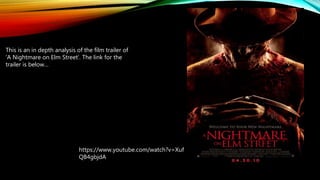
This is an in depth analysis of the film trailer of
‘A Nightmare on Elm Street’. The link for the
trailer is below…
Camera:
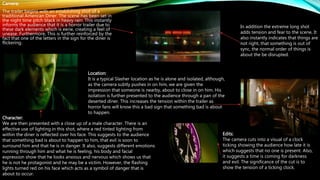
The trailer begins with an establishing shot of a
traditional American Diner. The scene has been set in
the night time pitch black in heavy rain. This instantly
informs the audience that it is a horror trailer due to
these dark elements which is eerie, creating a feel of
unease. Furthermore, This is further reinforced by the
fact that one of the letters in the sign for the diner is
flickering.
In addition the extreme long shot
adds tension and fear to the scene, It
also instantly indicates that things are
not right, that something is out of
sync, the normal order of things is
about the be disrupted.
Character:
We are then presented with a close up of a male character. There is an
effective use of lighting in this shot, where a red tinted lighting from
within the diner is reflected over his face. This suggests to the audience
that something bad is about to happen to him, that evil is soon to
surround him and that he is in danger. It also, suggests different emotions
running through him and what he is feeling, his body and facial
expression show that he looks anxious and nervous which shows us that
he is not he protagonist and he may be a victim. However, the flashing
lights turned red on his face which acts as a symbol of danger that is
about to occur.
Location:
It is a typical Slasher location as he is alone and isolated, although,
as the camera subtly pushes in on him, we are given the
impression that someone is nearby, about to close in on him. His
isolation is further presented to the audience through a pan of the
deserted diner. This increases the tension within the trailer as
horror fans will know this a bad sign that something bad is about
to happen.
Edits:
The camera cuts into a visual of a clock
ticking showing the audience how late it is
which suggests that no one is present. Also,
it suggests a time is coming for darkness
and evil. The significance of the cut is to
show the tension of a ticking clock.
Editing:
in the diner, except from the intensified diegetic
creaking of the kitchen door, which opens painfully
slowly to maximise the suspense. This is a typical
convention of horror films.
Camera shot:
Camera Movement:
Sound:
Location: The audience is presented with a male character
approaching the kitchen area at a very slow pace. This suggests
that he is in fear and he doesn't know what to expect which
creates tension for the audience.
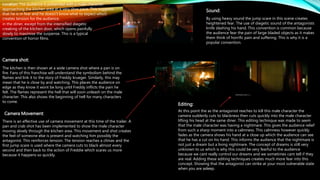
The kitchen is then shown at a wide camera shot where a pan is on
fire. Fans of this franchise will understand the symbolism behind the
flames and link it to the story of Freddy krueger. Similarly, this may
mean that he is close by and watching. This places the audience on
edge as they know it wont be long until Freddy inflicts the pain he
felt. The flames represent the hell that will soon unleash on the male
character. This also shows the beginning of hell for many characters
to come.
There is an effective use of camera movement at this time of the trailer. A
pan and crab shot has been implemented to show the male character
moving slowly through the kitchen area. This movement and shot creates
the feel of someone else is present and watching him possibly the
antagonist. This reinforces tension. The tension reaches a climax and the
first jump scare is used where the camera cuts to black almost every
second and then back to the action of Freddie which scares us more
because it happens so quickly.
By using heavy sound the jump scare in this scene creates
heightened fear. The use of diegetic sound of the antagonists
knife slashing his hand. This convention is common because
the audience fear the pain of large bladed objects as it makes
them think of horrific pain and suffering. This is why it is a
popular convention.
At this point the as the antagonist reaches to kill this male character the
camera suddenly cuts to blackness then cuts quickly into the male character
lifting his head at the same diner. This editing technique was made to seem
that the male character was having a nightmare. This gives the audience relief
from such a sharp moment into a calmness. This calmness however quickly
fades as the camera shows his hand at a close up which the audience can see
that he has a cut on his hand. This informs the audience that the nightmare is
not just a dream but a living nightmare. The concept of dreams is still very
unknown to us which is why this could be very fearful to the audience
because we cant really control our dreams and we sometimes cant tell if they
are real. Adding these editing techniques creates much more fear into this
concept. Showing that the antagonist can strike at your most vulnerable state
when you are asleep.
Editing:
Editing:
Camera shot:
Sound:
Camera Shot:
The audience is presented with the
Newline cinema logo on screen. This is a
convention by placing the institutional
information in a trailer usually at the
beginning and the end. This shows the
audience that the film has been created
by a well-known and successful
company. Also, placing this after the
horrific act at the diner tells the
audience that the hell has not even
begun.
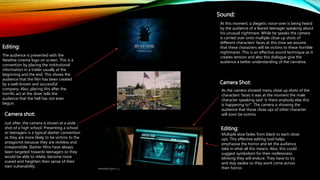
Just after, the camera is shown at a wide
shot of a high school. Presenting a school
or teenagers is a typical slasher convention
as they are more likely to be victims to the
antagonist because they are reckless and
irresponsible. Slasher films have always
been targeted towards teenagers so they
would be able to relate, become more
scared and heighten their sense of their
own vulnerability.
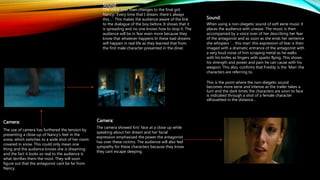
At this moment, a diegetic voice-over is being heard
by the audience of a feared teenager speaking about
his unusual nightmare. While he speaks the camera
is carried over onto multiple close up shots of
different characters’ faces at this time we assume
that these characters will be victims to these horrible
nightmares. This is an effective sound technique as it
creates tension and also this dialogue give the
audience a better understanding of the narrative.
As the camera showed many close up shots of the
characters’ faces it was at the moment the male
character speaking said ‘is there anybody else this
is happening to?’. The camera is showing the
audience that those close ups of other character
will soon be victims.
Multiple slow fades from black to each close
ups. This effective editing tool helps
emphasise the horror and let the audience
take in what all this means. Also, this could
suggest symbolism for their restlessness
blinking they will endure. They have to try
and stay awake so they wont come across
their horror.
This is the point where the non-diegetic sound
becomes more eerie and intense as the trailer takes a
turn and the dark times the characters are soon to face
is indicated through a shot of a female character
silhouetted in the distance…
Sound:
Camera:
Sound:
Camera:
The voice over then changes to the final girl,
Nancy; ‘Every time that I dream, there’s always
this…’. This makes the audience aware of the link
to the dialogue of the boy before. It shows that it
is spreading and no one knows how to stop it. The
audience will be in fear even more because they
know that whatever happens In these bad dreams
will happen in real life as they learned that from
the first male character presented in the diner.
The use of camera has furthered the tension by
presenting a close-up of Nancy’s feet in the
snow, which switches to a wide shot of her room
covered in snow. This could only mean one
thing and the audience knows she is dreaming
and the fact it looks so real to the audience is
what terrifies them the most. They will soon
figure out that the antagonist cant be far from
Nancy.
When using a non-diegetic sound of soft eerie music it
places the audience with unease. The music is then
accompanied by a voice over of her describing her fear
of the antagonist and as soon as she ends her sentence
she whispers ‘… this man’ this expression of fear is then
imaged with a dramatic entrance of the antagonist with
a very loud noise of him scraping metal as he walks
with his knifes as fingers with sparks flying. This shows
his strength and power and pain he can cause with his
weapon. This also, confirms that Freddy is the ‘Man’ the
characters are referring to.
The camera showed Kris’ face at a close up while
speaking about her dream and her facial
expression emphasised the power the antagonist
has over these victims. The audience will also feel
sympathy for these characters because they know
they cant escape sleeping.
Sound: A fast-paced non-diegetic sound is
then introduced. The fast pace of this non-
diegetic sound would reflect the fast pace of
the audience heart beat after the jump scare.
This is an effective tool of drawing in the
audience and making them feel like they are
in the trailer.
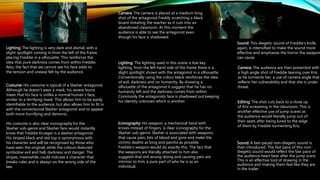
Lighting: The lighting is very dark and dismal, with a
slight spotlight coming in from the left of the frame,
placing Freddie in a silhouette. This reinforces the
idea that pure darkness comes from within Freddie.
Also, the fact that we cannot see his face adds to
the tension and unease felt by the audience.
Costume: His costume is typical of a Slasher antagonist.
Although he doesn’t wear a mask, his severe burns
mean that his face is unlike a normal human’s face,
similar to a terrifying mask. This allows him to be easily
identifiable to the audience, but also allows him to fit in
with the conventional Slasher antagonist and to appear
both more horrifying and demonic.
Iconography: His weapon, a mechanical hand with
knives instead of fingers, is clear iconography for the
Slasher sub-genre. Slasher is associated with weapons
that cause pain, lots of blood and gore and make the
victims deaths as long and painful as possible.
Freddie’s weapon would do exactly this. The fact that
the weapons are literally attached to him also
suggests that evil wrong-doing and causing pain are
intrinsic to him, a pure part of who he is as an
individual.
His costume is also clear iconography for the
Slasher sub-genre and Slasher fans would instantly
know that Freddie Krueger is a slasher antagonist.
His striped black and red top is synonymous with
his character and will be recognised by those who
have seen the original, while the colours featured
symbolise evil and hell, darkness and danger. The
stripes, meanwhile, could indicate a character that
breaks rules and is always on the wrong side of the
law.
Sound: This diegetic sound of Freddie’s knife,
again, is intensified to make the sound more
effective and emphasise the horror the weapon
can cause.
Camera: The audience are then presented with
a high angle shot of Freddie leaning over Kris
as he torments her, a use of camera angle that
reflects her vulnerability and that she is under
threat.
Editing: The shot cuts back to a close up
of Kris screaming in the classroom. This is
another effective use of jump scares as
the audience would literally jump out of
their seats after being lured to the edge
of them by Freddie tormenting Kris.
Camera: The camera is placed at a medium long
shot of the antagonist Freddy scratching a black
board imitating the teacher as it cuts into an
abandoned classroom. At this moment the
audience is able to see the antagonist even
though his face is shadowed.
Lighting: The lighting used in this scene is low key
lighting, from the left hand side of the frame there is a
slight spotlight shown with the antagonist in a silhouette.
Conventionally using the colour black reinforces the idea
of evil, darkness and no humanity. By showing a
silhouette of the antagonist it suggest that he has no
humanity left and the darkness comes from within.
Commonly the antagonists face is shadowed out keeping
his identity unknown which is another
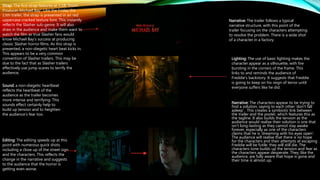
Narrative: The characters appear to be trying to
find a solution, saying to each other ‘don’t fall
asleep’ . This creates a symbiotic link between
the trailer and the poster, which features this as
the tagline. It also builds the tension as the
audience would realise their solution is one that
isn’t long-lasting as they cannot stay awake
forever, especially as one of the characters
claims that he is ‘dreaming with his eyes open’.
The audience will realise that there is no hope
for the characters and their attempts at escaping
Freddie will be futile: they will still die. The
characters tone builds up the tension and fear as
the characters appear desperate. They, like the
audience, are fully aware that hope is gone and
their time is almost up.
Strap: The first strap features at 1.18; ‘From
Producer Michael Bay’. Like the Friday the
13th trailer, the strap is presented in an red
uppercase cracked texture font. This instantly
reflects the Slasher sub-genre. It will also
draw in the audience and make them want to
watch the film as true Slasher fans would
know Michael Bay’s success at producing
classic Slasher horror films. As this strap is
presented, a non-diegetic heart beat kicks in.
This appears to be a very common
convention of Slasher trailers. This may be
due to the fact that as Slasher trailers
effectively use jump scares to terrify the
audience,
Sound: a non-diegetic heartbeat
reflects the heartbeat of the
audience as the trailer becomes
more intense and terrifying. This
sounds effect certainly help to
build up tension and to heighten
the audience’s fear too.
Editing: The editing speeds up at this
point with numerous quick shots
including a close up of the street sign
and the characters. This reflects the
change in the narrative and suggests
to the audience that the horror is
getting even worse.
Narrative: The trailer follows a typical
narrative structure, with this point of the
trailer focusing on the characters attempting
to resolve the problem. There is a wide shot
of a character in a factory.
Lighting: The use of basic lighting makes the
character appear as a silhouette, with fire
bursting in the corners of the frame. This
links to and reminds the audience of
Freddie’s backstory. It suggests that Freddie
is going to keep on his reign of terror until
everyone suffers like he did.
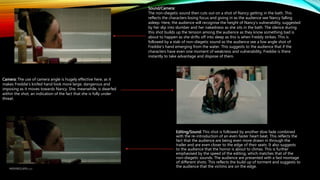
Editing/Sound: This shot is followed by another slow fade combined
with the re-introduction of an even faster heart beat. This reflects the
fact that the audience are being even more drawn in through the
trailer and are even closer to the edge of their seats. It also suggests
to the audience that the horror is about to climax. This is further
emphasised by the speed of the editing, which matches that of the
non-diegetic sounds. The audience are presented with a fast montage
of different shots. This reflects the build up of torment and suggests to
the audience that the victims are on the edge.
Sound/Camera:
The non-diegetic sound then cuts out on a shot of Nancy getting in the bath. This
reflects the characters losing focus and giving in as the audience see Nancy falling
asleep. Here, the audience will recognise the height of Nancy’s vulnerability, suggested
by her slip into slumber and her nakedness as she sits in the bath. The silence during
this shot builds up the tension among the audience as they know something bad is
about to happen as she drifts off into sleep as this is when Freddy strikes. This is
followed by a stab of non-diegetic sound as the audience see a low angle shot of
Freddie’s hand emerging from the water. This suggests to the audience that if the
characters have even one moment of weakness and vulnerability, Freddie is there
instantly to take advantage and dispose of them.
Camera: The use of camera angle is hugely effective here, as it
makes Freddie’s knifed hand look more large, dangerous and
imposing as it moves towards Nancy. She, meanwhile, is dwarfed
within the shot, an indication of the fact that she is fully under
threat.
Editing: The audience are then presented with a
fast montage of action shots before the title of
the film, with a voiceover of Freddie laughing,
which sounds sinister. A montage at the end of
the trailer is an effective and common
convention of trailers. It adds to the tension
created by the film and gives the audience an
quick insight into the main action scenes.
Another convention the trailer uses is a Sting.
We see Nancy in the hospital receiving an
injection that will ‘put her straight to sleep.’
Strap: A second strap is featured, presenting the
audience with the release date of the film: April 30th.
On this specific strap, all sound is cut out. This may
perhaps be to emphasise the importance of the
information.
Camera/Sound: The audience are then
presented with a close up of Jesse in a
warehouse as he realises he is dreaming. There
is diegetic dialogue of Jesse saying ‘oh my
god.’ Then Freddie replies ‘No. Just me.’ This
links in with idea that Freddie has come from
hell and is the absolute antithesis of all that is
good, pure and holy. There is also a certain
arrogance to this statement and sick humour,
as if Krueger is suggesting he is one the same
level with or mocking God. This idea is further
reinforced through the mise-en- scene.
Lighting: The lighting in this shot is very dark and dismal,
with hints of orange. There is also fire featured around
the setting in this shot. This further connotes hell and
also reminds the audience of Freddie’s backstory, as he
was burnt alive in a warehouse. This suggests to the
audience that Freddie is bringing his victims back to
where he suffered and to ensure they suffer even more.
Another strap is featured after this shot saying
‘Welcome’.
Sound: Unlike the first one, non-diegetic sound is
featured on this strap to suggest to the audience that
the following information will be far from welcoming. We
see a medium shot of Freddie from the perspective of
Nancy before another strap saying ‘To your new
nightmare.’ The non-diegetic sounds is cut out again to
put all the audiences focus on the sentence. The use of
direct address is effective in building up the tension and
pulling the audience in and making them fell vulnerable
too.
Sound: This last stab of horror is effective in keeping the
audience lured in until the very last moment. The trailer
ends with a final strap saying ‘Don’t fall asleep’. This is
an effective tool of ensuring the audience are terrified
and the fear continues after only seeing the trailer so
they will want to watch the film to get the same
adrenaline generated by the trailer. With this order
presented in front of them, they might also feel that
they too will be in danger if they fall asleep.

Trailer Analysis 1

  • 1.
  • 2.
    https://www.youtube.com/watch?v=Xuf QB4gbjdA This is anin depth analysis of the film trailer of ‘A Nightmare on Elm Street’. The link for the trailer is below…
  • 3.
    Camera: The trailer beginswith an establishing shot of a traditional American Diner. The scene has been set in the night time pitch black in heavy rain. This instantly informs the audience that it is a horror trailer due to these dark elements which is eerie, creating a feel of unease. Furthermore, This is further reinforced by the fact that one of the letters in the sign for the diner is flickering. In addition the extreme long shot adds tension and fear to the scene, It also instantly indicates that things are not right, that something is out of sync, the normal order of things is about the be disrupted. Character: We are then presented with a close up of a male character. There is an effective use of lighting in this shot, where a red tinted lighting from within the diner is reflected over his face. This suggests to the audience that something bad is about to happen to him, that evil is soon to surround him and that he is in danger. It also, suggests different emotions running through him and what he is feeling, his body and facial expression show that he looks anxious and nervous which shows us that he is not he protagonist and he may be a victim. However, the flashing lights turned red on his face which acts as a symbol of danger that is about to occur. Location: It is a typical Slasher location as he is alone and isolated, although, as the camera subtly pushes in on him, we are given the impression that someone is nearby, about to close in on him. His isolation is further presented to the audience through a pan of the deserted diner. This increases the tension within the trailer as horror fans will know this a bad sign that something bad is about to happen. Edits: The camera cuts into a visual of a clock ticking showing the audience how late it is which suggests that no one is present. Also, it suggests a time is coming for darkness and evil. The significance of the cut is to show the tension of a ticking clock.
  • 4.
    Editing: in the diner,except from the intensified diegetic creaking of the kitchen door, which opens painfully slowly to maximise the suspense. This is a typical convention of horror films. Camera shot: Camera Movement: Sound: Location: The audience is presented with a male character approaching the kitchen area at a very slow pace. This suggests that he is in fear and he doesn't know what to expect which creates tension for the audience. The kitchen is then shown at a wide camera shot where a pan is on fire. Fans of this franchise will understand the symbolism behind the flames and link it to the story of Freddy krueger. Similarly, this may mean that he is close by and watching. This places the audience on edge as they know it wont be long until Freddy inflicts the pain he felt. The flames represent the hell that will soon unleash on the male character. This also shows the beginning of hell for many characters to come. There is an effective use of camera movement at this time of the trailer. A pan and crab shot has been implemented to show the male character moving slowly through the kitchen area. This movement and shot creates the feel of someone else is present and watching him possibly the antagonist. This reinforces tension. The tension reaches a climax and the first jump scare is used where the camera cuts to black almost every second and then back to the action of Freddie which scares us more because it happens so quickly. By using heavy sound the jump scare in this scene creates heightened fear. The use of diegetic sound of the antagonists knife slashing his hand. This convention is common because the audience fear the pain of large bladed objects as it makes them think of horrific pain and suffering. This is why it is a popular convention. At this point the as the antagonist reaches to kill this male character the camera suddenly cuts to blackness then cuts quickly into the male character lifting his head at the same diner. This editing technique was made to seem that the male character was having a nightmare. This gives the audience relief from such a sharp moment into a calmness. This calmness however quickly fades as the camera shows his hand at a close up which the audience can see that he has a cut on his hand. This informs the audience that the nightmare is not just a dream but a living nightmare. The concept of dreams is still very unknown to us which is why this could be very fearful to the audience because we cant really control our dreams and we sometimes cant tell if they are real. Adding these editing techniques creates much more fear into this concept. Showing that the antagonist can strike at your most vulnerable state when you are asleep.
  • 5.
    Editing: Editing: Camera shot: Sound: Camera Shot: Theaudience is presented with the Newline cinema logo on screen. This is a convention by placing the institutional information in a trailer usually at the beginning and the end. This shows the audience that the film has been created by a well-known and successful company. Also, placing this after the horrific act at the diner tells the audience that the hell has not even begun. Just after, the camera is shown at a wide shot of a high school. Presenting a school or teenagers is a typical slasher convention as they are more likely to be victims to the antagonist because they are reckless and irresponsible. Slasher films have always been targeted towards teenagers so they would be able to relate, become more scared and heighten their sense of their own vulnerability. At this moment, a diegetic voice-over is being heard by the audience of a feared teenager speaking about his unusual nightmare. While he speaks the camera is carried over onto multiple close up shots of different characters’ faces at this time we assume that these characters will be victims to these horrible nightmares. This is an effective sound technique as it creates tension and also this dialogue give the audience a better understanding of the narrative. As the camera showed many close up shots of the characters’ faces it was at the moment the male character speaking said ‘is there anybody else this is happening to?’. The camera is showing the audience that those close ups of other character will soon be victims. Multiple slow fades from black to each close ups. This effective editing tool helps emphasise the horror and let the audience take in what all this means. Also, this could suggest symbolism for their restlessness blinking they will endure. They have to try and stay awake so they wont come across their horror.
  • 6.
    This is thepoint where the non-diegetic sound becomes more eerie and intense as the trailer takes a turn and the dark times the characters are soon to face is indicated through a shot of a female character silhouetted in the distance… Sound: Camera: Sound: Camera: The voice over then changes to the final girl, Nancy; ‘Every time that I dream, there’s always this…’. This makes the audience aware of the link to the dialogue of the boy before. It shows that it is spreading and no one knows how to stop it. The audience will be in fear even more because they know that whatever happens In these bad dreams will happen in real life as they learned that from the first male character presented in the diner. The use of camera has furthered the tension by presenting a close-up of Nancy’s feet in the snow, which switches to a wide shot of her room covered in snow. This could only mean one thing and the audience knows she is dreaming and the fact it looks so real to the audience is what terrifies them the most. They will soon figure out that the antagonist cant be far from Nancy. When using a non-diegetic sound of soft eerie music it places the audience with unease. The music is then accompanied by a voice over of her describing her fear of the antagonist and as soon as she ends her sentence she whispers ‘… this man’ this expression of fear is then imaged with a dramatic entrance of the antagonist with a very loud noise of him scraping metal as he walks with his knifes as fingers with sparks flying. This shows his strength and power and pain he can cause with his weapon. This also, confirms that Freddy is the ‘Man’ the characters are referring to. The camera showed Kris’ face at a close up while speaking about her dream and her facial expression emphasised the power the antagonist has over these victims. The audience will also feel sympathy for these characters because they know they cant escape sleeping.
  • 7.
    Sound: A fast-pacednon-diegetic sound is then introduced. The fast pace of this non- diegetic sound would reflect the fast pace of the audience heart beat after the jump scare. This is an effective tool of drawing in the audience and making them feel like they are in the trailer. Lighting: The lighting is very dark and dismal, with a slight spotlight coming in from the left of the frame, placing Freddie in a silhouette. This reinforces the idea that pure darkness comes from within Freddie. Also, the fact that we cannot see his face adds to the tension and unease felt by the audience. Costume: His costume is typical of a Slasher antagonist. Although he doesn’t wear a mask, his severe burns mean that his face is unlike a normal human’s face, similar to a terrifying mask. This allows him to be easily identifiable to the audience, but also allows him to fit in with the conventional Slasher antagonist and to appear both more horrifying and demonic. Iconography: His weapon, a mechanical hand with knives instead of fingers, is clear iconography for the Slasher sub-genre. Slasher is associated with weapons that cause pain, lots of blood and gore and make the victims deaths as long and painful as possible. Freddie’s weapon would do exactly this. The fact that the weapons are literally attached to him also suggests that evil wrong-doing and causing pain are intrinsic to him, a pure part of who he is as an individual. His costume is also clear iconography for the Slasher sub-genre and Slasher fans would instantly know that Freddie Krueger is a slasher antagonist. His striped black and red top is synonymous with his character and will be recognised by those who have seen the original, while the colours featured symbolise evil and hell, darkness and danger. The stripes, meanwhile, could indicate a character that breaks rules and is always on the wrong side of the law. Sound: This diegetic sound of Freddie’s knife, again, is intensified to make the sound more effective and emphasise the horror the weapon can cause. Camera: The audience are then presented with a high angle shot of Freddie leaning over Kris as he torments her, a use of camera angle that reflects her vulnerability and that she is under threat. Editing: The shot cuts back to a close up of Kris screaming in the classroom. This is another effective use of jump scares as the audience would literally jump out of their seats after being lured to the edge of them by Freddie tormenting Kris. Camera: The camera is placed at a medium long shot of the antagonist Freddy scratching a black board imitating the teacher as it cuts into an abandoned classroom. At this moment the audience is able to see the antagonist even though his face is shadowed. Lighting: The lighting used in this scene is low key lighting, from the left hand side of the frame there is a slight spotlight shown with the antagonist in a silhouette. Conventionally using the colour black reinforces the idea of evil, darkness and no humanity. By showing a silhouette of the antagonist it suggest that he has no humanity left and the darkness comes from within. Commonly the antagonists face is shadowed out keeping his identity unknown which is another
  • 8.
    Narrative: The charactersappear to be trying to find a solution, saying to each other ‘don’t fall asleep’ . This creates a symbiotic link between the trailer and the poster, which features this as the tagline. It also builds the tension as the audience would realise their solution is one that isn’t long-lasting as they cannot stay awake forever, especially as one of the characters claims that he is ‘dreaming with his eyes open’. The audience will realise that there is no hope for the characters and their attempts at escaping Freddie will be futile: they will still die. The characters tone builds up the tension and fear as the characters appear desperate. They, like the audience, are fully aware that hope is gone and their time is almost up. Strap: The first strap features at 1.18; ‘From Producer Michael Bay’. Like the Friday the 13th trailer, the strap is presented in an red uppercase cracked texture font. This instantly reflects the Slasher sub-genre. It will also draw in the audience and make them want to watch the film as true Slasher fans would know Michael Bay’s success at producing classic Slasher horror films. As this strap is presented, a non-diegetic heart beat kicks in. This appears to be a very common convention of Slasher trailers. This may be due to the fact that as Slasher trailers effectively use jump scares to terrify the audience, Sound: a non-diegetic heartbeat reflects the heartbeat of the audience as the trailer becomes more intense and terrifying. This sounds effect certainly help to build up tension and to heighten the audience’s fear too. Editing: The editing speeds up at this point with numerous quick shots including a close up of the street sign and the characters. This reflects the change in the narrative and suggests to the audience that the horror is getting even worse. Narrative: The trailer follows a typical narrative structure, with this point of the trailer focusing on the characters attempting to resolve the problem. There is a wide shot of a character in a factory. Lighting: The use of basic lighting makes the character appear as a silhouette, with fire bursting in the corners of the frame. This links to and reminds the audience of Freddie’s backstory. It suggests that Freddie is going to keep on his reign of terror until everyone suffers like he did.
  • 9.
    Editing/Sound: This shotis followed by another slow fade combined with the re-introduction of an even faster heart beat. This reflects the fact that the audience are being even more drawn in through the trailer and are even closer to the edge of their seats. It also suggests to the audience that the horror is about to climax. This is further emphasised by the speed of the editing, which matches that of the non-diegetic sounds. The audience are presented with a fast montage of different shots. This reflects the build up of torment and suggests to the audience that the victims are on the edge. Sound/Camera: The non-diegetic sound then cuts out on a shot of Nancy getting in the bath. This reflects the characters losing focus and giving in as the audience see Nancy falling asleep. Here, the audience will recognise the height of Nancy’s vulnerability, suggested by her slip into slumber and her nakedness as she sits in the bath. The silence during this shot builds up the tension among the audience as they know something bad is about to happen as she drifts off into sleep as this is when Freddy strikes. This is followed by a stab of non-diegetic sound as the audience see a low angle shot of Freddie’s hand emerging from the water. This suggests to the audience that if the characters have even one moment of weakness and vulnerability, Freddie is there instantly to take advantage and dispose of them. Camera: The use of camera angle is hugely effective here, as it makes Freddie’s knifed hand look more large, dangerous and imposing as it moves towards Nancy. She, meanwhile, is dwarfed within the shot, an indication of the fact that she is fully under threat.
  • 10.
    Editing: The audienceare then presented with a fast montage of action shots before the title of the film, with a voiceover of Freddie laughing, which sounds sinister. A montage at the end of the trailer is an effective and common convention of trailers. It adds to the tension created by the film and gives the audience an quick insight into the main action scenes. Another convention the trailer uses is a Sting. We see Nancy in the hospital receiving an injection that will ‘put her straight to sleep.’ Strap: A second strap is featured, presenting the audience with the release date of the film: April 30th. On this specific strap, all sound is cut out. This may perhaps be to emphasise the importance of the information. Camera/Sound: The audience are then presented with a close up of Jesse in a warehouse as he realises he is dreaming. There is diegetic dialogue of Jesse saying ‘oh my god.’ Then Freddie replies ‘No. Just me.’ This links in with idea that Freddie has come from hell and is the absolute antithesis of all that is good, pure and holy. There is also a certain arrogance to this statement and sick humour, as if Krueger is suggesting he is one the same level with or mocking God. This idea is further reinforced through the mise-en- scene. Lighting: The lighting in this shot is very dark and dismal, with hints of orange. There is also fire featured around the setting in this shot. This further connotes hell and also reminds the audience of Freddie’s backstory, as he was burnt alive in a warehouse. This suggests to the audience that Freddie is bringing his victims back to where he suffered and to ensure they suffer even more. Another strap is featured after this shot saying ‘Welcome’. Sound: Unlike the first one, non-diegetic sound is featured on this strap to suggest to the audience that the following information will be far from welcoming. We see a medium shot of Freddie from the perspective of Nancy before another strap saying ‘To your new nightmare.’ The non-diegetic sounds is cut out again to put all the audiences focus on the sentence. The use of direct address is effective in building up the tension and pulling the audience in and making them fell vulnerable too. Sound: This last stab of horror is effective in keeping the audience lured in until the very last moment. The trailer ends with a final strap saying ‘Don’t fall asleep’. This is an effective tool of ensuring the audience are terrified and the fear continues after only seeing the trailer so they will want to watch the film to get the same adrenaline generated by the trailer. With this order presented in front of them, they might also feel that they too will be in danger if they fall asleep.

Editor's Notes

  • #5 CLICK ‘Slideshow’ TO VIEW THE GIFS