どのような分野か
• SpatialAnalysis andArchitecturalTheory
• Building Morphology and Emergent performativity
• Spatial Morphology and UrbanGrowth
• UrbanTerritoriality and private and public Space
• Urban Structure and Spatial Distribution
• SpatialConfiguration and Social Structure
• New Modes of Modelling and Methodological Development
• Architectural Research andArchitectural Design
14.
理論
• 3つのコンセプト
• Isovist/ Michael Benedikt (U.Texas) : 可視領域に関する手法
• Axial space / Bill Hiller (UCL) : 外部空間を解析するために空間を線形化する手法
• Convex space / John Peponis (GeorgiaTech) :
• 街路に関する主な解析手法
• Integration
• Choice
• Depth Distance
15.
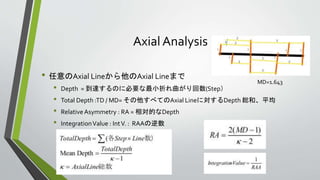
Axial Analysis
• AxialLineを引き、空間を線形化する: Axial Map
• ”least set of longest lines of direct movement”
• 最少の線分にて、すべてのConvexをカバー
これが主流
Bill Hiller:A Theory of the City as Object,Proceedings 3 rd International Space Syntax Symposium Atlanta,2001
既存研究
• J. Kerridgeand N. McNair, PEDFLOW — a system for modelling pedestrian
movement in occam
• 非常に限定されたエージェントモデルでの実験
• 交通量再現は難しい
• G.Thomas and S. Donikian, Modelling virtual cities dedicated to behavioural
animation,
• VisibilityGraphを用いたhuman-likeな振る舞い
• 見た目が自然なだけで流量は再現しない
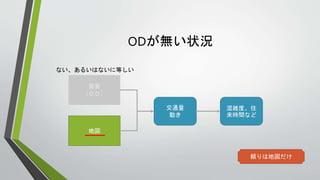
ODなしでは難しい
26.
Space Syntax AnalysisofTraffic
• SS によると現実のひとが完全に
Rationalなロジックで動いているとい
うのはdoubtfulに見える。
• Londonのデータ
• Depth と Flow の相関 0.83
27.
Line から Pointへ
•ショッピングセンターの回遊
• Line を Pointで置き換える
• オープンスペース
• Visibility GraphAnalysis (VGA)
• Pointの方が良い結果
28.
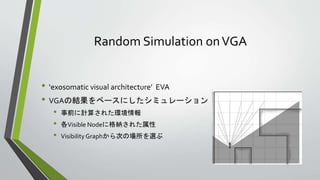
Random Simulation onVGA
•‘exosomatic visual architecture’ EVA
• VGAの結果をベースにしたシミュレーション
• 事前に計算された環境情報
• 各Visible Nodeに格納された属性
• VisibilityGraphから次の場所を選ぶ