

Traditional Healing Practices
mainly emphasis on Sikkim
Definition of Traditional medicine
• The World Health Organisation has referred to these
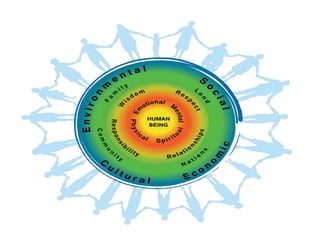
systems as “holistic”- i.e., “that of viewing man in his
totality within a wide ecological spectrum, and of
emphasising the view that ill health or disease is
brought about by an imbalance, or disequilibrium of
man in his total ecological system and not only by the
causative agents and pathogenic evolution”.
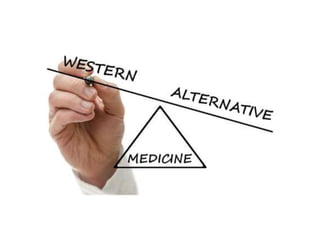
• Basically, there are two systems of health care in the
developing world: one is traditional and the other is
Western in derivation.
• Traditional medicine include all kinds of folk medicine,
unconventional medicine and indeed any kind of
therapeutic method that had been handed down by
the tradition of a community or ethnic group.
• Factors influencing the status of traditional
medicine in policy making are economic, cultural,
national crises (war and epidemics) and
international pressure to conserve traditional
knowledge, which all otherwise will disappear
because of lack of documentation.
• Indian Medical Council Act formally established the
traditional system—
• Ayurvedic,
• Homeopathy
• Unani and
• Siddha-as official components of national health
care in India.
• In Ladakh, a traditional medical system Amchi has
been incorporated into health planning.
• The treatment strategies used in traditional
systems of health include the use of herbal
medicines, mind/body approaches such as
meditation, and physical therapies including
massage, acupuncture and exercise programmes.
• These are low-cost, locally available treatments,
which according to WHO are utilised as the source
of primary health care by 80 % of the world’s
population. At present, more than 20 centres
around the world collaborate in the WHO
Traditional Medical Programme.
• Ethnic medical literature has defined two
types of Traditional Health Systems-
• The Naturalistic System and Personalistic
System.
• The naturalistic systems have been described
as those, which are natural sciences with
controlled investigation of documented
materia medica having a comprehensive
theoretical framework against which
treatments are tested and new treatments
are generated.
• The personalistic system have been described as
these which have the knowledge of healing,
possessed by an individual either selected by
someone in the community or by a process of
divine revelation, or by revelation (the divine or
supernatural disclosure to humans) of some form.
• The relationship between folk and classical
traditions in India is symbiotic (mutually beneficial
relationship).
• striking common ground for technical terms that are
used by folkhealers and traditional practitioners such
as vaata, pittaa, vaayu, kapha, ushna, sheetala. All
these terms form part of the knowledge of folk
practitioners and the households.
• The classical text of Ayurveda also mention about the
folk traditions and healers. In Charaka Samitha, it is
mentioned that “goat herds, shepherds, cowherds and
other forest dwellers possess knowledge about herbs
and its use in sickness”
• The traditional healer, as defined by the W.H.O. (1976), is
a person who is recognised by the community in which
he lives as competent to provide health care by using
vegetable, animal and mineral substances and certain
other methods based on the social, cultural and
religious background, as well as on the knowledge,
attributes and beliefs that are prevalent in the
community, regarding physical, mental and social well-
being and the causation of disease and disability.
Traditional healers in Sikkim
• There are a large number of traditional healers-
• Baidya, Dhami and Jhankri in the Nepali
community,
• Amji and Pau in the Bhutia community and
• Bongthing in the Lepcha community.
• Earlier the traditional healers were the only
medical practitioners in the village. For these, ‘jhar
phuk’ is the key word used by the powerful faith
healers.
• The first step in the curative process of traditional
healing is an interestingly complicated but
inexpensive course of treatment.
Nepali System Of Traditional Medicine
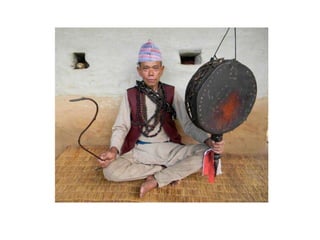
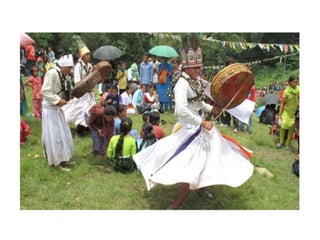
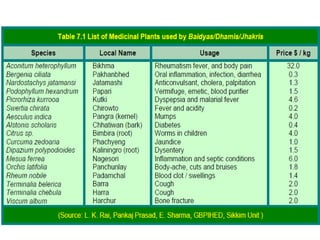
• The Nepali system of herbal medicine survives today as
Jaributi or simply as Pahadey dabai.
• The practitioners are known as Baidyas, Dhami or Jhakri
and can be seen practicing in the most of the rural areas of
the state.
• This system is most prevalent in the Tropical and
Subtropical villages.
• The traditional system of medicine has no organized set up
as compared to that of modern medicine and is fast
disappearing under the combined onslaught of modern
education and allopathic infrastructure.
• The Nepali system of medicine which has a wider base is
fast eroding and is in a critical need of being revived by
organizing the practitioners and linking them up with
reputed medical institutes.
• Amongst the various types of herbal healers in
this system of medicine, bone setters are still
quite in demand by the villagers.
• At present the system survives at the peddler
level, as there is no existing organized structure
or institution supporting this system of
traditional medicine within the state.
• However there is a Pakhrin Herbal hospital at
Alagarah, Kalimpong, Darjeeling District of
West Bengal, which specializes in bone
setting.
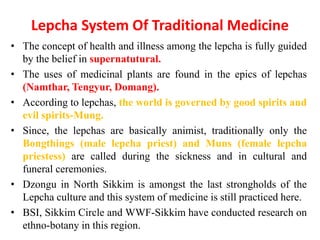
Lepcha System Of Traditional Medicine
• The concept of health and illness among the lepcha is fully guided
by the belief in supernatutural.
• The uses of medicinal plants are found in the epics of lepchas
(Namthar, Tengyur, Domang).
• According to lepchas, the world is governed by good spirits and
evil spirits-Mung.
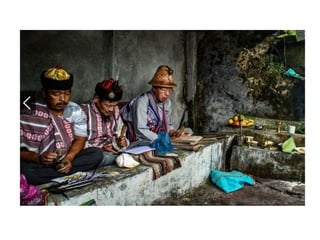
• Since, the lepchas are basically animist, traditionally only the
Bongthings (male lepcha priest) and Muns (female lepcha
priestess) are called during the sickness and in cultural and
funeral ceremonies.
• Dzongu in North Sikkim is amongst the last strongholds of the
Lepcha culture and this system of medicine is still practiced here.
• BSI, Sikkim Circle and WWF-Sikkim have conducted research on
ethno-botany in this region.
Following are some of the
local plants used in medicine by Lepchas:
• Mei-hroom-rik- Juice of the plant is used for sores in
mouth and tongue of small babies.
• Tuk—rik-koong- Flowers and leaves of the plant are used
as vermifuge tonic.
• Ka-chuk-koong- Bark and root is used for ulcer, bleeding,
piles and dysentery.
• Sa-naong-koong- Bark is used for diarrhoea.
• Re-be-rip- Rhizome and leaf paste is used for eye
ailments and cataract.
• Ruk-lim-koong –Seed, leaf and fruit is used for
rheumatism, paralysis and lumbago.
• Mongu-tafa/makch-mukh –whole plant is used for
urinary disorders.
• Naap-saor koong- Bark leaf is used for chronic
diarrhoea and gonorrhoea.
• Hik-bo-rik-loap –Rhizome of the plant is used for
scabies, itches and stomach troubles.
• Gye-bookha-noak –ftuit is used as purgative.
• Ka-look-paot –Fruit cotyledon paste is used for skin
diseases and mumps.
• De-chyoo-koong –Roots of the plant act as antidote in of
food poisoning.
• Tung-chaong-maon-rik –Crushed leaves are used for
poultice for sores.
• Faodjyirip –Bark, leaf and latex is used in case of acute
dysentery.
• Phachengfea –Crushed tuber paste is used in wounds and fracture as a
bandage.
• Naong-ryoo-koong – Oil extracted from seeds is used in curing
rheumatism.
• Dam-Paal-taon-koong –Seeds are taken for stomach ailments and viral
fever.
• PhozimAeyok –Whole plant is used for pneumonia and throat pain.
• Ta-kryup-poat –Seeds are used as vermifuge.
• Tum-baar-koong –Concoction of roots, leaves and flowers is used for
asthma and cough.
• Pa-go-koong/rip –Papery seeds and bark is taken for pneumonia and
chronic sores.
• Tuk-fit-rik –Paste of the fruit is used for toothache and pyorrhoea.
• Jaringomukh –Tender shoots are taken for stomach ailments and body
pains.
• Azramon –Paste of leaves is applied as bandage in case of wounds.
• Kaon-ke-koong –Pounded bark is applied for healing in fracture.
• Al-etok-koond - petals are used for dysentery and diarrhoea.
Tibetan System Of Traditional Medicine
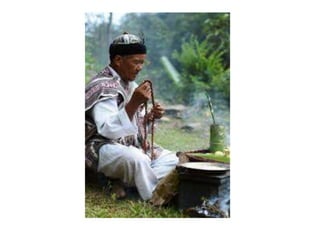
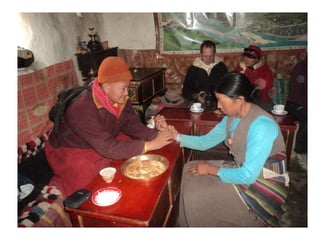
• The Tibetan system of medicine, whose practitioner is called an
Amji or Amchi is still prevalent in the Temperate eco-region,
thanks to the support from the Tibetan Medicine Training
Institutes at Chagpori, Darjeeling and Dharamsala, Himachal
Pradesh.
• Like the lepchas, the execution of religion is in the hands of
trained specialists like the Pau, Neyjum and Lamas.
• The pau is a male and the Neyjum is female.
• The Pau performs Phuphi by offering money, eggs and cloths
which have been circulated thrice over the patient’s head to the
malignant spirit.
• These things are thrown out and only the cloths are brought back.
It is belived that the person will get cured within three days of this
ritual.
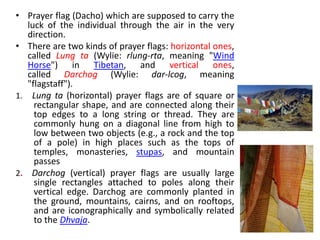
• Prayer flag (Dacho) which are supposed to carry the
luck of the individual through the air in the very
direction.
• There are two kinds of prayer flags: horizontal ones,
called Lung ta (Wylie: rlung-rta, meaning "Wind
Horse") in Tibetan, and vertical ones,
called Darchog (Wylie: dar-lcog, meaning
"flagstaff").
1. Lung ta (horizontal) prayer flags are of square or
rectangular shape, and are connected along their
top edges to a long string or thread. They are
commonly hung on a diagonal line from high to
low between two objects (e.g., a rock and the top
of a pole) in high places such as the tops of
temples, monasteries, stupas, and mountain
passes
2. Darchog (vertical) prayer flags are usually large
single rectangles attached to poles along their
vertical edge. Darchog are commonly planted in
the ground, mountains, cairns, and on rooftops,
and are iconographically and symbolically related
to the Dhvaja.
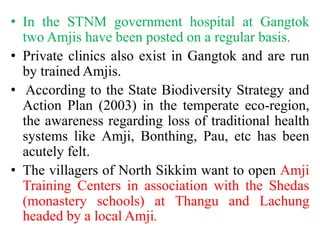
• In the STNM government hospital at Gangtok
two Amjis have been posted on a regular basis.
• Private clinics also exist in Gangtok and are run
by trained Amjis.
• According to the State Biodiversity Strategy and
Action Plan (2003) in the temperate eco-region,
the awareness regarding loss of traditional health
systems like Amji, Bonthing, Pau, etc has been
acutely felt.
• The villagers of North Sikkim want to open Amji
Training Centers in association with the Shedas
(monastery schools) at Thangu and Lachung
headed by a local Amji.
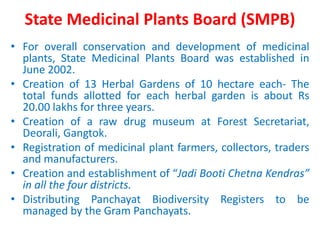
State Medicinal Plants Board (SMPB)
• For overall conservation and development of medicinal
plants, State Medicinal Plants Board was established in
June 2002.
• Creation of 13 Herbal Gardens of 10 hectare each- The
total funds allotted for each herbal garden is about Rs
20.00 lakhs for three years.
• Creation of a raw drug museum at Forest Secretariat,
Deorali, Gangtok.
• Registration of medicinal plant farmers, collectors, traders
and manufacturers.
• Creation and establishment of “Jadi Booti Chetna Kendras”
in all the four districts.
• Distributing Panchayat Biodiversity Registers to be
managed by the Gram Panchayats.
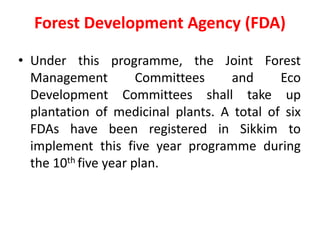
Forest Development Agency (FDA)
• Under this programme, the Joint Forest
Management Committees and Eco
Development Committees shall take up
plantation of medicinal plants. A total of six
FDAs have been registered in Sikkim to
implement this five year programme during
the 10th five year plan.
Development of Sanctuaries and
National Parks
• Under this scheme, integrated community
nurseries were created on private land around all
the six sanctuaries of the state during 2002 –
2003. These nurseries are being managed by a
self help group under the guidance of the
concerned EDC. A medicinal plants section is
being initiated in these nurseries. These nurseries
have good infrastructure including a germination
chamber, bio-composting, nursery beds etc and
can be brought under the network of
decentralized nurseries.
Community Biodiversity
Conservation, North East Council
• for the conservation of biodiversity including
medicinal plants through people’s
participation. This scheme has been recently
initiated in the state and shall be implemented
by the State Medicinal Plants Board.
Panchayat Herbal Gardens
• The Rural Development Department,
Government of Sikkim has created herbal
gardens which are owned by the Panchayat in
every Gram Panchayat Unit of Sikkim.
Research Initiatives in the Medicinal
Plant Sector
• STNM Hospital, Gangtok: The hospital has been conducting research in herbal
medicines in conjunction with the GBPIHED, Sikkim unit.
• Sikkim Manipal Institute of Medical Sciences and Central Referral Hospital:
This institute based in Tadong, Gangtok has the facilities for pharmacological
research in herbal medicine.
• Department of Health: During the past decade and half, the state of Sikkim’s
Directorate of health have sponsored and set up Tibetan medicine clinics.
Since then the clinics have helped thousands of people.
• Department of Horticulture: The Department of Horticulture, Government of
Sikkim, had initiated a trial plantation of Panax pseudo-ginseng at Lachung
(3000m) for a detailed study of the plant under cultural conditions. Cultivation
of high altitude endangered medicinal plants like Picrorrhiza kurrooa and
Orchis latifolia has also been initiated.
• Department of Science and Technology : This department has promoted
research and documentation in the field of medicinal herbs in the past
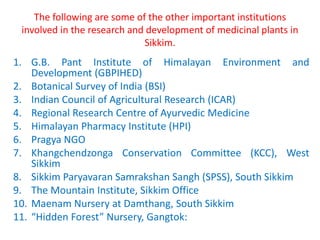
The following are some of the other important institutions
involved in the research and development of medicinal plants in
Sikkim.
1. G.B. Pant Institute of Himalayan Environment and
Development (GBPIHED)
2. Botanical Survey of India (BSI)
3. Indian Council of Agricultural Research (ICAR)
4. Regional Research Centre of Ayurvedic Medicine
5. Himalayan Pharmacy Institute (HPI)
6. Pragya NGO
7. Khangchendzonga Conservation Committee (KCC), West
Sikkim
8. Sikkim Paryavaran Samrakshan Sangh (SPSS), South Sikkim
9. The Mountain Institute, Sikkim Office
10. Maenam Nursery at Damthang, South Sikkim
11. “Hidden Forest” Nursery, Gangtok:
• Govt. Pharmacy College starts from June-July,
2018
Thank you

Traditional healing practices

  • 1.
  • 3.
    Definition of Traditionalmedicine • The World Health Organisation has referred to these systems as “holistic”- i.e., “that of viewing man in his totality within a wide ecological spectrum, and of emphasising the view that ill health or disease is brought about by an imbalance, or disequilibrium of man in his total ecological system and not only by the causative agents and pathogenic evolution”. • Basically, there are two systems of health care in the developing world: one is traditional and the other is Western in derivation. • Traditional medicine include all kinds of folk medicine, unconventional medicine and indeed any kind of therapeutic method that had been handed down by the tradition of a community or ethnic group.
  • 5.
    • Factors influencingthe status of traditional medicine in policy making are economic, cultural, national crises (war and epidemics) and international pressure to conserve traditional knowledge, which all otherwise will disappear because of lack of documentation. • Indian Medical Council Act formally established the traditional system— • Ayurvedic, • Homeopathy • Unani and • Siddha-as official components of national health care in India. • In Ladakh, a traditional medical system Amchi has been incorporated into health planning.
  • 6.
    • The treatmentstrategies used in traditional systems of health include the use of herbal medicines, mind/body approaches such as meditation, and physical therapies including massage, acupuncture and exercise programmes. • These are low-cost, locally available treatments, which according to WHO are utilised as the source of primary health care by 80 % of the world’s population. At present, more than 20 centres around the world collaborate in the WHO Traditional Medical Programme.
  • 8.
    • Ethnic medicalliterature has defined two types of Traditional Health Systems- • The Naturalistic System and Personalistic System. • The naturalistic systems have been described as those, which are natural sciences with controlled investigation of documented materia medica having a comprehensive theoretical framework against which treatments are tested and new treatments are generated.
  • 9.
    • The personalisticsystem have been described as these which have the knowledge of healing, possessed by an individual either selected by someone in the community or by a process of divine revelation, or by revelation (the divine or supernatural disclosure to humans) of some form. • The relationship between folk and classical traditions in India is symbiotic (mutually beneficial relationship). • striking common ground for technical terms that are used by folkhealers and traditional practitioners such as vaata, pittaa, vaayu, kapha, ushna, sheetala. All these terms form part of the knowledge of folk practitioners and the households.
  • 10.
    • The classicaltext of Ayurveda also mention about the folk traditions and healers. In Charaka Samitha, it is mentioned that “goat herds, shepherds, cowherds and other forest dwellers possess knowledge about herbs and its use in sickness” • The traditional healer, as defined by the W.H.O. (1976), is a person who is recognised by the community in which he lives as competent to provide health care by using vegetable, animal and mineral substances and certain other methods based on the social, cultural and religious background, as well as on the knowledge, attributes and beliefs that are prevalent in the community, regarding physical, mental and social well- being and the causation of disease and disability.
  • 11.
    Traditional healers inSikkim • There are a large number of traditional healers- • Baidya, Dhami and Jhankri in the Nepali community, • Amji and Pau in the Bhutia community and • Bongthing in the Lepcha community. • Earlier the traditional healers were the only medical practitioners in the village. For these, ‘jhar phuk’ is the key word used by the powerful faith healers. • The first step in the curative process of traditional healing is an interestingly complicated but inexpensive course of treatment.
  • 12.
    Nepali System OfTraditional Medicine • The Nepali system of herbal medicine survives today as Jaributi or simply as Pahadey dabai. • The practitioners are known as Baidyas, Dhami or Jhakri and can be seen practicing in the most of the rural areas of the state. • This system is most prevalent in the Tropical and Subtropical villages. • The traditional system of medicine has no organized set up as compared to that of modern medicine and is fast disappearing under the combined onslaught of modern education and allopathic infrastructure. • The Nepali system of medicine which has a wider base is fast eroding and is in a critical need of being revived by organizing the practitioners and linking them up with reputed medical institutes.
  • 15.
    • Amongst thevarious types of herbal healers in this system of medicine, bone setters are still quite in demand by the villagers. • At present the system survives at the peddler level, as there is no existing organized structure or institution supporting this system of traditional medicine within the state. • However there is a Pakhrin Herbal hospital at Alagarah, Kalimpong, Darjeeling District of West Bengal, which specializes in bone setting.
  • 17.
    Lepcha System OfTraditional Medicine • The concept of health and illness among the lepcha is fully guided by the belief in supernatutural. • The uses of medicinal plants are found in the epics of lepchas (Namthar, Tengyur, Domang). • According to lepchas, the world is governed by good spirits and evil spirits-Mung. • Since, the lepchas are basically animist, traditionally only the Bongthings (male lepcha priest) and Muns (female lepcha priestess) are called during the sickness and in cultural and funeral ceremonies. • Dzongu in North Sikkim is amongst the last strongholds of the Lepcha culture and this system of medicine is still practiced here. • BSI, Sikkim Circle and WWF-Sikkim have conducted research on ethno-botany in this region.
  • 20.
    Following are someof the local plants used in medicine by Lepchas: • Mei-hroom-rik- Juice of the plant is used for sores in mouth and tongue of small babies. • Tuk—rik-koong- Flowers and leaves of the plant are used as vermifuge tonic. • Ka-chuk-koong- Bark and root is used for ulcer, bleeding, piles and dysentery. • Sa-naong-koong- Bark is used for diarrhoea. • Re-be-rip- Rhizome and leaf paste is used for eye ailments and cataract. • Ruk-lim-koong –Seed, leaf and fruit is used for rheumatism, paralysis and lumbago. • Mongu-tafa/makch-mukh –whole plant is used for urinary disorders.
  • 21.
    • Naap-saor koong-Bark leaf is used for chronic diarrhoea and gonorrhoea. • Hik-bo-rik-loap –Rhizome of the plant is used for scabies, itches and stomach troubles. • Gye-bookha-noak –ftuit is used as purgative. • Ka-look-paot –Fruit cotyledon paste is used for skin diseases and mumps. • De-chyoo-koong –Roots of the plant act as antidote in of food poisoning. • Tung-chaong-maon-rik –Crushed leaves are used for poultice for sores. • Faodjyirip –Bark, leaf and latex is used in case of acute dysentery.
  • 22.
    • Phachengfea –Crushedtuber paste is used in wounds and fracture as a bandage. • Naong-ryoo-koong – Oil extracted from seeds is used in curing rheumatism. • Dam-Paal-taon-koong –Seeds are taken for stomach ailments and viral fever. • PhozimAeyok –Whole plant is used for pneumonia and throat pain. • Ta-kryup-poat –Seeds are used as vermifuge. • Tum-baar-koong –Concoction of roots, leaves and flowers is used for asthma and cough. • Pa-go-koong/rip –Papery seeds and bark is taken for pneumonia and chronic sores. • Tuk-fit-rik –Paste of the fruit is used for toothache and pyorrhoea. • Jaringomukh –Tender shoots are taken for stomach ailments and body pains. • Azramon –Paste of leaves is applied as bandage in case of wounds. • Kaon-ke-koong –Pounded bark is applied for healing in fracture. • Al-etok-koond - petals are used for dysentery and diarrhoea.
  • 23.
    Tibetan System OfTraditional Medicine • The Tibetan system of medicine, whose practitioner is called an Amji or Amchi is still prevalent in the Temperate eco-region, thanks to the support from the Tibetan Medicine Training Institutes at Chagpori, Darjeeling and Dharamsala, Himachal Pradesh. • Like the lepchas, the execution of religion is in the hands of trained specialists like the Pau, Neyjum and Lamas. • The pau is a male and the Neyjum is female. • The Pau performs Phuphi by offering money, eggs and cloths which have been circulated thrice over the patient’s head to the malignant spirit. • These things are thrown out and only the cloths are brought back. It is belived that the person will get cured within three days of this ritual.
  • 24.
    • Prayer flag(Dacho) which are supposed to carry the luck of the individual through the air in the very direction. • There are two kinds of prayer flags: horizontal ones, called Lung ta (Wylie: rlung-rta, meaning "Wind Horse") in Tibetan, and vertical ones, called Darchog (Wylie: dar-lcog, meaning "flagstaff"). 1. Lung ta (horizontal) prayer flags are of square or rectangular shape, and are connected along their top edges to a long string or thread. They are commonly hung on a diagonal line from high to low between two objects (e.g., a rock and the top of a pole) in high places such as the tops of temples, monasteries, stupas, and mountain passes 2. Darchog (vertical) prayer flags are usually large single rectangles attached to poles along their vertical edge. Darchog are commonly planted in the ground, mountains, cairns, and on rooftops, and are iconographically and symbolically related to the Dhvaja.
  • 25.
    • In theSTNM government hospital at Gangtok two Amjis have been posted on a regular basis. • Private clinics also exist in Gangtok and are run by trained Amjis. • According to the State Biodiversity Strategy and Action Plan (2003) in the temperate eco-region, the awareness regarding loss of traditional health systems like Amji, Bonthing, Pau, etc has been acutely felt. • The villagers of North Sikkim want to open Amji Training Centers in association with the Shedas (monastery schools) at Thangu and Lachung headed by a local Amji.
  • 30.
    State Medicinal PlantsBoard (SMPB) • For overall conservation and development of medicinal plants, State Medicinal Plants Board was established in June 2002. • Creation of 13 Herbal Gardens of 10 hectare each- The total funds allotted for each herbal garden is about Rs 20.00 lakhs for three years. • Creation of a raw drug museum at Forest Secretariat, Deorali, Gangtok. • Registration of medicinal plant farmers, collectors, traders and manufacturers. • Creation and establishment of “Jadi Booti Chetna Kendras” in all the four districts. • Distributing Panchayat Biodiversity Registers to be managed by the Gram Panchayats.
  • 31.
    Forest Development Agency(FDA) • Under this programme, the Joint Forest Management Committees and Eco Development Committees shall take up plantation of medicinal plants. A total of six FDAs have been registered in Sikkim to implement this five year programme during the 10th five year plan.
  • 32.
    Development of Sanctuariesand National Parks • Under this scheme, integrated community nurseries were created on private land around all the six sanctuaries of the state during 2002 – 2003. These nurseries are being managed by a self help group under the guidance of the concerned EDC. A medicinal plants section is being initiated in these nurseries. These nurseries have good infrastructure including a germination chamber, bio-composting, nursery beds etc and can be brought under the network of decentralized nurseries.
  • 33.
    Community Biodiversity Conservation, NorthEast Council • for the conservation of biodiversity including medicinal plants through people’s participation. This scheme has been recently initiated in the state and shall be implemented by the State Medicinal Plants Board.
  • 34.
    Panchayat Herbal Gardens •The Rural Development Department, Government of Sikkim has created herbal gardens which are owned by the Panchayat in every Gram Panchayat Unit of Sikkim.
  • 35.
    Research Initiatives inthe Medicinal Plant Sector • STNM Hospital, Gangtok: The hospital has been conducting research in herbal medicines in conjunction with the GBPIHED, Sikkim unit. • Sikkim Manipal Institute of Medical Sciences and Central Referral Hospital: This institute based in Tadong, Gangtok has the facilities for pharmacological research in herbal medicine. • Department of Health: During the past decade and half, the state of Sikkim’s Directorate of health have sponsored and set up Tibetan medicine clinics. Since then the clinics have helped thousands of people. • Department of Horticulture: The Department of Horticulture, Government of Sikkim, had initiated a trial plantation of Panax pseudo-ginseng at Lachung (3000m) for a detailed study of the plant under cultural conditions. Cultivation of high altitude endangered medicinal plants like Picrorrhiza kurrooa and Orchis latifolia has also been initiated. • Department of Science and Technology : This department has promoted research and documentation in the field of medicinal herbs in the past
  • 36.
    The following aresome of the other important institutions involved in the research and development of medicinal plants in Sikkim. 1. G.B. Pant Institute of Himalayan Environment and Development (GBPIHED) 2. Botanical Survey of India (BSI) 3. Indian Council of Agricultural Research (ICAR) 4. Regional Research Centre of Ayurvedic Medicine 5. Himalayan Pharmacy Institute (HPI) 6. Pragya NGO 7. Khangchendzonga Conservation Committee (KCC), West Sikkim 8. Sikkim Paryavaran Samrakshan Sangh (SPSS), South Sikkim 9. The Mountain Institute, Sikkim Office 10. Maenam Nursery at Damthang, South Sikkim 11. “Hidden Forest” Nursery, Gangtok:
  • 37.
    • Govt. PharmacyCollege starts from June-July, 2018
  • 38.