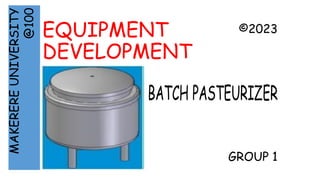
EQUIPMENT
DEVELOPMENT
GROUP 1
MAKERERE
UNIVERSITY
@100 ©2023
Stages involved in Equipment
Development
There are nine stages in the new product development process:
1. Idea generation
2. Concept development
3. Equipment development and testing
4. Marketing strategy development
5. Business analysis
6. Market testing
7. Commercialization
8. Consumer adoption
Idea generation
• According to the research paper, thermal preservation of
liquid foods is a necessity during processing.
• Pasteurization is a key process in the liquids food processing
industry used for preservation of processed liquid foods.
• Conventional pasteurizing equipment is usually high capacity
and expensive hence many small scale processors resort to
heating liquid foods in open boilers to make it safe as well as
to extend its shelf life.
• This affect the nutritional quality of the liquid food and
increase the risk of post pasteurization contamination
during ensuing hand packaging or loose distribution.
Idea generation………………..cont’d
• However, the main problems faced by small-scale liquid
foods processors in developing countries like Uganda in
particular include:
high business start-up costs
lack of appropriately sized equipment
• Therefore, the aim of this study was to design, construct
and evaluate a small scale automated pasteurizer; an
important equipment in liquid foods industry.
Concept Developments
• This involves;
• Material selection basing the fact that the inner wall of the
jacket should minimize heat loss to the surrounding air mass
and maximize heat transfer to the test liquid and,
• Stainless steel was selected because it is much less reactive
than other metals, particularly with acidic foods.
Concept Developments
• Specifications development where
calculations of height and volume
were made to estimate the size of
pasteurizer to be made basing on
mathematical equations, the
estimated height of the user and
material properties.
• The design of the batch
pasteurizer drawing was done using
Solid Edge V16 as illustrated in the
figure.
Equipment Development and testing
This included the design of the batch pasteurizer components
involving
• Element design: cutting, welding, grinding of the different
component parts.
• Assembly: where the parts are then joined together that is
fabrication and assembled to be able to produce the batch
pasteurizer.
Equipment Development and testing
It also involves
• choosing of the heater to be used in the batch pasteurizer
basing on;
The volume of liquid that the batch pasteurizer can
accommodate,
The heat distribution through out the pasteurizer,
The lethality and the microbial analysis that is how
effective the heating system is to be able to destroy
different microorganisms.
Equipment Development and testing
The batch pasteurizer was tested for the following
specifications;
• Output basing on the time taken for a certain batch.
• Heat distribution using data logger model.
• Microbial analysis through checking a gradual decrease in
the number of microorganisms.
• Lethality (L) that was obtained through calculating the D
and Z values of the pasteurization.
• Pasteurization performance (E).
……other stages of equipment
development
However from the paper though not indicated, after
equipment testing, it was supposed to undergo extra
step i.e;
• Marketing strategy development to plan of how who
and when to do the market testing, targeted groups
and consumer response.
• Business analysis to ascertain the feasibility of the
equipment in regard to the costs and benefits.
• Market testing to determine general acceptability
by the targeted group of consumers.
……other stages of equipment
development
• Commercialization to ascertain whether the business
goal is achievable
• Consumer adoption for the continuity of production
or termination of the venture
Group Members
1. ASIIMWE GERALD MASEREKA
2. KAGO SIMON PETER
3. NAKYANZI DOREEN NOELINE
4. WASWA SHONIA MUTEEBI
…..thanks for listening….
…..be blessed….

Equipment development presentation.pdf

  • 1.
  • 2.
    Stages involved inEquipment Development There are nine stages in the new product development process: 1. Idea generation 2. Concept development 3. Equipment development and testing 4. Marketing strategy development 5. Business analysis 6. Market testing 7. Commercialization 8. Consumer adoption
  • 3.
    Idea generation • Accordingto the research paper, thermal preservation of liquid foods is a necessity during processing. • Pasteurization is a key process in the liquids food processing industry used for preservation of processed liquid foods. • Conventional pasteurizing equipment is usually high capacity and expensive hence many small scale processors resort to heating liquid foods in open boilers to make it safe as well as to extend its shelf life. • This affect the nutritional quality of the liquid food and increase the risk of post pasteurization contamination during ensuing hand packaging or loose distribution.
  • 4.
    Idea generation………………..cont’d • However,the main problems faced by small-scale liquid foods processors in developing countries like Uganda in particular include: high business start-up costs lack of appropriately sized equipment • Therefore, the aim of this study was to design, construct and evaluate a small scale automated pasteurizer; an important equipment in liquid foods industry.
  • 5.
    Concept Developments • Thisinvolves; • Material selection basing the fact that the inner wall of the jacket should minimize heat loss to the surrounding air mass and maximize heat transfer to the test liquid and, • Stainless steel was selected because it is much less reactive than other metals, particularly with acidic foods.
  • 6.
    Concept Developments • Specificationsdevelopment where calculations of height and volume were made to estimate the size of pasteurizer to be made basing on mathematical equations, the estimated height of the user and material properties. • The design of the batch pasteurizer drawing was done using Solid Edge V16 as illustrated in the figure.
  • 7.
    Equipment Development andtesting This included the design of the batch pasteurizer components involving • Element design: cutting, welding, grinding of the different component parts. • Assembly: where the parts are then joined together that is fabrication and assembled to be able to produce the batch pasteurizer.
  • 8.
    Equipment Development andtesting It also involves • choosing of the heater to be used in the batch pasteurizer basing on; The volume of liquid that the batch pasteurizer can accommodate, The heat distribution through out the pasteurizer, The lethality and the microbial analysis that is how effective the heating system is to be able to destroy different microorganisms.
  • 9.
    Equipment Development andtesting The batch pasteurizer was tested for the following specifications; • Output basing on the time taken for a certain batch. • Heat distribution using data logger model. • Microbial analysis through checking a gradual decrease in the number of microorganisms. • Lethality (L) that was obtained through calculating the D and Z values of the pasteurization. • Pasteurization performance (E).
  • 10.
    ……other stages ofequipment development However from the paper though not indicated, after equipment testing, it was supposed to undergo extra step i.e; • Marketing strategy development to plan of how who and when to do the market testing, targeted groups and consumer response. • Business analysis to ascertain the feasibility of the equipment in regard to the costs and benefits. • Market testing to determine general acceptability by the targeted group of consumers.
  • 11.
    ……other stages ofequipment development • Commercialization to ascertain whether the business goal is achievable • Consumer adoption for the continuity of production or termination of the venture
  • 12.
    Group Members 1. ASIIMWEGERALD MASEREKA 2. KAGO SIMON PETER 3. NAKYANZI DOREEN NOELINE 4. WASWA SHONIA MUTEEBI
  • 13.