TRADITIONAL
AND
CONTEMPORARY
PUPPETRY
Basic Introduction
 Puppetry is a form of theatre or performance which involves the
manipulation of puppets. It is very ancient, and is believed to have
originated 30,000 years BC. Puppetry takes many forms but they all
share the process of animating inanimate performing objects. Puppetry
is used in almost all human societies both as an entertainment – in
performance – and ceremonially in rituals and celebrations such
as carnivals.
 Most puppetry involves storytelling.
The impact of puppetry depends on the process
of transformation of puppets, which has much in
common with magic and with play. Thus puppetry
can create complex and magical theatre with
relatively small resources.
Indian Puppetry
 Puppetry throughout the ages has held an important place
in traditional entertainment.
 The themes were basically EPICS and LEGENDS.
 Puppets from different parts of the country have their own
identity.
 The presentation of puppet programmes
involves the creative efforts of many people
working together.
Types of Puppets
 String Puppets
 Rod Puppets
Glove Puppets
 Shadow Puppets
String Puppets
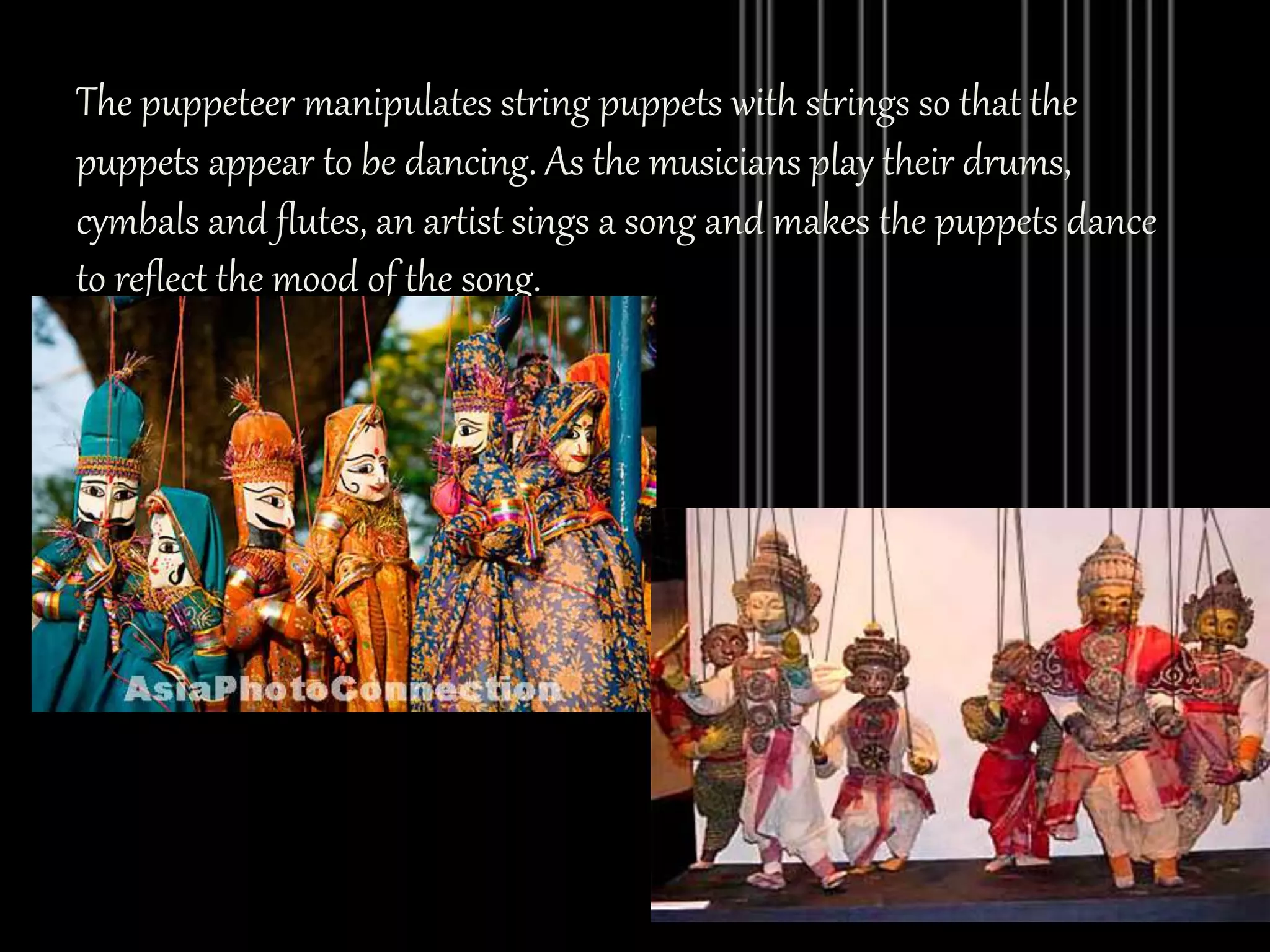
 The traditional marionettes of Rajasthan and Karnataka are
known as Kathputli and Gombeyatta respectively.
 Carved from a single piece of wood, these puppets are like
large dolls that are colorfully dressed.
 Puppeteers manipulate them with two to five strings which
are normally tied to their fingers and
not to a prop or a support.
The puppeteer manipulates string puppets with strings so that the
puppets appear to be dancing. As the musicians play their drums,
cymbals and flutes, an artist sings a song and makes the puppets dance
to reflect the mood of the song.
Rod Puppets
Rod puppets are an extension of glove-puppets, but often much
larger and are supported and manipulated by rods from below.
This form of puppetry now is found mostly in West Bengal and
Orissa. The tradition of rod puppet in Bengal goes back to the end
of fourteenth century and known as a PutulNatch(Puppet
dance), with an emphasis on operatic singing and
performance of a Jatra (folk play).
The dancing and the acting elements of
the performance are hinged on the traditions
of Ramayana, Mahabharata and Puranas.
Glove Puppets
Glove puppets, are also known as sleeve, hand or palm puppets.
These puppets are like limp dolls, but in the hands of an able
puppeteer, are capable of producing a wide range of movements.
The head is made of either paper mache, cloth or wood, with two
hands emerging from just below the neck. The rest of the figure
consists of a long flowing skirt.
The tradition of glove puppets in India
is popular in Uttar Pradesh, Orissa, West Bengal
and Kerala.
Shadow Puppets
 Shadow puppets are flat figures. They are cut out of leather,
which has been treated to make it translucent. Shadow
puppets are pressed against the screen with a strong source of
light behind it. The manipulation between the light and the
screen make silhouettes or colourful shadows, as the case may
be, for the viewers who sit in front of the screen.
This tradition of shadow puppets survives
in Orissa. Kerala, Andhra Pradesh, Karnataka,
Maharashtra and Tamil Nadu.
Contemporary Puppetry
 Japanese bunraku puppets:
The style is named after a Japanese puppet master, Uemura
Bunrakuken, of the 18th century. These figures, which are
one-half to two-thirds life size, may be operated by as many
as three manipulators: the chief manipulator controls head
movements with one hand by means of strings inside the
body, which may raise the eyebrows or swivel the eyes, while
using the other hand to move the right arm of the puppet; the
second manipulator moves the left arm of the puppet;
and the third moves the legs;
the coordination of movement
between these three artists requires
long and devoted training.
Finger Puppet:
The manipulator’s two fingers constitute the limbs of a
puppet, whose body is attached over the manipulator’s hand.
An even simpler finger puppet is a small, hollow figure that
fits over a single finger.
Water Puppetry in Vietnam:
 The puppets are made out of wood and then lacquered. The
shows are performed in a waist-deep pool. A long rod
supports each puppet under the water and is used by the
puppeteers, who are normally hidden behind a screen, to
control it so that the puppet appears to be moving over the
water.
The theme of the skits is rural and has a strong reference to
Vietnamese folklore. It tells of day-to-day
living in rural Vietnam and Vietnamese
folk tales that are told by grandparents
to their grandchildren.
 Blair Thomas and his puppets:
Blair Thomas & Company is a Chicago-based theater
company that creates and performs contemporary puppetry
and visual theater locally, nationally, and internationally.
Traditional and contemporary puppetry

Traditional and contemporary puppetry

  • 1.
  • 2.
    Basic Introduction  Puppetryis a form of theatre or performance which involves the manipulation of puppets. It is very ancient, and is believed to have originated 30,000 years BC. Puppetry takes many forms but they all share the process of animating inanimate performing objects. Puppetry is used in almost all human societies both as an entertainment – in performance – and ceremonially in rituals and celebrations such as carnivals.  Most puppetry involves storytelling. The impact of puppetry depends on the process of transformation of puppets, which has much in common with magic and with play. Thus puppetry can create complex and magical theatre with relatively small resources.
  • 3.
    Indian Puppetry  Puppetrythroughout the ages has held an important place in traditional entertainment.  The themes were basically EPICS and LEGENDS.  Puppets from different parts of the country have their own identity.  The presentation of puppet programmes involves the creative efforts of many people working together.
  • 4.
    Types of Puppets String Puppets  Rod Puppets Glove Puppets  Shadow Puppets
  • 5.
    String Puppets  Thetraditional marionettes of Rajasthan and Karnataka are known as Kathputli and Gombeyatta respectively.  Carved from a single piece of wood, these puppets are like large dolls that are colorfully dressed.  Puppeteers manipulate them with two to five strings which are normally tied to their fingers and not to a prop or a support.
  • 6.
    The puppeteer manipulatesstring puppets with strings so that the puppets appear to be dancing. As the musicians play their drums, cymbals and flutes, an artist sings a song and makes the puppets dance to reflect the mood of the song.
  • 7.
    Rod Puppets Rod puppetsare an extension of glove-puppets, but often much larger and are supported and manipulated by rods from below. This form of puppetry now is found mostly in West Bengal and Orissa. The tradition of rod puppet in Bengal goes back to the end of fourteenth century and known as a PutulNatch(Puppet dance), with an emphasis on operatic singing and performance of a Jatra (folk play). The dancing and the acting elements of the performance are hinged on the traditions of Ramayana, Mahabharata and Puranas.
  • 9.
    Glove Puppets Glove puppets,are also known as sleeve, hand or palm puppets. These puppets are like limp dolls, but in the hands of an able puppeteer, are capable of producing a wide range of movements. The head is made of either paper mache, cloth or wood, with two hands emerging from just below the neck. The rest of the figure consists of a long flowing skirt. The tradition of glove puppets in India is popular in Uttar Pradesh, Orissa, West Bengal and Kerala.
  • 11.
    Shadow Puppets  Shadowpuppets are flat figures. They are cut out of leather, which has been treated to make it translucent. Shadow puppets are pressed against the screen with a strong source of light behind it. The manipulation between the light and the screen make silhouettes or colourful shadows, as the case may be, for the viewers who sit in front of the screen. This tradition of shadow puppets survives in Orissa. Kerala, Andhra Pradesh, Karnataka, Maharashtra and Tamil Nadu.
  • 13.
  • 14.
    The style isnamed after a Japanese puppet master, Uemura Bunrakuken, of the 18th century. These figures, which are one-half to two-thirds life size, may be operated by as many as three manipulators: the chief manipulator controls head movements with one hand by means of strings inside the body, which may raise the eyebrows or swivel the eyes, while using the other hand to move the right arm of the puppet; the second manipulator moves the left arm of the puppet; and the third moves the legs; the coordination of movement between these three artists requires long and devoted training.
  • 15.
    Finger Puppet: The manipulator’stwo fingers constitute the limbs of a puppet, whose body is attached over the manipulator’s hand. An even simpler finger puppet is a small, hollow figure that fits over a single finger.
  • 16.
  • 17.
     The puppetsare made out of wood and then lacquered. The shows are performed in a waist-deep pool. A long rod supports each puppet under the water and is used by the puppeteers, who are normally hidden behind a screen, to control it so that the puppet appears to be moving over the water. The theme of the skits is rural and has a strong reference to Vietnamese folklore. It tells of day-to-day living in rural Vietnam and Vietnamese folk tales that are told by grandparents to their grandchildren.
  • 18.
     Blair Thomasand his puppets: Blair Thomas & Company is a Chicago-based theater company that creates and performs contemporary puppetry and visual theater locally, nationally, and internationally.