Chapter 5:
International Trade Theory
NASYUHA AFINA BINTI MOHD NAZARI
1506796492
1
2
Bangladesh’s Textile Trade
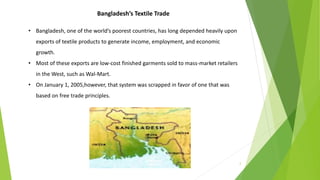
• Bangladesh, one of the world’s poorest countries, has long depended heavily upon
exports of textile products to generate income, employment, and economic
growth.
• Most of these exports are low-cost finished garments sold to mass-market retailers
in the West, such as Wal-Mart.
• On January 1, 2005,however, that system was scrapped in favor of one that was
based on free trade principles.
3
Why Is Free Trade Beneficial?
• Free trade - a situation where a government does not attempt to influence through
quotas or duties what its citizens can buy from another country or what
they can produce and sell to another country
• Trade theory shows why it is beneficial for a country to engage in international trade
even for products it is able to produce for itself
• International trade allows a country:
i. to specialize in the manufacture and export of products that it can produce efficiently
ii. import products that can be produced more efficiently in other countries
Why Do Certain Patterns Of Trade Exist?
4
 Some patterns of trade are fairly easy to explain
- it is obvious why Saudi Arabia exports oil, Ghana exports cocoa, and Brazil exports
coffee
 But, why does Switzerland export chemicals, pharmaceuticals, watches, and jewelry?
 Why does Japan export automobiles, consumer electronics, and machine tools?
5
What Role Does Government Have In Trade?
o The mercantilist philosophy makes a crude case for government involvement in promoting exports
and limiting imports
o Smith, Ricardo, and Heckscher-Ohlin promote unrestricted free trade
o New trade theory and Porter’s theory of national competitive advantage justify limited and
selective government intervention to support the development of certain export-oriented
industries
6
An Overview Of Trade Theory
How has international trade theory evolved?
7
What Is Mercantilism?
 Mercantilism suggests that it is in a country’s best interest to maintain a trade surplus.
• advocates government intervention to achieve a surplus in the balance of trade
 Mercantilism views trade as a zero-sum game.
8
What Is Smith’s Theory Of Absolute Advantage?
• Adam Smith argued that a country has an absolute advantage in the production of a product when it
is more efficient than any other country in producing it.
9
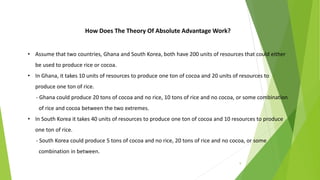
How Does The Theory Of Absolute Advantage Work?
• Assume that two countries, Ghana and South Korea, both have 200 units of resources that could either
be used to produce rice or cocoa.
• In Ghana, it takes 10 units of resources to produce one ton of cocoa and 20 units of resources to
produce one ton of rice.
- Ghana could produce 20 tons of cocoa and no rice, 10 tons of rice and no cocoa, or some combination
of rice and cocoa between the two extremes.
• In South Korea it takes 40 units of resources to produce one ton of cocoa and 10 resources to produce
one ton of rice.
- South Korea could produce 5 tons of cocoa and no rice, 20 tons of rice and no cocoa, or some
combination in between.
10
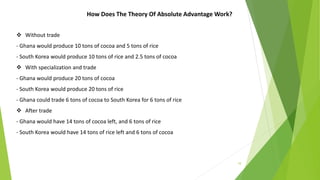
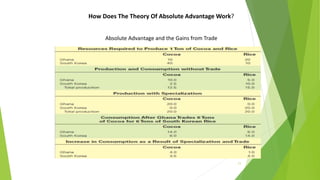
How Does The Theory Of Absolute Advantage Work?
 Without trade
- Ghana would produce 10 tons of cocoa and 5 tons of rice
- South Korea would produce 10 tons of rice and 2.5 tons of cocoa
 With specialization and trade
- Ghana would produce 20 tons of cocoa
- South Korea would produce 20 tons of rice
- Ghana could trade 6 tons of cocoa to South Korea for 6 tons of rice
 After trade
- Ghana would have 14 tons of cocoa left, and 6 tons of rice
- South Korea would have 14 tons of rice left and 6 tons of cocoa
11
How Does The Theory Of Absolute Advantage Work?
Absolute Advantage and the Gains from Trade
12
What Is Ricardo’s Theory Of Comparative Advantage?
• David Ricardo asked what might happen when one country has an absolute advantage in the production of all
goods.
• Ricardo’s theory of comparative advantage suggests that countries should specialize in the production of those
goods they produce most efficiently and buy goods that they produce less efficiently from other countries,
even if this means buying goods from other countries that they could produce more efficiently at home.
13
How Does The Theory Of Comparative Advantage Work?
Assume :
 Ghana is more efficient in the production of both cocoa and rice
in Ghana, it takes 10 resources to produce one ton of cocoa, and 13 1/3 resources to produce one ton of rice
 So, Ghana could produce 20 tons of cocoa and no rice, 15 tons of rice and no cocoa, or some combination of the
two.
 In South Korea, it takes 40 resources to produce one ton of cocoa and 20 resources to produce one ton of rice.
 So, South Korea could produce 5 tons of cocoa and no rice, 10 tons of rice and no cocoa, or some combination of
the two.
14
How Does The Theory Of Comparative Advantage Work?
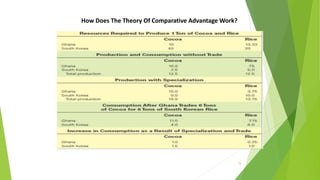
 With trade
- Ghana could export 4 tons of cocoa to South Korea in exchange for 4 tons of rice
- Ghana will still have 11 tons of cocoa, and 4 additional tons of rice
- South Korea still has 6 tons of rice and 4 tons of cocoa
- if each country specializes in the production of the good in which it has a comparative advantage and trades
for the other, both countries gain
 Comparative advantage theory provides a strong rationale for encouraging free trade.
15
How Does The Theory Of Comparative Advantage Work?
16
Is Unrestricted Free Trade Always Beneficial?
 Unrestricted free trade is beneficial, but the gains may not be as great as the simple model of comparative
advantage would suggest
- immobile resources
- diminishing returns
- dynamic effects and economic growth
 Opening a country to trade could increase
- a country's stock of resources as increased supplies become available from abroad
- the efficiency of resource utilization and so free up resources for other uses
- economic growth
17
Could A Rich Country Be Worse Off With Free Trade?
• Paul Samuelson - the dynamic gains from trade may not always be beneficial
- free trade may ultimately result in lower wages in the rich country
• The ability to offshore services jobs that were traditionally not internationally mobile
may have the effect of a mass inward migration into the United States, where wages
would then fall.

Trade Theory

  • 1.
    Chapter 5: International TradeTheory NASYUHA AFINA BINTI MOHD NAZARI 1506796492 1
  • 2.
    2 Bangladesh’s Textile Trade •Bangladesh, one of the world’s poorest countries, has long depended heavily upon exports of textile products to generate income, employment, and economic growth. • Most of these exports are low-cost finished garments sold to mass-market retailers in the West, such as Wal-Mart. • On January 1, 2005,however, that system was scrapped in favor of one that was based on free trade principles.
  • 3.
    3 Why Is FreeTrade Beneficial? • Free trade - a situation where a government does not attempt to influence through quotas or duties what its citizens can buy from another country or what they can produce and sell to another country • Trade theory shows why it is beneficial for a country to engage in international trade even for products it is able to produce for itself • International trade allows a country: i. to specialize in the manufacture and export of products that it can produce efficiently ii. import products that can be produced more efficiently in other countries
  • 4.
    Why Do CertainPatterns Of Trade Exist? 4  Some patterns of trade are fairly easy to explain - it is obvious why Saudi Arabia exports oil, Ghana exports cocoa, and Brazil exports coffee  But, why does Switzerland export chemicals, pharmaceuticals, watches, and jewelry?  Why does Japan export automobiles, consumer electronics, and machine tools?
  • 5.
    5 What Role DoesGovernment Have In Trade? o The mercantilist philosophy makes a crude case for government involvement in promoting exports and limiting imports o Smith, Ricardo, and Heckscher-Ohlin promote unrestricted free trade o New trade theory and Porter’s theory of national competitive advantage justify limited and selective government intervention to support the development of certain export-oriented industries
  • 6.
    6 An Overview OfTrade Theory How has international trade theory evolved?
  • 7.
    7 What Is Mercantilism? Mercantilism suggests that it is in a country’s best interest to maintain a trade surplus. • advocates government intervention to achieve a surplus in the balance of trade  Mercantilism views trade as a zero-sum game.
  • 8.
    8 What Is Smith’sTheory Of Absolute Advantage? • Adam Smith argued that a country has an absolute advantage in the production of a product when it is more efficient than any other country in producing it.
  • 9.
    9 How Does TheTheory Of Absolute Advantage Work? • Assume that two countries, Ghana and South Korea, both have 200 units of resources that could either be used to produce rice or cocoa. • In Ghana, it takes 10 units of resources to produce one ton of cocoa and 20 units of resources to produce one ton of rice. - Ghana could produce 20 tons of cocoa and no rice, 10 tons of rice and no cocoa, or some combination of rice and cocoa between the two extremes. • In South Korea it takes 40 units of resources to produce one ton of cocoa and 10 resources to produce one ton of rice. - South Korea could produce 5 tons of cocoa and no rice, 20 tons of rice and no cocoa, or some combination in between.
  • 10.
    10 How Does TheTheory Of Absolute Advantage Work?  Without trade - Ghana would produce 10 tons of cocoa and 5 tons of rice - South Korea would produce 10 tons of rice and 2.5 tons of cocoa  With specialization and trade - Ghana would produce 20 tons of cocoa - South Korea would produce 20 tons of rice - Ghana could trade 6 tons of cocoa to South Korea for 6 tons of rice  After trade - Ghana would have 14 tons of cocoa left, and 6 tons of rice - South Korea would have 14 tons of rice left and 6 tons of cocoa
  • 11.
    11 How Does TheTheory Of Absolute Advantage Work? Absolute Advantage and the Gains from Trade
  • 12.
    12 What Is Ricardo’sTheory Of Comparative Advantage? • David Ricardo asked what might happen when one country has an absolute advantage in the production of all goods. • Ricardo’s theory of comparative advantage suggests that countries should specialize in the production of those goods they produce most efficiently and buy goods that they produce less efficiently from other countries, even if this means buying goods from other countries that they could produce more efficiently at home.
  • 13.
    13 How Does TheTheory Of Comparative Advantage Work? Assume :  Ghana is more efficient in the production of both cocoa and rice in Ghana, it takes 10 resources to produce one ton of cocoa, and 13 1/3 resources to produce one ton of rice  So, Ghana could produce 20 tons of cocoa and no rice, 15 tons of rice and no cocoa, or some combination of the two.  In South Korea, it takes 40 resources to produce one ton of cocoa and 20 resources to produce one ton of rice.  So, South Korea could produce 5 tons of cocoa and no rice, 10 tons of rice and no cocoa, or some combination of the two.
  • 14.
    14 How Does TheTheory Of Comparative Advantage Work?  With trade - Ghana could export 4 tons of cocoa to South Korea in exchange for 4 tons of rice - Ghana will still have 11 tons of cocoa, and 4 additional tons of rice - South Korea still has 6 tons of rice and 4 tons of cocoa - if each country specializes in the production of the good in which it has a comparative advantage and trades for the other, both countries gain  Comparative advantage theory provides a strong rationale for encouraging free trade.
  • 15.
    15 How Does TheTheory Of Comparative Advantage Work?
  • 16.
    16 Is Unrestricted FreeTrade Always Beneficial?  Unrestricted free trade is beneficial, but the gains may not be as great as the simple model of comparative advantage would suggest - immobile resources - diminishing returns - dynamic effects and economic growth  Opening a country to trade could increase - a country's stock of resources as increased supplies become available from abroad - the efficiency of resource utilization and so free up resources for other uses - economic growth
  • 17.
    17 Could A RichCountry Be Worse Off With Free Trade? • Paul Samuelson - the dynamic gains from trade may not always be beneficial - free trade may ultimately result in lower wages in the rich country • The ability to offshore services jobs that were traditionally not internationally mobile may have the effect of a mass inward migration into the United States, where wages would then fall.