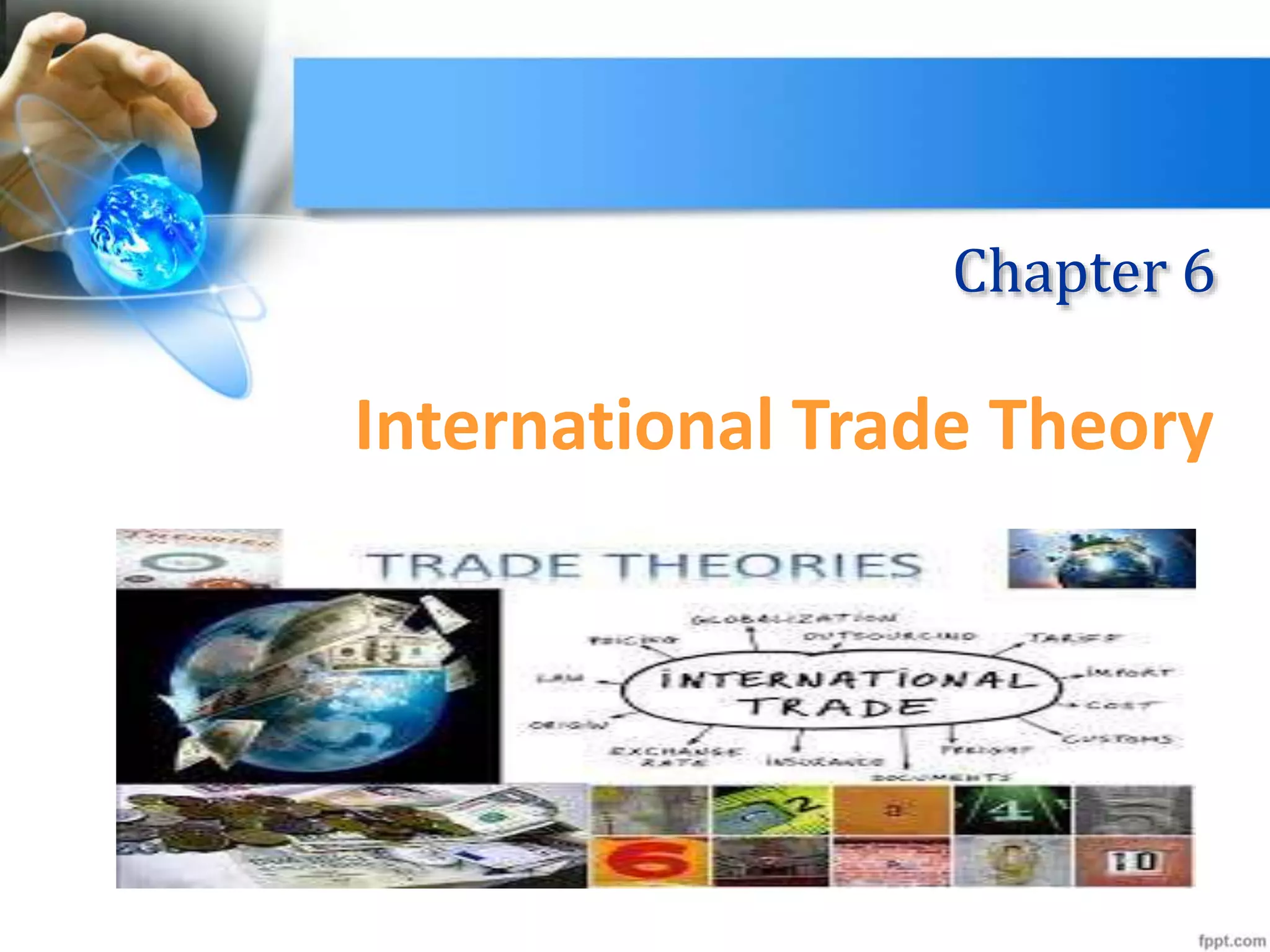
Chapter 6
International Trade Theory
Free Trade
Free trade is a situation where a
government does not attempt to
influence through quotas or duties
what its citizens can buy from
another country or what they can
produce and sell to another country.
• Trade theory shows why it is
beneficial for a country to engage in
international trade even for products
it is able to produce for itself.
Mercantilism
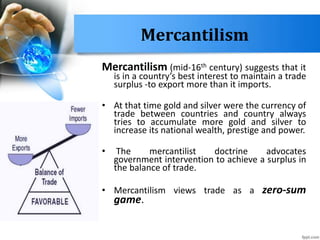
Mercantilism (mid-16th century) suggests that it
is in a country’s best interest to maintain a trade
surplus -to export more than it imports.
• At that time gold and silver were the currency of
trade between countries and country always
tries to accumulate more gold and silver to
increase its national wealth, prestige and power.
• The mercantilist doctrine advocates
government intervention to achieve a surplus in
the balance of trade.
• Mercantilism views trade as a zero-sum
game.
Smith’s Theory
Of Absolute Advantage
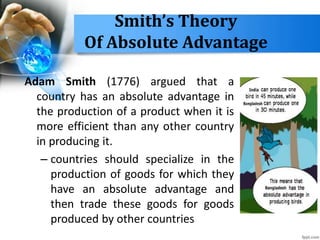
Adam Smith (1776) argued that a
country has an absolute advantage in
the production of a product when it is
more efficient than any other country
in producing it.
– countries should specialize in the
production of goods for which they
have an absolute advantage and
then trade these goods for goods
produced by other countries
How Does The Theory
Of Absolute Advantage Work?
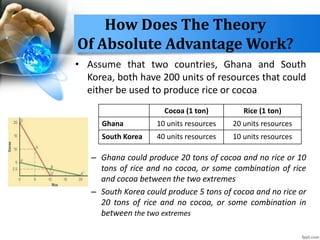
• Assume that two countries, Ghana and South
Korea, both have 200 units of resources that could
either be used to produce rice or cocoa
– Ghana could produce 20 tons of cocoa and no rice or 10
tons of rice and no cocoa, or some combination of rice
and cocoa between the two extremes
– South Korea could produce 5 tons of cocoa and no rice or
20 tons of rice and no cocoa, or some combination in
between the two extremes
Cocoa (1 ton) Rice (1 ton)
Ghana 10 units resources 20 units resources
South Korea 40 units resources 10 units resources
How Does The Theory
Of Absolute Advantage Work?
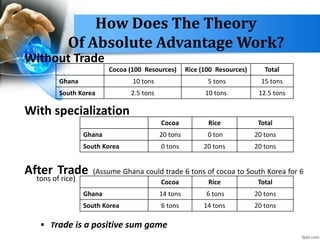
Without Trade
With specialization
After Trade (Assume Ghana could trade 6 tons of cocoa to South Korea for 6
tons of rice)
 Trade is a positive sum game
Cocoa (100 Resources) Rice (100 Resources) Total
Ghana 10 tons 5 tons 15 tons
South Korea 2.5 tons 10 tons 12.5 tons
Cocoa Rice Total
Ghana 14 tons 6 tons 20 tons
South Korea 6 tons 14 tons 20 tons
Cocoa Rice Total
Ghana 20 tons 0 ton 20 tons
South Korea 0 tons 20 tons 20 tons
Ricardo’s Theory
Of Comparative Advantage
• David Ricardo asked what happens when
one country has an absolute advantage
in the production of all goods
• The theory of comparative advantage
(1817) - countries should specialize in
the production of those goods they
produce most efficiently and buy goods
that they produce less efficiently from
other countries
– even if this means buying goods from
other countries that they could
produce more efficiently at home
How Does The Theory Of
Comparative Advantage Work?
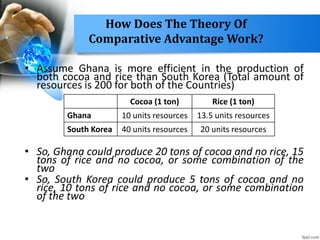
• Assume Ghana is more efficient in the production of
both cocoa and rice than South Korea (Total amount of
resources is 200 for both of the Countries)
• So, Ghana could produce 20 tons of cocoa and no rice, 15
tons of rice and no cocoa, or some combination of the
two
• So, South Korea could produce 5 tons of cocoa and no
rice, 10 tons of rice and no cocoa, or some combination
of the two
Cocoa (1 ton) Rice (1 ton)
Ghana 10 units resources 13.5 units resources
South Korea 40 units resources 20 units resources
How Does The Theory Of
Comparative Advantage Work?
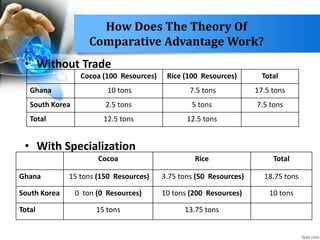
• Without Trade
• With Specialization
Cocoa (100 Resources) Rice (100 Resources) Total
Ghana 10 tons 7.5 tons 17.5 tons
South Korea 2.5 tons 5 tons 7.5 tons
Total 12.5 tons 12.5 tons
Cocoa Rice Total
Ghana 15 tons (150 Resources) 3.75 tons (50 Resources) 18.75 tons
South Korea 0 ton (0 Resources) 10 tons (200 Resources) 10 tons
Total 15 tons 13.75 tons
How Does The Theory Of
Comparative Advantage Work?
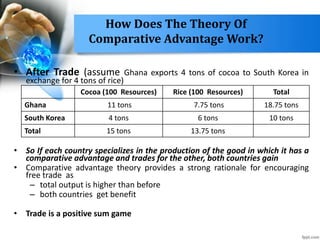
• After Trade (assume Ghana exports 4 tons of cocoa to South Korea in
exchange for 4 tons of rice)
• So If each country specializes in the production of the good in which it has a
comparative advantage and trades for the other, both countries gain
• Comparative advantage theory provides a strong rationale for encouraging
free trade as
– total output is higher than before
– both countries get benefit
• Trade is a positive sum game
Cocoa (100 Resources) Rice (100 Resources) Total
Ghana 11 tons 7.75 tons 18.75 tons
South Korea 4 tons 6 tons 10 tons
Total 15 tons 13.75 tons
The Heckscher-Ohlin Theory
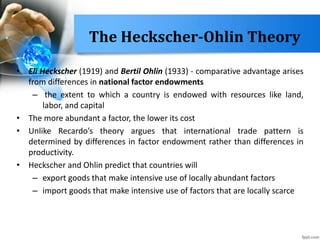
• Eli Heckscher (1919) and Bertil Ohlin (1933) - comparative advantage arises
from differences in national factor endowments
– the extent to which a country is endowed with resources like land,
labor, and capital
• The more abundant a factor, the lower its cost
• Unlike Recardo’s theory argues that international trade pattern is
determined by differences in factor endowment rather than differences in
productivity.
• Heckscher and Ohlin predict that countries will
– export goods that make intensive use of locally abundant factors
– import goods that make intensive use of factors that are locally scarce
Does The Heckscher-Ohlin Theory Hold?
(The Leontief Paradox)
• Wassily Leontief (1953) theorized that since the U.S.
was relatively abundant in capital compared to other
nations, the U.S. would be an exporter of capital
intensive goods and an importer of labor-intensive
goods.
– However, he found that U.S. exports were less capital
intensive than U.S. imports
• Since this result was at variance with the predictions of
trade theory, it became known as the Leontief Paradox
• Still, tests of the Heckscher-Ohlin theory using data for a
large number of countries tend to confirm the existence
of the Leontief paradox.
• This leaves economists with a dilemma that they prefer the Heckscher-Ohlin theory
on theoretical grounds, but it is a relatively poor predictor of real-world
international trade patterns.
• The best solution to this dilemma may be to return to the Ricardian idea that trade
patterns are largely driven by international differences in productivity.
• A key assumption in the Heckscher-Ohlin theory is that technologies are the same
across countries but this may not be the case.
• Differences in technology may lead to differences in productivity that drive
international trade.
• Thus, once the impact of differences of technology on productivity is controlled for,
the Heckscher-Ohlin theory seems to gain predictive power.
Does The Heckscher-Ohlin Theory Hold?
(The Leontief Paradox)

Lecture 4 (Chapter 6)(2).pptx

  • 1.
  • 2.
    Free Trade Free tradeis a situation where a government does not attempt to influence through quotas or duties what its citizens can buy from another country or what they can produce and sell to another country. • Trade theory shows why it is beneficial for a country to engage in international trade even for products it is able to produce for itself.
  • 3.
    Mercantilism Mercantilism (mid-16th century)suggests that it is in a country’s best interest to maintain a trade surplus -to export more than it imports. • At that time gold and silver were the currency of trade between countries and country always tries to accumulate more gold and silver to increase its national wealth, prestige and power. • The mercantilist doctrine advocates government intervention to achieve a surplus in the balance of trade. • Mercantilism views trade as a zero-sum game.
  • 4.
    Smith’s Theory Of AbsoluteAdvantage Adam Smith (1776) argued that a country has an absolute advantage in the production of a product when it is more efficient than any other country in producing it. – countries should specialize in the production of goods for which they have an absolute advantage and then trade these goods for goods produced by other countries
  • 5.
    How Does TheTheory Of Absolute Advantage Work? • Assume that two countries, Ghana and South Korea, both have 200 units of resources that could either be used to produce rice or cocoa – Ghana could produce 20 tons of cocoa and no rice or 10 tons of rice and no cocoa, or some combination of rice and cocoa between the two extremes – South Korea could produce 5 tons of cocoa and no rice or 20 tons of rice and no cocoa, or some combination in between the two extremes Cocoa (1 ton) Rice (1 ton) Ghana 10 units resources 20 units resources South Korea 40 units resources 10 units resources
  • 6.
    How Does TheTheory Of Absolute Advantage Work? Without Trade With specialization After Trade (Assume Ghana could trade 6 tons of cocoa to South Korea for 6 tons of rice)  Trade is a positive sum game Cocoa (100 Resources) Rice (100 Resources) Total Ghana 10 tons 5 tons 15 tons South Korea 2.5 tons 10 tons 12.5 tons Cocoa Rice Total Ghana 14 tons 6 tons 20 tons South Korea 6 tons 14 tons 20 tons Cocoa Rice Total Ghana 20 tons 0 ton 20 tons South Korea 0 tons 20 tons 20 tons
  • 7.
    Ricardo’s Theory Of ComparativeAdvantage • David Ricardo asked what happens when one country has an absolute advantage in the production of all goods • The theory of comparative advantage (1817) - countries should specialize in the production of those goods they produce most efficiently and buy goods that they produce less efficiently from other countries – even if this means buying goods from other countries that they could produce more efficiently at home
  • 8.
    How Does TheTheory Of Comparative Advantage Work? • Assume Ghana is more efficient in the production of both cocoa and rice than South Korea (Total amount of resources is 200 for both of the Countries) • So, Ghana could produce 20 tons of cocoa and no rice, 15 tons of rice and no cocoa, or some combination of the two • So, South Korea could produce 5 tons of cocoa and no rice, 10 tons of rice and no cocoa, or some combination of the two Cocoa (1 ton) Rice (1 ton) Ghana 10 units resources 13.5 units resources South Korea 40 units resources 20 units resources
  • 9.
    How Does TheTheory Of Comparative Advantage Work? • Without Trade • With Specialization Cocoa (100 Resources) Rice (100 Resources) Total Ghana 10 tons 7.5 tons 17.5 tons South Korea 2.5 tons 5 tons 7.5 tons Total 12.5 tons 12.5 tons Cocoa Rice Total Ghana 15 tons (150 Resources) 3.75 tons (50 Resources) 18.75 tons South Korea 0 ton (0 Resources) 10 tons (200 Resources) 10 tons Total 15 tons 13.75 tons
  • 10.
    How Does TheTheory Of Comparative Advantage Work? • After Trade (assume Ghana exports 4 tons of cocoa to South Korea in exchange for 4 tons of rice) • So If each country specializes in the production of the good in which it has a comparative advantage and trades for the other, both countries gain • Comparative advantage theory provides a strong rationale for encouraging free trade as – total output is higher than before – both countries get benefit • Trade is a positive sum game Cocoa (100 Resources) Rice (100 Resources) Total Ghana 11 tons 7.75 tons 18.75 tons South Korea 4 tons 6 tons 10 tons Total 15 tons 13.75 tons
  • 11.
    The Heckscher-Ohlin Theory •Eli Heckscher (1919) and Bertil Ohlin (1933) - comparative advantage arises from differences in national factor endowments – the extent to which a country is endowed with resources like land, labor, and capital • The more abundant a factor, the lower its cost • Unlike Recardo’s theory argues that international trade pattern is determined by differences in factor endowment rather than differences in productivity. • Heckscher and Ohlin predict that countries will – export goods that make intensive use of locally abundant factors – import goods that make intensive use of factors that are locally scarce
  • 12.
    Does The Heckscher-OhlinTheory Hold? (The Leontief Paradox) • Wassily Leontief (1953) theorized that since the U.S. was relatively abundant in capital compared to other nations, the U.S. would be an exporter of capital intensive goods and an importer of labor-intensive goods. – However, he found that U.S. exports were less capital intensive than U.S. imports • Since this result was at variance with the predictions of trade theory, it became known as the Leontief Paradox • Still, tests of the Heckscher-Ohlin theory using data for a large number of countries tend to confirm the existence of the Leontief paradox.
  • 13.
    • This leaveseconomists with a dilemma that they prefer the Heckscher-Ohlin theory on theoretical grounds, but it is a relatively poor predictor of real-world international trade patterns. • The best solution to this dilemma may be to return to the Ricardian idea that trade patterns are largely driven by international differences in productivity. • A key assumption in the Heckscher-Ohlin theory is that technologies are the same across countries but this may not be the case. • Differences in technology may lead to differences in productivity that drive international trade. • Thus, once the impact of differences of technology on productivity is controlled for, the Heckscher-Ohlin theory seems to gain predictive power. Does The Heckscher-Ohlin Theory Hold? (The Leontief Paradox)