INTERNATIONAL TRADE
Course 1 Yudy Yunardy S.E., M.M.
WHO AM I ?
Fifteen years of Banking experience, six
years’ experience in Trade Finance
Operations background with Unsecured
Loan experience, equipped with another
seven years’ experience in Management
Information Analyst and Dashboard
Reporting. Vastly experienced in Bank
Indonesia reporting (LBU, SID, LBBU, BMPK
etc.)
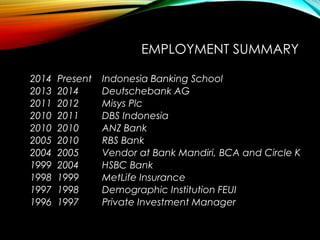
EMPLOYMENT SUMMARY
2014 Present Indonesia Banking School
2013 2014 Deutschebank AG
2011 2012 Misys Plc
2010 2011 DBS Indonesia
2010 2010 ANZ Bank
2005 2010 RBS Bank
2004 2005 Vendor at Bank Mandiri, BCA and Circle K
1999 2004 HSBC Bank
1998 1999 MetLife Insurance
1997 1998 Demographic Institution FEUI
1996 1997 Private Investment Manager
RULES
1.Disable your comm. device
2.Presence 80% minimum
3.Time alloc. 08.00 – 10.30
TEXTBOOK
Koch, Timothy
(2015), Bank
Management,
The Dryden Press
GRADING EVALUATION
1. Participation 5%
2. Quiz / exercise 10%
3. Assignment 15%
4. Midterm 35%
5. Final 35%
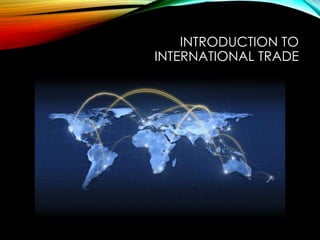
INTRODUCTION TO
INTERNATIONAL TRADE
INTRODUCTION TO
INTERNATIONAL TRADE
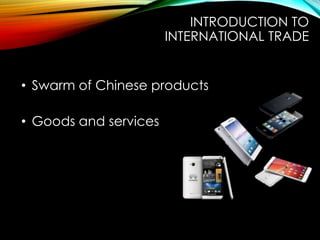
• Swarm of Chinese products
• Goods and services
• Winning the competition
• Definition of international trade
• Specialization in international trade
INTRODUCTION TO
INTERNATIONAL TRADE
CAUSES OF INTERNATIONAL
TRADE
1.Uneven distribution of resources
2.Advantage of resources
3.Increase consumption
4.Decrease domestic dependencies
5.Increase economic growth
6.Efficiency
7.Taste
INTERNATIONAL TRADE THEORY
1. Mercantilism
2. Absolute Advantage
3. Comparative Advantage
4. Heckscher-Ohlin
INTERNATIONAL TRADE THEORY
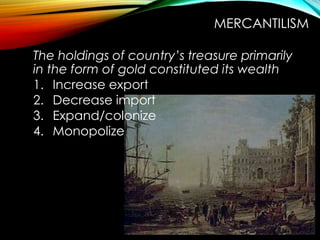
The holdings of country’s treasure primarily
in the form of gold constituted its wealth
1. Increase export
2. Decrease import
3. Expand/colonize
4. Monopolize
MERCANTILISM
The ability to produce more number of a
good product or service than competitors,
using the same amount of resources
ABSOLUTE ADVANTAGE
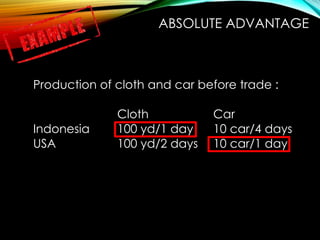
Production of cloth and car before trade :
Cloth Car
Indonesia 100 yd/1 day 10 car/4 days
USA 100 yd/2 days 10 car/1 day
ABSOLUTE ADVANTAGE
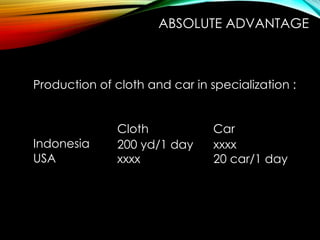
Production of cloth and car in specialization :
Cloth Car
Indonesia
USA
ABSOLUTE ADVANTAGE
200 yd/1 day xxxx
xxxx 20 car/1 day
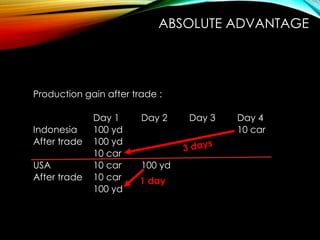
Production gain after trade :
Day 1 Day 2 Day 3 Day 4
Indonesia 100 yd 10 car
After trade 100 yd
10 car
USA 10 car 100 yd
After trade 10 car
100 yd
ABSOLUTE ADVANTAGE
1 day
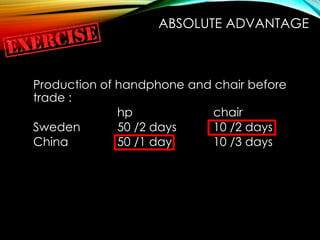
Production of handphone and chair before
trade :
hp chair
Sweden 50 /2 days 10 /2 days
China 50 /1 day 10 /3 days
ABSOLUTE ADVANTAGE
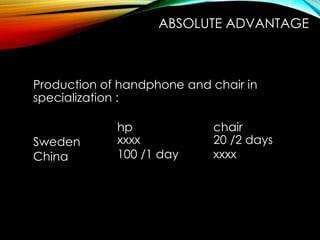
Production of handphone and chair in
specialization :
hp chair
Sweden
China
ABSOLUTE ADVANTAGE
xxxx 20 /2 days
100 /1 day xxxx
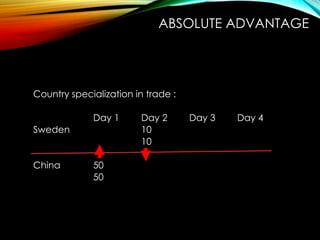
Country specialization in trade :
Day 1 Day 2 Day 3 Day 4
Sweden 10
10
China 50
50
ABSOLUTE ADVANTAGE
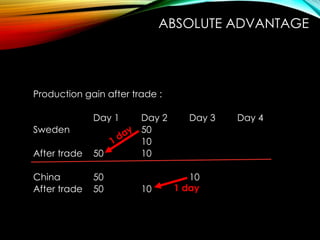
Production gain after trade :
Day 1 Day 2 Day 3 Day 4
Sweden 50
10
After trade 50 10
China 50 10
After trade 50 10
ABSOLUTE ADVANTAGE
1 day
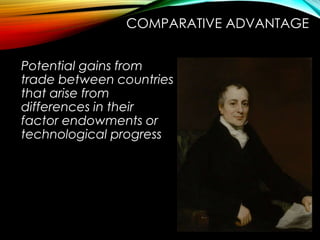
Potential gains from
trade between countries
that arise from
differences in their
factor endowments or
technological progress
COMPARATIVE ADVANTAGE
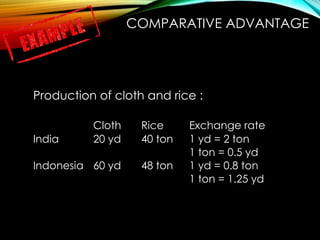
Production of cloth and rice :
Cloth Rice Exchange rate
India 20 yd 40 ton 1 yd = 2 ton
1 ton = 0.5 yd
Indonesia 60 yd 48 ton 1 yd = 0.8 ton
1 ton = 1.25 yd
COMPARATIVE ADVANTAGE
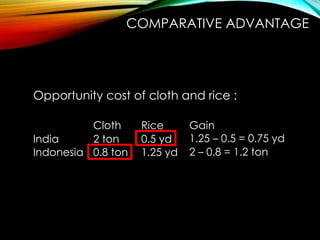
Opportunity cost of cloth and rice :
Cloth Rice Gain
India 2 ton 0.5 yd
Indonesia 0.8 ton 1.25 yd
1.25 – 0.5 = 0.75 yd
2 – 0.8 = 1.2 ton
COMPARATIVE ADVANTAGE
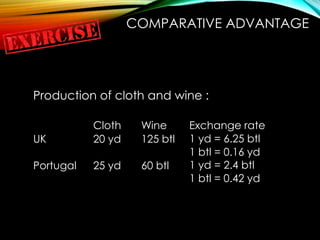
Production of cloth and wine :
Cloth Wine Exchange rate
UK 20 yd 125 btl
Portugal 25 yd 60 btl
1 yd = 6.25 btl
1 btl = 0.16 yd
1 btl = 0.42 yd
1 yd = 2.4 btl
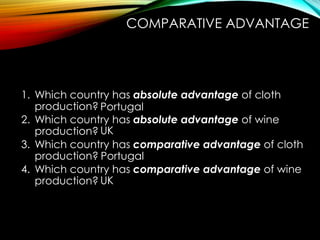
1. Which country has absolute advantage of cloth
production?
2. Which country has absolute advantage of wine
production?
3. Which country has comparative advantage of cloth
production?
4. Which country has comparative advantage of wine
production?
Portugal
UK
UK
Portugal
COMPARATIVE ADVANTAGE
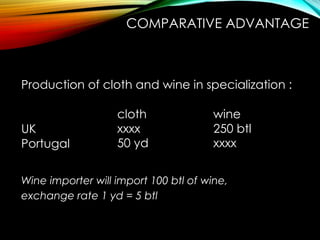
Production of cloth and wine in specialization :
cloth wine
UK
Portugal
Wine importer will import 100 btl of wine,
exchange rate 1 yd = 5 btl
xxxx 250 btl
50 yd xxxx
COMPARATIVE ADVANTAGE
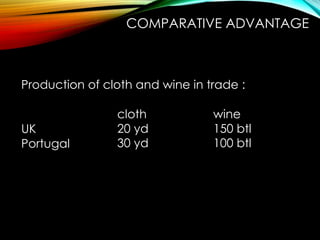
Production of cloth and wine in trade :
cloth wine
UK
Portugal
20 yd 150 btl
30 yd 100 btl
COMPARATIVE ADVANTAGE
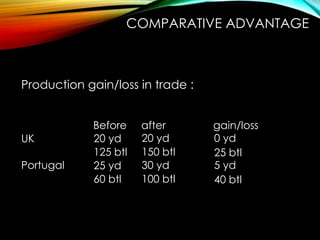
Production gain/loss in trade :
Before after gain/loss
UK
Portugal
20 yd 0 yd
150 btl 25 btl
20 yd
125 btl
30 yd 5 yd
100 btl 40 btl
25 yd
60 btl
COMPARATIVE ADVANTAGE
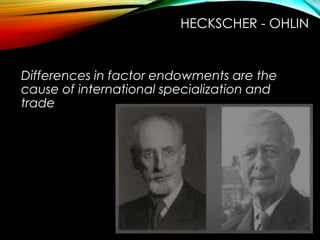
Differences in factor endowments are the
cause of international specialization and
trade
HECKSCHER - OHLIN
And the base of comparative advantage :
1. Endowment, factors of production (land,
labor and capital)
2. Intensity, level of technology
HECKSCHER - OHLIN
SO? WHAT’S THE DIFFERENCE WITH
COMPARATIVE ADVANTAGE?
Heckscher-Ohlin
trade based on resource availability
David Ricardo
• trade based on comparative advantage
based on difference in opportunity cost
• Opportunity cost based on technology
difference
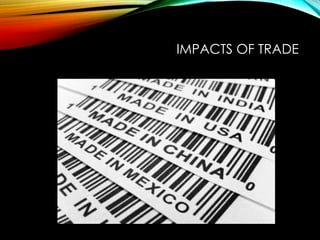
IMPACTS OF TRADE
1. Increase bilateral relationship
2. Fill demand gap
3. Push optimal production
4. Advance science and
technology
5. Specialization
6. Create additional employment
BENEFITS OF INTERNATIONAL
TRADE
1. Currency difference
2. Unskilled labor force
3. International payment risk
4. Import policy
5. War
6. Regional Economic organization
BARRIERS OF INTERNATIONAL
TRADE
1. Rapid depletion of exhaustible
natural resources
2. Import of Harmful Goods
3. Over specialization
4. Import dependencies
5. Danger of starvation
6. Consumerism
7. Smothering small business
8. One Country Gains at the Expense
of Other
9. May Lead to War
NEGATIVE EFFECTS OF
INTERNATIONAL TRADE
TRENDS IN INTERNATIONAL TRADE
1. Forced Dynamism
2. Cooperation among countries
3. Liberalization of cross-border
movements
4. Transfer of Technology
5. E-Commerce
TRENDS IN INTERNATIONAL TRADE
1. Businesses are constantly pushing the
frontiers of economic growth,
technology, culture, and politics which
also change the surrounding global
society and global economic context
2. Factors external to international trade
(e.g., developments in science and
information technology) are constantly
forcing international trade to change
how they operate
FORCED DYNAMISM
1. To gain reciprocal advantages
2. To attack problems they cannot solve
alone
3. To deal with concerns that lie outside
anyone’s territory
4. Countries set agreements on how to
commercially exploit areas outside any
of their territories
COOPERATION AMONG
COUNTRIES
1. So-called open economies (having very
few international restrictions) will give
consumers better access to a greater
variety of goods and services at lower
prices
2. Producers will become more efficient
by competing against foreign
3. If they reduce their own restrictions,
other countries will do the same
LIBERALIZATION OF CROSS-
BORDER MOVEMENTS
Technology transfer is the
process by which commercial
technology is disseminated
TRANSFER OF TECHNOLOGY
With the rise of interconnected network
(internet) shopping online becomes more
and more convenient
ELECTRONIC COMMERCE
E-commerce (electronic commerce or EC)
is the purchasing, selling and exchanging
of goods or services, or the transmitting of
funds or data, over an electronic network
ELECTRONIC COMMERCE
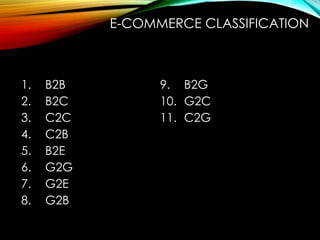
1. B2B
2. B2C
3. C2C
4. C2B
5. B2E
6. G2G
7. G2E
8. G2B
9. B2G
10. G2C
11. C2G
E-COMMERCE CLASSIFICATION
E-COMMERCE TRANSACTION
1. Cash on delivery
2. Bank transfer
3. Payment mediation service
4. PayPal
5. Western Union
6. Credit Card
ASSIGNMENT
•E-commerce will be booming in 2015, why?
Give the global sales of B2C e-commerce in
2012-2013 data, compare with world
merchandise export by major group in 2013
(from WTO) to support your reasoning
THANK YOU

International trade

  • 1.
    INTERNATIONAL TRADE Course 1Yudy Yunardy S.E., M.M.
  • 2.
    WHO AM I? Fifteen years of Banking experience, six years’ experience in Trade Finance Operations background with Unsecured Loan experience, equipped with another seven years’ experience in Management Information Analyst and Dashboard Reporting. Vastly experienced in Bank Indonesia reporting (LBU, SID, LBBU, BMPK etc.)
  • 3.
    EMPLOYMENT SUMMARY 2014 PresentIndonesia Banking School 2013 2014 Deutschebank AG 2011 2012 Misys Plc 2010 2011 DBS Indonesia 2010 2010 ANZ Bank 2005 2010 RBS Bank 2004 2005 Vendor at Bank Mandiri, BCA and Circle K 1999 2004 HSBC Bank 1998 1999 MetLife Insurance 1997 1998 Demographic Institution FEUI 1996 1997 Private Investment Manager
  • 4.
    RULES 1.Disable your comm.device 2.Presence 80% minimum 3.Time alloc. 08.00 – 10.30
  • 5.
  • 6.
    GRADING EVALUATION 1. Participation5% 2. Quiz / exercise 10% 3. Assignment 15% 4. Midterm 35% 5. Final 35%
  • 7.
  • 8.
    INTRODUCTION TO INTERNATIONAL TRADE •Swarm of Chinese products • Goods and services
  • 9.
    • Winning thecompetition • Definition of international trade • Specialization in international trade INTRODUCTION TO INTERNATIONAL TRADE
  • 10.
    CAUSES OF INTERNATIONAL TRADE 1.Unevendistribution of resources 2.Advantage of resources 3.Increase consumption 4.Decrease domestic dependencies 5.Increase economic growth 6.Efficiency 7.Taste
  • 11.
  • 12.
    1. Mercantilism 2. AbsoluteAdvantage 3. Comparative Advantage 4. Heckscher-Ohlin INTERNATIONAL TRADE THEORY
  • 13.
    The holdings ofcountry’s treasure primarily in the form of gold constituted its wealth 1. Increase export 2. Decrease import 3. Expand/colonize 4. Monopolize MERCANTILISM
  • 14.
    The ability toproduce more number of a good product or service than competitors, using the same amount of resources ABSOLUTE ADVANTAGE
  • 15.
    Production of clothand car before trade : Cloth Car Indonesia 100 yd/1 day 10 car/4 days USA 100 yd/2 days 10 car/1 day ABSOLUTE ADVANTAGE
  • 16.
    Production of clothand car in specialization : Cloth Car Indonesia USA ABSOLUTE ADVANTAGE 200 yd/1 day xxxx xxxx 20 car/1 day
  • 17.
    Production gain aftertrade : Day 1 Day 2 Day 3 Day 4 Indonesia 100 yd 10 car After trade 100 yd 10 car USA 10 car 100 yd After trade 10 car 100 yd ABSOLUTE ADVANTAGE 1 day
  • 18.
    Production of handphoneand chair before trade : hp chair Sweden 50 /2 days 10 /2 days China 50 /1 day 10 /3 days ABSOLUTE ADVANTAGE
  • 19.
    Production of handphoneand chair in specialization : hp chair Sweden China ABSOLUTE ADVANTAGE xxxx 20 /2 days 100 /1 day xxxx
  • 20.
    Country specialization intrade : Day 1 Day 2 Day 3 Day 4 Sweden 10 10 China 50 50 ABSOLUTE ADVANTAGE
  • 21.
    Production gain aftertrade : Day 1 Day 2 Day 3 Day 4 Sweden 50 10 After trade 50 10 China 50 10 After trade 50 10 ABSOLUTE ADVANTAGE 1 day
  • 22.
    Potential gains from tradebetween countries that arise from differences in their factor endowments or technological progress COMPARATIVE ADVANTAGE
  • 23.
    COMPARATIVE ADVANTAGE Production ofcloth and rice : Cloth Rice Exchange rate India 20 yd 40 ton 1 yd = 2 ton 1 ton = 0.5 yd Indonesia 60 yd 48 ton 1 yd = 0.8 ton 1 ton = 1.25 yd
  • 24.
    COMPARATIVE ADVANTAGE Opportunity costof cloth and rice : Cloth Rice Gain India 2 ton 0.5 yd Indonesia 0.8 ton 1.25 yd 1.25 – 0.5 = 0.75 yd 2 – 0.8 = 1.2 ton
  • 25.
    COMPARATIVE ADVANTAGE Production ofcloth and wine : Cloth Wine Exchange rate UK 20 yd 125 btl Portugal 25 yd 60 btl 1 yd = 6.25 btl 1 btl = 0.16 yd 1 btl = 0.42 yd 1 yd = 2.4 btl
  • 26.
    1. Which countryhas absolute advantage of cloth production? 2. Which country has absolute advantage of wine production? 3. Which country has comparative advantage of cloth production? 4. Which country has comparative advantage of wine production? Portugal UK UK Portugal COMPARATIVE ADVANTAGE
  • 27.
    Production of clothand wine in specialization : cloth wine UK Portugal Wine importer will import 100 btl of wine, exchange rate 1 yd = 5 btl xxxx 250 btl 50 yd xxxx COMPARATIVE ADVANTAGE
  • 28.
    Production of clothand wine in trade : cloth wine UK Portugal 20 yd 150 btl 30 yd 100 btl COMPARATIVE ADVANTAGE
  • 29.
    Production gain/loss intrade : Before after gain/loss UK Portugal 20 yd 0 yd 150 btl 25 btl 20 yd 125 btl 30 yd 5 yd 100 btl 40 btl 25 yd 60 btl COMPARATIVE ADVANTAGE
  • 30.
    Differences in factorendowments are the cause of international specialization and trade HECKSCHER - OHLIN
  • 31.
    And the baseof comparative advantage : 1. Endowment, factors of production (land, labor and capital) 2. Intensity, level of technology HECKSCHER - OHLIN
  • 32.
    SO? WHAT’S THEDIFFERENCE WITH COMPARATIVE ADVANTAGE? Heckscher-Ohlin trade based on resource availability David Ricardo • trade based on comparative advantage based on difference in opportunity cost • Opportunity cost based on technology difference
  • 33.
  • 34.
    1. Increase bilateralrelationship 2. Fill demand gap 3. Push optimal production 4. Advance science and technology 5. Specialization 6. Create additional employment BENEFITS OF INTERNATIONAL TRADE
  • 35.
    1. Currency difference 2.Unskilled labor force 3. International payment risk 4. Import policy 5. War 6. Regional Economic organization BARRIERS OF INTERNATIONAL TRADE
  • 36.
    1. Rapid depletionof exhaustible natural resources 2. Import of Harmful Goods 3. Over specialization 4. Import dependencies 5. Danger of starvation 6. Consumerism 7. Smothering small business 8. One Country Gains at the Expense of Other 9. May Lead to War NEGATIVE EFFECTS OF INTERNATIONAL TRADE
  • 37.
  • 38.
    1. Forced Dynamism 2.Cooperation among countries 3. Liberalization of cross-border movements 4. Transfer of Technology 5. E-Commerce TRENDS IN INTERNATIONAL TRADE
  • 39.
    1. Businesses areconstantly pushing the frontiers of economic growth, technology, culture, and politics which also change the surrounding global society and global economic context 2. Factors external to international trade (e.g., developments in science and information technology) are constantly forcing international trade to change how they operate FORCED DYNAMISM
  • 40.
    1. To gainreciprocal advantages 2. To attack problems they cannot solve alone 3. To deal with concerns that lie outside anyone’s territory 4. Countries set agreements on how to commercially exploit areas outside any of their territories COOPERATION AMONG COUNTRIES
  • 41.
    1. So-called openeconomies (having very few international restrictions) will give consumers better access to a greater variety of goods and services at lower prices 2. Producers will become more efficient by competing against foreign 3. If they reduce their own restrictions, other countries will do the same LIBERALIZATION OF CROSS- BORDER MOVEMENTS
  • 42.
    Technology transfer isthe process by which commercial technology is disseminated TRANSFER OF TECHNOLOGY
  • 43.
    With the riseof interconnected network (internet) shopping online becomes more and more convenient ELECTRONIC COMMERCE
  • 44.
    E-commerce (electronic commerceor EC) is the purchasing, selling and exchanging of goods or services, or the transmitting of funds or data, over an electronic network ELECTRONIC COMMERCE
  • 45.
    1. B2B 2. B2C 3.C2C 4. C2B 5. B2E 6. G2G 7. G2E 8. G2B 9. B2G 10. G2C 11. C2G E-COMMERCE CLASSIFICATION
  • 46.
    E-COMMERCE TRANSACTION 1. Cashon delivery 2. Bank transfer 3. Payment mediation service 4. PayPal 5. Western Union 6. Credit Card
  • 47.
    ASSIGNMENT •E-commerce will bebooming in 2015, why? Give the global sales of B2C e-commerce in 2012-2013 data, compare with world merchandise export by major group in 2013 (from WTO) to support your reasoning
  • 48.