Presenting Author: Dr. Saudamini Jadhav
2nd year resident, MVPS Dr.Vasantrao Pawar Medical College, Nashik
Guide: Dr. Mrunal Patil
Professor & Dean, MVPS Dr.Vasantrao Pawar Medical College, Nashik
Co-Author: Dr. Dhiraj Balwir
Associate Professor, MVPS Dr.Vasantrao Pawar Medical College, Nashik
Introduction
 Ab interno trabeculectomy (AIT) with the trabectomeis an
electrosurgical procedure utilized in the management of
glaucoma.
 In the family of minimally invasive glaucoma surgeries
(MIGS), AIT decreases intraocular pressure (IOP) by
improving aqueous drainage through plasma-mediated
ablation and disintegration of the primary barrier to
outflow, the trabecular meshwork (TM).
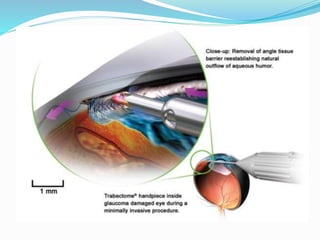
 Unlike trabeculectomy, access to the TM and schlemm’s
canal (SC) with AIT is achieved through insertion of the
trabectome electrode tip through a small 1.6 mm clear-
corneal incision and, therefore, the conjunctiva remains
undisturbed and potential subsequent filtration surgery is
unaffected.
 Further, energy delivery by the trabectome device is
highly controlled with minimal heat dissipation to
contiguous tissues.
 These factors contribute to the generally favorable
safety profile of the procedure compared to more
traditional glaucoma surgeries.
History
 The trabectome device was invented by George Baerveldt
of the University of California – Irvine and Roy S. Chuck of
Montefiore Medical Center, with the associated patent
being filed in 2002.
 The commercial device is manufactured by the NeoMedix
Corporation (Tustin, CA) and is marketed for the
“microsurgical management of adult and infantile
glaucoma”.
 The device was cleared by the United States Food and Drug
Administration (FDA) in April 2004.
 Initial cases were performed in Mexico, with the first
procedures conducted in the US occurring in January 2006
for the treatment of open angle glaucoma
Mechanism
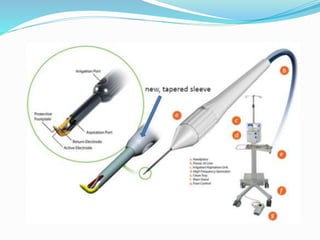
 The trabectome instrument utilizes a bipolar 550 kHz
electrode, with adjustable power, to enable plasma-
mediated ablation of the TM.
 Unlike cautery, plasma has a highly confined heat
dissipation cone with minimal thermal transfer to the outer
wall that is only about 1.2C. Plasma is the 4th state of
matter and causes tissue to disintegrate into its molecular
components, similar to ablative lasers.
 The device is equipped with a footplate that helps guide the
electrosurgical tip and protect adjacent tissues. Constant
infusion further helps to maintain the chamber and tissue
debris is removed by aspiration through the shaft of the
device.
Contraindications and Risk Factors
 neovascular glaucoma
 active uveitis
 elevated episcleral venous pressure
 angle dysgenesis
 corneal edema or other opacities causing a poor
gonioscopic view of the angle.

Trabectome

  • 1.
    Presenting Author: Dr.Saudamini Jadhav 2nd year resident, MVPS Dr.Vasantrao Pawar Medical College, Nashik Guide: Dr. Mrunal Patil Professor & Dean, MVPS Dr.Vasantrao Pawar Medical College, Nashik Co-Author: Dr. Dhiraj Balwir Associate Professor, MVPS Dr.Vasantrao Pawar Medical College, Nashik
  • 2.
    Introduction  Ab internotrabeculectomy (AIT) with the trabectomeis an electrosurgical procedure utilized in the management of glaucoma.  In the family of minimally invasive glaucoma surgeries (MIGS), AIT decreases intraocular pressure (IOP) by improving aqueous drainage through plasma-mediated ablation and disintegration of the primary barrier to outflow, the trabecular meshwork (TM).  Unlike trabeculectomy, access to the TM and schlemm’s canal (SC) with AIT is achieved through insertion of the trabectome electrode tip through a small 1.6 mm clear- corneal incision and, therefore, the conjunctiva remains undisturbed and potential subsequent filtration surgery is unaffected.
  • 4.
     Further, energydelivery by the trabectome device is highly controlled with minimal heat dissipation to contiguous tissues.  These factors contribute to the generally favorable safety profile of the procedure compared to more traditional glaucoma surgeries.
  • 5.
    History  The trabectomedevice was invented by George Baerveldt of the University of California – Irvine and Roy S. Chuck of Montefiore Medical Center, with the associated patent being filed in 2002.  The commercial device is manufactured by the NeoMedix Corporation (Tustin, CA) and is marketed for the “microsurgical management of adult and infantile glaucoma”.  The device was cleared by the United States Food and Drug Administration (FDA) in April 2004.  Initial cases were performed in Mexico, with the first procedures conducted in the US occurring in January 2006 for the treatment of open angle glaucoma
  • 6.
    Mechanism  The trabectomeinstrument utilizes a bipolar 550 kHz electrode, with adjustable power, to enable plasma- mediated ablation of the TM.  Unlike cautery, plasma has a highly confined heat dissipation cone with minimal thermal transfer to the outer wall that is only about 1.2C. Plasma is the 4th state of matter and causes tissue to disintegrate into its molecular components, similar to ablative lasers.  The device is equipped with a footplate that helps guide the electrosurgical tip and protect adjacent tissues. Constant infusion further helps to maintain the chamber and tissue debris is removed by aspiration through the shaft of the device.
  • 8.
    Contraindications and RiskFactors  neovascular glaucoma  active uveitis  elevated episcleral venous pressure  angle dysgenesis  corneal edema or other opacities causing a poor gonioscopic view of the angle.