The document discusses the modal verb "will" which is used to form the future tense in English. It explains that "will" must be followed by another verb and provides examples of affirmative, negative, and interrogative sentences using "will". Additionally, it notes that "will" can be used to make predictions, give orders, or suggest plans, and compares its usage to the similar modal verb "shall".
![That he is will? "Will" is a modal verb (or to help) that is used to form the future. For example: I will work [ai güil guork]. Yo trabajaré](https://image.slidesharecdn.com/cusersjuandidocumentstrabajoingls-090611091026-phpapp01/85/Trabajo-Ingles-2-320.jpg)
!["Will" always must go accompanied of another verb to form the future. For example: She will study [shi güil stadi]. Ella estudiará It will work. [It güil guork]. Funcionará](https://image.slidesharecdn.com/cusersjuandidocumentstrabajoingls-090611091026-phpapp01/85/Trabajo-Ingles-3-320.jpg)
!["Will" is contracted thus: ' ll. Therefore, we say: I'll go [ ail gou ]. I will go. Yo iré. Let us see all the contractions: I will I´ll You will You´ll he will He´ll she will She´ll it will It´ll we will we´ll You will you´ll they will they ´ ll](https://image.slidesharecdn.com/cusersjuandidocumentstrabajoingls-090611091026-phpapp01/85/Trabajo-Ingles-4-320.jpg)
![Will is used when we want to speak of a future no planned and uncertain, we must use "will" or "wont"(negative). Also "will" is used to make predictions. For example: "I think it will snow [ ai zink It güil snou ]". Creo que nevará.](https://image.slidesharecdn.com/cusersjuandidocumentstrabajoingls-090611091026-phpapp01/85/Trabajo-Ingles-5-320.jpg)
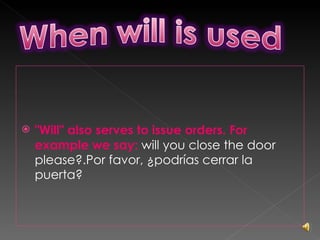
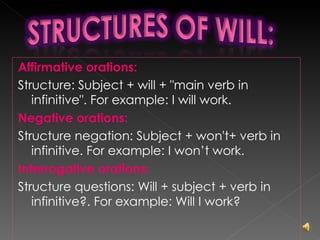
![Both are modals verbs (aids) that are used to form the future. Shall" more is used in English Briton and "Will" in English American. Not, "shall" can be used (in English Briton) to make a suggestion or invitation. For example: "Shall we go [shal güi gou ]“. Nos vamos.](https://image.slidesharecdn.com/cusersjuandidocumentstrabajoingls-090611091026-phpapp01/85/Trabajo-Ingles-8-320.jpg)


