

Improving the quality of my journal and increase its impact factor
Danilo Collalto Paulo
Intellectual Property & Science
Scientific and Scholarly Research
Introducing myself and asking a few questions
In this audience:
How many of you collaborate in a journal indexed in ISI Web of
Science?
How many of you represent a publisher of multiple journals?
How many of you are members of an editorial board?
How many of you are reviewers?
How many of you have access to WoS and JCR?
THOMSON REUTERS
JOURNAL SELECTION
PROCESS
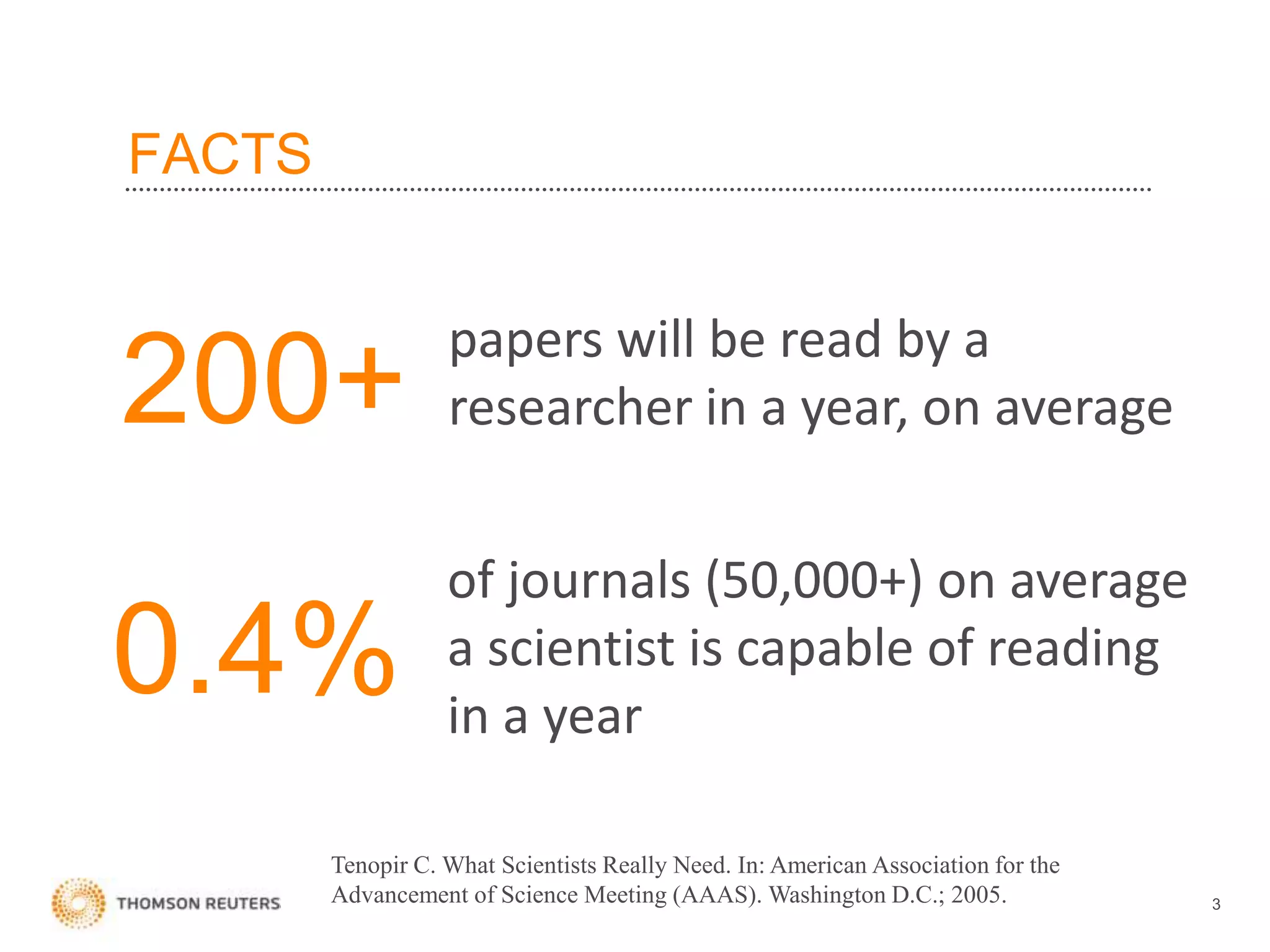
FACTS
3
papers will be read by a
researcher in a year, on average200+
of journals (50,000+) on average
a scientist is capable of reading
in a year
0.4%
Tenopir C. What Scientists Really Need. In: American Association for the
Advancement of Science Meeting (AAAS). Washington D.C.; 2005.
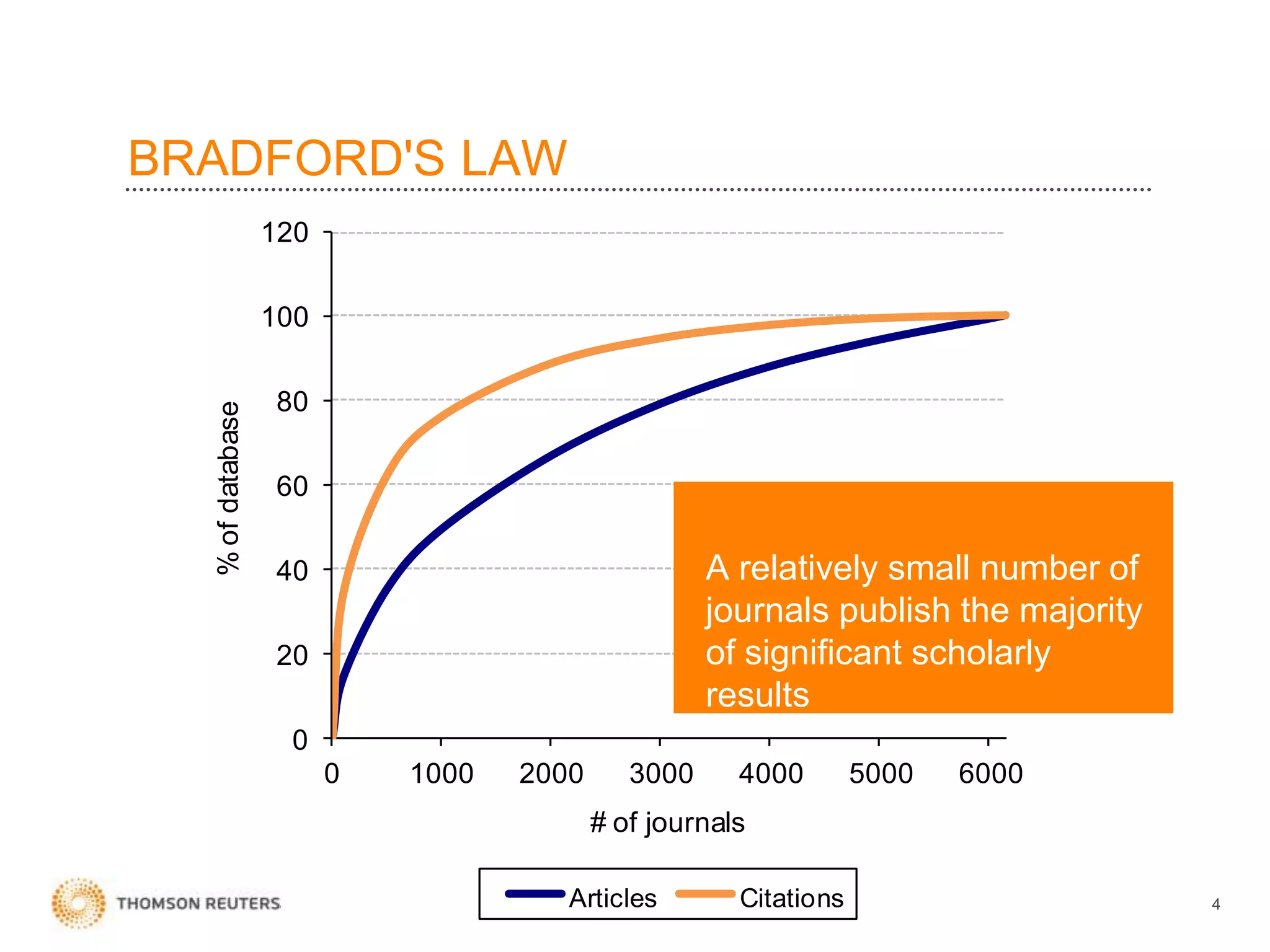
BRADFORD'S LAW
4
0
20
40
60
80
100
120
0 1000 2000 3000 4000 5000 6000
%ofdatabase
# of journals
Articles Citations
A relatively small number of
journals publish the majority
of significant scholarly
results
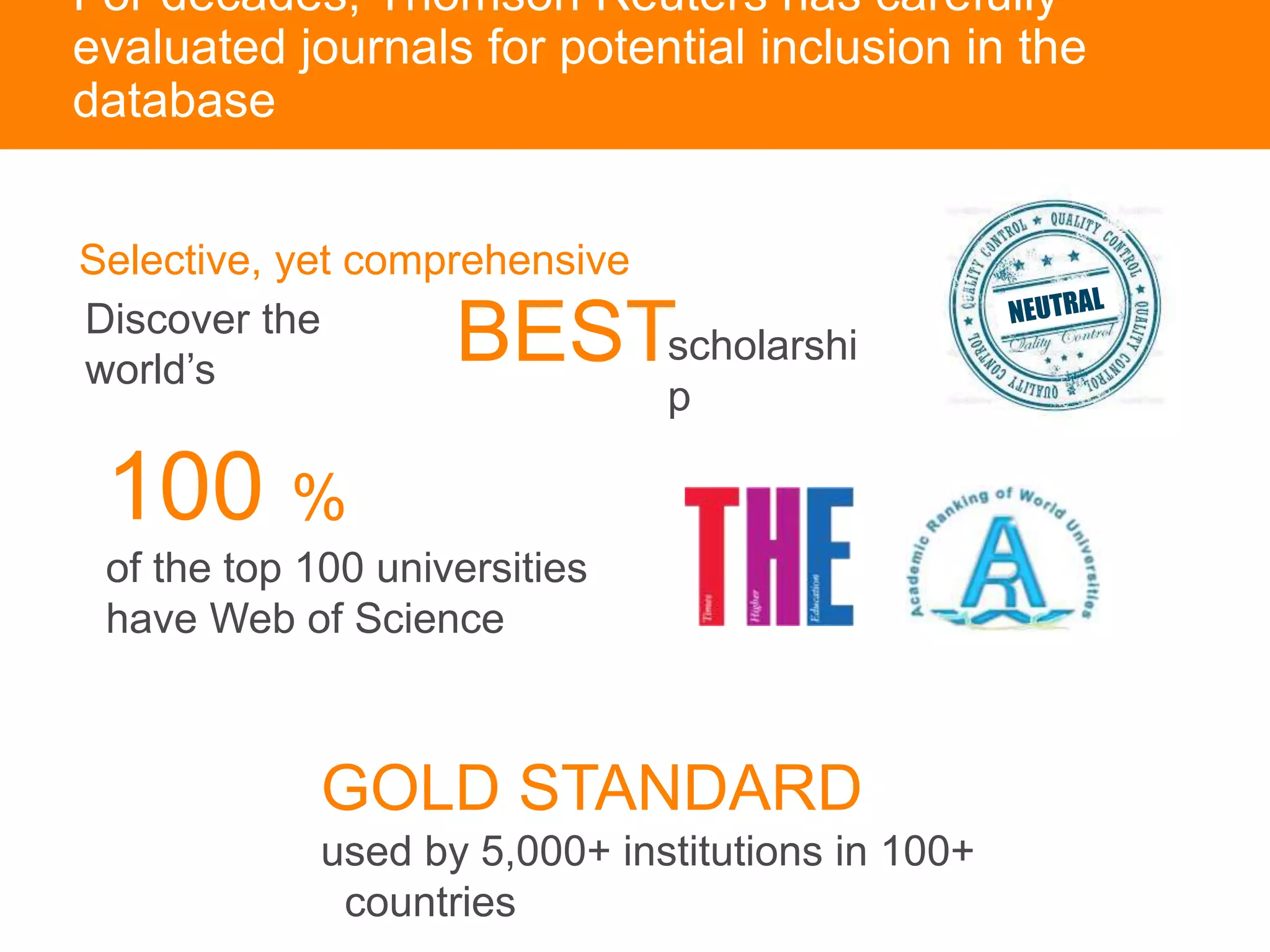
For decades, Thomson Reuters has carefully
evaluated journals for potential inclusion in the
database
100 %
of the top 100 universities
have Web of Science
GOLD STANDARD
used by 5,000+ institutions in 100+
countries
scholarshi
p
Selective, yet comprehensive
BESTDiscover the
world’s
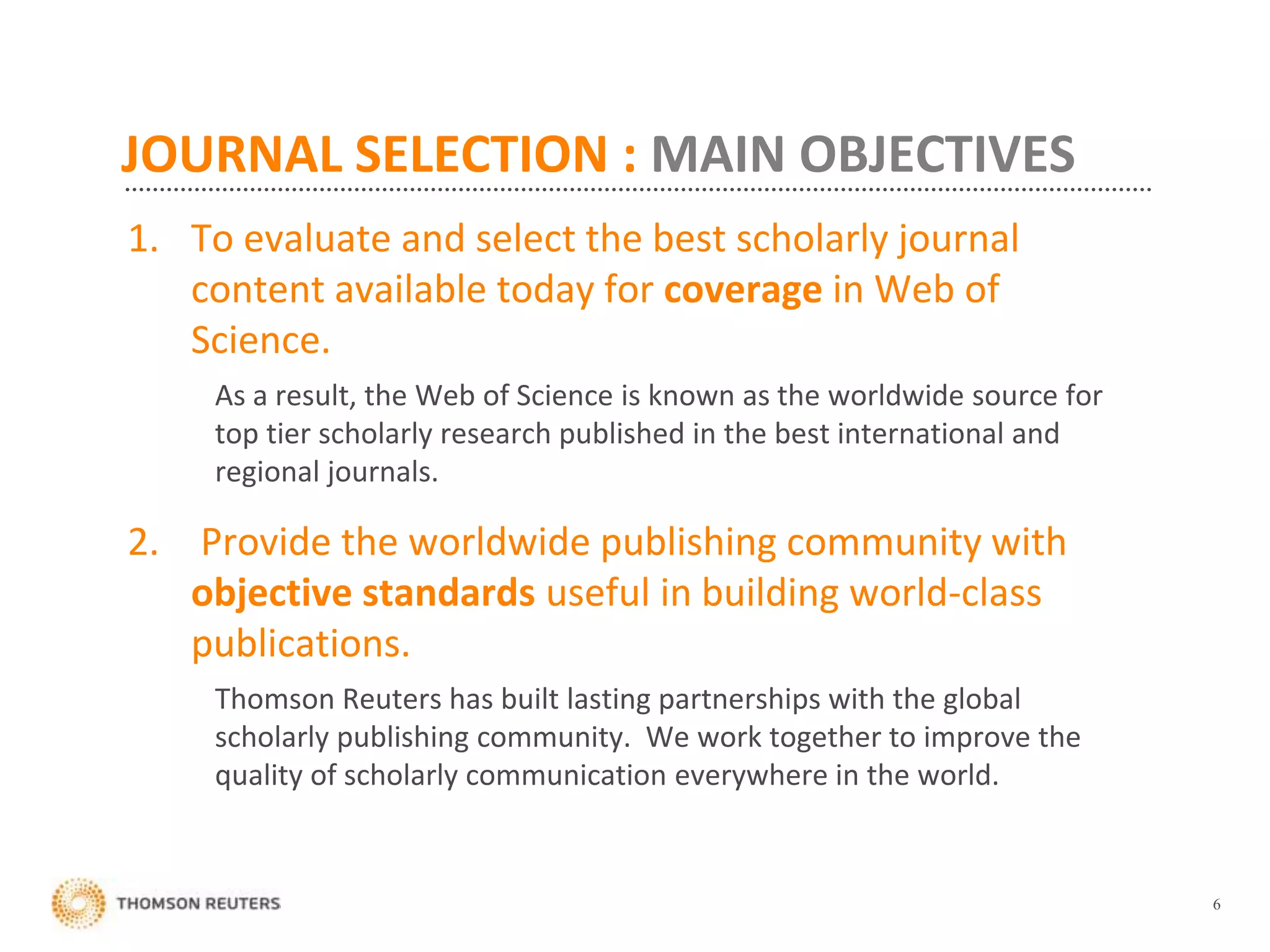
JOURNAL SELECTION : MAIN OBJECTIVES
1. To evaluate and select the best scholarly journal
content available today for coverage in Web of
Science.
As a result, the Web of Science is known as the worldwide source for
top tier scholarly research published in the best international and
regional journals.
2. Provide the worldwide publishing community with
objective standards useful in building world-class
publications.
Thomson Reuters has built lasting partnerships with the global
scholarly publishing community. We work together to improve the
quality of scholarly communication everywhere in the world.
6
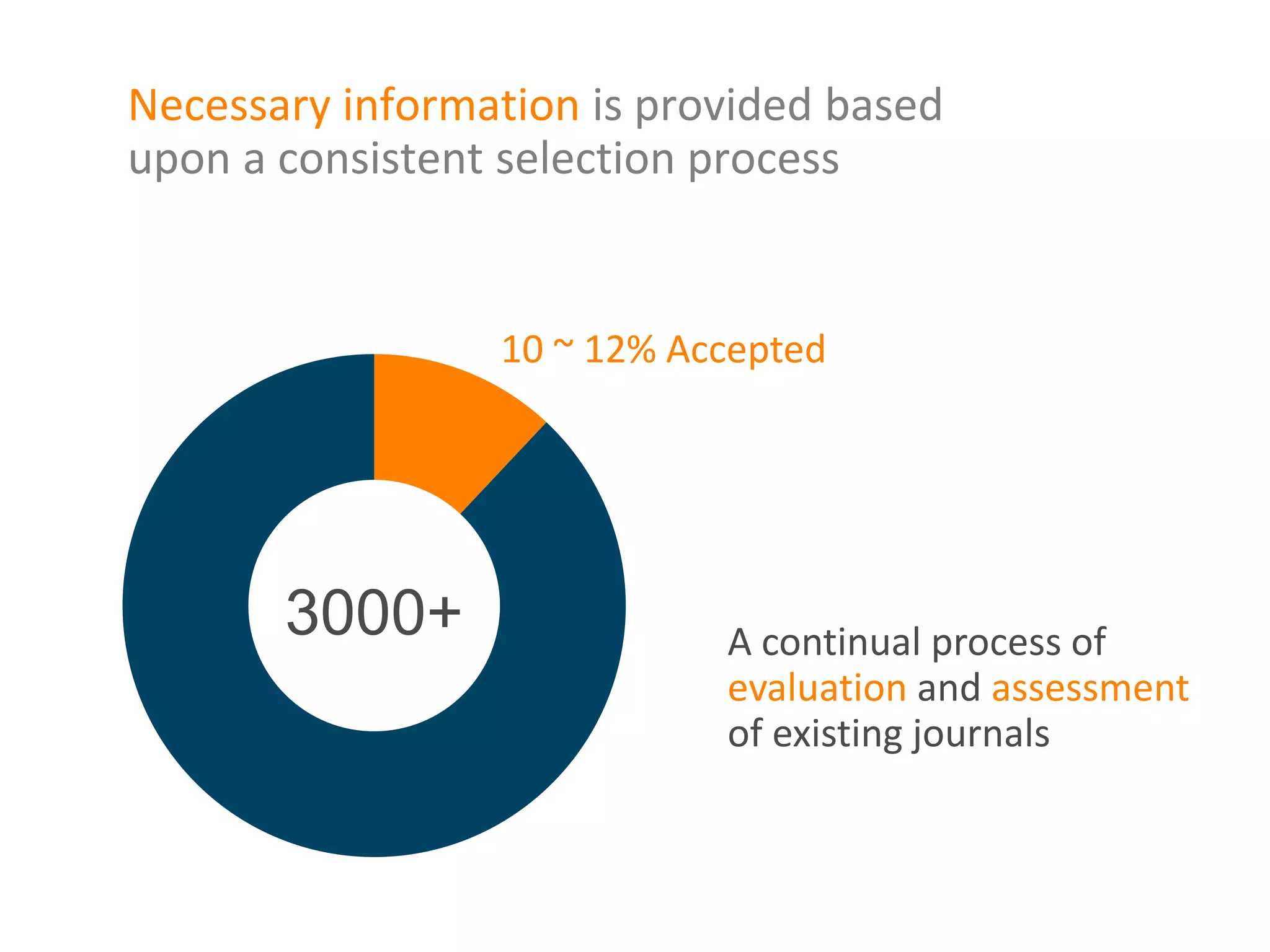
3000+
10 ~ 12% Accepted
A continual process of
evaluation and assessment
of existing journals
Necessary information is provided based
upon a consistent selection process
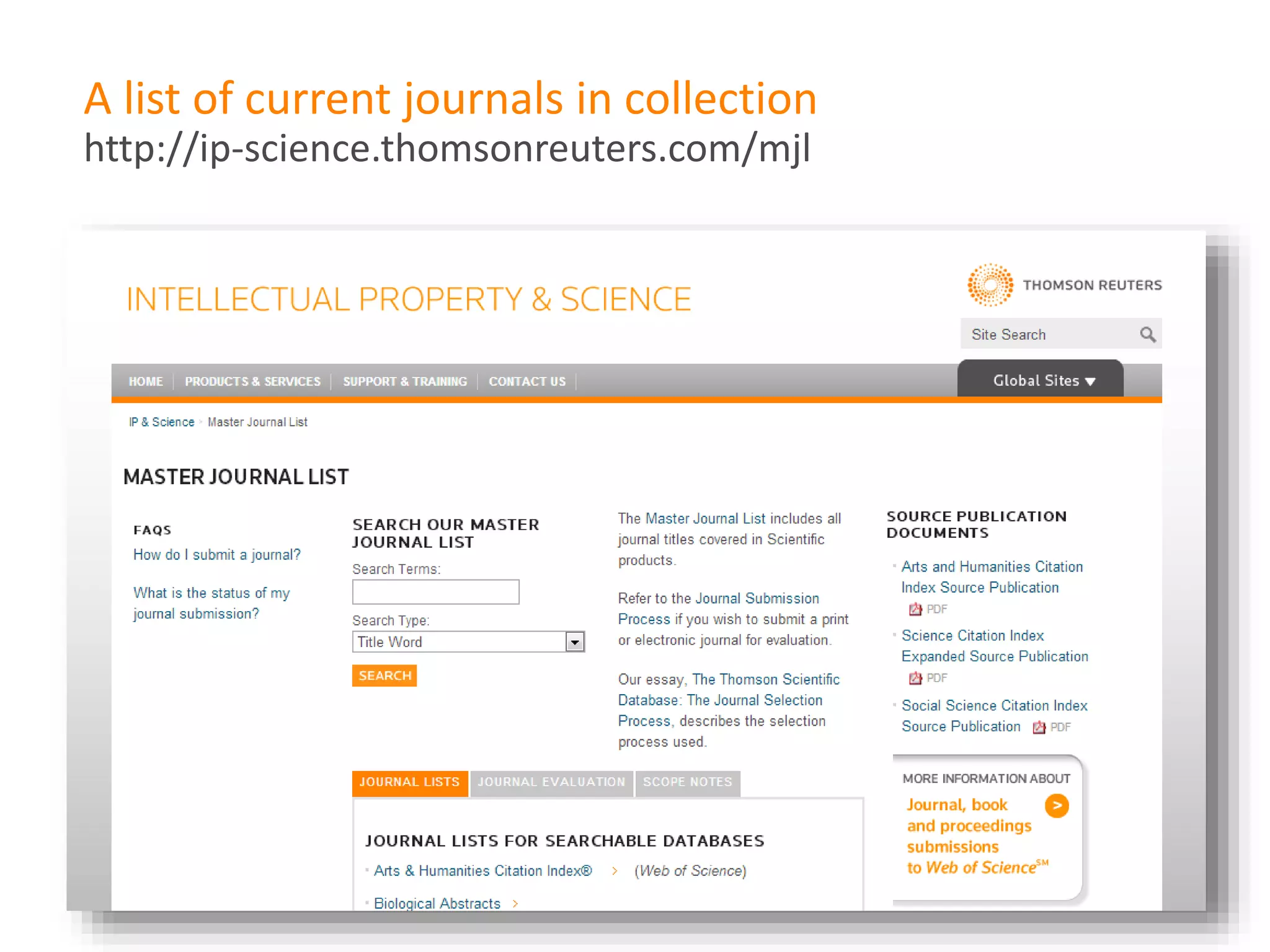
A list of current journals in collection
http://ip-science.thomsonreuters.com/mjl
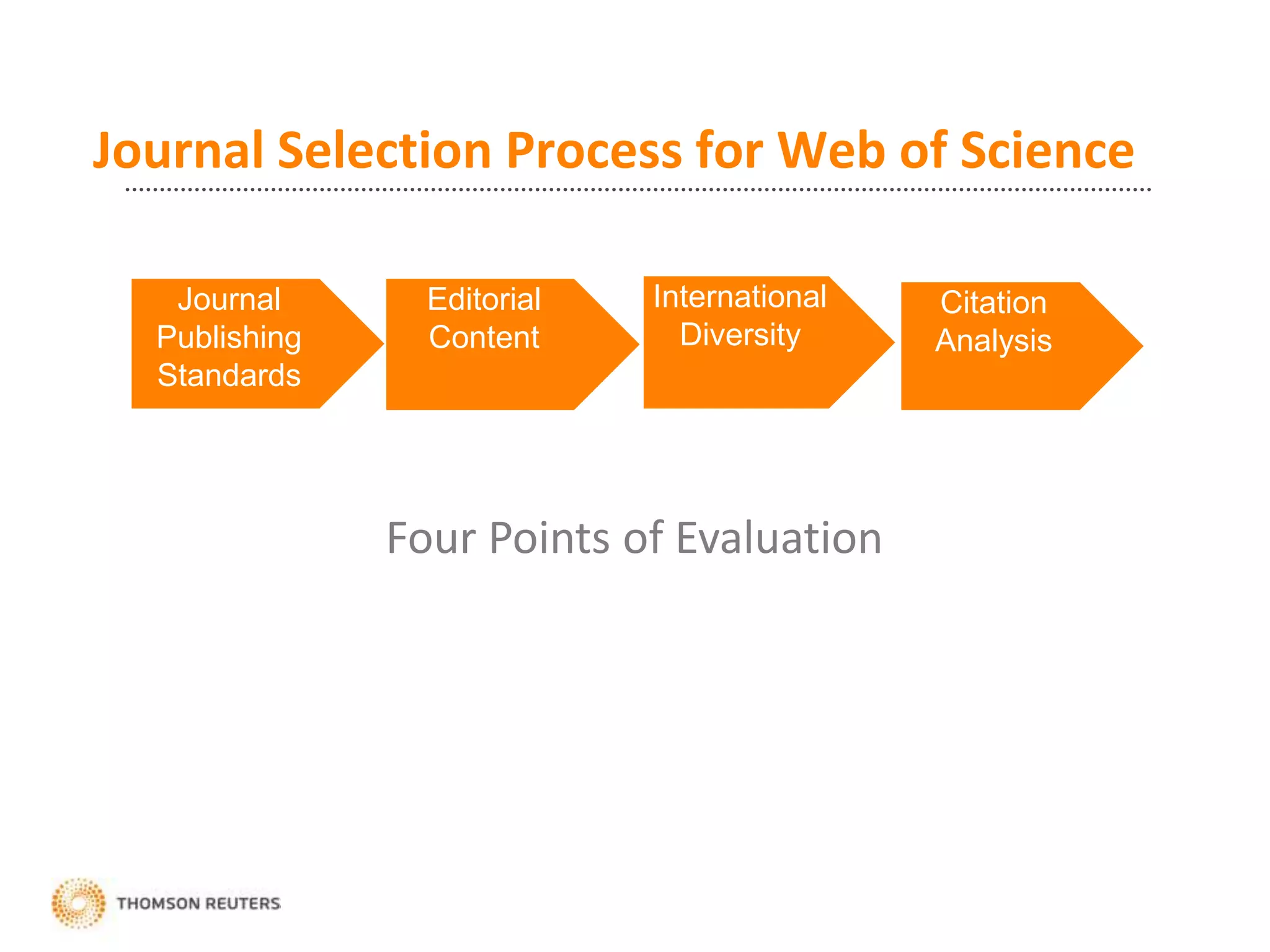
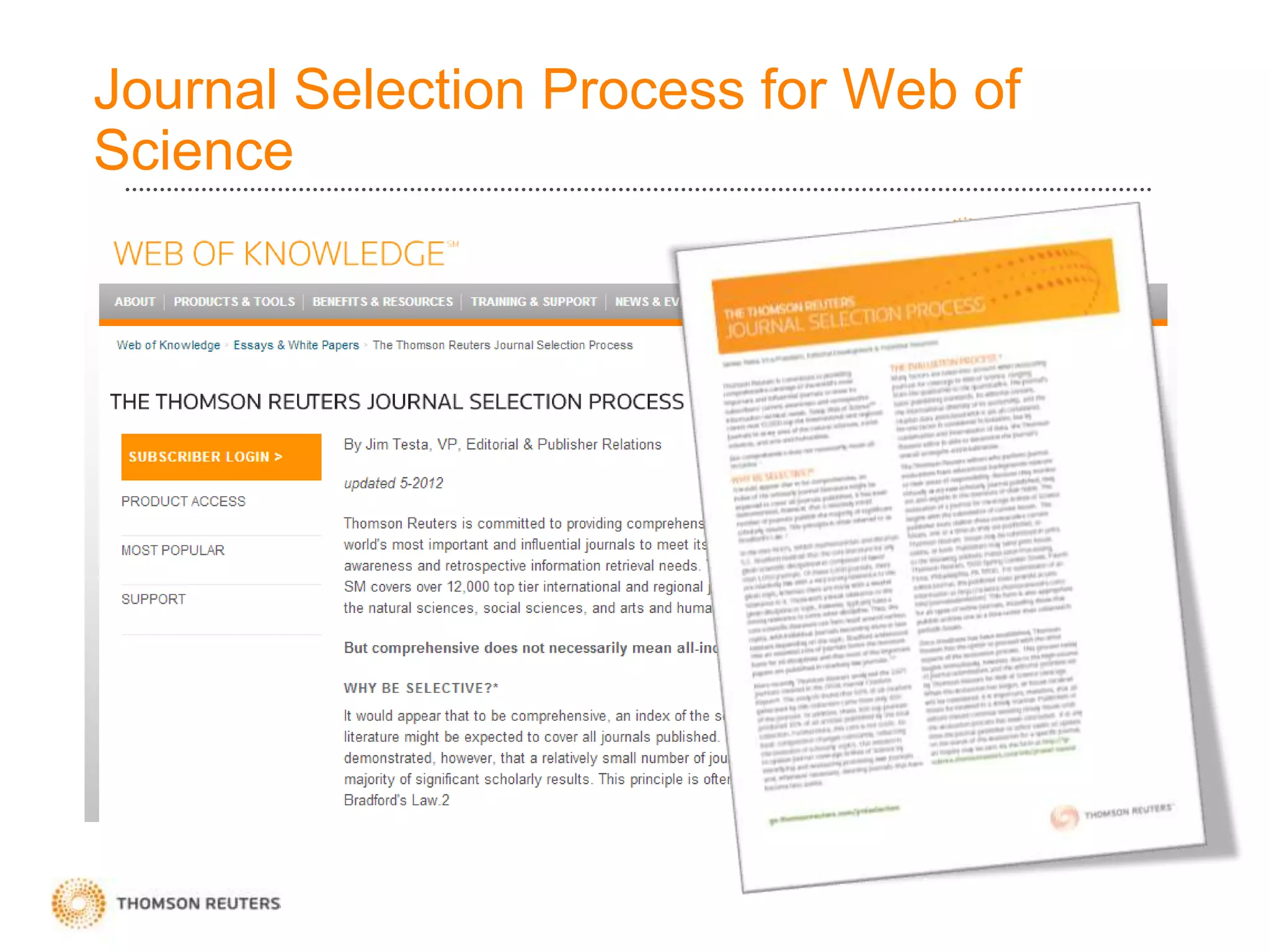
Journal Selection Process for Web of Science
Journal
Publishing
Standards
Editorial
Content
International
Diversity
Citation
Analysis
Four Points of Evaluation
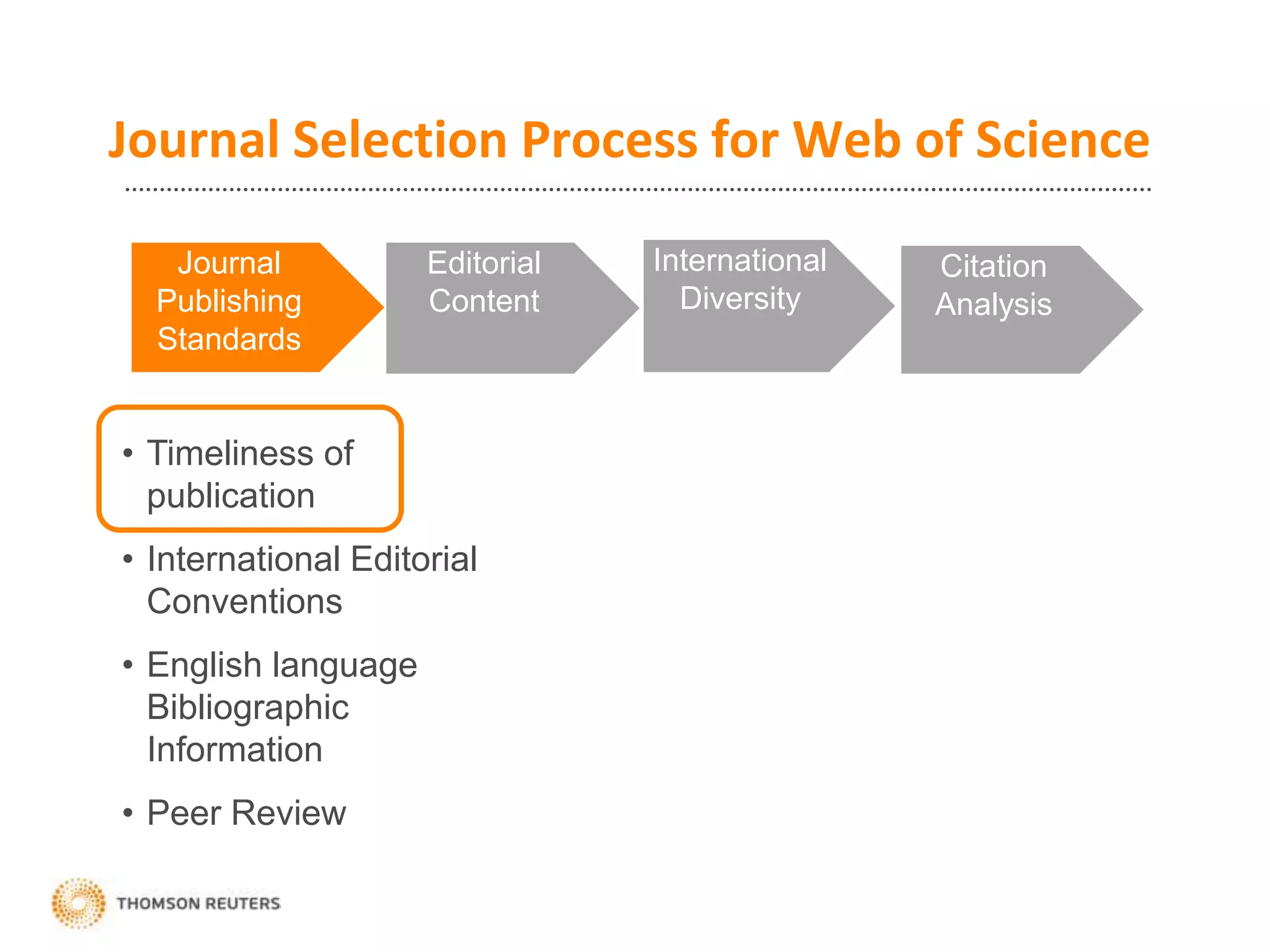
Journal Selection Process for Web of Science
Journal
Publishing
Standards
Editorial
Content
International
Diversity
Citation
Analysis
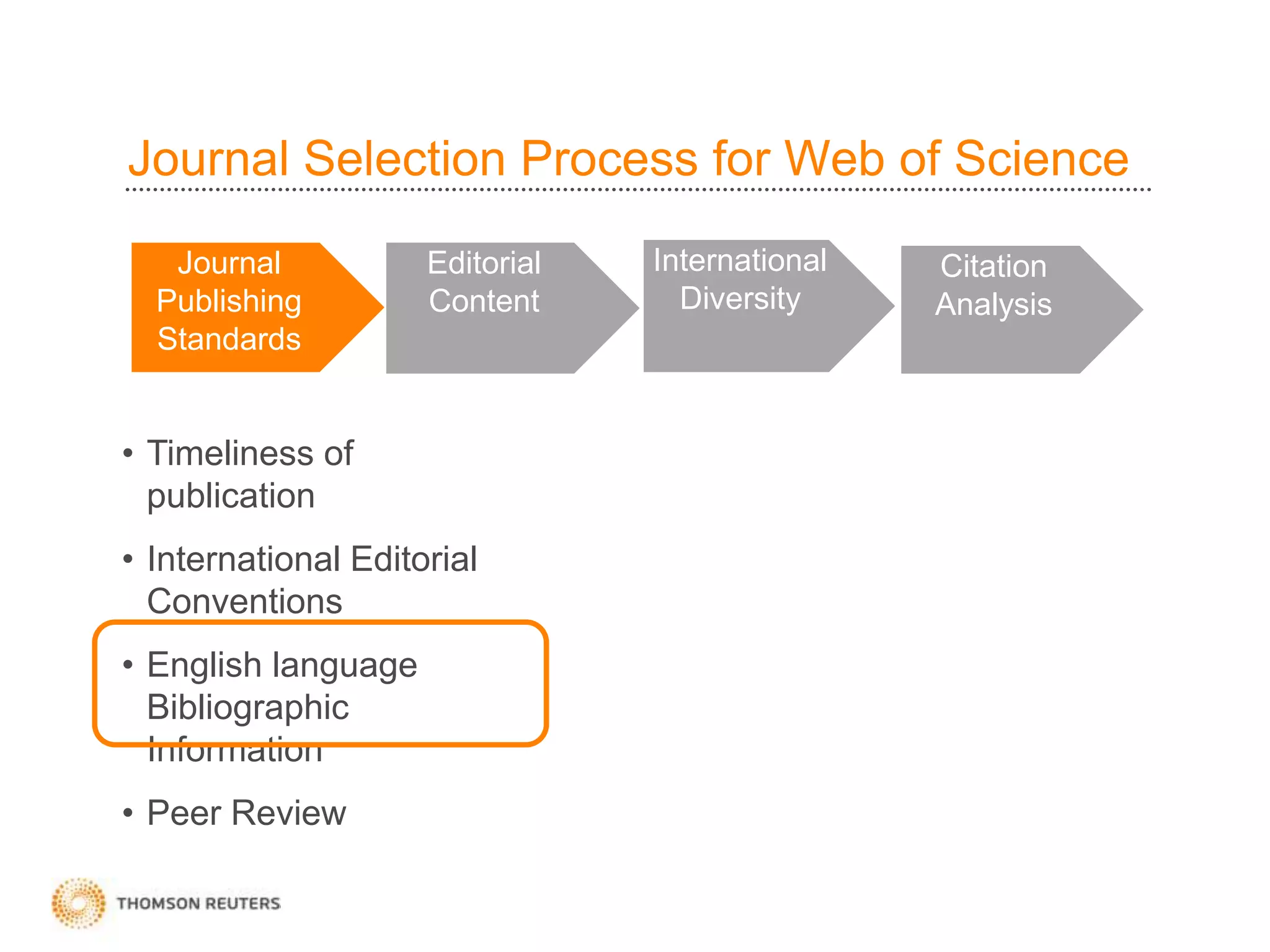
• Timeliness of
publication
• International Editorial
Conventions
• English language
Bibliographic
Information
• Peer Review
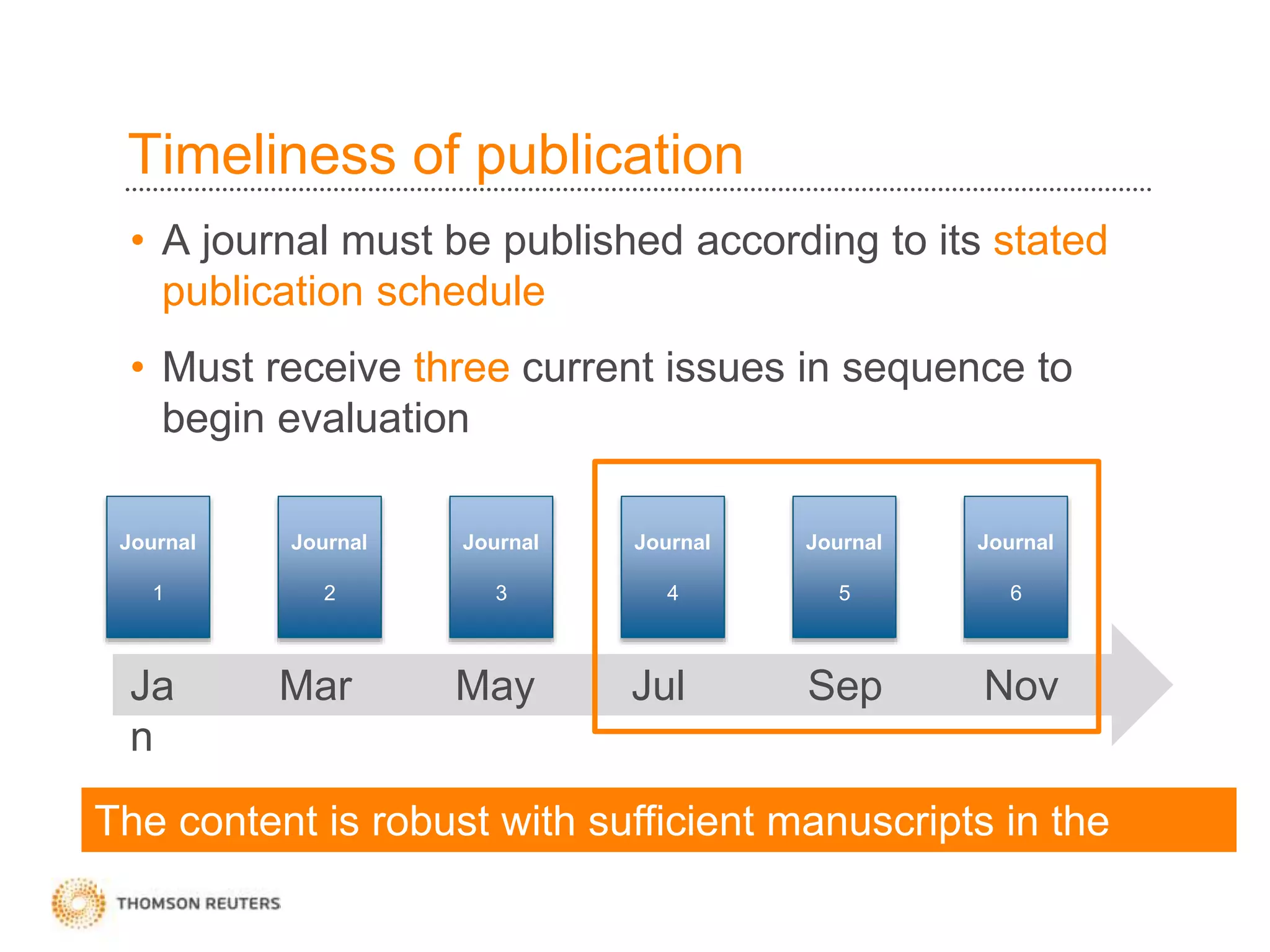
Timeliness of publication
• A journal must be published according to its stated
publication schedule
• Must receive three current issues in sequence to
begin evaluation
Ja
n
Mar May Jul Sep Nov
Journal
1
Journal
2
Journal
3
Journal
4
Journal
5
Journal
6
The content is robust with sufficient manuscripts in the
pipeline
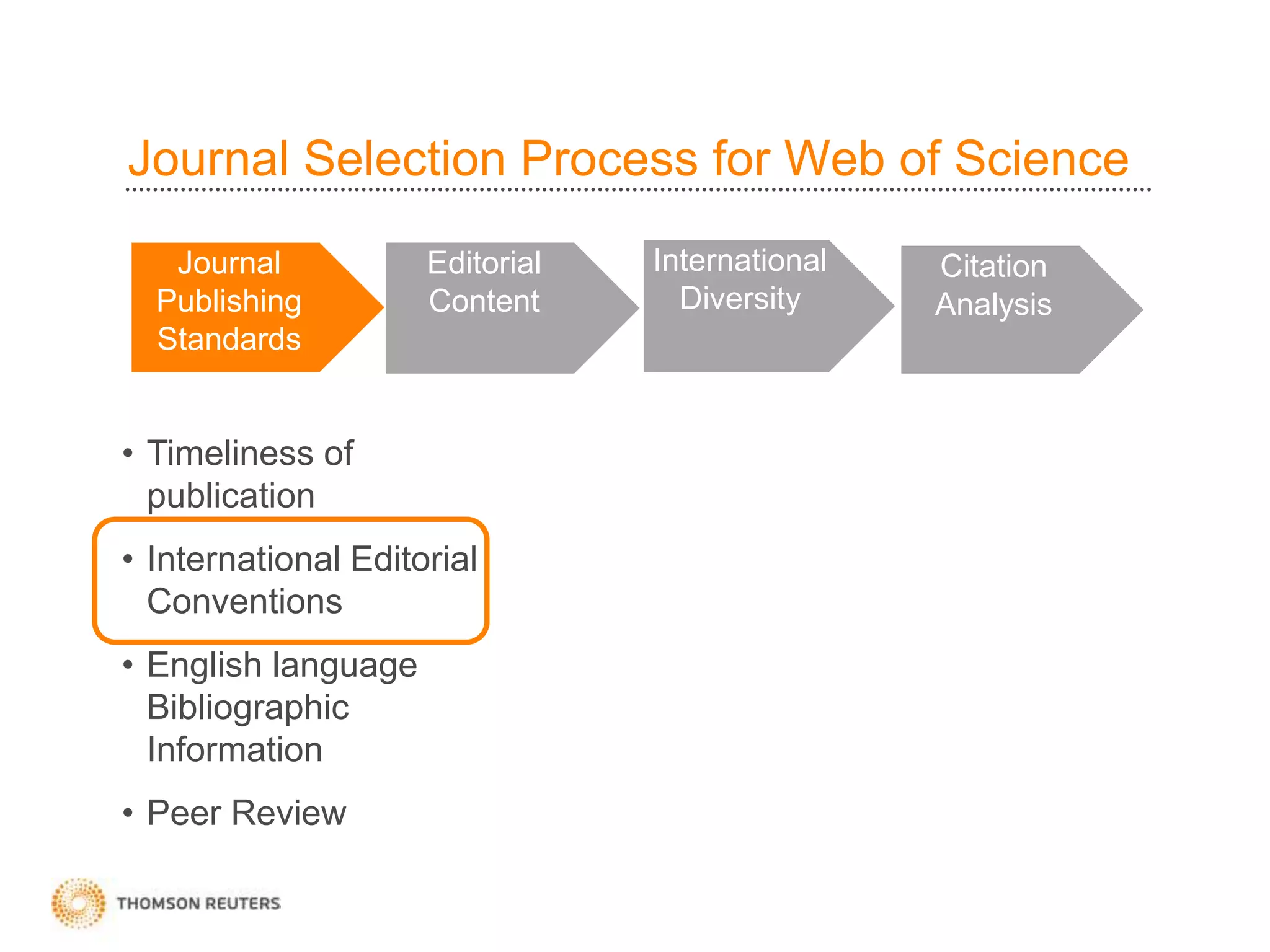
Journal Selection Process for Web of Science
Journal
Publishing
Standards
Editorial
Content
International
Diversity
Citation
Analysis
• Timeliness of
publication
• International Editorial
Conventions
• English language
Bibliographic
Information
• Peer Review
13
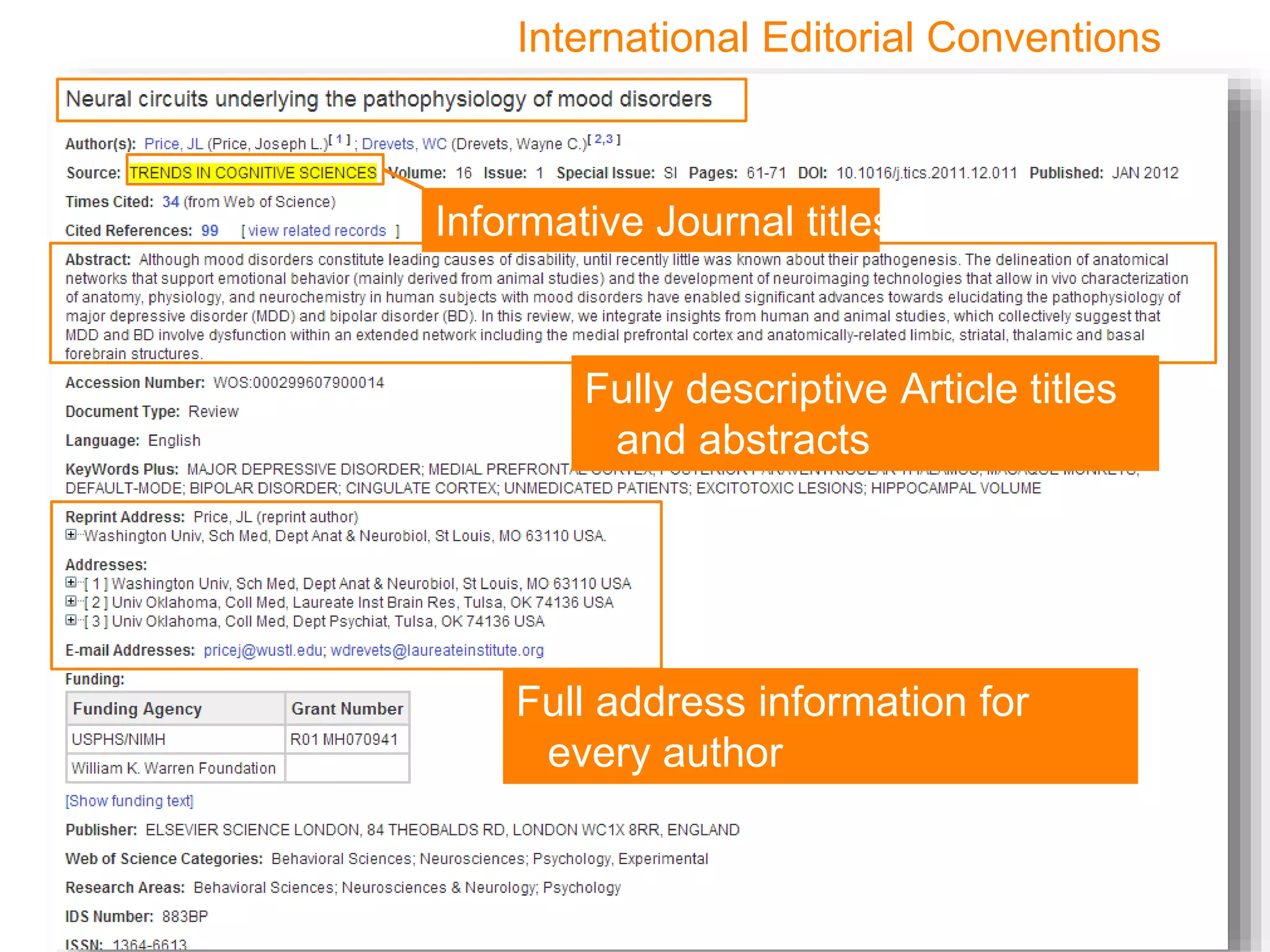
Informative Journal titles
International Editorial Conventions
Fully descriptive Article titles
and abstracts
Full address information for
every author
14
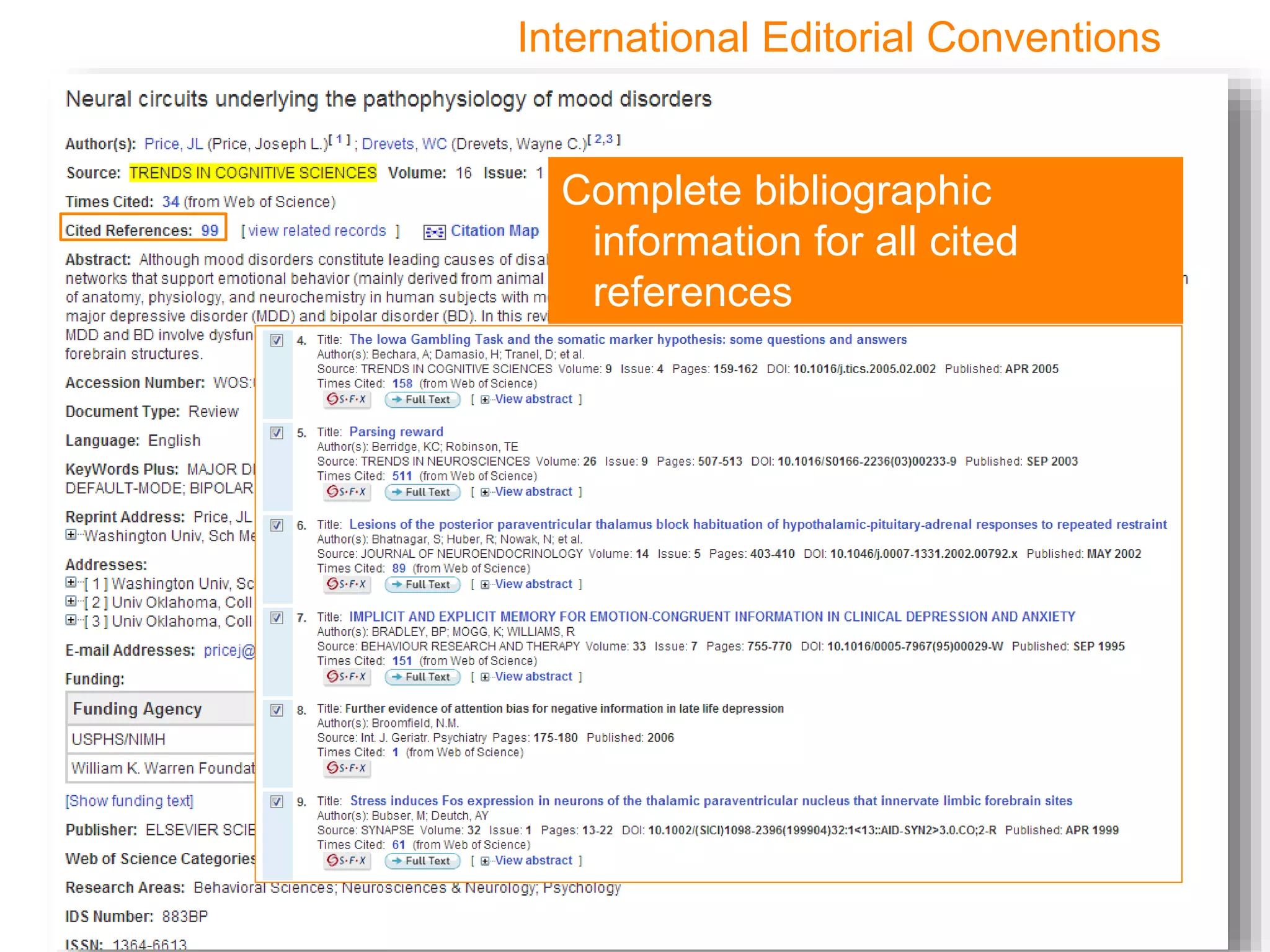
International Editorial Conventions
Complete bibliographic
information for all cited
references
Journal Selection Process for Web of Science
Journal
Publishing
Standards
Editorial
Content
International
Diversity
Citation
Analysis
• Timeliness of
publication
• International Editorial
Conventions
• English language
Bibliographic
Information
• Peer Review
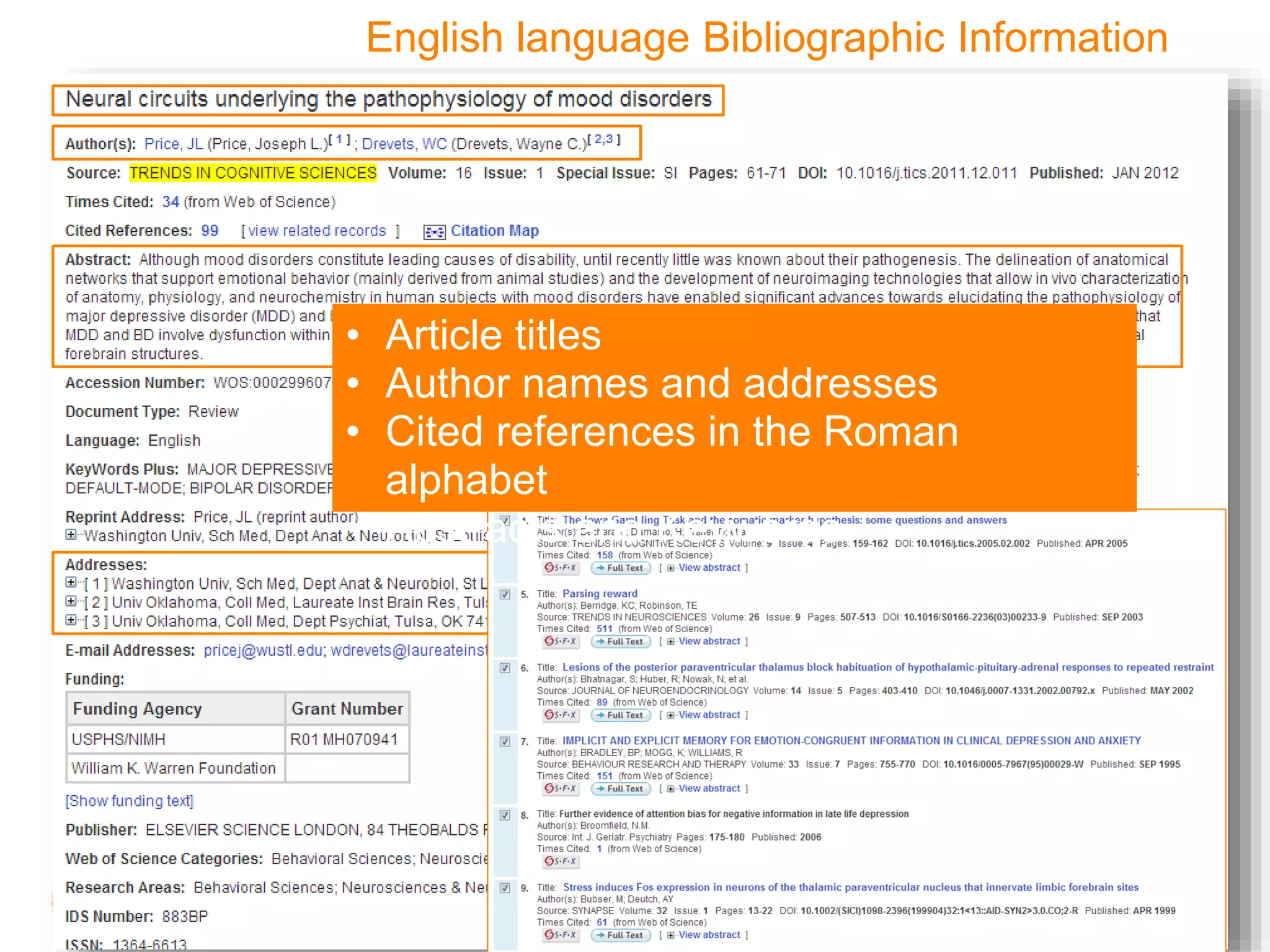
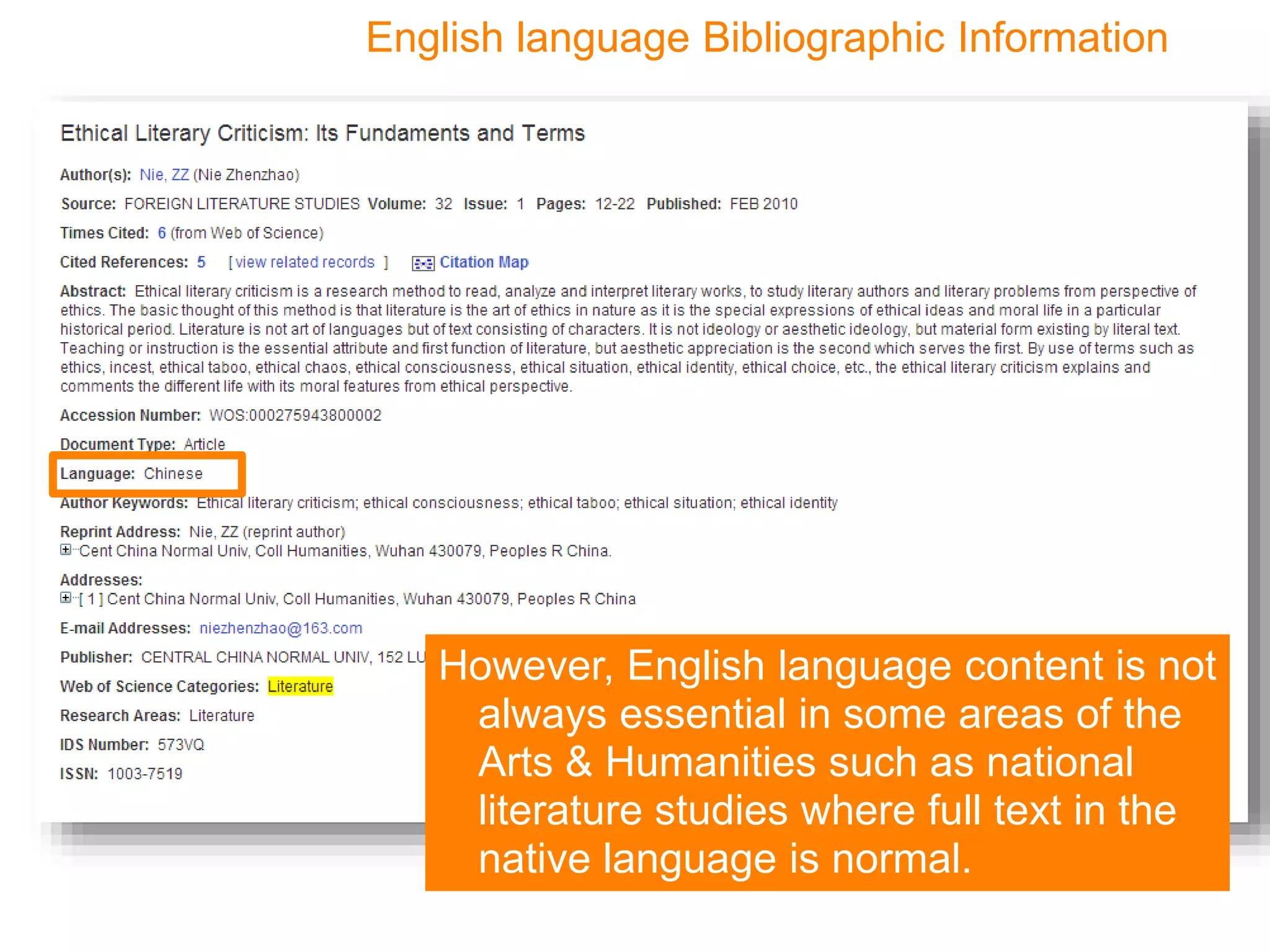
English language Bibliographic Information
• Article titles
• Author names and addresses
• Cited references in the Roman
alphabet
• Abstracts and Keywords
English language Bibliographic Information
However, English language content is not
always essential in some areas of the
Arts & Humanities such as national
literature studies where full text in the
native language is normal.
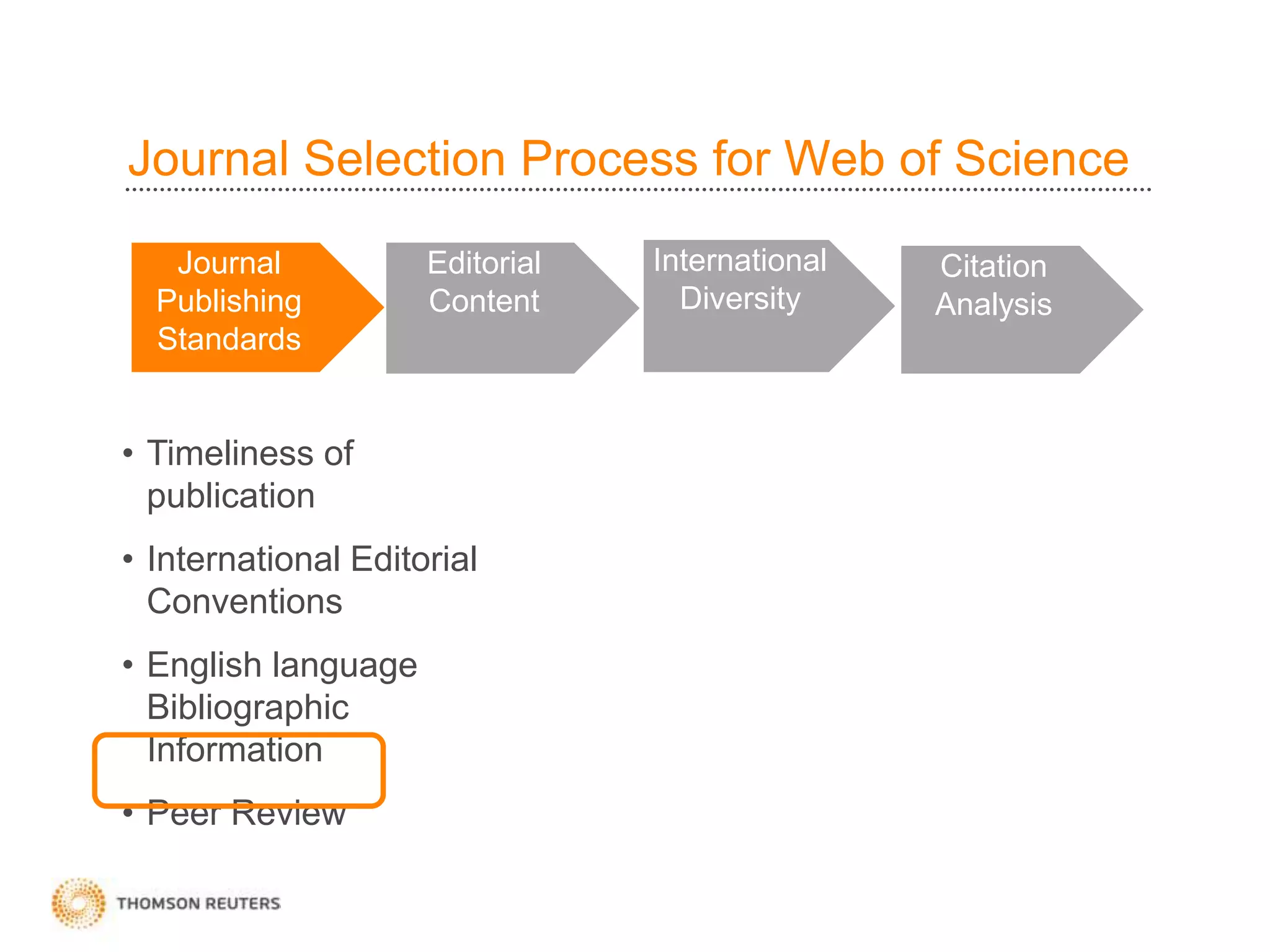
Journal Selection Process for Web of Science
Journal
Publishing
Standards
Editorial
Content
International
Diversity
Citation
Analysis
• Timeliness of
publication
• International Editorial
Conventions
• English language
Bibliographic
Information
• Peer Review
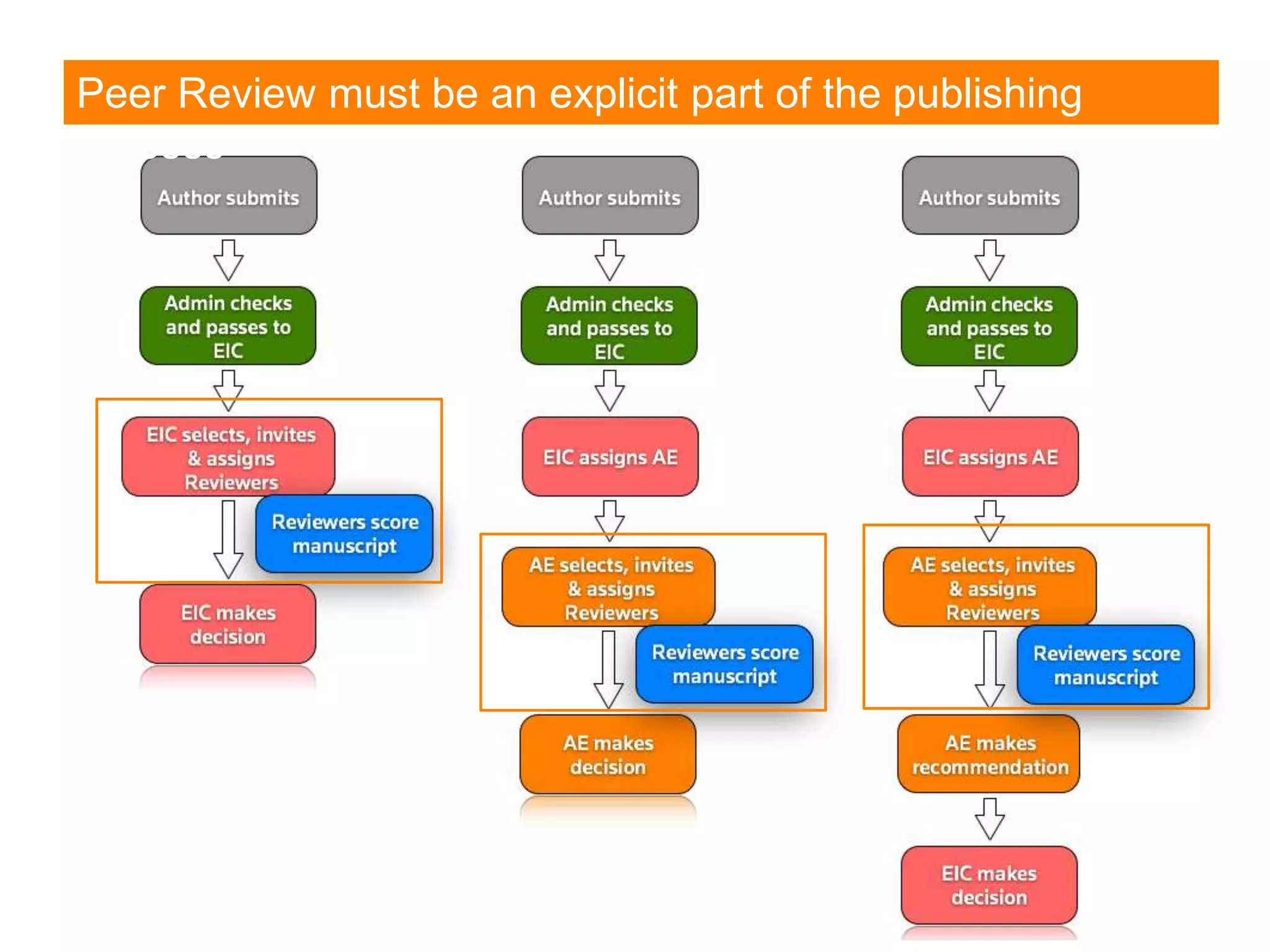
Peer Review must be an explicit part of the publishing
process
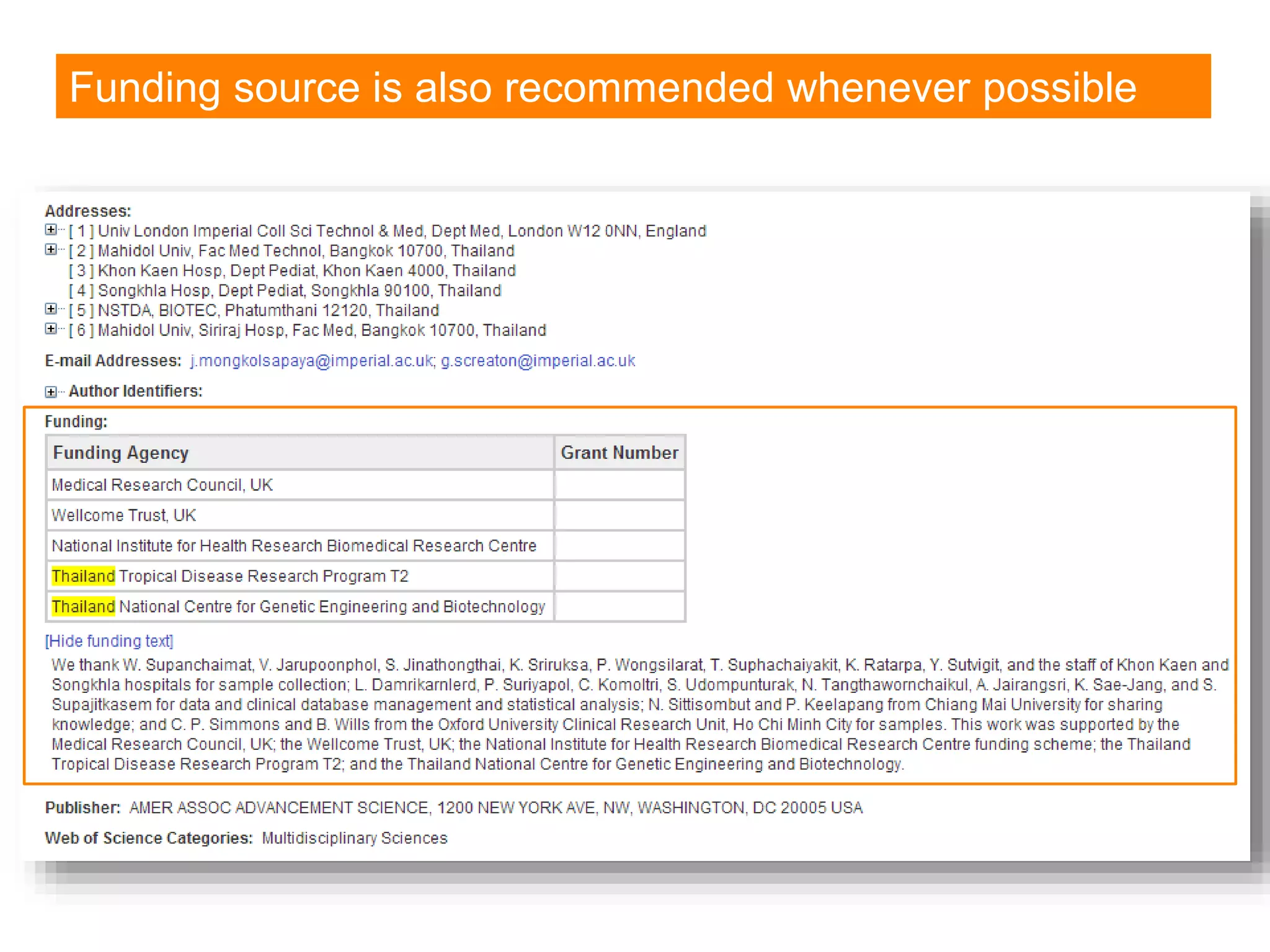
Funding source is also recommended whenever possible
Journal Selection Process for Web of Science
Journal
Publishing
Standards
Editorial
Content
International
Diversity
Citation
Analysis
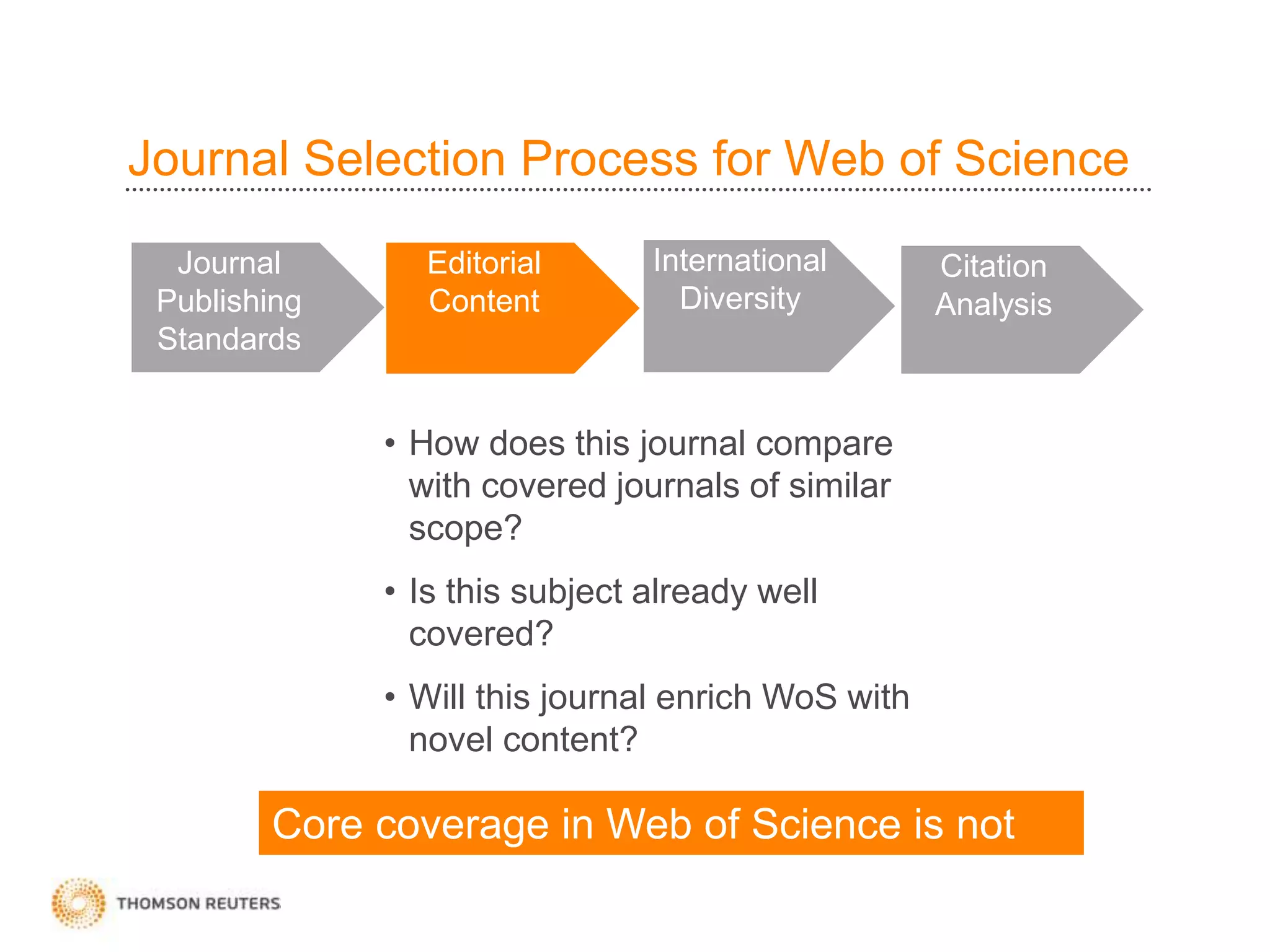
• How does this journal compare
with covered journals of similar
scope?
• Is this subject already well
covered?
• Will this journal enrich WoS with
novel content?
Core coverage in Web of Science is not
static !
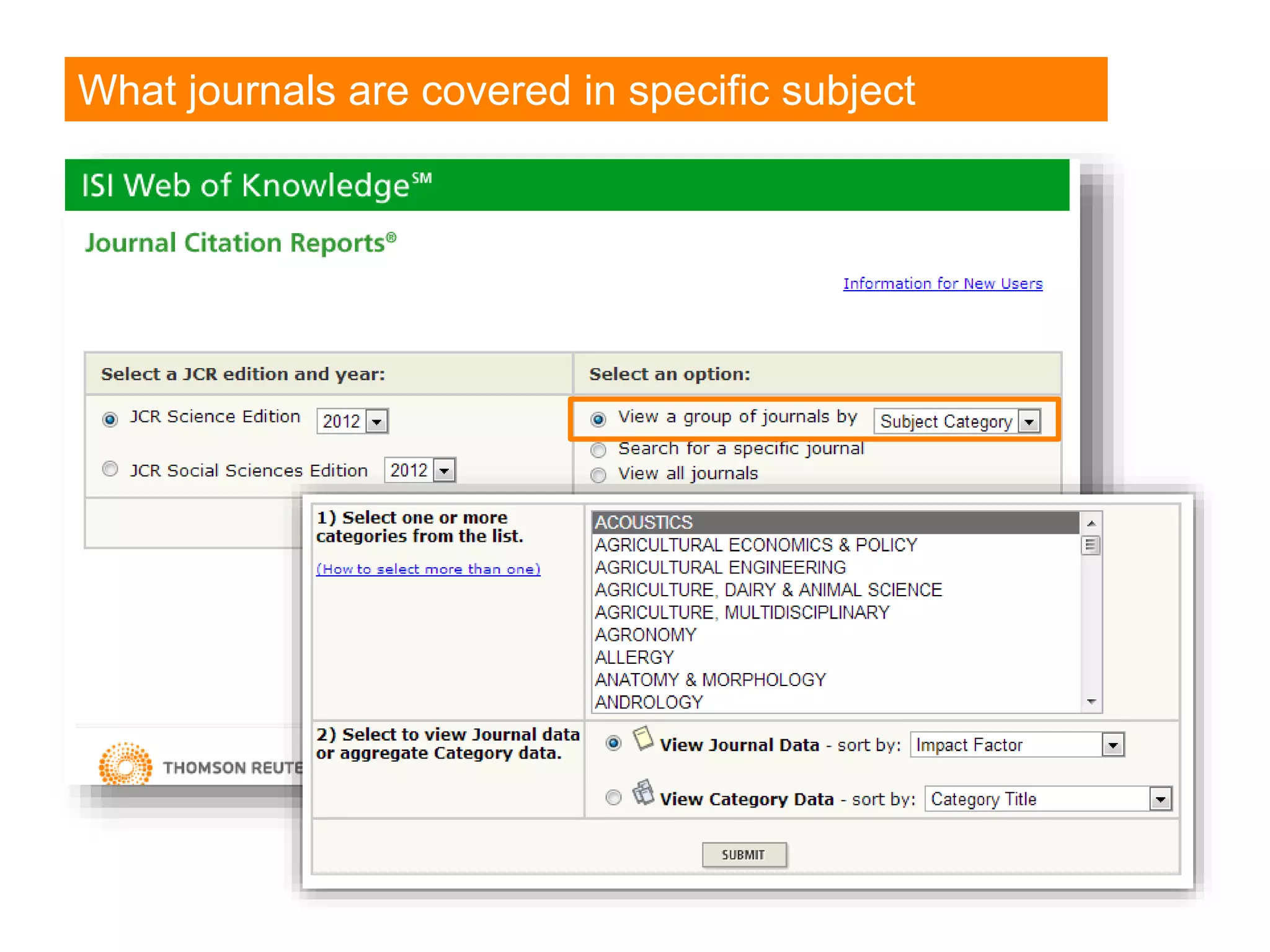
What journals are covered in specific subject
category?
What journals are covered in specific subject category?
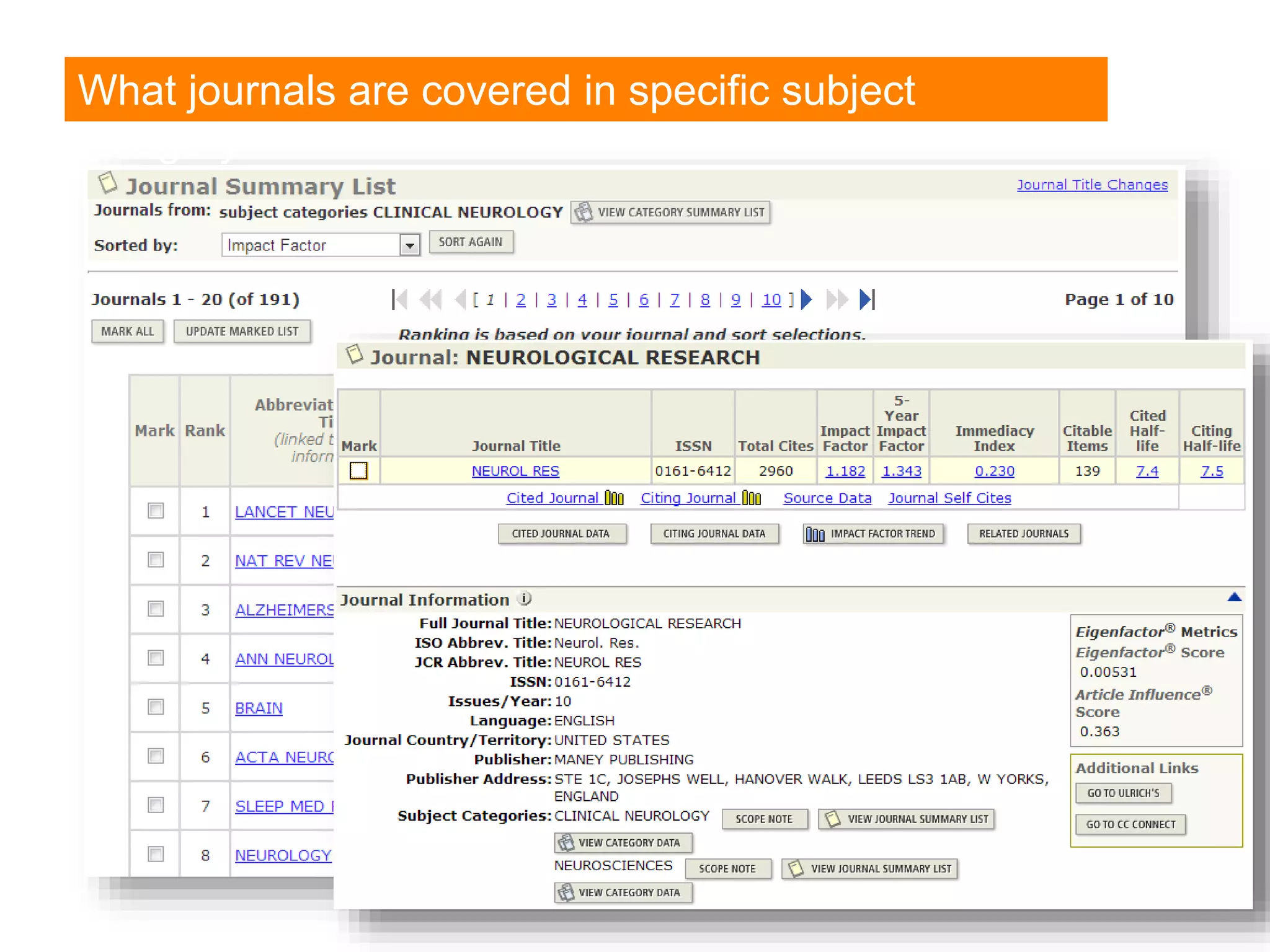
What journals are covered in specific subject
category?
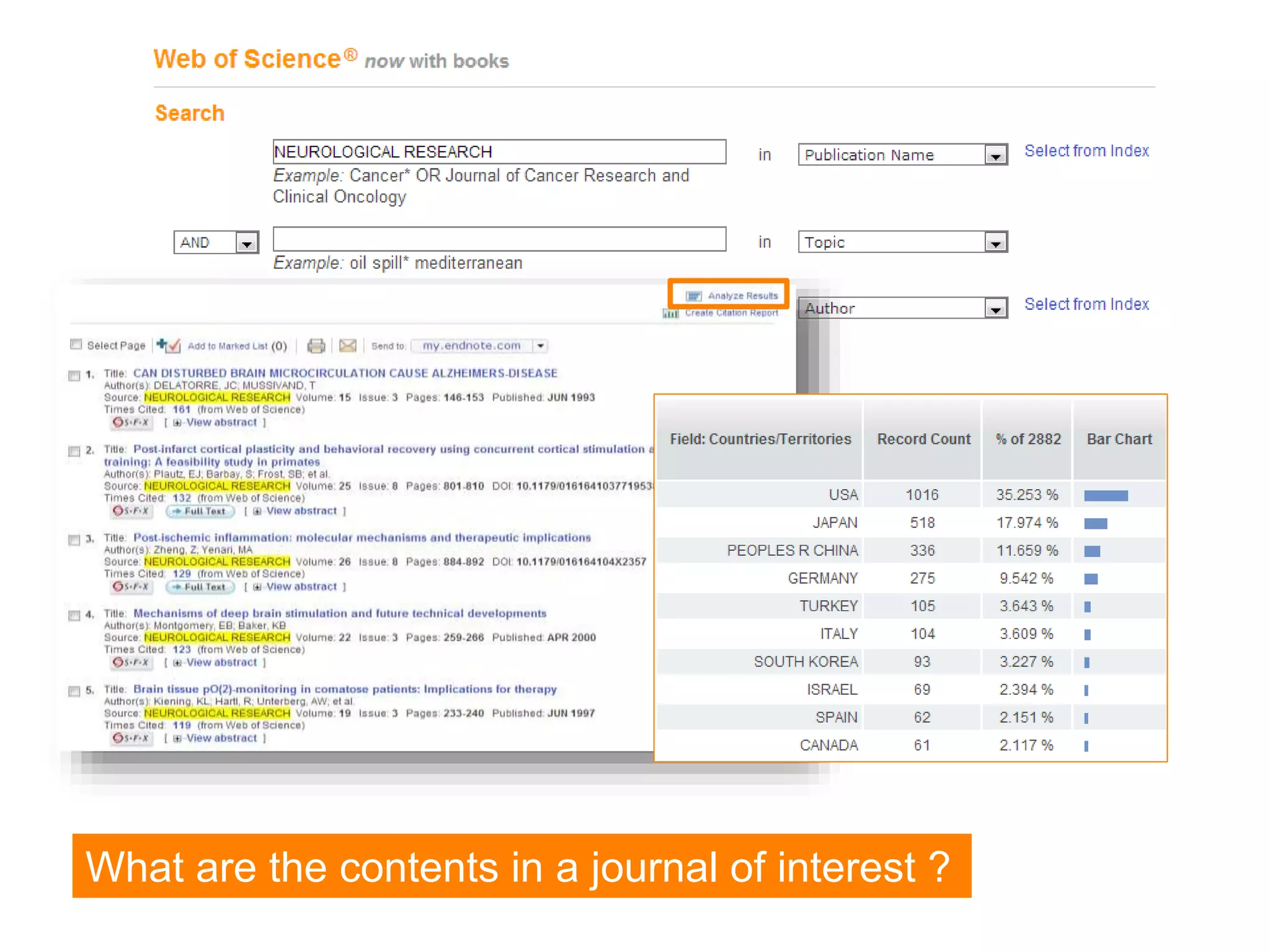
What are the contents in a journal of interest ?
Journal Selection Process for Web of Science
Journal
Publishing
Standards
Editorial
Content
International
Diversity
Citation
Analysis
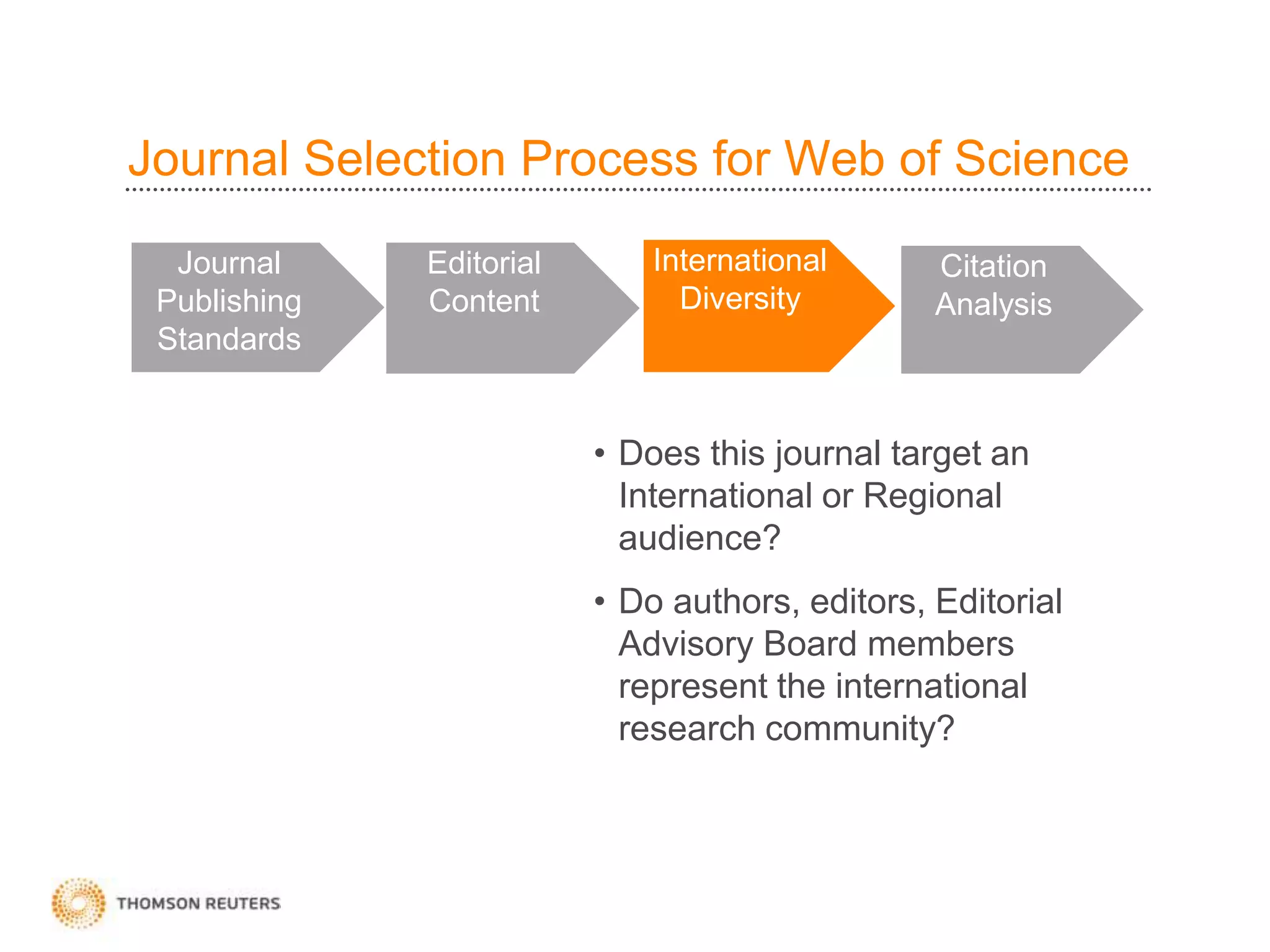
• Does this journal target an
International or Regional
audience?
• Do authors, editors, Editorial
Advisory Board members
represent the international
research community?
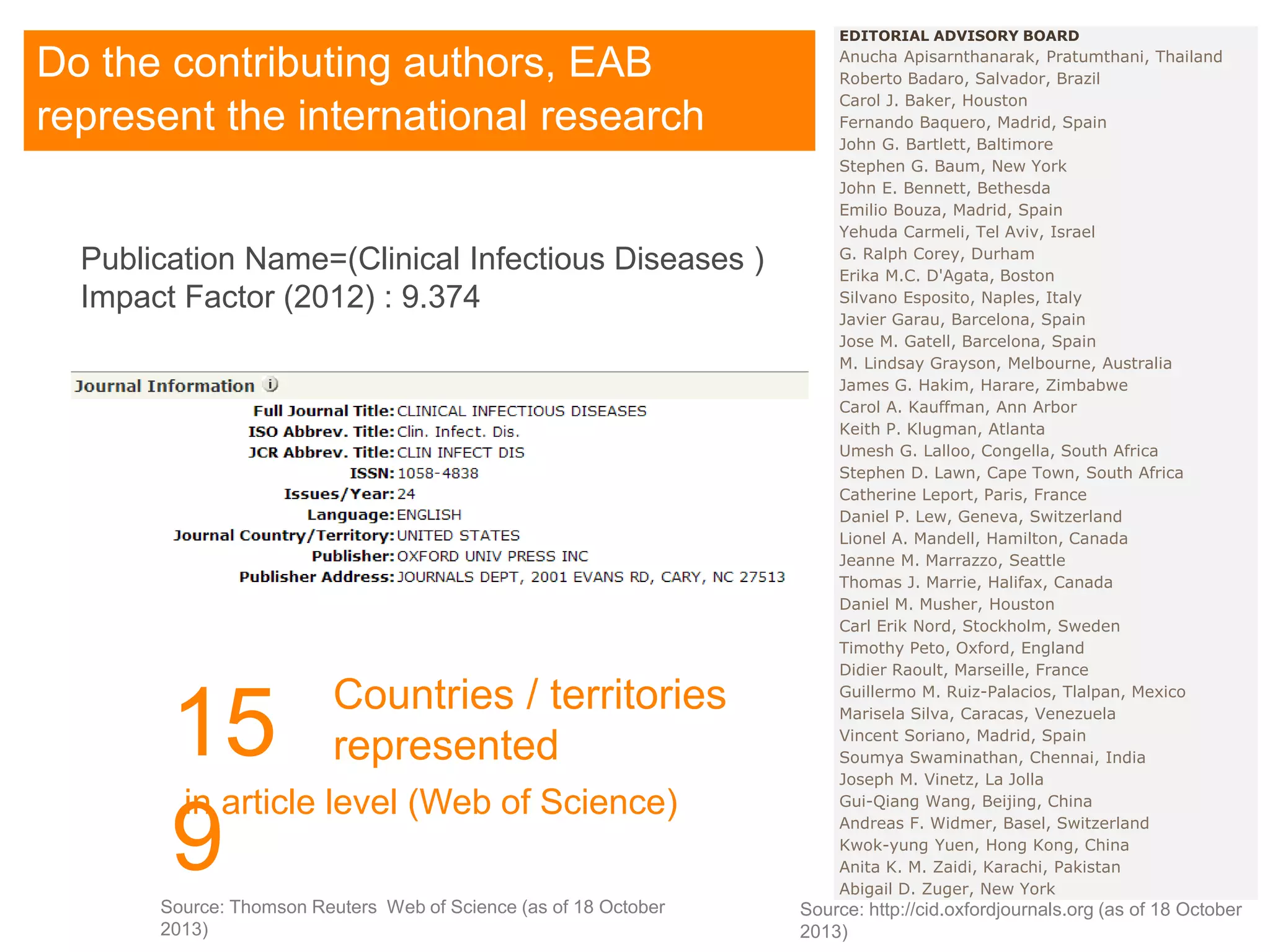
Publication Name=(Clinical Infectious Diseases )
Impact Factor (2012) : 9.374
EDITORIAL ADVISORY BOARD
Anucha Apisarnthanarak, Pratumthani, Thailand
Roberto Badaro, Salvador, Brazil
Carol J. Baker, Houston
Fernando Baquero, Madrid, Spain
John G. Bartlett, Baltimore
Stephen G. Baum, New York
John E. Bennett, Bethesda
Emilio Bouza, Madrid, Spain
Yehuda Carmeli, Tel Aviv, Israel
G. Ralph Corey, Durham
Erika M.C. D'Agata, Boston
Silvano Esposito, Naples, Italy
Javier Garau, Barcelona, Spain
Jose M. Gatell, Barcelona, Spain
M. Lindsay Grayson, Melbourne, Australia
James G. Hakim, Harare, Zimbabwe
Carol A. Kauffman, Ann Arbor
Keith P. Klugman, Atlanta
Umesh G. Lalloo, Congella, South Africa
Stephen D. Lawn, Cape Town, South Africa
Catherine Leport, Paris, France
Daniel P. Lew, Geneva, Switzerland
Lionel A. Mandell, Hamilton, Canada
Jeanne M. Marrazzo, Seattle
Thomas J. Marrie, Halifax, Canada
Daniel M. Musher, Houston
Carl Erik Nord, Stockholm, Sweden
Timothy Peto, Oxford, England
Didier Raoult, Marseille, France
Guillermo M. Ruiz-Palacios, Tlalpan, Mexico
Marisela Silva, Caracas, Venezuela
Vincent Soriano, Madrid, Spain
Soumya Swaminathan, Chennai, India
Joseph M. Vinetz, La Jolla
Gui-Qiang Wang, Beijing, China
Andreas F. Widmer, Basel, Switzerland
Kwok-yung Yuen, Hong Kong, China
Anita K. M. Zaidi, Karachi, Pakistan
Abigail D. Zuger, New York
15
9
Countries / territories
represented
in article level (Web of Science)
Do the contributing authors, EAB
represent the international research
community ?
Source: http://cid.oxfordjournals.org (as of 18 October
2013)
Source: Thomson Reuters Web of Science (as of 18 October
2013)
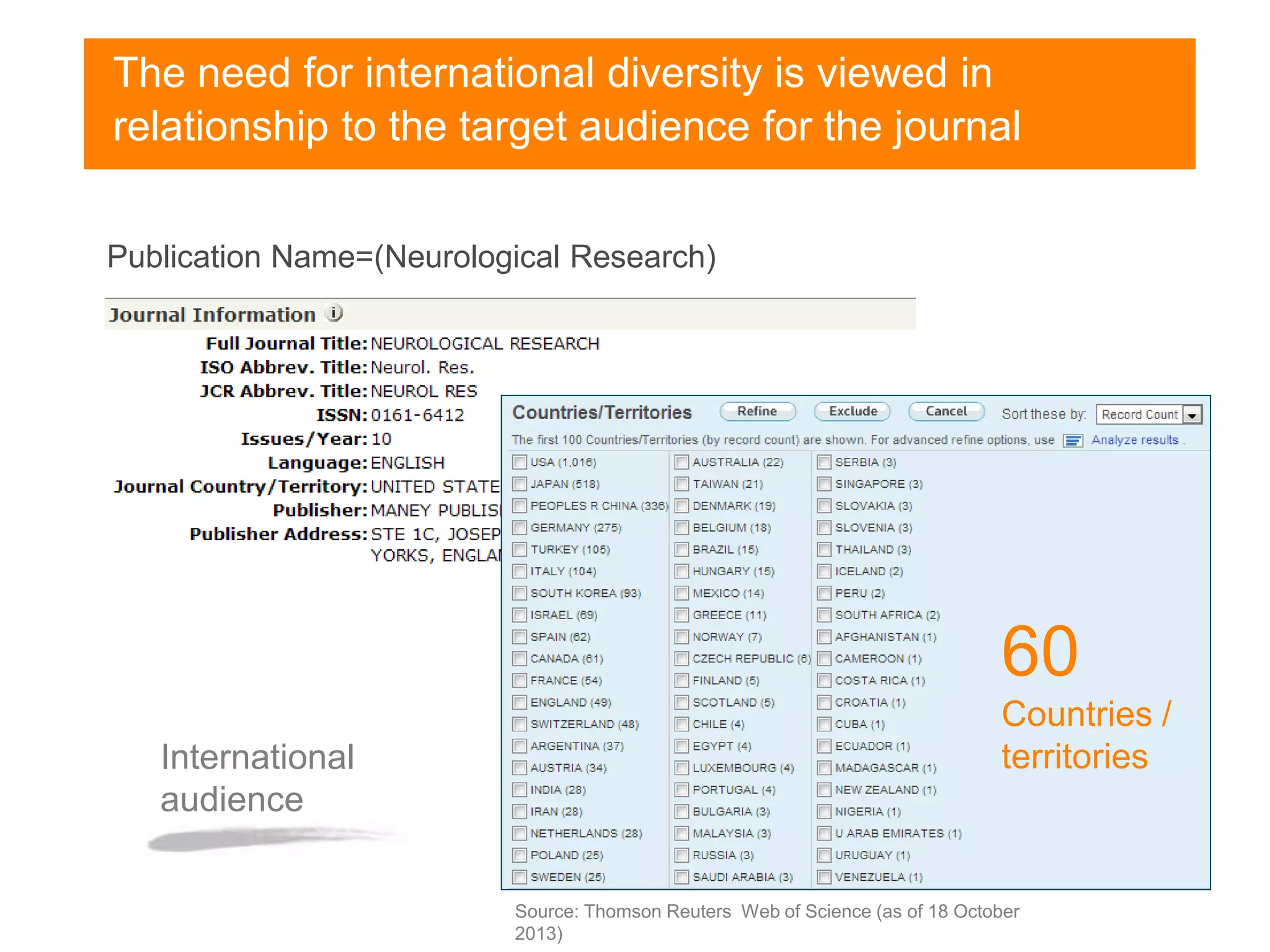
Publication Name=(Neurological Research)
The need for international diversity is viewed in
relationship to the target audience for the journal
60
Countries /
territoriesInternational
audience
Source: Thomson Reuters Web of Science (as of 18 October
2013)
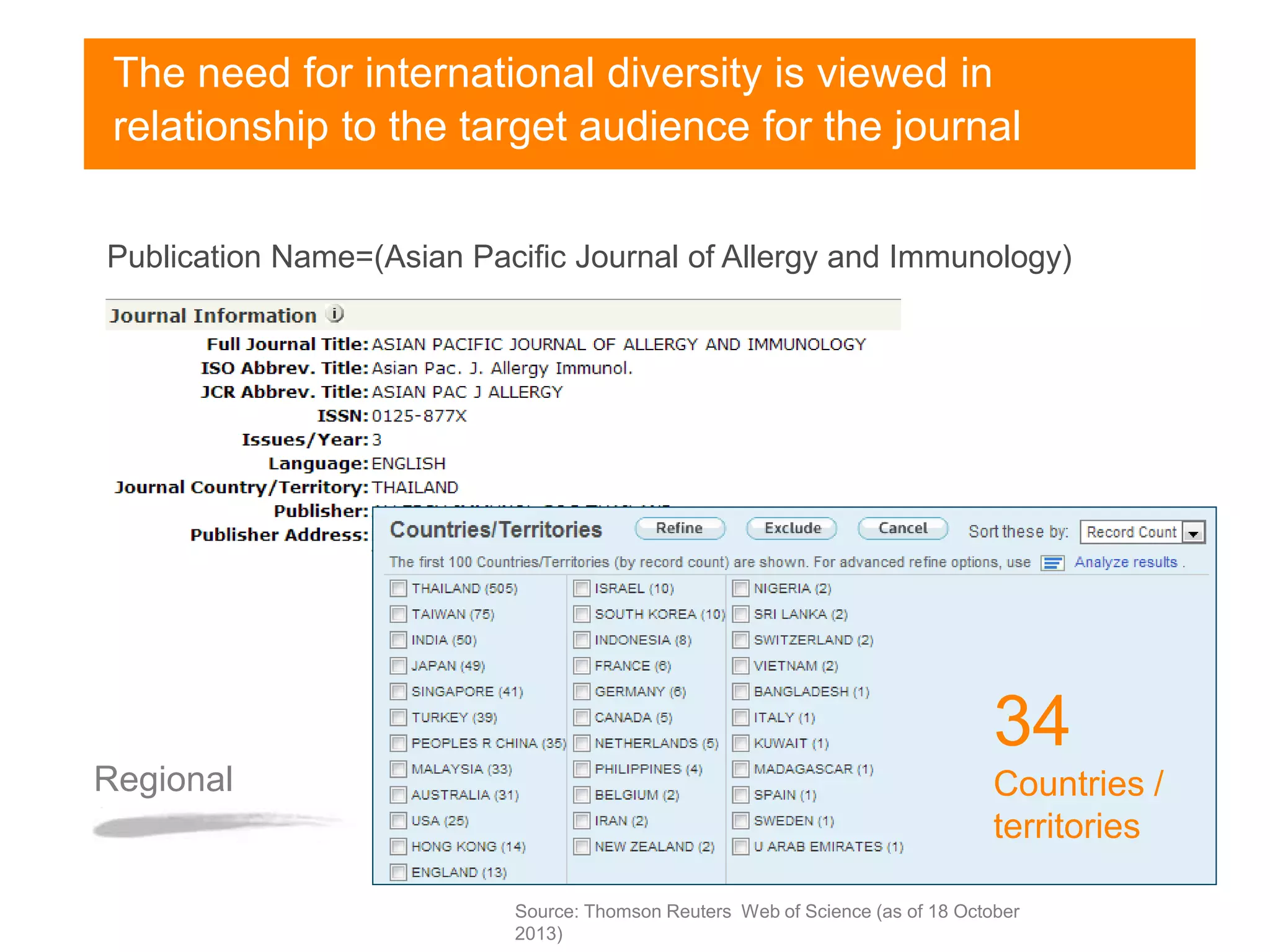
Publication Name=(Asian Pacific Journal of Allergy and Immunology)
34
Countries /
territories
The need for international diversity is viewed in
relationship to the target audience for the journal
Regional
focus
Source: Thomson Reuters Web of Science (as of 18 October
2013)
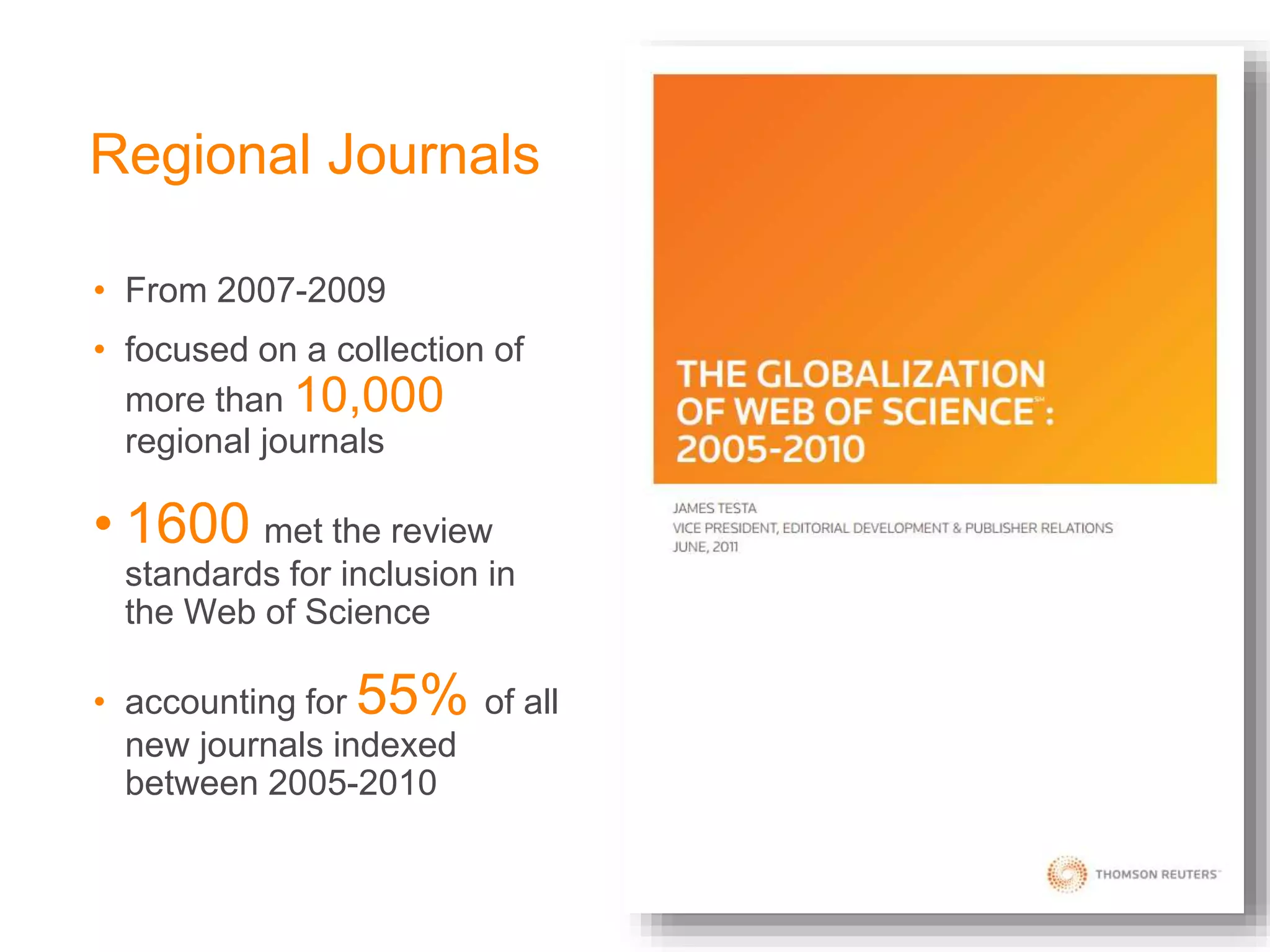
Regional Journals
• From 2007-2009
• focused on a collection of
more than 10,000
regional journals
• 1600 met the review
standards for inclusion in
the Web of Science
• accounting for 55% of all
new journals indexed
between 2005-2010
29
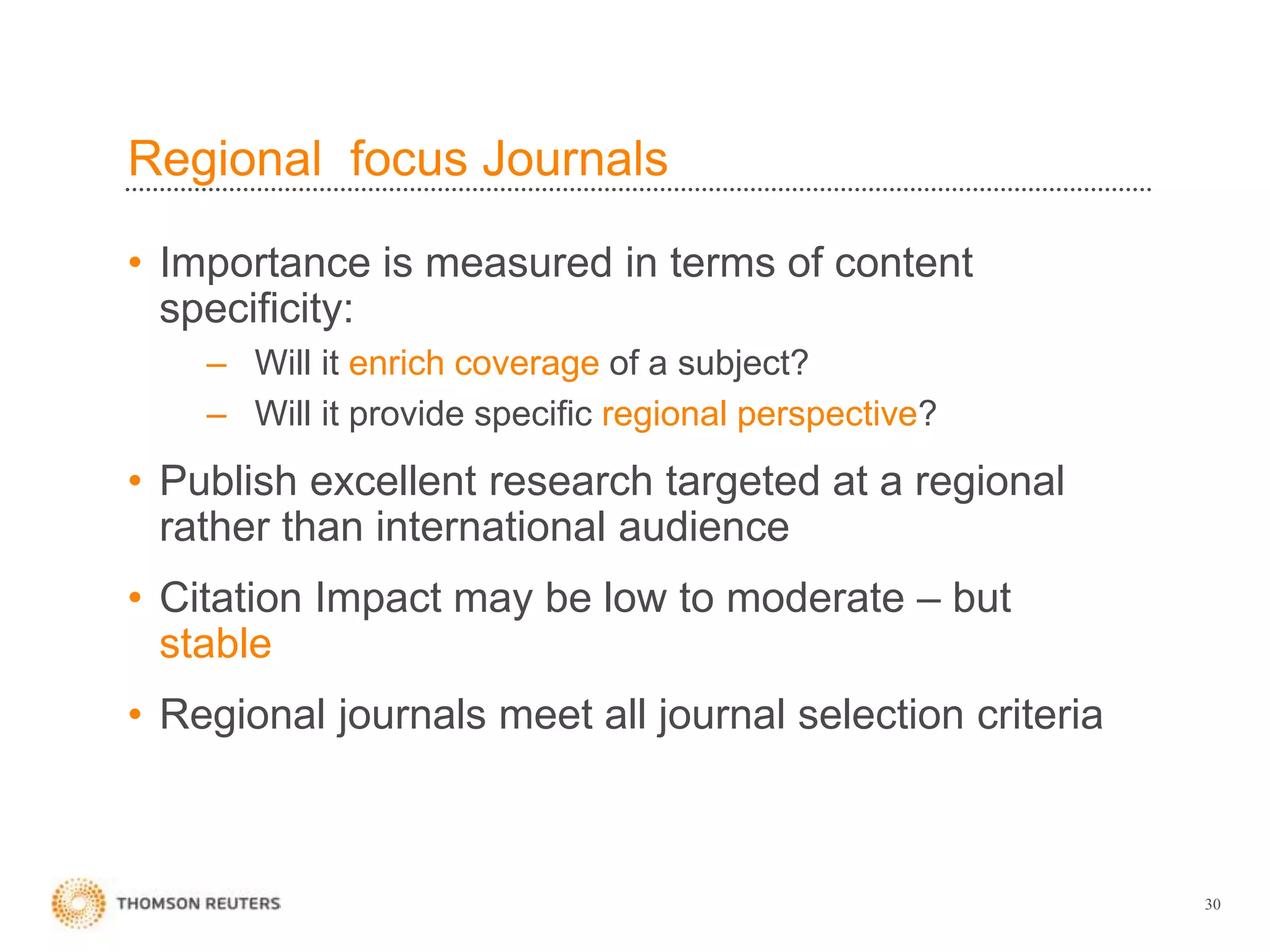
Regional focus Journals
• Importance is measured in terms of content
specificity:
– Will it enrich coverage of a subject?
– Will it provide specific regional perspective?
• Publish excellent research targeted at a regional
rather than international audience
• Citation Impact may be low to moderate – but
stable
• Regional journals meet all journal selection criteria
30
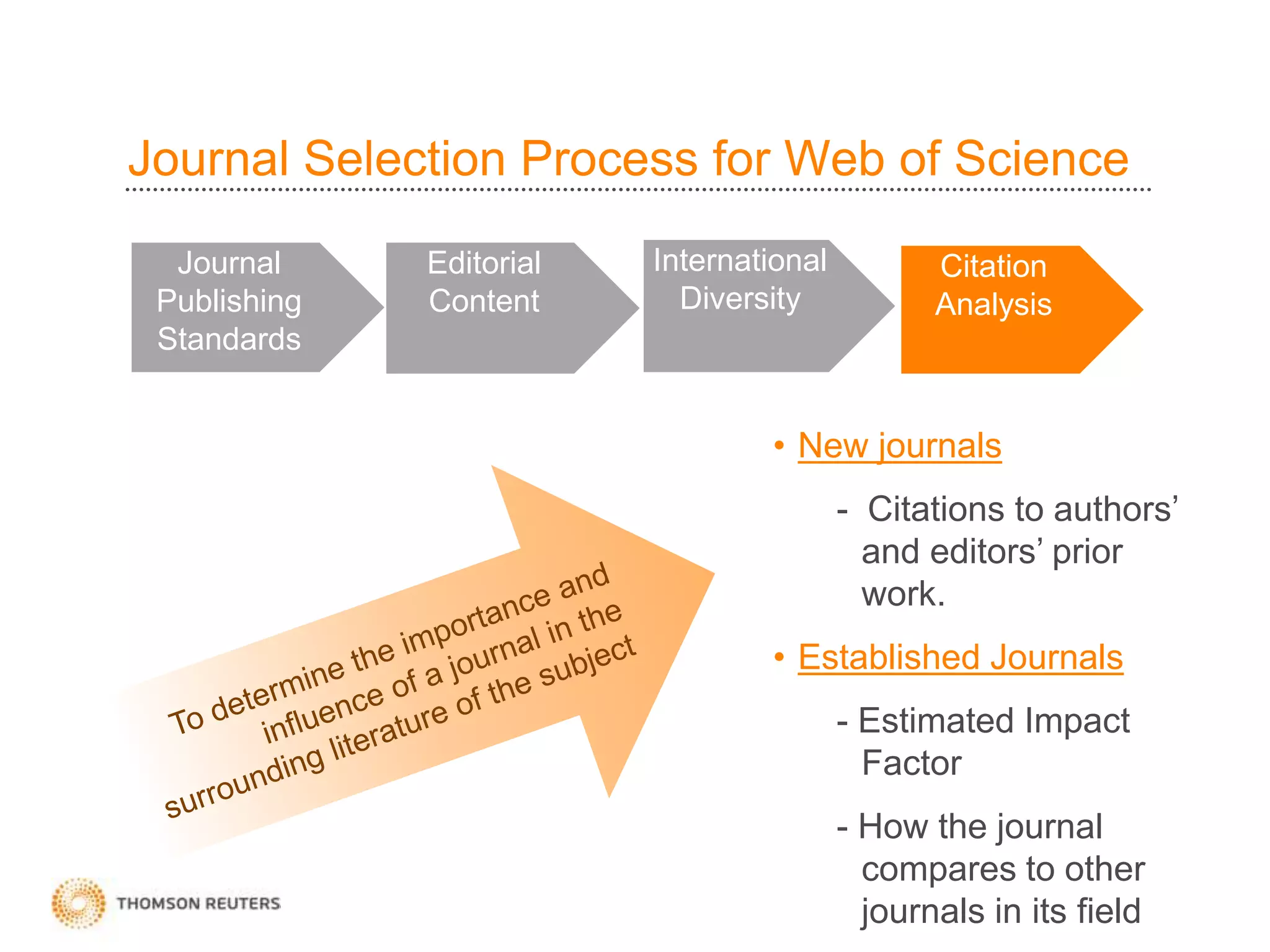
Journal Selection Process for Web of Science
Journal
Publishing
Standards
Editorial
Content
International
Diversity
Citation
Analysis
• New journals
- Citations to authors’
and editors’ prior
work.
• Established Journals
- Estimated Impact
Factor
- How the journal
compares to other
journals in its field
32
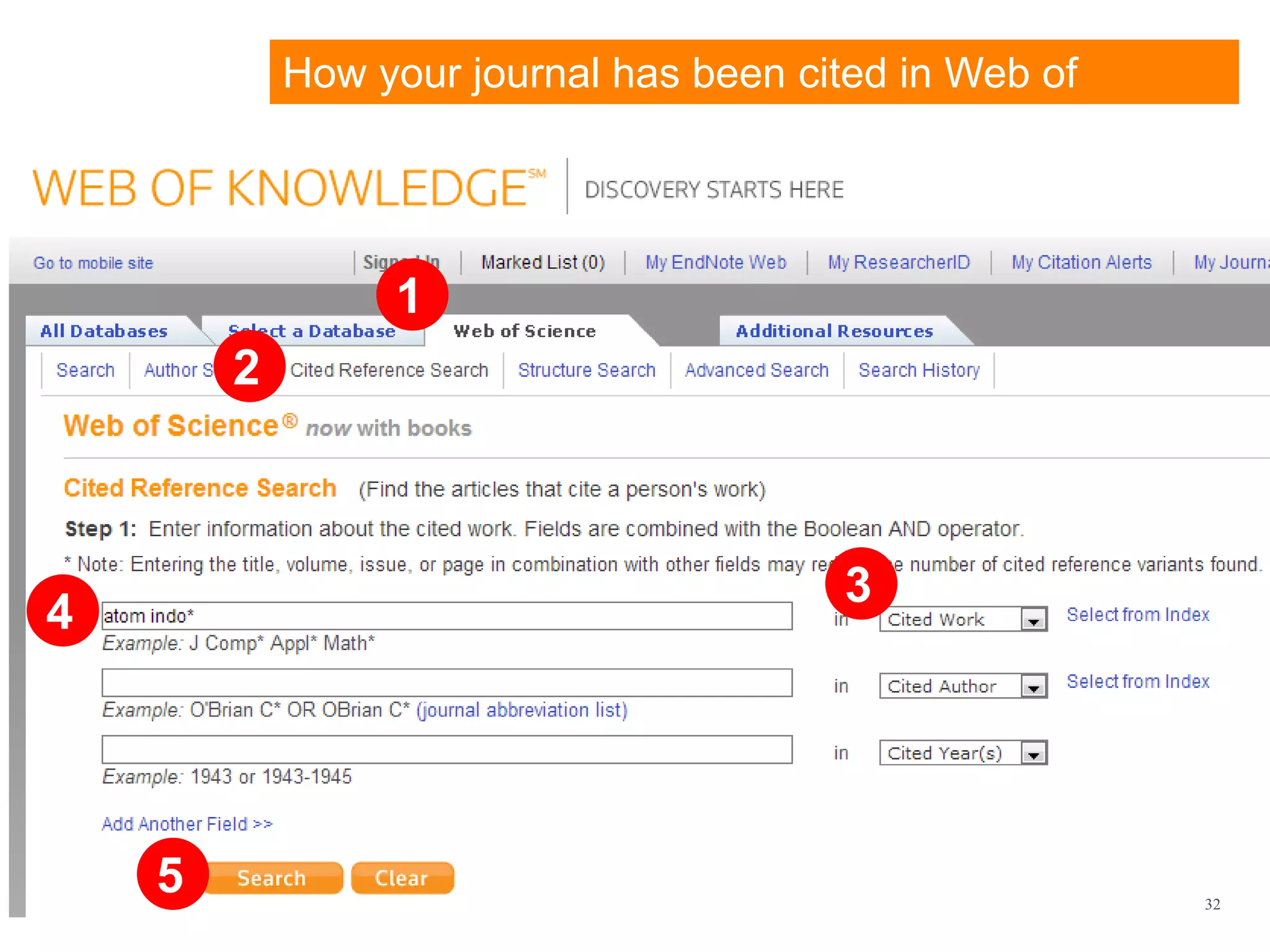
1
2
4
3
5
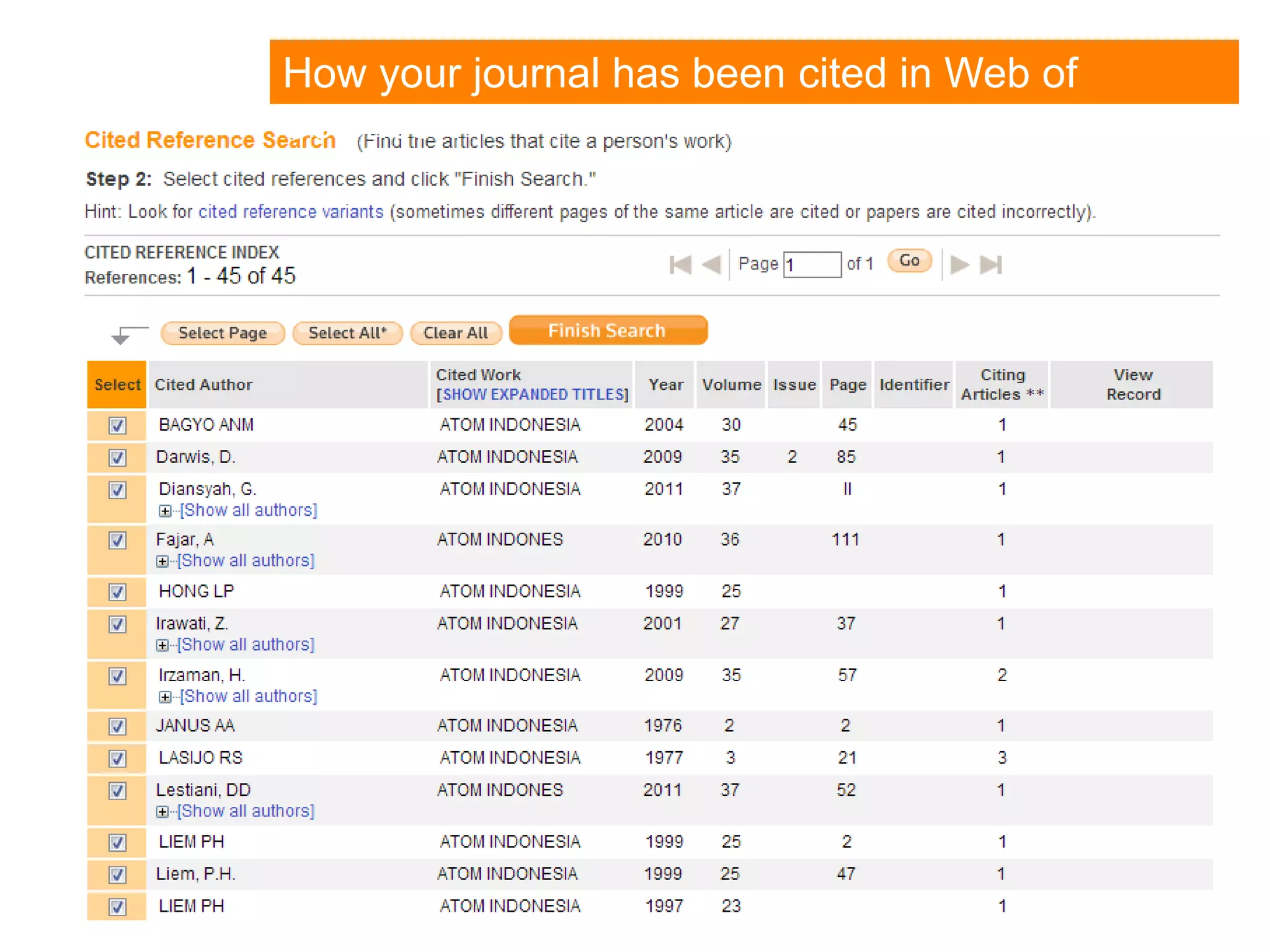
How your journal has been cited in Web of
Science ?
How your journal has been cited in Web of
Science ?
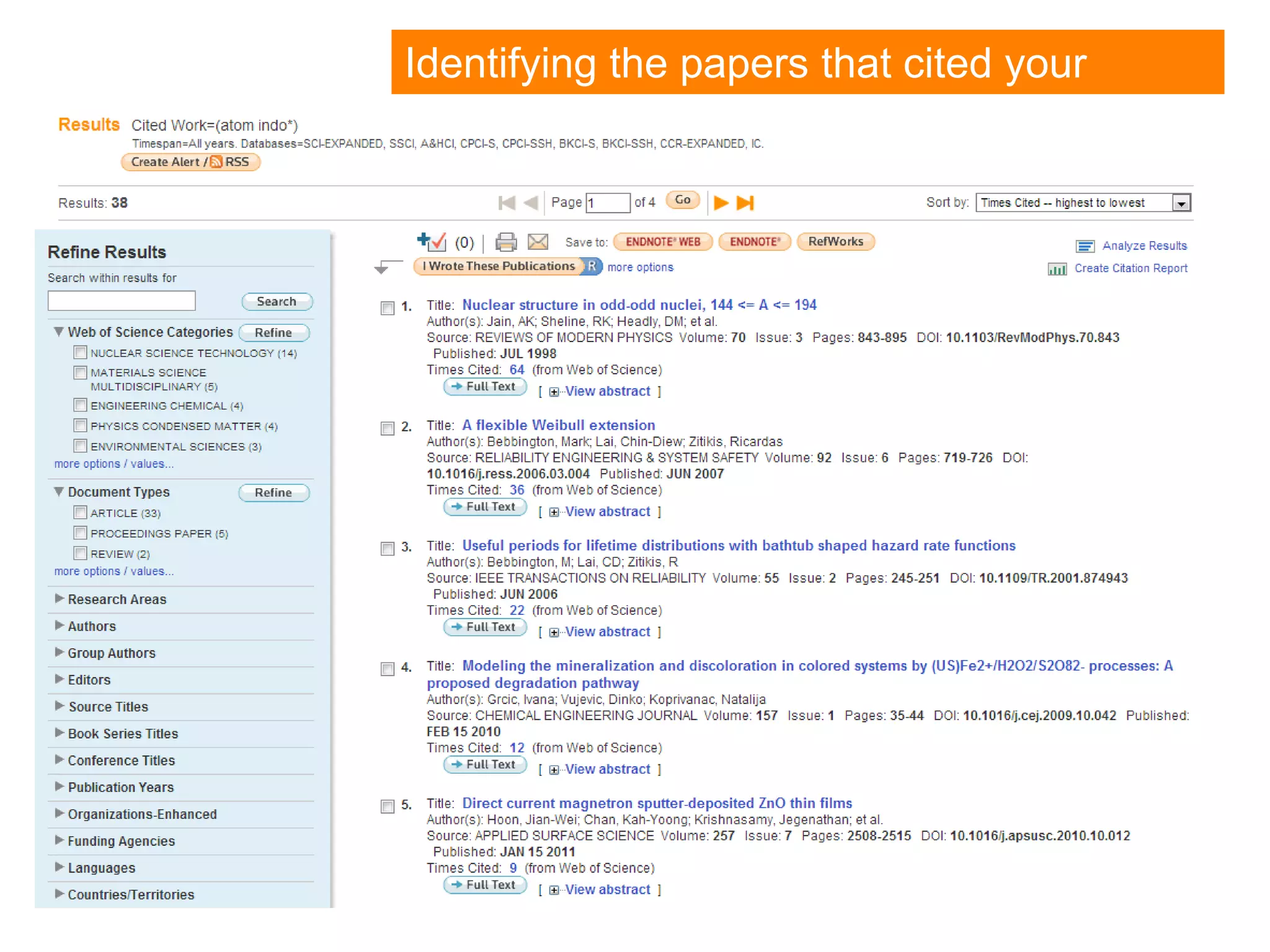
Identifying the papers that cited your
journal
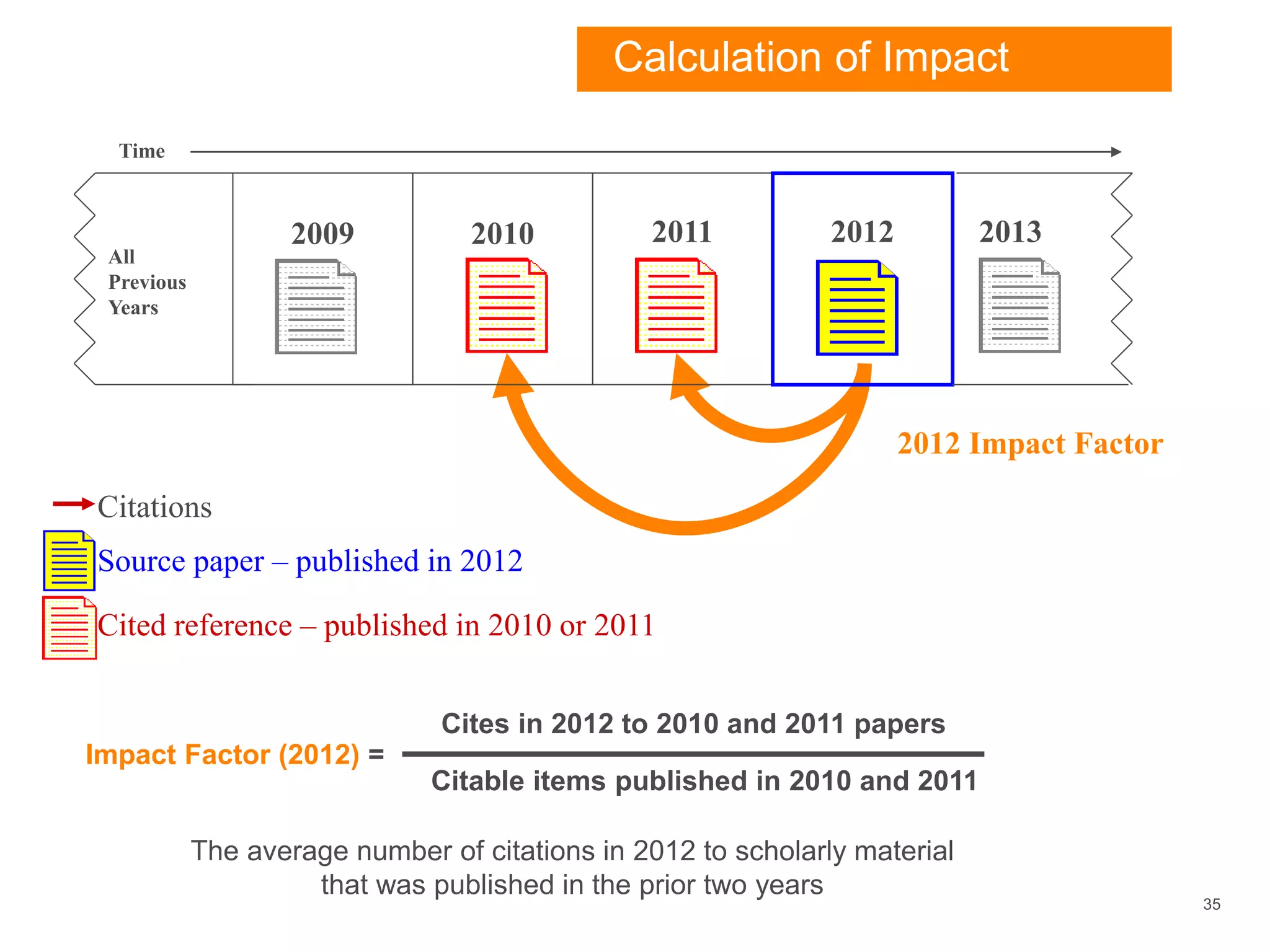
35
Impact Factor (2012) =
Cites in 2012 to 2010 and 2011 papers
Citable items published in 2010 and 2011
The average number of citations in 2012 to scholarly material
that was published in the prior two years
201220112010
Source paper – published in 2012
Cited reference – published in 2010 or 2011
Citations
2012 Impact Factor
All
Previous
Years
2009 2013
Time
Calculation of Impact
Factor
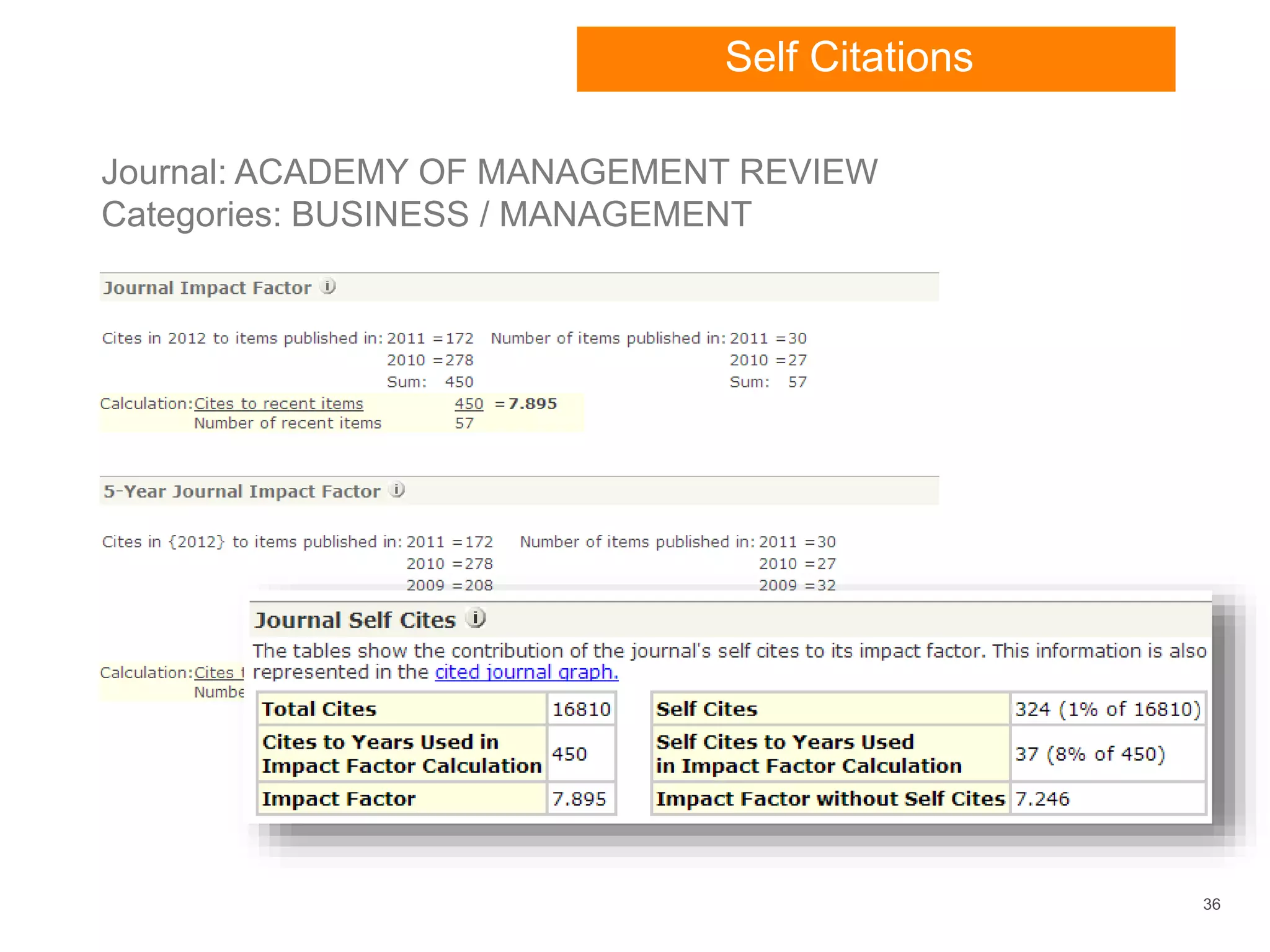
36
Calculation of Impact
Factor
Journal: ACADEMY OF MANAGEMENT REVIEW
Categories: BUSINESS / MANAGEMENT
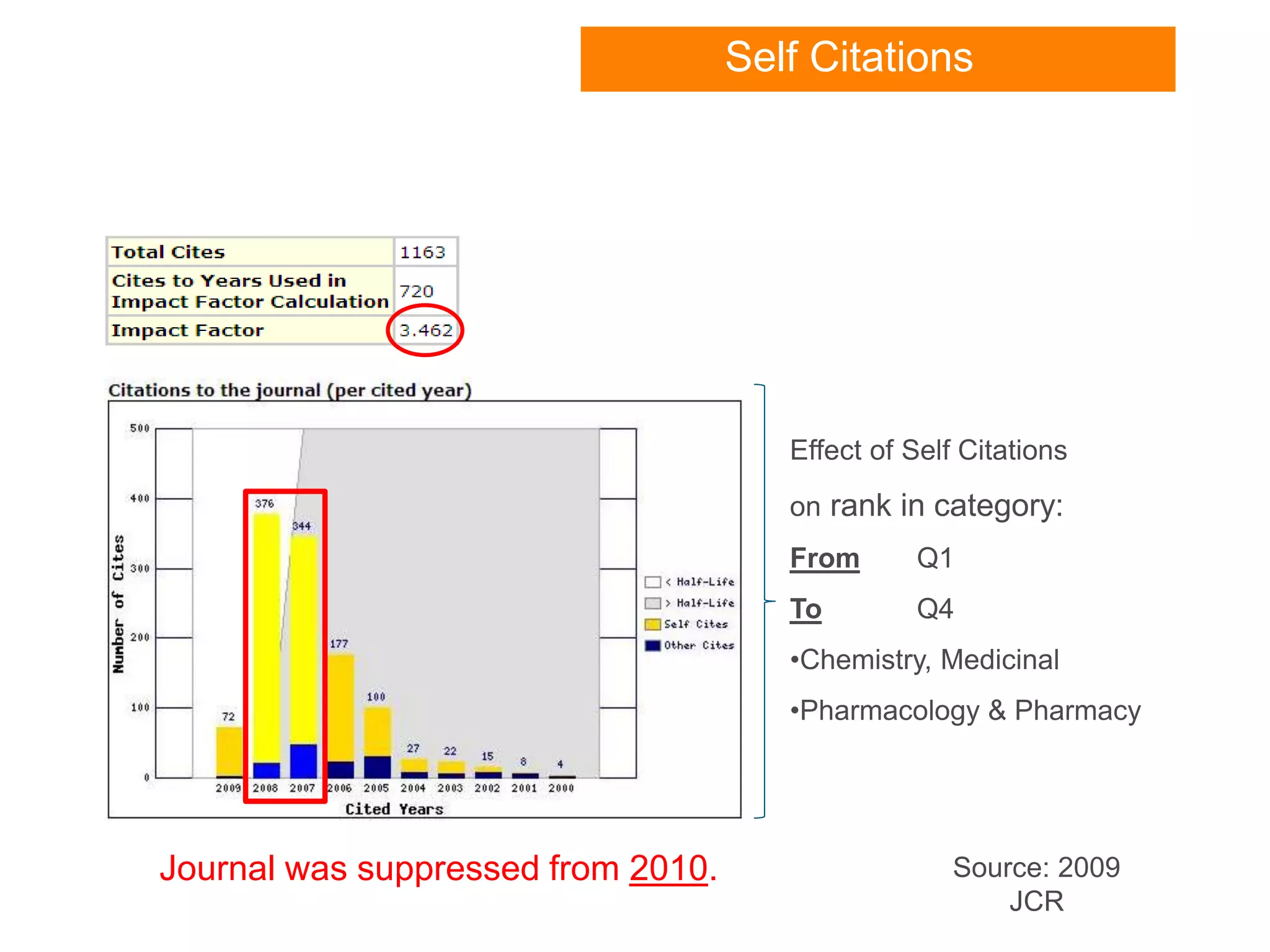
Self Citations
Self Citations
Source: 2009
JCR
Journal was suppressed from 2010.
Effect of Self Citations
on rank in category:
From Q1
To Q4
•Chemistry, Medicinal
•Pharmacology & Pharmacy
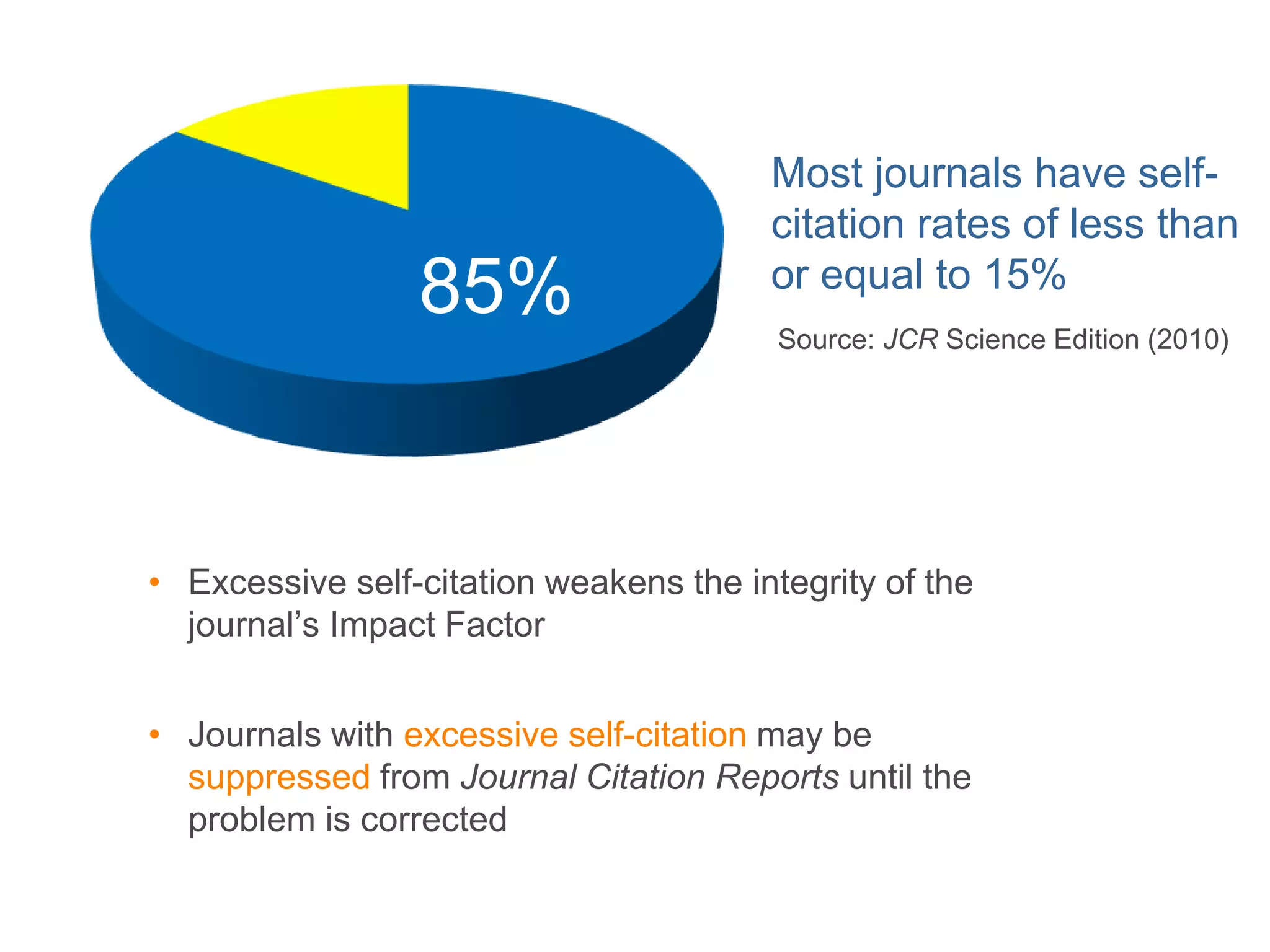
85%
Most journals have self-
citation rates of less than
or equal to 15%
Source: JCR Science Edition (2010)
• Excessive self-citation weakens the integrity of the
journal’s Impact Factor
• Journals with excessive self-citation may be
suppressed from Journal Citation Reports until the
problem is corrected
Journal Selection Process for Web of
Science
Journal
Publishing
Standards
Editorial
Content
International
Diversity
Citation
Analysis
URLs:
• Journal selection process in Portuguese
http://wokinfo.com/essays/journal-selection-process/
• How to submit a Journal
http://ip-science.thomsonreuters.com/info/journalsubmission-front/
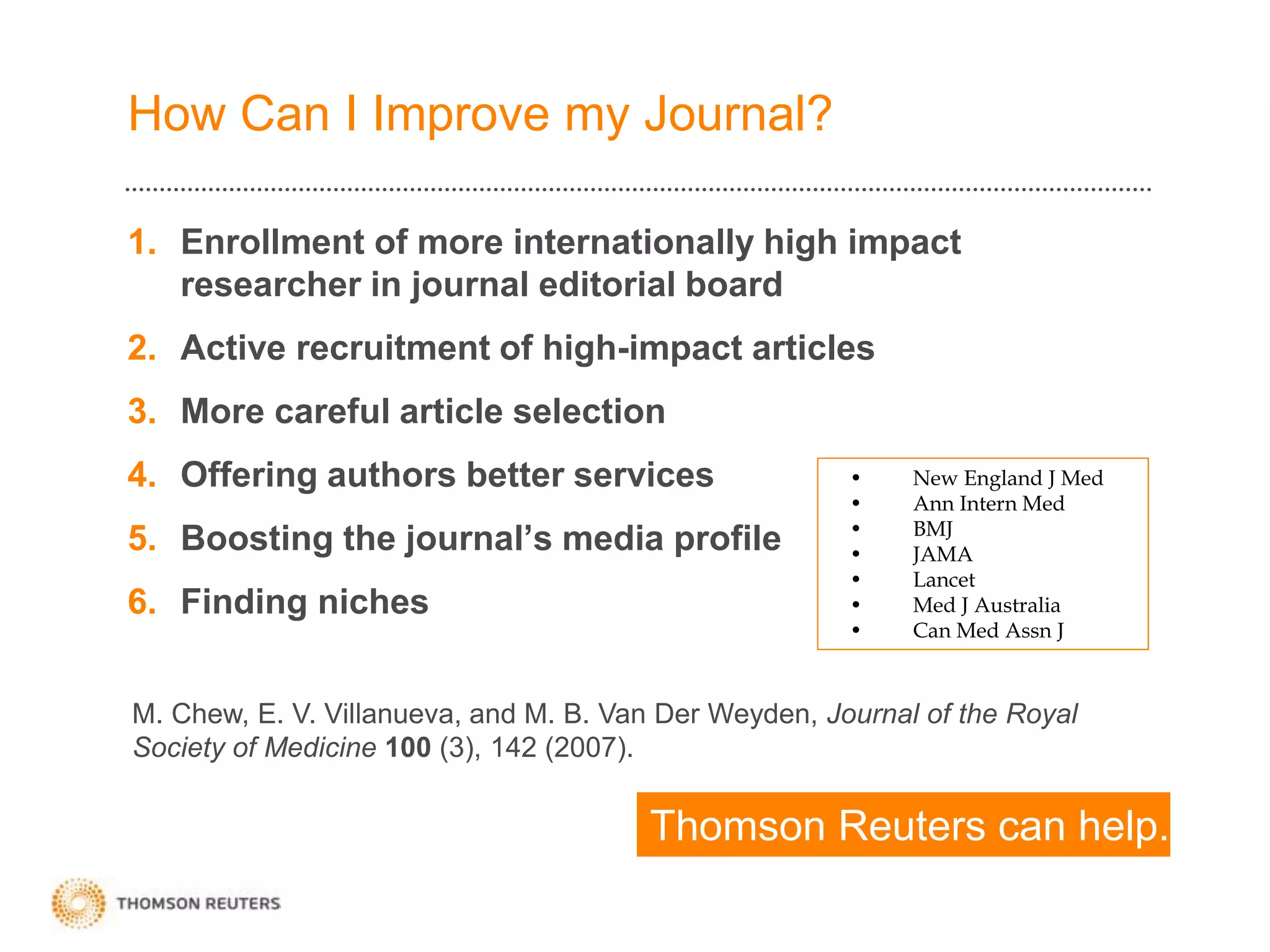
How Can I Improve my Journal?
1. Enrollment of more internationally high impact
researcher in journal editorial board
2. Active recruitment of high-impact articles
3. More careful article selection
4. Offering authors better services
5. Boosting the journal’s media profile
6. Finding niches
• New England J Med
• Ann Intern Med
• BMJ
• JAMA
• Lancet
• Med J Australia
• Can Med Assn J
M. Chew, E. V. Villanueva, and M. B. Van Der Weyden, Journal of the Royal
Society of Medicine 100 (3), 142 (2007).
Thomson Reuters can help.
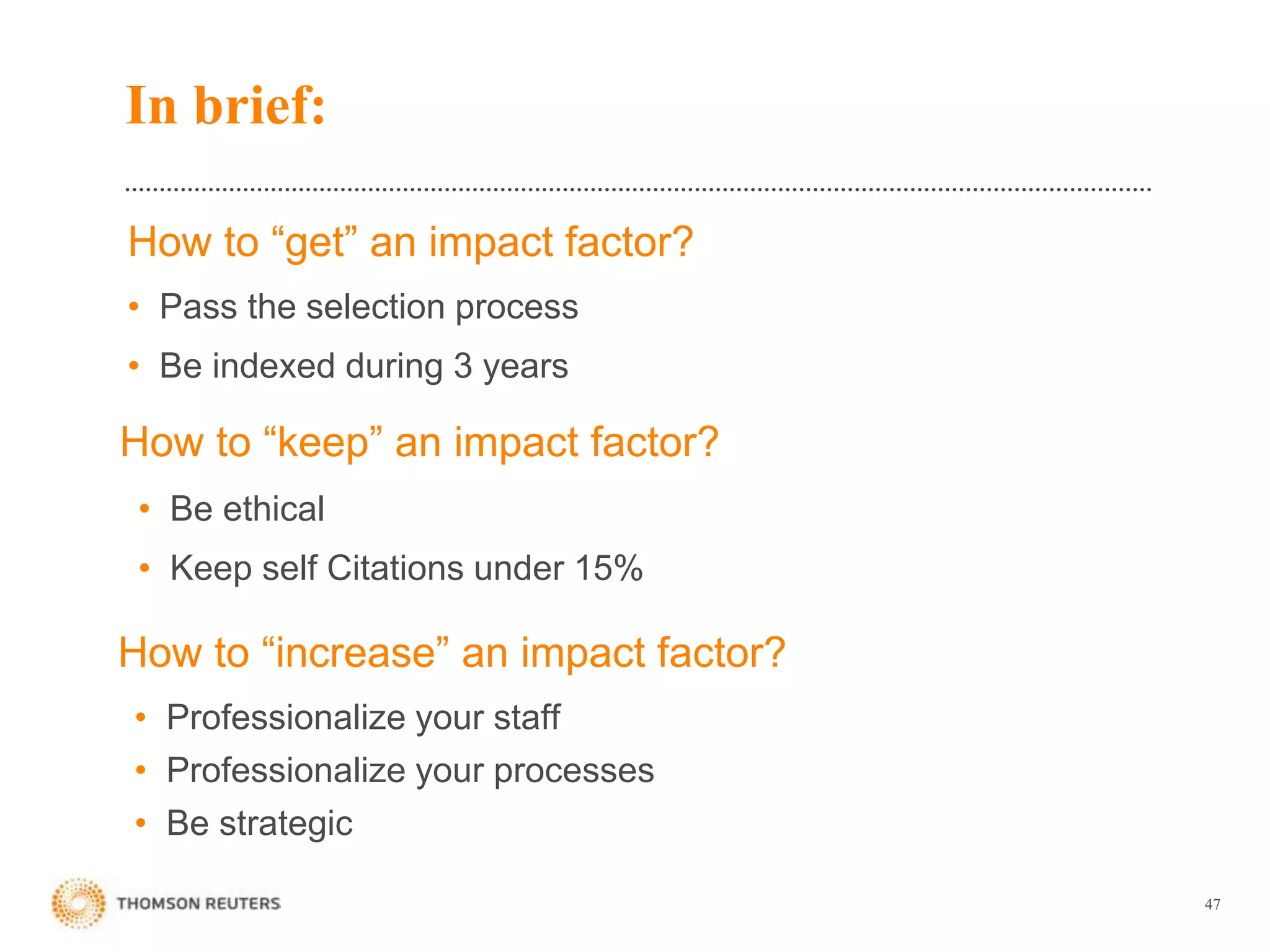
How to “get” an impact factor?
• Pass the selection process
• Be indexed during 3 years
47
How to “keep” an impact factor?
• Be ethical
• Keep self Citations under 15%
How to “increase” an impact factor?
• Professionalize your staff
• Professionalize your processes
• Be strategic
In brief:
Publication Processing
3501 Market Street, Philadelphia,
PA 19104, USA
ts.prsupport@thomsonreuters.com
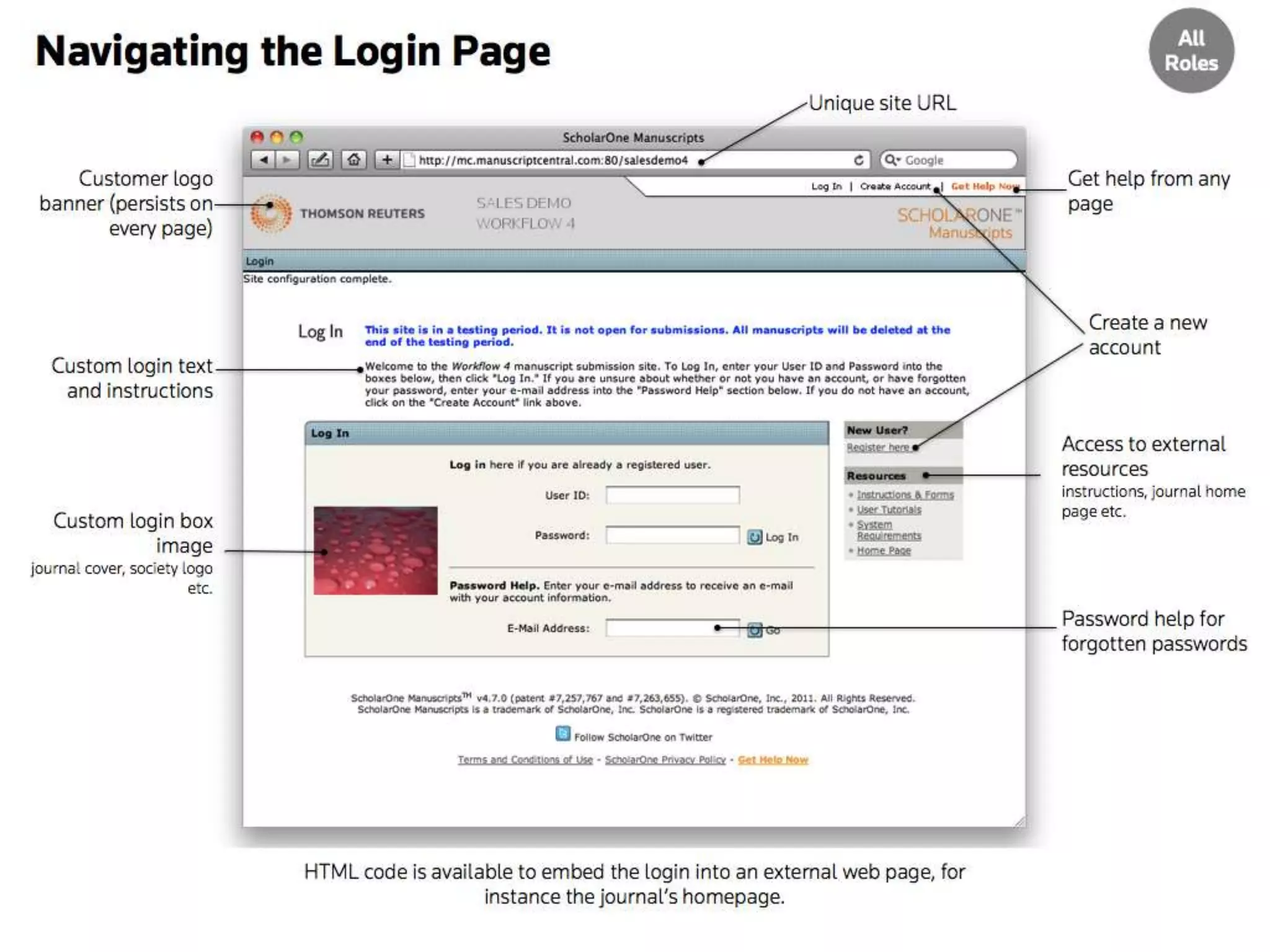
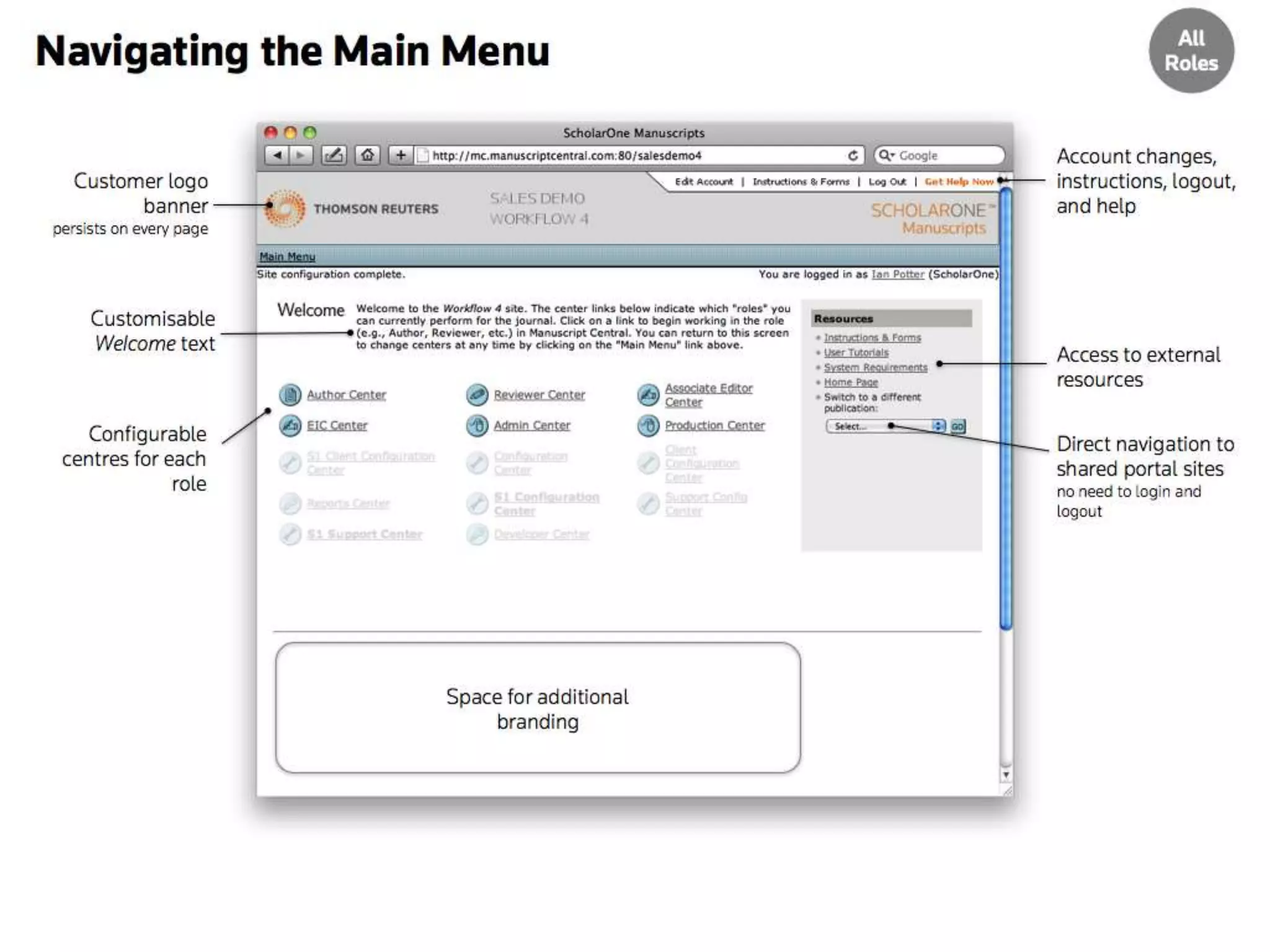
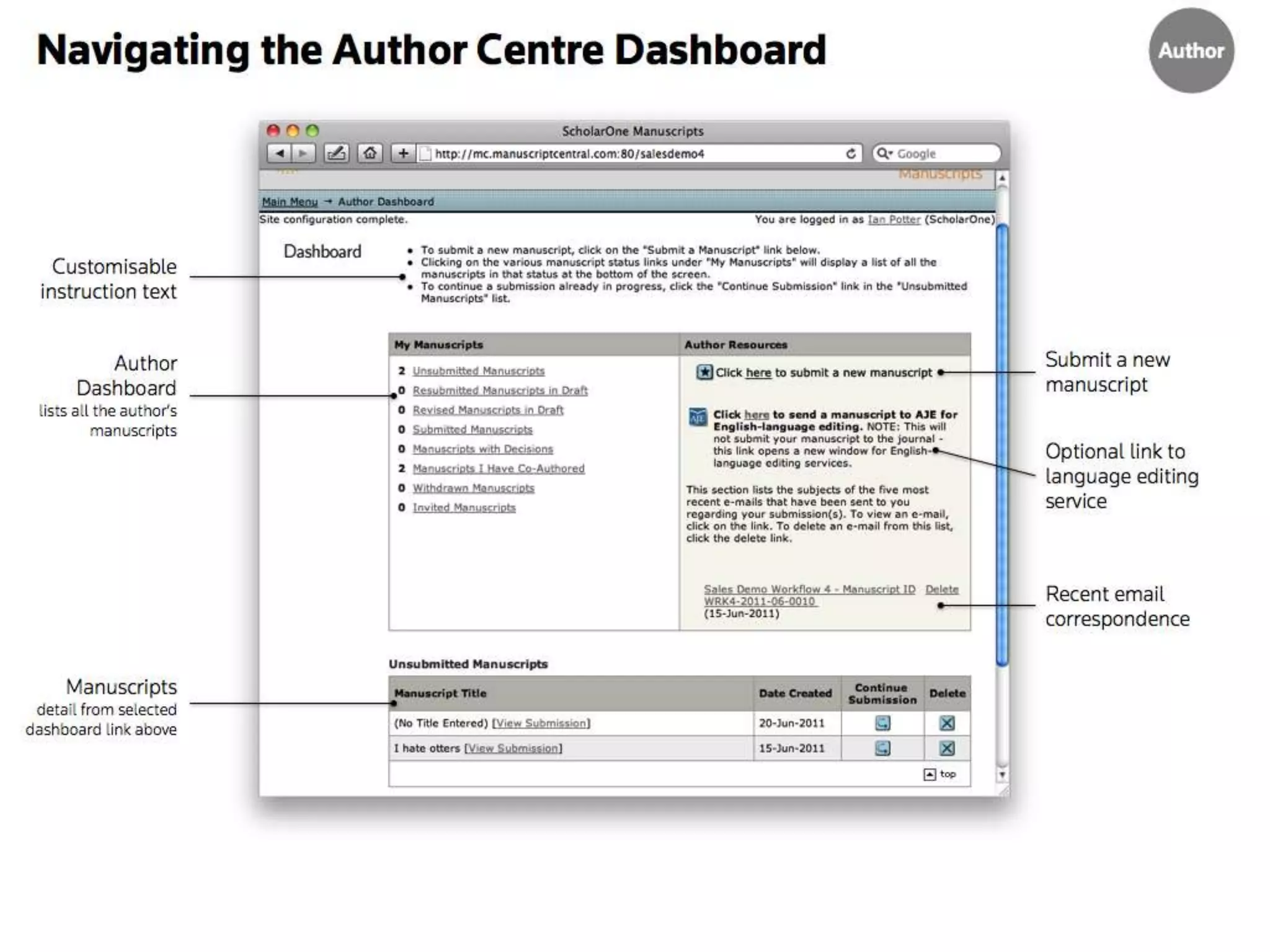
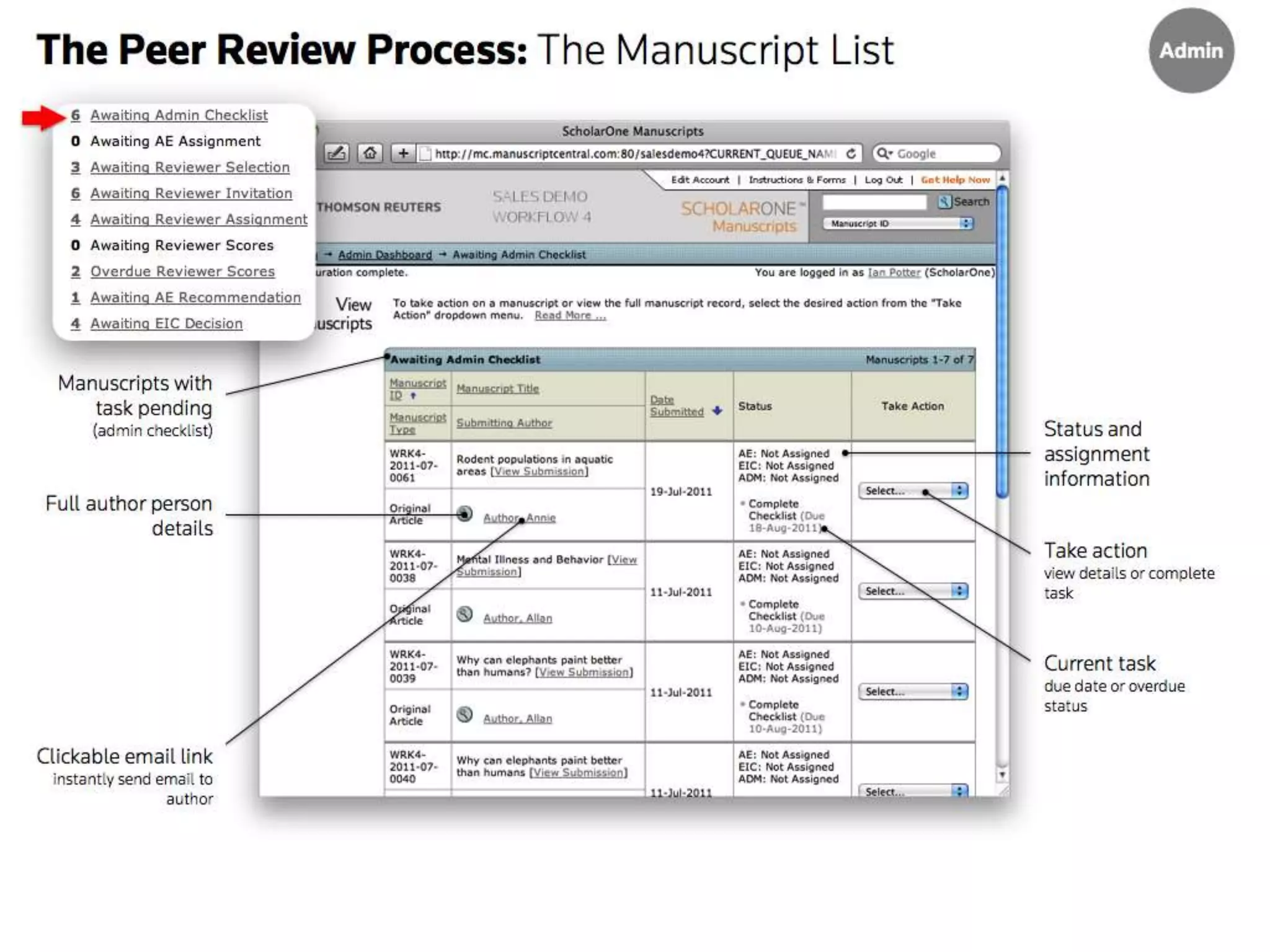
SCHOLARONE MANUSCRIPTS
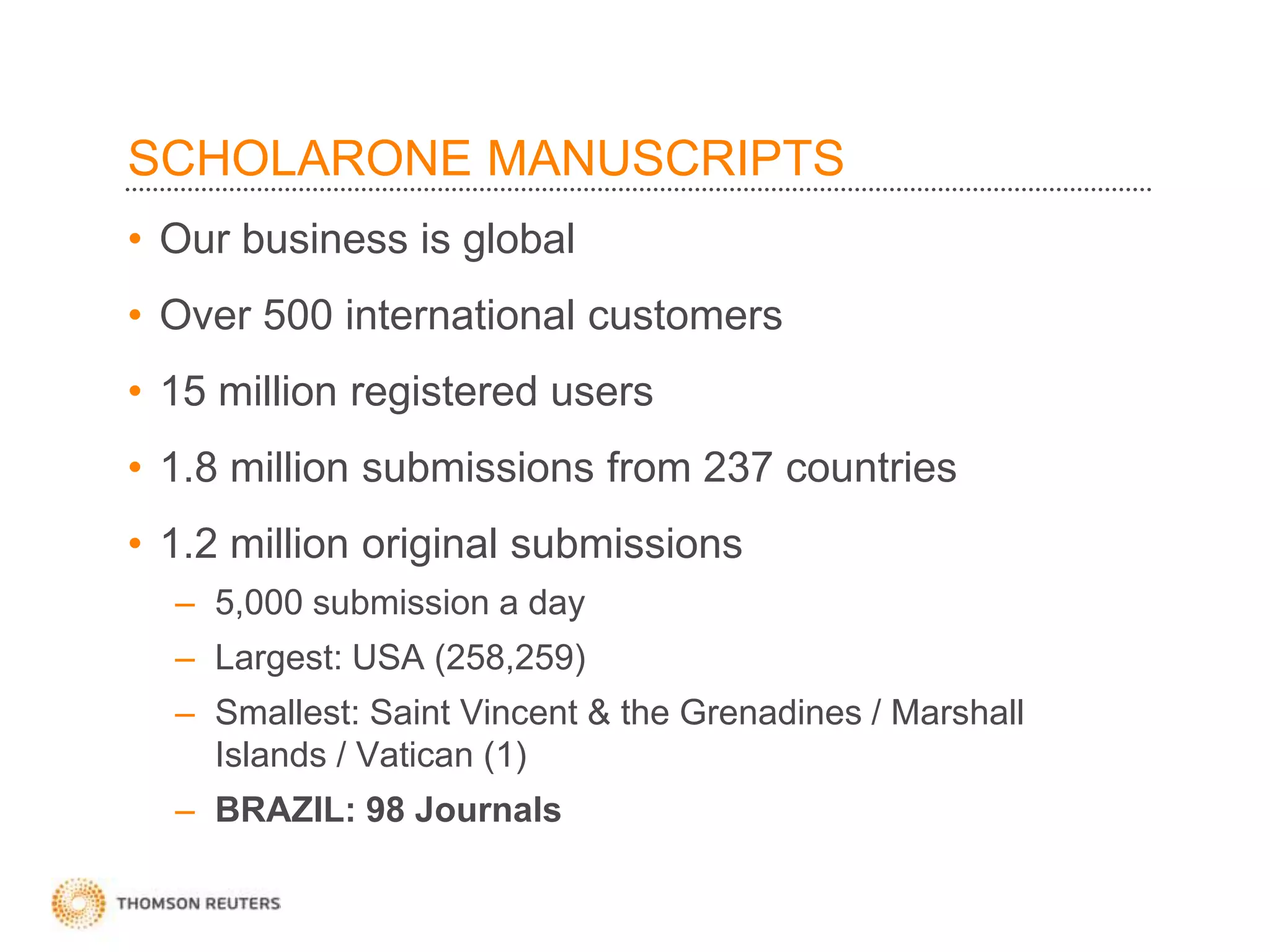
• Our business is global
• Over 500 international customers
• 15 million registered users
• 1.8 million submissions from 237 countries
• 1.2 million original submissions
– 5,000 submission a day
– Largest: USA (258,259)
– Smallest: Saint Vincent & the Grenadines / Marshall
Islands / Vatican (1)
– BRAZIL: 98 Journals
SOME OF OUR CUSTOMERS
51
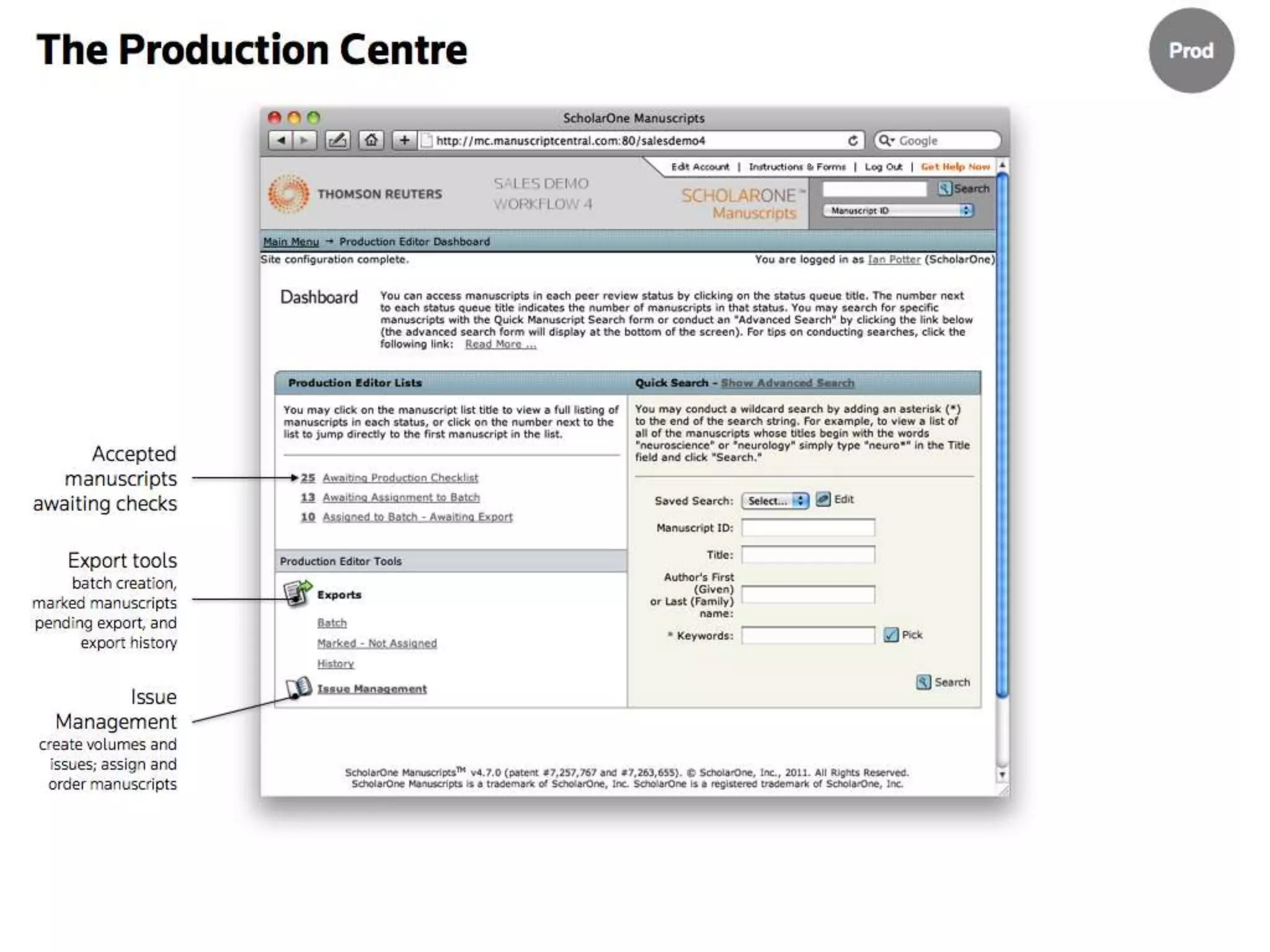
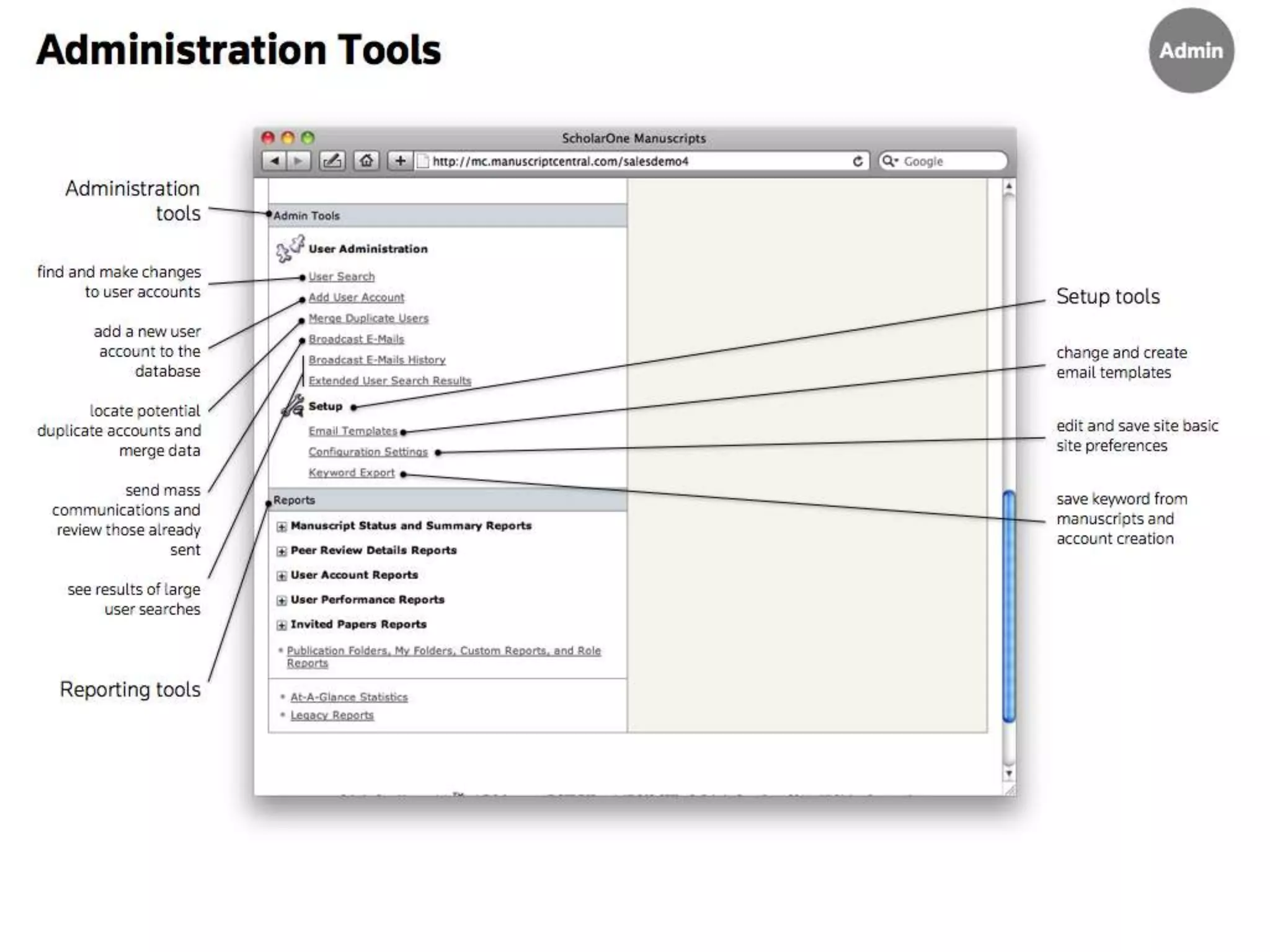
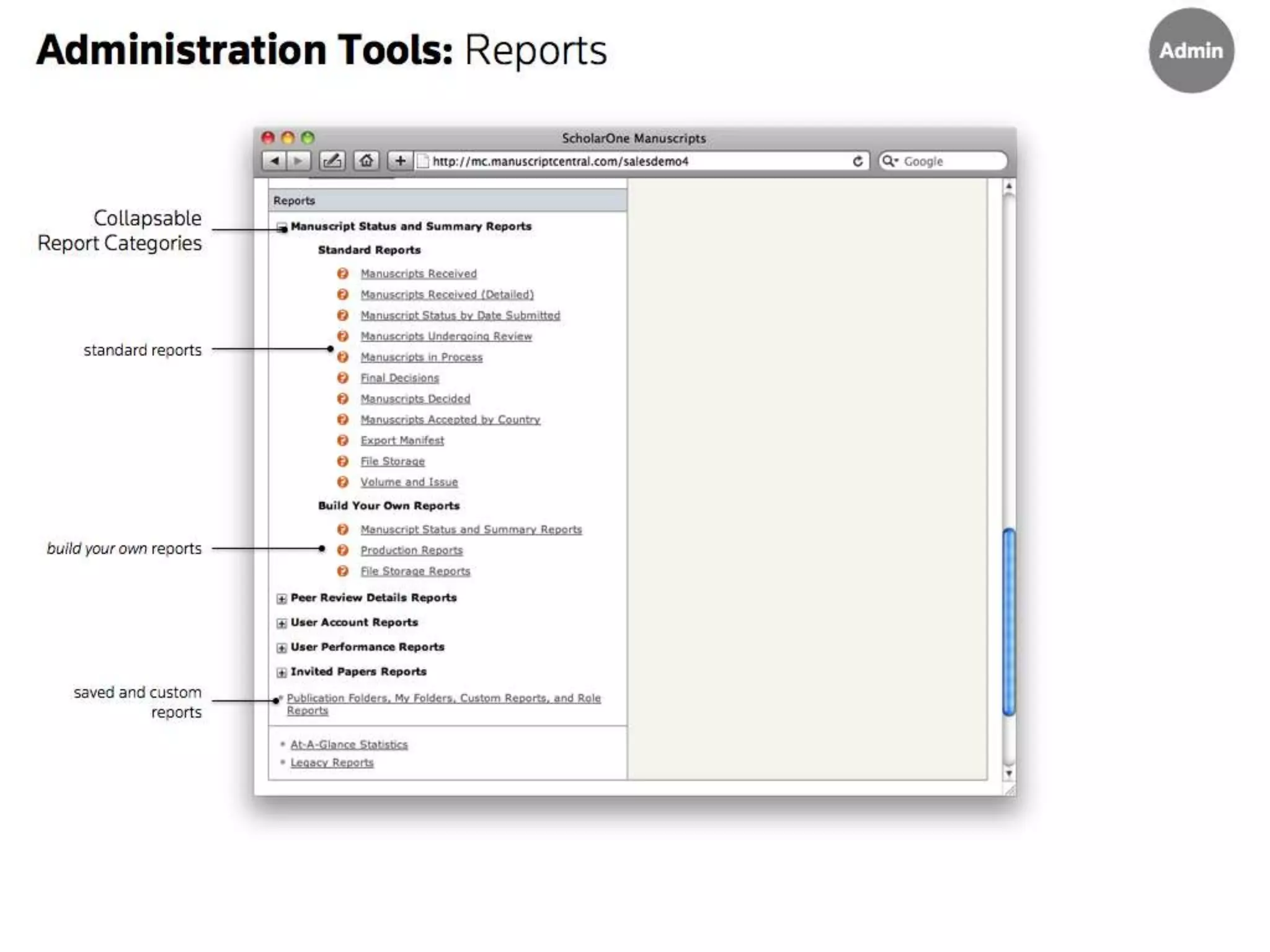
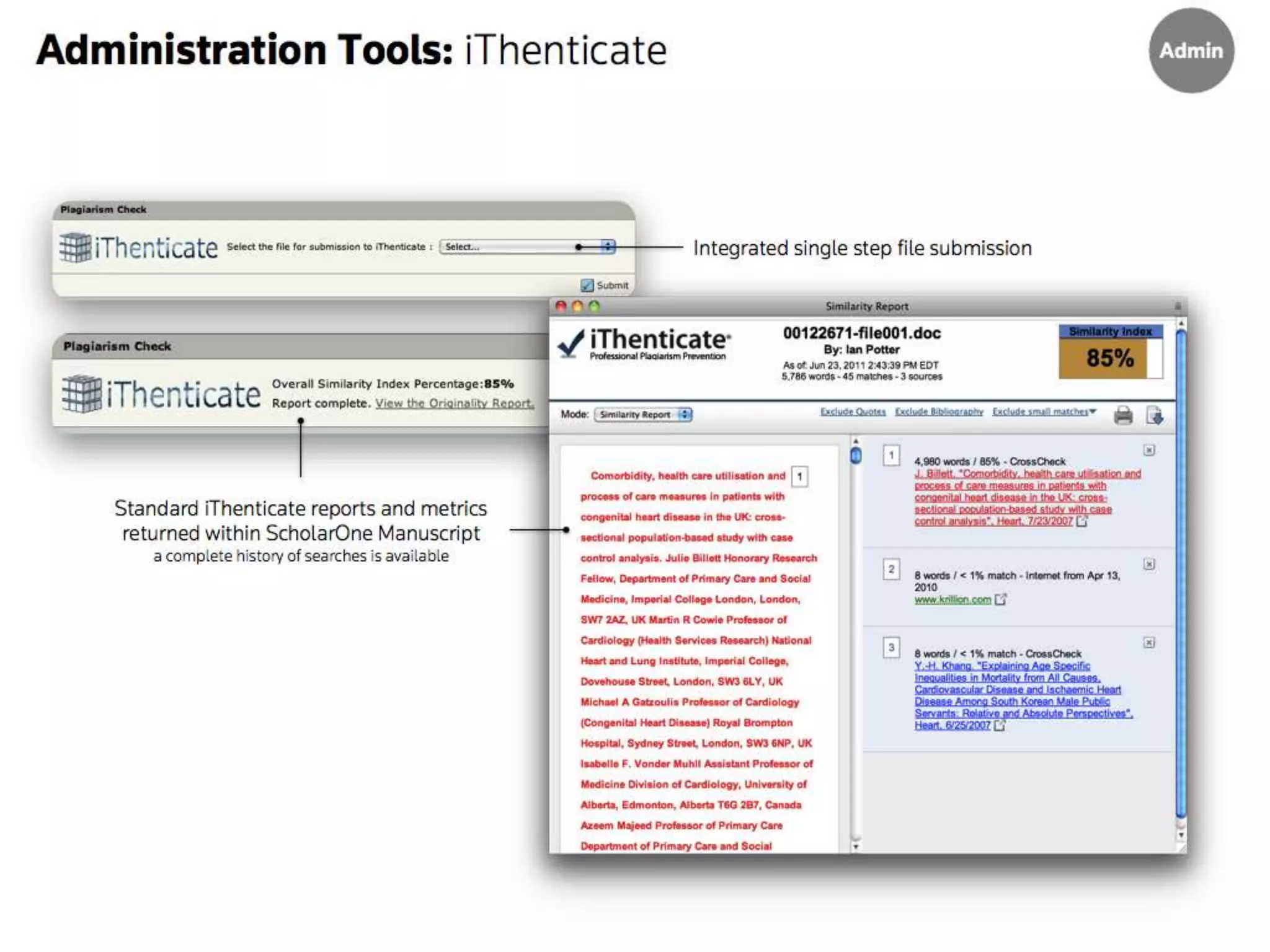
DEMO
DEMO
DEMO
DEMO
DEMO
DEMO
DEMO
DEMO
DEMO
DEMO
DEMO
THANK YOU
Danilo Collalto
Scientific & Scholarly Research
Thomson Reuters
danilo.collalto@thomsonreuters.com

Improving the quality of my journal and increase its impact factor

  • 1.
    Improving the qualityof my journal and increase its impact factor Danilo Collalto Paulo Intellectual Property & Science Scientific and Scholarly Research
  • 2.
    Introducing myself andasking a few questions In this audience: How many of you collaborate in a journal indexed in ISI Web of Science? How many of you represent a publisher of multiple journals? How many of you are members of an editorial board? How many of you are reviewers? How many of you have access to WoS and JCR?
  • 3.
  • 4.
    FACTS 3 papers will beread by a researcher in a year, on average200+ of journals (50,000+) on average a scientist is capable of reading in a year 0.4% Tenopir C. What Scientists Really Need. In: American Association for the Advancement of Science Meeting (AAAS). Washington D.C.; 2005.
  • 5.
    BRADFORD'S LAW 4 0 20 40 60 80 100 120 0 10002000 3000 4000 5000 6000 %ofdatabase # of journals Articles Citations A relatively small number of journals publish the majority of significant scholarly results
  • 6.
    For decades, ThomsonReuters has carefully evaluated journals for potential inclusion in the database 100 % of the top 100 universities have Web of Science GOLD STANDARD used by 5,000+ institutions in 100+ countries scholarshi p Selective, yet comprehensive BESTDiscover the world’s
  • 7.
    JOURNAL SELECTION :MAIN OBJECTIVES 1. To evaluate and select the best scholarly journal content available today for coverage in Web of Science. As a result, the Web of Science is known as the worldwide source for top tier scholarly research published in the best international and regional journals. 2. Provide the worldwide publishing community with objective standards useful in building world-class publications. Thomson Reuters has built lasting partnerships with the global scholarly publishing community. We work together to improve the quality of scholarly communication everywhere in the world. 6
  • 8.
    3000+ 10 ~ 12%Accepted A continual process of evaluation and assessment of existing journals Necessary information is provided based upon a consistent selection process
  • 9.
    A list ofcurrent journals in collection http://ip-science.thomsonreuters.com/mjl
  • 10.
    Journal Selection Processfor Web of Science Journal Publishing Standards Editorial Content International Diversity Citation Analysis Four Points of Evaluation
  • 11.
    Journal Selection Processfor Web of Science Journal Publishing Standards Editorial Content International Diversity Citation Analysis • Timeliness of publication • International Editorial Conventions • English language Bibliographic Information • Peer Review
  • 12.
    Timeliness of publication •A journal must be published according to its stated publication schedule • Must receive three current issues in sequence to begin evaluation Ja n Mar May Jul Sep Nov Journal 1 Journal 2 Journal 3 Journal 4 Journal 5 Journal 6 The content is robust with sufficient manuscripts in the pipeline
  • 13.
    Journal Selection Processfor Web of Science Journal Publishing Standards Editorial Content International Diversity Citation Analysis • Timeliness of publication • International Editorial Conventions • English language Bibliographic Information • Peer Review
  • 14.
    13 Informative Journal titles InternationalEditorial Conventions Fully descriptive Article titles and abstracts Full address information for every author
  • 15.
    14 International Editorial Conventions Completebibliographic information for all cited references
  • 16.
    Journal Selection Processfor Web of Science Journal Publishing Standards Editorial Content International Diversity Citation Analysis • Timeliness of publication • International Editorial Conventions • English language Bibliographic Information • Peer Review
  • 17.
    English language BibliographicInformation • Article titles • Author names and addresses • Cited references in the Roman alphabet • Abstracts and Keywords
  • 18.
    English language BibliographicInformation However, English language content is not always essential in some areas of the Arts & Humanities such as national literature studies where full text in the native language is normal.
  • 19.
    Journal Selection Processfor Web of Science Journal Publishing Standards Editorial Content International Diversity Citation Analysis • Timeliness of publication • International Editorial Conventions • English language Bibliographic Information • Peer Review
  • 20.
    Peer Review mustbe an explicit part of the publishing process
  • 21.
    Funding source isalso recommended whenever possible
  • 22.
    Journal Selection Processfor Web of Science Journal Publishing Standards Editorial Content International Diversity Citation Analysis • How does this journal compare with covered journals of similar scope? • Is this subject already well covered? • Will this journal enrich WoS with novel content? Core coverage in Web of Science is not static !
  • 23.
    What journals arecovered in specific subject category?
  • 24.
    What journals arecovered in specific subject category? What journals are covered in specific subject category?
  • 25.
    What are thecontents in a journal of interest ?
  • 26.
    Journal Selection Processfor Web of Science Journal Publishing Standards Editorial Content International Diversity Citation Analysis • Does this journal target an International or Regional audience? • Do authors, editors, Editorial Advisory Board members represent the international research community?
  • 27.
    Publication Name=(Clinical InfectiousDiseases ) Impact Factor (2012) : 9.374 EDITORIAL ADVISORY BOARD Anucha Apisarnthanarak, Pratumthani, Thailand Roberto Badaro, Salvador, Brazil Carol J. Baker, Houston Fernando Baquero, Madrid, Spain John G. Bartlett, Baltimore Stephen G. Baum, New York John E. Bennett, Bethesda Emilio Bouza, Madrid, Spain Yehuda Carmeli, Tel Aviv, Israel G. Ralph Corey, Durham Erika M.C. D'Agata, Boston Silvano Esposito, Naples, Italy Javier Garau, Barcelona, Spain Jose M. Gatell, Barcelona, Spain M. Lindsay Grayson, Melbourne, Australia James G. Hakim, Harare, Zimbabwe Carol A. Kauffman, Ann Arbor Keith P. Klugman, Atlanta Umesh G. Lalloo, Congella, South Africa Stephen D. Lawn, Cape Town, South Africa Catherine Leport, Paris, France Daniel P. Lew, Geneva, Switzerland Lionel A. Mandell, Hamilton, Canada Jeanne M. Marrazzo, Seattle Thomas J. Marrie, Halifax, Canada Daniel M. Musher, Houston Carl Erik Nord, Stockholm, Sweden Timothy Peto, Oxford, England Didier Raoult, Marseille, France Guillermo M. Ruiz-Palacios, Tlalpan, Mexico Marisela Silva, Caracas, Venezuela Vincent Soriano, Madrid, Spain Soumya Swaminathan, Chennai, India Joseph M. Vinetz, La Jolla Gui-Qiang Wang, Beijing, China Andreas F. Widmer, Basel, Switzerland Kwok-yung Yuen, Hong Kong, China Anita K. M. Zaidi, Karachi, Pakistan Abigail D. Zuger, New York 15 9 Countries / territories represented in article level (Web of Science) Do the contributing authors, EAB represent the international research community ? Source: http://cid.oxfordjournals.org (as of 18 October 2013) Source: Thomson Reuters Web of Science (as of 18 October 2013)
  • 28.
    Publication Name=(Neurological Research) Theneed for international diversity is viewed in relationship to the target audience for the journal 60 Countries / territoriesInternational audience Source: Thomson Reuters Web of Science (as of 18 October 2013)
  • 29.
    Publication Name=(Asian PacificJournal of Allergy and Immunology) 34 Countries / territories The need for international diversity is viewed in relationship to the target audience for the journal Regional focus Source: Thomson Reuters Web of Science (as of 18 October 2013)
  • 30.
    Regional Journals • From2007-2009 • focused on a collection of more than 10,000 regional journals • 1600 met the review standards for inclusion in the Web of Science • accounting for 55% of all new journals indexed between 2005-2010 29
  • 31.
    Regional focus Journals •Importance is measured in terms of content specificity: – Will it enrich coverage of a subject? – Will it provide specific regional perspective? • Publish excellent research targeted at a regional rather than international audience • Citation Impact may be low to moderate – but stable • Regional journals meet all journal selection criteria 30
  • 32.
    Journal Selection Processfor Web of Science Journal Publishing Standards Editorial Content International Diversity Citation Analysis • New journals - Citations to authors’ and editors’ prior work. • Established Journals - Estimated Impact Factor - How the journal compares to other journals in its field
  • 33.
    32 1 2 4 3 5 How your journalhas been cited in Web of Science ?
  • 34.
    How your journalhas been cited in Web of Science ?
  • 35.
    Identifying the papersthat cited your journal
  • 36.
    35 Impact Factor (2012)= Cites in 2012 to 2010 and 2011 papers Citable items published in 2010 and 2011 The average number of citations in 2012 to scholarly material that was published in the prior two years 201220112010 Source paper – published in 2012 Cited reference – published in 2010 or 2011 Citations 2012 Impact Factor All Previous Years 2009 2013 Time Calculation of Impact Factor
  • 37.
    36 Calculation of Impact Factor Journal:ACADEMY OF MANAGEMENT REVIEW Categories: BUSINESS / MANAGEMENT Self Citations
  • 38.
    Self Citations Source: 2009 JCR Journalwas suppressed from 2010. Effect of Self Citations on rank in category: From Q1 To Q4 •Chemistry, Medicinal •Pharmacology & Pharmacy
  • 39.
    85% Most journals haveself- citation rates of less than or equal to 15% Source: JCR Science Edition (2010) • Excessive self-citation weakens the integrity of the journal’s Impact Factor • Journals with excessive self-citation may be suppressed from Journal Citation Reports until the problem is corrected
  • 40.
    Journal Selection Processfor Web of Science Journal Publishing Standards Editorial Content International Diversity Citation Analysis
  • 41.
    URLs: • Journal selectionprocess in Portuguese http://wokinfo.com/essays/journal-selection-process/ • How to submit a Journal http://ip-science.thomsonreuters.com/info/journalsubmission-front/
  • 42.
    How Can IImprove my Journal? 1. Enrollment of more internationally high impact researcher in journal editorial board 2. Active recruitment of high-impact articles 3. More careful article selection 4. Offering authors better services 5. Boosting the journal’s media profile 6. Finding niches • New England J Med • Ann Intern Med • BMJ • JAMA • Lancet • Med J Australia • Can Med Assn J M. Chew, E. V. Villanueva, and M. B. Van Der Weyden, Journal of the Royal Society of Medicine 100 (3), 142 (2007). Thomson Reuters can help.
  • 43.
    How to “get”an impact factor? • Pass the selection process • Be indexed during 3 years 47 How to “keep” an impact factor? • Be ethical • Keep self Citations under 15% How to “increase” an impact factor? • Professionalize your staff • Professionalize your processes • Be strategic In brief:
  • 44.
    Publication Processing 3501 MarketStreet, Philadelphia, PA 19104, USA ts.prsupport@thomsonreuters.com
  • 46.
    SCHOLARONE MANUSCRIPTS • Ourbusiness is global • Over 500 international customers • 15 million registered users • 1.8 million submissions from 237 countries • 1.2 million original submissions – 5,000 submission a day – Largest: USA (258,259) – Smallest: Saint Vincent & the Grenadines / Marshall Islands / Vatican (1) – BRAZIL: 98 Journals
  • 47.
    SOME OF OURCUSTOMERS 51
  • 48.
  • 49.
  • 50.
  • 51.
  • 52.
  • 53.
  • 54.
  • 55.
  • 56.
  • 57.
  • 58.
  • 59.
    THANK YOU Danilo Collalto Scientific& Scholarly Research Thomson Reuters danilo.collalto@thomsonreuters.com