1
2
Before you start writing a research paper
Read relevant journals; scan abstract journals.
Choose a target journal; note policy and scope.
Study instructions to authors.
Study a recent issue of the target journal.
Springer journal selector
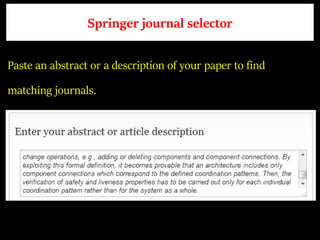
Paste an abstract or a description of your paper to find
matching journals.
Springer journal selector
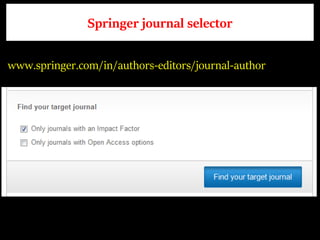
www.springer.com/in/authors-editors/journal-author
Elsevier journal selector
<http://journalfinder.elsevier.com/>
Insert title and abstract and select the field of research.
Research articles (up to ~4500 words) present a major
advance.
Reports (up to ~2500 words) present important new research
results of broad significance.
Reviews (up to 6000 words) describe and synthesize recent
developments of interdisciplinary significance and highlight
future directions.
Letters (up to 300 words) discuss material published in
Science in the last 3 months or issues of general interest.
Categories or ‘departments’ in Science
7
Pre-review assessment
Within the broad remit of the journal?
Addresses a broad subject area?
Have the potential to make a substantial contribution?
Subject topical and of interest to a wide readership?
Appropriately formatted?
Novel and interesting?
From submission to publication
1. Author submits (sends or uploads) a manuscript
2. Preliminary screening by the journal.
3. If not rejected, sent to reviewers (referees)
4. Reviewers’ comments conveyed to author
5. Author submits revised version
6. Matter sent for processing: proofs to author
7. Author returns corrected proofs; paper published
Journal of Ecology: possible decisions, 1
Manuscript unsuitable: subject matter inappropriate or lacks
novelty or is of insufficient general interest— rejected without
peer review.
Rejection after peer review
Rejection, resubmission invited: referees and editors see the
potential of the presented work
Revision: major or minor changes required
Journal of Ecology: possible decisions, 2
Further revision needed: comments only partly or
insufficiently addressed; further ambiguities remain. Authors
are asked to address these concerns in their final version.
 Acceptance subject to editing: content of acceptable standard
for publication; only editorial changes required.
Final acceptance: acceptance confirmed after a final editorial
check; files and forms are sent to publisher.
Writing the title and the abstract
‘Most people will decide whether to read a paper
solely on the basis of its title.’
Realize that title and abstract work together.
Use abbreviations sparingly.
Do not repeat information already in the title.
Use as keywords terms not already used in the title.
Skip background information.
Making it easy for others to find your paper, 1
Advice at authorservices.wiley.com/bauthor/seo.asp
Use 2- or 3-word phrases as keywords
Wiley Author Services: ‘Choose a clear, accurate title. [Use]
search terms that readers are likely to use when looking for
articles on the same topic as yours, and help them by
constructing your title to include those terms.’
Making it easy for others to find your paper, 2
‘Please pay attention to the keywords you select: they should
not already appear in the title or abstract. Rather, they should
be selected to draw in readers from wider areas that might not
otherwise pick up your paper when they are using search
engines.’
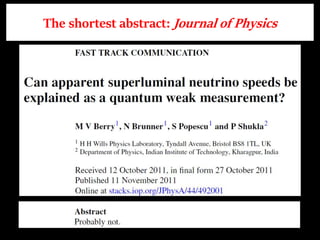
The shortest abstract: Journal of Physics
The IMRaD structure of a research paper
Introduction: reason for doing work, nature of hypothesis,
essential background
Materials and methods: sufficient details of techniques to enable
the work to be repeated.
Results: draw attention to important details in tables and
figures.
Discussion: significance of results in relation to reasons for
doing the work, and place them in the context of other work.
Writing the introduction
Answer the question W H Y.
State the problem.
Explain why the problem is important.
Review what has been done so far to solve it.
Introduce the study by pointing out what is different about it
compared to past research.
Writing the materials and methods section
Answer the question H O W.
Include enough detail for others to repeat the experiment.
Give sources of material, make and model of equipment,
quantities, duration, season, etc.
Writing the results section
Answer the question W H A T.
State only the results; leave comments and explanations for
the Discussion section.
Use tables and charts as appropriate but do not duplicate
information.
If results are not statistically significant, do not discuss them.
Writing the discussion section
Answer the question S O W H A T.
Explain what the results mean and how they are important.
Compare the results with earlier findings;
explain contradictory results, if any.
Suggest future line of work.
Sum up with a conclusion.
Finishing touches: following a journal’s style
Follow capitalization, bold, italics, Fig. / Figure, etc.
Follow style for headings: numbered or not numbered
Follow the target journal’s style but
— do not use multiple columns
— use a standard, serif font: Times, Georgia, Calibri
— use left justification; turn hyphenation off
— ignore indents, small capitals, running heads
— submit tables and figures as separate files.
https://www.springer.com/in/authors-
editors/journal-author
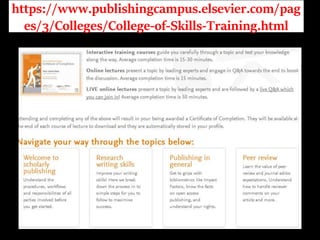
https://www.publishingcampus.elsevier.com/pag
es/3/Colleges/College-of-Skills-Training.html
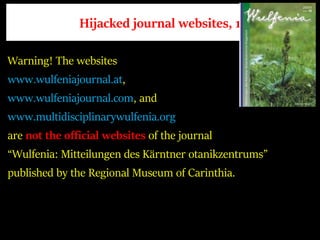
Hijacked journal websites, 1
Warning! The websites
www.wulfeniajournal.at,
www.wulfeniajournal.com, and
www.multidisciplinarywulfenia.org
are not the official websites of the journal
“Wulfenia: Mitteilungen des Kärntner otanikzentrums”
published by the Regional Museum of Carinthia.
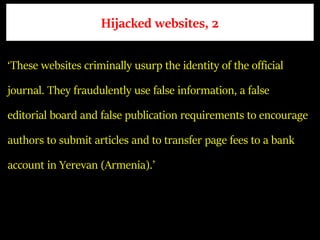
Hijacked websites, 2
‘These websites criminally usurp the identity of the official
journal. They fraudulently use false information, a false
editorial board and false publication requirements to encourage
authors to submit articles and to transfer page fees to a bank
account in Yerevan (Armenia).’
‘Predatory’ journals
Capitalize on the pressure to publish.
Charge a fee upfront and guarantee very rapid publication.
Offer no peer review or a cursory peer review.
Have large editorial boards with members spread worldwide.
Seldom show a physical location (street address).
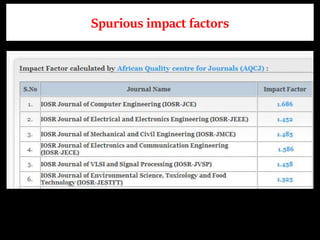
Show spurious impact factors.
Are typically multidisciplinary.
Spurious impact factors
Beware of invitations to submit papers
Beall’s List of Predatory Journals
Many new online publishers because of author-pays open-
access model
Many corrupt publishers exist only to make money from
processing charges.
Portfolio of a few to hundreds of individual journals
Avoid doing business with these publishers and journals.
<http://scholarlyoa.com/2015/01/02/bealls-list-of-predatory-
publishers-2015/>
Impact Factor, H index, etc.
Impact Factor: specific to a journal for a given year
Measures how often, on average, an article is cited.
H-index (Hirsch index) of X means a scientist has
published X papers that have been cited at least X times.
Altmetrics: combines a selection of online indicators – both
scholarly and non-scholarly – such as blogs, Twitter,
Facebook, Google+, message boards and mainstream
newspapers and magazines to measure digital impact and
reach (how much attention a paper is receiving relative to
their peers.
Impact Factor: specific to a journal for a given year
Measures, on average, how often an article is cited.
Given by Thomson-Reuters and given in
Journal Citation Reports.
About 11 150 journals included.
Impact Factor
31
Journal Impact Factor
The Impact Factor of Journal XYZ in 2014
is the number of times that journal was cited in 2014 divided by
the number of citable items [articles and reviews] published by
that journal in 2012 and 2013.
Selection of journals in the Web of Science
Criteria for selection
11 150 journals (272 new journals added in 2015)
82 countries
1 721 170 papers, 79 218 reviews, 493 588 other items
Journal Citation Reports 2015
35
Recommended reading
Hart G. 2014. Writing for Science Journals. Pointe-Claire,
Quebec, Canada: Diaskeuasis Publishing. 635 pp.
Glasman-Deal H. 2010. Science Research Writing for Non-
Native Speakers of English. London: Imperial College Press.
257 pp.
Blackwell J and Martin J. 2011. A Scientific Approach to
Scientific Writing. New York: Springer. 112 pp.
Recommended reading
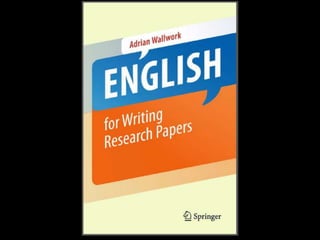
Wallwork A. English for Writing Research Papers.
New York: Springer. 325 pp.
COPE. 2014. Best Practice Guidelines on Publishing Ethics:
a publisher’s perspective, 2nd edn. Oxford: Wiley. 56 pp.
[Committee on Publication Ethics]
<http://exchanges.wiley.com/ethicsguidelines>
Language-editing services
Publishers and other agencies
Charges are based on number of words
A 4000-word paper costs roughly
— Rs 26 000, Springer
— Rs 20 930, Wiley-Blackwell
— Rs 20 280, Oxford Language Editing
— Rs 18 525, Elsevier
— Rs 16 575, Editage ($1 = Rs 65 in each case)

Writing a Research Paper

  • 1.
  • 2.
  • 3.
    Before you startwriting a research paper Read relevant journals; scan abstract journals. Choose a target journal; note policy and scope. Study instructions to authors. Study a recent issue of the target journal.
  • 4.
    Springer journal selector Pastean abstract or a description of your paper to find matching journals.
  • 5.
  • 6.
    Elsevier journal selector <http://journalfinder.elsevier.com/> Inserttitle and abstract and select the field of research.
  • 7.
    Research articles (upto ~4500 words) present a major advance. Reports (up to ~2500 words) present important new research results of broad significance. Reviews (up to 6000 words) describe and synthesize recent developments of interdisciplinary significance and highlight future directions. Letters (up to 300 words) discuss material published in Science in the last 3 months or issues of general interest. Categories or ‘departments’ in Science 7
  • 8.
    Pre-review assessment Within thebroad remit of the journal? Addresses a broad subject area? Have the potential to make a substantial contribution? Subject topical and of interest to a wide readership? Appropriately formatted? Novel and interesting?
  • 9.
    From submission topublication 1. Author submits (sends or uploads) a manuscript 2. Preliminary screening by the journal. 3. If not rejected, sent to reviewers (referees) 4. Reviewers’ comments conveyed to author 5. Author submits revised version 6. Matter sent for processing: proofs to author 7. Author returns corrected proofs; paper published
  • 10.
    Journal of Ecology:possible decisions, 1 Manuscript unsuitable: subject matter inappropriate or lacks novelty or is of insufficient general interest— rejected without peer review. Rejection after peer review Rejection, resubmission invited: referees and editors see the potential of the presented work Revision: major or minor changes required
  • 11.
    Journal of Ecology:possible decisions, 2 Further revision needed: comments only partly or insufficiently addressed; further ambiguities remain. Authors are asked to address these concerns in their final version.  Acceptance subject to editing: content of acceptable standard for publication; only editorial changes required. Final acceptance: acceptance confirmed after a final editorial check; files and forms are sent to publisher.
  • 12.
    Writing the titleand the abstract ‘Most people will decide whether to read a paper solely on the basis of its title.’ Realize that title and abstract work together. Use abbreviations sparingly. Do not repeat information already in the title. Use as keywords terms not already used in the title. Skip background information.
  • 13.
    Making it easyfor others to find your paper, 1 Advice at authorservices.wiley.com/bauthor/seo.asp Use 2- or 3-word phrases as keywords Wiley Author Services: ‘Choose a clear, accurate title. [Use] search terms that readers are likely to use when looking for articles on the same topic as yours, and help them by constructing your title to include those terms.’
  • 14.
    Making it easyfor others to find your paper, 2 ‘Please pay attention to the keywords you select: they should not already appear in the title or abstract. Rather, they should be selected to draw in readers from wider areas that might not otherwise pick up your paper when they are using search engines.’
  • 15.
    The shortest abstract:Journal of Physics
  • 16.
    The IMRaD structureof a research paper Introduction: reason for doing work, nature of hypothesis, essential background Materials and methods: sufficient details of techniques to enable the work to be repeated. Results: draw attention to important details in tables and figures. Discussion: significance of results in relation to reasons for doing the work, and place them in the context of other work.
  • 17.
    Writing the introduction Answerthe question W H Y. State the problem. Explain why the problem is important. Review what has been done so far to solve it. Introduce the study by pointing out what is different about it compared to past research.
  • 18.
    Writing the materialsand methods section Answer the question H O W. Include enough detail for others to repeat the experiment. Give sources of material, make and model of equipment, quantities, duration, season, etc.
  • 19.
    Writing the resultssection Answer the question W H A T. State only the results; leave comments and explanations for the Discussion section. Use tables and charts as appropriate but do not duplicate information. If results are not statistically significant, do not discuss them.
  • 20.
    Writing the discussionsection Answer the question S O W H A T. Explain what the results mean and how they are important. Compare the results with earlier findings; explain contradictory results, if any. Suggest future line of work. Sum up with a conclusion.
  • 21.
    Finishing touches: followinga journal’s style Follow capitalization, bold, italics, Fig. / Figure, etc. Follow style for headings: numbered or not numbered Follow the target journal’s style but — do not use multiple columns — use a standard, serif font: Times, Georgia, Calibri — use left justification; turn hyphenation off — ignore indents, small capitals, running heads — submit tables and figures as separate files.
  • 22.
  • 23.
  • 24.
    Hijacked journal websites,1 Warning! The websites www.wulfeniajournal.at, www.wulfeniajournal.com, and www.multidisciplinarywulfenia.org are not the official websites of the journal “Wulfenia: Mitteilungen des Kärntner otanikzentrums” published by the Regional Museum of Carinthia.
  • 25.
    Hijacked websites, 2 ‘Thesewebsites criminally usurp the identity of the official journal. They fraudulently use false information, a false editorial board and false publication requirements to encourage authors to submit articles and to transfer page fees to a bank account in Yerevan (Armenia).’
  • 26.
    ‘Predatory’ journals Capitalize onthe pressure to publish. Charge a fee upfront and guarantee very rapid publication. Offer no peer review or a cursory peer review. Have large editorial boards with members spread worldwide. Seldom show a physical location (street address). Show spurious impact factors. Are typically multidisciplinary.
  • 27.
  • 28.
    Beware of invitationsto submit papers
  • 29.
    Beall’s List ofPredatory Journals Many new online publishers because of author-pays open- access model Many corrupt publishers exist only to make money from processing charges. Portfolio of a few to hundreds of individual journals Avoid doing business with these publishers and journals. <http://scholarlyoa.com/2015/01/02/bealls-list-of-predatory- publishers-2015/>
  • 30.
    Impact Factor, Hindex, etc. Impact Factor: specific to a journal for a given year Measures how often, on average, an article is cited. H-index (Hirsch index) of X means a scientist has published X papers that have been cited at least X times. Altmetrics: combines a selection of online indicators – both scholarly and non-scholarly – such as blogs, Twitter, Facebook, Google+, message boards and mainstream newspapers and magazines to measure digital impact and reach (how much attention a paper is receiving relative to their peers.
  • 31.
    Impact Factor: specificto a journal for a given year Measures, on average, how often an article is cited. Given by Thomson-Reuters and given in Journal Citation Reports. About 11 150 journals included. Impact Factor 31
  • 32.
    Journal Impact Factor TheImpact Factor of Journal XYZ in 2014 is the number of times that journal was cited in 2014 divided by the number of citable items [articles and reviews] published by that journal in 2012 and 2013.
  • 33.
    Selection of journalsin the Web of Science
  • 34.
  • 35.
    11 150 journals(272 new journals added in 2015) 82 countries 1 721 170 papers, 79 218 reviews, 493 588 other items Journal Citation Reports 2015 35
  • 42.
    Recommended reading Hart G.2014. Writing for Science Journals. Pointe-Claire, Quebec, Canada: Diaskeuasis Publishing. 635 pp. Glasman-Deal H. 2010. Science Research Writing for Non- Native Speakers of English. London: Imperial College Press. 257 pp. Blackwell J and Martin J. 2011. A Scientific Approach to Scientific Writing. New York: Springer. 112 pp.
  • 43.
    Recommended reading Wallwork A.English for Writing Research Papers. New York: Springer. 325 pp. COPE. 2014. Best Practice Guidelines on Publishing Ethics: a publisher’s perspective, 2nd edn. Oxford: Wiley. 56 pp. [Committee on Publication Ethics] <http://exchanges.wiley.com/ethicsguidelines>
  • 44.
    Language-editing services Publishers andother agencies Charges are based on number of words A 4000-word paper costs roughly — Rs 26 000, Springer — Rs 20 930, Wiley-Blackwell — Rs 20 280, Oxford Language Editing — Rs 18 525, Elsevier — Rs 16 575, Editage ($1 = Rs 65 in each case)