Employee Training and
   Development


                        1-1
Introduction: Training for
 Competitive Advantage


                             1-2
Objectives
After reading this chapter, you
should be able to:
1.   Discuss the forces influencing the
     workplace and learning, and explain how
     training can help companies deal with these
     forces.
2.   Discuss various aspects of the instructional
     system design model.
3.   Describe the amount and types of training
     occurring in various companies.

                                                    1-3
Objectives         (continued)


4.   Discuss the key roles and competencies
     required for training professionals.
5.   Identify appropriate resources (e.g.,
     journals, websites) for learning about
     training research and practice.


                                              1-4
What is training?

 Training refers to a planned effort by a
  company to facilitate employees’ learning of
  job-related competencies.
 The goal of training is for employees to
   master the knowledge, skill, and behaviors
    emphasized in training programs, and
   apply them to their day-to-day activities


                                                 1-5
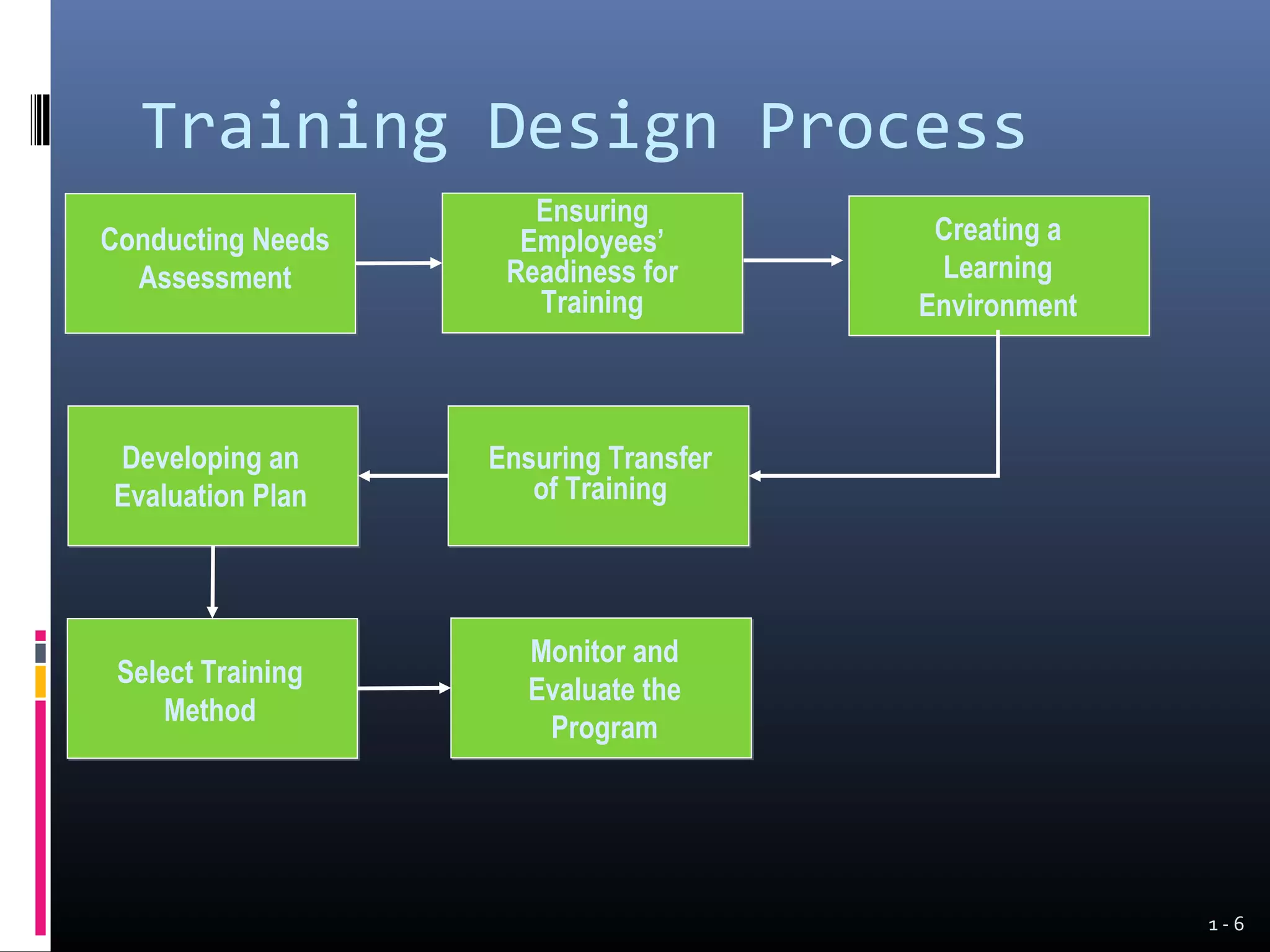
Training Design Process
                      Ensuring
Conducting Needs     Employees’         Creating a
  Assessment        Readiness for       Learning
                      Training         Environment


Developing an      Ensuring Transfer
Evaluation Plan       of Training


                      Monitor and
 Select Training
                      Evaluate the
     Method
                       Program


                                                     1-6
Assumptions of Training Design
Approaches
 Training design is effective only if it helps
  employees reach instructional or training
  goals and objectives.
 Measurable learning objectives should be
  identified before training.
 Evaluation plays an important part in
  planning and choosing a training method,
  monitoring the training program, and
  suggesting changes to the training design
  process.
                                                  1-7
Forces Influencing the
Workplace
and Training
 Globalization
 Need for leadership
 Increased value placed on knowledge
 Attracting and winning talent
 Quality emphasis
 Changing demographics and diversity of the
  work force
 New technology
 High-performance model of work systems
                                               1-8
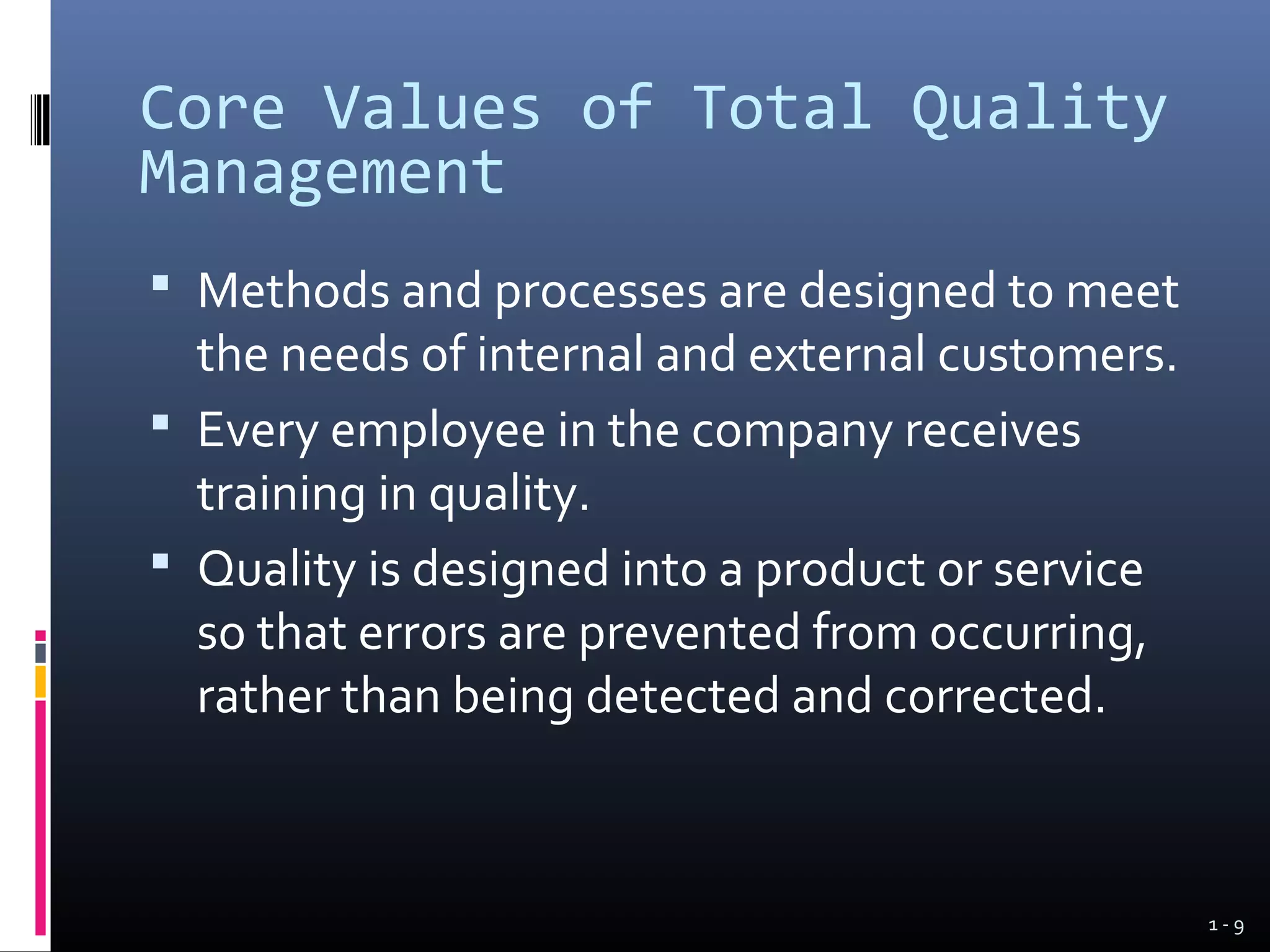
Core Values of Total Quality
Management
 Methods and processes are designed to meet
  the needs of internal and external customers.
 Every employee in the company receives
  training in quality.
 Quality is designed into a product or service
  so that errors are prevented from occurring,
  rather than being detected and corrected.


                                                  1-9
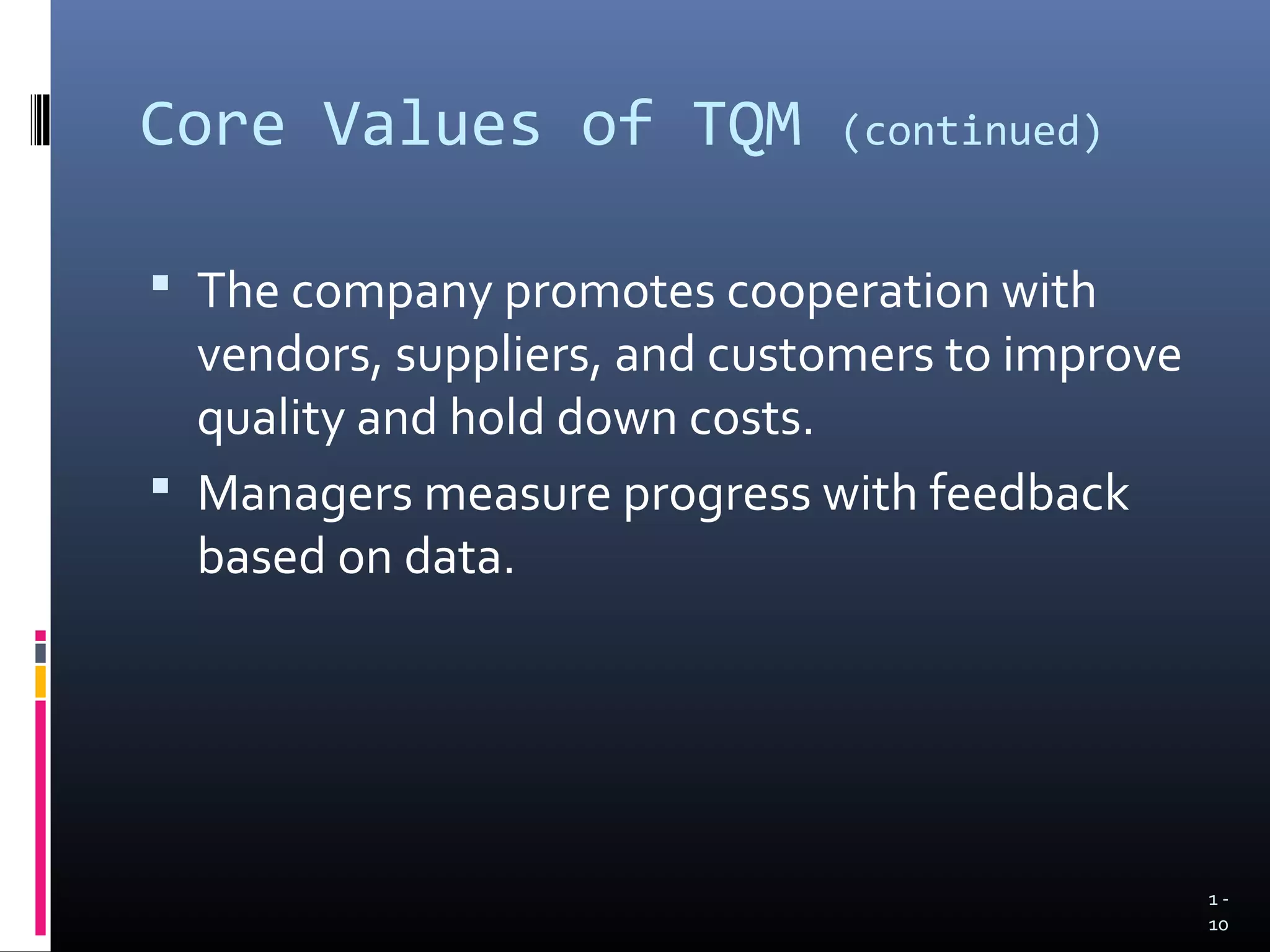
Core Values of TQM            (continued)


 The company promotes cooperation with
  vendors, suppliers, and customers to improve
  quality and hold down costs.
 Managers measure progress with feedback
  based on data.


                                                 1-
                                                 10
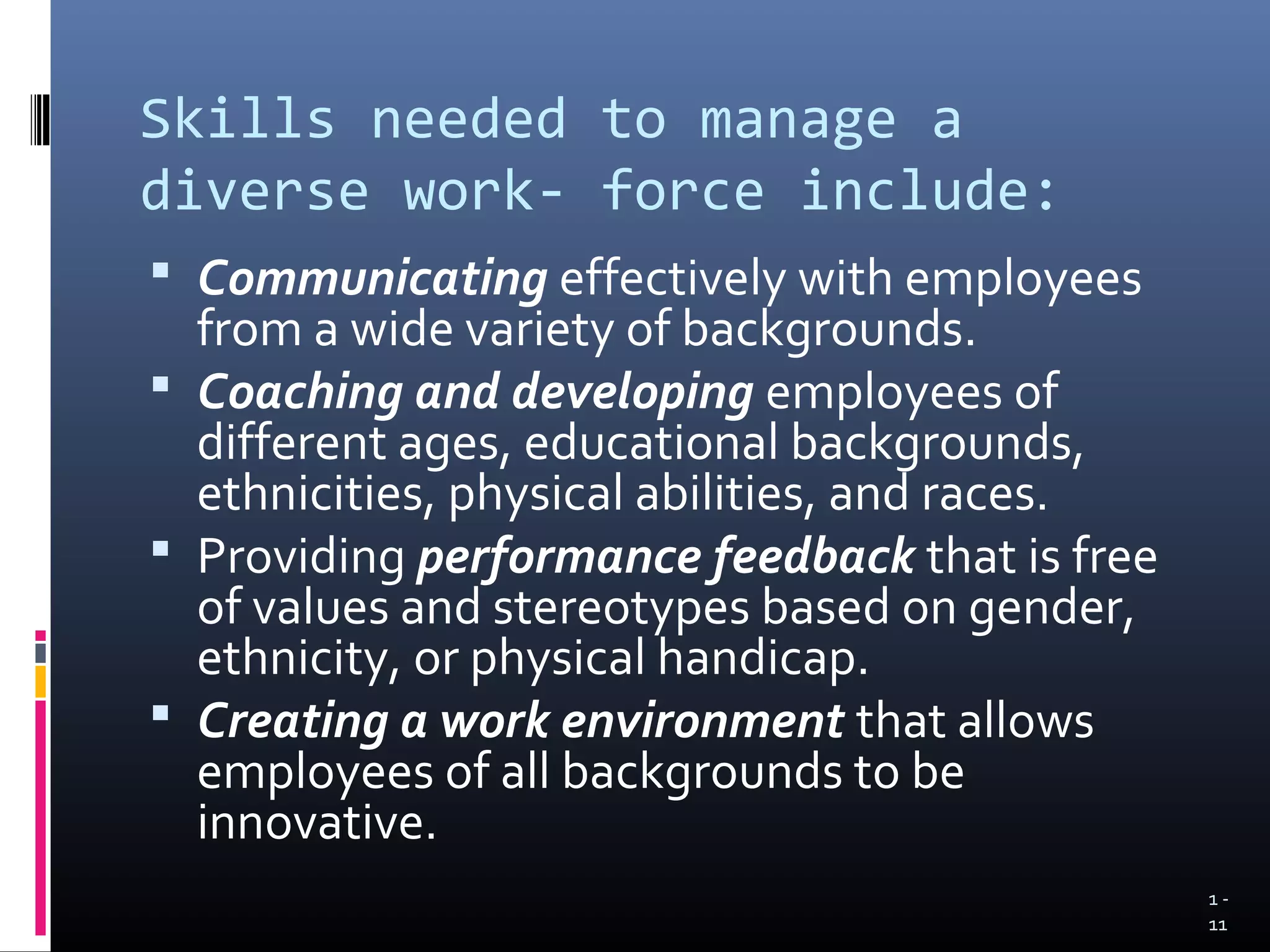
Skills needed to manage a
diverse work- force include:
 Communicating effectively with employees
  from a wide variety of backgrounds.
 Coaching and developing employees of
  different ages, educational backgrounds,
  ethnicities, physical abilities, and races.
 Providing performance feedback that is free
  of values and stereotypes based on gender,
  ethnicity, or physical handicap.
 Creating a work environment that allows
  employees of all backgrounds to be
  innovative.
                                                1-
                                                11
1 - 12
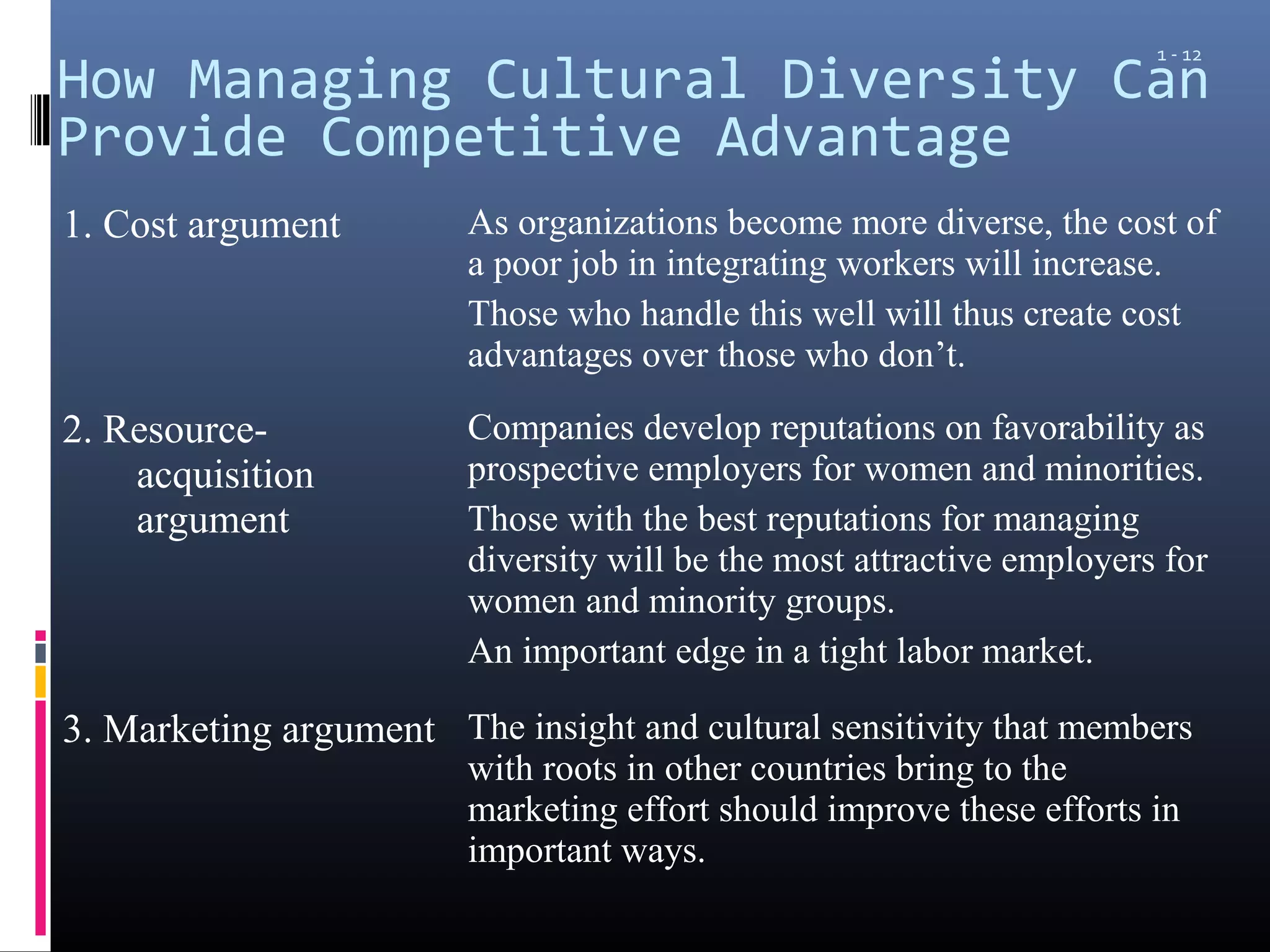
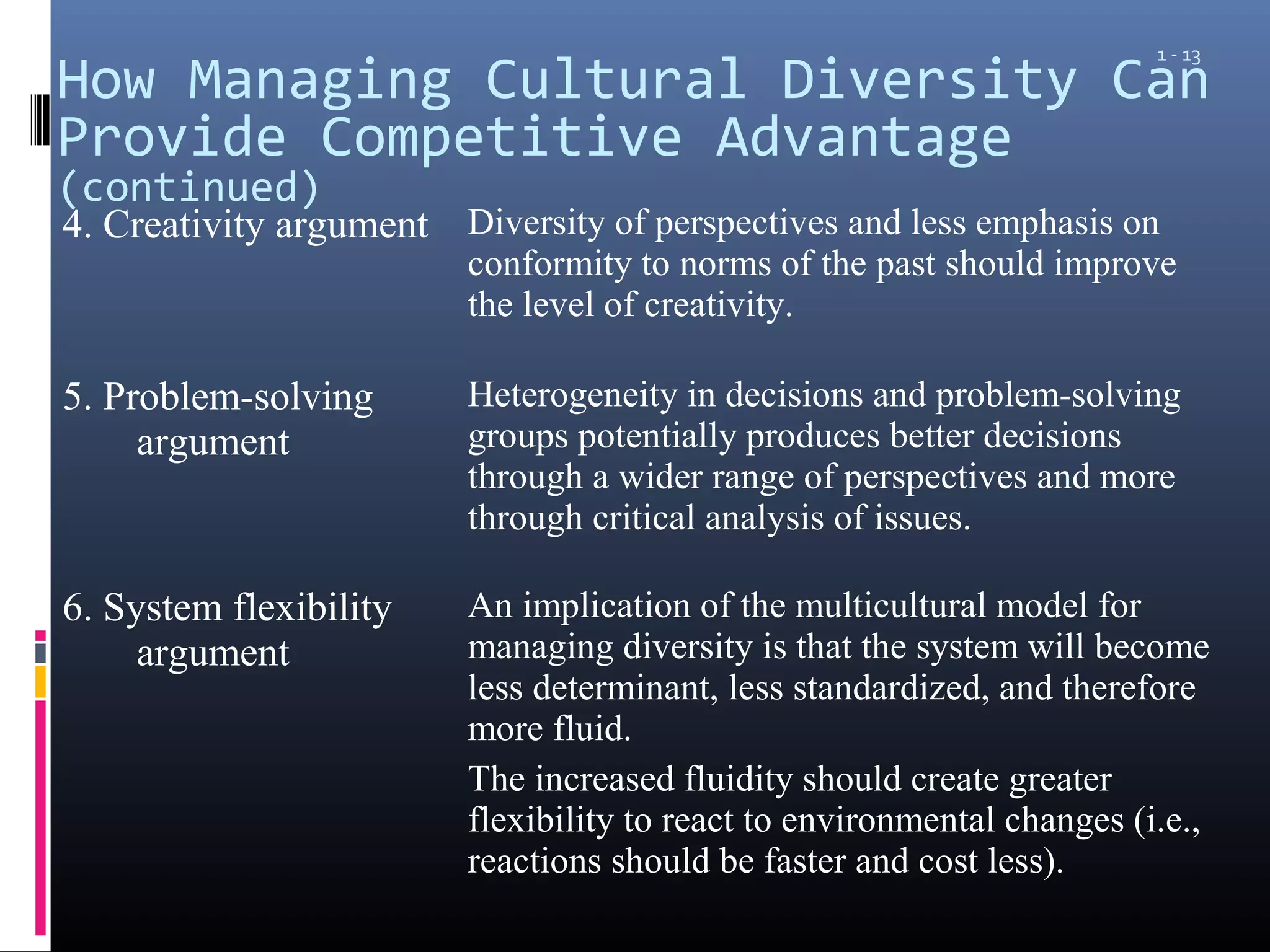
How Managing Cultural Diversity Can
Provide Competitive Advantage
1. Cost argument         As organizations become more diverse, the cost of
                         a poor job in integrating workers will increase.
                         Those who handle this well will thus create cost
                         advantages over those who don’t.

2. Resource-             Companies develop reputations on favorability as
    acquisition          prospective employers for women and minorities.
    argument             Those with the best reputations for managing
                         diversity will be the most attractive employers for
                         women and minority groups.
                         An important edge in a tight labor market.

3. Marketing argument The insight and cultural sensitivity that members
                         with roots in other countries bring to the
                         marketing effort should improve these efforts in
                         important ways.
1 - 13
How Managing Cultural Diversity Can
Provide Competitive Advantage
(continued)
4. Creativity argument Diversity of perspectives and less emphasis on
                         conformity to norms of the past should improve
                         the level of creativity.

5. Problem-solving       Heterogeneity in decisions and problem-solving
     argument            groups potentially produces better decisions
                         through a wider range of perspectives and more
                         through critical analysis of issues.

6. System flexibility    An implication of the multicultural model for
     argument            managing diversity is that the system will become
                         less determinant, less standardized, and therefore
                         more fluid.
                         The increased fluidity should create greater
                         flexibility to react to environmental changes (i.e.,
                         reactions should be faster and cost less).
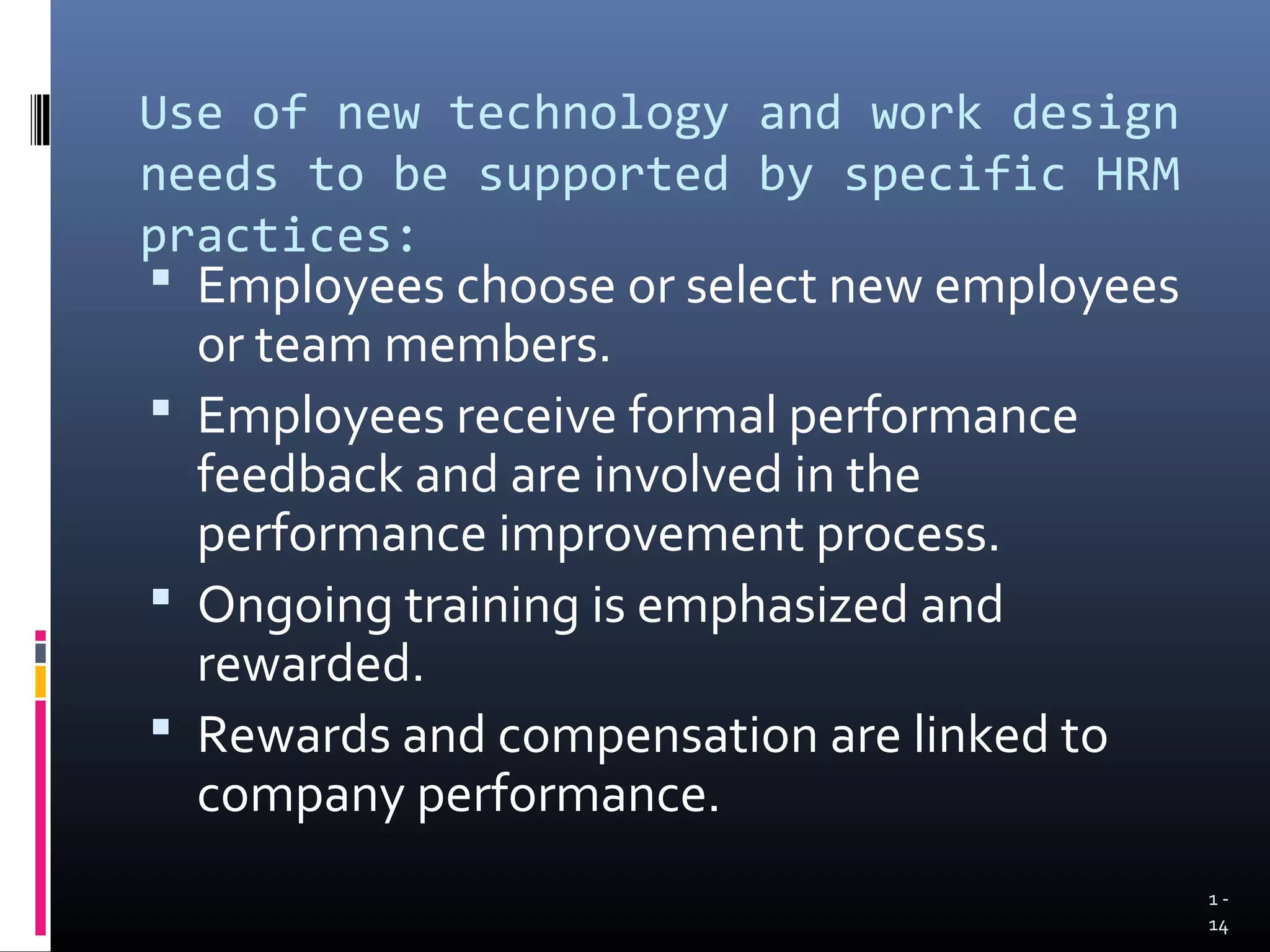
Use of new technology and work design
needs to be supported by specific HRM
practices:
 Employees choose or select new employees
  or team members.
 Employees receive formal performance
  feedback and are involved in the
  performance improvement process.
 Ongoing training is emphasized and
  rewarded.
 Rewards and compensation are linked to
  company performance.
                                             1-
                                             14
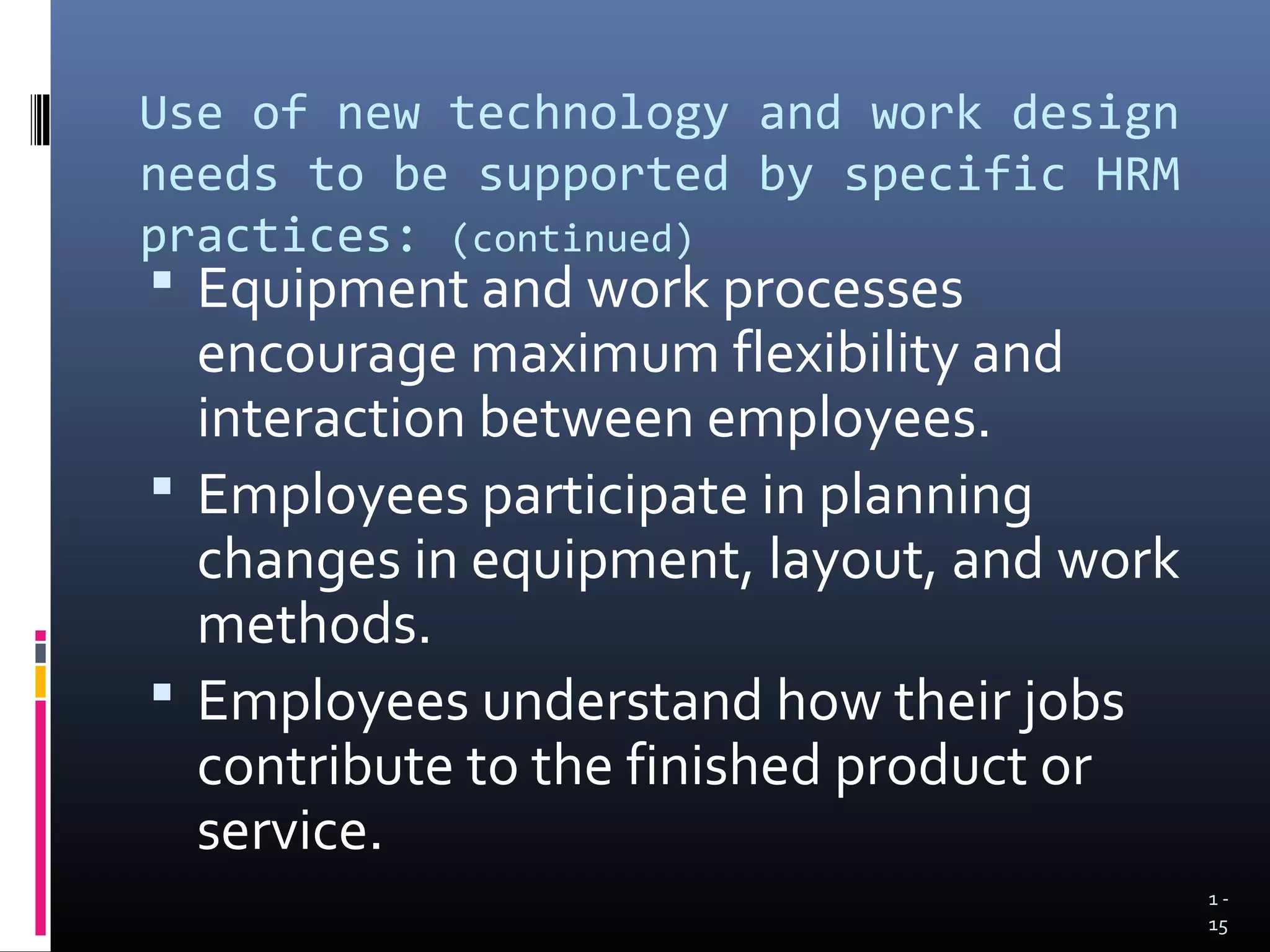
Use of new technology and work design
needs to be supported by specific HRM
practices: (continued)
 Equipment and work processes
  encourage maximum flexibility and
  interaction between employees.
 Employees participate in planning
  changes in equipment, layout, and work
  methods.
 Employees understand how their jobs
  contribute to the finished product or
  service.
                                           1-
                                           15
1 - 16

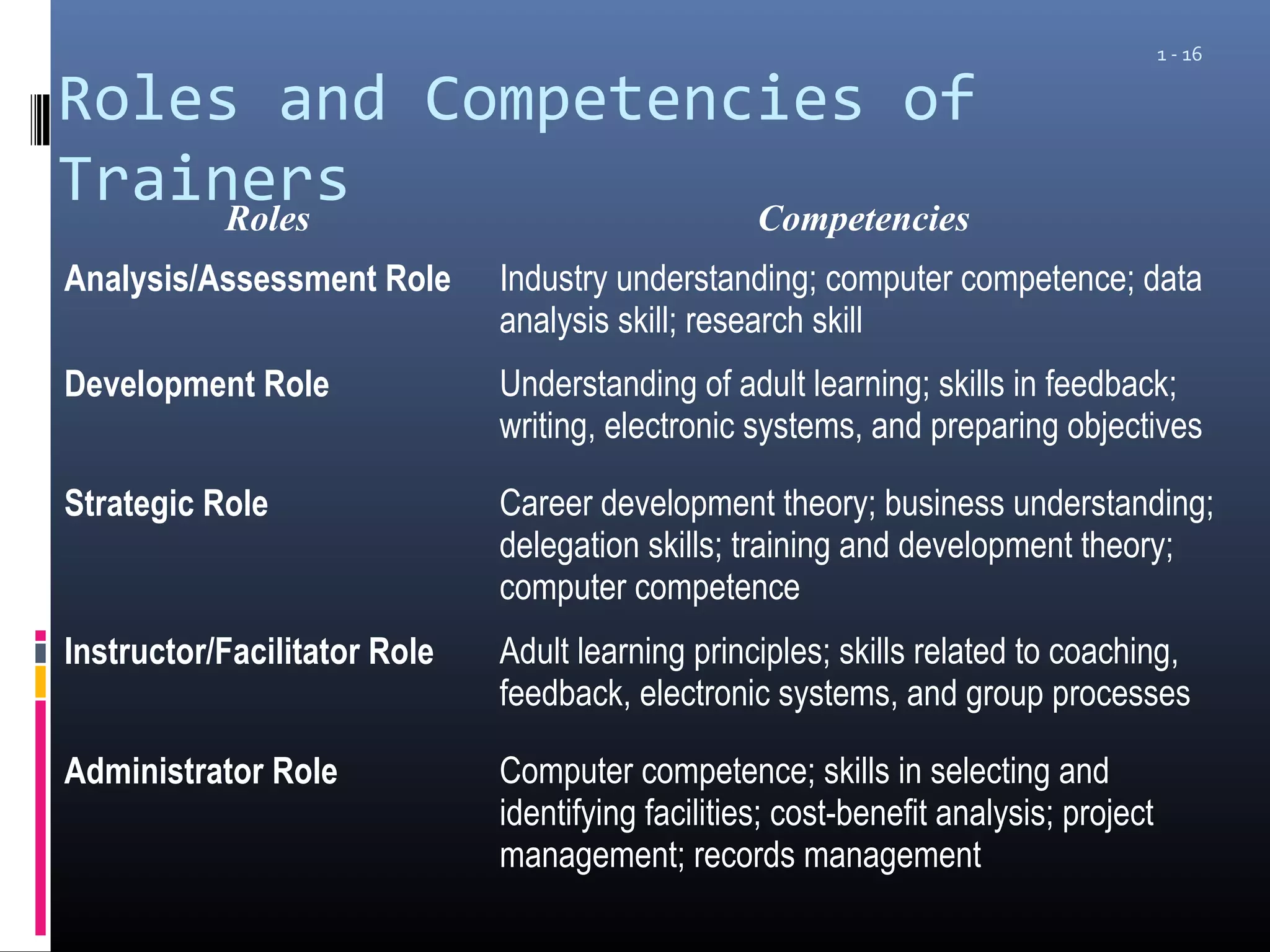
Roles and Competencies of
Trainers
     Roles         Competencies
Analysis/Assessment Role      Industry understanding; computer competence; data
                              analysis skill; research skill
Development Role              Understanding of adult learning; skills in feedback;
                              writing, electronic systems, and preparing objectives

Strategic Role                Career development theory; business understanding;
                              delegation skills; training and development theory;
                              computer competence
Instructor/Facilitator Role   Adult learning principles; skills related to coaching,
                              feedback, electronic systems, and group processes

Administrator Role            Computer competence; skills in selecting and
                              identifying facilities; cost-benefit analysis; project
                              management; records management

Introduction to employee training and development ppt 1 2

  • 1.
    Employee Training and Development 1-1
  • 2.
    Introduction: Training for Competitive Advantage 1-2
  • 3.
    Objectives After reading thischapter, you should be able to: 1. Discuss the forces influencing the workplace and learning, and explain how training can help companies deal with these forces. 2. Discuss various aspects of the instructional system design model. 3. Describe the amount and types of training occurring in various companies. 1-3
  • 4.
    Objectives (continued) 4. Discuss the key roles and competencies required for training professionals. 5. Identify appropriate resources (e.g., journals, websites) for learning about training research and practice. 1-4
  • 5.
    What is training? Training refers to a planned effort by a company to facilitate employees’ learning of job-related competencies.  The goal of training is for employees to  master the knowledge, skill, and behaviors emphasized in training programs, and  apply them to their day-to-day activities 1-5
  • 6.
    Training Design Process Ensuring Conducting Needs Employees’ Creating a Assessment Readiness for Learning Training Environment Developing an Ensuring Transfer Evaluation Plan of Training Monitor and Select Training Evaluate the Method Program 1-6
  • 7.
    Assumptions of TrainingDesign Approaches  Training design is effective only if it helps employees reach instructional or training goals and objectives.  Measurable learning objectives should be identified before training.  Evaluation plays an important part in planning and choosing a training method, monitoring the training program, and suggesting changes to the training design process. 1-7
  • 8.
    Forces Influencing the Workplace andTraining  Globalization  Need for leadership  Increased value placed on knowledge  Attracting and winning talent  Quality emphasis  Changing demographics and diversity of the work force  New technology  High-performance model of work systems 1-8
  • 9.
    Core Values ofTotal Quality Management  Methods and processes are designed to meet the needs of internal and external customers.  Every employee in the company receives training in quality.  Quality is designed into a product or service so that errors are prevented from occurring, rather than being detected and corrected. 1-9
  • 10.
    Core Values ofTQM (continued)  The company promotes cooperation with vendors, suppliers, and customers to improve quality and hold down costs.  Managers measure progress with feedback based on data. 1- 10
  • 11.
    Skills needed tomanage a diverse work- force include:  Communicating effectively with employees from a wide variety of backgrounds.  Coaching and developing employees of different ages, educational backgrounds, ethnicities, physical abilities, and races.  Providing performance feedback that is free of values and stereotypes based on gender, ethnicity, or physical handicap.  Creating a work environment that allows employees of all backgrounds to be innovative. 1- 11
  • 12.
    1 - 12 HowManaging Cultural Diversity Can Provide Competitive Advantage 1. Cost argument As organizations become more diverse, the cost of a poor job in integrating workers will increase. Those who handle this well will thus create cost advantages over those who don’t. 2. Resource- Companies develop reputations on favorability as acquisition prospective employers for women and minorities. argument Those with the best reputations for managing diversity will be the most attractive employers for women and minority groups. An important edge in a tight labor market. 3. Marketing argument The insight and cultural sensitivity that members with roots in other countries bring to the marketing effort should improve these efforts in important ways.
  • 13.
    1 - 13 HowManaging Cultural Diversity Can Provide Competitive Advantage (continued) 4. Creativity argument Diversity of perspectives and less emphasis on conformity to norms of the past should improve the level of creativity. 5. Problem-solving Heterogeneity in decisions and problem-solving argument groups potentially produces better decisions through a wider range of perspectives and more through critical analysis of issues. 6. System flexibility An implication of the multicultural model for argument managing diversity is that the system will become less determinant, less standardized, and therefore more fluid. The increased fluidity should create greater flexibility to react to environmental changes (i.e., reactions should be faster and cost less).
  • 14.
    Use of newtechnology and work design needs to be supported by specific HRM practices:  Employees choose or select new employees or team members.  Employees receive formal performance feedback and are involved in the performance improvement process.  Ongoing training is emphasized and rewarded.  Rewards and compensation are linked to company performance. 1- 14
  • 15.
    Use of newtechnology and work design needs to be supported by specific HRM practices: (continued)  Equipment and work processes encourage maximum flexibility and interaction between employees.  Employees participate in planning changes in equipment, layout, and work methods.  Employees understand how their jobs contribute to the finished product or service. 1- 15
  • 16.
    1 - 16 Rolesand Competencies of Trainers Roles Competencies Analysis/Assessment Role Industry understanding; computer competence; data analysis skill; research skill Development Role Understanding of adult learning; skills in feedback; writing, electronic systems, and preparing objectives Strategic Role Career development theory; business understanding; delegation skills; training and development theory; computer competence Instructor/Facilitator Role Adult learning principles; skills related to coaching, feedback, electronic systems, and group processes Administrator Role Computer competence; skills in selecting and identifying facilities; cost-benefit analysis; project management; records management

Editor's Notes

  • #7 See Figure 1-1 on page 6 for details
  • #9 See Table 1-1 on page 8 for details
  • #13 See Table 1-3 on page 19 for details
  • #14 See Table 1-3 on page 19 for details
  • #17 See Table 1-6 on page 28 for details