1
Two Phase Flow Pump Characterization
Eugene Chisely
05/06/2011
2
Agenda:
•Experimental Loop
•Single-Phase Pump
Performance
•Two-Phase Flow Pump
Characterization
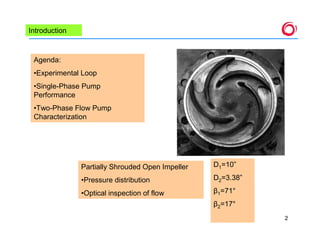
Partially Shrouded Open Impeller
•Pressure distribution
•Optical inspection of flow
Introduction
D1=10”
D2=3.38”
β1=71°
β2=17°
3
Two Phase Flow Pump Characterization
Two-Phase Flow Experiment Loop (Schematic)
PUMP TWO PHASE EXPERIMENT (Lillibridge Engr. Lab. ISU)
4
Experimental Loop
Primary
Separator
Tank
Secondary
Separator Tank
Loop
Pump
Pump Suction Pipe
Air Pipe
Mixer
5
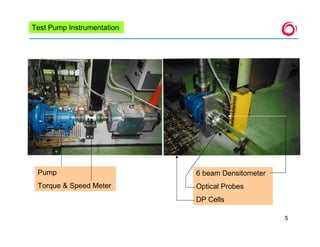
Test Pump Instrumentation
Pump
Torque & Speed Meter
6 beam Densitometer
Optical Probes
DP Cells
6
Test Pump Instrumentation
Optical Probe Ports
Pressure Probe Ports
•Followed the line bisecting the distance between two vanes
•0.03” hypodermic tubes (filtered pressure oscillation)
7
Test Pump Instrumentation
6-Beam low gamma & x-Ray attenuation densitometer
Schematic of 6-Beam
Densitometer
Source
Detectors
collimators
Body
Cover
plate
collimators
sleeves
8
Test Pump Instrumentation
Fluid pressure measurement arrangement through the pump
flow passages.
9
Pump Single Phase Pressure Distribution
1 2
3
+ Data
o Prediction
TEST matrix: N, Q
S-P Pump Models
10
Pump Single Phase Calculation
Input:
Impeller geometry: r1 [m],r2 [m], β’s
Suction pipe diameter: dpipe [m] ,
Volumetric flow rate: Q [liter/minute]
Water density (ρsp)
Pump Single-Phase Flow
Performance Prediction.
11
Pump Two Phase Flow Pump Performances
Two-phase flow mass flux effect
N=1250 rpm, psuction=130 [kPa]
The effect of different suction
pressure on pump head.
Preliminary Test Result:
Void Fraction
Pump Suction Pressure
Test Matrix:
N, QW,Qair, Psuction
12
Flow number versus Pressure Number
Inlet Diffuser -> 1.5
Impeller -> 1.05
Volute -> 0.75
1
3
2
Pump Two Phase Flow Pump Performances
13
Two Phase Flow Pump Performances
Different inlet fluid pressure
psuction=160 kPa
psuction=185 kPa
1
3
2
* Data
o Prediction
14
Pump Two Phase Flow Performances
+ Data
o Prediction
1 2
43
15
Two Phase Flow Pump Performances
Input:
Suction Pressure: psuction [kPa]
Two-Phase Flow Quality: x
S-P Water Flow Rate: m [kg/sec]
S-P pump pressure Distribution:
•Inlet Diffuser
•Pump Vane
•Pump Volute
Pump Two-Phase Flow
Performance Prediction
Psuction=101:150
X=2.5*10-5:1.2*10-3
Psuction=200:300
X=4.5*10-5:4.5*10-3
16
A B
DC
pressure
side
pressure
side
pressure
side
pressure
side
suction
side
suction
side
suction
side
suction
side
CONCLUSION
Two-phase flow regime in the vane flow
passage versus void fraction.
Pressure distribution along the vane flow
passage versus void fraction.
*Inlet diffuser
o First third of vane
+ Second Third
. Last section of vane
Two mechanism:
•Low Void fraction: chapping effect of Vane
•High void fraction: Intensive centrifuge field
17
CONCLUSION
•Single & Two Phase Flow Experiment
•Single & Two-Phase Models Were Developed
•Compared Them With Experimental Data Point
Recommendation:
More experimental work needed to develop more
accurate models to predict pump two-phase flow
pump performance for both condensable and un-
condensable fluids.

TP_Pump_Presentation

  • 1.
    1 Two Phase FlowPump Characterization Eugene Chisely 05/06/2011
  • 2.
    2 Agenda: •Experimental Loop •Single-Phase Pump Performance •Two-PhaseFlow Pump Characterization Partially Shrouded Open Impeller •Pressure distribution •Optical inspection of flow Introduction D1=10” D2=3.38” β1=71° β2=17°
  • 3.
    3 Two Phase FlowPump Characterization Two-Phase Flow Experiment Loop (Schematic) PUMP TWO PHASE EXPERIMENT (Lillibridge Engr. Lab. ISU)
  • 4.
  • 5.
    5 Test Pump Instrumentation Pump Torque& Speed Meter 6 beam Densitometer Optical Probes DP Cells
  • 6.
    6 Test Pump Instrumentation OpticalProbe Ports Pressure Probe Ports •Followed the line bisecting the distance between two vanes •0.03” hypodermic tubes (filtered pressure oscillation)
  • 7.
    7 Test Pump Instrumentation 6-Beamlow gamma & x-Ray attenuation densitometer Schematic of 6-Beam Densitometer Source Detectors collimators Body Cover plate collimators sleeves
  • 8.
    8 Test Pump Instrumentation Fluidpressure measurement arrangement through the pump flow passages.
  • 9.
    9 Pump Single PhasePressure Distribution 1 2 3 + Data o Prediction TEST matrix: N, Q S-P Pump Models
  • 10.
    10 Pump Single PhaseCalculation Input: Impeller geometry: r1 [m],r2 [m], β’s Suction pipe diameter: dpipe [m] , Volumetric flow rate: Q [liter/minute] Water density (ρsp) Pump Single-Phase Flow Performance Prediction.
  • 11.
    11 Pump Two PhaseFlow Pump Performances Two-phase flow mass flux effect N=1250 rpm, psuction=130 [kPa] The effect of different suction pressure on pump head. Preliminary Test Result: Void Fraction Pump Suction Pressure Test Matrix: N, QW,Qair, Psuction
  • 12.
    12 Flow number versusPressure Number Inlet Diffuser -> 1.5 Impeller -> 1.05 Volute -> 0.75 1 3 2 Pump Two Phase Flow Pump Performances
  • 13.
    13 Two Phase FlowPump Performances Different inlet fluid pressure psuction=160 kPa psuction=185 kPa 1 3 2 * Data o Prediction
  • 14.
    14 Pump Two PhaseFlow Performances + Data o Prediction 1 2 43
  • 15.
    15 Two Phase FlowPump Performances Input: Suction Pressure: psuction [kPa] Two-Phase Flow Quality: x S-P Water Flow Rate: m [kg/sec] S-P pump pressure Distribution: •Inlet Diffuser •Pump Vane •Pump Volute Pump Two-Phase Flow Performance Prediction Psuction=101:150 X=2.5*10-5:1.2*10-3 Psuction=200:300 X=4.5*10-5:4.5*10-3
  • 16.
    16 A B DC pressure side pressure side pressure side pressure side suction side suction side suction side suction side CONCLUSION Two-phase flowregime in the vane flow passage versus void fraction. Pressure distribution along the vane flow passage versus void fraction. *Inlet diffuser o First third of vane + Second Third . Last section of vane Two mechanism: •Low Void fraction: chapping effect of Vane •High void fraction: Intensive centrifuge field
  • 17.
    17 CONCLUSION •Single & TwoPhase Flow Experiment •Single & Two-Phase Models Were Developed •Compared Them With Experimental Data Point Recommendation: More experimental work needed to develop more accurate models to predict pump two-phase flow pump performance for both condensable and un- condensable fluids.