Project Management
Chapter 4:
Level of confidence in the Project?
Part of a series considering different aspects of Business Change
1Understanding and Supporting Business Change – by Martin Schyns/ FILE: Project Management_Chap_4_FINAL.pptx
IntroductionWho am I?
My headline would be…..Global Engineer Understands Transition Success Approach
Key take away is that I have been doing projects my whole career. I am an engineer at heart with a diverse
background and I recognize that all organizations, and individuals for that matter, must continually seek to
proactively change and adapt. As I am sure most organizations can attest, Change is hard. I thought I would
try using this medium to collect various themes and ideas on the subject of Business Change and share my
insights.
Understanding and Support Business Change
Naturally enough, Project Management is my first theme. It is a rich and complex endeavor and it is certainly an
area where I think most organizations would acknowledge they could do better. Typically the challenge is
that if you ask five people within an organization, what needs to change, you get five different responses.
The Initial Path for this Enquiry
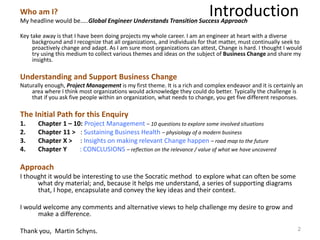
1. Chapter 1 – 10: Project Management – 10 questions to explore some involved situations
2. Chapter 11 > : Sustaining Business Health – physiology of a modern business
3. Chapter X > : Insights on making relevant Change happen – road map to the future
4. Chapter Y : CONCLUSIONS – reflection on the relevance / value of what we have uncovered
Approach
I thought it would be interesting to use the Socratic method to explore what can often be some
what dry material; and, because it helps me understand, a series of supporting diagrams
that, I hope, encapsulate and convey the key ideas and their context.
I would welcome any comments and alternative views to help challenge my desire to grow and
make a difference.
Thank you, Martin Schyns. 2
Ten common Project Management situations
that are not easily understood…why?
3
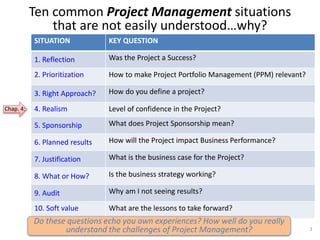
SITUATION KEY QUESTION
1. Reflection Was the Project a Success?
2. Prioritization How to make Project Portfolio Management (PPM) relevant?
3. Right Approach? How do you define a project?
4. Realism Level of confidence in the Project?
5. Sponsorship What does Project Sponsorship mean?
6. Planned results How will the Project impact Business Performance?
7. Justification What is the business case for the Project?
8. What or How? Is the business strategy working?
9. Audit Why am I not seeing results?
10. Soft value What are the lessons to take forward?
Do these questions echo you own experiences? How well do you really
understand the challenges of Project Management?
Chap. 4:
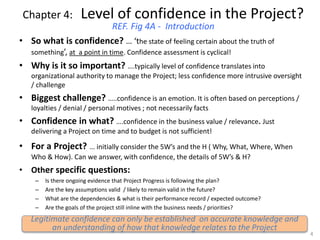
Chapter 4: Level of confidence in the Project?
REF. Fig 4A - Introduction
• So what is confidence? … ‘the state of feeling certain about the truth of
something’, at a point in time. Confidence assessment is cyclical!
• Why is it so important? ….typically level of confidence translates into
organizational authority to manage the Project; less confidence more intrusive oversight
/ challenge
• Biggest challenge? …..confidence is an emotion. It is often based on perceptions /
loyalties / denial / personal motives ; not necessarily facts
• Confidence in what? ….confidence in the business value / relevance. Just
delivering a Project on time and to budget is not sufficient!
• For a Project? … initially consider the 5W’s and the H ( Why, What, Where, When
Who & How). Can we answer, with confidence, the details of 5W’s & H?
• Other specific questions:
– Is there ongoing evidence that Project Progress is following the plan?
– Are the key assumptions valid / likely to remain valid in the future?
– What are the dependencies & what is their performance record / expected outcome?
– Are the goals of the project still inline with the business needs / priorities?
4
Legitimate confidence can only be established on accurate knowledge and
an understanding of how that knowledge relates to the Project
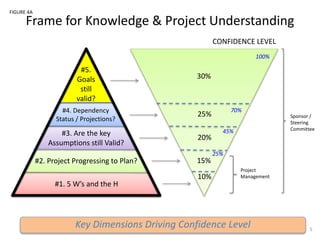
Frame for Knowledge & Project Understanding
5
#1. 5 W’s and the H
#2. Project Progressing to Plan?
#3. Are the key
Assumptions still Valid?
#4. Dependency
Status / Projections?
#5.
Goals
still
valid?
CONFIDENCE LEVEL
10%
15%
20%
25%
30%
25%
45%
70%
100%
Project
Management
Sponsor /
Steering
Committee
Key Dimensions Driving Confidence Level
FIGURE 4A
Dimensions of the Confidence Challenge
REF. Fig 4B / 4C - Dimensions of the Challenge
6
Improved management of these dimensions affords a Project a better
opportunity for improving the operating conditions & sustaining future existence
FIGURE 4B
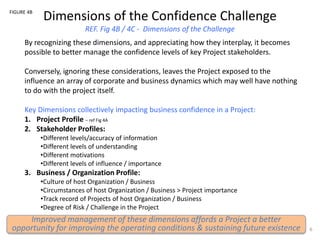
By recognizing these dimensions, and appreciating how they interplay, it becomes
possible to better manage the confidence levels of key Project stakeholders.
Conversely, ignoring these considerations, leaves the Project exposed to the
influence an array of corporate and business dynamics which may well have nothing
to do with the project itself.
Key Dimensions collectively impacting business confidence in a Project:
1. Project Profile – ref Fig 4A
2. Stakeholder Profiles:
•Different levels/accuracy of information
•Different levels of understanding
•Different motivations
•Different levels of influence / importance
3. Business / Organization Profile:
•Culture of host Organization / Business
•Circumstances of host Organization / Business > Project importance
•Track record of Projects of host Organization / Business
•Degree of Risk / Challenge in the Project
RESULT
Stakeholder#3RESULT
Stakeholder#2
Dimensions of the Confidence Challenge
7
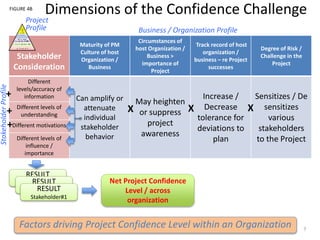
Factors driving Project Confidence Level within an Organization
FIGURE 4B
Stakeholder
Consideration
Maturity of PM
Culture of host
Organization /
Business
Circumstances of
host Organization /
Business >
importance of
Project
Track record of host
organization /
business – re Project
successes
Degree of Risk /
Challenge in the
Project
Different
levels/accuracy of
information Can amplify or
attenuate
individual
stakeholder
behavior
May heighten
or suppress
project
awareness
Increase /
Decrease
tolerance for
deviations to
plan
Sensitizes / De
sensitizes
various
stakeholders
to the Project
Different levels of
understanding
Different motivations
Different levels of
influence /
importance
Net Project Confidence
Level / across
organization
RESULT
Stakeholder#1
XXX
+
+
+
Business / Organization Profile
StakeholderProfile
Project
Profile
RESULT
Stakeholder#3RESULT
Stakeholder#2
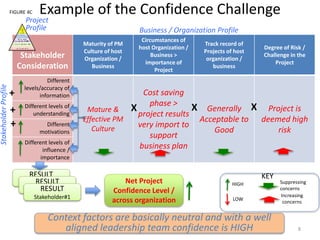
Example of the Confidence Challenge
8
Context factors are basically neutral and with a well
aligned leadership team confidence is HIGH
FIGURE 4C
Stakeholder
Consideration
Maturity of PM
Culture of host
Organization /
Business
Circumstances of
host Organization /
Business >
importance of
Project
Track record of
Projects of host
organization /
business
Degree of Risk /
Challenge in the
Project
Different
levels/accuracy of
information
Mature &
Effective PM
Culture
Cost saving
phase >
project results
very import to
support
business plan
Generally
Acceptable to
Good
Project is
deemed high
risk
Different levels of
understanding
Different
motivations
Different levels of
influence /
importance
Net Project
Confidence Level /
across organization
RESULT
Stakeholder#1
XXX
+
+
+
Suppressing
concerns
Increasing
concerns
HIGH
LOW
KEY
Business / Organization Profile
StakeholderProfile
Project
Profile
Chapter 4: Level of confidence in the Project?
- Why Manage Project Confidence?
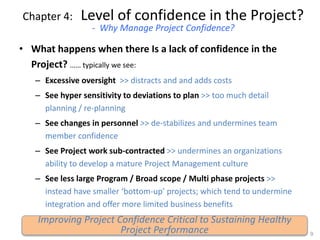
• What happens when there Is a lack of confidence in the
Project? …… typically we see:
– Excessive oversight >> distracts and and adds costs
– See hyper sensitivity to deviations to plan >> too much detail
planning / re-planning
– See changes in personnel >> de-stabilizes and undermines team
member confidence
– See Project work sub-contracted >> undermines an organizations
ability to develop a mature Project Management culture
– See less large Program / Broad scope / Multi phase projects >>
instead have smaller ‘bottom-up’ projects; which tend to undermine
integration and offer more limited business benefits
9
Improving Project Confidence Critical to Sustaining Healthy
Project Performance
Chapter 4: Level of confidence in the Project?
REF. Fig 4D - How to improve Confidence
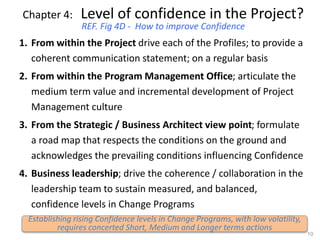
1. From within the Project drive each of the Profiles; to provide a
coherent communication statement; on a regular basis
2. From within the Program Management Office; articulate the
medium term value and incremental development of Project
Management culture
3. From the Strategic / Business Architect view point; formulate
a road map that respects the conditions on the ground and
acknowledges the prevailing conditions influencing Confidence
4. Business leadership; drive the coherence / collaboration in the
leadership team to sustain measured, and balanced,
confidence levels in Change Programs
10
Establishing rising Confidence levels in Change Programs, with low volatility,
requires concerted Short, Medium and Longer terms actions
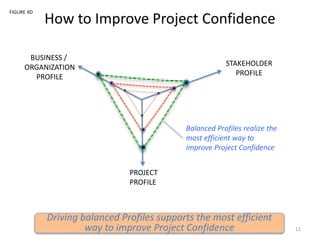
How to Improve Project Confidence
11
Driving balanced Profiles supports the most efficient
way to improve Project Confidence
FIGURE 4D
PROJECT
PROFILE
STAKEHOLDER
PROFILE
BUSINESS /
ORGANIZATION
PROFILE
Balanced Profiles realize the
most efficient way to
improve Project Confidence
Chapter 4: Level of confidence in the Project?
- CONCLUSIONS
1. There are a series of hierarchical dimensions that make up the
Project Profile influencing confidence ( see Fig 4A)
2. Individual and collective Stakeholder profiles often prove the most
challenging to manage / change (see Fig 4B)
3. Business / Organization profile changes very slowly and requires
top level support to sustain concerted improvement
4. All three profiles should be managed in a balanced way as Project
Confidence is a product of all three profiles
5. Raising the collective Business / Organization confidence in
Projects makes it possible for a virtuous cycle of Project
Management performance improvement; conversely a static or
declining level of confidence in Project/s almost guarantees a
lowering of project performance / benefit
12
Successfully Managing Project Confidence enables Project
Performance improvements

Project management chap 4_final

  • 1.
    Project Management Chapter 4: Levelof confidence in the Project? Part of a series considering different aspects of Business Change 1Understanding and Supporting Business Change – by Martin Schyns/ FILE: Project Management_Chap_4_FINAL.pptx
  • 2.
    IntroductionWho am I? Myheadline would be…..Global Engineer Understands Transition Success Approach Key take away is that I have been doing projects my whole career. I am an engineer at heart with a diverse background and I recognize that all organizations, and individuals for that matter, must continually seek to proactively change and adapt. As I am sure most organizations can attest, Change is hard. I thought I would try using this medium to collect various themes and ideas on the subject of Business Change and share my insights. Understanding and Support Business Change Naturally enough, Project Management is my first theme. It is a rich and complex endeavor and it is certainly an area where I think most organizations would acknowledge they could do better. Typically the challenge is that if you ask five people within an organization, what needs to change, you get five different responses. The Initial Path for this Enquiry 1. Chapter 1 – 10: Project Management – 10 questions to explore some involved situations 2. Chapter 11 > : Sustaining Business Health – physiology of a modern business 3. Chapter X > : Insights on making relevant Change happen – road map to the future 4. Chapter Y : CONCLUSIONS – reflection on the relevance / value of what we have uncovered Approach I thought it would be interesting to use the Socratic method to explore what can often be some what dry material; and, because it helps me understand, a series of supporting diagrams that, I hope, encapsulate and convey the key ideas and their context. I would welcome any comments and alternative views to help challenge my desire to grow and make a difference. Thank you, Martin Schyns. 2
  • 3.
    Ten common ProjectManagement situations that are not easily understood…why? 3 SITUATION KEY QUESTION 1. Reflection Was the Project a Success? 2. Prioritization How to make Project Portfolio Management (PPM) relevant? 3. Right Approach? How do you define a project? 4. Realism Level of confidence in the Project? 5. Sponsorship What does Project Sponsorship mean? 6. Planned results How will the Project impact Business Performance? 7. Justification What is the business case for the Project? 8. What or How? Is the business strategy working? 9. Audit Why am I not seeing results? 10. Soft value What are the lessons to take forward? Do these questions echo you own experiences? How well do you really understand the challenges of Project Management? Chap. 4:
  • 4.
    Chapter 4: Levelof confidence in the Project? REF. Fig 4A - Introduction • So what is confidence? … ‘the state of feeling certain about the truth of something’, at a point in time. Confidence assessment is cyclical! • Why is it so important? ….typically level of confidence translates into organizational authority to manage the Project; less confidence more intrusive oversight / challenge • Biggest challenge? …..confidence is an emotion. It is often based on perceptions / loyalties / denial / personal motives ; not necessarily facts • Confidence in what? ….confidence in the business value / relevance. Just delivering a Project on time and to budget is not sufficient! • For a Project? … initially consider the 5W’s and the H ( Why, What, Where, When Who & How). Can we answer, with confidence, the details of 5W’s & H? • Other specific questions: – Is there ongoing evidence that Project Progress is following the plan? – Are the key assumptions valid / likely to remain valid in the future? – What are the dependencies & what is their performance record / expected outcome? – Are the goals of the project still inline with the business needs / priorities? 4 Legitimate confidence can only be established on accurate knowledge and an understanding of how that knowledge relates to the Project
  • 5.
    Frame for Knowledge& Project Understanding 5 #1. 5 W’s and the H #2. Project Progressing to Plan? #3. Are the key Assumptions still Valid? #4. Dependency Status / Projections? #5. Goals still valid? CONFIDENCE LEVEL 10% 15% 20% 25% 30% 25% 45% 70% 100% Project Management Sponsor / Steering Committee Key Dimensions Driving Confidence Level FIGURE 4A
  • 6.
    Dimensions of theConfidence Challenge REF. Fig 4B / 4C - Dimensions of the Challenge 6 Improved management of these dimensions affords a Project a better opportunity for improving the operating conditions & sustaining future existence FIGURE 4B By recognizing these dimensions, and appreciating how they interplay, it becomes possible to better manage the confidence levels of key Project stakeholders. Conversely, ignoring these considerations, leaves the Project exposed to the influence an array of corporate and business dynamics which may well have nothing to do with the project itself. Key Dimensions collectively impacting business confidence in a Project: 1. Project Profile – ref Fig 4A 2. Stakeholder Profiles: •Different levels/accuracy of information •Different levels of understanding •Different motivations •Different levels of influence / importance 3. Business / Organization Profile: •Culture of host Organization / Business •Circumstances of host Organization / Business > Project importance •Track record of Projects of host Organization / Business •Degree of Risk / Challenge in the Project
  • 7.
    RESULT Stakeholder#3RESULT Stakeholder#2 Dimensions of theConfidence Challenge 7 Factors driving Project Confidence Level within an Organization FIGURE 4B Stakeholder Consideration Maturity of PM Culture of host Organization / Business Circumstances of host Organization / Business > importance of Project Track record of host organization / business – re Project successes Degree of Risk / Challenge in the Project Different levels/accuracy of information Can amplify or attenuate individual stakeholder behavior May heighten or suppress project awareness Increase / Decrease tolerance for deviations to plan Sensitizes / De sensitizes various stakeholders to the Project Different levels of understanding Different motivations Different levels of influence / importance Net Project Confidence Level / across organization RESULT Stakeholder#1 XXX + + + Business / Organization Profile StakeholderProfile Project Profile
  • 8.
    RESULT Stakeholder#3RESULT Stakeholder#2 Example of theConfidence Challenge 8 Context factors are basically neutral and with a well aligned leadership team confidence is HIGH FIGURE 4C Stakeholder Consideration Maturity of PM Culture of host Organization / Business Circumstances of host Organization / Business > importance of Project Track record of Projects of host organization / business Degree of Risk / Challenge in the Project Different levels/accuracy of information Mature & Effective PM Culture Cost saving phase > project results very import to support business plan Generally Acceptable to Good Project is deemed high risk Different levels of understanding Different motivations Different levels of influence / importance Net Project Confidence Level / across organization RESULT Stakeholder#1 XXX + + + Suppressing concerns Increasing concerns HIGH LOW KEY Business / Organization Profile StakeholderProfile Project Profile
  • 9.
    Chapter 4: Levelof confidence in the Project? - Why Manage Project Confidence? • What happens when there Is a lack of confidence in the Project? …… typically we see: – Excessive oversight >> distracts and and adds costs – See hyper sensitivity to deviations to plan >> too much detail planning / re-planning – See changes in personnel >> de-stabilizes and undermines team member confidence – See Project work sub-contracted >> undermines an organizations ability to develop a mature Project Management culture – See less large Program / Broad scope / Multi phase projects >> instead have smaller ‘bottom-up’ projects; which tend to undermine integration and offer more limited business benefits 9 Improving Project Confidence Critical to Sustaining Healthy Project Performance
  • 10.
    Chapter 4: Levelof confidence in the Project? REF. Fig 4D - How to improve Confidence 1. From within the Project drive each of the Profiles; to provide a coherent communication statement; on a regular basis 2. From within the Program Management Office; articulate the medium term value and incremental development of Project Management culture 3. From the Strategic / Business Architect view point; formulate a road map that respects the conditions on the ground and acknowledges the prevailing conditions influencing Confidence 4. Business leadership; drive the coherence / collaboration in the leadership team to sustain measured, and balanced, confidence levels in Change Programs 10 Establishing rising Confidence levels in Change Programs, with low volatility, requires concerted Short, Medium and Longer terms actions
  • 11.
    How to ImproveProject Confidence 11 Driving balanced Profiles supports the most efficient way to improve Project Confidence FIGURE 4D PROJECT PROFILE STAKEHOLDER PROFILE BUSINESS / ORGANIZATION PROFILE Balanced Profiles realize the most efficient way to improve Project Confidence
  • 12.
    Chapter 4: Levelof confidence in the Project? - CONCLUSIONS 1. There are a series of hierarchical dimensions that make up the Project Profile influencing confidence ( see Fig 4A) 2. Individual and collective Stakeholder profiles often prove the most challenging to manage / change (see Fig 4B) 3. Business / Organization profile changes very slowly and requires top level support to sustain concerted improvement 4. All three profiles should be managed in a balanced way as Project Confidence is a product of all three profiles 5. Raising the collective Business / Organization confidence in Projects makes it possible for a virtuous cycle of Project Management performance improvement; conversely a static or declining level of confidence in Project/s almost guarantees a lowering of project performance / benefit 12 Successfully Managing Project Confidence enables Project Performance improvements