INTRODUCTION
This project is our final project for Elements in Natural and Built and Environment (ENBE). According to
the project brief, we are required to do two (2) parts: Part A-Individual work and Part B-Group work. This is my
final project individual work which will be submitted on the 6th
of November 2014. For individual work, we need
to do researches on the town that we chose as a group.
There are three (3) types of town that we need to focus on. Those are ancient town, present town and
future town. For ancient town and present town, we will include their historical background, detail, and what
elements that can be used for our future town. Also, we will include the positive and negative side of the future.
ENBE | Final Project | Part A – Report | A Better Town of Future
ERICA CHIN CHING | 0320460 | PUAN HASMANIRA| FNBE AUG 2014 | TAYLOR’S UNIVERSITY LAKESIDE CAMPUS
TOWN
2.1 WHAT IS A TOWN?
Town is a region which has a name, boundaries and local government that is bigger than a village but smaller
than a city. Town is generally smaller than a city in populations and lower rate of development.
2.2 WHAT MAKES A TOWN?
Basically, towns are made up by medium high population forms of social organization which immigration is
occurring. This increases the population of the town and eventually the town would become a city. In a town, it
has the basic systems such as public transportation, business centre, sport centre, housing and so on.
2.3 WHAT MAKES A GOOD TOWN?
A good township is definitely the most important basis to become a good town. The township must include the
responsible to the water supply, electricity, sewage and so on.
2.4 WHAT IS THE FUTURE TOWN?
When we say future it indicates tomorrow, the next 20 years or even a century. In this modern world, future
town that is either floating on the water or floating in the air is not an impossible possibility. We could be living
in a town which is floating on the water in the next 10 years.
ENBE | Final Project | Part A – Report | A Better Town of Future
ERICA CHIN CHING | 0320460 | PUAN HASMANIRA| FNBE AUG 2014 | TAYLOR’S UNIVERSITY LAKESIDE CAMPUS
ANCIENT TOWN / CITY (ASSUR, MESOPOTAMIA)
3.1 HISTORY BACKGROUND
Early History
 A city was existed in Mesopotamia in the 3rd
millennium BCE was shown in the archeological excavations.
 The oldest foundations were discovered in those beneath the first Ishtar Temple, which probably was
the base of an earlier temple.
 The pottery proved that Assur was an important trade centre in the early years in Assyrian Empire. The
trade between Mesopotamia and Anatolia were increased in time.
 Assur played an important role in these transactions. All the profits were spent on the renovations of
the city and modifications of the private homes and the public buildings.
 Assur was expanded through trading and eventually became the capital of Assyria by the 2nd
millennium
BCE. Walls were also built for defense purpose.
Assur the Capital
 The city continued to improve under the rule of Shalmaneser. Also, he managed to build the city of
Kalhu.
 Renovations and building projects were continued even after Shalmaneser was no longer ruling.
 Between 1115-1076 BCE, Assur continued as the capital and the jewel of the empire.
 After the death of Tiglath Pileser I, Assur remained stable even though other kingdoms that was built by
Tiglath Pileser I fell apart.
 Assur was the hub of the giant wheel of empire during the rise of Adad-Nirari II(912-891 BCE)
ENBE | Final Project | Part A – Report | A Better Town of Future
ERICA CHIN CHING | 0320460 | PUAN HASMANIRA| FNBE AUG 2014 | TAYLOR’S UNIVERSITY LAKESIDE CAMPUS
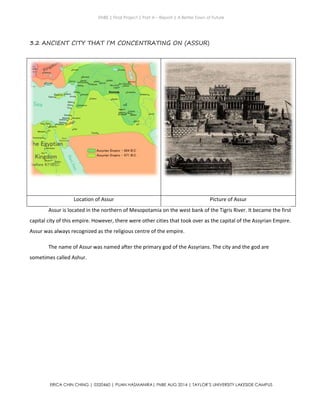
3.2 ANCIENT CITY THAT I’M CONCENTRATING ON (ASSUR)
Location of Assur Picture of Assur
Assur is located in the northern of Mesopotamia on the west bank of the Tigris River. It became the first
capital city of this empire. However, there were other cities that took over as the capital of the Assyrian Empire.
Assur was always recognized as the religious centre of the empire.
The name of Assur was named after the primary god of the Assyrians. The city and the god are
sometimes called Ashur.
ENBE | Final Project | Part A – Report | A Better Town of Future
ERICA CHIN CHING | 0320460 | PUAN HASMANIRA| FNBE AUG 2014 | TAYLOR’S UNIVERSITY LAKESIDE CAMPUS
3.3 HOW IT IS A SIGNIFICANT CITY AND DETAILS
3.3.1 WATER SUPPLY
 Since the majority of the canals lie in the river terraces, so it was easier to drain water from the Tigris
River and to channel it for gravity- fed irrigation parallel to the river.
 As the region was near to the river, it was easy for the people who lived there to obtain water for daily
basis.
 In the middle of the 2nd
millennium, the demand for a stable supply of crops became essential for the
expanding political power.
 Makhmur Canal which stands out the most from the other mapped canals.
 The canal above distributed to multiple channels to the fields in the lower Zab.
 Besides transporting water to the agriculture fields, they were used for fishing purposes. This eventually
helped the economy of the city since the population was able to produce their own food and sold the
goods to the market.
3.3.2 Designs of the Assyrians buildings
 All the building plans were rectangular and they had the most lovely and varied forms.
 Tower-like structures each rising from a square base.
 Graceful curves and on the basis of an ordinary square hall carry up a dome(octagon or circle)
 Sculptures were also done in this time.
 The uniqueness of their buildings was that there’re only a door in a building and no windows.
ENBE | Final Project | Part A – Report | A Better Town of Future
ERICA CHIN CHING | 0320460 | PUAN HASMANIRA| FNBE AUG 2014 | TAYLOR’S UNIVERSITY LAKESIDE CAMPUS
3.3.3 Building Materials
 Clay masonry and of increasingly complex forms of the stacked mud brick.
 Adobe-brick has superior thermal properties and has lower manufacturing costs which make it
preferable compare to vitreous brick.
 Red brick was used in small applications involving water, decoration, and monumental construction. A
late innovation was glazed vitreous brick.
 The bricks were layered in a row perpendicular to the rest rows.
 The plano-convex bricks were advantageous to the speed of manufacture. Also, the irregular surface
held the finishing plaster coat better than a smooth from other brick types.
ENBE | Final Project | Part A – Report | A Better Town of Future
ERICA CHIN CHING | 0320460 | PUAN HASMANIRA| FNBE AUG 2014 | TAYLOR’S UNIVERSITY LAKESIDE CAMPUS
3.4 CONCLUSION
After I did researches on Assur, I’ve learnt a few things such as:
(a) History of Assur
(b) Water supply
(c) Designs of their architecture
(d) Building materials
3.5 INFORMATION AND ELEMENTS THAT CAN BE USED FOR FUTURE TOWN
(a) The usage of canals in Assur
(b) How the canal systems contributed in the economy of Assur
ENBE | Final Project | Part A – Report | A Better Town of Future
ERICA CHIN CHING | 0320460 | PUAN HASMANIRA| FNBE AUG 2014 | TAYLOR’S UNIVERSITY LAKESIDE CAMPUS
PRESENT TOWN / CITY (VENICE, ITALY)
4.1 HISTORY BACKGROUND
Venice in the Middle Ages
 In 421 A.D. - Venice was founded. Since 49 BC Venetians had been Roman citizens.
 In 453 A.D - Attila the Hun invaded Italy, some Venetians fled to islands and built village there. A loose
federation is formed.
 Byzantine Empire was controlling the Venice.
 In 726 A.D - The Venetians partly gained their independence and Orso Ipato was elected as their duke.
 In 810 A.D - The Franks tried to conquer the Venetians but failed.
 Venice became a trading center and ships sailed to and fro. The population of Venice grew steadily.
 Middle Ages - Venice continued to flourish as a port and trading center.
 In 1199 A.D. - The Venetians agree to build a fleet of ships to ferry the Crusaders.
 13th
and 14th
centuries - The Genoese and Venetians fought 5 wars.
 In 1348, the Black Death devastated the population of Venice.
 In 1403, Venice introduced quarantine.
 In 15th
century - Venice faced a new threat from the Turks.
 In 1453 - They captured Constantinople and afterwards they advanced into Southeast Europe.
 In 1489 - Venice came to rule Cyprus.
 In 1508 - Several European countries formed the League of Cambrai and went to war against Venice.
However after 8 years of war the map was largely unchanged
 In 1571 - The Turks conquered the island.
Modern Venice
 17th
century - Venice gradually lost power and influence.
 18th century - Venice was politically unimportant although the art of opera was flourished.
 In 1797 - Napoleon dissolved the Republic of Venice.
 In 1815 – Napoleon handed Venice to Austria after his fall.
ENBE | Final Project | Part A – Report | A Better Town of Future
ERICA CHIN CHING | 0320460 | PUAN HASMANIRA| FNBE AUG 2014 | TAYLOR’S UNIVERSITY LAKESIDE CAMPUS
 In 1846 - The railway reached Venice.
 In 1848 - Revolutions swept Europe and Venice rose in rebellion against the Austrians. For a short period
Daniele Manin became president of an independent Venice.
 In 1849 - Austrian forces bombarded the city and Venice was forced to surrender.
 In 1866 - The Austrians were defeated by the Prussians and Venice was allowed to join the new nation
of Italy.
 In late 19th century - Venice was flourished as a port and a manufacturing center.
 In 1933 - Mussolini built a road from the mainland to Venice. World War II, Venice was undamaged by
fighting but the Jewish population was deported.
 In 1966 - Venice suffered a severe flood but the city soon recovered.
 Since mid-19th
century - The population if Venice has fallen sharply.
 Today - Tourism is the mainstay of Venice. The population of Venice is about 271,000.
ENBE | Final Project | Part A – Report | A Better Town of Future
ERICA CHIN CHING | 0320460 | PUAN HASMANIRA| FNBE AUG 2014 | TAYLOR’S UNIVERSITY LAKESIDE CAMPUS
4.2 PRESENT CITY THAT I’M CONCENTRATING ON (VENICE)
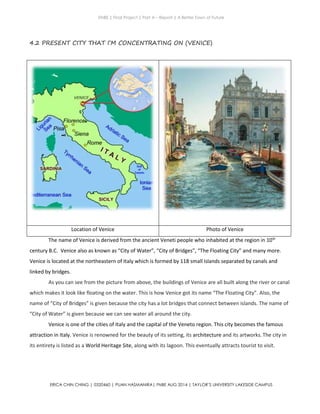
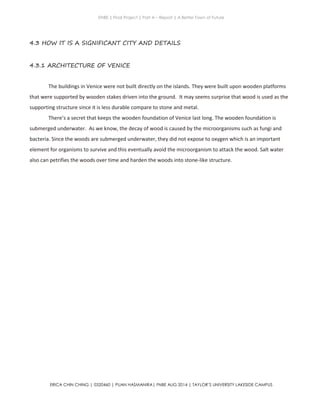
Location of Venice Photo of Venice
The name of Venice is derived from the ancient Veneti people who inhabited at the region in 10th
century B.C. Venice also as known as “City of Water”, “City of Bridges”, “The Floating City” and many more.
Venice is located at the northeastern of Italy which is formed by 118 small islands separated by canals and
linked by bridges.
As you can see from the picture from above, the buildings of Venice are all built along the river or canal
which makes it look like floating on the water. This is how Venice got its name “The Floating City”. Also, the
name of “City of Bridges” is given because the city has a lot bridges that connect between islands. The name of
“City of Water” is given because we can see water all around the city.
Venice is one of the cities of Italy and the capital of the Veneto region. This city becomes the famous
attraction in Italy. Venice is renowned for the beauty of its setting, its architecture and its artworks.The city in
its entirety is listed as a World Heritage Site, along with its lagoon. This eventually attracts tourist to visit.
ENBE | Final Project | Part A – Report | A Better Town of Future
ERICA CHIN CHING | 0320460 | PUAN HASMANIRA| FNBE AUG 2014 | TAYLOR’S UNIVERSITY LAKESIDE CAMPUS
4.3 HOW IT IS A SIGNIFICANT CITY AND DETAILS
4.3.1 ARCHITECTURE OF VENICE
The buildings in Venice were not built directly on the islands. They were built upon wooden platforms
that were supported by wooden stakes driven into the ground. It may seems surprise that wood is used as the
supporting structure since it is less durable compare to stone and metal.
There’s a secret that keeps the wooden foundation of Venice last long. The wooden foundation is
submerged underwater. As we know, the decay of wood is caused by the microorganisms such as fungi and
bacteria. Since the woods are submerged underwater, they did not expose to oxygen which is an important
element for organisms to survive and this eventually avoid the microorganism to attack the wood. Salt water
also can petrifies the woods over time and harden the woods into stone-like structure.
ENBE | Final Project | Part A – Report | A Better Town of Future
ERICA CHIN CHING | 0320460 | PUAN HASMANIRA| FNBE AUG 2014 | TAYLOR’S UNIVERSITY LAKESIDE CAMPUS
4.3.2 TOWNSHIP AND ZONING OF VENICE
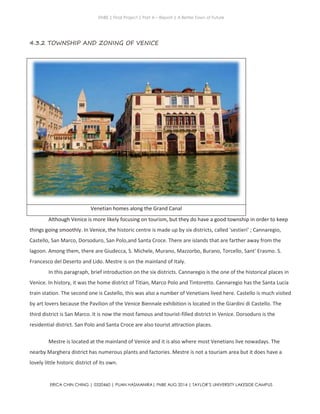
Venetian homes along the Grand Canal
Although Venice is more likely focusing on tourism, but they do have a good township in order to keep
things going smoothly. In Venice, the historic centre is made up by six districts, called 'sestieri' ; Cannaregio,
Castello, San Marco, Dorsoduro, San Polo,and Santa Croce. There are islands that are farther away from the
lagoon. Among them, there are Giudecca, S. Michele, Murano, Mazzorbo, Burano, Torcello, Sant' Erasmo. S.
Francesco del Deserto and Lido. Mestre is on the mainland of Italy.
In this paragraph, brief introduction on the six districts. Cannaregio is the one of the historical places in
Venice. In history, it was the home district of Titian, Marco Polo and Tintoretto. Cannaregio has the Santa Lucia
train station. The second one is Castello, this was also a number of Venetians lived here. Castello is much visited
by art lovers because the Pavilion of the Venice Biennale exhibition is located in the Giardini di Castello. The
third district is San Marco. It is now the most famous and tourist-filled district in Venice. Dorsoduro is the
residential district. San Polo and Santa Croce are also tourist attraction places.
Mestre is located at the mainland of Venice and it is also where most Venetians live nowadays. The
nearby Marghera district has numerous plants and factories. Mestre is not a touriam area but it does have a
lovely little historic district of its own.
ENBE | Final Project | Part A – Report | A Better Town of Future
ERICA CHIN CHING | 0320460 | PUAN HASMANIRA| FNBE AUG 2014 | TAYLOR’S UNIVERSITY LAKESIDE CAMPUS
4.4 CONCLUSION
After I did researches on Venice, I’ve learnt a few things such as:
(e) History of Venice
(f) Architecture of Venice
(g) Culture of Venice
(h) Zoning and township of Venice
4.5 INFORMATION AND ELEMENTS THAT CAN BE USED FOR FUTURE TOWN
(c) The wooden foundation
(d) The stone-built bridges
(e) Zoning and township
(f) Transportation
ENBE | Final Project | Part A – Report | A Better Town of Future
ERICA CHIN CHING | 0320460 | PUAN HASMANIRA| FNBE AUG 2014 | TAYLOR’S UNIVERSITY LAKESIDE CAMPUS
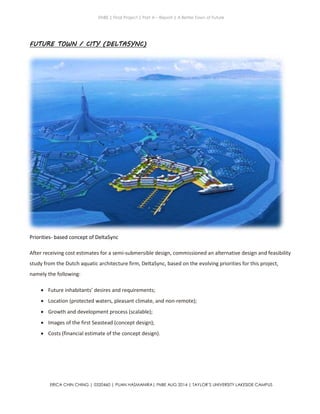
FUTURE TOWN / CITY (DELTASYNC)
Priorities- based concept of DeltaSync
After receiving cost estimates for a semi-submersible design, commissioned an alternative design and feasibility
study from the Dutch aquatic architecture firm, DeltaSync, based on the evolving priorities for this project,
namely the following:
 Future inhabitants’ desires and requirements;
 Location (protected waters, pleasant climate, and non­remote);
 Growth and development process (scalable);
 Images of the first Seastead (concept design);
 Costs (financial estimate of the concept design).
ENBE | Final Project | Part A – Report | A Better Town of Future
ERICA CHIN CHING | 0320460 | PUAN HASMANIRA| FNBE AUG 2014 | TAYLOR’S UNIVERSITY LAKESIDE CAMPUS
Designs of this city are based on:
 Estimation of platform size
 Platform structure and material
 Buildings on the platform
 Urban configuration and preliminary design
ENBE | Final Project | Part A – Report | A Better Town of Future
ERICA CHIN CHING | 0320460 | PUAN HASMANIRA| FNBE AUG 2014 | TAYLOR’S UNIVERSITY LAKESIDE CAMPUS
THE NEW “X” TOWN: SIXSHELL, THE FLOATING TOWN
6.1 SOLUTIONS TO CREATE NEW TOWN
In this modern society, people start to have the thoughts of living in luxurious and magnificent town or
city. There were books and movie about the floating city on the water. China had started their research on the
floating city and came up with a few ideas on how they’re going to propose the town. Besides, DeltaSync and
The Seasteading Institute had their final report on the implementation plan on the 16th
December 2013.
In this ENBE project, the chosen topic is A Better Town of Future - Floating City. I did some research in
order to make a successful future town. The first solution is to have a good town planning beforehand. The
second solution is
6.2 IMPORTANT CHARACTERISTICS AND ELEMENTS
The special characteristics and elements of SixShell:
 Has the shape of seashell
- Unique shape that is compatible with the floating city theme
- A step closer to the nature
 Very eco-friendly
- use renewable energy to generate the power
- has a lot of trees and greenery area
 Only electric cars can be used within that city
- It’s eco-friendly
- Does not release hazardous gases like carbon monoxide, sulphur dioxide and etc.
 Sufficient public transport
- They have subways, bus, taxi
 A few alternative ways to head back home (the chances of traffic in the city is lesser)
- Decrease the traffics during peak hour.
- Get to the destination faster.
ENBE | Final Project | Part A – Report | A Better Town of Future
ERICA CHIN CHING | 0320460 | PUAN HASMANIRA| FNBE AUG 2014 | TAYLOR’S UNIVERSITY LAKESIDE CAMPUS
The weakness of this city
 Takes time to reach mainland
- Using water transportation such as boat, ferry, submarine
- Using air transportation such as airplane and helicopter
 Agriculture might affect by the climate change
 Higher living cost
- Maintenance of the floating mechanism
- Imported food from mainland
- Electric cars costing
ENBE | Final Project | Part A – Report | A Better Town of Future
ERICA CHIN CHING | 0320460 | PUAN HASMANIRA| FNBE AUG 2014 | TAYLOR’S UNIVERSITY LAKESIDE CAMPUS
6.3 DOCUMENTATION OF 6SHELL
6.3.1 Master Plan
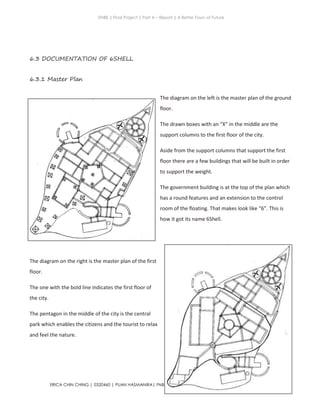
The diagram on the left is the master plan of the ground
floor.
The drawn boxes with an “X” in the middle are the
support columns to the first floor of the city.
Aside from the support columns that support the first
floor there are a few buildings that will be built in order
to support the weight.
The government building is at the top of the plan which
has a round features and an extension to the control
room of the floating. That makes look like “6”. This is
how it got its name 6Shell.
The diagram on the right is the master plan of the first
floor.
The one with the bold line indicates the first floor of
the city.
The pentagon in the middle of the city is the central
park which enables the citizens and the tourist to relax
and feel the nature.
ENBE | Final Project | Part A – Report | A Better Town of Future
ERICA CHIN CHING | 0320460 | PUAN HASMANIRA| FNBE AUG 2014 | TAYLOR’S UNIVERSITY LAKESIDE CAMPUS
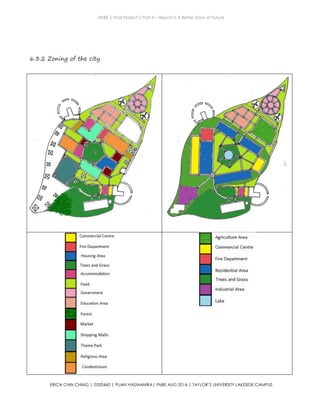
6.3.2 Zoning of the city
ENBE | Final Project | Part A – Report | A Better Town of Future
ERICA CHIN CHING | 0320460 | PUAN HASMANIRA| FNBE AUG 2014 | TAYLOR’S UNIVERSITY LAKESIDE CAMPUS
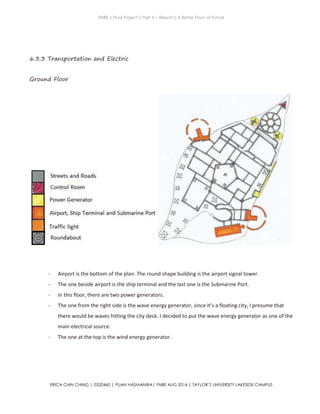
6.3.3 Transportation and Electric
Ground Floor
- Airport is the bottom of the plan. The round shape building is the airport signal tower.
- The one beside airport is the ship terminal and the last one is the Submarine Port.
- In this floor, there are two power generators.
- The one from the right side is the wave energy generator, since it’s a floating city, I presume that
there would be waves hitting the city deck. I decided to put the wave energy generator as one of the
main electrical source.
- The one at the top is the wind energy generator.
ENBE | Final Project | Part A – Report | A Better Town of Future
ERICA CHIN CHING | 0320460 | PUAN HASMANIRA| FNBE AUG 2014 | TAYLOR’S UNIVERSITY LAKESIDE CAMPUS
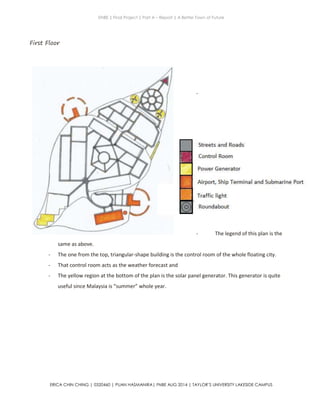
First Floor
-
- The legend of this plan is the
same as above.
- The one from the top, triangular-shape building is the control room of the whole floating city.
- That control room acts as the weather forecast and
- The yellow region at the bottom of the plan is the solar panel generator. This generator is quite
useful since Malaysia is “summer” whole year.
ENBE | Final Project | Part A – Report | A Better Town of Future
ERICA CHIN CHING | 0320460 | PUAN HASMANIRA| FNBE AUG 2014 | TAYLOR’S UNIVERSITY LAKESIDE CAMPUS
6.4 CONCLUSION
SixShell is definitely is a better future town for the modern urbanites like us.
SixShell has most of the basic system that a town should have:
- Commercial Centre
- Residential Area
- Recreation centre
- Tourism Centre
- Agricultural Area
- Indusrial Area
- Medical Centre
- Fire Department
- Transportation
The new facilities that are introduced to our “X” Town are:
- Electric cars
- Wind energy power generator
- Wave energy power generator
- Solar energy power generator
- Submarine as one of the transportation
ENBE | Final Project | Part A – Report | A Better Town of Future
ERICA CHIN CHING | 0320460 | PUAN HASMANIRA| FNBE AUG 2014 | TAYLOR’S UNIVERSITY LAKESIDE CAMPUS
CONCLUSION
Throughout this project, I manage to do quite a number of researches on the ancient, present and the
future towns. I learnt the history of Assur and on how did they manage to stand strong even after a few
kingdoms had fallen. Also, the materials that they used for their buildings during that time.
Besides, the present city that I did is Venice. Without this project, I would never know that it has so
many alternative names. I also learnt that the wooden foundation of Venice is not merely a knowledge but the
wisdom of our ancestor that had pass on to us.
I would like to thank our coordinator, Pn.Has to give us this opportunity to know more about the history
in order to create a better future town.
ENBE | Final Project | Part A – Report | A Better Town of Future
ERICA CHIN CHING | 0320460 | PUAN HASMANIRA| FNBE AUG 2014 | TAYLOR’S UNIVERSITY LAKESIDE CAMPUS
REFERENCE LIST
http://en.wikipedia.org/wiki/Venice
https://www.google.com.my/webhp?sourceid=chrome-instant&ion=1&espv=2&ie=UTF-
8#q=brief+history+of+venice
http://www.ancient.eu/ashur/
http://www.localhistories.org/venice.html
http://seasteading.wpengine.netdna-cdn.com/wp-content/uploads/2013/12/DeltaSync-Final-Concept-
Report.pdf

Town Planning Proposal- SixShell

  • 1.
    INTRODUCTION This project isour final project for Elements in Natural and Built and Environment (ENBE). According to the project brief, we are required to do two (2) parts: Part A-Individual work and Part B-Group work. This is my final project individual work which will be submitted on the 6th of November 2014. For individual work, we need to do researches on the town that we chose as a group. There are three (3) types of town that we need to focus on. Those are ancient town, present town and future town. For ancient town and present town, we will include their historical background, detail, and what elements that can be used for our future town. Also, we will include the positive and negative side of the future.
  • 2.
    ENBE | FinalProject | Part A – Report | A Better Town of Future ERICA CHIN CHING | 0320460 | PUAN HASMANIRA| FNBE AUG 2014 | TAYLOR’S UNIVERSITY LAKESIDE CAMPUS TOWN 2.1 WHAT IS A TOWN? Town is a region which has a name, boundaries and local government that is bigger than a village but smaller than a city. Town is generally smaller than a city in populations and lower rate of development. 2.2 WHAT MAKES A TOWN? Basically, towns are made up by medium high population forms of social organization which immigration is occurring. This increases the population of the town and eventually the town would become a city. In a town, it has the basic systems such as public transportation, business centre, sport centre, housing and so on. 2.3 WHAT MAKES A GOOD TOWN? A good township is definitely the most important basis to become a good town. The township must include the responsible to the water supply, electricity, sewage and so on. 2.4 WHAT IS THE FUTURE TOWN? When we say future it indicates tomorrow, the next 20 years or even a century. In this modern world, future town that is either floating on the water or floating in the air is not an impossible possibility. We could be living in a town which is floating on the water in the next 10 years.
  • 3.
    ENBE | FinalProject | Part A – Report | A Better Town of Future ERICA CHIN CHING | 0320460 | PUAN HASMANIRA| FNBE AUG 2014 | TAYLOR’S UNIVERSITY LAKESIDE CAMPUS ANCIENT TOWN / CITY (ASSUR, MESOPOTAMIA) 3.1 HISTORY BACKGROUND Early History  A city was existed in Mesopotamia in the 3rd millennium BCE was shown in the archeological excavations.  The oldest foundations were discovered in those beneath the first Ishtar Temple, which probably was the base of an earlier temple.  The pottery proved that Assur was an important trade centre in the early years in Assyrian Empire. The trade between Mesopotamia and Anatolia were increased in time.  Assur played an important role in these transactions. All the profits were spent on the renovations of the city and modifications of the private homes and the public buildings.  Assur was expanded through trading and eventually became the capital of Assyria by the 2nd millennium BCE. Walls were also built for defense purpose. Assur the Capital  The city continued to improve under the rule of Shalmaneser. Also, he managed to build the city of Kalhu.  Renovations and building projects were continued even after Shalmaneser was no longer ruling.  Between 1115-1076 BCE, Assur continued as the capital and the jewel of the empire.  After the death of Tiglath Pileser I, Assur remained stable even though other kingdoms that was built by Tiglath Pileser I fell apart.  Assur was the hub of the giant wheel of empire during the rise of Adad-Nirari II(912-891 BCE)
  • 4.
    ENBE | FinalProject | Part A – Report | A Better Town of Future ERICA CHIN CHING | 0320460 | PUAN HASMANIRA| FNBE AUG 2014 | TAYLOR’S UNIVERSITY LAKESIDE CAMPUS 3.2 ANCIENT CITY THAT I’M CONCENTRATING ON (ASSUR) Location of Assur Picture of Assur Assur is located in the northern of Mesopotamia on the west bank of the Tigris River. It became the first capital city of this empire. However, there were other cities that took over as the capital of the Assyrian Empire. Assur was always recognized as the religious centre of the empire. The name of Assur was named after the primary god of the Assyrians. The city and the god are sometimes called Ashur.
  • 5.
    ENBE | FinalProject | Part A – Report | A Better Town of Future ERICA CHIN CHING | 0320460 | PUAN HASMANIRA| FNBE AUG 2014 | TAYLOR’S UNIVERSITY LAKESIDE CAMPUS 3.3 HOW IT IS A SIGNIFICANT CITY AND DETAILS 3.3.1 WATER SUPPLY  Since the majority of the canals lie in the river terraces, so it was easier to drain water from the Tigris River and to channel it for gravity- fed irrigation parallel to the river.  As the region was near to the river, it was easy for the people who lived there to obtain water for daily basis.  In the middle of the 2nd millennium, the demand for a stable supply of crops became essential for the expanding political power.  Makhmur Canal which stands out the most from the other mapped canals.  The canal above distributed to multiple channels to the fields in the lower Zab.  Besides transporting water to the agriculture fields, they were used for fishing purposes. This eventually helped the economy of the city since the population was able to produce their own food and sold the goods to the market. 3.3.2 Designs of the Assyrians buildings  All the building plans were rectangular and they had the most lovely and varied forms.  Tower-like structures each rising from a square base.  Graceful curves and on the basis of an ordinary square hall carry up a dome(octagon or circle)  Sculptures were also done in this time.  The uniqueness of their buildings was that there’re only a door in a building and no windows.
  • 6.
    ENBE | FinalProject | Part A – Report | A Better Town of Future ERICA CHIN CHING | 0320460 | PUAN HASMANIRA| FNBE AUG 2014 | TAYLOR’S UNIVERSITY LAKESIDE CAMPUS 3.3.3 Building Materials  Clay masonry and of increasingly complex forms of the stacked mud brick.  Adobe-brick has superior thermal properties and has lower manufacturing costs which make it preferable compare to vitreous brick.  Red brick was used in small applications involving water, decoration, and monumental construction. A late innovation was glazed vitreous brick.  The bricks were layered in a row perpendicular to the rest rows.  The plano-convex bricks were advantageous to the speed of manufacture. Also, the irregular surface held the finishing plaster coat better than a smooth from other brick types.
  • 7.
    ENBE | FinalProject | Part A – Report | A Better Town of Future ERICA CHIN CHING | 0320460 | PUAN HASMANIRA| FNBE AUG 2014 | TAYLOR’S UNIVERSITY LAKESIDE CAMPUS 3.4 CONCLUSION After I did researches on Assur, I’ve learnt a few things such as: (a) History of Assur (b) Water supply (c) Designs of their architecture (d) Building materials 3.5 INFORMATION AND ELEMENTS THAT CAN BE USED FOR FUTURE TOWN (a) The usage of canals in Assur (b) How the canal systems contributed in the economy of Assur
  • 8.
    ENBE | FinalProject | Part A – Report | A Better Town of Future ERICA CHIN CHING | 0320460 | PUAN HASMANIRA| FNBE AUG 2014 | TAYLOR’S UNIVERSITY LAKESIDE CAMPUS PRESENT TOWN / CITY (VENICE, ITALY) 4.1 HISTORY BACKGROUND Venice in the Middle Ages  In 421 A.D. - Venice was founded. Since 49 BC Venetians had been Roman citizens.  In 453 A.D - Attila the Hun invaded Italy, some Venetians fled to islands and built village there. A loose federation is formed.  Byzantine Empire was controlling the Venice.  In 726 A.D - The Venetians partly gained their independence and Orso Ipato was elected as their duke.  In 810 A.D - The Franks tried to conquer the Venetians but failed.  Venice became a trading center and ships sailed to and fro. The population of Venice grew steadily.  Middle Ages - Venice continued to flourish as a port and trading center.  In 1199 A.D. - The Venetians agree to build a fleet of ships to ferry the Crusaders.  13th and 14th centuries - The Genoese and Venetians fought 5 wars.  In 1348, the Black Death devastated the population of Venice.  In 1403, Venice introduced quarantine.  In 15th century - Venice faced a new threat from the Turks.  In 1453 - They captured Constantinople and afterwards they advanced into Southeast Europe.  In 1489 - Venice came to rule Cyprus.  In 1508 - Several European countries formed the League of Cambrai and went to war against Venice. However after 8 years of war the map was largely unchanged  In 1571 - The Turks conquered the island. Modern Venice  17th century - Venice gradually lost power and influence.  18th century - Venice was politically unimportant although the art of opera was flourished.  In 1797 - Napoleon dissolved the Republic of Venice.  In 1815 – Napoleon handed Venice to Austria after his fall.
  • 9.
    ENBE | FinalProject | Part A – Report | A Better Town of Future ERICA CHIN CHING | 0320460 | PUAN HASMANIRA| FNBE AUG 2014 | TAYLOR’S UNIVERSITY LAKESIDE CAMPUS  In 1846 - The railway reached Venice.  In 1848 - Revolutions swept Europe and Venice rose in rebellion against the Austrians. For a short period Daniele Manin became president of an independent Venice.  In 1849 - Austrian forces bombarded the city and Venice was forced to surrender.  In 1866 - The Austrians were defeated by the Prussians and Venice was allowed to join the new nation of Italy.  In late 19th century - Venice was flourished as a port and a manufacturing center.  In 1933 - Mussolini built a road from the mainland to Venice. World War II, Venice was undamaged by fighting but the Jewish population was deported.  In 1966 - Venice suffered a severe flood but the city soon recovered.  Since mid-19th century - The population if Venice has fallen sharply.  Today - Tourism is the mainstay of Venice. The population of Venice is about 271,000.
  • 10.
    ENBE | FinalProject | Part A – Report | A Better Town of Future ERICA CHIN CHING | 0320460 | PUAN HASMANIRA| FNBE AUG 2014 | TAYLOR’S UNIVERSITY LAKESIDE CAMPUS 4.2 PRESENT CITY THAT I’M CONCENTRATING ON (VENICE) Location of Venice Photo of Venice The name of Venice is derived from the ancient Veneti people who inhabited at the region in 10th century B.C. Venice also as known as “City of Water”, “City of Bridges”, “The Floating City” and many more. Venice is located at the northeastern of Italy which is formed by 118 small islands separated by canals and linked by bridges. As you can see from the picture from above, the buildings of Venice are all built along the river or canal which makes it look like floating on the water. This is how Venice got its name “The Floating City”. Also, the name of “City of Bridges” is given because the city has a lot bridges that connect between islands. The name of “City of Water” is given because we can see water all around the city. Venice is one of the cities of Italy and the capital of the Veneto region. This city becomes the famous attraction in Italy. Venice is renowned for the beauty of its setting, its architecture and its artworks.The city in its entirety is listed as a World Heritage Site, along with its lagoon. This eventually attracts tourist to visit.
  • 11.
    ENBE | FinalProject | Part A – Report | A Better Town of Future ERICA CHIN CHING | 0320460 | PUAN HASMANIRA| FNBE AUG 2014 | TAYLOR’S UNIVERSITY LAKESIDE CAMPUS 4.3 HOW IT IS A SIGNIFICANT CITY AND DETAILS 4.3.1 ARCHITECTURE OF VENICE The buildings in Venice were not built directly on the islands. They were built upon wooden platforms that were supported by wooden stakes driven into the ground. It may seems surprise that wood is used as the supporting structure since it is less durable compare to stone and metal. There’s a secret that keeps the wooden foundation of Venice last long. The wooden foundation is submerged underwater. As we know, the decay of wood is caused by the microorganisms such as fungi and bacteria. Since the woods are submerged underwater, they did not expose to oxygen which is an important element for organisms to survive and this eventually avoid the microorganism to attack the wood. Salt water also can petrifies the woods over time and harden the woods into stone-like structure.
  • 12.
    ENBE | FinalProject | Part A – Report | A Better Town of Future ERICA CHIN CHING | 0320460 | PUAN HASMANIRA| FNBE AUG 2014 | TAYLOR’S UNIVERSITY LAKESIDE CAMPUS 4.3.2 TOWNSHIP AND ZONING OF VENICE Venetian homes along the Grand Canal Although Venice is more likely focusing on tourism, but they do have a good township in order to keep things going smoothly. In Venice, the historic centre is made up by six districts, called 'sestieri' ; Cannaregio, Castello, San Marco, Dorsoduro, San Polo,and Santa Croce. There are islands that are farther away from the lagoon. Among them, there are Giudecca, S. Michele, Murano, Mazzorbo, Burano, Torcello, Sant' Erasmo. S. Francesco del Deserto and Lido. Mestre is on the mainland of Italy. In this paragraph, brief introduction on the six districts. Cannaregio is the one of the historical places in Venice. In history, it was the home district of Titian, Marco Polo and Tintoretto. Cannaregio has the Santa Lucia train station. The second one is Castello, this was also a number of Venetians lived here. Castello is much visited by art lovers because the Pavilion of the Venice Biennale exhibition is located in the Giardini di Castello. The third district is San Marco. It is now the most famous and tourist-filled district in Venice. Dorsoduro is the residential district. San Polo and Santa Croce are also tourist attraction places. Mestre is located at the mainland of Venice and it is also where most Venetians live nowadays. The nearby Marghera district has numerous plants and factories. Mestre is not a touriam area but it does have a lovely little historic district of its own.
  • 13.
    ENBE | FinalProject | Part A – Report | A Better Town of Future ERICA CHIN CHING | 0320460 | PUAN HASMANIRA| FNBE AUG 2014 | TAYLOR’S UNIVERSITY LAKESIDE CAMPUS 4.4 CONCLUSION After I did researches on Venice, I’ve learnt a few things such as: (e) History of Venice (f) Architecture of Venice (g) Culture of Venice (h) Zoning and township of Venice 4.5 INFORMATION AND ELEMENTS THAT CAN BE USED FOR FUTURE TOWN (c) The wooden foundation (d) The stone-built bridges (e) Zoning and township (f) Transportation
  • 14.
    ENBE | FinalProject | Part A – Report | A Better Town of Future ERICA CHIN CHING | 0320460 | PUAN HASMANIRA| FNBE AUG 2014 | TAYLOR’S UNIVERSITY LAKESIDE CAMPUS FUTURE TOWN / CITY (DELTASYNC) Priorities- based concept of DeltaSync After receiving cost estimates for a semi-submersible design, commissioned an alternative design and feasibility study from the Dutch aquatic architecture firm, DeltaSync, based on the evolving priorities for this project, namely the following:  Future inhabitants’ desires and requirements;  Location (protected waters, pleasant climate, and non­remote);  Growth and development process (scalable);  Images of the first Seastead (concept design);  Costs (financial estimate of the concept design).
  • 15.
    ENBE | FinalProject | Part A – Report | A Better Town of Future ERICA CHIN CHING | 0320460 | PUAN HASMANIRA| FNBE AUG 2014 | TAYLOR’S UNIVERSITY LAKESIDE CAMPUS Designs of this city are based on:  Estimation of platform size  Platform structure and material  Buildings on the platform  Urban configuration and preliminary design
  • 16.
    ENBE | FinalProject | Part A – Report | A Better Town of Future ERICA CHIN CHING | 0320460 | PUAN HASMANIRA| FNBE AUG 2014 | TAYLOR’S UNIVERSITY LAKESIDE CAMPUS THE NEW “X” TOWN: SIXSHELL, THE FLOATING TOWN 6.1 SOLUTIONS TO CREATE NEW TOWN In this modern society, people start to have the thoughts of living in luxurious and magnificent town or city. There were books and movie about the floating city on the water. China had started their research on the floating city and came up with a few ideas on how they’re going to propose the town. Besides, DeltaSync and The Seasteading Institute had their final report on the implementation plan on the 16th December 2013. In this ENBE project, the chosen topic is A Better Town of Future - Floating City. I did some research in order to make a successful future town. The first solution is to have a good town planning beforehand. The second solution is 6.2 IMPORTANT CHARACTERISTICS AND ELEMENTS The special characteristics and elements of SixShell:  Has the shape of seashell - Unique shape that is compatible with the floating city theme - A step closer to the nature  Very eco-friendly - use renewable energy to generate the power - has a lot of trees and greenery area  Only electric cars can be used within that city - It’s eco-friendly - Does not release hazardous gases like carbon monoxide, sulphur dioxide and etc.  Sufficient public transport - They have subways, bus, taxi  A few alternative ways to head back home (the chances of traffic in the city is lesser) - Decrease the traffics during peak hour. - Get to the destination faster.
  • 17.
    ENBE | FinalProject | Part A – Report | A Better Town of Future ERICA CHIN CHING | 0320460 | PUAN HASMANIRA| FNBE AUG 2014 | TAYLOR’S UNIVERSITY LAKESIDE CAMPUS The weakness of this city  Takes time to reach mainland - Using water transportation such as boat, ferry, submarine - Using air transportation such as airplane and helicopter  Agriculture might affect by the climate change  Higher living cost - Maintenance of the floating mechanism - Imported food from mainland - Electric cars costing
  • 18.
    ENBE | FinalProject | Part A – Report | A Better Town of Future ERICA CHIN CHING | 0320460 | PUAN HASMANIRA| FNBE AUG 2014 | TAYLOR’S UNIVERSITY LAKESIDE CAMPUS 6.3 DOCUMENTATION OF 6SHELL 6.3.1 Master Plan The diagram on the left is the master plan of the ground floor. The drawn boxes with an “X” in the middle are the support columns to the first floor of the city. Aside from the support columns that support the first floor there are a few buildings that will be built in order to support the weight. The government building is at the top of the plan which has a round features and an extension to the control room of the floating. That makes look like “6”. This is how it got its name 6Shell. The diagram on the right is the master plan of the first floor. The one with the bold line indicates the first floor of the city. The pentagon in the middle of the city is the central park which enables the citizens and the tourist to relax and feel the nature.
  • 19.
    ENBE | FinalProject | Part A – Report | A Better Town of Future ERICA CHIN CHING | 0320460 | PUAN HASMANIRA| FNBE AUG 2014 | TAYLOR’S UNIVERSITY LAKESIDE CAMPUS 6.3.2 Zoning of the city
  • 20.
    ENBE | FinalProject | Part A – Report | A Better Town of Future ERICA CHIN CHING | 0320460 | PUAN HASMANIRA| FNBE AUG 2014 | TAYLOR’S UNIVERSITY LAKESIDE CAMPUS 6.3.3 Transportation and Electric Ground Floor - Airport is the bottom of the plan. The round shape building is the airport signal tower. - The one beside airport is the ship terminal and the last one is the Submarine Port. - In this floor, there are two power generators. - The one from the right side is the wave energy generator, since it’s a floating city, I presume that there would be waves hitting the city deck. I decided to put the wave energy generator as one of the main electrical source. - The one at the top is the wind energy generator.
  • 21.
    ENBE | FinalProject | Part A – Report | A Better Town of Future ERICA CHIN CHING | 0320460 | PUAN HASMANIRA| FNBE AUG 2014 | TAYLOR’S UNIVERSITY LAKESIDE CAMPUS First Floor - - The legend of this plan is the same as above. - The one from the top, triangular-shape building is the control room of the whole floating city. - That control room acts as the weather forecast and - The yellow region at the bottom of the plan is the solar panel generator. This generator is quite useful since Malaysia is “summer” whole year.
  • 22.
    ENBE | FinalProject | Part A – Report | A Better Town of Future ERICA CHIN CHING | 0320460 | PUAN HASMANIRA| FNBE AUG 2014 | TAYLOR’S UNIVERSITY LAKESIDE CAMPUS 6.4 CONCLUSION SixShell is definitely is a better future town for the modern urbanites like us. SixShell has most of the basic system that a town should have: - Commercial Centre - Residential Area - Recreation centre - Tourism Centre - Agricultural Area - Indusrial Area - Medical Centre - Fire Department - Transportation The new facilities that are introduced to our “X” Town are: - Electric cars - Wind energy power generator - Wave energy power generator - Solar energy power generator - Submarine as one of the transportation
  • 23.
    ENBE | FinalProject | Part A – Report | A Better Town of Future ERICA CHIN CHING | 0320460 | PUAN HASMANIRA| FNBE AUG 2014 | TAYLOR’S UNIVERSITY LAKESIDE CAMPUS CONCLUSION Throughout this project, I manage to do quite a number of researches on the ancient, present and the future towns. I learnt the history of Assur and on how did they manage to stand strong even after a few kingdoms had fallen. Also, the materials that they used for their buildings during that time. Besides, the present city that I did is Venice. Without this project, I would never know that it has so many alternative names. I also learnt that the wooden foundation of Venice is not merely a knowledge but the wisdom of our ancestor that had pass on to us. I would like to thank our coordinator, Pn.Has to give us this opportunity to know more about the history in order to create a better future town.
  • 24.
    ENBE | FinalProject | Part A – Report | A Better Town of Future ERICA CHIN CHING | 0320460 | PUAN HASMANIRA| FNBE AUG 2014 | TAYLOR’S UNIVERSITY LAKESIDE CAMPUS REFERENCE LIST http://en.wikipedia.org/wiki/Venice https://www.google.com.my/webhp?sourceid=chrome-instant&ion=1&espv=2&ie=UTF- 8#q=brief+history+of+venice http://www.ancient.eu/ashur/ http://www.localhistories.org/venice.html http://seasteading.wpengine.netdna-cdn.com/wp-content/uploads/2013/12/DeltaSync-Final-Concept- Report.pdf