Cochin
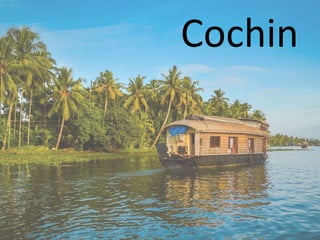
Cochin
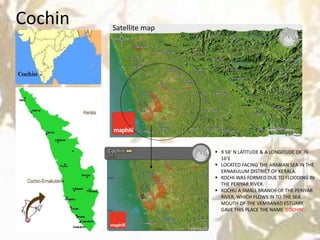
 9 58’ N LATITUDE & A LONGITUDE OF 76
16’E
 LOCATED FACING THE ARABIAN SEA IN THE
ERNAKULUM DISTRICT OF KERALA.
 KOCHI WAS FORMED DUE TO FLOODING IN
THE PERIYAR RIVER.
 KOCHU A SMALL BRANCH OF THE PERIYAR
RIVER, WHICH FLOWS IN TO THE SEA
MOUTH OF THE VEMBANAD ESTUARY,
GAVE THIS PLACE THE NAME ‘COCHIN’.
Satellite map
Cochin
 Kochi, also known as Cochin, is a major port city on the south-west coast of India and
is part of the district of Ernakulum in the state of Kerala.
 It is the second largest city in Kerala after Thiruvananthapuram .
 Kochi also known as the Queen of the Arabian Sea, was an important spice trading
centre on the west coast of India from the 14th century onward, and maintained a
trade network with Arab merchants from the pre-Islamic era.
 THE ENTIRE REGION COVERING FORT KOCHI, MATTANCHERRY, WELLINGTON ISLAND,
MAINLAND ERNAKULAM AND ITS SUBURBIA (INCLUDING VYTTILA, VENNALA,
EDAPALLY) IS GENERALLY REFERRED TO AS KOCHI (OR COCHIN) BECAUSE ALL THESE
AREAS WERE PART OF THE ERSTWHILE KINGDOM OF KOCHI IN PREINDEPENDENCE
INDIA.
 •DIVERSE COMMUNITY PROFILE COMPRISING OF HINDUS, MUSLIMS, JEWS,
KONKANIS ETC
 Languages: Malayalam, English, Hindi, Tamil, Kon kani.
Cochin: geographyCochin
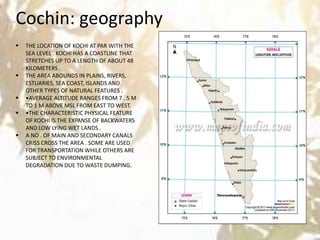
 THE LOCATION OF KOCHI AT PAR WITH THE
SEA LEVEL . KOCHI HAS A COASTLINE THAT
STRETCHES UP TO A LENGTH OF ABOUT 48
KILOMETERS .
 THE AREA ABOUNDS IN PLAINS, RIVERS,
ESTUARIES, SEA COAST, ISLANDS AND
OTHER TYPES OF NATURAL FEATURES .
 •AVERAGE ALTITUDE RANGES FROM 7 . 5 M
TO 1 M ABOVE MSL FROM EAST TO WEST.
 •THE CHARACTERISTIC PHYSICAL FEATURE
OF KOCHI IS THE EXPANSE OF BACKWATERS
AND LOW LYING WET LANDS .
 A NO . OF MAIN AND SECONDARY CANALS
CRISS CROSS THE AREA . SOME ARE USED
FOR TRANSPORTATION WHILE OTHERS ARE
SUBJECT TO ENVIRONMENTAL
DEGRADATION DUE TO WASTE DUMPING.
VEGETATION
 18.44 % (6817.55 HECTARES) OF THE KOCHI
CITY REGION REMAINS AS SHALLOW WET
LANDS THAT IS EITHER PADDY OR FISH
FARM AND MARSHY.
 THE PATENTED ‘POKKALI RICE’ IS BEING
CULTIVATED IN THE PADDY FIELDS, WHICH
NEEDSGOVERNMENTAL SUPPORT TO BE
ECONOMICALBUT IN THE COASTAL
PANCHAYATS THE FIELDS ARE CULTIVATED
FOR SINGLE CROP AND USED FOR PRAWN
FARMING DURING REST OF THE YEAR.
THESE ACT AS OPEN LUNG SPACE IN THE
CITY
 THE ENVIRONMENTALLY SENSITIVE AREAS
OF KOCHI CITY REGION INCLUDE THE
FOLLOWING COMPONENTS:A. BACKWATERS
B. MANGROVE AREAS C. LOW LANDS AND
PADDY FIELDS D. CANAL SYSTEM
historyEARLY HISTORY:
•COCHIN PORT WAS FORMED IN 1341, WHEN THE HEAVY FLOODS OF
THAT YEAR SILTED UP THE MOUTHS OF THE MUSIRIS HARBOR AND THE
SURGING WATERS FORCED A CHANNEL PAST THE PRESENT INLET INTO
THE SEA. THE OLD MERCHANTS OF MUSIRIS SHIFTED TO COCHIN AS
SOON AS THE NEW OUTLET BECAME MORE OR LESS STABLE.
•AS THE HARBOUR GAINED PROMINENCE, THE THEN RULER OF THE
REGION SHIFTED HIS CAPITAL ALSO TO COCHIN, GIVING IMPETUS TO
THE GROWTH OF THE TOWN.
•THE EARLY SETTLEMENT OF COCHIN WAS AT MATTANCHERY, FACING
THE PROTECTED LAGOONS IN THE EAST, WHICH PROVIDED SAFE
ANCHORAGE TO COUNTRY CRAFTS IN ALL SEASONS. MATTANCHERY
WAS LINKED TO THE ENTIRE COASTAL STRETCH OF KERALA THROUGH
THIS INLAND WATERS. THUS GRADUALLY IT GREW INTO A BUSY
SETTLEMENT.
•NICOLO CONTI RECORDED THAT, BY 1440, COCHIN WAS A CITY 5
MILES IN CIRCUMFERENCE AND THAT CHINESE AND ARABS CARRIED
ON BRISK TRADE WITH THE NATIVES OF THIS TOWN.
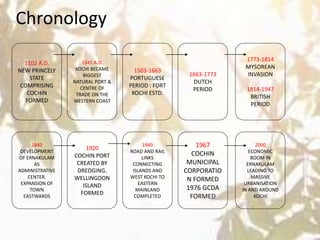
Chronology
1102 A.D.
NEW PRINCELY
STATE
COMPRISING
COCHIN
FORMED
1341 A.D.
KOCHI BECAME
BIGGEST
NATURAL PORT &
CENTRE OF
TRADE ON THE
WESTERN COAST
1503-1663
PORTUGUESE
PERIOD : FORT
KOCHI ESTD.
1663-1773
DUTCH
PERIOD
1773-1814
MYSOREAN
INVASION
1814-1947
BRITISH
PERIOD
1840
DEVELOPMENT
OF ERNAKULAM
AS
ADMINISTRATIVE
CENTER.
EXPANSION OF
TOWN
EASTWARDS
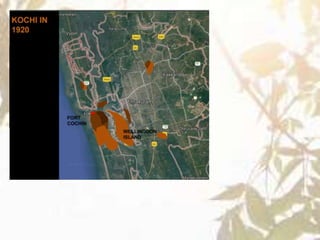
1920
COCHIN PORT
CREATED BY
DREDGING.
WELLINGDON
ISLAND
FORMED
1940
ROAD AND RAIL
LINKS
CONNECTING
ISLANDS AND
WEST KOCHI TO
EASTERN
MAINLAND
COMPLETED
1967
COCHIN
MUNICIPAL
CORPORATIO
N FORMED
1976 GCDA
FORMED
2000
ECONOMIC
BOOM IN
ERNAKULAM
LEADING TO
MASSIVE
URBANISATION
IN AND AROUND
KOCHI
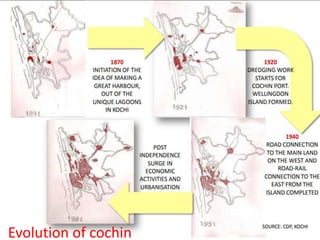
Evolution of cochin
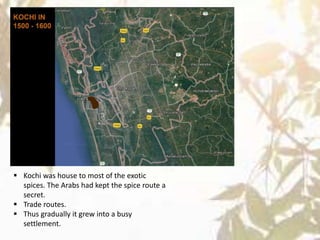
 Kochi was house to most of the exotic
spices. The Arabs had kept the spice route a
secret.
 Trade routes.
 Thus gradually it grew into a busy
settlement.
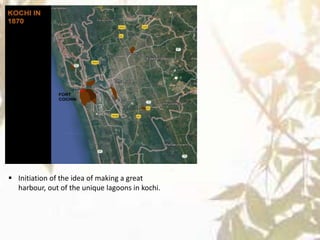
 Initiation of the idea of making a great
harbour, out of the unique lagoons in kochi.
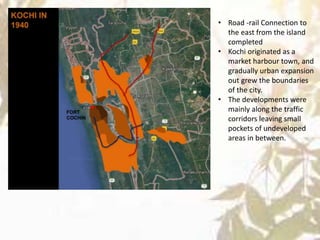
• Road -rail Connection to
the east from the island
completed
• Kochi originated as a
market harbour town, and
gradually urban expansion
out grew the boundaries
of the city.
• The developments were
mainly along the traffic
corridors leaving small
pockets of undeveloped
areas in between.
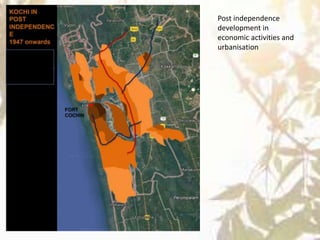
Post independence
development in
economic activities and
urbanisation
o THE BACKWATERS ARE RICH IN THEIR MARINE FOODS AND HENCE FORM THE
MEANS OF LIVELIHOOD FOR A LARGE PORTION OF THE POPULATION.
o IN SUMMER THE WETLANDS PARTIALLY DRY UP AND BECOME SUITABLE FOR
PADDY CULTIVATION.
o INDISCRIMINATE FILLING OF SUCH AREA IN RECENT TIMES IS OFTEN CREATING
POSSIBILITIES OF FLOODING AND WATER LOGGING IN THEADJOINING AREAS.
o INDISCRIMINATE DISPOSAL OF SOLID WASTES INTO THE CANALS AND THE
DIRECT DISCHARGE OF UNTREATED WASTE WATER POSE THE BIGGEST THREAT TO
COMMUNITY HEALTH AND SMOOTH FUNCTIONING OF THE CANALSYSTEM.
o MOST OF THE LOWLANDS ARE GETTING FILLED UP AND CONVERTED FOR
RESIDENTIAL AND COMMERCIAL PURPOSES.
o AT PRESENT, THE KOCHI BACKWATER IS SUBJECTED THREAT DUE TO
DEVELOPMENT ACTIVITIES IN THE MAINLAND LIKE URBANIZATION (MAINLY BY
DUMPING OF URBAN WASTES AND EFFLUENTS INTO THE SYSTEM THROUGH THE
CANALS), INDUSTRIALIZATION (BOTH IN THE CORPORATION AND ADJOINING
AREAS),ACTIVITIES IN THE PORT, SHIPYARD ETC.
SOURCE: CDP, KOCHI
Kochi
Cochin: natural resourses
Administrative setup
 KOCHI CORPORATION, HEADED BY A MAYOR IS DIVIDED
INTO 74 WARDS.
 FORT KOCHI, MATTANCHERRY AND ERNAKULAM WERE
THE THREE MUNICIPALITIES IN COCHIN AREA, WHICH
WAS LATER MERGED TO FORM THE COCHIN
CORPORATION.
 THE CORPORATION HAS ITS HEADQUARTERS IN
ERNAKULAM KOCHI CITY REGION INCLUDES
KOCHICORPORATION, THRIPUNITHURA MUNICIPALITY,
KALAMASSERY MUNICIPALITY AND 14PANCHAYATS;
ALTOGETHER ENCOMPASSING OF 369.72 SQ. KM AREA.
 HIGH COURT OF KERALA, THE HIGHEST JUDICIAL BODY
IN THE STATE IS IN KOCHI.
 KOCHI IS THE HEADQUARTERS OF THE SOUTHERN
NAVAL COMMAND, THE PRIMARY TRAINING CENTRE OF
THE INDIAN NAVY.
demographic
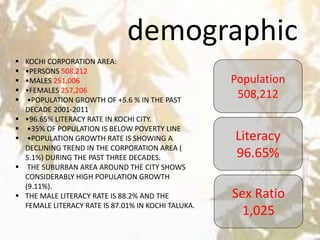
 KOCHI CORPORATION AREA:
 •PERSONS 508,212
 •MALES 251,006
 •FEMALES 257,206
 •POPULATION GROWTH OF +5.6 % IN THE PAST
DECADE 2001-2011
 •96.65% LITERACY RATE IN KOCHI CITY.
 •35% OF POPULATION IS BELOW POVERTY LINE
 •POPULATION GROWTH RATE IS SHOWING A
DECLINING TREND IN THE CORPORATION AREA (
5.1%) DURING THE PAST THREE DECADES.
 THE SUBURBAN AREA AROUND THE CITY SHOWS
CONSIDERABLY HIGH POPULATION GROWTH
(9.11%).
 THE MALE LITERACY RATE IS 88.2% AND THE
FEMALE LITERACY RATE IS 87.01% IN KOCHI TALUKA.
Population
508,212
Literacy
96.65%
Sex Ratio
1,025
demographic
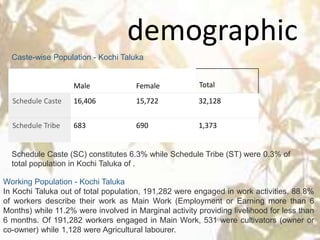
Caste-wise Population - Kochi Taluka
Male Female Total
Schedule Caste 16,406 15,722 32,128
Schedule Tribe 683 690 1,373
Schedule Caste (SC) constitutes 6.3% while Schedule Tribe (ST) were 0.3% of
total population in Kochi Taluka of .
Working Population - Kochi Taluka
In Kochi Taluka out of total population, 191,282 were engaged in work activities. 88.8%
of workers describe their work as Main Work (Employment or Earning more than 6
Months) while 11.2% were involved in Marginal activity providing livelihood for less than
6 months. Of 191,282 workers engaged in Main Work, 531 were cultivators (owner or
co-owner) while 1,128 were Agricultural labourer.
demographic
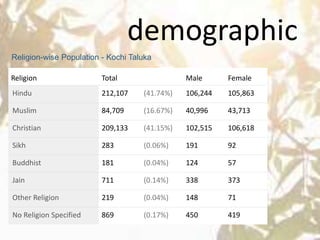
Religion-wise Population - Kochi Taluka
Religion Total Male Female
Hindu 212,107 (41.74%) 106,244 105,863
Muslim 84,709 (16.67%) 40,996 43,713
Christian 209,133 (41.15%) 102,515 106,618
Sikh 283 (0.06%) 191 92
Buddhist 181 (0.04%) 124 57
Jain 711 (0.14%) 338 373
Other Religion 219 (0.04%) 148 71
No Religion Specified 869 (0.17%) 450 419
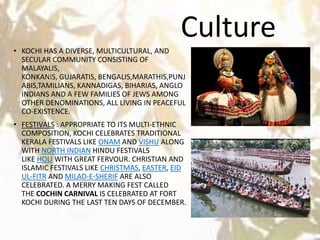
• KOCHI HAS A DIVERSE, MULTICULTURAL, AND
SECULAR COMMUNITY CONSISTING OF
MALAYALIS,
KONKANIS, GUJARATIS, BENGALIS,MARATHIS,PUNJ
ABIS,TAMILIANS, KANNADIGAS, BIHARIAS, ANGLO
INDIANS AND A FEW FAMILIES OF JEWS AMONG
OTHER DENOMINATIONS, ALL LIVING IN PEACEFUL
CO-EXISTENCE.
• FESTIVALS : APPROPRIATE TO ITS MULTI-ETHNIC
COMPOSITION, KOCHI CELEBRATES TRADITIONAL
KERALA FESTIVALS LIKE ONAM AND VISHU ALONG
WITH NORTH INDIAN HINDU FESTIVALS
LIKE HOLI WITH GREAT FERVOUR. CHRISTIAN AND
ISLAMIC FESTIVALS LIKE CHRISTMAS, EASTER, EID
UL-FITR AND MILAD-E-SHERIF ARE ALSO
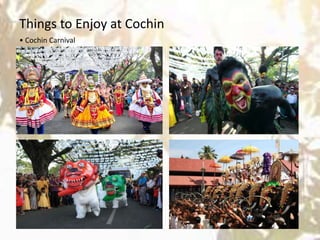
CELEBRATED. A MERRY MAKING FEST CALLED
THE COCHIN CARNIVAL IS CELEBRATED AT FORT
KOCHI DURING THE LAST TEN DAYS OF DECEMBER.
Culture
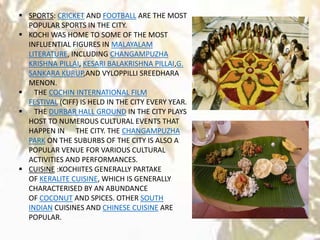
 SPORTS: CRICKET AND FOOTBALL ARE THE MOST
POPULAR SPORTS IN THE CITY.
 KOCHI WAS HOME TO SOME OF THE MOST
INFLUENTIAL FIGURES IN MALAYALAM
LITERATURE, INCLUDING CHANGAMPUZHA
KRISHNA PILLAI, KESARI BALAKRISHNA PILLAI,G.
SANKARA KURUP,AND VYLOPPILLI SREEDHARA
MENON.
 THE COCHIN INTERNATIONAL FILM
FESTIVAL (CIFF) IS HELD IN THE CITY EVERY YEAR.
 THE DURBAR HALL GROUND IN THE CITY PLAYS
HOST TO NUMEROUS CULTURAL EVENTS THAT
HAPPEN IN THE CITY. THE CHANGAMPUZHA
PARK ON THE SUBURBS OF THE CITY IS ALSO A
POPULAR VENUE FOR VARIOUS CULTURAL
ACTIVITIES AND PERFORMANCES.
 CUISINE :KOCHIITES GENERALLY PARTAKE
OF KERALITE CUISINE, WHICH IS GENERALLY
CHARACTERISED BY AN ABUNDANCE
OF COCONUT AND SPICES. OTHER SOUTH
INDIAN CUISINES AND CHINESE CUISINE ARE
POPULAR.
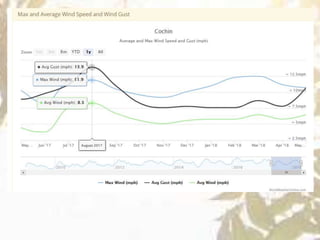
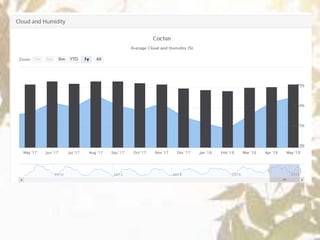
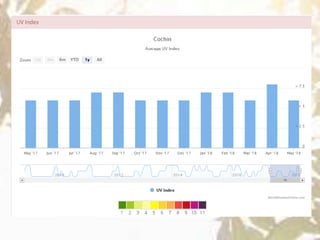
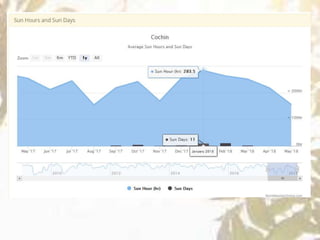
Climate
CLIMATIC CONDITIONS:
 CHARACTERISTIC PHYSICAL FEATURE –
EXPANSE OF BACKWATERS AND LOW
LYING WETLANDS.
 TYPICAL SOIL STRATA – ALLUVIAL SOIL
LADEN WITH FINE SILT & CLAY TO
DEPTHS UP TO 50M.
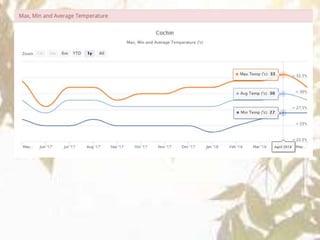
 HOT HUMID CLIMATE WITH MAX.
TEMP OF 34 DEG & MIN OF 22 DEG.
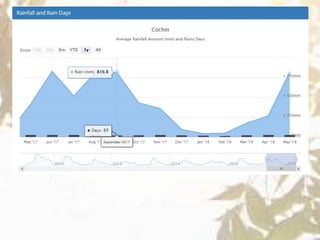
 AVERAGE ANNUAL RAIN FALL – 3000
MM FROM TWO MONSOONS.
 RELATIVE HUMIDITY – 70 – 87 %
 Temperature: Summer : Max 35ºC,
Min ºC. Winter : Max 25ºC, Min ºC.
VernacularArchitecture
Influence of climate
• Kerala has a warm humid climate.
The rainfall is very heavy from south west and north
east monsoons
• To keep the rain and sun away form the walls the roofs
of the building come down very low. • They have
verandah all round the building protecting the external
walls from sun and rain.
• The width of the verandah varies from 2 ft to 12ft
• In rooms were people spend most of their time during
day the window openings were brought in at ground
level otherwise the windows were small so that there
was only subdued light inside or had timber jalis to give
diffused light without glare.
• They also have an internal courtyard for better flow of
air.
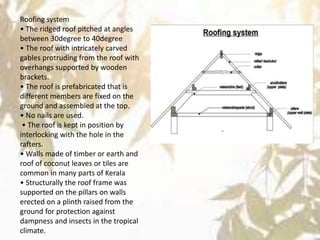
Roofing system
• The ridged roof pitched at angles
between 30degree to 40degree
• The roof with intricately carved
gables protruding from the roof with
overhangs supported by wooden
brackets.
• The roof is prefabricated that is
different members are fixed on the
ground and assembled at the top.
• No nails are used.
• The roof is kept in position by
interlocking with the hole in the
rafters.
• Walls made of timber or earth and
roof of coconut leaves or tiles are
common in many parts of Kerala
• Structurally the roof frame was
supported on the pillars on walls
erected on a plinth raised from the
ground for protection against
dampness and insects in the tropical
climate.
Flooring System
• The most common type of flooring was that
of beaten earth polished with cow dung at
regular intervals • Black colored traditional
flooring used in the more expensive buildings
was done with the mixture of lime, sand,
coconut shell, white of egg, jaggery, coconut
water and other vegetable extracts. The
smoothness was achieved by polishing the
floor with a particular variety of banana
Building Materials
• The availability of granite -a strong and durable building stone is restricted mainly to
the highlands and marginally to some hilly zones. Accordingly, the skill in quarrying,
dressing and sculpturing of stone is scarce in Kerala.
• Laterite stone however, is abundantly found
• Soft laterite available at shallow depth can be easily cut, dressed and used as building
blocks. It is a local stone that gets stronger and durable with exposure to the atmosphere.
• Block of this stone may be bonded in mortars of shell lime, - the classic binding material
used in traditional buildings.
• Lime mortar can be improved in strength and performance by admixtures of vegetable
juices. Such enriched mortars were utilised for plastering and low relief work.
Building Materials
• Timber remains the prime structural material
abundantly available in Kerala, in many varieties -
from bamboo to teak and rosewood. The skilful
choice of timber, artful assembly and delicate
carving of wood work for columns, walls and
roofs frames are the unique characteristics of
Kerala architecture, using accurate fit of joints.
• Clay was used in many forms - for walling, in
filling the timber floors and making bricks and
tiles after firing in kilns, tempered with
admixtures.
• Palm leaves are still used effectively for
thatching the roofs and for making partition walls
and along with mu
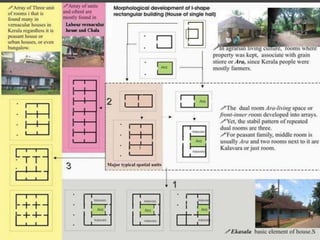
Residential architecture
• There are various terms of house for
different tribes according to social status and
profession. The house of:
• Pariah - CHERI
• the agrestic slave – Cheraman - CHALA.
• blacksmith, the goldsmith, the carpenter,
the weaver – KUDI
• temple servants reside – VARIYAM /
PISHARAM
• The ordinary Nayars - VEEDU / BHAVANAM
• Nayar’s authority - IDAM.
• Raja lives in a KOVILAKKAM / KOTTARAM
TRANSPORT/CONNECTIVITY
AIR:
 The air gateway to Kochi is the Cochin International Airport (CIAL) located
at Nedumbassery, which is about 28 km (17 mi) north of Kochi city, and handles both
domestic and international flights.
 The Cochin airport provides direct connectivity to popular international destinations in
the Middle East, Malaysia, Thailand and Singapore and to most major Indian cities
apart from tourist destinations like Lakshadweep.
 It is also the fourth busiest airport in India in terms of international passenger traffic,
and seventh busiest overall.
ROAD:
 Kochi is well connected to neighbouring cities and states via several highways. It is a
node in the North-South Corridor of the National Highway system.
 Kochi is served by National Highway 66, National Highway 544, National Highway
966A and National Highway 966B.
 The main arterial roads of the city are the Mahatma Gandhi Road and Saharan
Ayyappan Road in Ernakulam,
RAIL:
 The city has four major railway stations – Ernakulam
Junction, Ernakulam Town (locally known as
the South and North railway stations
respectively), Aluva and Tripunithura followed by smaller
stations, Edapally and Kalamassery.
 There is also the Cochin Harbour Terminusproviding rail
connectivity to the southern segment of the Port of Kochi.
 The Kochi Metro is a metro rapid transit system serving the
city of Kochi, intended to considerably ease traffic
congestion in the city and its surrounding metropolitan area.
WATER:
 Kochi ranks among India's major seaports, partly due to
being one of the safest harbours in the Indian Ocean.
 offers facilities for bunkering, handling cargo and passenger
ships and storage accommodation. The port is a complex of
three islands, one of which is man-made.
TRANSPORT/CONNECTIVITY
ECONOMIC BASE:
•EXPORT AND IMPORT
•FISHING
•MANUFACTURING INDUSTRIES LIKE FACT,
TRAVANCORE COCHIN CHEMICALS, HMT,
APOLLO TYRES, SHIPBUILDING ETC.
•INFORMATION TECHNOLOGY AND
INFORMATION TECHNOLOGY ENABLED
SERVICES: WIPRO, TATA CONSULTANCY
SERVICES AND COGNIZANT HAVE AN ACTIVE
PRESENCE IN THE CITY.
•TOURISM SECTOR
•BANKING AND FINANCE SECTOR
•PORT ACTIVITIES
•COCHIN STOCK EXCHANGE
Trade and commerce
Trade and commerce
Market Town- Mattanchery
•Mattanchery, meanwhile, had developed as a
typical oriental market town, with commercial
•activities distributed along the waterfronts.
•The agricultural produce from the vast
hinterland flowed to its markets to be sold or
exchanged for textiles, metals, and other
products of European Countries. Jews and
Muslims had their settlements here.
•The trading communities from Gujarat and the
emigrants from Goa too established themselves
in Mattanchery along with the native Hindus
and early Christians. As far as the rulers were
concerned, this helped to strike a balance of
economic power with the European traders.
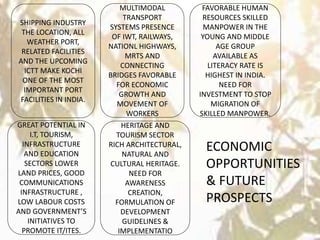
SHIPPING INDUSTRY
THE LOCATION, ALL
WEATHER PORT,
RELATED FACILITIES
AND THE UPCOMING
ICTT MAKE KOCHI
ONE OF THE MOST
IMPORTANT PORT
FACILITIES IN INDIA.
MULTIMODAL
TRANSPORT
SYSTEMS PRESENCE
OF IWT, RAILWAYS,
NATIONL HIGHWAYS,
MRTS AND
CONNECTING
BRIDGES FAVORABLE
FOR ECONOMIC
GROWTH AND
MOVEMENT OF
WORKERS
FAVORABLE HUMAN
RESOURCES SKILLED
MANPOWER IN THE
YOUNG AND MIDDLE
AGE GROUP
AVAILABLE AS
LITERACY RATE IS
HIGHEST IN INDIA.
NEED FOR
INVESTMENT TO STOP
MIGRATION OF
SKILLED MANPOWER.
GREAT POTENTIAL IN
I.T, TOURISM,
INFRASTRUCTURE
AND EDUCATION
SECTORS LOWER
LAND PRICES, GOOD
COMMUNICATIONS
INFRASTRUCTURE ,
LOW LABOUR COSTS
AND GOVERNMENT’S
INITIATIVES TO
PROMOTE IT/ITES.
HERITAGE AND
TOURISM SECTOR
RICH ARCHITECTURAL,
NATURAL AND
CULTURAL HERITAGE.
NEED FOR
AWARENESS
CREATION,
FORMULATION OF
DEVELOPMENT
GUIDELINES &
IMPLEMENTATIO
ECONOMIC
OPPORTUNITIES
& FUTURE
PROSPECTS
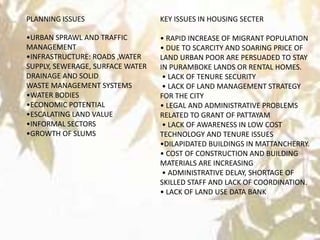
PLANNING ISSUES
•URBAN SPRAWL AND TRAFFIC
MANAGEMENT
•INFRASTRUCTURE: ROADS ,WATER
SUPPLY, SEWERAGE, SURFACE WATER
DRAINAGE AND SOLID
WASTE MANAGEMENT SYSTEMS
•WATER BODIES
•ECONOMIC POTENTIAL
•ESCALATING LAND VALUE
•INFORMAL SECTORS
•GROWTH OF SLUMS
KEY ISSUES IN HOUSING SECTER
• RAPID INCREASE OF MIGRANT POPULATION
• DUE TO SCARCITY AND SOARING PRICE OF
LAND URBAN POOR ARE PERSUADED TO STAY
IN PURAMBOKE LANDS OR RENTAL HOMES.
• LACK OF TENURE SECURITY
• LACK OF LAND MANAGEMENT STRATEGY
FOR THE CITY
• LEGAL AND ADMINISTRATIVE PROBLEMS
RELATED TO GRANT OF PATTAYAM
• LACK OF AWARENESS IN LOW COST
TECHNOLOGY AND TENURE ISSUES
•DILAPIDATED BUILDINGS IN MATTANCHERRY.
• COST OF CONSTRUCTION AND BUILDING
MATERIALS ARE INCREASING
• ADMINISTRATIVE DELAY, SHORTAGE OF
SKILLED STAFF AND LACK OF COORDINATION.
• LACK OF LAND USE DATA BANK
Place to visit
 Best Time to Visit Cochin
The peak season to travel Kochi is between
October and April, when hot and dry climate
prevails
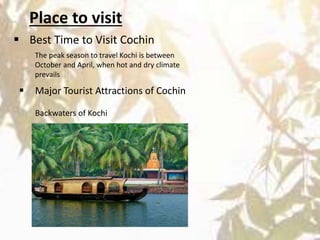
 Major Tourist Attractions of Cochin
Backwaters of Kochi
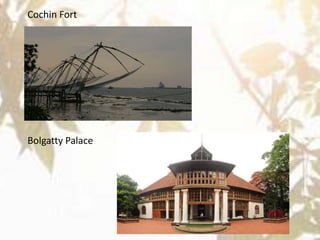
Cochin Fort
Bolgatty Palace
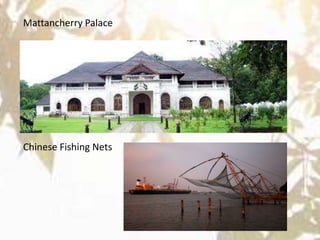
Mattancherry Palace
Chinese Fishing Nets
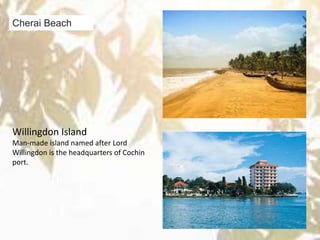
Cherai Beach
Willingdon Island
Man-made island named after Lord
Willingdon is the headquarters of Cochin
port.
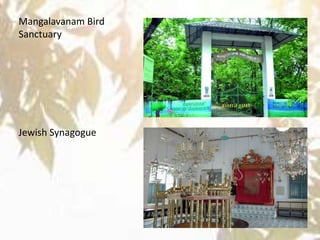
Mangalavanam Bird
Sanctuary
Jewish Synagogue
Things to Enjoy at Cochin
• Cochin Carnival
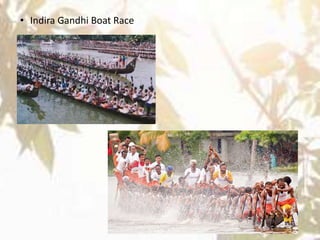
• Indira Gandhi Boat Race
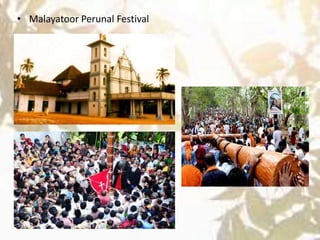
• Malayatoor Perunal Festival

kochi : a brief

  • 1.
  • 2.
    Cochin  9 58’N LATITUDE & A LONGITUDE OF 76 16’E  LOCATED FACING THE ARABIAN SEA IN THE ERNAKULUM DISTRICT OF KERALA.  KOCHI WAS FORMED DUE TO FLOODING IN THE PERIYAR RIVER.  KOCHU A SMALL BRANCH OF THE PERIYAR RIVER, WHICH FLOWS IN TO THE SEA MOUTH OF THE VEMBANAD ESTUARY, GAVE THIS PLACE THE NAME ‘COCHIN’. Satellite map
  • 3.
    Cochin  Kochi, alsoknown as Cochin, is a major port city on the south-west coast of India and is part of the district of Ernakulum in the state of Kerala.  It is the second largest city in Kerala after Thiruvananthapuram .  Kochi also known as the Queen of the Arabian Sea, was an important spice trading centre on the west coast of India from the 14th century onward, and maintained a trade network with Arab merchants from the pre-Islamic era.  THE ENTIRE REGION COVERING FORT KOCHI, MATTANCHERRY, WELLINGTON ISLAND, MAINLAND ERNAKULAM AND ITS SUBURBIA (INCLUDING VYTTILA, VENNALA, EDAPALLY) IS GENERALLY REFERRED TO AS KOCHI (OR COCHIN) BECAUSE ALL THESE AREAS WERE PART OF THE ERSTWHILE KINGDOM OF KOCHI IN PREINDEPENDENCE INDIA.  •DIVERSE COMMUNITY PROFILE COMPRISING OF HINDUS, MUSLIMS, JEWS, KONKANIS ETC  Languages: Malayalam, English, Hindi, Tamil, Kon kani.
  • 4.
    Cochin: geographyCochin  THELOCATION OF KOCHI AT PAR WITH THE SEA LEVEL . KOCHI HAS A COASTLINE THAT STRETCHES UP TO A LENGTH OF ABOUT 48 KILOMETERS .  THE AREA ABOUNDS IN PLAINS, RIVERS, ESTUARIES, SEA COAST, ISLANDS AND OTHER TYPES OF NATURAL FEATURES .  •AVERAGE ALTITUDE RANGES FROM 7 . 5 M TO 1 M ABOVE MSL FROM EAST TO WEST.  •THE CHARACTERISTIC PHYSICAL FEATURE OF KOCHI IS THE EXPANSE OF BACKWATERS AND LOW LYING WET LANDS .  A NO . OF MAIN AND SECONDARY CANALS CRISS CROSS THE AREA . SOME ARE USED FOR TRANSPORTATION WHILE OTHERS ARE SUBJECT TO ENVIRONMENTAL DEGRADATION DUE TO WASTE DUMPING.
  • 5.
    VEGETATION  18.44 %(6817.55 HECTARES) OF THE KOCHI CITY REGION REMAINS AS SHALLOW WET LANDS THAT IS EITHER PADDY OR FISH FARM AND MARSHY.  THE PATENTED ‘POKKALI RICE’ IS BEING CULTIVATED IN THE PADDY FIELDS, WHICH NEEDSGOVERNMENTAL SUPPORT TO BE ECONOMICALBUT IN THE COASTAL PANCHAYATS THE FIELDS ARE CULTIVATED FOR SINGLE CROP AND USED FOR PRAWN FARMING DURING REST OF THE YEAR. THESE ACT AS OPEN LUNG SPACE IN THE CITY  THE ENVIRONMENTALLY SENSITIVE AREAS OF KOCHI CITY REGION INCLUDE THE FOLLOWING COMPONENTS:A. BACKWATERS B. MANGROVE AREAS C. LOW LANDS AND PADDY FIELDS D. CANAL SYSTEM
  • 6.
    historyEARLY HISTORY: •COCHIN PORTWAS FORMED IN 1341, WHEN THE HEAVY FLOODS OF THAT YEAR SILTED UP THE MOUTHS OF THE MUSIRIS HARBOR AND THE SURGING WATERS FORCED A CHANNEL PAST THE PRESENT INLET INTO THE SEA. THE OLD MERCHANTS OF MUSIRIS SHIFTED TO COCHIN AS SOON AS THE NEW OUTLET BECAME MORE OR LESS STABLE. •AS THE HARBOUR GAINED PROMINENCE, THE THEN RULER OF THE REGION SHIFTED HIS CAPITAL ALSO TO COCHIN, GIVING IMPETUS TO THE GROWTH OF THE TOWN. •THE EARLY SETTLEMENT OF COCHIN WAS AT MATTANCHERY, FACING THE PROTECTED LAGOONS IN THE EAST, WHICH PROVIDED SAFE ANCHORAGE TO COUNTRY CRAFTS IN ALL SEASONS. MATTANCHERY WAS LINKED TO THE ENTIRE COASTAL STRETCH OF KERALA THROUGH THIS INLAND WATERS. THUS GRADUALLY IT GREW INTO A BUSY SETTLEMENT. •NICOLO CONTI RECORDED THAT, BY 1440, COCHIN WAS A CITY 5 MILES IN CIRCUMFERENCE AND THAT CHINESE AND ARABS CARRIED ON BRISK TRADE WITH THE NATIVES OF THIS TOWN.
  • 7.
    Chronology 1102 A.D. NEW PRINCELY STATE COMPRISING COCHIN FORMED 1341A.D. KOCHI BECAME BIGGEST NATURAL PORT & CENTRE OF TRADE ON THE WESTERN COAST 1503-1663 PORTUGUESE PERIOD : FORT KOCHI ESTD. 1663-1773 DUTCH PERIOD 1773-1814 MYSOREAN INVASION 1814-1947 BRITISH PERIOD 1840 DEVELOPMENT OF ERNAKULAM AS ADMINISTRATIVE CENTER. EXPANSION OF TOWN EASTWARDS 1920 COCHIN PORT CREATED BY DREDGING. WELLINGDON ISLAND FORMED 1940 ROAD AND RAIL LINKS CONNECTING ISLANDS AND WEST KOCHI TO EASTERN MAINLAND COMPLETED 1967 COCHIN MUNICIPAL CORPORATIO N FORMED 1976 GCDA FORMED 2000 ECONOMIC BOOM IN ERNAKULAM LEADING TO MASSIVE URBANISATION IN AND AROUND KOCHI
  • 8.
  • 9.
     Kochi washouse to most of the exotic spices. The Arabs had kept the spice route a secret.  Trade routes.  Thus gradually it grew into a busy settlement.
  • 10.
     Initiation ofthe idea of making a great harbour, out of the unique lagoons in kochi.
  • 12.
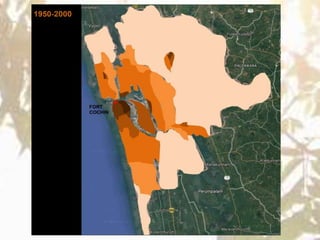
    • Road -railConnection to the east from the island completed • Kochi originated as a market harbour town, and gradually urban expansion out grew the boundaries of the city. • The developments were mainly along the traffic corridors leaving small pockets of undeveloped areas in between.
  • 13.
    Post independence development in economicactivities and urbanisation
  • 15.
    o THE BACKWATERSARE RICH IN THEIR MARINE FOODS AND HENCE FORM THE MEANS OF LIVELIHOOD FOR A LARGE PORTION OF THE POPULATION. o IN SUMMER THE WETLANDS PARTIALLY DRY UP AND BECOME SUITABLE FOR PADDY CULTIVATION. o INDISCRIMINATE FILLING OF SUCH AREA IN RECENT TIMES IS OFTEN CREATING POSSIBILITIES OF FLOODING AND WATER LOGGING IN THEADJOINING AREAS. o INDISCRIMINATE DISPOSAL OF SOLID WASTES INTO THE CANALS AND THE DIRECT DISCHARGE OF UNTREATED WASTE WATER POSE THE BIGGEST THREAT TO COMMUNITY HEALTH AND SMOOTH FUNCTIONING OF THE CANALSYSTEM. o MOST OF THE LOWLANDS ARE GETTING FILLED UP AND CONVERTED FOR RESIDENTIAL AND COMMERCIAL PURPOSES. o AT PRESENT, THE KOCHI BACKWATER IS SUBJECTED THREAT DUE TO DEVELOPMENT ACTIVITIES IN THE MAINLAND LIKE URBANIZATION (MAINLY BY DUMPING OF URBAN WASTES AND EFFLUENTS INTO THE SYSTEM THROUGH THE CANALS), INDUSTRIALIZATION (BOTH IN THE CORPORATION AND ADJOINING AREAS),ACTIVITIES IN THE PORT, SHIPYARD ETC. SOURCE: CDP, KOCHI Kochi Cochin: natural resourses
  • 16.
    Administrative setup  KOCHICORPORATION, HEADED BY A MAYOR IS DIVIDED INTO 74 WARDS.  FORT KOCHI, MATTANCHERRY AND ERNAKULAM WERE THE THREE MUNICIPALITIES IN COCHIN AREA, WHICH WAS LATER MERGED TO FORM THE COCHIN CORPORATION.  THE CORPORATION HAS ITS HEADQUARTERS IN ERNAKULAM KOCHI CITY REGION INCLUDES KOCHICORPORATION, THRIPUNITHURA MUNICIPALITY, KALAMASSERY MUNICIPALITY AND 14PANCHAYATS; ALTOGETHER ENCOMPASSING OF 369.72 SQ. KM AREA.  HIGH COURT OF KERALA, THE HIGHEST JUDICIAL BODY IN THE STATE IS IN KOCHI.  KOCHI IS THE HEADQUARTERS OF THE SOUTHERN NAVAL COMMAND, THE PRIMARY TRAINING CENTRE OF THE INDIAN NAVY.
  • 17.
    demographic  KOCHI CORPORATIONAREA:  •PERSONS 508,212  •MALES 251,006  •FEMALES 257,206  •POPULATION GROWTH OF +5.6 % IN THE PAST DECADE 2001-2011  •96.65% LITERACY RATE IN KOCHI CITY.  •35% OF POPULATION IS BELOW POVERTY LINE  •POPULATION GROWTH RATE IS SHOWING A DECLINING TREND IN THE CORPORATION AREA ( 5.1%) DURING THE PAST THREE DECADES.  THE SUBURBAN AREA AROUND THE CITY SHOWS CONSIDERABLY HIGH POPULATION GROWTH (9.11%).  THE MALE LITERACY RATE IS 88.2% AND THE FEMALE LITERACY RATE IS 87.01% IN KOCHI TALUKA. Population 508,212 Literacy 96.65% Sex Ratio 1,025
  • 18.
    demographic Caste-wise Population -Kochi Taluka Male Female Total Schedule Caste 16,406 15,722 32,128 Schedule Tribe 683 690 1,373 Schedule Caste (SC) constitutes 6.3% while Schedule Tribe (ST) were 0.3% of total population in Kochi Taluka of . Working Population - Kochi Taluka In Kochi Taluka out of total population, 191,282 were engaged in work activities. 88.8% of workers describe their work as Main Work (Employment or Earning more than 6 Months) while 11.2% were involved in Marginal activity providing livelihood for less than 6 months. Of 191,282 workers engaged in Main Work, 531 were cultivators (owner or co-owner) while 1,128 were Agricultural labourer.
  • 19.
    demographic Religion-wise Population -Kochi Taluka Religion Total Male Female Hindu 212,107 (41.74%) 106,244 105,863 Muslim 84,709 (16.67%) 40,996 43,713 Christian 209,133 (41.15%) 102,515 106,618 Sikh 283 (0.06%) 191 92 Buddhist 181 (0.04%) 124 57 Jain 711 (0.14%) 338 373 Other Religion 219 (0.04%) 148 71 No Religion Specified 869 (0.17%) 450 419
  • 20.
    • KOCHI HASA DIVERSE, MULTICULTURAL, AND SECULAR COMMUNITY CONSISTING OF MALAYALIS, KONKANIS, GUJARATIS, BENGALIS,MARATHIS,PUNJ ABIS,TAMILIANS, KANNADIGAS, BIHARIAS, ANGLO INDIANS AND A FEW FAMILIES OF JEWS AMONG OTHER DENOMINATIONS, ALL LIVING IN PEACEFUL CO-EXISTENCE. • FESTIVALS : APPROPRIATE TO ITS MULTI-ETHNIC COMPOSITION, KOCHI CELEBRATES TRADITIONAL KERALA FESTIVALS LIKE ONAM AND VISHU ALONG WITH NORTH INDIAN HINDU FESTIVALS LIKE HOLI WITH GREAT FERVOUR. CHRISTIAN AND ISLAMIC FESTIVALS LIKE CHRISTMAS, EASTER, EID UL-FITR AND MILAD-E-SHERIF ARE ALSO CELEBRATED. A MERRY MAKING FEST CALLED THE COCHIN CARNIVAL IS CELEBRATED AT FORT KOCHI DURING THE LAST TEN DAYS OF DECEMBER. Culture
  • 21.
     SPORTS: CRICKETAND FOOTBALL ARE THE MOST POPULAR SPORTS IN THE CITY.  KOCHI WAS HOME TO SOME OF THE MOST INFLUENTIAL FIGURES IN MALAYALAM LITERATURE, INCLUDING CHANGAMPUZHA KRISHNA PILLAI, KESARI BALAKRISHNA PILLAI,G. SANKARA KURUP,AND VYLOPPILLI SREEDHARA MENON.  THE COCHIN INTERNATIONAL FILM FESTIVAL (CIFF) IS HELD IN THE CITY EVERY YEAR.  THE DURBAR HALL GROUND IN THE CITY PLAYS HOST TO NUMEROUS CULTURAL EVENTS THAT HAPPEN IN THE CITY. THE CHANGAMPUZHA PARK ON THE SUBURBS OF THE CITY IS ALSO A POPULAR VENUE FOR VARIOUS CULTURAL ACTIVITIES AND PERFORMANCES.  CUISINE :KOCHIITES GENERALLY PARTAKE OF KERALITE CUISINE, WHICH IS GENERALLY CHARACTERISED BY AN ABUNDANCE OF COCONUT AND SPICES. OTHER SOUTH INDIAN CUISINES AND CHINESE CUISINE ARE POPULAR.
  • 22.
    Climate CLIMATIC CONDITIONS:  CHARACTERISTICPHYSICAL FEATURE – EXPANSE OF BACKWATERS AND LOW LYING WETLANDS.  TYPICAL SOIL STRATA – ALLUVIAL SOIL LADEN WITH FINE SILT & CLAY TO DEPTHS UP TO 50M.  HOT HUMID CLIMATE WITH MAX. TEMP OF 34 DEG & MIN OF 22 DEG.  AVERAGE ANNUAL RAIN FALL – 3000 MM FROM TWO MONSOONS.  RELATIVE HUMIDITY – 70 – 87 %  Temperature: Summer : Max 35ºC, Min ºC. Winter : Max 25ºC, Min ºC.
  • 29.
    VernacularArchitecture Influence of climate •Kerala has a warm humid climate. The rainfall is very heavy from south west and north east monsoons • To keep the rain and sun away form the walls the roofs of the building come down very low. • They have verandah all round the building protecting the external walls from sun and rain. • The width of the verandah varies from 2 ft to 12ft • In rooms were people spend most of their time during day the window openings were brought in at ground level otherwise the windows were small so that there was only subdued light inside or had timber jalis to give diffused light without glare. • They also have an internal courtyard for better flow of air.
  • 30.
    Roofing system • Theridged roof pitched at angles between 30degree to 40degree • The roof with intricately carved gables protruding from the roof with overhangs supported by wooden brackets. • The roof is prefabricated that is different members are fixed on the ground and assembled at the top. • No nails are used. • The roof is kept in position by interlocking with the hole in the rafters. • Walls made of timber or earth and roof of coconut leaves or tiles are common in many parts of Kerala • Structurally the roof frame was supported on the pillars on walls erected on a plinth raised from the ground for protection against dampness and insects in the tropical climate.
  • 31.
    Flooring System • Themost common type of flooring was that of beaten earth polished with cow dung at regular intervals • Black colored traditional flooring used in the more expensive buildings was done with the mixture of lime, sand, coconut shell, white of egg, jaggery, coconut water and other vegetable extracts. The smoothness was achieved by polishing the floor with a particular variety of banana Building Materials • The availability of granite -a strong and durable building stone is restricted mainly to the highlands and marginally to some hilly zones. Accordingly, the skill in quarrying, dressing and sculpturing of stone is scarce in Kerala. • Laterite stone however, is abundantly found • Soft laterite available at shallow depth can be easily cut, dressed and used as building blocks. It is a local stone that gets stronger and durable with exposure to the atmosphere. • Block of this stone may be bonded in mortars of shell lime, - the classic binding material used in traditional buildings. • Lime mortar can be improved in strength and performance by admixtures of vegetable juices. Such enriched mortars were utilised for plastering and low relief work.
  • 32.
    Building Materials • Timberremains the prime structural material abundantly available in Kerala, in many varieties - from bamboo to teak and rosewood. The skilful choice of timber, artful assembly and delicate carving of wood work for columns, walls and roofs frames are the unique characteristics of Kerala architecture, using accurate fit of joints. • Clay was used in many forms - for walling, in filling the timber floors and making bricks and tiles after firing in kilns, tempered with admixtures. • Palm leaves are still used effectively for thatching the roofs and for making partition walls and along with mu
  • 33.
    Residential architecture • Thereare various terms of house for different tribes according to social status and profession. The house of: • Pariah - CHERI • the agrestic slave – Cheraman - CHALA. • blacksmith, the goldsmith, the carpenter, the weaver – KUDI • temple servants reside – VARIYAM / PISHARAM • The ordinary Nayars - VEEDU / BHAVANAM • Nayar’s authority - IDAM. • Raja lives in a KOVILAKKAM / KOTTARAM
  • 35.
    TRANSPORT/CONNECTIVITY AIR:  The airgateway to Kochi is the Cochin International Airport (CIAL) located at Nedumbassery, which is about 28 km (17 mi) north of Kochi city, and handles both domestic and international flights.  The Cochin airport provides direct connectivity to popular international destinations in the Middle East, Malaysia, Thailand and Singapore and to most major Indian cities apart from tourist destinations like Lakshadweep.  It is also the fourth busiest airport in India in terms of international passenger traffic, and seventh busiest overall. ROAD:  Kochi is well connected to neighbouring cities and states via several highways. It is a node in the North-South Corridor of the National Highway system.  Kochi is served by National Highway 66, National Highway 544, National Highway 966A and National Highway 966B.  The main arterial roads of the city are the Mahatma Gandhi Road and Saharan Ayyappan Road in Ernakulam,
  • 36.
    RAIL:  The cityhas four major railway stations – Ernakulam Junction, Ernakulam Town (locally known as the South and North railway stations respectively), Aluva and Tripunithura followed by smaller stations, Edapally and Kalamassery.  There is also the Cochin Harbour Terminusproviding rail connectivity to the southern segment of the Port of Kochi.  The Kochi Metro is a metro rapid transit system serving the city of Kochi, intended to considerably ease traffic congestion in the city and its surrounding metropolitan area. WATER:  Kochi ranks among India's major seaports, partly due to being one of the safest harbours in the Indian Ocean.  offers facilities for bunkering, handling cargo and passenger ships and storage accommodation. The port is a complex of three islands, one of which is man-made. TRANSPORT/CONNECTIVITY
  • 37.
    ECONOMIC BASE: •EXPORT ANDIMPORT •FISHING •MANUFACTURING INDUSTRIES LIKE FACT, TRAVANCORE COCHIN CHEMICALS, HMT, APOLLO TYRES, SHIPBUILDING ETC. •INFORMATION TECHNOLOGY AND INFORMATION TECHNOLOGY ENABLED SERVICES: WIPRO, TATA CONSULTANCY SERVICES AND COGNIZANT HAVE AN ACTIVE PRESENCE IN THE CITY. •TOURISM SECTOR •BANKING AND FINANCE SECTOR •PORT ACTIVITIES •COCHIN STOCK EXCHANGE Trade and commerce
  • 38.
    Trade and commerce MarketTown- Mattanchery •Mattanchery, meanwhile, had developed as a typical oriental market town, with commercial •activities distributed along the waterfronts. •The agricultural produce from the vast hinterland flowed to its markets to be sold or exchanged for textiles, metals, and other products of European Countries. Jews and Muslims had their settlements here. •The trading communities from Gujarat and the emigrants from Goa too established themselves in Mattanchery along with the native Hindus and early Christians. As far as the rulers were concerned, this helped to strike a balance of economic power with the European traders.
  • 39.
    SHIPPING INDUSTRY THE LOCATION,ALL WEATHER PORT, RELATED FACILITIES AND THE UPCOMING ICTT MAKE KOCHI ONE OF THE MOST IMPORTANT PORT FACILITIES IN INDIA. MULTIMODAL TRANSPORT SYSTEMS PRESENCE OF IWT, RAILWAYS, NATIONL HIGHWAYS, MRTS AND CONNECTING BRIDGES FAVORABLE FOR ECONOMIC GROWTH AND MOVEMENT OF WORKERS FAVORABLE HUMAN RESOURCES SKILLED MANPOWER IN THE YOUNG AND MIDDLE AGE GROUP AVAILABLE AS LITERACY RATE IS HIGHEST IN INDIA. NEED FOR INVESTMENT TO STOP MIGRATION OF SKILLED MANPOWER. GREAT POTENTIAL IN I.T, TOURISM, INFRASTRUCTURE AND EDUCATION SECTORS LOWER LAND PRICES, GOOD COMMUNICATIONS INFRASTRUCTURE , LOW LABOUR COSTS AND GOVERNMENT’S INITIATIVES TO PROMOTE IT/ITES. HERITAGE AND TOURISM SECTOR RICH ARCHITECTURAL, NATURAL AND CULTURAL HERITAGE. NEED FOR AWARENESS CREATION, FORMULATION OF DEVELOPMENT GUIDELINES & IMPLEMENTATIO ECONOMIC OPPORTUNITIES & FUTURE PROSPECTS
  • 40.
    PLANNING ISSUES •URBAN SPRAWLAND TRAFFIC MANAGEMENT •INFRASTRUCTURE: ROADS ,WATER SUPPLY, SEWERAGE, SURFACE WATER DRAINAGE AND SOLID WASTE MANAGEMENT SYSTEMS •WATER BODIES •ECONOMIC POTENTIAL •ESCALATING LAND VALUE •INFORMAL SECTORS •GROWTH OF SLUMS KEY ISSUES IN HOUSING SECTER • RAPID INCREASE OF MIGRANT POPULATION • DUE TO SCARCITY AND SOARING PRICE OF LAND URBAN POOR ARE PERSUADED TO STAY IN PURAMBOKE LANDS OR RENTAL HOMES. • LACK OF TENURE SECURITY • LACK OF LAND MANAGEMENT STRATEGY FOR THE CITY • LEGAL AND ADMINISTRATIVE PROBLEMS RELATED TO GRANT OF PATTAYAM • LACK OF AWARENESS IN LOW COST TECHNOLOGY AND TENURE ISSUES •DILAPIDATED BUILDINGS IN MATTANCHERRY. • COST OF CONSTRUCTION AND BUILDING MATERIALS ARE INCREASING • ADMINISTRATIVE DELAY, SHORTAGE OF SKILLED STAFF AND LACK OF COORDINATION. • LACK OF LAND USE DATA BANK
  • 41.
    Place to visit Best Time to Visit Cochin The peak season to travel Kochi is between October and April, when hot and dry climate prevails  Major Tourist Attractions of Cochin Backwaters of Kochi
  • 42.
  • 43.
  • 44.
    Cherai Beach Willingdon Island Man-madeisland named after Lord Willingdon is the headquarters of Cochin port.
  • 45.
  • 46.
    Things to Enjoyat Cochin • Cochin Carnival
  • 47.
  • 48.