Towards a classification
framework for social machines
Submission at SOCM2013@WWW2013
Elena Simperl
26 April 2013
Motivation and objectives
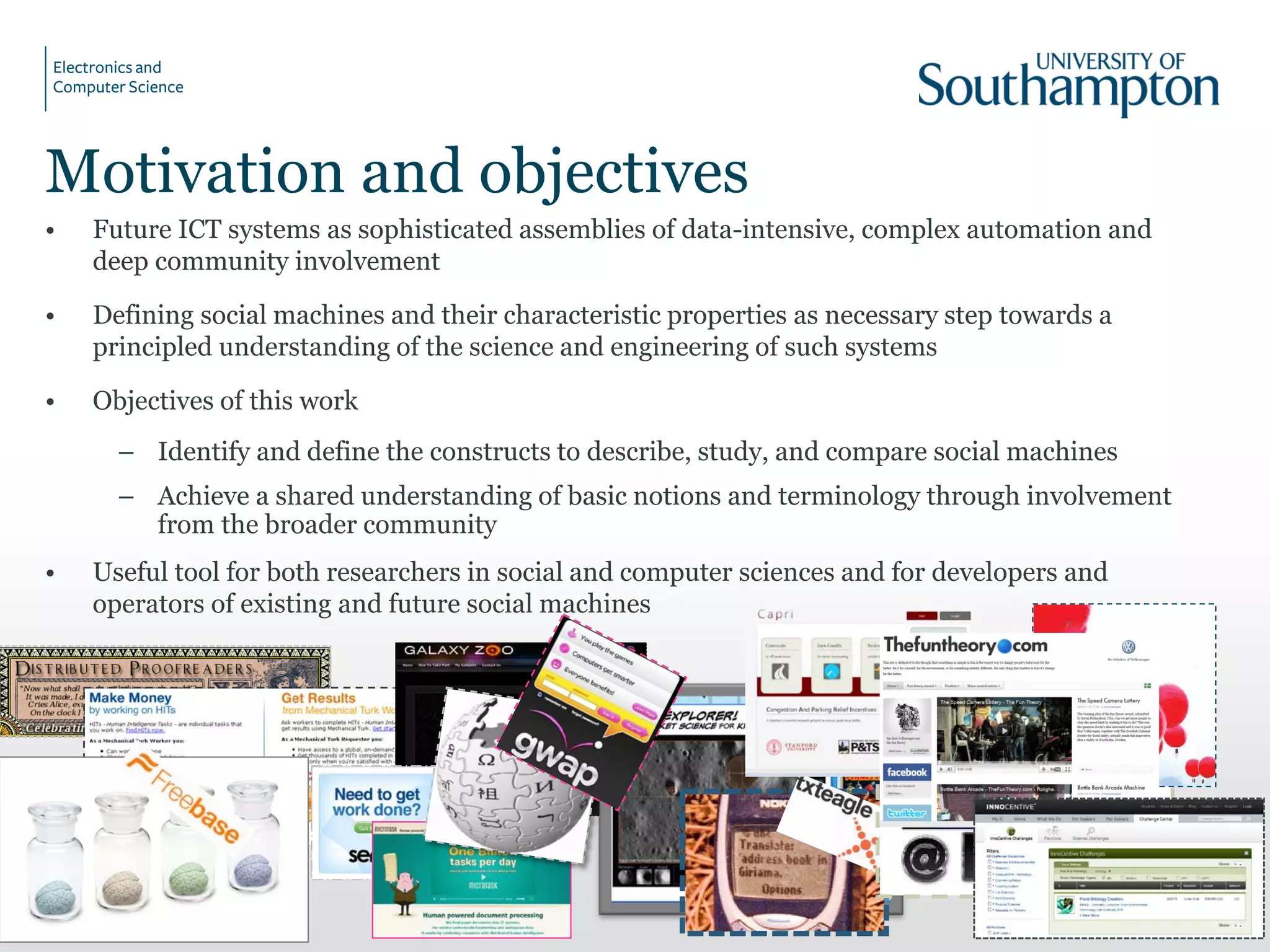
• Future ICT systems as sophisticated assemblies of data-intensive, complex automation and
deep community involvement
• Defining social machines and their characteristic properties as necessary step towards a
principled understanding of the science and engineering of such systems
• Objectives of this work
– Identify and define the constructs to describe, study, and compare social machines
– Achieve a shared understanding of basic notions and terminology through involvement
from the broader community
• Useful tool for both researchers in social and computer sciences and for developers and
operators of existing and future social machines
2
General considerations
• Machine: ‘(1) an assemblage of
parts that transmit forces,
motion, and energy one to
another in a predetermined
manner; (2) an instrument (as
a lever) designed to transmit or
modify the application of power,
force, or motion’ [Merriam-
Webster]
• In relation to living beings: ‘one
that resembles a machine (as in
being methodical, tireless, or
consistently productive)’
[Merriam-Webster]
• Social machine
1. co-existence of and interaction
among algorithmic and social
components;
2. problem/task specification changes
as the system evolves;
3. operation of the system is governed
by a different set of rules;
4. different performance models and
approaches to measure them;
3[Courtesy of Dave de Roure]
The polyarchical relationship of social machines
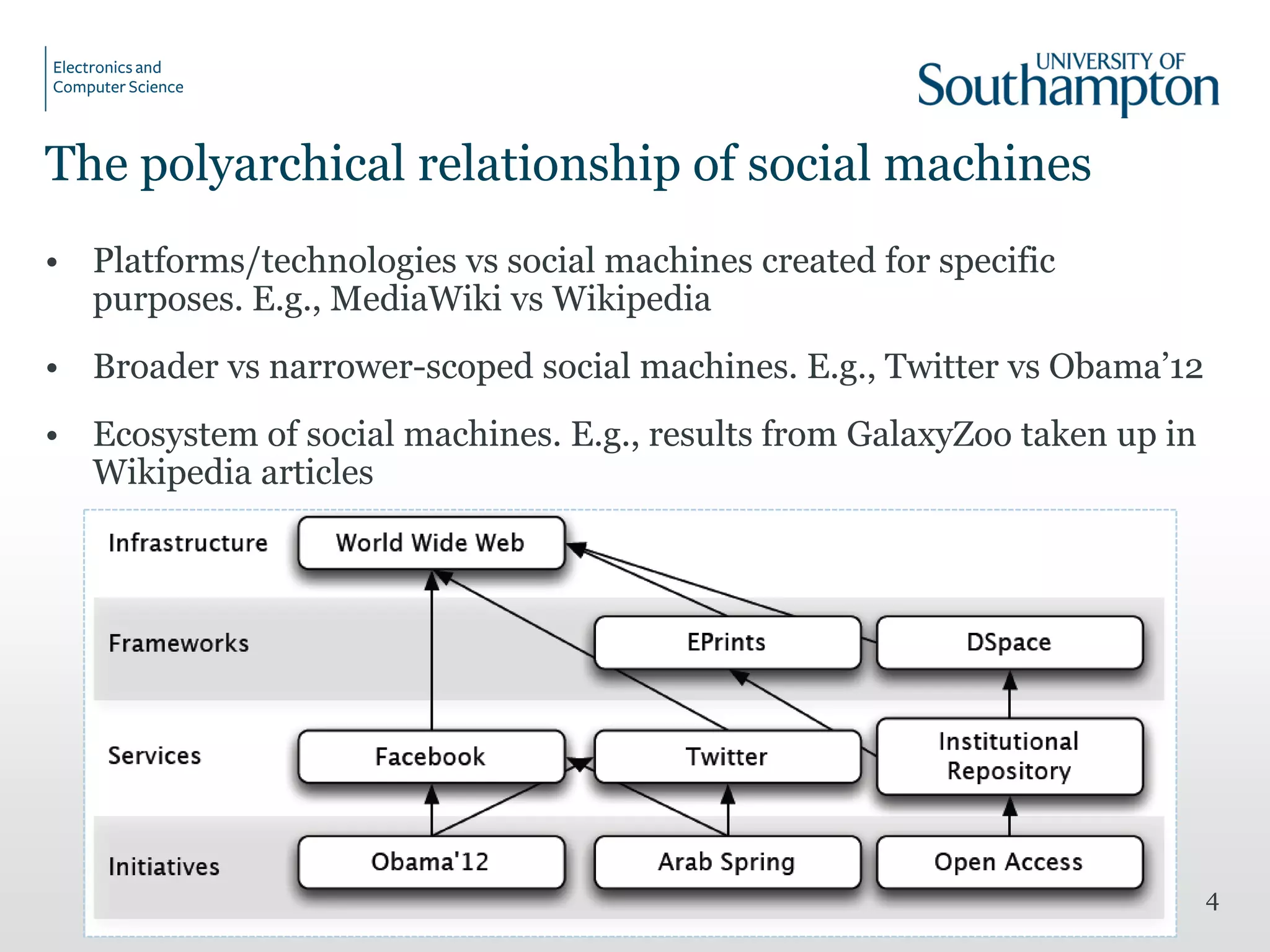
• Platforms/technologies vs social machines created for specific
purposes. E.g., MediaWiki vs Wikipedia
• Broader vs narrower-scoped social machines. E.g., Twitter vs Obama’12
• Ecosystem of social machines. E.g., results from GalaxyZoo taken up in
Wikipedia articles
4
Social machines and related areas
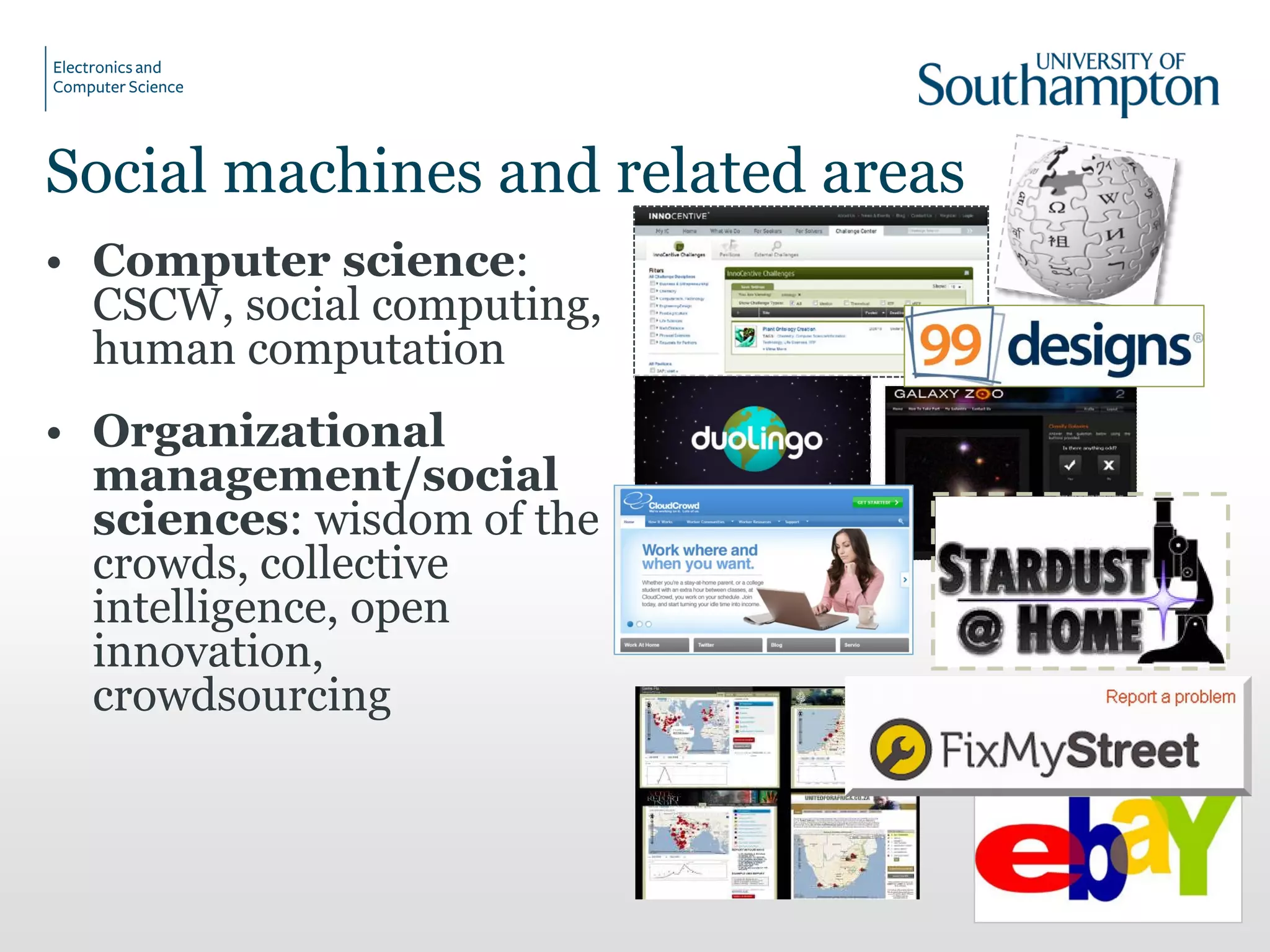
• Computer science:
CSCW, social computing,
human computation
• Organizational
management/social
sciences: wisdom of the
crowds, collective
intelligence, open
innovation,
crowdsourcing
5
Social machines and related areas (2)
• Who defines the task/purpose of the system
– The system designer vs community
• What kind of tasks do humans undertake
– Creative vs computationally expensive
• Who is supporting whom
– Humans supporting algorithmic processes or machines
supporting human tasks
6
Methodology
• Repertory grid elicitation to derive an initial set of elements
(instances of social machines) and constructs (characteristics
of social machines)  10 grids, 56 elements, 117 constructs
• Consolidation and clustering of constructs  31 constructs, five
clusters
– General description
– Purpose and tasks
– Participants and roles
– Motivation and incentives
– Technology
7
Purpose and forms of contribution
• Contributions towards public vs private good
• Implicit vs explicit contributions
• Degree to which contributors decide what they can work on
• Degree to which contributors can change the
nature/purpose/development of the social machine
• How is the final result created/aggregation
8
Participation and interaction
• Who can contribute and what: roles, requester/worker,
game models, skills and learning curve
• Workflow management: task/resource assignment
(scarcity, requester-contributions cardinality),
parallelization, synchronization, aggregation
– Machine replacing/assisting humans vs humans
replacing machines
• Dynamics of participation model
9
Quality and performance
• Which contributions are validated
• Is there a ground truth and where does it come from: no one,
community, dedicated group, machine owner
• How is quality assessment performed: manually,
agreement/voting between participants, computed automatically
• Are criteria and quality control methods explicit/transparent
• Can contributors change the criteria or earn the right to perform
evaluations
10
Motivation and incentives
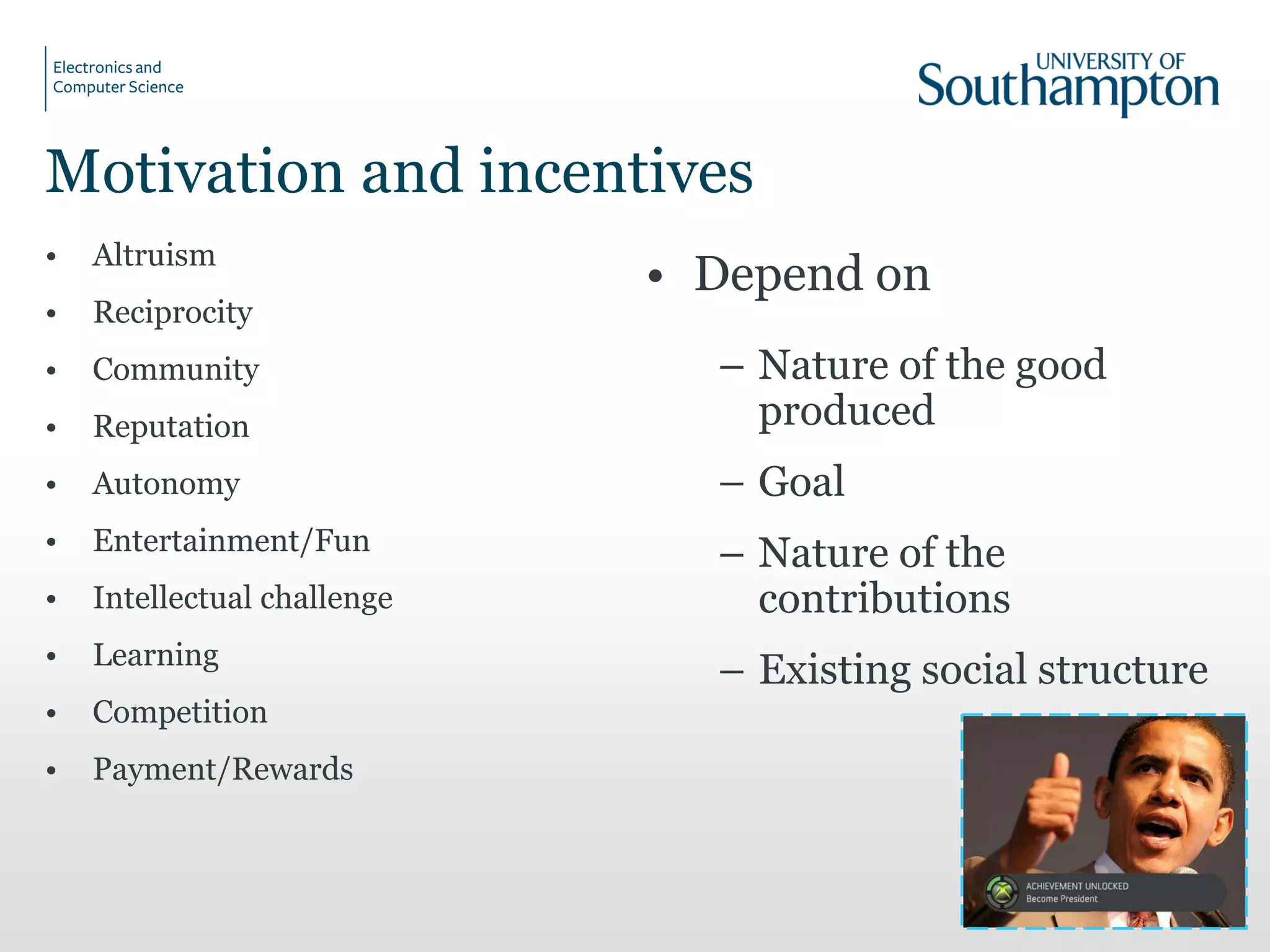
• Altruism
• Reciprocity
• Community
• Reputation
• Autonomy
• Entertainment/Fun
• Intellectual challenge
• Learning
• Competition
• Payment/Rewards
• Depend on
– Nature of the good
produced
– Goal
– Nature of the
contributions
– Existing social structure
11
Technology and engineering
• Requirements specification and evolution
• Security, trust
• Decentralization
• Data ownership and access
• Profile building
• Social networks
• Analytics on top of social network and actual data
12
[Courtesy of Dave Robertson]
Next steps
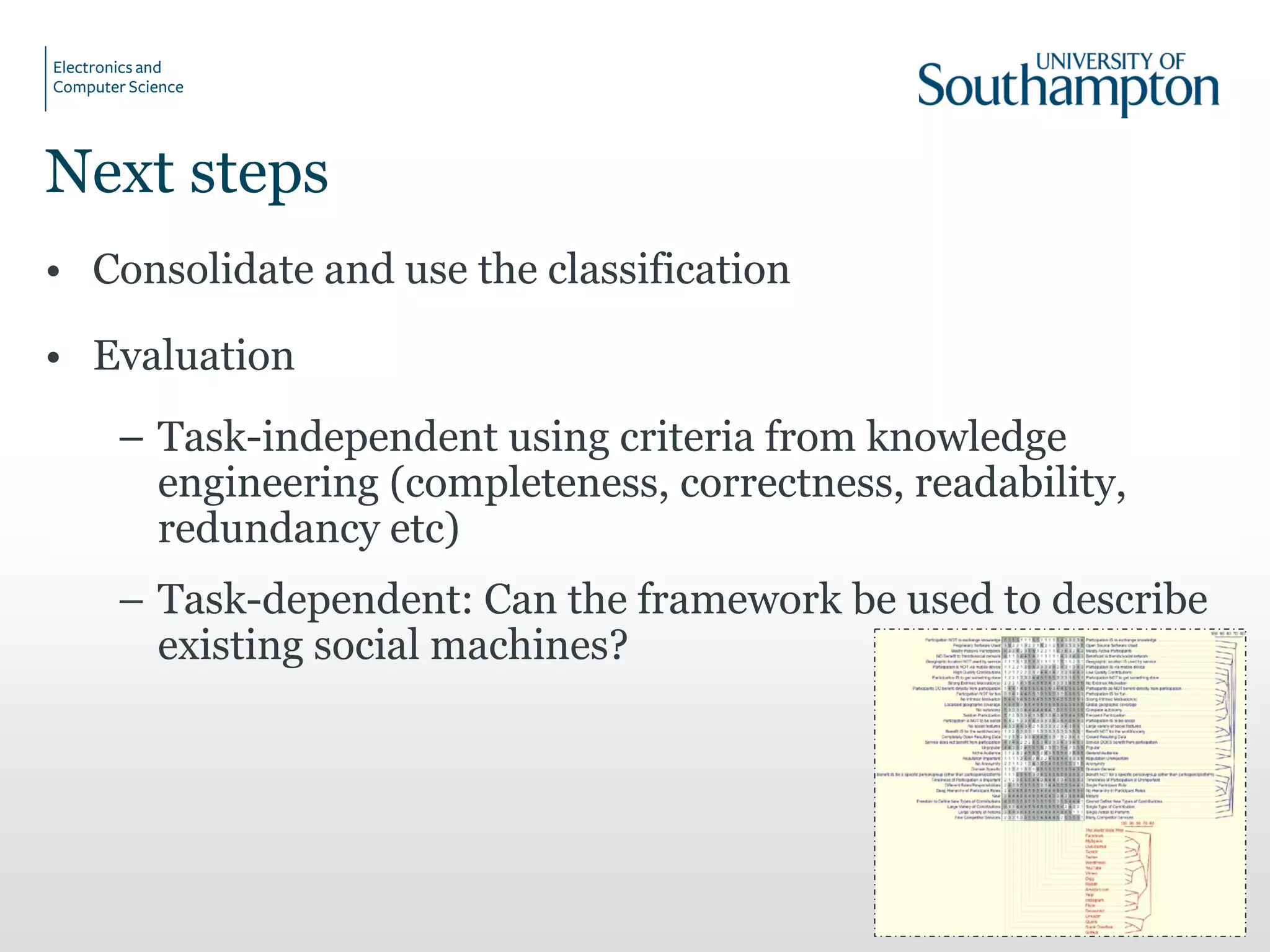
• Consolidate and use the classification
• Evaluation
– Task-independent using criteria from knowledge
engineering (completeness, correctness, readability,
redundancy etc)
– Task-dependent: Can the framework be used to describe
existing social machines?
13
Theory and practice
of social machines
May 13, 2013
14
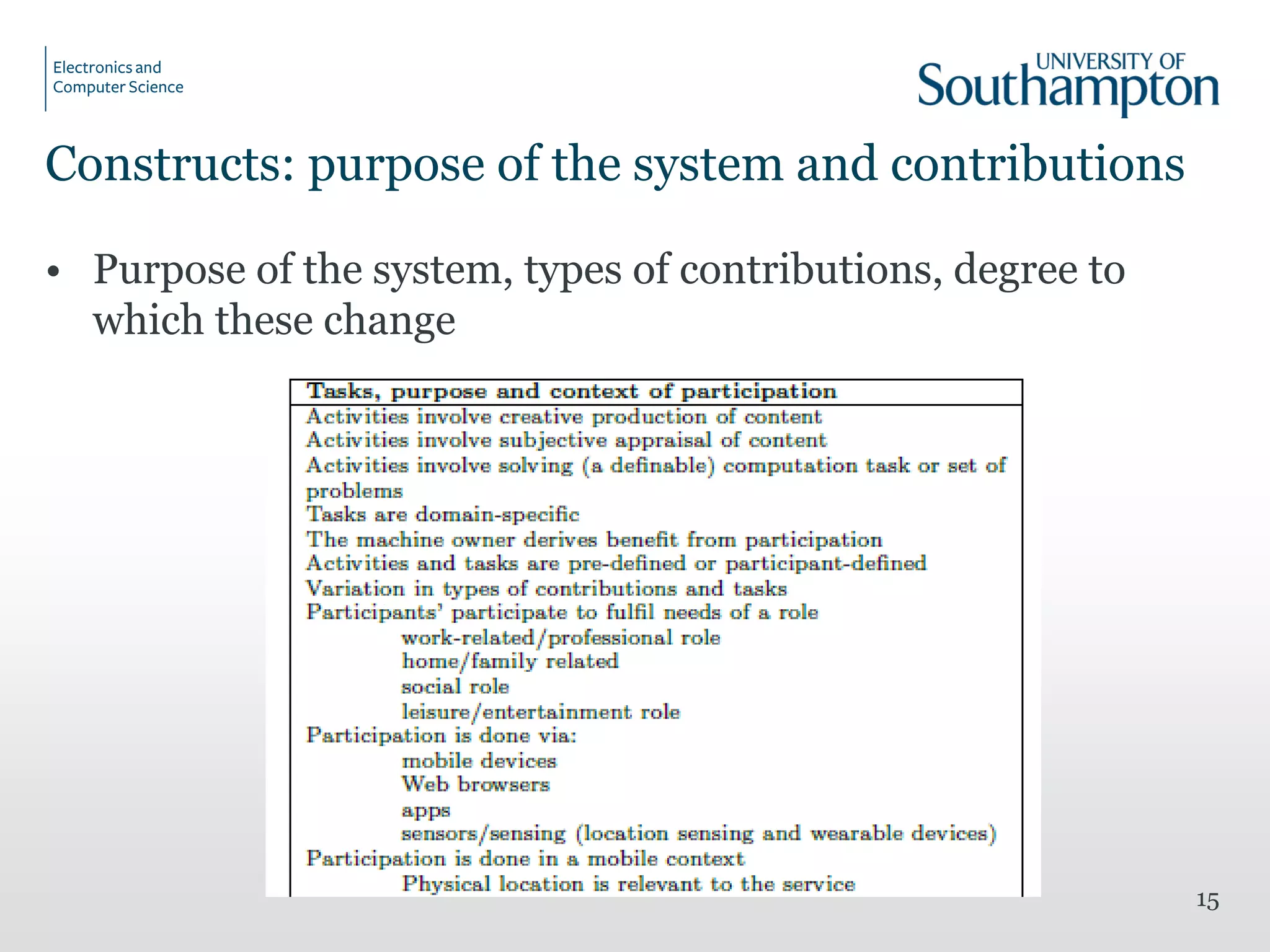
Constructs: purpose of the system and contributions
• Purpose of the system, types of contributions, degree to
which these change
15
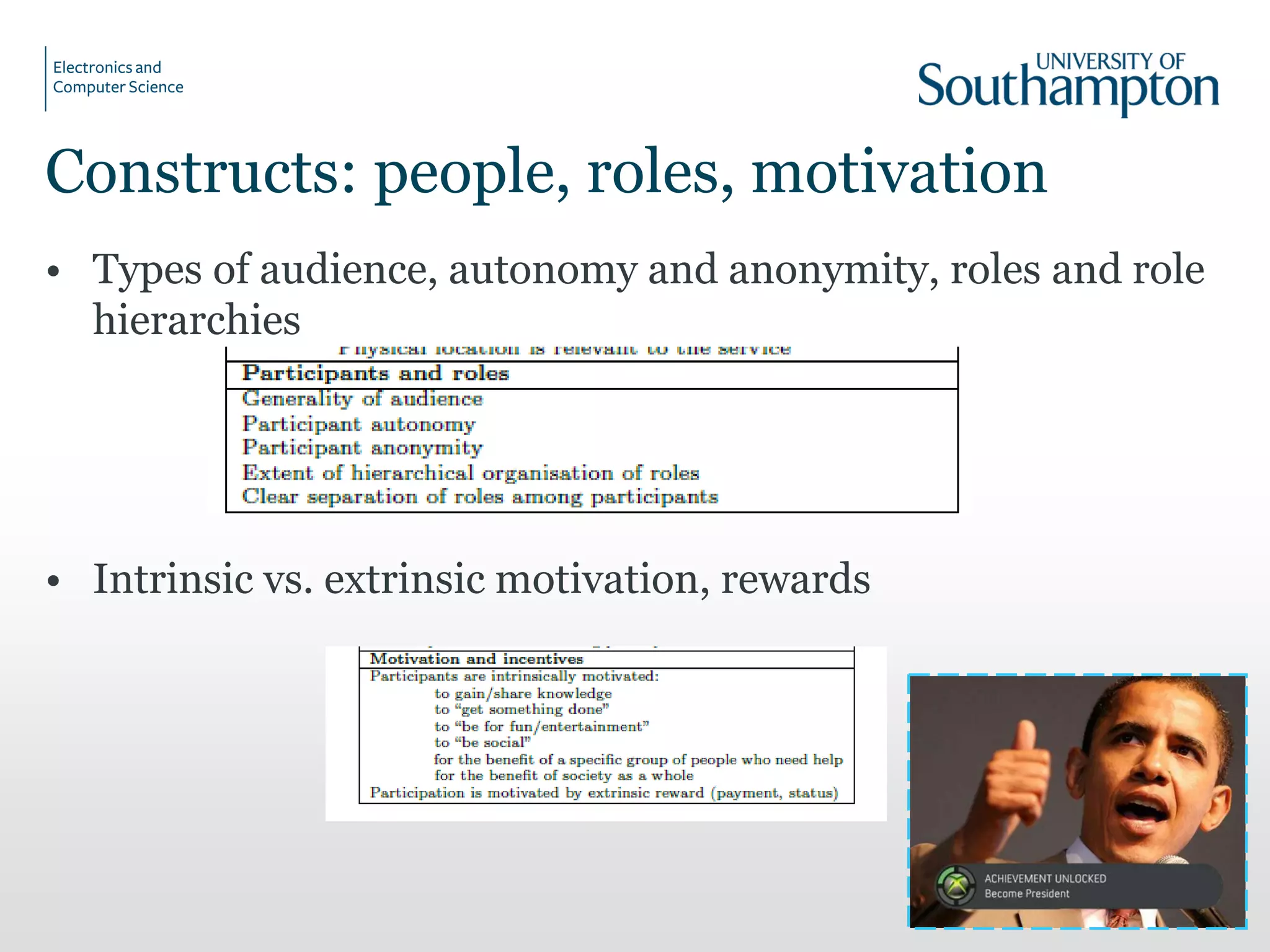
Constructs: people, roles, motivation
• Types of audience, autonomy and anonymity, roles and role
hierarchies
• Intrinsic vs. extrinsic motivation, rewards
16

Towards a classification framework for social machines

  • 1.
    Towards a classification frameworkfor social machines Submission at SOCM2013@WWW2013 Elena Simperl 26 April 2013
  • 2.
    Motivation and objectives •Future ICT systems as sophisticated assemblies of data-intensive, complex automation and deep community involvement • Defining social machines and their characteristic properties as necessary step towards a principled understanding of the science and engineering of such systems • Objectives of this work – Identify and define the constructs to describe, study, and compare social machines – Achieve a shared understanding of basic notions and terminology through involvement from the broader community • Useful tool for both researchers in social and computer sciences and for developers and operators of existing and future social machines 2
  • 3.
    General considerations • Machine:‘(1) an assemblage of parts that transmit forces, motion, and energy one to another in a predetermined manner; (2) an instrument (as a lever) designed to transmit or modify the application of power, force, or motion’ [Merriam- Webster] • In relation to living beings: ‘one that resembles a machine (as in being methodical, tireless, or consistently productive)’ [Merriam-Webster] • Social machine 1. co-existence of and interaction among algorithmic and social components; 2. problem/task specification changes as the system evolves; 3. operation of the system is governed by a different set of rules; 4. different performance models and approaches to measure them; 3[Courtesy of Dave de Roure]
  • 4.
    The polyarchical relationshipof social machines • Platforms/technologies vs social machines created for specific purposes. E.g., MediaWiki vs Wikipedia • Broader vs narrower-scoped social machines. E.g., Twitter vs Obama’12 • Ecosystem of social machines. E.g., results from GalaxyZoo taken up in Wikipedia articles 4
  • 5.
    Social machines andrelated areas • Computer science: CSCW, social computing, human computation • Organizational management/social sciences: wisdom of the crowds, collective intelligence, open innovation, crowdsourcing 5
  • 6.
    Social machines andrelated areas (2) • Who defines the task/purpose of the system – The system designer vs community • What kind of tasks do humans undertake – Creative vs computationally expensive • Who is supporting whom – Humans supporting algorithmic processes or machines supporting human tasks 6
  • 7.
    Methodology • Repertory gridelicitation to derive an initial set of elements (instances of social machines) and constructs (characteristics of social machines)  10 grids, 56 elements, 117 constructs • Consolidation and clustering of constructs  31 constructs, five clusters – General description – Purpose and tasks – Participants and roles – Motivation and incentives – Technology 7
  • 8.
    Purpose and formsof contribution • Contributions towards public vs private good • Implicit vs explicit contributions • Degree to which contributors decide what they can work on • Degree to which contributors can change the nature/purpose/development of the social machine • How is the final result created/aggregation 8
  • 9.
    Participation and interaction •Who can contribute and what: roles, requester/worker, game models, skills and learning curve • Workflow management: task/resource assignment (scarcity, requester-contributions cardinality), parallelization, synchronization, aggregation – Machine replacing/assisting humans vs humans replacing machines • Dynamics of participation model 9
  • 10.
    Quality and performance •Which contributions are validated • Is there a ground truth and where does it come from: no one, community, dedicated group, machine owner • How is quality assessment performed: manually, agreement/voting between participants, computed automatically • Are criteria and quality control methods explicit/transparent • Can contributors change the criteria or earn the right to perform evaluations 10
  • 11.
    Motivation and incentives •Altruism • Reciprocity • Community • Reputation • Autonomy • Entertainment/Fun • Intellectual challenge • Learning • Competition • Payment/Rewards • Depend on – Nature of the good produced – Goal – Nature of the contributions – Existing social structure 11
  • 12.
    Technology and engineering •Requirements specification and evolution • Security, trust • Decentralization • Data ownership and access • Profile building • Social networks • Analytics on top of social network and actual data 12 [Courtesy of Dave Robertson]
  • 13.
    Next steps • Consolidateand use the classification • Evaluation – Task-independent using criteria from knowledge engineering (completeness, correctness, readability, redundancy etc) – Task-dependent: Can the framework be used to describe existing social machines? 13
  • 14.
    Theory and practice ofsocial machines May 13, 2013 14
  • 15.
    Constructs: purpose ofthe system and contributions • Purpose of the system, types of contributions, degree to which these change 15
  • 16.
    Constructs: people, roles,motivation • Types of audience, autonomy and anonymity, roles and role hierarchies • Intrinsic vs. extrinsic motivation, rewards 16