“Toward a Global Research Platform
for Big Data Analysis”
Keynote Presentation:
Hawaii International Conference on System Sciences - 51 (HICSS-51)
Hilton Waikoloa Village
Big Island, HI
January 5, 2018
Dr. Larry Smarr
Director, California Institute for Telecommunications and Information Technology
Harry E. Gruber Professor,
Dept. of Computer Science and Engineering
Jacobs School of Engineering, UCSD
http://lsmarr.calit2.net
1
Abstract
In every field we see an exponential rise of Big Data, which in turn is
demanding new technological solutions in visualization, machine
learning, and high performance cyberinfrastructure. I will describe how
my NSF-funded Pacific Research Platform (PRP), which provides an
Internet platform with 100-1000 times the bandwidth of today’s
commodity Internet to all the research universities on the West Coast,
is being designed from the Big Data application needs of multi-
institutional research teams from particle physics to climate to human
health. NSF is also funding a Cognitive Hardware and Software
Ecosystem Community Infrastructure (CHASE-CI) to be built on top of
the PRP, adding GPU and non-von Neumann machine learning
capabilities to enable distributed Big Data Analytics. The next stage,
well underway, is understanding how to scale this prototype
cyberinfrastructure to a National and Global Research Platform.
The 30-Year Quest to Create a Tightly-Coupled,
Yet Highly Distributed “Computer” for Big Data Analysis
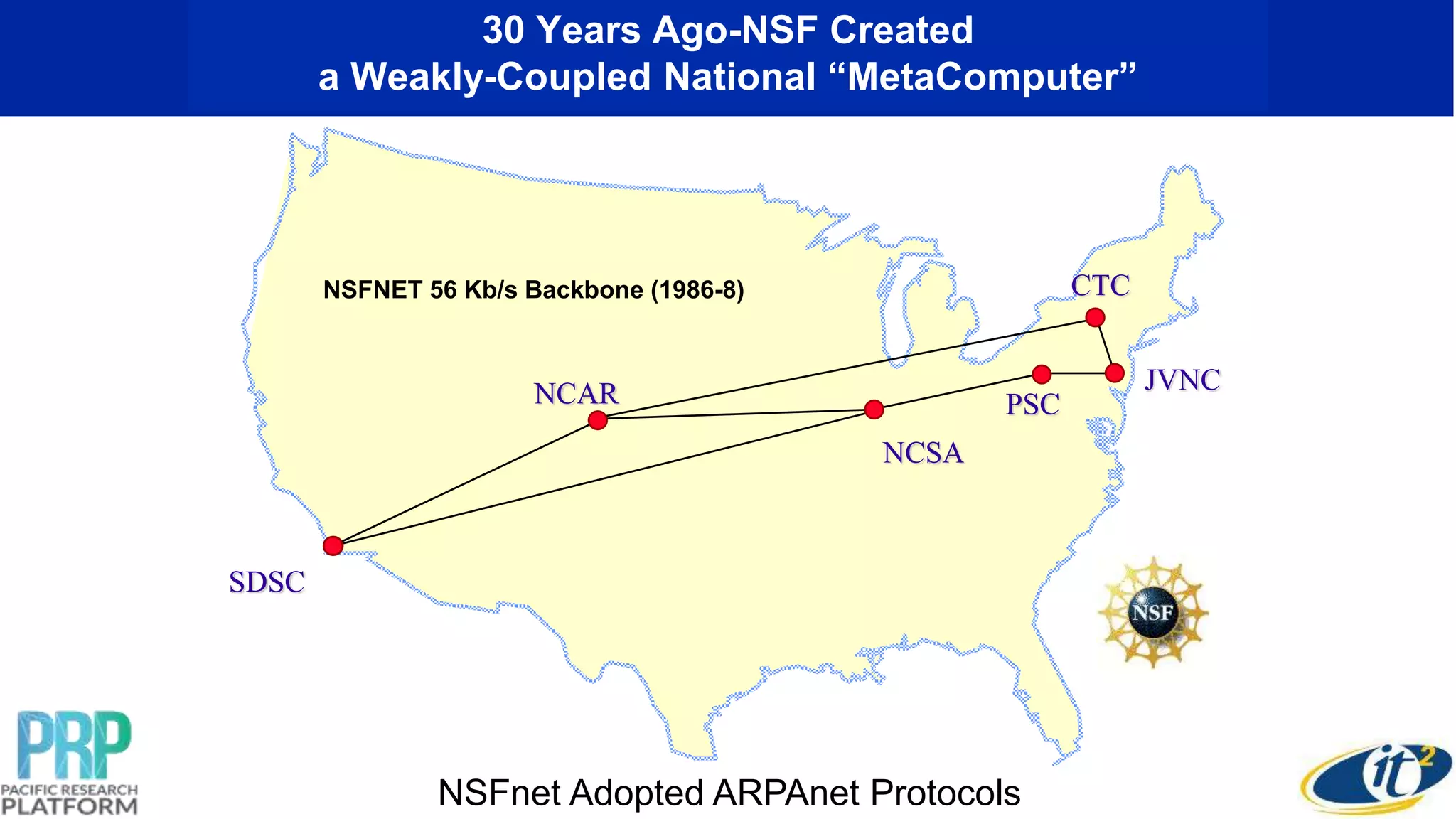
30 Years Ago-NSF Created
a Weakly-Coupled National “MetaComputer”
NCSA
NSFNET 56 Kb/s Backbone (1986-8)
PSCNCAR
CTC
JVNC
SDSC
NSFnet Adopted ARPAnet Protocols
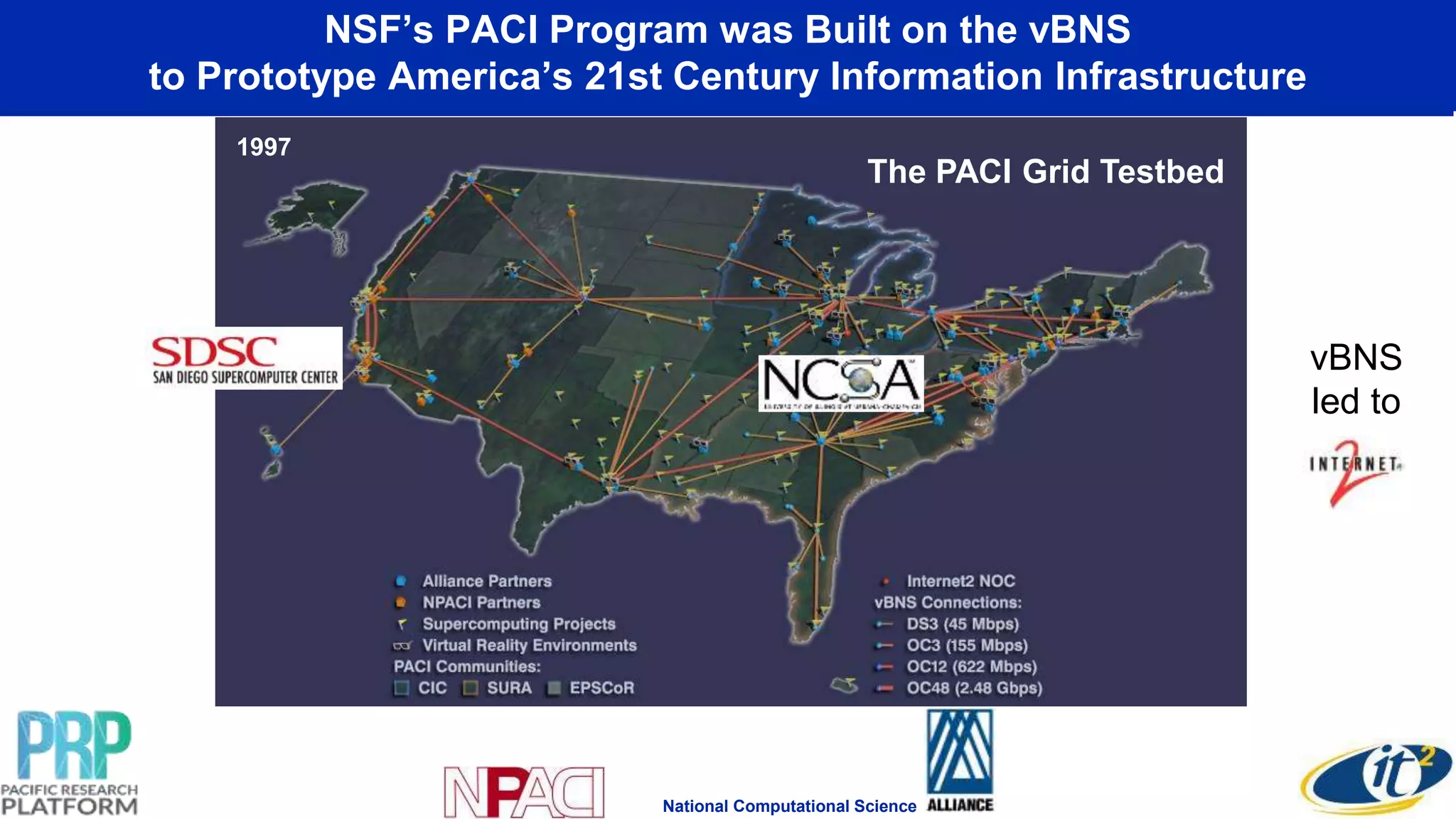
NSF’s PACI Program was Built on the vBNS
to Prototype America’s 21st Century Information Infrastructure
The PACI Grid Testbed
National Computational Science
1997
vBNS
led to
Vision:
Use Optical Fiber to Connect
Big Data Generators and Consumers,
Creating a Big Data Tightly-Coupled Distributed “Computer”
“The Bisection Bandwidth of a Cluster Interconnect,
but Deployed on a 20-Campus Scale.”
This Vision Has Been Building for 15 Years
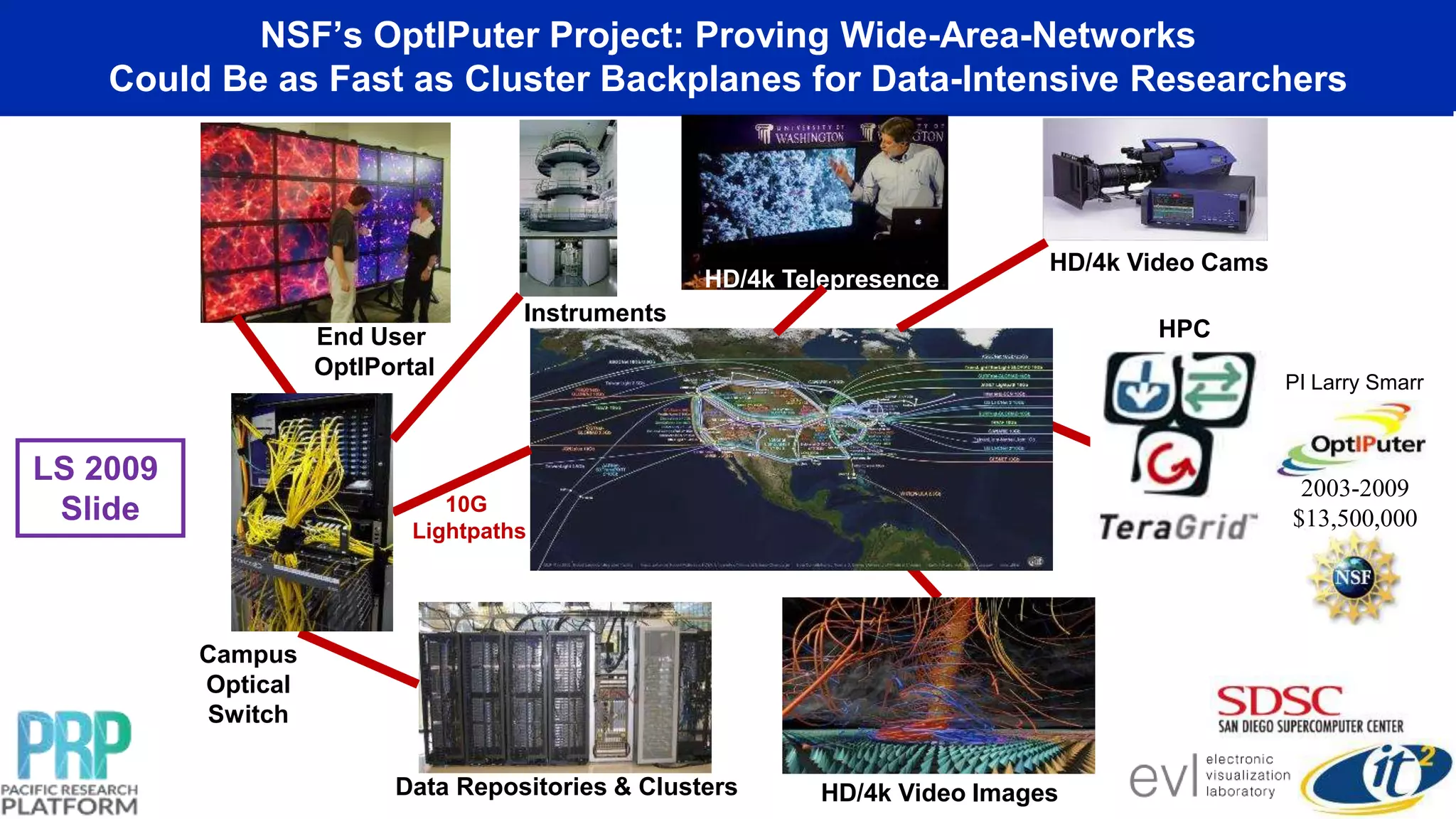
NSF’s OptIPuter Project: Proving Wide-Area-Networks
Could Be as Fast as Cluster Backplanes for Data-Intensive Researchers
Campus
Optical
Switch
Data Repositories & Clusters
HPC
HD/4k Video Images
HD/4k Video Cams
End User
OptIPortal
10G
Lightpaths
HD/4k Telepresence
Instruments
LS 2009
Slide
2003-2009
$13,500,000
PI Larry Smarr
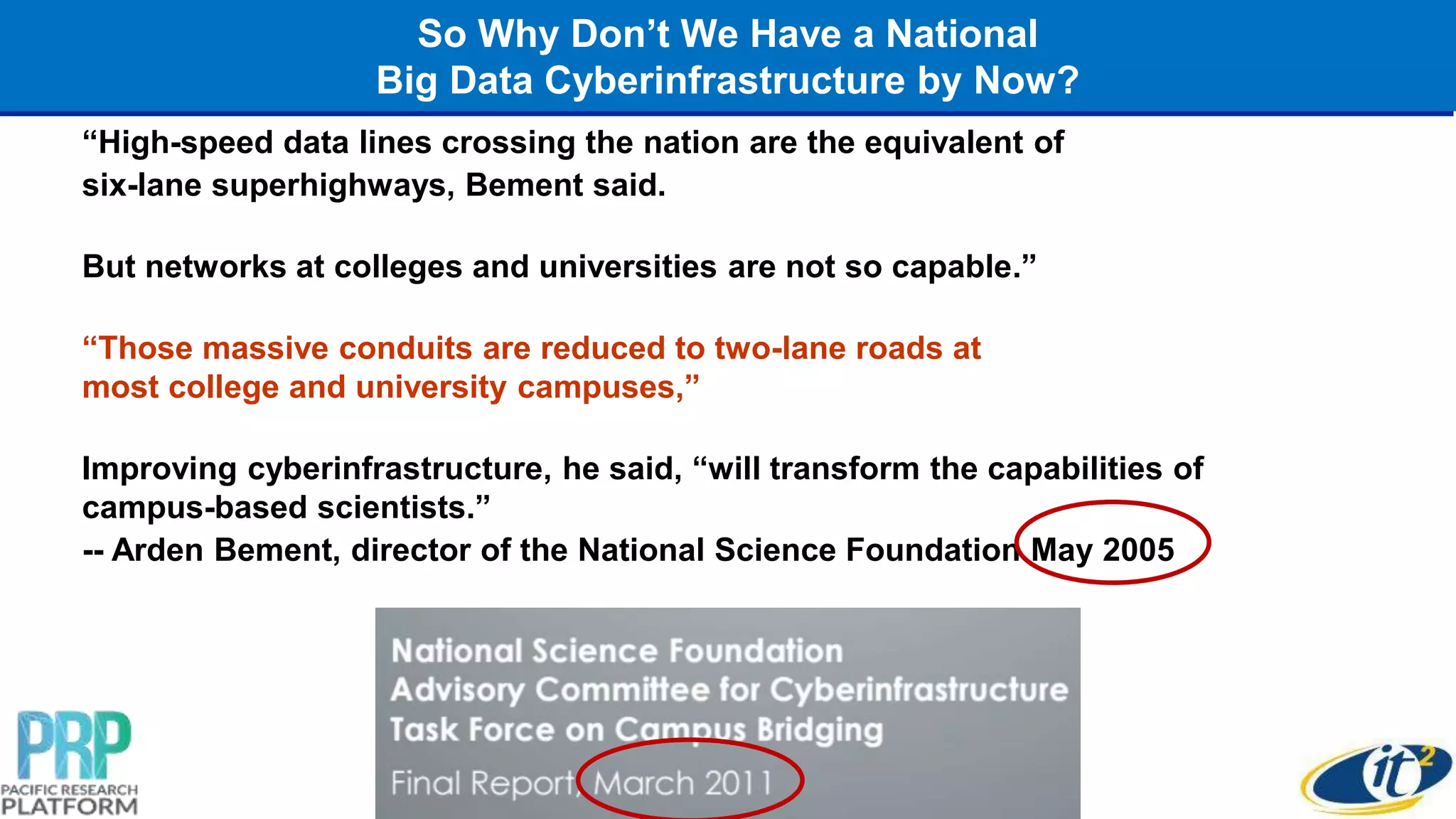
So Why Don’t We Have a National
Big Data Cyberinfrastructure by Now?
“High-speed data lines crossing the nation are the equivalent of
six-lane superhighways, Bement said.
But networks at colleges and universities are not so capable.”
“Those massive conduits are reduced to two-lane roads at
most college and university campuses,”
Improving cyberinfrastructure, he said, “will transform the capabilities of
campus-based scientists.”
-- Arden Bement, director of the National Science Foundation May 2005
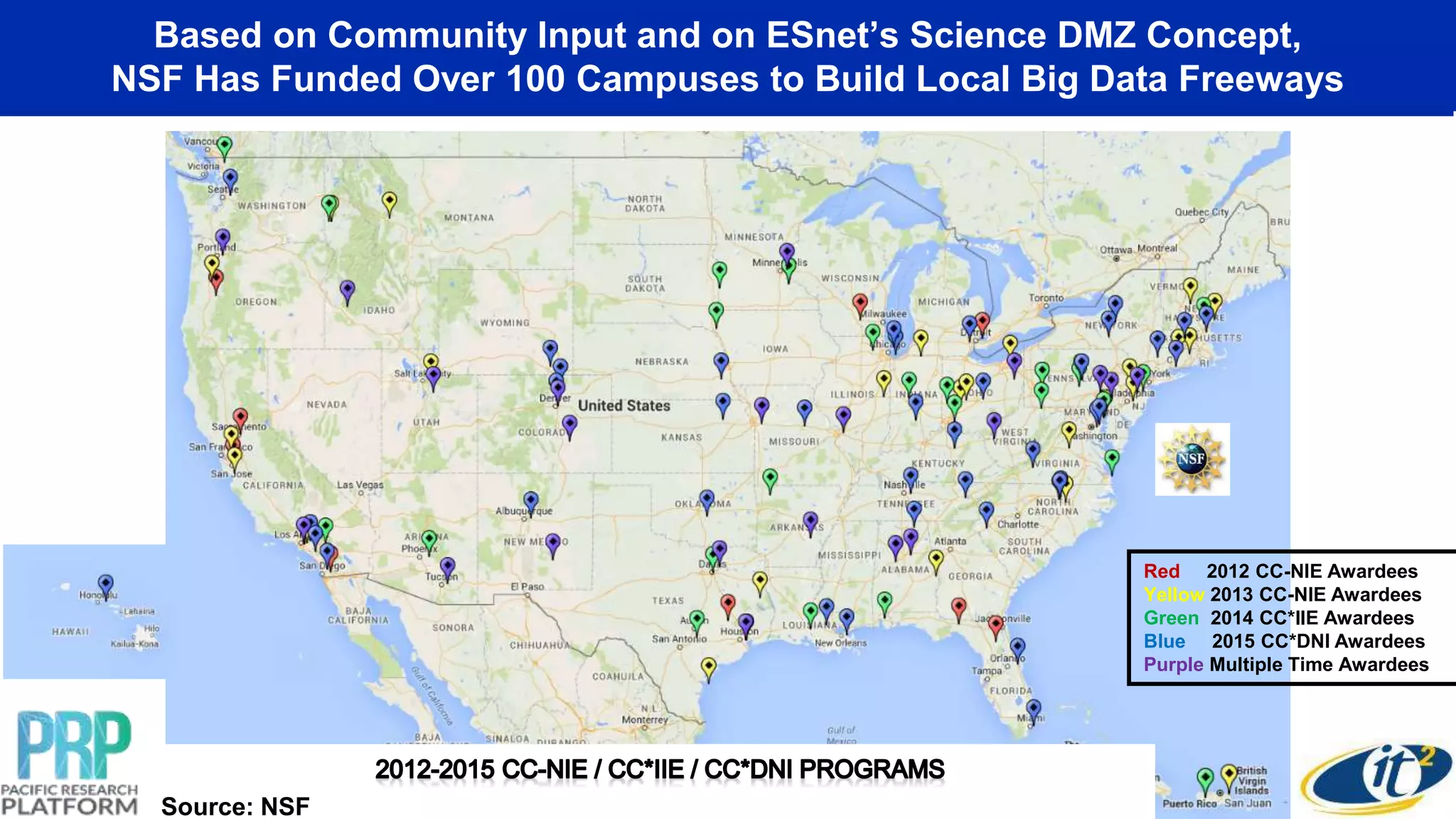
Based on Community Input and on ESnet’s Science DMZ Concept,
NSF Has Funded Over 100 Campuses to Build Local Big Data Freeways
Red 2012 CC-NIE Awardees
Yellow 2013 CC-NIE Awardees
Green 2014 CC*IIE Awardees
Blue 2015 CC*DNI Awardees
Purple Multiple Time Awardees
Source: NSF
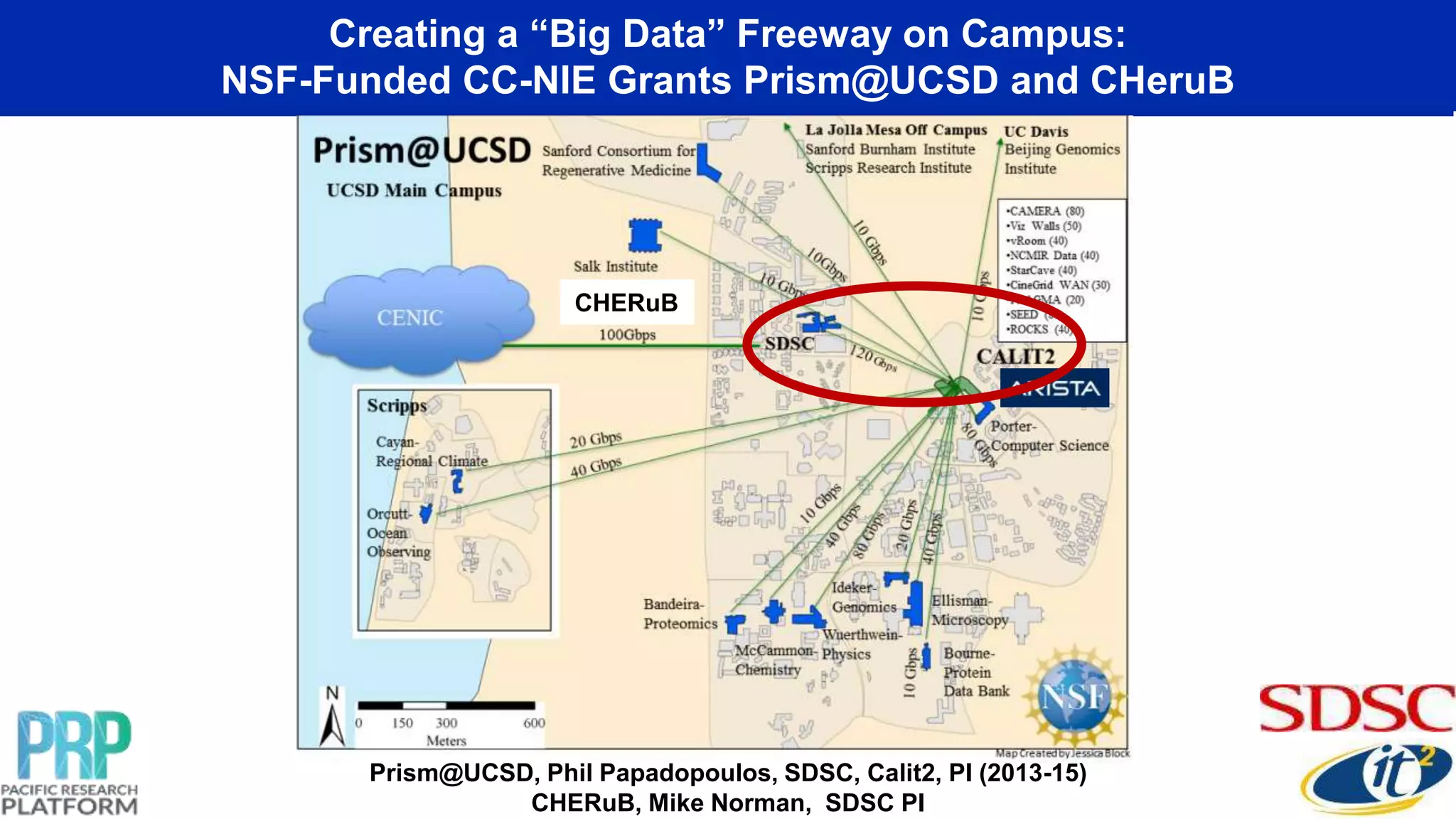
Creating a “Big Data” Freeway on Campus:
NSF-Funded CC-NIE Grants Prism@UCSD and CHeruB
Prism@UCSD, Phil Papadopoulos, SDSC, Calit2, PI (2013-15)
CHERuB, Mike Norman, SDSC PI
CHERuB
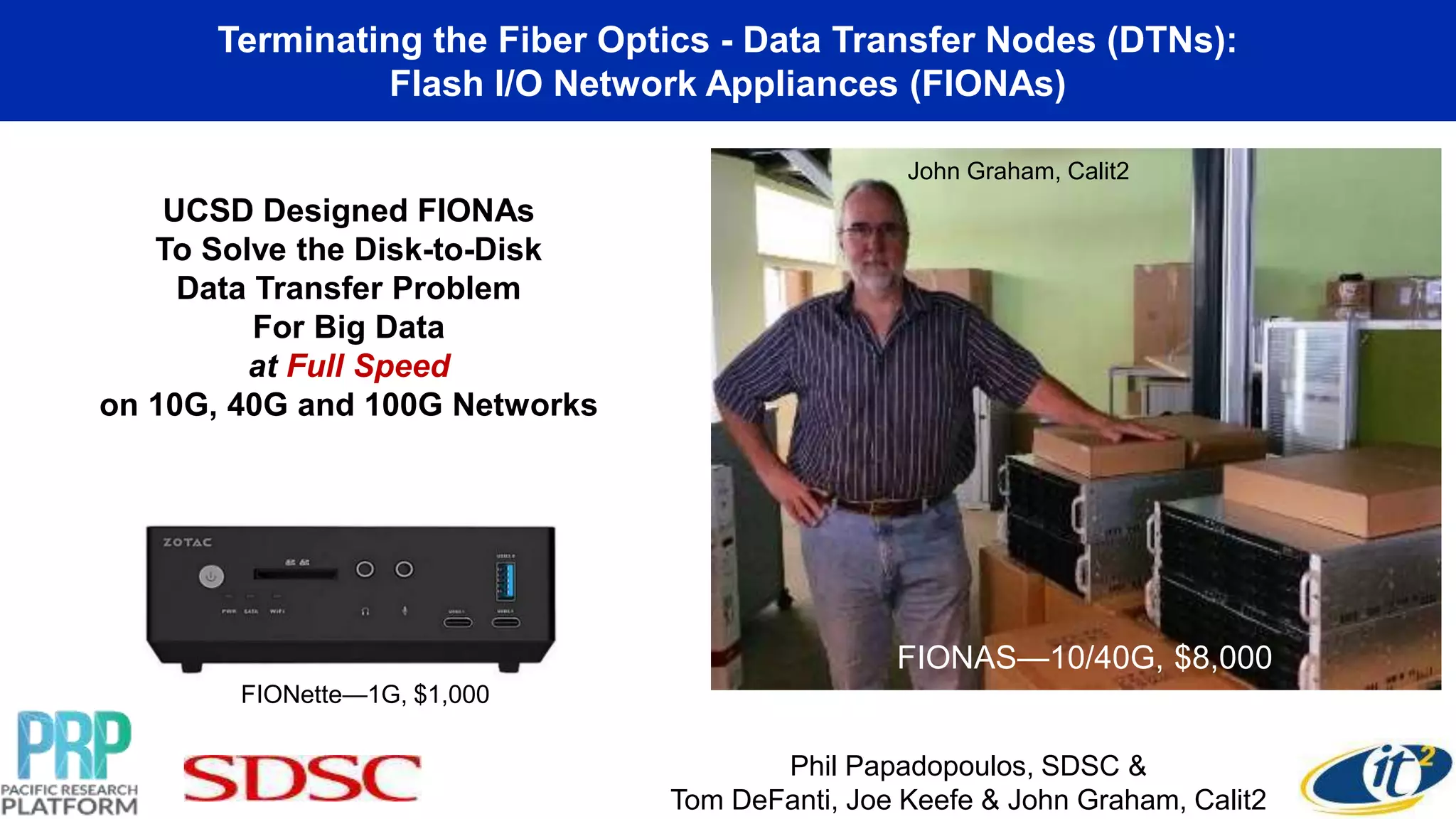
Terminating the Fiber Optics - Data Transfer Nodes (DTNs):
Flash I/O Network Appliances (FIONAs)
UCSD Designed FIONAs
To Solve the Disk-to-Disk
Data Transfer Problem
For Big Data
at Full Speed
on 10G, 40G and 100G Networks
FIONAS—10/40G, $8,000
FIONette—1G, $1,000
Phil Papadopoulos, SDSC &
Tom DeFanti, Joe Keefe & John Graham, Calit2
John Graham, Calit2
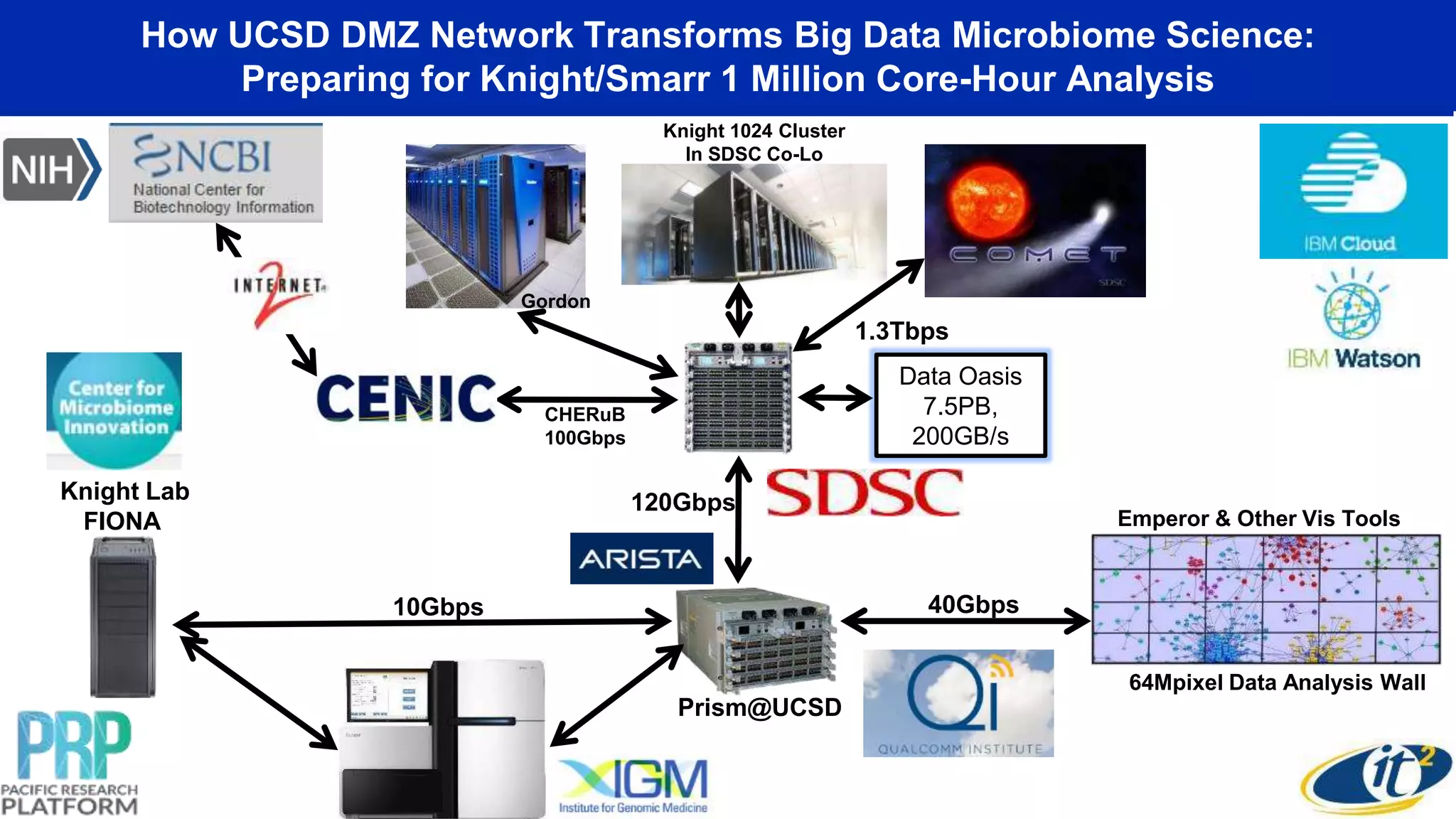
How UCSD DMZ Network Transforms Big Data Microbiome Science:
Preparing for Knight/Smarr 1 Million Core-Hour Analysis
Knight Lab
FIONA
10Gbps
Gordon
Prism@UCSD
Data Oasis
7.5PB,
200GB/s
Knight 1024 Cluster
In SDSC Co-Lo
CHERuB
100Gbps
Emperor & Other Vis Tools
64Mpixel Data Analysis Wall
120Gbps
40Gbps
1.3Tbps
(GDC)
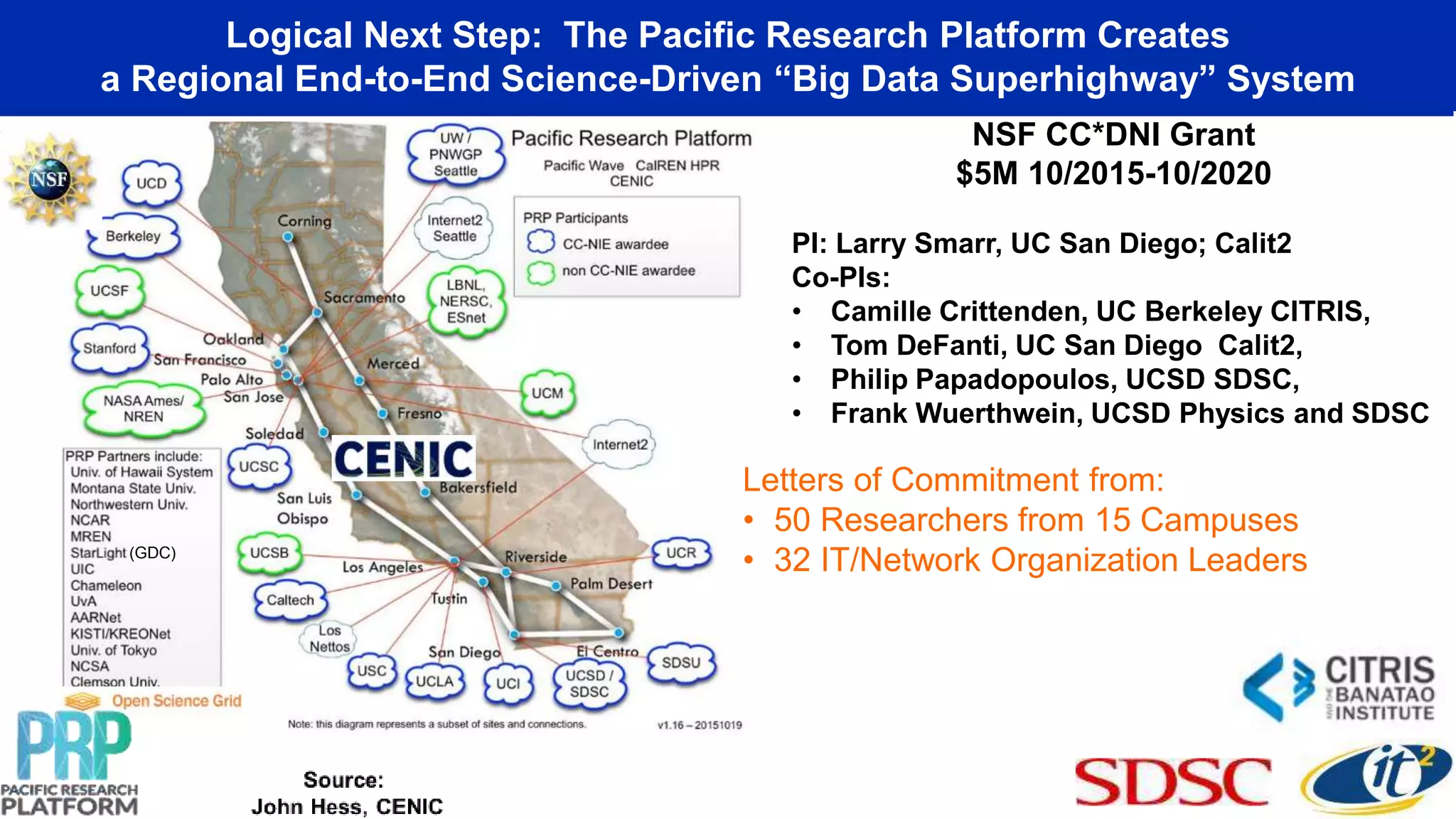
Logical Next Step: The Pacific Research Platform Creates
a Regional End-to-End Science-Driven “Big Data Superhighway” System
NSF CC*DNI Grant
$5M 10/2015-10/2020
PI: Larry Smarr, UC San Diego; Calit2
Co-PIs:
• Camille Crittenden, UC Berkeley CITRIS,
• Tom DeFanti, UC San Diego Calit2,
• Philip Papadopoulos, UCSD SDSC,
• Frank Wuerthwein, UCSD Physics and SDSC
Letters of Commitment from:
• 50 Researchers from 15 Campuses
• 32 IT/Network Organization Leaders
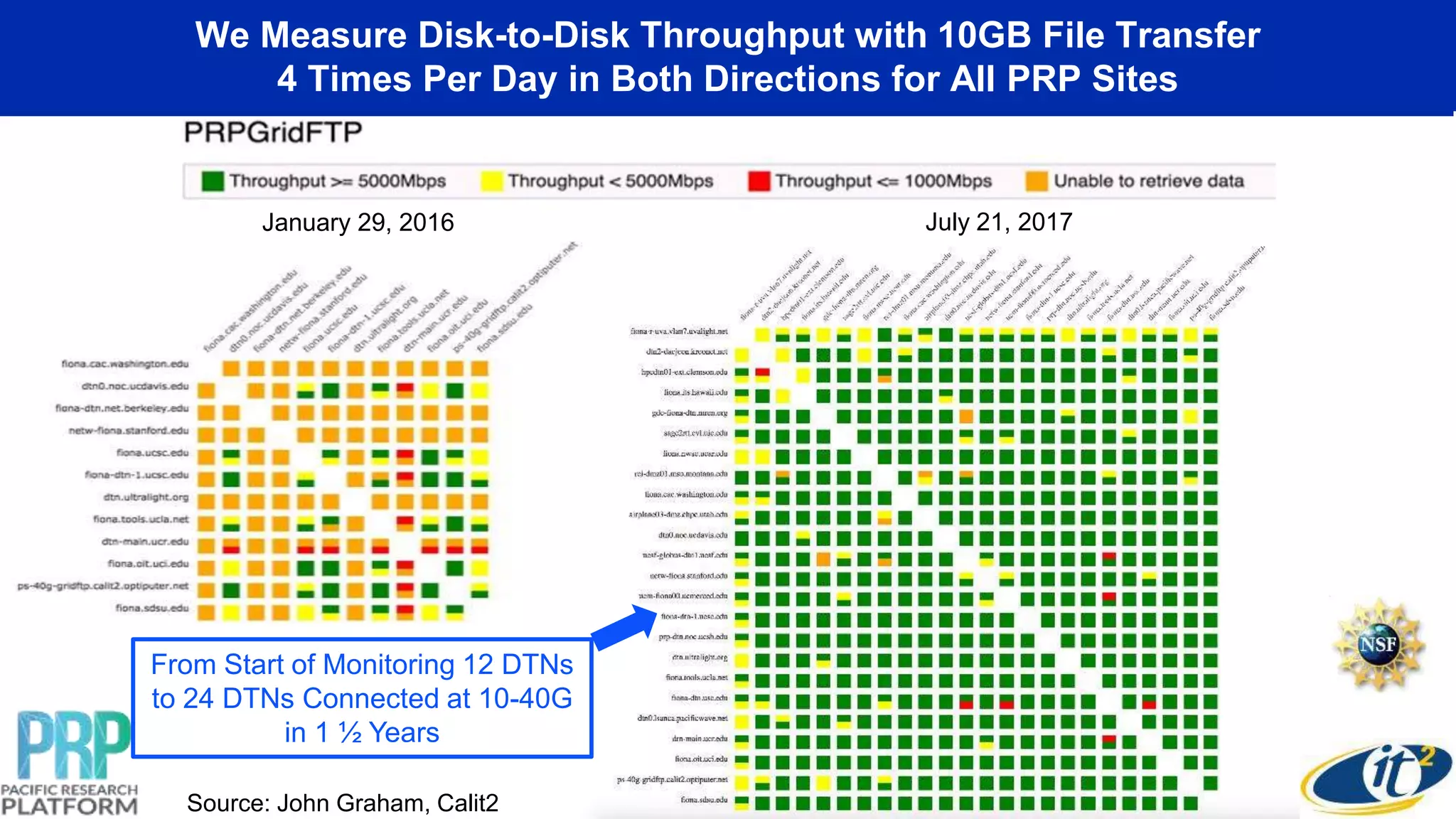
We Measure Disk-to-Disk Throughput with 10GB File Transfer
4 Times Per Day in Both Directions for All PRP Sites
January 29, 2016
From Start of Monitoring 12 DTNs
to 24 DTNs Connected at 10-40G
in 1 ½ Years
July 21, 2017
Source: John Graham, Calit2
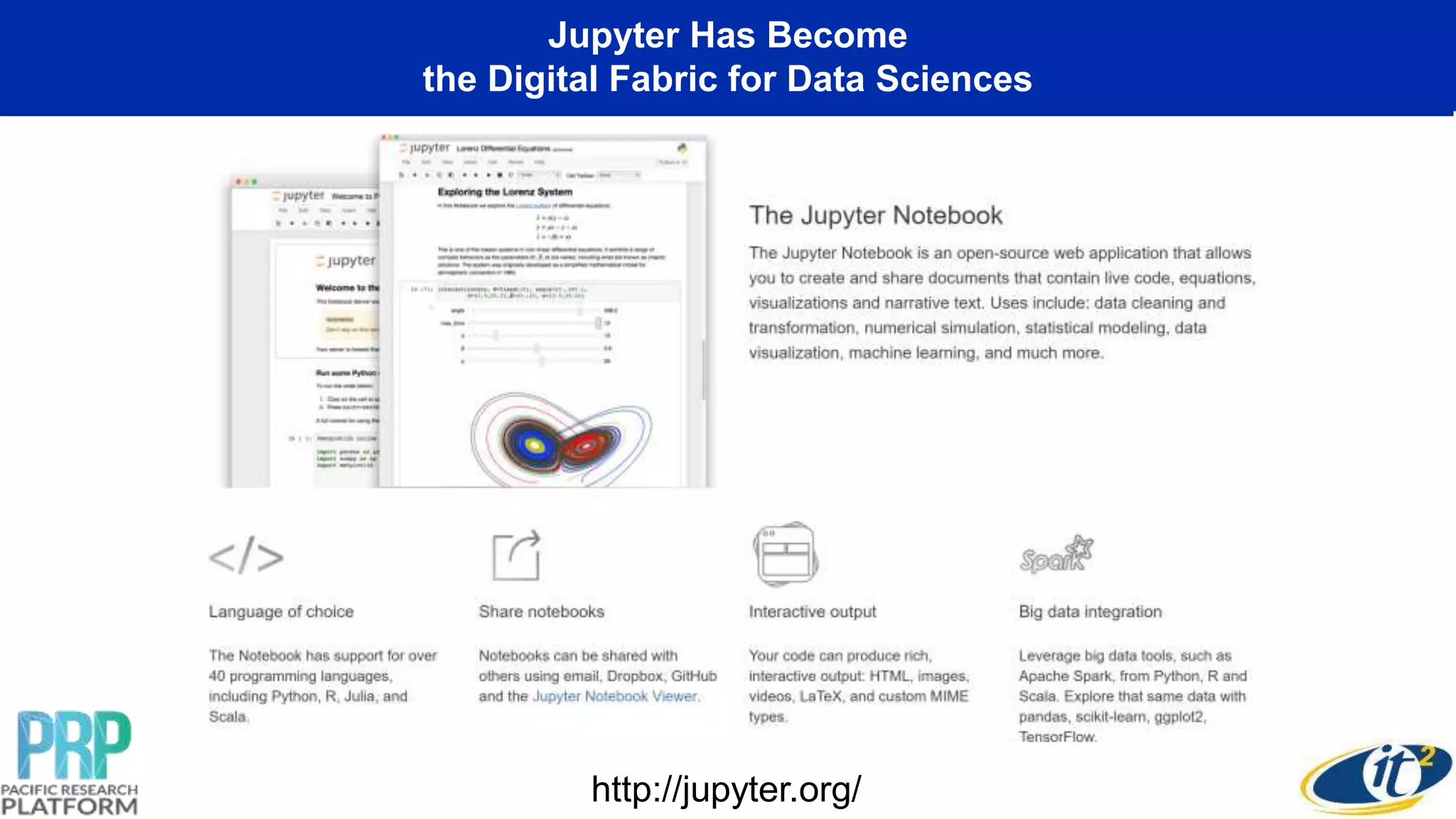
Jupyter Has Become
the Digital Fabric for Data Sciences
http://jupyter.org/
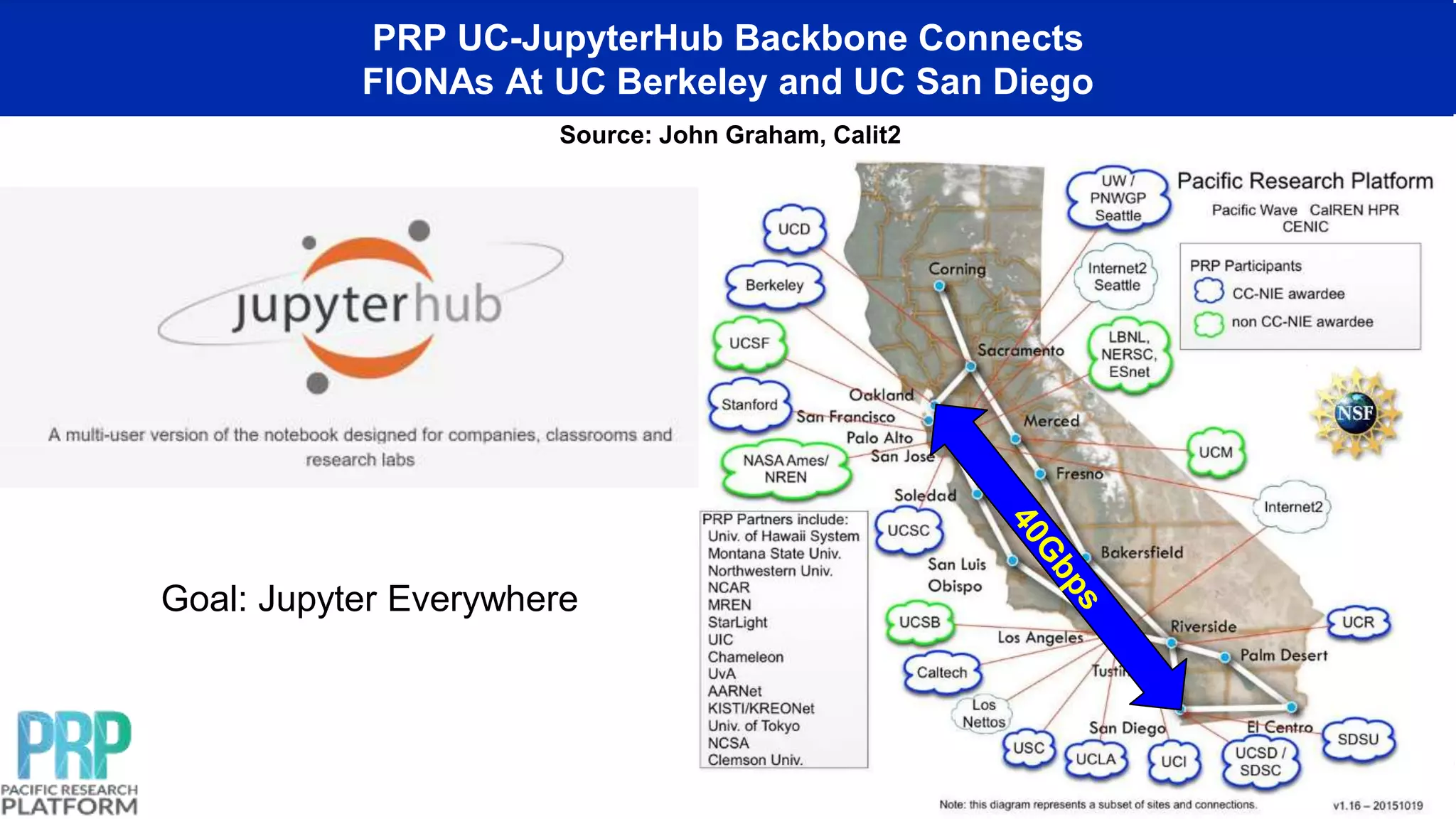
PRP UC-JupyterHub Backbone Connects
FIONAs At UC Berkeley and UC San Diego
Source: John Graham, Calit2
Goal: Jupyter Everywhere
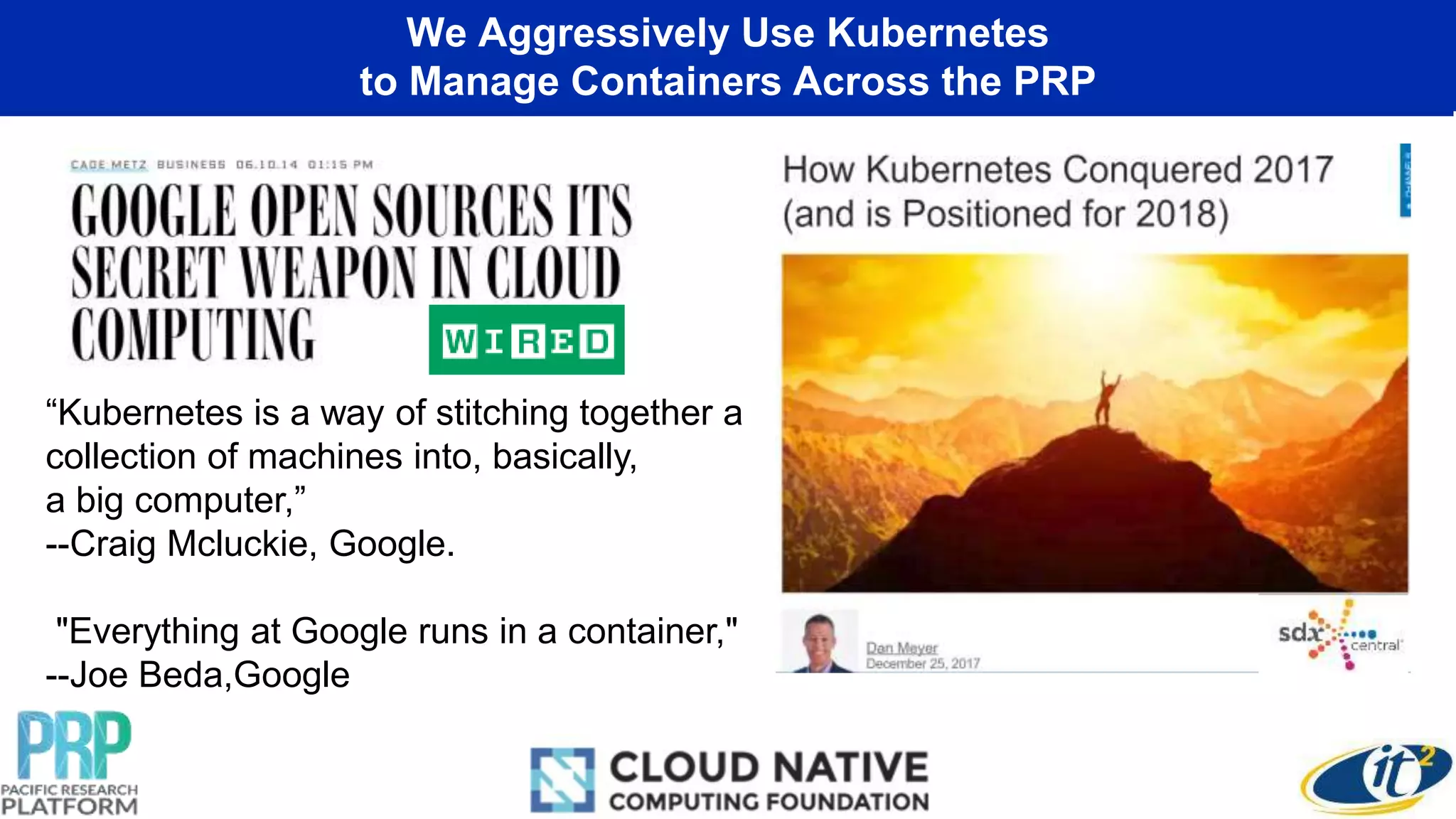
We Aggressively Use Kubernetes
to Manage Containers Across the PRP
“Kubernetes is a way of stitching together a
collection of machines into, basically,
a big computer,”
--Craig Mcluckie, Google.
"Everything at Google runs in a container,"
--Joe Beda,Google
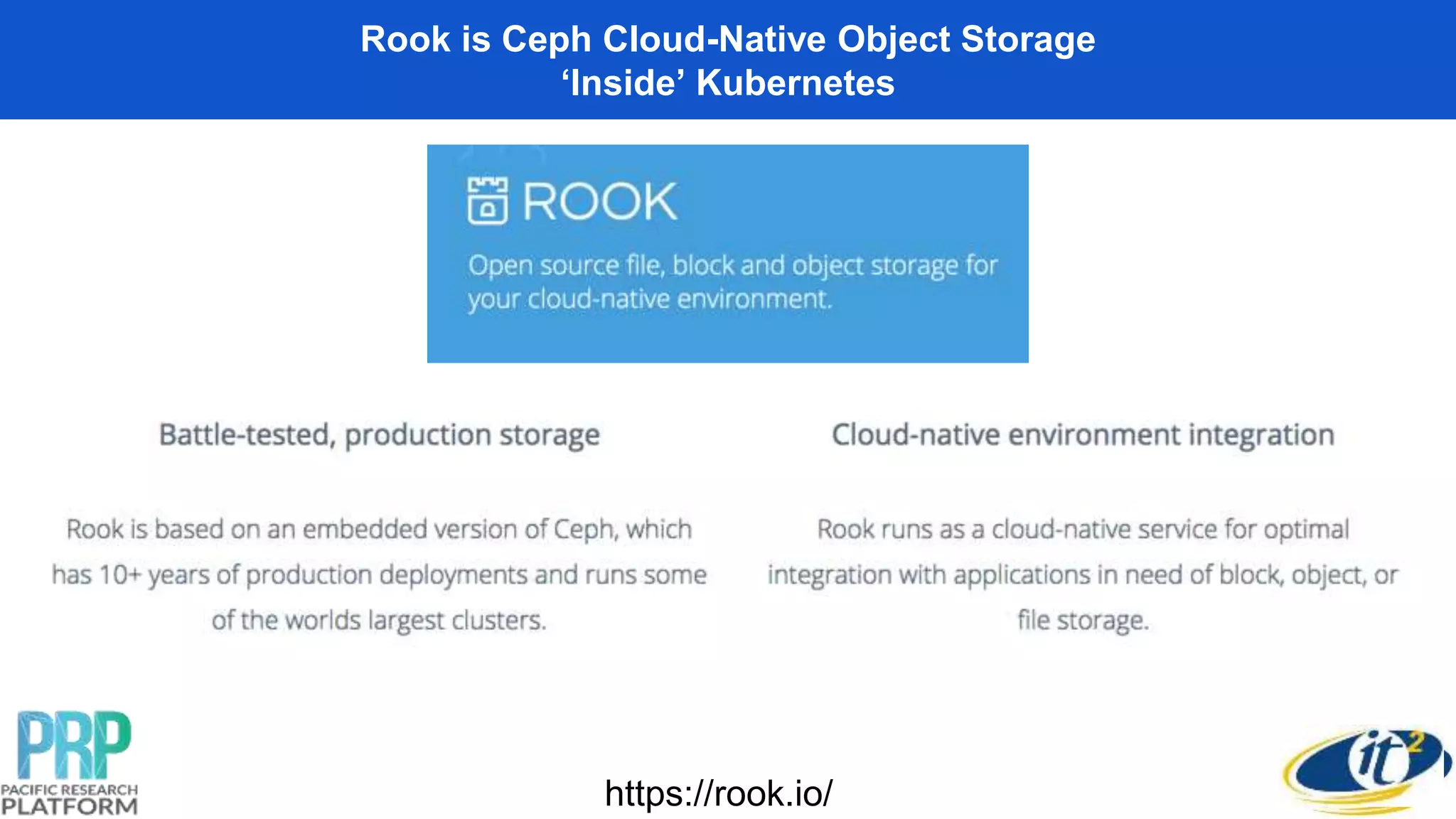
Rook is Ceph Cloud-Native Object Storage
‘Inside’ Kubernetes
https://rook.io/
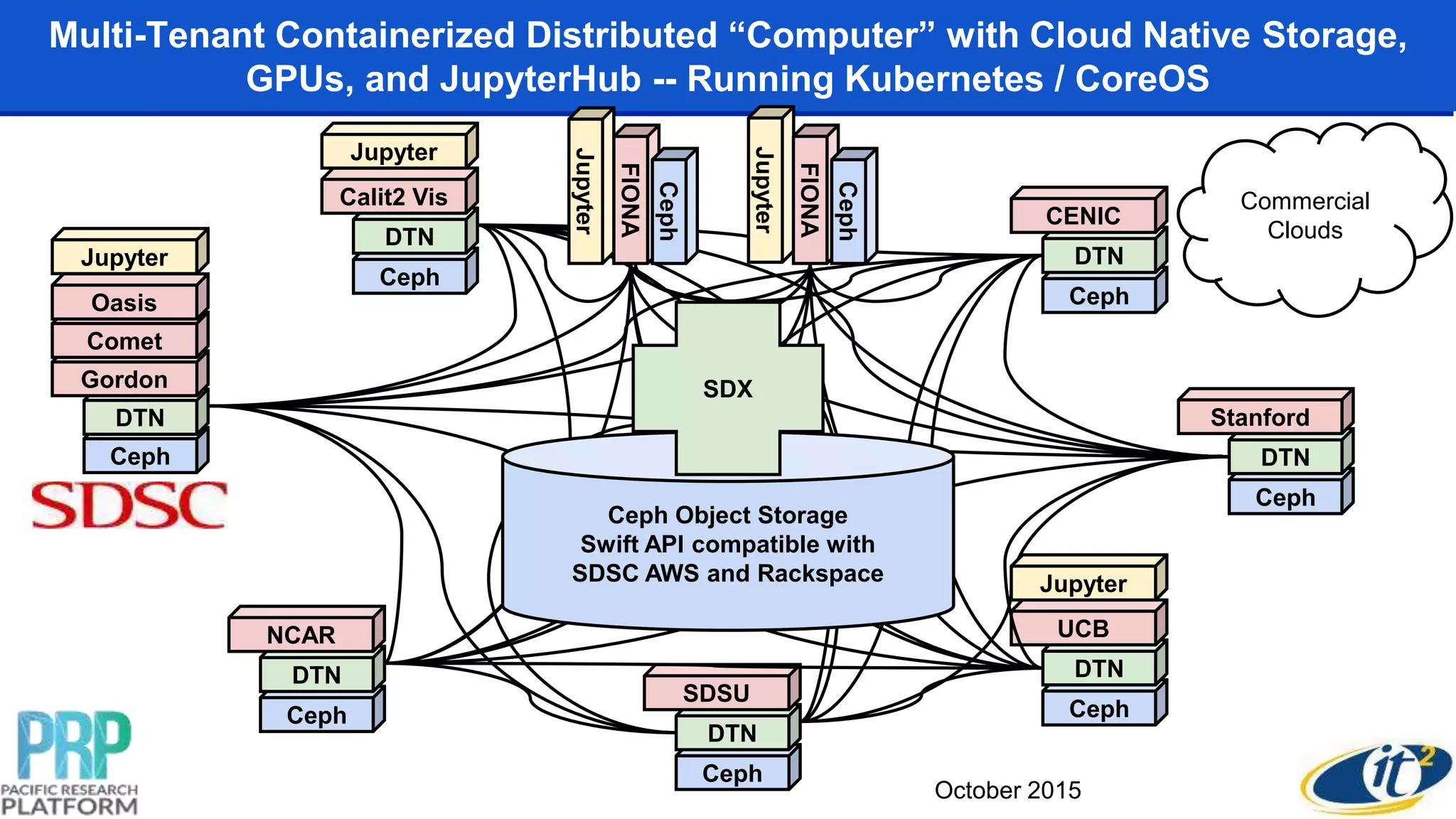
Multi-Tenant Containerized Distributed “Computer” with Cloud Native Storage,
GPUs, and JupyterHub -- Running Kubernetes / CoreOS
Ceph
DTN
Calit2 Vis
Ceph
DTN
CENIC
Ceph
DTN
SDSU
Ceph
DTN
NCAR
Ceph
DTN
Stanford
Ceph
DTN
Gordon
Comet
Oasis
Ceph
DTN
UCB
Ceph Object Storage
Swift API compatible with
SDSC AWS and Rackspace
SDX
Jupyter
Jupyter
Jupyter
FIONA
Ceph
Jupyter
FIONA
Ceph
Commercial
Clouds
Jupyter
October 2015
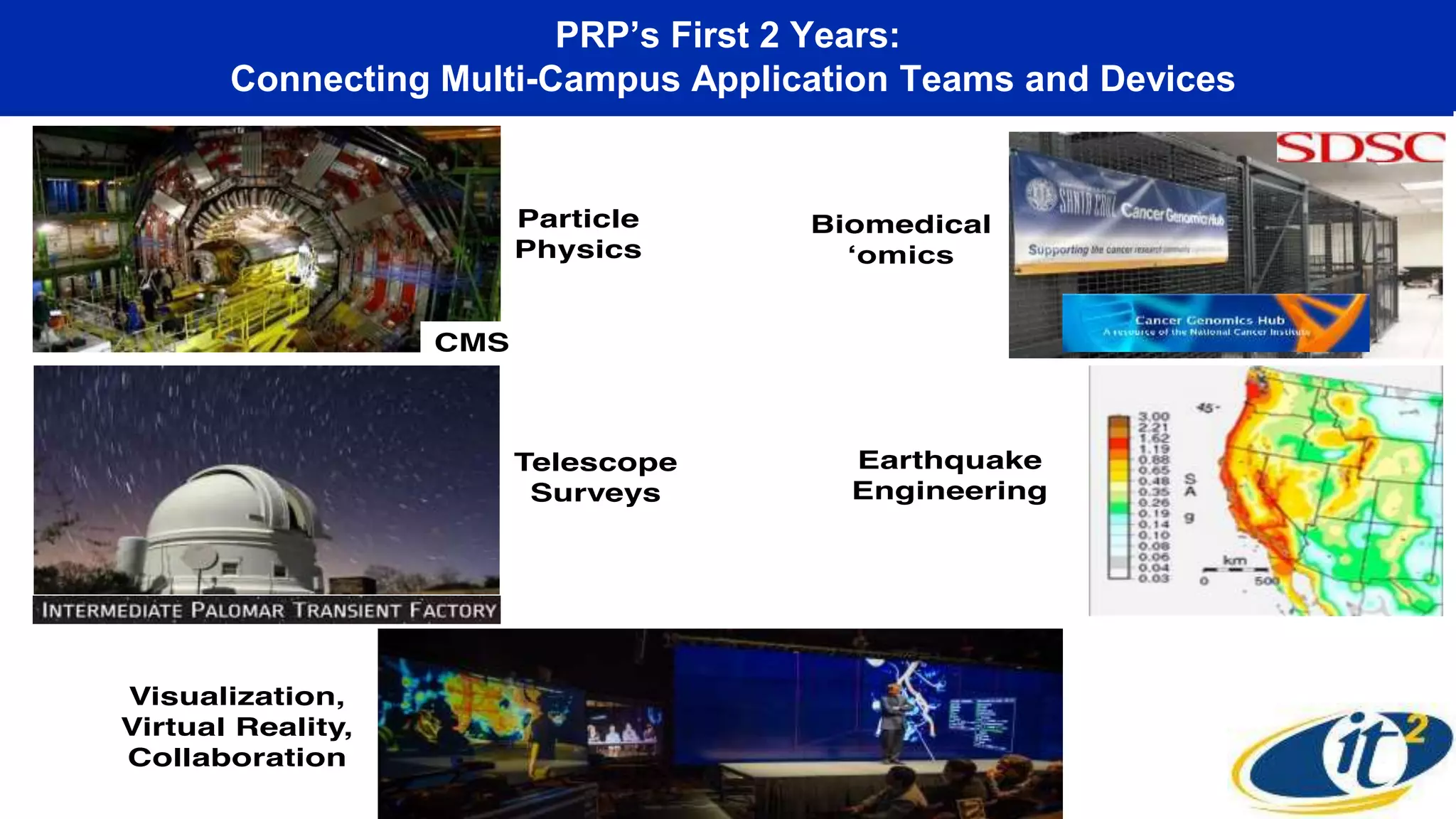
PRP’s First 2 Years:
Connecting Multi-Campus Application Teams and Devices
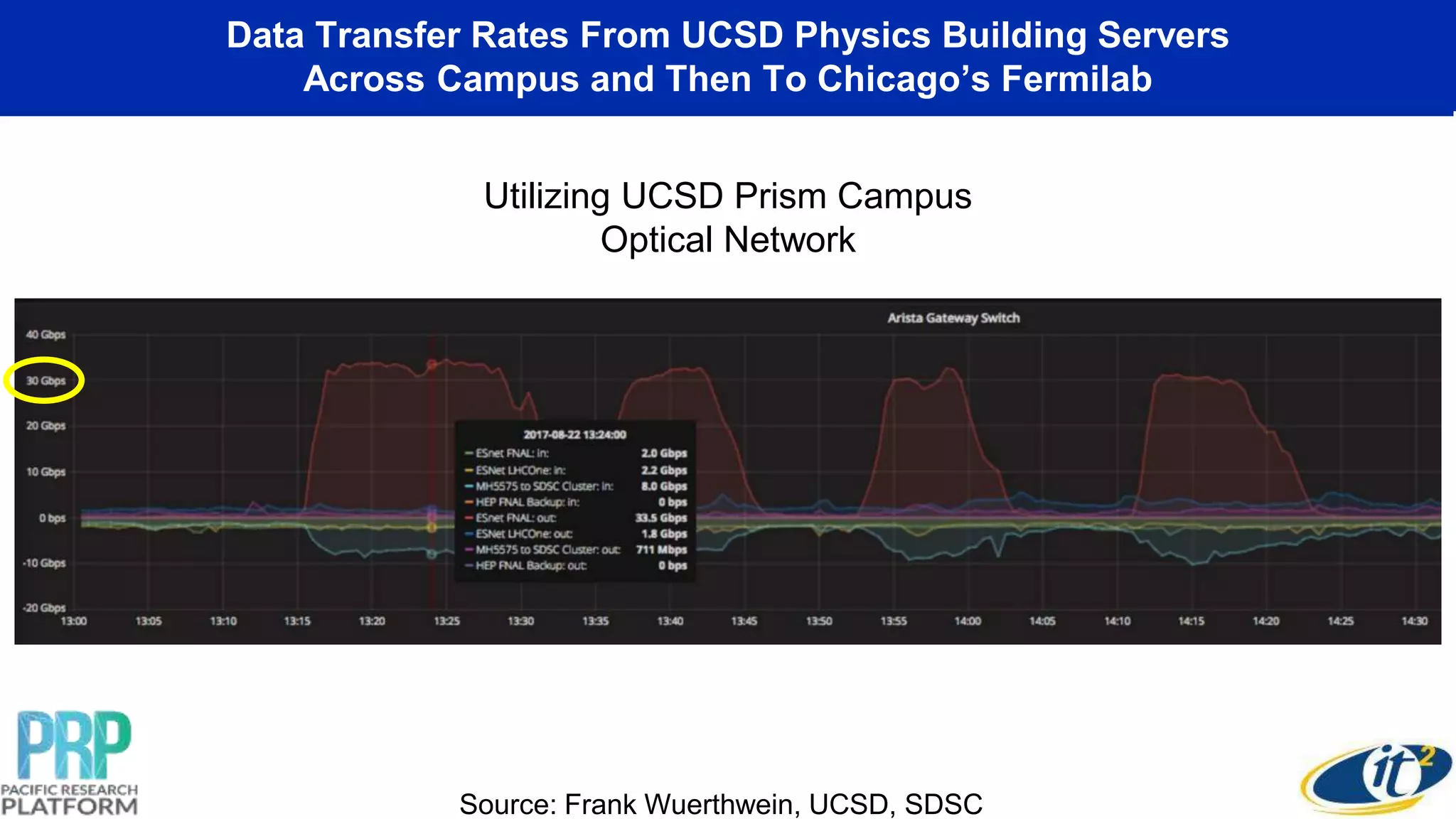
Data Transfer Rates From UCSD Physics Building Servers
Across Campus and Then To Chicago’s Fermilab
Utilizing UCSD Prism Campus
Optical Network
Source: Frank Wuerthwein, UCSD, SDSC
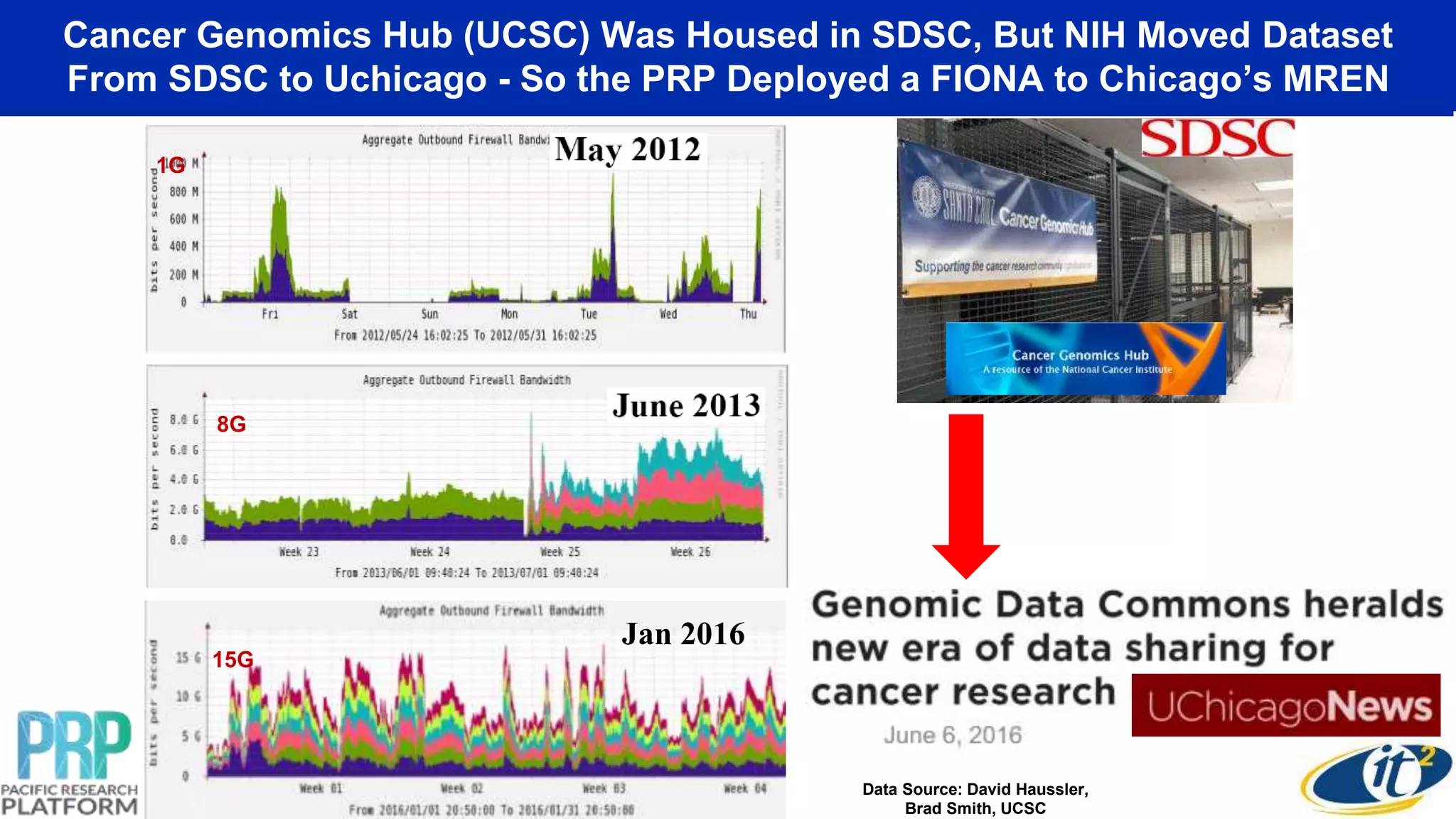
Cancer Genomics Hub (UCSC) Was Housed in SDSC, But NIH Moved Dataset
From SDSC to Uchicago - So the PRP Deployed a FIONA to Chicago’s MREN
1G
8G
Data Source: David Haussler,
Brad Smith, UCSC
15G
Jan 2016
40G FIONAs
20x40G PRP-connected
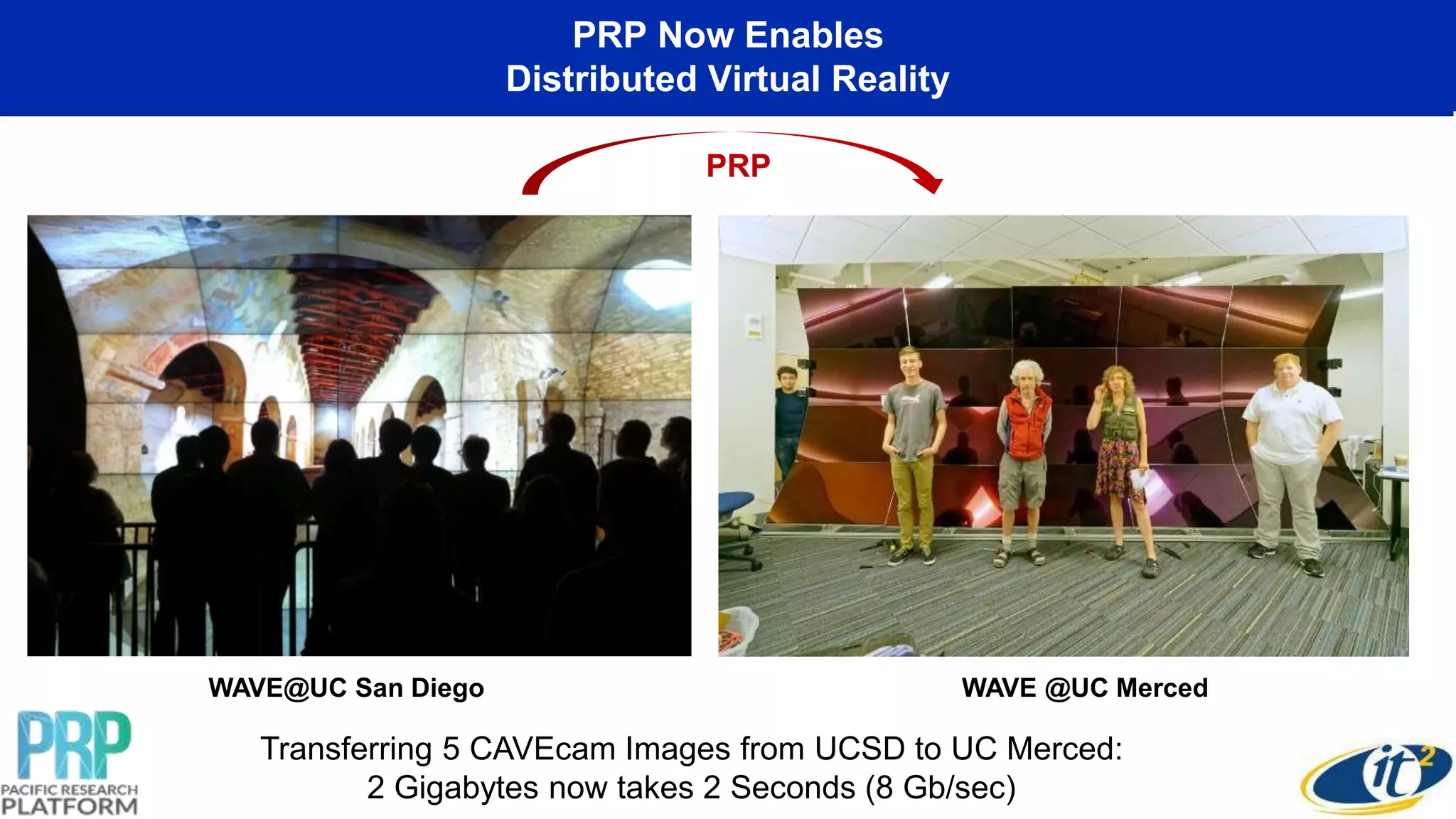
WAVE@UC San Diego
PRP Now Enables
Distributed Virtual Reality
PRP
WAVE @UC Merced
Transferring 5 CAVEcam Images from UCSD to UC Merced:
2 Gigabytes now takes 2 Seconds (8 Gb/sec)
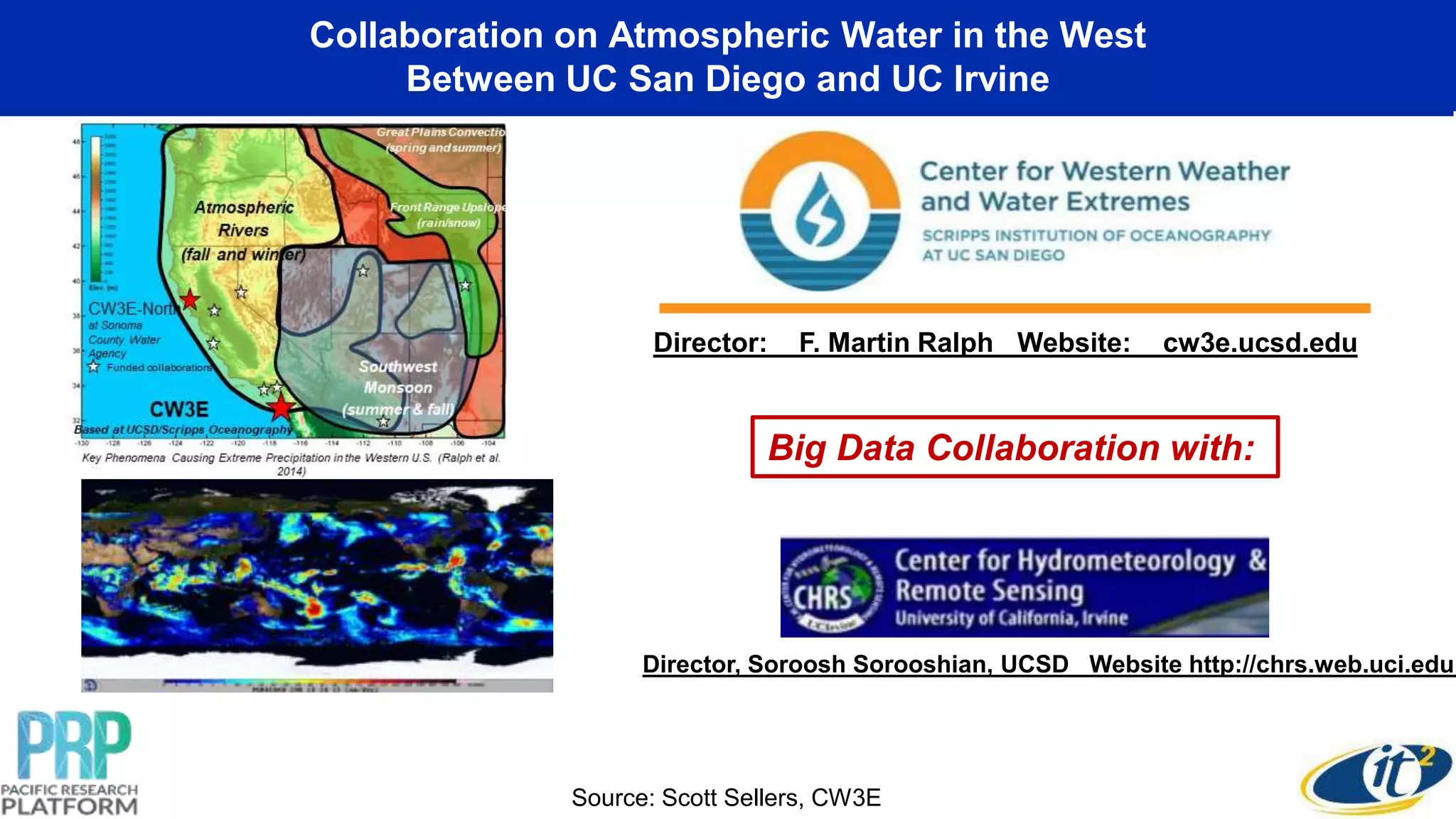
Director: F. Martin Ralph Website: cw3e.ucsd.edu
Big Data Collaboration with:
Source: Scott Sellers, CW3E
Collaboration on Atmospheric Water in the West
Between UC San Diego and UC Irvine
Director, Soroosh Sorooshian, UCSD Website http://chrs.web.uci.edu
Calit2’s FIONA
SDSC’s COMET
Calit2’s FIONA
Pacific Research Platform (10-100 Gb/s)
GPUsGPUs
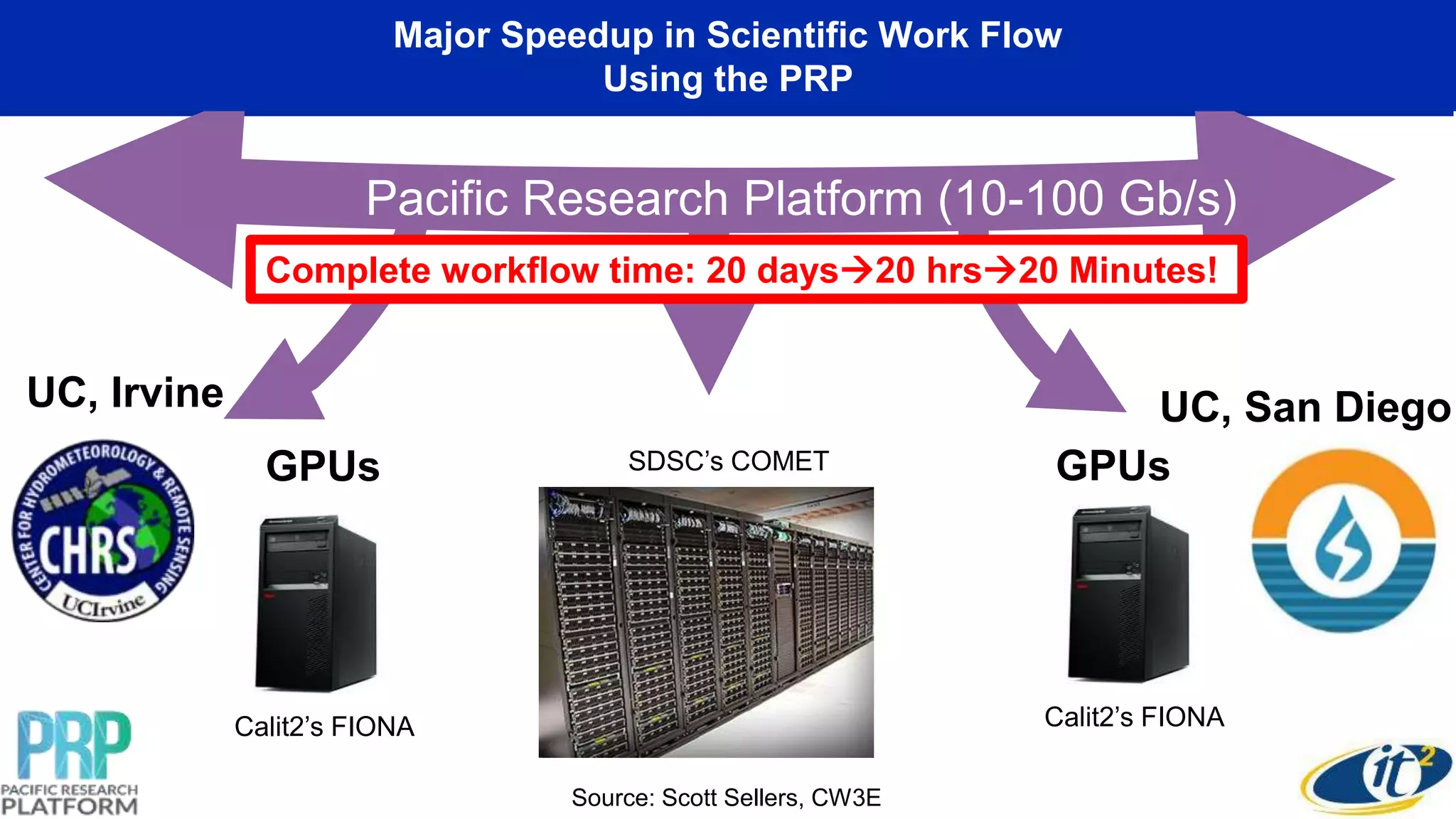
Complete workflow time: 20 days20 hrs20 Minutes!
UC, Irvine UC, San Diego
Major Speedup in Scientific Work Flow
Using the PRP
Source: Scott Sellers, CW3E
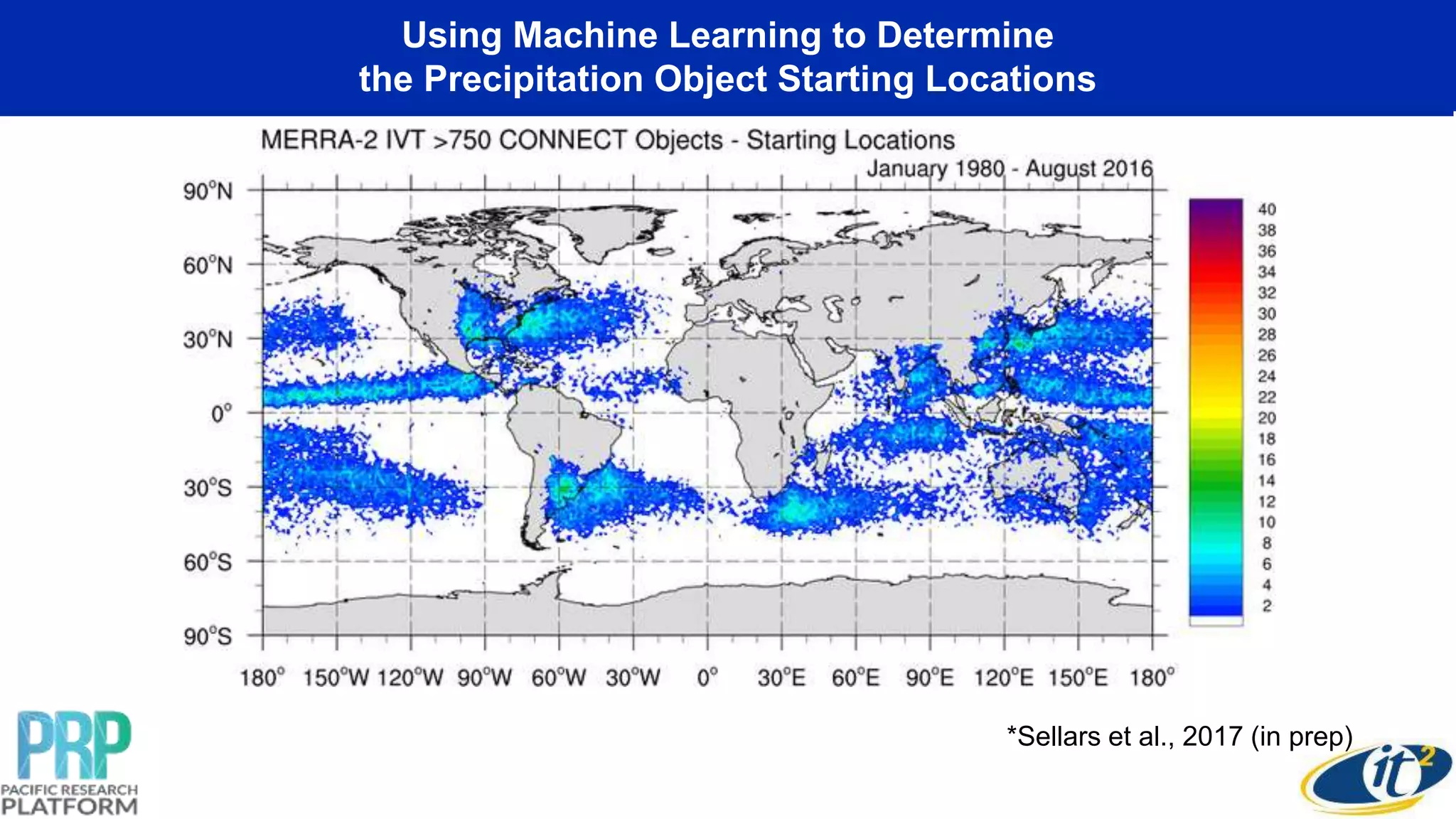
Using Machine Learning to Determine
the Precipitation Object Starting Locations
*Sellars et al., 2017 (in prep)
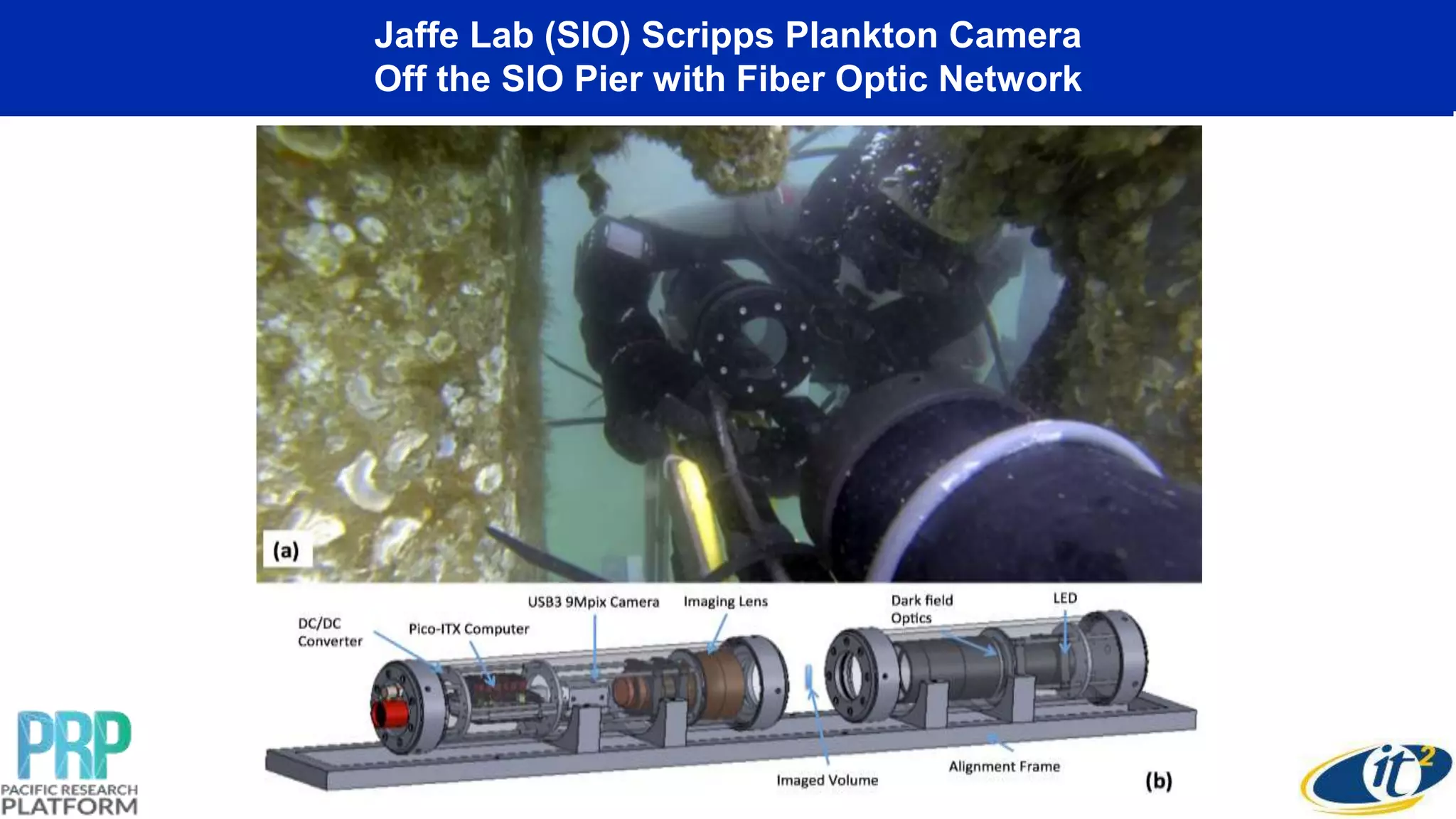
Jaffe Lab (SIO) Scripps Plankton Camera
Off the SIO Pier with Fiber Optic Network
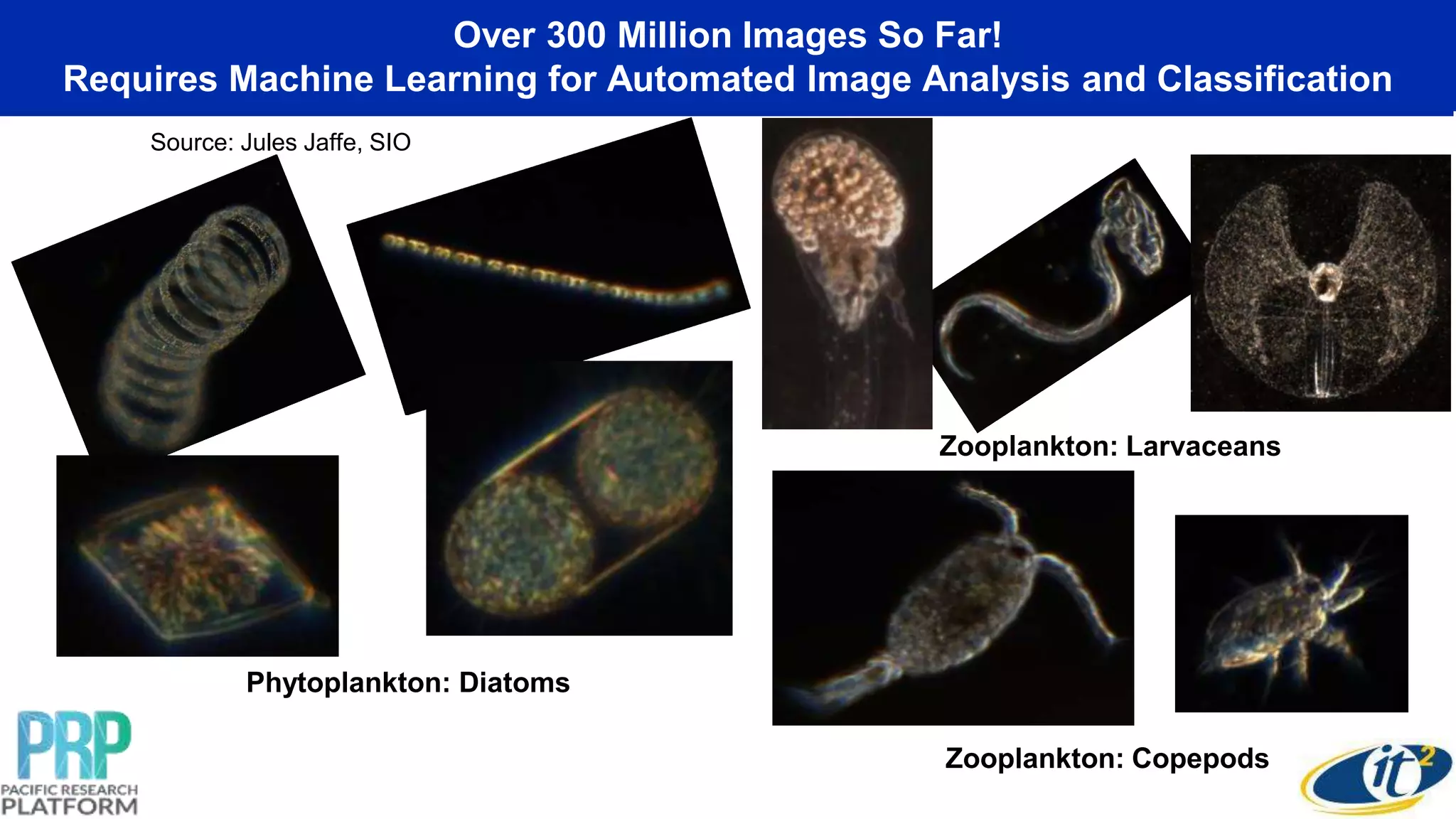
Over 300 Million Images So Far!
Requires Machine Learning for Automated Image Analysis and Classification
Phytoplankton: Diatoms
Zooplankton: Copepods
Zooplankton: Larvaceans
Source: Jules Jaffe, SIO
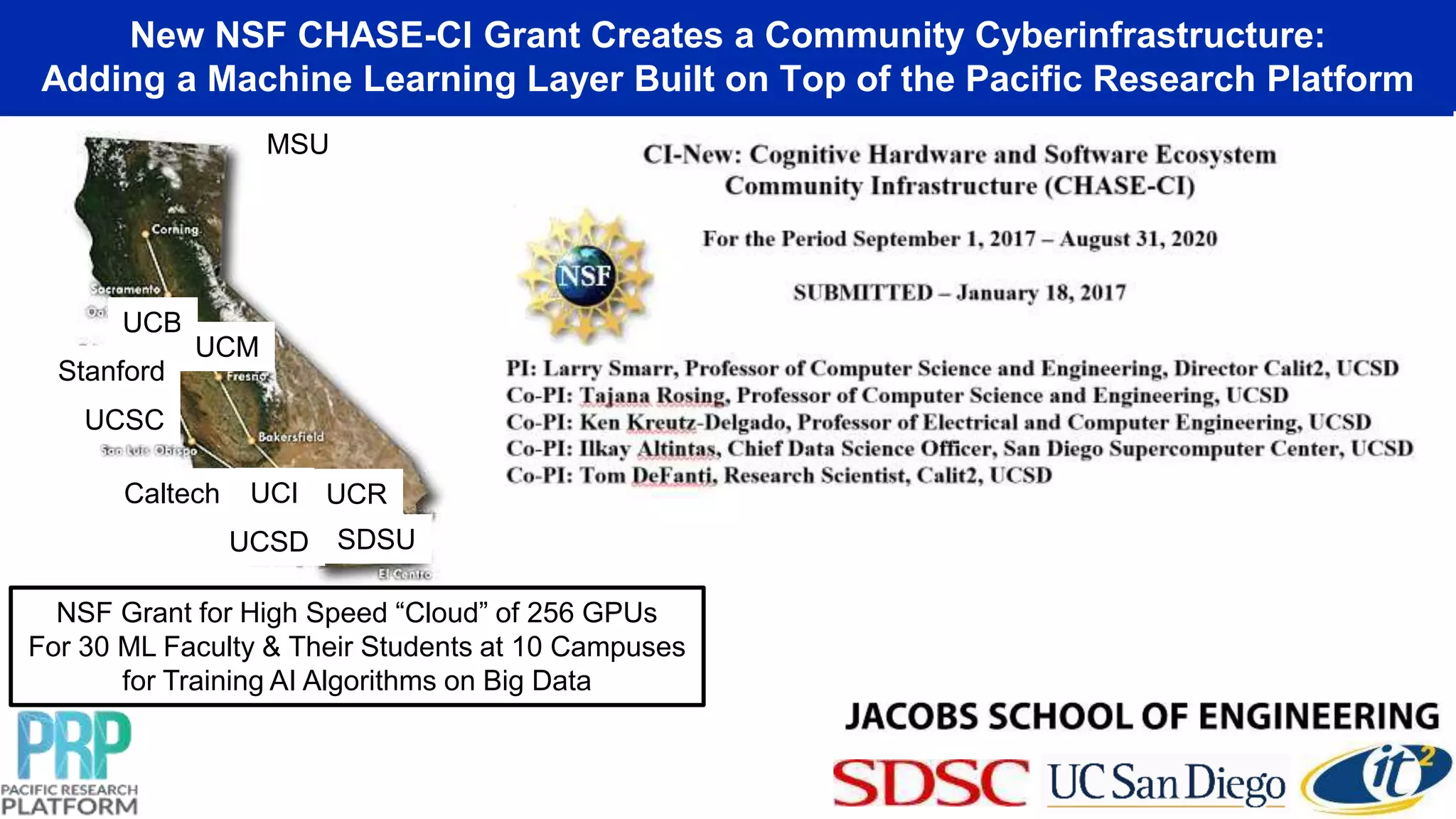
New NSF CHASE-CI Grant Creates a Community Cyberinfrastructure:
Adding a Machine Learning Layer Built on Top of the Pacific Research Platform
Caltech
UCB
UCI UCR
UCSD
UCSC
Stanford
MSU
UCM
SDSU
NSF Grant for High Speed “Cloud” of 256 GPUs
For 30 ML Faculty & Their Students at 10 Campuses
for Training AI Algorithms on Big Data
Machine Learning Researchers
Need a New Cyberinfrastructure
“Until cloud providers are willing to find a solution
to place commodity (32-bit) game GPUs into their servers
and price services accordingly,
I think we will not be able to leverage the cloud effectively.”
“There is an actual scientific infrastructure need here,
surprisingly unmet by the commercial market,
and perhaps CHASE-CI is the perfect catalyst to break this logjam.”
--UC Berkeley Professor Trevor Darrell
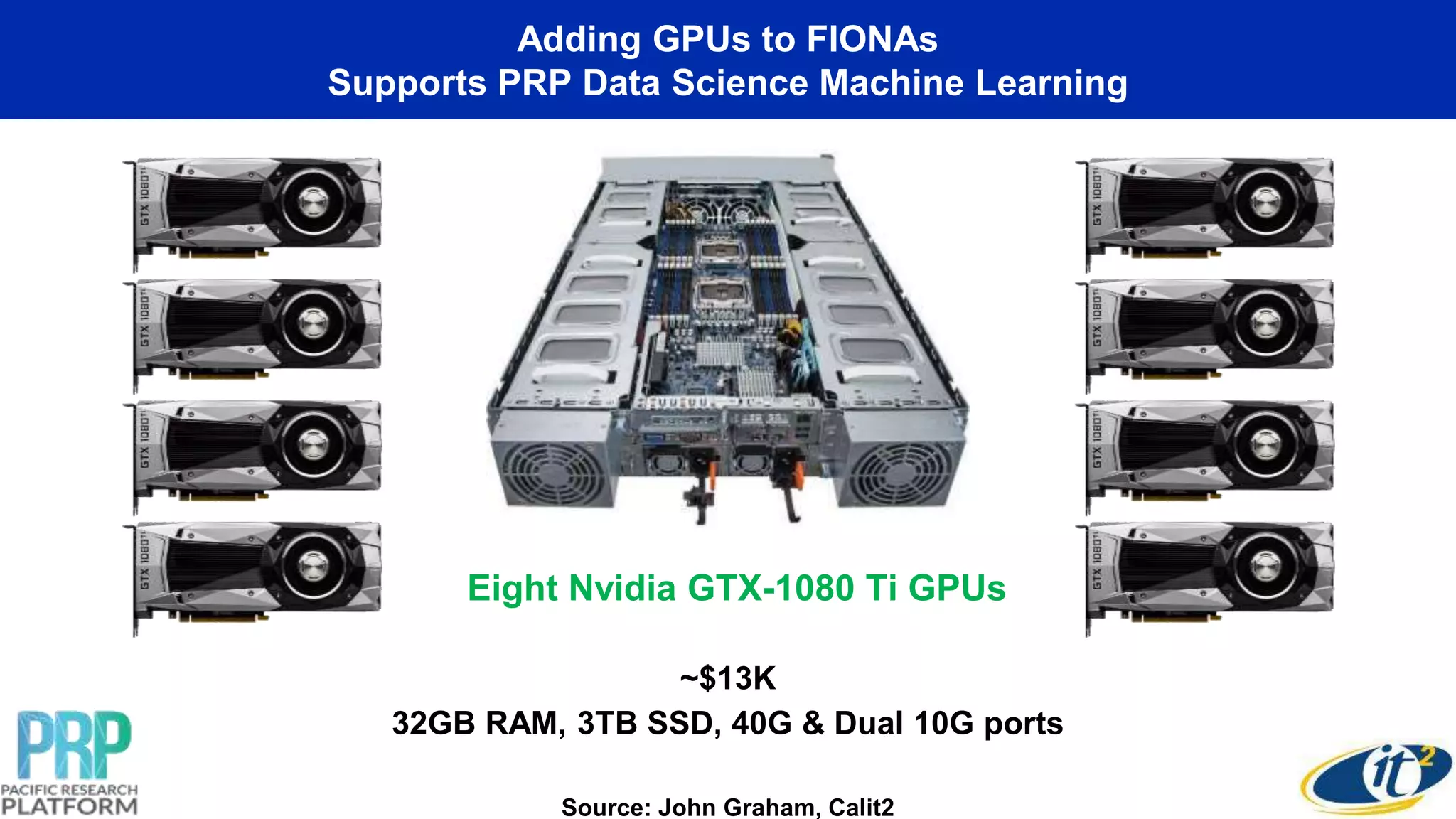
Adding GPUs to FIONAs
Supports PRP Data Science Machine Learning
Eight Nvidia GTX-1080 Ti GPUs
~$13K
32GB RAM, 3TB SSD, 40G & Dual 10G ports
Source: John Graham, Calit2
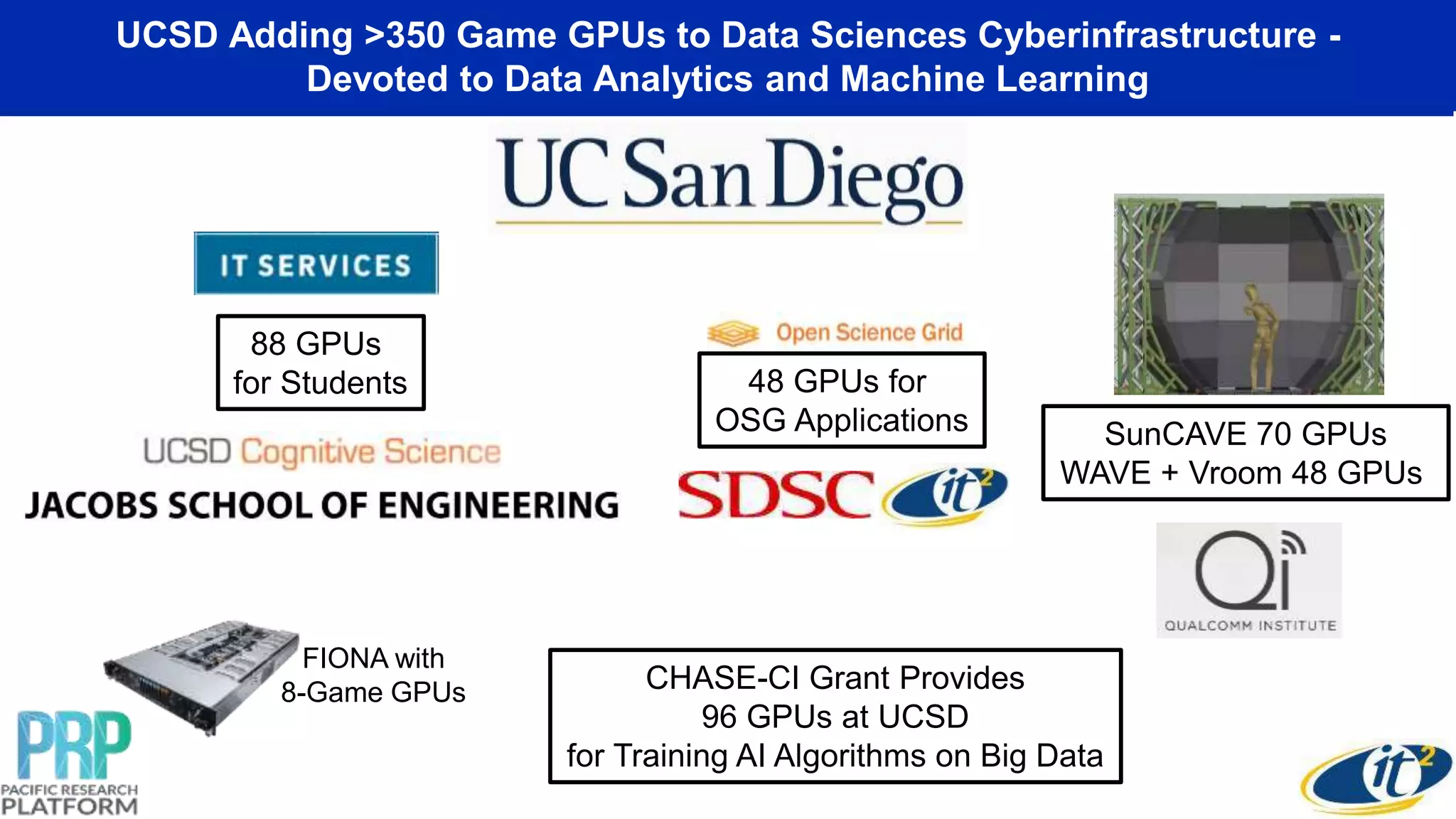
48 GPUs for
OSG Applications
UCSD Adding >350 Game GPUs to Data Sciences Cyberinfrastructure -
Devoted to Data Analytics and Machine Learning
SunCAVE 70 GPUs
WAVE + Vroom 48 GPUs
FIONA with
8-Game GPUs
88 GPUs
for Students
CHASE-CI Grant Provides
96 GPUs at UCSD
for Training AI Algorithms on Big Data
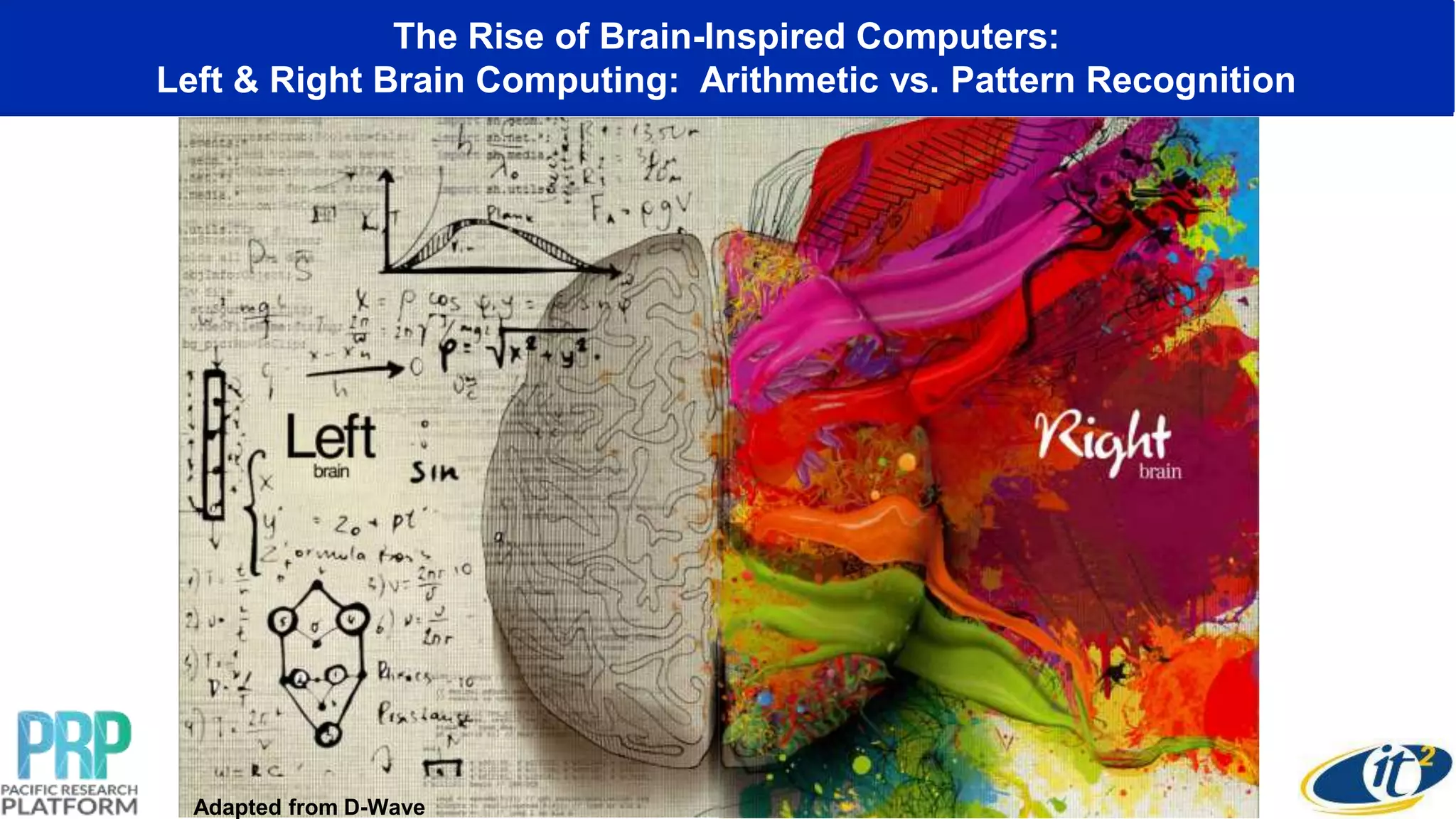
The Rise of Brain-Inspired Computers:
Left & Right Brain Computing: Arithmetic vs. Pattern Recognition
Adapted from D-Wave
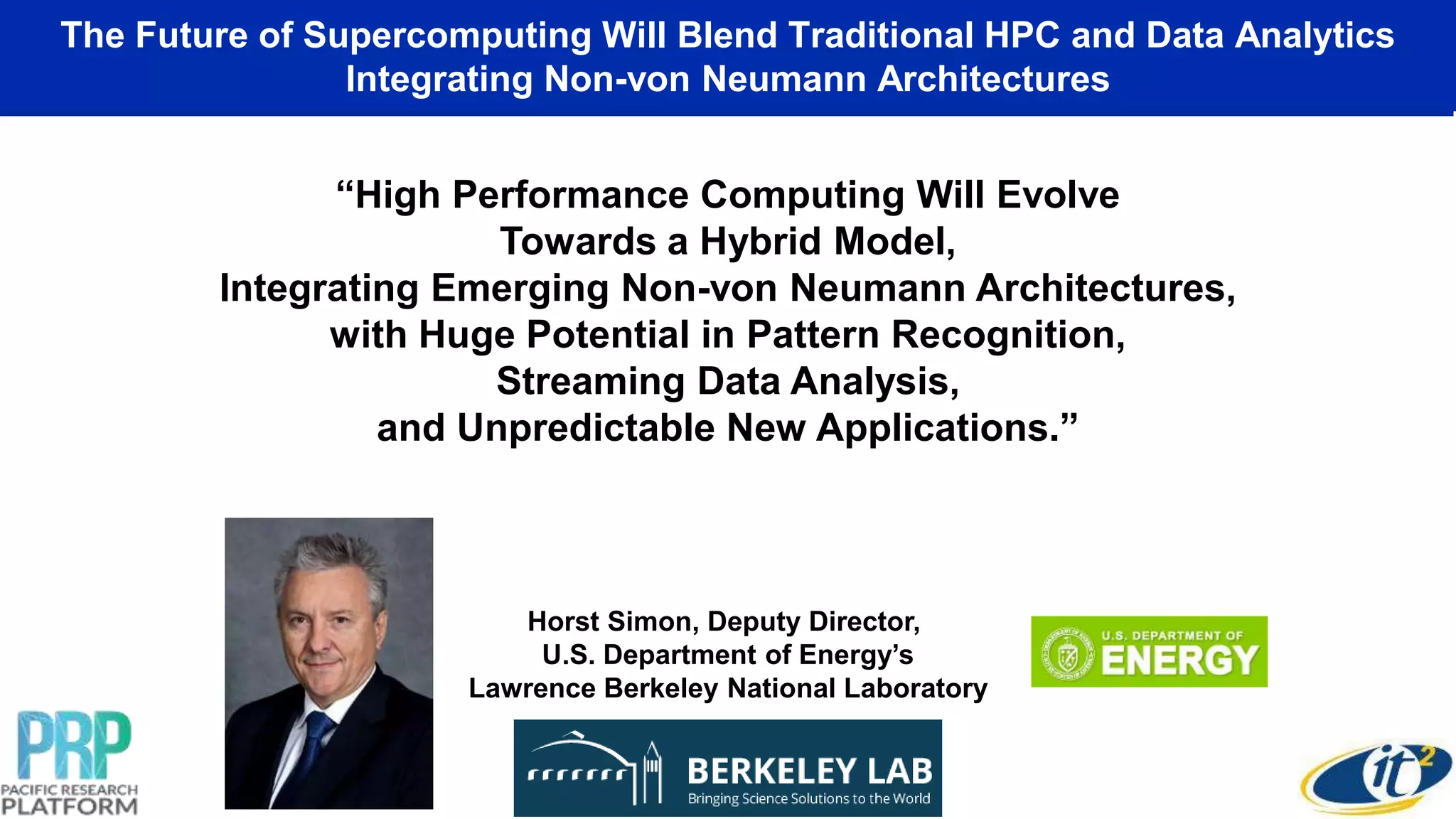
The Future of Supercomputing Will Blend Traditional HPC and Data Analytics
Integrating Non-von Neumann Architectures
“High Performance Computing Will Evolve
Towards a Hybrid Model,
Integrating Emerging Non-von Neumann Architectures,
with Huge Potential in Pattern Recognition,
Streaming Data Analysis,
and Unpredictable New Applications.”
Horst Simon, Deputy Director,
U.S. Department of Energy’s
Lawrence Berkeley National Laboratory
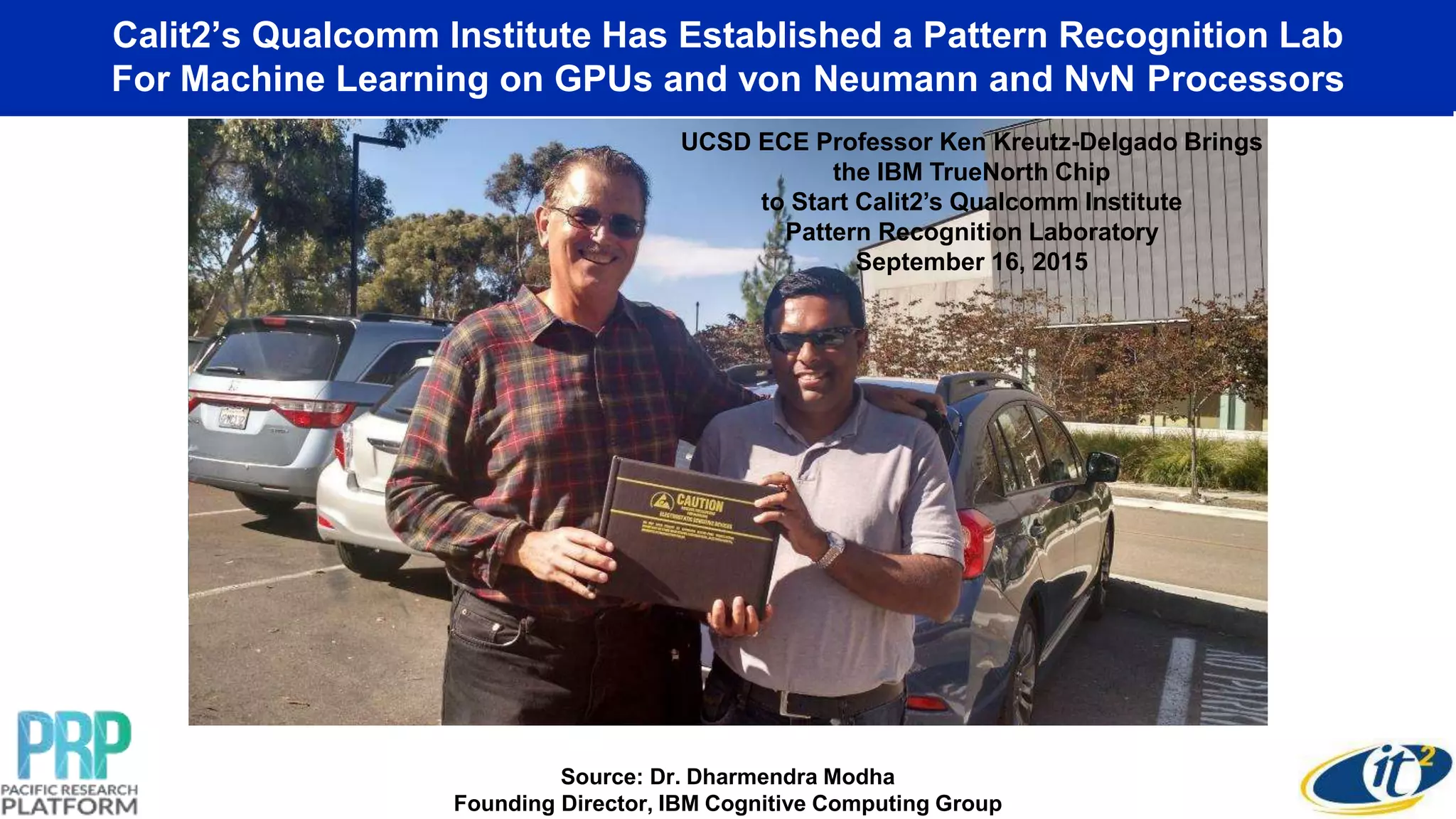
Calit2’s Qualcomm Institute Has Established a Pattern Recognition Lab
For Machine Learning on GPUs and von Neumann and NvN Processors
Source: Dr. Dharmendra Modha
Founding Director, IBM Cognitive Computing Group
August 8, 2014
UCSD ECE Professor Ken Kreutz-Delgado Brings
the IBM TrueNorth Chip
to Start Calit2’s Qualcomm Institute
Pattern Recognition Laboratory
September 16, 2015
Our Pattern Recognition Lab is Exploring Mapping
Machine Learning Algorithm Families Onto Novel Architectures
Qualcomm
Institute
• Deep & Recurrent Neural Networks (DNN, RNN)
• Graph Theoretic
• Reinforcement Learning (RL)
• Clustering and other neighborhood-based
• Support Vector Machine (SVM)
• Sparse Signal Processing and Source Localization
• Dimensionality Reduction & Manifold Learning
• Latent Variable Analysis (PCA, ICA)
• Stochastic Sampling, Variational Approximation
• Decision Tree Learning
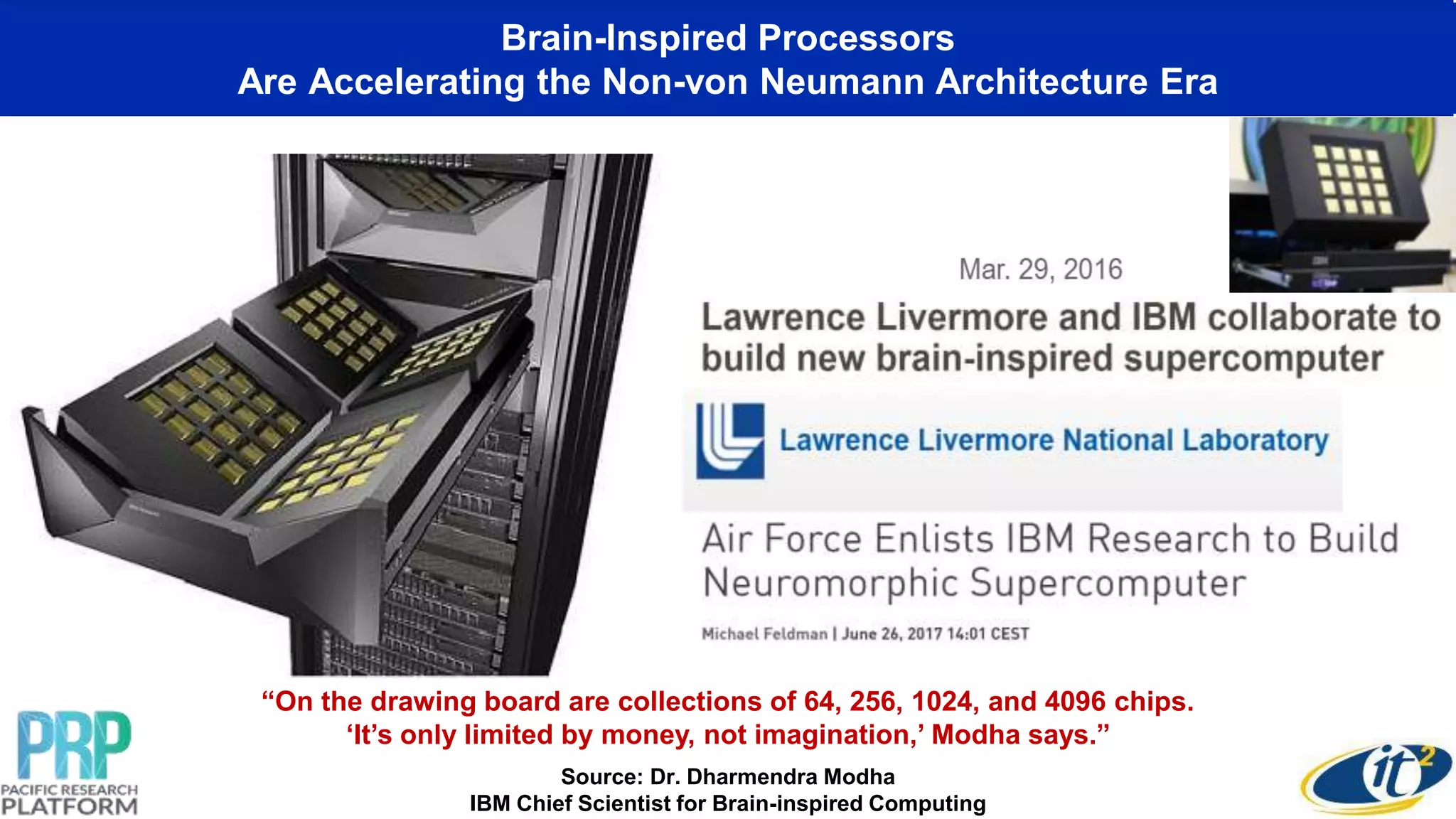
Brain-Inspired Processors
Are Accelerating the Non-von Neumann Architecture Era
“On the drawing board are collections of 64, 256, 1024, and 4096 chips.
‘It’s only limited by money, not imagination,’ Modha says.”
Source: Dr. Dharmendra Modha
IBM Chief Scientist for Brain-inspired Computing
August 8, 2014
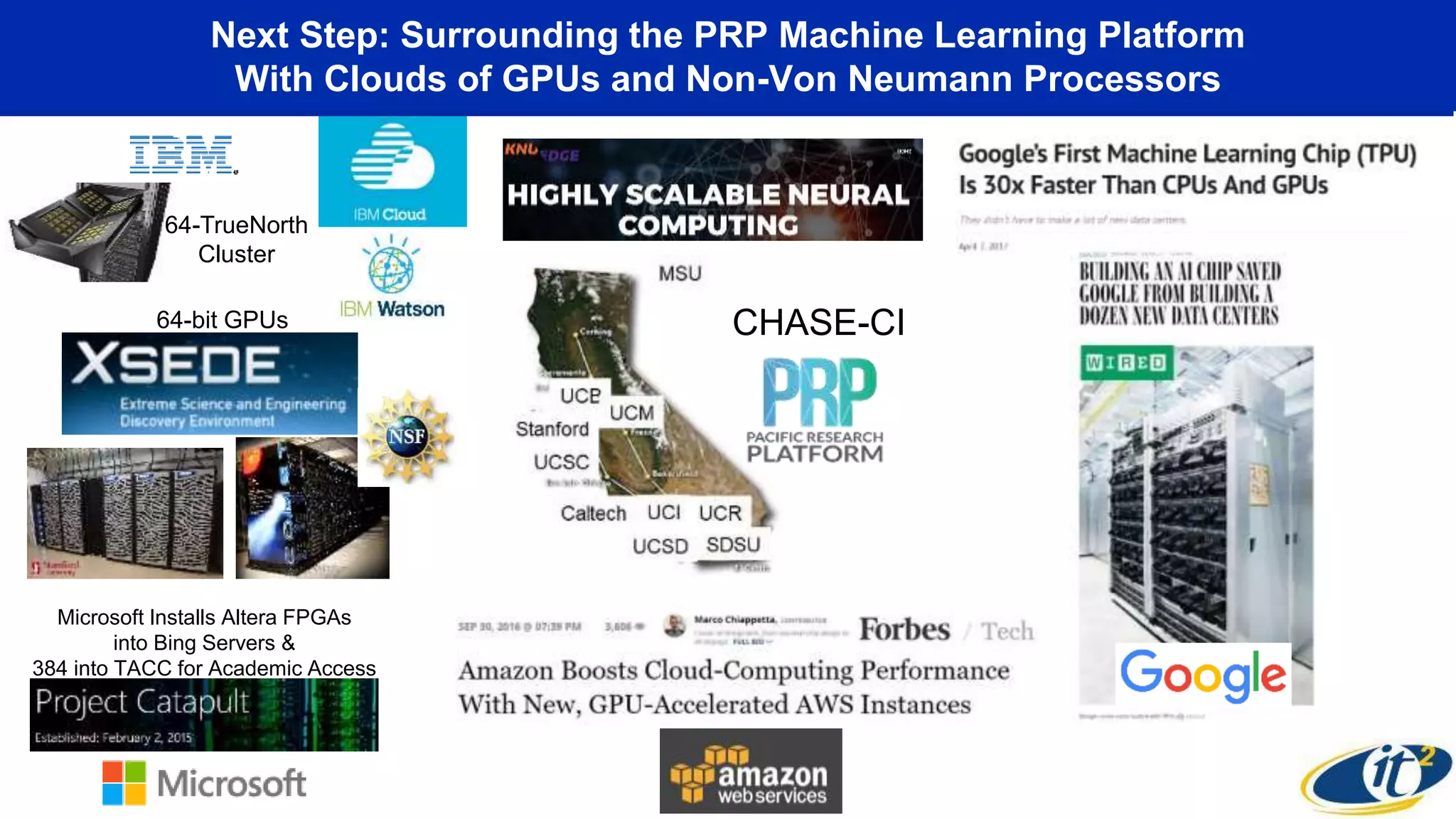
Next Step: Surrounding the PRP Machine Learning Platform
With Clouds of GPUs and Non-Von Neumann Processors
Microsoft Installs Altera FPGAs
into Bing Servers &
384 into TACC for Academic Access
CHASE-CI
64-TrueNorth
Cluster
64-bit GPUs
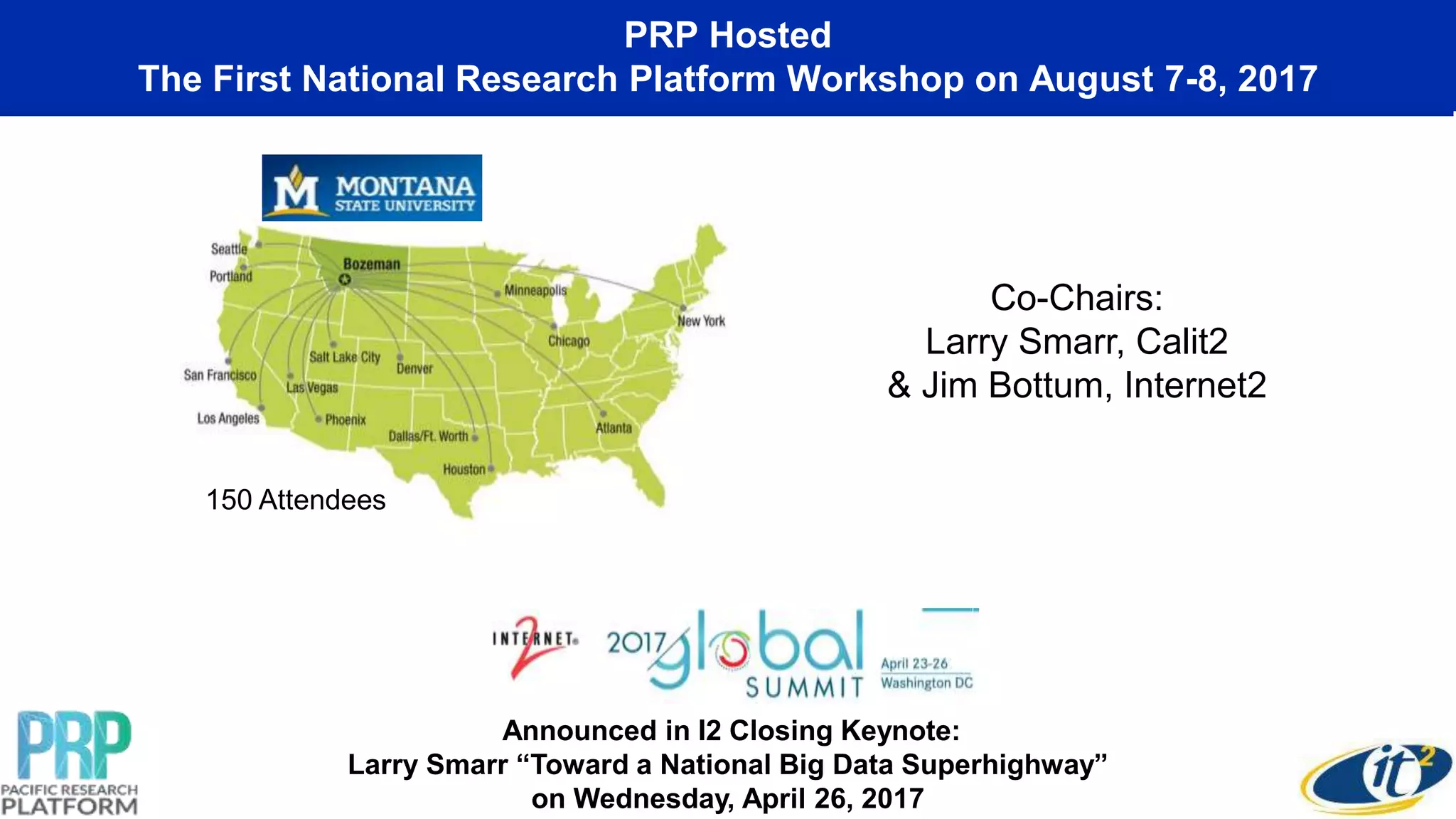
PRP Hosted
The First National Research Platform Workshop on August 7-8, 2017
Announced in I2 Closing Keynote:
Larry Smarr “Toward a National Big Data Superhighway”
on Wednesday, April 26, 2017
Co-Chairs:
Larry Smarr, Calit2
& Jim Bottum, Internet2
150 Attendees
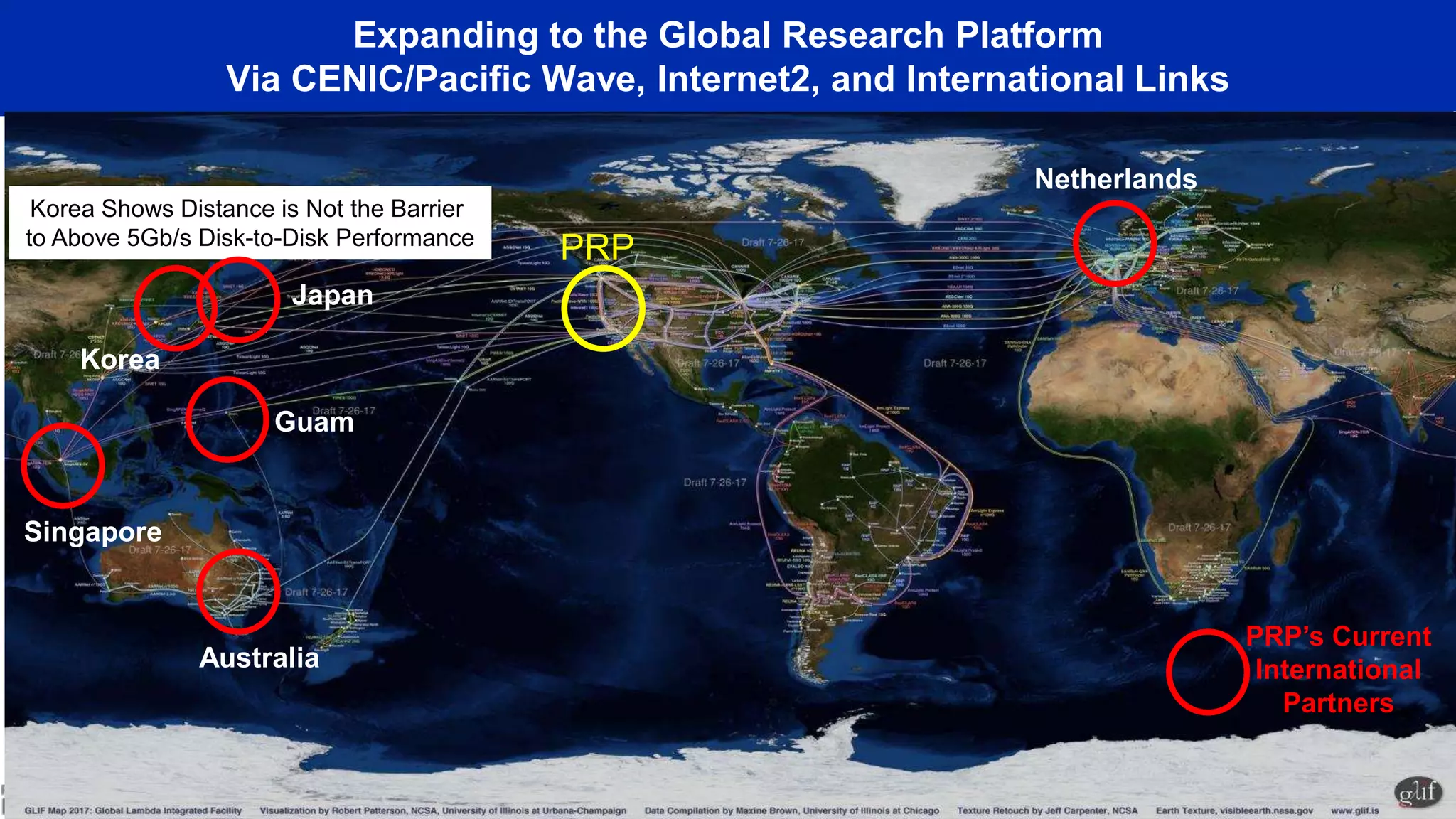
Expanding to the Global Research Platform
Via CENIC/Pacific Wave, Internet2, and International Links
PRP
PRP’s Current
International
Partners
Korea Shows Distance is Not the Barrier
to Above 5Gb/s Disk-to-Disk Performance
Netherlands
Guam
Australia
Korea
Japan
Singapore
Now That We Have a Tightly-Coupled,
Yet Highly Distributed “Computer” for Big Data Analysis
There Are So Many Open Research Questions.
How To:
• Encourage Application Teams to Adopt It?
• Strengthen Cybersecurity
• Tightly Integrate Cloud Providers
• Scale Both Technically and Socially?
• Plus Many More…
Our Support:
• US National Science Foundation (NSF) awards
 CNS 0821155, CNS-1338192, CNS-1456638, CNS-1730158,
ACI-1540112, & ACI-1541349
• University of California Office of the President CIO
• UCSD Chancellor’s Integrated Digital Infrastructure Program
• UCSD Next Generation Networking initiative
• Calit2 and Calit2 Qualcomm Institute
• CENIC, PacificWave and StarLight
• DOE ESnet

Toward a Global Research Platform for Big Data Analysis

  • 1.
    “Toward a GlobalResearch Platform for Big Data Analysis” Keynote Presentation: Hawaii International Conference on System Sciences - 51 (HICSS-51) Hilton Waikoloa Village Big Island, HI January 5, 2018 Dr. Larry Smarr Director, California Institute for Telecommunications and Information Technology Harry E. Gruber Professor, Dept. of Computer Science and Engineering Jacobs School of Engineering, UCSD http://lsmarr.calit2.net 1
  • 2.
    Abstract In every fieldwe see an exponential rise of Big Data, which in turn is demanding new technological solutions in visualization, machine learning, and high performance cyberinfrastructure. I will describe how my NSF-funded Pacific Research Platform (PRP), which provides an Internet platform with 100-1000 times the bandwidth of today’s commodity Internet to all the research universities on the West Coast, is being designed from the Big Data application needs of multi- institutional research teams from particle physics to climate to human health. NSF is also funding a Cognitive Hardware and Software Ecosystem Community Infrastructure (CHASE-CI) to be built on top of the PRP, adding GPU and non-von Neumann machine learning capabilities to enable distributed Big Data Analytics. The next stage, well underway, is understanding how to scale this prototype cyberinfrastructure to a National and Global Research Platform.
  • 3.
    The 30-Year Questto Create a Tightly-Coupled, Yet Highly Distributed “Computer” for Big Data Analysis
  • 4.
    30 Years Ago-NSFCreated a Weakly-Coupled National “MetaComputer” NCSA NSFNET 56 Kb/s Backbone (1986-8) PSCNCAR CTC JVNC SDSC NSFnet Adopted ARPAnet Protocols
  • 5.
    NSF’s PACI Programwas Built on the vBNS to Prototype America’s 21st Century Information Infrastructure The PACI Grid Testbed National Computational Science 1997 vBNS led to
  • 6.
    Vision: Use Optical Fiberto Connect Big Data Generators and Consumers, Creating a Big Data Tightly-Coupled Distributed “Computer” “The Bisection Bandwidth of a Cluster Interconnect, but Deployed on a 20-Campus Scale.” This Vision Has Been Building for 15 Years
  • 7.
    NSF’s OptIPuter Project:Proving Wide-Area-Networks Could Be as Fast as Cluster Backplanes for Data-Intensive Researchers Campus Optical Switch Data Repositories & Clusters HPC HD/4k Video Images HD/4k Video Cams End User OptIPortal 10G Lightpaths HD/4k Telepresence Instruments LS 2009 Slide 2003-2009 $13,500,000 PI Larry Smarr
  • 8.
    So Why Don’tWe Have a National Big Data Cyberinfrastructure by Now? “High-speed data lines crossing the nation are the equivalent of six-lane superhighways, Bement said. But networks at colleges and universities are not so capable.” “Those massive conduits are reduced to two-lane roads at most college and university campuses,” Improving cyberinfrastructure, he said, “will transform the capabilities of campus-based scientists.” -- Arden Bement, director of the National Science Foundation May 2005
  • 9.
    Based on CommunityInput and on ESnet’s Science DMZ Concept, NSF Has Funded Over 100 Campuses to Build Local Big Data Freeways Red 2012 CC-NIE Awardees Yellow 2013 CC-NIE Awardees Green 2014 CC*IIE Awardees Blue 2015 CC*DNI Awardees Purple Multiple Time Awardees Source: NSF
  • 10.
    Creating a “BigData” Freeway on Campus: NSF-Funded CC-NIE Grants Prism@UCSD and CHeruB Prism@UCSD, Phil Papadopoulos, SDSC, Calit2, PI (2013-15) CHERuB, Mike Norman, SDSC PI CHERuB
  • 11.
    Terminating the FiberOptics - Data Transfer Nodes (DTNs): Flash I/O Network Appliances (FIONAs) UCSD Designed FIONAs To Solve the Disk-to-Disk Data Transfer Problem For Big Data at Full Speed on 10G, 40G and 100G Networks FIONAS—10/40G, $8,000 FIONette—1G, $1,000 Phil Papadopoulos, SDSC & Tom DeFanti, Joe Keefe & John Graham, Calit2 John Graham, Calit2
  • 12.
    How UCSD DMZNetwork Transforms Big Data Microbiome Science: Preparing for Knight/Smarr 1 Million Core-Hour Analysis Knight Lab FIONA 10Gbps Gordon Prism@UCSD Data Oasis 7.5PB, 200GB/s Knight 1024 Cluster In SDSC Co-Lo CHERuB 100Gbps Emperor & Other Vis Tools 64Mpixel Data Analysis Wall 120Gbps 40Gbps 1.3Tbps
  • 13.
    (GDC) Logical Next Step:The Pacific Research Platform Creates a Regional End-to-End Science-Driven “Big Data Superhighway” System NSF CC*DNI Grant $5M 10/2015-10/2020 PI: Larry Smarr, UC San Diego; Calit2 Co-PIs: • Camille Crittenden, UC Berkeley CITRIS, • Tom DeFanti, UC San Diego Calit2, • Philip Papadopoulos, UCSD SDSC, • Frank Wuerthwein, UCSD Physics and SDSC Letters of Commitment from: • 50 Researchers from 15 Campuses • 32 IT/Network Organization Leaders
  • 14.
    We Measure Disk-to-DiskThroughput with 10GB File Transfer 4 Times Per Day in Both Directions for All PRP Sites January 29, 2016 From Start of Monitoring 12 DTNs to 24 DTNs Connected at 10-40G in 1 ½ Years July 21, 2017 Source: John Graham, Calit2
  • 15.
    Jupyter Has Become theDigital Fabric for Data Sciences http://jupyter.org/
  • 16.
    PRP UC-JupyterHub BackboneConnects FIONAs At UC Berkeley and UC San Diego Source: John Graham, Calit2 Goal: Jupyter Everywhere
  • 17.
    We Aggressively UseKubernetes to Manage Containers Across the PRP “Kubernetes is a way of stitching together a collection of machines into, basically, a big computer,” --Craig Mcluckie, Google. "Everything at Google runs in a container," --Joe Beda,Google
  • 18.
    Rook is CephCloud-Native Object Storage ‘Inside’ Kubernetes https://rook.io/
  • 19.
    Multi-Tenant Containerized Distributed“Computer” with Cloud Native Storage, GPUs, and JupyterHub -- Running Kubernetes / CoreOS Ceph DTN Calit2 Vis Ceph DTN CENIC Ceph DTN SDSU Ceph DTN NCAR Ceph DTN Stanford Ceph DTN Gordon Comet Oasis Ceph DTN UCB Ceph Object Storage Swift API compatible with SDSC AWS and Rackspace SDX Jupyter Jupyter Jupyter FIONA Ceph Jupyter FIONA Ceph Commercial Clouds Jupyter October 2015
  • 20.
    PRP’s First 2Years: Connecting Multi-Campus Application Teams and Devices
  • 21.
    Data Transfer RatesFrom UCSD Physics Building Servers Across Campus and Then To Chicago’s Fermilab Utilizing UCSD Prism Campus Optical Network Source: Frank Wuerthwein, UCSD, SDSC
  • 22.
    Cancer Genomics Hub(UCSC) Was Housed in SDSC, But NIH Moved Dataset From SDSC to Uchicago - So the PRP Deployed a FIONA to Chicago’s MREN 1G 8G Data Source: David Haussler, Brad Smith, UCSC 15G Jan 2016
  • 23.
    40G FIONAs 20x40G PRP-connected WAVE@UCSan Diego PRP Now Enables Distributed Virtual Reality PRP WAVE @UC Merced Transferring 5 CAVEcam Images from UCSD to UC Merced: 2 Gigabytes now takes 2 Seconds (8 Gb/sec)
  • 24.
    Director: F. MartinRalph Website: cw3e.ucsd.edu Big Data Collaboration with: Source: Scott Sellers, CW3E Collaboration on Atmospheric Water in the West Between UC San Diego and UC Irvine Director, Soroosh Sorooshian, UCSD Website http://chrs.web.uci.edu
  • 25.
    Calit2’s FIONA SDSC’s COMET Calit2’sFIONA Pacific Research Platform (10-100 Gb/s) GPUsGPUs Complete workflow time: 20 days20 hrs20 Minutes! UC, Irvine UC, San Diego Major Speedup in Scientific Work Flow Using the PRP Source: Scott Sellers, CW3E
  • 26.
    Using Machine Learningto Determine the Precipitation Object Starting Locations *Sellars et al., 2017 (in prep)
  • 27.
    Jaffe Lab (SIO)Scripps Plankton Camera Off the SIO Pier with Fiber Optic Network
  • 28.
    Over 300 MillionImages So Far! Requires Machine Learning for Automated Image Analysis and Classification Phytoplankton: Diatoms Zooplankton: Copepods Zooplankton: Larvaceans Source: Jules Jaffe, SIO
  • 29.
    New NSF CHASE-CIGrant Creates a Community Cyberinfrastructure: Adding a Machine Learning Layer Built on Top of the Pacific Research Platform Caltech UCB UCI UCR UCSD UCSC Stanford MSU UCM SDSU NSF Grant for High Speed “Cloud” of 256 GPUs For 30 ML Faculty & Their Students at 10 Campuses for Training AI Algorithms on Big Data
  • 30.
    Machine Learning Researchers Needa New Cyberinfrastructure “Until cloud providers are willing to find a solution to place commodity (32-bit) game GPUs into their servers and price services accordingly, I think we will not be able to leverage the cloud effectively.” “There is an actual scientific infrastructure need here, surprisingly unmet by the commercial market, and perhaps CHASE-CI is the perfect catalyst to break this logjam.” --UC Berkeley Professor Trevor Darrell
  • 31.
    Adding GPUs toFIONAs Supports PRP Data Science Machine Learning Eight Nvidia GTX-1080 Ti GPUs ~$13K 32GB RAM, 3TB SSD, 40G & Dual 10G ports Source: John Graham, Calit2
  • 32.
    48 GPUs for OSGApplications UCSD Adding >350 Game GPUs to Data Sciences Cyberinfrastructure - Devoted to Data Analytics and Machine Learning SunCAVE 70 GPUs WAVE + Vroom 48 GPUs FIONA with 8-Game GPUs 88 GPUs for Students CHASE-CI Grant Provides 96 GPUs at UCSD for Training AI Algorithms on Big Data
  • 33.
    The Rise ofBrain-Inspired Computers: Left & Right Brain Computing: Arithmetic vs. Pattern Recognition Adapted from D-Wave
  • 34.
    The Future ofSupercomputing Will Blend Traditional HPC and Data Analytics Integrating Non-von Neumann Architectures “High Performance Computing Will Evolve Towards a Hybrid Model, Integrating Emerging Non-von Neumann Architectures, with Huge Potential in Pattern Recognition, Streaming Data Analysis, and Unpredictable New Applications.” Horst Simon, Deputy Director, U.S. Department of Energy’s Lawrence Berkeley National Laboratory
  • 35.
    Calit2’s Qualcomm InstituteHas Established a Pattern Recognition Lab For Machine Learning on GPUs and von Neumann and NvN Processors Source: Dr. Dharmendra Modha Founding Director, IBM Cognitive Computing Group August 8, 2014 UCSD ECE Professor Ken Kreutz-Delgado Brings the IBM TrueNorth Chip to Start Calit2’s Qualcomm Institute Pattern Recognition Laboratory September 16, 2015
  • 36.
    Our Pattern RecognitionLab is Exploring Mapping Machine Learning Algorithm Families Onto Novel Architectures Qualcomm Institute • Deep & Recurrent Neural Networks (DNN, RNN) • Graph Theoretic • Reinforcement Learning (RL) • Clustering and other neighborhood-based • Support Vector Machine (SVM) • Sparse Signal Processing and Source Localization • Dimensionality Reduction & Manifold Learning • Latent Variable Analysis (PCA, ICA) • Stochastic Sampling, Variational Approximation • Decision Tree Learning
  • 37.
    Brain-Inspired Processors Are Acceleratingthe Non-von Neumann Architecture Era “On the drawing board are collections of 64, 256, 1024, and 4096 chips. ‘It’s only limited by money, not imagination,’ Modha says.” Source: Dr. Dharmendra Modha IBM Chief Scientist for Brain-inspired Computing August 8, 2014
  • 38.
    Next Step: Surroundingthe PRP Machine Learning Platform With Clouds of GPUs and Non-Von Neumann Processors Microsoft Installs Altera FPGAs into Bing Servers & 384 into TACC for Academic Access CHASE-CI 64-TrueNorth Cluster 64-bit GPUs
  • 39.
    PRP Hosted The FirstNational Research Platform Workshop on August 7-8, 2017 Announced in I2 Closing Keynote: Larry Smarr “Toward a National Big Data Superhighway” on Wednesday, April 26, 2017 Co-Chairs: Larry Smarr, Calit2 & Jim Bottum, Internet2 150 Attendees
  • 40.
    Expanding to theGlobal Research Platform Via CENIC/Pacific Wave, Internet2, and International Links PRP PRP’s Current International Partners Korea Shows Distance is Not the Barrier to Above 5Gb/s Disk-to-Disk Performance Netherlands Guam Australia Korea Japan Singapore
  • 41.
    Now That WeHave a Tightly-Coupled, Yet Highly Distributed “Computer” for Big Data Analysis There Are So Many Open Research Questions. How To: • Encourage Application Teams to Adopt It? • Strengthen Cybersecurity • Tightly Integrate Cloud Providers • Scale Both Technically and Socially? • Plus Many More…
  • 42.
    Our Support: • USNational Science Foundation (NSF) awards  CNS 0821155, CNS-1338192, CNS-1456638, CNS-1730158, ACI-1540112, & ACI-1541349 • University of California Office of the President CIO • UCSD Chancellor’s Integrated Digital Infrastructure Program • UCSD Next Generation Networking initiative • Calit2 and Calit2 Qualcomm Institute • CENIC, PacificWave and StarLight • DOE ESnet