Tourist Behaviour
© Aditya Ranjan
© Aditya Ranjan
UNIT 4 : TOURISM DEMAND AND MARKET
This unit covers :
1. Global pattern of tourism demand
2. Nature of demand in different segments of
tourism market
3. Consumer behaviour and markets in
different sectors of tourism
© Aditya Ranjan
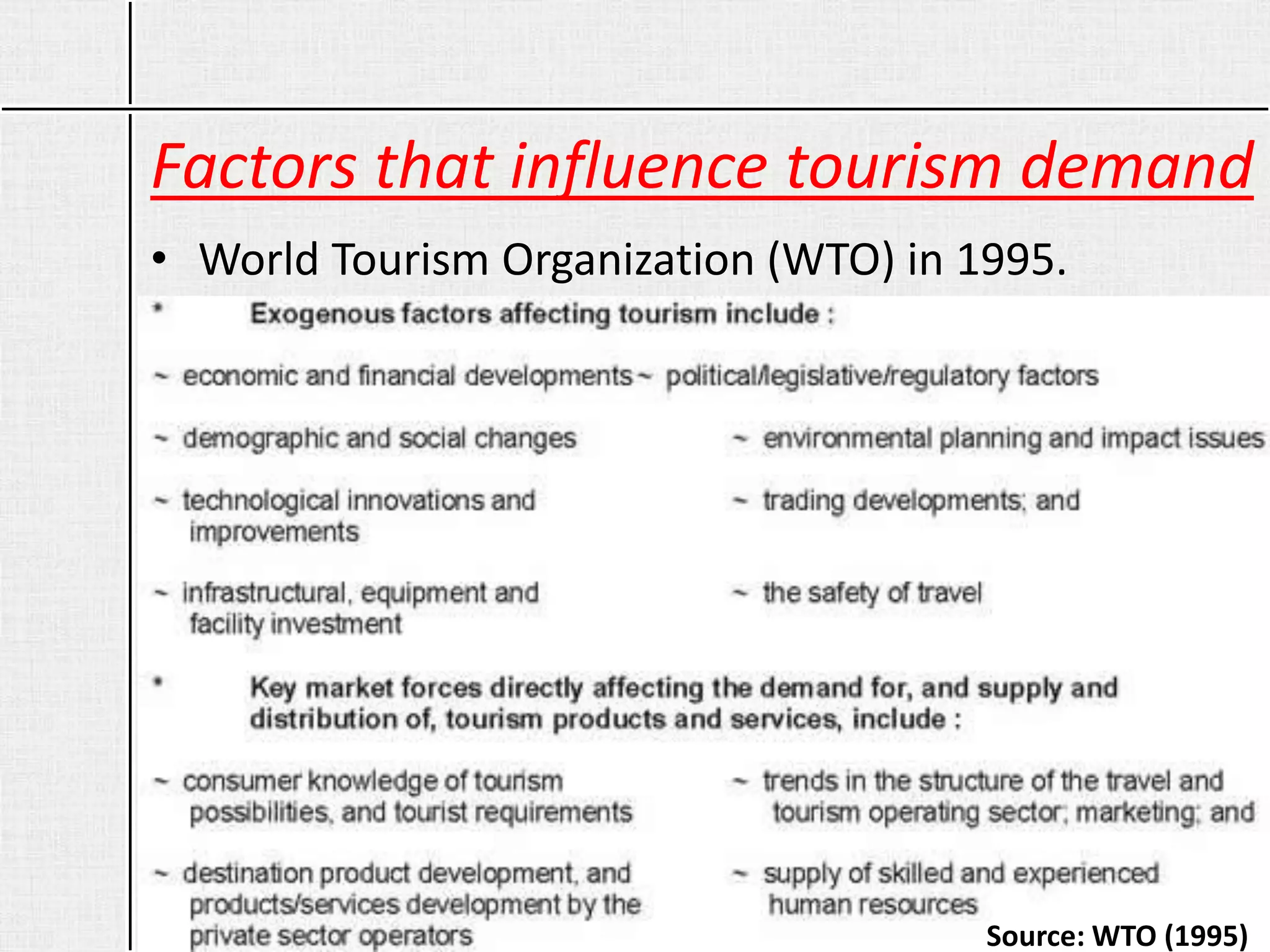
Factors that influence tourism demand
• World Tourism Organization (WTO) in 1995.
© Aditya Ranjan
Source: WTO (1995)
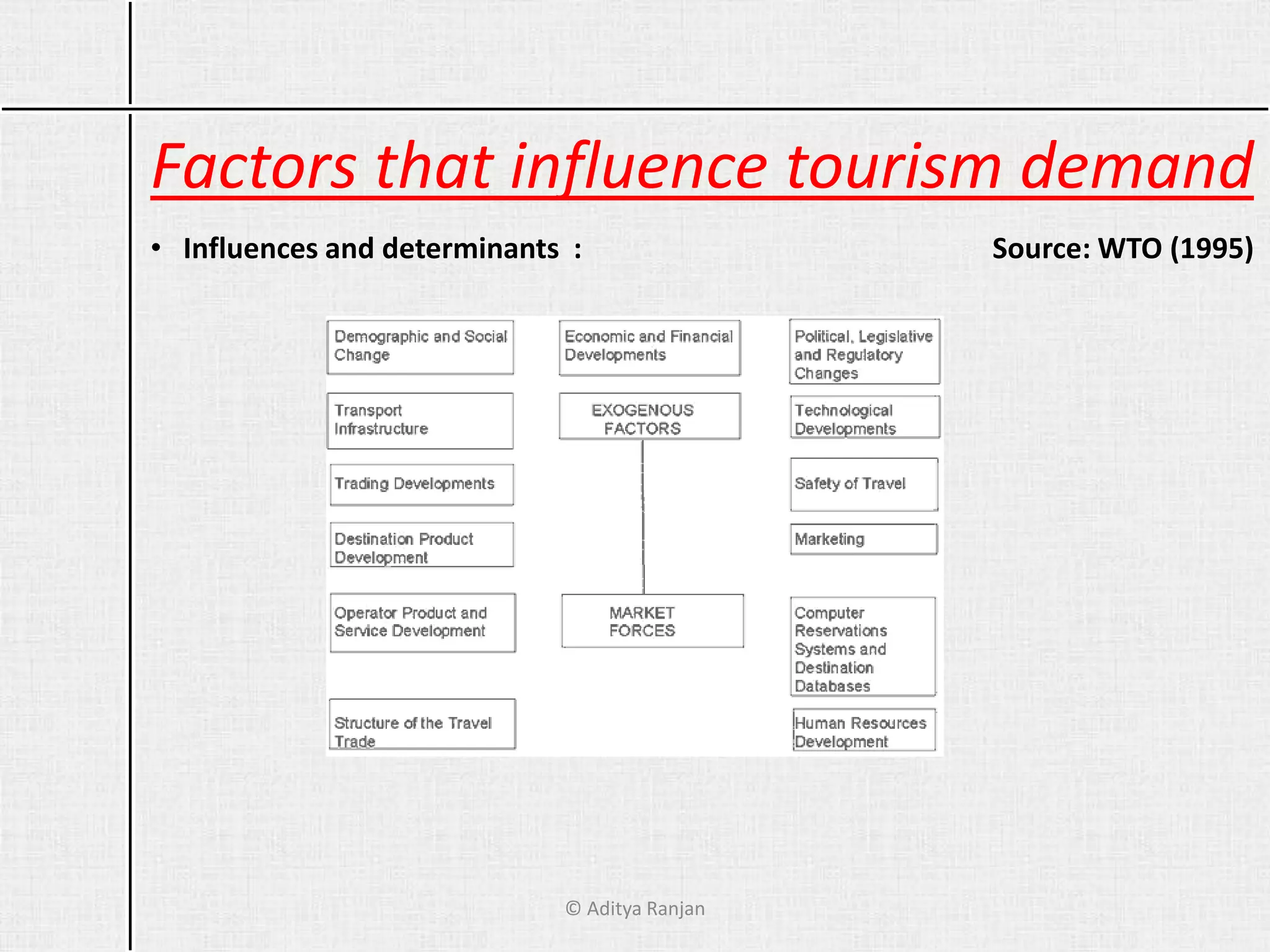
Factors that influence tourism demand
© Aditya Ranjan
• Influences and determinants : Source: WTO (1995)
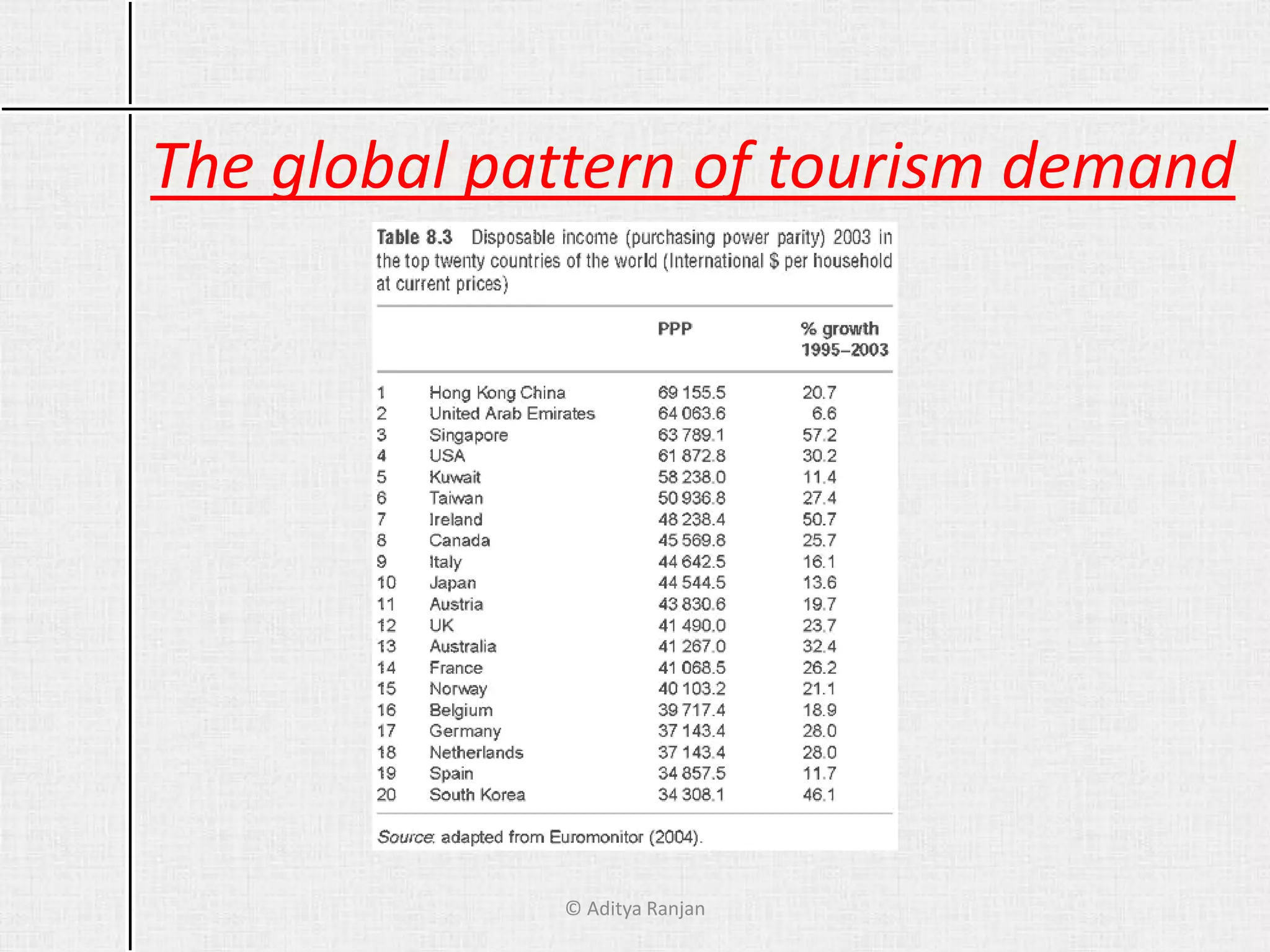
The global pattern of tourism demand
© Aditya Ranjan
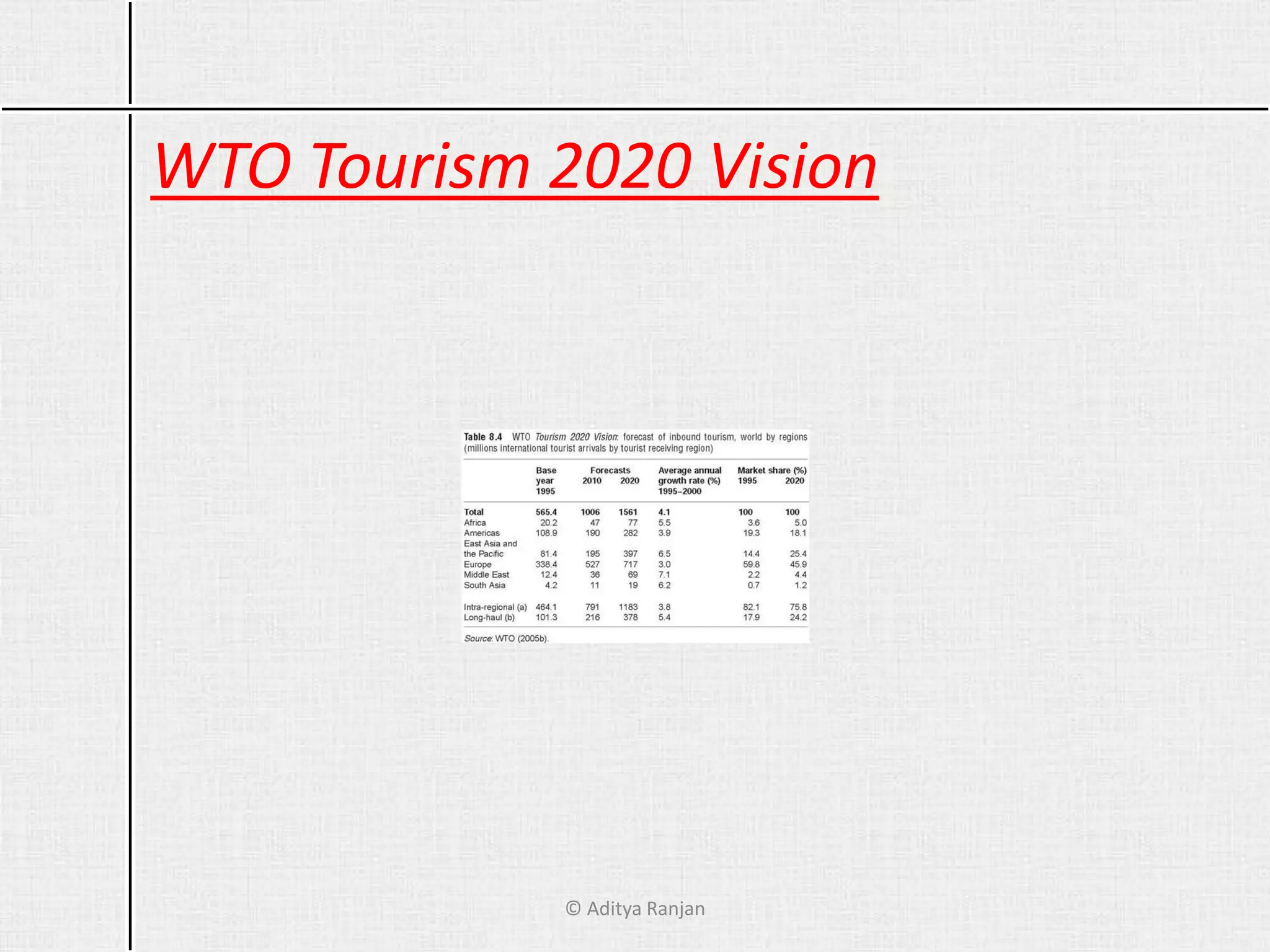
WTO Tourism 2020 Vision
© Aditya Ranjan
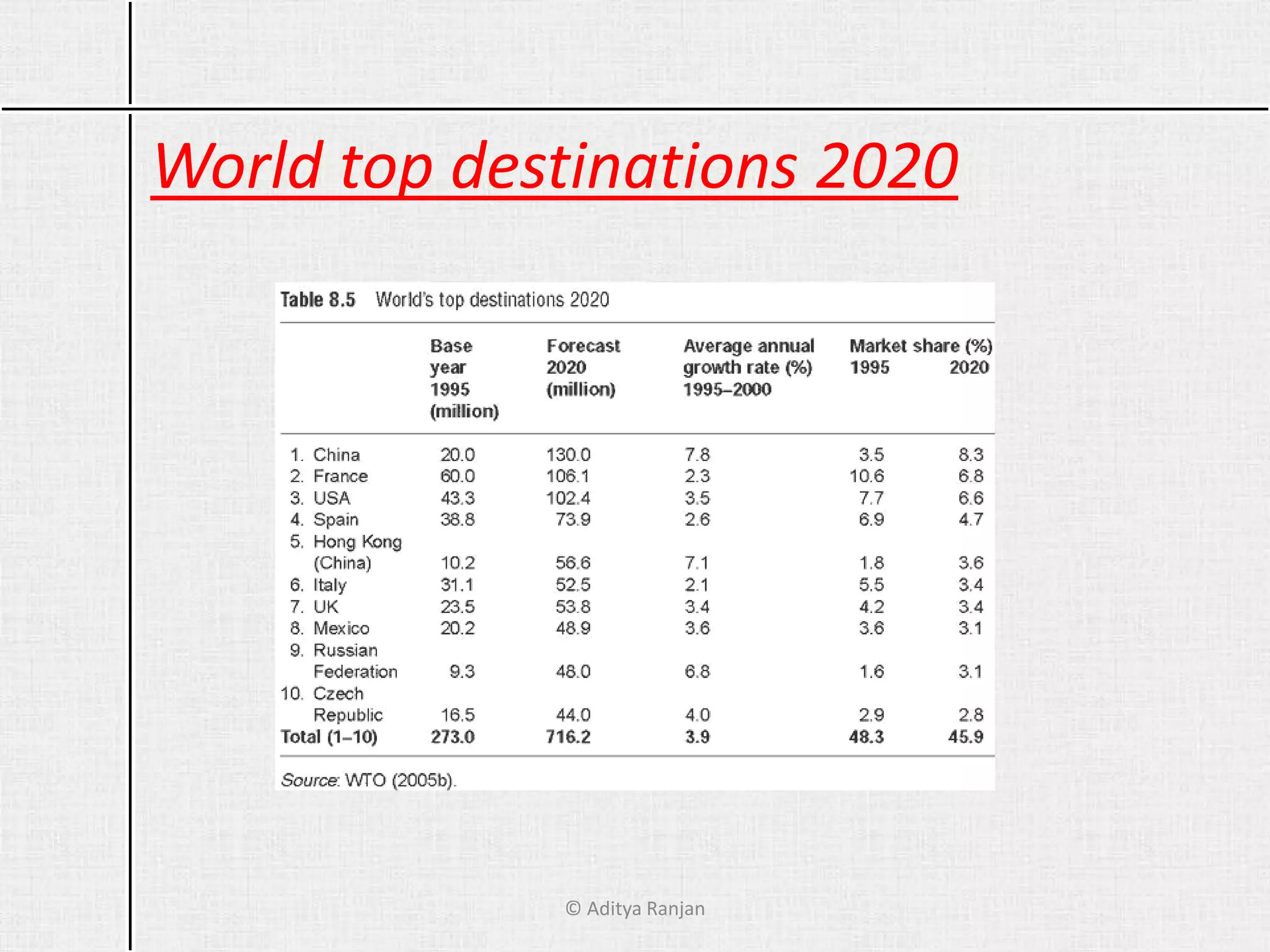
World top destinations 2020
© Aditya Ranjan
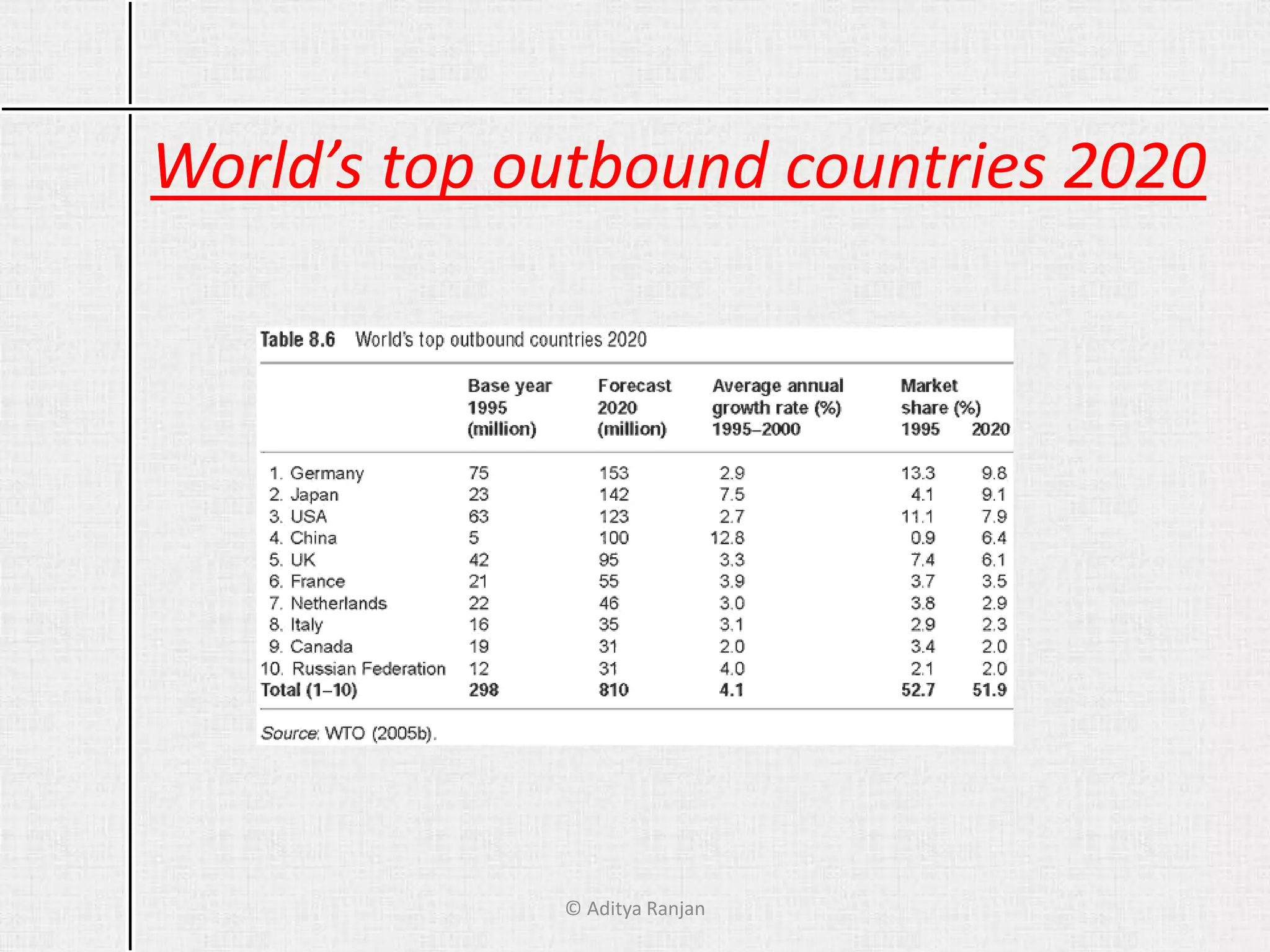
World’s top outbound countries 2020
© Aditya Ranjan
Conclusions :
• Inbound and outbound tourism are predicted to grow
in importance over the next decade.
• Outbound tourism is predicted to grow rapidly from
countries within the Asian regions.
• The Asian, African and Middle Eastern outbound
markets are in their introductory or growth stages and
there will be a great potential for developments from
these regions in the future.
• The nature of demand may alter as increasing numbers
of outbound tourists travel from these regions.
• Increasing interest in beach holidays and environmental
issues are examples of trends which are predicted for
outbound tourists from Japan and Asia in general.© Aditya Ranjan
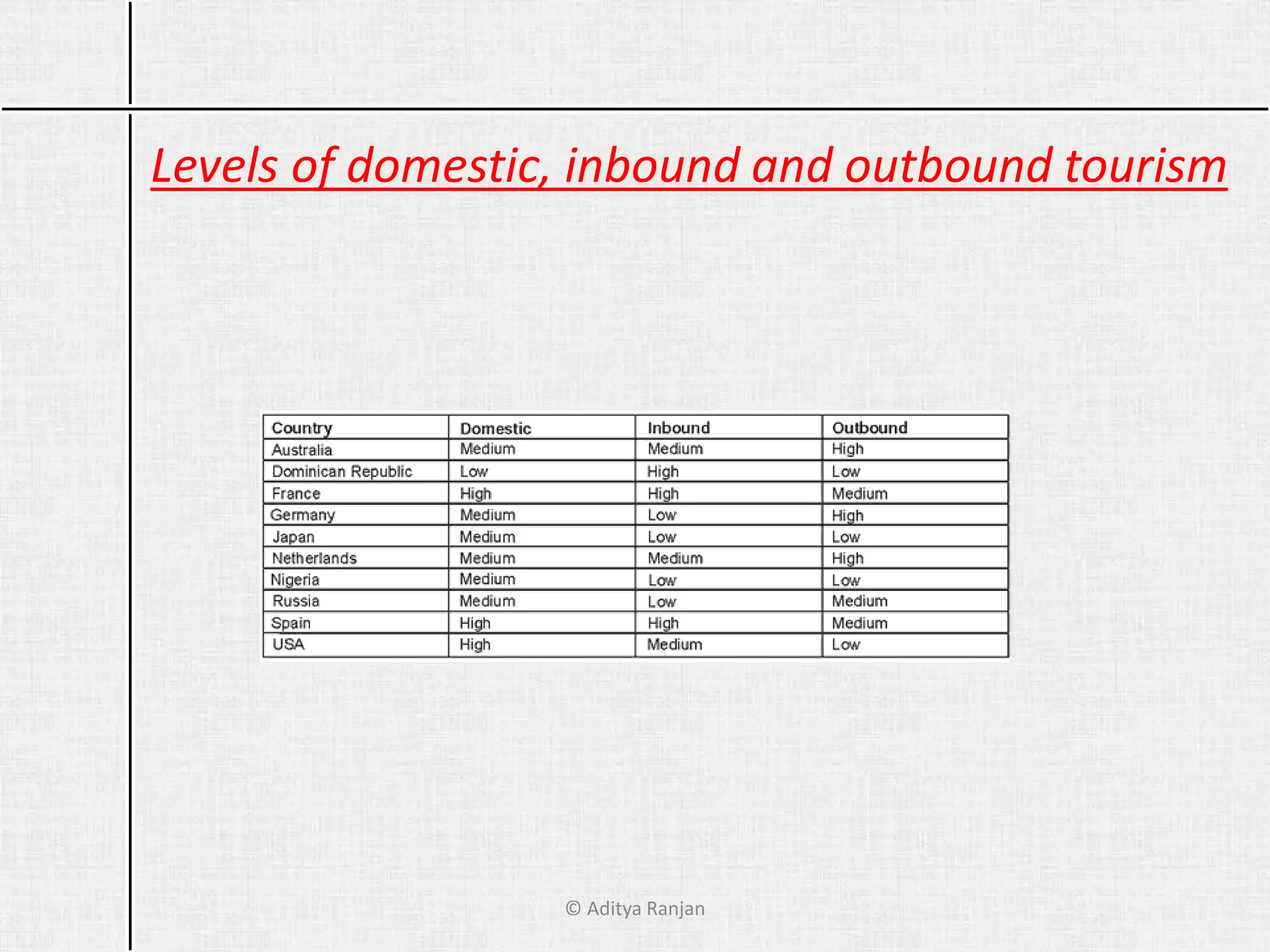
Tourism National differences:
domestic, outbound and inbound
© Aditya Ranjan
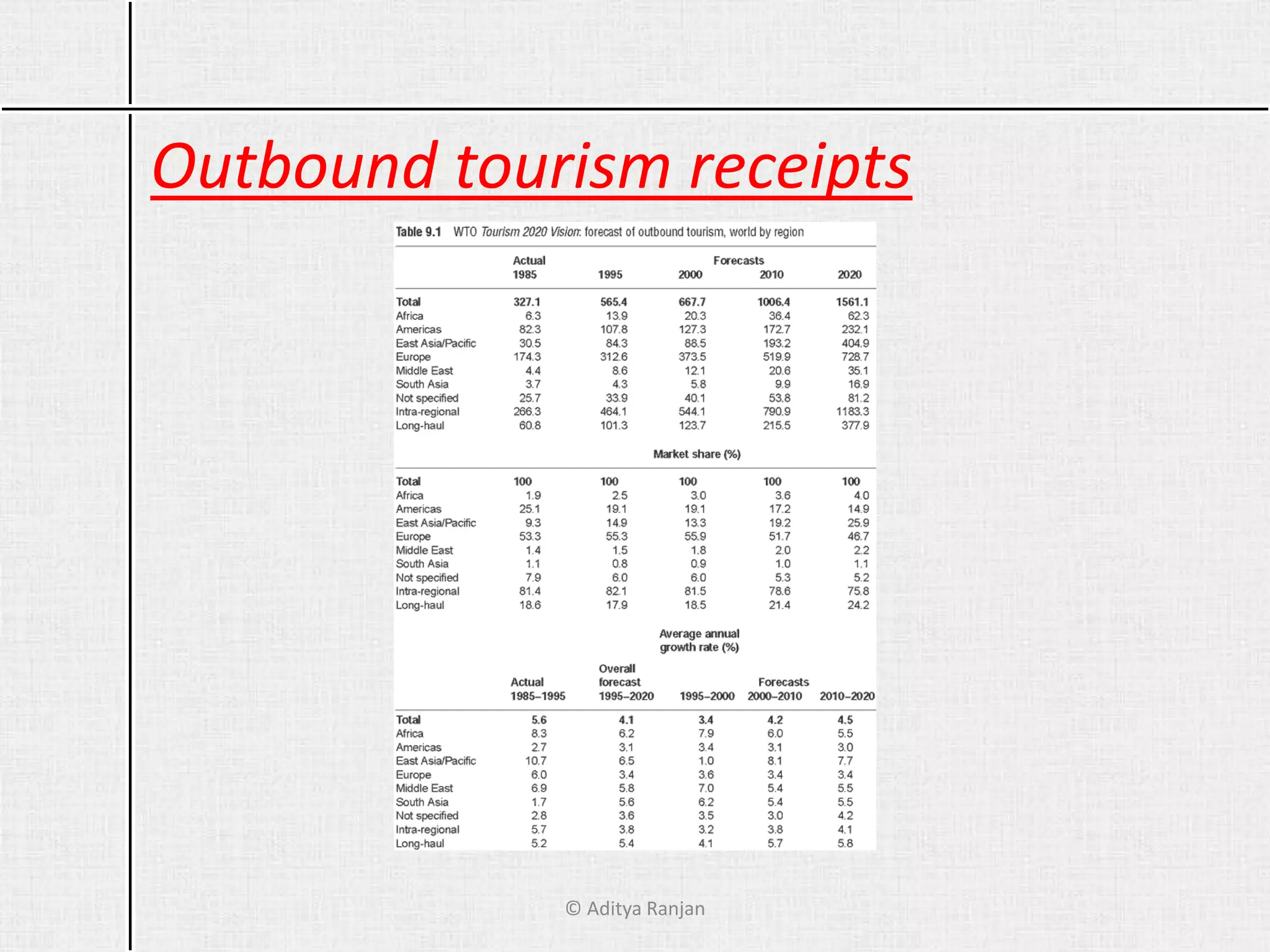
Outbound tourism receipts
© Aditya Ranjan
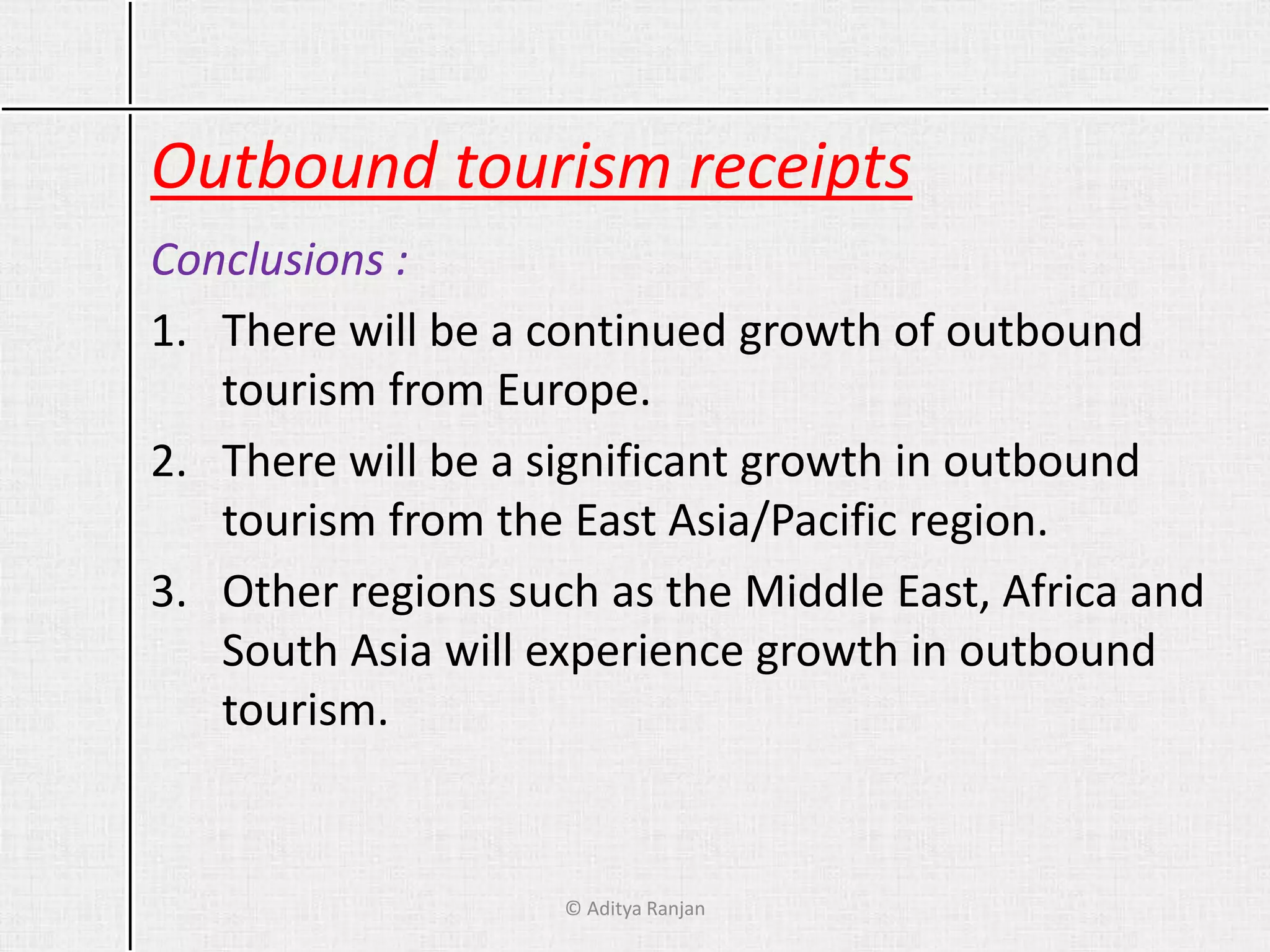
Outbound tourism receipts
Conclusions :
1. There will be a continued growth of outbound
tourism from Europe.
2. There will be a significant growth in outbound
tourism from the East Asia/Pacific region.
3. Other regions such as the Middle East, Africa and
South Asia will experience growth in outbound
tourism.
© Aditya Ranjan
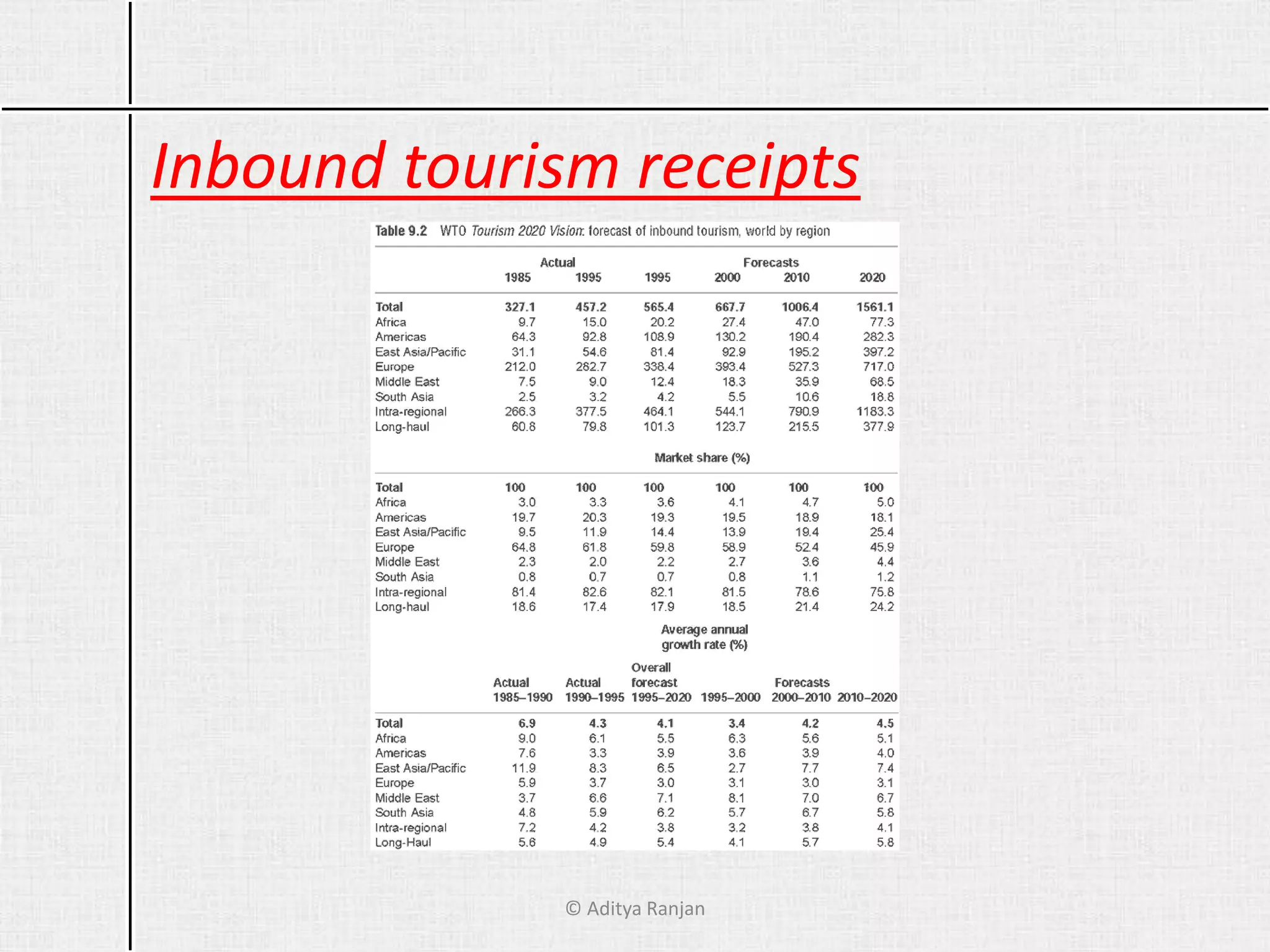
Inbound tourism receipts
© Aditya Ranjan
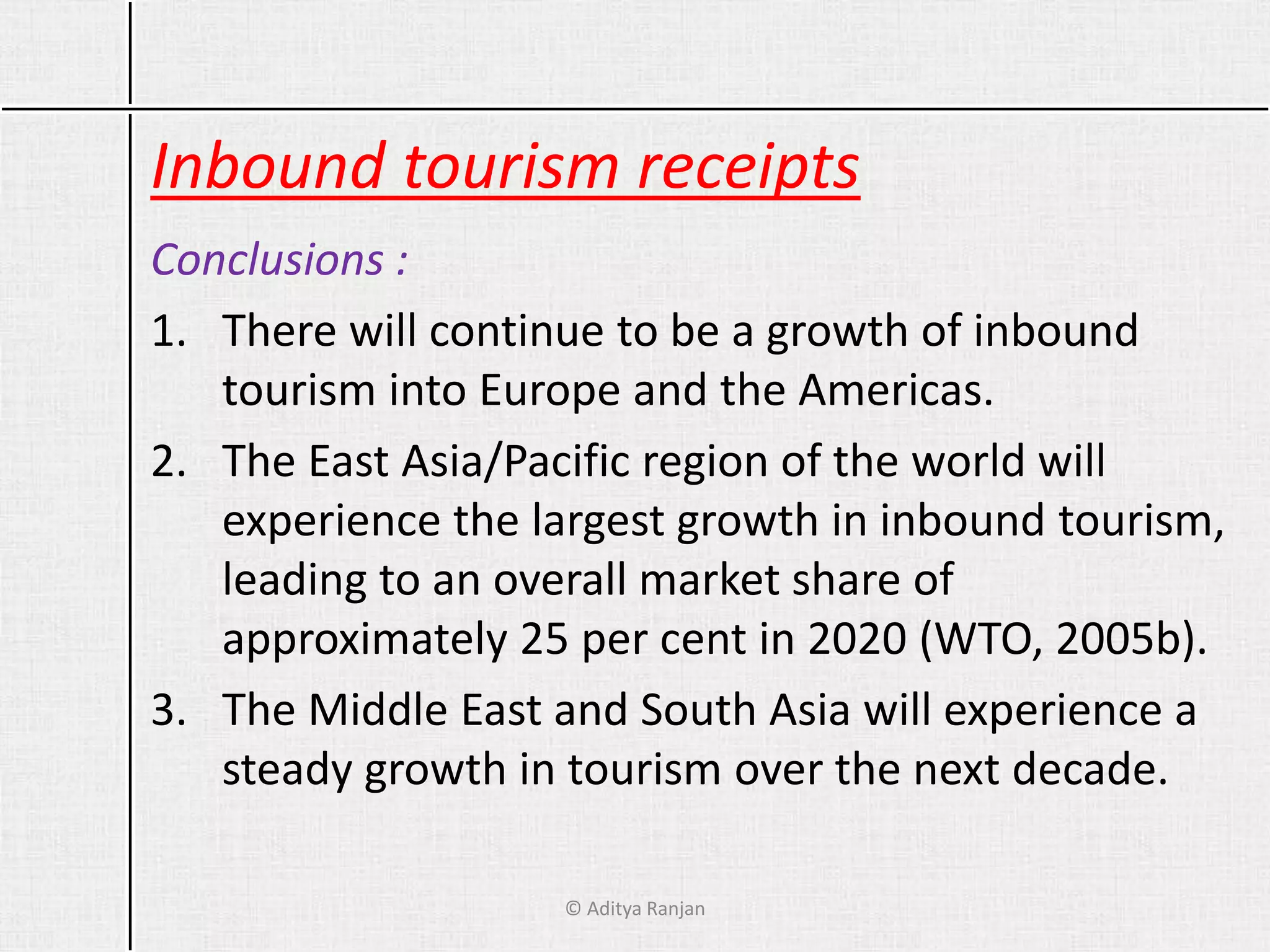
Inbound tourism receipts
Conclusions :
1. There will continue to be a growth of inbound
tourism into Europe and the Americas.
2. The East Asia/Pacific region of the world will
experience the largest growth in inbound tourism,
leading to an overall market share of
approximately 25 per cent in 2020 (WTO, 2005b).
3. The Middle East and South Asia will experience a
steady growth in tourism over the next decade.
© Aditya Ranjan
Levels of domestic, inbound and outbound tourism
© Aditya Ranjan
The nature of demand in
different segments of the
tourism market
© Aditya Ranjan
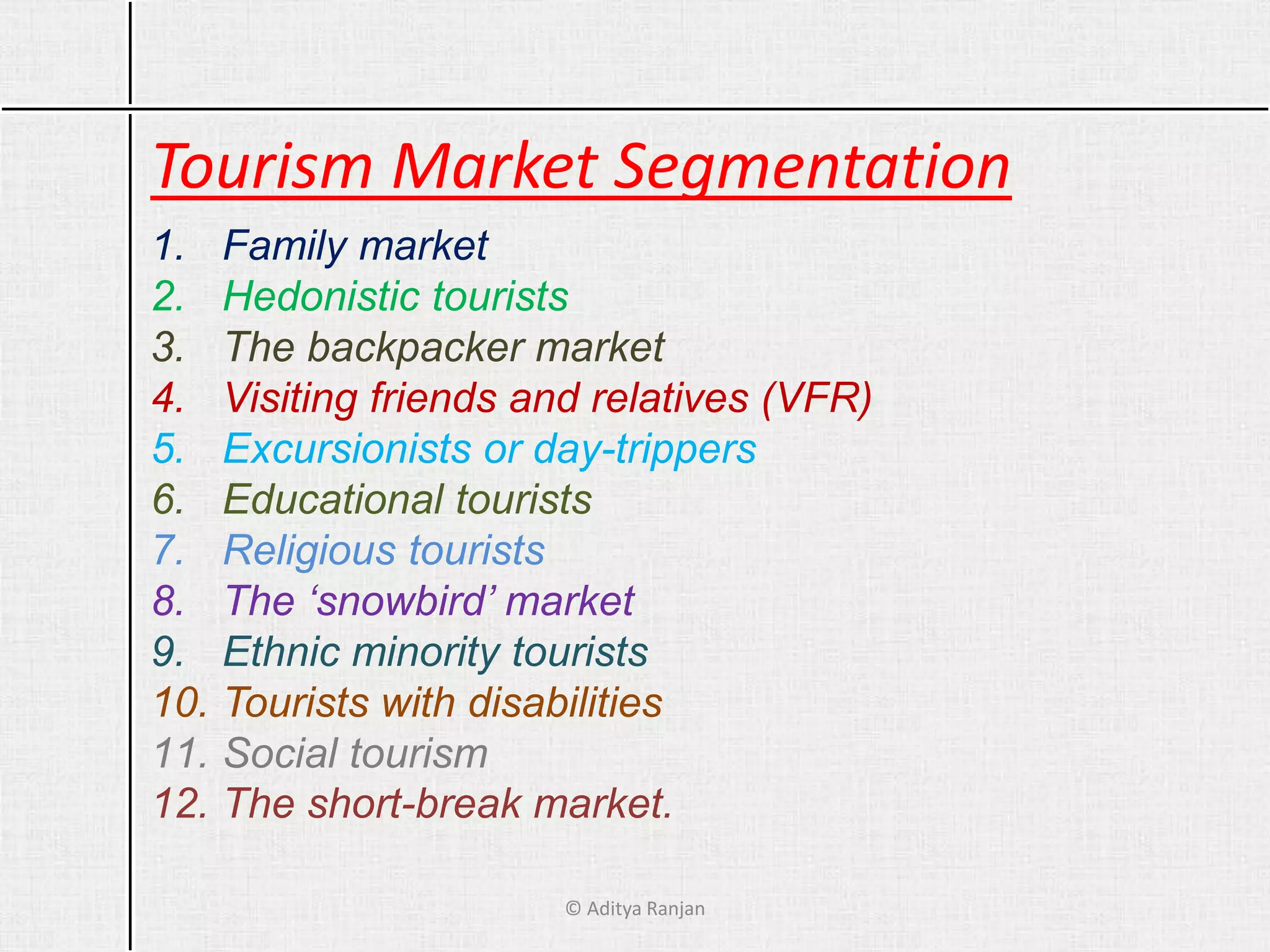
Tourism Market Segmentation
1. Family market
2. Hedonistic tourists
3. The backpacker market
4. Visiting friends and relatives (VFR)
5. Excursionists or day-trippers
6. Educational tourists
7. Religious tourists
8. The ‘snowbird’ market
9. Ethnic minority tourists
10. Tourists with disabilities
11. Social tourism
12. The short-break market.
© Aditya Ranjan
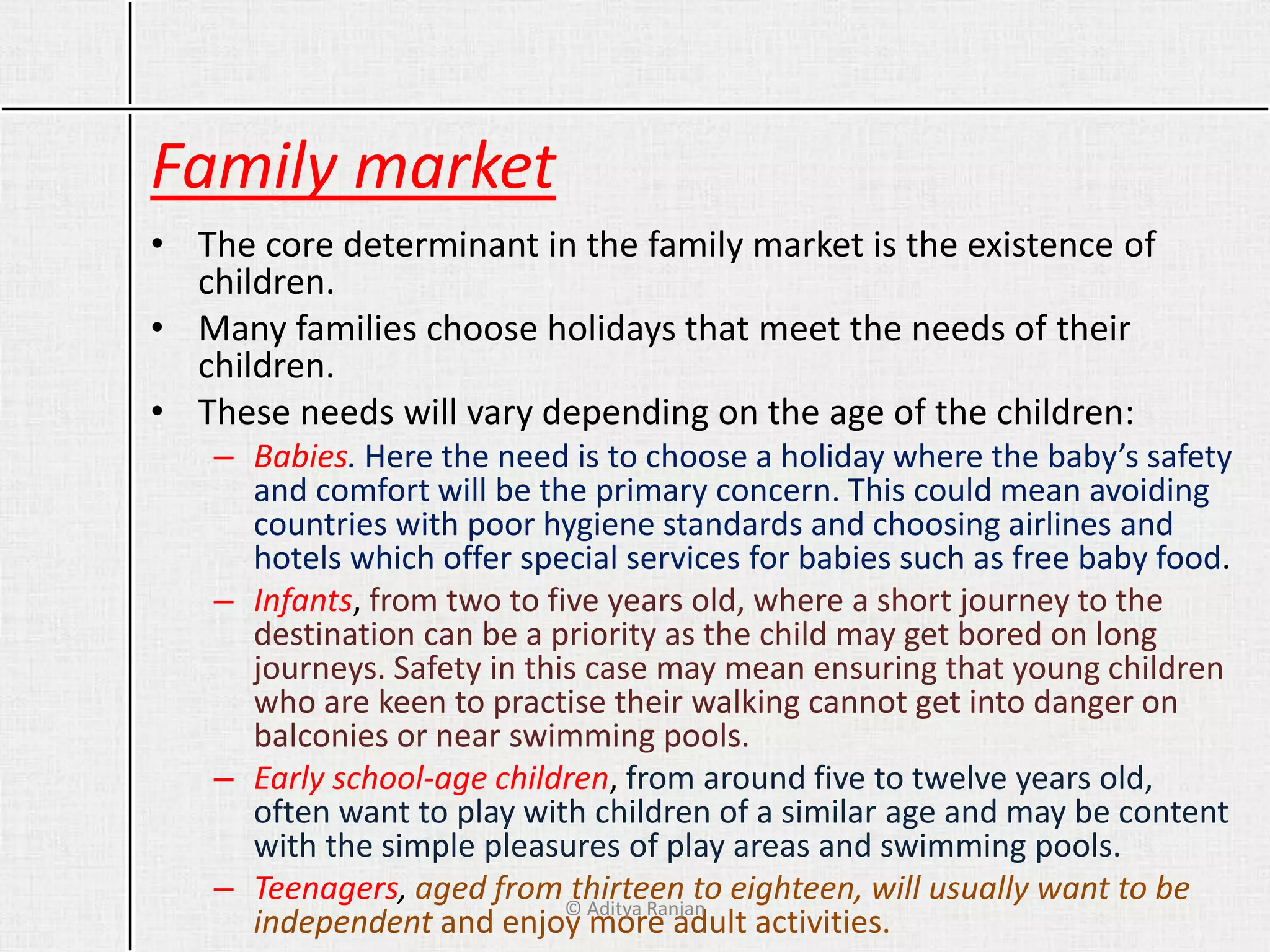
Family market
• The core determinant in the family market is the existence of
children.
• Many families choose holidays that meet the needs of their
children.
• These needs will vary depending on the age of the children:
– Babies. Here the need is to choose a holiday where the baby’s safety
and comfort will be the primary concern. This could mean avoiding
countries with poor hygiene standards and choosing airlines and
hotels which offer special services for babies such as free baby food.
– Infants, from two to five years old, where a short journey to the
destination can be a priority as the child may get bored on long
journeys. Safety in this case may mean ensuring that young children
who are keen to practise their walking cannot get into danger on
balconies or near swimming pools.
– Early school-age children, from around five to twelve years old,
often want to play with children of a similar age and may be content
with the simple pleasures of play areas and swimming pools.
– Teenagers, aged from thirteen to eighteen, will usually want to be
independent and enjoy more adult activities.© Aditya Ranjan
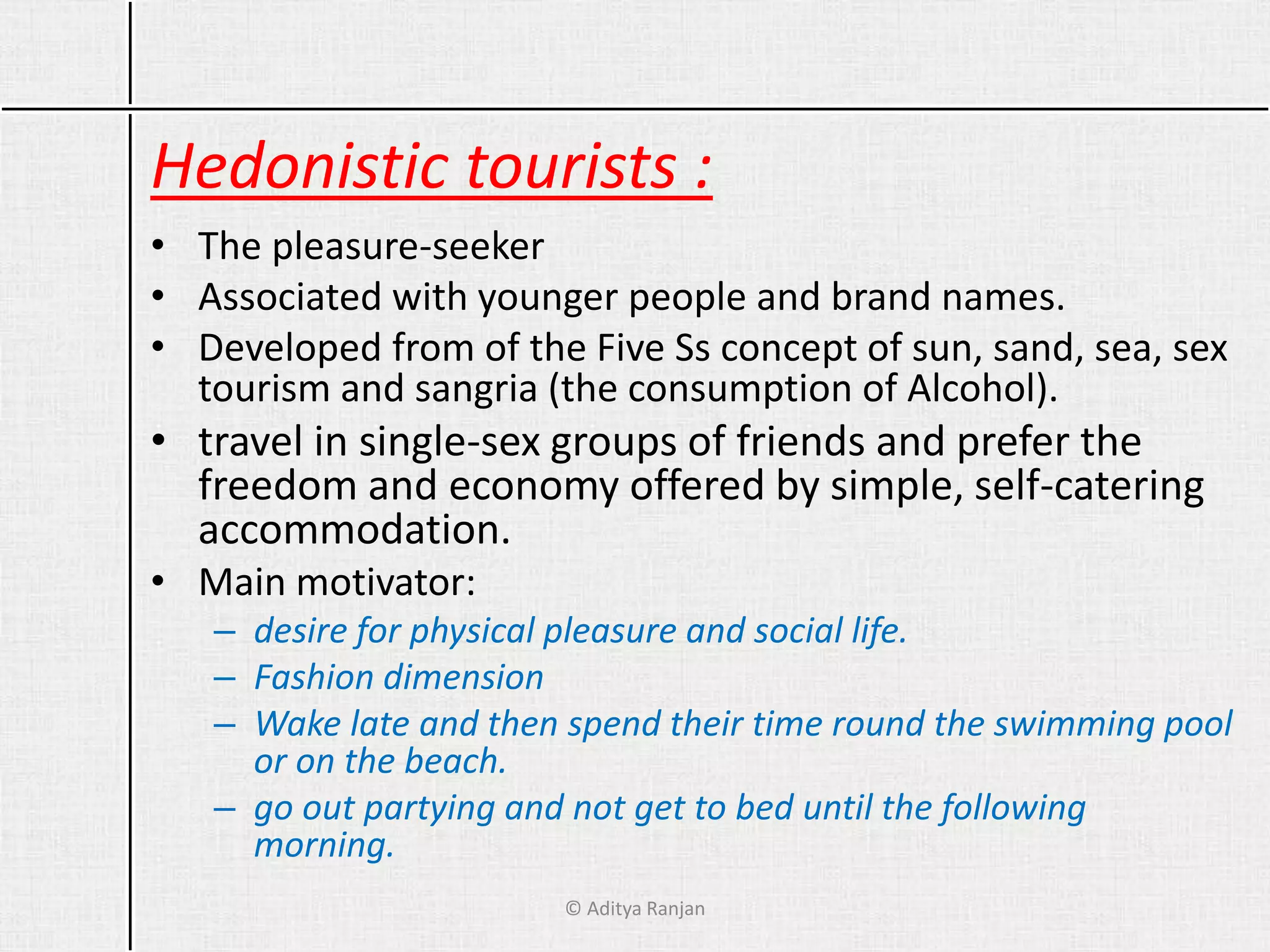
Hedonistic tourists :
• The pleasure-seeker
• Associated with younger people and brand names.
• Developed from of the Five Ss concept of sun, sand, sea, sex
tourism and sangria (the consumption of Alcohol).
• travel in single-sex groups of friends and prefer the
freedom and economy offered by simple, self-catering
accommodation.
• Main motivator:
– desire for physical pleasure and social life.
– Fashion dimension
– Wake late and then spend their time round the swimming pool
or on the beach.
– go out partying and not get to bed until the following
morning.
© Aditya Ranjan
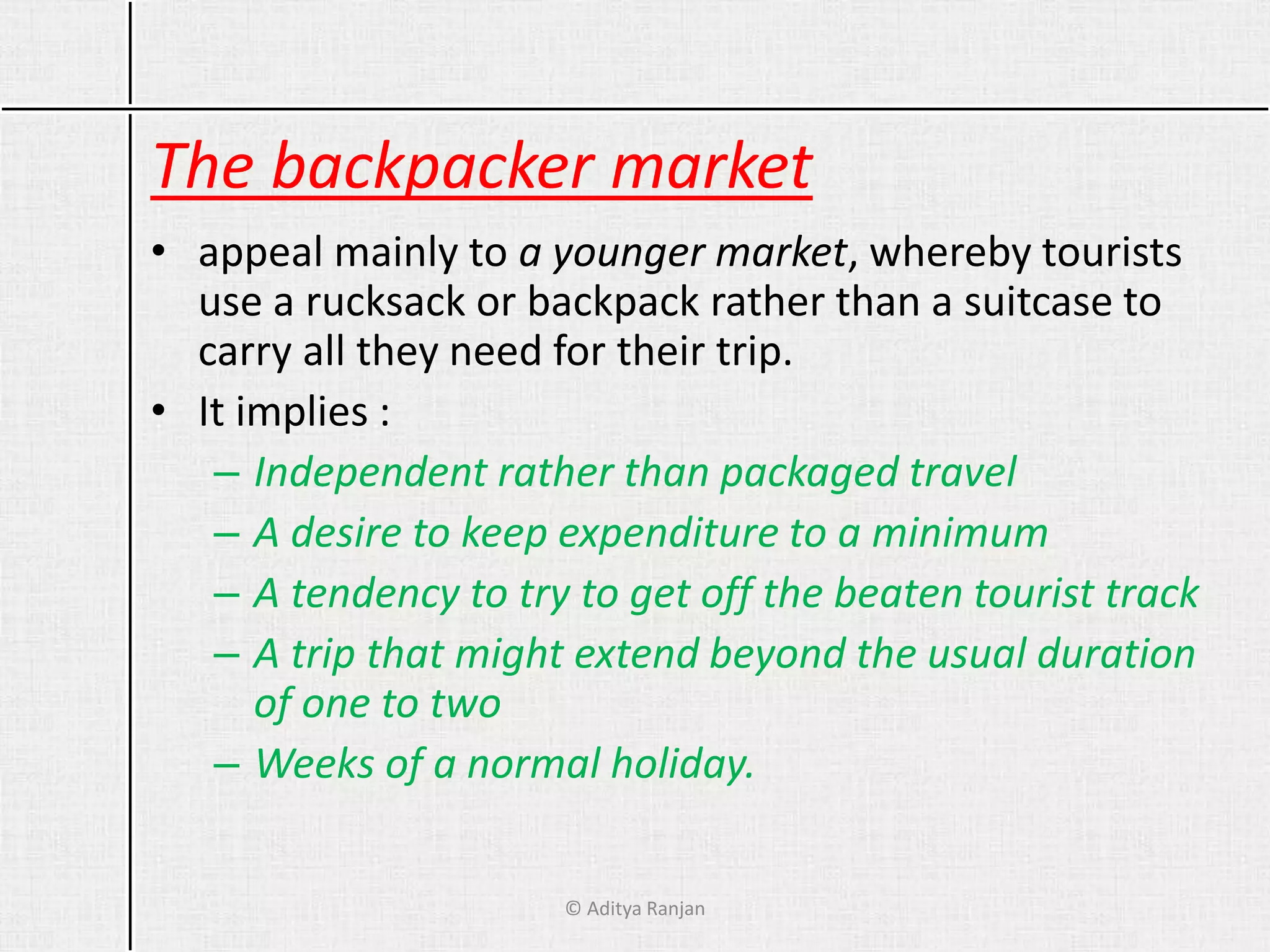
The backpacker market
• appeal mainly to a younger market, whereby tourists
use a rucksack or backpack rather than a suitcase to
carry all they need for their trip.
• It implies :
– Independent rather than packaged travel
– A desire to keep expenditure to a minimum
– A tendency to try to get off the beaten tourist track
– A trip that might extend beyond the usual duration
of one to two
– Weeks of a normal holiday.
© Aditya Ranjan
Visiting friends and relatives (VFR)
• people do not stay in commercial accommodation.
• Usually domestic tourists.
• very important for the visitor attraction market.
• brings business for local attractions.
© Aditya Ranjan
Excursionists and day-trippers
• Generally a domestic tourist, but can be International.
• a spontaneous decision maker.
• the core market for most visitor attractions, many
seaside resorts and some rural areas.
• major consumers of food and drink services and tend to
make considerable use of leisure and shopping
facilities.
• For example
– Thopping trips by Britons to France and Malaysian people to
Singapore.
– Trip to Tromso, beyond the Arctic Circle, from Heathrow
airport. © Aditya Ranjan
Educational tourists
• Educational tourism has a number of dimensions.
• It Includes :
– Students exchanges between universities where students
may travel for periods ranging from two or three months
to a year.
– Young people attending language classes in a foreign
country, which can last from a week to several months.
– Themed holidays where tourists travel with like-minded
people to pursue a common interest which could be
archaeology, a foreign culture, painting or cooking.
• In the first two cases the consumer, i.e. the tourist,
may not be the actual customer who makes the
decision or pays the bill.© Aditya Ranjan
Religious tourists
• One of the oldest forms of tourism.
• Unique, perhaps, in that it is driven by a sense of
duty and obligation rather than a search for
pleasure and leisure.
• A highly restricted market, being only available to
believers in a particular faith.
• The traditional infrastructure of religious tourism
has also become an attraction for the non-religious
tourist, most notably visiting cathedrals and
churches.
© Aditya Ranjan
Snowbird market
• ‘snowbirds’ – Movement from the cold, snowy to mild
winter climates.
• Motivator for such tourist –
– Escape the cold weather in their own state/country
– Reduce their expenditure on heating at home
– Improve their health given that they may suffer from illnesses like
arthritis which may be exacerbated by the damp, cold weather in
their home state/country
– Make new friends and have a less lonely life than they might in their
own community.
• characteristics:
– The trips are of long duration, from four weeks to four months.
– They are normally taken by retired people who have the time to
take such a long vacation.
© Aditya Ranjan
Ethnic minority tourists
• Many countries contain ethnic minority communities,
many of which may have been in the country for
generations.
• Often people in these communities will have
maintained contact with their original country, and will
have their own patterns of tourism and tourism
infrastructure.
© Aditya Ranjan
The short-break market
• Two-day weekend, and the rise of car ownership and
faster aircraft, have helped stimulate the development
of the short weekend break market.
• Short breaks exist in a number of forms, including:
– romantic weekends for a couple.
– shopping trips
– visiting friends and relatives trips
– health farm or health spa breaks
– special interest and activity breaks such as fishing trips,
painting, horse-riding or golf
– breaks built around a special event whether it be a theatre
performance or a football match
– unwinding, relaxing breaks in country house hotels© Aditya Ranjan
Factors taken into account when
making a purchase decision
© Aditya Ranjan
Factors taken into account
• Seasonality
• Distance travelled to use tourism product and
services
• Frequency of purchase
• Methods of segmenting the market
• Price paid for the product or service
• Methods of booking or reserving
© Aditya Ranjan
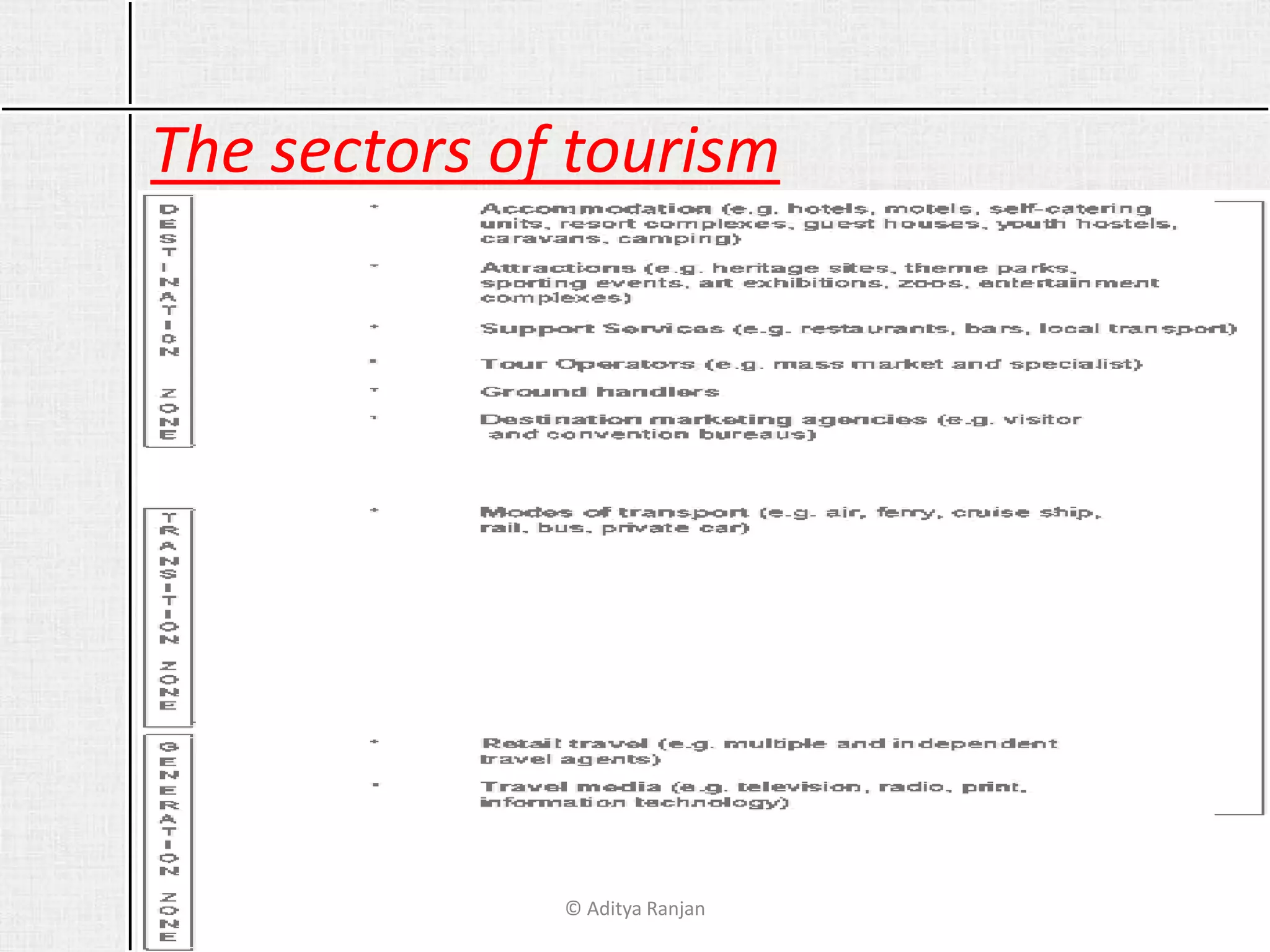
The sectors of tourism
© Aditya Ranjan
Special cases
• Retail travel
– it does not have a product of its own
– exists to provide a service, namely, giving consumers access to
the products of the other sectors of tourism.
• Destinations
– a do-it-yourself (DIY) kit, rather than as a finished product
– offers tourists a range of opportunities from which they can
produce their own product or experience.
• Business tourism
– different consumer to the leisure traveller.
– special provision may be made to meet business travellers’
needs, such as in-bedroom computer access points in hotels
and onboard fax machines on aircraft.
© Aditya Ranjan
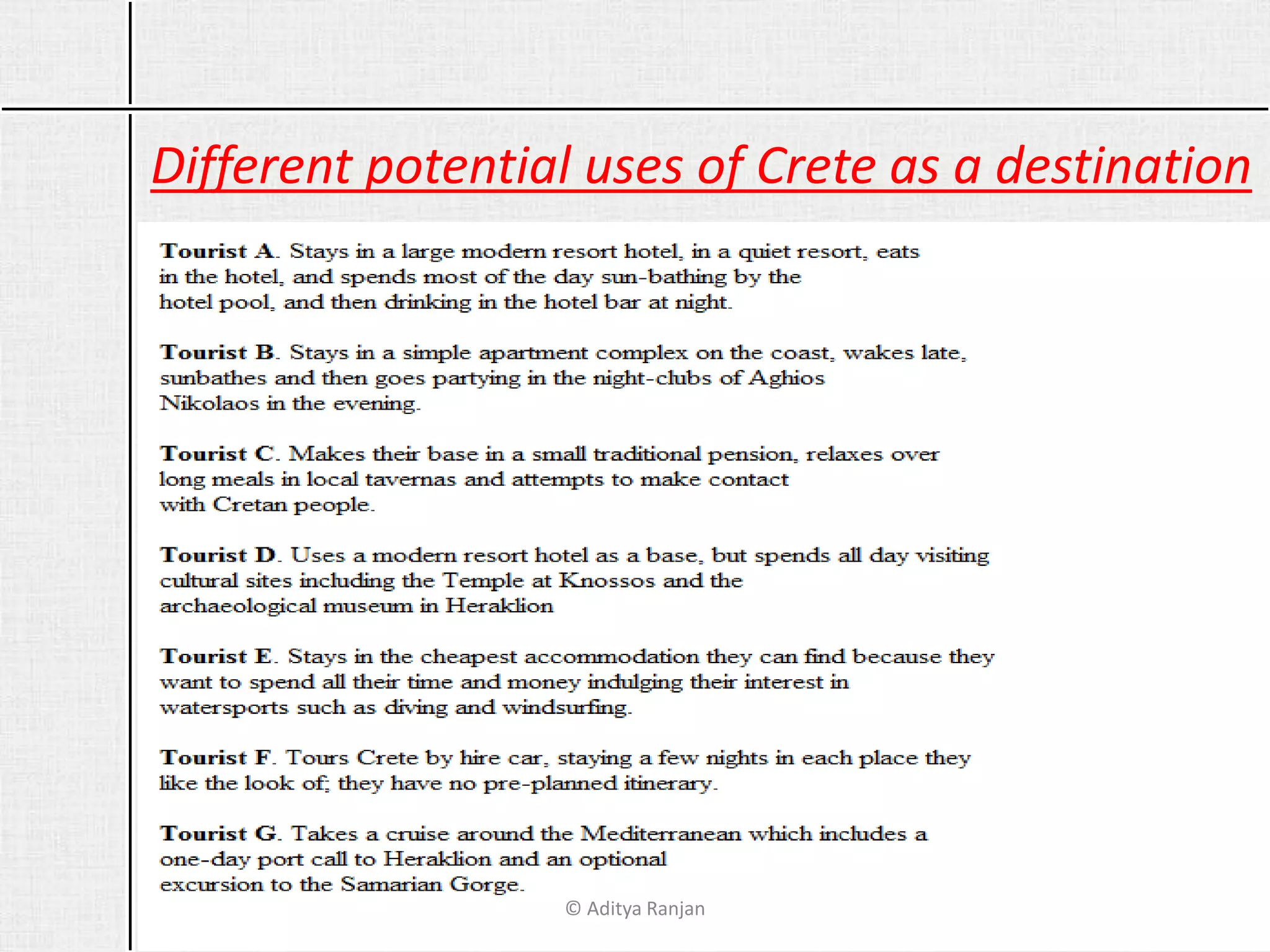
Different potential uses of Crete as a destination
© Aditya Ranjan
Differences in consumer behaviour
between business tourists and
leisure tourists
© Aditya Ranjan
© Aditya Ranjan
Refrences :
• John Swarbrooke and Susan Horner (1999). Elsevier
Ltd. 2nd ediition.
• Tourism Management (2009). Consumer Behaviour.
Hotelmule.com
© Aditya Ranjan
Thank you Everyone
© Aditya Ranjan

Tourist behaviour- Unit 4

  • 1.
    Tourist Behaviour © AdityaRanjan © Aditya Ranjan UNIT 4 : TOURISM DEMAND AND MARKET
  • 2.
    This unit covers: 1. Global pattern of tourism demand 2. Nature of demand in different segments of tourism market 3. Consumer behaviour and markets in different sectors of tourism © Aditya Ranjan
  • 3.
    Factors that influencetourism demand • World Tourism Organization (WTO) in 1995. © Aditya Ranjan Source: WTO (1995)
  • 4.
    Factors that influencetourism demand © Aditya Ranjan • Influences and determinants : Source: WTO (1995)
  • 5.
    The global patternof tourism demand © Aditya Ranjan
  • 6.
    WTO Tourism 2020Vision © Aditya Ranjan
  • 7.
    World top destinations2020 © Aditya Ranjan
  • 8.
    World’s top outboundcountries 2020 © Aditya Ranjan
  • 9.
    Conclusions : • Inboundand outbound tourism are predicted to grow in importance over the next decade. • Outbound tourism is predicted to grow rapidly from countries within the Asian regions. • The Asian, African and Middle Eastern outbound markets are in their introductory or growth stages and there will be a great potential for developments from these regions in the future. • The nature of demand may alter as increasing numbers of outbound tourists travel from these regions. • Increasing interest in beach holidays and environmental issues are examples of trends which are predicted for outbound tourists from Japan and Asia in general.© Aditya Ranjan
  • 10.
    Tourism National differences: domestic,outbound and inbound © Aditya Ranjan
  • 11.
  • 12.
    Outbound tourism receipts Conclusions: 1. There will be a continued growth of outbound tourism from Europe. 2. There will be a significant growth in outbound tourism from the East Asia/Pacific region. 3. Other regions such as the Middle East, Africa and South Asia will experience growth in outbound tourism. © Aditya Ranjan
  • 13.
  • 14.
    Inbound tourism receipts Conclusions: 1. There will continue to be a growth of inbound tourism into Europe and the Americas. 2. The East Asia/Pacific region of the world will experience the largest growth in inbound tourism, leading to an overall market share of approximately 25 per cent in 2020 (WTO, 2005b). 3. The Middle East and South Asia will experience a steady growth in tourism over the next decade. © Aditya Ranjan
  • 15.
    Levels of domestic,inbound and outbound tourism © Aditya Ranjan
  • 16.
    The nature ofdemand in different segments of the tourism market © Aditya Ranjan
  • 17.
    Tourism Market Segmentation 1.Family market 2. Hedonistic tourists 3. The backpacker market 4. Visiting friends and relatives (VFR) 5. Excursionists or day-trippers 6. Educational tourists 7. Religious tourists 8. The ‘snowbird’ market 9. Ethnic minority tourists 10. Tourists with disabilities 11. Social tourism 12. The short-break market. © Aditya Ranjan
  • 18.
    Family market • Thecore determinant in the family market is the existence of children. • Many families choose holidays that meet the needs of their children. • These needs will vary depending on the age of the children: – Babies. Here the need is to choose a holiday where the baby’s safety and comfort will be the primary concern. This could mean avoiding countries with poor hygiene standards and choosing airlines and hotels which offer special services for babies such as free baby food. – Infants, from two to five years old, where a short journey to the destination can be a priority as the child may get bored on long journeys. Safety in this case may mean ensuring that young children who are keen to practise their walking cannot get into danger on balconies or near swimming pools. – Early school-age children, from around five to twelve years old, often want to play with children of a similar age and may be content with the simple pleasures of play areas and swimming pools. – Teenagers, aged from thirteen to eighteen, will usually want to be independent and enjoy more adult activities.© Aditya Ranjan
  • 19.
    Hedonistic tourists : •The pleasure-seeker • Associated with younger people and brand names. • Developed from of the Five Ss concept of sun, sand, sea, sex tourism and sangria (the consumption of Alcohol). • travel in single-sex groups of friends and prefer the freedom and economy offered by simple, self-catering accommodation. • Main motivator: – desire for physical pleasure and social life. – Fashion dimension – Wake late and then spend their time round the swimming pool or on the beach. – go out partying and not get to bed until the following morning. © Aditya Ranjan
  • 20.
    The backpacker market •appeal mainly to a younger market, whereby tourists use a rucksack or backpack rather than a suitcase to carry all they need for their trip. • It implies : – Independent rather than packaged travel – A desire to keep expenditure to a minimum – A tendency to try to get off the beaten tourist track – A trip that might extend beyond the usual duration of one to two – Weeks of a normal holiday. © Aditya Ranjan
  • 21.
    Visiting friends andrelatives (VFR) • people do not stay in commercial accommodation. • Usually domestic tourists. • very important for the visitor attraction market. • brings business for local attractions. © Aditya Ranjan
  • 22.
    Excursionists and day-trippers •Generally a domestic tourist, but can be International. • a spontaneous decision maker. • the core market for most visitor attractions, many seaside resorts and some rural areas. • major consumers of food and drink services and tend to make considerable use of leisure and shopping facilities. • For example – Thopping trips by Britons to France and Malaysian people to Singapore. – Trip to Tromso, beyond the Arctic Circle, from Heathrow airport. © Aditya Ranjan
  • 23.
    Educational tourists • Educationaltourism has a number of dimensions. • It Includes : – Students exchanges between universities where students may travel for periods ranging from two or three months to a year. – Young people attending language classes in a foreign country, which can last from a week to several months. – Themed holidays where tourists travel with like-minded people to pursue a common interest which could be archaeology, a foreign culture, painting or cooking. • In the first two cases the consumer, i.e. the tourist, may not be the actual customer who makes the decision or pays the bill.© Aditya Ranjan
  • 24.
    Religious tourists • Oneof the oldest forms of tourism. • Unique, perhaps, in that it is driven by a sense of duty and obligation rather than a search for pleasure and leisure. • A highly restricted market, being only available to believers in a particular faith. • The traditional infrastructure of religious tourism has also become an attraction for the non-religious tourist, most notably visiting cathedrals and churches. © Aditya Ranjan
  • 25.
    Snowbird market • ‘snowbirds’– Movement from the cold, snowy to mild winter climates. • Motivator for such tourist – – Escape the cold weather in their own state/country – Reduce their expenditure on heating at home – Improve their health given that they may suffer from illnesses like arthritis which may be exacerbated by the damp, cold weather in their home state/country – Make new friends and have a less lonely life than they might in their own community. • characteristics: – The trips are of long duration, from four weeks to four months. – They are normally taken by retired people who have the time to take such a long vacation. © Aditya Ranjan
  • 26.
    Ethnic minority tourists •Many countries contain ethnic minority communities, many of which may have been in the country for generations. • Often people in these communities will have maintained contact with their original country, and will have their own patterns of tourism and tourism infrastructure. © Aditya Ranjan
  • 27.
    The short-break market •Two-day weekend, and the rise of car ownership and faster aircraft, have helped stimulate the development of the short weekend break market. • Short breaks exist in a number of forms, including: – romantic weekends for a couple. – shopping trips – visiting friends and relatives trips – health farm or health spa breaks – special interest and activity breaks such as fishing trips, painting, horse-riding or golf – breaks built around a special event whether it be a theatre performance or a football match – unwinding, relaxing breaks in country house hotels© Aditya Ranjan
  • 28.
    Factors taken intoaccount when making a purchase decision © Aditya Ranjan
  • 29.
    Factors taken intoaccount • Seasonality • Distance travelled to use tourism product and services • Frequency of purchase • Methods of segmenting the market • Price paid for the product or service • Methods of booking or reserving © Aditya Ranjan
  • 30.
    The sectors oftourism © Aditya Ranjan
  • 31.
    Special cases • Retailtravel – it does not have a product of its own – exists to provide a service, namely, giving consumers access to the products of the other sectors of tourism. • Destinations – a do-it-yourself (DIY) kit, rather than as a finished product – offers tourists a range of opportunities from which they can produce their own product or experience. • Business tourism – different consumer to the leisure traveller. – special provision may be made to meet business travellers’ needs, such as in-bedroom computer access points in hotels and onboard fax machines on aircraft. © Aditya Ranjan
  • 32.
    Different potential usesof Crete as a destination © Aditya Ranjan
  • 33.
    Differences in consumerbehaviour between business tourists and leisure tourists © Aditya Ranjan
  • 34.
  • 35.
    Refrences : • JohnSwarbrooke and Susan Horner (1999). Elsevier Ltd. 2nd ediition. • Tourism Management (2009). Consumer Behaviour. Hotelmule.com © Aditya Ranjan
  • 36.
    Thank you Everyone ©Aditya Ranjan