

Political instability
 and its effects on
      Tourism
Abstract
According to Poirier (2000) tourism today
is second only to oil as the world’s leading
export commodity, accounting for global
earnings of more than $300 billion, or
nearly 25 per cent of total world GNP. Over
the last two decades, tourism has proved
to be the world’s fastest growing
economic sector, with average growth of
7.1 per cent per year in arrivals and 12.5
per cent in receipts. Despite these
statistics, tourism growth in many
countries has not been this high, in
particular those countries confronted with
various political instabilities that have
caused to retard development in tourism.
This paper will examine
• How tourism can be used as a tool
  for political and ideological goals.
• How tourism reform occurs in
  industries within politically troubled
  nations.
• How tourism can be moulded by the
  political purpose.
Introduction
   – Political stability and political relations
     influences the image of destinations in
     tourist-generating regions (Hall and
     O’Sullivan,1996)
   – Media portrayal: books, magazines,
     newspapers, satellite and cable links has a
     substantial influence.
   – Examples of political strife that cause
     problematic concerns in the attraction of
     visitors are:
      • Warfare
      • coups
      • political strikes or protests
“Any evidence of domestic turmoil is likely to result
  in a decision not to visit that country. “
  Ankomah and Crompton (1990, p19)
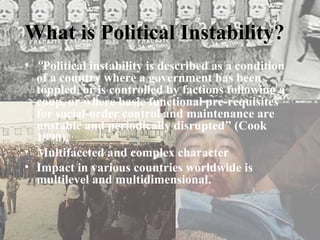
What is Political Instability?
• “Political instability is described as a condition
  of a country where a government has been
  toppled, or is controlled by factions following a
  coup, or where basic functional pre-requisites
  for social-order control and maintenance are
  unstable and periodically disrupted” (Cook
  1990).
• Multifaceted and complex character
• Impact in various countries worldwide is
  multilevel and multidimensional.
Relationship between politics
           and tourism
• “The political aspects of tourism are
  interwoven with its economic
  consequences…tourism is not only a
  “continuation of politics” but an integral
  part of the world’s political economy. In
  short, tourism is, or can be, a tool used not
  only for economic but for political means”
  (Edgell, 1990).
The Reasons Behind the Neglect
Unwillingness on the part of many decision
  makers both in government and in the
  private sector to acknowledge the
  political nature of tourism.
- Lack of official interest in conducting
  research into the politics of tourism.
- Tourism not regarded as a serious
  scholarly subject.


          -“ Tourism is by now too
         important and a pervasive
         activity for governments to
          ignore.” (Hughes 1984).
Has tourism been affected by
     political instability?
      Effects of Political violence
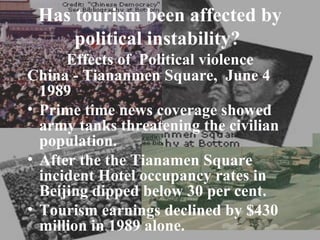
China - Tiananmen Square, June 4
  1989
• Prime time news coverage showed
  army tanks threatening the civilian
  population.
• After the the Tianamen Square
  incident Hotel occupancy rates in
  Beijing dipped below 30 per cent.
• Tourism earnings declined by $430
  million in 1989 alone.
Effects of Military Coups
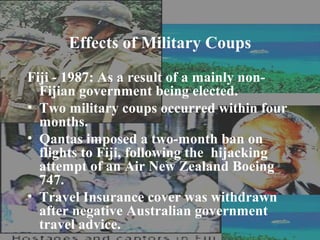
Fiji - 1987: As a result of a mainly non-
  Fijian government being elected.
• Two military coups occurred within four
  months.
• Qantas imposed a two-month ban on
  flights to Fiji, following the hijacking
  attempt of an Air New Zealand Boeing
  747.
• Travel Insurance cover was withdrawn
  after negative Australian government
  travel advice.
Effects of Revolutions

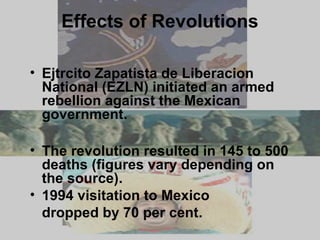
• Ejtrcito Zapatista de Liberacion
  National (EZLN) initiated an armed
  rebellion against the Mexican
  government.

• The revolution resulted in 145 to 500
  deaths (figures vary depending on
  the source).
• 1994 visitation to Mexico
  dropped by 70 per cent.
Effects of Civil War
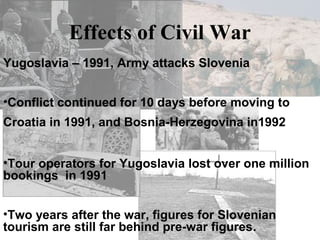
Yugoslavia – 1991, Army attacks Slovenia


•Conflict continued for 10 days before moving to
Croatia in 1991, and Bosnia-Herzegovina in1992


•Tour operators for Yugoslavia lost over one million
bookings in 1991


•Two years after the war, figures for Slovenian
tourism are still far behind pre-war figures.
Effects of Civil War
                Sub Saharan Africa 

•Zimbabwe (formerly southern Rhodesia) was the scene of a fifteen
years Liberation War of Attrition between Africans and white
settlers.
The most extensive of Sub-Saharan colonial wars was fought in
Angola,

Mozambique and Guinea Bissau . Nigeria had five successful coups
since gaining independence in the 1960’


•In total, more than 20 major wars have taken place on the sub-
Saharan region of Africa since the 1960s (Ankomah and Crompton
1990, p19).
Effects of Civil War
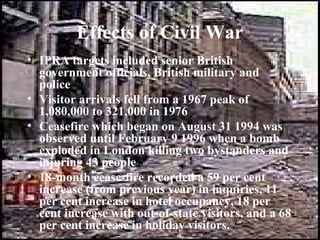
• IPRA targets included senior British
  government officials, British military and
  police
• Visitor arrivals fell from a 1967 peak of
  1,080,000 to 321,000 in 1976
• Ceasefire which began on August 31 1994 was
  observed until February 9 1996 when a bomb
  exploded in London killing two bystanders and
  injuring 43 people
• 18-month cease-fire recorded a 59 per cent
  increase (from previous year) in inquiries, 11
  per cent increase in hotel occupancy, 18 per
  cent increase with out-of-state visitors, and a 68
  per cent increase in holiday visitors.
Effects of Terrorism

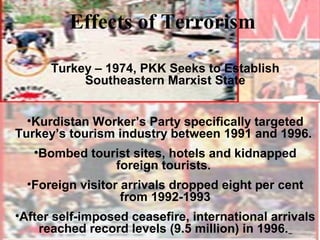
      Turkey – 1974, PKK Seeks to Establish
           Southeastern Marxist State


  •Kurdistan Worker’s Party specifically targeted
Turkey’s tourism industry between 1991 and 1996.
   •Bombed tourist sites, hotels and kidnapped
               foreign tourists.
  •Foreign visitor arrivals dropped eight per cent
                   from 1992-1993
•After self-imposed ceasefire, international arrivals
    reached record levels (9.5 million) in 1996.
Effects of Terrorism
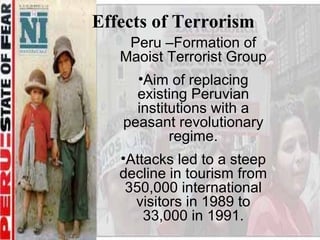
    Peru –Formation of
   Maoist Terrorist Group
     •Aim of replacing
     existing Peruvian
     institutions with a
   peasant revolutionary
           regime.
   •Attacks led to a steep
   decline in tourism from
    350,000 international
     visitors in 1989 to
       33,000 in 1991.
Effects of Terrorism
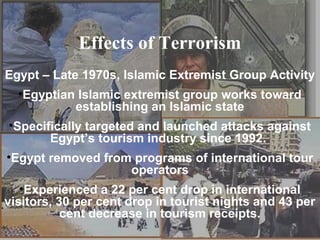
Egypt – Late 1970s, Islamic Extremist Group Activity
  •Egyptian Islamic extremist group works toward
           establishing an Islamic state
•Specifically targeted and launched attacks against
       Egypt’s tourism industry since 1992.
•Egypt removed from programs of international tour
                   operators
   •Experienced a 22 per cent drop in international
visitors, 30 per cent drop in tourist nights and 43 per
           cent decrease in tourism receipts.
Effects of Terrorism
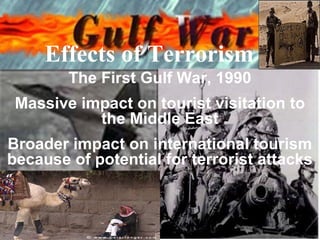
        The First Gulf War, 1990
 Massive impact on tourist visitation to
           the Middle East
Broader impact on international tourism
because of potential for terrorist attacks
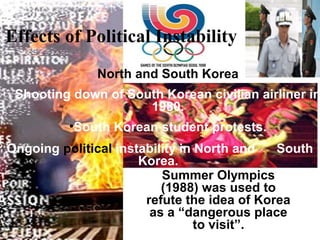
Effects of Political Instability
              North and South Korea
 Shooting down of South Korean civilian airliner in
                     1980.
          •South Korean student protests.
Ongoing political instability in North and   South
                      Korea.
                          Summer Olympics
                          (1988) was used to
                       refute the idea of Korea
                        as a “dangerous place
                                 to visit”.
Tourism as a Political Objective :
      Arab and Israeli ideology
 •So far, Tourism has been passively affected by
                 political events
 •The direct involvement of tourism in the
         battle of political ideology
  •The ongoing conflict Israel v Palestine
•Not only economical and street conflict, but
      political competition (Kobi, 2004)
 •Israel = promotion of own image through
tourism, stimulate Zionist view of Palestine
•Palestine = Promotion of a distinctly Arab-
          oriented image of Israel
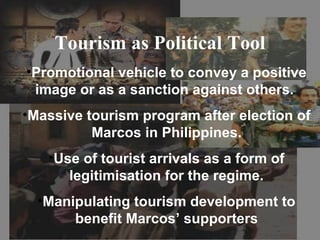
Tourism as Political Tool
•Promotional vehicle to convey a positive
 image or as a sanction against others.
•Massive tourism program after election of
          Marcos in Philippines.
   •Use of tourist arrivals as a form of
      legitimisation for the regime.
  •Manipulating tourism development to
       benefit Marcos’ supporters
Tourism for Political
        Objectives the backlash
  •Bombing attempt on Marcos at 1980
  American Society of Travel Agents
  Conference.
•Bombing attempt resulted in a dramatic
reduction in tourist visitation from the USA.
•Misuse of tourist infrastructure caused spill-
over effects such as enormous inflation,
housing shortages, energy and water
shortages, and mass prostitution.
THE INFLUENCE OF GOVERNMENT
           TRAVEL ADVISORIES
• Western governments issue regular travel
advisories for their citizens warning them of risks in
travelling to certain destinations.
•Governments can and do exert political pressure
through tourism and use it as a promotional vehicle
to convey a positive image or as a sanction against
unfriendly countries.
•The tourist may take into account the perceived risk
of travelling to destinations that receive government
warnings, and therefore choose not to travel or may
alter the travel destination..
Summary
• Political instability and war can increase the
perception of risk at a destination
Political instability generates negative
publicity, which results in an inevitable
decrease in tourist arrivals
• Risk perception can influence tourist
decision-making and destinations can be
severely affected.
• Policymakers from tourism destination
countries need to be aware of how political
instability is perceived
Conclusion
Despite the considerable body of evidence on the
effects of political instability on both tourism income
and potential for negative social and cultural
outcomes, tourism management courses do not
include any serious discussion of international
politics and its influence on tourism. This paper,
which is part of an ongoing research into risk
management in tourism, attempts to address that by
discussing the ways in which the political nature of
tourism can be incorporated into tourism
management subjects, particularly at postgraduate
level.
Thank you!

Tourim and Politic

  • 1.
    Political instability andits effects on Tourism
  • 2.
    Abstract According to Poirier(2000) tourism today is second only to oil as the world’s leading export commodity, accounting for global earnings of more than $300 billion, or nearly 25 per cent of total world GNP. Over the last two decades, tourism has proved to be the world’s fastest growing economic sector, with average growth of 7.1 per cent per year in arrivals and 12.5 per cent in receipts. Despite these statistics, tourism growth in many countries has not been this high, in particular those countries confronted with various political instabilities that have caused to retard development in tourism.
  • 3.
    This paper willexamine • How tourism can be used as a tool for political and ideological goals. • How tourism reform occurs in industries within politically troubled nations. • How tourism can be moulded by the political purpose.
  • 4.
    Introduction – Political stability and political relations influences the image of destinations in tourist-generating regions (Hall and O’Sullivan,1996) – Media portrayal: books, magazines, newspapers, satellite and cable links has a substantial influence. – Examples of political strife that cause problematic concerns in the attraction of visitors are: • Warfare • coups • political strikes or protests “Any evidence of domestic turmoil is likely to result in a decision not to visit that country. “ Ankomah and Crompton (1990, p19)
  • 5.
    What is PoliticalInstability? • “Political instability is described as a condition of a country where a government has been toppled, or is controlled by factions following a coup, or where basic functional pre-requisites for social-order control and maintenance are unstable and periodically disrupted” (Cook 1990). • Multifaceted and complex character • Impact in various countries worldwide is multilevel and multidimensional.
  • 6.
    Relationship between politics and tourism • “The political aspects of tourism are interwoven with its economic consequences…tourism is not only a “continuation of politics” but an integral part of the world’s political economy. In short, tourism is, or can be, a tool used not only for economic but for political means” (Edgell, 1990).
  • 7.
    The Reasons Behindthe Neglect Unwillingness on the part of many decision makers both in government and in the private sector to acknowledge the political nature of tourism. - Lack of official interest in conducting research into the politics of tourism. - Tourism not regarded as a serious scholarly subject. -“ Tourism is by now too important and a pervasive activity for governments to ignore.” (Hughes 1984).
  • 8.
    Has tourism beenaffected by political instability? Effects of Political violence China - Tiananmen Square, June 4 1989 • Prime time news coverage showed army tanks threatening the civilian population. • After the the Tianamen Square incident Hotel occupancy rates in Beijing dipped below 30 per cent. • Tourism earnings declined by $430 million in 1989 alone.
  • 9.
    Effects of MilitaryCoups Fiji - 1987: As a result of a mainly non- Fijian government being elected. • Two military coups occurred within four months. • Qantas imposed a two-month ban on flights to Fiji, following the hijacking attempt of an Air New Zealand Boeing 747. • Travel Insurance cover was withdrawn after negative Australian government travel advice.
  • 10.
    Effects of Revolutions •Ejtrcito Zapatista de Liberacion National (EZLN) initiated an armed rebellion against the Mexican government. • The revolution resulted in 145 to 500 deaths (figures vary depending on the source). • 1994 visitation to Mexico dropped by 70 per cent.
  • 11.
    Effects of CivilWar Yugoslavia – 1991, Army attacks Slovenia •Conflict continued for 10 days before moving to Croatia in 1991, and Bosnia-Herzegovina in1992 •Tour operators for Yugoslavia lost over one million bookings in 1991 •Two years after the war, figures for Slovenian tourism are still far behind pre-war figures.
  • 12.
    Effects of CivilWar Sub Saharan Africa  •Zimbabwe (formerly southern Rhodesia) was the scene of a fifteen years Liberation War of Attrition between Africans and white settlers. The most extensive of Sub-Saharan colonial wars was fought in Angola, Mozambique and Guinea Bissau . Nigeria had five successful coups since gaining independence in the 1960’ •In total, more than 20 major wars have taken place on the sub- Saharan region of Africa since the 1960s (Ankomah and Crompton 1990, p19).
  • 13.
    Effects of CivilWar • IPRA targets included senior British government officials, British military and police • Visitor arrivals fell from a 1967 peak of 1,080,000 to 321,000 in 1976 • Ceasefire which began on August 31 1994 was observed until February 9 1996 when a bomb exploded in London killing two bystanders and injuring 43 people • 18-month cease-fire recorded a 59 per cent increase (from previous year) in inquiries, 11 per cent increase in hotel occupancy, 18 per cent increase with out-of-state visitors, and a 68 per cent increase in holiday visitors.
  • 14.
    Effects of Terrorism Turkey – 1974, PKK Seeks to Establish Southeastern Marxist State •Kurdistan Worker’s Party specifically targeted Turkey’s tourism industry between 1991 and 1996. •Bombed tourist sites, hotels and kidnapped foreign tourists. •Foreign visitor arrivals dropped eight per cent from 1992-1993 •After self-imposed ceasefire, international arrivals reached record levels (9.5 million) in 1996.
  • 15.
    Effects of Terrorism Peru –Formation of Maoist Terrorist Group •Aim of replacing existing Peruvian institutions with a peasant revolutionary regime. •Attacks led to a steep decline in tourism from 350,000 international visitors in 1989 to 33,000 in 1991.
  • 16.
    Effects of Terrorism Egypt– Late 1970s, Islamic Extremist Group Activity •Egyptian Islamic extremist group works toward establishing an Islamic state •Specifically targeted and launched attacks against Egypt’s tourism industry since 1992. •Egypt removed from programs of international tour operators •Experienced a 22 per cent drop in international visitors, 30 per cent drop in tourist nights and 43 per cent decrease in tourism receipts.
  • 17.
    Effects of Terrorism The First Gulf War, 1990 Massive impact on tourist visitation to the Middle East Broader impact on international tourism because of potential for terrorist attacks
  • 18.
    Effects of PoliticalInstability North and South Korea Shooting down of South Korean civilian airliner in 1980. •South Korean student protests. Ongoing political instability in North and South Korea. Summer Olympics (1988) was used to refute the idea of Korea as a “dangerous place to visit”.
  • 19.
    Tourism as aPolitical Objective : Arab and Israeli ideology •So far, Tourism has been passively affected by political events •The direct involvement of tourism in the battle of political ideology •The ongoing conflict Israel v Palestine •Not only economical and street conflict, but political competition (Kobi, 2004) •Israel = promotion of own image through tourism, stimulate Zionist view of Palestine •Palestine = Promotion of a distinctly Arab- oriented image of Israel
  • 20.
    Tourism as PoliticalTool •Promotional vehicle to convey a positive image or as a sanction against others. •Massive tourism program after election of Marcos in Philippines. •Use of tourist arrivals as a form of legitimisation for the regime. •Manipulating tourism development to benefit Marcos’ supporters
  • 21.
    Tourism for Political Objectives the backlash •Bombing attempt on Marcos at 1980 American Society of Travel Agents Conference. •Bombing attempt resulted in a dramatic reduction in tourist visitation from the USA. •Misuse of tourist infrastructure caused spill- over effects such as enormous inflation, housing shortages, energy and water shortages, and mass prostitution.
  • 22.
    THE INFLUENCE OFGOVERNMENT TRAVEL ADVISORIES • Western governments issue regular travel advisories for their citizens warning them of risks in travelling to certain destinations. •Governments can and do exert political pressure through tourism and use it as a promotional vehicle to convey a positive image or as a sanction against unfriendly countries. •The tourist may take into account the perceived risk of travelling to destinations that receive government warnings, and therefore choose not to travel or may alter the travel destination..
  • 23.
    Summary • Political instabilityand war can increase the perception of risk at a destination Political instability generates negative publicity, which results in an inevitable decrease in tourist arrivals • Risk perception can influence tourist decision-making and destinations can be severely affected. • Policymakers from tourism destination countries need to be aware of how political instability is perceived
  • 24.
    Conclusion Despite the considerablebody of evidence on the effects of political instability on both tourism income and potential for negative social and cultural outcomes, tourism management courses do not include any serious discussion of international politics and its influence on tourism. This paper, which is part of an ongoing research into risk management in tourism, attempts to address that by discussing the ways in which the political nature of tourism can be incorporated into tourism management subjects, particularly at postgraduate level.
  • 25.