
Cascante Caballero Walter
Bachelor’s Degree in International
Hospitality and Tourism Management
The Political Factors influencing Tourism
Kenya
 Literature review
 Relationship between Tourism and politics
 What is the role of the government in Tourism
 Evaluating policies and decision making by Governments
 Political instability
 Methodology
 Data Analysis and type of Data used to the findings
 Findings and Analysis
 Kenya Overview
 Politics, Government and tourism in Kenya in the last 10 years of the 21st
century
 Evaluating Policies and decision making in two periods (2002-2007) and
(2008-20012)
 To evaluate how influential political instability is on the tourism industry in
Kenya.
 Conclusion
Contents
Introduction
Aim
 To evaluate, the political factors influencing tourism
especially in Kenya, in the first decade of the 21st
century.
Objectives
 To understand the relationship between tourism and
politics.
 To examine the position of the government in the
tourism sector in Kenya.
 To analyze the tourism policy-making
 To evaluate how political instability influences tourism
in Kenya
Relationship between
Tourism and politics
• The relationship between politics and tourism are higlight in
nowadays by the economics importance in developing countries.
• The tourism industry is widespread in majorities of productive
sectors
• the political system, directly or indirectly influences tourism,
through policies established by governments in order to develop
the country.
• The highest purpose of tourism policy is to integrate the economic,
political, cultural, and intellectual and economics benefits of
tourism cohesively with people, destinations and countries.
• Then it is palpable that politics and tourism share a wide range of
factors such as social, economic, political and cultural, in a country.
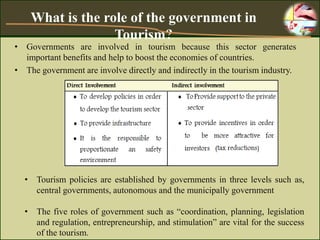
• Governments are involved in tourism because this sector generates
important benefits and help to boost the economies of countries.
• The government are involve directly and indirectly in the tourism industry.
What is the role of the government in
Tourism?
• Tourism policies are established by governments in three levels such as,
central governments, autonomous and the municipally government
• The five roles of government such as “coordination, planning, legislation
and regulation, entrepreneurship, and stimulation” are vital for the success
of the tourism.
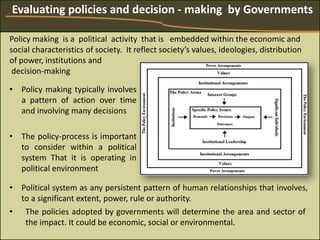
• Policy making typically involves
a pattern of action over time
and involving many decisions
• The policy-process is important
to consider within a political
system That it is operating in
political environment
Evaluating policies and decision - making by Governments
Policy making is a political activity that is embedded within the economic and
social characteristics of society. It reflect society’s values, ideologies, distribution
of power, institutions and
decision-making
• The policies adopted by governments will determine the area and sector of
the impact. It could be economic, social or environmental.
• Political system as any persistent pattern of human relationships that involves,
to a significant extent, power, rule or authority.
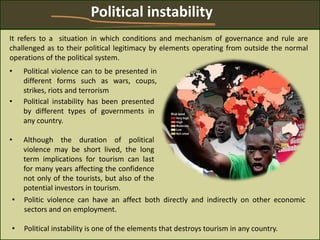
• Political violence can to be presented in
different forms such as wars, coups,
strikes, riots and terrorism
Political instability
• Political instability has been presented
by different types of governments in
any country.
• Although the duration of political
violence may be short lived, the long
term implications for tourism can last
for many years affecting the confidence
not only of the tourists, but also of the
potential investors in tourism.
It refers to a situation in which conditions and mechanism of governance and rule are
challenged as to their political legitimacy by elements operating from outside the normal
operations of the political system.
• Politic violence can have an affect both directly and indirectly on other economic
sectors and on employment.
• Political instability is one of the elements that destroys tourism in any country.
Methodology
Data Analysis
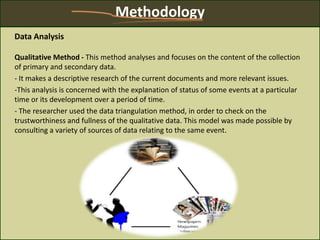
Qualitative Method - This method analyses and focuses on the content of the collection
of primary and secondary data.
- It makes a descriptive research of the current documents and more relevant issues.
-This analysis is concerned with the explanation of status of some events at a particular
time or its development over a period of time.
- The researcher used the data triangulation method, in order to check on the
trustworthiness and fullness of the qualitative data. This model was made possible by
consulting a variety of sources of data relating to the same event.
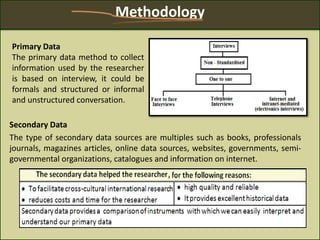
Secondary Data
The type of secondary data sources are multiples such as books, professionals
journals, magazines articles, online data sources, websites, governments, semi-
governmental organizations, catalogues and information on internet.
Methodology
Primary Data
The primary data method to collect
information used by the researcher
is based on interview, it could be
formals and structured or informal
and unstructured conversation.
Politics, Government and tourism in Kenya in the first decade of 21st century
• Tourism was viewed by government of Kenya as a capitalist device. Similarly,
the opinion has one’ of the interviewees, who states that in Kenya the tourism
was viewed by the government as an important contributor in the economy.
• Tourism is viewed by Kenyan government as a political bridge between nations,
this helps to improve relations, made agreements between countries (2001 to
2005, the second agreement called East African Community (EAC) was signed)
• the Plan launched by the government of Kenya in 2003, called “Economic
Recovery Strategy for Wealth and Employment Creation (2003-2007)”, where
tourism was seen as a productive sector by the government. It was due its high
economic multiplier effect in others sectors such as transport, entertainment,
agriculture, trade and industry
• the government of Kenya plays an important role in tourism through the
ministry of tourism, which promotes this sector.
FINDINGS AND ANALYSIS
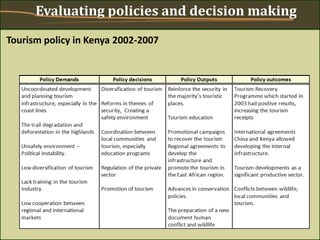
Evaluating policies and decision making
Tourism policy in Kenya 2002-2007
Evaluating policies and decision making
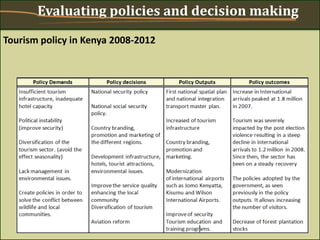
Tourism policy in Kenya 2008-2012
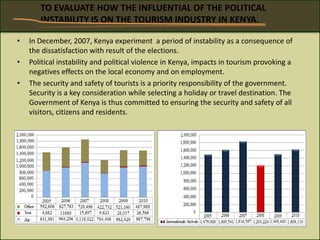
• In December, 2007, Kenya experiment a period of instability as a consequence of
the dissatisfaction with result of the elections.
• Political instability and political violence in Kenya, impacts in tourism provoking a
negatives effects on the local economy and on employment.
• The security and safety of tourists is a priority responsibility of the government.
Security is a key consideration while selecting a holiday or travel destination. The
Government of Kenya is thus committed to ensuring the security and safety of all
visitors, citizens and residents.
TO EVALUATE HOW THE INFLUENTIAL OF THE POLITICAL
INSTABILITY IS ON THE TOURISM INDUSTRY IN KENYA.
CONCLUSION
• 2002 -2007, it was a period characterized by an economic recovery.
• 2008 -2012, It was focuses in economic aspects, social, environment, wildlife,
security and political factors.
• The role of the government was integrated different organization, ministries and
local communities in order to develop appropriate policies for tourism sector.
• Kenyan Government combines its resources such as human, financial and
physics. All of these in order to formulate policies to satisfy demands, that it
consider more important to improve the tourism sector.
• It is evident the implication of government within tourism, who use this sector as
a medium to reduce the poverty, create new jobs, improve quality of live of the
people and the economy of Kenya
• there is a big political influence in tourism in Kenya, because all political
environments affect the tourism directly or indirectly. It on base on the decisions
made affect positive or negative the tourism, but is clear that the governments
are who identify the necessities of the sector In order to improve, it is necessary
the coordination a correct planning to execute a accurate policy in order to solve
the weakness of this sector
Thanks

Presentacion final uem

  • 1.
    Cascante Caballero Walter Bachelor’sDegree in International Hospitality and Tourism Management The Political Factors influencing Tourism Kenya
  • 2.
     Literature review Relationship between Tourism and politics  What is the role of the government in Tourism  Evaluating policies and decision making by Governments  Political instability  Methodology  Data Analysis and type of Data used to the findings  Findings and Analysis  Kenya Overview  Politics, Government and tourism in Kenya in the last 10 years of the 21st century  Evaluating Policies and decision making in two periods (2002-2007) and (2008-20012)  To evaluate how influential political instability is on the tourism industry in Kenya.  Conclusion Contents
  • 3.
    Introduction Aim  To evaluate,the political factors influencing tourism especially in Kenya, in the first decade of the 21st century. Objectives  To understand the relationship between tourism and politics.  To examine the position of the government in the tourism sector in Kenya.  To analyze the tourism policy-making  To evaluate how political instability influences tourism in Kenya
  • 4.
    Relationship between Tourism andpolitics • The relationship between politics and tourism are higlight in nowadays by the economics importance in developing countries. • The tourism industry is widespread in majorities of productive sectors • the political system, directly or indirectly influences tourism, through policies established by governments in order to develop the country. • The highest purpose of tourism policy is to integrate the economic, political, cultural, and intellectual and economics benefits of tourism cohesively with people, destinations and countries. • Then it is palpable that politics and tourism share a wide range of factors such as social, economic, political and cultural, in a country.
  • 5.
    • Governments areinvolved in tourism because this sector generates important benefits and help to boost the economies of countries. • The government are involve directly and indirectly in the tourism industry. What is the role of the government in Tourism? • Tourism policies are established by governments in three levels such as, central governments, autonomous and the municipally government • The five roles of government such as “coordination, planning, legislation and regulation, entrepreneurship, and stimulation” are vital for the success of the tourism.
  • 6.
    • Policy makingtypically involves a pattern of action over time and involving many decisions • The policy-process is important to consider within a political system That it is operating in political environment Evaluating policies and decision - making by Governments Policy making is a political activity that is embedded within the economic and social characteristics of society. It reflect society’s values, ideologies, distribution of power, institutions and decision-making • The policies adopted by governments will determine the area and sector of the impact. It could be economic, social or environmental. • Political system as any persistent pattern of human relationships that involves, to a significant extent, power, rule or authority.
  • 7.
    • Political violencecan to be presented in different forms such as wars, coups, strikes, riots and terrorism Political instability • Political instability has been presented by different types of governments in any country. • Although the duration of political violence may be short lived, the long term implications for tourism can last for many years affecting the confidence not only of the tourists, but also of the potential investors in tourism. It refers to a situation in which conditions and mechanism of governance and rule are challenged as to their political legitimacy by elements operating from outside the normal operations of the political system. • Politic violence can have an affect both directly and indirectly on other economic sectors and on employment. • Political instability is one of the elements that destroys tourism in any country.
  • 8.
    Methodology Data Analysis Qualitative Method- This method analyses and focuses on the content of the collection of primary and secondary data. - It makes a descriptive research of the current documents and more relevant issues. -This analysis is concerned with the explanation of status of some events at a particular time or its development over a period of time. - The researcher used the data triangulation method, in order to check on the trustworthiness and fullness of the qualitative data. This model was made possible by consulting a variety of sources of data relating to the same event.
  • 9.
    Secondary Data The typeof secondary data sources are multiples such as books, professionals journals, magazines articles, online data sources, websites, governments, semi- governmental organizations, catalogues and information on internet. Methodology Primary Data The primary data method to collect information used by the researcher is based on interview, it could be formals and structured or informal and unstructured conversation.
  • 10.
    Politics, Government andtourism in Kenya in the first decade of 21st century • Tourism was viewed by government of Kenya as a capitalist device. Similarly, the opinion has one’ of the interviewees, who states that in Kenya the tourism was viewed by the government as an important contributor in the economy. • Tourism is viewed by Kenyan government as a political bridge between nations, this helps to improve relations, made agreements between countries (2001 to 2005, the second agreement called East African Community (EAC) was signed) • the Plan launched by the government of Kenya in 2003, called “Economic Recovery Strategy for Wealth and Employment Creation (2003-2007)”, where tourism was seen as a productive sector by the government. It was due its high economic multiplier effect in others sectors such as transport, entertainment, agriculture, trade and industry • the government of Kenya plays an important role in tourism through the ministry of tourism, which promotes this sector. FINDINGS AND ANALYSIS
  • 11.
    Evaluating policies anddecision making Tourism policy in Kenya 2002-2007
  • 12.
    Evaluating policies anddecision making Tourism policy in Kenya 2008-2012
  • 13.
    • In December,2007, Kenya experiment a period of instability as a consequence of the dissatisfaction with result of the elections. • Political instability and political violence in Kenya, impacts in tourism provoking a negatives effects on the local economy and on employment. • The security and safety of tourists is a priority responsibility of the government. Security is a key consideration while selecting a holiday or travel destination. The Government of Kenya is thus committed to ensuring the security and safety of all visitors, citizens and residents. TO EVALUATE HOW THE INFLUENTIAL OF THE POLITICAL INSTABILITY IS ON THE TOURISM INDUSTRY IN KENYA.
  • 14.
    CONCLUSION • 2002 -2007,it was a period characterized by an economic recovery. • 2008 -2012, It was focuses in economic aspects, social, environment, wildlife, security and political factors. • The role of the government was integrated different organization, ministries and local communities in order to develop appropriate policies for tourism sector. • Kenyan Government combines its resources such as human, financial and physics. All of these in order to formulate policies to satisfy demands, that it consider more important to improve the tourism sector. • It is evident the implication of government within tourism, who use this sector as a medium to reduce the poverty, create new jobs, improve quality of live of the people and the economy of Kenya • there is a big political influence in tourism in Kenya, because all political environments affect the tourism directly or indirectly. It on base on the decisions made affect positive or negative the tourism, but is clear that the governments are who identify the necessities of the sector In order to improve, it is necessary the coordination a correct planning to execute a accurate policy in order to solve the weakness of this sector
  • 15.

Editor's Notes

  • #6 The government fully recognizes the great economic and employment contribution and potential of tourism and seeks to encourage the development, growth and international competitiveness of the UK tourism industry”. Elliot 1997Tourism economic activity is seen as a multiplier effect helping other sectors of the economy. Tourism and notes the value of supporting this industry, because it is helping to alleviate poverty and to create employment and other opportunities for people in the country
  • #7 The researcher notes that it is evident that policy- making in tourism, has a widespread effect on economic, social, environmental and political actions, in countries where these have been applied. The development of policies for tourism, both short-term and long-term, will however depend on the actors that are immersed in decision-making policies. Political system can be liberal, democratic or totalitarian, but in practice all types of governments have supported or sponsored tourism
  • #8 , Hall (2005) suggests that governments are stable when they are able to adapt and satisfy the demands of the external elements within a political system. In contrast when the governments are unable to satisfy the demands and to adapt to the challenges of the external forces then political instability occurs
  • #10 On the other hand (Healey, 1991; Healey and Rawilson, 1993; cited in Saunders et al., 2007, p, 312) suggest other typology of interview, differentiating between standardised interview and non standardised interview, but both help to gather valid and reliable data relevant to the research.The researcher decided to use an unstructured interview because it is more exploratory, according to Saunders et al,. (2007) this type of interview is informal, and is generally used to explore in depth general areas in which the researcher is interested (see in fig.6 Interview is a purposeful discussion between two or more people that can help you gather valid and reliable data that is relevant to your research objectives (Kahn and Cannell, 1957 cited in Saunders et al., 2007, p. 310)
  • #11 This strategy allowed cooperates between the members in the public and private sector, all of this to coordinate and develop a strategy focussed to promote the marketing of quality tourismThe East African Community (EAC) is the regional intergovernmental organisation of the Republics of Kenya, Uganda, the United Republic of Tanzania, Republic of Rwanda and Republic of Burundi with its headquarters in Arusha, Tanzania