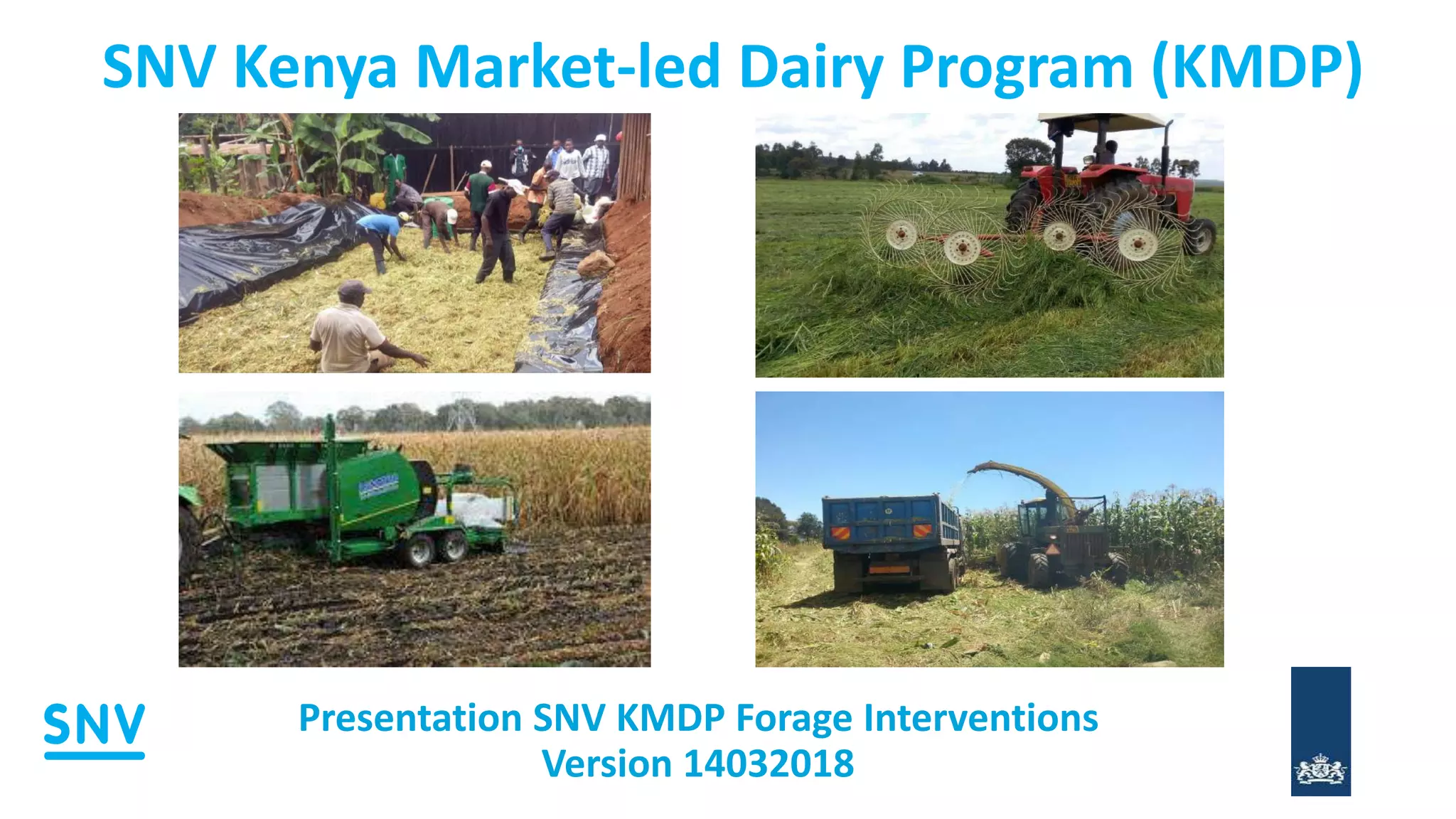
SNV Kenya Market-led Dairy Program (KMDP)
Presentation SNV KMDP Forage Interventions
Version 14032018
SNV Kenya Market-led
Dairy Programme
Funded by the Embassy of the Kingdom of the
Netherlands in Nairobi
Implemented by SNV – Kenya
Phase 1: July 2012 – December 2016
Phase 2: October 2016 – June 2019
3R Project Kenya – Wageningen University Research
and Kenyan Universities: Documentation of KMDP
fodder interventions (a.o.)
SNV Kenya Market-led Dairy
Programme
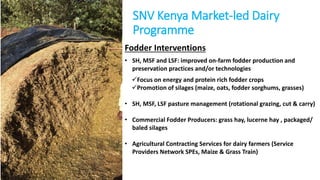
Fodder Interventions
• SH, MSF and LSF: improved on-farm fodder production and
preservation practices and/or technologies
Focus on energy and protein rich fodder crops
Promotion of silages (maize, oats, fodder sorghums, grasses)
• SH, MSF, LSF pasture management (rotational grazing, cut & carry)
• Commercial Fodder Producers: grass hay, lucerne hay , packaged/
baled silages
• Agricultural Contracting Services for dairy farmers (Service
Providers Network SPEs, Maize & Grass Train)
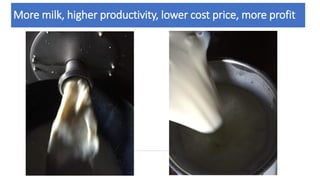
More milk, higher productivity, lower cost price, more profit
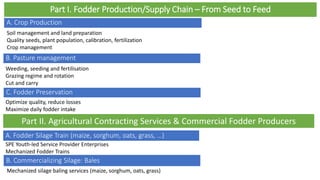
Part I. Fodder Production/Supply Chain – From Seed to Feed
A. Crop Production
C. Fodder Preservation
Soil management and land preparation
Quality seeds, plant population, calibration, fertilization
Crop management
Optimize quality, reduce losses
Maximize daily fodder intake
A. Fodder Silage Train (maize, sorghum, oats, grass, …)
B. Commercializing Silage: Bales
Part II. Agricultural Contracting Services & Commercial Fodder Producers
SPE Youth-led Service Provider Enterprises
Mechanized Fodder Trains
Mechanized silage baling services (maize, sorghum, oats, grass)
B. Pasture management
Weeding, seeding and fertilisation
Grazing regime and rotation
Cut and carry
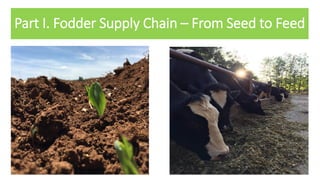
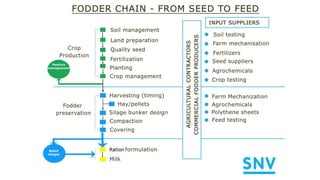
Part I. Fodder Supply Chain – From Seed to Feed
A. Crop Production: Total Yield = Quantity + Quality
Factors influencing yield:
• Soil management
• Land preparation
• Quality seeds
• Plant population (calibration / fertilization)
• Weather
• Crop management
• Discipline
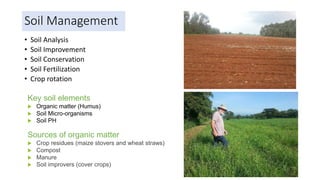
Soil Management
• Soil Analysis
• Soil Improvement
• Soil Conservation
• Soil Fertilization
• Crop rotation
Key soil elements
 Organic matter (Humus)
 Soil Micro-organisms
 Soil PH
Sources of organic matter
 Crop residues (maize stovers and wheat straws)
 Compost
 Manure
 Soil improvers (cover crops)
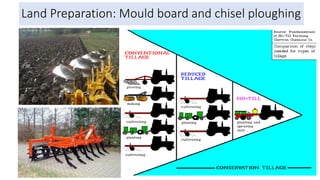
Land Preparation: Mould board and chisel ploughing
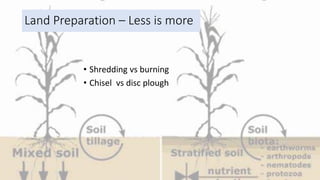
Land Preparation – Less is more
• Shredding vs burning
• Chisel vs disc plough
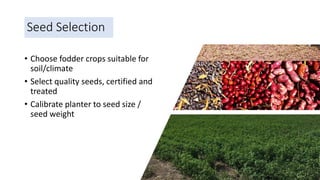
Seed Selection
• Choose fodder crops suitable for
soil/climate
• Select quality seeds, certified and
treated
• Calibrate planter to seed size /
seed weight
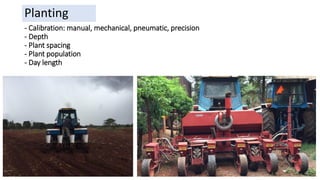
- Calibration: manual, mechanical, pneumatic, precision
- Depth
- Plant spacing
- Plant population
- Day length
Planting
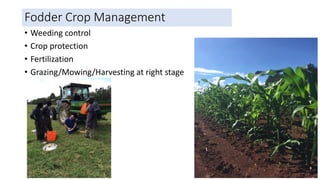
Fodder Crop Management
• Weeding control
• Crop protection
• Fertilization
• Grazing/Mowing/Harvesting at right stage
• Clearing of shrubs, weeds, stones, stubbles and levelling
• Before start of rainy season spread cow dung in the field with harrow
• Mowing (gyro-mower)
• Fertilisation (manure, top dressing CAN, minimum 50 kgs N/hectare)
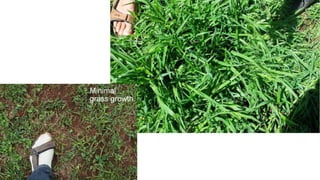
• The aim is to get a very thick and dense grass cover
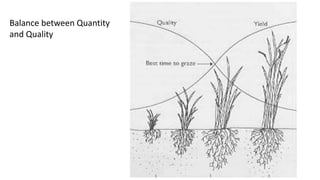
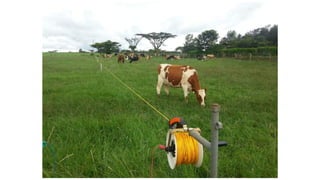
• Grazing: grasses to grow up to 15-17 cms, allow cows to enter,
use paddock system for rotational grazing (refertilize after 2 grazings)
• Cut-and-carry: 23 cms and Silage: 35 cms
• Manure and CAN application directly after silage making
B. Pasture Management (Rehabilitation)
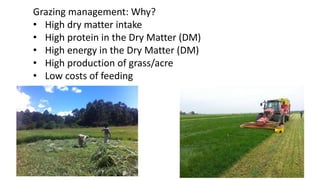
Grazing management: Why?
• High dry matter intake
• High protein in the Dry Matter (DM)
• High energy in the Dry Matter (DM)
• High production of grass/acre
• Low costs of feeding
Balance between Quantity
and Quality
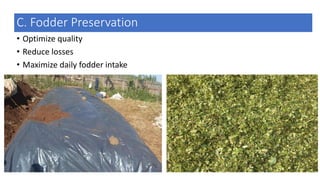
C. Fodder Preservation
• Optimize quality
• Reduce losses
• Maximize daily fodder intake
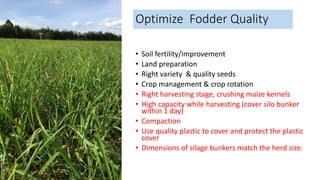
Optimize Fodder Quality
• Soil fertility/improvement
• Land preparation
• Right variety & quality seeds
• Crop management & crop rotation
• Right harvesting stage, crushing maize kernels
• High capacity while harvesting (cover silo bunker
within 1 day)
• Compaction
• Use quality plastic to cover and protect the plastic
cover
• Dimensions of silage bunkers match the herd size.
Reduce Losses
• While harvesting
• Capacity while harvesting
• Covering silage clamp/bunker within 1 day
• Protect plastic; not to be damaged
• Dimensions of silage clamp / bunker
• Feeding speed ( 1 meter/week)
• Avoid moulds and heating of silage
• Palatable / Quality silage increases daily feed intake, reducing losses
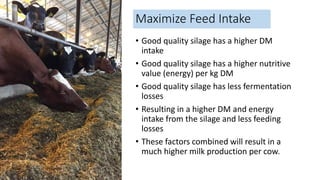
Maximize Feed Intake
• Good quality silage has a higher DM
intake
• Good quality silage has a higher nutritive
value (energy) per kg DM
• Good quality silage has less fermentation
losses
• Resulting in a higher DM and energy
intake from the silage and less feeding
losses
• These factors combined will result in a
much higher milk production per cow.
25
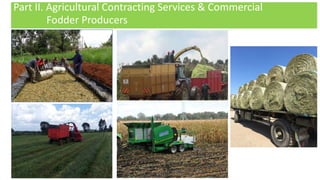
Part II. Agricultural Contracting Services & Commercial
Fodder Producers
A. Fodder Silage Train (maize, sorghum, oats, grass, …)
• Specialized fodder production and preservation services for SHs, MSFs, LSFs
• From semi-manual (SPE) to fully mechanized 1-6 row forage harvesters
• From Seed to Feed:
Soil management
Crop management
Harvesting, chopping and crushing
Ensiling: high capacity (1-6 row forage harvesters), compaction
• Increasing fodder security and reduced seasonal fluctuations
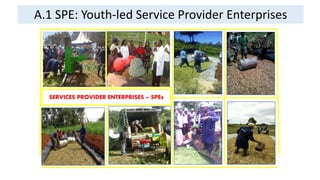
SERVICES PROVIDER ENTERPRISES – SPEs
A.1 SPE: Youth-led Service Provider Enterprises
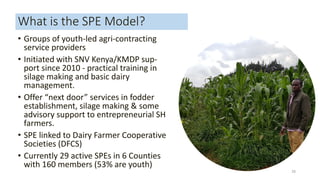
What is the SPE Model?
• Groups of youth-led agri-contracting
service providers
• Initiated with SNV Kenya/KMDP sup-
port since 2010 - practical training in
silage making and basic dairy
management.
• Offer “next door” services in fodder
establishment, silage making & some
advisory support to entrepreneurial SH
farmers.
• SPE linked to Dairy Farmer Cooperative
Societies (DFCS)
• Currently 29 active SPEs in 6 Counties
with 160 members (53% are youth)
28
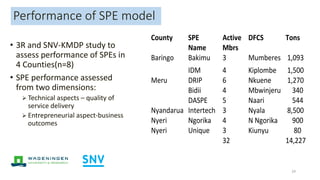
Performance of SPE model
• 3R and SNV-KMDP study to
assess performance of SPEs in
4 Counties(n=8)
• SPE performance assessed
from two dimensions:
 Technical aspects – quality of
service delivery
 Entrepreneurial aspect-business
outcomes
29
County SPE
Name
Active
Mbrs
DFCS Tons
Baringo Bakimu 3 Mumberes 1,093
IDM 4 Kiplombe 1,500
Meru DRIP 6 Nkuene 1,270
Bidii 4 Mbwinjeru 340
DASPE 5 Naari 544
Nyandarua Intertech 3 Nyala 8,500
Nyeri Ngorika 4 N Ngorika 900
Nyeri Unique 3 Kiunyu 80
32 14,227
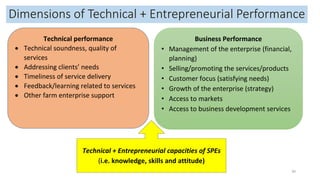
Dimensions of Technical + Entrepreneurial Performance
30
Technical performance
 Technical soundness, quality of
services
 Addressing clients’ needs
 Timeliness of service delivery
 Feedback/learning related to services
 Other farm enterprise support
Business Performance
• Management of the enterprise (financial,
planning)
• Selling/promoting the services/products
• Customer focus (satisfying needs)
• Growth of the enterprise (strategy)
• Access to markets
• Access to business development services
Technical + Entrepreneurial capacities of SPEs
(i.e. knowledge, skills and attitude)
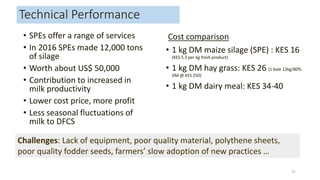
Technical Performance
• SPEs offer a range of services
• In 2016 SPEs made 12,000 tons
of silage
• Worth about US$ 50,000
• Contribution to increased in
milk productivity
• Lower cost price, more profit
• Less seasonal fluctuations of
milk to DFCS
Cost comparison
• 1 kg DM maize silage (SPE) : KES 16
(KES 5.3 per kg fresh product)
• 1 kg DM hay grass: KES 26 (1 bale 12kg/80%
DM @ KES 250)
• 1 kg DM dairy meal: KES 34-40
31
Challenges: Lack of equipment, poor quality material, polythene sheets,
poor quality fodder seeds, farmers’ slow adoption of new practices …
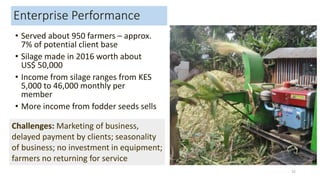
Enterprise Performance
• Served about 950 farmers – approx.
7% of potential client base
• Silage made in 2016 worth about
US$ 50,000
• Income from silage ranges from KES
5,000 to 46,000 monthly per
member
• More income from fodder seeds sells
32
Challenges: Marketing of business,
delayed payment by clients; seasonality
of business; no investment in equipment;
farmers no returning for service
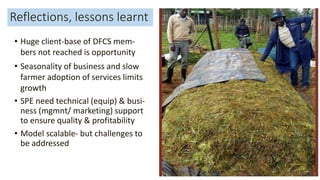
Reflections, lessons learnt
• Huge client-base of DFCS mem-
bers not reached is opportunity
• Seasonality of business and slow
farmer adoption of services limits
growth
• SPE need technical (equip) & busi-
ness (mgmnt/ marketing) support
to ensure quality & profitability
• Model scalable- but challenges to
be addressed
33
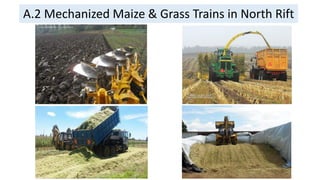
A.2 Mechanized Maize & Grass Trains in North Rift
35
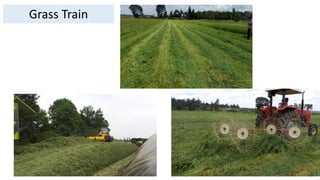
Grass Train
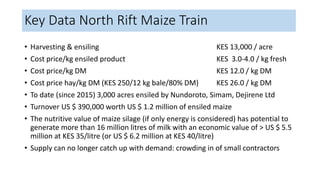
Key Data North Rift Maize Train
• Harvesting & ensiling KES 13,000 / acre
• Cost price/kg ensiled product KES 3.0-4.0 / kg fresh
• Cost price/kg DM KES 12.0 / kg DM
• Cost price hay/kg DM (KES 250/12 kg bale/80% DM) KES 26.0 / kg DM
• To date (since 2015) 3,000 acres ensiled by Nundoroto, Simam, Dejirene Ltd
• Turnover US $ 390,000 worth US $ 1.2 million of ensiled maize
• The nutritive value of maize silage (if only energy is considered) has potential to
generate more than 16 million litres of milk with an economic value of > US $ 5.5
million at KES 35/litre (or US $ 6.2 million at KES 40/litre)
• Supply can no longer catch up with demand: crowding in of small contractors
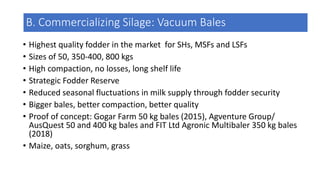
B. Commercializing Silage: Vacuum Bales
• Highest quality fodder in the market for SHs, MSFs and LSFs
• Sizes of 50, 350-400, 800 kgs
• High compaction, no losses, long shelf life
• Strategic Fodder Reserve
• Reduced seasonal fluctuations in milk supply through fodder security
• Bigger bales, better compaction, better quality
• Proof of concept: Gogar Farm 50 kg bales (2015), Agventure Group/
AusQuest 50 and 400 kg bales and FIT Ltd Agronic Multibaler 350 kg bales
(2018)
• Maize, oats, sorghum, grass
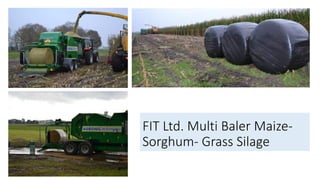
FIT Ltd. Multi Baler Maize-
Sorghum- Grass Silage
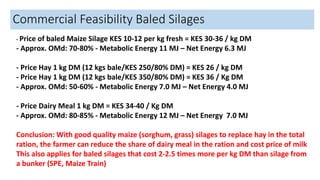
- Price of baled Maize Silage KES 10-12 per kg fresh = KES 30-36 / kg DM
- Approx. OMd: 70-80% - Metabolic Energy 11 MJ – Net Energy 6.3 MJ
- Price Hay 1 kg DM (12 kgs bale/KES 250/80% DM) = KES 26 / kg DM
- Price Hay 1 kg DM (12 kgs bale/KES 350/80% DM) = KES 36 / Kg DM
- Approx. OMd: 50-60% - Metabolic Energy 7.0 MJ – Net Energy 4.0 MJ
- Price Dairy Meal 1 kg DM = KES 34-40 / Kg DM
- Approx. OMd: 80-85% - Metabolic Energy 12 MJ – Net Energy 7.0 MJ
Conclusion: With good quality maize (sorghum, grass) silages to replace hay in the total
ration, the farmer can reduce the share of dairy meal in the ration and cost price of milk
This also applies for baled silages that cost 2-2.5 times more per kg DM than silage from
a bunker (SPE, Maize Train)
Commercial Feasibility Baled Silages
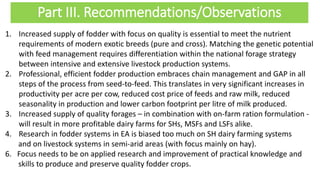
Part III. Recommendations/Observations
1. Increased supply of fodder with focus on quality is essential to meet the nutrient
requirements of modern exotic breeds (pure and cross). Matching the genetic potential
with feed management requires differentiation within the national forage strategy
between intensive and extensive livestock production systems.
2. Professional, efficient fodder production embraces chain management and GAP in all
steps of the process from seed-to-feed. This translates in very significant increases in
productivity per acre per cow, reduced cost price of feeds and raw milk, reduced
seasonality in production and lower carbon footprint per litre of milk produced.
3. Increased supply of quality forages – in combination with on-farm ration formulation -
will result in more profitable dairy farms for SHs, MSFs and LSFs alike.
4. Research in fodder systems in EA is biased too much on SH dairy farming systems
and on livestock systems in semi-arid areas (with focus mainly on hay).
6. Focus needs to be on applied research and improvement of practical knowledge and
skills to produce and preserve quality fodder crops.
III. Recommendations/Observations (c’tnd)
7. Fodder crop production and preservation needs further mechanisation to assure scale,
speed, proper timing, compaction and shelf-life for enhanced quality, nutritive value and
reduction of losses.
8. Government and donors should create a conducive enabling environment for
international fodder seed companies and for private investors in agricultural contracting
and large scale mechanized commercial fodder production (CFP).
9. Focus on CFP business models that add value to the dairy sector and not only assures
high return on investment for the CFP (i.e. current hay market).
10. Better use can be made of available information on agro-ecological zones, climate,
weather data in relation to suitable fodder crops and timing of crop production related
activities during the growing season and harvest.
11. Addressing these issues will bring innovations, create business opportunities, employ-
ment, income, enhanced profitability of the DVC, increased affordability of milk
(products) to consumers, and a more climate smart sector.
SNV Kenya/KMDP & 3R Project Kenya
Feed & Fodder Publications/Reports/Seminars
1. BLGG Feed and Fodder Study (Reports I-VII)
2. Fodder Production and Service Centre (Feasibility Study Report)
3. Fodder Seeds (Survey Report)
4. Fodder Production and Preservation Demos
5. Status Report on Medium Scale Farmers and Commercial Fodder Producers
6. Performance of emerging dairy services agri-enterprises: A case of youth-led
Service Provider Enterprises (SPE), 2018, WUR LR, 3R Project Kenya (plus
video)
7. National Fodder and Agribusiness Conference, December 2018
8. Seminar: Review KMDP PUM forage interventions, December 2017
www.cowsoko.com/KMDP
THANK YOU

SNV-KMDP Forage Interventions in Kenya

  • 1.
    SNV Kenya Market-ledDairy Program (KMDP) Presentation SNV KMDP Forage Interventions Version 14032018
  • 2.
    SNV Kenya Market-led DairyProgramme Funded by the Embassy of the Kingdom of the Netherlands in Nairobi Implemented by SNV – Kenya Phase 1: July 2012 – December 2016 Phase 2: October 2016 – June 2019 3R Project Kenya – Wageningen University Research and Kenyan Universities: Documentation of KMDP fodder interventions (a.o.)
  • 3.
    SNV Kenya Market-ledDairy Programme Fodder Interventions • SH, MSF and LSF: improved on-farm fodder production and preservation practices and/or technologies Focus on energy and protein rich fodder crops Promotion of silages (maize, oats, fodder sorghums, grasses) • SH, MSF, LSF pasture management (rotational grazing, cut & carry) • Commercial Fodder Producers: grass hay, lucerne hay , packaged/ baled silages • Agricultural Contracting Services for dairy farmers (Service Providers Network SPEs, Maize & Grass Train)
  • 4.
    More milk, higherproductivity, lower cost price, more profit
  • 5.
    Part I. FodderProduction/Supply Chain – From Seed to Feed A. Crop Production C. Fodder Preservation Soil management and land preparation Quality seeds, plant population, calibration, fertilization Crop management Optimize quality, reduce losses Maximize daily fodder intake A. Fodder Silage Train (maize, sorghum, oats, grass, …) B. Commercializing Silage: Bales Part II. Agricultural Contracting Services & Commercial Fodder Producers SPE Youth-led Service Provider Enterprises Mechanized Fodder Trains Mechanized silage baling services (maize, sorghum, oats, grass) B. Pasture management Weeding, seeding and fertilisation Grazing regime and rotation Cut and carry
  • 6.
    Part I. FodderSupply Chain – From Seed to Feed
  • 8.
    A. Crop Production:Total Yield = Quantity + Quality Factors influencing yield: • Soil management • Land preparation • Quality seeds • Plant population (calibration / fertilization) • Weather • Crop management • Discipline
  • 9.
    Soil Management • SoilAnalysis • Soil Improvement • Soil Conservation • Soil Fertilization • Crop rotation Key soil elements  Organic matter (Humus)  Soil Micro-organisms  Soil PH Sources of organic matter  Crop residues (maize stovers and wheat straws)  Compost  Manure  Soil improvers (cover crops)
  • 10.
    Land Preparation: Mouldboard and chisel ploughing
  • 11.
    Land Preparation –Less is more • Shredding vs burning • Chisel vs disc plough
  • 12.
    Seed Selection • Choosefodder crops suitable for soil/climate • Select quality seeds, certified and treated • Calibrate planter to seed size / seed weight
  • 13.
    - Calibration: manual,mechanical, pneumatic, precision - Depth - Plant spacing - Plant population - Day length Planting
  • 14.
    Fodder Crop Management •Weeding control • Crop protection • Fertilization • Grazing/Mowing/Harvesting at right stage
  • 15.
    • Clearing ofshrubs, weeds, stones, stubbles and levelling • Before start of rainy season spread cow dung in the field with harrow • Mowing (gyro-mower) • Fertilisation (manure, top dressing CAN, minimum 50 kgs N/hectare) • The aim is to get a very thick and dense grass cover • Grazing: grasses to grow up to 15-17 cms, allow cows to enter, use paddock system for rotational grazing (refertilize after 2 grazings) • Cut-and-carry: 23 cms and Silage: 35 cms • Manure and CAN application directly after silage making B. Pasture Management (Rehabilitation)
  • 17.
    Grazing management: Why? •High dry matter intake • High protein in the Dry Matter (DM) • High energy in the Dry Matter (DM) • High production of grass/acre • Low costs of feeding
  • 18.
  • 21.
    C. Fodder Preservation •Optimize quality • Reduce losses • Maximize daily fodder intake
  • 22.
    Optimize Fodder Quality •Soil fertility/improvement • Land preparation • Right variety & quality seeds • Crop management & crop rotation • Right harvesting stage, crushing maize kernels • High capacity while harvesting (cover silo bunker within 1 day) • Compaction • Use quality plastic to cover and protect the plastic cover • Dimensions of silage bunkers match the herd size.
  • 23.
    Reduce Losses • Whileharvesting • Capacity while harvesting • Covering silage clamp/bunker within 1 day • Protect plastic; not to be damaged • Dimensions of silage clamp / bunker • Feeding speed ( 1 meter/week) • Avoid moulds and heating of silage • Palatable / Quality silage increases daily feed intake, reducing losses
  • 24.
    Maximize Feed Intake •Good quality silage has a higher DM intake • Good quality silage has a higher nutritive value (energy) per kg DM • Good quality silage has less fermentation losses • Resulting in a higher DM and energy intake from the silage and less feeding losses • These factors combined will result in a much higher milk production per cow.
  • 25.
    25 Part II. AgriculturalContracting Services & Commercial Fodder Producers
  • 26.
    A. Fodder SilageTrain (maize, sorghum, oats, grass, …) • Specialized fodder production and preservation services for SHs, MSFs, LSFs • From semi-manual (SPE) to fully mechanized 1-6 row forage harvesters • From Seed to Feed: Soil management Crop management Harvesting, chopping and crushing Ensiling: high capacity (1-6 row forage harvesters), compaction • Increasing fodder security and reduced seasonal fluctuations
  • 27.
    SERVICES PROVIDER ENTERPRISES– SPEs A.1 SPE: Youth-led Service Provider Enterprises
  • 28.
    What is theSPE Model? • Groups of youth-led agri-contracting service providers • Initiated with SNV Kenya/KMDP sup- port since 2010 - practical training in silage making and basic dairy management. • Offer “next door” services in fodder establishment, silage making & some advisory support to entrepreneurial SH farmers. • SPE linked to Dairy Farmer Cooperative Societies (DFCS) • Currently 29 active SPEs in 6 Counties with 160 members (53% are youth) 28
  • 29.
    Performance of SPEmodel • 3R and SNV-KMDP study to assess performance of SPEs in 4 Counties(n=8) • SPE performance assessed from two dimensions:  Technical aspects – quality of service delivery  Entrepreneurial aspect-business outcomes 29 County SPE Name Active Mbrs DFCS Tons Baringo Bakimu 3 Mumberes 1,093 IDM 4 Kiplombe 1,500 Meru DRIP 6 Nkuene 1,270 Bidii 4 Mbwinjeru 340 DASPE 5 Naari 544 Nyandarua Intertech 3 Nyala 8,500 Nyeri Ngorika 4 N Ngorika 900 Nyeri Unique 3 Kiunyu 80 32 14,227
  • 30.
    Dimensions of Technical+ Entrepreneurial Performance 30 Technical performance  Technical soundness, quality of services  Addressing clients’ needs  Timeliness of service delivery  Feedback/learning related to services  Other farm enterprise support Business Performance • Management of the enterprise (financial, planning) • Selling/promoting the services/products • Customer focus (satisfying needs) • Growth of the enterprise (strategy) • Access to markets • Access to business development services Technical + Entrepreneurial capacities of SPEs (i.e. knowledge, skills and attitude)
  • 31.
    Technical Performance • SPEsoffer a range of services • In 2016 SPEs made 12,000 tons of silage • Worth about US$ 50,000 • Contribution to increased in milk productivity • Lower cost price, more profit • Less seasonal fluctuations of milk to DFCS Cost comparison • 1 kg DM maize silage (SPE) : KES 16 (KES 5.3 per kg fresh product) • 1 kg DM hay grass: KES 26 (1 bale 12kg/80% DM @ KES 250) • 1 kg DM dairy meal: KES 34-40 31 Challenges: Lack of equipment, poor quality material, polythene sheets, poor quality fodder seeds, farmers’ slow adoption of new practices …
  • 32.
    Enterprise Performance • Servedabout 950 farmers – approx. 7% of potential client base • Silage made in 2016 worth about US$ 50,000 • Income from silage ranges from KES 5,000 to 46,000 monthly per member • More income from fodder seeds sells 32 Challenges: Marketing of business, delayed payment by clients; seasonality of business; no investment in equipment; farmers no returning for service
  • 33.
    Reflections, lessons learnt •Huge client-base of DFCS mem- bers not reached is opportunity • Seasonality of business and slow farmer adoption of services limits growth • SPE need technical (equip) & busi- ness (mgmnt/ marketing) support to ensure quality & profitability • Model scalable- but challenges to be addressed 33
  • 34.
    A.2 Mechanized Maize& Grass Trains in North Rift
  • 35.
  • 36.
    Key Data NorthRift Maize Train • Harvesting & ensiling KES 13,000 / acre • Cost price/kg ensiled product KES 3.0-4.0 / kg fresh • Cost price/kg DM KES 12.0 / kg DM • Cost price hay/kg DM (KES 250/12 kg bale/80% DM) KES 26.0 / kg DM • To date (since 2015) 3,000 acres ensiled by Nundoroto, Simam, Dejirene Ltd • Turnover US $ 390,000 worth US $ 1.2 million of ensiled maize • The nutritive value of maize silage (if only energy is considered) has potential to generate more than 16 million litres of milk with an economic value of > US $ 5.5 million at KES 35/litre (or US $ 6.2 million at KES 40/litre) • Supply can no longer catch up with demand: crowding in of small contractors
  • 37.
    B. Commercializing Silage:Vacuum Bales • Highest quality fodder in the market for SHs, MSFs and LSFs • Sizes of 50, 350-400, 800 kgs • High compaction, no losses, long shelf life • Strategic Fodder Reserve • Reduced seasonal fluctuations in milk supply through fodder security • Bigger bales, better compaction, better quality • Proof of concept: Gogar Farm 50 kg bales (2015), Agventure Group/ AusQuest 50 and 400 kg bales and FIT Ltd Agronic Multibaler 350 kg bales (2018) • Maize, oats, sorghum, grass
  • 38.
    FIT Ltd. MultiBaler Maize- Sorghum- Grass Silage
  • 39.
    - Price ofbaled Maize Silage KES 10-12 per kg fresh = KES 30-36 / kg DM - Approx. OMd: 70-80% - Metabolic Energy 11 MJ – Net Energy 6.3 MJ - Price Hay 1 kg DM (12 kgs bale/KES 250/80% DM) = KES 26 / kg DM - Price Hay 1 kg DM (12 kgs bale/KES 350/80% DM) = KES 36 / Kg DM - Approx. OMd: 50-60% - Metabolic Energy 7.0 MJ – Net Energy 4.0 MJ - Price Dairy Meal 1 kg DM = KES 34-40 / Kg DM - Approx. OMd: 80-85% - Metabolic Energy 12 MJ – Net Energy 7.0 MJ Conclusion: With good quality maize (sorghum, grass) silages to replace hay in the total ration, the farmer can reduce the share of dairy meal in the ration and cost price of milk This also applies for baled silages that cost 2-2.5 times more per kg DM than silage from a bunker (SPE, Maize Train) Commercial Feasibility Baled Silages
  • 40.
    Part III. Recommendations/Observations 1.Increased supply of fodder with focus on quality is essential to meet the nutrient requirements of modern exotic breeds (pure and cross). Matching the genetic potential with feed management requires differentiation within the national forage strategy between intensive and extensive livestock production systems. 2. Professional, efficient fodder production embraces chain management and GAP in all steps of the process from seed-to-feed. This translates in very significant increases in productivity per acre per cow, reduced cost price of feeds and raw milk, reduced seasonality in production and lower carbon footprint per litre of milk produced. 3. Increased supply of quality forages – in combination with on-farm ration formulation - will result in more profitable dairy farms for SHs, MSFs and LSFs alike. 4. Research in fodder systems in EA is biased too much on SH dairy farming systems and on livestock systems in semi-arid areas (with focus mainly on hay). 6. Focus needs to be on applied research and improvement of practical knowledge and skills to produce and preserve quality fodder crops.
  • 41.
    III. Recommendations/Observations (c’tnd) 7.Fodder crop production and preservation needs further mechanisation to assure scale, speed, proper timing, compaction and shelf-life for enhanced quality, nutritive value and reduction of losses. 8. Government and donors should create a conducive enabling environment for international fodder seed companies and for private investors in agricultural contracting and large scale mechanized commercial fodder production (CFP). 9. Focus on CFP business models that add value to the dairy sector and not only assures high return on investment for the CFP (i.e. current hay market). 10. Better use can be made of available information on agro-ecological zones, climate, weather data in relation to suitable fodder crops and timing of crop production related activities during the growing season and harvest. 11. Addressing these issues will bring innovations, create business opportunities, employ- ment, income, enhanced profitability of the DVC, increased affordability of milk (products) to consumers, and a more climate smart sector.
  • 42.
    SNV Kenya/KMDP &3R Project Kenya Feed & Fodder Publications/Reports/Seminars 1. BLGG Feed and Fodder Study (Reports I-VII) 2. Fodder Production and Service Centre (Feasibility Study Report) 3. Fodder Seeds (Survey Report) 4. Fodder Production and Preservation Demos 5. Status Report on Medium Scale Farmers and Commercial Fodder Producers 6. Performance of emerging dairy services agri-enterprises: A case of youth-led Service Provider Enterprises (SPE), 2018, WUR LR, 3R Project Kenya (plus video) 7. National Fodder and Agribusiness Conference, December 2018 8. Seminar: Review KMDP PUM forage interventions, December 2017 www.cowsoko.com/KMDP
  • 43.