Governing for Super-Aging・Knowledge 
economy Society by ICT in Japan 
Prof. Dr. Toshio OBI 
Waseda University
Big data 
Interesting Facts about the Japanese seniors 
• About 32 % of Japanese population are elderly or handicapped people 
• Aging people (65 and beyond) spend a half of national healthcare cost. 
• 25% of aging people lives along and their percentage is expected to increase 
• 70 % of persons injured during big disasters such as earthquakes and typhoons 
and 50% of traffic accident victims are the elderly 
• 80% of aging people would like to die at home, not at hospital, at Home 
• Aging people keep a half of personal financial assets in Japan 
• 80% of retired people look for jobs and 20 % can get jobs 
• Ratio of Digital Divide among the senior people was expected to reduce from 
60% to 33 % in 2012 
• Average annual income of 30 % of the elderly is around 2 million yen or below 
(about $20000) 
• Average of Daily Walking coverage of the seniors is limited to 500 meters 
around the house
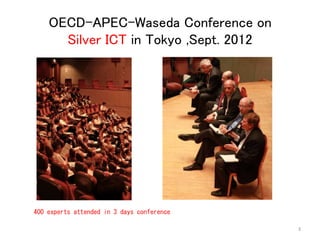
OECD-APEC-Waseda Conference on 
Silver ICT in Tokyo ,Sept. 2012 
3 
400 experts attended in 3 days conference
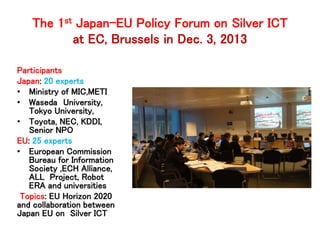
The 1st Japan-EU Policy Forum on Silver ICT 
at EC, Brussels in Dec. 3, 2013 
Participants 
Japan: 20 experts 
• Ministry of MIC,METI 
• Waseda University, 
Tokyo University, 
• Toyota, NEC, KDDI, 
Senior NPO 
EU: 25 experts 
• European Commission 
Bureau for Information 
Society ,ECH Alliance, 
ALL Project, Robot 
ERA and universities 
Topics: EU Horizon 2020 
and collaboration between 
Japan EU on Silver ICT
On-going APEC project on 「ICT applications for 
Aging Society」Co-chair by Prof. Obi 
• C0-sponsoring Economies-Japan and Singapore, USA, 
Russia, Thailand, Philippines, Chinese Taipei,Indonesia 
• Successful APEC workshops –Da Nang (Vietnam 
2012),Tokyo (2012), Hawaii (2013) and Singapore (2014) 
• ICT Accessibility + Availability(increasing Digital Inclusion) 
+ Affordability (reducing price) + Usability (applications by 
innovation) 
• Digital Divide ⇒ Digital Opportunity ⇒Digital Inclusion 
• Local – national – Global linkage 
• Government-led / initiatives ⇒ Citizen centric /ICT driven by 
Social Media 
• Government ⇒e-Government plus universal design 
• Resilient health community by ICT in APEC region 
5
Prof. Obi -Deputy Chair of MIC Council on Silver ICT 
[Smart Platinum]VISIONs and PROPOSALs of the Council 
Official report published in June 2014 
Vision I Live independently and Enjoy a long and healthy life 
• Proposal(1) Establishment of ICT Health (Prevention) Model 
• Proposal(2) Nationwide Expansion of Medical Information Collaborative 
Infrastructure 
• Proposal(3) Creation of Life Support Businesses 
Vision Ⅱ Work with motivation and Participation in society 
• Proposal(4) Improvements in ICT Literacy 
• Proposal(5) Achievement of New Work Styles -Telework 
• Proposal(6) ICT-employed Robots for Practical Use 
Vision Ⅲ Create new industries & Expand into global market 
• Proposal (7) Creation of Silver ICT Industry 
• Proposal(8) Global Expansion and International Cooperation
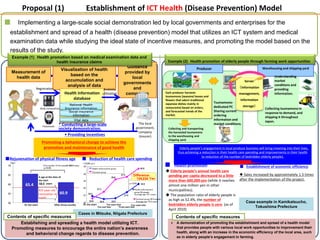
Proposal (1) Establishment of ICT Health (Disease Prevention) Model 
■ Implementing a large-scale social demonstration led by local governments and enterprises for the 
establishment and spread of a health (disease prevention) model that utilizes an ICT system and medical 
examination data while studying the ideal state of incentive measures, and promoting the model based on the 
results of the study. 
Example (2) Health promotion of elderly people through farming work opportunities 
Producer 
Each producer harvests 
tsumamono (seasonal leaves and 
flowers that adorn traditional 
Japanese dishes mainly in 
restaurants) based on orders, 
and forecasted trends of the 
market. 
Collecting and transporting 
the harvested tsumamono 
to the warehousing and 
shipping yard. 
Warehousing and shipping yard 
Understanding 
market 
conditions and 
providing 
information. 
Collecting tsumamono in 
response to demand, and 
shipping it throughout 
Japan. 
Tsumamono-dedicated 
PC 
Sharing current 
ordering 
information and 
market conditions. 
Elderly people’s engagement in local produce business will bring meaning into their lives, 
thus achieving a reduction in their health care spending and improvements in their health 
(a reduction of the number of bedridden elderly people). 
■ Health promotion ■ Establishment of economic efficiency 
◆ Elderly people’s annual health care 
pending per capita decreased to a little 
more than 600,000 yen (while it reaches 
almost one million yen in other 
municipalities). 
◆ The population ratio of elderly people is 
as high as 52.4%, the number of 
bedridden elderly people is zero (as of 
April 2010) 
 Sales increased by approximately 1.5 times 
after the implementation of the project. 
Case example in Kamikatsucho, 
Tokushima Prefecture 
 A demonstration of promoting the establishment and spread of a health model 
that provides people with various local work opportunities to improvement their 
health, along with an increase in the economic efficiency of the local area, such 
as in elderly people’s engagement in farming. 
Example (1) Health promotion based on medical examination data and 
health insurance claims 
Visualization of health 
based on the 
accumulation and 
analysis of data 
Guidance 
provided by 
local 
governments 
and 
companies 
Measurement of 
Body composition 
National Health 
Insurance information 
Social insurance 
information 
* Conducting a large-scale 
society demonstration. 
• Providing incentives 
meter 
Promoting a behavioral change to achieve the 
promotion and maintenance of good health 
health data 
■Rejuvenation of physical fitness age ■ Reduction of health care spending 
(The number of the people2,123,1232 people) 
p<0.05 
◆Health enforcement 
group 94 people 
Average age 70.1 years 
(10,000 yen) 
Two years later 
Four years later 
Cases in Mitsuke, Niigata Prefecture 
Pedometer 
Health information 
database 
Vital data 
Analysis, 
utilization 
The local 
government, 
company 
(insurer) 
Server 
(Information 
management, 
information 
storage) 
Contents of specific measures 
Registration 
65.4 
60.9 
70 
65 
60 
55 
50 
p<0.05 
4.5-year-old 
restoration of 
youth 
At the start After three months 
(Age) 
A age at the time of 
the start 
58.0 years 
(10,000 yen) 
■Contrast group 28.2 people 
Average age 70.2 years 
35.6 
22.9 
32.5 
24.4 
22.4 
27.0 
27.3 
42.9 
22.8 
37.4 
45 
Health enforcement group 
Contrast group 
Difference: 
104,234 Yen 
40 
35 
30 
25 
20 
At the start 
One year later 
Three years later 
Contents of specific measures 
Establishing and spreading a health model utilizing ICT. 
Promoting measures to encourage the entire nation’s awareness 
and behavioral change regards to disease prevention.
Proposal(2) Nationwide Expansion of Medical Information Collaborative Infrastructure 
■ Promoting the development of medical information collaborative infrastructure that will serve as a basic infrastructure enabling patients and medical 
service workers, including health care professionals, to share and utilize data in the medical, nursing care, and health fields. 
■ Expanding ICT systems nationwide based on the demonstration of the efficacy of ICT systems to support the cooperation of home care and long-term 
care teams, with consideration to the practicability of ICT systems. 
Nationwide expansion of medical information 
collaboration platform 
Developing a medical information 
collaboration platform that will serve as 
basic infrastructure enabling patients and 
medical service workers including health 
care professionals to share and utilize 
data in the medical, nursing care, and 
Registering and 
viewing medical 
information on 
patients. 
health bold 
Viewing prescription information 
of hospitals and clinics. 
 Making the verification of technology 
required for a nationwide expansion of 
ICT systems and a demonstration of the 
establishment of operational rules 
 Verifying the ideal state of inexpensive 
ICT systems. 
1 
Patients 
[Main effects expected] 
Provision of medical services through information sharing. 
Preventing serious diseases through disease management. 
Reducing work burdens with an increase in work efficiency with 
the avoidance of redundancies, such by test duplication. 
Promotion of the cooperation of home care and long-term care 
teams. 
Backup during disasters. 
 Specific information to be shared 
between medical and nursing care 
 Standardization of data and systems in 
the nursing field 
The local 
government 
Drugstore Clinic 
Core medical 
institution 
Nursing institute 
Home 
of the 
patient 
Home care support 
medical office 
Office of the care provider 
Each patient uses his/her PC or mobile 
telephone to browse his/her own medical 
information and pharmacy information. 
Visit drugstore 
Information registration in 
being at home 
 Clarifying of the means of utilizing mobile 
terminals and sensors and other technologies 
at home. 
 Studying mechanisms to ensure the 
sustainable operation of ICT systems. 
Contents of specific measures 
Strengthening the cooperation of home care and long-term teams. 
Confirmation of 
patient 
information 
Home nursing station
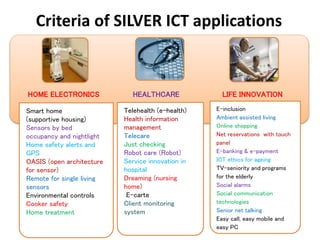
Criteria of SILVER ICT applications 
HOME ELECTRONICS HEALTHCARE LIFE INNOVATION 
Smart home 
(supportive housing) 
Sensors by bed 
occupancy and nightlight 
Home safety alerts and 
GPS 
OASIS (open architecture 
for sensor) 
Remote for single living 
sensors 
Environmental controls 
Cooker safety 
Home treatment 
Telehealth (e-health) 
Health information 
management 
Telecare 
Just checking 
Robot care (Robot) 
Service innovation in 
hospital 
Dreaming (nursing 
home) 
E-carte 
Client monitoring 
system 
E-inclusion 
Ambient assisted living 
Online shopping 
Net reservations with touch 
panel 
E-banking & e-payment 
ICT ethics for ageing 
TV-seniority and programs 
for the elderly 
Social alarms 
Social communication 
technologies 
Senior net talking 
Easy call, easy mobile and 
easy PC
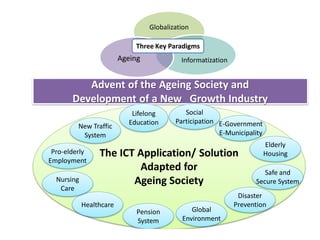
Globalization 
Three Key Paradigms 
Ageing Informatization 
Advent of the Ageing Society and 
Development of a New Growth Industry 
Social 
Lifelong 
Education Participation 
E-Government 
New Traffic 
System 
The ICT Application/ Solution 
Adapted for 
Ageing Society 
E-Municipality 
Elderly 
Housing 
Safe and 
Secure System 
Disaster 
Prevention 
Global 
Environment 
Pension 
System 
Pro-elderly 
Employment 
Healthcare 
Nursing 
Care
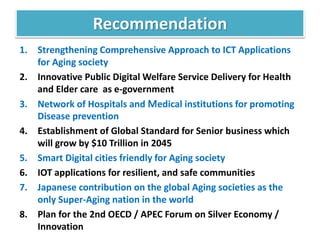
Recommendation 
1. Strengthening Comprehensive Approach to ICT Applications 
for Aging society 
2. Innovative Public Digital Welfare Service Delivery for Health 
and Elder care as e-government 
3. Network of Hospitals and Medical institutions for promoting 
Disease prevention 
4. Establishment of Global Standard for Senior business which 
will grow by $10 Trillion in 2045 
5. Smart Digital cities friendly for Aging society 
6. IOT applications for resilient, and safe communities 
7. Japanese contribution on the global Aging societies as the 
only Super-Aging nation in the world 
8. Plan for the 2nd OECD / APEC Forum on Silver Economy / 
Innovation
Thank you !! 
Information 
Prof. Dr. Toshio Obi 
obi.waseda@gmail.com 
12

Toshio Obi gfke 2014

  • 1.
    Governing for Super-Aging・Knowledge economy Society by ICT in Japan Prof. Dr. Toshio OBI Waseda University
  • 2.
    Big data InterestingFacts about the Japanese seniors • About 32 % of Japanese population are elderly or handicapped people • Aging people (65 and beyond) spend a half of national healthcare cost. • 25% of aging people lives along and their percentage is expected to increase • 70 % of persons injured during big disasters such as earthquakes and typhoons and 50% of traffic accident victims are the elderly • 80% of aging people would like to die at home, not at hospital, at Home • Aging people keep a half of personal financial assets in Japan • 80% of retired people look for jobs and 20 % can get jobs • Ratio of Digital Divide among the senior people was expected to reduce from 60% to 33 % in 2012 • Average annual income of 30 % of the elderly is around 2 million yen or below (about $20000) • Average of Daily Walking coverage of the seniors is limited to 500 meters around the house
  • 3.
    OECD-APEC-Waseda Conference on Silver ICT in Tokyo ,Sept. 2012 3 400 experts attended in 3 days conference
  • 4.
    The 1st Japan-EUPolicy Forum on Silver ICT at EC, Brussels in Dec. 3, 2013 Participants Japan: 20 experts • Ministry of MIC,METI • Waseda University, Tokyo University, • Toyota, NEC, KDDI, Senior NPO EU: 25 experts • European Commission Bureau for Information Society ,ECH Alliance, ALL Project, Robot ERA and universities Topics: EU Horizon 2020 and collaboration between Japan EU on Silver ICT
  • 5.
    On-going APEC projecton 「ICT applications for Aging Society」Co-chair by Prof. Obi • C0-sponsoring Economies-Japan and Singapore, USA, Russia, Thailand, Philippines, Chinese Taipei,Indonesia • Successful APEC workshops –Da Nang (Vietnam 2012),Tokyo (2012), Hawaii (2013) and Singapore (2014) • ICT Accessibility + Availability(increasing Digital Inclusion) + Affordability (reducing price) + Usability (applications by innovation) • Digital Divide ⇒ Digital Opportunity ⇒Digital Inclusion • Local – national – Global linkage • Government-led / initiatives ⇒ Citizen centric /ICT driven by Social Media • Government ⇒e-Government plus universal design • Resilient health community by ICT in APEC region 5
  • 6.
    Prof. Obi -DeputyChair of MIC Council on Silver ICT [Smart Platinum]VISIONs and PROPOSALs of the Council Official report published in June 2014 Vision I Live independently and Enjoy a long and healthy life • Proposal(1) Establishment of ICT Health (Prevention) Model • Proposal(2) Nationwide Expansion of Medical Information Collaborative Infrastructure • Proposal(3) Creation of Life Support Businesses Vision Ⅱ Work with motivation and Participation in society • Proposal(4) Improvements in ICT Literacy • Proposal(5) Achievement of New Work Styles -Telework • Proposal(6) ICT-employed Robots for Practical Use Vision Ⅲ Create new industries & Expand into global market • Proposal (7) Creation of Silver ICT Industry • Proposal(8) Global Expansion and International Cooperation
  • 7.
    Proposal (1) Establishmentof ICT Health (Disease Prevention) Model ■ Implementing a large-scale social demonstration led by local governments and enterprises for the establishment and spread of a health (disease prevention) model that utilizes an ICT system and medical examination data while studying the ideal state of incentive measures, and promoting the model based on the results of the study. Example (2) Health promotion of elderly people through farming work opportunities Producer Each producer harvests tsumamono (seasonal leaves and flowers that adorn traditional Japanese dishes mainly in restaurants) based on orders, and forecasted trends of the market. Collecting and transporting the harvested tsumamono to the warehousing and shipping yard. Warehousing and shipping yard Understanding market conditions and providing information. Collecting tsumamono in response to demand, and shipping it throughout Japan. Tsumamono-dedicated PC Sharing current ordering information and market conditions. Elderly people’s engagement in local produce business will bring meaning into their lives, thus achieving a reduction in their health care spending and improvements in their health (a reduction of the number of bedridden elderly people). ■ Health promotion ■ Establishment of economic efficiency ◆ Elderly people’s annual health care pending per capita decreased to a little more than 600,000 yen (while it reaches almost one million yen in other municipalities). ◆ The population ratio of elderly people is as high as 52.4%, the number of bedridden elderly people is zero (as of April 2010)  Sales increased by approximately 1.5 times after the implementation of the project. Case example in Kamikatsucho, Tokushima Prefecture  A demonstration of promoting the establishment and spread of a health model that provides people with various local work opportunities to improvement their health, along with an increase in the economic efficiency of the local area, such as in elderly people’s engagement in farming. Example (1) Health promotion based on medical examination data and health insurance claims Visualization of health based on the accumulation and analysis of data Guidance provided by local governments and companies Measurement of Body composition National Health Insurance information Social insurance information * Conducting a large-scale society demonstration. • Providing incentives meter Promoting a behavioral change to achieve the promotion and maintenance of good health health data ■Rejuvenation of physical fitness age ■ Reduction of health care spending (The number of the people2,123,1232 people) p<0.05 ◆Health enforcement group 94 people Average age 70.1 years (10,000 yen) Two years later Four years later Cases in Mitsuke, Niigata Prefecture Pedometer Health information database Vital data Analysis, utilization The local government, company (insurer) Server (Information management, information storage) Contents of specific measures Registration 65.4 60.9 70 65 60 55 50 p<0.05 4.5-year-old restoration of youth At the start After three months (Age) A age at the time of the start 58.0 years (10,000 yen) ■Contrast group 28.2 people Average age 70.2 years 35.6 22.9 32.5 24.4 22.4 27.0 27.3 42.9 22.8 37.4 45 Health enforcement group Contrast group Difference: 104,234 Yen 40 35 30 25 20 At the start One year later Three years later Contents of specific measures Establishing and spreading a health model utilizing ICT. Promoting measures to encourage the entire nation’s awareness and behavioral change regards to disease prevention.
  • 8.
    Proposal(2) Nationwide Expansionof Medical Information Collaborative Infrastructure ■ Promoting the development of medical information collaborative infrastructure that will serve as a basic infrastructure enabling patients and medical service workers, including health care professionals, to share and utilize data in the medical, nursing care, and health fields. ■ Expanding ICT systems nationwide based on the demonstration of the efficacy of ICT systems to support the cooperation of home care and long-term care teams, with consideration to the practicability of ICT systems. Nationwide expansion of medical information collaboration platform Developing a medical information collaboration platform that will serve as basic infrastructure enabling patients and medical service workers including health care professionals to share and utilize data in the medical, nursing care, and Registering and viewing medical information on patients. health bold Viewing prescription information of hospitals and clinics.  Making the verification of technology required for a nationwide expansion of ICT systems and a demonstration of the establishment of operational rules  Verifying the ideal state of inexpensive ICT systems. 1 Patients [Main effects expected] Provision of medical services through information sharing. Preventing serious diseases through disease management. Reducing work burdens with an increase in work efficiency with the avoidance of redundancies, such by test duplication. Promotion of the cooperation of home care and long-term care teams. Backup during disasters.  Specific information to be shared between medical and nursing care  Standardization of data and systems in the nursing field The local government Drugstore Clinic Core medical institution Nursing institute Home of the patient Home care support medical office Office of the care provider Each patient uses his/her PC or mobile telephone to browse his/her own medical information and pharmacy information. Visit drugstore Information registration in being at home  Clarifying of the means of utilizing mobile terminals and sensors and other technologies at home.  Studying mechanisms to ensure the sustainable operation of ICT systems. Contents of specific measures Strengthening the cooperation of home care and long-term teams. Confirmation of patient information Home nursing station
  • 9.
    Criteria of SILVERICT applications HOME ELECTRONICS HEALTHCARE LIFE INNOVATION Smart home (supportive housing) Sensors by bed occupancy and nightlight Home safety alerts and GPS OASIS (open architecture for sensor) Remote for single living sensors Environmental controls Cooker safety Home treatment Telehealth (e-health) Health information management Telecare Just checking Robot care (Robot) Service innovation in hospital Dreaming (nursing home) E-carte Client monitoring system E-inclusion Ambient assisted living Online shopping Net reservations with touch panel E-banking & e-payment ICT ethics for ageing TV-seniority and programs for the elderly Social alarms Social communication technologies Senior net talking Easy call, easy mobile and easy PC
  • 10.
    Globalization Three KeyParadigms Ageing Informatization Advent of the Ageing Society and Development of a New Growth Industry Social Lifelong Education Participation E-Government New Traffic System The ICT Application/ Solution Adapted for Ageing Society E-Municipality Elderly Housing Safe and Secure System Disaster Prevention Global Environment Pension System Pro-elderly Employment Healthcare Nursing Care
  • 11.
    Recommendation 1. StrengtheningComprehensive Approach to ICT Applications for Aging society 2. Innovative Public Digital Welfare Service Delivery for Health and Elder care as e-government 3. Network of Hospitals and Medical institutions for promoting Disease prevention 4. Establishment of Global Standard for Senior business which will grow by $10 Trillion in 2045 5. Smart Digital cities friendly for Aging society 6. IOT applications for resilient, and safe communities 7. Japanese contribution on the global Aging societies as the only Super-Aging nation in the world 8. Plan for the 2nd OECD / APEC Forum on Silver Economy / Innovation
  • 12.
    Thank you !! Information Prof. Dr. Toshio Obi obi.waseda@gmail.com 12

Editor's Notes

  • #7 Ministry of Internal Affairs and communication establish the committee on ICT Super aging society in last December and discuss on this issues for 6 months and finally reported fruitful discussion.