Mobile technologies
for oral health: an
implementation guide
BE HE@LTHY
BE MOBILE
Mobile technologies
for oral health: an
implementation guide
BE HE@LTHY
BE MOBILE
Mobile technologies for oral health: an implementation guide
ISBN (WHO) 978-92-4-003522-5 (electronic version)
ISBN (WHO) 978-92-4-003523-2 (print version)
ISBN (ITU) 978-92-61-35121-2 (electronic version)
ISBN (ITU) 978-92-61-35111-3 (print version)
© World Health Organization and International Telecommunication Union, 2021
Some rights reserved. This work is available under the Creative Commons Attribution-
NonCommercial-ShareAlike 3.0 IGO licence (CC BY-NC-SA 3.0 IGO; https://creativecommons.
org/licenses/by-nc-sa/3.0/igo).
Under the terms of this licence, you may copy, redistribute and adapt the work for non-commercial
purposes, provided the work is appropriately cited, as indicated below. In any use of this work,
there should be no suggestion that WHO or ITU endorses any specific organization, products or
services. The unauthorized use of the WHO or ITU names or logos is not permitted. If you adapt
the work, then you must license your work under the same or equivalent Creative Commons
licence. If you create a translation of this work, you should add the following disclaimer along with
the suggested citation: “This translation was not created by the World Health Organization (WHO)
or the International Telecommunication Union (ITU). Neither WHO nor ITU are responsible for
the content or accuracy of this translation. The original English edition shall be the binding and
authentic edition”.
Any mediation relating to disputes arising under the licence shall be conducted in accordance
with the mediation rules of the World Intellectual Property Organization (http://www.wipo.int/
amc/en/mediation/rules).
Suggested citation. Mobile technologies for oral health: an implementation guide. Geneva: World
Health Organization and International Telecommunication Union, 2021. Licence: CC BY-NC-SA
3.0 IGO.
Cataloguing-in-Publication (CIP) data. CIP data are available at http://apps.who.int/iris.
Sales, rights and licensing. To purchase WHO publications, see http://apps.who.int/
bookorders. ITU Publications can be obtained from ITU Bookshop http://www.itu.int/en/
publications. To submit requests for commercial use and queries on rights and licensing, see
http://www.who.int/copyright.
Third-party materials. If you wish to reuse material from this work that is attributed to a third
party, such as tables, figures or images, it is your responsibility to determine whether permission
is needed for that reuse and to obtain permission from the copyright holder. The risk of claims
resulting from infringement of any third-party-owned component in the work rests solely with the
user.
General disclaimers. The designations employed and the presentation of the material in this
publication do not imply the expression of any opinion whatsoever on the part of WHO or ITU
concerning the legal status of any country, territory, city or area or of its authorities, or concerning
the delimitation of its frontiers or boundaries. Dotted and dashed lines on maps represent
approximate border lines for which there may not yet be full agreement.
The mention of specific companies or of certain manufacturers’ products does not imply that
they are endorsed or recommended by WHO or ITU in preference to others of a similar nature
that are not mentioned. Errors and omissions excepted, the names of proprietary products are
distinguished by initial capital letters.
All reasonable precautions have been taken by WHO and ITU to verify the information contained
in this publication. However, the published material is being distributed without warranty of any
kind, either expressed or implied. The responsibility for the interpretation and use of the material
lies with the reader. In no event shall WHO or ITU be liable for damages arising from its use.
Contents
1
2
Contentsiii
Acknowledgementsv
Abbreviations and acronyms vi
Glossary  vii
Executive summary ix
Introduction1
1 	 Rationale for mHealth 1
2 	 The Be He@lthy Be Mobile initiative 2
3 	 The burden of oral diseases and
their impact 2
4 	 What is an mOralHealth programme? 3
4.1 	 Module 1: mOralHealth literacy 5
4.2 	 Module 2: mOralHealth training 7
4.3 	 Module 3: mOralHealth early detection 9
4.4 	 Module 4: mOralHealth surveillance 10
Operations management 12
1.1 	 Workplan development  14
1.2 	 Needs assessment 16
1.3 	 Formative research  19
1.4 	 Programme leadership  19
1.5 	 Programme partnerships 21
Content development and adaptation  22
2.1 	 Developing or adapting an mOralHealth
literacy module 24
2.1.1	 Target audience/users  24
2.1.2 	 Design and adaptation of the programme
framework24
2.1.3 	 Existing content and its adaptation  25
2.1.4 	 Development of additional content  28
2.2.1 	 Target users 29
2.2.2 	 Designing a training module  29
2.2.3 	 Training module content development 32
2.3.1 	 Target audience/groups 34
2.3.2 	 Design of the framework  34
2.3.3 	 Collection, storage and processing of data 35
2.3.4 	 Adaptation to the country context  36
2.3.5 	 Pretesting, piloting and refining the early
detection module  36
2.4.1 	 mOralHealth surveillance target audience 39
2.4.2 	 Design of an mOralHealth surveillance
framework40
2.4.3 	 Pretesting, piloting and refining the early
surveillance module 41
iii
3
4
5
Promotion, participation and retention 44
3.1 	 Promotion of the mOralHealth
programme46
3.1.1 	 Target audience and access to media/
promotional and recruitment strategies 46
3.1.2 	 The owner or perceived messenger of
the mOralHealth programme 48
3.1.3 	 Cost of the promotion campaign 48
3.1.4 	 Synergies with existing strategies,
leveraging other campaigns and timing 48
3.1.5 	 Accessibility of promotion materials 48
3.1.6 	 Content of the campaign 48
3.1.7 	 Using marketing specialists or learnings
from the private sector 48
3.1.8 	 Testing the promotion and recruitment
strategy through a soft launch 49
3.1.9 	 Preintervention information session 49
3.1.10 	 Local mobile communications environment
and institutional channels 49
3.2 	 Participation in the mOralHealth
programme49
3.3 	 Retention in the mOralHealth programme 50
Technology specifications  54
Monitoring and evaluation of
mOralHealth programmes  60
5.1 	 Developing an ME plan 62
5.1.1 	 Process monitoring 64
5.1.2 	 Process evaluation 64
5.1.3 	 Outcome evaluation  64
5.2 	 Relevant indicators and collection methods  65
5.3 	 Data analysis, reporting and dissemination 68
Conclusion  69
References70
Annexes74
Annex 1. Additional examples of mHealth
programmes promoting oral health 75
Annex 2. mOralHealth literacy programme
content libraries 79
Suggested mOralHealth algorithms and
message libraries 80
Example messages  81
Example messages for the general population 81
Example messages for parents of children
aged 3–9 years 81
Example messages for teachers of children
aged 3–9 years 81
Example messages for adolescents 81
Example messages for people who are pregnant
or breastfeeding 81
Annex 3. Main themes and operationalizing
strategies for message development  82
Annex 4. Adapting content to other technologies  83
Adapting to voice messages 83
Adapting to messenger apps 83
Conversational agents and conversationalizing
content84
Transfer of the content library into an app  86
Annex 5. Example indicators for ME of an
mOralHealth programme 87
Annex 6. Negotiating with telecommunications
operators  95
Mobile technologies for oral health: an implementation guide
iv
Acknowledgements
- Chair eSante Montpellier), Roland Petcu (University
of Montpellier), Ave Põld (International Association
of Dental Students), Laeticia Razafimamonjy (Aide
Odontologique Internationale), Eva Ranivoharilanto
(Ministry of Health Madagascar), Eli Schwarz (Oregon
Health  Science University), Nicole Stauf (The Health
Bureau Ltd), Faleh Tamimi (McGill University), Paula
Vassallo (Ministry of Health Malta), Mathis Winkler
(Hilfsaktion Noma e.V.).
WHO Regional Office oral health focal points: Gampo
Dorji (WHO South East Asian Regional Office), Jill
Louise Farrington (WHO European Regional Office),
Huda Abdul Ghaffar (WHO Eastern Mediterranean
Office [EMRO]), Carolina Hommes (WHO Americas
Regional Office), Wasiq Mehmood Khan (WHO EMRO),
Yuka Makino (WHO African Regional Office), Carmela
Mijares-Majini (WHO Western Pacific Regional Office).
WHO Regional Office digital health advisors: Marcelo
D’Agostino (WHO Americas Regional Office), Patricia
Codyre (WHO Western Pacific Regional Office),
Clayton Hamilton (WHO European Regional Office),
Jun Ghao (WHO Western Pacific Regional Office), Ba
Housseynou (WHO African Regional Office), Jagdish
Kaur (WHO South East Asian Regional Office), Ahmed
Mandil (WHO Eastern Mediterranean Office [EMRO]),
Mohamed Hasan Nour (WHO EMRO).
Layout and design
400 Communications, UK
Financial and in-kind support
Be He@lthy Be Mobile, University of Montpellier,
France, University of McGill, Canada and Hilfsaktion
Noma e.V.
Cover Photo credit
© PeopleImages
 
The World Health Organization (WHO) and International
Telecommunication Union (ITU) gratefully acknowledge
the following contributors to this handbook.
Handbook coordination and development
WHO Noncommunicable Diseases Department, Oral
Health Programme: Benoit Varenne
WHO/ITU Be He@lthy Be Mobile team: Sameer Pujari,
Hani Eskandar, Roman Chestnov, Javier Elkin, Melissa
Harper Shehadeh, Surabhi Joshi, Briana Lucido, Evan
Pye, Mata Toure.
Editorial committee
David Conway (University of Glasgow and Public
Health Scotland, United Kingdom of Great Britain
and Northern Ireland), Rosie Dobson (University of
Auckland, New Zealand), Nicolas Giraudeau (University
of Montpellier, France), Janneke Scheerman (ACTA
University and Inholland University of Applied
Sciences, The Netherlands), Benoit Varenne (WHO Oral
Health Programme, Switzerland).
Guidance
Be He@lthy Be Mobile Steering Committee members,
from WHO: Mr Bernardo Mariano Jr, Director, Digital
Health and Innovations and Chief Information Officer;
Dr Ren Minghui, Assistant Director General / Dr Bente
Mikkelsen, Director, Noncommunicable Diseases;
Dr Naoko Yamamoto, Assistant Director General / Dr
Ruediger Krech, Director, Health Promotion. From ITU:
Doreen Bogdan-Martin, Director, Telecommunication
Development Bureau; Stephen Bereaux, Deputy to
Director, Telecommunication Development Bureau;
Marco Obiso, Chief, AI Digital Network and Society
Department, Telecommunication Development Bureau.
Further contributions
Caren Bavaresco (Conceição Hospital Group, Lutheran
University of Brazil), Raman Bedi (World Federation
of Public Health Associations), Bernard Decroix (Aide
Odontologique Internationale), Ousmane Dipama
(Aide Odontologique Internationale), Elham Emami
(McGill University), Awa Gaye (Ministry of Health
Senegal), O.P. Kharbanda (All India Institute of Medical
Sciences India), Line Kleinebreil (Université Numérique
Francophone Mondiale), Jason Ligot (Consultant
International Health Communication), Laurence Lupi-
Pegurier (Collège National des Chirurgiens-Dentistes
Universitaires en Santé Publique), Rodrigo Mariño
(University of Melbourne), Joshua Okello (Consultant
Digital Technology), Sabine Perrier-Bonnet (Fondation
v
Abbreviations and
acronyms
AI artificial intelligence
apps (mobile) applications
BHBM Be He@lthy Be Mobile
CDSS clinical decision support system
CHW community health worker
CIC conversational interface chatbot
COVID-19 coronavirus disease
CPD continued professional development
EOHR electronic oral health record
GHz gigahertz
ICT information and communications technology
ITU International Telecommunication Union
IVR interactive voice response
ME monitoring and evaluation
mHealth mobile health
MOOC massive online open course
mOralHealth mobile oral health
NCD noncommunicable disease
NLP natural language processing
PHC primary health care
SDGs Sustainable Development Goals
STEPwise WHO STEPwise approach to Surveillance
TAG technical advisory group
telecoms telecommunications
VPN virtual private network
WHO World Health Organization
vi
Glossary
Appropriate use of
digital technologies
ICT that takes into account safety, ethical use, cost–effectiveness and
affordability and is people centred, evidence based, effective, efficient,
sustainable, inclusive, equitable and contextualized (1).
Artificial intelligence
(AI)
An area of computer science that emphasizes the simulation of human
intelligence processes by machines that work and react like human beings (1).
Digital divide The gap between demographics and regions that have access to modern
ICT and those that do not or that have restricted access. This technology can
include the telephone, television, personal computers and the internet (1).
Digital health Used as a broad umbrella term encompassing e-health (which includes
mHealth) as well as emerging areas such as the use of advanced computing
sciences in big data, genomics and AI (2, 3).
E-health The cost-effective and secure use of ICT in support of health and health-
related fields, including health care services, health surveillance, health
literature and health education, knowledge and research. mHealth is a
component of e-health (3, 4).
E-learning The use of ICT for education.
Evaluation An episodic assessment of either a completed or ongoing programme or
intervention to determine the extent to which its stated objectives were
achieved efficiently and effectively.
Global Oral Health
Agenda
The WHO Global Oral Health Programme promotes a global agenda for
achieving better oral health as part of WHO’s noncommunicable disease and
universal health coverage, thereby contributing to the achievement of the
United Nations 2030 Agenda for Sustainable Development. The mOralHealth
programme is one of these priorities jointly developed with the WHO–ITU
Be He@lthy Be Mobile initiative and supporting Member States to improve
oral health worldwide.
Health literacy Implies the achievement of a level of knowledge, skills and confidence
to take action to improve personal and community health by changing
lifestyles and living conditions. By improving people’s access to health
information and their capacity to use it effectively, health literacy is critical
to empowerment. Health literacy itself depends on more general levels of
literacy. Poor literacy can affect people’s health directly by limiting their
personal, social and cultural development as well as by hindering the
development of health literacy (5).
Interoperability The ability of multiple ICT systems and software applications to access,
exchange, integrate and cooperatively use data in a coordinated manner
through the use of shared application interfaces and standards, within and
across organizational, regional and national boundaries, to provide timely
and seamless portability of information and optimize health outcomes (1).
vii
Information and
communication
technology (ICT)
Refers to technology that provides access to information through
telecommunications technologies, which encompasses the internet,
wireless networks, cell phones, computers, software, middleware,
videoconferencing, social networking and other media applications
and services that allow users to access, retrieve, store and transmit
information in a digital form.
Machine learning
(ML)
A subset of AI that allows computer programs to learn without being
explicitly programmed. These programs learn from data sets, identify
patterns within them and use the information to make predictions
about data they have not been previously exposed to (6).
mHealth A subset of e-health that uses mobile and wireless technologies to support
health objectives, including providing health care support to patients or
technical support to health service providers in a direct, cost-efficient and
engaging manner (3, 7). mHealth involves the use of and capitalization
on a mobile phone’s core utility of voice and SMS as well as more complex
functionalities and applications, including general packet radio service,
third- and fourth-generation mobile telecommunications (3G and 4G
systems), global positioning systems and Bluetooth technology (7).
Monitoring Routine tracking of an intervention’s performance using data collected
internally on a regular and ongoing basis on specified indicators.
This information is used to assess the extent to which an intervention
is achieving its intended targets on time and on budget.
Teledentistry Uses ICT for dental consultations, diagnosis and treatment planning,
including the transmission of clinical information and images between an
oral health professional and patient or between two health professionals,
including at least one oral health professional, who are separated by
distance (8).
Telehealth The delivery of health care services where patients and providers are
separated by distance. Telehealth uses ICT to exchange information
about the diagnosis and treatment of diseases and injuries, for research
and evaluation and for the continuing education of health professionals.
Telehealth can contribute to achieving universal health coverage by
improving access for patients to quality, cost-effective health services
wherever they may be. It is particularly valuable for those in remote areas,
vulnerable groups and ageing populations (4).
Mobile technologies for oral health: an implementation guide
viii
Executive summary
Almost 97% of the world’s population lives within reach of a cellular
network, and the number of mobile phone subscriptions has been
growing steadily over past decades (9). Building on the widespread use
of cellular phones and similar technologies, mobile health – or mHealth
– approaches have emerged using mobile technologies for health-
related interventions. The World Health Organization (WHO) and the
International Telecommunication Union (ITU) have partnered to promote
the use of mobile technologies to address the burden of modifiable
diseases. The joint initiative Be He@lthy Be Mobile (BHBM) provides
guidance on delivering disease prevention and management information
through mobile technologies directly to specific target groups, including
individuals, communities and health care professionals, to strengthen
health systems. In line with strategic objective one of the Global Digital
Health Strategy, BHBM promotes global collaboration and advances
knowledge transfer on digital health.
Oral diseases affected about 3.5 billion
people around the world in 2017, untreated
dental caries in permanent teeth being the
most prevalent condition. Severe periodontal
disease is widely spread and is a major cause
of total tooth loss (10). Cancers of the lip and
oral cavity are among the 15 most common
cancers worldwide (11). Other lesser known oral
diseases such as noma also have significant
health, social and economic impacts in some
regions, resulting in high mortality and
disabilities in those affected. Among the most
common congenital conditions are cleft lip
and palate, which require early and complex
surgical interventions and rehabilitation. Similar
to other ailments, oral diseases primarily affect
the poorest, most disadvantaged and most
socioeconomically marginalized populations.
Oral diseases considerably affect health, well-
being and quality of life across the life course,
especially where resources for prevention,
diagnosis and treatment are limited.
Approaches based on new technologies, such
as mHealth, can be used to promote oral health
as well as to prevent and control oral disease.
Against this background, the mOralHealth
programme was jointly developed by the
WHO Global Oral Health Programme and the
BHBM initiative. It aims to contribute to the
achievement of better oral health as part of the
2030 Sustainable Development Agenda, including
universal health coverage (UHC), as well as to
tackle the burden of noncommunicable diseases
(NCDs).
ix
The mOralHealth programme comprises four key
modules addressing a range of target groups.
The mOralHealth literacy module aims to
improve the oral health literacy of individuals
and communities as well as raise awareness
of and advocacy for oral health priorities among
policy-makers, decision-makers, the media and
civil society organizations (CSOs).
The mOralHealth early detection module provides
information on the potential of early detection
by using remote diagnostics tools to improve timely
treatment and facilitate access to and improve
quality of health care services.
These modules are designed as flexible
components that can be implemented individually
or collectively, according to a country’s specific
needs. Similarly, the mOralHealth programme can
be implemented as a stand-alone intervention to
improve oral health or be integrated into existing
initiatives targeting other NCDs.
This handbook provides guidance for developing
and implementing an mOralHealth programme
to support respective target groups in preventing
and controlling oral diseases, maintaining good
oral health, and improving well-being and quality
of life. It is intended to assist policy- and decision-
makers and implementers to realize a national or
large-scale mOralHealth programme. It describes
how an mOralHealth programme can be used
to complement existing initiatives and health
system responses.
The handbook starts by providing background
information on mHealth, the BHBM initiative
and the burden of oral diseases as well as more
details about the handbook’s structure. It then
describes the operational management of an
mOralHealth programme, including executing
a needs assessment, building leadership and
partnerships, conducting formative research
and developing a workplan. The following
chapter specifies how to develop and adapt
content to the national context for each of the
four modules. The next chapter on promotion,
recruitment and dissemination shares insights
into how to raise awareness of target groups
to enrol in the mOralHealth programme. The
nature of an mHealth programme requires
the setup of a technological environment; the
chapter on technology specifications refers to
technical aspects that need to be considered.
Finally, considerations for monitoring and
evaluation (ME) are addressed as essential
components of the mOralHealth programme
to ensure its relevance and effectiveness for
improving oral health.

The mOralHealth training module encourages
using mobile technologies for e-learning approaches
to enhance the knowledge and skills of general
health professionals as well as expand awareness
of priority oral health interventions for oral
health professionals.
The mOralHealth surveillance module informs about
the use of mobile technologies in the context of oral
health surveillance and collection of epidemiological
data as well as monitoring of quality patient care
and service delivery.
1
3
2
4
Mobile technologies for oral health: an implementation guide
x
Introduction
1 Rationale for mHealth
It is estimated that in mid-2020, 96.7% of the world’s population lived
within reach of a cellular network: 99.6% in developed, 96.1% in developing
and 88.9% in least developed countries. Averaged globally, there were
more mobile phone connections than people, with 105 subscriptions per
100 inhabitants in 2020.
These averages differed among the regions,
with 82.3 cellular telephone subscriptions per
100 inhabitants in Africa compared to 98 in
the Arab States, 104.6 in Asia and the Pacific,
122.7 in Europe, 148.2 in the Commonwealth of
Independent States and 110.9 in the Americas
(9).1
Although rates vary by country and
region, it is estimated that 76% of the world’s
population owns a mobile phone: 92% of those
in developed countries and 56% in the least
developed countries. Gaps in access among
population groups and regions, also referred
to as the digital divide, do exist, but the spread
and increasing trend of new technologies,
particularly mobile phones, make this platform
a key modality for delivering health-related
interventions.
Mobile health, or mHealth, refers to the use
of mobile technologies for health-related
interventions. Mobile phones, tablets and other
mobile devices and digital technologies are
used to deliver information, training and access
to health services. There is growing evidence
for the use of mHealth using tools such as text
messaging, video messaging, phone calls, mobile
internet, mobile applications (apps), visualization
and diagnostic tools, and monitoring devices.
mHealth has been successfully used across a
range of health areas, including public health
education and telehealth, chronic disease
monitoring, medication and treatment adherence,
patient–provider communication and behaviour
change intervention (7). Because of the high
adoption of mobile phones and diversity of
mHealth interventions, mHealth has the potential
to reach population groups in remote and low-
resource settings or where barriers to accessing
1 	
ITU country classifications available at: https://www.itu.int/en/ITU-D/Statistics/Pages/definitions/regions.aspx (accessed 4 January 2021).
health care exist (12). It provides a unique
tool to be used by individuals and health
care professionals at opportune times and
locations (13).
Mobile technologies can strengthen health
systems, communities and individuals to
manage health more effectively and can improve
the delivery of health services. By providing
motivation and knowledge to empower
people to make better choices, tools for health
professionals to expand knowledge and skills,
new technologies for detecting oral diseases
across distances and the means to monitor and
evaluate the impact of policies on population
health, mHealth technologies may have a
profound effect on how health services are
delivered and how health systems are run (14).
Thorough preparation and planning are key,
and certain considerations and prerequisites
need to be taken into account. Ensuring a person-
centred approach will help to focus on the needs
and circumstances of the person rather than
just the condition or disease. Similarly, involving
key stakeholders in the planning process
and accompanying the implementation with
appropriate change-management measures
are crucial to ensuring acceptance of mHealth
interventions by the target population or users,
such as health care providers and patients.
A critical element of mHealth interventions
involves taking measures to ensure confidentiality
and ethical storage of data as well as
interoperability and integration with current
digital health information and services.
1
By providing access to health information and
services to people who did not have access
before, mHealth can reduce inequalities.
Depending on the intervention, it may also
exclude some groups of people, such as those
who are not literate or who communicate in
a language not covered in the intervention
and those who don’t have access to mobile
technologies. Therefore, particular attention
needs to be paid to these excluding factors
in order to not increase health inequalities or
marginalize certain groups.
There has never been a more relevant time
to invest in mHealth than now. The COVID-19
pandemic, which started at the end of 2019,
presents the greatest global challenge to the
delivery of oral health care in decades. The role
of technologies in the health care response to
the pandemic and, indeed, in connecting people,
communities and services more generally has
come to the fore. There is a need for promotion
and prevention measures to reduce further
burden on stretched health care systems and to
use remote consultations in primary health care
(PHC) to maintain patient and provider safety
and reduce costs.
With the increasing presence of mobile phones
in everyday life, mHealth has the potential
to improve and complement the delivery
and support of health care and public health,
including disseminating information rapidly
and widely, empowering patients and reaching
diverse population groups.
2 The Be He@lthy Be Mobile
initiative
The BHBM initiative is a global partnership
jointly led by WHO and ITU and representing
the United Nations agencies for health and
information and communication technologies
(ICT), respectively. The initiative provides
technical expertise and supports countries and
governments to use mHealth within national
health systems to help combat noncommunicable
and modifiable diseases like diabetes, cancer,
cardiovascular diseases, chronic respiratory
diseases and oral diseases, as well as their
risk factors.
The BHBM initiative develops operational
guidance to help countries and governments to
implement mHealth programmes, supporting
the first strategic objective of the global digital
health strategy: promoting global collaboration
and knowledge transfer on digital health. The
programme-specific handbooks are central tools
providing relevant information to aid policy- and
decision-makers and implementers of national
or large-scale mHealth programmes.
3 The burden of oral diseases
and their impact
In 2017, more than 3.5 billion people suffered
from oral disease. Untreated dental caries
in permanent teeth was the single most
prevalent condition, affecting 2.3 billion people
worldwide. Untreated dental caries of primary
teeth affected 530 million children. Severe
periodontal disease, a major cause of total
tooth loss, is estimated to impair 796 million
people, particularly older adults (10). Cancers of
the lip and oral cavity are among the 20 most
common cancers worldwide. In Melanesia and
South Asia, they are the leading cause of cancer-
related deaths among males (11). Other lesser
known oral diseases also have significant health,
social and economic impacts. Prevalent in some
African and Asian countries, noma results in high
mortality or lifelong disability of the children
affected. It is a devastating and necrotizing
disease that starts in the mouth and is a marker
of extreme poverty. Cleft lip and palate are
among the most common congenital conditions
and require early and complex surgical
interventions and rehabilitation.
Similar to other ailments, oral diseases primarily
affect the poorest, most disadvantaged
and most socioeconomically marginalized
populations. Inequalities relating to oral health
can be observed both within and between
countries. Oral diseases also account for a large
economic burden (11), not only as direct costs
related to treatment but also as costs due to loss
of time in the workplace or at school. Unequal
distribution of oral health professionals and lack
of access to appropriate facilities for vulnerable
populations living in deprived communities or
remote areas result in most oral diseases going
undetected and therefore untreated.
Oral diseases share common risk factors
with other NCDs, particularly unhealthy diets
rich in free sugars, tobacco use and harmful
alcohol consumption. Reducing risk exposure
and applying simple protective measures can
significantly reduce the burden of oral diseases.
Strategies to improve oral health through policy
as well as through community- and clinical-level
disease prevention and management approaches
can therefore be integrated with and used to
strengthen interventions targeting other NCDs
across the life course.
Mobile technologies for oral health: an implementation guide
2
4 What is an mOralHealth
programme?
Based on the burden of oral diseases and the
potential of mHealth, the WHO Global Oral
Health Programme, as part of the joint WHO–ITU
BHBM initiative, made the development of the
mOralHealth programme one of its priorities.
The main aim is to support Member States in
improving oral health worldwide in the context
of attaining the Sustainable Development Goals
(SDGs), including the achievement of UHC,
with a basic package of oral health care. At the
country level, an mOralHealth programme is
intended to complement, support and strengthen
implementation of a national oral health policy
or interventions using mobile and digital
technologies.
In the area of oral health, mHealth is a
growing sector, and mHealth interventions
have demonstrated significant potential
(15, 16). (See Annex 1 for examples of mHealth
programmes promoting oral health.) Against
this background, mHealth approaches may be
implemented and further strengthened to help
promote oral health. While mHealth provides
great opportunities, it also entails challenges
to employ mobile technologies in a way that
ensures everyone benefits and that inequalities
in health and oral health are reduced instead of
contributing to further widening the gap and
leaving people behind. Where there are existing
mHealth and digital health programmes,
interoperability of the mOralHealth programme
also needs to be considered.
The mOralHealth handbook comprises four
modules spanning different target groups and
intervention areas as illustrated in Fig. 1.
All modules are complementary and mutually
enhancing. Each module can be implemented
as a stand-alone intervention or in combination
with other modules. The scope of the
mOralHealth programme largely depends on
the country context, existing health systems,
needs of potential target groups and available
resources, among other aspects.
The mOralHealth literacy module aims to
improve the oral health literacy of individuals
and communities as well as raise awareness
of and advocacy for oral health priorities among
policy-makers, decision-makers, the media and
civil society organizations (CSOs).
The mOralHealth early detection module provides
information on the potential of early detection
by using remote diagnostics tools to improve timely
treatment and facilitate access to and improve
quality of health care services.

The mOralHealth training module encourages
using mobile technologies for e-learning approaches
to enhance the knowledge and skills of general
health professionals as well as expand awareness
of priority oral health interventions for oral
health professionals.
The mOralHealth surveillance module informs about
the use of mobile technologies in the context of oral
health surveillance and collection of epidemiological
data as well as monitoring of quality patient care
and service delivery.
1
3
2
4
Introduction 3
1 mOralHealth
LITERACY
Individuals and
communities
• 
Improve oral health
literacy
Policy-makers,
the media and
civil society
• 
Promote oral
health advocacy
2 mOralHealth
TRAINING
Health workers
• 
Increase oral health
knowledge and
skills
Oral health
professionals
• 
Expand awareness
of the global oral
health agenda
3 mOralHealth
EARLY DETECTION
National health
system
• 
Innovate on early
detection of oral
diseases
4 mOralHealth
SURVEILLANCE
National
health system
• 
Strengthen
population oral
health surveillance
• Monitor quality
patient care and
service delivery
mOralHealth
LITERACY
mOralHealth
SURVEILLANCE
mOralHealth
TRAINING
mOralHealth
EARLY DETECTION
2
3
1
4
FIG. 1.
The four complementary modules of the mOralHealth
programme, their target audiences/groups and their goals
Mobile technologies for oral health: an implementation guide
4
The four modules making up the mOralHealth
programme vary with regard to the scope and
level of guidance and detail provided. mHealth
literacy programmes in different areas, including
oral health, have been implemented widely,
and as a result, more information, experience
and evidence are now available on those. For
the modules on training, early detection and
surveillance, this handbook provides general
guidance and considerations complemented
with experience from case studies. These three
modules hold great potential, and countries are
encouraged to use the existing guidance and
then share their experiences and learnings with
the BHBM team.
4.1 Module 1: mOralHealth literacy
Mobile technologies, particularly mobile phones,
are increasingly being used to access health
information. Several mobile-based solutions
exist to improve access to information and
knowledge and to foster behaviour change to
improve health.
The mOralHealth literacy module is designed
to empower individuals and communities to
access, understand and apply information
to help them maintain good oral health. It builds
on the momentum of the SDGs’ emphasis on
health promotion.
Focusing on the individual and community level,
the mOralHealth literacy module gives basic
essential information on promoting oral health
and preventing oral diseases. By employing
behaviour change techniques like motivational
and supportive messages as well as reminders,
the literacy module encourages individuals
at all ages to perform healthier oral health
behaviours.
Alongside individuals and communities with
limited oral health knowledge and support,
the mOralHealth literacy module aims to raise
awareness and advocate for the importance
of oral health among influential groups.
These particularly include policy- and decision-
makers, the media and CSOs. Their influence
may contribute to increasing the development
and implementation of effective policies based
on the global oral health agenda and reaching
different population and societal groups. A
comprehensive summary of an mOralHealth
literacy module is provided in Table 1.
Text messaging is well suited for public health
interventions due to its low cost, vast reach and
ability to be tailored and personalized. To date,
text messaging has been the most extensively
researched form of mHealth intervention, with
the majority of health interventions based on
text messages showing evidence for positive
impacts on behavioural or health outcomes
and cost–effectiveness (17–21). Other forms of
interaction, such as through mobile apps, also
present avenues to disseminate information and
motivate people to perform healthy oral health
behaviours (22).
In a time of information overload and the spread
of fake news (see Box 1), an mOralHealth literacy
module can be used to counteract misinformation
among the public by disseminating knowledge
and evidence-based information.
Introduction 5
TABLE 1.
Overview of the mOralHealth literacy module
mOralHealth literacy
Literacy for individuals and
communities
Literacy for other groups
(Policy-makers, the media and
nonstate actors)
Aim Improve oral health literacy and
increase good oral health behaviour
of individuals and communities
Promote oral health advocacy by
policy-makers, media and nonstate
actors
Implementers Governmental bodies (local,
national), public health agencies,
academia, CSOs, etc.
Governmental bodies (local,
national), public health agencies,
academia, CSOs, etc.
Target audience/
groups
•	 general population
•	 
parents and teachers as
intermediaries to reach children
•	 adolescents
•	 pregnant and lactating women
•	 
persons with specific needs
(ageing persons, persons living
with physical and/or mental
disabilities)
•	 dental public health officers
•	 decision- and policy-makers
•	 the media
•	 
consumer and patient
associations
•	 CSOs
•	 national dental associations
•	 
other non–oral health
professionals
Potential
technologies
SMS, voice messages, messages on
social networks, smartphone apps,
etc.
Messaging for health, social media,
apps, etc.
Potential outcomes Improve knowledge and supportive
behaviours through accessing,
understanding and applying
information to maintain good
health, specifically:
•	 increased awareness of common
risk factors for NCDs (tobacco,
betel/areca nut and khat/qat use;
harmful use of alcohol; unhealthy
diet rich in free sugars)
•	 
improved knowledge, attitudes
and skills regarding oral hygiene,
including fluoride toothpaste and
healthy diet related to free sugars
•	 
better understanding of the
advantages of preventive, safe,
early, minimally invasive and
environmentally sound oral care
•	 
improved knowledge of access to
oral health care
Improve awareness and
understanding of and access to oral
health–related information in order
to advocate for better oral health
through:
•	 
developing and implementing
effective oral health policy
•	 
stopping fake news in oral health
by publishing real news
•	 
fighting against counterfeit
medicines and oral hygiene
products
•	 
advocating for fiscal policies that
promote effective and affordable
oral hygiene products
•	 
making the financial case to
increase budgets for oral health
•	 
supporting UHC initiatives that
include oral health care and
prevention measures
•	 
disseminating oral health
information based on best
available evidence
Potential impacts Improved ability to engage in self
oral health care, manage diseases
and access health care systems and
effective oral hygiene products
Oral health better prioritized in
national public health policy
Mobile technologies for oral health: an implementation guide
6
4.2 Module 2: mOralHealth training
Training in oral health, as in other areas of
health, is becoming more and more digitized.
Using mobile technologies to inform, support
and build capacity in the area of oral health
can be an important way to empower health
professionals and also contribute to improving
the quality of care, particularly in PHC and
people-centred and integrated health care.
mHealth may also contribute to addressing the
ongoing challenges of workforce shortages
and access to medical education more broadly,
thereby strengthening health systems.
The mOralHealth training module aims to
1) increase the oral health knowledge and skills
of general health professionals, particularly
frontline health workers, including community
health workers (CHWs), and 2) expand awareness
of priority public health interventions and the
global oral health agenda among oral health
professionals. The details of an mOralHealth
training module are summarized in Table 2.
BOX 1:
Fake news in oral health
The internet is an important source of
oral health information for many people.
However, the internet and social media are
also used to circulate fake news. Fake news
refers to deceptive information in which
facts are (wilfully) distorted or falsified,
the scientific evidence is lacking or the
message contains quasi-scientific results.
Social media, in contrast to traditional
media, is largely uncensored. Quoting,
sharing or liking fake news on social
media channels can disseminate the false
information rapidly and widely without any
checking or validation mechanism to ensure
information quality. As a result, information
with a varying degree of accuracy exists.
This makes it more difficult for users to
navigate the internet to find health-related
information that is evidence based.
Exposure to fake news can influence people’s
decision-making process and consequently
mislead them to make choices with negative
health impacts. It is therefore important to
encourage people to verify the information
they find online, enable them to identify
evidence-based health information and
guide them in identifying and interpreting
health information (23).
An example of widely shared fake news is
the harmful effect of fluoride in toothpaste.
This misinformation can convince people
to switch from a fluoride to a biological
(nonfluoridated) toothpaste, which may
increase the risk of tooth decay.
One way to counteract fake news is to
disseminate evidence-based health
information. The mOralHealth literacy
module can be used to spread evidence-
based oral health information to various
target groups.
Introduction 7
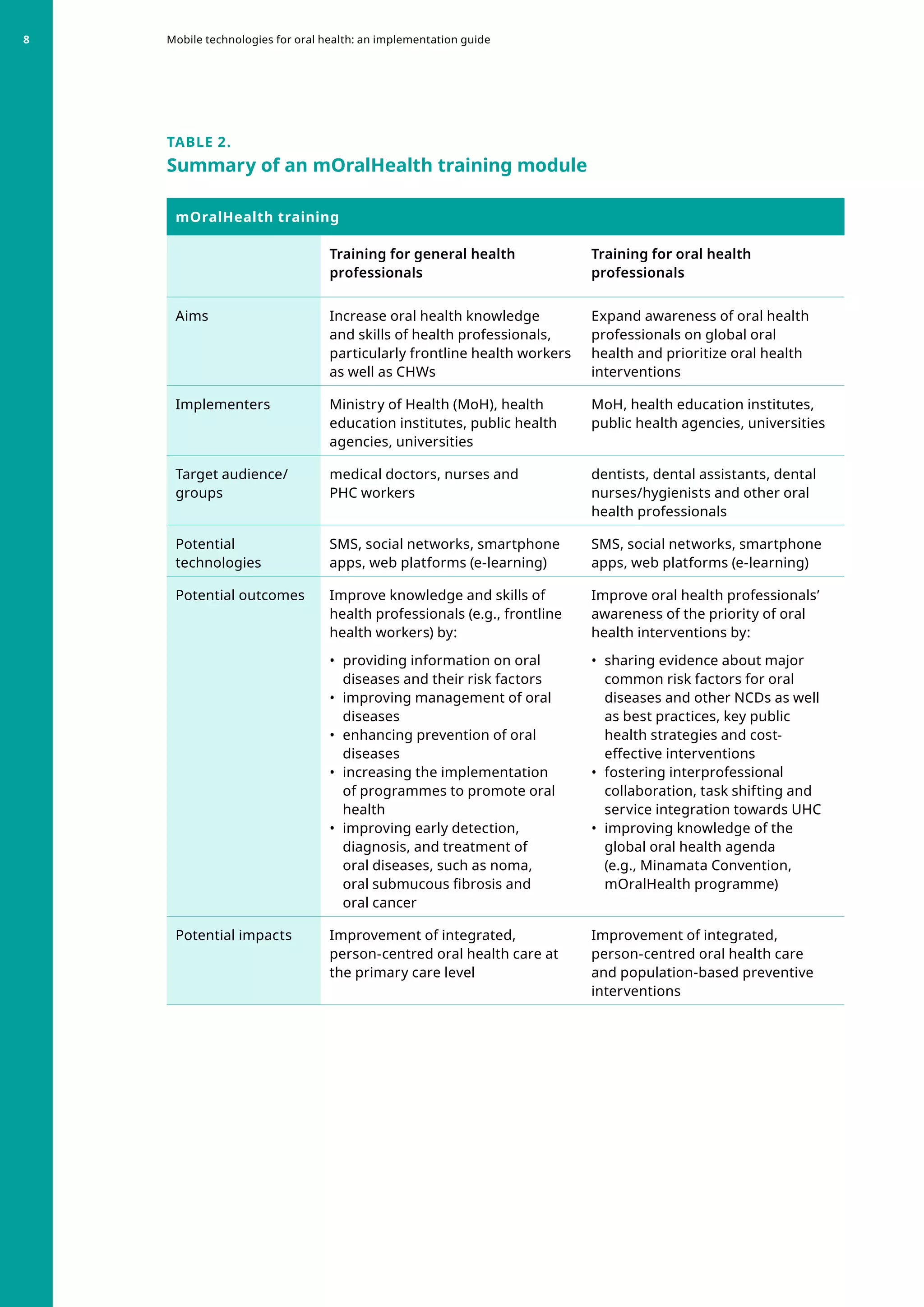
TABLE 2.
Summary of an mOralHealth training module
mOralHealth training
Training for general health
professionals
Training for oral health
professionals
Aims Increase oral health knowledge
and skills of health professionals,
particularly frontline health workers
as well as CHWs
Expand awareness of oral health
professionals on global oral
health and prioritize oral health
interventions
Implementers Ministry of Health (MoH), health
education institutes, public health
agencies, universities
MoH, health education institutes,
public health agencies, universities
Target audience/
groups
medical doctors, nurses and
PHC workers
dentists, dental assistants, dental
nurses/hygienists and other oral
health professionals
Potential
technologies
SMS, social networks, smartphone
apps, web platforms (e-learning)
SMS, social networks, smartphone
apps, web platforms (e-learning)
Potential outcomes Improve knowledge and skills of
health professionals (e.g., frontline
health workers) by:
•	 providing information on oral
diseases and their risk factors
•	 improving management of oral
diseases
•	 enhancing prevention of oral
diseases
•	 increasing the implementation
of programmes to promote oral
health
•	 improving early detection,
diagnosis, and treatment of
oral diseases, such as noma,
oral submucous fibrosis and
oral cancer
Improve oral health professionals’
awareness of the priority of oral
health interventions by:
•	 sharing evidence about major
common risk factors for oral
diseases and other NCDs as well
as best practices, key public
health strategies and cost-
effective interventions
•	 fostering interprofessional
collaboration, task shifting and
service integration towards UHC
•	 improving knowledge of the
global oral health agenda
(e.g., Minamata Convention,
mOralHealth programme)
Potential impacts Improvement of integrated,
person-centred oral health care at
the primary care level
Improvement of integrated,
person-centred oral health care
and population-based preventive
interventions
Mobile technologies for oral health: an implementation guide
8
4.3 Module 3: mOralHealth early detection
The mOralHealth early detection module aims
to use mobile technologies to improve early
detection of oral diseases such as oral cancer
and noma. An example of an mOralHealth early
detection intervention is the use of telemedicine
to provide oral examinations and diagnose oral
diseases remotely, such as in rural communities
and/or communities with issues accessing oral
health care. Remote detection and diagnosis can
also be used in combination with physical oral
examinations. Studies show that a combination
of conventional (face-to-face) oral examination
and digital technology assistance improves the
accuracy and quality of early diagnosis of some
oral diseases (24, 25).
Early detection increases the chances for
timely, effective and successful treatment
by focusing on identifying symptomatic and
asymptomatic patients as early as possible.
Recognizing signs of oral diseases early,
facilitating diagnosis and enabling prompt
action can improve disease management and
outcomes. Delays or restrictions in accessing
health care are common, particularly in remote
areas, lower resource settings and vulnerable
populations. The consequences of delays in
accessing health care are decreased survival,
greater burden of disease (i.e., disability) and
higher mortality rates. In such a context, early
diagnosis aims at reducing the proportion of
individuals who are diagnosed at a late stage
and at providing care at the earliest possible
stage. Applying mobile technologies to remote
detection and diagnostics in oral health can
redirect interventions from a dental practice to
another setting. PHC and health systems are
transformed towards a more people-centred
and integrated model of health service delivery
through interventions like mHealth, telehealth
and remote care (14).
Based on current knowledge and experience,
there is a potential for mobile technologies to
support remote access and consultation for early
detection and referral to services for treatment
and disease management. Further innovation
development, testing and evaluation are needed.
Although these technologies have been shown
to improve the timing and quality of screening,
they cannot yet be applied sustainably on a global
level. This is particularly the case in areas that
face socioeconomic, cultural and geographical
barriers. Any intervention inherently needs to be
adapted to the context and setting in which it is to
be used to achieve effectiveness.
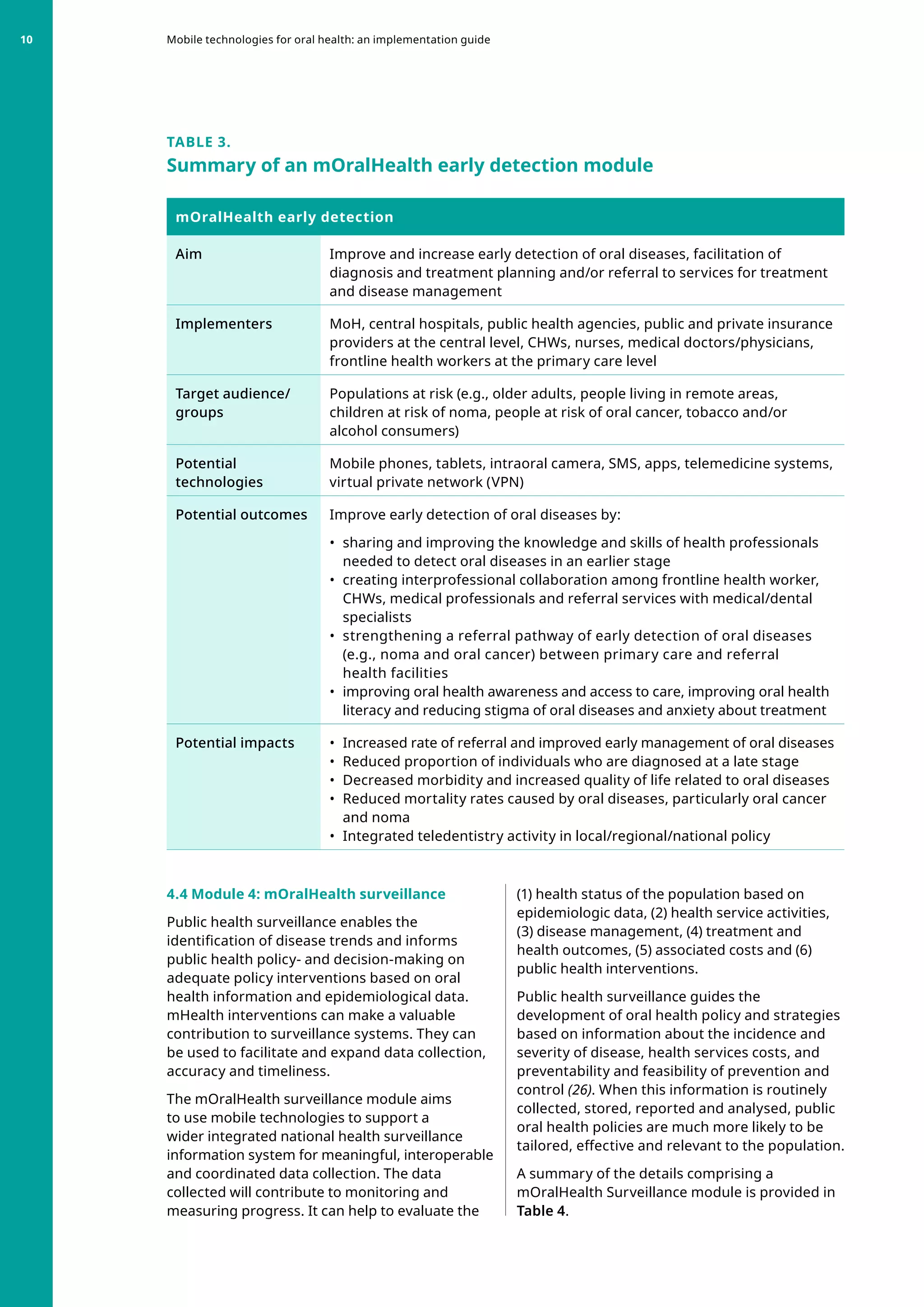
The details of an mOralHealth early detection
module are summarized in Table 3.
Introduction 9
4.4 Module 4: mOralHealth surveillance
Public health surveillance enables the
identification of disease trends and informs
public health policy- and decision-making on
adequate policy interventions based on oral
health information and epidemiological data.
mHealth interventions can make a valuable
contribution to surveillance systems. They can
be used to facilitate and expand data collection,
accuracy and timeliness.
The mOralHealth surveillance module aims
to use mobile technologies to support a
wider integrated national health surveillance
information system for meaningful, interoperable
and coordinated data collection. The data
collected will contribute to monitoring and
measuring progress. It can help to evaluate the
TABLE 3.
Summary of an mOralHealth early detection module
mOralHealth early detection
Aim Improve and increase early detection of oral diseases, facilitation of
diagnosis and treatment planning and/or referral to services for treatment
and disease management
Implementers MoH, central hospitals, public health agencies, public and private insurance
providers at the central level, CHWs, nurses, medical doctors/physicians,
frontline health workers at the primary care level
Target audience/
groups
Populations at risk (e.g., older adults, people living in remote areas,
children at risk of noma, people at risk of oral cancer, tobacco and/or
alcohol consumers)
Potential
technologies
Mobile phones, tablets, intraoral camera, SMS, apps, telemedicine systems,
virtual private network (VPN)
Potential outcomes Improve early detection of oral diseases by:
•	 sharing and improving the knowledge and skills of health professionals
needed to detect oral diseases in an earlier stage
•	 creating interprofessional collaboration among frontline health worker,
CHWs, medical professionals and referral services with medical/dental
specialists
•	 strengthening a referral pathway of early detection of oral diseases
(e.g., noma and oral cancer) between primary care and referral
health facilities
•	 improving oral health awareness and access to care, improving oral health
literacy and reducing stigma of oral diseases and anxiety about treatment
Potential impacts •	 Increased rate of referral and improved early management of oral diseases
•	 Reduced proportion of individuals who are diagnosed at a late stage
•	 Decreased morbidity and increased quality of life related to oral diseases
•	 Reduced mortality rates caused by oral diseases, particularly oral cancer
and noma
•	 Integrated teledentistry activity in local/regional/national policy
(1) health status of the population based on
epidemiologic data, (2) health service activities,
(3) disease management, (4) treatment and
health outcomes, (5) associated costs and (6)
public health interventions.
Public health surveillance guides the
development of oral health policy and strategies
based on information about the incidence and
severity of disease, health services costs, and
preventability and feasibility of prevention and
control (26). When this information is routinely
collected, stored, reported and analysed, public
oral health policies are much more likely to be
tailored, effective and relevant to the population.
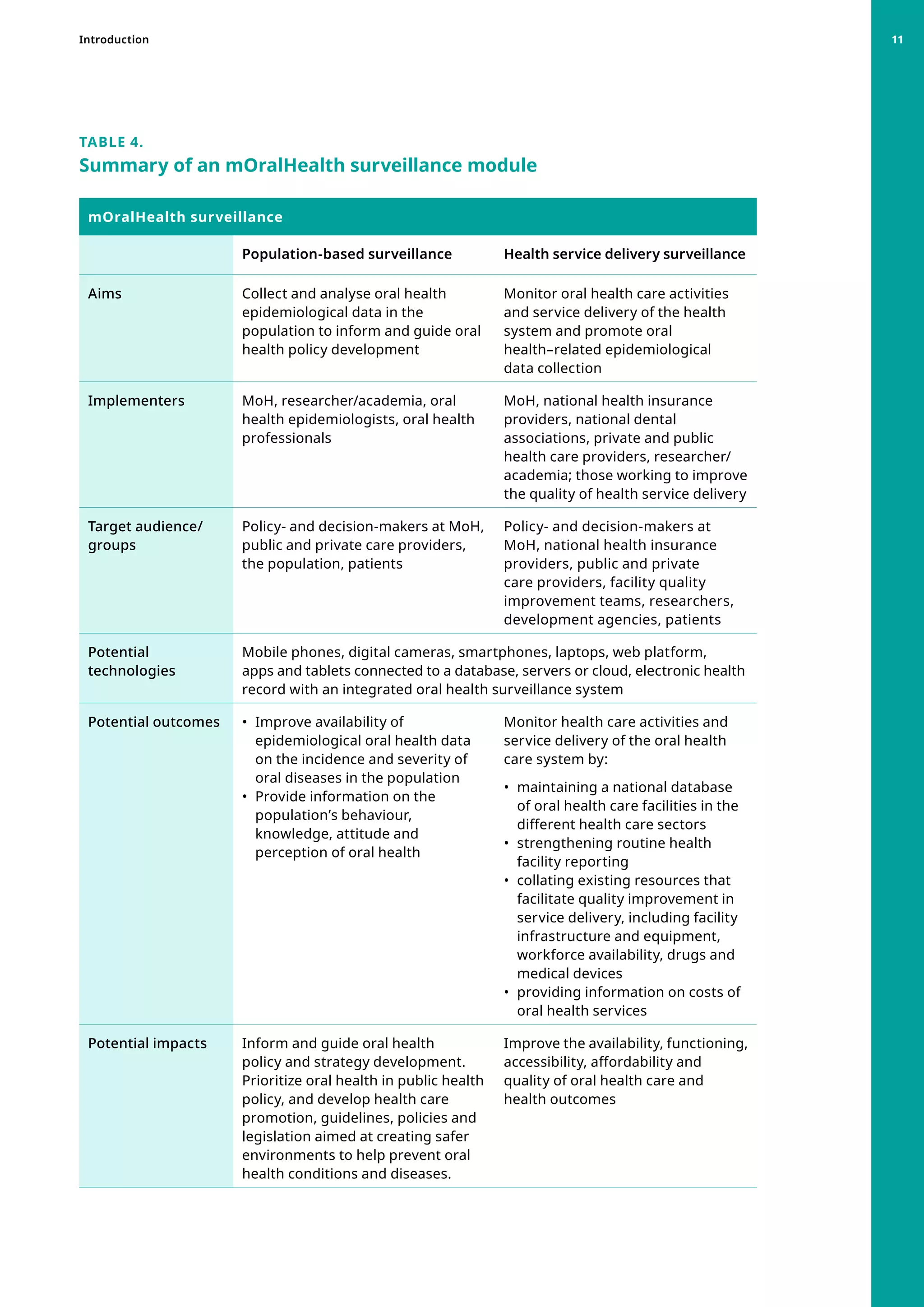
A summary of the details comprising a
mOralHealth Surveillance module is provided in
Table 4.
Mobile technologies for oral health: an implementation guide
10
TABLE 4.
Summary of an mOralHealth surveillance module
mOralHealth surveillance
Population-based surveillance Health service delivery surveillance
Aims Collect and analyse oral health
epidemiological data in the
population to inform and guide oral
health policy development
Monitor oral health care activities
and service delivery of the health
system and promote oral
health–related epidemiological
data collection
Implementers MoH, researcher/academia, oral
health epidemiologists, oral health
professionals
MoH, national health insurance
providers, national dental
associations, private and public
health care providers, researcher/
academia; those working to improve
the quality of health service delivery
Target audience/
groups
Policy- and decision-makers at MoH,
public and private care providers,
the population, patients
Policy- and decision-makers at
MoH, national health insurance
providers, public and private
care providers, facility quality
improvement teams, researchers,
development agencies, patients
Potential
technologies
Mobile phones, digital cameras, smartphones, laptops, web platform,
apps and tablets connected to a database, servers or cloud, electronic health
record with an integrated oral health surveillance system
Potential outcomes •	 Improve availability of
epidemiological oral health data
on the incidence and severity of
oral diseases in the population
•	 Provide information on the
population’s behaviour,
knowledge, attitude and
perception of oral health
Monitor health care activities and
service delivery of the oral health
care system by:
•	 maintaining a national database
of oral health care facilities in the
different health care sectors
•	 strengthening routine health
facility reporting
•	 collating existing resources that
facilitate quality improvement in
service delivery, including facility
infrastructure and equipment,
workforce availability, drugs and
medical devices
•	 providing information on costs of
oral health services
Potential impacts Inform and guide oral health
policy and strategy development.
Prioritize oral health in public health
policy, and develop health care
promotion, guidelines, policies and
legislation aimed at creating safer
environments to help prevent oral
health conditions and diseases.
Improve the availability, functioning,
accessibility, affordability and
quality of oral health care and
health outcomes
Introduction 11
1
Operations
management
© mediaphotos
8
This chapter describes
key activities that need to
be considered during the
planning and preparation
phase of an mOralHealth
programme, including:
•	 developing a workplan
•	 conducting a needs assessment
•	 doing formative research
•	 setting up programme leadership
•	 establishing partnerships.
13
1.1 	 Workplan development  14
1.2 	 Needs assessment 16
1.3 	 Formative research  19
1.4 	 Programme leadership  19
1.5 	 Programme partnerships 21
1 Operations management 13
1.1 Workplan development
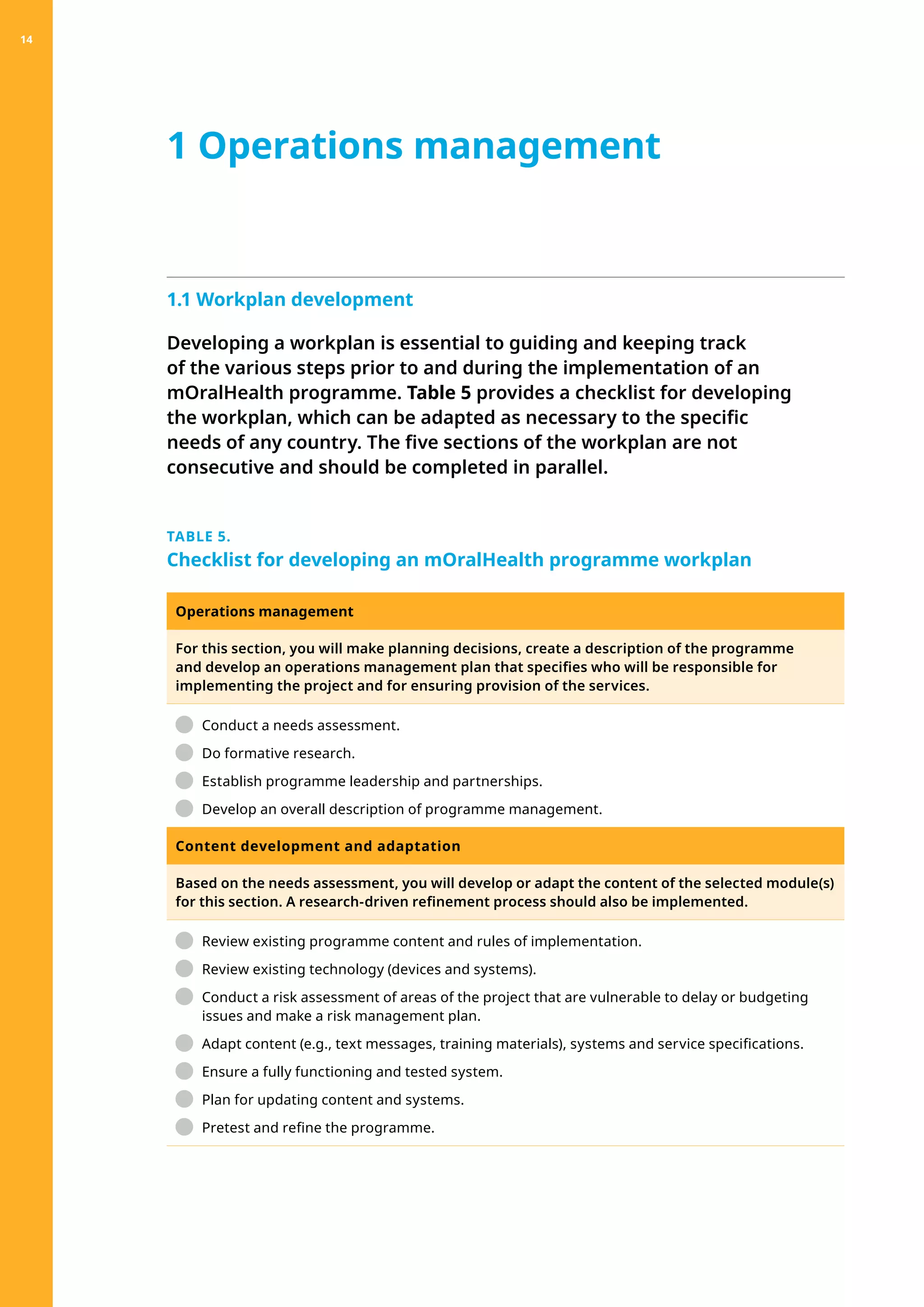
Developing a workplan is essential to guiding and keeping track
of the various steps prior to and during the implementation of an
mOralHealth programme. Table 5 provides a checklist for developing
the workplan, which can be adapted as necessary to the specific
needs of any country. The five sections of the workplan are not
consecutive and should be completed in parallel.
1 Operations management
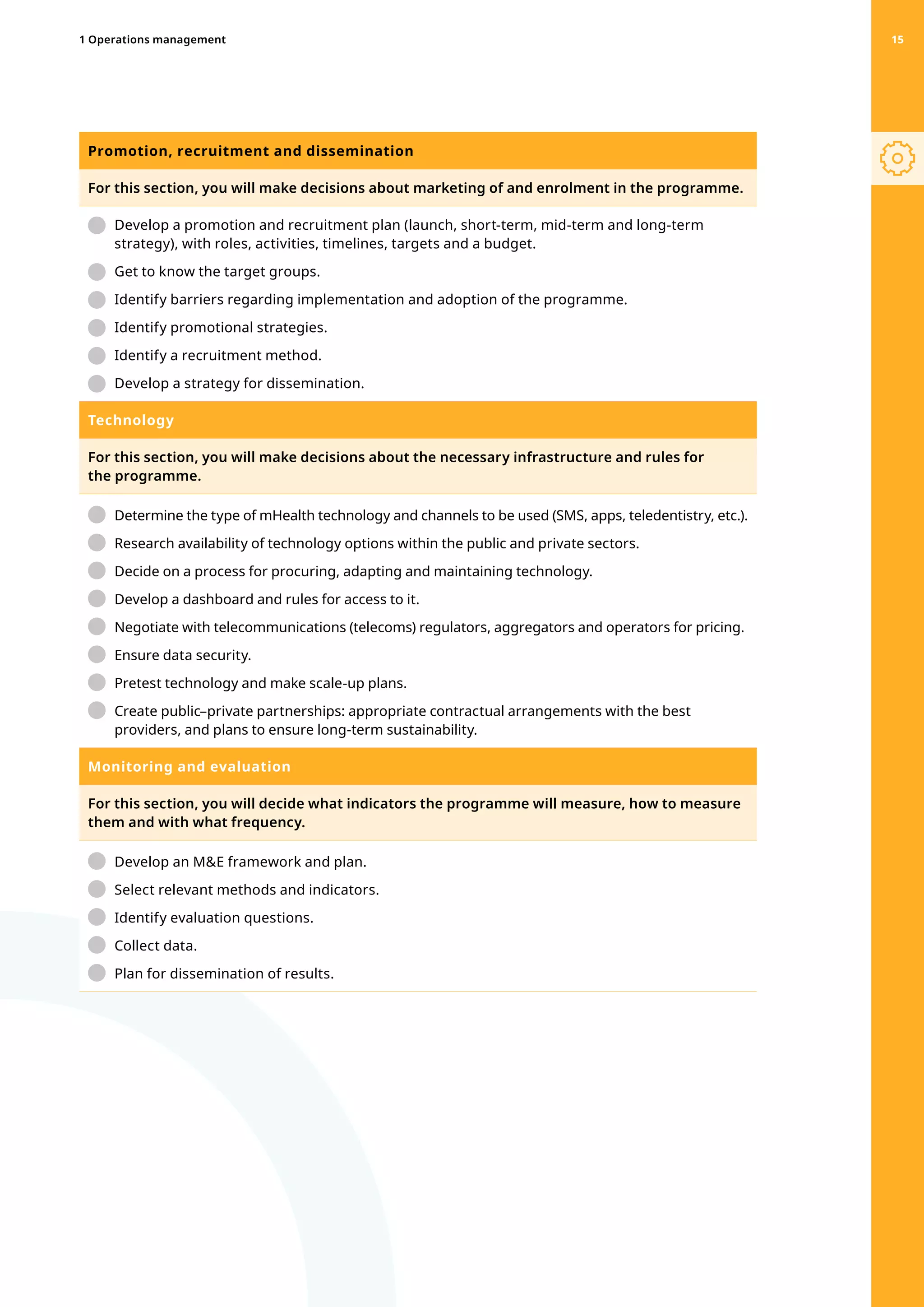
TABLE 5.
Checklist for developing an mOralHealth programme workplan
Operations management
For this section, you will make planning decisions, create a description of the programme
and develop an operations management plan that specifies who will be responsible for
implementing the project and for ensuring provision of the services.
	 Conduct a needs assessment.
	 Do formative research.
	 Establish programme leadership and partnerships.
	 Develop an overall description of programme management.
Content development and adaptation
Based on the needs assessment, you will develop or adapt the content of the selected module(s)
for this section. A research-driven refinement process should also be implemented.	
	 Review existing programme content and rules of implementation.
	 Review existing technology (devices and systems).
	 
Conduct a risk assessment of areas of the project that are vulnerable to delay or budgeting
issues and make a risk management plan.
	 Adapt content (e.g., text messages, training materials), systems and service specifications.
	 Ensure a fully functioning and tested system.
	 Plan for updating content and systems.
	 Pretest and refine the programme.
14
Promotion, recruitment and dissemination
For this section, you will make decisions about marketing of and enrolment in the programme.
	 Develop a promotion and recruitment plan (launch, short-term, mid-term and long-term
strategy), with roles, activities, timelines, targets and a budget.
	 Get to know the target groups.
	 Identify barriers regarding implementation and adoption of the programme.
	 Identify promotional strategies.
	 Identify a recruitment method.
	 Develop a strategy for dissemination.
Technology
For this section, you will make decisions about the necessary infrastructure and rules for
the programme.
	 
Determine the type of mHealth technology and channels to be used (SMS, apps, teledentistry, etc.).
	 Research availability of technology options within the public and private sectors.
	 Decide on a process for procuring, adapting and maintaining technology.
	 Develop a dashboard and rules for access to it.
	 
Negotiate with telecommunications (telecoms) regulators, aggregators and operators for pricing.
	 Ensure data security.
	 Pretest technology and make scale-up plans.
	 
Create public–private partnerships: appropriate contractual arrangements with the best
providers, and plans to ensure long-term sustainability.
Monitoring and evaluation
For this section, you will decide what indicators the programme will measure, how to measure
them and with what frequency.
	 Develop an ME framework and plan.
	 Select relevant methods and indicators.
	 Identify evaluation questions.
	 Collect data.
	 Plan for dissemination of results.
1 Operations management 15
1.2 Needs assessment
For an mOralHealth programme to be effective,
it is essential to understand the context in which
the interventions will be delivered and the needs
of the target groups and users. Conducting
a needs assessment, including a readiness
assessment, is a prerequisite to getting a
better understanding of the setting. The needs
assessment follows a systematic process for
collecting relevant information for planning,
identifying gaps in resources, knowledge and
skills, and informing decision-making.
It also helps to determine the relevant barriers
and facilitators of behaviour change within a
country’s context. The needs assessment should
be conducted in an iterative way during which
stakeholders are encouraged to identify sources
of information and additional stakeholders.
The results of the needs assessment will inform
the development and implementation of the
mOralHealth programme and help establish
baseline measurements from which the
programme can be monitored and evaluated.
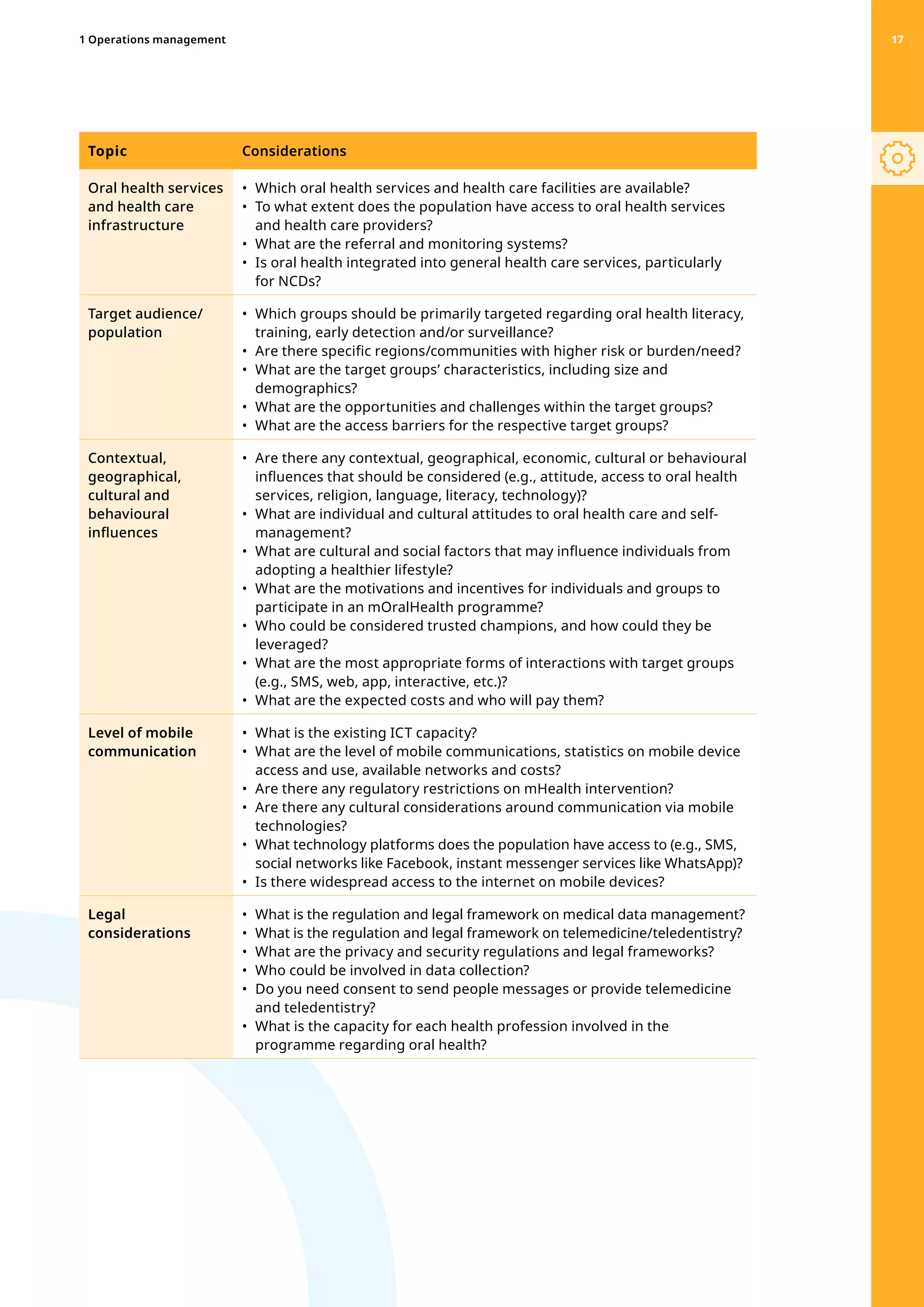
Table 6 lists the considerations for conducting a
needs assessment.
TABLE 6.
Recommended considerations for an mOralHealth needs assessment
Topic Considerations
Current situation of
oral health
•	 What are the public oral health problems (e.g., mortality, morbidity,
burden of oral diseases, incidence and prevalence across population
groups disaggregated by age, sex and location for different oral diseases
and conditions)?
•	 What are the risk factors of oral diseases?
•	 What are the social determinants and inequalities in access to services
and oral health outcomes?
•	 What are the national priorities for oral health?
•	 What are the national guidelines for oral health?
•	 What are the population knowledge levels, cultural attitudes, perceptions
of risk, current behaviours and behaviour trends?
•	 What are the workforce knowledge levels, cultural attitudes, perceptions
of risk, current behaviours and behaviour trends?
National response
and provision of
oral health care
services
•	 What existing national oral health policies are in place?
•	 What are the national priorities of the government and the health system?
•	 What existing national oral health programmes are in place?
•	 What are the objectives, constraints, institutional and human resources,
and available funding?
•	 What are the limitations of services, training, equipment, treatment,
supplies and resources?
•	 What are the scope and uptake of current oral health services, including
integration into UHC?
•	 What is the capacity of the oral health workforce?
•	 What is the level of training?
•	 What training and quality assurance systems are in place?
Mobile technologies for oral health: an implementation guide
16
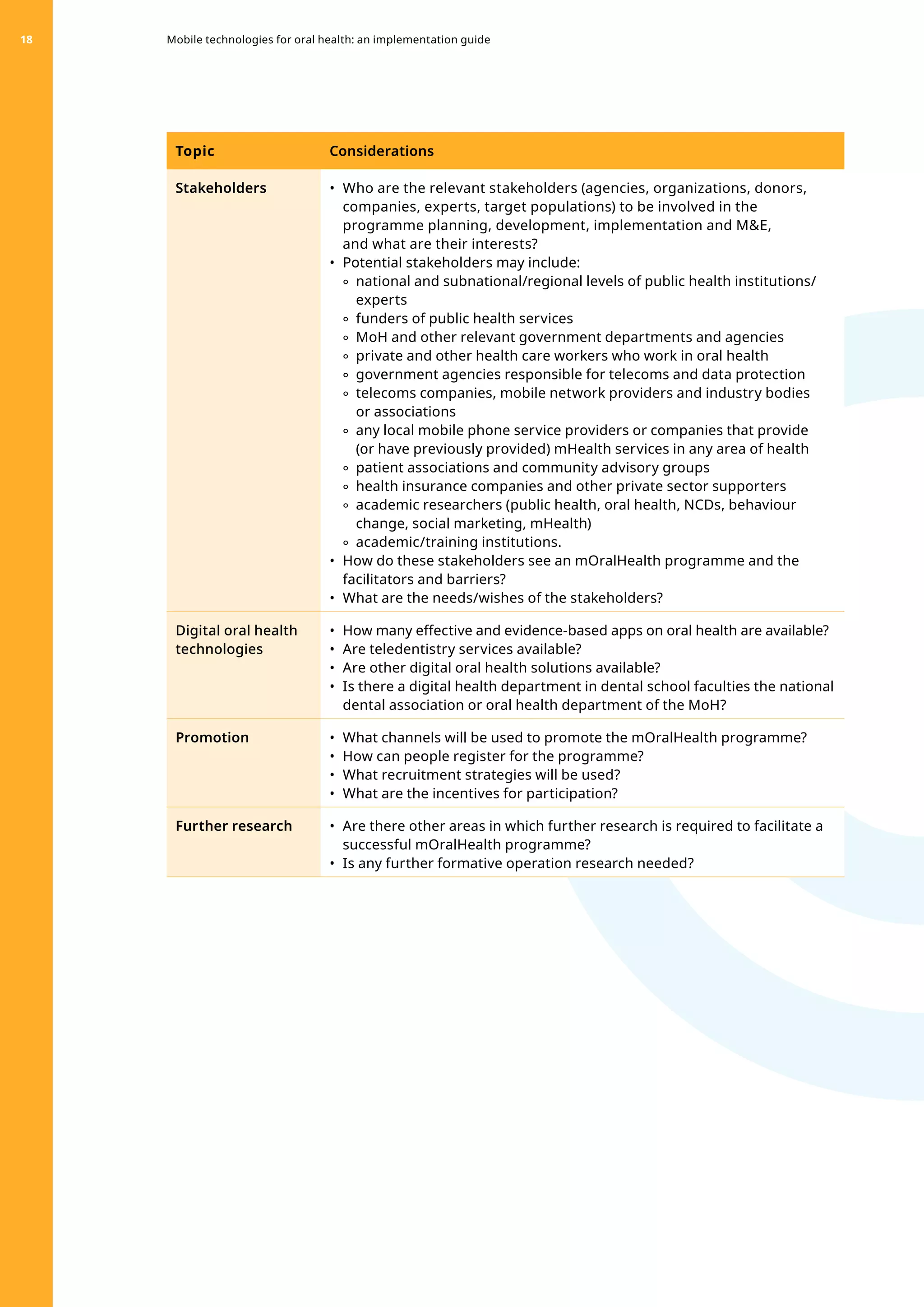
Topic Considerations
Oral health services
and health care
infrastructure
•	 Which oral health services and health care facilities are available?
•	 To what extent does the population have access to oral health services
and health care providers?
•	 What are the referral and monitoring systems?
•	 Is oral health integrated into general health care services, particularly
for NCDs?
Target audience/
population
•	 Which groups should be primarily targeted regarding oral health literacy,
training, early detection and/or surveillance?
•	 Are there specific regions/communities with higher risk or burden/need?
•	 What are the target groups’ characteristics, including size and
demographics?
•	 What are the opportunities and challenges within the target groups?
•	 What are the access barriers for the respective target groups?
Contextual,
geographical,
cultural and
behavioural
influences
•	 Are there any contextual, geographical, economic, cultural or behavioural
influences that should be considered (e.g., attitude, access to oral health
services, religion, language, literacy, technology)?
•	 What are individual and cultural attitudes to oral health care and self-
management?
•	 What are cultural and social factors that may influence individuals from
adopting a healthier lifestyle?
•	 What are the motivations and incentives for individuals and groups to
participate in an mOralHealth programme?
•	 Who could be considered trusted champions, and how could they be
leveraged?
•	 What are the most appropriate forms of interactions with target groups
(e.g., SMS, web, app, interactive, etc.)?
•	 What are the expected costs and who will pay them?
Level of mobile
communication
•	 What is the existing ICT capacity?
•	 What are the level of mobile communications, statistics on mobile device
access and use, available networks and costs?
•	 Are there any regulatory restrictions on mHealth intervention?
•	 Are there any cultural considerations around communication via mobile
technologies?
•	 What technology platforms does the population have access to (e.g., SMS,
social networks like Facebook, instant messenger services like WhatsApp)?
•	 Is there widespread access to the internet on mobile devices?
Legal
considerations
•	 What is the regulation and legal framework on medical data management?
•	 What is the regulation and legal framework on telemedicine/teledentistry?
•	 What are the privacy and security regulations and legal frameworks?
•	 Who could be involved in data collection?
•	 Do you need consent to send people messages or provide telemedicine
and teledentistry?
•	 What is the capacity for each health profession involved in the
programme regarding oral health?
1 Operations management 17
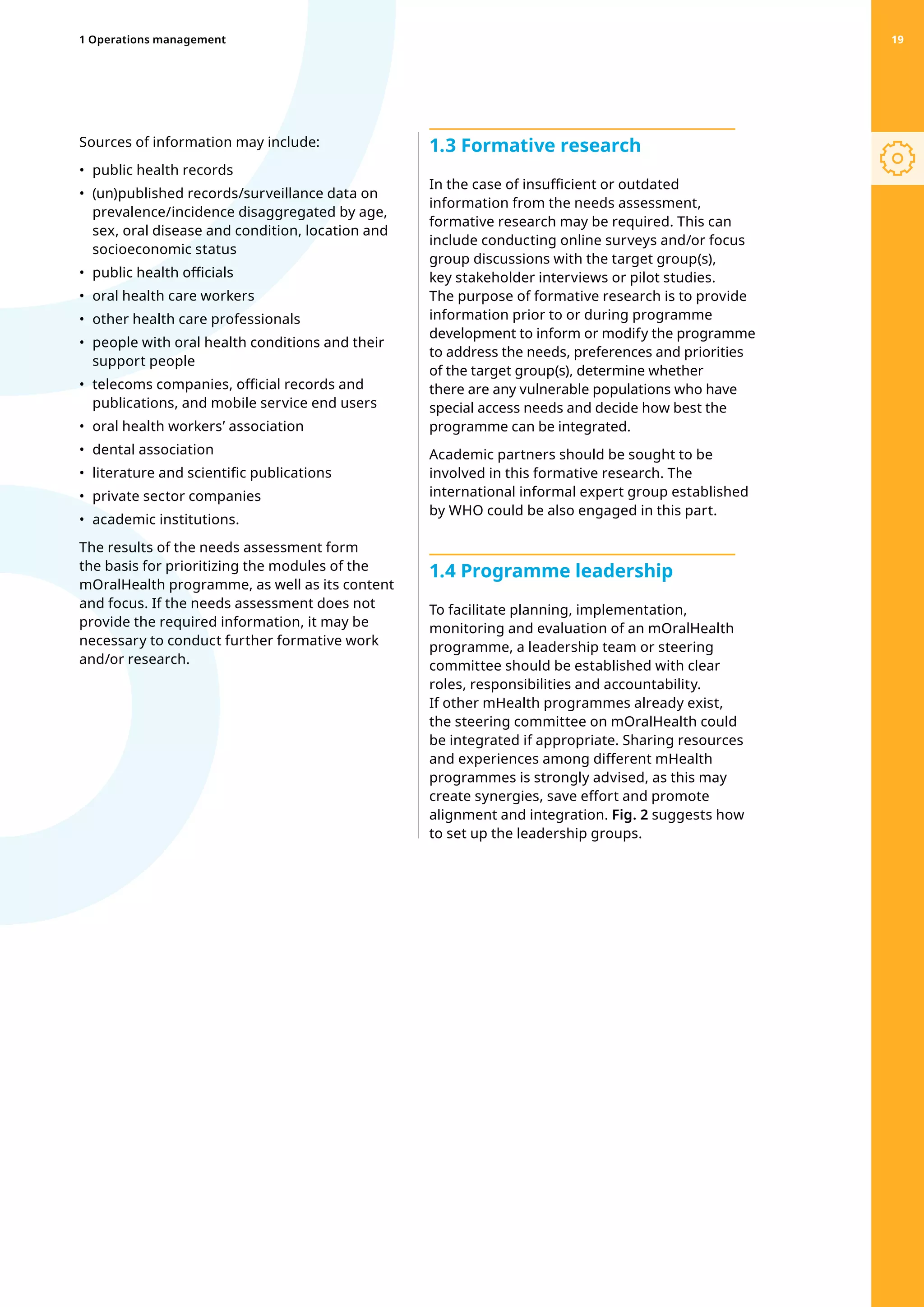
Topic Considerations
Stakeholders •	 Who are the relevant stakeholders (agencies, organizations, donors,
companies, experts, target populations) to be involved in the
programme planning, development, implementation and ME,
and what are their interests?
•	 Potential stakeholders may include:
	
° national and subnational/regional levels of public health institutions/
experts
	
° funders of public health services
	
° MoH and other relevant government departments and agencies
	
° private and other health care workers who work in oral health
	
° government agencies responsible for telecoms and data protection
	
° telecoms companies, mobile network providers and industry bodies
or associations
	
° any local mobile phone service providers or companies that provide
(or have previously provided) mHealth services in any area of health
	
° patient associations and community advisory groups
	
° health insurance companies and other private sector supporters
	
° academic researchers (public health, oral health, NCDs, behaviour
change, social marketing, mHealth)
	
° academic/training institutions.
•	 How do these stakeholders see an mOralHealth programme and the
facilitators and barriers?
•	 What are the needs/wishes of the stakeholders?
Digital oral health
technologies
•	 How many effective and evidence-based apps on oral health are available?
•	 Are teledentistry services available?
•	 Are other digital oral health solutions available?
•	 Is there a digital health department in dental school faculties the national
dental association or oral health department of the MoH?
Promotion •	 What channels will be used to promote the mOralHealth programme?
•	 How can people register for the programme?
•	 What recruitment strategies will be used?
•	 What are the incentives for participation?
Further research •	 Are there other areas in which further research is required to facilitate a
successful mOralHealth programme?
•	 Is any further formative operation research needed?
Mobile technologies for oral health: an implementation guide
18
Sources of information may include:
•	 public health records
•	 
(un)published records/surveillance data on
prevalence/incidence disaggregated by age,
sex, oral disease and condition, location and
socioeconomic status
•	 public health officials
•	 oral health care workers
•	 other health care professionals
•	 
people with oral health conditions and their
support people
•	 
telecoms companies, official records and
publications, and mobile service end users
•	 oral health workers’ association
•	 dental association
•	 literature and scientific publications
•	 private sector companies
•	 academic institutions.
The results of the needs assessment form
the basis for prioritizing the modules of the
mOralHealth programme, as well as its content
and focus. If the needs assessment does not
provide the required information, it may be
necessary to conduct further formative work
and/or research.
1.3 Formative research
In the case of insufficient or outdated
information from the needs assessment,
formative research may be required. This can
include conducting online surveys and/or focus
group discussions with the target group(s),
key stakeholder interviews or pilot studies.
The purpose of formative research is to provide
information prior to or during programme
development to inform or modify the programme
to address the needs, preferences and priorities
of the target group(s), determine whether
there are any vulnerable populations who have
special access needs and decide how best the
programme can be integrated.
Academic partners should be sought to be
involved in this formative research. The
international informal expert group established
by WHO could be also engaged in this part.
1.4 Programme leadership
To facilitate planning, implementation,
monitoring and evaluation of an mOralHealth
programme, a leadership team or steering
committee should be established with clear
roles, responsibilities and accountability.
If other mHealth programmes already exist,
the steering committee on mOralHealth could
be integrated if appropriate. Sharing resources
and experiences among different mHealth
programmes is strongly advised, as this may
create synergies, save effort and promote
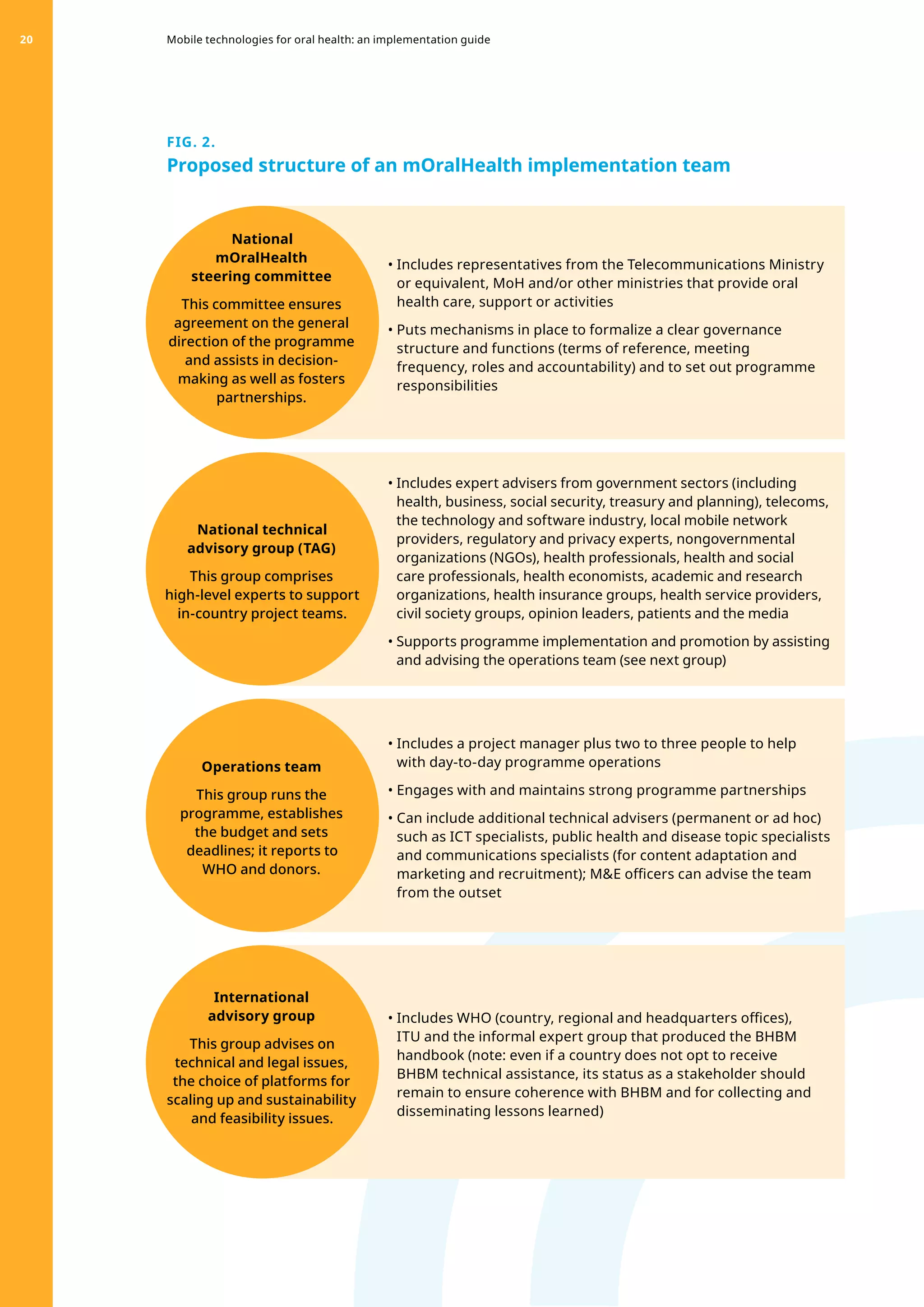
alignment and integration. Fig. 2 suggests how
to set up the leadership groups.
1 Operations management 19
FIG. 2.
Proposed structure of an mOralHealth implementation team
• 
Includes representatives from the Telecommunications Ministry
or equivalent, MoH and/or other ministries that provide oral
health care, support or activities
• 
Puts mechanisms in place to formalize a clear governance
structure and functions (terms of reference, meeting
frequency, roles and accountability) and to set out programme
responsibilities
• 
Includes expert advisers from government sectors (including
health, business, social security, treasury and planning), telecoms,
the technology and software industry, local mobile network
providers, regulatory and privacy experts, nongovernmental
organizations (NGOs), health professionals, health and social
care professionals, health economists, academic and research
organizations, health insurance groups, health service providers,
civil society groups, opinion leaders, patients and the media
• 
Supports programme implementation and promotion by assisting
and advising the operations team (see next group)
• 
Includes a project manager plus two to three people to help
with day-to-day programme operations
• 
Engages with and maintains strong programme partnerships
• 
Can include additional technical advisers (permanent or ad hoc)
such as ICT specialists, public health and disease topic specialists
and communications specialists (for content adaptation and
marketing and recruitment); ME officers can advise the team
from the outset
• 
Includes WHO (country, regional and headquarters offices),
ITU and the informal expert group that produced the BHBM
handbook (note: even if a country does not opt to receive
BHBM technical assistance, its status as a stakeholder should
remain to ensure coherence with BHBM and for collecting and
disseminating lessons learned)
National
mOralHealth
steering committee
This committee ensures
agreement on the general
direction of the programme
and assists in decision-
making as well as fosters
partnerships.
Operations team
This group runs the
programme, establishes
the budget and sets
deadlines; it reports to
WHO and donors.
National technical
advisory group (TAG)
This group comprises
high-level experts to support
in-country project teams.
International
advisory group
This group advises on
technical and legal issues,
the choice of platforms for
scaling up and sustainability
and feasibility issues.
Mobile technologies for oral health: an implementation guide
20
1.5 Programme partnerships
Forming partnerships is an essential component
of developing an mOralHealth programme,
and identified partners are closely involved in all
phases of the programme, from planning and
development to implementation and evaluation.
They include the government, CSOs (such as
patient organizations and professional societies),
the private sector (telecoms organizations,
technological companies and insurance
companies), academic institutions, NGOs and
international organizations. Box two provides
some lessons learned from BHBM’s extensive
experience in working with diverse partners.
BOX 2:
Lessons learned from BHBM
partnership management
Multisector dialogue: In Senegal and Sudan,
BHBM, through a digital platform supported
by ITU, became the first health care initiative
that increased the country’s technical
capacity with regard to mHealth. From the
beginning, it brought together the public
and private sector by inviting all telecoms
companies to join forces.
Alignment with public value: Public value
refers to how value is created through a
partnership among the private, public and
third sector to meet everyone’s basic needs.
To design future strategic partnerships,
members of BHBM need to align themselves
with a larger societal purpose such as
improved well-being of society. In Senegal,
alignment with a social purpose resulted in
a flat partnership structure where all mobile
providers joined forces, regardless of market
competition, power position or previous
market share, resulting to an increased
level of trust among all sectors. Aligning
partnerships with a social purpose has also
attracted long-term investment from the
private sector.
Empowerment of civil society: In both
Senegal and Sudan, civil society – especially
the patient groups and diabetes associations
– demonstrated a creative approach
to solving a social problem by actively
searching for new innovations and bringing
partners together through an open dialogue.
Members of civil society, such as patients’
groups, own more power than previously
had been considered and could hold the key
to establishing future strategic partnerships.
Service-based innovation ecosystem:
Developing a long-term view on partnership
and placing a digital platform at the heart
of BHBM has led to some spillover benefits.
Best practices from India, Senegal and
Sudan highlight how a digital platform has
the potential to enable an array of emerging
services and form a serviced-based
ecosystem, which could help to sustain
BHBM on a country level.
1 Operations management 21
2
Content
development
and adaptation
© epicurean
This chapter gives oral
health promotion planners
a framework for developing
and adapting the content
of each module of an
mOralHealth programme.
2.1 	 Developing or adapting an mOralHealth literacy module 24
2.1.1 	 Target audience/users  24
2.1.2 	 Design and adaptation of the programme framework 24
2.1.3 	 Existing content and its adaptation  25
2.1.4 	 Development of additional content  28
2.2 	 Developing an mOralHealth training module 29
2.2.1 	 Target users 29
2.2.2 	 Designing a training module  29
2.2.3 	 Training module content development 32
2.3 	 Developing an mOralHealth early detection module 34
2.3.1 	 Target audience/groups 34
2.3.2 	 Design of the framework  34
2.3.3 	 Collection, storage and processing of data 35
2.3.4 	 Adaptation to the country context  36
2.3.5 	 Pretesting, piloting and refining the early detection module  36
2.4 	 Developing an mOralHealth surveillance module 39
2.4.1 	 mOralHealth surveillance target audience 39
2.4.2 	 Design of an mOralHealth surveillance framework 40
2.4.3 	 Pretesting, piloting and refining the early surveillance module 41
23
2 Content development 
and adaptation 23
2.1 Developing or adapting an mOralHealth literacy module
Experience shows that despite the best efforts of health experts to craft
appropriate content for a global audience, programmes are critically
improved by target user-driven processes to refining the programme
content and mode of delivery.
This section of the handbook will provide
guidance on:
•	 
identifying target users of the standard
content library
•	 
adapting the design of the mOralHealth
literacy module to the respective country
context
•	 
adapting the existing BHBM mOralHealth
literacy content library to the country context
•	 
creating additional content for the
mOralHealth literacy module if the content
provided is not sufficient to the needs.
Text messages are the most equitable modality
for delivering health messages, particularly in
resource-restricted settings (where much of the
population may not have access to a computer
or a smartphone). Therefore, BHBM suggests
that countries run SMS programming alongside
other technology options like messenger apps
or stand-alone apps if they wish to deliver the
programme through smartphones. See Annex 4
for guidance on adapting the content library to
other formats (e.g., voice and messenger apps
and chatbots) and adding multimedia.
Whether you are adapting an existing content
library of the mOralHealth literacy module
or creating new evidence-based content,
the national TAG should review any existing
mOralHealth prevention and management
programmes and guidelines that may guide
the development of programme content.
In both cases, target users should be involved
to test the understandability and clarity of the
message content and design and to provide
essential insights for validating and finalizing
the programme design and content.
2 Content development
and adaptation
The BHBM team encourages all countries that
have adapted the mOralHealth literacy module
to share any additional messages or content
with the BHBM secretariat to enhance and
inform further iterations of the global content
libraries and to share with other countries that
can potentially benefit.
2.1.1 Target audience/users
The content library has been developed based
on the scientific literature, United Nations
publications and policy statements and
guidelines of professional organizations.
The message library currently contains oral
health messages across nine topic areas
(e.g., oral health behaviours, diet, consulting a
dentist, smoking) that can be adapted to country
contexts and message delivery platforms for
the following four main target groups:
1. 
parents and teachers as intermediaries to
reach children from 3 to 9 years old
2. 
adolescents from 10 to 19 years old
3. 
pregnant and lactating women
4. 
persons with specific needs (e.g., older
persons, persons under cancer treatment or
persons living with diabetes or other physical
or mental disabilities).
2.1.2 Design and adaptation of the
programme framework
When designing a framework for an
mOralHealth programme, the TAG seeks
behaviour change techniques (BCTs) and
practical strategies to effect oral health
behaviour changes of individuals or
communities and/or to change organizational
and environmental factors. The BCT taxonomy
24
gives an overview of existing techniques
(see BCT in the app store or visit https://www.
bct-taxonomy.com/). A practical strategy is a
way of organizing and operationalizing the BCTs.
For example, the BCT “providing information
about health consequences” can be translated
as a practical strategy: “provide information via
SMS messages on how sugar consumption can
cause dental diseases”.
As text messages have been proven to be an
effective application for providing oral health
information and thereby promoting oral
health, the WHO developed an mOralHealth
text-message library. The mOralHealth literacy
content library includes a set of one-way
messages for different target groups. This
standard content library is available on request
for countries to use as a basis for an mOralHealth
literacy module (see Annex 2). The messages
have been written in SMS format but are
adaptable to other mHealth technologies.
BHBM suggests running the module for a
minimum duration of three months, as habit
formation takes an average of 66 days (27).
The proposed algorithm starts at a higher
frequency of messages, which diminishes
over time. Several behaviours are targeted
simultaneously to keep the module from
becoming uninteresting; however, evidence does
not show that simultaneous is more beneficial
than consecutive behaviour change. The module
splits the population based on a number of
characteristics to better tailor the content to the
respective target groups.
There is flexibility for countries to choose to not
adopt all recommendations of the module, run
the module for a longer or shorter period, adjust
the number of messages to make the module
more or less intensive or adapt the system rules
(such as length, message frequency and timing,
etc.), registration, opt-in/out and other functions.
When adapting the mOralHealth literacy module,
the following should be considered and guided
by feedback from target users of the module:
•	 media and channels used
•	 
timing, frequency and duration of the
intervention
•	 
collection and storage of baseline and
accumulating research data
•	 
registration, opt-in and opt-out process and
administrative communication (if any)
•	 
mode of communication/interaction (one- or
two-way interaction)
•	 
degree of choice and flexibility in how
messages are received
•	 
possibility of stopping and/or changing the
programme
•	 
extent of interaction with clinicians or the
health service system.
2.1.3 Existing content and its adaptation
International experts in oral health, mHealth
and health communications were involved in
the process of developing the mOralHealth
literacy content library. Messages were drafted
based on WHO guidelines and other scientific
evidence. The content has been written with
the understanding that the messages should
be adapted for country use and we suggest a
process like that outlined in figure 3. Adaptation
is important to ensure that the information
is clear and relevant to the target population.
Target groups need to be able to relate to
the content and have the means to apply
the behaviour change strategies in order to
improve outcomes and ensure retention of
users. In other words, the messages must be
understandable, acceptable and relevant to the
people using them to increase their impact.
FIG. 3.
Overview of the suggested adaptation process
Translation Adapt the messages:
•	 Local expert review
•	 Focus group review
•	 Ecological testing
WHO content
verification (optional)
Scale the programme
and ongoing updates
1 2 3 4
25
2 Content development 
and adaptation 25
2.1.3.1 Translation
The first step of adaptation is translation.
The original message library must be first
translated into the local language(s). Sensitive
translation is essential so that the messages
are clear, engaging and linguistically sensitive.
When translating the programme content, it is
important to consider the choice of languages
and dialects.
The choice of languages is critical to ensure
that the target groups are able to access
the programme. Experience running BHBM
programmes and feedback from users have
reiterated the importance of this. For example,
in Tunisia implementers found that the
programme must be available in Arabic as well
as French for it to be taken up. In India the team
learned that having at least Hindi in addition to
English was crucial to obtain more subscriptions.
In countries where there are multiple dialects
within languages, it is important to explore which
dialect will be most acceptable to the most people
or whether the programme must be available in
more than one dialect. When considering dialects,
consider spoken versus written or classical forms
of the language: for example, would writing in
the spoken style of Arabic be more engaging for
users than classical written Arabic?
Once translated from English to the local
language, the translation should be back-
translated into English again by a
different translator (one who has not
seen the original English content)
to check its accuracy. This does not
need to be a professional translator
but can rather be a person who
speaks and reads both languages.
If there are discrepancies between
the original and the back-translated
English versions, the two translators and
the implementing team can discuss the best
alternatives to provide a sensitive and accurate
translation into the local language.
2.1.3.2 Adapting the messages
Local experts and target users should be
involved in the adaptation process leading to
a contextualized library of messages (or other
content, such as chatbot scripts or app content).
Messages need to be easy to understand,
unambiguous, appropriate and relevant to
the target users. Their inputs can be gathered
through review processes and qualitative
methods, including focus groups, surveys and
user pretesting. This can be done by a trained
expert in the mOralHealth programme or a
contracted specialist market research company.
In the provided mOralHealth literacy content
library, some words are written in red font to
show where surface or superficial adaptations
will likely be necessary in country (e.g., replacing
food items with local foods or activities that are
context or culture specific). It is important to note
that adaptation should not be limited to these
words. Other parts of the message (or whole
messages) may also need to be adapted. The
challenge is to maintain the scientific accuracy
of the message while making it relevant to users
in a local context. For example, fish is suggested
in some programmes as a source of protein and
omega-3. If fish is very expensive or unavailable
in the local context, it will be necessary to
change it to another appropriate food containing
omega-3 and protein, such as nuts and seeds.
Another example may be to adapt a suggestion
to exercise by walking; in the case that it is unsafe
or too hot to walk outside, suggest instead to do
some exercise in the home.
The process of adapting the message library
may involve the following steps to ensure a
user-centred, cost- and time-balanced approach.
2a. Local expert review
Local experts in oral health, including academics,
PHC workers, health communications specialists
and behavioural scientists, can be invited to
send their review of the adapted and translated
messages. They may complete the review for
free if they are acknowledged in the programme
reporting and related materials. If you have the
resources, you can host an initial adaptation
workshop in person or online for these experts to
meet and discuss their review. These specialists
should have a background in behaviour change
and/or health promotion in the field of oral
health. It is important to ask them during this
review if additional content should be developed
(see Section 2.1.4). Incorporating the feedback
from this review should result in a draft local
content library. The next step is to validate the
messages through the target population.
2b. Focus group review
Focus groups with end users can gather
feedback on the understanding, perceptions,
opinions, beliefs and attitudes towards the
messages. Although this step can be resource
intensive, many BHBM countries have found
that it is worth the investment. This phase can
involve a small number of in-person or virtual
focus groups with target users and health
workers (e.g., five groups of 8–10 participants).
If necessary, some focus groups could be
replaced with telephone interviews.
Mobile technologies for oral health: an implementation guide
26
The choice of languages
is critical to ensure
that the target groups
are able to access the
programme.
The focus group should include persons
representative of the target population,
with geographic diversity (rural, urban,
different districts or regions nationwide),
linguistic diversity (regional dialects), diverse
socioeconomic backgrounds and different
cadres of health workers (if they constitute
the target population). When composing
focus groups, group dynamics and cultural
norms need to be considered; for example, is
it appropriate or may it inhibit participation in
the discussion if elders are mixed with youth
or if groups are mixed gender or hierarchies?
The goal is that the group should feel
comfortable and disinhibited in participating.
Focus group participants may be recruited
through community message boards or local
community events, social media or health
centres. The latter should be used only if really
needed as the results may be biased if using
persons already engaged with health services.
Remunerating the time of the participants
needs to be considered, and informed consent
to participate needs to be obtained for ethical
reasons.
The goal of the focus groups is to verify whether
the programme content is:
•	 
understandable (Do users understand the
concepts and terminology used in the content
library? Are the terminology and phrasing clear
and unambiguous for the target groups?)
•	 
acceptable (Are the messages respectful
of and sensitive to the local context and
inoffensive?)
•	 
relevant (Are all the messages necessary and
applicable to the environment and context
of the user? Will people engage with the
messages?).
Focus group discussions can also be used to find
out more about user preferences for the timing
(e.g., mornings, common break times, etc.) and
frequency (e.g., once a day, every second day) of
the messaging/intervention as well as the level
of engagement that can be expected in the case
of using apps or chatbots.
The project team should review findings from
the focus groups and then make changes to
the content library and programme as needed.
It is important to document the changes made
and the rationale for the changes for future
reference. This information is also valuable to
the BHBM secretariat for making improvements
to the mOralHealth literacy content library and
understanding more about its global relevance
and use.
2c. Ecological testing
Ecological testing refers to testing the
programme content in a way that mimics
the conditions in which the programme will
ultimately be delivered and received by the
users. Receiving the messages on a mobile
phone during a normal day is different than
sitting down to read a list of messages on
paper or in a presentation in a focus group.
Although time- and resource-consuming,
ecological testing is important and can go a
long way towards overall programme success.
Ecological testing may be done in a small group
of potential users or via real-world pilot testing.
For small-group testing, it is recommended
that you test the sign-up process and the
programme messages (or app or chatbot)
for one to two weeks with a small group of
participants (approximately 15) and ask them
to rate each message (or session) immediately
as they receive it, providing feedback on the
acceptability and helpfulness of the message.
For example, you can ask testers:
•	 
“How did you find the sign-up process on a
scale of 1 (being very easy) to 5 (being very
difficult)?”
•	 
“Please estimate how long in minutes it took
you to sign up (approximately) and reply with
the approximate number of minutes.”
•	 
“How much did you like the message on a scale
of 1 (very much) to 5 (not at all)?”
•	 
“How helpful was this on a scale of 1 (very useful)
to 5 (not useful at all)?”
•	 
“How likely would you be to implement the
suggested advice or instruction in the message
on a scale of 1 (very likely) to 5 (not likely at all)?”
Ecological testing could also involve real-
world pilot testing. In the example of
mTobaccoCessation Tunisia, the team deemed
user testing and piloting as “essential”. When
conducting real-world consumer testing, the
adapted programme is sent live to a group of
participants as part of a soft launch or pilot
study. This is similar to programme scaling, with
the same dose and frequency of messages (or
interactions), although over a shorter period of
time if resources are restricted (e.g., the first two
months of the programme instead of the entire
six months). The group is surveyed over the
telephone periodically during the course of the
pilot, mainly to determine how understandable,
acceptable and relevant the messages are, but
also how likely they would be to engage in the
suggested behaviour change. The results are
then used to refine the programme.
27
2 Content development 
and adaptation 27
2.1.3.3 Optional fidelity checking of the
adapted content
The international expert group who contributed
to the original content library of the mOralHealth
module is available for reviewing the adapted
and contextualized version (back-translated,
English-language) of the content library before
widespread use in a particular country context.
The request may be sent to bhbm@who.int,
and the team will arrange for a review by the
expert group.
2.1.3.4 Scale the programme and ongoing
review and maintenance
Many countries choose to carry out a small
soft launch or pilot of the programme as part
of real-world consumer testing. This process
can also test the appropriateness of the
evaluation mechanism and indicators. This
Phase 1 programme evaluation will likely gather
qualitative feedback from users, which can be
used to further adapt the content library, even
after Phase 1 implementation has begun.
Finally, the national TAG must finalize and agree
on a plan (including who is responsible) for
maintaining the database of programme content
(such as messages or chatbot scripts) for updates
(e.g., to incorporate updates from BHBM or
updated national clinical guidelines, etc.).
2.1.4 Development of additional content
The process for creating the content library
of the mOralHealth literacy module is
comprehensive, with it being linked to other
areas of the global oral health agenda and in
close collaboration with an international expert
group. However, it additional material may be
required for the selected target groups.
To assess whether additional content is needed
or whether the BHBM mOralHealth literacy
library is sufficient, consider the following
questions:
•	 Are there any groups or subpopulations that
are not served by adapting existing BHBM
content?
•	 Are there any popular values or beliefs around
oral health specific to the target groups that
warrant additional programme content?
•	 Are oral diseases highly stigmatized?
•	 Are there special informational or oral
health management needs resulting from
a high prevalence of related diseases and
conditions that are not already covered in the
mOralHealth literacy content library?
•	 Are the rules of the BHBM mOralHealth
literacy content module (e.g., the frequency
and duration, interactivity, etc.) inappropriate
for the target groups?
If any of the previous questions are affirmed,
first clarify if potential content from other health
communications campaigns exists. If not, try to
gather as much information as you can about
the details in order to create the new content.
You will need to gather opinions of specialists in
the health topic area to develop new content.
When developing the content, it is important to
take into account the following aspects, so that
messages (or app content or chatbot scripts)
are understandable, acceptable and relevant to
the users: 	
•	 language, tone and clarity of the health
messages
•	 health literacy and technological literacy level
of the target groups
•	 ensured provision of information, concrete
instruction for self-managed behaviour
change, reminders and motivational content
•	 consideration of and potentially tailoring to
specific groups (e.g., healthy populations, rural
or urban populations, socioeconomic status,
ethnic group, age, gender)
•	 salience and utility of practical tips and
strategies for the population
•	 avoiding an alarmist tone or negative framing
to behaviour change messages (if a negative
framing is used, be sure to provide an
instruction, solution or hopeful statement as
well to avoid causing anxiety and a feeling of
disempowerment in the user)
•	 an “active” component, or an “ask,” is included
(e.g., a statement that asks users to act)
•	 whether the information should be static
or dynamic, depending on whether the
programme is uni- or bidirectional or fully
interactive via a chatbot or an app (based on
input from the user)
•	 length of characters per message allowed
in each country or the data implications of
sending the content (more applicable to
images and videos).
Mobile technologies for oral health: an implementation guide
28
Research shows that there are “mediators of
meaning” when developing written messages,
which go beyond basic tailoring of messages to
different cultural settings (28). These mediators
help explain the hidden assumptions related to
culture, health and the health system, which may
be interpreted through health communication
messages. Maar et al. (28) found that there are six
main themes or factors that influence the level of
congruence between the message content that
researchers perceive to send versus the content
that is perceived by the recipients. See Annex 3
for a summary of the relationships between the
main themes, the operationalizing strategies
and the affected behaviour change conditions,
which will be helpful to consider when composing
the messages (28). New content should then
be user tested with target users as outlined in
Section 2.1.3.2.
2.2 Developing an mOralHealth
training module
Health care systems worldwide are challenged
by a shortage of health care professionals, and
this trend is expected to increase. This shortage
also applies to oral health professionals. Unequal
distribution and lack of appropriate treatment
facilities further contribute to a situation where
most of the oral disease burden (particularly
tooth decay) remains untreated. Advances and
innovations in education technology, including
mHealth as a tool to deliver training and education,
offer a way to address these challenges. The health
sector has adopted e-learning approaches as one
of the key strategies for health workforce training
as well as for continued professional development
(CPD) to expand and better equip the existing
health care workforce. Although e-learning has
many advantages, it should be noted that it
cannot completely replace training, diagnosis and
treatment by oral health professionals. However,
it may complement and contribute to existing
services and improve referrals.
2.2.1 Target users
Using e-learning approaches may increase
access to learning opportunities for various
target groups at scale as well as those that are
geographically remote or have no link to training
facilities. E-learning gives health professionals
the opportunity to access to or refresh their
oral health knowledge and skills in a flexible
and efficient way (4). Engaging oral health
professionals in the wider health and oral health
area on national and international levels, priority
oral health interventions and dental public
health knowledge may have the potential for
significant contributions to both NCD and oral
health agendas.
The main target audience for mOralHealth
training programmes should be people directly
in contact with communities such as general
health professionals, particularly frontline health
workers, doctors, nurses and CHWs. In many
countries, frontline health workers are often
the first and only contact for patients within
the health care system. With their medical
background and training, they are potentially
well-suited to also address basic oral health
matters, such as oral health promotion, oral
disease prevention and, with appropriate
training, even basic treatment. CHWs are often
an essential element of and access point to
the PHC system. In their scope of work, CHWs
provide first aid, health education and referrals.
E-learning measures may therefore provide
an opportunity for them to enhance their oral
health knowledge and skills. These measures
may also make tools (e.g., checklists, decision
tools, etc.) available on mobile devices to general
and particularly to frontline health workers
in order to expand access to and improve
quality of care. Several public health e-learning
interventions are available, all proven to be
effective in reducing common risk factors and
promoting oral health.
The mHealth literacy module (as described in
Section 2.1) can contribute to the mOralHealth
training module, which in turn can be linked
to the mOralHealth early detection module to
train target groups in employing early detection
technologies or to the mOralHealth surveillance
module to provide training on improving or
implementing surveillance.
2.2.2 Designing a training module
Prospective training courses for both target
groups should ideally ensure quality, neutrality
and credibility of content. The background
and context of training providers should be
considered in order to be aware of possible
bias. Employing a reputable, accredited
platform or institution is critical for increasing
credibility and trust. Using information based
on evidence and scientific literature and
regularly updating content will strengthen
transparency and relevance.
29
2 Content development 
and adaptation 29
E-learning tools should be easy to locate and
access and should meet the needs of target
users. Certificates, credits for CPD or similar
recognition may be considered to provide users
with incentives to enrol, complete the training
module and apply acquired knowledge and
skills. Alignment with international and national
strategies, policies and programmes is essential
to mainstream content and messages and to
avoid confusion and misinformation. Being
aware of the limitations of e-learning courses
in terms of additional knowledge and skills
of learners is key to keep expectations and
activities realistic and safe. Training courses
should be evaluated in terms of learners’
experiences and course outcome and impact.
It is important that potential target users are
involved in the development process of any
mOralHealth training module. Evidence has
shown that there needs to be high perception
of utility of the training for target groups
(e.g., facilitating access to knowledge and saving
time and money) and ease of use for success.
Additionally, interactivity within
programmes is highly valued,
in the sense of easy contact
with tutors and other colleagues
and tutorials available on the
web for guidance and feedback.
Therefore, in addition to providing
fast and inexpensive high-quality
knowledge in a convenient
format tailored to the learner’s
expectations, tele-education
initiatives should consider how
human interaction and feedback are taking
place (e.g., webinars, email, live chat, video,
simulations, virtual content).
An international data bank of training sessions
in oral health may offer considerable value.
If every country shares its web platform on
training oral health, we could have an important
and global platform of content that could be
used by every Member State. An international
expert committee could validate the content to
make sure that only factual information will be
disseminated.
Several considerations should be taken into
account when designing an mOralHealth
training module.
Quality content and alignment with national
policy context
First and foremost, the content of an e-learning
measure should provide evidence-based or
evidence-informed information and have
undergone some sort of review and assessment
by (a group of) experts or a public authority to
ensure its quality. Information also needs to be
independent of commercial bias.
Ideally, an e-learning measure needs to be
maintained by regular revisions and updates
based on new scientific research results. If a
course carries a recent time stamp or update
notice, its relevance may be improved for
learners. Adding modules over time to reflect
new developments, learnings and emerging
knowledge enhances the overall relevance of
the course.
Content of e-learning measures should be
aligned with national policies and programmes
and be culturally and contextually appropriate.
Ensuring this may require further efforts for
local adaptation.
Integration with existing health professional
trainings and accreditation
There are different ways to promote
participation in mHealth-related trainings and
e-learning measures. They can be standardized
trainings integrated into existing preservice
education and/or in-service training. They can
be made mandatory for specific health care
professionals or offered voluntarily to those who
are interested.
Available courses may be developed together with
or reviewed by respective national institutions
in order to receive national accreditation. Ideally,
they are officially recognized by MoHs or other
institutions so that they can be used for meeting
CPD criteria.
Awarding CPD or any other form of recognition
for engaging in additional efforts provides
incentives for participation and completion.
Giving incentives to health care workers as well
as oral health professionals to access e-learning
for oral health promotion, oral disease
prevention and dental public health is crucial for
creating need and demand as well as retention.
Incentives may include certificates of completion
or credit points for CPD as well as making the
training mandatory in the job description or for
promotion.
Using the platform of a credible and respected
institution
The credibility of the content also depends on
the institution providing the e-learning measure,
which in turn may be an incentive in itself
(i.e., a course carrying the WHO or a WHO CC
logo may have higher credibility and hence better
Mobile technologies for oral health: an implementation guide
30
Although e-learning
has many advantages,
it should be noted
that it cannot
completely replace
training, diagnosis
and treatment by oral
health professionals.
participation). Therefore, it is important that
e-learning measures are provided by institutions
that are considered credible, respected and
legitimate. They also need to be transparent
with regard to their objectives, structure and
funding. There should be no hidden agenda or
bias. Ideally, e-learning measures would have
to adhere to minimal requirements based on
national or international standards to ensure full
transparency of funders, developers and sources
used as well as a number of other criteria.
E-learning measures should be located or linked
to a national or international institution that is
credible and known in the health sector to easily
locate it and to counteract isolated approaches
and fragmentation. This could also be a platform
that provides a meta site, which accumulates
available high-quality e-learning resources in
a structured way. The platform should be easy
to locate online by those who are interested in
or who need to take mandatory CPD courses.
Existing networks and platforms for respective
oral and general health care professionals, such
as professional bodies or associations, could also
be used to promote participation.
Accessibility and modality
Ideally, e-learning tools are freely accessible
to learners or available under a minimal cover
charge to ensure affordability and access for
those with limited resources. Carefully consider
the question of whether to charge fees: there is
often a perception that free content is not worth
anything. This perception must be balanced
against the credibility of the hosting institution
or provider.
E-learning can be given in an asynchronous
matter by providing course materials and
prerecorded lectures or videos to be accessed
by the learner at their time of convenience.
E-learning can also be made synchronous by
convening at a certain time online, presenting
course material, providing remote online peer
tutoring for clinical skills training and so forth.
Also consider where learners are located and
if barriers such as low bandwidth could prevent
them from accessing content. Preloading or
downloading videos to address streaming
difficulties in areas with slow internet speeds
can be an option.
Massive online open courses (MOOCs) are
established ways of delivering courses on all
kinds of subjects in various sectors for learning
new skills and enhancing existing ones. Accessed
online using computers or mobile devices such
as smartphones, MOOCs are flexible tools
with the potential to reach learners at scale.
Virtual reality (a 3D simulation) and augmented
reality (a superimposed image onto an existing
object) are now being used as tools for training
dentistry students as well, with good learning
outcomes (29).
Content design and methodology
Not only the content but also the pedagogical
approach are important and should be learner
friendly. Employing a learner interface that
is clearly structured and intuitive facilitates
navigation and learning and is a critical success
factor for uptake and use. Employing different
technological features, such as videos, audios,
text, infographics, pictures and interactive tools,
increases the engagement of learners.
Training measures should meet the need
of learners (ideally with their input) while
accommodating their different starting points
as learners may have various backgrounds,
contexts, professions and experiences.
Therefore, it is advisable to provide basic
introductory information to level knowledge
and skills. Learners should be engaged and
motivated to apply what they have learned.
At the same time, they should be aware of and
stay within their limits.
Assessment and evaluation of course
material, output, (health) outcomes and cost–
effectiveness should take place regularly in order
to revise and refine the content and delivery
of the learning materials as part of continuous
quality improvement efforts. If possible,
evaluation from an economic and health
outcome perspective should be considered.
Enhancing e-learning with blended-learning,
offline material and support mechanisms
E-learning measures could be enhanced with
blended-learning elements. Or, in places with
insufficient technical equipment or access to the
internet, e-learning materials could be used to
facilitate teaching and learning in a group.
In addition to online content, consider providing
a written manual reflecting the content of the
e-learning course. This can be used for revision
purposes and/or for settings where access to a
personal device or stable internet connection
might not always be a given (for example, WHO’s
Vaccine safety basics learning manual [2013]).
Interaction with other learners and facilitation
by a moderator or instructor enhance
motivation, learning and retention. However, this
interaction depends on available resources such
as support services, which can increase effort
and expense.
31
2 Content development 
and adaptation 31
Availability of financial and human resources
Expenses for advanced technology, including
infrastructure, hardware, software and
personnel to prepare and maintain (updating,
learner support, etc.) e-learning measures
should be assessed for the long term. Consider
available resources, possible collaborations
and access to external sources of funding.
Box 3 features some technology considerations
for e-learning programmes to be accessible.
Limitations of e-learning
An mOralHealth training measure is a great way
to enhance knowledge and skills. However,
it cannot substitute for full-scale training as
an oral health or general health professional.
Additional competencies and skills are always
beneficial, but utmost care must be taken not
to overrate the knowledge and skills of those
trained. Overestimating competencies may result
in health risks to patients and must be avoided.
2.2.3 Training module content development
A needs assessment conducted prior to planning
the mOralHealth programme is key to get clarity
on the training needs of the different target
groups. It will inform what knowledge and skills
are most needed and useful. It will also provide
insights into how the training is best conducted
and which modalities are likely to have the best
outcomes.
An mOralHealth training module may include
dental public health knowledge or oral health
promotion strategies as well as information on
preventing and managing oral diseases. Specific
interventions adapted to a national context in
the most prevalent pathologies and guidance
on referrals to other levels of the health care
network can also be provided. Interprofessional
training components could be developed to
give information on oral and general health and
upskill non–oral health professionals.
Pilot projects should be undertaken to verify
material acceptability and impacts on the
outcome to be analysed. The pilot results should
inform refinement of the training programme
before it is rolled out.
BOX 3:
Technical tools
The availability of technology will need
to be considered in the design of the
mOralHealth training module. There has
been rapid advancement in the development
and availability of technical tools. The
information in this section was correct at the
time this handbook was developed, but it
is important to note that requirements will
change over time.
For the development, internet, cable or
wireless access to dedicated equipment
should be served by a minimum nominal
(logical) band of 640 Kbps so that even with
fluctuations, the average is around the
minimum 128 Kbps for video transmission.
The appropriate equipment will be a
desktop or laptop, mobile phone or tablet,
minimally with:
•	 LCD screen
•	 keyboard and mouse
•	 2 GB RAM or higher
•	 multicore processor with 64-bit instruction
set, 3.2 GHz minimum internal clock rate,
minimum external frequency, megahertz
(front side bus) and minimum internal
cache 2 MB
•	 160 GB hard disk or higher
•	 1.2 MP webcam
•	 speakers
•	 headphone
•	 VoIP application (sound and image over IP)
•	 applications as needed (text editor,
spreadsheet, desktop editor, presentations
and database).
Mobile technologies for oral health: an implementation guide
32
T
	he The Global Health Starter Kit is a
competency-based global health starter
curriculum designed for dental educators
and students. This curriculum is free and
available for anyone to use and is organized
into two versions. The first version contains
materials (guide, notes, presentations, videos
and video transcript) for educators and
teachers, and the second version contains
materials for students and self-guided learning.
This Starter Kit consists of five modules: 1)
Global Trends, 2) Global Goals, 3) Back to Basics
Primary Care, 4) Social Determinants and Risks
and 5) Ethics and Sustainability. It was developed
by the Harvard School of Dental Medicine
and the Consortium of Universities for Global
Health’s Global Oral Health Interest Group
to improve knowledge of health professions
educators on global health. Several specialists
have been involved in creating the content:
dentists, paediatricians, sociologists, primary
care physicians, policy professors and public
and global health professors. In 2020, 102 users
were registered from 30 countries. The training
modules are available at https://hsdm.harvard.
edu/global-health-starter-kit or on the YouTube
channel of Harvard Dental School (e.g., the
Module 1 Learner Video is available at https://
www.youtube.com/watch?v=ySlPsOVIo6A)
(30–34).
Strengths: streamlined, thorough, evidence-
based materials, classroom tested, consensus-
building process of development, unique
programme, open access
Limitations: available only in English
CASE STUDY:
Global Health Starter Kit (USA)
A
	
group of researchers, developers
and experts in evidence-based health
care at McGill University (Canada),
Université de Montréal (Canada), Concordia
University (Canada) and Universität Bern
(Switzerland) created a digital tool to provide
instant access to evidence-based publications
on the outcomes of dental treatments.
CASE STUDY:
Evidence-Based Healthcare Now (Canada)
Evidence-based treatment planning in dentistry
helps clinicians provide the most contemporary
treatment justified by a thorough review of
alternative treatments, diagnostic information,
patient wishes and evidence-based outcome
data. No matter how conscious the dental
community is about the importance of evidence-
based dentistry, it is rarely applied, mostly
because of time limitations. Therefore, quicker
access to evidence-based knowledge may
help dental clinicians, mentors, researchers
and students effectively implement evidence-
based practice. Since 2017, the EBHnow website
(https://www.ebhnow.com) has been used
in more than 90 countries worldwide by over
200,000 users. It is mainly used by dentists,
dental hygienists, specialists and dental
students (35, 36).
Strengths: fast and easy access to evidence from
a specific clinical case
Limitations: available only in English
© Faleh Tamimi Marino
© Brittany Seymour
33
2 Content development 
and adaptation 33
2.3 Developing an mOralHealth
early detection module
Most oral diseases are treatable, particularly
if detected and diagnosed at an early stage of
disease development. Recognizing signs of oral
diseases through early detection and taking
prompt action lead to early diagnosis, which may
increase the chances of successful management
and treatment of the diseases. However,
barriers exist that result in limited or no access
to oral health services, often leading to delayed
treatment. Delays in accessing health care are
common, particularly in lower resource settings
and vulnerable populations. Such delays may
decrease survival and increase morbidity and/or
mortality. Early detection aims at increasing the
proportion of individuals who are diagnosed and
treated at the earliest possible time.
Barriers to accessing oral health services may
include low health-care-seeking behaviour,
unaffordable services, geographical location
leading to greater costs and time needed to reach
oral health services, limited mobility due to older
age, disability, being bound in a setting (e.g.,
in a detention centre, clinic, etc.) and logistical
challenges to arranging an appointment,
among others. With the advancement of mobile
technologies for early detection and diagnosis
applicable to the field of oral health, the potential
exists to address some of these barriers.
2.3.1 Target audience/groups
Two potential target groups should be considered
for an mOralHealth early detection module:
•	 health professionals, carers and the like:
frontline health workers who can use the early
detection programme (e.g., tele-detection
system) and the oral health professionals
involved in managing the incoming data
•	 communities: those that could benefit from
the early detection system, particularly those
that face barriers like remote locations without
access to oral health services (rural areas),
older adults, persons with chronic diseases and
disabilities or those with restricted mobility
(e.g., detainees, military).
2.3.2 Design of the framework
It is important that any mOralHealth early
detection module be included in national
strategies as services and support need to be
available to manage and treat the oral diseases
identified. An mOralHealth early detection
module incorporating intraoral cameras and
telemedicine systems offers opportunities to
detect oral diseases remotely. This provides a
new paradigm of care that must be considered.
Frontline health workers must be familiar and
comfortable with the technology and systems,
and new relationships between health workers
and oral health professionals may have to be
established.
Additionally, the following considerations
should be taken into account when designing an
mOralHealth early detection module.
Regulations regarding medical data management
What are the country regulations regarding
the management of medical data that may
be produced from the module? For example,
are there rules around who can record the
data needed (e.g., medical information, dental
history, photos, videos) and how the data must
be stored and transferred?
Health care professionals and other persons
Which types of professionals can be involved in
the module? For example, which types of health
workers can record the data and could these
be non–health professionals, is specific training
needed, and which types of health professionals
can be involved in the analysis of the data?
Can other non–health professionals be involved,
like caregivers for the elderly or teachers for
children?
Intervention type
How is this type of module considered? Is it
classed as an assessment/consultation, is it
medical practice, or is this type of telemedicine
considered differently, and how will those
involved be paid for their services?
Patient rights
What are the patient rights regarding this
module? How is patient consent obtained and
privacy maintained, and how are cultural and
religious factors considered? Is there a choice
in who analyses the data, will the patient be
made aware of who is analysing their data, and
can recorded patient data be used for further
analysis and research purposes?
Mobile technologies for oral health: an implementation guide
34
mOralHealth early detection approaches
In terms of early detection and care delivery,
digital clinical decision support systems (CDSSs)
have been helping health workers to diagnose
health problems since the late 1950s and helping
to formulate treatment plans since the late
1960s (37). CDSSs have evolved from simple
algorithms based on binary presence or absence
of symptoms to, for example, elaborate neural
networks that use machine learning to predict
the likelihood of oral cancer or precancer (38)
or to plan treatment of dental caries (39). A
CDSS can be stand-alone or can interact with
radiology or clinical databases to gather large
amounts of data in an AI feedback system,
learning to further elaborate its decision-making
capabilities. Data from intraoral cameras or
scanners can be fed into a CDSS, which can then
make detailed observations to flag potential
lesions or abnormalities that may be missed with
the naked eye.
Patient and health care professional centred
Patient-centric interventions empower the
patients themselves to capture data required
for screening. This is done through intraoral
video or images typically captured with a
smartphone and transmitted to a remote expert
for diagnosis.
For interventions centred on a health care
professional, a health care professional captures
the video or image using intraoral imaging
technology to carry out spot screening and
diagnosis or transmit the data to a remote
expert for the diagnosis.
Light-based and RNA-based technologies
Light-based technologies work either through
taking photos of the oral cavity for scrutiny,
sometimes in combination with biopsy, or
by measuring tissue reflectance and tissue
autofluorescence. Autofluorescence is the natural
ability of biological structures (e.g., tissues) to emit
light in the visible spectrum when they absorb
photons. This is triggered by exciting the tissue
through high-energy light of wavelengths between
300 nm and 400 nm, peaking at about 440 nm (40).
The tissues then emit light in the visible spectrum.
Normal tissues have higher emission than
abnormal ones, and the quantitative differences
allow clinicians to tell them apart. The tissue
reflectance technique uses a dye (1% acetic acid
solution) to stain tissues, which are then viewed
using blue-white light. For instance, malignant
tissue will appear white under the blue-white
light while normal tissue will show a light blue.
Studies on the efficacy of the tissue reflectance
techniques are, however, inconclusive. On the
contrary, studies have found autofluorescence
techniques to be more accurate at identifying
premalignant tissues (41, 42).
Considerations for the selection of light-based
technology include the image/video quality, the
ease of use when capturing data (portability),
transmission capabilities, ease of powering
(power source), the core light-based technology
and teleconsultation readiness.
RNA-based technologies are noninvasive and
work by testing for RNA biomarkers in patient
saliva. The studies on the efficacy of this
technique are still inconclusive for specificity
and sensitivity.
2.3.3 Collection, storage and processing of data
Considerations must be made as to how the data
will be collected/recorded and then how these
data are sent/transmitted, stored and analysed.
Recording the data
For programmes that use devices like cameras,
it is important to remember that the device must
be evidenced based and clinically validated for
the purpose that it will be used for before as well
as after specified periods of use. The nature of the
data (e.g., videos or photos) collected will dictate
which type of device is needed; mobile-phone
cameras may be suitable for general detection
but may be inadequate for diagnosing specific
diseases. Fluorescence or transillumination could
be useful to improve accuracy.
Sending/transmitting the data
Connectivity and the quality of the
telecommunication network need to be
considered as well as the type of device used
to capture the data. Adequate gigahertz (GHz)
are needed to send photos and videos from
the device to a server. A secure virtual private
network (VPN) could be used, or if regulations
permit, the data could be sent by SMS,
messaging applications, social media or email.
Storing the data
Data are saved and stored on a central server.
Regulations on the storage of personal and
medical data will provide detailed requirements.
It is important to consider storage capacity,
security and backup capacity.
35
2 Content development 
and adaptation 35
Analysing the data
Appropriate technology will be required for the
data to be viewed and analysed (e.g., screen/
monitor), and a connection to the server will
be needed. Also consider how the analysis and
any reports will be stored, transmitted back to
the patient and frontline health worker, sent to
appropriate health services and/or integrated
into the patient’s health care record.
AI and machine learning (ML) have
been used successfully in many
areas, and advances in computer
vision, image processing and
pattern recognition show great
potential. Using AI and ML, a
computer can initially and quickly
analyse images and videos, with
the option of having a second
opinion from an expert. These
technologies have the potential to speed up
diagnosis and help to tackle the problem
where the dentist–patient ratio is low, although
challenges around implementation into practice
will need to be overcome.
Existing systems
Existing telemedicine systems (within the
country and internationally) should be reviewed
and considered before additional software
is developed. Where national health care
information systems exist, the mOralHealth
early detection module could be linked to the
national system to access existing patient
data and integrate the new data collected. Any
new information system should be developed
considering its interoperability with existing
national systems.
2.3.4 Adaptation to the country context
A number of technical innovations exist that
can be used in the context of an mOralHealth
early detection module. Based on current
knowledge and experience, digital technologies
have the potential to support remote access
and consultation for early detection followed
by referral to services for definitive diagnosis
and management. Studies show that combining
a conventional oral examination with digital
technology assistance improves the accuracy
and quality of early diagnosis of some oral
diseases (24, 25). In particular, technologies
that improve visibility in the oral cavity for
premalignant mucosal lesions have proven
promising. This is an area of continuous
development with the need for further
innovation, testing and evaluation.
Applying remote detection and diagnostic
technologies is not universally feasible and
highly depends on the country context.
Accordingly, the development of an mOralHealth
early detection module needs to be informed
by the findings of the needs assessment (see
Section 1.2). Technologies should be based on
solid evidence and need to be validated in the
context where they are intended to be used.
Any intervention inherently needs modification
to achieve effectiveness in the region in which
it is be implemented, also considering social,
cultural and economic aspects.
2.3.5 Pretesting, piloting and refining the
early detection module
Pretesting and piloting ensures feasibility,
acceptability, appropriateness and usability
within the target groups, considering the culture
of the target population, the professionals
involved and the national health system.
Satisfaction from target groups should also be
measured. The pretesting should be carried out
with the target population, including those who
will be involved in recording the data and those
involved in analysing and interpreting the data.
The clinical validity of the module must also be
assessed at this stage, prioritizing patient safety.
Technical issues can be identified at this stage,
and refinement of the system should be carried
out based on the results of the pretesting
and pilot. Continuous monitoring during
module implementation should be an essential
component to inform ongoing refinement as
needed.
Mobile technologies for oral health: an implementation guide
36
Technologies should be
based on solid evidence
and need to be validated
in the context where
they are intended
to be used.
CASE STUDY:
e-DENT (France)
A
	
ccess to oral health care is not a given
for some population groups. Access to
oral health professionals may be
restricted, particularly for older adults with
limited mobility, persons with disabilities and
chronic illness and persons in detention centres.
With that in mind, the Regional Health Agency
of Languedoc-Roussillon and the University of
Montpellier launched the teledentistry system to
support asynchronous remote oral consultation
and diagnosis in 2012.
Requirements stipulated by the national law on
telemedicine that permits medical professionals
to use ICT for remote diagnostics set the legal
framework for the project. A telemedicine
contract had to be drafted to frame practice,
organization of activities and roles of different
parties for the telemedicine activity.
An initial clinical study was conducted to assess
and validate the use of an intraoral camera
with fluorescent light for remote diagnosis.
With the camera, (precursory) lesions, gingival
inflammations and dental plaque are made visible.
Additionally, a telemedicine platform specialized
for dentistry was set up. The platform required
managing the recording of patient data and videos
while ensuring secure transfer and storage of
data to protect patients’ privacy according to the
legal requirements. A workflow was developed to
formalize a protocol and clear sequence of steps.
Prior to carrying out remote diagnosis, a health
care professional or carer in the respective setting,
typically a qualified nurse, received training in
the main principles of dentistry, application of
software, handling of the intraoral camera and
steps of recording the required information.
During the process of applying remote diagnosis,
the qualified nurse is present with the patient
to facilitate recording of necessary information.
Once the data are recorded, an oral health
professional at a distant location can perform the
dental diagnosis and propose a treatment plan
and an adapted medical pathway for the patient,
integrating the medical status, cognitive state and
oral health status. A report is created and sent
back to the nurse through the system to inform
the patient and the medical team.
There is usually no vital medical urgency, so these
processes can be performed asynchronously.
The advantage of this is that the person doing the
recording and the dental surgeon do not need to
be connected at the same time, which allows for
greater flexibility in coordination, organization
and implementation. Collecting information
and recording video as well as the analysis,
diagnosis and development of a treatment plan
can take place at a convenient time for both sides
without time pressure and can accommodate
the intervention according to their schedules.
The recording does not require a secure, stable
Wi-Fi connection. Therefore, the intervention can
take place in a convenient location (e.g., patients’
bedrooms). The data can be transmitted later
when a secure internet connection is available,
reducing costs and logistical efforts.
Within three years, more than 2,000 remote
diagnoses through telemedicine had been
conducted, resulting in improved quality of oral
care for respective communities. Older adults
and patients with disabilities appreciated that
the oral examination did not require travel and
that familiar persons performed the intervention.
Detainees benefited from more frequent dental
checkups and related prioritization for treatment
and reduced number of emergencies.
The e-DENT project was financed as a pilot trial.
To establish a continuous practice of remote
dental diagnosis, a sustainable economic
model is key. Remuneration and redistribution
of revenue among all involved parties and
development and setup of specialized software
and a data host need to be considered, among
other things (21, 43–45).
Strengths: improved frequency of dental
checkups for frail people, early identification
of oral and dental pathologies, improved
coordination of the dental pathway.
Limitations: need for a trained health professional
close by the patient, initial infrastructure set-
up cost high unless this can leverage existing
telehealth platforms in use.
Further information can be found in the list of
additional mOralHealth projects in Annex 1.
© Nicolas Giraudeau
37
2 Content development 
and adaptation 37
CASE STUDY:
EstomatoNet (Brazil)
T
	
he Telehealth Brazil Programme was
implemented by the MoH in Brazil in
2007 with the aim of qualifying PHC.
Since then, there has been a notable
expansion of telehealth actions in Brazil with
federal universities, and here we highlight
the Telehealth Centre that was created in
collaboration with the Federal University of
Rio Grande do Sul (TelessaúdeRS-UFRGS).
The telehealth project in Rio Grande do Sul,
Brazil, comprises a number of components,
including synchronous and asynchronous
teleconsultations, telediagnosis services
(EstomatoNet), webinars, distance learning,
tele-education and formative second opinions.
The service is intended to provide support
for clinical practice, give diagnosis and
management advice to practitioners and
prevent unnecessary referrals to higher levels
of care, thereby reducing costs and supporting
the management of low-complexity cases at
the primary care level.
Teleconsultations are carried out synchronously
through free-of-charge telephone calls, where
PHC professionals from all over Brazil can
get in touch with professional teleconsulting,
including dentists. Clinical cases in dentistry
and general issues related to work processes
can be discussed. The applicant can send
clinical photos or complementary exams to
assist the teleconsultant in diagnosis and
suggest clinical conduct.
Consulting with EstomatoNet facilitated a
significant decrease in PHC practitioners
feeling unable to diagnose or treat patients and
intending to refer them for specialized treatment.
High rates of satisfaction with responses were
reported, as well as significant changes in
treatment approach by the PHC practitioner
following teleconsultation and a decrease of
45% in referrals to other levels of care (46–53).
Strengths: Access to support from specialists;
reduction in waiting times for consultations;
increases equity by removing geographical
barriers to care; refines the information in the
referral system and allows the definition of
priority criteria.
Limitations: Requires stable, good quality internet
connections; lack of data and clinical photographs.
More information is available in the list of
additional mOralHealth programmes in Annex 1.
Recommendation for complementary
examination, if necessary
Definitions:
•	Final diagnosis or main hypotheses
•	Additional tests, if necessary
•	Management
•	Define need for referral or collaborative
treatment at primary care level
Acceptable
Request for consultation in oral medicine through
cloud-based platform
•	Basic information: signs, symptoms, and duration
•	Photograph obtained by smartphone
Report posted in
cloud-based platform
within 72 hr
Preliminary
analysis of
data quality
Return for
improvement
Poor
Lack of information
Low-quality images
Professional at primary case General dental
consultant
Dentist Physician
Specialized dental
teleconsultant
Mobile technologies for oral health: an implementation guide
38
2.4 Developing an mOralHealth surveillance
module
Public health surveillance activities include the
regular collection of health-related information
in the population. Selected health indicators are
routinely monitored and results analysed over
time across population groups and geographical
areas. Regular dissemination of results and the
related scientific knowledge provide information
for planning, implementing and evaluating
public health interventions as well as inform
decision-making and health policy development.
Oral health surveillance over time and
monitoring and evaluation of activities are
key elements of a public health programme.
Decision-makers need qualitative, up-to-date
oral health information from reliable surveillance
systems for policy-making, planning, tracking
progress and measuring impact of interventions.
WHO encourages countries to conduct
population-based integrated oral health
surveillance and monitoring based on existing
survey tools. These tools include the STEPwise
approach to surveillance and the Global
School-Based Student Health Survey, to name
a few. Using digital technologies for disease
surveillance via the internet and mobile phone
apps can potentially support and complement
traditional disease surveillance systems.
Beyond population-based surveillance, many
systems have been developed and established
for early detection, immediate response and
surveillance. This information is essential for
forming effective interventions, improving
awareness, preventing disease, and providing
care and comprehensive management. These
systems are continuously evaluated and
improved; however, traditional surveillance
systems that rely on medical/dental or other
health providers may be inefficient or incomplete
and may experience delays between the event
and reporting, which may result in an incomplete
account of health events (54).
Digital and mobile technologies can improve the
ability to collect, analyse, manage and exchange
information and data in all areas of health.
They are used to improve health information
systems at every level of the health system,
from community to national and international
levels. Using digital and mobile technologies can
also improve timeliness and accuracy of data
gathering and transmission (14).
Mobile devices and social media have
considerable potential in the context of
surveillance programmes. These technologies
represent an enhancement of traditional
systems rather than an alternative system of
oral health surveillance. As such, they should
provide opportunities to improve what is
already being done, for example by improving
interaction with other surveillance systems.
The development or adaptation of an mOralHealth
surveillance module should be informed by the
existing evidence on surveillance programmes
(specifically oral health programmes), aligned with
WHO and national guidelines and based on the
findings of an mHealth country needs assessment
(see Section 1.2).
2.4.1 mOralHealth surveillance target audience
Widespread access to mobile phone–based data
collection tools (e.g., text, photo, video, audio)
opens up new opportunities for epidemiologic
surveillance. An mOralHealth surveillance
module may include a range of target groups
for data collection in the context of oral health
surveillance. These groups can include:
•	 the entire population
•	 people with oral health conditions
•	 health care professionals
•	 oral health professionals
•	 researchers
•	 administrators.
Although including target groups that are not
typically involved in any surveillance activities
has the potential to expand data pools, it
is important to be cautious and consider
data/information accuracy, potential bias
from self-reporting and other forms of bias,
such as selection bias, which may under- or
overrepresent certain population groups.
39
2 Content development 
and adaptation 39
2.4.2 Design of an mOralHealth surveillance
framework
Gathering, processing, and analysing data can
be a complex undertaking. Mobile technology
can provide a feasible approach for small- as well
as large-scale surveillance. It holds the potential
to be a cost-effective and time-saving strategy
with regard to data entry and management,
resulting in quality, real-time data for analysis
and decision-making. Evidence also indicates
that mobile data collection and management can
be more reliable, economical, user-friendly and
faster than traditional paper-based methods.
However, it requires a systematic approach
as well as technical knowledge and resources
to set up a team and develop software and
related systems. The following considerations
should be taken into account when setting up
the framework for an mOralHealth surveillance
programme (55, 56).
Purpose of the surveillance
The purpose of the surveillance determines
who will be monitored, who should collect the
data, on which scale surveillance should take
place and which design will be most suitable.
Developing and selecting relevant indicators
are crucial and need to meet the purpose of
surveillance and the research questions at hand
to inform health sector response and decision-
making in public health and policy development.
Scale of surveillance
Mobile data collection can be performed on
different levels. A national surveillance of
oral health and oral diseases requires a more
complex setup, with a team of developers, data
managers, support staff, principal and co-
investigators, a mobile data collection system,
data protocols, and related structures and
resources. Smaller scale surveillance, such as
community- and district-based surveillance, or
opportunistic monitoring involving laypersons
may be less complex and still provide
informative data.
Data collection method and appropriate
technology
Mobile technologies have opened new ways of
collecting, sharing and processing information
but require selecting adequate technologies and
developing software, a technical protocol and
an implementation plan. The overall technical
specifications of an mOralHealth surveillance
module will depend on the nature of the module
and the context. An appropriate mobile device
for data collection and transmission needs to
be identified, such as a basic mobile phone,
smartphone, notebook or tablet. Even basic
mobile phones can be employed using SMS to
collect and forward data. Data can be checked
in real time for quality assurance, to reduce
losses and errors and for timely analysis. Mobile
technology needs to be accepted and usable by
those identified to collect the data. Furthermore,
an appropriate system needs to be set up based
on a technical protocol, which depends on the
needs of the surveillance purpose and guides the
development of mobile apps, data transfer, web-
based platforms, servers, content databases,
appropriate data safety and security measures,
and access rights, among other aspects. The
system application should have a simple, clear,
easy-to-use interface that users with limited
technical and/or oral health knowledge can use
with little need for technical support.
Lack of or limited mobile network coverage can
be a problem. There are ways to circumvent
these connectivity problems, with store-and-
forward capability of the software app, for
example. Data can be stored until access to a
network is available to upload data. Paper-based
surveys can be used as a backup system in case
of technical challenges.
Data collection methods and management and
the overall system need to be tested and their
validity and usability assessed.
Mobile technologies for oral health: an implementation guide
40
Data collection and management
For a national systematic surveillance activity,
it is advisable to set up a study team, possibly
including data collectors, supervisors and
research support staff as well as principal and
co-investigators. For smaller scale studies and
monitoring activities through laypersons such
as patients, a smaller team for technical setup,
supervision and analysis may be sufficient.
Instructions and training
Depending on the complexity, instruction
or training is useful for the process of data
collection and management. If laypersons
gather data through an app, it might be
sufficient to give some brief instruction on how
to use the app and guidance on how to answer
survey questions (e.g., through text messages,
audio, images or videos). In the case of a
national surveillance activity with a study team
or regular collection by health professionals,
more comprehensive training is advisable. This
training could include information and practices
on how to use the mobile device, access and
handle the software app, administer survey
questions, store and transfer data, deal with
technical challenges and so forth. In the case of
a long-term data collection activity, a refresher
course may be required. Supervision and access
to remote supervision via phone can also be
helpful to address issues that may come up.
Providing feedback and sending confirmation
messages upon receipt of data can motivate
those collecting the data.
Cleaning, analysis and dissemination of data
Collected data need to be scrutinized for
accuracy, and any gaps or errors need
to be followed up and resolved. Ideally,
interoperability of the data collection system is
ensured, and collected data are integrated into
an existing surveillance system, complementing
other data sources. Making it possible to export
collected data to a statistical software program
can facilitate analysis and evaluation. This links
back to the overall purpose of the surveillance.
2.4.3 Pretesting, piloting and refining the
early surveillance module
It is important to ensure that all the components
of the mOralHealth surveillance system
work together effectively and to comply with
necessary requirements and specifications.
Pretesting and piloting of the programme should
ensure validity, usability and acceptability from
the user perspective as well the efficiency and
effectiveness of the technology for the purpose.
This allows for modifications to be made to the
module before implementation. In summary,
this stage should ensure that 1) all components
function correctly and follow the requirements
and specifications, 2) the module results in
outcomes that it is to address, 3) the diagnostic
system for non–oral health professional users is
validated, and 4) the module is feasible, usable
and acceptable.
41
2 Content development 
and adaptation 41
CASE STUDY:
Dental Trauma Tracker (Australia, Chile)
I
njuries are common and are considered
a public health problem. This includes
traumatic dental injuries, which refer to
injuries ranging from minor tooth fractures
to more significant displacement of the teeth
with or without damage to the surrounding
bone and soft tissues.
In 2017, a mobile phone–based app, the Dental
Trauma Tracker (DTT), was developed for
community-based surveillance of traumatic
dental injuries. The DTT system involves a
mobile application for general users to report
dental traumas and a web application for
researchers to generate epidemiological data.
DTT’s validity and usability were assessed. The
DTT evaluation used mixed methods and was
conducted in three phases: 1) validation of a
trauma identification system using preselected
images; 2) design evaluation by experts; and
3) usability evaluation measured by reporting
three fictitious cases and using the system
usability scale.
Lack of representative data and information
on the circumstances of traumatic dental injuries
poses a challenge for oral health care services
to adequately address dental trauma through
appropriate treatment, health promotion and
prevention strategies. The widespread use of
mobile technology facilitates development of
innovative participatory surveillance strategies.
Against this background, an oro-dental trauma
surveillance system was set up to gather data to
strengthen assessment and response at a local
level (e.g., appropriate first aid, identifying high-
risk locations and activities, etc.). The DTT project
comprised a mobile phone–based application and
a web app. The mobile phone app was developed
for a number of users, such as patients, teachers
and potentially also health care providers
among others, to answer a questionnaire with
standard information associated with dental
and maxillofacial trauma for the epidemiologic
surveillance based on the Centers for Disease
Control and Prevention’s Minimum Essential Data
Set for oro-dental trauma.
The DTT app was used to collect on-site data,
including personal and demographic data,
accident data and injury data (dentition and
teeth affected, type of dental trauma, etc.) in
different formats (e.g., text, photo). A library
with representative injury pictures facilitated
identification. The app enabled storage in a
database, followed by interventions and follow-
ups to facilitate evaluations of efficacy. The app
was available on multiple platforms, including
iOS and Android. A secure password-protected
user login and registration system ensured
privacy and security of users.
The web app facilitated collection (e.g., adaptation
of questions for different user groups) and
management of the data for researchers and
administrators. It also allowed analysis of dental
trauma reports and epidemiological indicators
(e.g., distribution of dental trauma by sex, age
group and location). Based on the collected data,
a risk map could be generated. An HTTPS protocol
to secure the communication network and an
encryption algorithm to protect sensitive data
were used.
Preliminary usability testing based on a sample
of potential users and fictitious case studies
demonstrated that the DTT was effective,
efficient and accurate and that it was accepted
by its users as a community-based disease
surveillance tool (57, 58).
Strengths: Easy to use; supports multiple
platforms such as IOS and Android; secure
password-protected user login and registration
system to ensure privacy and security.
Limitations: Working prototype system collecting
only dental trauma; needs to be scaled up to
prove its feasibility; available only in English.
© Rodrigo Mariño
Mobile technologies for oral health: an implementation guide
42
CASE STUDY:
Dent@Prevent (Germany)
T
he Dent@Prevent project has developed
a prototypic CDSS to enhance the
interdisciplinary integration of diabetes
and periodontal care among general
practitioners and dentists. The prototypic
CDSS was designed to operate primarily on
the basis of patient-reported data. Through
a mobile app, patients fill in a survey based
on the Periodontitis Risk Score, the Finnish
Diabetes Risk Score (FINDRISC) questionnaire
and a basic anamnesis.
The CDSS accordingly calculates the patient’s
risk for periodontitis and type 2 diabetes
mellitus. For patients with a calculated high
risk, CDSS provides information to the end
user about the bidirectional relationship
between type 2 diabetes and periodontitis as
well as their common risk factors. In addition,
upon increased diabetic/periodontitis risk,
the CDSS recommends a visit to the general
practitioner or general dental practitioner to
check for potential diabetes or periodontitis,
respectively. General dental practitioners are
also encouraged to ask for glycated hemoglobin
(HbA1c) values of known diabetics and take
these into account when planning periodontal
treatment. The Dent@Prevent CDSS warrants
broad future interoperability with other data/
information sources such as sensors, scanners
and biomarkers via application programming
interfaces (APIs).
During the prototypic test, the CDSS has been
used by 202 general dental practitioners and
206 general practitioners. This kind of tool could
be implemented by governments, public health
authorities, health insurance organizations,
hospitals, medical and dental practices, and
providers of e-health platforms and mobile apps
for citizens/patients.
Strengths: one-stop-shop solution for getting
the right information to the right person in
the right format through the right channel at
the right time; potential to serve as a blueprint
model for integrated interprofessional care for
the entire spectrum of NCDs
Limitations: fragmentation of dental and
medical practice software systems/standards/
terminology complicates full integration of all
providers
For further information, see https://www.
oralsystemicintegration.com/about-the-project/.
Physician
Dentist
Patient
Patient
data CDS
APP
•	Screening for risk
of NCDs  dental
diseases
•	Personalized
treatment
recommendations
Integration
of care
processes
43
2 Content development 
and adaptation 43
3
Promotion,
participation
and retention
© triloks
This chapter provides strategies
to create a tailored mOralHealth
programme that will engage
participants, including:
•	promoting the programme
•	increasing participation
•	retaining participants
3.1 	 Promotion of the mOralHealth programme 46
3.1.1 	 Target audience and access to media/promotional and
recruitment strategies 46
3.1.2 	 The owner or perceived messenger of the mOralHealth programme 48
3.1.3 	 Cost of the promotion campaign 48
3.1.4 	 Synergies with existing strategies, leveraging other campaigns
and timing 48
3.1.5 	 Accessibility of promotion materials 48
3.1.6 	 Content of the campaign 48
3.1.7 	 Using marketing specialists or learnings from the private sector 48
3.1.8 	 Testing the promotion and recruitment strategy through a soft launch 49
3.1.9 	 Preintervention information session 49
3.1.10 	 Local mobile communications environment and institutional channels 49
3.2 	 Participation in the mOralHealth programme 49
3.3 	 Retention in the mOralHealth programme 50
45
3 Promotion, participation and retention 45
3.1 Promotion of the mOralHealth programme
Advocacy and promotion of the mOralHealth programme are crucial
to inform and attract members of the target groups to participate in
the mOralHealth module. Without a critical number of participants,
the mOralHealth programme will only have limited outcomes. Making
the subscription process as easy and convenient as possible will reduce
deterrence and facilitate enrolment.
Promotion campaigns and recruitment into the
programme through a nationwide or target
user–specific strategy are essential activities.
Employ multiple engagement platforms to
address respective target groups more generally
as well as in specific ways through channels
aimed at particular users. The most appropriate
channels depend on the country context and
where contact with target groups is most likely.
To best utilize outreach activities and minimize
efforts and costs, carefully develop a strategy
for promotion, recruitment and dissemination
during the early stages of the planning process.
Table 7 presents important considerations,
learning points and suggestions from other
BHBM programmes.
3.1.1 Target audience and access to media/
promotional and recruitment strategies
There are two broad target audiences in the
context of promoting and recruiting for the
mOralHealth modules: members of target
groups and promoters.
Once defined, learning more about the target
audiences – if not already done through focus
groups, interviews and surveys – is useful
for designing the promotion and recruitment
strategy. Professional agencies can help with
this if sufficient resources are available.
3 Promotion, participation
and retention
The more that promotion and recruitment
strategies are tailored to the target groups,
the more effective they will be at encouraging
members of these groups to subscribe and the
wider the reach of the mOralHealth programme.
Understanding the groups’ characteristics and
motivations can help make recruitment more
successful (e.g., leveraging motivation for
change in the recruitment campaign).
One BHBM programme suggested segmenting
the target groups by different characteristics
and tailoring promotion materials accordingly.
It was suggested to run some focus groups with
representatives of the respective target groups
during the preparatory stage of developing the
mOralHealth programme to inform the design
of the programme. These focus groups can also
be used to gather ideas and recommendations
of recruitment methods as a basis for the
promotion strategy.
46
TABLE 7.
Considerations for promotion, recruitment and dissemination
mOralHealth training module
Target audience/group members
oral health professionals, general health professionals, teachers, carers
Promoters
dental schools, continuing education institutions, medical schools, training institutions,
national health care system administration, employers, etc.
mOralHealth early detection module
Target audience/group members
high-risk groups (e.g., people exposed to risk factors such as strong consumption of
tobacco and harmful use of alcohol), people with limited access to oral health services
(e.g., living in remote areas, limited mobility, etc.), general health professionals
(e.g., frontline health workers)
Promoters
oral health professionals, general health professionals (e.g., frontline health workers),
insurance providers
mOralHealth surveillance module
Target audience/group members
general population, oral health professionals, general health professionals, parents,
teachers
Promoters
health care providers, oral health professionals, general health professionals, CSOs
mOralHealth literacy module
Target audience/group members
patients, parents/caregivers, teachers, general health professionals, etc.
Promoters
oral health professionals (dentists, dental hygienists, etc.), general health professionals
(doctors, nurses, frontline health workers, CHWs) social workers, pharmacists, phone
vendors, contract vendors, health promotion NGOs and related actors
47
3 Promotion, participation and retention 47
3.1.2 The owner or perceived messenger of
the mOralHealth programme
Ensure, if possible, that the members of the
target groups are aware that the programme
comes from or is recommended by the MoH
or another trusted health authority. Consider
setting up a page on this authority’s website
where potential users can access information
about the programme and adding the link to
promotion materials.
Identify other trusted actors, institutions or
authorities (e.g., local partners and stakeholders
that can help with promotion and recruitment).
Partners can include religious or social
organizations, cultural activity groups, CSOs,
public and private health institutions, oral
and general health practitioners, educational
institutions and the like.
3.1.3 Cost of the promotion campaign
Cost of social media advertising (and radio and
TV, if target users suggest) can be high in some
countries but may be an important method
for promoting the programme if research with
target users suggests this strategy. Consider
collaboration with social media influencers in the
spirit of benevolence and social impact.
Initially underestimating promotional costs is
common and can be difficult to remedy later.
The principles of negotiating with telecoms
companies can also be useful when negotiating
with broadcasting and social media companies
(see Annex 6).
3.1.4 Synergies with existing strategies,
leveraging other campaigns and timing
Campaigns for health, and can those campaigns
be linked or leveraged? Which mHealth
programmes have previously been implemented
in the area? Can lessons be learned about which
promotional techniques are effective in the
country?
Leveraging the existing marketing and health
promotional campaigns of programme
stakeholders or partner agencies such as
telecoms companies may save effort and
expense. If the country is already running
a campaign on improving oral health or
tackling NCDs, the mOralHealth programme
can be integrated as an add-on. For example,
if you have mass participation events, such
as a marathon to raise awareness of people
suffering from NCDs on World Health Day
(7 April) or promotion of toothbrushing on
World Oral Health Day (20 March), announce
the mOralHealth programme and how to
subscribe on the day of the mass event.
3.1.5 Accessibility of promotion materials
Consider the target groups and if/how they
access certain media channels. What is the
media channel they will most likely see and
engage with? How can you make accessing
recruitment materials more equitable to
minority populations or people with disabilities?
Promotion should be targeted at groups that are
typically difficult to access.
3.1.6 Content of the campaign
Make sure that the promotion materials
include all relevant information in a clear and
concise way. The potential user should know
who the programme is for, what it is about
and what they can get out of it in terms of oral
health benefits, the conditions of signing up
(e.g., any related expenses), and how to access
and sign up for the programme. Consider
cultural and social attitudes that might influence
the target audience’s perception of the
campaign. Design and communicate messages
in a way that is tailored to characteristics of the
end users.
3.1.7 Using marketing specialists or learnings
from the private sector
It may be that the MoH or other implementing
agency does not have the in-house expertise
to plan and deliver an effective promotion
campaign. Contracting out to a marketing agency
may sound expensive, but if the appropriate
agency is chosen (one with a good track record
in health marketing), it may boost programme
numbers substantially.
Mobile technologies for oral health: an implementation guide
48
Creating a call for proposals with the aim of the
promotion campaign and disseminating it to
companies will solicit proposals with a range
of methodologies. Choosing which company to
contract will depend on any market research
you have done with target groups (e.g., if
the proposed methods are appropriate), the
company’s success and experience with other
health campaigns, and a competitive price.
Other BHBM programmes have involved
large private-sector companies to get tips on
marketing, which helped them to design their
campaigns. This support was negotiated to have
no cost to the programme.
3.1.8 Testing the promotion and recruitment
strategy through a soft launch
Consider a test run or a “soft launch” prior to
starting the promotional campaign to ensure
that all processes are working well before a large
number of participants sign up. This may include
running focus groups with representatives from
target groups to compare some differently
worded or presented promotion-campaign
materials or to ask them what messages about
the mOralHealth programme and marketing
materials would make them want to participate.
3.1.9 Preintervention information session
Launching information sessions about the
mOralHealth programme at places the target
audience frequently visits can enhance
the visibility of programme and encourage
participation. These information sessions can be
part of the promotion and campaign strategy.
Displaying flyers where the target groups visit
frequently, such as clinics, community centres,
schools, public institutions and public transport,
can also increase the accessibility of materials.
3.1.10 Local mobile communications
environment and institutional channels
Check whether sending unsolicited messages
is allowed (this contravenes telecoms codes of
conduct in some countries). Consider whether
a population that often receives unsolicited
health-related messages will be likely to read
and respond to messages from the programme.
Also consider the issue of message receipt
versus message engagement.
Depending on the mOralHealth module, check
whether messages can be sent to specific
target groups through existing communication
channels, such as health personnel of the
national health system.
3.2 Participation in the
mOralHealth programme
As the result of an effective promotion campaign,
a number of interested users of the respective
target groups will be ready to interact with
the mOralHealth programme and participate.
This enrolment process must be user tested,
clear, easy and brief.
Some major barriers affect the uptake and use
of mHealth solutions. Costs associated with
the intervention can hinder participation.
An mOralHealth programme should be free for
the user wherever possible, including replies
to messages (see Annex 6 on negotiating with
telecoms operators) and downloads associated
with use of the programme where mobile
devices such as smartphones are involved.
Another hurdle is the enrolment process.
BHBM programme evaluations have shown
that long or complicated sign-up processes
can result in nonparticipation. The more
burdensome or tedious the enrolment, the
more likely that users will be lost before they
have even started. Testing can again be a good
way to get feedback from target users and
revise the process to make it user-friendly. A
balance will need to be struck between getting
all the needed data from the users (in order
to place them in a segment that receives
tailored content or to act as a baseline for key
evaluation indicators) and not tiring or boring
them so they lose interest. Careful design of
this process is necessary, and user testing
will be essential in getting this right. BHBM
suggests knowing the target users and testing
and refining the sign-up process with them
wherever possible.
49
3 Promotion, participation and retention 49
Another option is automatic enrolment for
particular groups of health service or telecoms
service users. This approach has been used
in some BHBM programmes. In Zambia, all
customers of one telecoms carrier received
messages. In India and Sudan, users were
automatically enrolled through health services
or door-to-door when they screened positive for
being at risk of diabetes (as part of a national
inclusive screening programme), and there was
a free and easy opt-out mechanism. This option
could be a possibility, although contextual
factors need to be considered, such as legality of
sending unsolicited messages or acceptability
of such an approach.
Although target users may enrol in the
programme, they may not engage or
participate in the module. To learn more about
the engagement of target users, two-way
messages (providing that responses are free) or
gathering data in an app can help
to gauge ongoing participation.
These messages or requests
can be part of the basic content
package, such as motivational
messages, or designed for the
purpose of checking participation
and monitoring health behaviour
change (e.g., “How did it go with
your walking goal today? Reply
1 for met, 2 for …”), and some of the BHBM
message libraries include such messages.
Information on participation of target users
can also be captured at the evaluation stage.
For instance, BHBM has collected useful data in
surveys whereby users were asked to estimate
the proportion of messages that they a) saw and
b) read and whether they sustained behaviour
change throughout the programme.
3.3 Retention in the mOralHealth
programme
Promoting continued participation depends
on the respective mOralHealth module as
well as context in terms of social, cultural and
technological factors. This section suggests some
ways, based on BHBM programming experience,
to foster retention and reduce dropout.
The programme should be promoted accurately
to ensure that users have correct expectations
at enrolment. Promotion should describe the
purpose of the programme as well as its features
and duration. The programme should include
concrete goals and progress checking towards
those goals, as this is a strong motivator for
behaviour change. However, benefits of the
programme should not be exaggerated or
misleading. If there are any costs (e.g., in the
case of two-way messaging), these should be
communicated clearly. Giving users a clear
understanding of the programme will ensure
that their expectations are met and therefore
keep retention high.
Dropout is common in health behaviour change
programmes, and mHealth programmes
are no exception. It is important to enhance
the programme in a way to motivate target
groups to actively continue. For text-based
interventions, such as the mOralHealth literacy
module, two-way messaging or interactivity
where the user receives dynamic and focused
support or messages/tasks about goal
setting and follow-up is one way to improve
effectiveness and retention (e.g., in a messaging
programme, “Send the word SUGAR to learn
more about the impact of food and drinks high in
sugar on your teeth”). Interactivity is easier to do
with some technologies (such as conversational
agents) than others. Tailoring and personalizing
messages to the user have also shown positive
effects on participation. Interventions with
an individualized or decreasing frequency of
messages throughout the intervention were
more successful compared to those with a fixed
message frequency (59). Delivery of messages at
appropriate times (e.g., delivering messages at
the time the behaviour is likely to occur) or when
users can respond to questions (e.g., after work
hours) can also reduce dropout.
Mobile technologies for oral health: an implementation guide
50
Testing the
programme’s content
with target users is
absolutely crucial to
make it appealing
to them.
The module needs to run smoothly and
responsively on the technology platform of
choice. Technical problems, especially if there
is no technical support for users, can be very
frustrating and is a major reason for dropout
in BHBM programmes. Pretest the platform to
ensure that messages or content will be delivered
in an accessible and timely way. For example,
if the programme features two-way messaging,
the response to the user’s reply should be
instantaneous, and users must be aware if this
will be free or have a cost. Otherwise, users will
become frustrated and may leave the module.
Similarly, an app or digital platform should be free
of bugs and be responsive.
Stop messages are often included in SMS or
other text-based modules to enable the user to
stop receiving messages (e.g., “Reply STOP if
you wish to stop receiving messages”). It is an
ethical imperative that users can unsubscribe
or stop receiving messages if they wish, and
it is important in any BHBM programme that
they know how to do this. However, literature
suggests that programmes with more frequent
STOP messages have higher dropout rates (60);
therefore, it is important to consider how many
times it is necessary to send stop messages.
Users need to be comfortable with engaging
in the module and feel capable of handling the
technology, so it should be user-friendly and
easy to navigate. This is particularly relevant
for the mOralHealth training, early detection,
and surveillance modules. In this context and
depending on the complexity, conducting brief
trainings or providing supervision may be
considered to foster technology adoption and
acceptance.
Incentives are also important for retention
in mHealth interventions on training and
surveillance. Recognizing the efforts of
completing a training with a certificate or
receiving a confirmation message after
submitting data can incentivize retention
and utilization.
In general, the more target users feel that
the module is relevant to them and brings
additional value, the more likely it is that they
will use it and continue participation. Therefore,
testing the programme’s content with target
users is absolutely crucial to make it appealing
to them. BHBM programme implementers
have also suggested tailoring programmes to
different user groups for this reason. Tailoring
will mean that screening questions will be
necessary to place users in a given group.
Replies to these questions should be free, but
if for any reason (other than cost) a user cannot
reply, they should still be enrolled in a generic
version of the module.
If users should leave and two-way messaging
is free or users can be contacted, it is useful
to ask why they are leaving. (Consent should
be gathered for contacting participants about
dropout.) Telephone surveys are another way
to gather this information. BHBM programmes
have surveyed dropouts with interesting
findings. Reasons for dropout included that the
intervention did not meet the user’s expectations
based on what was originally promoted, the
guidance was too difficult to follow, and more
tailoring would have been beneficial. Other
feedback included that the messages were not
motivating enough and use of images and videos
would have been more effective. Combining
the messaging programme with other support
services would also have been beneficial.
51
3 Promotion, participation and retention 51
CASE STUDY:
mOralHealth training module –
oral health care training for PHC workers
T
	
his training was produced by WHO
and the Centre for Dental Education
and Research, All India Institute of
Medical Sciences, New Delhi. MOOC training
modules have been curated with a focus on
transferring knowledge and training health
care workers, nurses, dental auxiliaries and
dentists to reinforce learning on patient-
centred approaches to oral health care in
primary care settings. There is a focus on
screening and referral for oral premalignant
disorders (OPMDs) and oral cancer.
The course provides four modules on oral health
promotion, five modules on OPMDs and oral
cancer, and one module on setting up oral health
services in primary care settings.
Dental and oral disease modules:
Introduction to healthy teeth and mouth
Common oral diseases
Life-course approaches to preventing common
oral conditions
How to handle dental conditions that warrant
urgent attention
OPMD and cancer modules:
Risk factors for oral cancer
Variations in oral mucosa, OPMDs and oral
cancer
Early detection of oral cancer
Oral visual examination and mouth self-
examination
Diagnosis and treatment of oral cancer
Module on setting up oral health services:
Setting up oral health services at the primary
care level
The entire course is user-friendly, created with
supporting visuals, animations and lucid text
integrated with easy-to-comprehend narration.
Each module lasts between 12 and 35 minutes
and has been developed with the course
competency framework and end objectives in
mind. At the end of each module, the learner
takes a test, and upon completion of all the
modules, a final assessment is required for
certification.
Programme managers, programme directors
and trainers as well as health care workers
and other health professionals (more than
100 in total) from Bangladesh, Bhutan, Nepal
and Sri Lanka underwent online training and
assessment on the mOralHealth training
module. It was delivered as a component of the
WHO package of essential NCD interventions for
primary health care in 2020.
The WHO South-East Asia Regional Office has
signed an agreement with the Indian Dental
Association (IDA) to improve oral health services
by using the MOOC to train PHC workers in two
districts of Maharashtra. The IDA will further
expand the training to other regions of India.
Its implementation in other countries is also
under exploration.
The course is accessible to all and can be found
at http://moocoralhealth.aiims.edu/.
Strengths: Open and online for all to access,
appropriate for multiple cadres of health
workers; WHO developed so quality assured; and
a WHO certificate of completion is attractive to
prospective users
Limitations: Requires stable, good quality
internet connections; available only in English.
© O.P. Kharbanda
Mobile technologies for oral health: an implementation guide
52
CASE STUDY:
mDiabetes promotion in Egypt
I
n February 2016, the MoH in Egypt launched
a national mDiabetes programme at a
media event with the aim of increasing
people’s access to information on diabetes
prevention and management.
With support from WHO, the SMS and WhatsApp
messaging programme was promoted at health
care facilities in Cairo and at public places such
as train and metro stations. A Facebook page
called “Your Health in a Message” was set up
for targeted recruitment. Banners, posters and
brochures were distributed to patients along with
their prescriptions as well as in outpatient waiting
areas, pharmacies and various government
offices. The ministry also partnered with popular
radio and television channels and journalists to
promote the programme and in partnership with
WHO conducted a media workshop to inform
journalists about the programme, which resulted
in widespread media coverage.
A group of social change agents was trained
to promote the mDiabetes programme during
their home visits in the catchment areas of PHC
centres in Giza and Qalyobia, giving diabetes
patients the option to register by providing
their mobile numbers. A database of diabetes
patients was also obtained from public hospital
and PHC centre records, diabetes national
institutes and a database of government-
sponsored patients enrolled in the National
Programme of Treatment. These patients
formed the database for the mDiabetes
programme.
Self-registration was encouraged through
two mobile numbers listed on all promotional
materials. Diabetes patients had the option to
register by sending either a text or WhatsApp
message, by a call to either of the two numbers
or by registering through the MoH website.
© Be He@lthy Be Mobile
53
3 Promotion, participation and retention 53
4
Technology
specifications
© Tom Werner
This chapter contains
essential guidance on setting
up a reliable technology
platform that is appropriate
for the context of the
mOralHealth programme
being implemented.
55
4 Technology specifications 55
The following technical aspects of an mOralHealth programme,
including their scalability and feasibility, must be considered by the
TAG from the start:
•	 type of mOralHealth intervention and channels
to be used (SMS, voice, apps, video, intraoral
cameras)
•	 availability of technology options in the public
or private sectors
•	 process for procuring and adapting technology
•	 negotiation with telecoms regulators,
aggregators and operators for pricing
•	 data security
•	 review and clearance by appropriate ethics or
regulatory bodies
•	 technology pretesting and scale-up plans.
4 Technology specifications
Several underlying principles should be
considered by the TAG when setting up
mOralHealth technology that will help guide
planning (Fig. 4).
FIG. 4.
Underlying principles to be considered in setting up
mHealth technology
Underlying
principles to
consider
Influence of the
mobile network
environment on
implementation of
the programme
Interoperability
with other mHealth
and telemedicine
programmes
Ensuring
sustainable service
provision in the long
term
Ensuring
alignment of the
programme with
guidelines
Appropriate
contractual
arrangements with
the best providers
Costs, aiming for the
service to be free of
charge for users
Privacy and
security
A “win-win”
philosophy for all
partners, particularly
for a long-term
strategy
56
When thinking about the technical aspects of an
mOralHealth programme, the TAG may consider
the following questions.
•	 Technology type: Should the literacy module
use text-based, interactive messaging for basic
mobile phones? How can the training module
provide e-learning content to the target
group? What early detection and diagnostics
technology is realistic and sustainable? Should
surveillance on oral health be improved?
What are the capacity, cost–effectiveness
and reach of the available technologies in the
country? What are the cultural, demographic
and socioeconomic factors that may influence
technology use?
•	 Free access: How can the programme be made
free and available to all members of the target
groups regardless of their carrier, network or
location?
•	 Research: Who will conduct research
on process, outcomes and impact of the
programme?
•	 Data ownership, privacy and security: What
are the considerations to ensure that data are
handled safely and securely, protecting privacy
and confidentiality of users?
•	 Interoperability: Are there other mHealth
programmes that have been developed that
this programme could be integrated with? Is
there a BHBM programme already developed
that could be adapted for this context? Is there
already a platform (e.g., SMS, web, app) that
could be used?
•	 Partnerships: What sort of arrangement with
telecoms companies, public institutions and/or
private-sector companies will best suit long-
term implementation of the programme?
•	 Sustainability: What are the operating costs of
the programme, such as costs for platforms/
servers, maintenance, human resources
and the like, and how will these affect the
programme?
•	 Scalability: What is the potential of the
programme to support or provide a platform
for other mHealth interventions in a country?
Can the service be leveraged in the future for
projects or tasks beyond the immediate scope
of the programme (see Box 4)? What additional
advantages can the programme provide to a
broader range of stakeholders?
•	 Contracts: In establishing contractual
arrangements with partners, what are the
issues regarding intellectual property, security
and privacy of data (including mobile phone
numbers), testing, expectations of involvement
in ME and service agreements? Who will
hold the contractual arrangements, and what
support will be given for maintenance and any
other problems? What lessons can be drawn
from previous experiences in other countries?
BOX 4:
An example of scalability:
Tunisia in leveraging the
mTobaccoCessation/mDiabetes
BHBM platform for COVID-19
response
Amidst the COVID-19 outbreak in Tunisia,
the government was able to quickly
repurpose its functioning BHBM mDiabetes
programme to support awareness raising
and dissemination of preventive advice.
A short series of messages was sent to
over 10 million people, and an interactive
messaging service was set up to follow up
with inbound travellers during the period of
the mandatory quarantine.
57
4 Technology specifications 57
The TAG should also consider the detailed
logistics and functional plan and finalize the
functional specifications. This should be done
in collaboration with the technical partners
who will build the appropriate systems
and interfaces and test internal and user
acceptance. Table 8 provides an overview of
the roles of the various stakeholders when
determining the logistics of the system.
TABLE 8.
Roles of stakeholders in setting up mHealth technology
Stakeholder Potential roles
Ministry of Health •	 Official owner and custodian of an mOralHealth programme and part of
the governing body
•	 Assesses and identifies needs and develops and validates content
•	 Contracts service providers or builds in-house infrastructure or a platform
•	 Signs cooperation agreements with all operators and/or service providers
•	 Provides funding for the programme
•	 Hosts the platform and databases
•	 Owns the short code (the unique number used to send and receive SMS
messages) to and from mobile phones (for SMS programmes)
•	 Manages the promotion and marketing campaigns
Telecommunications
ministry
e-government
(e-gov) entity
(if applicable)
•	 Policy-making to enable mobile and/or web services in terms of
regulations and policies; part of the governing body
•	 Provides funding for the programme
•	 Provides technical expertise to the MoH
•	 May host the platform
•	 Facilitates dialogue between the MoH and ICT stakeholders
•	 Supports negotiation of preferential prices for mobile and/or web services
Telecommunication
regulatory
authority
•	 Verifies eligibility for short code acquisition and allocation of short code
(for SMS programmes)
•	 Facilitates dialogue between the MoH and ICT stakeholders
•	 Funds or partly funds the programme
Mobile and web
service provider
(if MoH or e-gov
does not have a
platform)
•	 Provides content management application and/or platform (for SMS or
app-based programmes)
•	 Manages and runs the platform
•	 Manages the security of the application and platform
•	 Provides 24-7 technical support
•	 Deals with telecoms or network operators
Mobile technologies for oral health: an implementation guide
58
Stakeholder Potential roles
Telecoms or
network operator
•	 Delivers SMS to end users (for SMS programmes)
•	 Provides internet capacity to end users
•	 Sets the cost (e.g., SMS, data) and agrees on special tariffs with the MoH,
if possible
•	 Helps identify and enrol specific audience groups
•	 Facilitates interfacing with service providers (e.g., local aggregator)
•	 Provides technical expertise around quality of the network and capacity
to support the programme
•	 Manages the security of the network for transfer of data
•	 Supports promotion of the service
Local aggregator •	 Provides an interface with all operators and manages relationships and
the invoicing process (for SMS programmes)
•	 Reports on services delivered or failed (for SMS programmes)
•	 May own and manage the short code (for SMS programmes)
Data privacy
commission
•	 Sets the rules for data protection
•	 Enforces application of data protection regulations
•	 Authorizes mHealth services if they respect data privacy
•	 Authorizes data storage outside the country, if necessary
WHO and ITU •	 Provide technical expertise and share experience from other countries
•	 Help convene stakeholders
59
4 Technology specifications 59
5
Monitoring and
evaluation of
mOralHealth
programmes
© surachetkhamsuk
This section of the handbook
represents a compact guide.
If further information is
required, more comprehensive
guidance is available in the
WHO guide for digital health
monitoring and evaluation (61).
5.1 	 Developing an ME plan 62
5.1.1 	 Process monitoring 64
5.1.2 	 Process evaluation 64
5.1.3 	 Outcome evaluation  64
5.2 	 Relevant indicators and collection methods  65
5.3 	 Data analysis, reporting and dissemination 68
61
5 Monitoring and evaluation of mOralHealth programmes 61
ME should be planned, resourced and integrated into routine
programme management functions as an ongoing activity from the start
of preparing an mOralHealth programme. There needs to be a designated
person or team in charge of the ME-related processes; if needed, seeking
external support may be useful. Doing so will create a programme with
clear outcomes and measurable benefits for all stakeholders.
Impact measurement of an mOralHealth
programme is intended to inform decision-
makers about progress, strengthen the
programme moving forward and highlight the
overall impact of the intervention. Conducting
impact-related activities, such as ME, facilitates
the business case for scaling and generates
information that will enable the introduction of
other mHealth programmes in the country.
It will also inform stakeholders, including those
in other countries, about barriers, enablers
and effectiveness.
5.1 Developing an ME plan
At the start, stakeholders should determine the
objectives of the programme, in this case, the
ability of the mOralHealth programme to reach
identified target groups, feasibility, effectiveness
and efficiency of the respective interventions
depending on the modules chosen. Based on
these broad objectives, questions that will be
answered through ME can be developed.
Such questions may include:
•	 Is the programme sufficiently resourced?
•	 Does the mHealth platform operate optimally?
•	 Is the programme running on target (budget
and timelines)?
•	 How effective is the marketing campaign in
reaching new users?
•	 Is the intervention easy to understand and
accessible to users?
•	 How many people out of the target population
did the programme reach?
•	 How many stayed for the programme’s
duration?
•	 Are users improving their knowledge
or modifying their behaviour due to the
programme?
•	 Are users increasing their use of oral health
services?
•	 Are health workers improving their
performance?
The ME plan should be agreed to by the TAG.
An overview of the steps for ME is shown in
Fig. 5.
BHBM recommends using a framework or logic
model as a guide to planning the ME process
for digital health programmes (63). This model
can illustrate the presumed relationships
among the programme’s inputs, outputs,
outcomes and impact.
•	 Inputs are the financial, human, material and
intellectual resources used to develop and
implement an intervention.
•	 Activities are undertaken in the delivery of
an intervention and may include training
courses or other capacity-building, software
or hardware development, adapting
content, partnership/negotiation meetings,
programme promotion activities and the like.
•	 Outputs are the direct products/deliverables of
process activities in an intervention.
•	 Outcomes refer to the intermediate changes
that emerge as a result of inputs and processes.
•	 Impact can be defined as the medium- to long-
term effects produced by an intervention on
population health, health systems or other
benefits.
An example of an mOralHealth literacy logic
model is shown in Fig. 6.
5 Monitoring and evaluation
of mOralHealth programmes
62
FIG. 5.
Overview of necessary steps for ME
Define outcomes
and questions to be
answered through ME
Plan ME human
resources
Develop an ME
framework
Prepare ME budget
for HR, data collection
and analysis and
dissemination costs
Design study (sampling
requirements, create/
adapt data collection
tools [surveys, interview/
focus group guides])
Collect data
Select/adapt ME
indicators and their
frequency
Analyse and report as
per plan and incorporate
findings into future
activities
1
5
2
6
3
7
4
8
FIG. 6.
Example logic model of an mOralHealth literacy module
Programme
development
resources
Staff
Time
Funding
Partnerships
Governance
Policy change
(if necessary)
Operations and
stakeholder
management
•	Needs
assessment
•	Content
adaptation (incl.
user testing)
•	Programme
design
•	Technology
development
(incl. testing)
•	Negotiation for
free/low-cost
messaging
•	Health worker
training
•	Outreach and
promotion
•	Baseline data
from needs
assessment
•	Quality adapted
content
•	Programme
specifications
•	Functioning
message platform
•	Low-cost/
free two-way
messaging
•	Trained health
workers
•	Promotion
activities
•	Analytics on reach
of promotion
•	Users enrolled
•	Messages sent
and received
•	Health workers
trained
•	Increased oral
health literacy
•	Comparison of
baseline and post
data
•	User satisfaction
of programme
•	User engagement
•	Technology
performance
•	Knowledge gains
•	Behaviour change
•	Target user
satisfaction
from promotion
activities
•	Systematic
change in policy
or health service
delivery
•	Improved oral
health on a
population level
•	Cost savings
•	Decrease in
health burden
•	Increase in
productivity
Process ME Outcome evaluation
METHOD ACTIVITIES OUTPUTS OUTCOMES IMPACTS
63
5 Monitoring and evaluation of mOralHealth programmes 63
The overall impact of an mHealth programme
at scale is its contribution towards the
achievement of the SDGs, in particular SDG 3:
“Ensure healthy lives and promote well-being
for all at all ages” and SDG 9: “Build resilient
infrastructure, promote inclusive and sustainable
industrialization and foster innovation”.
Measuring the impact of a scale programme
may not be feasible for most settings. Impact
indicators pose significant attribution challenges
and necessitate considerable investment of
funds and time. For these reasons, this handbook
focuses on process (activities) and outcome
indicators. ME of both process and outcomes
levels are useful, as they give different insights
into the programme.
5.1.1 Process monitoring
Implementers of all mHealth programmes
should conduct routine process monitoring for
the purposes of good programme management.
Process monitoring tends to be carried out
internally and regularly (monthly or
quarterly) and provides information
for planning and feedback about
the progress of the project.
Monitoring should start at the
programme’s inception, and a
routine reporting mechanism will
need to be set up to monitor the
core indicators and key deliverables. In some
countries with more sophisticated web-based
platforms, the monitoring report might be
presented as a data dashboard. Monitoring
reports and dashboards are helpful in providing
a quick overview to see whether a programme is
on track to reach its objectives.
These routine data should be analysed on a
regular basis to understand progress and give
feedback to programme staff, the TAG and other
key stakeholders. They should look at all broad
factors such as participation, technical errors
and activity. Questions to discuss may include:
•	 Is the month’s number of new registrants/
users consistent with past months and
comparable to this time last year? If not,
what events might explain a higher or lower
number? Who can help increase participation?
•	 Are all modules of the programme being
delivered as planned? What factors might
explain any technical problems? What is the
team doing to reduce technical problems?
5.1.2 Process evaluation
Process evaluation is the periodic assessment of
the implementation of a programme in relation
to planned activities and their overall objectives.
It identifies the constraints that hinder the
programme in achieving its objectives and
can help to provide solutions that can then be
implemented. Process evaluation tends to be
carried out annually and uses a range of data
collection methods. These can include simple
recording of the completion of key activities,
use of service analytics (e.g., to understand the
flow of content between the programme and
user) as per the telecoms company reporting or
conducting focus groups and interviews for
in-depth exploration of experiences, attitudes
and ideas.
5.1.3 Outcome evaluation
An outcome evaluation is a type of evaluation
that is concerned with determining if and by
how much a programme’s activities achieved its
intended targets. It tracks information directly
related to a programme’s users, such as changes
in biological markers, knowledge or behaviours.
It can be an important investment to analyse
and communicate the effectiveness of the
program. In terms of designing the evaluation,
the two major considerations are data collection
methodology and study design.
Suggested methods of data collection for a robust
evaluation of an mHealth intervention include
surveys of users and clinical examinations,
among others. A survey is suggested to assess
the self-reported perceptions, behaviours,
knowledge and attitudes of registered users.
Mobile technologies for oral health: an implementation guide
64
Monitoring reports and
dashboards can provide
a quick overview
for evaluating the
programme’s objectives.
5.2 Relevant indicators and
collection methods
Relevant indicators allow answering of questions
about the implementation process and overall
achievements of the mOralHealth programme.
WHO defines an indicator as a quantitative
or qualitative factor or variable that provides
a simple and reliable means to measure
achievement, to reflect the changes connected
to an intervention (62).
When planning an mOralHealth programme,
think about the type of input, output, process
and impact indicators, possible data sources
available in the local context and frequency
of measurements. It is important to strike the
balance between feasibility of data collection
and utility of data to provide feedback and
improve the programme. Annex 5 provides an
indicator matrix with suggested mOralHealth
indicators that programmes should routinely
collect and report (including to the BHBM
secretariat if the programme is supported by
BHBM). The annex presents indicators as well as
comments and suggested data collection and
reporting frequency.
BHBM recommends setting up a routine
reporting mechanism to monitor the core
indicators and key objectives. In countries where
web-based platforms can be developed, creating
a real-time online dashboard supports regular
monitoring of the programme. Some core
indicators apply to all mHealth programmes,
such as “reach and registration”, “information
about the user population” and “feasibility of
the programme”. Core indicators specific to
an mOralHealth programme depend on local
context and target groups.
Monitoring reports and dashboards can
provide a quick overview for evaluating the
programme’s objectives. Monitoring reports are
usually designed for programme managers and
decision-makers to assess progress and adjust
the programme when needed. The raw data
will include a wealth of information, and data
management should be discussed beforehand.
At this point, it will also be important to agree
on the frequency of report updating, methods
of analysis, presentation of the consolidated
information on the dashboard and access issues.
Some questions for consideration include:
•	 Which of the report indicators can be
automated?
•	 What will be the frequency of data collection
for the indicators?
•	 What will be the format for analysing data that
are not featured on the dashboard?
There are a range of possible study designs that
could be used for mHealth evaluations, both
qualitative and quantitative (see Table 9).
65
5 Monitoring and evaluation of mOralHealth programmes 65
TABLE 9.
Methods and data for mHealth evaluation
Method Purpose Considerations and examples
Survey Assess the perceptions,
behaviours, knowledge, attitudes
and intentions of registered users.
•	 Can be administered on the Web,
on a mobile device (recommended),
or by an interviewer over the phone
or in person
•	 Should be as short as possible and
employ multiple-choice yes/no
questions wherever possible (see
Annex 5 for examples)
Focus group Deepen understanding of users’
experiences and explore the
factors that may affect the user
experience, such as language
ability, gender, age, geographical
location etc.
•	 Conducted by a facilitator in groups
of 5-8 people
•	 Can also be used to brainstorm
ideas for increasing registration,
improving the programme and
enhancing desired outcomes
Interview Interviews with users: qualitative
feedback on their experience,
perceptions and satisfaction with
the mOralHealth Programme
implementers: information on
perceived strengths, weaknesses
and needs related to programme
delivery, processes, staff and
management structures, capacity
and communications methods
•	 For qualitative methodology of
focus groups and interview, refer
to (46)
Objective measure
of outcomes
Collect data on biomechanical
or physiological outcomes of
performing behaviours, often
collected in real time
•	 Literature searches can help identify
objective assessment methods for
relevant health behaviours
•	 Examples include devices such as
accelerometers or pedometers
to measure physical activity,
and saliva cotinine test to prove
smoking cessation
•	 Appointments made and held
•	 If it is not feasible to collect objective
measures for all participants,
the measures could be used on a
subsample of the mOralHealth user
group, which can be generalized to
the total sample after demographic
matching
Cost analysis Compare the cost per user of the
mHealth approach with traditional
approaches to reaching people in
similar oral health programmes
•	 Collect costs on items such as
development/planning, staff,
marketing and technology
Mobile technologies for oral health: an implementation guide
66
The following methods have been used in other
BHBM programme evaluations:
•	 A post-intervention survey is a survey that is
carried out over the telephone in a structured
interview, online in a self-report form or as
a series of questions and responses using
the programme medium (SMS, messenger
app, etc.). One questionnaire is administered
after the user has finished the intervention.
Without baseline data, however, it is difficult
to determine causality, which impacts
negatively on the study’s quality, as there
is no preprogramme information to make
a comparison with. The questionnaire can
gather both qualitative and quantitative
data. This is likely the cheapest way to gather
evaluation data from users.
•	 In a pre-post study, a survey or other
measurement is assessed before a user
starts the intervention, and then the user
completes the same survey or measure
after the intervention. Preintervention
measures (baseline measures) are taken
after registration but before the programme
starts. This enables a comparison between
the baseline measure and post-measure in the
same participant, meaning that causality is
more likely to be inferred than from a post-
intervention survey alone. To minimize the
burden on users, it may be feasible to deliver
ME questions via mobile phone (e.g., SMS
messages). Fig. 7 gives an example of how
evaluation questions can be delivered via
messaging at baseline and follow-up.
•	 A longitudinal cohort study follows a group
of similar individuals (cohort) over time.
Participants differ with respect to certain
factors under study to see how these factors
may affect certain outcomes.
•	 A randomized controlled trial divides the study
population randomly into two groups: a group
that receives the intervention (the intervention
group) and a group that does not (control
group). This study design is often considered
the gold standard of robustness in research,
although it may not be the most appropriate
for evaluating scale programmes. Randomized
controlled trials are expensive, and their
coverage will be limited. In past BHBM
programmes, they have been used to evaluate
a pilot programme, providing robust proof of
concept, but they are not recommended for
scale evaluation.
This is not an exhaustive list of possible
evaluation designs. Considering required
resources versus learnings, BHBM suggests
carrying out pre-post studies or evaluation
studies on a subset of the users. For these, you
will need to collect the same data before and
after the program. All of these methods use
surveys, either provided through the mHealth
technology (SMS or messenger apps) or
conducted over the telephone.
Studies may require review and clearance by an
ethical review committee; thus, it is important
to check the country’s laws and regulations.
The review may be conducted by national or
local ethics committees or by other stakeholder
institutions with formal ethics approval systems.
FIG. 7.
Example survey question (Q) delivered by mobile phone
Q1: During the past week,
how often did you brush
your teeth using fluoride
toothpaste? Please
respond with a number.
Q2: During the past
week, how often did you
brush your teeth using
fluoride toothpaste?
Please respond with
a number.
Baseline Follow-up
Delivery of
mOralHealth
programme
67
5 Monitoring and evaluation of mOralHealth programmes 67
5.3 Data analysis, reporting and
dissemination
After data are collected, thorough analysis
provides insights and answers to the initial
questions developed as part of the ME
plan. Analysis could mean calculating simple
percentages, collating qualitative data into
themes or, if the quantitative data is robust
enough, running statistical tests on the data.
Involving someone in the data division of
the implementing organization in case of
uncertainties with data analysis or approaching
the BHBM country support team can help.
The results of the data analysis should allow
the objectives of the programme to be assessed
and substantiated.
Analysis results should be consistently reported
to provide feedback that is relevant for the
respective stakeholders, such as the programme
manager or other decision-makers. Data should
be presented in a short and user-friendly manner.
It should be used to support collaboration and
decision-making among stakeholders regarding
ongoing resource allocation and processes for
the programme’s future. For example, if the data
show irregularities in registration, delivery of
messages or user responses, then such issues
must be brought up to the concerned decision-
makers through regular review meetings. In
addition, these data should feed into the annual
process and outcome evaluation report to show
progress and share lessons learned.
ME findings should be disseminated in an
accessible and timely manner through:
•	 formal and informal networks via meetings,
newsletters and other forums
•	 professional conferences via discussion papers
or posters
•	 journals (scientific or lay)
•	 electronic media, such as web pages, social
media and e-mail.
All ME findings should be incorporated into
programme management to improve the
mHealth service.
Mobile technologies for oral health: an implementation guide
68
Conclusion
Oral diseases are widespread and greatly impact the health and
well-being as well as compromise the social interactions and economic
productivity of those affected. Utilization of mobile technologies in
health has increasingly been shown to enhance existing approaches
to improve general health. It also holds great potential to improve oral
health and prevent and manage oral diseases.
This handbook provides guidance for developing
and implementing an mOralHealth programme
to improve oral health and prevent and control
oral diseases. It consists of four modules with
different interventions targeting several target
groups.
•	 The mOralHealth literacy module focuses on
empowering individuals and communities
by strengthening their oral health literacy.
It also fosters awareness and advocacy of
the importance of oral health among policy-
makers, decision-makers, the media and CSOs
to increase its visibility and prioritization.
•	 The mOralHealth training module encourages
the employment of mobile technologies for
training approaches to enhance the knowledge
and skills of general health professionals
as well as raise awareness of the global
oral health agenda and priority oral health
interventions among oral health professionals.
•	 The mOralHealth early detection module
provides helpful considerations for using
remote detection and diagnostics tools, which
are increasingly being used to facilitate access
to and improve quality of health care services.
•	 The mOralHealth surveillance module
informs about the use of mobile technologies
in the context of strengthening oral
health surveillance systems and collecting
epidemiological data, as well as monitoring
quality patient care and service delivery.
All modules are complementary and mutually
enhancing. Each module can be implemented
as a stand-alone intervention or in combination
with other modules.
When approaches from this handbook are
incorporated into existing health systems,
policies and interventions, mOralHealth can
enhance, complement and reinforce ongoing
efforts to improve oral health. This handbook
provides a comprehensive framework and
guidance for governments that wish to
integrate an mOralHealth programme into their
national health system, outlining steps in five
programmatic areas: operations management,
content development and adaptation,
technology, promotion and recruitment, and
ME. Realistic planning of and assessing an
mOralHealth programme to also know about
its limitations are important, as the programme
cannot replace but should rather enhance
existing interventions.
Adaptation and contextualization of the
mOralHealth programme to the setting where
it will be implemented are absolutely key to
aligning the programme with the existing
health system so that it can address the needs
of potential target groups and be sustainable
based on available resources, among other
aspects. This includes considering how to reach
vulnerable groups to decrease inequalities.
Case studies throughout the handbook
illustrate how oral health literacy, training,
early detection and surveillance have been
implemented in different settings.
All governments are encouraged to share their
experiences with implementing an mOralHealth
programme with the BHBM initiative to collect
further insights and learnings for the benefit of
other countries planning to implement such a
programme.
69
1. 	 Global strategy on digital health 2020–2025. Geneva: World Health Organization; 2020 (https://
www.who.int/docs/default-source/documents/gs4dhdaa2a9f352b0445bafbc79ca799dce4d.
pdf, accessed 31 May 2021).
2. 	 WHO guideline: recommendations on digital interventions for health system strengthening.
Geneva: World Health Organization; 2019 (https://apps.who.int/iris/bitstream/hand
le/10665/311941/9789241550505-eng.pdf?ua=1, accessed 31 May 2021).
3. 	 Executive Board, 142. mHealth: use of appropriate digital technologies for public health report
by the Director-General. Geneva: World Health Organization (https://apps.who.int/iris/
handle/10665/274134, accessed 31 May 2021).
4. 	 Global diffusion of eHealth: making universal health coverage achievable: report of the third
global survey on eHealth. Geneva: World Health Organization; 2016 (https://www.who.int/
publications/i/item/9789241511780, accessed 31 May 2021).
5. 	 The WHO health promotion glossary. Geneva: World Health Organization; 1998 (https://www.
who.int/healthpromotion/about/HPR%20Glossary%201998.pdf, accessed 31 May 2021).
6. 	 Paul AK, Morgan HM. Safeguards for the use of artificial intelligence and machine learning in
global health. Bull World Health Organ. 2020;98:293–5. DOI: 10.2471/BLT.19.237099
7. 	 WHO Global Observatory for eHealth. mHealth: New horizons for health through mobile
technologies: second global survey on eHealth 2011. Geneva: World Health Organization; 2011
(https://apps.who.int/iris/handle/10665/44607, accessed 31 May 2021).
8. 	 Jampani ND, Nutalapati R, Dontula BS, Boyapati R. Applications of teledentistry: a literature
review and update. J Int Soc Prev Community Dent. 2011;1(2):37–44. DOI: 10.4103/2231-
0762.97695
9. 	 Statistics. In: Global and regional ICD data [online database] Geneva: International
Telecommunications Union; 2020 (https://www.itu.int/en/ITU-D/Statistics/Pages/stat/default.
aspx, accessed 31 May 2021).
10. 	GBD 2017 Oral Disorders Collaborators, Bernabe E, Marcenes W et al. Global, regional and
national levels and trends in burden of oral conditions from 1990 to 2017: a systematic
analysis for the Global Burden of Disease 2017 Study. J Dent Res. 2020;99(4):362–73. DOI
10.1177/0022034520908533
11. 	Peres MA, Daly B, Guarnizo-Herreño CC, Benzian H, Watt RG. Oral diseases: a global public health
challenge. Lancet 2020;395(10219):186–7. DOI: 10.1016/S0140-6736(19)31146-8
12. 	Gibbons MC. A historical overview of health disparities and the potential of eHealth solutions. J
Med Internet Res. 2005;7(5):e50. DOI: 10.2196/jmir.7.5.e50
13. Militello LK, Kelly SA, Melnyk BM. Systematic review of text-messaging interventions to promote
healthy behaviors in pediatric and adolescent populations: implications for clinical practice and
research. Worldviews Evid Based Nurs. 2012;9(2):66–77. DOI: 10.1111/j.1741-6787.2011.00239.x
14. 	Digital technologies: shaping the future of primary health care. Geneva: World Health
Organization; 2018 (https://apps.who.int/iris/handle/10665/326573, accessed 31 May 2021).
15. 	Tiffany B, Blasi P, Catz SL, McClure JB. Mobile apps for oral health promotion: content review and
heuristic usability analysis. JMIR Mhealth Uhealth. 2018;6(9):e11432. DOI: 10.2196/11432
16. 	Toniazzo MP, Nodari D, Muniz FWMG, Weidlich P. Effect of mHealth in improving oral hygiene:
a systematic review with meta-analysis. J Clin Periodontol. 2019;46(3):297–309. DOI: 10.1111/
jcpe.13083
17. 	Iribarren SJ, Cato K, Falzon L, Stone PW. What is the economic evidence for mHealth? A systematic
review of economic evaluations of mHealth solutions. PLoS One. 2017;12(2):e0170581. DOI:
10.1371/journal.pone.0170581
References
70
18. 	Cole-Lewis H, Kershaw T. Text messaging as a tool for behavior change in disease prevention and
management. Epidemiologic Reviews. 2010;32(1). DOI: 10.1093/epirev/mxq004
19. 	Wei J, Hollin I, Kachnowski S. A review of the use of mobile phone text messaging in clinical
and healthy behaviour interventions. J of Telemed Telecare. 2011;17(1):41–8. DOI: 10.1258/
jtt.2010.100322
20. Free C, Phillips G, Galli L, Watson L, Felix L, Edwards P et al. The effectiveness of mobile-health
technology-based health behaviour change or disease management interventions for health
care consumers: a systematic review. PLoS Med. 2013;10(1):e1001362. DOI: 10.1371/journal.
pmed.1001362
21. 	Whittaker R, McRobbie H, Bullen C, Rodgers A, Gu Y, Dobson R. Mobile phone text messaging
and app-based interventions for smoking cessation. Cochrane Database of Systematic Reviews.
2019;10:CD006611. DOI:10.1002/14651858.CD006611.pub5.
22. 	Scheerman JFM, van Meijel B, van Empelen P et al. The effect of using a mobile application
(”WhiteTeeth”) on improving oral hygiene: a randomized controlled trial. Int J Dent Hyg.
2020;18(1):73–83. DOI: 10.1111/idh.12415
23. Valizadeh-Haghi S, Rahmatizadeh S. eHealth literacy and general interest in using online health
information: a survey among patients with dental diseases. Online J Public Health Inform.
2018;10(3):e219. DOI: 10.5210/ojphi.v10i3.9487
24. 	Listl S, Weyant R. For careful consideration: the reporting of health economic evaluations in
dentistry. J Public Health Dent. 2019;79(4):273–4. DOI: 10.1111/jphd.12344
25. 	Queyroux A, Saricassapian B, Herzog D et al. Accuracy of teledentistry for diagnosing dental
pathology using direct examination as a gold standard: results of the tel-e-dent study of
older adults living in nursing homes. J Am Med Dir Assoc. 2017;18(6):528–32. DOI: 10.1016/j.
jamda.2016.12.082
26. Thacker SB, Berkelman RL. Public health surveillance in the United States. Epidemiol Rev.
1988;10:164–90. DOI: 10.1093/oxfordjournals.epirev.a036021
27. 	Gardner B, Lally P, Wardle J. Making health habitual: the psychology of ‘habit-formation’ and
general practice. Br J Gen Pract. 2012;62(605):664–6. DOI: 10.3399/bjgp12X659466
28. 	Maar MA, Yeates K, Toth Z et al. Unpacking the black box: a formative research approach to
the development of theory-driven, evidence-based and culturally safe text messages in mobile
health interventions. JMIR Mhealth Uhealth. 2016;4(1):e10. DOI: 10.2196/mhealth.4994
29. 	Roy E, Bakr MM, George R. The need for virtual reality simulators in dental education: a review.
Saudi Dent J. 2017;29(2):41–7. DOI: 10.1016/j.sdentj.2017.02.001
30. 	Seymour B, Barrow J, Kalenderian E. Results from a new global oral health course: a case study
at one dental school. J Dent Educ. 2013;77(10):1245–51. DOI: 10.1002/j.0022-0337.2013.77.10.
tb05598.x
31. 	Seymour B, Shick E, Chaffee BW, Benzian H. Going global: toward competency-based best
practices for global health in dental education. J Dent Educ. 2017;81(6):707–15. DOI: 10.21815/
JDE.016.034
32. 	Resolution A/HRC/RES/16/27. Promotion and protection of all human rights, civil, poiitical,
economic, social and cultural rights, including the right to development. United Nations Human
Rights Council; 2011.
33. 	Yu A, Lambert RF, Alvarado JA, Guzman CAF, Seymour B. Integrating competency-based didactic
and experiential global health learning for dental students: the global health learning helix
model. J Dent Educ. 2020;84(4):438–48. DOI: 10.21815/JDE.019.186
34. 	Benzian H, Greenspan JS, Barrow J et al. A competency matrix for global oral health. J Dent Educ.
2015;79(4):353–61. DOI: 10.1002/j.0022-0337.2015.79.4.tb05891.x
35. 	Afrashtehfar KI, Eimar H, Yassine R, Abi-Nader S, Tamimi F. Evidence-based dentistry for planning
restorative treatments: barriers and potential solutions. Eur J Dent Educ. 2017;21(4):e7–e18. DOI:
10.1111/eje.12208
References 71
36. 	Afrashtehfar KI, Tamimi F. An online tool that provides access to evidence-based literature on
dental restorations: www.crownorfill.com. J Prosthet Dent 2017;118(6):696–7. DOI: 10.1016/j.
prosdent.2017.02.001
37. 	Wright A, Sittig DF. A four-phase model of the evolution of clinical decision support architectures.
Int J Med Inform. 2008;77(10):641–9. DOI: 10.1016/j.ijmedinf.2008.01.004
38. 	Speight PM, Elliott AE, Jullien JA, Downer MC, Zakzrewska JM. The use of artificial intelligence to
identify people at risk of oral cancer and precancer. Br Dent J. 1995;179(10):382–7. DOI: 10.1038/
sj.bdj.4808932
39. 	Mago V.K. PB, Bhatia A., Mago A. A decision-making system for the treatment of dental caries.
In: Soft computing applications in business: studies in fuzziness and soft computing. Berlin,
Heidelberg: Springer; 2008.
40. 	Lee YK. Fluorescence properties of human teeth and dental calculus for clinical applications.
J Biomed Opt. 2015;20(4):040901. DOI: 10.1117/1.JBO.20.4.040901
41. 	Lingen MW, Kalmar JR, Karrison T, Speight PM. Critical evaluation of diagnostic aids for the
detection of oral cancer. Oral Oncol. 2008;44(1):10–22. DOI: 10.1016/j.oraloncology.2007.06.011
42. 	Kharma MY, Alalwani MS, MF A. Promising future in the detection of oral cancer by using
advance screening technology. J Oral Health Craniofac Sci. 2016;1:22–33. DOI: 10.29328/journal.
johcs.1001003
43. 	Olivier R, Thibault D, Stéphane V et al. Oral care in facilities for disabled people: interest of
teledentistry. Dental, Oral and Maxillofacial Research. 2019;5(4). DOI: 10.15761/DOMR.1000303
44. 	Giraudeau N, Inquimbert C, Delafoy R, Tramini P, Valcarcel J, Meroueh F. Teledentistry, new oral
care tool for prisoners. Int J Prison Health. 2017;13(2):124–34. DOI: 10.1108/IJPH-04-2016-0011
45. 	Inquimbert C, Malthierry E, Arzens G et al. Teledentistry in France: example of the e-DENT Project.
e-Health Care in Dentistry and Oral Medicine. Springer; 2018:143 –54. DOI:10.1007/978-3-319-
69450-4_12
46. 	Carrard VC, Roxo Gonçalves M, Rodriguez Strey J et al. Telediagnosis of oral lesions in primary
care: the EstomatoNet Program. Oral Diseases. 2018;24(6):1012–9. DOI: 10.1111/odi.12851
47. 	Harzheim E, Gonçalves MR, Umpierre RN et al. Telehealth in Rio Grande do Sul, Brazil: bridging
the gaps. Telemedicine and e-Health. 2016;22(11):938–44. DOI: 10.1089/tmj.2015.0210
48. 	Saúde MD. Portaria n°2.546, de 27 de outubro de 2011. 2011.
49. 	Gonçalves MR, Umpierre RN, D’Avila OP et al. Expanding primary care access: a telehealth success
story. Ann Fam Med. 2017;15(4):383. DOI: 10.1370/afm.2086
50. 	Gusev BI, Abylkassimova ZN, Apsalikov KN. The Semipalatinsk nuclear test site: a first assessment
of the radiological situation and the test-related radiation doses in the surrounding territories.
Radiat Environ Biophys. 1997;36:201–4. DOI: 10.1007/s004110050072
51. 	Demenet P. Contre l’apartheid médical. Le Monde diplomatique. 2001:26–7.
52. 	Haddad AE, Skelton-Macedo MC, Abdala V et al. Formative second opinion: qualifying health
professionals for the unified health system through the Brazilian Telehealth Program. Telemed J E
Health. 2015;21(2):138–42. DOI: 10.1089/tmj.2014.0001
53. 	Bavaresco CS, Braganca SG, D’Avila OP, Umpierre R, Harzheim E, Rodrigues JA. Pediatric dentistry
in primary healthcare: creation, development and evaluation of a distance education course.
Telemedicine and e-Health. 2018;24(8):624–30. DOI: 10.1089/tmj.2017.0180
54. 	Choi J, Cho Y, Shim E, Woo H. Web-based infectious disease surveillance systems and public
health perspectives: a systematic review. BMC Public Health. 2016;16(1):1238. DOI: 10.1186/
s12889-016-3893-0
55. 	Singh Y, Jackson D, Bhardwaj S, Titus N, Goga A. National surveillance using mobile systems for
health monitoring: complexity, functionality and feasibility. BMC Infect Dis. 2019;19(Suppl 1):786.
DOI: 10.1186/s12879-019-4338-z
Mobile technologies for oral health: an implementation guide
72
56. 	Brinkel J, Krämer A, Krumkamp R, May J, Fobil J. Mobile phone-based mHealth
approaches for public health surveillance in sub-Saharan Africa: a systematic review.
Int J Environ Res Public Health. 2014;11:11559–82. DOI: 10.3390/ijerph111111559
57. 	Mariño R, Li Y, Clarke K, Zaror C, Onetto JE, Atala-Acevedo C. Dental Trauma Tracker:
a mobile phone application for the epidemiological surveillance of dental and
maxillofacial trauma. J Int Soc Telemed eHealth. 2017;5(GKR):e31
58. 	Zaror C, Espinoza-Espinoza G, Atala-Acevedo C et al. Validation and usability of
a mobile phone application for epidemiological surveillance of traumatic dental
injuries. Dent Traumatol. 2019;35(1):33–40. DOI: 10.1111/edt.12444
59. 	Head KJ, Noar SM, Iannarino NT, Grant Harrington N. Efficacy of text messaging-
based interventions for health promotion: a meta-analysis. Soc Sci Med. 2013;97:41–
8. DOI: 10.1016/j.socscimed.2013.08.003
60. 	Grutzmacher SK, Munger AL, Speirs KE et al. Predicting attrition in a text-based
nutrition education program: survival analysis of Text2BHealthy. JMIR Mhealth
Uhealth. 2019;7(1):e9967. DOI: 10.2196/mhealth.9967
61. 	Monitoring and evaluating digital health interventions: a practical guide to
conducting research and assessment. Geneva: World Health Organization; 2016
(https://www.who.int/reproductivehealth/publications/mhealth/digital-health-
interventions/en/, accessed 31 May 2021).
62. 	WHO evaluation practice handbook. Geneva: World Health Organization; 2013
(https://apps.who.int/iris/handle/10665/96311, accessed 31 May 2021).
References 73
Annexes
Programme
(country)
Objective
of
the
programme
Description
Advantages
and
disadvantages
Links/Resources
E-DENT
(France)
To
identify
oral
lesions
that
would
have
remained
undetected
or
untreated
and
to
improve
the
medical
coordination
and
optimize
patients’
pathways.
E-DENT
is
a
teledentistry
system
to
support
remote
oral
diagnosis
using
intraoral
cameras
for
different
kind
of
patients:
elderly
people,
people
with
disabilities,
detainees
or
people
in
prison,
etc.
Some
hesitation
and
resistance
were
observed
among
carers
in
homes
for
elderly,
owing
to
a
lack
of
technology
skills.
After
equipment
had
been
introduced,
however,
their
attitude
towards
it
changed.
Implementation
and
improvement
of
the
programme
continues.
Inquimbert
C,
Malthierry
E,
Arzens
G,
Camman
P,
Charvier
M,
Cuisinier
F,
et
al.
Teledentistry
in
France:
example
of
the
e-DENT
Project.
In:
Giraudeau
N,
editor.
e-Health
care
in
dentistry
and
oral
medicine.
Springer,
Cham;
2018:143–54.
doi:10.1007/978-3-319-69450-4_12.
Giraudeau
N,
Valcarcel
J,
Tassery
H,
Levallois
B,
Cuisinier
F,
Tramini
P,
et
al.
Projet
e-DENT:
téléconsultation
bucco-dentaire
en
EHPAD.
Eur
Res
Telemed
Rech
Eur
En
Télémédecine.
2014;3(2):51–6.
WhiteTeeth
(The
Netherlands)
To
promote
good
oral
health
behaviour
(i.e.,
increasing
exposure
to
fluoride
and
improving
dental
plaque
levels),
thereby
improving
oral
health
and
reducing
costs.
WhiteTeeth
is
a
theory-based
mobile
app
for
promoting
oral
health
behaviour
in
addition
to
usual
care
for
adolescent
orthodontic
patients.
The
app
provides
oral
health
education
and
automatic
coaching
through
action
and
coping
plans,
cues
to
action,
prompts,
reminders,
reinforcement
and
feedback.
App
development
was
guided
by
the
intervention
mapping
protocol
thus
based
on
sound
evidence
and
incorporating
several
BCTs.
Mapping
the
development
and
content
of
the
app
allows
researchers
to
replicate
the
programme.
Results
of
a
randomized
controlled
trial
showed
that
the
app
in
addition
to
usual
care
significantly
improved
patients’
oral
hygiene.
The
attenuated
effect
on
mouth-rinse
use
may
have
been
due
to
the
fact
that,
after
six
weeks,
most
patients
used
the
app
less
often.
Implementation
and
improvement
of
the
programme
continues.
Scheerman
JFM,
van
Empelen
P,
van
Loveren
C,
van
Meijel
B.
A
mobile
app
(WhiteTeeth)
to
promote
good
oral
health
behavior
among
Dutch
adolescents
with
fixed
orthodontic
appliances:
intervention
mapping
approach.
JMIR
mHealth
and
uHealth.
2018;6(8),
e163.
Scheerman
JFM,
van
Meijel
B,
van
Empelen
P,
Verrips
GHW,
van
Loveren
C,
Twisk
JWR,
et
al.
The
effect
of
using
a
mobile
application
(“WhiteTeeth”)
on
improving
oral
hygiene:
a
randomized
controlled
trial.
Int
J
Dent
Hyg.
2019.
doi:
10.1111/idh.12415.
Annex
1.
Additional
examples
of
mHealth
programmes
promoting
oral
health
Annex 1. Additional examples of mHealth programmes promoting oral health 75
Programme
(country)
Objective
of
the
programme
Description
Advantages
and
disadvantages
Links/Resources
EstomatoNet
(Brazil)
To
provide
support
for
clinical
practice,
give
diagnosis
and
management
advice
to
practitioners
and
prevent
unnecessary
referrals
to
higher
levels
of
care,
thereby
reducing
costs
and
supporting
management
of
low-complexity
cases
at
the
primary
care
level.
EstomatoNet
is
a
telehealth
service
that
provides
synchronous
and
asynchronous
teleconsultations,
telediagnosis
services,
webinars,
distance
learning,
tele-education
and
formative
second
opinions.
Telediagnosis
for
oral
lesions
is
feasible
and
has
potential
to
improve
the
quality
of
PHC
by
bridging
the
gap
between
primary
and
specialized
health
care.
Challenges
to
telehealth
persist,
however,
and
include
the
availability
of
stable,
good
quality
internet
connections,
lack
of
data
and
clinical
photographs,
and
low
telehealth
uptake
among
dentists.
Carrard
VC,
Martins
MA,
Molina-Bastos
CG,
Concalves
MR.
WhatsApp:
a
telemedicine
platform
for
facilitating
remote
oral
medicine
consultation
and
improving
clinical
examinations
–
some
considerations.
Oral
Surg
Oral
Med
Oral
Pathol
Oral
Radiol,
2017;123(3):408.
Bavaresco
CS,
Braganca
SG,
DÁvila
Op,
Umpierre
R,
Harzheim
E,
Rodrigues
JA.
Pediatric
dentistry
in
primary
healthcare:
creation,
development
and
evaluation
of
a
distance
education
course.
Telemed
J
E
Health.
2018;24(8)624–30.
Haddad
AE,
Skelton-Macedo
MC,
Abdala
V,
Bavaresco
C,
Mengehel
D,
Abdala
CG,
et
al.
Formative
second
opinion:
qualifying
health
professionals
for
the
unified
health
system
through
Brazilian
telehealth
program.
Telemed
J
E
Health.
2015;21(2):138–42.
Oregon
Telehealth
Network
for
Oral
Health
(USA)
To
reach
children
who
have
not
received
regular
dental
care
through
schools
and
to
disseminate
the
Virtual
Dental
Home
(VDH)
concept
throughout
Oregon.
The
VDH
aims
to
reduce
the
need
for
most
children
to
be
seen
by
a
dentist
in
stationary
dental
clinics.
Mobile
dental
teams
comprising
an
expanded-practice
dental
hygienist
and
assistant
screen
children
and
submit
the
data
to
a
cloud-based
electronic
health
record
so
that
collaborating
dentists
can
examine
the
children.
The
diagnosis
and
treatment
plans
are
returned
to
the
dental
team,
which
either
conducts
the
treatment
or
refers
the
child
to
a
dentist.
The
VDH
enables
delivery
of
oral
health
services
in
nontraditional
settings
using
nondental
professionals,
expanding
roles
for
existing
dental
professionals
and
new
types
of
dental
professionals,
and
incorporating
telehealth
technologies.
Multiple
barriers
to
wider
deployment
of
telehealth
included
confusing
or
contradictory
definitions
of
telehealth,
uncertainty
of
payment
for
services,
difficulties
in
developing
and
sustaining
networks,
the
challenge
of
integrating
technology
among
providers
and
lack
of
training
resources.
Glassman
P,
Harrington
M,
Namakian
M,
Subar
P.
The
Virtual
Dental
Home:
bringing
oral
health
to
vulnerable
and
unserved
populations.
J
Calif
Dent
Assoc.
2012;
40(7):569–77.
Glassman
P,
Helgeson
M,
Kattlove
J.
Using
telehealth
technologies
to
improve
oral
health
for
vulnerable
and
underserved
populations.
J
Calif
Dent
Assoc.
2012;
40(7):579–89.
Kohli
R,
Clemens
J,
Mann
L,
Newton
M,
Glassman
P,
Schwarz
E.
Training
dental
hygienists
to
place
interim
therapeutic
restorations
in
a
school-
based
teledentistry
program:
Oregon’s
Virtual
Dental
Home.
J
Public
Health
Dent.
2021;81.
Mobile technologies for oral health: an implementation guide
76
Programme
(country)
Objective
of
the
programme
Description
Advantages
and
disadvantages
Links/Resources
Oral-health
programme
using
social
media
(Iran)
To
promote
good
oral
hygiene
behaviour
and
thereby
improve
oral
health
outcomes
among
Iranian
adolescents.
A
theory-based
programme
was
delivered
by
a
social
media
platform
(Telegram).
The
programme
included
several
BCTs
that
targeted
a
range
of
behavioural
determinants.
It
provided
information
about
poor
oral
hygiene
practices
and
positive
consequences
of
daily
toothbrushing.
Adolescents
were
encouraged
to
formulate
their
own
potential
pros
and
cons
of
regular
toothbrushing
and
to
make
concrete
plans.
Further,
instructions
on
and
role
modelling
of
effective
behaviours
(via
a
short
video)
were
provided.
A
Telegram
channel
was
also
created
for
mothers
that
instructed
them
to
coach
and
monitor
their
children’s
behaviour.
Results
of
an
experimental
study
support
the
use
of
the
theory-based
programme
delivered
by
Telegram
to
improve
good
oral
hygiene
behaviour
and
oral
health
outcomes
among
Iranian
adolescents.
The
study
also
highlighted
that
involving
mothers
in
the
process
resulted
in
better
outcomes
in
terms
of
oral
hygiene
practices
and
oral
health.
To
give
more
insight
into
how
mothers
influence
the
effectiveness
of
the
intervention,
future
studies
should
measure
the
extent
to
which
mothers
are
involved
in
the
experiment,
such
as
how
often
mothers
supported
and
monitored
their
children’s
behaviour.
Scheerman
JFM,
Hamilton
K,
Sharif
MO,
Lindmark
U,
Pakpour
AH.
A
theory-based
intervention
delivered
by
an
online
social
media
platform
to
promote
oral
health
among
Iranian
adolescents:
a
cluster
randomized
controlled
trial.
Psychol
Health
(in
press).
e-DantSeva
–
the
National
Dental
Portal
(India)
To
raise
public
awareness
about
the
significance
of
maintaining
optimal
oral
health
and
provide
the
tools
and
knowledge
to
do
so.
The
portal
has
a
variety
of
features,
such
an
A-Z
list
of
oral
health
topics,
including
common
dental
diseases
and
their
treatments
and
information
on
myths
and
facts
about
oral
health.
It
also
has
interactive
sections,
such
as
games,
a
quiz,
self-examination
tools,
videos
and
a
symptom
checker.
The
portal
includes
a
distinct
“find
dental
facility”
feature,
listing
all
the
dental
teaching
institutes
and
governmental
hospitals
across
the
country.
Results
from
a
qualitative
evaluation
showed
that
most
of
the
participants
were
satisfied
with
the
website
e-DantSeva.
Participants
suggested
creating
a
regional
language
interface
for
easier
navigation,
including
an
online
chatting
session
with
experts
and
enabling
personal
accounts
so
they
can
receive
personalized
messages.
e-DantSeva
[website].
NOHP,
MOHFW,
Government
of
India;
2021
(http://edantseva.gov.
in/,
accessed
28
May
2021).
Annex 1. Additional examples of mHealth programmes promoting oral health 77
Programme
(country)
Objective
of
the
programme
Description
Advantages
and
disadvantages
Links/Resources
Text2floss
(USA)
To
promote
good
oral
health
knowledge
and
behaviour
in
mothers
of
young
children.
Text2floss
is
a
seven-day
text
messaging
intervention
(two-
way
SMS
service)
to
improve
oral
health
knowledge
and
behaviour
in
mothers
of
young
children.
According
to
a
feasibility
study,
mothers
receiving
text
messages
improved
their
own
oral
health
behaviours
and
knowledge
as
well
as
their
behaviours
regarding
their
children’s
oral
health.
Using
text
messages
to
remind
about
flossing
and
deliver
oral
health
information
was
considered
acceptable.
Participation
was
limited,
as
some
mothers
were
deemed
ineligible
because
their
wireless
carriers
were
unable
to
receive
Text2Floss
messages.
Hashemian
TS,
Kritz‐Silverstein
D,
Baker
R.
Text2Floss:
the
feasibility
and
acceptability
of
a
text
messaging
intervention
to
improve
oral
health
behavior
and
knowledge.
J
Public
Health
Dent.
2015;75(1):34–41.
Dental
Coach
(The
Netherlands)
To
improve
adherence
to
oral
health
instructions
of
patients
who
are
suffering
from
dental
diseases
(such
as
periodontitis).
Dental
coach
(mondmaatje)
is
an
online
platform
made
available
to
patients
via
their
caregivers,
e.g.,
periodontologists.
Enrolment
into
the
mHealth
programme
occurs
by
scanning
a
QR
code
in
the
dental
clinic.
As
a
result,
the
app
on
the
mobile
phone
of
the
patient
is
activated.
The
app
allows
patients
to
access
their
medical
files,
gives
insights
into
their
oral
health
risks,
summarizes
personal
oral
health
instructions,
demonstrates
desired
behaviour
using
videos
and
coaches
patients
to
change
their
oral
health
behaviours
by
self-monitoring
of
behaviour
and
providing
practical
support.
According
to
a
cross-sectional
study,
most
of
the
participants
evaluated
the
content
and
appeal
of
the
app
as
positive.
Although
Dental
Coach’s
usability
was
rated
as
moderate,
its
use
triggered
a
self-reported
positive
change
in
oral
health
behaviour.
Future
research
is
needed
to
determine
whether
this
self-reported
behaviour
change
translates
into
better
oral
health.
Dental
Coach
[website].
2021
(https://www.
dentalcoach.app/en/,
accessed
28
May
2021).
Scheerman
J,
Giraudeau
N,
El-kadi
I,
De
Groot
J,
Aa
S,
Van
Meijel
B,
et
al.
The
dental-coach
app:
its
usability
and
patients’
oral-health
behaviour
change.
IADR/AADR/CADR
General
Session;
2020
(https://iadr.abstractarchives.com/
abstract/20iags-3319938/the-dental-coach-app-
its-usability-and-patients-oral-health-behavior-
change,
accessed
28
May
2021).
Mobile technologies for oral health: an implementation guide
78
mOralHealth literacy message library overview
Goals of the
programme
Improve oral health literacy and increase the good oral health behaviour of
communities. Potential outcomes include:
1.	improved quality and frequency of oral health behaviour
2.	increased understanding of good oral care products
3.	increased understanding of the importance of oral care
4.	increased awareness of common risk factors for poor oral health
(tobacco use, harmful alcohol use, unhealthy diet).
Target audience General population. In addition, messages are designed for those from the
following specific groups:
•	 parents/primary caregivers as proxy targets to reach children aged
3–9 years
•	 teachers as proxy targets to reach children aged 3–9 years
•	 people who are pregnant or breastfeeding
•	 adolescents
•	 populations with specific needs (e.g., ageing, diabetes, cancer, disabilities).
Consent from end users to receive the messages should be obtained before
messages are delivered; this is especially important for sensitive topics or
specific health conditions (e.g., HIV, diabetes).
Message delivery
modality
Messages have been designed for SMS delivery but are adaptable for
delivery via other modalities, including app messaging and social media
(see Annex 4).
Content of the
messages
BCTs were used to underpin the mOralHealth program. Each message is
categorized into one of four domains: motivation, support, information or
reminders.
Messages are designed to be clear and direct, offering practical and relevant
advice in simple language to those with lower health literacy. Messages are
positively framed, focusing on emphasizing the benefits of action.
Programme
algorithm
The programme is designed to be approximately three months in duration
(12 weeks), with messages starting at a high frequency and decreasing
frequency over time. Message delivery timing should vary each day.
Annex 2. mOralHealth literacy programme content libraries
(available on request bhbm@who.int)
Literacy programme content libraries are available on request from bhbm@who.int.
Annex 2. mOralHealth literacy programme content libraries 79
mOralHealth literacy message library overview
Local tailoring The specific behaviours targeted and information included in the messages
should be guided by national and international oral health guidelines.
Local/national terminology should be used where possible (e.g., fizzy drink,
soda). This includes references to dental health professionals. For example,
where dentists are not available, the names of local professionals able to
provide dental care should be used.
Details and links (or phone numbers) should be included in messages
referring people to dental services. These services should preferably be
free or affordable and accessible. Where [service link] or [service number]
is included in a message, this should be replaced by a website or phone
number. Where available and accessible, references to specific tools
(e.g., apps, games) can be added to the messages.
Where possible, messages should be personalized. Examples include:
•	 adding local greetings to the start of messages
•	 adding the recipient’s name to the start of the messages
(e.g., “Hi, Amanda”).
•	 adding the child’s name to replace “your child” in the messages
(for parent programmes).
Additionally, initial formative work should investigate important aspects of
the target culture(s) for adapting and tailoring of the messages. This could
include:
•	 cultural norms around oral health
•	 oral health myths common within the culture
•	 motivations for behaviour change relevant to the cultural context.
Suggested mOralHealth algorithms and
message libraries
The mOralHealth programme is designed
to include 46 messages delivered over a
three-month period. The specific 46 messages
are chosen from the mOralHealth library
depending on the target audience. The library
consists of a total of 246 messages categorized
by target group:
•	 74 general messages: Messages OH1–OH74
•	 46 messages for parents (as proxy targets to
reach children aged 3–9 years): Messages
PA1–PA46
•	 46 messages for teachers (as proxy targets
to reach children aged 3–9 years): Messages
TA1–TA46
•	 20 messages for people who are pregnant
or breastfeeding: Messages PR1–PR13 and
BF1–BF7
•	 18 messages for adolescents: Messages
AD1–AD18
•	 42 messages for populations with specific needs:
	
° 14 messages for ageing populations:
Messages AGH1–AG12
	
° 4 messages specific to people with
disabilities: Messages DS1–DS3
	
° 6 messages specific to people with diabetes:
Messages DI1–DI6
	
° 1 message specific to people with chronic
respiratory conditions: Message CR1
	
° 4 messages specific to people with HIV:
Messages HI1–HI4
	
° 6 messages specific to people undergoing
cancer treatment: Messages CA1–CA6
	
° 5 messages specific to areas where noma is
common: Messages NO1–NO5
	
° 2 messages specific to populations where
betel nut is common: Message BE1–BE2
Mobile technologies for oral health: an implementation guide
80
Example messages for adolescents
Keep your smile looking good by protecting your
teeth with a mouthguard or face mask if you are
playing contact sports.
Taking care of your teeth and mouth is essential
for your future health. Good oral health makes
you feel good, remain pain free and have fresh
breath.*
*Add locally relevant motivators if necessary.
Smoking, drinking alcohol and using drugs can
lead to poor oral health (e.g., bad breath, stained
teeth, oral cancer). Avoid these things for a
healthy smile.
Example messages for people who are
pregnant or breastfeeding
Vomiting from morning sickness increases the
acid in your mouth, which can cause tooth decay.
Rinse your mouth with water regularly to help
protect your teeth.
It is important to take good care of your oral
health during pregnancy. Changes in pregnancy
hormones make your gums more likely to be
tender or sore or to bleed.
Breastfeeding for at least six months can
prevent your baby from developing problems
with their bite (e.g., overbite).
Make sure you continue to eat a healthy diet with
plenty of calcium while breastfeeding to keep
your bones and teeth healthy.
There are additional messages specific to the
needs of the following groups:
•	 older adults (ageing populations)
•	 people with disabilities
•	 people with diabetes
•	 people undergoing treatment for cancer
•	 people with HIV
•	 people with chronic respiratory conditions
•	 areas with high prevalence of noma
•	 areas where betel nut products are used
Example messages
Message libraries are available on request from
bhbm@who.int.
Example messages for the general population
Do you forget to brush your teeth? Planning
ahead helps. Plan to do it around key events
in your day, e.g., after taking a shower or right
before going to bed.*
*Add local examples where appropriate
(e.g., prayer times).
After brushing, spit out the toothpaste foam.
You don’t need to rinse your mouth out
afterwards because the foam releases fluoride,
which strengthens your teeth.
Take care of your teeth! Don’t brush too hard,
avoid grinding your teeth, and limit sugary and
acidic foods and drinks. This will prevent damage
to your teeth.
It is common to forget to take good care of
ourselves when we are stressed. Remember
that brushing your teeth is still important during
these times.
Example messages for parents of children
aged 3–9 years
Starting good oral health practices in childhood
will give your child the best chance of carrying
these habits through to adulthood.
The best drink option for children is water. Try
to avoid sugary and fizzy drinks or fruit juice to
reduce the risk of tooth decay.
Issues with teeth can affect a child’s speech,
eating, confidence and self-esteem. Regular
checkups with a dentist will help to identify
issues early.
Why not make up a song for your child to brush
their teeth to? Aim for two minutes so they
know how long to brush for. This can make
toothbrushing time more fun.
Example messages for teachers of children
aged 3–9 years
Children spend a lot of time at school, so it is
the perfect opportunity to teach them healthy
oral-hygiene habits and other health behaviours.
Protect children’s teeth when playing sports to
prevent injuries to the head, neck and mouth;
for example, use mouthguards for contact
sports and helmets when cycling.
Schools are important to support children to
learn good oral hygiene habits and other healthy
behaviours like washing hands with soap.
Annex 2. mOralHealth literacy programme content libraries 81
Main strategies based
on themes
Operationalizing strategies for message
development based on subthemes
Behaviour change
condition affected
Use positively framed
advocacies, as they are
more persuasive; avoid
negative or nonaffirming
framing of advocacies.
Empower and ease stress by pointing to
successes.
Inspire and show respect for receivers.
Show compatibility with positive indigenous
views of health as “living a good life”.
Motivation
Avoid fear- or
stress-inducing
messages.
Show respect for autonomy.
Authoritarian messages may be perceived
as lacking in respect, invoke historic
distrust issues with the colonial or medical
system and cause defiant response.
Provide healthy lifestyle education
messages.
Motivation
Motivation
Motivation
Build on healthy cultural
and traditional practices
whenever possible; avoid
incongruity with cultural
and traditional practices.
Empower with a strengths-based approach
to local culture.
Show respect for culture.
Capability, opportunity,
motivation
Capability, opportunity,
motivation
Recognize social
determinants of health
as drivers of the ability to
adopt behaviours; avoid
disconnect with the reality
of social determinants of
health and the diversity
of cultures within a
population.
Consider cultural settings and cultural
norms related to lifestyle.
Understand affordability and accessibility
of foods and medications.
Consider access to providers and/or
medications in the health care system.
Capability, opportunity
Ensure pragmatic content
within the local setting;
avoid lack of clarity and
lack of practicality of
content.
Give preference for practical tips over
higher level advice.
Avoid ambiguity in wording and
assumptions.
Consider and check the local dialect in
translation.
Capability
Capability
Capability
Source: Reprinted from Maar MA, Yeates K, Toth Z et al. Unpacking the black box: a formative research approach to the development of
theory-driven, evidence-based and culturally safe text messages in mobile health interventions. JMIR Mhealth Uhealth. 2016;4(1):e10.
Annex 3. Main themes and operationalizing strategies for
message development
Mobile technologies for oral health: an implementation guide
82
Annex 4. Adapting content to other technologies
The mOralHealth literacy content library
is in SMS format as an equitable mode of
dissemination of mobile messaging. The
library can easily be adapted to free-phone
voice messages, which are a good way to get
messages to populations with low literacy or
visual impairment. However, if your needs
assessment and inputs from target users of the
programme suggest that it may be impactful to
provide the programme through smartphone
apps in addition to SMS, you may adapt the
content library to a messenger app (as normal
instant messages or in chatbot format) or as a
stand-alone app.
Adapting to voice messages
Interactive voice response (IVR) enables
reaching those who may not be able to interact
with text content. Either actors or software
can be used to record the adapted messages
in the BHBM content library, which can then be
delivered by inbound or outbound phone calls
to a smartphone or a feature phone. The call
should be free of charge. With IVR, the user can
input a response using key words (for example,
voice: “Have you brushed your teeth today with
fluoride toothpaste? Say YES or NO”; depending
on the user’s answer, an appropriate pre-
recorded response is given by the voice).
Voice messages can be creative if that is
appropriate for and engages the target users
based on preferences indicated during the
testing phase. A series of short one- to three-
minute audio plays or stories could be developed
to deliver the mOralHealth literacy content
library via the telephone. Actors in a number
of scenarios could be recorded engaged in a
discussion (e.g., an oral health professional
and a patient receiving information, advice or
instruction or a trusted community member
providing information or behaviour change
strategies). When adapting the content of voice
messages, the original intent of the message in
the BHBM content library should be retained.
Adapting to messenger apps
According to a range of studies, people check
their phones for messages and notifications
between 50 and 100 times a day. Messaging
through messenger apps like Facebook
Messenger, WhatsApp, WeChat and Viber offers
an opportunity to get your messages read and
noticed, as these apps are commonly used in
some cultures. Messenger apps also provide
more freedom with the length of messages
you can send and the different medias you
can engage people with, such as audio files,
images, GIFs and videos, external web links, or
localization-based suggestions or content. They
have restricted reach, however, limited to users
who have smartphones.
The mOralHealth literacy content library should
be used as a starting point. Additional details
can be added to messages where the user may
benefit from more clarity, while preserving the
scientific fidelity of the original library. BHBM
suggests asking for feedback from the target
users on what they would likely engage with in
terms of additional multimedia (e.g., images).
See Table 10 for suggested multimedia dos and
don’ts.
Annex 4. Adapting content to other technologies 83
TABLE 10.
Multimedia dos and don’ts
Multimedia content dos Multimedia content don’ts
Do ensure equal representation of men and women
and different ethnic groups within your target
population in all visual content.
Don’t use stereotyped images of
particular social groups.
Do consider the file size and data usage costs for users,
avoiding heavy files and compressing image and video
files if possible.
Don’t use colours or gestures associated
with a particular political or social group.
Do use a variety of relevant regional accents if possible
in audio materials.
Don’t use complicated infographics,
graphs or other visual representations
of information. Keep them simple.
Do try quizzes: they can be a fun way to engage,
reward and collect data about knowledge gains and
behaviour change.
Don’t accidentally place products in
photographs or videos (e.g., a branded
good in the background).
Do be creative with content: try to use visuals
alongside education messages (e.g., an illustration
of a culturally appropriate healthy meal alongside a
nutrition instruction about healthy meals).
Conversational agents and
conversationalizing content
To create a more interactive and tailored
experience, a chatbot can be used. You should
consider the user experience when designing
the conversational scripts for the chatbot.
It is expensive and can be imprecise and less
feasible to use a natural language processing
(NLP) chatbot because NLP incorporates an
artificial intelligence (AI) system that has to be
trained using lots of data and then maintained.
Against this background, experience with
some WHO bots shows that users have more
conversational exchanges with an NLP bot.
A conversational interface chatbot (CIC) is
much easier to set up than an NLP chatbot.
A CIC chatbot presents limited input options for
users to select using buttons or emojis or by
typing the corresponding number or key word
from a list of information topics. This results
in the user navigating the chatbot and getting
the tailored information they desire with less
likelihood of the chatbot misunderstanding
free-text inputs. Alternatively, there are hybrid
chatbots that are predominantly CIC but have
some basic NLP capabilities. See Fig. 8 for an
example of a CIC (the WHO Health Alert service
provided through WhatsApp).
FIG. 8.
Example navigation of the
COVID-19 health alert chatbot
Mobile technologies for oral health: an implementation guide
84
After the design of the possible topics
and conversations has been finished, the
accompanying audio files, images, videos
or links can be made according to user
preferences. Table 11 lists some dos and don’ts
for creating chatbot conversations.
TABLE 11.
Chatbot dos and don’ts
Chatbot conversation dos Chatbot conversation don’ts
Do keep messages short, simple and to the point. Don’t use casual fillers like in normal
speech as these can be misinterpreted.
Do explain clearly how the user navigates
(e.g., “select from the buttons below”, “type the
number of your desired response”).
Don’t be too chatty.
Do have the function to save the user’s progress so
that they can come back to the same point if they
have to leave the conversation.
Don’t overwhelm.
Do keep the goal of the bot in mind when writing
the script.
Don’t use humour unless you are sure it
will be understood by all. It could create
confusion.
Do be consistent with your voice and tone throughout
the script and with tenses.
Don’t request clarification on every
input; only clarify important questions
such as screening questions for tailoring
purposes.
Do proofread and test your script for errors in the
algorithm. It is essential that all content works
smoothly.
Don’t use emojis if multiple messenger
apps will be used, as they can’t be
recognized over all platforms.
Do make sure it is obvious when a chat session is over
and how and when the user can next engage.
Do personalize either by writing all messages in the
first person or by including a name or mascot for the
service (characterizing the speaker).
Annex 4. Adapting content to other technologies 85
Transfer of the content library into an app
Evidence is lacking into the features of
smartphone health apps that increase
effectiveness. However, literature is emerging
in this field. Apps should have an engaging
design and be very easy to use and navigate. All
instructions should be clear and concise. User
testing is vital to creating an app that will be used
and that will retain its users. Table 12 summarizes
characteristics of apps found to be associated
with positive user experience and engagement.
TABLE 12.
App characteristics linked to positive user ratings and app engagement
Features/content having positive impact on user ratings and/or increased use
Content Includes references to internal behaviour change drivers, such as
motivation, self-efficacy, illness understanding and attribution
(internal drivers)a
Includes references to external behaviour change drivers, such as
availability of information, the beliefs of peers and family, and the role of
social networksa
Evidence Strong evidence base and behaviour change theory
Service user and
professional input
Ensures user compatibility and acceptability of app, especially at the
design stagea
Clarity Factors such as ease and simplicity of use, specific instructions, features
that save time, accessibility, relevant functions and clear security features
are also important with high ratings in app storesb
Incentives Tangible and intangible rewards provided by the health app
Social competition Competition with others (seeing other people using the app and sharing
behavioural data that could be compared to others on social networking
sites) and the ability to share personal information (sharing information
with family or friends leads to informational and emotional social support)
Hedonic factors A gaming element or entertaining feature
Trackers Tracking for awareness and progress (built-in feature to track the user’s
activity, including diet, exercise and sensor-based automatic tracking)
Goal-setting
features
Help users discipline themselves and slowly change their behaviours
a	 Fitzgerald M, McClelland T. What makes a mobile app successful in supporting health behaviour change. Health Educ J.
2017;76(3):373–81.
b	 Mendiola MF, Kalnicki M, Lindenauer S. Valuable features in mobile health apps for patients and consumers: content analysis of
apps and user ratings. JMIR mHealth and uHealth. 2015;3(2):e40.
Mobile technologies for oral health: an implementation guide
86
Indicator
Type
Comment
Data
collection
method
Frequency
Operations
#
of
full-time
equivalent
persons
working
at
leading
agency
on
programme
Inputs
This
gauges
the
human
resources
commitment
from
the
leading
implementation
agency
and
will
help
to
understand
the
cost
of
the
programme.
Terms
of
reference
of
involved
employees
or
verbally
from
team
lead
Annually
#
of
full-time
equivalent
persons
working
at
supporting
agencies
on
programme
Inputs
This
gauges
the
human
resources
commitment
from
supporting
agencies
and
will
help
to
understand
the
cost
of
the
programme.
Terms
of
reference
of
involved
employees
or
verbally
from
team
lead
Annually
National
TAG
set
up
Input
This
records
whether
the
team
is
functioning
by
month
three.
Carried
out:
yes/no
and
composition
Y1,
m3
Commitments
for
funding
(USD)
across
contributors
and
the
duration
of
each
commitment
Input
Knowing
where
the
funding
is
coming
from,
how
much
and
for
how
long
will
help
to
identify
whether
more
funding
is
needed
and
plan
accordingly.
Qualitative
description;
may
have
to
speak
with
others
responsible
for
resource
mobility
Annually
#
of
fundraising
activities
for
sustainability
Process
This
motivates
to
think
about
sustainability
from
the
outset
and
nurture
funding
relationships
throughout.
Carried
out:
yes/no
and
description
Annually
Budgeted
plan
produced
for
current
and
following
year
Process
This
should
happen
within
the
first
three
months.
Carried
out:
yes/no
Y1,
m3,
then
annually
Budget
spent
Input
A
budget
tracker,
be
it
a
Microsoft
Excel
spreadsheet
or
written
report,
is
useful
to
monitor
spending
and
plan
ahead.
Main
budgetary
items
in
USD
amounts
Quarterly
(and
cumulative)
Annex
5.
Example
indicators
for
ME
of
an
mOralHealth
programme
Note
that
these
indicators
are
only
a
selection
of
possible
indicators
to
monitor
and
evaluate
an
mOralHealth
programme.
Annex 5. Example indicators for ME of an mOralHealth programme
 87
Indicator
Type
Comment
Data
collection
method
Frequency
#
of
partnerships
and
names
of
partner
organizations
with
supporting
documentation,
such
as
memorandums
of
understanding
or
terms
of
reference
Inputs
This
will
measure
the
interest
and
growth
of
the
programme
in
terms
of
its
partnership
support
from
other
government
agencies,
health
services,
the
private
sector
and
civil
society.
This
will
be
found
in
records
or
anecdotally
from
the
programme
manager.
Annually
Policy
engagement
and
systemic
change
Description
of
policy
engagement
Inputs/
process/
outputs
This
qualitative
indicator
can
describe
the
policy-
level
support
to
the
programme
or
changes
attributable
to
the
programme.
Describe
the
policy
interaction
with
the
programme
over
the
last
year
(e.g.,
policy
consultations
held,
policy-makers
involved
and
speaking
in
programme
meetings,
number
of
policy
briefs
prepared,
newsletters
sent,
actual
policy
change,
etc.).
Maintain
a
record
of
such
interactions
and
events.
Annually
Description
of
systemic
change
attributable
to
programme
activities
Process/
outputs
This
qualitative
indicator
can
describe
any
changes
to
the
health
system
as
a
result
of
programme
activities
over
the
last
year.
This
may
include
other
uses
of
acquired
software
or
the
content
delivery
platform,
institutionalization
of
the
programme,
changes
in
referral
mechanisms,
changes
in
public
awareness
of
the
health
topic,
new
synergies
between
partners
or
ministries,
changes
in
process
or
procedures
among
partners
due
to
the
programme
and
so
forth.
This
attempts
to
document
added
value
of
the
programme.
This
information
can
be
gathered
from
the
programme
manager
or
the
TAG.
Annually
Mobile technologies for oral health: an implementation guide
88
Indicator
Type
Comment
Data
collection
method
Frequency
Programme
performance
–
literacy
Existence
of
programme
specifications
Inputs
Have
the
programme
design
specifications
been
set,
such
as
verifying
the
aims,
adapting
the
logic
model
if
necessary,
and
designing
the
length
of
programme
and
its
rules?
Carried
out:
yes/no
End
of
second
quarter
#
of
new
messages
developed/new
app
content
or
features
Process
This
should
be
numeric
if
messages,
description
if
app.
(Please
send
any
new
content
to
BHBM
secretariat
[bhbm@who.int].)
Consult
the
content
library
as
it
evolves.
Annually
Messages
adapted
Process
This
may
be
relevant
only
to
Year
1.
Carried
out:
yes/no
End
of
second
quarter
Verification
of
fidelity
of
messages
Process
This
may
be
relevant
only
to
Year
1
and
is
optional.
Carried
out:
yes/no
End
of
second
quarter
Content
management
system
(CMS)
set
up
and/or
maintained
Process
The
CMS
may
be
as
simple
as
a
Microsoft
Excel
spreadsheet
or
Word
document
(and
passed
to
telecoms
companies
or
bot
providers)
or
as
advanced
as
an
in-house
software
solution
with
an
interoperable
programming
language.
What
is
important
is
whether
the
CMS
exists
and
is
maintained.
Carried
out:
yes/no
Annually
#
of
users
after
programme
launch
Output
This
records
the
interest
in
the
programme
after
the
promotion
campaign.
Service
analytics
Week
2
postlaunch
#
of
new
subscribers
per
month
Output
This
helps
to
see
if
appetite
for
the
programme
is
maintained
and
can
help
to
determine
if
promotion
strategies
are
achieving
the
aim
of
recruitment.
Service
analytics
Monthly
%
of
users
who
shared
the
message
content
with
others
not
enrolled
in
the
programme
Output
This
will
assess
additional
reach
of
messages
and
can
be
used
as
an
indication
of
the
satisfaction
with
the
content.
Surveys/message
survey
replies
M3
after
launch
and
annually
Annex 5. Example indicators for ME of an mOralHealth programme
 89
Indicator
Type
Comment
Data
collection
method
Frequency
Estimate
of
the
number
of
messages
read
by
users
Output
Although
messages
are
sent,
receiving
doesn’t
mean
engaging,
so
it
could
be
helpful
to
ask,
“How
many
of
the
text
messages
did
you
read?
(Select
1
only)
1
=
None,
I
didn’t
receive
any;
2
=
None,
I
didn’t
read
any;
3
=
Some
(less
than
half);
4
=
Most
(more
than
half);
5
=
All
or
nearly
all
of
the
messages.”
Surveys/message
survey
replies
Annually
%
of
users
who
increased
their
quiz
scores
pre-
and
postprogramme
in
knowledge
quizzes
(chatbots
and
apps)
Outcome
If
content
included
quizzes,
this
looks
at
the
change
pre-
and
postprogramme
in
knowledge
or
attitudes
among
users.
Telephone
surveys/message
survey
replies
Postprogramme
and
annually
%
of
surveyed
users
who
changed
the
targeted
behaviour/s
such
as
%
of
children
up
to
age
18
years
(or
another
age
group)
who
brush
their
teeth
twice
daily
with
fluoride
toothpaste
Outcome
It
is
best
to
have
a
baseline
and
also
a
post
measure
of
engagement
in
specific
behaviours
targeted
by
the
programme
to
see
if
behaviour
change
has
occurred.
Telephone
surveys/message
survey
replies
Annually
%
of
surveyed
users
who
changed
the
targeted
behaviour/s
such
as
%
of
children
who
report
eating
sweets
or
soft
drinks
daily
Outcome
It
is
best
to
have
a
baseline
and
also
a
post
measure
of
engagement
in
specific
behaviours
targeted
by
the
programme
to
see
if
behaviour
change
has
occurred.
Telephone
surveys/message
survey
replies
Annually
%
of
surveyed
users
who
reported
an
increase
in
their
use
of
health
services/got
an
oral
health
checkup
Outcome
It
is
best
to
have
a
baseline
and
also
a
post
measure
of
engagement
in
specific
behaviours
targeted
by
the
programme
to
see
if
behaviour
change
has
occurred.
Telephone
surveys/message
survey
replies
Annually
Programme
performance
–
training
Outcome
This
can
be
collected
by
health
facilities
as
a
basic
question
on
an
intake
form
or
triage
assessment
form:
for
example,
“Where
did
you
hear
about
the
service?
What
motivated
you
to
come
today?”
Health
facility
access
or
triage
data
Annually
Mobile technologies for oral health: an implementation guide
90
Indicator
Type
Comment
Data
collection
method
Frequency
Programme
performance
–
training
#
of
training
units
developed
and
available
on
the
e-learning
platform
Process
This
indicates
the
content
provided
to
target
groups.
Progress
report
M3
after
launch
and
annually
Estimate
of
users
engaging
with
content
Output
This
indicates
the
number
of
users
actively
engaging
with
the
content
and
possibly
applying
knowledge
and
skills
offered
through
the
training.
Month
three
is
specified
as
the
first
measure
to
identify
if
improvements
need
to
be
made.
Platform
analytics
M3
after
launch
and
annually
#
of
users
who
completed
trainings
Output
This
shows
how
many
users
remained
in
the
course
and
completed
all
units
offered.
Platform
analytics
M3
after
launch
and
annually
%
of
users
who
increased
their
quiz
scores
pre-
and
post-programme
in
knowledge
quizzes
(chatbots
and
apps)
Outcome
Training
should
include
knowledge,
attitudes
or
practice
tests
before
and
after
providing
training
content.
Online
or
in-training
surveys
Postprogramme
and
annually
%
of
primary
health
care
facilities
collecting
and
reporting
data
on
oral
diseases
as
part
of
a
Health
management
Information
System
Outcome
This
indicates
application
of
the
module
content
in
actual
work
context.
Surveys,
referral
rates,
patient
interviews
M3
after
completion
of
training
(survey),
annually
for
other
data
Programme
performance
–
early
detection
#
of
completed
trainings
on
early
detection
Output
This
shows
how
many
users
have
completed
trainings
and
can
apply
early
detection
technology.
Records
of
training
and
resource
allocation
Annually
%
of
the
users
who
completed
trainings
on
early
detection
who
are
using
the
learning
and
techniques
in
their
work
Outcome
This
shows
whether
the
learning
and
resources
provided
for
early
detection
are
being
used
in
practice.
Surveys
with
health
workers
(or
service
managers)
who
were
trained
and
provided
with
resources
for
early
detection
M6
postlaunch
and
annually
Annex 5. Example indicators for ME of an mOralHealth programme
 91
Indicator
Type
Comment
Data
collection
method
Frequency
%
of
primary
health
care
facilities
able
to
provide
safe
oral
urgent
treatment
%
increase
in
a)
treatment
and
b)
referral
rates
Outcome
This
indicates
if
the
early-detection
activities
are
having
an
effect
on
service
provision.
Surveys
with
service
managers/
medical
record
data/facility
records
M6
postlaunch
and
annually
Programme
performance
–
surveillance
#
of
people
monitored
Output
Reach
of
surveillance
Platform
database
Annually
Interventions
(policy
or
clinical)
developed
based
on
surveillance
data
Outcome
Indicates
if
data
collected
through
surveillance
activity
have
been
used
for
decision-making
and
development
of
appropriate
response/intervention/
policy
Health
system
Annually
Programme
promotion
Promotion
strategy
compiled
Process
A
promotion
strategy
is
a
plan
laying
out
the
promotion
activities
that
will
be
completed
and
when.
Carried
out:
yes/no
Annually
#
of
media
pieces
Input
This
indicates
the
number
of
media
pieces
published
in
local
and/or
national
newspapers
and/
or
broadcast
on
radio/TV.
Media
analysis
Monthly
#
of
users
who
were
made
aware
of
the
mHealth
intervention
by
a
given
marketing
channel
Output
This
asks
users
how
they
heard
about
the
programme
Survey
through
message
channel,
telephone
survey
or
survey
during
consultations
Annually
User
satisfaction
with
promotion
campaign
Outcome
User
satisfaction
questions
could
include:
•	
Were
the
promotion
materials
easy
to
understand?
•	
Were
they
appropriate
for
you
and
your
community?
•	
Were
you
able
to
sign
up
with
the
information
provided
by
the
promotion
campaign?
Survey
Annually
Mobile technologies for oral health: an implementation guide
92
Indicator
Type
Comment
Data
collection
method
Frequency
%
of
surveyed
health
care
workers
who
know
about
(or
use)
the
programme
Output
This
measures
the
reach
of
the
programme
to
the
average
health
worker/target
audience
member.
Survey
Annually
%
of
surveyed
health
care
workers
who
encourage
their
patients
to
use
the
programme
Outcome
This
indicator
attempts
to
understand
health
care
workers’
engagement
with
the
programme.
Survey
Biannually
Functionality
and
technology
performance
Functioning
dashboard
Input
Is
the
platform
dashboard
functioning
without
service
outages?
Yes/no
Annually
Ease
of
sign-up:
Was
it
easy
for
users
to
subscribe
on
a
scale
of
1
to
5?
Output
Any
barriers
to
sign-up
or
engagement
may
have
a
serious
effect
on
the
number
of
users.
The
process
should
be
clear,
easy
and
not
too
burdensome.
This
indicator
can
check
this.
If
users
say
it
was
not
easy,
you
may
need
to
revisit
the
design
of
your
sign-up
or
engagement
procedure.
Message
or
telephone
survey
responses
User
testing
and
first
quarter
#
of
system
errors
Output
A
system
error
is
an
error
in
the
operating
system
that
may
or
may
not
impact
the
delivery
of
content.
Service
analytics
a
and/or
message
or
telephone
survey
responses
Quarterly
#
days/weeks
of
system
downtime
Output
This
records
any
amount
of
time
that
content
did
not
reach
users
due
to
a
system
error.
Service
analytics
Monthly
#
of
bugs
reported
and
fixed
(apps)
Output
This
is
both
a
proxy
for
technology
performance
and
a
measure
of
responsiveness
of
the
service
provider.
Information
from
regular
contact
with
technology
provider
Monthly
a
Service
analytics
are
routinely
collected
back-end
data
from
a
platform
that
can
be
provided
by
the
service
operator
(e.g.,
telecoms
provider,
chatbot
provider).
Annex 5. Example indicators for ME of an mOralHealth programme
 93
Indicator
Type
Comment
Data
collection
method
Frequency
Reach
and
retention
Demographic
information
about
users
Output
This
can
help
to
assess
what
groups
are
accessing
the
programme
and
what
target
user
groups
may
not
be
equitably
accessing
the
programme.
Telephone
surveys/message
survey
replies
Quarterly
#
of
dropouts
(STOP
replies
in
the
case
of
messaging)
or
users
who
opted
out
Outcome
This
can
be
used
as
a
proxy
for
user
satisfaction.
Service
analytics
Monthly
#
of
inputs
received
from
users
Output
If
a
two-way
messaging
program
or
other
two-
way
communication
platform
is
being
used,
on
average
how
many
responses
were
received
from
participants?
This
could
be
reported
as
a
percentage,
with
the
total
number
of
prompts
for
reply
as
the
denominator
for
the
percentage
calculation
((replies/#prompts)x100).
Service
analytics
Quarterly
Oral
health
system
impact
Incidence
of
oral
diseases
(e.g.,
tooth
decay)
in
children
aged
X
Impact
This
indicates
if
the
programme
has
an
impact
on
oral
disease
burden.
Oral
health
surveillance
Annually
#
of
treatments
of
an
oral
disease
(e.g.,
tooth
decay)
in
children
aged
X
Impact
This
indicates
impact
on
oral
health
care
use.
Health
system
Annually
Mobile technologies for oral health: an implementation guide
94
Strategic partnerships can be mutually
beneficial if they are a good fit with one or more
organizations’ long-term corporate strategies.
Through consultation with private companies,
BHBM has identified a number of factors that
motivate the private sector to collaborate with
country programmes, including shared missions
and the opportunity to share knowledge and
extend programme reach, among others.
In addition, the private sector and particularly
telecoms operators provide BHBM programmes
with several opportunities to improve service
delivery.
It is necessary to ensure that any partnership
remains impartial and that the organization does
not pose a conflict of interest. Any contracts or
written agreements should be accompanied
by a declaration of interests and a due
diligence process with clear clauses regarding
data ownership and intellectual property. To
maximize chances of success, attempts should
be made to select companies whose longer term
engagement is consistent with their corporate
strategy and core business. This will ensure a
sustainable, long-term partnership. BHBM has
some experience working with private partners
and can provide advice and support with
managing these potential partners.
Negotiating with telecoms operators will be
key to the success of the programme because if
any cost is incurred for end users or if they feel
the programme is not secure or is tedious to
use, it is likely that they will not engage with the
programme. This is relevant whether you are
running the programme via SMS or smartphone
apps. In the case of SMS, there should be no fee
to receive or reply to programme messages,
and in the case of messenger apps, it will be
necessary to waive data costs associated with
receipt of and replies to messages. If you choose
to build a standalone oral health app, the initial
download must be free (both the price of the
app and the data required for its download), and
subsequent information exchange should also
be free. In all cases, users’ data should be private
and secure.
Annex 6. Negotiating with telecommunications operators
The objectives of the negotiations are to:
•	 reduce or cut costs associated with the
programmes, especially the costs that fall on
the intended users of the programme
•	 make the programme hassle free for the
end users
•	 ensure data protection and privacy of the
end users.
Entering into discussions well prepared
is essential. Here are some tips, gathered
throughout the seven years of BHBM
programming, for giving yourself a good chance
of success:
•	 Ahead of negotiations, consultations need
to be held with relevant authorities (e.g.,
the telecommunications authority, national
ministries and market regulators) to identify
and understand what benefits/privileges can
be granted to telecoms operators in return
for their collaboration. (For example, it could
be discussed what visibility options could
be offered to the operator to showcase its
corporate social responsibility.)
•	 Have an ICT expert with technical knowledge
of the platform and software you are using
with you to respond to technical questions or
discussions.
•	 Share your values and vision and discuss those
of the telecoms company, highlighting where
values match.
•	 ITU (regional office) can act as a bridge
to facilitate the negotiations between the
MoH, the telecommunications authority and
telecoms companies.
•	 The intended number of users of the
programme must be estimated before
commencing negotiations with telecoms
companies. This will help to assess the scale
of contribution that telecoms need to be
asked for.
•	 The negotiators must be aware of the current
costs of services, costs of packages and sliding
rates, which are vital for the negotiations.
•	 Incentivize the participation of telecoms
companies.
Annex 6. Negotiating with telecommunications operators 95
To incentivize preferential rates and
engagement, negotiators could leverage any
combination of the following arguments:
•	 Direct benefits can be provided to the
operators from the Ministry of Commerce
(e.g., tax relief for gifted services).
•	 Increased policy and consumer confidence and
a greater appetite for additional services may
be an incentive.
•	 Operators have the added benefit of an access
point into a new market by understanding
the mHealth service structure and user
experiences.
•	 Within the broader programme timeline,
operators can use their growing experience to
develop their independent mHealth portfolios,
nationally or internationally, driven by rising
national demand.
•	 Showing the effectiveness of mHealth services
could offer operators a new source of future
revenue in value-added health services.
•	 Given that in most countries the telecoms
market consists of two to three major
providers that have more or less similar
subscription plans, a telecoms operator can
distinguish itself from the rest of the market
by demonstrating its ability to offer additional
benefits to its users.
•	 An early-mover advantage is knowledge
transfer: operators need to learn how to run
large-scale public health programmes, and
participation in the programme will maximize
the quantity and quality of knowledge in
comparison to the competition.
•	 From a public relations angle, showcase the
company’s contribution to the public well-
being through marketing, providing good
visibility as a socially responsible company.
The MoH needs to ensure that they offer
operators options for this visibility, including
promotion in mobile stores, potentially with
the MoH or programme logo, websites and
public campaigns.
•	 Establish a good working relationship
with the MoH (and possibly with the
telecommunications authority).
•	 Operators need support for their own interests
in mHealth: mobile money and mobile health
insurance. Telecoms companies can identify
priority areas where the MoH can consider
providing support in the future.
•	 Operators will be favourably positioned
for future innovations and experience
(both nationally and internationally).
•	 There are also benefits to the employees of
telecoms companies:
	
° priority for employees when registering for
the programme
	
° morale boost
	
° contribution to employee wellness,
productivity and corporate health insurance.
BHBM is here to help with this, and its ITU
secretariat members can accompany you in
negotiations. Just write to bhbm@who.int for
assistance.
Mobile technologies for oral health: an implementation guide
96
World Health Organization
20 Avenue Appia
1211 Geneva 27
Switzerland
International Telecommunication Union
Place des Nations
CH-1211 Geneva 20
Switzerland
website: www.who.int/initiatives/behealthy
https://www.who.int/health-topics/oral-health
e-mail: bhbm@who.in
e-mail: mHealth@itu.int

Mobile technologies for oral health an implementation guide

  • 1.
    Mobile technologies for oralhealth: an implementation guide BE HE@LTHY BE MOBILE
  • 2.
    Mobile technologies for oralhealth: an implementation guide BE HE@LTHY BE MOBILE
  • 3.
    Mobile technologies fororal health: an implementation guide ISBN (WHO) 978-92-4-003522-5 (electronic version) ISBN (WHO) 978-92-4-003523-2 (print version) ISBN (ITU) 978-92-61-35121-2 (electronic version) ISBN (ITU) 978-92-61-35111-3 (print version) © World Health Organization and International Telecommunication Union, 2021 Some rights reserved. This work is available under the Creative Commons Attribution- NonCommercial-ShareAlike 3.0 IGO licence (CC BY-NC-SA 3.0 IGO; https://creativecommons. org/licenses/by-nc-sa/3.0/igo). Under the terms of this licence, you may copy, redistribute and adapt the work for non-commercial purposes, provided the work is appropriately cited, as indicated below. In any use of this work, there should be no suggestion that WHO or ITU endorses any specific organization, products or services. The unauthorized use of the WHO or ITU names or logos is not permitted. If you adapt the work, then you must license your work under the same or equivalent Creative Commons licence. If you create a translation of this work, you should add the following disclaimer along with the suggested citation: “This translation was not created by the World Health Organization (WHO) or the International Telecommunication Union (ITU). Neither WHO nor ITU are responsible for the content or accuracy of this translation. The original English edition shall be the binding and authentic edition”. Any mediation relating to disputes arising under the licence shall be conducted in accordance with the mediation rules of the World Intellectual Property Organization (http://www.wipo.int/ amc/en/mediation/rules). Suggested citation. Mobile technologies for oral health: an implementation guide. Geneva: World Health Organization and International Telecommunication Union, 2021. Licence: CC BY-NC-SA 3.0 IGO. Cataloguing-in-Publication (CIP) data. CIP data are available at http://apps.who.int/iris. Sales, rights and licensing. To purchase WHO publications, see http://apps.who.int/ bookorders. ITU Publications can be obtained from ITU Bookshop http://www.itu.int/en/ publications. To submit requests for commercial use and queries on rights and licensing, see http://www.who.int/copyright. Third-party materials. If you wish to reuse material from this work that is attributed to a third party, such as tables, figures or images, it is your responsibility to determine whether permission is needed for that reuse and to obtain permission from the copyright holder. The risk of claims resulting from infringement of any third-party-owned component in the work rests solely with the user. General disclaimers. The designations employed and the presentation of the material in this publication do not imply the expression of any opinion whatsoever on the part of WHO or ITU concerning the legal status of any country, territory, city or area or of its authorities, or concerning the delimitation of its frontiers or boundaries. Dotted and dashed lines on maps represent approximate border lines for which there may not yet be full agreement. The mention of specific companies or of certain manufacturers’ products does not imply that they are endorsed or recommended by WHO or ITU in preference to others of a similar nature that are not mentioned. Errors and omissions excepted, the names of proprietary products are distinguished by initial capital letters. All reasonable precautions have been taken by WHO and ITU to verify the information contained in this publication. However, the published material is being distributed without warranty of any kind, either expressed or implied. The responsibility for the interpretation and use of the material lies with the reader. In no event shall WHO or ITU be liable for damages arising from its use.
  • 4.
    Contents 1 2 Contentsiii Acknowledgementsv Abbreviations and acronymsvi Glossary vii Executive summary ix Introduction1 1 Rationale for mHealth 1 2 The Be He@lthy Be Mobile initiative 2 3 The burden of oral diseases and their impact 2 4 What is an mOralHealth programme? 3 4.1 Module 1: mOralHealth literacy 5 4.2 Module 2: mOralHealth training 7 4.3 Module 3: mOralHealth early detection 9 4.4 Module 4: mOralHealth surveillance 10 Operations management 12 1.1 Workplan development 14 1.2 Needs assessment 16 1.3 Formative research 19 1.4 Programme leadership 19 1.5 Programme partnerships 21 Content development and adaptation 22 2.1 Developing or adapting an mOralHealth literacy module 24 2.1.1 Target audience/users 24 2.1.2 Design and adaptation of the programme framework24 2.1.3 Existing content and its adaptation 25 2.1.4 Development of additional content 28 2.2.1 Target users 29 2.2.2 Designing a training module 29 2.2.3 Training module content development 32 2.3.1 Target audience/groups 34 2.3.2 Design of the framework 34 2.3.3 Collection, storage and processing of data 35 2.3.4 Adaptation to the country context 36 2.3.5 Pretesting, piloting and refining the early detection module 36 2.4.1 mOralHealth surveillance target audience 39 2.4.2 Design of an mOralHealth surveillance framework40 2.4.3 Pretesting, piloting and refining the early surveillance module 41 iii
  • 5.
    3 4 5 Promotion, participation andretention 44 3.1 Promotion of the mOralHealth programme46 3.1.1 Target audience and access to media/ promotional and recruitment strategies 46 3.1.2 The owner or perceived messenger of the mOralHealth programme 48 3.1.3 Cost of the promotion campaign 48 3.1.4 Synergies with existing strategies, leveraging other campaigns and timing 48 3.1.5 Accessibility of promotion materials 48 3.1.6 Content of the campaign 48 3.1.7 Using marketing specialists or learnings from the private sector 48 3.1.8 Testing the promotion and recruitment strategy through a soft launch 49 3.1.9 Preintervention information session 49 3.1.10 Local mobile communications environment and institutional channels 49 3.2 Participation in the mOralHealth programme49 3.3 Retention in the mOralHealth programme 50 Technology specifications 54 Monitoring and evaluation of mOralHealth programmes 60 5.1 Developing an ME plan 62 5.1.1 Process monitoring 64 5.1.2 Process evaluation 64 5.1.3 Outcome evaluation 64 5.2 Relevant indicators and collection methods 65 5.3 Data analysis, reporting and dissemination 68 Conclusion 69 References70 Annexes74 Annex 1. Additional examples of mHealth programmes promoting oral health 75 Annex 2. mOralHealth literacy programme content libraries 79 Suggested mOralHealth algorithms and message libraries 80 Example messages 81 Example messages for the general population 81 Example messages for parents of children aged 3–9 years 81 Example messages for teachers of children aged 3–9 years 81 Example messages for adolescents 81 Example messages for people who are pregnant or breastfeeding 81 Annex 3. Main themes and operationalizing strategies for message development 82 Annex 4. Adapting content to other technologies 83 Adapting to voice messages 83 Adapting to messenger apps 83 Conversational agents and conversationalizing content84 Transfer of the content library into an app 86 Annex 5. Example indicators for ME of an mOralHealth programme 87 Annex 6. Negotiating with telecommunications operators 95 Mobile technologies for oral health: an implementation guide iv
  • 6.
    Acknowledgements - Chair eSanteMontpellier), Roland Petcu (University of Montpellier), Ave Põld (International Association of Dental Students), Laeticia Razafimamonjy (Aide Odontologique Internationale), Eva Ranivoharilanto (Ministry of Health Madagascar), Eli Schwarz (Oregon Health Science University), Nicole Stauf (The Health Bureau Ltd), Faleh Tamimi (McGill University), Paula Vassallo (Ministry of Health Malta), Mathis Winkler (Hilfsaktion Noma e.V.). WHO Regional Office oral health focal points: Gampo Dorji (WHO South East Asian Regional Office), Jill Louise Farrington (WHO European Regional Office), Huda Abdul Ghaffar (WHO Eastern Mediterranean Office [EMRO]), Carolina Hommes (WHO Americas Regional Office), Wasiq Mehmood Khan (WHO EMRO), Yuka Makino (WHO African Regional Office), Carmela Mijares-Majini (WHO Western Pacific Regional Office). WHO Regional Office digital health advisors: Marcelo D’Agostino (WHO Americas Regional Office), Patricia Codyre (WHO Western Pacific Regional Office), Clayton Hamilton (WHO European Regional Office), Jun Ghao (WHO Western Pacific Regional Office), Ba Housseynou (WHO African Regional Office), Jagdish Kaur (WHO South East Asian Regional Office), Ahmed Mandil (WHO Eastern Mediterranean Office [EMRO]), Mohamed Hasan Nour (WHO EMRO). Layout and design 400 Communications, UK Financial and in-kind support Be He@lthy Be Mobile, University of Montpellier, France, University of McGill, Canada and Hilfsaktion Noma e.V. Cover Photo credit © PeopleImages   The World Health Organization (WHO) and International Telecommunication Union (ITU) gratefully acknowledge the following contributors to this handbook. Handbook coordination and development WHO Noncommunicable Diseases Department, Oral Health Programme: Benoit Varenne WHO/ITU Be He@lthy Be Mobile team: Sameer Pujari, Hani Eskandar, Roman Chestnov, Javier Elkin, Melissa Harper Shehadeh, Surabhi Joshi, Briana Lucido, Evan Pye, Mata Toure. Editorial committee David Conway (University of Glasgow and Public Health Scotland, United Kingdom of Great Britain and Northern Ireland), Rosie Dobson (University of Auckland, New Zealand), Nicolas Giraudeau (University of Montpellier, France), Janneke Scheerman (ACTA University and Inholland University of Applied Sciences, The Netherlands), Benoit Varenne (WHO Oral Health Programme, Switzerland). Guidance Be He@lthy Be Mobile Steering Committee members, from WHO: Mr Bernardo Mariano Jr, Director, Digital Health and Innovations and Chief Information Officer; Dr Ren Minghui, Assistant Director General / Dr Bente Mikkelsen, Director, Noncommunicable Diseases; Dr Naoko Yamamoto, Assistant Director General / Dr Ruediger Krech, Director, Health Promotion. From ITU: Doreen Bogdan-Martin, Director, Telecommunication Development Bureau; Stephen Bereaux, Deputy to Director, Telecommunication Development Bureau; Marco Obiso, Chief, AI Digital Network and Society Department, Telecommunication Development Bureau. Further contributions Caren Bavaresco (Conceição Hospital Group, Lutheran University of Brazil), Raman Bedi (World Federation of Public Health Associations), Bernard Decroix (Aide Odontologique Internationale), Ousmane Dipama (Aide Odontologique Internationale), Elham Emami (McGill University), Awa Gaye (Ministry of Health Senegal), O.P. Kharbanda (All India Institute of Medical Sciences India), Line Kleinebreil (Université Numérique Francophone Mondiale), Jason Ligot (Consultant International Health Communication), Laurence Lupi- Pegurier (Collège National des Chirurgiens-Dentistes Universitaires en Santé Publique), Rodrigo Mariño (University of Melbourne), Joshua Okello (Consultant Digital Technology), Sabine Perrier-Bonnet (Fondation v
  • 7.
    Abbreviations and acronyms AI artificialintelligence apps (mobile) applications BHBM Be He@lthy Be Mobile CDSS clinical decision support system CHW community health worker CIC conversational interface chatbot COVID-19 coronavirus disease CPD continued professional development EOHR electronic oral health record GHz gigahertz ICT information and communications technology ITU International Telecommunication Union IVR interactive voice response ME monitoring and evaluation mHealth mobile health MOOC massive online open course mOralHealth mobile oral health NCD noncommunicable disease NLP natural language processing PHC primary health care SDGs Sustainable Development Goals STEPwise WHO STEPwise approach to Surveillance TAG technical advisory group telecoms telecommunications VPN virtual private network WHO World Health Organization vi
  • 8.
    Glossary Appropriate use of digitaltechnologies ICT that takes into account safety, ethical use, cost–effectiveness and affordability and is people centred, evidence based, effective, efficient, sustainable, inclusive, equitable and contextualized (1). Artificial intelligence (AI) An area of computer science that emphasizes the simulation of human intelligence processes by machines that work and react like human beings (1). Digital divide The gap between demographics and regions that have access to modern ICT and those that do not or that have restricted access. This technology can include the telephone, television, personal computers and the internet (1). Digital health Used as a broad umbrella term encompassing e-health (which includes mHealth) as well as emerging areas such as the use of advanced computing sciences in big data, genomics and AI (2, 3). E-health The cost-effective and secure use of ICT in support of health and health- related fields, including health care services, health surveillance, health literature and health education, knowledge and research. mHealth is a component of e-health (3, 4). E-learning The use of ICT for education. Evaluation An episodic assessment of either a completed or ongoing programme or intervention to determine the extent to which its stated objectives were achieved efficiently and effectively. Global Oral Health Agenda The WHO Global Oral Health Programme promotes a global agenda for achieving better oral health as part of WHO’s noncommunicable disease and universal health coverage, thereby contributing to the achievement of the United Nations 2030 Agenda for Sustainable Development. The mOralHealth programme is one of these priorities jointly developed with the WHO–ITU Be He@lthy Be Mobile initiative and supporting Member States to improve oral health worldwide. Health literacy Implies the achievement of a level of knowledge, skills and confidence to take action to improve personal and community health by changing lifestyles and living conditions. By improving people’s access to health information and their capacity to use it effectively, health literacy is critical to empowerment. Health literacy itself depends on more general levels of literacy. Poor literacy can affect people’s health directly by limiting their personal, social and cultural development as well as by hindering the development of health literacy (5). Interoperability The ability of multiple ICT systems and software applications to access, exchange, integrate and cooperatively use data in a coordinated manner through the use of shared application interfaces and standards, within and across organizational, regional and national boundaries, to provide timely and seamless portability of information and optimize health outcomes (1). vii
  • 9.
    Information and communication technology (ICT) Refersto technology that provides access to information through telecommunications technologies, which encompasses the internet, wireless networks, cell phones, computers, software, middleware, videoconferencing, social networking and other media applications and services that allow users to access, retrieve, store and transmit information in a digital form. Machine learning (ML) A subset of AI that allows computer programs to learn without being explicitly programmed. These programs learn from data sets, identify patterns within them and use the information to make predictions about data they have not been previously exposed to (6). mHealth A subset of e-health that uses mobile and wireless technologies to support health objectives, including providing health care support to patients or technical support to health service providers in a direct, cost-efficient and engaging manner (3, 7). mHealth involves the use of and capitalization on a mobile phone’s core utility of voice and SMS as well as more complex functionalities and applications, including general packet radio service, third- and fourth-generation mobile telecommunications (3G and 4G systems), global positioning systems and Bluetooth technology (7). Monitoring Routine tracking of an intervention’s performance using data collected internally on a regular and ongoing basis on specified indicators. This information is used to assess the extent to which an intervention is achieving its intended targets on time and on budget. Teledentistry Uses ICT for dental consultations, diagnosis and treatment planning, including the transmission of clinical information and images between an oral health professional and patient or between two health professionals, including at least one oral health professional, who are separated by distance (8). Telehealth The delivery of health care services where patients and providers are separated by distance. Telehealth uses ICT to exchange information about the diagnosis and treatment of diseases and injuries, for research and evaluation and for the continuing education of health professionals. Telehealth can contribute to achieving universal health coverage by improving access for patients to quality, cost-effective health services wherever they may be. It is particularly valuable for those in remote areas, vulnerable groups and ageing populations (4). Mobile technologies for oral health: an implementation guide viii
  • 10.
    Executive summary Almost 97%of the world’s population lives within reach of a cellular network, and the number of mobile phone subscriptions has been growing steadily over past decades (9). Building on the widespread use of cellular phones and similar technologies, mobile health – or mHealth – approaches have emerged using mobile technologies for health- related interventions. The World Health Organization (WHO) and the International Telecommunication Union (ITU) have partnered to promote the use of mobile technologies to address the burden of modifiable diseases. The joint initiative Be He@lthy Be Mobile (BHBM) provides guidance on delivering disease prevention and management information through mobile technologies directly to specific target groups, including individuals, communities and health care professionals, to strengthen health systems. In line with strategic objective one of the Global Digital Health Strategy, BHBM promotes global collaboration and advances knowledge transfer on digital health. Oral diseases affected about 3.5 billion people around the world in 2017, untreated dental caries in permanent teeth being the most prevalent condition. Severe periodontal disease is widely spread and is a major cause of total tooth loss (10). Cancers of the lip and oral cavity are among the 15 most common cancers worldwide (11). Other lesser known oral diseases such as noma also have significant health, social and economic impacts in some regions, resulting in high mortality and disabilities in those affected. Among the most common congenital conditions are cleft lip and palate, which require early and complex surgical interventions and rehabilitation. Similar to other ailments, oral diseases primarily affect the poorest, most disadvantaged and most socioeconomically marginalized populations. Oral diseases considerably affect health, well- being and quality of life across the life course, especially where resources for prevention, diagnosis and treatment are limited. Approaches based on new technologies, such as mHealth, can be used to promote oral health as well as to prevent and control oral disease. Against this background, the mOralHealth programme was jointly developed by the WHO Global Oral Health Programme and the BHBM initiative. It aims to contribute to the achievement of better oral health as part of the 2030 Sustainable Development Agenda, including universal health coverage (UHC), as well as to tackle the burden of noncommunicable diseases (NCDs). ix
  • 11.
    The mOralHealth programmecomprises four key modules addressing a range of target groups. The mOralHealth literacy module aims to improve the oral health literacy of individuals and communities as well as raise awareness of and advocacy for oral health priorities among policy-makers, decision-makers, the media and civil society organizations (CSOs). The mOralHealth early detection module provides information on the potential of early detection by using remote diagnostics tools to improve timely treatment and facilitate access to and improve quality of health care services. These modules are designed as flexible components that can be implemented individually or collectively, according to a country’s specific needs. Similarly, the mOralHealth programme can be implemented as a stand-alone intervention to improve oral health or be integrated into existing initiatives targeting other NCDs. This handbook provides guidance for developing and implementing an mOralHealth programme to support respective target groups in preventing and controlling oral diseases, maintaining good oral health, and improving well-being and quality of life. It is intended to assist policy- and decision- makers and implementers to realize a national or large-scale mOralHealth programme. It describes how an mOralHealth programme can be used to complement existing initiatives and health system responses. The handbook starts by providing background information on mHealth, the BHBM initiative and the burden of oral diseases as well as more details about the handbook’s structure. It then describes the operational management of an mOralHealth programme, including executing a needs assessment, building leadership and partnerships, conducting formative research and developing a workplan. The following chapter specifies how to develop and adapt content to the national context for each of the four modules. The next chapter on promotion, recruitment and dissemination shares insights into how to raise awareness of target groups to enrol in the mOralHealth programme. The nature of an mHealth programme requires the setup of a technological environment; the chapter on technology specifications refers to technical aspects that need to be considered. Finally, considerations for monitoring and evaluation (ME) are addressed as essential components of the mOralHealth programme to ensure its relevance and effectiveness for improving oral health. The mOralHealth training module encourages using mobile technologies for e-learning approaches to enhance the knowledge and skills of general health professionals as well as expand awareness of priority oral health interventions for oral health professionals. The mOralHealth surveillance module informs about the use of mobile technologies in the context of oral health surveillance and collection of epidemiological data as well as monitoring of quality patient care and service delivery. 1 3 2 4 Mobile technologies for oral health: an implementation guide x
  • 12.
    Introduction 1 Rationale formHealth It is estimated that in mid-2020, 96.7% of the world’s population lived within reach of a cellular network: 99.6% in developed, 96.1% in developing and 88.9% in least developed countries. Averaged globally, there were more mobile phone connections than people, with 105 subscriptions per 100 inhabitants in 2020. These averages differed among the regions, with 82.3 cellular telephone subscriptions per 100 inhabitants in Africa compared to 98 in the Arab States, 104.6 in Asia and the Pacific, 122.7 in Europe, 148.2 in the Commonwealth of Independent States and 110.9 in the Americas (9).1 Although rates vary by country and region, it is estimated that 76% of the world’s population owns a mobile phone: 92% of those in developed countries and 56% in the least developed countries. Gaps in access among population groups and regions, also referred to as the digital divide, do exist, but the spread and increasing trend of new technologies, particularly mobile phones, make this platform a key modality for delivering health-related interventions. Mobile health, or mHealth, refers to the use of mobile technologies for health-related interventions. Mobile phones, tablets and other mobile devices and digital technologies are used to deliver information, training and access to health services. There is growing evidence for the use of mHealth using tools such as text messaging, video messaging, phone calls, mobile internet, mobile applications (apps), visualization and diagnostic tools, and monitoring devices. mHealth has been successfully used across a range of health areas, including public health education and telehealth, chronic disease monitoring, medication and treatment adherence, patient–provider communication and behaviour change intervention (7). Because of the high adoption of mobile phones and diversity of mHealth interventions, mHealth has the potential to reach population groups in remote and low- resource settings or where barriers to accessing 1 ITU country classifications available at: https://www.itu.int/en/ITU-D/Statistics/Pages/definitions/regions.aspx (accessed 4 January 2021). health care exist (12). It provides a unique tool to be used by individuals and health care professionals at opportune times and locations (13). Mobile technologies can strengthen health systems, communities and individuals to manage health more effectively and can improve the delivery of health services. By providing motivation and knowledge to empower people to make better choices, tools for health professionals to expand knowledge and skills, new technologies for detecting oral diseases across distances and the means to monitor and evaluate the impact of policies on population health, mHealth technologies may have a profound effect on how health services are delivered and how health systems are run (14). Thorough preparation and planning are key, and certain considerations and prerequisites need to be taken into account. Ensuring a person- centred approach will help to focus on the needs and circumstances of the person rather than just the condition or disease. Similarly, involving key stakeholders in the planning process and accompanying the implementation with appropriate change-management measures are crucial to ensuring acceptance of mHealth interventions by the target population or users, such as health care providers and patients. A critical element of mHealth interventions involves taking measures to ensure confidentiality and ethical storage of data as well as interoperability and integration with current digital health information and services. 1
  • 13.
    By providing accessto health information and services to people who did not have access before, mHealth can reduce inequalities. Depending on the intervention, it may also exclude some groups of people, such as those who are not literate or who communicate in a language not covered in the intervention and those who don’t have access to mobile technologies. Therefore, particular attention needs to be paid to these excluding factors in order to not increase health inequalities or marginalize certain groups. There has never been a more relevant time to invest in mHealth than now. The COVID-19 pandemic, which started at the end of 2019, presents the greatest global challenge to the delivery of oral health care in decades. The role of technologies in the health care response to the pandemic and, indeed, in connecting people, communities and services more generally has come to the fore. There is a need for promotion and prevention measures to reduce further burden on stretched health care systems and to use remote consultations in primary health care (PHC) to maintain patient and provider safety and reduce costs. With the increasing presence of mobile phones in everyday life, mHealth has the potential to improve and complement the delivery and support of health care and public health, including disseminating information rapidly and widely, empowering patients and reaching diverse population groups. 2 The Be He@lthy Be Mobile initiative The BHBM initiative is a global partnership jointly led by WHO and ITU and representing the United Nations agencies for health and information and communication technologies (ICT), respectively. The initiative provides technical expertise and supports countries and governments to use mHealth within national health systems to help combat noncommunicable and modifiable diseases like diabetes, cancer, cardiovascular diseases, chronic respiratory diseases and oral diseases, as well as their risk factors. The BHBM initiative develops operational guidance to help countries and governments to implement mHealth programmes, supporting the first strategic objective of the global digital health strategy: promoting global collaboration and knowledge transfer on digital health. The programme-specific handbooks are central tools providing relevant information to aid policy- and decision-makers and implementers of national or large-scale mHealth programmes. 3 The burden of oral diseases and their impact In 2017, more than 3.5 billion people suffered from oral disease. Untreated dental caries in permanent teeth was the single most prevalent condition, affecting 2.3 billion people worldwide. Untreated dental caries of primary teeth affected 530 million children. Severe periodontal disease, a major cause of total tooth loss, is estimated to impair 796 million people, particularly older adults (10). Cancers of the lip and oral cavity are among the 20 most common cancers worldwide. In Melanesia and South Asia, they are the leading cause of cancer- related deaths among males (11). Other lesser known oral diseases also have significant health, social and economic impacts. Prevalent in some African and Asian countries, noma results in high mortality or lifelong disability of the children affected. It is a devastating and necrotizing disease that starts in the mouth and is a marker of extreme poverty. Cleft lip and palate are among the most common congenital conditions and require early and complex surgical interventions and rehabilitation. Similar to other ailments, oral diseases primarily affect the poorest, most disadvantaged and most socioeconomically marginalized populations. Inequalities relating to oral health can be observed both within and between countries. Oral diseases also account for a large economic burden (11), not only as direct costs related to treatment but also as costs due to loss of time in the workplace or at school. Unequal distribution of oral health professionals and lack of access to appropriate facilities for vulnerable populations living in deprived communities or remote areas result in most oral diseases going undetected and therefore untreated. Oral diseases share common risk factors with other NCDs, particularly unhealthy diets rich in free sugars, tobacco use and harmful alcohol consumption. Reducing risk exposure and applying simple protective measures can significantly reduce the burden of oral diseases. Strategies to improve oral health through policy as well as through community- and clinical-level disease prevention and management approaches can therefore be integrated with and used to strengthen interventions targeting other NCDs across the life course. Mobile technologies for oral health: an implementation guide 2
  • 14.
    4 What isan mOralHealth programme? Based on the burden of oral diseases and the potential of mHealth, the WHO Global Oral Health Programme, as part of the joint WHO–ITU BHBM initiative, made the development of the mOralHealth programme one of its priorities. The main aim is to support Member States in improving oral health worldwide in the context of attaining the Sustainable Development Goals (SDGs), including the achievement of UHC, with a basic package of oral health care. At the country level, an mOralHealth programme is intended to complement, support and strengthen implementation of a national oral health policy or interventions using mobile and digital technologies. In the area of oral health, mHealth is a growing sector, and mHealth interventions have demonstrated significant potential (15, 16). (See Annex 1 for examples of mHealth programmes promoting oral health.) Against this background, mHealth approaches may be implemented and further strengthened to help promote oral health. While mHealth provides great opportunities, it also entails challenges to employ mobile technologies in a way that ensures everyone benefits and that inequalities in health and oral health are reduced instead of contributing to further widening the gap and leaving people behind. Where there are existing mHealth and digital health programmes, interoperability of the mOralHealth programme also needs to be considered. The mOralHealth handbook comprises four modules spanning different target groups and intervention areas as illustrated in Fig. 1. All modules are complementary and mutually enhancing. Each module can be implemented as a stand-alone intervention or in combination with other modules. The scope of the mOralHealth programme largely depends on the country context, existing health systems, needs of potential target groups and available resources, among other aspects. The mOralHealth literacy module aims to improve the oral health literacy of individuals and communities as well as raise awareness of and advocacy for oral health priorities among policy-makers, decision-makers, the media and civil society organizations (CSOs). The mOralHealth early detection module provides information on the potential of early detection by using remote diagnostics tools to improve timely treatment and facilitate access to and improve quality of health care services. The mOralHealth training module encourages using mobile technologies for e-learning approaches to enhance the knowledge and skills of general health professionals as well as expand awareness of priority oral health interventions for oral health professionals. The mOralHealth surveillance module informs about the use of mobile technologies in the context of oral health surveillance and collection of epidemiological data as well as monitoring of quality patient care and service delivery. 1 3 2 4 Introduction 3
  • 15.
    1 mOralHealth LITERACY Individuals and communities • Improve oral health literacy Policy-makers, the media and civil society • Promote oral health advocacy 2 mOralHealth TRAINING Health workers • Increase oral health knowledge and skills Oral health professionals • Expand awareness of the global oral health agenda 3 mOralHealth EARLY DETECTION National health system • Innovate on early detection of oral diseases 4 mOralHealth SURVEILLANCE National health system • Strengthen population oral health surveillance • Monitor quality patient care and service delivery mOralHealth LITERACY mOralHealth SURVEILLANCE mOralHealth TRAINING mOralHealth EARLY DETECTION 2 3 1 4 FIG. 1. The four complementary modules of the mOralHealth programme, their target audiences/groups and their goals Mobile technologies for oral health: an implementation guide 4
  • 16.
    The four modulesmaking up the mOralHealth programme vary with regard to the scope and level of guidance and detail provided. mHealth literacy programmes in different areas, including oral health, have been implemented widely, and as a result, more information, experience and evidence are now available on those. For the modules on training, early detection and surveillance, this handbook provides general guidance and considerations complemented with experience from case studies. These three modules hold great potential, and countries are encouraged to use the existing guidance and then share their experiences and learnings with the BHBM team. 4.1 Module 1: mOralHealth literacy Mobile technologies, particularly mobile phones, are increasingly being used to access health information. Several mobile-based solutions exist to improve access to information and knowledge and to foster behaviour change to improve health. The mOralHealth literacy module is designed to empower individuals and communities to access, understand and apply information to help them maintain good oral health. It builds on the momentum of the SDGs’ emphasis on health promotion. Focusing on the individual and community level, the mOralHealth literacy module gives basic essential information on promoting oral health and preventing oral diseases. By employing behaviour change techniques like motivational and supportive messages as well as reminders, the literacy module encourages individuals at all ages to perform healthier oral health behaviours. Alongside individuals and communities with limited oral health knowledge and support, the mOralHealth literacy module aims to raise awareness and advocate for the importance of oral health among influential groups. These particularly include policy- and decision- makers, the media and CSOs. Their influence may contribute to increasing the development and implementation of effective policies based on the global oral health agenda and reaching different population and societal groups. A comprehensive summary of an mOralHealth literacy module is provided in Table 1. Text messaging is well suited for public health interventions due to its low cost, vast reach and ability to be tailored and personalized. To date, text messaging has been the most extensively researched form of mHealth intervention, with the majority of health interventions based on text messages showing evidence for positive impacts on behavioural or health outcomes and cost–effectiveness (17–21). Other forms of interaction, such as through mobile apps, also present avenues to disseminate information and motivate people to perform healthy oral health behaviours (22). In a time of information overload and the spread of fake news (see Box 1), an mOralHealth literacy module can be used to counteract misinformation among the public by disseminating knowledge and evidence-based information. Introduction 5
  • 17.
    TABLE 1. Overview ofthe mOralHealth literacy module mOralHealth literacy Literacy for individuals and communities Literacy for other groups (Policy-makers, the media and nonstate actors) Aim Improve oral health literacy and increase good oral health behaviour of individuals and communities Promote oral health advocacy by policy-makers, media and nonstate actors Implementers Governmental bodies (local, national), public health agencies, academia, CSOs, etc. Governmental bodies (local, national), public health agencies, academia, CSOs, etc. Target audience/ groups • general population • parents and teachers as intermediaries to reach children • adolescents • pregnant and lactating women • persons with specific needs (ageing persons, persons living with physical and/or mental disabilities) • dental public health officers • decision- and policy-makers • the media • consumer and patient associations • CSOs • national dental associations • other non–oral health professionals Potential technologies SMS, voice messages, messages on social networks, smartphone apps, etc. Messaging for health, social media, apps, etc. Potential outcomes Improve knowledge and supportive behaviours through accessing, understanding and applying information to maintain good health, specifically: • increased awareness of common risk factors for NCDs (tobacco, betel/areca nut and khat/qat use; harmful use of alcohol; unhealthy diet rich in free sugars) • improved knowledge, attitudes and skills regarding oral hygiene, including fluoride toothpaste and healthy diet related to free sugars • better understanding of the advantages of preventive, safe, early, minimally invasive and environmentally sound oral care • improved knowledge of access to oral health care Improve awareness and understanding of and access to oral health–related information in order to advocate for better oral health through: • developing and implementing effective oral health policy • stopping fake news in oral health by publishing real news • fighting against counterfeit medicines and oral hygiene products • advocating for fiscal policies that promote effective and affordable oral hygiene products • making the financial case to increase budgets for oral health • supporting UHC initiatives that include oral health care and prevention measures • disseminating oral health information based on best available evidence Potential impacts Improved ability to engage in self oral health care, manage diseases and access health care systems and effective oral hygiene products Oral health better prioritized in national public health policy Mobile technologies for oral health: an implementation guide 6
  • 18.
    4.2 Module 2:mOralHealth training Training in oral health, as in other areas of health, is becoming more and more digitized. Using mobile technologies to inform, support and build capacity in the area of oral health can be an important way to empower health professionals and also contribute to improving the quality of care, particularly in PHC and people-centred and integrated health care. mHealth may also contribute to addressing the ongoing challenges of workforce shortages and access to medical education more broadly, thereby strengthening health systems. The mOralHealth training module aims to 1) increase the oral health knowledge and skills of general health professionals, particularly frontline health workers, including community health workers (CHWs), and 2) expand awareness of priority public health interventions and the global oral health agenda among oral health professionals. The details of an mOralHealth training module are summarized in Table 2. BOX 1: Fake news in oral health The internet is an important source of oral health information for many people. However, the internet and social media are also used to circulate fake news. Fake news refers to deceptive information in which facts are (wilfully) distorted or falsified, the scientific evidence is lacking or the message contains quasi-scientific results. Social media, in contrast to traditional media, is largely uncensored. Quoting, sharing or liking fake news on social media channels can disseminate the false information rapidly and widely without any checking or validation mechanism to ensure information quality. As a result, information with a varying degree of accuracy exists. This makes it more difficult for users to navigate the internet to find health-related information that is evidence based. Exposure to fake news can influence people’s decision-making process and consequently mislead them to make choices with negative health impacts. It is therefore important to encourage people to verify the information they find online, enable them to identify evidence-based health information and guide them in identifying and interpreting health information (23). An example of widely shared fake news is the harmful effect of fluoride in toothpaste. This misinformation can convince people to switch from a fluoride to a biological (nonfluoridated) toothpaste, which may increase the risk of tooth decay. One way to counteract fake news is to disseminate evidence-based health information. The mOralHealth literacy module can be used to spread evidence- based oral health information to various target groups. Introduction 7
  • 19.
    TABLE 2. Summary ofan mOralHealth training module mOralHealth training Training for general health professionals Training for oral health professionals Aims Increase oral health knowledge and skills of health professionals, particularly frontline health workers as well as CHWs Expand awareness of oral health professionals on global oral health and prioritize oral health interventions Implementers Ministry of Health (MoH), health education institutes, public health agencies, universities MoH, health education institutes, public health agencies, universities Target audience/ groups medical doctors, nurses and PHC workers dentists, dental assistants, dental nurses/hygienists and other oral health professionals Potential technologies SMS, social networks, smartphone apps, web platforms (e-learning) SMS, social networks, smartphone apps, web platforms (e-learning) Potential outcomes Improve knowledge and skills of health professionals (e.g., frontline health workers) by: • providing information on oral diseases and their risk factors • improving management of oral diseases • enhancing prevention of oral diseases • increasing the implementation of programmes to promote oral health • improving early detection, diagnosis, and treatment of oral diseases, such as noma, oral submucous fibrosis and oral cancer Improve oral health professionals’ awareness of the priority of oral health interventions by: • sharing evidence about major common risk factors for oral diseases and other NCDs as well as best practices, key public health strategies and cost- effective interventions • fostering interprofessional collaboration, task shifting and service integration towards UHC • improving knowledge of the global oral health agenda (e.g., Minamata Convention, mOralHealth programme) Potential impacts Improvement of integrated, person-centred oral health care at the primary care level Improvement of integrated, person-centred oral health care and population-based preventive interventions Mobile technologies for oral health: an implementation guide 8
  • 20.
    4.3 Module 3:mOralHealth early detection The mOralHealth early detection module aims to use mobile technologies to improve early detection of oral diseases such as oral cancer and noma. An example of an mOralHealth early detection intervention is the use of telemedicine to provide oral examinations and diagnose oral diseases remotely, such as in rural communities and/or communities with issues accessing oral health care. Remote detection and diagnosis can also be used in combination with physical oral examinations. Studies show that a combination of conventional (face-to-face) oral examination and digital technology assistance improves the accuracy and quality of early diagnosis of some oral diseases (24, 25). Early detection increases the chances for timely, effective and successful treatment by focusing on identifying symptomatic and asymptomatic patients as early as possible. Recognizing signs of oral diseases early, facilitating diagnosis and enabling prompt action can improve disease management and outcomes. Delays or restrictions in accessing health care are common, particularly in remote areas, lower resource settings and vulnerable populations. The consequences of delays in accessing health care are decreased survival, greater burden of disease (i.e., disability) and higher mortality rates. In such a context, early diagnosis aims at reducing the proportion of individuals who are diagnosed at a late stage and at providing care at the earliest possible stage. Applying mobile technologies to remote detection and diagnostics in oral health can redirect interventions from a dental practice to another setting. PHC and health systems are transformed towards a more people-centred and integrated model of health service delivery through interventions like mHealth, telehealth and remote care (14). Based on current knowledge and experience, there is a potential for mobile technologies to support remote access and consultation for early detection and referral to services for treatment and disease management. Further innovation development, testing and evaluation are needed. Although these technologies have been shown to improve the timing and quality of screening, they cannot yet be applied sustainably on a global level. This is particularly the case in areas that face socioeconomic, cultural and geographical barriers. Any intervention inherently needs to be adapted to the context and setting in which it is to be used to achieve effectiveness. The details of an mOralHealth early detection module are summarized in Table 3. Introduction 9
  • 21.
    4.4 Module 4:mOralHealth surveillance Public health surveillance enables the identification of disease trends and informs public health policy- and decision-making on adequate policy interventions based on oral health information and epidemiological data. mHealth interventions can make a valuable contribution to surveillance systems. They can be used to facilitate and expand data collection, accuracy and timeliness. The mOralHealth surveillance module aims to use mobile technologies to support a wider integrated national health surveillance information system for meaningful, interoperable and coordinated data collection. The data collected will contribute to monitoring and measuring progress. It can help to evaluate the TABLE 3. Summary of an mOralHealth early detection module mOralHealth early detection Aim Improve and increase early detection of oral diseases, facilitation of diagnosis and treatment planning and/or referral to services for treatment and disease management Implementers MoH, central hospitals, public health agencies, public and private insurance providers at the central level, CHWs, nurses, medical doctors/physicians, frontline health workers at the primary care level Target audience/ groups Populations at risk (e.g., older adults, people living in remote areas, children at risk of noma, people at risk of oral cancer, tobacco and/or alcohol consumers) Potential technologies Mobile phones, tablets, intraoral camera, SMS, apps, telemedicine systems, virtual private network (VPN) Potential outcomes Improve early detection of oral diseases by: • sharing and improving the knowledge and skills of health professionals needed to detect oral diseases in an earlier stage • creating interprofessional collaboration among frontline health worker, CHWs, medical professionals and referral services with medical/dental specialists • strengthening a referral pathway of early detection of oral diseases (e.g., noma and oral cancer) between primary care and referral health facilities • improving oral health awareness and access to care, improving oral health literacy and reducing stigma of oral diseases and anxiety about treatment Potential impacts • Increased rate of referral and improved early management of oral diseases • Reduced proportion of individuals who are diagnosed at a late stage • Decreased morbidity and increased quality of life related to oral diseases • Reduced mortality rates caused by oral diseases, particularly oral cancer and noma • Integrated teledentistry activity in local/regional/national policy (1) health status of the population based on epidemiologic data, (2) health service activities, (3) disease management, (4) treatment and health outcomes, (5) associated costs and (6) public health interventions. Public health surveillance guides the development of oral health policy and strategies based on information about the incidence and severity of disease, health services costs, and preventability and feasibility of prevention and control (26). When this information is routinely collected, stored, reported and analysed, public oral health policies are much more likely to be tailored, effective and relevant to the population. A summary of the details comprising a mOralHealth Surveillance module is provided in Table 4. Mobile technologies for oral health: an implementation guide 10
  • 22.
    TABLE 4. Summary ofan mOralHealth surveillance module mOralHealth surveillance Population-based surveillance Health service delivery surveillance Aims Collect and analyse oral health epidemiological data in the population to inform and guide oral health policy development Monitor oral health care activities and service delivery of the health system and promote oral health–related epidemiological data collection Implementers MoH, researcher/academia, oral health epidemiologists, oral health professionals MoH, national health insurance providers, national dental associations, private and public health care providers, researcher/ academia; those working to improve the quality of health service delivery Target audience/ groups Policy- and decision-makers at MoH, public and private care providers, the population, patients Policy- and decision-makers at MoH, national health insurance providers, public and private care providers, facility quality improvement teams, researchers, development agencies, patients Potential technologies Mobile phones, digital cameras, smartphones, laptops, web platform, apps and tablets connected to a database, servers or cloud, electronic health record with an integrated oral health surveillance system Potential outcomes • Improve availability of epidemiological oral health data on the incidence and severity of oral diseases in the population • Provide information on the population’s behaviour, knowledge, attitude and perception of oral health Monitor health care activities and service delivery of the oral health care system by: • maintaining a national database of oral health care facilities in the different health care sectors • strengthening routine health facility reporting • collating existing resources that facilitate quality improvement in service delivery, including facility infrastructure and equipment, workforce availability, drugs and medical devices • providing information on costs of oral health services Potential impacts Inform and guide oral health policy and strategy development. Prioritize oral health in public health policy, and develop health care promotion, guidelines, policies and legislation aimed at creating safer environments to help prevent oral health conditions and diseases. Improve the availability, functioning, accessibility, affordability and quality of oral health care and health outcomes Introduction 11
  • 23.
  • 24.
    8 This chapter describes keyactivities that need to be considered during the planning and preparation phase of an mOralHealth programme, including: • developing a workplan • conducting a needs assessment • doing formative research • setting up programme leadership • establishing partnerships. 13 1.1 Workplan development 14 1.2 Needs assessment 16 1.3 Formative research 19 1.4 Programme leadership 19 1.5 Programme partnerships 21 1 Operations management 13
  • 25.
    1.1 Workplan development Developinga workplan is essential to guiding and keeping track of the various steps prior to and during the implementation of an mOralHealth programme. Table 5 provides a checklist for developing the workplan, which can be adapted as necessary to the specific needs of any country. The five sections of the workplan are not consecutive and should be completed in parallel. 1 Operations management TABLE 5. Checklist for developing an mOralHealth programme workplan Operations management For this section, you will make planning decisions, create a description of the programme and develop an operations management plan that specifies who will be responsible for implementing the project and for ensuring provision of the services. Conduct a needs assessment. Do formative research. Establish programme leadership and partnerships. Develop an overall description of programme management. Content development and adaptation Based on the needs assessment, you will develop or adapt the content of the selected module(s) for this section. A research-driven refinement process should also be implemented. Review existing programme content and rules of implementation. Review existing technology (devices and systems). Conduct a risk assessment of areas of the project that are vulnerable to delay or budgeting issues and make a risk management plan. Adapt content (e.g., text messages, training materials), systems and service specifications. Ensure a fully functioning and tested system. Plan for updating content and systems. Pretest and refine the programme. 14
  • 26.
    Promotion, recruitment anddissemination For this section, you will make decisions about marketing of and enrolment in the programme. Develop a promotion and recruitment plan (launch, short-term, mid-term and long-term strategy), with roles, activities, timelines, targets and a budget. Get to know the target groups. Identify barriers regarding implementation and adoption of the programme. Identify promotional strategies. Identify a recruitment method. Develop a strategy for dissemination. Technology For this section, you will make decisions about the necessary infrastructure and rules for the programme. Determine the type of mHealth technology and channels to be used (SMS, apps, teledentistry, etc.). Research availability of technology options within the public and private sectors. Decide on a process for procuring, adapting and maintaining technology. Develop a dashboard and rules for access to it. Negotiate with telecommunications (telecoms) regulators, aggregators and operators for pricing. Ensure data security. Pretest technology and make scale-up plans. Create public–private partnerships: appropriate contractual arrangements with the best providers, and plans to ensure long-term sustainability. Monitoring and evaluation For this section, you will decide what indicators the programme will measure, how to measure them and with what frequency. Develop an ME framework and plan. Select relevant methods and indicators. Identify evaluation questions. Collect data. Plan for dissemination of results. 1 Operations management 15
  • 27.
    1.2 Needs assessment Foran mOralHealth programme to be effective, it is essential to understand the context in which the interventions will be delivered and the needs of the target groups and users. Conducting a needs assessment, including a readiness assessment, is a prerequisite to getting a better understanding of the setting. The needs assessment follows a systematic process for collecting relevant information for planning, identifying gaps in resources, knowledge and skills, and informing decision-making. It also helps to determine the relevant barriers and facilitators of behaviour change within a country’s context. The needs assessment should be conducted in an iterative way during which stakeholders are encouraged to identify sources of information and additional stakeholders. The results of the needs assessment will inform the development and implementation of the mOralHealth programme and help establish baseline measurements from which the programme can be monitored and evaluated. Table 6 lists the considerations for conducting a needs assessment. TABLE 6. Recommended considerations for an mOralHealth needs assessment Topic Considerations Current situation of oral health • What are the public oral health problems (e.g., mortality, morbidity, burden of oral diseases, incidence and prevalence across population groups disaggregated by age, sex and location for different oral diseases and conditions)? • What are the risk factors of oral diseases? • What are the social determinants and inequalities in access to services and oral health outcomes? • What are the national priorities for oral health? • What are the national guidelines for oral health? • What are the population knowledge levels, cultural attitudes, perceptions of risk, current behaviours and behaviour trends? • What are the workforce knowledge levels, cultural attitudes, perceptions of risk, current behaviours and behaviour trends? National response and provision of oral health care services • What existing national oral health policies are in place? • What are the national priorities of the government and the health system? • What existing national oral health programmes are in place? • What are the objectives, constraints, institutional and human resources, and available funding? • What are the limitations of services, training, equipment, treatment, supplies and resources? • What are the scope and uptake of current oral health services, including integration into UHC? • What is the capacity of the oral health workforce? • What is the level of training? • What training and quality assurance systems are in place? Mobile technologies for oral health: an implementation guide 16
  • 28.
    Topic Considerations Oral healthservices and health care infrastructure • Which oral health services and health care facilities are available? • To what extent does the population have access to oral health services and health care providers? • What are the referral and monitoring systems? • Is oral health integrated into general health care services, particularly for NCDs? Target audience/ population • Which groups should be primarily targeted regarding oral health literacy, training, early detection and/or surveillance? • Are there specific regions/communities with higher risk or burden/need? • What are the target groups’ characteristics, including size and demographics? • What are the opportunities and challenges within the target groups? • What are the access barriers for the respective target groups? Contextual, geographical, cultural and behavioural influences • Are there any contextual, geographical, economic, cultural or behavioural influences that should be considered (e.g., attitude, access to oral health services, religion, language, literacy, technology)? • What are individual and cultural attitudes to oral health care and self- management? • What are cultural and social factors that may influence individuals from adopting a healthier lifestyle? • What are the motivations and incentives for individuals and groups to participate in an mOralHealth programme? • Who could be considered trusted champions, and how could they be leveraged? • What are the most appropriate forms of interactions with target groups (e.g., SMS, web, app, interactive, etc.)? • What are the expected costs and who will pay them? Level of mobile communication • What is the existing ICT capacity? • What are the level of mobile communications, statistics on mobile device access and use, available networks and costs? • Are there any regulatory restrictions on mHealth intervention? • Are there any cultural considerations around communication via mobile technologies? • What technology platforms does the population have access to (e.g., SMS, social networks like Facebook, instant messenger services like WhatsApp)? • Is there widespread access to the internet on mobile devices? Legal considerations • What is the regulation and legal framework on medical data management? • What is the regulation and legal framework on telemedicine/teledentistry? • What are the privacy and security regulations and legal frameworks? • Who could be involved in data collection? • Do you need consent to send people messages or provide telemedicine and teledentistry? • What is the capacity for each health profession involved in the programme regarding oral health? 1 Operations management 17
  • 29.
    Topic Considerations Stakeholders • Who are the relevant stakeholders (agencies, organizations, donors, companies, experts, target populations) to be involved in the programme planning, development, implementation and ME, and what are their interests? • Potential stakeholders may include: ° national and subnational/regional levels of public health institutions/ experts ° funders of public health services ° MoH and other relevant government departments and agencies ° private and other health care workers who work in oral health ° government agencies responsible for telecoms and data protection ° telecoms companies, mobile network providers and industry bodies or associations ° any local mobile phone service providers or companies that provide (or have previously provided) mHealth services in any area of health ° patient associations and community advisory groups ° health insurance companies and other private sector supporters ° academic researchers (public health, oral health, NCDs, behaviour change, social marketing, mHealth) ° academic/training institutions. • How do these stakeholders see an mOralHealth programme and the facilitators and barriers? • What are the needs/wishes of the stakeholders? Digital oral health technologies • How many effective and evidence-based apps on oral health are available? • Are teledentistry services available? • Are other digital oral health solutions available? • Is there a digital health department in dental school faculties the national dental association or oral health department of the MoH? Promotion • What channels will be used to promote the mOralHealth programme? • How can people register for the programme? • What recruitment strategies will be used? • What are the incentives for participation? Further research • Are there other areas in which further research is required to facilitate a successful mOralHealth programme? • Is any further formative operation research needed? Mobile technologies for oral health: an implementation guide 18
  • 30.
    Sources of informationmay include: • public health records • (un)published records/surveillance data on prevalence/incidence disaggregated by age, sex, oral disease and condition, location and socioeconomic status • public health officials • oral health care workers • other health care professionals • people with oral health conditions and their support people • telecoms companies, official records and publications, and mobile service end users • oral health workers’ association • dental association • literature and scientific publications • private sector companies • academic institutions. The results of the needs assessment form the basis for prioritizing the modules of the mOralHealth programme, as well as its content and focus. If the needs assessment does not provide the required information, it may be necessary to conduct further formative work and/or research. 1.3 Formative research In the case of insufficient or outdated information from the needs assessment, formative research may be required. This can include conducting online surveys and/or focus group discussions with the target group(s), key stakeholder interviews or pilot studies. The purpose of formative research is to provide information prior to or during programme development to inform or modify the programme to address the needs, preferences and priorities of the target group(s), determine whether there are any vulnerable populations who have special access needs and decide how best the programme can be integrated. Academic partners should be sought to be involved in this formative research. The international informal expert group established by WHO could be also engaged in this part. 1.4 Programme leadership To facilitate planning, implementation, monitoring and evaluation of an mOralHealth programme, a leadership team or steering committee should be established with clear roles, responsibilities and accountability. If other mHealth programmes already exist, the steering committee on mOralHealth could be integrated if appropriate. Sharing resources and experiences among different mHealth programmes is strongly advised, as this may create synergies, save effort and promote alignment and integration. Fig. 2 suggests how to set up the leadership groups. 1 Operations management 19
  • 31.
    FIG. 2. Proposed structureof an mOralHealth implementation team • Includes representatives from the Telecommunications Ministry or equivalent, MoH and/or other ministries that provide oral health care, support or activities • Puts mechanisms in place to formalize a clear governance structure and functions (terms of reference, meeting frequency, roles and accountability) and to set out programme responsibilities • Includes expert advisers from government sectors (including health, business, social security, treasury and planning), telecoms, the technology and software industry, local mobile network providers, regulatory and privacy experts, nongovernmental organizations (NGOs), health professionals, health and social care professionals, health economists, academic and research organizations, health insurance groups, health service providers, civil society groups, opinion leaders, patients and the media • Supports programme implementation and promotion by assisting and advising the operations team (see next group) • Includes a project manager plus two to three people to help with day-to-day programme operations • Engages with and maintains strong programme partnerships • Can include additional technical advisers (permanent or ad hoc) such as ICT specialists, public health and disease topic specialists and communications specialists (for content adaptation and marketing and recruitment); ME officers can advise the team from the outset • Includes WHO (country, regional and headquarters offices), ITU and the informal expert group that produced the BHBM handbook (note: even if a country does not opt to receive BHBM technical assistance, its status as a stakeholder should remain to ensure coherence with BHBM and for collecting and disseminating lessons learned) National mOralHealth steering committee This committee ensures agreement on the general direction of the programme and assists in decision- making as well as fosters partnerships. Operations team This group runs the programme, establishes the budget and sets deadlines; it reports to WHO and donors. National technical advisory group (TAG) This group comprises high-level experts to support in-country project teams. International advisory group This group advises on technical and legal issues, the choice of platforms for scaling up and sustainability and feasibility issues. Mobile technologies for oral health: an implementation guide 20
  • 32.
    1.5 Programme partnerships Formingpartnerships is an essential component of developing an mOralHealth programme, and identified partners are closely involved in all phases of the programme, from planning and development to implementation and evaluation. They include the government, CSOs (such as patient organizations and professional societies), the private sector (telecoms organizations, technological companies and insurance companies), academic institutions, NGOs and international organizations. Box two provides some lessons learned from BHBM’s extensive experience in working with diverse partners. BOX 2: Lessons learned from BHBM partnership management Multisector dialogue: In Senegal and Sudan, BHBM, through a digital platform supported by ITU, became the first health care initiative that increased the country’s technical capacity with regard to mHealth. From the beginning, it brought together the public and private sector by inviting all telecoms companies to join forces. Alignment with public value: Public value refers to how value is created through a partnership among the private, public and third sector to meet everyone’s basic needs. To design future strategic partnerships, members of BHBM need to align themselves with a larger societal purpose such as improved well-being of society. In Senegal, alignment with a social purpose resulted in a flat partnership structure where all mobile providers joined forces, regardless of market competition, power position or previous market share, resulting to an increased level of trust among all sectors. Aligning partnerships with a social purpose has also attracted long-term investment from the private sector. Empowerment of civil society: In both Senegal and Sudan, civil society – especially the patient groups and diabetes associations – demonstrated a creative approach to solving a social problem by actively searching for new innovations and bringing partners together through an open dialogue. Members of civil society, such as patients’ groups, own more power than previously had been considered and could hold the key to establishing future strategic partnerships. Service-based innovation ecosystem: Developing a long-term view on partnership and placing a digital platform at the heart of BHBM has led to some spillover benefits. Best practices from India, Senegal and Sudan highlight how a digital platform has the potential to enable an array of emerging services and form a serviced-based ecosystem, which could help to sustain BHBM on a country level. 1 Operations management 21
  • 33.
  • 34.
    This chapter givesoral health promotion planners a framework for developing and adapting the content of each module of an mOralHealth programme. 2.1 Developing or adapting an mOralHealth literacy module 24 2.1.1 Target audience/users 24 2.1.2 Design and adaptation of the programme framework 24 2.1.3 Existing content and its adaptation 25 2.1.4 Development of additional content 28 2.2 Developing an mOralHealth training module 29 2.2.1 Target users 29 2.2.2 Designing a training module 29 2.2.3 Training module content development 32 2.3 Developing an mOralHealth early detection module 34 2.3.1 Target audience/groups 34 2.3.2 Design of the framework 34 2.3.3 Collection, storage and processing of data 35 2.3.4 Adaptation to the country context 36 2.3.5 Pretesting, piloting and refining the early detection module 36 2.4 Developing an mOralHealth surveillance module 39 2.4.1 mOralHealth surveillance target audience 39 2.4.2 Design of an mOralHealth surveillance framework 40 2.4.3 Pretesting, piloting and refining the early surveillance module 41 23 2 Content development and adaptation 23
  • 35.
    2.1 Developing oradapting an mOralHealth literacy module Experience shows that despite the best efforts of health experts to craft appropriate content for a global audience, programmes are critically improved by target user-driven processes to refining the programme content and mode of delivery. This section of the handbook will provide guidance on: • identifying target users of the standard content library • adapting the design of the mOralHealth literacy module to the respective country context • adapting the existing BHBM mOralHealth literacy content library to the country context • creating additional content for the mOralHealth literacy module if the content provided is not sufficient to the needs. Text messages are the most equitable modality for delivering health messages, particularly in resource-restricted settings (where much of the population may not have access to a computer or a smartphone). Therefore, BHBM suggests that countries run SMS programming alongside other technology options like messenger apps or stand-alone apps if they wish to deliver the programme through smartphones. See Annex 4 for guidance on adapting the content library to other formats (e.g., voice and messenger apps and chatbots) and adding multimedia. Whether you are adapting an existing content library of the mOralHealth literacy module or creating new evidence-based content, the national TAG should review any existing mOralHealth prevention and management programmes and guidelines that may guide the development of programme content. In both cases, target users should be involved to test the understandability and clarity of the message content and design and to provide essential insights for validating and finalizing the programme design and content. 2 Content development and adaptation The BHBM team encourages all countries that have adapted the mOralHealth literacy module to share any additional messages or content with the BHBM secretariat to enhance and inform further iterations of the global content libraries and to share with other countries that can potentially benefit. 2.1.1 Target audience/users The content library has been developed based on the scientific literature, United Nations publications and policy statements and guidelines of professional organizations. The message library currently contains oral health messages across nine topic areas (e.g., oral health behaviours, diet, consulting a dentist, smoking) that can be adapted to country contexts and message delivery platforms for the following four main target groups: 1. parents and teachers as intermediaries to reach children from 3 to 9 years old 2. adolescents from 10 to 19 years old 3. pregnant and lactating women 4. persons with specific needs (e.g., older persons, persons under cancer treatment or persons living with diabetes or other physical or mental disabilities). 2.1.2 Design and adaptation of the programme framework When designing a framework for an mOralHealth programme, the TAG seeks behaviour change techniques (BCTs) and practical strategies to effect oral health behaviour changes of individuals or communities and/or to change organizational and environmental factors. The BCT taxonomy 24
  • 36.
    gives an overviewof existing techniques (see BCT in the app store or visit https://www. bct-taxonomy.com/). A practical strategy is a way of organizing and operationalizing the BCTs. For example, the BCT “providing information about health consequences” can be translated as a practical strategy: “provide information via SMS messages on how sugar consumption can cause dental diseases”. As text messages have been proven to be an effective application for providing oral health information and thereby promoting oral health, the WHO developed an mOralHealth text-message library. The mOralHealth literacy content library includes a set of one-way messages for different target groups. This standard content library is available on request for countries to use as a basis for an mOralHealth literacy module (see Annex 2). The messages have been written in SMS format but are adaptable to other mHealth technologies. BHBM suggests running the module for a minimum duration of three months, as habit formation takes an average of 66 days (27). The proposed algorithm starts at a higher frequency of messages, which diminishes over time. Several behaviours are targeted simultaneously to keep the module from becoming uninteresting; however, evidence does not show that simultaneous is more beneficial than consecutive behaviour change. The module splits the population based on a number of characteristics to better tailor the content to the respective target groups. There is flexibility for countries to choose to not adopt all recommendations of the module, run the module for a longer or shorter period, adjust the number of messages to make the module more or less intensive or adapt the system rules (such as length, message frequency and timing, etc.), registration, opt-in/out and other functions. When adapting the mOralHealth literacy module, the following should be considered and guided by feedback from target users of the module: • media and channels used • timing, frequency and duration of the intervention • collection and storage of baseline and accumulating research data • registration, opt-in and opt-out process and administrative communication (if any) • mode of communication/interaction (one- or two-way interaction) • degree of choice and flexibility in how messages are received • possibility of stopping and/or changing the programme • extent of interaction with clinicians or the health service system. 2.1.3 Existing content and its adaptation International experts in oral health, mHealth and health communications were involved in the process of developing the mOralHealth literacy content library. Messages were drafted based on WHO guidelines and other scientific evidence. The content has been written with the understanding that the messages should be adapted for country use and we suggest a process like that outlined in figure 3. Adaptation is important to ensure that the information is clear and relevant to the target population. Target groups need to be able to relate to the content and have the means to apply the behaviour change strategies in order to improve outcomes and ensure retention of users. In other words, the messages must be understandable, acceptable and relevant to the people using them to increase their impact. FIG. 3. Overview of the suggested adaptation process Translation Adapt the messages: • Local expert review • Focus group review • Ecological testing WHO content verification (optional) Scale the programme and ongoing updates 1 2 3 4 25 2 Content development and adaptation 25
  • 37.
    2.1.3.1 Translation The firststep of adaptation is translation. The original message library must be first translated into the local language(s). Sensitive translation is essential so that the messages are clear, engaging and linguistically sensitive. When translating the programme content, it is important to consider the choice of languages and dialects. The choice of languages is critical to ensure that the target groups are able to access the programme. Experience running BHBM programmes and feedback from users have reiterated the importance of this. For example, in Tunisia implementers found that the programme must be available in Arabic as well as French for it to be taken up. In India the team learned that having at least Hindi in addition to English was crucial to obtain more subscriptions. In countries where there are multiple dialects within languages, it is important to explore which dialect will be most acceptable to the most people or whether the programme must be available in more than one dialect. When considering dialects, consider spoken versus written or classical forms of the language: for example, would writing in the spoken style of Arabic be more engaging for users than classical written Arabic? Once translated from English to the local language, the translation should be back- translated into English again by a different translator (one who has not seen the original English content) to check its accuracy. This does not need to be a professional translator but can rather be a person who speaks and reads both languages. If there are discrepancies between the original and the back-translated English versions, the two translators and the implementing team can discuss the best alternatives to provide a sensitive and accurate translation into the local language. 2.1.3.2 Adapting the messages Local experts and target users should be involved in the adaptation process leading to a contextualized library of messages (or other content, such as chatbot scripts or app content). Messages need to be easy to understand, unambiguous, appropriate and relevant to the target users. Their inputs can be gathered through review processes and qualitative methods, including focus groups, surveys and user pretesting. This can be done by a trained expert in the mOralHealth programme or a contracted specialist market research company. In the provided mOralHealth literacy content library, some words are written in red font to show where surface or superficial adaptations will likely be necessary in country (e.g., replacing food items with local foods or activities that are context or culture specific). It is important to note that adaptation should not be limited to these words. Other parts of the message (or whole messages) may also need to be adapted. The challenge is to maintain the scientific accuracy of the message while making it relevant to users in a local context. For example, fish is suggested in some programmes as a source of protein and omega-3. If fish is very expensive or unavailable in the local context, it will be necessary to change it to another appropriate food containing omega-3 and protein, such as nuts and seeds. Another example may be to adapt a suggestion to exercise by walking; in the case that it is unsafe or too hot to walk outside, suggest instead to do some exercise in the home. The process of adapting the message library may involve the following steps to ensure a user-centred, cost- and time-balanced approach. 2a. Local expert review Local experts in oral health, including academics, PHC workers, health communications specialists and behavioural scientists, can be invited to send their review of the adapted and translated messages. They may complete the review for free if they are acknowledged in the programme reporting and related materials. If you have the resources, you can host an initial adaptation workshop in person or online for these experts to meet and discuss their review. These specialists should have a background in behaviour change and/or health promotion in the field of oral health. It is important to ask them during this review if additional content should be developed (see Section 2.1.4). Incorporating the feedback from this review should result in a draft local content library. The next step is to validate the messages through the target population. 2b. Focus group review Focus groups with end users can gather feedback on the understanding, perceptions, opinions, beliefs and attitudes towards the messages. Although this step can be resource intensive, many BHBM countries have found that it is worth the investment. This phase can involve a small number of in-person or virtual focus groups with target users and health workers (e.g., five groups of 8–10 participants). If necessary, some focus groups could be replaced with telephone interviews. Mobile technologies for oral health: an implementation guide 26 The choice of languages is critical to ensure that the target groups are able to access the programme.
  • 38.
    The focus groupshould include persons representative of the target population, with geographic diversity (rural, urban, different districts or regions nationwide), linguistic diversity (regional dialects), diverse socioeconomic backgrounds and different cadres of health workers (if they constitute the target population). When composing focus groups, group dynamics and cultural norms need to be considered; for example, is it appropriate or may it inhibit participation in the discussion if elders are mixed with youth or if groups are mixed gender or hierarchies? The goal is that the group should feel comfortable and disinhibited in participating. Focus group participants may be recruited through community message boards or local community events, social media or health centres. The latter should be used only if really needed as the results may be biased if using persons already engaged with health services. Remunerating the time of the participants needs to be considered, and informed consent to participate needs to be obtained for ethical reasons. The goal of the focus groups is to verify whether the programme content is: • understandable (Do users understand the concepts and terminology used in the content library? Are the terminology and phrasing clear and unambiguous for the target groups?) • acceptable (Are the messages respectful of and sensitive to the local context and inoffensive?) • relevant (Are all the messages necessary and applicable to the environment and context of the user? Will people engage with the messages?). Focus group discussions can also be used to find out more about user preferences for the timing (e.g., mornings, common break times, etc.) and frequency (e.g., once a day, every second day) of the messaging/intervention as well as the level of engagement that can be expected in the case of using apps or chatbots. The project team should review findings from the focus groups and then make changes to the content library and programme as needed. It is important to document the changes made and the rationale for the changes for future reference. This information is also valuable to the BHBM secretariat for making improvements to the mOralHealth literacy content library and understanding more about its global relevance and use. 2c. Ecological testing Ecological testing refers to testing the programme content in a way that mimics the conditions in which the programme will ultimately be delivered and received by the users. Receiving the messages on a mobile phone during a normal day is different than sitting down to read a list of messages on paper or in a presentation in a focus group. Although time- and resource-consuming, ecological testing is important and can go a long way towards overall programme success. Ecological testing may be done in a small group of potential users or via real-world pilot testing. For small-group testing, it is recommended that you test the sign-up process and the programme messages (or app or chatbot) for one to two weeks with a small group of participants (approximately 15) and ask them to rate each message (or session) immediately as they receive it, providing feedback on the acceptability and helpfulness of the message. For example, you can ask testers: • “How did you find the sign-up process on a scale of 1 (being very easy) to 5 (being very difficult)?” • “Please estimate how long in minutes it took you to sign up (approximately) and reply with the approximate number of minutes.” • “How much did you like the message on a scale of 1 (very much) to 5 (not at all)?” • “How helpful was this on a scale of 1 (very useful) to 5 (not useful at all)?” • “How likely would you be to implement the suggested advice or instruction in the message on a scale of 1 (very likely) to 5 (not likely at all)?” Ecological testing could also involve real- world pilot testing. In the example of mTobaccoCessation Tunisia, the team deemed user testing and piloting as “essential”. When conducting real-world consumer testing, the adapted programme is sent live to a group of participants as part of a soft launch or pilot study. This is similar to programme scaling, with the same dose and frequency of messages (or interactions), although over a shorter period of time if resources are restricted (e.g., the first two months of the programme instead of the entire six months). The group is surveyed over the telephone periodically during the course of the pilot, mainly to determine how understandable, acceptable and relevant the messages are, but also how likely they would be to engage in the suggested behaviour change. The results are then used to refine the programme. 27 2 Content development and adaptation 27
  • 39.
    2.1.3.3 Optional fidelitychecking of the adapted content The international expert group who contributed to the original content library of the mOralHealth module is available for reviewing the adapted and contextualized version (back-translated, English-language) of the content library before widespread use in a particular country context. The request may be sent to bhbm@who.int, and the team will arrange for a review by the expert group. 2.1.3.4 Scale the programme and ongoing review and maintenance Many countries choose to carry out a small soft launch or pilot of the programme as part of real-world consumer testing. This process can also test the appropriateness of the evaluation mechanism and indicators. This Phase 1 programme evaluation will likely gather qualitative feedback from users, which can be used to further adapt the content library, even after Phase 1 implementation has begun. Finally, the national TAG must finalize and agree on a plan (including who is responsible) for maintaining the database of programme content (such as messages or chatbot scripts) for updates (e.g., to incorporate updates from BHBM or updated national clinical guidelines, etc.). 2.1.4 Development of additional content The process for creating the content library of the mOralHealth literacy module is comprehensive, with it being linked to other areas of the global oral health agenda and in close collaboration with an international expert group. However, it additional material may be required for the selected target groups. To assess whether additional content is needed or whether the BHBM mOralHealth literacy library is sufficient, consider the following questions: • Are there any groups or subpopulations that are not served by adapting existing BHBM content? • Are there any popular values or beliefs around oral health specific to the target groups that warrant additional programme content? • Are oral diseases highly stigmatized? • Are there special informational or oral health management needs resulting from a high prevalence of related diseases and conditions that are not already covered in the mOralHealth literacy content library? • Are the rules of the BHBM mOralHealth literacy content module (e.g., the frequency and duration, interactivity, etc.) inappropriate for the target groups? If any of the previous questions are affirmed, first clarify if potential content from other health communications campaigns exists. If not, try to gather as much information as you can about the details in order to create the new content. You will need to gather opinions of specialists in the health topic area to develop new content. When developing the content, it is important to take into account the following aspects, so that messages (or app content or chatbot scripts) are understandable, acceptable and relevant to the users: • language, tone and clarity of the health messages • health literacy and technological literacy level of the target groups • ensured provision of information, concrete instruction for self-managed behaviour change, reminders and motivational content • consideration of and potentially tailoring to specific groups (e.g., healthy populations, rural or urban populations, socioeconomic status, ethnic group, age, gender) • salience and utility of practical tips and strategies for the population • avoiding an alarmist tone or negative framing to behaviour change messages (if a negative framing is used, be sure to provide an instruction, solution or hopeful statement as well to avoid causing anxiety and a feeling of disempowerment in the user) • an “active” component, or an “ask,” is included (e.g., a statement that asks users to act) • whether the information should be static or dynamic, depending on whether the programme is uni- or bidirectional or fully interactive via a chatbot or an app (based on input from the user) • length of characters per message allowed in each country or the data implications of sending the content (more applicable to images and videos). Mobile technologies for oral health: an implementation guide 28
  • 40.
    Research shows thatthere are “mediators of meaning” when developing written messages, which go beyond basic tailoring of messages to different cultural settings (28). These mediators help explain the hidden assumptions related to culture, health and the health system, which may be interpreted through health communication messages. Maar et al. (28) found that there are six main themes or factors that influence the level of congruence between the message content that researchers perceive to send versus the content that is perceived by the recipients. See Annex 3 for a summary of the relationships between the main themes, the operationalizing strategies and the affected behaviour change conditions, which will be helpful to consider when composing the messages (28). New content should then be user tested with target users as outlined in Section 2.1.3.2. 2.2 Developing an mOralHealth training module Health care systems worldwide are challenged by a shortage of health care professionals, and this trend is expected to increase. This shortage also applies to oral health professionals. Unequal distribution and lack of appropriate treatment facilities further contribute to a situation where most of the oral disease burden (particularly tooth decay) remains untreated. Advances and innovations in education technology, including mHealth as a tool to deliver training and education, offer a way to address these challenges. The health sector has adopted e-learning approaches as one of the key strategies for health workforce training as well as for continued professional development (CPD) to expand and better equip the existing health care workforce. Although e-learning has many advantages, it should be noted that it cannot completely replace training, diagnosis and treatment by oral health professionals. However, it may complement and contribute to existing services and improve referrals. 2.2.1 Target users Using e-learning approaches may increase access to learning opportunities for various target groups at scale as well as those that are geographically remote or have no link to training facilities. E-learning gives health professionals the opportunity to access to or refresh their oral health knowledge and skills in a flexible and efficient way (4). Engaging oral health professionals in the wider health and oral health area on national and international levels, priority oral health interventions and dental public health knowledge may have the potential for significant contributions to both NCD and oral health agendas. The main target audience for mOralHealth training programmes should be people directly in contact with communities such as general health professionals, particularly frontline health workers, doctors, nurses and CHWs. In many countries, frontline health workers are often the first and only contact for patients within the health care system. With their medical background and training, they are potentially well-suited to also address basic oral health matters, such as oral health promotion, oral disease prevention and, with appropriate training, even basic treatment. CHWs are often an essential element of and access point to the PHC system. In their scope of work, CHWs provide first aid, health education and referrals. E-learning measures may therefore provide an opportunity for them to enhance their oral health knowledge and skills. These measures may also make tools (e.g., checklists, decision tools, etc.) available on mobile devices to general and particularly to frontline health workers in order to expand access to and improve quality of care. Several public health e-learning interventions are available, all proven to be effective in reducing common risk factors and promoting oral health. The mHealth literacy module (as described in Section 2.1) can contribute to the mOralHealth training module, which in turn can be linked to the mOralHealth early detection module to train target groups in employing early detection technologies or to the mOralHealth surveillance module to provide training on improving or implementing surveillance. 2.2.2 Designing a training module Prospective training courses for both target groups should ideally ensure quality, neutrality and credibility of content. The background and context of training providers should be considered in order to be aware of possible bias. Employing a reputable, accredited platform or institution is critical for increasing credibility and trust. Using information based on evidence and scientific literature and regularly updating content will strengthen transparency and relevance. 29 2 Content development and adaptation 29
  • 41.
    E-learning tools shouldbe easy to locate and access and should meet the needs of target users. Certificates, credits for CPD or similar recognition may be considered to provide users with incentives to enrol, complete the training module and apply acquired knowledge and skills. Alignment with international and national strategies, policies and programmes is essential to mainstream content and messages and to avoid confusion and misinformation. Being aware of the limitations of e-learning courses in terms of additional knowledge and skills of learners is key to keep expectations and activities realistic and safe. Training courses should be evaluated in terms of learners’ experiences and course outcome and impact. It is important that potential target users are involved in the development process of any mOralHealth training module. Evidence has shown that there needs to be high perception of utility of the training for target groups (e.g., facilitating access to knowledge and saving time and money) and ease of use for success. Additionally, interactivity within programmes is highly valued, in the sense of easy contact with tutors and other colleagues and tutorials available on the web for guidance and feedback. Therefore, in addition to providing fast and inexpensive high-quality knowledge in a convenient format tailored to the learner’s expectations, tele-education initiatives should consider how human interaction and feedback are taking place (e.g., webinars, email, live chat, video, simulations, virtual content). An international data bank of training sessions in oral health may offer considerable value. If every country shares its web platform on training oral health, we could have an important and global platform of content that could be used by every Member State. An international expert committee could validate the content to make sure that only factual information will be disseminated. Several considerations should be taken into account when designing an mOralHealth training module. Quality content and alignment with national policy context First and foremost, the content of an e-learning measure should provide evidence-based or evidence-informed information and have undergone some sort of review and assessment by (a group of) experts or a public authority to ensure its quality. Information also needs to be independent of commercial bias. Ideally, an e-learning measure needs to be maintained by regular revisions and updates based on new scientific research results. If a course carries a recent time stamp or update notice, its relevance may be improved for learners. Adding modules over time to reflect new developments, learnings and emerging knowledge enhances the overall relevance of the course. Content of e-learning measures should be aligned with national policies and programmes and be culturally and contextually appropriate. Ensuring this may require further efforts for local adaptation. Integration with existing health professional trainings and accreditation There are different ways to promote participation in mHealth-related trainings and e-learning measures. They can be standardized trainings integrated into existing preservice education and/or in-service training. They can be made mandatory for specific health care professionals or offered voluntarily to those who are interested. Available courses may be developed together with or reviewed by respective national institutions in order to receive national accreditation. Ideally, they are officially recognized by MoHs or other institutions so that they can be used for meeting CPD criteria. Awarding CPD or any other form of recognition for engaging in additional efforts provides incentives for participation and completion. Giving incentives to health care workers as well as oral health professionals to access e-learning for oral health promotion, oral disease prevention and dental public health is crucial for creating need and demand as well as retention. Incentives may include certificates of completion or credit points for CPD as well as making the training mandatory in the job description or for promotion. Using the platform of a credible and respected institution The credibility of the content also depends on the institution providing the e-learning measure, which in turn may be an incentive in itself (i.e., a course carrying the WHO or a WHO CC logo may have higher credibility and hence better Mobile technologies for oral health: an implementation guide 30 Although e-learning has many advantages, it should be noted that it cannot completely replace training, diagnosis and treatment by oral health professionals.
  • 42.
    participation). Therefore, itis important that e-learning measures are provided by institutions that are considered credible, respected and legitimate. They also need to be transparent with regard to their objectives, structure and funding. There should be no hidden agenda or bias. Ideally, e-learning measures would have to adhere to minimal requirements based on national or international standards to ensure full transparency of funders, developers and sources used as well as a number of other criteria. E-learning measures should be located or linked to a national or international institution that is credible and known in the health sector to easily locate it and to counteract isolated approaches and fragmentation. This could also be a platform that provides a meta site, which accumulates available high-quality e-learning resources in a structured way. The platform should be easy to locate online by those who are interested in or who need to take mandatory CPD courses. Existing networks and platforms for respective oral and general health care professionals, such as professional bodies or associations, could also be used to promote participation. Accessibility and modality Ideally, e-learning tools are freely accessible to learners or available under a minimal cover charge to ensure affordability and access for those with limited resources. Carefully consider the question of whether to charge fees: there is often a perception that free content is not worth anything. This perception must be balanced against the credibility of the hosting institution or provider. E-learning can be given in an asynchronous matter by providing course materials and prerecorded lectures or videos to be accessed by the learner at their time of convenience. E-learning can also be made synchronous by convening at a certain time online, presenting course material, providing remote online peer tutoring for clinical skills training and so forth. Also consider where learners are located and if barriers such as low bandwidth could prevent them from accessing content. Preloading or downloading videos to address streaming difficulties in areas with slow internet speeds can be an option. Massive online open courses (MOOCs) are established ways of delivering courses on all kinds of subjects in various sectors for learning new skills and enhancing existing ones. Accessed online using computers or mobile devices such as smartphones, MOOCs are flexible tools with the potential to reach learners at scale. Virtual reality (a 3D simulation) and augmented reality (a superimposed image onto an existing object) are now being used as tools for training dentistry students as well, with good learning outcomes (29). Content design and methodology Not only the content but also the pedagogical approach are important and should be learner friendly. Employing a learner interface that is clearly structured and intuitive facilitates navigation and learning and is a critical success factor for uptake and use. Employing different technological features, such as videos, audios, text, infographics, pictures and interactive tools, increases the engagement of learners. Training measures should meet the need of learners (ideally with their input) while accommodating their different starting points as learners may have various backgrounds, contexts, professions and experiences. Therefore, it is advisable to provide basic introductory information to level knowledge and skills. Learners should be engaged and motivated to apply what they have learned. At the same time, they should be aware of and stay within their limits. Assessment and evaluation of course material, output, (health) outcomes and cost– effectiveness should take place regularly in order to revise and refine the content and delivery of the learning materials as part of continuous quality improvement efforts. If possible, evaluation from an economic and health outcome perspective should be considered. Enhancing e-learning with blended-learning, offline material and support mechanisms E-learning measures could be enhanced with blended-learning elements. Or, in places with insufficient technical equipment or access to the internet, e-learning materials could be used to facilitate teaching and learning in a group. In addition to online content, consider providing a written manual reflecting the content of the e-learning course. This can be used for revision purposes and/or for settings where access to a personal device or stable internet connection might not always be a given (for example, WHO’s Vaccine safety basics learning manual [2013]). Interaction with other learners and facilitation by a moderator or instructor enhance motivation, learning and retention. However, this interaction depends on available resources such as support services, which can increase effort and expense. 31 2 Content development and adaptation 31
  • 43.
    Availability of financialand human resources Expenses for advanced technology, including infrastructure, hardware, software and personnel to prepare and maintain (updating, learner support, etc.) e-learning measures should be assessed for the long term. Consider available resources, possible collaborations and access to external sources of funding. Box 3 features some technology considerations for e-learning programmes to be accessible. Limitations of e-learning An mOralHealth training measure is a great way to enhance knowledge and skills. However, it cannot substitute for full-scale training as an oral health or general health professional. Additional competencies and skills are always beneficial, but utmost care must be taken not to overrate the knowledge and skills of those trained. Overestimating competencies may result in health risks to patients and must be avoided. 2.2.3 Training module content development A needs assessment conducted prior to planning the mOralHealth programme is key to get clarity on the training needs of the different target groups. It will inform what knowledge and skills are most needed and useful. It will also provide insights into how the training is best conducted and which modalities are likely to have the best outcomes. An mOralHealth training module may include dental public health knowledge or oral health promotion strategies as well as information on preventing and managing oral diseases. Specific interventions adapted to a national context in the most prevalent pathologies and guidance on referrals to other levels of the health care network can also be provided. Interprofessional training components could be developed to give information on oral and general health and upskill non–oral health professionals. Pilot projects should be undertaken to verify material acceptability and impacts on the outcome to be analysed. The pilot results should inform refinement of the training programme before it is rolled out. BOX 3: Technical tools The availability of technology will need to be considered in the design of the mOralHealth training module. There has been rapid advancement in the development and availability of technical tools. The information in this section was correct at the time this handbook was developed, but it is important to note that requirements will change over time. For the development, internet, cable or wireless access to dedicated equipment should be served by a minimum nominal (logical) band of 640 Kbps so that even with fluctuations, the average is around the minimum 128 Kbps for video transmission. The appropriate equipment will be a desktop or laptop, mobile phone or tablet, minimally with: • LCD screen • keyboard and mouse • 2 GB RAM or higher • multicore processor with 64-bit instruction set, 3.2 GHz minimum internal clock rate, minimum external frequency, megahertz (front side bus) and minimum internal cache 2 MB • 160 GB hard disk or higher • 1.2 MP webcam • speakers • headphone • VoIP application (sound and image over IP) • applications as needed (text editor, spreadsheet, desktop editor, presentations and database). Mobile technologies for oral health: an implementation guide 32
  • 44.
    T he The GlobalHealth Starter Kit is a competency-based global health starter curriculum designed for dental educators and students. This curriculum is free and available for anyone to use and is organized into two versions. The first version contains materials (guide, notes, presentations, videos and video transcript) for educators and teachers, and the second version contains materials for students and self-guided learning. This Starter Kit consists of five modules: 1) Global Trends, 2) Global Goals, 3) Back to Basics Primary Care, 4) Social Determinants and Risks and 5) Ethics and Sustainability. It was developed by the Harvard School of Dental Medicine and the Consortium of Universities for Global Health’s Global Oral Health Interest Group to improve knowledge of health professions educators on global health. Several specialists have been involved in creating the content: dentists, paediatricians, sociologists, primary care physicians, policy professors and public and global health professors. In 2020, 102 users were registered from 30 countries. The training modules are available at https://hsdm.harvard. edu/global-health-starter-kit or on the YouTube channel of Harvard Dental School (e.g., the Module 1 Learner Video is available at https:// www.youtube.com/watch?v=ySlPsOVIo6A) (30–34). Strengths: streamlined, thorough, evidence- based materials, classroom tested, consensus- building process of development, unique programme, open access Limitations: available only in English CASE STUDY: Global Health Starter Kit (USA) A group of researchers, developers and experts in evidence-based health care at McGill University (Canada), Université de Montréal (Canada), Concordia University (Canada) and Universität Bern (Switzerland) created a digital tool to provide instant access to evidence-based publications on the outcomes of dental treatments. CASE STUDY: Evidence-Based Healthcare Now (Canada) Evidence-based treatment planning in dentistry helps clinicians provide the most contemporary treatment justified by a thorough review of alternative treatments, diagnostic information, patient wishes and evidence-based outcome data. No matter how conscious the dental community is about the importance of evidence- based dentistry, it is rarely applied, mostly because of time limitations. Therefore, quicker access to evidence-based knowledge may help dental clinicians, mentors, researchers and students effectively implement evidence- based practice. Since 2017, the EBHnow website (https://www.ebhnow.com) has been used in more than 90 countries worldwide by over 200,000 users. It is mainly used by dentists, dental hygienists, specialists and dental students (35, 36). Strengths: fast and easy access to evidence from a specific clinical case Limitations: available only in English © Faleh Tamimi Marino © Brittany Seymour 33 2 Content development and adaptation 33
  • 45.
    2.3 Developing anmOralHealth early detection module Most oral diseases are treatable, particularly if detected and diagnosed at an early stage of disease development. Recognizing signs of oral diseases through early detection and taking prompt action lead to early diagnosis, which may increase the chances of successful management and treatment of the diseases. However, barriers exist that result in limited or no access to oral health services, often leading to delayed treatment. Delays in accessing health care are common, particularly in lower resource settings and vulnerable populations. Such delays may decrease survival and increase morbidity and/or mortality. Early detection aims at increasing the proportion of individuals who are diagnosed and treated at the earliest possible time. Barriers to accessing oral health services may include low health-care-seeking behaviour, unaffordable services, geographical location leading to greater costs and time needed to reach oral health services, limited mobility due to older age, disability, being bound in a setting (e.g., in a detention centre, clinic, etc.) and logistical challenges to arranging an appointment, among others. With the advancement of mobile technologies for early detection and diagnosis applicable to the field of oral health, the potential exists to address some of these barriers. 2.3.1 Target audience/groups Two potential target groups should be considered for an mOralHealth early detection module: • health professionals, carers and the like: frontline health workers who can use the early detection programme (e.g., tele-detection system) and the oral health professionals involved in managing the incoming data • communities: those that could benefit from the early detection system, particularly those that face barriers like remote locations without access to oral health services (rural areas), older adults, persons with chronic diseases and disabilities or those with restricted mobility (e.g., detainees, military). 2.3.2 Design of the framework It is important that any mOralHealth early detection module be included in national strategies as services and support need to be available to manage and treat the oral diseases identified. An mOralHealth early detection module incorporating intraoral cameras and telemedicine systems offers opportunities to detect oral diseases remotely. This provides a new paradigm of care that must be considered. Frontline health workers must be familiar and comfortable with the technology and systems, and new relationships between health workers and oral health professionals may have to be established. Additionally, the following considerations should be taken into account when designing an mOralHealth early detection module. Regulations regarding medical data management What are the country regulations regarding the management of medical data that may be produced from the module? For example, are there rules around who can record the data needed (e.g., medical information, dental history, photos, videos) and how the data must be stored and transferred? Health care professionals and other persons Which types of professionals can be involved in the module? For example, which types of health workers can record the data and could these be non–health professionals, is specific training needed, and which types of health professionals can be involved in the analysis of the data? Can other non–health professionals be involved, like caregivers for the elderly or teachers for children? Intervention type How is this type of module considered? Is it classed as an assessment/consultation, is it medical practice, or is this type of telemedicine considered differently, and how will those involved be paid for their services? Patient rights What are the patient rights regarding this module? How is patient consent obtained and privacy maintained, and how are cultural and religious factors considered? Is there a choice in who analyses the data, will the patient be made aware of who is analysing their data, and can recorded patient data be used for further analysis and research purposes? Mobile technologies for oral health: an implementation guide 34
  • 46.
    mOralHealth early detectionapproaches In terms of early detection and care delivery, digital clinical decision support systems (CDSSs) have been helping health workers to diagnose health problems since the late 1950s and helping to formulate treatment plans since the late 1960s (37). CDSSs have evolved from simple algorithms based on binary presence or absence of symptoms to, for example, elaborate neural networks that use machine learning to predict the likelihood of oral cancer or precancer (38) or to plan treatment of dental caries (39). A CDSS can be stand-alone or can interact with radiology or clinical databases to gather large amounts of data in an AI feedback system, learning to further elaborate its decision-making capabilities. Data from intraoral cameras or scanners can be fed into a CDSS, which can then make detailed observations to flag potential lesions or abnormalities that may be missed with the naked eye. Patient and health care professional centred Patient-centric interventions empower the patients themselves to capture data required for screening. This is done through intraoral video or images typically captured with a smartphone and transmitted to a remote expert for diagnosis. For interventions centred on a health care professional, a health care professional captures the video or image using intraoral imaging technology to carry out spot screening and diagnosis or transmit the data to a remote expert for the diagnosis. Light-based and RNA-based technologies Light-based technologies work either through taking photos of the oral cavity for scrutiny, sometimes in combination with biopsy, or by measuring tissue reflectance and tissue autofluorescence. Autofluorescence is the natural ability of biological structures (e.g., tissues) to emit light in the visible spectrum when they absorb photons. This is triggered by exciting the tissue through high-energy light of wavelengths between 300 nm and 400 nm, peaking at about 440 nm (40). The tissues then emit light in the visible spectrum. Normal tissues have higher emission than abnormal ones, and the quantitative differences allow clinicians to tell them apart. The tissue reflectance technique uses a dye (1% acetic acid solution) to stain tissues, which are then viewed using blue-white light. For instance, malignant tissue will appear white under the blue-white light while normal tissue will show a light blue. Studies on the efficacy of the tissue reflectance techniques are, however, inconclusive. On the contrary, studies have found autofluorescence techniques to be more accurate at identifying premalignant tissues (41, 42). Considerations for the selection of light-based technology include the image/video quality, the ease of use when capturing data (portability), transmission capabilities, ease of powering (power source), the core light-based technology and teleconsultation readiness. RNA-based technologies are noninvasive and work by testing for RNA biomarkers in patient saliva. The studies on the efficacy of this technique are still inconclusive for specificity and sensitivity. 2.3.3 Collection, storage and processing of data Considerations must be made as to how the data will be collected/recorded and then how these data are sent/transmitted, stored and analysed. Recording the data For programmes that use devices like cameras, it is important to remember that the device must be evidenced based and clinically validated for the purpose that it will be used for before as well as after specified periods of use. The nature of the data (e.g., videos or photos) collected will dictate which type of device is needed; mobile-phone cameras may be suitable for general detection but may be inadequate for diagnosing specific diseases. Fluorescence or transillumination could be useful to improve accuracy. Sending/transmitting the data Connectivity and the quality of the telecommunication network need to be considered as well as the type of device used to capture the data. Adequate gigahertz (GHz) are needed to send photos and videos from the device to a server. A secure virtual private network (VPN) could be used, or if regulations permit, the data could be sent by SMS, messaging applications, social media or email. Storing the data Data are saved and stored on a central server. Regulations on the storage of personal and medical data will provide detailed requirements. It is important to consider storage capacity, security and backup capacity. 35 2 Content development and adaptation 35
  • 47.
    Analysing the data Appropriatetechnology will be required for the data to be viewed and analysed (e.g., screen/ monitor), and a connection to the server will be needed. Also consider how the analysis and any reports will be stored, transmitted back to the patient and frontline health worker, sent to appropriate health services and/or integrated into the patient’s health care record. AI and machine learning (ML) have been used successfully in many areas, and advances in computer vision, image processing and pattern recognition show great potential. Using AI and ML, a computer can initially and quickly analyse images and videos, with the option of having a second opinion from an expert. These technologies have the potential to speed up diagnosis and help to tackle the problem where the dentist–patient ratio is low, although challenges around implementation into practice will need to be overcome. Existing systems Existing telemedicine systems (within the country and internationally) should be reviewed and considered before additional software is developed. Where national health care information systems exist, the mOralHealth early detection module could be linked to the national system to access existing patient data and integrate the new data collected. Any new information system should be developed considering its interoperability with existing national systems. 2.3.4 Adaptation to the country context A number of technical innovations exist that can be used in the context of an mOralHealth early detection module. Based on current knowledge and experience, digital technologies have the potential to support remote access and consultation for early detection followed by referral to services for definitive diagnosis and management. Studies show that combining a conventional oral examination with digital technology assistance improves the accuracy and quality of early diagnosis of some oral diseases (24, 25). In particular, technologies that improve visibility in the oral cavity for premalignant mucosal lesions have proven promising. This is an area of continuous development with the need for further innovation, testing and evaluation. Applying remote detection and diagnostic technologies is not universally feasible and highly depends on the country context. Accordingly, the development of an mOralHealth early detection module needs to be informed by the findings of the needs assessment (see Section 1.2). Technologies should be based on solid evidence and need to be validated in the context where they are intended to be used. Any intervention inherently needs modification to achieve effectiveness in the region in which it is be implemented, also considering social, cultural and economic aspects. 2.3.5 Pretesting, piloting and refining the early detection module Pretesting and piloting ensures feasibility, acceptability, appropriateness and usability within the target groups, considering the culture of the target population, the professionals involved and the national health system. Satisfaction from target groups should also be measured. The pretesting should be carried out with the target population, including those who will be involved in recording the data and those involved in analysing and interpreting the data. The clinical validity of the module must also be assessed at this stage, prioritizing patient safety. Technical issues can be identified at this stage, and refinement of the system should be carried out based on the results of the pretesting and pilot. Continuous monitoring during module implementation should be an essential component to inform ongoing refinement as needed. Mobile technologies for oral health: an implementation guide 36 Technologies should be based on solid evidence and need to be validated in the context where they are intended to be used.
  • 48.
    CASE STUDY: e-DENT (France) A ccessto oral health care is not a given for some population groups. Access to oral health professionals may be restricted, particularly for older adults with limited mobility, persons with disabilities and chronic illness and persons in detention centres. With that in mind, the Regional Health Agency of Languedoc-Roussillon and the University of Montpellier launched the teledentistry system to support asynchronous remote oral consultation and diagnosis in 2012. Requirements stipulated by the national law on telemedicine that permits medical professionals to use ICT for remote diagnostics set the legal framework for the project. A telemedicine contract had to be drafted to frame practice, organization of activities and roles of different parties for the telemedicine activity. An initial clinical study was conducted to assess and validate the use of an intraoral camera with fluorescent light for remote diagnosis. With the camera, (precursory) lesions, gingival inflammations and dental plaque are made visible. Additionally, a telemedicine platform specialized for dentistry was set up. The platform required managing the recording of patient data and videos while ensuring secure transfer and storage of data to protect patients’ privacy according to the legal requirements. A workflow was developed to formalize a protocol and clear sequence of steps. Prior to carrying out remote diagnosis, a health care professional or carer in the respective setting, typically a qualified nurse, received training in the main principles of dentistry, application of software, handling of the intraoral camera and steps of recording the required information. During the process of applying remote diagnosis, the qualified nurse is present with the patient to facilitate recording of necessary information. Once the data are recorded, an oral health professional at a distant location can perform the dental diagnosis and propose a treatment plan and an adapted medical pathway for the patient, integrating the medical status, cognitive state and oral health status. A report is created and sent back to the nurse through the system to inform the patient and the medical team. There is usually no vital medical urgency, so these processes can be performed asynchronously. The advantage of this is that the person doing the recording and the dental surgeon do not need to be connected at the same time, which allows for greater flexibility in coordination, organization and implementation. Collecting information and recording video as well as the analysis, diagnosis and development of a treatment plan can take place at a convenient time for both sides without time pressure and can accommodate the intervention according to their schedules. The recording does not require a secure, stable Wi-Fi connection. Therefore, the intervention can take place in a convenient location (e.g., patients’ bedrooms). The data can be transmitted later when a secure internet connection is available, reducing costs and logistical efforts. Within three years, more than 2,000 remote diagnoses through telemedicine had been conducted, resulting in improved quality of oral care for respective communities. Older adults and patients with disabilities appreciated that the oral examination did not require travel and that familiar persons performed the intervention. Detainees benefited from more frequent dental checkups and related prioritization for treatment and reduced number of emergencies. The e-DENT project was financed as a pilot trial. To establish a continuous practice of remote dental diagnosis, a sustainable economic model is key. Remuneration and redistribution of revenue among all involved parties and development and setup of specialized software and a data host need to be considered, among other things (21, 43–45). Strengths: improved frequency of dental checkups for frail people, early identification of oral and dental pathologies, improved coordination of the dental pathway. Limitations: need for a trained health professional close by the patient, initial infrastructure set- up cost high unless this can leverage existing telehealth platforms in use. Further information can be found in the list of additional mOralHealth projects in Annex 1. © Nicolas Giraudeau 37 2 Content development and adaptation 37
  • 49.
    CASE STUDY: EstomatoNet (Brazil) T heTelehealth Brazil Programme was implemented by the MoH in Brazil in 2007 with the aim of qualifying PHC. Since then, there has been a notable expansion of telehealth actions in Brazil with federal universities, and here we highlight the Telehealth Centre that was created in collaboration with the Federal University of Rio Grande do Sul (TelessaúdeRS-UFRGS). The telehealth project in Rio Grande do Sul, Brazil, comprises a number of components, including synchronous and asynchronous teleconsultations, telediagnosis services (EstomatoNet), webinars, distance learning, tele-education and formative second opinions. The service is intended to provide support for clinical practice, give diagnosis and management advice to practitioners and prevent unnecessary referrals to higher levels of care, thereby reducing costs and supporting the management of low-complexity cases at the primary care level. Teleconsultations are carried out synchronously through free-of-charge telephone calls, where PHC professionals from all over Brazil can get in touch with professional teleconsulting, including dentists. Clinical cases in dentistry and general issues related to work processes can be discussed. The applicant can send clinical photos or complementary exams to assist the teleconsultant in diagnosis and suggest clinical conduct. Consulting with EstomatoNet facilitated a significant decrease in PHC practitioners feeling unable to diagnose or treat patients and intending to refer them for specialized treatment. High rates of satisfaction with responses were reported, as well as significant changes in treatment approach by the PHC practitioner following teleconsultation and a decrease of 45% in referrals to other levels of care (46–53). Strengths: Access to support from specialists; reduction in waiting times for consultations; increases equity by removing geographical barriers to care; refines the information in the referral system and allows the definition of priority criteria. Limitations: Requires stable, good quality internet connections; lack of data and clinical photographs. More information is available in the list of additional mOralHealth programmes in Annex 1. Recommendation for complementary examination, if necessary Definitions: • Final diagnosis or main hypotheses • Additional tests, if necessary • Management • Define need for referral or collaborative treatment at primary care level Acceptable Request for consultation in oral medicine through cloud-based platform • Basic information: signs, symptoms, and duration • Photograph obtained by smartphone Report posted in cloud-based platform within 72 hr Preliminary analysis of data quality Return for improvement Poor Lack of information Low-quality images Professional at primary case General dental consultant Dentist Physician Specialized dental teleconsultant Mobile technologies for oral health: an implementation guide 38
  • 50.
    2.4 Developing anmOralHealth surveillance module Public health surveillance activities include the regular collection of health-related information in the population. Selected health indicators are routinely monitored and results analysed over time across population groups and geographical areas. Regular dissemination of results and the related scientific knowledge provide information for planning, implementing and evaluating public health interventions as well as inform decision-making and health policy development. Oral health surveillance over time and monitoring and evaluation of activities are key elements of a public health programme. Decision-makers need qualitative, up-to-date oral health information from reliable surveillance systems for policy-making, planning, tracking progress and measuring impact of interventions. WHO encourages countries to conduct population-based integrated oral health surveillance and monitoring based on existing survey tools. These tools include the STEPwise approach to surveillance and the Global School-Based Student Health Survey, to name a few. Using digital technologies for disease surveillance via the internet and mobile phone apps can potentially support and complement traditional disease surveillance systems. Beyond population-based surveillance, many systems have been developed and established for early detection, immediate response and surveillance. This information is essential for forming effective interventions, improving awareness, preventing disease, and providing care and comprehensive management. These systems are continuously evaluated and improved; however, traditional surveillance systems that rely on medical/dental or other health providers may be inefficient or incomplete and may experience delays between the event and reporting, which may result in an incomplete account of health events (54). Digital and mobile technologies can improve the ability to collect, analyse, manage and exchange information and data in all areas of health. They are used to improve health information systems at every level of the health system, from community to national and international levels. Using digital and mobile technologies can also improve timeliness and accuracy of data gathering and transmission (14). Mobile devices and social media have considerable potential in the context of surveillance programmes. These technologies represent an enhancement of traditional systems rather than an alternative system of oral health surveillance. As such, they should provide opportunities to improve what is already being done, for example by improving interaction with other surveillance systems. The development or adaptation of an mOralHealth surveillance module should be informed by the existing evidence on surveillance programmes (specifically oral health programmes), aligned with WHO and national guidelines and based on the findings of an mHealth country needs assessment (see Section 1.2). 2.4.1 mOralHealth surveillance target audience Widespread access to mobile phone–based data collection tools (e.g., text, photo, video, audio) opens up new opportunities for epidemiologic surveillance. An mOralHealth surveillance module may include a range of target groups for data collection in the context of oral health surveillance. These groups can include: • the entire population • people with oral health conditions • health care professionals • oral health professionals • researchers • administrators. Although including target groups that are not typically involved in any surveillance activities has the potential to expand data pools, it is important to be cautious and consider data/information accuracy, potential bias from self-reporting and other forms of bias, such as selection bias, which may under- or overrepresent certain population groups. 39 2 Content development and adaptation 39
  • 51.
    2.4.2 Design ofan mOralHealth surveillance framework Gathering, processing, and analysing data can be a complex undertaking. Mobile technology can provide a feasible approach for small- as well as large-scale surveillance. It holds the potential to be a cost-effective and time-saving strategy with regard to data entry and management, resulting in quality, real-time data for analysis and decision-making. Evidence also indicates that mobile data collection and management can be more reliable, economical, user-friendly and faster than traditional paper-based methods. However, it requires a systematic approach as well as technical knowledge and resources to set up a team and develop software and related systems. The following considerations should be taken into account when setting up the framework for an mOralHealth surveillance programme (55, 56). Purpose of the surveillance The purpose of the surveillance determines who will be monitored, who should collect the data, on which scale surveillance should take place and which design will be most suitable. Developing and selecting relevant indicators are crucial and need to meet the purpose of surveillance and the research questions at hand to inform health sector response and decision- making in public health and policy development. Scale of surveillance Mobile data collection can be performed on different levels. A national surveillance of oral health and oral diseases requires a more complex setup, with a team of developers, data managers, support staff, principal and co- investigators, a mobile data collection system, data protocols, and related structures and resources. Smaller scale surveillance, such as community- and district-based surveillance, or opportunistic monitoring involving laypersons may be less complex and still provide informative data. Data collection method and appropriate technology Mobile technologies have opened new ways of collecting, sharing and processing information but require selecting adequate technologies and developing software, a technical protocol and an implementation plan. The overall technical specifications of an mOralHealth surveillance module will depend on the nature of the module and the context. An appropriate mobile device for data collection and transmission needs to be identified, such as a basic mobile phone, smartphone, notebook or tablet. Even basic mobile phones can be employed using SMS to collect and forward data. Data can be checked in real time for quality assurance, to reduce losses and errors and for timely analysis. Mobile technology needs to be accepted and usable by those identified to collect the data. Furthermore, an appropriate system needs to be set up based on a technical protocol, which depends on the needs of the surveillance purpose and guides the development of mobile apps, data transfer, web- based platforms, servers, content databases, appropriate data safety and security measures, and access rights, among other aspects. The system application should have a simple, clear, easy-to-use interface that users with limited technical and/or oral health knowledge can use with little need for technical support. Lack of or limited mobile network coverage can be a problem. There are ways to circumvent these connectivity problems, with store-and- forward capability of the software app, for example. Data can be stored until access to a network is available to upload data. Paper-based surveys can be used as a backup system in case of technical challenges. Data collection methods and management and the overall system need to be tested and their validity and usability assessed. Mobile technologies for oral health: an implementation guide 40
  • 52.
    Data collection andmanagement For a national systematic surveillance activity, it is advisable to set up a study team, possibly including data collectors, supervisors and research support staff as well as principal and co-investigators. For smaller scale studies and monitoring activities through laypersons such as patients, a smaller team for technical setup, supervision and analysis may be sufficient. Instructions and training Depending on the complexity, instruction or training is useful for the process of data collection and management. If laypersons gather data through an app, it might be sufficient to give some brief instruction on how to use the app and guidance on how to answer survey questions (e.g., through text messages, audio, images or videos). In the case of a national surveillance activity with a study team or regular collection by health professionals, more comprehensive training is advisable. This training could include information and practices on how to use the mobile device, access and handle the software app, administer survey questions, store and transfer data, deal with technical challenges and so forth. In the case of a long-term data collection activity, a refresher course may be required. Supervision and access to remote supervision via phone can also be helpful to address issues that may come up. Providing feedback and sending confirmation messages upon receipt of data can motivate those collecting the data. Cleaning, analysis and dissemination of data Collected data need to be scrutinized for accuracy, and any gaps or errors need to be followed up and resolved. Ideally, interoperability of the data collection system is ensured, and collected data are integrated into an existing surveillance system, complementing other data sources. Making it possible to export collected data to a statistical software program can facilitate analysis and evaluation. This links back to the overall purpose of the surveillance. 2.4.3 Pretesting, piloting and refining the early surveillance module It is important to ensure that all the components of the mOralHealth surveillance system work together effectively and to comply with necessary requirements and specifications. Pretesting and piloting of the programme should ensure validity, usability and acceptability from the user perspective as well the efficiency and effectiveness of the technology for the purpose. This allows for modifications to be made to the module before implementation. In summary, this stage should ensure that 1) all components function correctly and follow the requirements and specifications, 2) the module results in outcomes that it is to address, 3) the diagnostic system for non–oral health professional users is validated, and 4) the module is feasible, usable and acceptable. 41 2 Content development and adaptation 41
  • 53.
    CASE STUDY: Dental TraumaTracker (Australia, Chile) I njuries are common and are considered a public health problem. This includes traumatic dental injuries, which refer to injuries ranging from minor tooth fractures to more significant displacement of the teeth with or without damage to the surrounding bone and soft tissues. In 2017, a mobile phone–based app, the Dental Trauma Tracker (DTT), was developed for community-based surveillance of traumatic dental injuries. The DTT system involves a mobile application for general users to report dental traumas and a web application for researchers to generate epidemiological data. DTT’s validity and usability were assessed. The DTT evaluation used mixed methods and was conducted in three phases: 1) validation of a trauma identification system using preselected images; 2) design evaluation by experts; and 3) usability evaluation measured by reporting three fictitious cases and using the system usability scale. Lack of representative data and information on the circumstances of traumatic dental injuries poses a challenge for oral health care services to adequately address dental trauma through appropriate treatment, health promotion and prevention strategies. The widespread use of mobile technology facilitates development of innovative participatory surveillance strategies. Against this background, an oro-dental trauma surveillance system was set up to gather data to strengthen assessment and response at a local level (e.g., appropriate first aid, identifying high- risk locations and activities, etc.). The DTT project comprised a mobile phone–based application and a web app. The mobile phone app was developed for a number of users, such as patients, teachers and potentially also health care providers among others, to answer a questionnaire with standard information associated with dental and maxillofacial trauma for the epidemiologic surveillance based on the Centers for Disease Control and Prevention’s Minimum Essential Data Set for oro-dental trauma. The DTT app was used to collect on-site data, including personal and demographic data, accident data and injury data (dentition and teeth affected, type of dental trauma, etc.) in different formats (e.g., text, photo). A library with representative injury pictures facilitated identification. The app enabled storage in a database, followed by interventions and follow- ups to facilitate evaluations of efficacy. The app was available on multiple platforms, including iOS and Android. A secure password-protected user login and registration system ensured privacy and security of users. The web app facilitated collection (e.g., adaptation of questions for different user groups) and management of the data for researchers and administrators. It also allowed analysis of dental trauma reports and epidemiological indicators (e.g., distribution of dental trauma by sex, age group and location). Based on the collected data, a risk map could be generated. An HTTPS protocol to secure the communication network and an encryption algorithm to protect sensitive data were used. Preliminary usability testing based on a sample of potential users and fictitious case studies demonstrated that the DTT was effective, efficient and accurate and that it was accepted by its users as a community-based disease surveillance tool (57, 58). Strengths: Easy to use; supports multiple platforms such as IOS and Android; secure password-protected user login and registration system to ensure privacy and security. Limitations: Working prototype system collecting only dental trauma; needs to be scaled up to prove its feasibility; available only in English. © Rodrigo Mariño Mobile technologies for oral health: an implementation guide 42
  • 54.
    CASE STUDY: Dent@Prevent (Germany) T heDent@Prevent project has developed a prototypic CDSS to enhance the interdisciplinary integration of diabetes and periodontal care among general practitioners and dentists. The prototypic CDSS was designed to operate primarily on the basis of patient-reported data. Through a mobile app, patients fill in a survey based on the Periodontitis Risk Score, the Finnish Diabetes Risk Score (FINDRISC) questionnaire and a basic anamnesis. The CDSS accordingly calculates the patient’s risk for periodontitis and type 2 diabetes mellitus. For patients with a calculated high risk, CDSS provides information to the end user about the bidirectional relationship between type 2 diabetes and periodontitis as well as their common risk factors. In addition, upon increased diabetic/periodontitis risk, the CDSS recommends a visit to the general practitioner or general dental practitioner to check for potential diabetes or periodontitis, respectively. General dental practitioners are also encouraged to ask for glycated hemoglobin (HbA1c) values of known diabetics and take these into account when planning periodontal treatment. The Dent@Prevent CDSS warrants broad future interoperability with other data/ information sources such as sensors, scanners and biomarkers via application programming interfaces (APIs). During the prototypic test, the CDSS has been used by 202 general dental practitioners and 206 general practitioners. This kind of tool could be implemented by governments, public health authorities, health insurance organizations, hospitals, medical and dental practices, and providers of e-health platforms and mobile apps for citizens/patients. Strengths: one-stop-shop solution for getting the right information to the right person in the right format through the right channel at the right time; potential to serve as a blueprint model for integrated interprofessional care for the entire spectrum of NCDs Limitations: fragmentation of dental and medical practice software systems/standards/ terminology complicates full integration of all providers For further information, see https://www. oralsystemicintegration.com/about-the-project/. Physician Dentist Patient Patient data CDS APP • Screening for risk of NCDs dental diseases • Personalized treatment recommendations Integration of care processes 43 2 Content development and adaptation 43
  • 55.
  • 56.
    This chapter providesstrategies to create a tailored mOralHealth programme that will engage participants, including: • promoting the programme • increasing participation • retaining participants 3.1 Promotion of the mOralHealth programme 46 3.1.1 Target audience and access to media/promotional and recruitment strategies 46 3.1.2 The owner or perceived messenger of the mOralHealth programme 48 3.1.3 Cost of the promotion campaign 48 3.1.4 Synergies with existing strategies, leveraging other campaigns and timing 48 3.1.5 Accessibility of promotion materials 48 3.1.6 Content of the campaign 48 3.1.7 Using marketing specialists or learnings from the private sector 48 3.1.8 Testing the promotion and recruitment strategy through a soft launch 49 3.1.9 Preintervention information session 49 3.1.10 Local mobile communications environment and institutional channels 49 3.2 Participation in the mOralHealth programme 49 3.3 Retention in the mOralHealth programme 50 45 3 Promotion, participation and retention 45
  • 57.
    3.1 Promotion ofthe mOralHealth programme Advocacy and promotion of the mOralHealth programme are crucial to inform and attract members of the target groups to participate in the mOralHealth module. Without a critical number of participants, the mOralHealth programme will only have limited outcomes. Making the subscription process as easy and convenient as possible will reduce deterrence and facilitate enrolment. Promotion campaigns and recruitment into the programme through a nationwide or target user–specific strategy are essential activities. Employ multiple engagement platforms to address respective target groups more generally as well as in specific ways through channels aimed at particular users. The most appropriate channels depend on the country context and where contact with target groups is most likely. To best utilize outreach activities and minimize efforts and costs, carefully develop a strategy for promotion, recruitment and dissemination during the early stages of the planning process. Table 7 presents important considerations, learning points and suggestions from other BHBM programmes. 3.1.1 Target audience and access to media/ promotional and recruitment strategies There are two broad target audiences in the context of promoting and recruiting for the mOralHealth modules: members of target groups and promoters. Once defined, learning more about the target audiences – if not already done through focus groups, interviews and surveys – is useful for designing the promotion and recruitment strategy. Professional agencies can help with this if sufficient resources are available. 3 Promotion, participation and retention The more that promotion and recruitment strategies are tailored to the target groups, the more effective they will be at encouraging members of these groups to subscribe and the wider the reach of the mOralHealth programme. Understanding the groups’ characteristics and motivations can help make recruitment more successful (e.g., leveraging motivation for change in the recruitment campaign). One BHBM programme suggested segmenting the target groups by different characteristics and tailoring promotion materials accordingly. It was suggested to run some focus groups with representatives of the respective target groups during the preparatory stage of developing the mOralHealth programme to inform the design of the programme. These focus groups can also be used to gather ideas and recommendations of recruitment methods as a basis for the promotion strategy. 46
  • 58.
    TABLE 7. Considerations forpromotion, recruitment and dissemination mOralHealth training module Target audience/group members oral health professionals, general health professionals, teachers, carers Promoters dental schools, continuing education institutions, medical schools, training institutions, national health care system administration, employers, etc. mOralHealth early detection module Target audience/group members high-risk groups (e.g., people exposed to risk factors such as strong consumption of tobacco and harmful use of alcohol), people with limited access to oral health services (e.g., living in remote areas, limited mobility, etc.), general health professionals (e.g., frontline health workers) Promoters oral health professionals, general health professionals (e.g., frontline health workers), insurance providers mOralHealth surveillance module Target audience/group members general population, oral health professionals, general health professionals, parents, teachers Promoters health care providers, oral health professionals, general health professionals, CSOs mOralHealth literacy module Target audience/group members patients, parents/caregivers, teachers, general health professionals, etc. Promoters oral health professionals (dentists, dental hygienists, etc.), general health professionals (doctors, nurses, frontline health workers, CHWs) social workers, pharmacists, phone vendors, contract vendors, health promotion NGOs and related actors 47 3 Promotion, participation and retention 47
  • 59.
    3.1.2 The owneror perceived messenger of the mOralHealth programme Ensure, if possible, that the members of the target groups are aware that the programme comes from or is recommended by the MoH or another trusted health authority. Consider setting up a page on this authority’s website where potential users can access information about the programme and adding the link to promotion materials. Identify other trusted actors, institutions or authorities (e.g., local partners and stakeholders that can help with promotion and recruitment). Partners can include religious or social organizations, cultural activity groups, CSOs, public and private health institutions, oral and general health practitioners, educational institutions and the like. 3.1.3 Cost of the promotion campaign Cost of social media advertising (and radio and TV, if target users suggest) can be high in some countries but may be an important method for promoting the programme if research with target users suggests this strategy. Consider collaboration with social media influencers in the spirit of benevolence and social impact. Initially underestimating promotional costs is common and can be difficult to remedy later. The principles of negotiating with telecoms companies can also be useful when negotiating with broadcasting and social media companies (see Annex 6). 3.1.4 Synergies with existing strategies, leveraging other campaigns and timing Campaigns for health, and can those campaigns be linked or leveraged? Which mHealth programmes have previously been implemented in the area? Can lessons be learned about which promotional techniques are effective in the country? Leveraging the existing marketing and health promotional campaigns of programme stakeholders or partner agencies such as telecoms companies may save effort and expense. If the country is already running a campaign on improving oral health or tackling NCDs, the mOralHealth programme can be integrated as an add-on. For example, if you have mass participation events, such as a marathon to raise awareness of people suffering from NCDs on World Health Day (7 April) or promotion of toothbrushing on World Oral Health Day (20 March), announce the mOralHealth programme and how to subscribe on the day of the mass event. 3.1.5 Accessibility of promotion materials Consider the target groups and if/how they access certain media channels. What is the media channel they will most likely see and engage with? How can you make accessing recruitment materials more equitable to minority populations or people with disabilities? Promotion should be targeted at groups that are typically difficult to access. 3.1.6 Content of the campaign Make sure that the promotion materials include all relevant information in a clear and concise way. The potential user should know who the programme is for, what it is about and what they can get out of it in terms of oral health benefits, the conditions of signing up (e.g., any related expenses), and how to access and sign up for the programme. Consider cultural and social attitudes that might influence the target audience’s perception of the campaign. Design and communicate messages in a way that is tailored to characteristics of the end users. 3.1.7 Using marketing specialists or learnings from the private sector It may be that the MoH or other implementing agency does not have the in-house expertise to plan and deliver an effective promotion campaign. Contracting out to a marketing agency may sound expensive, but if the appropriate agency is chosen (one with a good track record in health marketing), it may boost programme numbers substantially. Mobile technologies for oral health: an implementation guide 48
  • 60.
    Creating a callfor proposals with the aim of the promotion campaign and disseminating it to companies will solicit proposals with a range of methodologies. Choosing which company to contract will depend on any market research you have done with target groups (e.g., if the proposed methods are appropriate), the company’s success and experience with other health campaigns, and a competitive price. Other BHBM programmes have involved large private-sector companies to get tips on marketing, which helped them to design their campaigns. This support was negotiated to have no cost to the programme. 3.1.8 Testing the promotion and recruitment strategy through a soft launch Consider a test run or a “soft launch” prior to starting the promotional campaign to ensure that all processes are working well before a large number of participants sign up. This may include running focus groups with representatives from target groups to compare some differently worded or presented promotion-campaign materials or to ask them what messages about the mOralHealth programme and marketing materials would make them want to participate. 3.1.9 Preintervention information session Launching information sessions about the mOralHealth programme at places the target audience frequently visits can enhance the visibility of programme and encourage participation. These information sessions can be part of the promotion and campaign strategy. Displaying flyers where the target groups visit frequently, such as clinics, community centres, schools, public institutions and public transport, can also increase the accessibility of materials. 3.1.10 Local mobile communications environment and institutional channels Check whether sending unsolicited messages is allowed (this contravenes telecoms codes of conduct in some countries). Consider whether a population that often receives unsolicited health-related messages will be likely to read and respond to messages from the programme. Also consider the issue of message receipt versus message engagement. Depending on the mOralHealth module, check whether messages can be sent to specific target groups through existing communication channels, such as health personnel of the national health system. 3.2 Participation in the mOralHealth programme As the result of an effective promotion campaign, a number of interested users of the respective target groups will be ready to interact with the mOralHealth programme and participate. This enrolment process must be user tested, clear, easy and brief. Some major barriers affect the uptake and use of mHealth solutions. Costs associated with the intervention can hinder participation. An mOralHealth programme should be free for the user wherever possible, including replies to messages (see Annex 6 on negotiating with telecoms operators) and downloads associated with use of the programme where mobile devices such as smartphones are involved. Another hurdle is the enrolment process. BHBM programme evaluations have shown that long or complicated sign-up processes can result in nonparticipation. The more burdensome or tedious the enrolment, the more likely that users will be lost before they have even started. Testing can again be a good way to get feedback from target users and revise the process to make it user-friendly. A balance will need to be struck between getting all the needed data from the users (in order to place them in a segment that receives tailored content or to act as a baseline for key evaluation indicators) and not tiring or boring them so they lose interest. Careful design of this process is necessary, and user testing will be essential in getting this right. BHBM suggests knowing the target users and testing and refining the sign-up process with them wherever possible. 49 3 Promotion, participation and retention 49
  • 61.
    Another option isautomatic enrolment for particular groups of health service or telecoms service users. This approach has been used in some BHBM programmes. In Zambia, all customers of one telecoms carrier received messages. In India and Sudan, users were automatically enrolled through health services or door-to-door when they screened positive for being at risk of diabetes (as part of a national inclusive screening programme), and there was a free and easy opt-out mechanism. This option could be a possibility, although contextual factors need to be considered, such as legality of sending unsolicited messages or acceptability of such an approach. Although target users may enrol in the programme, they may not engage or participate in the module. To learn more about the engagement of target users, two-way messages (providing that responses are free) or gathering data in an app can help to gauge ongoing participation. These messages or requests can be part of the basic content package, such as motivational messages, or designed for the purpose of checking participation and monitoring health behaviour change (e.g., “How did it go with your walking goal today? Reply 1 for met, 2 for …”), and some of the BHBM message libraries include such messages. Information on participation of target users can also be captured at the evaluation stage. For instance, BHBM has collected useful data in surveys whereby users were asked to estimate the proportion of messages that they a) saw and b) read and whether they sustained behaviour change throughout the programme. 3.3 Retention in the mOralHealth programme Promoting continued participation depends on the respective mOralHealth module as well as context in terms of social, cultural and technological factors. This section suggests some ways, based on BHBM programming experience, to foster retention and reduce dropout. The programme should be promoted accurately to ensure that users have correct expectations at enrolment. Promotion should describe the purpose of the programme as well as its features and duration. The programme should include concrete goals and progress checking towards those goals, as this is a strong motivator for behaviour change. However, benefits of the programme should not be exaggerated or misleading. If there are any costs (e.g., in the case of two-way messaging), these should be communicated clearly. Giving users a clear understanding of the programme will ensure that their expectations are met and therefore keep retention high. Dropout is common in health behaviour change programmes, and mHealth programmes are no exception. It is important to enhance the programme in a way to motivate target groups to actively continue. For text-based interventions, such as the mOralHealth literacy module, two-way messaging or interactivity where the user receives dynamic and focused support or messages/tasks about goal setting and follow-up is one way to improve effectiveness and retention (e.g., in a messaging programme, “Send the word SUGAR to learn more about the impact of food and drinks high in sugar on your teeth”). Interactivity is easier to do with some technologies (such as conversational agents) than others. Tailoring and personalizing messages to the user have also shown positive effects on participation. Interventions with an individualized or decreasing frequency of messages throughout the intervention were more successful compared to those with a fixed message frequency (59). Delivery of messages at appropriate times (e.g., delivering messages at the time the behaviour is likely to occur) or when users can respond to questions (e.g., after work hours) can also reduce dropout. Mobile technologies for oral health: an implementation guide 50 Testing the programme’s content with target users is absolutely crucial to make it appealing to them.
  • 62.
    The module needsto run smoothly and responsively on the technology platform of choice. Technical problems, especially if there is no technical support for users, can be very frustrating and is a major reason for dropout in BHBM programmes. Pretest the platform to ensure that messages or content will be delivered in an accessible and timely way. For example, if the programme features two-way messaging, the response to the user’s reply should be instantaneous, and users must be aware if this will be free or have a cost. Otherwise, users will become frustrated and may leave the module. Similarly, an app or digital platform should be free of bugs and be responsive. Stop messages are often included in SMS or other text-based modules to enable the user to stop receiving messages (e.g., “Reply STOP if you wish to stop receiving messages”). It is an ethical imperative that users can unsubscribe or stop receiving messages if they wish, and it is important in any BHBM programme that they know how to do this. However, literature suggests that programmes with more frequent STOP messages have higher dropout rates (60); therefore, it is important to consider how many times it is necessary to send stop messages. Users need to be comfortable with engaging in the module and feel capable of handling the technology, so it should be user-friendly and easy to navigate. This is particularly relevant for the mOralHealth training, early detection, and surveillance modules. In this context and depending on the complexity, conducting brief trainings or providing supervision may be considered to foster technology adoption and acceptance. Incentives are also important for retention in mHealth interventions on training and surveillance. Recognizing the efforts of completing a training with a certificate or receiving a confirmation message after submitting data can incentivize retention and utilization. In general, the more target users feel that the module is relevant to them and brings additional value, the more likely it is that they will use it and continue participation. Therefore, testing the programme’s content with target users is absolutely crucial to make it appealing to them. BHBM programme implementers have also suggested tailoring programmes to different user groups for this reason. Tailoring will mean that screening questions will be necessary to place users in a given group. Replies to these questions should be free, but if for any reason (other than cost) a user cannot reply, they should still be enrolled in a generic version of the module. If users should leave and two-way messaging is free or users can be contacted, it is useful to ask why they are leaving. (Consent should be gathered for contacting participants about dropout.) Telephone surveys are another way to gather this information. BHBM programmes have surveyed dropouts with interesting findings. Reasons for dropout included that the intervention did not meet the user’s expectations based on what was originally promoted, the guidance was too difficult to follow, and more tailoring would have been beneficial. Other feedback included that the messages were not motivating enough and use of images and videos would have been more effective. Combining the messaging programme with other support services would also have been beneficial. 51 3 Promotion, participation and retention 51
  • 63.
    CASE STUDY: mOralHealth trainingmodule – oral health care training for PHC workers T his training was produced by WHO and the Centre for Dental Education and Research, All India Institute of Medical Sciences, New Delhi. MOOC training modules have been curated with a focus on transferring knowledge and training health care workers, nurses, dental auxiliaries and dentists to reinforce learning on patient- centred approaches to oral health care in primary care settings. There is a focus on screening and referral for oral premalignant disorders (OPMDs) and oral cancer. The course provides four modules on oral health promotion, five modules on OPMDs and oral cancer, and one module on setting up oral health services in primary care settings. Dental and oral disease modules: Introduction to healthy teeth and mouth Common oral diseases Life-course approaches to preventing common oral conditions How to handle dental conditions that warrant urgent attention OPMD and cancer modules: Risk factors for oral cancer Variations in oral mucosa, OPMDs and oral cancer Early detection of oral cancer Oral visual examination and mouth self- examination Diagnosis and treatment of oral cancer Module on setting up oral health services: Setting up oral health services at the primary care level The entire course is user-friendly, created with supporting visuals, animations and lucid text integrated with easy-to-comprehend narration. Each module lasts between 12 and 35 minutes and has been developed with the course competency framework and end objectives in mind. At the end of each module, the learner takes a test, and upon completion of all the modules, a final assessment is required for certification. Programme managers, programme directors and trainers as well as health care workers and other health professionals (more than 100 in total) from Bangladesh, Bhutan, Nepal and Sri Lanka underwent online training and assessment on the mOralHealth training module. It was delivered as a component of the WHO package of essential NCD interventions for primary health care in 2020. The WHO South-East Asia Regional Office has signed an agreement with the Indian Dental Association (IDA) to improve oral health services by using the MOOC to train PHC workers in two districts of Maharashtra. The IDA will further expand the training to other regions of India. Its implementation in other countries is also under exploration. The course is accessible to all and can be found at http://moocoralhealth.aiims.edu/. Strengths: Open and online for all to access, appropriate for multiple cadres of health workers; WHO developed so quality assured; and a WHO certificate of completion is attractive to prospective users Limitations: Requires stable, good quality internet connections; available only in English. © O.P. Kharbanda Mobile technologies for oral health: an implementation guide 52
  • 64.
    CASE STUDY: mDiabetes promotionin Egypt I n February 2016, the MoH in Egypt launched a national mDiabetes programme at a media event with the aim of increasing people’s access to information on diabetes prevention and management. With support from WHO, the SMS and WhatsApp messaging programme was promoted at health care facilities in Cairo and at public places such as train and metro stations. A Facebook page called “Your Health in a Message” was set up for targeted recruitment. Banners, posters and brochures were distributed to patients along with their prescriptions as well as in outpatient waiting areas, pharmacies and various government offices. The ministry also partnered with popular radio and television channels and journalists to promote the programme and in partnership with WHO conducted a media workshop to inform journalists about the programme, which resulted in widespread media coverage. A group of social change agents was trained to promote the mDiabetes programme during their home visits in the catchment areas of PHC centres in Giza and Qalyobia, giving diabetes patients the option to register by providing their mobile numbers. A database of diabetes patients was also obtained from public hospital and PHC centre records, diabetes national institutes and a database of government- sponsored patients enrolled in the National Programme of Treatment. These patients formed the database for the mDiabetes programme. Self-registration was encouraged through two mobile numbers listed on all promotional materials. Diabetes patients had the option to register by sending either a text or WhatsApp message, by a call to either of the two numbers or by registering through the MoH website. © Be He@lthy Be Mobile 53 3 Promotion, participation and retention 53
  • 65.
  • 66.
    This chapter contains essentialguidance on setting up a reliable technology platform that is appropriate for the context of the mOralHealth programme being implemented. 55 4 Technology specifications 55
  • 67.
    The following technicalaspects of an mOralHealth programme, including their scalability and feasibility, must be considered by the TAG from the start: • type of mOralHealth intervention and channels to be used (SMS, voice, apps, video, intraoral cameras) • availability of technology options in the public or private sectors • process for procuring and adapting technology • negotiation with telecoms regulators, aggregators and operators for pricing • data security • review and clearance by appropriate ethics or regulatory bodies • technology pretesting and scale-up plans. 4 Technology specifications Several underlying principles should be considered by the TAG when setting up mOralHealth technology that will help guide planning (Fig. 4). FIG. 4. Underlying principles to be considered in setting up mHealth technology Underlying principles to consider Influence of the mobile network environment on implementation of the programme Interoperability with other mHealth and telemedicine programmes Ensuring sustainable service provision in the long term Ensuring alignment of the programme with guidelines Appropriate contractual arrangements with the best providers Costs, aiming for the service to be free of charge for users Privacy and security A “win-win” philosophy for all partners, particularly for a long-term strategy 56
  • 68.
    When thinking aboutthe technical aspects of an mOralHealth programme, the TAG may consider the following questions. • Technology type: Should the literacy module use text-based, interactive messaging for basic mobile phones? How can the training module provide e-learning content to the target group? What early detection and diagnostics technology is realistic and sustainable? Should surveillance on oral health be improved? What are the capacity, cost–effectiveness and reach of the available technologies in the country? What are the cultural, demographic and socioeconomic factors that may influence technology use? • Free access: How can the programme be made free and available to all members of the target groups regardless of their carrier, network or location? • Research: Who will conduct research on process, outcomes and impact of the programme? • Data ownership, privacy and security: What are the considerations to ensure that data are handled safely and securely, protecting privacy and confidentiality of users? • Interoperability: Are there other mHealth programmes that have been developed that this programme could be integrated with? Is there a BHBM programme already developed that could be adapted for this context? Is there already a platform (e.g., SMS, web, app) that could be used? • Partnerships: What sort of arrangement with telecoms companies, public institutions and/or private-sector companies will best suit long- term implementation of the programme? • Sustainability: What are the operating costs of the programme, such as costs for platforms/ servers, maintenance, human resources and the like, and how will these affect the programme? • Scalability: What is the potential of the programme to support or provide a platform for other mHealth interventions in a country? Can the service be leveraged in the future for projects or tasks beyond the immediate scope of the programme (see Box 4)? What additional advantages can the programme provide to a broader range of stakeholders? • Contracts: In establishing contractual arrangements with partners, what are the issues regarding intellectual property, security and privacy of data (including mobile phone numbers), testing, expectations of involvement in ME and service agreements? Who will hold the contractual arrangements, and what support will be given for maintenance and any other problems? What lessons can be drawn from previous experiences in other countries? BOX 4: An example of scalability: Tunisia in leveraging the mTobaccoCessation/mDiabetes BHBM platform for COVID-19 response Amidst the COVID-19 outbreak in Tunisia, the government was able to quickly repurpose its functioning BHBM mDiabetes programme to support awareness raising and dissemination of preventive advice. A short series of messages was sent to over 10 million people, and an interactive messaging service was set up to follow up with inbound travellers during the period of the mandatory quarantine. 57 4 Technology specifications 57
  • 69.
    The TAG shouldalso consider the detailed logistics and functional plan and finalize the functional specifications. This should be done in collaboration with the technical partners who will build the appropriate systems and interfaces and test internal and user acceptance. Table 8 provides an overview of the roles of the various stakeholders when determining the logistics of the system. TABLE 8. Roles of stakeholders in setting up mHealth technology Stakeholder Potential roles Ministry of Health • Official owner and custodian of an mOralHealth programme and part of the governing body • Assesses and identifies needs and develops and validates content • Contracts service providers or builds in-house infrastructure or a platform • Signs cooperation agreements with all operators and/or service providers • Provides funding for the programme • Hosts the platform and databases • Owns the short code (the unique number used to send and receive SMS messages) to and from mobile phones (for SMS programmes) • Manages the promotion and marketing campaigns Telecommunications ministry e-government (e-gov) entity (if applicable) • Policy-making to enable mobile and/or web services in terms of regulations and policies; part of the governing body • Provides funding for the programme • Provides technical expertise to the MoH • May host the platform • Facilitates dialogue between the MoH and ICT stakeholders • Supports negotiation of preferential prices for mobile and/or web services Telecommunication regulatory authority • Verifies eligibility for short code acquisition and allocation of short code (for SMS programmes) • Facilitates dialogue between the MoH and ICT stakeholders • Funds or partly funds the programme Mobile and web service provider (if MoH or e-gov does not have a platform) • Provides content management application and/or platform (for SMS or app-based programmes) • Manages and runs the platform • Manages the security of the application and platform • Provides 24-7 technical support • Deals with telecoms or network operators Mobile technologies for oral health: an implementation guide 58
  • 70.
    Stakeholder Potential roles Telecomsor network operator • Delivers SMS to end users (for SMS programmes) • Provides internet capacity to end users • Sets the cost (e.g., SMS, data) and agrees on special tariffs with the MoH, if possible • Helps identify and enrol specific audience groups • Facilitates interfacing with service providers (e.g., local aggregator) • Provides technical expertise around quality of the network and capacity to support the programme • Manages the security of the network for transfer of data • Supports promotion of the service Local aggregator • Provides an interface with all operators and manages relationships and the invoicing process (for SMS programmes) • Reports on services delivered or failed (for SMS programmes) • May own and manage the short code (for SMS programmes) Data privacy commission • Sets the rules for data protection • Enforces application of data protection regulations • Authorizes mHealth services if they respect data privacy • Authorizes data storage outside the country, if necessary WHO and ITU • Provide technical expertise and share experience from other countries • Help convene stakeholders 59 4 Technology specifications 59
  • 71.
  • 72.
    This section ofthe handbook represents a compact guide. If further information is required, more comprehensive guidance is available in the WHO guide for digital health monitoring and evaluation (61). 5.1 Developing an ME plan 62 5.1.1 Process monitoring 64 5.1.2 Process evaluation 64 5.1.3 Outcome evaluation 64 5.2 Relevant indicators and collection methods 65 5.3 Data analysis, reporting and dissemination 68 61 5 Monitoring and evaluation of mOralHealth programmes 61
  • 73.
    ME should beplanned, resourced and integrated into routine programme management functions as an ongoing activity from the start of preparing an mOralHealth programme. There needs to be a designated person or team in charge of the ME-related processes; if needed, seeking external support may be useful. Doing so will create a programme with clear outcomes and measurable benefits for all stakeholders. Impact measurement of an mOralHealth programme is intended to inform decision- makers about progress, strengthen the programme moving forward and highlight the overall impact of the intervention. Conducting impact-related activities, such as ME, facilitates the business case for scaling and generates information that will enable the introduction of other mHealth programmes in the country. It will also inform stakeholders, including those in other countries, about barriers, enablers and effectiveness. 5.1 Developing an ME plan At the start, stakeholders should determine the objectives of the programme, in this case, the ability of the mOralHealth programme to reach identified target groups, feasibility, effectiveness and efficiency of the respective interventions depending on the modules chosen. Based on these broad objectives, questions that will be answered through ME can be developed. Such questions may include: • Is the programme sufficiently resourced? • Does the mHealth platform operate optimally? • Is the programme running on target (budget and timelines)? • How effective is the marketing campaign in reaching new users? • Is the intervention easy to understand and accessible to users? • How many people out of the target population did the programme reach? • How many stayed for the programme’s duration? • Are users improving their knowledge or modifying their behaviour due to the programme? • Are users increasing their use of oral health services? • Are health workers improving their performance? The ME plan should be agreed to by the TAG. An overview of the steps for ME is shown in Fig. 5. BHBM recommends using a framework or logic model as a guide to planning the ME process for digital health programmes (63). This model can illustrate the presumed relationships among the programme’s inputs, outputs, outcomes and impact. • Inputs are the financial, human, material and intellectual resources used to develop and implement an intervention. • Activities are undertaken in the delivery of an intervention and may include training courses or other capacity-building, software or hardware development, adapting content, partnership/negotiation meetings, programme promotion activities and the like. • Outputs are the direct products/deliverables of process activities in an intervention. • Outcomes refer to the intermediate changes that emerge as a result of inputs and processes. • Impact can be defined as the medium- to long- term effects produced by an intervention on population health, health systems or other benefits. An example of an mOralHealth literacy logic model is shown in Fig. 6. 5 Monitoring and evaluation of mOralHealth programmes 62
  • 74.
    FIG. 5. Overview ofnecessary steps for ME Define outcomes and questions to be answered through ME Plan ME human resources Develop an ME framework Prepare ME budget for HR, data collection and analysis and dissemination costs Design study (sampling requirements, create/ adapt data collection tools [surveys, interview/ focus group guides]) Collect data Select/adapt ME indicators and their frequency Analyse and report as per plan and incorporate findings into future activities 1 5 2 6 3 7 4 8 FIG. 6. Example logic model of an mOralHealth literacy module Programme development resources Staff Time Funding Partnerships Governance Policy change (if necessary) Operations and stakeholder management • Needs assessment • Content adaptation (incl. user testing) • Programme design • Technology development (incl. testing) • Negotiation for free/low-cost messaging • Health worker training • Outreach and promotion • Baseline data from needs assessment • Quality adapted content • Programme specifications • Functioning message platform • Low-cost/ free two-way messaging • Trained health workers • Promotion activities • Analytics on reach of promotion • Users enrolled • Messages sent and received • Health workers trained • Increased oral health literacy • Comparison of baseline and post data • User satisfaction of programme • User engagement • Technology performance • Knowledge gains • Behaviour change • Target user satisfaction from promotion activities • Systematic change in policy or health service delivery • Improved oral health on a population level • Cost savings • Decrease in health burden • Increase in productivity Process ME Outcome evaluation METHOD ACTIVITIES OUTPUTS OUTCOMES IMPACTS 63 5 Monitoring and evaluation of mOralHealth programmes 63
  • 75.
    The overall impactof an mHealth programme at scale is its contribution towards the achievement of the SDGs, in particular SDG 3: “Ensure healthy lives and promote well-being for all at all ages” and SDG 9: “Build resilient infrastructure, promote inclusive and sustainable industrialization and foster innovation”. Measuring the impact of a scale programme may not be feasible for most settings. Impact indicators pose significant attribution challenges and necessitate considerable investment of funds and time. For these reasons, this handbook focuses on process (activities) and outcome indicators. ME of both process and outcomes levels are useful, as they give different insights into the programme. 5.1.1 Process monitoring Implementers of all mHealth programmes should conduct routine process monitoring for the purposes of good programme management. Process monitoring tends to be carried out internally and regularly (monthly or quarterly) and provides information for planning and feedback about the progress of the project. Monitoring should start at the programme’s inception, and a routine reporting mechanism will need to be set up to monitor the core indicators and key deliverables. In some countries with more sophisticated web-based platforms, the monitoring report might be presented as a data dashboard. Monitoring reports and dashboards are helpful in providing a quick overview to see whether a programme is on track to reach its objectives. These routine data should be analysed on a regular basis to understand progress and give feedback to programme staff, the TAG and other key stakeholders. They should look at all broad factors such as participation, technical errors and activity. Questions to discuss may include: • Is the month’s number of new registrants/ users consistent with past months and comparable to this time last year? If not, what events might explain a higher or lower number? Who can help increase participation? • Are all modules of the programme being delivered as planned? What factors might explain any technical problems? What is the team doing to reduce technical problems? 5.1.2 Process evaluation Process evaluation is the periodic assessment of the implementation of a programme in relation to planned activities and their overall objectives. It identifies the constraints that hinder the programme in achieving its objectives and can help to provide solutions that can then be implemented. Process evaluation tends to be carried out annually and uses a range of data collection methods. These can include simple recording of the completion of key activities, use of service analytics (e.g., to understand the flow of content between the programme and user) as per the telecoms company reporting or conducting focus groups and interviews for in-depth exploration of experiences, attitudes and ideas. 5.1.3 Outcome evaluation An outcome evaluation is a type of evaluation that is concerned with determining if and by how much a programme’s activities achieved its intended targets. It tracks information directly related to a programme’s users, such as changes in biological markers, knowledge or behaviours. It can be an important investment to analyse and communicate the effectiveness of the program. In terms of designing the evaluation, the two major considerations are data collection methodology and study design. Suggested methods of data collection for a robust evaluation of an mHealth intervention include surveys of users and clinical examinations, among others. A survey is suggested to assess the self-reported perceptions, behaviours, knowledge and attitudes of registered users. Mobile technologies for oral health: an implementation guide 64 Monitoring reports and dashboards can provide a quick overview for evaluating the programme’s objectives.
  • 76.
    5.2 Relevant indicatorsand collection methods Relevant indicators allow answering of questions about the implementation process and overall achievements of the mOralHealth programme. WHO defines an indicator as a quantitative or qualitative factor or variable that provides a simple and reliable means to measure achievement, to reflect the changes connected to an intervention (62). When planning an mOralHealth programme, think about the type of input, output, process and impact indicators, possible data sources available in the local context and frequency of measurements. It is important to strike the balance between feasibility of data collection and utility of data to provide feedback and improve the programme. Annex 5 provides an indicator matrix with suggested mOralHealth indicators that programmes should routinely collect and report (including to the BHBM secretariat if the programme is supported by BHBM). The annex presents indicators as well as comments and suggested data collection and reporting frequency. BHBM recommends setting up a routine reporting mechanism to monitor the core indicators and key objectives. In countries where web-based platforms can be developed, creating a real-time online dashboard supports regular monitoring of the programme. Some core indicators apply to all mHealth programmes, such as “reach and registration”, “information about the user population” and “feasibility of the programme”. Core indicators specific to an mOralHealth programme depend on local context and target groups. Monitoring reports and dashboards can provide a quick overview for evaluating the programme’s objectives. Monitoring reports are usually designed for programme managers and decision-makers to assess progress and adjust the programme when needed. The raw data will include a wealth of information, and data management should be discussed beforehand. At this point, it will also be important to agree on the frequency of report updating, methods of analysis, presentation of the consolidated information on the dashboard and access issues. Some questions for consideration include: • Which of the report indicators can be automated? • What will be the frequency of data collection for the indicators? • What will be the format for analysing data that are not featured on the dashboard? There are a range of possible study designs that could be used for mHealth evaluations, both qualitative and quantitative (see Table 9). 65 5 Monitoring and evaluation of mOralHealth programmes 65
  • 77.
    TABLE 9. Methods anddata for mHealth evaluation Method Purpose Considerations and examples Survey Assess the perceptions, behaviours, knowledge, attitudes and intentions of registered users. • Can be administered on the Web, on a mobile device (recommended), or by an interviewer over the phone or in person • Should be as short as possible and employ multiple-choice yes/no questions wherever possible (see Annex 5 for examples) Focus group Deepen understanding of users’ experiences and explore the factors that may affect the user experience, such as language ability, gender, age, geographical location etc. • Conducted by a facilitator in groups of 5-8 people • Can also be used to brainstorm ideas for increasing registration, improving the programme and enhancing desired outcomes Interview Interviews with users: qualitative feedback on their experience, perceptions and satisfaction with the mOralHealth Programme implementers: information on perceived strengths, weaknesses and needs related to programme delivery, processes, staff and management structures, capacity and communications methods • For qualitative methodology of focus groups and interview, refer to (46) Objective measure of outcomes Collect data on biomechanical or physiological outcomes of performing behaviours, often collected in real time • Literature searches can help identify objective assessment methods for relevant health behaviours • Examples include devices such as accelerometers or pedometers to measure physical activity, and saliva cotinine test to prove smoking cessation • Appointments made and held • If it is not feasible to collect objective measures for all participants, the measures could be used on a subsample of the mOralHealth user group, which can be generalized to the total sample after demographic matching Cost analysis Compare the cost per user of the mHealth approach with traditional approaches to reaching people in similar oral health programmes • Collect costs on items such as development/planning, staff, marketing and technology Mobile technologies for oral health: an implementation guide 66
  • 78.
    The following methodshave been used in other BHBM programme evaluations: • A post-intervention survey is a survey that is carried out over the telephone in a structured interview, online in a self-report form or as a series of questions and responses using the programme medium (SMS, messenger app, etc.). One questionnaire is administered after the user has finished the intervention. Without baseline data, however, it is difficult to determine causality, which impacts negatively on the study’s quality, as there is no preprogramme information to make a comparison with. The questionnaire can gather both qualitative and quantitative data. This is likely the cheapest way to gather evaluation data from users. • In a pre-post study, a survey or other measurement is assessed before a user starts the intervention, and then the user completes the same survey or measure after the intervention. Preintervention measures (baseline measures) are taken after registration but before the programme starts. This enables a comparison between the baseline measure and post-measure in the same participant, meaning that causality is more likely to be inferred than from a post- intervention survey alone. To minimize the burden on users, it may be feasible to deliver ME questions via mobile phone (e.g., SMS messages). Fig. 7 gives an example of how evaluation questions can be delivered via messaging at baseline and follow-up. • A longitudinal cohort study follows a group of similar individuals (cohort) over time. Participants differ with respect to certain factors under study to see how these factors may affect certain outcomes. • A randomized controlled trial divides the study population randomly into two groups: a group that receives the intervention (the intervention group) and a group that does not (control group). This study design is often considered the gold standard of robustness in research, although it may not be the most appropriate for evaluating scale programmes. Randomized controlled trials are expensive, and their coverage will be limited. In past BHBM programmes, they have been used to evaluate a pilot programme, providing robust proof of concept, but they are not recommended for scale evaluation. This is not an exhaustive list of possible evaluation designs. Considering required resources versus learnings, BHBM suggests carrying out pre-post studies or evaluation studies on a subset of the users. For these, you will need to collect the same data before and after the program. All of these methods use surveys, either provided through the mHealth technology (SMS or messenger apps) or conducted over the telephone. Studies may require review and clearance by an ethical review committee; thus, it is important to check the country’s laws and regulations. The review may be conducted by national or local ethics committees or by other stakeholder institutions with formal ethics approval systems. FIG. 7. Example survey question (Q) delivered by mobile phone Q1: During the past week, how often did you brush your teeth using fluoride toothpaste? Please respond with a number. Q2: During the past week, how often did you brush your teeth using fluoride toothpaste? Please respond with a number. Baseline Follow-up Delivery of mOralHealth programme 67 5 Monitoring and evaluation of mOralHealth programmes 67
  • 79.
    5.3 Data analysis,reporting and dissemination After data are collected, thorough analysis provides insights and answers to the initial questions developed as part of the ME plan. Analysis could mean calculating simple percentages, collating qualitative data into themes or, if the quantitative data is robust enough, running statistical tests on the data. Involving someone in the data division of the implementing organization in case of uncertainties with data analysis or approaching the BHBM country support team can help. The results of the data analysis should allow the objectives of the programme to be assessed and substantiated. Analysis results should be consistently reported to provide feedback that is relevant for the respective stakeholders, such as the programme manager or other decision-makers. Data should be presented in a short and user-friendly manner. It should be used to support collaboration and decision-making among stakeholders regarding ongoing resource allocation and processes for the programme’s future. For example, if the data show irregularities in registration, delivery of messages or user responses, then such issues must be brought up to the concerned decision- makers through regular review meetings. In addition, these data should feed into the annual process and outcome evaluation report to show progress and share lessons learned. ME findings should be disseminated in an accessible and timely manner through: • formal and informal networks via meetings, newsletters and other forums • professional conferences via discussion papers or posters • journals (scientific or lay) • electronic media, such as web pages, social media and e-mail. All ME findings should be incorporated into programme management to improve the mHealth service. Mobile technologies for oral health: an implementation guide 68
  • 80.
    Conclusion Oral diseases arewidespread and greatly impact the health and well-being as well as compromise the social interactions and economic productivity of those affected. Utilization of mobile technologies in health has increasingly been shown to enhance existing approaches to improve general health. It also holds great potential to improve oral health and prevent and manage oral diseases. This handbook provides guidance for developing and implementing an mOralHealth programme to improve oral health and prevent and control oral diseases. It consists of four modules with different interventions targeting several target groups. • The mOralHealth literacy module focuses on empowering individuals and communities by strengthening their oral health literacy. It also fosters awareness and advocacy of the importance of oral health among policy- makers, decision-makers, the media and CSOs to increase its visibility and prioritization. • The mOralHealth training module encourages the employment of mobile technologies for training approaches to enhance the knowledge and skills of general health professionals as well as raise awareness of the global oral health agenda and priority oral health interventions among oral health professionals. • The mOralHealth early detection module provides helpful considerations for using remote detection and diagnostics tools, which are increasingly being used to facilitate access to and improve quality of health care services. • The mOralHealth surveillance module informs about the use of mobile technologies in the context of strengthening oral health surveillance systems and collecting epidemiological data, as well as monitoring quality patient care and service delivery. All modules are complementary and mutually enhancing. Each module can be implemented as a stand-alone intervention or in combination with other modules. When approaches from this handbook are incorporated into existing health systems, policies and interventions, mOralHealth can enhance, complement and reinforce ongoing efforts to improve oral health. This handbook provides a comprehensive framework and guidance for governments that wish to integrate an mOralHealth programme into their national health system, outlining steps in five programmatic areas: operations management, content development and adaptation, technology, promotion and recruitment, and ME. Realistic planning of and assessing an mOralHealth programme to also know about its limitations are important, as the programme cannot replace but should rather enhance existing interventions. Adaptation and contextualization of the mOralHealth programme to the setting where it will be implemented are absolutely key to aligning the programme with the existing health system so that it can address the needs of potential target groups and be sustainable based on available resources, among other aspects. This includes considering how to reach vulnerable groups to decrease inequalities. Case studies throughout the handbook illustrate how oral health literacy, training, early detection and surveillance have been implemented in different settings. All governments are encouraged to share their experiences with implementing an mOralHealth programme with the BHBM initiative to collect further insights and learnings for the benefit of other countries planning to implement such a programme. 69
  • 81.
    1. Globalstrategy on digital health 2020–2025. Geneva: World Health Organization; 2020 (https:// www.who.int/docs/default-source/documents/gs4dhdaa2a9f352b0445bafbc79ca799dce4d. pdf, accessed 31 May 2021). 2. WHO guideline: recommendations on digital interventions for health system strengthening. Geneva: World Health Organization; 2019 (https://apps.who.int/iris/bitstream/hand le/10665/311941/9789241550505-eng.pdf?ua=1, accessed 31 May 2021). 3. Executive Board, 142. mHealth: use of appropriate digital technologies for public health report by the Director-General. Geneva: World Health Organization (https://apps.who.int/iris/ handle/10665/274134, accessed 31 May 2021). 4. Global diffusion of eHealth: making universal health coverage achievable: report of the third global survey on eHealth. Geneva: World Health Organization; 2016 (https://www.who.int/ publications/i/item/9789241511780, accessed 31 May 2021). 5. The WHO health promotion glossary. Geneva: World Health Organization; 1998 (https://www. who.int/healthpromotion/about/HPR%20Glossary%201998.pdf, accessed 31 May 2021). 6. Paul AK, Morgan HM. Safeguards for the use of artificial intelligence and machine learning in global health. Bull World Health Organ. 2020;98:293–5. DOI: 10.2471/BLT.19.237099 7. WHO Global Observatory for eHealth. mHealth: New horizons for health through mobile technologies: second global survey on eHealth 2011. Geneva: World Health Organization; 2011 (https://apps.who.int/iris/handle/10665/44607, accessed 31 May 2021). 8. Jampani ND, Nutalapati R, Dontula BS, Boyapati R. Applications of teledentistry: a literature review and update. J Int Soc Prev Community Dent. 2011;1(2):37–44. DOI: 10.4103/2231- 0762.97695 9. Statistics. In: Global and regional ICD data [online database] Geneva: International Telecommunications Union; 2020 (https://www.itu.int/en/ITU-D/Statistics/Pages/stat/default. aspx, accessed 31 May 2021). 10. GBD 2017 Oral Disorders Collaborators, Bernabe E, Marcenes W et al. Global, regional and national levels and trends in burden of oral conditions from 1990 to 2017: a systematic analysis for the Global Burden of Disease 2017 Study. J Dent Res. 2020;99(4):362–73. DOI 10.1177/0022034520908533 11. Peres MA, Daly B, Guarnizo-Herreño CC, Benzian H, Watt RG. Oral diseases: a global public health challenge. Lancet 2020;395(10219):186–7. DOI: 10.1016/S0140-6736(19)31146-8 12. Gibbons MC. A historical overview of health disparities and the potential of eHealth solutions. J Med Internet Res. 2005;7(5):e50. DOI: 10.2196/jmir.7.5.e50 13. Militello LK, Kelly SA, Melnyk BM. Systematic review of text-messaging interventions to promote healthy behaviors in pediatric and adolescent populations: implications for clinical practice and research. Worldviews Evid Based Nurs. 2012;9(2):66–77. DOI: 10.1111/j.1741-6787.2011.00239.x 14. Digital technologies: shaping the future of primary health care. Geneva: World Health Organization; 2018 (https://apps.who.int/iris/handle/10665/326573, accessed 31 May 2021). 15. Tiffany B, Blasi P, Catz SL, McClure JB. Mobile apps for oral health promotion: content review and heuristic usability analysis. JMIR Mhealth Uhealth. 2018;6(9):e11432. DOI: 10.2196/11432 16. Toniazzo MP, Nodari D, Muniz FWMG, Weidlich P. Effect of mHealth in improving oral hygiene: a systematic review with meta-analysis. J Clin Periodontol. 2019;46(3):297–309. DOI: 10.1111/ jcpe.13083 17. Iribarren SJ, Cato K, Falzon L, Stone PW. What is the economic evidence for mHealth? A systematic review of economic evaluations of mHealth solutions. PLoS One. 2017;12(2):e0170581. DOI: 10.1371/journal.pone.0170581 References 70
  • 82.
    18. Cole-Lewis H,Kershaw T. Text messaging as a tool for behavior change in disease prevention and management. Epidemiologic Reviews. 2010;32(1). DOI: 10.1093/epirev/mxq004 19. Wei J, Hollin I, Kachnowski S. A review of the use of mobile phone text messaging in clinical and healthy behaviour interventions. J of Telemed Telecare. 2011;17(1):41–8. DOI: 10.1258/ jtt.2010.100322 20. Free C, Phillips G, Galli L, Watson L, Felix L, Edwards P et al. The effectiveness of mobile-health technology-based health behaviour change or disease management interventions for health care consumers: a systematic review. PLoS Med. 2013;10(1):e1001362. DOI: 10.1371/journal. pmed.1001362 21. Whittaker R, McRobbie H, Bullen C, Rodgers A, Gu Y, Dobson R. Mobile phone text messaging and app-based interventions for smoking cessation. Cochrane Database of Systematic Reviews. 2019;10:CD006611. DOI:10.1002/14651858.CD006611.pub5. 22. Scheerman JFM, van Meijel B, van Empelen P et al. The effect of using a mobile application (”WhiteTeeth”) on improving oral hygiene: a randomized controlled trial. Int J Dent Hyg. 2020;18(1):73–83. DOI: 10.1111/idh.12415 23. Valizadeh-Haghi S, Rahmatizadeh S. eHealth literacy and general interest in using online health information: a survey among patients with dental diseases. Online J Public Health Inform. 2018;10(3):e219. DOI: 10.5210/ojphi.v10i3.9487 24. Listl S, Weyant R. For careful consideration: the reporting of health economic evaluations in dentistry. J Public Health Dent. 2019;79(4):273–4. DOI: 10.1111/jphd.12344 25. Queyroux A, Saricassapian B, Herzog D et al. Accuracy of teledentistry for diagnosing dental pathology using direct examination as a gold standard: results of the tel-e-dent study of older adults living in nursing homes. J Am Med Dir Assoc. 2017;18(6):528–32. DOI: 10.1016/j. jamda.2016.12.082 26. Thacker SB, Berkelman RL. Public health surveillance in the United States. Epidemiol Rev. 1988;10:164–90. DOI: 10.1093/oxfordjournals.epirev.a036021 27. Gardner B, Lally P, Wardle J. Making health habitual: the psychology of ‘habit-formation’ and general practice. Br J Gen Pract. 2012;62(605):664–6. DOI: 10.3399/bjgp12X659466 28. Maar MA, Yeates K, Toth Z et al. Unpacking the black box: a formative research approach to the development of theory-driven, evidence-based and culturally safe text messages in mobile health interventions. JMIR Mhealth Uhealth. 2016;4(1):e10. DOI: 10.2196/mhealth.4994 29. Roy E, Bakr MM, George R. The need for virtual reality simulators in dental education: a review. Saudi Dent J. 2017;29(2):41–7. DOI: 10.1016/j.sdentj.2017.02.001 30. Seymour B, Barrow J, Kalenderian E. Results from a new global oral health course: a case study at one dental school. J Dent Educ. 2013;77(10):1245–51. DOI: 10.1002/j.0022-0337.2013.77.10. tb05598.x 31. Seymour B, Shick E, Chaffee BW, Benzian H. Going global: toward competency-based best practices for global health in dental education. J Dent Educ. 2017;81(6):707–15. DOI: 10.21815/ JDE.016.034 32. Resolution A/HRC/RES/16/27. Promotion and protection of all human rights, civil, poiitical, economic, social and cultural rights, including the right to development. United Nations Human Rights Council; 2011. 33. Yu A, Lambert RF, Alvarado JA, Guzman CAF, Seymour B. Integrating competency-based didactic and experiential global health learning for dental students: the global health learning helix model. J Dent Educ. 2020;84(4):438–48. DOI: 10.21815/JDE.019.186 34. Benzian H, Greenspan JS, Barrow J et al. A competency matrix for global oral health. J Dent Educ. 2015;79(4):353–61. DOI: 10.1002/j.0022-0337.2015.79.4.tb05891.x 35. Afrashtehfar KI, Eimar H, Yassine R, Abi-Nader S, Tamimi F. Evidence-based dentistry for planning restorative treatments: barriers and potential solutions. Eur J Dent Educ. 2017;21(4):e7–e18. DOI: 10.1111/eje.12208 References 71
  • 83.
    36. Afrashtehfar KI,Tamimi F. An online tool that provides access to evidence-based literature on dental restorations: www.crownorfill.com. J Prosthet Dent 2017;118(6):696–7. DOI: 10.1016/j. prosdent.2017.02.001 37. Wright A, Sittig DF. A four-phase model of the evolution of clinical decision support architectures. Int J Med Inform. 2008;77(10):641–9. DOI: 10.1016/j.ijmedinf.2008.01.004 38. Speight PM, Elliott AE, Jullien JA, Downer MC, Zakzrewska JM. The use of artificial intelligence to identify people at risk of oral cancer and precancer. Br Dent J. 1995;179(10):382–7. DOI: 10.1038/ sj.bdj.4808932 39. Mago V.K. PB, Bhatia A., Mago A. A decision-making system for the treatment of dental caries. In: Soft computing applications in business: studies in fuzziness and soft computing. Berlin, Heidelberg: Springer; 2008. 40. Lee YK. Fluorescence properties of human teeth and dental calculus for clinical applications. J Biomed Opt. 2015;20(4):040901. DOI: 10.1117/1.JBO.20.4.040901 41. Lingen MW, Kalmar JR, Karrison T, Speight PM. Critical evaluation of diagnostic aids for the detection of oral cancer. Oral Oncol. 2008;44(1):10–22. DOI: 10.1016/j.oraloncology.2007.06.011 42. Kharma MY, Alalwani MS, MF A. Promising future in the detection of oral cancer by using advance screening technology. J Oral Health Craniofac Sci. 2016;1:22–33. DOI: 10.29328/journal. johcs.1001003 43. Olivier R, Thibault D, Stéphane V et al. Oral care in facilities for disabled people: interest of teledentistry. Dental, Oral and Maxillofacial Research. 2019;5(4). DOI: 10.15761/DOMR.1000303 44. Giraudeau N, Inquimbert C, Delafoy R, Tramini P, Valcarcel J, Meroueh F. Teledentistry, new oral care tool for prisoners. Int J Prison Health. 2017;13(2):124–34. DOI: 10.1108/IJPH-04-2016-0011 45. Inquimbert C, Malthierry E, Arzens G et al. Teledentistry in France: example of the e-DENT Project. e-Health Care in Dentistry and Oral Medicine. Springer; 2018:143 –54. DOI:10.1007/978-3-319- 69450-4_12 46. Carrard VC, Roxo Gonçalves M, Rodriguez Strey J et al. Telediagnosis of oral lesions in primary care: the EstomatoNet Program. Oral Diseases. 2018;24(6):1012–9. DOI: 10.1111/odi.12851 47. Harzheim E, Gonçalves MR, Umpierre RN et al. Telehealth in Rio Grande do Sul, Brazil: bridging the gaps. Telemedicine and e-Health. 2016;22(11):938–44. DOI: 10.1089/tmj.2015.0210 48. Saúde MD. Portaria n°2.546, de 27 de outubro de 2011. 2011. 49. Gonçalves MR, Umpierre RN, D’Avila OP et al. Expanding primary care access: a telehealth success story. Ann Fam Med. 2017;15(4):383. DOI: 10.1370/afm.2086 50. Gusev BI, Abylkassimova ZN, Apsalikov KN. The Semipalatinsk nuclear test site: a first assessment of the radiological situation and the test-related radiation doses in the surrounding territories. Radiat Environ Biophys. 1997;36:201–4. DOI: 10.1007/s004110050072 51. Demenet P. Contre l’apartheid médical. Le Monde diplomatique. 2001:26–7. 52. Haddad AE, Skelton-Macedo MC, Abdala V et al. Formative second opinion: qualifying health professionals for the unified health system through the Brazilian Telehealth Program. Telemed J E Health. 2015;21(2):138–42. DOI: 10.1089/tmj.2014.0001 53. Bavaresco CS, Braganca SG, D’Avila OP, Umpierre R, Harzheim E, Rodrigues JA. Pediatric dentistry in primary healthcare: creation, development and evaluation of a distance education course. Telemedicine and e-Health. 2018;24(8):624–30. DOI: 10.1089/tmj.2017.0180 54. Choi J, Cho Y, Shim E, Woo H. Web-based infectious disease surveillance systems and public health perspectives: a systematic review. BMC Public Health. 2016;16(1):1238. DOI: 10.1186/ s12889-016-3893-0 55. Singh Y, Jackson D, Bhardwaj S, Titus N, Goga A. National surveillance using mobile systems for health monitoring: complexity, functionality and feasibility. BMC Infect Dis. 2019;19(Suppl 1):786. DOI: 10.1186/s12879-019-4338-z Mobile technologies for oral health: an implementation guide 72
  • 84.
    56. Brinkel J,Krämer A, Krumkamp R, May J, Fobil J. Mobile phone-based mHealth approaches for public health surveillance in sub-Saharan Africa: a systematic review. Int J Environ Res Public Health. 2014;11:11559–82. DOI: 10.3390/ijerph111111559 57. Mariño R, Li Y, Clarke K, Zaror C, Onetto JE, Atala-Acevedo C. Dental Trauma Tracker: a mobile phone application for the epidemiological surveillance of dental and maxillofacial trauma. J Int Soc Telemed eHealth. 2017;5(GKR):e31 58. Zaror C, Espinoza-Espinoza G, Atala-Acevedo C et al. Validation and usability of a mobile phone application for epidemiological surveillance of traumatic dental injuries. Dent Traumatol. 2019;35(1):33–40. DOI: 10.1111/edt.12444 59. Head KJ, Noar SM, Iannarino NT, Grant Harrington N. Efficacy of text messaging- based interventions for health promotion: a meta-analysis. Soc Sci Med. 2013;97:41– 8. DOI: 10.1016/j.socscimed.2013.08.003 60. Grutzmacher SK, Munger AL, Speirs KE et al. Predicting attrition in a text-based nutrition education program: survival analysis of Text2BHealthy. JMIR Mhealth Uhealth. 2019;7(1):e9967. DOI: 10.2196/mhealth.9967 61. Monitoring and evaluating digital health interventions: a practical guide to conducting research and assessment. Geneva: World Health Organization; 2016 (https://www.who.int/reproductivehealth/publications/mhealth/digital-health- interventions/en/, accessed 31 May 2021). 62. WHO evaluation practice handbook. Geneva: World Health Organization; 2013 (https://apps.who.int/iris/handle/10665/96311, accessed 31 May 2021). References 73
  • 85.
  • 86.
    Programme (country) Objective of the programme Description Advantages and disadvantages Links/Resources E-DENT (France) To identify oral lesions that would have remained undetected or untreated and to improve the medical coordination and optimize patients’ pathways. E-DENT is a teledentistry system to support remote oral diagnosis using intraoral cameras for different kind of patients: elderly people, people with disabilities, detainees or people in prison, etc. Some hesitation and resistance were observed among carers in homes for elderly, owing to a lack of technology skills. After equipment had been introduced, however, their attitude towards it changed. Implementation and improvement of the programme continues. Inquimbert C, Malthierry E, Arzens G, Camman P, Charvier M, Cuisinier F, et al. Teledentistry in France: example of the e-DENT Project. In: Giraudeau N, editor. e-Health care in dentistry and oral medicine. Springer, Cham; 2018:143–54. doi:10.1007/978-3-319-69450-4_12. Giraudeau N, Valcarcel J, Tassery H, Levallois B, Cuisinier F, Tramini P, et al. Projet e-DENT: téléconsultation bucco-dentaire en EHPAD. Eur Res Telemed Rech Eur En Télémédecine. 2014;3(2):51–6. WhiteTeeth (The Netherlands) To promote good oral health behaviour (i.e., increasing exposure to fluoride and improving dental plaque levels), thereby improving oral health and reducing costs. WhiteTeeth is a theory-based mobile app for promoting oral health behaviour in addition to usual care for adolescent orthodontic patients. The app provides oral health education and automatic coaching through action and coping plans, cues to action, prompts, reminders, reinforcement and feedback. App development was guided by the intervention mapping protocol thus based on sound evidence and incorporating several BCTs. Mapping the development and content of the app allows researchers to replicate the programme. Results of a randomized controlled trial showed that the app in addition to usual care significantly improved patients’ oral hygiene. The attenuated effect on mouth-rinse use may have been due to the fact that, after six weeks, most patients used the app less often. Implementation and improvement of the programme continues. Scheerman JFM, van Empelen P, van Loveren C, van Meijel B. A mobile app (WhiteTeeth) to promote good oral health behavior among Dutch adolescents with fixed orthodontic appliances: intervention mapping approach. JMIR mHealth and uHealth. 2018;6(8), e163. Scheerman JFM, van Meijel B, van Empelen P, Verrips GHW, van Loveren C, Twisk JWR, et al. The effect of using a mobile application (“WhiteTeeth”) on improving oral hygiene: a randomized controlled trial. Int J Dent Hyg. 2019. doi: 10.1111/idh.12415. Annex 1. Additional examples of mHealth programmes promoting oral health Annex 1. Additionalexamples of mHealth programmes promoting oral health 75
  • 87.
    Programme (country) Objective of the programme Description Advantages and disadvantages Links/Resources EstomatoNet (Brazil) To provide support for clinical practice, give diagnosis and management advice to practitioners and prevent unnecessary referrals to higher levels of care, thereby reducing costs and supporting management of low-complexity cases at the primary care level. EstomatoNet is a telehealth service that provides synchronous and asynchronous teleconsultations, telediagnosis services, webinars, distance learning, tele-education and formative second opinions. Telediagnosis for oral lesions is feasible and has potential to improve the quality of PHC by bridging the gap between primary and specialized health care. Challenges to telehealth persist, however, and include the availability of stable, good quality internet connections, lack of data and clinical photographs, and low telehealth uptake among dentists. Carrard VC, Martins MA, Molina-Bastos CG, Concalves MR. WhatsApp: a telemedicine platform for facilitating remote oral medicine consultation and improving clinical examinations – some considerations. Oral Surg Oral Med Oral Pathol Oral Radiol, 2017;123(3):408. Bavaresco CS, Braganca SG, DÁvila Op, Umpierre R, Harzheim E, Rodrigues JA. Pediatric dentistry in primary healthcare: creation, development and evaluation of a distance education course. Telemed J E Health. 2018;24(8)624–30. Haddad AE, Skelton-Macedo MC, Abdala V, Bavaresco C, Mengehel D, Abdala CG, et al. Formative second opinion: qualifying health professionals for the unified health system through Brazilian telehealth program. Telemed J E Health. 2015;21(2):138–42. Oregon Telehealth Network for Oral Health (USA) To reach children who have not received regular dental care through schools and to disseminate the Virtual Dental Home (VDH) concept throughout Oregon. The VDH aims to reduce the need for most children to be seen by a dentist in stationary dental clinics. Mobile dental teams comprising an expanded-practice dental hygienist and assistant screen children and submit the data to a cloud-based electronic health record so that collaborating dentists can examine the children. The diagnosis and treatment plans are returned to the dental team, which either conducts the treatment or refers the child to a dentist. The VDH enables delivery of oral health services in nontraditional settings using nondental professionals, expanding roles for existing dental professionals and new types of dental professionals, and incorporating telehealth technologies. Multiple barriers to wider deployment of telehealth included confusing or contradictory definitions of telehealth, uncertainty of payment for services, difficulties in developing and sustaining networks, the challenge of integrating technology among providers and lack of training resources. Glassman P, Harrington M, Namakian M, Subar P. The Virtual Dental Home: bringing oral health to vulnerable and unserved populations. J Calif Dent Assoc. 2012; 40(7):569–77. Glassman P, Helgeson M, Kattlove J. Using telehealth technologies to improve oral health for vulnerable and underserved populations. J Calif Dent Assoc. 2012; 40(7):579–89. Kohli R, Clemens J, Mann L, Newton M, Glassman P, Schwarz E. Training dental hygienists to place interim therapeutic restorations in a school- based teledentistry program: Oregon’s Virtual Dental Home. J Public Health Dent. 2021;81. Mobile technologies fororal health: an implementation guide 76
  • 88.
    Programme (country) Objective of the programme Description Advantages and disadvantages Links/Resources Oral-health programme using social media (Iran) To promote good oral hygiene behaviour and thereby improve oral health outcomes among Iranian adolescents. A theory-based programme was delivered by a social media platform (Telegram). The programme included several BCTs that targeted a range of behavioural determinants. It provided information about poor oral hygiene practices and positive consequences of daily toothbrushing. Adolescents were encouraged to formulate their own potential pros and cons of regular toothbrushing and to make concrete plans. Further, instructions on and role modelling of effective behaviours (via a short video) were provided. A Telegram channel was also created for mothers that instructed them to coach and monitor their children’s behaviour. Results of an experimental study support the use of the theory-based programme delivered by Telegram to improve good oral hygiene behaviour and oral health outcomes among Iranian adolescents. The study also highlighted that involving mothers in the process resulted in better outcomes in terms of oral hygiene practices and oral health. To give more insight into how mothers influence the effectiveness of the intervention, future studies should measure the extent to which mothers are involved in the experiment, such as how often mothers supported and monitored their children’s behaviour. Scheerman JFM, Hamilton K, Sharif MO, Lindmark U, Pakpour AH. A theory-based intervention delivered by an online social media platform to promote oral health among Iranian adolescents: a cluster randomized controlled trial. Psychol Health (in press). e-DantSeva – the National Dental Portal (India) To raise public awareness about the significance of maintaining optimal oral health and provide the tools and knowledge to do so. The portal has a variety of features, such an A-Z list of oral health topics, including common dental diseases and their treatments and information on myths and facts about oral health. It also has interactive sections, such as games, a quiz, self-examination tools, videos and a symptom checker. The portal includes a distinct “find dental facility” feature, listing all the dental teaching institutes and governmental hospitals across the country. Results from a qualitative evaluation showed that most of the participants were satisfied with the website e-DantSeva. Participants suggested creating a regional language interface for easier navigation, including an online chatting session with experts and enabling personal accounts so they can receive personalized messages. e-DantSeva [website]. NOHP, MOHFW, Government of India; 2021 (http://edantseva.gov. in/, accessed 28 May 2021). Annex 1. Additionalexamples of mHealth programmes promoting oral health 77
  • 89.
    Programme (country) Objective of the programme Description Advantages and disadvantages Links/Resources Text2floss (USA) To promote good oral health knowledge and behaviour in mothers of young children. Text2floss is a seven-day text messaging intervention (two- way SMS service) to improve oral health knowledge and behaviour in mothers of young children. According to a feasibility study, mothers receiving text messages improved their own oral health behaviours and knowledge as well as their behaviours regarding their children’s oral health. Using text messages to remind about flossing and deliver oral health information was considered acceptable. Participation was limited, as some mothers were deemed ineligible because their wireless carriers were unable to receive Text2Floss messages. Hashemian TS, Kritz‐Silverstein D, Baker R. Text2Floss: the feasibility and acceptability of a text messaging intervention to improve oral health behavior and knowledge. J Public Health Dent. 2015;75(1):34–41. Dental Coach (The Netherlands) To improve adherence to oral health instructions of patients who are suffering from dental diseases (such as periodontitis). Dental coach (mondmaatje) is an online platform made available to patients via their caregivers, e.g., periodontologists. Enrolment into the mHealth programme occurs by scanning a QR code in the dental clinic. As a result, the app on the mobile phone of the patient is activated. The app allows patients to access their medical files, gives insights into their oral health risks, summarizes personal oral health instructions, demonstrates desired behaviour using videos and coaches patients to change their oral health behaviours by self-monitoring of behaviour and providing practical support. According to a cross-sectional study, most of the participants evaluated the content and appeal of the app as positive. Although Dental Coach’s usability was rated as moderate, its use triggered a self-reported positive change in oral health behaviour. Future research is needed to determine whether this self-reported behaviour change translates into better oral health. Dental Coach [website]. 2021 (https://www. dentalcoach.app/en/, accessed 28 May 2021). Scheerman J, Giraudeau N, El-kadi I, De Groot J, Aa S, Van Meijel B, et al. The dental-coach app: its usability and patients’ oral-health behaviour change. IADR/AADR/CADR General Session; 2020 (https://iadr.abstractarchives.com/ abstract/20iags-3319938/the-dental-coach-app- its-usability-and-patients-oral-health-behavior- change, accessed 28 May 2021). Mobile technologies fororal health: an implementation guide 78
  • 90.
    mOralHealth literacy messagelibrary overview Goals of the programme Improve oral health literacy and increase the good oral health behaviour of communities. Potential outcomes include: 1. improved quality and frequency of oral health behaviour 2. increased understanding of good oral care products 3. increased understanding of the importance of oral care 4. increased awareness of common risk factors for poor oral health (tobacco use, harmful alcohol use, unhealthy diet). Target audience General population. In addition, messages are designed for those from the following specific groups: • parents/primary caregivers as proxy targets to reach children aged 3–9 years • teachers as proxy targets to reach children aged 3–9 years • people who are pregnant or breastfeeding • adolescents • populations with specific needs (e.g., ageing, diabetes, cancer, disabilities). Consent from end users to receive the messages should be obtained before messages are delivered; this is especially important for sensitive topics or specific health conditions (e.g., HIV, diabetes). Message delivery modality Messages have been designed for SMS delivery but are adaptable for delivery via other modalities, including app messaging and social media (see Annex 4). Content of the messages BCTs were used to underpin the mOralHealth program. Each message is categorized into one of four domains: motivation, support, information or reminders. Messages are designed to be clear and direct, offering practical and relevant advice in simple language to those with lower health literacy. Messages are positively framed, focusing on emphasizing the benefits of action. Programme algorithm The programme is designed to be approximately three months in duration (12 weeks), with messages starting at a high frequency and decreasing frequency over time. Message delivery timing should vary each day. Annex 2. mOralHealth literacy programme content libraries (available on request bhbm@who.int) Literacy programme content libraries are available on request from bhbm@who.int. Annex 2. mOralHealth literacy programme content libraries 79
  • 91.
    mOralHealth literacy messagelibrary overview Local tailoring The specific behaviours targeted and information included in the messages should be guided by national and international oral health guidelines. Local/national terminology should be used where possible (e.g., fizzy drink, soda). This includes references to dental health professionals. For example, where dentists are not available, the names of local professionals able to provide dental care should be used. Details and links (or phone numbers) should be included in messages referring people to dental services. These services should preferably be free or affordable and accessible. Where [service link] or [service number] is included in a message, this should be replaced by a website or phone number. Where available and accessible, references to specific tools (e.g., apps, games) can be added to the messages. Where possible, messages should be personalized. Examples include: • adding local greetings to the start of messages • adding the recipient’s name to the start of the messages (e.g., “Hi, Amanda”). • adding the child’s name to replace “your child” in the messages (for parent programmes). Additionally, initial formative work should investigate important aspects of the target culture(s) for adapting and tailoring of the messages. This could include: • cultural norms around oral health • oral health myths common within the culture • motivations for behaviour change relevant to the cultural context. Suggested mOralHealth algorithms and message libraries The mOralHealth programme is designed to include 46 messages delivered over a three-month period. The specific 46 messages are chosen from the mOralHealth library depending on the target audience. The library consists of a total of 246 messages categorized by target group: • 74 general messages: Messages OH1–OH74 • 46 messages for parents (as proxy targets to reach children aged 3–9 years): Messages PA1–PA46 • 46 messages for teachers (as proxy targets to reach children aged 3–9 years): Messages TA1–TA46 • 20 messages for people who are pregnant or breastfeeding: Messages PR1–PR13 and BF1–BF7 • 18 messages for adolescents: Messages AD1–AD18 • 42 messages for populations with specific needs: ° 14 messages for ageing populations: Messages AGH1–AG12 ° 4 messages specific to people with disabilities: Messages DS1–DS3 ° 6 messages specific to people with diabetes: Messages DI1–DI6 ° 1 message specific to people with chronic respiratory conditions: Message CR1 ° 4 messages specific to people with HIV: Messages HI1–HI4 ° 6 messages specific to people undergoing cancer treatment: Messages CA1–CA6 ° 5 messages specific to areas where noma is common: Messages NO1–NO5 ° 2 messages specific to populations where betel nut is common: Message BE1–BE2 Mobile technologies for oral health: an implementation guide 80
  • 92.
    Example messages foradolescents Keep your smile looking good by protecting your teeth with a mouthguard or face mask if you are playing contact sports. Taking care of your teeth and mouth is essential for your future health. Good oral health makes you feel good, remain pain free and have fresh breath.* *Add locally relevant motivators if necessary. Smoking, drinking alcohol and using drugs can lead to poor oral health (e.g., bad breath, stained teeth, oral cancer). Avoid these things for a healthy smile. Example messages for people who are pregnant or breastfeeding Vomiting from morning sickness increases the acid in your mouth, which can cause tooth decay. Rinse your mouth with water regularly to help protect your teeth. It is important to take good care of your oral health during pregnancy. Changes in pregnancy hormones make your gums more likely to be tender or sore or to bleed. Breastfeeding for at least six months can prevent your baby from developing problems with their bite (e.g., overbite). Make sure you continue to eat a healthy diet with plenty of calcium while breastfeeding to keep your bones and teeth healthy. There are additional messages specific to the needs of the following groups: • older adults (ageing populations) • people with disabilities • people with diabetes • people undergoing treatment for cancer • people with HIV • people with chronic respiratory conditions • areas with high prevalence of noma • areas where betel nut products are used Example messages Message libraries are available on request from bhbm@who.int. Example messages for the general population Do you forget to brush your teeth? Planning ahead helps. Plan to do it around key events in your day, e.g., after taking a shower or right before going to bed.* *Add local examples where appropriate (e.g., prayer times). After brushing, spit out the toothpaste foam. You don’t need to rinse your mouth out afterwards because the foam releases fluoride, which strengthens your teeth. Take care of your teeth! Don’t brush too hard, avoid grinding your teeth, and limit sugary and acidic foods and drinks. This will prevent damage to your teeth. It is common to forget to take good care of ourselves when we are stressed. Remember that brushing your teeth is still important during these times. Example messages for parents of children aged 3–9 years Starting good oral health practices in childhood will give your child the best chance of carrying these habits through to adulthood. The best drink option for children is water. Try to avoid sugary and fizzy drinks or fruit juice to reduce the risk of tooth decay. Issues with teeth can affect a child’s speech, eating, confidence and self-esteem. Regular checkups with a dentist will help to identify issues early. Why not make up a song for your child to brush their teeth to? Aim for two minutes so they know how long to brush for. This can make toothbrushing time more fun. Example messages for teachers of children aged 3–9 years Children spend a lot of time at school, so it is the perfect opportunity to teach them healthy oral-hygiene habits and other health behaviours. Protect children’s teeth when playing sports to prevent injuries to the head, neck and mouth; for example, use mouthguards for contact sports and helmets when cycling. Schools are important to support children to learn good oral hygiene habits and other healthy behaviours like washing hands with soap. Annex 2. mOralHealth literacy programme content libraries 81
  • 93.
    Main strategies based onthemes Operationalizing strategies for message development based on subthemes Behaviour change condition affected Use positively framed advocacies, as they are more persuasive; avoid negative or nonaffirming framing of advocacies. Empower and ease stress by pointing to successes. Inspire and show respect for receivers. Show compatibility with positive indigenous views of health as “living a good life”. Motivation Avoid fear- or stress-inducing messages. Show respect for autonomy. Authoritarian messages may be perceived as lacking in respect, invoke historic distrust issues with the colonial or medical system and cause defiant response. Provide healthy lifestyle education messages. Motivation Motivation Motivation Build on healthy cultural and traditional practices whenever possible; avoid incongruity with cultural and traditional practices. Empower with a strengths-based approach to local culture. Show respect for culture. Capability, opportunity, motivation Capability, opportunity, motivation Recognize social determinants of health as drivers of the ability to adopt behaviours; avoid disconnect with the reality of social determinants of health and the diversity of cultures within a population. Consider cultural settings and cultural norms related to lifestyle. Understand affordability and accessibility of foods and medications. Consider access to providers and/or medications in the health care system. Capability, opportunity Capability, opportunity Capability, opportunity Ensure pragmatic content within the local setting; avoid lack of clarity and lack of practicality of content. Give preference for practical tips over higher level advice. Avoid ambiguity in wording and assumptions. Consider and check the local dialect in translation. Capability Capability Capability Source: Reprinted from Maar MA, Yeates K, Toth Z et al. Unpacking the black box: a formative research approach to the development of theory-driven, evidence-based and culturally safe text messages in mobile health interventions. JMIR Mhealth Uhealth. 2016;4(1):e10. Annex 3. Main themes and operationalizing strategies for message development Mobile technologies for oral health: an implementation guide 82
  • 94.
    Annex 4. Adaptingcontent to other technologies The mOralHealth literacy content library is in SMS format as an equitable mode of dissemination of mobile messaging. The library can easily be adapted to free-phone voice messages, which are a good way to get messages to populations with low literacy or visual impairment. However, if your needs assessment and inputs from target users of the programme suggest that it may be impactful to provide the programme through smartphone apps in addition to SMS, you may adapt the content library to a messenger app (as normal instant messages or in chatbot format) or as a stand-alone app. Adapting to voice messages Interactive voice response (IVR) enables reaching those who may not be able to interact with text content. Either actors or software can be used to record the adapted messages in the BHBM content library, which can then be delivered by inbound or outbound phone calls to a smartphone or a feature phone. The call should be free of charge. With IVR, the user can input a response using key words (for example, voice: “Have you brushed your teeth today with fluoride toothpaste? Say YES or NO”; depending on the user’s answer, an appropriate pre- recorded response is given by the voice). Voice messages can be creative if that is appropriate for and engages the target users based on preferences indicated during the testing phase. A series of short one- to three- minute audio plays or stories could be developed to deliver the mOralHealth literacy content library via the telephone. Actors in a number of scenarios could be recorded engaged in a discussion (e.g., an oral health professional and a patient receiving information, advice or instruction or a trusted community member providing information or behaviour change strategies). When adapting the content of voice messages, the original intent of the message in the BHBM content library should be retained. Adapting to messenger apps According to a range of studies, people check their phones for messages and notifications between 50 and 100 times a day. Messaging through messenger apps like Facebook Messenger, WhatsApp, WeChat and Viber offers an opportunity to get your messages read and noticed, as these apps are commonly used in some cultures. Messenger apps also provide more freedom with the length of messages you can send and the different medias you can engage people with, such as audio files, images, GIFs and videos, external web links, or localization-based suggestions or content. They have restricted reach, however, limited to users who have smartphones. The mOralHealth literacy content library should be used as a starting point. Additional details can be added to messages where the user may benefit from more clarity, while preserving the scientific fidelity of the original library. BHBM suggests asking for feedback from the target users on what they would likely engage with in terms of additional multimedia (e.g., images). See Table 10 for suggested multimedia dos and don’ts. Annex 4. Adapting content to other technologies 83
  • 95.
    TABLE 10. Multimedia dosand don’ts Multimedia content dos Multimedia content don’ts Do ensure equal representation of men and women and different ethnic groups within your target population in all visual content. Don’t use stereotyped images of particular social groups. Do consider the file size and data usage costs for users, avoiding heavy files and compressing image and video files if possible. Don’t use colours or gestures associated with a particular political or social group. Do use a variety of relevant regional accents if possible in audio materials. Don’t use complicated infographics, graphs or other visual representations of information. Keep them simple. Do try quizzes: they can be a fun way to engage, reward and collect data about knowledge gains and behaviour change. Don’t accidentally place products in photographs or videos (e.g., a branded good in the background). Do be creative with content: try to use visuals alongside education messages (e.g., an illustration of a culturally appropriate healthy meal alongside a nutrition instruction about healthy meals). Conversational agents and conversationalizing content To create a more interactive and tailored experience, a chatbot can be used. You should consider the user experience when designing the conversational scripts for the chatbot. It is expensive and can be imprecise and less feasible to use a natural language processing (NLP) chatbot because NLP incorporates an artificial intelligence (AI) system that has to be trained using lots of data and then maintained. Against this background, experience with some WHO bots shows that users have more conversational exchanges with an NLP bot. A conversational interface chatbot (CIC) is much easier to set up than an NLP chatbot. A CIC chatbot presents limited input options for users to select using buttons or emojis or by typing the corresponding number or key word from a list of information topics. This results in the user navigating the chatbot and getting the tailored information they desire with less likelihood of the chatbot misunderstanding free-text inputs. Alternatively, there are hybrid chatbots that are predominantly CIC but have some basic NLP capabilities. See Fig. 8 for an example of a CIC (the WHO Health Alert service provided through WhatsApp). FIG. 8. Example navigation of the COVID-19 health alert chatbot Mobile technologies for oral health: an implementation guide 84
  • 96.
    After the designof the possible topics and conversations has been finished, the accompanying audio files, images, videos or links can be made according to user preferences. Table 11 lists some dos and don’ts for creating chatbot conversations. TABLE 11. Chatbot dos and don’ts Chatbot conversation dos Chatbot conversation don’ts Do keep messages short, simple and to the point. Don’t use casual fillers like in normal speech as these can be misinterpreted. Do explain clearly how the user navigates (e.g., “select from the buttons below”, “type the number of your desired response”). Don’t be too chatty. Do have the function to save the user’s progress so that they can come back to the same point if they have to leave the conversation. Don’t overwhelm. Do keep the goal of the bot in mind when writing the script. Don’t use humour unless you are sure it will be understood by all. It could create confusion. Do be consistent with your voice and tone throughout the script and with tenses. Don’t request clarification on every input; only clarify important questions such as screening questions for tailoring purposes. Do proofread and test your script for errors in the algorithm. It is essential that all content works smoothly. Don’t use emojis if multiple messenger apps will be used, as they can’t be recognized over all platforms. Do make sure it is obvious when a chat session is over and how and when the user can next engage. Do personalize either by writing all messages in the first person or by including a name or mascot for the service (characterizing the speaker). Annex 4. Adapting content to other technologies 85
  • 97.
    Transfer of thecontent library into an app Evidence is lacking into the features of smartphone health apps that increase effectiveness. However, literature is emerging in this field. Apps should have an engaging design and be very easy to use and navigate. All instructions should be clear and concise. User testing is vital to creating an app that will be used and that will retain its users. Table 12 summarizes characteristics of apps found to be associated with positive user experience and engagement. TABLE 12. App characteristics linked to positive user ratings and app engagement Features/content having positive impact on user ratings and/or increased use Content Includes references to internal behaviour change drivers, such as motivation, self-efficacy, illness understanding and attribution (internal drivers)a Includes references to external behaviour change drivers, such as availability of information, the beliefs of peers and family, and the role of social networksa Evidence Strong evidence base and behaviour change theory Service user and professional input Ensures user compatibility and acceptability of app, especially at the design stagea Clarity Factors such as ease and simplicity of use, specific instructions, features that save time, accessibility, relevant functions and clear security features are also important with high ratings in app storesb Incentives Tangible and intangible rewards provided by the health app Social competition Competition with others (seeing other people using the app and sharing behavioural data that could be compared to others on social networking sites) and the ability to share personal information (sharing information with family or friends leads to informational and emotional social support) Hedonic factors A gaming element or entertaining feature Trackers Tracking for awareness and progress (built-in feature to track the user’s activity, including diet, exercise and sensor-based automatic tracking) Goal-setting features Help users discipline themselves and slowly change their behaviours a Fitzgerald M, McClelland T. What makes a mobile app successful in supporting health behaviour change. Health Educ J. 2017;76(3):373–81. b Mendiola MF, Kalnicki M, Lindenauer S. Valuable features in mobile health apps for patients and consumers: content analysis of apps and user ratings. JMIR mHealth and uHealth. 2015;3(2):e40. Mobile technologies for oral health: an implementation guide 86
  • 98.
    Indicator Type Comment Data collection method Frequency Operations # of full-time equivalent persons working at leading agency on programme Inputs This gauges the human resources commitment from the leading implementation agency and will help to understand the cost of the programme. Terms of reference of involved employees or verbally from team lead Annually # of full-time equivalent persons working at supporting agencies on programme Inputs This gauges the human resources commitment from supporting agencies and will help to understand the cost of the programme. Terms of reference of involved employees or verbally from team lead Annually National TAG set up Input This records whether the team is functioning by month three. Carried out: yes/no and composition Y1, m3 Commitments for funding (USD) across contributors and the duration of each commitment Input Knowing where the funding is coming from, how much and for how long will help to identify whether more funding is needed and plan accordingly. Qualitative description; may have to speak with others responsible for resource mobility Annually # of fundraising activities for sustainability Process This motivates to think about sustainability from the outset and nurture funding relationships throughout. Carried out: yes/no and description Annually Budgeted plan produced for current and following year Process This should happen within the first three months. Carried out: yes/no Y1, m3, then annually Budget spent Input A budget tracker, be it a Microsoft Excel spreadsheet or written report, is useful to monitor spending and plan ahead. Main budgetary items in USD amounts Quarterly (and cumulative) Annex 5. Example indicators for ME of an mOralHealth programme Note that these indicators are only a selection of possible indicators to monitor and evaluate an mOralHealth programme. Annex 5. Exampleindicators for ME of an mOralHealth programme 87
  • 99.
    Indicator Type Comment Data collection method Frequency # of partnerships and names of partner organizations with supporting documentation, such as memorandums of understanding or terms of reference Inputs This will measure the interest and growth of the programme in terms of its partnership support from other government agencies, health services, the private sector and civil society. This will be found in records or anecdotally from the programme manager. Annually Policy engagement and systemic change Description of policy engagement Inputs/ process/ outputs This qualitative indicator can describe the policy- level support to the programme or changes attributable to the programme. Describe the policy interaction with the programme over the last year (e.g., policy consultations held, policy-makers involved and speaking in programme meetings, number of policy briefs prepared, newsletters sent, actual policy change, etc.). Maintain a record of such interactions and events. Annually Description of systemic change attributable to programme activities Process/ outputs This qualitative indicator can describe any changes to the health system as a result of programme activities over the last year. This may include other uses of acquired software or the content delivery platform, institutionalization of the programme, changes in referral mechanisms, changes in public awareness of the health topic, new synergies between partners or ministries, changes in process or procedures among partners due to the programme and so forth. This attempts to document added value of the programme. This information can be gathered from the programme manager or the TAG. Annually Mobile technologies fororal health: an implementation guide 88
  • 100.
    Indicator Type Comment Data collection method Frequency Programme performance – literacy Existence of programme specifications Inputs Have the programme design specifications been set, such as verifying the aims, adapting the logic model if necessary, and designing the length of programme and its rules? Carried out: yes/no End of second quarter # of new messages developed/new app content or features Process This should be numeric if messages, description if app. (Please send any new content to BHBM secretariat [bhbm@who.int].) Consult the content library as it evolves. Annually Messages adapted Process This may be relevant only to Year 1. Carried out: yes/no End of second quarter Verification of fidelity of messages Process This may be relevant only to Year 1 and is optional. Carried out: yes/no End of second quarter Content management system (CMS) set up and/or maintained Process The CMS may be as simple as a Microsoft Excel spreadsheet or Word document (and passed to telecoms companies or bot providers) or as advanced as an in-house software solution with an interoperable programming language. What is important is whether the CMS exists and is maintained. Carried out: yes/no Annually # of users after programme launch Output This records the interest in the programme after the promotion campaign. Service analytics Week 2 postlaunch # of new subscribers per month Output This helps to see if appetite for the programme is maintained and can help to determine if promotion strategies are achieving the aim of recruitment. Service analytics Monthly % of users who shared the message content with others not enrolled in the programme Output This will assess additional reach of messages and can be used as an indication of the satisfaction with the content. Surveys/message survey replies M3 after launch and annually Annex 5. Exampleindicators for ME of an mOralHealth programme 89
  • 101.
    Indicator Type Comment Data collection method Frequency Estimate of the number of messages read by users Output Although messages are sent, receiving doesn’t mean engaging, so it could be helpful to ask, “How many of the text messages did you read? (Select 1 only) 1 = None, I didn’t receive any; 2 = None, I didn’t read any; 3 = Some (less than half); 4 = Most (more than half); 5 = All or nearly all of the messages.” Surveys/message survey replies Annually % of users who increased their quiz scores pre- and postprogramme in knowledge quizzes (chatbots and apps) Outcome If content included quizzes, this looks at the change pre- and postprogramme in knowledge or attitudes among users. Telephone surveys/message survey replies Postprogramme and annually % of surveyed users who changed the targeted behaviour/s such as % of children up to age 18 years (or another age group) who brush their teeth twice daily with fluoride toothpaste Outcome It is best to have a baseline and also a post measure of engagement in specific behaviours targeted by the programme to see if behaviour change has occurred. Telephone surveys/message survey replies Annually % of surveyed users who changed the targeted behaviour/s such as % of children who report eating sweets or soft drinks daily Outcome It is best to have a baseline and also a post measure of engagement in specific behaviours targeted by the programme to see if behaviour change has occurred. Telephone surveys/message survey replies Annually % of surveyed users who reported an increase in their use of health services/got an oral health checkup Outcome It is best to have a baseline and also a post measure of engagement in specific behaviours targeted by the programme to see if behaviour change has occurred. Telephone surveys/message survey replies Annually Programme performance – training Outcome This can be collected by health facilities as a basic question on an intake form or triage assessment form: for example, “Where did you hear about the service? What motivated you to come today?” Health facility access or triage data Annually Mobile technologies fororal health: an implementation guide 90
  • 102.
    Indicator Type Comment Data collection method Frequency Programme performance – training # of training units developed and available on the e-learning platform Process This indicates the content provided to target groups. Progress report M3 after launch and annually Estimate of users engaging with content Output This indicates the number of users actively engaging with the content and possibly applying knowledge and skills offered through the training. Month three is specified as the first measure to identify if improvements need to be made. Platform analytics M3 after launch and annually # of users who completed trainings Output This shows how many users remained in the course and completed all units offered. Platform analytics M3 after launch and annually % of users who increased their quiz scores pre- and post-programme in knowledge quizzes (chatbots and apps) Outcome Training should include knowledge, attitudes or practice tests before and after providing training content. Online or in-training surveys Postprogramme and annually % of primary health care facilities collecting and reporting data on oral diseases as part of a Health management Information System Outcome This indicates application of the module content in actual work context. Surveys, referral rates, patient interviews M3 after completion of training (survey), annually for other data Programme performance – early detection # of completed trainings on early detection Output This shows how many users have completed trainings and can apply early detection technology. Records of training and resource allocation Annually % of the users who completed trainings on early detection who are using the learning and techniques in their work Outcome This shows whether the learning and resources provided for early detection are being used in practice. Surveys with health workers (or service managers) who were trained and provided with resources for early detection M6 postlaunch and annually Annex 5. Exampleindicators for ME of an mOralHealth programme 91
  • 103.
    Indicator Type Comment Data collection method Frequency % of primary health care facilities able to provide safe oral urgent treatment % increase in a) treatment and b) referral rates Outcome This indicates if the early-detection activities are having an effect on service provision. Surveys with service managers/ medical record data/facility records M6 postlaunch and annually Programme performance – surveillance # of people monitored Output Reach of surveillance Platform database Annually Interventions (policy or clinical) developed based on surveillance data Outcome Indicates if data collected through surveillance activity have been used for decision-making and development of appropriate response/intervention/ policy Health system Annually Programme promotion Promotion strategy compiled Process A promotion strategy is a plan laying out the promotion activities that will be completed and when. Carried out: yes/no Annually # of media pieces Input This indicates the number of media pieces published in local and/or national newspapers and/ or broadcast on radio/TV. Media analysis Monthly # of users who were made aware of the mHealth intervention by a given marketing channel Output This asks users how they heard about the programme Survey through message channel, telephone survey or survey during consultations Annually User satisfaction with promotion campaign Outcome User satisfaction questions could include: • Were the promotion materials easy to understand? • Were they appropriate for you and your community? • Were you able to sign up with the information provided by the promotion campaign? Survey Annually Mobile technologies fororal health: an implementation guide 92
  • 104.
    Indicator Type Comment Data collection method Frequency % of surveyed health care workers who know about (or use) the programme Output This measures the reach of the programme to the average health worker/target audience member. Survey Annually % of surveyed health care workers who encourage their patients to use the programme Outcome This indicator attempts to understand health care workers’ engagement with the programme. Survey Biannually Functionality and technology performance Functioning dashboard Input Is the platform dashboard functioning without service outages? Yes/no Annually Ease of sign-up: Was it easy for users to subscribe on a scale of 1 to 5? Output Any barriers to sign-up or engagement may have a serious effect on the number of users. The process should be clear, easy and not too burdensome. This indicator can check this. If users say it was not easy, you may need to revisit the design of your sign-up or engagement procedure. Message or telephone survey responses User testing and first quarter # of system errors Output A system error is an error in the operating system that may or may not impact the delivery of content. Service analytics a and/or message or telephone survey responses Quarterly # days/weeks of system downtime Output This records any amount of time that content did not reach users due to a system error. Service analytics Monthly # of bugs reported and fixed (apps) Output This is both a proxy for technology performance and a measure of responsiveness of the service provider. Information from regular contact with technology provider Monthly a Service analytics are routinely collected back-end data from a platform that can be provided by the service operator (e.g., telecoms provider, chatbot provider). Annex 5. Exampleindicators for ME of an mOralHealth programme 93
  • 105.
    Indicator Type Comment Data collection method Frequency Reach and retention Demographic information about users Output This can help to assess what groups are accessing the programme and what target user groups may not be equitably accessing the programme. Telephone surveys/message survey replies Quarterly # of dropouts (STOP replies in the case of messaging) or users who opted out Outcome This can be used as a proxy for user satisfaction. Service analytics Monthly # of inputs received from users Output If a two-way messaging program or other two- way communication platform is being used, on average how many responses were received from participants? This could be reported as a percentage, with the total number of prompts for reply as the denominator for the percentage calculation ((replies/#prompts)x100). Service analytics Quarterly Oral health system impact Incidence of oral diseases (e.g., tooth decay) in children aged X Impact This indicates if the programme has an impact on oral disease burden. Oral health surveillance Annually # of treatments of an oral disease (e.g., tooth decay) in children aged X Impact This indicates impact on oral health care use. Health system Annually Mobile technologies fororal health: an implementation guide 94
  • 106.
    Strategic partnerships canbe mutually beneficial if they are a good fit with one or more organizations’ long-term corporate strategies. Through consultation with private companies, BHBM has identified a number of factors that motivate the private sector to collaborate with country programmes, including shared missions and the opportunity to share knowledge and extend programme reach, among others. In addition, the private sector and particularly telecoms operators provide BHBM programmes with several opportunities to improve service delivery. It is necessary to ensure that any partnership remains impartial and that the organization does not pose a conflict of interest. Any contracts or written agreements should be accompanied by a declaration of interests and a due diligence process with clear clauses regarding data ownership and intellectual property. To maximize chances of success, attempts should be made to select companies whose longer term engagement is consistent with their corporate strategy and core business. This will ensure a sustainable, long-term partnership. BHBM has some experience working with private partners and can provide advice and support with managing these potential partners. Negotiating with telecoms operators will be key to the success of the programme because if any cost is incurred for end users or if they feel the programme is not secure or is tedious to use, it is likely that they will not engage with the programme. This is relevant whether you are running the programme via SMS or smartphone apps. In the case of SMS, there should be no fee to receive or reply to programme messages, and in the case of messenger apps, it will be necessary to waive data costs associated with receipt of and replies to messages. If you choose to build a standalone oral health app, the initial download must be free (both the price of the app and the data required for its download), and subsequent information exchange should also be free. In all cases, users’ data should be private and secure. Annex 6. Negotiating with telecommunications operators The objectives of the negotiations are to: • reduce or cut costs associated with the programmes, especially the costs that fall on the intended users of the programme • make the programme hassle free for the end users • ensure data protection and privacy of the end users. Entering into discussions well prepared is essential. Here are some tips, gathered throughout the seven years of BHBM programming, for giving yourself a good chance of success: • Ahead of negotiations, consultations need to be held with relevant authorities (e.g., the telecommunications authority, national ministries and market regulators) to identify and understand what benefits/privileges can be granted to telecoms operators in return for their collaboration. (For example, it could be discussed what visibility options could be offered to the operator to showcase its corporate social responsibility.) • Have an ICT expert with technical knowledge of the platform and software you are using with you to respond to technical questions or discussions. • Share your values and vision and discuss those of the telecoms company, highlighting where values match. • ITU (regional office) can act as a bridge to facilitate the negotiations between the MoH, the telecommunications authority and telecoms companies. • The intended number of users of the programme must be estimated before commencing negotiations with telecoms companies. This will help to assess the scale of contribution that telecoms need to be asked for. • The negotiators must be aware of the current costs of services, costs of packages and sliding rates, which are vital for the negotiations. • Incentivize the participation of telecoms companies. Annex 6. Negotiating with telecommunications operators 95
  • 107.
    To incentivize preferentialrates and engagement, negotiators could leverage any combination of the following arguments: • Direct benefits can be provided to the operators from the Ministry of Commerce (e.g., tax relief for gifted services). • Increased policy and consumer confidence and a greater appetite for additional services may be an incentive. • Operators have the added benefit of an access point into a new market by understanding the mHealth service structure and user experiences. • Within the broader programme timeline, operators can use their growing experience to develop their independent mHealth portfolios, nationally or internationally, driven by rising national demand. • Showing the effectiveness of mHealth services could offer operators a new source of future revenue in value-added health services. • Given that in most countries the telecoms market consists of two to three major providers that have more or less similar subscription plans, a telecoms operator can distinguish itself from the rest of the market by demonstrating its ability to offer additional benefits to its users. • An early-mover advantage is knowledge transfer: operators need to learn how to run large-scale public health programmes, and participation in the programme will maximize the quantity and quality of knowledge in comparison to the competition. • From a public relations angle, showcase the company’s contribution to the public well- being through marketing, providing good visibility as a socially responsible company. The MoH needs to ensure that they offer operators options for this visibility, including promotion in mobile stores, potentially with the MoH or programme logo, websites and public campaigns. • Establish a good working relationship with the MoH (and possibly with the telecommunications authority). • Operators need support for their own interests in mHealth: mobile money and mobile health insurance. Telecoms companies can identify priority areas where the MoH can consider providing support in the future. • Operators will be favourably positioned for future innovations and experience (both nationally and internationally). • There are also benefits to the employees of telecoms companies: ° priority for employees when registering for the programme ° morale boost ° contribution to employee wellness, productivity and corporate health insurance. BHBM is here to help with this, and its ITU secretariat members can accompany you in negotiations. Just write to bhbm@who.int for assistance. Mobile technologies for oral health: an implementation guide 96
  • 108.
    World Health Organization 20Avenue Appia 1211 Geneva 27 Switzerland International Telecommunication Union Place des Nations CH-1211 Geneva 20 Switzerland website: www.who.int/initiatives/behealthy https://www.who.int/health-topics/oral-health e-mail: bhbm@who.in e-mail: mHealth@itu.int