
1NATIONAL HEALTH STACK • Components of the National Health Stack
National
Health
Stack
Strategy and Approach
July 2018
NITI Aayog
National Institute for
Transforming India
Government of India
National
Health
Stack
Strategy and Approach
July 2018
NITI Aayog
National Institute for
Transforming India
Government of India
In today’s time, a strong health system is inconceivable
without a strong and resilient digital backbone. The
National Health Policy 2017 envisages creation of a digital health technology
eco-system aiming at developing an integrated health information
system that serves the needs of all stakeholders and improves efficiency,
transparency and citizens’ experience with linkage across public and private
healthcare.
The need for a future-ready digital health system has become even
more urgent with the announcement of Ayushman Bharat, Hon’ble Prime
Minister’sflagshipprogram,thatwouldheraldasystemleveltransformation
of nation’s health system. This historic initiative is designed with a powerful
yet simple objective in mind: to scale up a wellness-oriented rather than
illness-focused approach and to ensure cost-effective healthcare without
financial hardship for all.
Ayushman Bharat comprises twin missions:
i.	 Operationalizing 1.5 lac health and wellness centers offering
preventive and primary care, on the supply side;
ii. Financial protection of up to 5 lacs per year per family for the
deprived 10 crores plus households towards secondary and
tertiary care, on the demand side.
The National Health Stack (NHS) is a visionary digital framework usable
by centre and state across public and private sectors. It represents a holistic
platform that supports a multitude of health verticals and their disparate
branches, and is capable of integrating future IT solutions for a sector that
is poised for rapid, disruptive changes and unforeseen twists. It is now
conceivable to aim for digital health records for all citizens by the year 2022.
The innovativeness of the proposed National Health Stack design
lies in its ability to leverage a shared public good—a strong IT spine built
with a deep understanding of the complex structures of the system. Various
layers of the National Health Stack will seamlessly link to support national
health electronic registries, a coverage and claims platform, a federated
personal health records framework, a national health analytics platform
as well as other horizontal components. The stack will embrace health
management systems of public health programs and socio-demographic
data systems. The population level base of such an IT system would be
individual health record logged through the Health and Wellness Centres
in rural areas and corresponding primary health care in urban areas.
The Strategy and Approach paper on the National Health Stack is a
blueprint for India’s futuristic digital health system that would undoubtedly
be the very best in the world.
Message from Member (Health),
NITI Aayog
Dr Vinod K Paul
Member (Health),
NITI Aayog
What will it take to Transform India?
This is the fundamental question that we at
NITI Aayog ask ourselves: we seek to bring together states
and the center to shape strategic policy actions that will accelerate
India’s progress towards becoming a global digital and economic
powerhouse.
Universal health coverage is undoubtedly a key lever to
achieving this goal. Not only does improved health security have
the potential to transform individual well-being, it would also allow
our nation to fully leverage our strongest asset: human capital.
Recognising the significance of this agenda, the ambitiously designed
Ayushman Bharat Programme (earmarked in Budget 2018) will
work in Mission Mode to ensure healthcare for all—and particularly
for the poorest and most vulnerable. Through both a rapid scale up
of primary healthcare facilities and a comprehensive insurance plan
allowing 50 crore individuals to access secondary and tertiary care, it
would create the largest government-funded healthcare program in
the world.
Achieving such scale requires us to rethink the core technology
backbone of our system and leverage cutting edge digital solutions to
tackle the challenge. The proposed National Health Stack (NHS) will
thus deploy a powerful technology arsenal, from Big Data Analytics
and Machine Learning all the way to Artificial Intelligence and a
state of the art Policy MarkUp Language. The result? A complete
redesign of the flow of people, money, and information, as well as
a layered approach to providing comprehensive foundational health
functions for all states and programs—grounded in an inclusive and
interoperable technology strategy. Once implemented, the National
Health Stack will significantly bring down the costs of health
protection, converge disparate systems to ensure a cashless and
seamlessly integrated experience for the poorest beneficiaries, and
promote wellness across the population.
We hope that you will join us on this journey to developing a
best-in-class healthcare information technology approach across the
nation—one that the world would seek to emulate, and one which
would become the cornerstone of India’s public health system for
years to come.
Mr Amitabh Kant
CEO,
NITI Aayog
Message from CEO, NITI Aayog
Table of Contents
Executive Summary
Acronyms
Introduction
National Health Stack
(NHS) Overview
Components of the
National Health Stack
—India Stack
—Electronic Health
Registries
—Coverage and Claims
Platform
—Digital Health ID
—Federated Personal
Health Records (PHR)
Framework
—National Health Analytics
Framework
11
13
14
17
18
18
19
23
28
29
32
34
37
37
38
39
40
40
40
41
Guiding Principles for
the Overall Design of the
National Health Stack
Benefits of the National
Health Stack
—Benefits to Public
—Benefits to the Central
Government
—Benefits to the States
Well-functioning and
Accountable Private
Sector Participation
—Service Providers
—Health Insurance Providers
Conclusion
11
The Union Budget of the fiscal year 2018–19 laid the foundation for the Ayushman
Bharat Yojana, a program designed to address health holistically through a two-
pronged approach—
• Set up of 1.5 L Health and Wellness Centres for comprehensive primary
healthcare offering preventive and promotive healthcare accessible to all.
• A flagship scheme Pradhan Mantri-Rashtriya Swasthya Suraksha Mission
(PM-RSSM) which will cover 10 Cr+ poor and vulnerable families providing
coverage up to 5 L per family per year for secondary and tertiary care
hospitalization.
The PM-RSS Mission, which is expected to be rolled out by states themselves, seeks
to converge multiple health protection schemes across states into one universal health
protection scheme over time. This will be a key step towards achieving Universal
Health Coverage (UHC) and Portability—which essentially translates into an
environment where All people can obtain health services Anywhere in the country
without suffering financial hardship or excessive indirect costs.
Through Ayushman Bharat, the Indian government has significantly stepped up its
financial commitment in public healthcare. And while financing on demand side is
critical, it is equally important to build a national digital infrastructure as an integral
part of the program design to enable supply-side readiness. The PM-RSS Mission
provides the right opportunity to build such an infrastructure.
In this document, we present the idea of a National Health Stack (NHS)—a digital
infrastructure built with a deep understanding of the incentive structures prevalent in
the Indian healthcare ecosystem. The NHS, a set of building blocks which are essential
in implementing digital health initiatives, would be “built as a Common Public Good”
to avoid duplication of efforts and successfully achieve convergence. Also, the NHS will
be “built for NHPS but designed beyond NHPS” as an enabler for rapid development
of diverse solutions in health and their adoption by states.
The key components of the National Health Stack are—
A. National Health Electronic Registries: to create a single source of truth for
and manage master health data of the nation;
B. A Coverage and Claims platform: building blocks to support large health
protection schemes, enable horizontal and vertical expansion of RSSM by
states and robust fraud detection;
Executive Summary
12NATIONAL HEALTH STACK • Executive Summary
C. A Federated Personal Health Records (PHR) Framework: to solve twin
challenges of access to their own health data by patients and availability of
health data for medical research, critical for advancing our understanding of
human health;
D. A National Health Analytics Platform: to bring a holistic view combining
information on multiple health initiatives and feed into smart policy making,
for instance, through improved predictive analytics;
E. Other horizontal Components: including, and not restricted to, unique
Digital Health ID, Health Data Dictionaries and Supply Chain Management
for Drugs, payment gateways etc shared across all health programs.
The National Health Stack will facilitate collection of comprehensive healthcare data
across the country. Designed to leverage India Stack, subsequent data analysis on NHS
will not only allow policy makers to experiment with policies, detect fraud in health
insurance, measure outcomes and move towards smart policy making, it will also
engage market players (NGOs, researchers, watchdog organizations) to innovate and
build relevant services on top of the platform and fill the gaps.
The design is geared to generate vast amounts of data resulting in some of the largest
health databases with secured aggregated data that will put India at the forefront of
medical research in the world.
We believe that with the adoption of this technology approach, the government’s
policies on health and health protection can achieve:
•	 Continuum of Care as the Stack supports information flow across primary,
secondary and tertiary healthcare
•	 Shift focus from Illness to Wellness to drive down future cost of health
protection
•	 Cashless Care to ensure financial protection to the poor
•	 Timely Payments on Scientific Package Rates to service providers, a strong
lever to participate in government-funded healthcare programs
•	 Robust Fraud Detection to prevent funds leakage
•	 Improved Policy Making through access to timely reporting on utilization
and measurement of impact across health initiatives and
•	 Enhanced Trust and Accountability through non-repudiable transaction
audit trails.
13
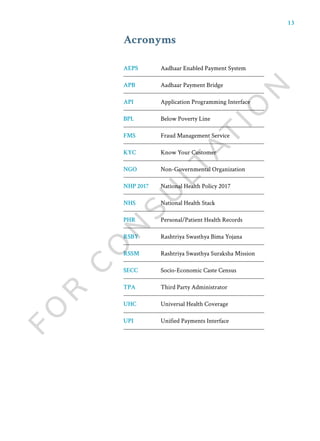
AEPS
APB
API
BPL
FMS
KYC
NGO
NHP 2017
NHS
PHR
RSBY
RSSM
SECC
TPA
UHC
UPI
Aadhaar Enabled Payment System
Aadhaar Payment Bridge
Application Programming Interface
Below Poverty Line
Fraud Management Service
Know Your Customer
Non-Governmental Organization
National Health Policy 2017
National Health Stack
Personal/Patient Health Records
Rashtriya Swasthya Bima Yojana
Rashtriya Swasthya Suraksha Mission
Socio-Economic Caste Census
Third Party Administrator
Universal Health Coverage
Unified Payments Interface
Acronyms
14
The Union Cabinet chaired by the Prime Minister Shri Narendra Modi in its meeting
on 15th
March, 2017 had approved the National Health Policy 2017 (NHP 2017) which
states as its goal—
….The attainment of the highest possible level of health and wellbeing for all at all ages, through
a preventive and promotive health care orientation in all developmental policies, and universal
access to good quality health care services without anyone having to face financial hardship as
a consequence…..
To this effect, The Union Minister for Finance and Corporate Affairs, Shri Arun Jaitley,
while presenting the General Budget 2018–19, has announced two major initiatives in
health sector, as part of Ayushman Bharat Yojana.
(i) Health and Wellness Centre: 1.5 L Health and Wellness Centres will be set
up across the nation to bring healthcare system closer to the homes of people.
These centres will provide comprehensive Primary Health Care, including
for non-communicable diseases and maternal and child health services. These
centres will also provide free essential drugs and diagnostic services. The
Budget has allocated Rs.1200 crore for this flagship programme.
(ii) Pradhan Mantri-Rashtriya Swasthya Suraksha Mission: This second
flagship programme under Ayushman Bharat will cover over 10.74 crore
poor and vulnerable families (approximately 50 crore beneficiaries) providing
coverage upto 5 lakh rupees per family per year for Secondary and Tertiary
Care hospitalization.
Forthefirsttime,thepolicypositionshealthasamajornationalagendalinkingoutcomes
to the economic development of the nation. These two health sector initiatives under
Ayushman Bharat Programme, if delivered successfully, will realize its dream of New
India 2022 and ensure enhanced productivity and wellbeing, avert wage loss and arrest
impoverishment.
This document will introduce the concept of a shared digital infrastructure called the
National Health Stack (NHS) to help achieve the desired Continuum of Care across
primary, secondary and tertiary care.
The Rashtriya Swasthya Suraksha Mission has been identified for rapid rollout across
states. Therefore, while the National Health Stack will be built in the context of RSSM,
it will be designed for ‘beyond RSSM’ to support existing and future health initiatives,
both public and private.
Introduction
15NATIONAL HEALTH STACK • Introduction
In the past there have been several health insurance initiatives by the central and state
governments. Examples include the Rashtriya Swasthya Bima Yojana (RSBY), Rajiv
Arogyasri in Telangana, Yeshasvini in Karnataka, etc. Each government-funded
healthcare scheme has historically aimed to cover a section of the society that requires
essential protection from sudden, large expenditures for treatment.
However, despite the right intent, government-funded healthcare schemes have faced
several challenges in implementation, major ones listed below:
1. Low enrolment of entitled beneficiaries— The significant on-the-ground
challenges of enrolling beneficiaries covered under various health schemes
are a result of both poor process implementation and adverse incentives. As
per National Sample Survey (NSS) 71st
round (2014) only 11.3% of the bottom
40% population has any insurance coverage.
2. Low participation by service providers— Many hospitals and nursing
homes decide not to participate or refuse to offer services post empanelment.
The main reasons cited are low package rates compared to market, long
payment times and lack of transparency in claims process. According to NSS
only 4.5% of total hospitalization expenses are reimbursed to the bottom 40%.
This results in high Out-of-Pocket Expenses (OOPE).
3. Poor fraud detection— The lack of robust systems makes it difficult to quickly
identify and prevent health insurance fraud. This leads to funds leakage, long
claims cycle time and increase in rejected claims owing to a conservative
approach adopted by insurance providers. This creates a vicious cycle of
disillusioned service provider who refuses to participate in such schemes
which in turn pushes up the Out-of-Pocket Expenses (OOPE).
4. Lack of reliable and timely data & analytics— There are significant gaps in
data availability and data quality across the system as of now. The absence
of reliable and timely data aggregated at the patient level reduces quality of
care, and at a systemic level puts significant constraints on policy makers
to evaluate the performance of various players or measure outcomes in a
consistent manner to make evidence-based decisions.
We are convinced that to address the above challenges, in addition to the issue of
Portability of health services (in a country like India where health is a state subject), the
National Health Stack (NHS) will prove to be the ultimate Game Changer. Built as
a Common Public Good by the Centre for adoption by all states, it will eliminate any
repetitive efforts on part of, yet retain autonomy for, the states—paving way for rapid
rollout of various health initiatives, achieve convergence and accelerate the momentum
to achieve the goal of Universal Health Coverage well ahead of time.
16NATIONAL HEALTH STACK • Introduction
The scope of this document is limited to stating the vision, strategy and approach
for the development of the National Health Stack. The document also contains an
overview of the principles guiding the design and architecture of the National Health
Stack and illustrates the two-track implementation approach of the NHS through the
Rashtriya Swasthya Suraksha Mission. The operational details of building and rolling
out the Stack including the delivery mechanisms and other related matters are beyond
the scope of this document.
17
The National Health Stack is designed to provide the foundational components that will
be required across Ayushman Bharat and other health programs in India. The Health
Stack is a nationally shared digital infrastructure usable by both Centre and State
across public and private sectors. The Stack is designed to bring a holistic view across
multiple health verticals and enable rapid creation of diverse solutions in health.
The National Health Stack is a collection of cloud-based services. Each service provides
just one capability across multiple health services, accessible via simple open APIs
compatible with global standards. Together they create a powerful framework to bring
convergence and faster go-to market for any health initiative.
The scope of the National Health Stack includes (and is not restricted) to the following
subjects: Induction of Private Hospitals and Private Practitioners into the Primary
and Secondary healthcare ecosystem; Focus on Non-Communicable Diseases (NCD);
Disease Surveillance; Health Schemes Management Systems; Nutrition Management;
School Health Schemes; Emergency Management; e-Learning Platform for health,
LMS, Telehealth, Tele-radiology; Diagnostic Equipment; Health Call Centre(s) etc.
National Health Stack (NHS) Overview
RSSM
Portal and
Application
Coverage
and Claims
Platform
National Health Registries (Providers, Doctors, Beneficiaries, Family Taxonomy, etc)
India Stack
Jan Dhan, Aadhaar, Mobile
Federated
PHR
Framework
National Health
Analytics
Platform
National Health
Upskilling
Platform
...
Existing
State
Insurance
Systems
Health and
Wellness
Clinics
eHospitals NCD
Other
Health
Apps (RCH,
etc)
Exhibit 1:
The National
Health Stack—
High Level
Architecture
NATIONAL HEALTH STACK
18
At a high level, the components of National Health Stack are organized in two layers.
There is a National Health Registries layer, which forms the base of the Stack and houses
the services required to manage the master data for all health programs. Above it, there
is a layer of software services and platforms which encapsulate additional building
blocks required for operationalizing programs. This includes a Coverage and Claims
Platform, a Federated Personal Health Records (PHR) Framework and a National Health
Analytics Framework (NHAF) amongst others. In the design of these components, the
Health Stack utilizes various components of the India Stack, which we briefly describe
below.
India Stack is a set of digital public goods which collectively make it easier for innovators
to introduce digital services in India across a range of sectors.
india stack
Components of the National Health Stack
Exhibit 2:
The India Stack
Provides a modern data sharing
framework
Data Empowerment and
Protection Architecture (DEPA)
AEPS, APB, and UPI
Aadhaar e-KYC, E-sign, Digital
Locker
Aadhaar Authentication
Game changing electronic payment
systems; transition to cashless economy
Rapidly growing base of paperless
systems with billions of artifacts
Unique digital biometric identity with
open access of nearly a billion users
Presence-less Layer
Paperless Layer
Cashless Layer
Consent Layer
IndiaStack
Jan Dhan, Aadhaar, MobileJAM
LAYERS OF INDIA STACK
19NATIONAL HEALTH STACK • Components of the National Health Stack
India Stack has four essential layers:
1.Presence-lesslayer,whichenablesremovalofbarrierstopeople’sparticipation
in formal services through digital identities and remote authentication
mechanisms;
2.Paper-lesslayer, whichenablesdigitalrecordstobemovedwithanindividual’s
digital identity;
3. Cashless layer, which includes a set of payments services to ease monetary
transactions; and
4. Consent layer, which empowers individuals to share their data in a safe and
secure manner, thus enabling access to better financial, healthcare, and other
services.
The widespread rapid adoption of basic bank accounts under the Prime Minister’s
financial inclusion scheme, the Jan Dhan Yojna (JDY); the digital identity called
Aadhaar; and mobile phones, especially smartphones, has created a foundation (JAM)
in India on which the India Stack operates.
More information about India Stack is available from http://www.indiastack.org/
A lack of reliable and easily accessible master data is a core problem that affects current
health systems: each vertical program in the government tends to maintain its own
copy of data that is difficult to keep updated and restricts data sharing across programs.
This, in turn, makes it difficult to get a holistic picture of care across programs. To
overcome these challenges, the National Health Stack will incorporate a layer of
electronic registries that will form the base layer of the Stack. This layer will be utilized
by all programs which are built on top of the National Health Stack.
Registries will include data for various health-sector stakeholders, in particular (but not
restricted to) healthcare providers (hospitals, clinics, labs etc), beneficiaries, doctors,
insurers and ASHAs, and they may also contain data about other aspects of health
programs like information on drugs and interventions. All registries will have open
APIs for publishing and consent-based access by authorised entities.
electronic registries—managing the health
master data of the nation
20NATIONAL HEALTH STACK • Components of the National Health Stack
The registries in NHS will be developed with the following design principles in mind:
Principles of well-designed registries
Self-Maintainability
Entities listed in the registry
should be able to view their
information and through
appropriate workflows
be able to update their
information in a verifiable
and trusted manner.
Non-Repudiable Data
The source for each attribute
in the registry should be
visible: viewers should be
able to tell who added which
information and when. All
attributes should be digitally
signed by the authorized
updater. This leads to greater
trust in the data and stronger
accountability.
Incentive-aligned
Design
Registry owners must
attempt to enact mandates
that require the entities
listed by the registry to
register and to keep their
data up to date. Where
mandates are not possible,
suitable incentives need to
be provided as part of the
implementation process. For
example, empanelment of
hospitals for health insurance
must encourage the insurer
or third-party administrator
(TPA) to always obtain
the information from the
provider registry and not
collect it directly from the
provider. This ensures that
the provider has an incentive
to keep its registry entry up
to date.
Extensibility and
Flexible Schemas
Registry owners will have
to set up a process to accept
feedback and to update
registry schemas. Health
applications built on top
of the Health Stack should
be able to extend the base
registries and use derived
versions of them.
Open APIs
Creation, updation and
retrieval of data must be
possible using open APIs.
For some APIs, entity
authentication mechanisms
must be implemented in
order to ensure data security.
Controlled Data
Visibility and
Consented Data
Sharing
Registries will offer fine-
grained control and visibility
over each attribute of an
entity. Attributes can be
public or private, masked or
encrypted. Sharing of private
attributes to a data requestor
will require consented access.
Data Provenance
A non-repudiable audit
trail must exist for all
changes made to entries in
the registry. In general, it
should not be possible to
delete data from registries,
though it may be possible for
the registry owner to mark
certain entries as obsolete.
21NATIONAL HEALTH STACK • Components of the National Health Stack
While we do not present the detailed design of the registry layer in this document,
we point out a few essential elements of the approach that will be taken to design two
important registries: the provider registry and the beneficiary registry.
The provider registry will be the one which will manage
master data for all healthcare providers in the country. This
will include hospitals (both government and private), clinics,
diagnostic labs and other clinical establishments. Building
a provider registry along the above design principles is
essential for running any insurance scheme effectively and
in running other programs which rely on ensuring veracity
of provider data.
Multiple efforts are currently underway to build
provider registries in India. This includes the National
Health Resource Repository (NHRR) being managed by
the Central Bureau of Health Intelligence (CBHI),1
the NIN
database2
implemented by Ministry of Health and Family
Welfare (MoHFW) and NIC and the Registry of Hospitals in
NetworkofInsurance(ROHINI)3
developedbytheInsurance
Information Bureau of India (IIB). These efforts have thus
far been disconnected from each other and are resulting
in redundancy in datasets. The NHS provider registry
will not only provide features like self-maintainability,
non-repudiability and consented access of data, it will also
attempt to unify existing efforts on provider registries
and reduce the redundancy in these efforts. All existing
registry implementations will be able to publish provider
information securely to the NHS registry, on a per-provider
basis or in bulk, and extract information from it for their
respective programs. (These implementations will operate
as applications on top of the Health Stack.) There will also
be the flexibility to extend provider schemas defined in the
NHS registry for individual use cases. In this manner, both
Approach and Considerations for designing Electronic Registries
Provider
Registry
1 http://dghs.gov.in/content/1370_1_CBHI.aspx
2 https://nin.nhp.gov.in/login.php
3 https://rohini.iib.gov.in/
22NATIONAL HEALTH STACK • Components of the National Health Stack
existing and future programs reliant on provider registries
will be benefitted.
An important element of maintaining provider
registries will be the role of a surveyor who will be tasked
with physically visiting providers and validating registry
data. The interfaces for surveyors and data validators will be
defined and their role scoped out in detail.
Provider registries, as other registries like doctor
registries and insurer registries, will have attributes for
grading and scoring providers on different metrics; some
of these grading mechanisms could be crowdsourced. Such
information about providers will have a different approach
for data update and access. There will be a facility to allow
some entities in the healthcare ecosystem to create, update
and access data about others in/from the latter’s registries
(e.g., beneficiaries will have the authority to grade providers
andsubmitthesegradestotheproviderregistry).Suchcross-
entity access of information will also need to be scoped out.
Health programs are likely to use a variety of identifiers to
identify the individual and family on the ground, and so the
beneficiaryregistryintheNHS isdesignedtoofferflexibility.
The base entry in the beneficiary registry will be created with
a link to a strong foundational ID such as the beneficiary’s
Aadhaar number. The registry would allow any number of
other identifiers being used in the health system to be linked
to the Health ID. This will not only enable a holistic view
of the different programs that beneficiaries participate in, it
will also enable efficient search and recovery of beneficiary
details given program-specific identifiers.
Beneficiary registries will also capture and store
important beneficiary-to-beneficiary linkages e.g,
information about a beneficiary’s family will be available
from the record corresponding to that beneficiary. The
NHS registry will not assign any group IDs (e.g., family IDs)
to beneficiaries although such attributes may be added by
individual NHS applications.
Beneficiary
Registry
23NATIONAL HEALTH STACK • Components of the National Health Stack
coverage and claims platform
The coverage and claims platform provides the building blocks required to implement
any large-scale health insurance program, in particular, any government-funded
healthcare programs. This platform has the transformative vision of enabling both
public and private actors to implement insurance schemes in an automated, data-driven
manner through open APIs.
There will be three primary sub-components of this platform: a policy engine, a claims
engine, and a fraud management service.
Policy Engine
(Uses Policy Markup
Language)
Claims Engine
(Enables Auto-
adjudication of Claims)
Federated PHR
National Health
Analytics
Framework
Fraud Management
Service
(Pluggable fraud
detection)
Beneficiary Registry Provider Registry Doctor Registry
Insurer Registry ...
Coverage and Claims Platform
Registries
Exhibit 3:
Coverage and
Claims Platform
and linkages
with the National
Health Stack
24NATIONAL HEALTH STACK • Components of the National Health Stack
Policy Engine
The Policy Engine is a service that allows defining and storing of insurance policies for
individuals and families in a machine-readable format, and provides APIs to consume
and update these policies. Two key components of this engine are a Unified Multi-
Policy View per beneficiary and a new Policy Markup Language (PML).
The Policy Engine, through its APIs, will empower
beneficiariestogetaunifiedviewofalltheirhealthinsurance
policies in a convenient and user-friendly manner. This will
cover both government-funded healthcare policies as well
as private insurance policies that the beneficiary may have
purchased.
A key innovation in the NHS would be the idea of Policy
Markup Language (PML), which would be a machine-
readable language designed for describing, updating,
accessing and communicating policies between software
programs. The PML will enable health insurance policies to
be written to cover their various attributes, including:
• The list of empaneled providers linked to the policy
• The coverage amount
• The coverage period
• List of procedures that are covered
• Pre-authorization requirements for procedures
• Pre-authorization approver details
• Hospitalization costs payable for each procedure
• Exclusion criteria for any procedures
Unified
Multi-Policy
View
Policy
Markup
Language
(PML)
To start using the coverage and claims platform, health insurance schemes will need to
define a set of health insurance policies in the Policy Markup Language. The policy is
uploaded and validated to be syntactically correct in the policy repository. Each policy
willneedtobeaccompaniedwithadigitalsignature,linkedtotheentitythatisproviding
the coverage (e.g., insurance company or a health trust set up by the state). Only when
the signature has been generated will the policy become active. The Policy Engine will
allow policies to be activated at different times for each beneficiary. Activation requires
that premiums that cover the beneficiary be transferred to the insurance company or
25NATIONAL HEALTH STACK • Components of the National Health Stack
Claims Engine
Claims processing is the most vital component in the coverage and claims platform.
The Claims Engine will manage the way claims flow in health insurance schemes and
ensure ease of filing and settling claims. This engine will:
1. Ensure auto-adjudication of claims: A large part of the claims process
(covering both pre-authorization and post-treatment claims processing) can
be automated given machine-readable description of policies, as in the Policy
Markup Language. The claims engine will accomplish this automation, which
in turn will help insurers and third-party administrators (TPAs) in making
faster decisions.
2. Orchestrate the payment flow: The claims engine will also send payment
triggers and notifications to designated entities which will help ensure
that insurance Service Level Agreements (SLAs) are adhered to and claims
processing times are accurately reported to the authorities.
3. Provide data points: The claims engine will generate a rich data trail on the
history of claims processed by the NHS, which will serve as the key input to
the Fraud Management Service (FMS).
4. Receive requests for audit: The claims engine may also receive requests for
audit on past claims from the FMS. In such situations, claims would be re-
assessed and the resulting analyses provided back to the FMS. With better
data, suspicious claims can be detected and analysed in this manner.
Claims in coverage and claims platform are settled within the time defined by the SLA
of the insurance policy. The engine is responsible for ensuring that claims originating
health trust. It is the responsibility of the Centre and State to ensure the the funding
cycle for any government-funded healthcare programs is correctly managed so that
policies do not expire and the poor and vulnerable do not suffer due to policy expiry.
Subject to the approval and successful demonstration of the technology, there could
be a possibility for policies to be developed based on Smart Contracts, a derivative
of Blockchain Technology. Smart contracts will enable policies to have intelligence
embedded in them, which will allow each policy to directly interact with the Claims
Engine (or other parts of the Stack). So, for example, policies would automatically be
able to trigger insurance payments once certain conditions in the claims process are
met.
26NATIONAL HEALTH STACK • Components of the National Health Stack
in the system are adjudicated at the earliest. In order to do so, this component takes
into account inputs from the external Fraud Management System (FMS) which
recommends an action to be taken on the claim. For example, the FMS may recommend
acceptance or advise TPA intervention for a newly filed and documented claim. If FMS
recommends acceptance, the platform will auto-adjudicate the claim in accordance
with rules specified in the policy.
When resolving such re-assessed cases, detailed analyses is provided to the FMS as
feedback, along with the case resolution.
• Is the request coming from an
empaneled and active provider?
• Is the beneficiary covered under the
policy?
• Is the beneficiary authenticated in the
provider premises?
• Is the policy active?
• Is the procedure covered under the
policy?
• Are there enough funds for the
beneficiary to be covered under policy?
• Does the provider have the facilities to
perform this procedure?
• Does the consultant have the
background to perform this procedure?
• Does the provider have a rating score
that allows automatic approval?
• Can this procedure be instantly pre-
authorized or requires manual pre-
authorization?
• Authentication of the beneficiary against the health ID provided
• Procedure that is to be performed
• Pre-authorization documents for the procedure that is to be performed
• Details of the Consultant who will provide the treatment
Automated Pre-Auth Validation
using Policy and Registry
information
Pre-Auth Request (from Provider) includes
National Health Insurance Platform
Claims
Engine
Policy
Engine
Provider
Registry
Doctor
Registry
User
Registry
Fraud
Management
27NATIONAL HEALTH STACK • Components of the National Health Stack
Fraud management processes are improved dramatically when its analysis is based
on national scale data; this is possibly the greatest impetus for a shared digital
infrastructure. The fraud management component is responsible for ensuring that the
number of fraudulent claims settled by coverage and claims platform is minimized. The
component aims to reduce losses due to dishonest claims and ensure that the healthcare
system covers the people who need it the most.
Fraud Detection using big data analytics and machine intelligence is improving at a
rapid pace. Thus, the fraud management service will be implemented leveraging
multiple engines in an effort to encourage innovation. In order to maximize fraud
detection rates and accuracy, the engines will be incentivized to report fraud events and
will compete with each other in the process. This approach will boost the rates of true
positives as well as the rate of true negatives in fraud detection. The data feed into the
fraud management system will be anonymized to protect patient and provider privacy.
Fraud Management Service
Claims
Engine
National Health
Analytics
Dashboards
Analytics
and ML
Algorithms
...
Rules-
Based
System
AI (ML)
Based
System
FRM
Middleware
Distributed
Messaging
Distributed
Messaging
Distributed Data
Store (Test,
Training, Scored
Data)
Claims Manual
Adjudication
System
Model DB
Implementing Open
APIs and multi-
engine fusion
Pluggable
multi-engine
support to
use different
fraud
detection
techniques
Rules DB
28NATIONAL HEALTH STACK • Components of the National Health Stack
The NHS will provide for a mechanism through which every user participating
in the system can be uniquely identified. Accurate identification will greatly reduce
the risk of preventable medical errors and significantly increase quality of care. It will
enable users to obtain a longitudinal view of their healthcare records. Also, it will also
drive out unnecessary costs by reducing inefficiency.
Upon successful registration of the user, a Digital Health ID (unique, system-wide
identifier) will be created and provided to the registrant. The registrant may create
a Virtual Health ID to preserve their privacy when interacting with other users or
stakeholders in the system.
When enrolling into any Scheme, users will be able to provide one of many national
identifiers (like Aadhaar, PAN card, Election ID, etc) to identify themselves as specified
by the National Health Policy.4
Upon successfully completing KYC, these users will be
registered by the system. The NHS Health ID is generated for each user upon successful
registration in the system.
When a registered beneficiary approaches a service provider for Scheme-related
facilities, she is expected to only provide her Health ID. This federated identification
digital health id
When a fraud is reported, all pending claim settlements and any new claim settlements
for a hospital are placed on hold until the fraud raised can be investigated. Governments,
insurance companies and TPAs are expected to have vigilance teams that investigate
the fraud scenarios suggested by the fraud management service. The teams would need
to decide as to whether it is a truly fraudulent scenario or an item incorrectly flagged as
fraud. The FMS service gets the feedback from the same process.
Personal Health Records (PHR) are a core requirement to avoid fraud and bring greater
trust into the claim handling process, as most fraud is based upon either unwanted
or redundant tests and procedures, or claims made by patients/providers on false
procedures.
4 The NHP Document (https://www.nhp.gov.in/categories-for-adoption-of-standards_mtl) from 2016 states the
following: “A health record system must have provision to include patient identifiers of following types: (1)
UIDAI Aadhaar Number (preferred where available), (2) Both of the following in case Aadhaar is not available:
2.1 Local Identifier (as per scheme used by HSP), 2.2 Any Central or State Government issued Photo Identity
Card Number.
29NATIONAL HEALTH STACK • Components of the National Health Stack
Like the Health ID, similar Digital IDs will be provided by the system to
stakeholders like Government departments, insurers, TPAs and providers.
Just as in the case of individual clients, identifiers will be assigned to these
institutions only upon successful KYC for the institution. This KYC could be
performed using a unique national ID already assigned to the institution (e.g.,
the institution’s TAN number).
This component of the Health Stack enables the management and aggregation of user
health data, as well as the consent-based flow of such data across different stakeholders
who require access in order to deliver value-added services to the user.
Personal Health Records (PHR) refers to the integrated view of all data related to an
individualacrossvarioushealthproviders,comprisingofmedicalhistory,medication
and allergies, immunization status, laboratory test results, radiology images, vital signs,
personal stats such as age and weight, demographics and billing information, and
multiple health apps. Because health data is sensitive, the design and implementation
must ensure the right level of privacy and security for health data; thus, the PHR is
maintained in a secure and private environment, with the individual determining
rights of access. This will be made possible through Health Data Fiduciaries (trustees)
that shall facilitate consent-driven interaction between entities that generate the health
data and entities that want to consume the PHR for delivering better services to the
individual.
federated personal health records (phr)
framework
system ensures that a user is identified uniquely in the NHS without requiring additional
national identities to be produced for each transaction. The user or stakeholder is
securely verified via authentication provided by the NHS.
The Health ID may also be looked up in a secure manner if the beneficiary does not have
her identifier handy. For example—a beneficiary visiting a provider, in the absence of
NHS Health ID, may authenticate against Aadhaar. A secure verification process will
ensure that the beneficiary is validated. The provider will then be able to look up this
beneficiary’s relevant information using this reverse lookup.
30NATIONAL HEALTH STACK • Components of the National Health Stack
A meaningful patient-controlled health-record infrastructure, made possible via
Health Data Fiduciaries, will support the development of highly desirable health system
qualities. First, it allows a patient to effectively become a health information exchange
of one: as meaningful data accumulate in a patient-controlled repository, a complete
picture of the patient emerges, resulting in an improved quality of care across a range
of providers. Secondly, the federated structure of PHRs (with pre-authorizations built
in) can facilitate the access to this valuable data in a consented manner for the purposes
of medical research (which in turn results in reduced cost and better health outcomes).
Exhibit 4:
Health Data
Fiduciaries for
Consented Sharing
of PHR
Health
Information
Users
Health
Information
Providers
Consent
to Share
Request for DataRequest for Data
Encrypted Data Flow
Health Data
Fiduciary
• Hospital
• Doctor / Specialist
• Insurance Provider
• Personal Health
Apps
• Hospital
• Lab
• Health Apps
31NATIONAL HEALTH STACK • Components of the National Health Stack
1.
The Patient is the
Controller of her data:
True empowerment
occurs when the patient
is the controller of data
rather than just the owner.
Incentivised mandates for
healthcare organizations
to provide data to patients
after an encounter through
a standardized electronic
mechanism (automated
updates, for instance) has the
potential to achieve a patient
driven information economy
in addition to inculcating a
stronger partnership between
patients and clinicians.
2.
Leveraging a Federated,
rather than a Centralised
Approach:
A key aspect of the PHR
framework is that it enables
meaningful health data to
be stored and managed in a
federated manner: i.e. multiple
entities (e.g., hospital systems,
health-technology companies,
etc.) will manage health data
about users. User will be able
to share their data via Health
Data Fiduciaries (that will
generate and manage consent)
with data requestors. This will
be achieved using standardized
and open APIs through which
these entities will be able to
communicate with each other
and with stakeholder systems.
Such an approach to managing
and sharing data has many
advantages from a scalability
and flexibility perspective
over a centralized solution for
managing health data.
3.
Privacy by Design:
User data needs to be protected
from abuse and compromise.
The PHR framework will define
data sharing mechanisms, using
the MeitY Electronic Consent
Framework,5
that gives the user
control of their data and ensures
privacy of user data ground-
up. Tools to protect privacy
of data must be in-built in the
framework and best-practice
guidelines should be in place for
the framework users (hospitals,
insurers, and other stakeholders)
to ensure privacy of data.
The key guiding principles for this framework are listed below:
5 Reference to MeitY Electronic Consent Framework (http://dla.gov.in/sites/default/files/pdf/MeitY-Consent-Tech-
Framework%20v1.1.pdf)
32NATIONAL HEALTH STACK • Components of the National Health Stack
4.
Minimal changes to
existing health record
formats:
The diverse IT products used by
healthcare providers in India do
not follow a common standard
for data storage and do not
communicate with each other.
Therefore, the framework must
require minimal to no changes
to existing IT products and must
be designed to work with the
existing IT infrastructure as-is.
5.
A clear incentive for
providers to participate:
Almost 80% of Indians seek
private healthcare and pay out
of pocket. In order to ensure
the private healthcare providers
participate, the framework
should support built-in
incentive structures to ensure
rapid and universal adoption.
Incentives and regulatory
control need to be suitably
balanced, in order to ensure
maximum participation and
innovation, and still ensuring
user privacy and control.
6.
Open APIs:
The framework should provide
an open and standard set of
application programming
interfaces (APIs) for creating,
accessing and updating records
in EHRs, as proposed in the
Policy for Open APIs by MeitY.6
The API definitions should be
simple and follow the principles
of minimalism and privacy
by design. Some parts of the
framework could be publicly
available (as public goods) for
any framework user to utilize.
6 http://meity.gov.in/sites/upload_files/dit/files/Open_APIs_19May2015.pdf
7 Reference to MeitY’s National Data Sharing & Accessibility Policy (NDSAP) (http://meity.gov.in/open-data)
national health analytics framework
The National Health Analytics Framework will enable the creation of anonymised and
aggregated datasets that assist in the creation of dashboards, reports, and other types of
statistics. These aggregated datasets will present the overall direction of health of the
country/state/district leading to data-driven decisions and targeted policymaking in
the health sector.
In alignment with the National Data Sharing & Accessibility Policy (NDSAP),7
open datasets shall be published as part of this framework to increase transparency,
accountability, civil society engagement, and innovations in service delivery.
A few examples of data which could be obtained through this framework are listed
below:
• Average number of patients treated in a day
• Most commonly occurring diseases in India (Epidemiology)
33NATIONAL HEALTH STACK • Components of the National Health Stack
• Percentage of claims filed by the entities (Healthcare Provider, Doctor, or
Beneficiaries) that are accepted/rejected (Resource Utilisation)
• Average billed amount / billed amount for a particular medical procedure
• Average time of settlement
• Treatment characteristics and procedures
• Years of experience of doctors across state/district/country.
While the National Health Analytics Framework will initially focus on Health
Insurance, it will provide for “horizontal expansibility”—enabling the potential to
cover, at a later point in time, important areas including (and not limited to) disease
surveillance, predicting epidemics, classifying and clustering population segments for
proactive care, nutrition, health schemes, and national health infrastructure such as
telemedicine, teleradiology, and the enhancement of process controls.
Moreover,thetreatmentandpatientcaredatainPM-RSSMcanprovidecriticalinsights
into the healthcare skill shortage at various governance levels (e.g. both the villager and
block levels) and enable the implementation of skill development initiatives at a very
granular level (for instance, through ASHA workers).
The National Health Analytics Framework will also help develop newly benchmarked
standards in areas such as data formats, pricing, standard operating procedures in
daily operations, and standard treatment procedures with optimal cost—whilst also
providing the opportunity for continuous evaluation of National Health Policy. This
will help shift evaluation away from an annual exercise towards a real-time approach,
to help rapidly curate data collected through the insurance schemes and feed into agile
smart policy decisions.
34
Guiding Principles for the Overall Design
of the National Health Stack
1.
Mandated PHR
Every citizen has a right to not
just her/his health data but also
right to access to structured
data. All service provider EHRs
and stand alone PHRs which
include wearables, mHealth
devices and health apps etc
should have APIs compatible to
NHS PHR.
2.
Separating the Consent
Layer from Data Flow is
Key
It has been successfully
implemented by India Stack
while building the Universal
Payment Interface. Patients may
opt to (consent to) archive their
data in one or more types of
meta-directories that will then
allow (or restrict) automated
access for clinical, research,
quality improvement, or
marketing purposes.
3.
Interoperability through
Open APIs and Open
Standards
Interoperability is essential
for our solution to be able to
support a large number of
applications. NHS must be
built using open standards,
absent dependence on
specific platforms or software
frameworks. In addition, the
components of the Stack should
be loosely coupled using open
interfaces (APIs).8
Adoption of
open APIs and open standards
and, where prudent, choosing
open source frameworks and
components over proprietary
ones, creating vendor-neutral
API’s, will help achieve the goal
of interoperability.
4.
Privacy and Security by
Design
Managing security and
privacy of data is important
in healthcare technology and
thus will be a critical part of
the design of the Stack. All
data access must be through
API calls to ensure centralised
management of security
controls. Direct access will
be prohibited for internal
modules and use of APIs will
be mandated. NHS will ensure
privacy and data integrity
and will disseminate data to
authenticated and authorised
stakeholders only (both
internal and external). Sensitive
health data about individuals
will be encrypted at rest.
Mechanisms for user consent,
using the MeitY Electronic
Consent Framework,9
will
be implemented to enable
applications to share data about
users in a safe manner. Finally,
tools to enable audit and breach
investigations will be present.
8 Reference to MeitY Open API Policy 2015 (http://meity.gov.in/content/policy-open-application-programming-
interfaces-government-india)
9 Reference to MeitY Electronic Consent Framework (http://dla.gov.in/sites/default/files/pdf/MeitY-Consent-Tech-
Framework%20v1.1.pdf)
35NATIONAL HEALTH STACK • Guiding Principles for the Overall Design of NHS
5.
Strong Data Governance
NHS will follow principles of
strong data governance. Data
about any individual (patient,
doctor, etc) in the system
must be under the control
of that individual, using the
MeitY Electronic Consent
Framework,10
and any entity
holding that data must first
obtain legitimate consent from
that individual before sharing
the data or processing it in other
ways. Strong mechanisms for
anonymization must be in place
to enable data to be efficiently
aggregated and analyzed for
purposes where aggregate data
is desirable (e.g. fraud detection,
medical research).
6.
Ensuring Extensibility
through the use of
Layered Design
The design of NHS will be
modular: there will be a clear
separation of concerns for
data storage, software services
and APIs. Components will be
minimalistic and independently
replaceable and extensible. This
will allow different components
to be loosely coupled when
building applications which will
enable application diversity.
State governments will be able
to customise at a sub-stack level
and create contextual solutions
to serve their specific purpose,
make changes to them with
appropriate permission control
and audit trace.
7.
Granular Control
The modular design of NHS
will enable governments (both
center and state) to configure it
easily and to use its components
depending on their needs. A
configurable plug-n-play model
will also ensure simplicity
and governments will be
able to implement their own
applications rapidly, allowing
the Stack to scale nationally with
ease.
8.
Designing for
Evolvability and Scale
The Stack must be able to
scale horizontally to hundreds
of millions of users in the
healthcare ecosystem and to
handle trillions of data records.
All components including
computer, network and storage
resources must be capable of
scaling horizontally: it should be
possible to add new resources
as and when needed to achieve
required scale. Being cloud-
ready and using commodity
hardware will ensure that
capital investments on the Stack
will be minimal. This will also
give a choice of infrastructure
to the implementers and
enable systems to evolve
heterogeneously. Finally,
the scale of use of the Stack
should be measurable and
demonstrable.
10 Reference to MeitY Electronic Consent Framework (http://dla.gov.in/sites/default/files/pdf/MeitY-Consent-Tech-
Framework%20v1.1.pdf)
36
9.
Based on Common Open-
Source to create Public
Goods
NHS will be built using
available open-source
frameworks. This approach
will ensure full flexibility in
feature enhancements, give
full code control to program
implementers, avoid vendor
lock-in, and allow any third
party to build solutions on top
of the platform. These features,
in turn, will help ensure agility
of the Stack and its applications,
build trust among consumers
and enable scalability.
10.
Transparency and
Accountability through
Data
The verified registry of all the
entities and the non-repudiable
transaction trails shall lead
to higher trust and stronger
accountability. NHS will be
data-driven and will use data
generated through transactions
for reporting and analysis.
Public Open Data shall be
made available via APIs for
transparency. The access to
open data will ensure high-
quality analytics, accurate fraud
detection, shorter cycles for
system improvement (e.g.,
updates to health policies
can be made efficiently)
and, most importantly, high
responsiveness to user needs.
NATIONAL HEALTH STACK • Guiding Principles for the Overall Design of NHS
37
Benefits of the National Health Stack
There are numerous benefits to this approach—expected to accrue to individual
beneficiaries, the central and state governments, the private sector; nudge healthcare
service and insurance providers towards efficiency and accountability. These are
outlined below.
The greatest impact of the National Health Stack on the lives of people in the country
will be, for the first time ever, the shift towards Citizen and Wellness Centric policy
making.
As NHS matures with data over time, it will be well equipped to deliver solutions
(in phases) to the four big challenges of healthcare faced by the people of India—
availability, accessibility, affordability and acceptability.
Technology in Healthcare will provide affordability.
Increased participation of service providers and availability of healthcare services due
to justified pricing, instant adjudication and On Time payment of claims will result
in more widespread cashless care. This will result in significant improvement in:
• Financial protection (reduced out-of-pocket payments)
• Improved overall health and reduction of wage loss through individuals
seeking more preventative care, and accessing medical assistance in earlier
stages of illness
Over time as data is collated on the platform and a modern schema-less federated PHR
is adopted, we foresee doing away with the need to conduct unnecessary tests as all
records will be linked.
benefits to public
National Health Stack will:
• Allow beneficiaries to avail the policy at any point in time of the year
Phase 1—Improving Affordability
Phase 2—Improving Accessibility & Availability
38
benefits to the central government
Phase 3—Improve Acceptability
• Increase access and availability of service providers for the beneficiaries
through the Faster Adjudication of claims feature for service providers,
making the program more attractive to them
• Incentivize service providers, via a scorecard mechanism, to set up facilities
closer to the beneficiaries (e.g. tier 3 towns)—thus empowering the
beneficiaries with choice
Instant adjudication, payment and claims closure will incentivise the service providers
to participate in government-financed health insurance schemes with tremendous
energy—increasing access and availability of service providers for the beneficiaries.
A Value-based Purchasing feature can now be introduced as the Stack collates enough
data to initiate a reward-based program based on incentivized payments and public
reporting for the quality of care they give to patients, productivity and cost control.
The Hospital Value-based Purchasing Program encourages hospitals to improve the
quality and safety of acute inpatient care for health protection beneficiaries and all
patients by:
• Eliminating or reducing adverse events (healthcare errors resulting in patient
harm)
• Adopting evidence-based care standards and protocols that make the best
outcomes for the most patients
• Changing hospital processes to make patients’ care experiences better
• Increasing care transparency for consumers
• Recognizinghospitalsthatgivehigh-qualitycareatalowercosttogovernment-
funded healthcare program beneficiaries
India’s is a federal government and health is a state subject. The National Health Stack
will allow the Government of India to:
• Build in the feature of Portability for migrants, thus allowing it to fulfil its
promise of healthcare and health protection anywhere in the country
• Achieve portability not just for the beneficiaries but also for practitioners
NATIONAL HEALTH STACK • Benefits of the National Health Stack
39
• Potentially place India at the forefront of medical research in the world. The
design is geared to generate vast amounts of data resulting in some of the
largest health databases with secured anonymised aggregated data
• Get a holistic view across health verticals through integrated national
dashboards
• Adopt data-driven policy making through real-time reports and analytics
• Reduce the cost of healthcare through improved fraud detection, and
• Enable effective management of schemes and mission to achieve the goals of
NHM
The National Health Stack will allow States to:
• Incorporate horizontal and vertical expansion of scheme and facilitate co-
branding
• Leverage RSSM funds yet configure and customize based on their needs (items
like eligibility, coverage of procedures etc), as well as maintain control over
data.
• Avoid duplication of efforts and enable ease of adoption for those without
systems or with dysfunctional systems in place
• Continue using their own state system while integrating with RSSM via APIs,
making migration simple in case of states with more advanced systems.
benefits to the states
NATIONAL HEALTH STACK • Benefits of the National Health Stack
40
Well-functioning and Accountable
Private Sector Participation
The core intent of the National Health Stack is to enable On Time Payments for the
Service Providers. The technology stack will enable the distinction between good and
bad service providers, as dictated by data, and subsequent recognition/treatment to
create a self-sustaining win-win ecosystem in healthcare where better service providers
will bubble to the top.
• Digitization of policies, user registries, provider registries will standardize
empanelment, pre-authorization, claims processes and streamline operations
resulting in administration ease for those participating in multiple
government-financed health protection schemes
• Combination of Instant Adjudication and Fraud Detection tools will ensure
the service provider is rewarded immediately for making honest claims and
has no incentives to make fraudulent claims
• Analytics on data reported by service providers on actual cost for a procedure
will result in establishing scientific packages and pricing of procedures
Historically, insurance providers have been plagued with adverse incentives to reduce
the claims ratio and avoid enrolling vulnerable, high risk populations which tend to
have the greatest need for health protection.
The National Health Stack will benefit insurance providers while simultaneously
bringing in efficiencies and enforcing accountability through:
• A dramatic reduction in fraud due to network scale data collated as a result
of shared digital infrastructure
• Reduced cost of operations, as most processes will be streamlined on the
claims engine
• Access to data on performance of service providers to help fine tune their
sourcing mix
• Reduction in claims ratio, as the whole ecosystem will work towards
management of health rather than management of disease
• Market expansion and targeted product offering with availability of supply
side data
service providers
health insurance providers
41
Conclusion
In India, 6 Cr individuals move Below the Poverty Line (BPL) every year because
of expenses related to unforeseen illnesses, placing substantial constraints on the
individual welfare and the nation’s economic growth. Our Out-of-Pocket Expense rate
stands currently at 70%, while the government’s health budget is a mere 1.3% of its GDP
(which remains largely unspent). Providing health coverage to the more vulnerable
sections of society is a large and complex problem which needs to be tackled on a war
footing. With Ayushman Bharat, the Government of India has indicated its desire to
take healthcare protection to a new aspirational level.
The most critical lever in the ecosystem which can bring about a shift is the Service
Provider. Participation of the currently disillusioned service provider in turn can
be secured only through timely payments. This requires auto-adjudication of pre-
authorizations and claims possible through world-class fraud detection system and
hence the need for a claims engine.
Past experience and success with UPI, GSTN and other national platforms suggests
that a platform approach could benefit the healthcare sector in improving the process
flows for service providers. With building blocks in the form of policy repositories and
variousnationallevelregistries,workflowsandPHR,incentivisedaccesstostakeholders
through open APIs, and consolidation of all insurance and assurance claims for health
care at all levels (primary and preventive, secondary and tertiary) through a Claims
Engine, the quality and accessibility of care could be dramatically improved.
We believe that this modular and open-source design will help cater to the current and
growing needs of over a billion people and navigate the complexities of governance
structures, multiple health systems and a combination of public and private providers.
The concept of National Health Stack will significantly accelerate the participation of
various stakeholders of the healthcare ecosystem and ensure deployment of patient-
centricpolicies—resultinginCashlessCarewithImprovedAccesstoensureprotection
for the poor.
Given its federal structure and limited resources, India demands agility, flexibility
and evidence based smart policy making for implementation of healthcare initiatives,
driving all stakeholders towards health-seeking behaviours with renewed energy.
The adoption of the National Health Stack will provide a stimulus not only to act in
conformity with a globally progressive commitment to health equity, but also enable
India to become a leader of the movement by creating one of the best contemporary
technology-informed models for universal health coverage.
NITI Aayog
National Institute for
Transforming India
Government of India
NHS strategy-and-approach-document-for-consultation

NHS strategy-and-approach-document-for-consultation

  • 1.
    1NATIONAL HEALTH STACK• Components of the National Health Stack National Health Stack Strategy and Approach July 2018 NITI Aayog National Institute for Transforming India Government of India
  • 3.
    National Health Stack Strategy and Approach July2018 NITI Aayog National Institute for Transforming India Government of India
  • 5.
    In today’s time,a strong health system is inconceivable without a strong and resilient digital backbone. The National Health Policy 2017 envisages creation of a digital health technology eco-system aiming at developing an integrated health information system that serves the needs of all stakeholders and improves efficiency, transparency and citizens’ experience with linkage across public and private healthcare. The need for a future-ready digital health system has become even more urgent with the announcement of Ayushman Bharat, Hon’ble Prime Minister’sflagshipprogram,thatwouldheraldasystemleveltransformation of nation’s health system. This historic initiative is designed with a powerful yet simple objective in mind: to scale up a wellness-oriented rather than illness-focused approach and to ensure cost-effective healthcare without financial hardship for all. Ayushman Bharat comprises twin missions: i. Operationalizing 1.5 lac health and wellness centers offering preventive and primary care, on the supply side; ii. Financial protection of up to 5 lacs per year per family for the deprived 10 crores plus households towards secondary and tertiary care, on the demand side. The National Health Stack (NHS) is a visionary digital framework usable by centre and state across public and private sectors. It represents a holistic platform that supports a multitude of health verticals and their disparate branches, and is capable of integrating future IT solutions for a sector that is poised for rapid, disruptive changes and unforeseen twists. It is now conceivable to aim for digital health records for all citizens by the year 2022. The innovativeness of the proposed National Health Stack design lies in its ability to leverage a shared public good—a strong IT spine built with a deep understanding of the complex structures of the system. Various layers of the National Health Stack will seamlessly link to support national health electronic registries, a coverage and claims platform, a federated personal health records framework, a national health analytics platform as well as other horizontal components. The stack will embrace health management systems of public health programs and socio-demographic data systems. The population level base of such an IT system would be individual health record logged through the Health and Wellness Centres in rural areas and corresponding primary health care in urban areas. The Strategy and Approach paper on the National Health Stack is a blueprint for India’s futuristic digital health system that would undoubtedly be the very best in the world. Message from Member (Health), NITI Aayog Dr Vinod K Paul Member (Health), NITI Aayog
  • 7.
    What will ittake to Transform India? This is the fundamental question that we at NITI Aayog ask ourselves: we seek to bring together states and the center to shape strategic policy actions that will accelerate India’s progress towards becoming a global digital and economic powerhouse. Universal health coverage is undoubtedly a key lever to achieving this goal. Not only does improved health security have the potential to transform individual well-being, it would also allow our nation to fully leverage our strongest asset: human capital. Recognising the significance of this agenda, the ambitiously designed Ayushman Bharat Programme (earmarked in Budget 2018) will work in Mission Mode to ensure healthcare for all—and particularly for the poorest and most vulnerable. Through both a rapid scale up of primary healthcare facilities and a comprehensive insurance plan allowing 50 crore individuals to access secondary and tertiary care, it would create the largest government-funded healthcare program in the world. Achieving such scale requires us to rethink the core technology backbone of our system and leverage cutting edge digital solutions to tackle the challenge. The proposed National Health Stack (NHS) will thus deploy a powerful technology arsenal, from Big Data Analytics and Machine Learning all the way to Artificial Intelligence and a state of the art Policy MarkUp Language. The result? A complete redesign of the flow of people, money, and information, as well as a layered approach to providing comprehensive foundational health functions for all states and programs—grounded in an inclusive and interoperable technology strategy. Once implemented, the National Health Stack will significantly bring down the costs of health protection, converge disparate systems to ensure a cashless and seamlessly integrated experience for the poorest beneficiaries, and promote wellness across the population. We hope that you will join us on this journey to developing a best-in-class healthcare information technology approach across the nation—one that the world would seek to emulate, and one which would become the cornerstone of India’s public health system for years to come. Mr Amitabh Kant CEO, NITI Aayog Message from CEO, NITI Aayog
  • 9.
    Table of Contents ExecutiveSummary Acronyms Introduction National Health Stack (NHS) Overview Components of the National Health Stack —India Stack —Electronic Health Registries —Coverage and Claims Platform —Digital Health ID —Federated Personal Health Records (PHR) Framework —National Health Analytics Framework 11 13 14 17 18 18 19 23 28 29 32 34 37 37 38 39 40 40 40 41 Guiding Principles for the Overall Design of the National Health Stack Benefits of the National Health Stack —Benefits to Public —Benefits to the Central Government —Benefits to the States Well-functioning and Accountable Private Sector Participation —Service Providers —Health Insurance Providers Conclusion
  • 11.
    11 The Union Budgetof the fiscal year 2018–19 laid the foundation for the Ayushman Bharat Yojana, a program designed to address health holistically through a two- pronged approach— • Set up of 1.5 L Health and Wellness Centres for comprehensive primary healthcare offering preventive and promotive healthcare accessible to all. • A flagship scheme Pradhan Mantri-Rashtriya Swasthya Suraksha Mission (PM-RSSM) which will cover 10 Cr+ poor and vulnerable families providing coverage up to 5 L per family per year for secondary and tertiary care hospitalization. The PM-RSS Mission, which is expected to be rolled out by states themselves, seeks to converge multiple health protection schemes across states into one universal health protection scheme over time. This will be a key step towards achieving Universal Health Coverage (UHC) and Portability—which essentially translates into an environment where All people can obtain health services Anywhere in the country without suffering financial hardship or excessive indirect costs. Through Ayushman Bharat, the Indian government has significantly stepped up its financial commitment in public healthcare. And while financing on demand side is critical, it is equally important to build a national digital infrastructure as an integral part of the program design to enable supply-side readiness. The PM-RSS Mission provides the right opportunity to build such an infrastructure. In this document, we present the idea of a National Health Stack (NHS)—a digital infrastructure built with a deep understanding of the incentive structures prevalent in the Indian healthcare ecosystem. The NHS, a set of building blocks which are essential in implementing digital health initiatives, would be “built as a Common Public Good” to avoid duplication of efforts and successfully achieve convergence. Also, the NHS will be “built for NHPS but designed beyond NHPS” as an enabler for rapid development of diverse solutions in health and their adoption by states. The key components of the National Health Stack are— A. National Health Electronic Registries: to create a single source of truth for and manage master health data of the nation; B. A Coverage and Claims platform: building blocks to support large health protection schemes, enable horizontal and vertical expansion of RSSM by states and robust fraud detection; Executive Summary
  • 12.
    12NATIONAL HEALTH STACK• Executive Summary C. A Federated Personal Health Records (PHR) Framework: to solve twin challenges of access to their own health data by patients and availability of health data for medical research, critical for advancing our understanding of human health; D. A National Health Analytics Platform: to bring a holistic view combining information on multiple health initiatives and feed into smart policy making, for instance, through improved predictive analytics; E. Other horizontal Components: including, and not restricted to, unique Digital Health ID, Health Data Dictionaries and Supply Chain Management for Drugs, payment gateways etc shared across all health programs. The National Health Stack will facilitate collection of comprehensive healthcare data across the country. Designed to leverage India Stack, subsequent data analysis on NHS will not only allow policy makers to experiment with policies, detect fraud in health insurance, measure outcomes and move towards smart policy making, it will also engage market players (NGOs, researchers, watchdog organizations) to innovate and build relevant services on top of the platform and fill the gaps. The design is geared to generate vast amounts of data resulting in some of the largest health databases with secured aggregated data that will put India at the forefront of medical research in the world. We believe that with the adoption of this technology approach, the government’s policies on health and health protection can achieve: • Continuum of Care as the Stack supports information flow across primary, secondary and tertiary healthcare • Shift focus from Illness to Wellness to drive down future cost of health protection • Cashless Care to ensure financial protection to the poor • Timely Payments on Scientific Package Rates to service providers, a strong lever to participate in government-funded healthcare programs • Robust Fraud Detection to prevent funds leakage • Improved Policy Making through access to timely reporting on utilization and measurement of impact across health initiatives and • Enhanced Trust and Accountability through non-repudiable transaction audit trails.
  • 13.
    13 AEPS APB API BPL FMS KYC NGO NHP 2017 NHS PHR RSBY RSSM SECC TPA UHC UPI Aadhaar EnabledPayment System Aadhaar Payment Bridge Application Programming Interface Below Poverty Line Fraud Management Service Know Your Customer Non-Governmental Organization National Health Policy 2017 National Health Stack Personal/Patient Health Records Rashtriya Swasthya Bima Yojana Rashtriya Swasthya Suraksha Mission Socio-Economic Caste Census Third Party Administrator Universal Health Coverage Unified Payments Interface Acronyms
  • 14.
    14 The Union Cabinetchaired by the Prime Minister Shri Narendra Modi in its meeting on 15th March, 2017 had approved the National Health Policy 2017 (NHP 2017) which states as its goal— ….The attainment of the highest possible level of health and wellbeing for all at all ages, through a preventive and promotive health care orientation in all developmental policies, and universal access to good quality health care services without anyone having to face financial hardship as a consequence….. To this effect, The Union Minister for Finance and Corporate Affairs, Shri Arun Jaitley, while presenting the General Budget 2018–19, has announced two major initiatives in health sector, as part of Ayushman Bharat Yojana. (i) Health and Wellness Centre: 1.5 L Health and Wellness Centres will be set up across the nation to bring healthcare system closer to the homes of people. These centres will provide comprehensive Primary Health Care, including for non-communicable diseases and maternal and child health services. These centres will also provide free essential drugs and diagnostic services. The Budget has allocated Rs.1200 crore for this flagship programme. (ii) Pradhan Mantri-Rashtriya Swasthya Suraksha Mission: This second flagship programme under Ayushman Bharat will cover over 10.74 crore poor and vulnerable families (approximately 50 crore beneficiaries) providing coverage upto 5 lakh rupees per family per year for Secondary and Tertiary Care hospitalization. Forthefirsttime,thepolicypositionshealthasamajornationalagendalinkingoutcomes to the economic development of the nation. These two health sector initiatives under Ayushman Bharat Programme, if delivered successfully, will realize its dream of New India 2022 and ensure enhanced productivity and wellbeing, avert wage loss and arrest impoverishment. This document will introduce the concept of a shared digital infrastructure called the National Health Stack (NHS) to help achieve the desired Continuum of Care across primary, secondary and tertiary care. The Rashtriya Swasthya Suraksha Mission has been identified for rapid rollout across states. Therefore, while the National Health Stack will be built in the context of RSSM, it will be designed for ‘beyond RSSM’ to support existing and future health initiatives, both public and private. Introduction
  • 15.
    15NATIONAL HEALTH STACK• Introduction In the past there have been several health insurance initiatives by the central and state governments. Examples include the Rashtriya Swasthya Bima Yojana (RSBY), Rajiv Arogyasri in Telangana, Yeshasvini in Karnataka, etc. Each government-funded healthcare scheme has historically aimed to cover a section of the society that requires essential protection from sudden, large expenditures for treatment. However, despite the right intent, government-funded healthcare schemes have faced several challenges in implementation, major ones listed below: 1. Low enrolment of entitled beneficiaries— The significant on-the-ground challenges of enrolling beneficiaries covered under various health schemes are a result of both poor process implementation and adverse incentives. As per National Sample Survey (NSS) 71st round (2014) only 11.3% of the bottom 40% population has any insurance coverage. 2. Low participation by service providers— Many hospitals and nursing homes decide not to participate or refuse to offer services post empanelment. The main reasons cited are low package rates compared to market, long payment times and lack of transparency in claims process. According to NSS only 4.5% of total hospitalization expenses are reimbursed to the bottom 40%. This results in high Out-of-Pocket Expenses (OOPE). 3. Poor fraud detection— The lack of robust systems makes it difficult to quickly identify and prevent health insurance fraud. This leads to funds leakage, long claims cycle time and increase in rejected claims owing to a conservative approach adopted by insurance providers. This creates a vicious cycle of disillusioned service provider who refuses to participate in such schemes which in turn pushes up the Out-of-Pocket Expenses (OOPE). 4. Lack of reliable and timely data & analytics— There are significant gaps in data availability and data quality across the system as of now. The absence of reliable and timely data aggregated at the patient level reduces quality of care, and at a systemic level puts significant constraints on policy makers to evaluate the performance of various players or measure outcomes in a consistent manner to make evidence-based decisions. We are convinced that to address the above challenges, in addition to the issue of Portability of health services (in a country like India where health is a state subject), the National Health Stack (NHS) will prove to be the ultimate Game Changer. Built as a Common Public Good by the Centre for adoption by all states, it will eliminate any repetitive efforts on part of, yet retain autonomy for, the states—paving way for rapid rollout of various health initiatives, achieve convergence and accelerate the momentum to achieve the goal of Universal Health Coverage well ahead of time.
  • 16.
    16NATIONAL HEALTH STACK• Introduction The scope of this document is limited to stating the vision, strategy and approach for the development of the National Health Stack. The document also contains an overview of the principles guiding the design and architecture of the National Health Stack and illustrates the two-track implementation approach of the NHS through the Rashtriya Swasthya Suraksha Mission. The operational details of building and rolling out the Stack including the delivery mechanisms and other related matters are beyond the scope of this document.
  • 17.
    17 The National HealthStack is designed to provide the foundational components that will be required across Ayushman Bharat and other health programs in India. The Health Stack is a nationally shared digital infrastructure usable by both Centre and State across public and private sectors. The Stack is designed to bring a holistic view across multiple health verticals and enable rapid creation of diverse solutions in health. The National Health Stack is a collection of cloud-based services. Each service provides just one capability across multiple health services, accessible via simple open APIs compatible with global standards. Together they create a powerful framework to bring convergence and faster go-to market for any health initiative. The scope of the National Health Stack includes (and is not restricted) to the following subjects: Induction of Private Hospitals and Private Practitioners into the Primary and Secondary healthcare ecosystem; Focus on Non-Communicable Diseases (NCD); Disease Surveillance; Health Schemes Management Systems; Nutrition Management; School Health Schemes; Emergency Management; e-Learning Platform for health, LMS, Telehealth, Tele-radiology; Diagnostic Equipment; Health Call Centre(s) etc. National Health Stack (NHS) Overview RSSM Portal and Application Coverage and Claims Platform National Health Registries (Providers, Doctors, Beneficiaries, Family Taxonomy, etc) India Stack Jan Dhan, Aadhaar, Mobile Federated PHR Framework National Health Analytics Platform National Health Upskilling Platform ... Existing State Insurance Systems Health and Wellness Clinics eHospitals NCD Other Health Apps (RCH, etc) Exhibit 1: The National Health Stack— High Level Architecture NATIONAL HEALTH STACK
  • 18.
    18 At a highlevel, the components of National Health Stack are organized in two layers. There is a National Health Registries layer, which forms the base of the Stack and houses the services required to manage the master data for all health programs. Above it, there is a layer of software services and platforms which encapsulate additional building blocks required for operationalizing programs. This includes a Coverage and Claims Platform, a Federated Personal Health Records (PHR) Framework and a National Health Analytics Framework (NHAF) amongst others. In the design of these components, the Health Stack utilizes various components of the India Stack, which we briefly describe below. India Stack is a set of digital public goods which collectively make it easier for innovators to introduce digital services in India across a range of sectors. india stack Components of the National Health Stack Exhibit 2: The India Stack Provides a modern data sharing framework Data Empowerment and Protection Architecture (DEPA) AEPS, APB, and UPI Aadhaar e-KYC, E-sign, Digital Locker Aadhaar Authentication Game changing electronic payment systems; transition to cashless economy Rapidly growing base of paperless systems with billions of artifacts Unique digital biometric identity with open access of nearly a billion users Presence-less Layer Paperless Layer Cashless Layer Consent Layer IndiaStack Jan Dhan, Aadhaar, MobileJAM LAYERS OF INDIA STACK
  • 19.
    19NATIONAL HEALTH STACK• Components of the National Health Stack India Stack has four essential layers: 1.Presence-lesslayer,whichenablesremovalofbarrierstopeople’sparticipation in formal services through digital identities and remote authentication mechanisms; 2.Paper-lesslayer, whichenablesdigitalrecordstobemovedwithanindividual’s digital identity; 3. Cashless layer, which includes a set of payments services to ease monetary transactions; and 4. Consent layer, which empowers individuals to share their data in a safe and secure manner, thus enabling access to better financial, healthcare, and other services. The widespread rapid adoption of basic bank accounts under the Prime Minister’s financial inclusion scheme, the Jan Dhan Yojna (JDY); the digital identity called Aadhaar; and mobile phones, especially smartphones, has created a foundation (JAM) in India on which the India Stack operates. More information about India Stack is available from http://www.indiastack.org/ A lack of reliable and easily accessible master data is a core problem that affects current health systems: each vertical program in the government tends to maintain its own copy of data that is difficult to keep updated and restricts data sharing across programs. This, in turn, makes it difficult to get a holistic picture of care across programs. To overcome these challenges, the National Health Stack will incorporate a layer of electronic registries that will form the base layer of the Stack. This layer will be utilized by all programs which are built on top of the National Health Stack. Registries will include data for various health-sector stakeholders, in particular (but not restricted to) healthcare providers (hospitals, clinics, labs etc), beneficiaries, doctors, insurers and ASHAs, and they may also contain data about other aspects of health programs like information on drugs and interventions. All registries will have open APIs for publishing and consent-based access by authorised entities. electronic registries—managing the health master data of the nation
  • 20.
    20NATIONAL HEALTH STACK• Components of the National Health Stack The registries in NHS will be developed with the following design principles in mind: Principles of well-designed registries Self-Maintainability Entities listed in the registry should be able to view their information and through appropriate workflows be able to update their information in a verifiable and trusted manner. Non-Repudiable Data The source for each attribute in the registry should be visible: viewers should be able to tell who added which information and when. All attributes should be digitally signed by the authorized updater. This leads to greater trust in the data and stronger accountability. Incentive-aligned Design Registry owners must attempt to enact mandates that require the entities listed by the registry to register and to keep their data up to date. Where mandates are not possible, suitable incentives need to be provided as part of the implementation process. For example, empanelment of hospitals for health insurance must encourage the insurer or third-party administrator (TPA) to always obtain the information from the provider registry and not collect it directly from the provider. This ensures that the provider has an incentive to keep its registry entry up to date. Extensibility and Flexible Schemas Registry owners will have to set up a process to accept feedback and to update registry schemas. Health applications built on top of the Health Stack should be able to extend the base registries and use derived versions of them. Open APIs Creation, updation and retrieval of data must be possible using open APIs. For some APIs, entity authentication mechanisms must be implemented in order to ensure data security. Controlled Data Visibility and Consented Data Sharing Registries will offer fine- grained control and visibility over each attribute of an entity. Attributes can be public or private, masked or encrypted. Sharing of private attributes to a data requestor will require consented access. Data Provenance A non-repudiable audit trail must exist for all changes made to entries in the registry. In general, it should not be possible to delete data from registries, though it may be possible for the registry owner to mark certain entries as obsolete.
  • 21.
    21NATIONAL HEALTH STACK• Components of the National Health Stack While we do not present the detailed design of the registry layer in this document, we point out a few essential elements of the approach that will be taken to design two important registries: the provider registry and the beneficiary registry. The provider registry will be the one which will manage master data for all healthcare providers in the country. This will include hospitals (both government and private), clinics, diagnostic labs and other clinical establishments. Building a provider registry along the above design principles is essential for running any insurance scheme effectively and in running other programs which rely on ensuring veracity of provider data. Multiple efforts are currently underway to build provider registries in India. This includes the National Health Resource Repository (NHRR) being managed by the Central Bureau of Health Intelligence (CBHI),1 the NIN database2 implemented by Ministry of Health and Family Welfare (MoHFW) and NIC and the Registry of Hospitals in NetworkofInsurance(ROHINI)3 developedbytheInsurance Information Bureau of India (IIB). These efforts have thus far been disconnected from each other and are resulting in redundancy in datasets. The NHS provider registry will not only provide features like self-maintainability, non-repudiability and consented access of data, it will also attempt to unify existing efforts on provider registries and reduce the redundancy in these efforts. All existing registry implementations will be able to publish provider information securely to the NHS registry, on a per-provider basis or in bulk, and extract information from it for their respective programs. (These implementations will operate as applications on top of the Health Stack.) There will also be the flexibility to extend provider schemas defined in the NHS registry for individual use cases. In this manner, both Approach and Considerations for designing Electronic Registries Provider Registry 1 http://dghs.gov.in/content/1370_1_CBHI.aspx 2 https://nin.nhp.gov.in/login.php 3 https://rohini.iib.gov.in/
  • 22.
    22NATIONAL HEALTH STACK• Components of the National Health Stack existing and future programs reliant on provider registries will be benefitted. An important element of maintaining provider registries will be the role of a surveyor who will be tasked with physically visiting providers and validating registry data. The interfaces for surveyors and data validators will be defined and their role scoped out in detail. Provider registries, as other registries like doctor registries and insurer registries, will have attributes for grading and scoring providers on different metrics; some of these grading mechanisms could be crowdsourced. Such information about providers will have a different approach for data update and access. There will be a facility to allow some entities in the healthcare ecosystem to create, update and access data about others in/from the latter’s registries (e.g., beneficiaries will have the authority to grade providers andsubmitthesegradestotheproviderregistry).Suchcross- entity access of information will also need to be scoped out. Health programs are likely to use a variety of identifiers to identify the individual and family on the ground, and so the beneficiaryregistryintheNHS isdesignedtoofferflexibility. The base entry in the beneficiary registry will be created with a link to a strong foundational ID such as the beneficiary’s Aadhaar number. The registry would allow any number of other identifiers being used in the health system to be linked to the Health ID. This will not only enable a holistic view of the different programs that beneficiaries participate in, it will also enable efficient search and recovery of beneficiary details given program-specific identifiers. Beneficiary registries will also capture and store important beneficiary-to-beneficiary linkages e.g, information about a beneficiary’s family will be available from the record corresponding to that beneficiary. The NHS registry will not assign any group IDs (e.g., family IDs) to beneficiaries although such attributes may be added by individual NHS applications. Beneficiary Registry
  • 23.
    23NATIONAL HEALTH STACK• Components of the National Health Stack coverage and claims platform The coverage and claims platform provides the building blocks required to implement any large-scale health insurance program, in particular, any government-funded healthcare programs. This platform has the transformative vision of enabling both public and private actors to implement insurance schemes in an automated, data-driven manner through open APIs. There will be three primary sub-components of this platform: a policy engine, a claims engine, and a fraud management service. Policy Engine (Uses Policy Markup Language) Claims Engine (Enables Auto- adjudication of Claims) Federated PHR National Health Analytics Framework Fraud Management Service (Pluggable fraud detection) Beneficiary Registry Provider Registry Doctor Registry Insurer Registry ... Coverage and Claims Platform Registries Exhibit 3: Coverage and Claims Platform and linkages with the National Health Stack
  • 24.
    24NATIONAL HEALTH STACK• Components of the National Health Stack Policy Engine The Policy Engine is a service that allows defining and storing of insurance policies for individuals and families in a machine-readable format, and provides APIs to consume and update these policies. Two key components of this engine are a Unified Multi- Policy View per beneficiary and a new Policy Markup Language (PML). The Policy Engine, through its APIs, will empower beneficiariestogetaunifiedviewofalltheirhealthinsurance policies in a convenient and user-friendly manner. This will cover both government-funded healthcare policies as well as private insurance policies that the beneficiary may have purchased. A key innovation in the NHS would be the idea of Policy Markup Language (PML), which would be a machine- readable language designed for describing, updating, accessing and communicating policies between software programs. The PML will enable health insurance policies to be written to cover their various attributes, including: • The list of empaneled providers linked to the policy • The coverage amount • The coverage period • List of procedures that are covered • Pre-authorization requirements for procedures • Pre-authorization approver details • Hospitalization costs payable for each procedure • Exclusion criteria for any procedures Unified Multi-Policy View Policy Markup Language (PML) To start using the coverage and claims platform, health insurance schemes will need to define a set of health insurance policies in the Policy Markup Language. The policy is uploaded and validated to be syntactically correct in the policy repository. Each policy willneedtobeaccompaniedwithadigitalsignature,linkedtotheentitythatisproviding the coverage (e.g., insurance company or a health trust set up by the state). Only when the signature has been generated will the policy become active. The Policy Engine will allow policies to be activated at different times for each beneficiary. Activation requires that premiums that cover the beneficiary be transferred to the insurance company or
  • 25.
    25NATIONAL HEALTH STACK• Components of the National Health Stack Claims Engine Claims processing is the most vital component in the coverage and claims platform. The Claims Engine will manage the way claims flow in health insurance schemes and ensure ease of filing and settling claims. This engine will: 1. Ensure auto-adjudication of claims: A large part of the claims process (covering both pre-authorization and post-treatment claims processing) can be automated given machine-readable description of policies, as in the Policy Markup Language. The claims engine will accomplish this automation, which in turn will help insurers and third-party administrators (TPAs) in making faster decisions. 2. Orchestrate the payment flow: The claims engine will also send payment triggers and notifications to designated entities which will help ensure that insurance Service Level Agreements (SLAs) are adhered to and claims processing times are accurately reported to the authorities. 3. Provide data points: The claims engine will generate a rich data trail on the history of claims processed by the NHS, which will serve as the key input to the Fraud Management Service (FMS). 4. Receive requests for audit: The claims engine may also receive requests for audit on past claims from the FMS. In such situations, claims would be re- assessed and the resulting analyses provided back to the FMS. With better data, suspicious claims can be detected and analysed in this manner. Claims in coverage and claims platform are settled within the time defined by the SLA of the insurance policy. The engine is responsible for ensuring that claims originating health trust. It is the responsibility of the Centre and State to ensure the the funding cycle for any government-funded healthcare programs is correctly managed so that policies do not expire and the poor and vulnerable do not suffer due to policy expiry. Subject to the approval and successful demonstration of the technology, there could be a possibility for policies to be developed based on Smart Contracts, a derivative of Blockchain Technology. Smart contracts will enable policies to have intelligence embedded in them, which will allow each policy to directly interact with the Claims Engine (or other parts of the Stack). So, for example, policies would automatically be able to trigger insurance payments once certain conditions in the claims process are met.
  • 26.
    26NATIONAL HEALTH STACK• Components of the National Health Stack in the system are adjudicated at the earliest. In order to do so, this component takes into account inputs from the external Fraud Management System (FMS) which recommends an action to be taken on the claim. For example, the FMS may recommend acceptance or advise TPA intervention for a newly filed and documented claim. If FMS recommends acceptance, the platform will auto-adjudicate the claim in accordance with rules specified in the policy. When resolving such re-assessed cases, detailed analyses is provided to the FMS as feedback, along with the case resolution. • Is the request coming from an empaneled and active provider? • Is the beneficiary covered under the policy? • Is the beneficiary authenticated in the provider premises? • Is the policy active? • Is the procedure covered under the policy? • Are there enough funds for the beneficiary to be covered under policy? • Does the provider have the facilities to perform this procedure? • Does the consultant have the background to perform this procedure? • Does the provider have a rating score that allows automatic approval? • Can this procedure be instantly pre- authorized or requires manual pre- authorization? • Authentication of the beneficiary against the health ID provided • Procedure that is to be performed • Pre-authorization documents for the procedure that is to be performed • Details of the Consultant who will provide the treatment Automated Pre-Auth Validation using Policy and Registry information Pre-Auth Request (from Provider) includes National Health Insurance Platform Claims Engine Policy Engine Provider Registry Doctor Registry User Registry Fraud Management
  • 27.
    27NATIONAL HEALTH STACK• Components of the National Health Stack Fraud management processes are improved dramatically when its analysis is based on national scale data; this is possibly the greatest impetus for a shared digital infrastructure. The fraud management component is responsible for ensuring that the number of fraudulent claims settled by coverage and claims platform is minimized. The component aims to reduce losses due to dishonest claims and ensure that the healthcare system covers the people who need it the most. Fraud Detection using big data analytics and machine intelligence is improving at a rapid pace. Thus, the fraud management service will be implemented leveraging multiple engines in an effort to encourage innovation. In order to maximize fraud detection rates and accuracy, the engines will be incentivized to report fraud events and will compete with each other in the process. This approach will boost the rates of true positives as well as the rate of true negatives in fraud detection. The data feed into the fraud management system will be anonymized to protect patient and provider privacy. Fraud Management Service Claims Engine National Health Analytics Dashboards Analytics and ML Algorithms ... Rules- Based System AI (ML) Based System FRM Middleware Distributed Messaging Distributed Messaging Distributed Data Store (Test, Training, Scored Data) Claims Manual Adjudication System Model DB Implementing Open APIs and multi- engine fusion Pluggable multi-engine support to use different fraud detection techniques Rules DB
  • 28.
    28NATIONAL HEALTH STACK• Components of the National Health Stack The NHS will provide for a mechanism through which every user participating in the system can be uniquely identified. Accurate identification will greatly reduce the risk of preventable medical errors and significantly increase quality of care. It will enable users to obtain a longitudinal view of their healthcare records. Also, it will also drive out unnecessary costs by reducing inefficiency. Upon successful registration of the user, a Digital Health ID (unique, system-wide identifier) will be created and provided to the registrant. The registrant may create a Virtual Health ID to preserve their privacy when interacting with other users or stakeholders in the system. When enrolling into any Scheme, users will be able to provide one of many national identifiers (like Aadhaar, PAN card, Election ID, etc) to identify themselves as specified by the National Health Policy.4 Upon successfully completing KYC, these users will be registered by the system. The NHS Health ID is generated for each user upon successful registration in the system. When a registered beneficiary approaches a service provider for Scheme-related facilities, she is expected to only provide her Health ID. This federated identification digital health id When a fraud is reported, all pending claim settlements and any new claim settlements for a hospital are placed on hold until the fraud raised can be investigated. Governments, insurance companies and TPAs are expected to have vigilance teams that investigate the fraud scenarios suggested by the fraud management service. The teams would need to decide as to whether it is a truly fraudulent scenario or an item incorrectly flagged as fraud. The FMS service gets the feedback from the same process. Personal Health Records (PHR) are a core requirement to avoid fraud and bring greater trust into the claim handling process, as most fraud is based upon either unwanted or redundant tests and procedures, or claims made by patients/providers on false procedures. 4 The NHP Document (https://www.nhp.gov.in/categories-for-adoption-of-standards_mtl) from 2016 states the following: “A health record system must have provision to include patient identifiers of following types: (1) UIDAI Aadhaar Number (preferred where available), (2) Both of the following in case Aadhaar is not available: 2.1 Local Identifier (as per scheme used by HSP), 2.2 Any Central or State Government issued Photo Identity Card Number.
  • 29.
    29NATIONAL HEALTH STACK• Components of the National Health Stack Like the Health ID, similar Digital IDs will be provided by the system to stakeholders like Government departments, insurers, TPAs and providers. Just as in the case of individual clients, identifiers will be assigned to these institutions only upon successful KYC for the institution. This KYC could be performed using a unique national ID already assigned to the institution (e.g., the institution’s TAN number). This component of the Health Stack enables the management and aggregation of user health data, as well as the consent-based flow of such data across different stakeholders who require access in order to deliver value-added services to the user. Personal Health Records (PHR) refers to the integrated view of all data related to an individualacrossvarioushealthproviders,comprisingofmedicalhistory,medication and allergies, immunization status, laboratory test results, radiology images, vital signs, personal stats such as age and weight, demographics and billing information, and multiple health apps. Because health data is sensitive, the design and implementation must ensure the right level of privacy and security for health data; thus, the PHR is maintained in a secure and private environment, with the individual determining rights of access. This will be made possible through Health Data Fiduciaries (trustees) that shall facilitate consent-driven interaction between entities that generate the health data and entities that want to consume the PHR for delivering better services to the individual. federated personal health records (phr) framework system ensures that a user is identified uniquely in the NHS without requiring additional national identities to be produced for each transaction. The user or stakeholder is securely verified via authentication provided by the NHS. The Health ID may also be looked up in a secure manner if the beneficiary does not have her identifier handy. For example—a beneficiary visiting a provider, in the absence of NHS Health ID, may authenticate against Aadhaar. A secure verification process will ensure that the beneficiary is validated. The provider will then be able to look up this beneficiary’s relevant information using this reverse lookup.
  • 30.
    30NATIONAL HEALTH STACK• Components of the National Health Stack A meaningful patient-controlled health-record infrastructure, made possible via Health Data Fiduciaries, will support the development of highly desirable health system qualities. First, it allows a patient to effectively become a health information exchange of one: as meaningful data accumulate in a patient-controlled repository, a complete picture of the patient emerges, resulting in an improved quality of care across a range of providers. Secondly, the federated structure of PHRs (with pre-authorizations built in) can facilitate the access to this valuable data in a consented manner for the purposes of medical research (which in turn results in reduced cost and better health outcomes). Exhibit 4: Health Data Fiduciaries for Consented Sharing of PHR Health Information Users Health Information Providers Consent to Share Request for DataRequest for Data Encrypted Data Flow Health Data Fiduciary • Hospital • Doctor / Specialist • Insurance Provider • Personal Health Apps • Hospital • Lab • Health Apps
  • 31.
    31NATIONAL HEALTH STACK• Components of the National Health Stack 1. The Patient is the Controller of her data: True empowerment occurs when the patient is the controller of data rather than just the owner. Incentivised mandates for healthcare organizations to provide data to patients after an encounter through a standardized electronic mechanism (automated updates, for instance) has the potential to achieve a patient driven information economy in addition to inculcating a stronger partnership between patients and clinicians. 2. Leveraging a Federated, rather than a Centralised Approach: A key aspect of the PHR framework is that it enables meaningful health data to be stored and managed in a federated manner: i.e. multiple entities (e.g., hospital systems, health-technology companies, etc.) will manage health data about users. User will be able to share their data via Health Data Fiduciaries (that will generate and manage consent) with data requestors. This will be achieved using standardized and open APIs through which these entities will be able to communicate with each other and with stakeholder systems. Such an approach to managing and sharing data has many advantages from a scalability and flexibility perspective over a centralized solution for managing health data. 3. Privacy by Design: User data needs to be protected from abuse and compromise. The PHR framework will define data sharing mechanisms, using the MeitY Electronic Consent Framework,5 that gives the user control of their data and ensures privacy of user data ground- up. Tools to protect privacy of data must be in-built in the framework and best-practice guidelines should be in place for the framework users (hospitals, insurers, and other stakeholders) to ensure privacy of data. The key guiding principles for this framework are listed below: 5 Reference to MeitY Electronic Consent Framework (http://dla.gov.in/sites/default/files/pdf/MeitY-Consent-Tech- Framework%20v1.1.pdf)
  • 32.
    32NATIONAL HEALTH STACK• Components of the National Health Stack 4. Minimal changes to existing health record formats: The diverse IT products used by healthcare providers in India do not follow a common standard for data storage and do not communicate with each other. Therefore, the framework must require minimal to no changes to existing IT products and must be designed to work with the existing IT infrastructure as-is. 5. A clear incentive for providers to participate: Almost 80% of Indians seek private healthcare and pay out of pocket. In order to ensure the private healthcare providers participate, the framework should support built-in incentive structures to ensure rapid and universal adoption. Incentives and regulatory control need to be suitably balanced, in order to ensure maximum participation and innovation, and still ensuring user privacy and control. 6. Open APIs: The framework should provide an open and standard set of application programming interfaces (APIs) for creating, accessing and updating records in EHRs, as proposed in the Policy for Open APIs by MeitY.6 The API definitions should be simple and follow the principles of minimalism and privacy by design. Some parts of the framework could be publicly available (as public goods) for any framework user to utilize. 6 http://meity.gov.in/sites/upload_files/dit/files/Open_APIs_19May2015.pdf 7 Reference to MeitY’s National Data Sharing & Accessibility Policy (NDSAP) (http://meity.gov.in/open-data) national health analytics framework The National Health Analytics Framework will enable the creation of anonymised and aggregated datasets that assist in the creation of dashboards, reports, and other types of statistics. These aggregated datasets will present the overall direction of health of the country/state/district leading to data-driven decisions and targeted policymaking in the health sector. In alignment with the National Data Sharing & Accessibility Policy (NDSAP),7 open datasets shall be published as part of this framework to increase transparency, accountability, civil society engagement, and innovations in service delivery. A few examples of data which could be obtained through this framework are listed below: • Average number of patients treated in a day • Most commonly occurring diseases in India (Epidemiology)
  • 33.
    33NATIONAL HEALTH STACK• Components of the National Health Stack • Percentage of claims filed by the entities (Healthcare Provider, Doctor, or Beneficiaries) that are accepted/rejected (Resource Utilisation) • Average billed amount / billed amount for a particular medical procedure • Average time of settlement • Treatment characteristics and procedures • Years of experience of doctors across state/district/country. While the National Health Analytics Framework will initially focus on Health Insurance, it will provide for “horizontal expansibility”—enabling the potential to cover, at a later point in time, important areas including (and not limited to) disease surveillance, predicting epidemics, classifying and clustering population segments for proactive care, nutrition, health schemes, and national health infrastructure such as telemedicine, teleradiology, and the enhancement of process controls. Moreover,thetreatmentandpatientcaredatainPM-RSSMcanprovidecriticalinsights into the healthcare skill shortage at various governance levels (e.g. both the villager and block levels) and enable the implementation of skill development initiatives at a very granular level (for instance, through ASHA workers). The National Health Analytics Framework will also help develop newly benchmarked standards in areas such as data formats, pricing, standard operating procedures in daily operations, and standard treatment procedures with optimal cost—whilst also providing the opportunity for continuous evaluation of National Health Policy. This will help shift evaluation away from an annual exercise towards a real-time approach, to help rapidly curate data collected through the insurance schemes and feed into agile smart policy decisions.
  • 34.
    34 Guiding Principles forthe Overall Design of the National Health Stack 1. Mandated PHR Every citizen has a right to not just her/his health data but also right to access to structured data. All service provider EHRs and stand alone PHRs which include wearables, mHealth devices and health apps etc should have APIs compatible to NHS PHR. 2. Separating the Consent Layer from Data Flow is Key It has been successfully implemented by India Stack while building the Universal Payment Interface. Patients may opt to (consent to) archive their data in one or more types of meta-directories that will then allow (or restrict) automated access for clinical, research, quality improvement, or marketing purposes. 3. Interoperability through Open APIs and Open Standards Interoperability is essential for our solution to be able to support a large number of applications. NHS must be built using open standards, absent dependence on specific platforms or software frameworks. In addition, the components of the Stack should be loosely coupled using open interfaces (APIs).8 Adoption of open APIs and open standards and, where prudent, choosing open source frameworks and components over proprietary ones, creating vendor-neutral API’s, will help achieve the goal of interoperability. 4. Privacy and Security by Design Managing security and privacy of data is important in healthcare technology and thus will be a critical part of the design of the Stack. All data access must be through API calls to ensure centralised management of security controls. Direct access will be prohibited for internal modules and use of APIs will be mandated. NHS will ensure privacy and data integrity and will disseminate data to authenticated and authorised stakeholders only (both internal and external). Sensitive health data about individuals will be encrypted at rest. Mechanisms for user consent, using the MeitY Electronic Consent Framework,9 will be implemented to enable applications to share data about users in a safe manner. Finally, tools to enable audit and breach investigations will be present. 8 Reference to MeitY Open API Policy 2015 (http://meity.gov.in/content/policy-open-application-programming- interfaces-government-india) 9 Reference to MeitY Electronic Consent Framework (http://dla.gov.in/sites/default/files/pdf/MeitY-Consent-Tech- Framework%20v1.1.pdf)
  • 35.
    35NATIONAL HEALTH STACK• Guiding Principles for the Overall Design of NHS 5. Strong Data Governance NHS will follow principles of strong data governance. Data about any individual (patient, doctor, etc) in the system must be under the control of that individual, using the MeitY Electronic Consent Framework,10 and any entity holding that data must first obtain legitimate consent from that individual before sharing the data or processing it in other ways. Strong mechanisms for anonymization must be in place to enable data to be efficiently aggregated and analyzed for purposes where aggregate data is desirable (e.g. fraud detection, medical research). 6. Ensuring Extensibility through the use of Layered Design The design of NHS will be modular: there will be a clear separation of concerns for data storage, software services and APIs. Components will be minimalistic and independently replaceable and extensible. This will allow different components to be loosely coupled when building applications which will enable application diversity. State governments will be able to customise at a sub-stack level and create contextual solutions to serve their specific purpose, make changes to them with appropriate permission control and audit trace. 7. Granular Control The modular design of NHS will enable governments (both center and state) to configure it easily and to use its components depending on their needs. A configurable plug-n-play model will also ensure simplicity and governments will be able to implement their own applications rapidly, allowing the Stack to scale nationally with ease. 8. Designing for Evolvability and Scale The Stack must be able to scale horizontally to hundreds of millions of users in the healthcare ecosystem and to handle trillions of data records. All components including computer, network and storage resources must be capable of scaling horizontally: it should be possible to add new resources as and when needed to achieve required scale. Being cloud- ready and using commodity hardware will ensure that capital investments on the Stack will be minimal. This will also give a choice of infrastructure to the implementers and enable systems to evolve heterogeneously. Finally, the scale of use of the Stack should be measurable and demonstrable. 10 Reference to MeitY Electronic Consent Framework (http://dla.gov.in/sites/default/files/pdf/MeitY-Consent-Tech- Framework%20v1.1.pdf)
  • 36.
    36 9. Based on CommonOpen- Source to create Public Goods NHS will be built using available open-source frameworks. This approach will ensure full flexibility in feature enhancements, give full code control to program implementers, avoid vendor lock-in, and allow any third party to build solutions on top of the platform. These features, in turn, will help ensure agility of the Stack and its applications, build trust among consumers and enable scalability. 10. Transparency and Accountability through Data The verified registry of all the entities and the non-repudiable transaction trails shall lead to higher trust and stronger accountability. NHS will be data-driven and will use data generated through transactions for reporting and analysis. Public Open Data shall be made available via APIs for transparency. The access to open data will ensure high- quality analytics, accurate fraud detection, shorter cycles for system improvement (e.g., updates to health policies can be made efficiently) and, most importantly, high responsiveness to user needs. NATIONAL HEALTH STACK • Guiding Principles for the Overall Design of NHS
  • 37.
    37 Benefits of theNational Health Stack There are numerous benefits to this approach—expected to accrue to individual beneficiaries, the central and state governments, the private sector; nudge healthcare service and insurance providers towards efficiency and accountability. These are outlined below. The greatest impact of the National Health Stack on the lives of people in the country will be, for the first time ever, the shift towards Citizen and Wellness Centric policy making. As NHS matures with data over time, it will be well equipped to deliver solutions (in phases) to the four big challenges of healthcare faced by the people of India— availability, accessibility, affordability and acceptability. Technology in Healthcare will provide affordability. Increased participation of service providers and availability of healthcare services due to justified pricing, instant adjudication and On Time payment of claims will result in more widespread cashless care. This will result in significant improvement in: • Financial protection (reduced out-of-pocket payments) • Improved overall health and reduction of wage loss through individuals seeking more preventative care, and accessing medical assistance in earlier stages of illness Over time as data is collated on the platform and a modern schema-less federated PHR is adopted, we foresee doing away with the need to conduct unnecessary tests as all records will be linked. benefits to public National Health Stack will: • Allow beneficiaries to avail the policy at any point in time of the year Phase 1—Improving Affordability Phase 2—Improving Accessibility & Availability
  • 38.
    38 benefits to thecentral government Phase 3—Improve Acceptability • Increase access and availability of service providers for the beneficiaries through the Faster Adjudication of claims feature for service providers, making the program more attractive to them • Incentivize service providers, via a scorecard mechanism, to set up facilities closer to the beneficiaries (e.g. tier 3 towns)—thus empowering the beneficiaries with choice Instant adjudication, payment and claims closure will incentivise the service providers to participate in government-financed health insurance schemes with tremendous energy—increasing access and availability of service providers for the beneficiaries. A Value-based Purchasing feature can now be introduced as the Stack collates enough data to initiate a reward-based program based on incentivized payments and public reporting for the quality of care they give to patients, productivity and cost control. The Hospital Value-based Purchasing Program encourages hospitals to improve the quality and safety of acute inpatient care for health protection beneficiaries and all patients by: • Eliminating or reducing adverse events (healthcare errors resulting in patient harm) • Adopting evidence-based care standards and protocols that make the best outcomes for the most patients • Changing hospital processes to make patients’ care experiences better • Increasing care transparency for consumers • Recognizinghospitalsthatgivehigh-qualitycareatalowercosttogovernment- funded healthcare program beneficiaries India’s is a federal government and health is a state subject. The National Health Stack will allow the Government of India to: • Build in the feature of Portability for migrants, thus allowing it to fulfil its promise of healthcare and health protection anywhere in the country • Achieve portability not just for the beneficiaries but also for practitioners NATIONAL HEALTH STACK • Benefits of the National Health Stack
  • 39.
    39 • Potentially placeIndia at the forefront of medical research in the world. The design is geared to generate vast amounts of data resulting in some of the largest health databases with secured anonymised aggregated data • Get a holistic view across health verticals through integrated national dashboards • Adopt data-driven policy making through real-time reports and analytics • Reduce the cost of healthcare through improved fraud detection, and • Enable effective management of schemes and mission to achieve the goals of NHM The National Health Stack will allow States to: • Incorporate horizontal and vertical expansion of scheme and facilitate co- branding • Leverage RSSM funds yet configure and customize based on their needs (items like eligibility, coverage of procedures etc), as well as maintain control over data. • Avoid duplication of efforts and enable ease of adoption for those without systems or with dysfunctional systems in place • Continue using their own state system while integrating with RSSM via APIs, making migration simple in case of states with more advanced systems. benefits to the states NATIONAL HEALTH STACK • Benefits of the National Health Stack
  • 40.
    40 Well-functioning and Accountable PrivateSector Participation The core intent of the National Health Stack is to enable On Time Payments for the Service Providers. The technology stack will enable the distinction between good and bad service providers, as dictated by data, and subsequent recognition/treatment to create a self-sustaining win-win ecosystem in healthcare where better service providers will bubble to the top. • Digitization of policies, user registries, provider registries will standardize empanelment, pre-authorization, claims processes and streamline operations resulting in administration ease for those participating in multiple government-financed health protection schemes • Combination of Instant Adjudication and Fraud Detection tools will ensure the service provider is rewarded immediately for making honest claims and has no incentives to make fraudulent claims • Analytics on data reported by service providers on actual cost for a procedure will result in establishing scientific packages and pricing of procedures Historically, insurance providers have been plagued with adverse incentives to reduce the claims ratio and avoid enrolling vulnerable, high risk populations which tend to have the greatest need for health protection. The National Health Stack will benefit insurance providers while simultaneously bringing in efficiencies and enforcing accountability through: • A dramatic reduction in fraud due to network scale data collated as a result of shared digital infrastructure • Reduced cost of operations, as most processes will be streamlined on the claims engine • Access to data on performance of service providers to help fine tune their sourcing mix • Reduction in claims ratio, as the whole ecosystem will work towards management of health rather than management of disease • Market expansion and targeted product offering with availability of supply side data service providers health insurance providers
  • 41.
    41 Conclusion In India, 6Cr individuals move Below the Poverty Line (BPL) every year because of expenses related to unforeseen illnesses, placing substantial constraints on the individual welfare and the nation’s economic growth. Our Out-of-Pocket Expense rate stands currently at 70%, while the government’s health budget is a mere 1.3% of its GDP (which remains largely unspent). Providing health coverage to the more vulnerable sections of society is a large and complex problem which needs to be tackled on a war footing. With Ayushman Bharat, the Government of India has indicated its desire to take healthcare protection to a new aspirational level. The most critical lever in the ecosystem which can bring about a shift is the Service Provider. Participation of the currently disillusioned service provider in turn can be secured only through timely payments. This requires auto-adjudication of pre- authorizations and claims possible through world-class fraud detection system and hence the need for a claims engine. Past experience and success with UPI, GSTN and other national platforms suggests that a platform approach could benefit the healthcare sector in improving the process flows for service providers. With building blocks in the form of policy repositories and variousnationallevelregistries,workflowsandPHR,incentivisedaccesstostakeholders through open APIs, and consolidation of all insurance and assurance claims for health care at all levels (primary and preventive, secondary and tertiary) through a Claims Engine, the quality and accessibility of care could be dramatically improved. We believe that this modular and open-source design will help cater to the current and growing needs of over a billion people and navigate the complexities of governance structures, multiple health systems and a combination of public and private providers. The concept of National Health Stack will significantly accelerate the participation of various stakeholders of the healthcare ecosystem and ensure deployment of patient- centricpolicies—resultinginCashlessCarewithImprovedAccesstoensureprotection for the poor. Given its federal structure and limited resources, India demands agility, flexibility and evidence based smart policy making for implementation of healthcare initiatives, driving all stakeholders towards health-seeking behaviours with renewed energy. The adoption of the National Health Stack will provide a stimulus not only to act in conformity with a globally progressive commitment to health equity, but also enable India to become a leader of the movement by creating one of the best contemporary technology-informed models for universal health coverage.
  • 42.
    NITI Aayog National Institutefor Transforming India Government of India