Trauma-Informed Social
Work: What is it, and Why
Should We Care?
Nancy J. Smyth, PhD, LCSW
Professor & Dean
University at Buffalo School of Social Work
June 25, 2015
Factor-Inwentash Faculty of Social Work
University of Toronto
Overview
• Why should we care?
• Understanding trauma reactions
• Trauma-informed Social Work ? (“Trauma-
informed care”)
Some of this content is from an online workshop developed by Professors Sue Green &
Nancy Smyth on trauma-informed care and creating trauma-informed organizations.
Traumatic Experiences: Common in Those
who Need Social Work Services
• High prevalence rates of traumatic
experiences (75%-90%) among people seeking
services (mental health, substance abuse,
homeless)
• Best to assume it’s there and rule it out.
• Trauma-Informed Care (TIC): focuses on how
services are delivered and seeks to create an
environment that supports those with trauma
histories and avoids inadvertent retraumatization
Anna
Caroline
Jennings
1960 - 1992
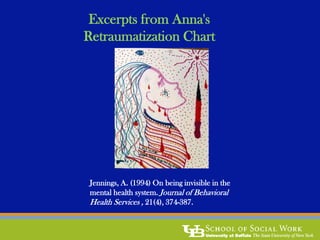
Jennings, A. (1994) On being invisible in the
mental health system. Journal of Behavioral
Health Services , 21(4), 374-387.
Excerpts from Anna's
Retraumatization Chart
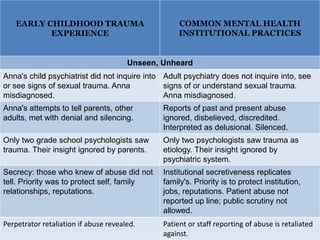
EARLY CHILDHOOD TRAUMA
EXPERIENCE
Unseen, Unheard
COMMON MENTAL HEALTH
INSTITUTIONAL PRACTICES
Anna's child psychiatrist did not inquire into
or see signs of sexual trauma. Anna
misdiagnosed.
Adult psychiatry does not inquire into, see
signs of or understand sexual trauma.
Anna misdiagnosed.
Anna's attempts to tell parents, other
adults, met with denial and silencing.
Reports of past and present abuse
ignored, disbelieved, discredited.
Interpreted as delusional. Silenced.
Only two psychologists saw trauma as
etiology. Their insight ignored by
psychiatric system.
Institutional secretiveness replicates
family's. Priority is to protect institution,
jobs, reputations. Patient abuse not
reported up line; public scrutiny not
allowed.
Secrecy: those who knew of abuse did not
tell. Priority was to protect self, family
relationships, reputations.
Only two grade school psychologists saw
trauma. Their insight ignored by parents.
Patient or staff reporting of abuse is retaliated
against.
Perpetrator retaliation if abuse revealed.
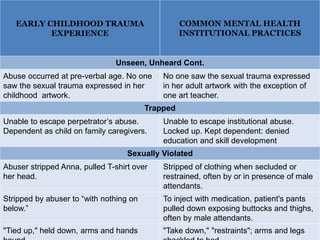
EARLY CHILDHOOD TRAUMA
EXPERIENCE
COMMON MENTAL HEALTH
INSTITUTIONAL PRACTICES
Unseen, Unheard Cont.
Abuse occurred at pre-verbal age. No one
saw the sexual trauma expressed in her
childhood artwork.
No one saw the sexual trauma expressed
in her adult artwork with the exception of
one art teacher.
Trapped
Unable to escape perpetrator’s abuse.
Dependent as child on family caregivers.
Unable to escape institutional abuse.
Locked up. Kept dependent: denied
education and skill development
Sexually Violated
Abuser stripped Anna, pulled T-shirt over
her head.
Stripped of clothing when secluded or
restrained, often by or in presence of male
attendants.
Stripped by abuser to “with nothing on
below.”
To inject with medication, patient's pants
pulled down exposing buttocks and thighs,
often by male attendants.
"Tied up," held down, arms and hands "Take down," "restraints"; arms and legs
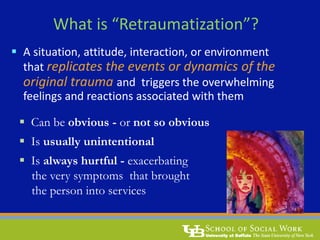
What is “Retraumatization”?
 A situation, attitude, interaction, or environment
that replicates the events or dynamics of the
original trauma and triggers the overwhelming
feelings and reactions associated with them
 Can be obvious - or not so obvious
 Is usually unintentional
 Is always hurtful - exacerbating
the very symptoms that brought
the person into services
Examples of StaffMessages/Actions
that can Confirm
Traumogenic Perceptions
• No progress expected
“you’re defective and hopeless”
• Disregarding valid needs/requests
“you don’t matter”
• Over-emphasis on Compliance vs. Collaboration
“you are powerless”
Impacts of Retraumatization on
Service Recipients
 Decrease or loss of trust
 Higher rates of self-injury
 Significantly less willingness to engage in any treatment
 Increase of intrusive memories, nightmares and flashbacks
 Reexperiencing of symptoms and emotions from previous
trauma – when extreme may take on delusional intensity
 Increase in chronicity of stress with greater risk for psychiatric
morbidity, e.g. PTSD, chronic depression
Examples of Service Systems that
Can Be Retraumatizing
• Health care services
– Impact of colonoscopy for a sexual abuse survivor
– Dental care for an oral abuse survivor
– Any medical care for a survivor of torture at hands of
medical personnel
• Correctional Services
• Mental health and substance abuse
• Schools
• Nursing homes
The Impact of Trauma
Once bitten by a snake, you are even
frightened by a rope that resembles a
snake
Chinese Proverb
Defining Trauma
McCann and Pearlman (1990)
Psychological trauma:
• is sudden, unexpected, or non-normative.
• Exceeds the individual’s perceived ability to
meet its demands
• Disrupts the individual’s frame of reference
and... psychological needs...
DSM-5 Definition of
Traumatic Event
(American Psychiatric Association, 2013)
• The person was exposed to: death, threatened
death, actual or threatened serious injury, or
actual or threatened sexual violence
Consequences of Trauma
Increased:
– Fight, flight, freeze response
– Hypervigilance, arousal, paranoia
– Perceptual and information processing distortions
– Pain tolerance
– Emotional blunting
– Numbing
– Aggression and irritability
Consequences of Trauma
Decreased:
– Memory processing and retrieval
– Reality testing
– Body and emotional awareness
– Immune response
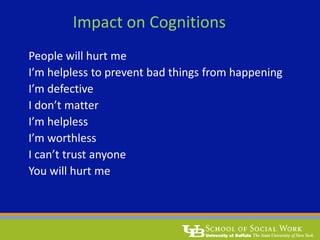
Impact on Cognitions
People will hurt me
I’m helpless to prevent bad things from happening
I’m defective
I don’t matter
I’m helpless
I’m worthless
I can’t trust anyone
You will hurt me
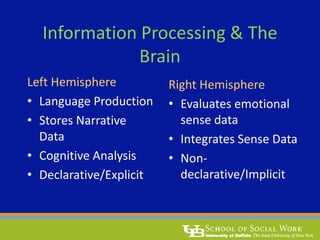
Information Processing & The
Brain
Left Hemisphere
• Language Production
• Stores Narrative
Data
• Cognitive Analysis
• Declarative/Explicit
Right Hemisphere
• Evaluates emotional
sense data
• Integrates Sense Data
• Non-
declarative/Implicit
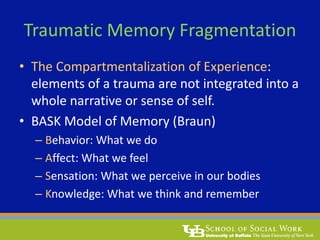
Traumatic Memory Fragmentation
• The Compartmentalization of Experience:
elements of a trauma are not integrated into a
whole narrative or sense of self.
• BASK Model of Memory (Braun)
– Behavior: What we do
– Affect: What we feel
– Sensation: What we perceive in our bodies
– Knowledge: What we think and remember
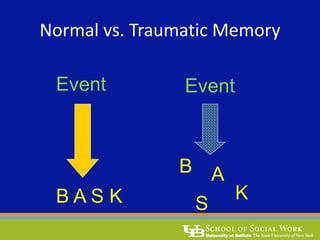
Normal vs. Traumatic Memory
Event
B A S K
Event
B A
S
K
Trauma Reactions
• Type I: Short-term, unexpected event
– Examples: One time rape, car accident, natural disaster
– Likely to result in typical PTSD sx
• Type II: (Complex Trauma): Sustained,
repeated ordeal stressors
– Examples: ongoing physical/sexual abuse, combat
– More likely to result in long-standing characterological &
interpersonal problems, dissociation, substance abuse
Trauma-Informed Care
• Seeks to avoid inadvertent retraumatization,
and to enhance clients’ participation in all
aspects of services
• Is strengths based:
– Instead of asking “What is wrong with this
person?”
– Asks “What has happened to this person?”
• Is a value-framework through which services
can be organized and delivered
Trauma-Informed Care
• May not be specifically designed to treat the actual
trauma, but services are:
– Are based on knowledge about trauma reactions
– Sensitive to trauma related issues present in survivors and
communities
– Allows clients to
• feel safe
• be accepted
• be understood
by everyone who may come in contact with the patient
• Ensures access to trauma-specific treatments
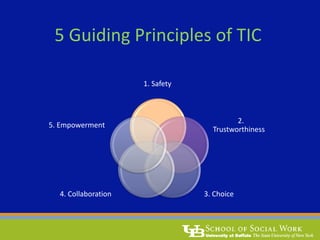
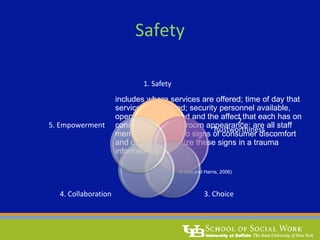
5 Guiding Principles of TIC
1. Safety
2.
Trustworthiness
3. Choice4. Collaboration
5. Empowerment
includes where services are offered; time of day that
services are offered; security personnel available,
open doors or locked and the affect that each has on
consumers; waiting room appearance; are all staff
members attentive to signs of consumer discomfort
and do they recognize these signs in a trauma
informed way?
(Fallot and Harris, 2006)
1. Safety
Safety
2.
Trustworthiness
3. Choice4. Collaboration
5. Empowerment
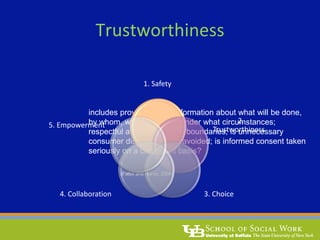
includes providing clear information about what will be done,
by whom, when, why and under what circumstances;
respectful and professional boundaries; is unnecessary
consumer disappointment avoided; is informed consent taken
seriously on a consistent basis?
(Fallot and Harris, 2006)
Trustworthiness
1. Safety
2.
Trustworthiness
3. Choice4. Collaboration
5. Empowerment
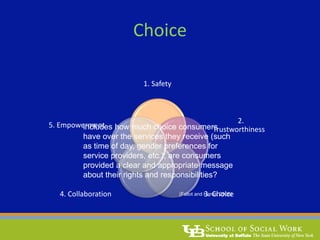
Choice
1. Safety
2.
Trustworthiness
3. Choice4. Collaboration
5. Empowermentincludes how much choice consumers
have over the services they receive (such
as time of day, gender preferences for
service providers, etc.); are consumers
provided a clear and appropriate message
about their rights and responsibilities?
(Fallot and Harris, 2006)
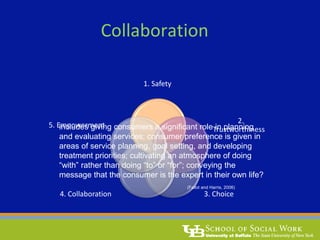
Collaboration
1. Safety
2.
Trustworthiness
3. Choice4. Collaboration
5. Empowermentincludes giving consumers a significant role in planning
and evaluating services; consumer preference is given in
areas of service planning, goal setting, and developing
treatment priorities; cultivating an atmosphere of doing
“with” rather than doing “to” or “for”; conveying the
message that the consumer is the expert in their own life?
(Fallot and Harris, 2006)
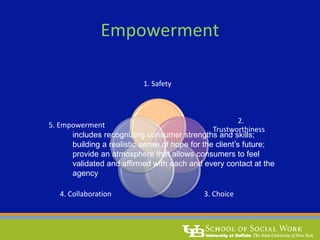
Empowerment
1. Safety
2.
Trustworthiness
3. Choice4. Collaboration
5. Empowerment
includes recognizing consumer strengths and skills;
building a realistic sense of hope for the client’s future;
provide an atmosphere that allows consumers to feel
validated and affirmed with each and every contact at the
agency
Culture Change in Service Provision
Service-Level Changes:
• Program Procedure and Settings
• Formal Service Policies
• Trauma Screening
(Creating Cultures of Trauma-Informed Care (CCTIC): A Self-Assessment and Planning Protocol,
2009)
Culture Change in Human Service
Programs
Systems-level/Administrative Changes
• Program-Wide Trauma Informed Services
• Staff Trauma Training and Education
• Human Resources Practices
(Creating Cultures of Trauma-Informed Care (CCTIC): A Self-Assessment and Planning Protocol,
2009)
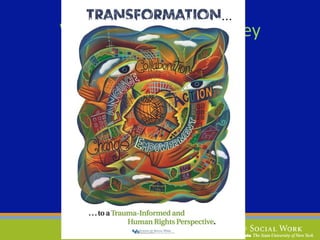
Walking our own Journey
Resources
• The Anna Institute: http://www.theannainstitute.org/
• Podcasts (free audio recordings) on UBSSW website:
http://insocialwork.org and sort on categories, then trauma
• National Child Traumatic Stress Network:
http://www.nctsn.org/
• National Center for Trauma-Informed Care:
http://www.samhsa.gov/nctic/
• UBSSW Institute on Trauma and Trauma-Informed Care:
http://socialwork.buffalo.edu/social-research/institutes-
centers/institute-on-trauma-and-trauma-informed-care.html
Trauma-Informed Care Principles
(Fallot and Harris, 2006)
1. Safety includes where services are offered; time of day that services are offered; security
personnel available, open doors or locked and the affect that each has on consumers; waiting
room appearance; are all staff members attentive to signs of consumer discomfort and do they
recognize these signs in a trauma
2. Trustworthiness includes providing clear information about what will be done, by whom, when,
why and under what circumstances; respectful and professional boundaries; is unnecessary
consumer disappointment avoided; is informed consent taken seriously on a consistent basis?
3. Choice includes how much choice consumers have over the services they receive (such as time
of day, gender preferences for service providers, etc.); are consumers provided a clear and
appropriate message about their rights and responsibilities?
4. Collaboration: includes giving consumers a significant role in planning and evaluating services;
consumer preference is given in areas of service planning, goal setting, and developing
treatment priorities; cultivating an atmosphere of doing “with” rather than doing “to” or “for”;
conveying the message that the consumer is the expert in their own life?
5. Empowerment: includes recognizing consumer strengths and skills; building a realistic sense of
hope for the client’s future; provide an atmosphere that allows consumers to feel validated and
affirmed with each and every contact at the agency

Trauma-Informed Social Work: What is it, and Why Should We Care?

  • 1.
    Trauma-Informed Social Work: Whatis it, and Why Should We Care? Nancy J. Smyth, PhD, LCSW Professor & Dean University at Buffalo School of Social Work June 25, 2015 Factor-Inwentash Faculty of Social Work University of Toronto
  • 2.
    Overview • Why shouldwe care? • Understanding trauma reactions • Trauma-informed Social Work ? (“Trauma- informed care”) Some of this content is from an online workshop developed by Professors Sue Green & Nancy Smyth on trauma-informed care and creating trauma-informed organizations.
  • 3.
    Traumatic Experiences: Commonin Those who Need Social Work Services • High prevalence rates of traumatic experiences (75%-90%) among people seeking services (mental health, substance abuse, homeless) • Best to assume it’s there and rule it out. • Trauma-Informed Care (TIC): focuses on how services are delivered and seeks to create an environment that supports those with trauma histories and avoids inadvertent retraumatization
  • 4.
  • 5.
    Jennings, A. (1994)On being invisible in the mental health system. Journal of Behavioral Health Services , 21(4), 374-387. Excerpts from Anna's Retraumatization Chart
  • 6.
    EARLY CHILDHOOD TRAUMA EXPERIENCE Unseen,Unheard COMMON MENTAL HEALTH INSTITUTIONAL PRACTICES Anna's child psychiatrist did not inquire into or see signs of sexual trauma. Anna misdiagnosed. Adult psychiatry does not inquire into, see signs of or understand sexual trauma. Anna misdiagnosed. Anna's attempts to tell parents, other adults, met with denial and silencing. Reports of past and present abuse ignored, disbelieved, discredited. Interpreted as delusional. Silenced. Only two psychologists saw trauma as etiology. Their insight ignored by psychiatric system. Institutional secretiveness replicates family's. Priority is to protect institution, jobs, reputations. Patient abuse not reported up line; public scrutiny not allowed. Secrecy: those who knew of abuse did not tell. Priority was to protect self, family relationships, reputations. Only two grade school psychologists saw trauma. Their insight ignored by parents. Patient or staff reporting of abuse is retaliated against. Perpetrator retaliation if abuse revealed.
  • 7.
    EARLY CHILDHOOD TRAUMA EXPERIENCE COMMONMENTAL HEALTH INSTITUTIONAL PRACTICES Unseen, Unheard Cont. Abuse occurred at pre-verbal age. No one saw the sexual trauma expressed in her childhood artwork. No one saw the sexual trauma expressed in her adult artwork with the exception of one art teacher. Trapped Unable to escape perpetrator’s abuse. Dependent as child on family caregivers. Unable to escape institutional abuse. Locked up. Kept dependent: denied education and skill development Sexually Violated Abuser stripped Anna, pulled T-shirt over her head. Stripped of clothing when secluded or restrained, often by or in presence of male attendants. Stripped by abuser to “with nothing on below.” To inject with medication, patient's pants pulled down exposing buttocks and thighs, often by male attendants. "Tied up," held down, arms and hands "Take down," "restraints"; arms and legs
  • 8.
    What is “Retraumatization”? A situation, attitude, interaction, or environment that replicates the events or dynamics of the original trauma and triggers the overwhelming feelings and reactions associated with them  Can be obvious - or not so obvious  Is usually unintentional  Is always hurtful - exacerbating the very symptoms that brought the person into services
  • 9.
    Examples of StaffMessages/Actions thatcan Confirm Traumogenic Perceptions • No progress expected “you’re defective and hopeless” • Disregarding valid needs/requests “you don’t matter” • Over-emphasis on Compliance vs. Collaboration “you are powerless”
  • 10.
    Impacts of Retraumatizationon Service Recipients  Decrease or loss of trust  Higher rates of self-injury  Significantly less willingness to engage in any treatment  Increase of intrusive memories, nightmares and flashbacks  Reexperiencing of symptoms and emotions from previous trauma – when extreme may take on delusional intensity  Increase in chronicity of stress with greater risk for psychiatric morbidity, e.g. PTSD, chronic depression
  • 11.
    Examples of ServiceSystems that Can Be Retraumatizing • Health care services – Impact of colonoscopy for a sexual abuse survivor – Dental care for an oral abuse survivor – Any medical care for a survivor of torture at hands of medical personnel • Correctional Services • Mental health and substance abuse • Schools • Nursing homes
  • 12.
    The Impact ofTrauma Once bitten by a snake, you are even frightened by a rope that resembles a snake Chinese Proverb
  • 13.
    Defining Trauma McCann andPearlman (1990) Psychological trauma: • is sudden, unexpected, or non-normative. • Exceeds the individual’s perceived ability to meet its demands • Disrupts the individual’s frame of reference and... psychological needs...
  • 14.
    DSM-5 Definition of TraumaticEvent (American Psychiatric Association, 2013) • The person was exposed to: death, threatened death, actual or threatened serious injury, or actual or threatened sexual violence
  • 15.
    Consequences of Trauma Increased: –Fight, flight, freeze response – Hypervigilance, arousal, paranoia – Perceptual and information processing distortions – Pain tolerance – Emotional blunting – Numbing – Aggression and irritability
  • 16.
    Consequences of Trauma Decreased: –Memory processing and retrieval – Reality testing – Body and emotional awareness – Immune response
  • 17.
    Impact on Cognitions Peoplewill hurt me I’m helpless to prevent bad things from happening I’m defective I don’t matter I’m helpless I’m worthless I can’t trust anyone You will hurt me
  • 18.
    Information Processing &The Brain Left Hemisphere • Language Production • Stores Narrative Data • Cognitive Analysis • Declarative/Explicit Right Hemisphere • Evaluates emotional sense data • Integrates Sense Data • Non- declarative/Implicit
  • 19.
    Traumatic Memory Fragmentation •The Compartmentalization of Experience: elements of a trauma are not integrated into a whole narrative or sense of self. • BASK Model of Memory (Braun) – Behavior: What we do – Affect: What we feel – Sensation: What we perceive in our bodies – Knowledge: What we think and remember
  • 20.
    Normal vs. TraumaticMemory Event B A S K Event B A S K
  • 21.
    Trauma Reactions • TypeI: Short-term, unexpected event – Examples: One time rape, car accident, natural disaster – Likely to result in typical PTSD sx • Type II: (Complex Trauma): Sustained, repeated ordeal stressors – Examples: ongoing physical/sexual abuse, combat – More likely to result in long-standing characterological & interpersonal problems, dissociation, substance abuse
  • 22.
    Trauma-Informed Care • Seeksto avoid inadvertent retraumatization, and to enhance clients’ participation in all aspects of services • Is strengths based: – Instead of asking “What is wrong with this person?” – Asks “What has happened to this person?” • Is a value-framework through which services can be organized and delivered
  • 23.
    Trauma-Informed Care • Maynot be specifically designed to treat the actual trauma, but services are: – Are based on knowledge about trauma reactions – Sensitive to trauma related issues present in survivors and communities – Allows clients to • feel safe • be accepted • be understood by everyone who may come in contact with the patient • Ensures access to trauma-specific treatments
  • 24.
    5 Guiding Principlesof TIC 1. Safety 2. Trustworthiness 3. Choice4. Collaboration 5. Empowerment
  • 25.
    includes where servicesare offered; time of day that services are offered; security personnel available, open doors or locked and the affect that each has on consumers; waiting room appearance; are all staff members attentive to signs of consumer discomfort and do they recognize these signs in a trauma informed way? (Fallot and Harris, 2006) 1. Safety Safety 2. Trustworthiness 3. Choice4. Collaboration 5. Empowerment
  • 26.
    includes providing clearinformation about what will be done, by whom, when, why and under what circumstances; respectful and professional boundaries; is unnecessary consumer disappointment avoided; is informed consent taken seriously on a consistent basis? (Fallot and Harris, 2006) Trustworthiness 1. Safety 2. Trustworthiness 3. Choice4. Collaboration 5. Empowerment
  • 27.
    Choice 1. Safety 2. Trustworthiness 3. Choice4.Collaboration 5. Empowermentincludes how much choice consumers have over the services they receive (such as time of day, gender preferences for service providers, etc.); are consumers provided a clear and appropriate message about their rights and responsibilities? (Fallot and Harris, 2006)
  • 28.
    Collaboration 1. Safety 2. Trustworthiness 3. Choice4.Collaboration 5. Empowermentincludes giving consumers a significant role in planning and evaluating services; consumer preference is given in areas of service planning, goal setting, and developing treatment priorities; cultivating an atmosphere of doing “with” rather than doing “to” or “for”; conveying the message that the consumer is the expert in their own life? (Fallot and Harris, 2006)
  • 29.
    Empowerment 1. Safety 2. Trustworthiness 3. Choice4.Collaboration 5. Empowerment includes recognizing consumer strengths and skills; building a realistic sense of hope for the client’s future; provide an atmosphere that allows consumers to feel validated and affirmed with each and every contact at the agency
  • 30.
    Culture Change inService Provision Service-Level Changes: • Program Procedure and Settings • Formal Service Policies • Trauma Screening (Creating Cultures of Trauma-Informed Care (CCTIC): A Self-Assessment and Planning Protocol, 2009)
  • 31.
    Culture Change inHuman Service Programs Systems-level/Administrative Changes • Program-Wide Trauma Informed Services • Staff Trauma Training and Education • Human Resources Practices (Creating Cultures of Trauma-Informed Care (CCTIC): A Self-Assessment and Planning Protocol, 2009)
  • 32.
  • 33.
    Resources • The AnnaInstitute: http://www.theannainstitute.org/ • Podcasts (free audio recordings) on UBSSW website: http://insocialwork.org and sort on categories, then trauma • National Child Traumatic Stress Network: http://www.nctsn.org/ • National Center for Trauma-Informed Care: http://www.samhsa.gov/nctic/ • UBSSW Institute on Trauma and Trauma-Informed Care: http://socialwork.buffalo.edu/social-research/institutes- centers/institute-on-trauma-and-trauma-informed-care.html
  • 34.
    Trauma-Informed Care Principles (Fallotand Harris, 2006) 1. Safety includes where services are offered; time of day that services are offered; security personnel available, open doors or locked and the affect that each has on consumers; waiting room appearance; are all staff members attentive to signs of consumer discomfort and do they recognize these signs in a trauma 2. Trustworthiness includes providing clear information about what will be done, by whom, when, why and under what circumstances; respectful and professional boundaries; is unnecessary consumer disappointment avoided; is informed consent taken seriously on a consistent basis? 3. Choice includes how much choice consumers have over the services they receive (such as time of day, gender preferences for service providers, etc.); are consumers provided a clear and appropriate message about their rights and responsibilities? 4. Collaboration: includes giving consumers a significant role in planning and evaluating services; consumer preference is given in areas of service planning, goal setting, and developing treatment priorities; cultivating an atmosphere of doing “with” rather than doing “to” or “for”; conveying the message that the consumer is the expert in their own life? 5. Empowerment: includes recognizing consumer strengths and skills; building a realistic sense of hope for the client’s future; provide an atmosphere that allows consumers to feel validated and affirmed with each and every contact at the agency