Intimate partner violence: Prevalence, impact, treatment, prevention 
ALIYA R. WEBERMANN, B.A. 
M.A. CANDIDATE, CLINICAL PSYCHOLOGY 
TOWSON UNIVERSITY
Overview 
 This presentation will discuss the following topics: 
Definition of intimate partner violence (IPV) and typologies 
U.S. national IPV prevalence 
Impact and outcomes of victimization, including psychiatric comorbidities 
Risk factors for IPV 
IPV and identity 
Assessment and treatment of IPV 
Preventative and protective factors 
Trigger warning: this presentation will provide examples of IPV perpetration and consequences of IPV victimization, which may cause emotional distress.
Definition 
 Physical, sexual, psychological, or emotional harm from a current or former partner or spouse 
 A pattern of abusive behavior in any relationship that is used by one partner to gain or maintain power and control over another partner 
(CDC, 2013)
Typologies 
 Physical: Intentional use of physical force- kicking, using a weapon, grabbing 
 Sexual: Force, coercion, assault/rape, involvement with incapacitated person 
 Psychological: Threats, intimidation, isolation, controlling behavior 
 Emotional: Insults, put-downs, humiliation 
 Financial (not in CDC definition): Limiting access to money and resources, identity theft, sabotaging career opportunities, incurring debt 
(CDC, 2013; NNEDV, 2014a)
Typologies, continued 
 Based on physiological differences in heart rate reactivity that may indicate differences in intent and motivation: 
Characterological violence (Type 1): heart rate lowers during interactions, behavior stems from desire for power and control 
Increased verbal and facial expressions of anger 
Situational violence (Type 2): heart rate increases during interactions, behavior stems from emotion dysregulation and physical loss of control 
Situational aggression increases more over time 
Equally violent within romantic partnerships as Type 1 
(Babcock et al., 2004; Gottman et al., 1995; Meehan et al., 2001)
Prevalence: Victimization 
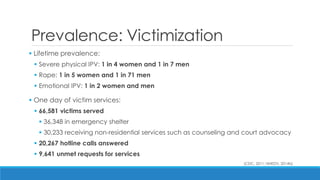
 Lifetime prevalence: 
Severe physical IPV: 1 in 4 women and 1 in 7 men 
Rape: 1 in 5 women and 1 in 71 men 
Emotional IPV: 1 in 2 women and men 
 One day of victim services: 
66,581 victims served 
36,348 in emergency shelter 
30,233 receiving non-residential services such as counseling and court advocacy 
20,267 hotline calls answered 
9,641 unmet requests for services 
(CDC, 2011; NNEDV, 2014b)
Prevalence: Perpetration 
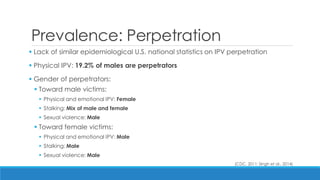
 Lack of similar epidemiological U.S. national statistics on IPV perpetration 
 Physical IPV: 19.2% of males are perpetrators 
 Gender of perpetrators: 
Toward male victims: 
Physical and emotional IPV: Female 
Stalking: Mix of male and female 
Sexual violence: Male 
Toward female victims: 
Physical and emotional IPV: Male 
Stalking: Male 
Sexual violence: Male 
(CDC, 2011; Singh et al., 2014)
Impact: Adult victims 
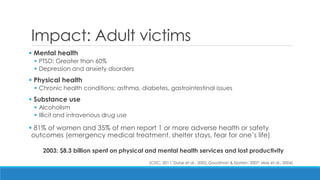
 Mental health 
PTSD: Greater than 60% 
Depression and anxiety disorders 
 Physical health 
Chronic health conditions: asthma, diabetes, gastrointestinal issues 
 Substance use 
Alcoholism 
Illicit and intravenous drug use 
 81% of women and 35% of men report 1 or more adverse health or safety outcomes (emergency medical treatment, shelter stays, fear for one’s life) 
2003: $8.3 billion spent on physical and mental health services and lost productivity 
(CDC, 2011; Dube et al., 2002; Goodman & Epstein, 2007; Max et al., 2004)
Impact: Child victims 
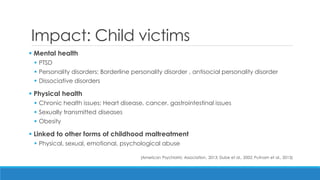
 Mental health 
PTSD 
Personality disorders: Borderline personality disorder , antisocial personality disorder 
Dissociative disorders 
 Physical health 
Chronic health issues: Heart disease, cancer, gastrointestinal issues 
Sexually transmitted diseases 
Obesity 
 Linked to other forms of childhood maltreatment 
Physical, sexual, emotional, psychological abuse 
(American Psychiatric Association, 2013; Dube et al., 2002; Putnam et al., 2013)
Risk factors: Perpetration 
 Childhood maltreatment and witnessing of domestic violence 
 Multiple types of IPV (engaging in an IPV type increases likelihood of other types) 
 Marital dissatisfaction 
 Illicit drug use and alcoholism 
 Traditional gender and sex role ideology 
 Implicit attitudes condoning violence 
 Physical health issues: Insomnia, gastrointestinal issues 
 Mental health issues: Personality disorders, depression 
 Insecure/disorganized attachment style 
(Alexander & Warner, 2003; Eckhardt & Crane, 2014; Heise & Garcia-Moreno, 2002; Singh et al., 2014; Stith et al., 2004; Tjaden & Thoennes, 2000; Whitfield et al., 2003;)
Risk factors: Victimization 
 Childhood maltreatment and witnessing of domestic violence 
 Mental health issues: Personality disorders, depression, dissociative disorders 
 Economic disempowerment 
 Youth: 80% of female sexual assault victims are under 25 
 Insecure/disorganized attachment style 
 Predictors of escalation in abusive relationships: 
Female victims perpetrating violence toward male perpetrators 
Partner threats to harm and/or kill 
(Alexander, 2009; CDC, 2011; Goodman & Epstein, 2007; Stith et al., 2004; ; Tjaden & Thoennes, 2000; Whitfield et al., 2003)
IPV and identity 
 Race 
Institutionalized racism (criminal justice system) 
“Traitor” to community 
 Gender identity 
Male and transgender victims 
 Religion 
Taboo of divorce 
 Sexual orientation 
“Outness” of victim v. perpetrator 
Female perpetrators
IPV and identity 
Income level 
Financially dependent on perpetrator 
Difficult to access resources 
Immigration status 
Fear of deportation 
Need to report perpetrator/assist in prosecution to receive visa 
Language abilities 
Disability 
Dependent on perpetrator for survival 
Lack of resources
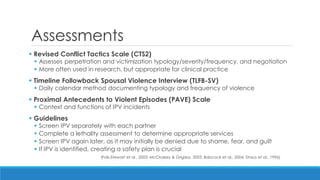
Assessments 
 Revised Conflict Tactics Scale (CTS2) 
Assesses perpetration and victimization typology/severity/frequency, and negotiation 
More often used in research, but appropriate for clinical practice 
 Timeline Followback Spousal Violence Interview (TLFB-SV) 
Daily calendar method documenting typology and frequency of violence 
 Proximal Antecedents to Violent Episodes (PAVE) Scale 
Context and functions of IPV incidents 
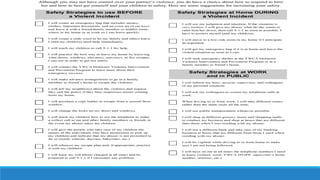
 Guidelines 
Screen IPV separately with each partner 
Complete a lethality assessment to determine appropriate services 
Screen IPV again later, as it may initially be denied due to shame, fear, and guilt 
If IPV is identified, creating a safety plan is crucial 
(Fals-Stewart et al., 2003; McCloskey & Grigsby, 2005; Babcock et al., 2004; Straus et al., 1996)
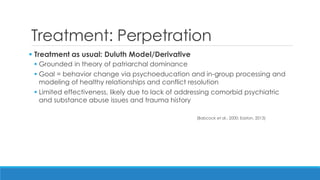
Treatment: Perpetration 
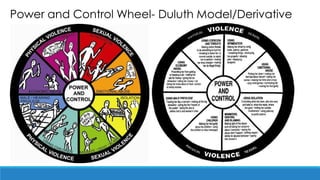
 Treatment as usual: Duluth Model/Derivative 
Grounded in theory of patriarchal dominance 
Goal = behavior change via psychoeducation and in-group processing and modeling of healthy relationships and conflict resolution 
Limited effectiveness, likely due to lack of addressing comorbid psychiatric and substance abuse issues and trauma history 
(Babcock et al., 2000; Easton, 2013)
Power and Control Wheel- Duluth Model/Derivative
Treatment: Perpetration, continued 
 Couples therapy 
Only recommended with situational common-couple violence, rather then characterological violence perpetrated by one partner 
Behavioral couples therapy shown to be effective with substance using couples 
Multi-couple group therapy 
Demonstrated success with mild to moderate situational common-couple violence 
 Group therapy 
Batterer/abuser intervention programs 
Most effective if comorbid psychiatric and substance use issues are addressed 
Demonstrated success utilizing CBT and MI modalities and in conjunction with individual therapy 
(Connors, Mills, & Gray, 2013; Easton, 2013; Fals-Stewart & Clinton-Sherrod, 2009; Gottman et al., 1995; Stare & Fernando, 2014; Stith et al., 2004)
Preventative and protective factors 
 Preventing child maltreatment, including witnessing of domestic violence 
 Promoting flexible gender roles, egalitarian relationships, non-violence, and feminist identity 
 Treating comorbid substance use and psychiatric disorders 
 Training physical and mental health care providers to a) identify the effects of IPV on patients presenting to treatment and b) accurately and appropriately assess IPV 
 Targeted education about intimate partner violence, sexual assault, and healthy relationships 
 Economic independence, vocational opportunities, affordable housing 
 Social supports 
(Backus & Mahalik, 2011; Easton, 2013; Goodman & Epstein, 2007; McCloskey & Grigsby, 2005)
References 
American Psychiatric Association. (2013). Diagnostic and statistical manual of mental disorders (5th ed.). Arlington, VA: American Psychiatric Publishing. Alexander, P. C. (2009). Childhood trauma, attachment, and abuse by multiple partners. Psychological Trauma: Theory, Research, Practice, And Policy, 1(1), 78-88. Alexander, P. C., & Warner, S. (2003). Attachment theory and family systems theory as frameworks for understanding the intergenerational transmission of family violence. In P. Erdman, T. Caffery (Eds.) , Attachment and family systems: Conceptual, empirical, and therapeutic relatedness (pp. 241-257). New York, NY, US: Brunner-Routledge. Babcock, J. C., Green, C. E., & Robie, C. (2004). Does batterers' treatment work? A meta-analytic review of domestic violence treatment. Clinical Psychology Review, 23(8), 1023-1053. Backus, F. R., & Mahalik, J. R. (2011). The masculinity of Mr. Right: Feminist identity and heterosexual women’s ideal romantic partners. Psychology of Women Quarterly, 35(2), 318-326. Centers for Disease Control and Prevention, National Center for Injury Prevention and Control, Division of Violence Prevention (2013). Intimate Partner Violence. Retrieved from http://www.cdc.gov/violenceprevention/intimatepartnerviolence/.
References, continued 
Centers for Disease Control and Prevention, National Center for Injury Prevention and Control, Division of Violence Prevention (2011). National Intimate Partner and Sexual Violence Survey 2010. Retrieved from http://www.cdc.gov/violenceprevention/pdf/cdc_nisvs_overview_insert_final-a.pdf. 
Conners, A. D., Mills, J. F., & Gray, A. L. (2013). Intimate partner violence intervention for high-risk offenders. Psychological Services, 10, 12-23. 
Dube, S. R., Anda, R. F., Felitti, V. J., Edwards, V. J., & Williamson, D. F. (2002). Exposure to abuse, neglect and household dysfunction among adults who witnessed intimate partner violence as children: Implications for health and social services. Violence And Victims, 17(1), 3-18. 
Easton, C. J. (2013). Treatments for offenders of intimate partner violence. In M. McMurran (Ed.) , Alcohol-related violence: Prevention and treatment (pp. 171-185). Wiley-Blackwell. 
Eckhardt, C. I., & Crane, C. A. (2014). Male perpetrators of intimate partner violence and implicit attitudes toward violence: Associations with treatment outcomes. Cognitive Therapy And Research, 38(3), 291-301. 
Fals-Stewart, W., Birchler, G. R., & Kelley, M. L. (2003). The Timeline Followback Spousal Violence Interview to Assess Physical Aggression Between Intimate Partners: Reliability and Validity. Journal Of Family Violence, 18(3), 131-142. 
Fals-Stewart, W., & Clinton-Sherrod, M. (2009). Treating intimate partner violence among substance-abusing dyads: The effect of couples therapy. Professional Psychology: Research And Practice, 40(3), 257-263.
References, continued 
Goodman, L. A., & Epstein, D. (2007). Listening to battered women: A survivor-centered approach to advocacy, mental health, and justice. Washington, D.C.: American Psychological Association. 
Heise, L., & Garcia-Moreno, C. (2002). Violence by intimate partners. In E. Krug, L. L. Dahlberg, J.A. Mercy, et al. (Eds.), World report on violence and health (pp. 87-121). Geneva, Switzerland: World Health Organization. Retrieved from http://www.who.int/violence_injury_prevention/violence/ global_campaign/en/chap4.pdf. 
Max, W., Rice, D. P., Finkelstein, E., Bardwell, R. A., & Leadbetter, S. (2004). The Economic Toll of Intimate Partner Violence Against Women in the United States. Violence And Victims, 19(3), 259-272. 
McCloskey, K., & Grigsby, N. (2005). The Ubiquitous Clinical Problem of Adult Intimate Partner Violence: The Need for Routine Assessment. Professional Psychology: Research And Practice, 36(3), 264-275. 
Meehan, J. C., Holtzworth-Munroe, A., & Herron, K. (2001). Maritally violent men's heart rate reactivity to marital interactions: A failure to replicate the Gottman et al. (1995) typology. Journal Of Family Psychology, 15(3), 394-408. 
National Network to End Domestic Violence (2014a). About Financial Abuse. Retrieved from http://nnedv.org/resources/ejresources/about-financial-abuse.html. 
National Network to End Domestic Violence (2014b). Domestic Violence Counts National Summary 2013. Retrieved from http://nnedv.org/downloads/Census/DVCounts2013/DVCounts13_NatlSummary.pdf.
References, continued 
Putnam, K. T., Harris, W. W., & Putnam, F. W. (2013). Synergistic childhood adversities and complex adult psychopathology. Journal of Traumatic Stress, 26(4), 435-442. 
Singh, V., Tolman, R., Walton, M., Chermack, S., & Cunningham, R. (2014). Characteristics of men who perpetrate intimate partner violence. Journal of Behavioral Family Medicine, 27(5), 661-668. 
Stare, B. G., & Fernando, D. M. (2014). Intimate partner violence typology and treatment: A brief literature review. The Family Journal, 22(3), 298-303. 
Stith, S. M., Smith, D. B., Penn, C. E., Ward, D. B., & Tritt, D. (2004). Intimate partner physical abuse perpetration and victimization risk factors: A meta-analytic review. Aggression And Violent Behavior, 10(1), 65-98. 
Straus, M. A., Hamby, S. L., Boney-McCoy, S., & Sugarman, D. B. (1996). The revised Conflict Tactics Scales (CTS2): Development and preliminary psychometric data. Journal of Family Issues, 17(3), 283-316. 
Tjaden, P., & Thoennes, N. (2000). Extent, nature, and consequences of intimate partner violence: Findings from the National Violence Against Women Survey. Washington (DC): Department of Justice. Retrieved from: http://www.ojp.usdoj.gov/nij/pubs-sum/181867.htm. 
Whitfield, C. L., Anda, R. F., Dube, S. R., & Felitti, V. J. (2003). Violent childhood experiences and the risk of intimate partner violence in adults: Assessment in a large health maintenance organization. Journal Of Interpersonal Violence, 18(2), 166-185.

Intimate Partner Violence: Prevalence, impact, treatment, prevention

  • 1.
    Intimate partner violence:Prevalence, impact, treatment, prevention ALIYA R. WEBERMANN, B.A. M.A. CANDIDATE, CLINICAL PSYCHOLOGY TOWSON UNIVERSITY
  • 2.
    Overview  Thispresentation will discuss the following topics: Definition of intimate partner violence (IPV) and typologies U.S. national IPV prevalence Impact and outcomes of victimization, including psychiatric comorbidities Risk factors for IPV IPV and identity Assessment and treatment of IPV Preventative and protective factors Trigger warning: this presentation will provide examples of IPV perpetration and consequences of IPV victimization, which may cause emotional distress.
  • 3.
    Definition  Physical,sexual, psychological, or emotional harm from a current or former partner or spouse  A pattern of abusive behavior in any relationship that is used by one partner to gain or maintain power and control over another partner (CDC, 2013)
  • 4.
    Typologies  Physical:Intentional use of physical force- kicking, using a weapon, grabbing  Sexual: Force, coercion, assault/rape, involvement with incapacitated person  Psychological: Threats, intimidation, isolation, controlling behavior  Emotional: Insults, put-downs, humiliation  Financial (not in CDC definition): Limiting access to money and resources, identity theft, sabotaging career opportunities, incurring debt (CDC, 2013; NNEDV, 2014a)
  • 5.
    Typologies, continued Based on physiological differences in heart rate reactivity that may indicate differences in intent and motivation: Characterological violence (Type 1): heart rate lowers during interactions, behavior stems from desire for power and control Increased verbal and facial expressions of anger Situational violence (Type 2): heart rate increases during interactions, behavior stems from emotion dysregulation and physical loss of control Situational aggression increases more over time Equally violent within romantic partnerships as Type 1 (Babcock et al., 2004; Gottman et al., 1995; Meehan et al., 2001)
  • 6.
    Prevalence: Victimization Lifetime prevalence: Severe physical IPV: 1 in 4 women and 1 in 7 men Rape: 1 in 5 women and 1 in 71 men Emotional IPV: 1 in 2 women and men  One day of victim services: 66,581 victims served 36,348 in emergency shelter 30,233 receiving non-residential services such as counseling and court advocacy 20,267 hotline calls answered 9,641 unmet requests for services (CDC, 2011; NNEDV, 2014b)
  • 7.
    Prevalence: Perpetration Lack of similar epidemiological U.S. national statistics on IPV perpetration  Physical IPV: 19.2% of males are perpetrators  Gender of perpetrators: Toward male victims: Physical and emotional IPV: Female Stalking: Mix of male and female Sexual violence: Male Toward female victims: Physical and emotional IPV: Male Stalking: Male Sexual violence: Male (CDC, 2011; Singh et al., 2014)
  • 8.
    Impact: Adult victims  Mental health PTSD: Greater than 60% Depression and anxiety disorders  Physical health Chronic health conditions: asthma, diabetes, gastrointestinal issues  Substance use Alcoholism Illicit and intravenous drug use  81% of women and 35% of men report 1 or more adverse health or safety outcomes (emergency medical treatment, shelter stays, fear for one’s life) 2003: $8.3 billion spent on physical and mental health services and lost productivity (CDC, 2011; Dube et al., 2002; Goodman & Epstein, 2007; Max et al., 2004)
  • 9.
    Impact: Child victims  Mental health PTSD Personality disorders: Borderline personality disorder , antisocial personality disorder Dissociative disorders  Physical health Chronic health issues: Heart disease, cancer, gastrointestinal issues Sexually transmitted diseases Obesity  Linked to other forms of childhood maltreatment Physical, sexual, emotional, psychological abuse (American Psychiatric Association, 2013; Dube et al., 2002; Putnam et al., 2013)
  • 10.
    Risk factors: Perpetration  Childhood maltreatment and witnessing of domestic violence  Multiple types of IPV (engaging in an IPV type increases likelihood of other types)  Marital dissatisfaction  Illicit drug use and alcoholism  Traditional gender and sex role ideology  Implicit attitudes condoning violence  Physical health issues: Insomnia, gastrointestinal issues  Mental health issues: Personality disorders, depression  Insecure/disorganized attachment style (Alexander & Warner, 2003; Eckhardt & Crane, 2014; Heise & Garcia-Moreno, 2002; Singh et al., 2014; Stith et al., 2004; Tjaden & Thoennes, 2000; Whitfield et al., 2003;)
  • 11.
    Risk factors: Victimization  Childhood maltreatment and witnessing of domestic violence  Mental health issues: Personality disorders, depression, dissociative disorders  Economic disempowerment  Youth: 80% of female sexual assault victims are under 25  Insecure/disorganized attachment style  Predictors of escalation in abusive relationships: Female victims perpetrating violence toward male perpetrators Partner threats to harm and/or kill (Alexander, 2009; CDC, 2011; Goodman & Epstein, 2007; Stith et al., 2004; ; Tjaden & Thoennes, 2000; Whitfield et al., 2003)
  • 12.
    IPV and identity  Race Institutionalized racism (criminal justice system) “Traitor” to community  Gender identity Male and transgender victims  Religion Taboo of divorce  Sexual orientation “Outness” of victim v. perpetrator Female perpetrators
  • 13.
    IPV and identity Income level Financially dependent on perpetrator Difficult to access resources Immigration status Fear of deportation Need to report perpetrator/assist in prosecution to receive visa Language abilities Disability Dependent on perpetrator for survival Lack of resources
  • 14.
    Assessments  RevisedConflict Tactics Scale (CTS2) Assesses perpetration and victimization typology/severity/frequency, and negotiation More often used in research, but appropriate for clinical practice  Timeline Followback Spousal Violence Interview (TLFB-SV) Daily calendar method documenting typology and frequency of violence  Proximal Antecedents to Violent Episodes (PAVE) Scale Context and functions of IPV incidents  Guidelines Screen IPV separately with each partner Complete a lethality assessment to determine appropriate services Screen IPV again later, as it may initially be denied due to shame, fear, and guilt If IPV is identified, creating a safety plan is crucial (Fals-Stewart et al., 2003; McCloskey & Grigsby, 2005; Babcock et al., 2004; Straus et al., 1996)
  • 16.
    Treatment: Perpetration Treatment as usual: Duluth Model/Derivative Grounded in theory of patriarchal dominance Goal = behavior change via psychoeducation and in-group processing and modeling of healthy relationships and conflict resolution Limited effectiveness, likely due to lack of addressing comorbid psychiatric and substance abuse issues and trauma history (Babcock et al., 2000; Easton, 2013)
  • 17.
    Power and ControlWheel- Duluth Model/Derivative
  • 18.
    Treatment: Perpetration, continued  Couples therapy Only recommended with situational common-couple violence, rather then characterological violence perpetrated by one partner Behavioral couples therapy shown to be effective with substance using couples Multi-couple group therapy Demonstrated success with mild to moderate situational common-couple violence  Group therapy Batterer/abuser intervention programs Most effective if comorbid psychiatric and substance use issues are addressed Demonstrated success utilizing CBT and MI modalities and in conjunction with individual therapy (Connors, Mills, & Gray, 2013; Easton, 2013; Fals-Stewart & Clinton-Sherrod, 2009; Gottman et al., 1995; Stare & Fernando, 2014; Stith et al., 2004)
  • 19.
    Preventative and protectivefactors  Preventing child maltreatment, including witnessing of domestic violence  Promoting flexible gender roles, egalitarian relationships, non-violence, and feminist identity  Treating comorbid substance use and psychiatric disorders  Training physical and mental health care providers to a) identify the effects of IPV on patients presenting to treatment and b) accurately and appropriately assess IPV  Targeted education about intimate partner violence, sexual assault, and healthy relationships  Economic independence, vocational opportunities, affordable housing  Social supports (Backus & Mahalik, 2011; Easton, 2013; Goodman & Epstein, 2007; McCloskey & Grigsby, 2005)
  • 20.
    References American PsychiatricAssociation. (2013). Diagnostic and statistical manual of mental disorders (5th ed.). Arlington, VA: American Psychiatric Publishing. Alexander, P. C. (2009). Childhood trauma, attachment, and abuse by multiple partners. Psychological Trauma: Theory, Research, Practice, And Policy, 1(1), 78-88. Alexander, P. C., & Warner, S. (2003). Attachment theory and family systems theory as frameworks for understanding the intergenerational transmission of family violence. In P. Erdman, T. Caffery (Eds.) , Attachment and family systems: Conceptual, empirical, and therapeutic relatedness (pp. 241-257). New York, NY, US: Brunner-Routledge. Babcock, J. C., Green, C. E., & Robie, C. (2004). Does batterers' treatment work? A meta-analytic review of domestic violence treatment. Clinical Psychology Review, 23(8), 1023-1053. Backus, F. R., & Mahalik, J. R. (2011). The masculinity of Mr. Right: Feminist identity and heterosexual women’s ideal romantic partners. Psychology of Women Quarterly, 35(2), 318-326. Centers for Disease Control and Prevention, National Center for Injury Prevention and Control, Division of Violence Prevention (2013). Intimate Partner Violence. Retrieved from http://www.cdc.gov/violenceprevention/intimatepartnerviolence/.
  • 21.
    References, continued Centersfor Disease Control and Prevention, National Center for Injury Prevention and Control, Division of Violence Prevention (2011). National Intimate Partner and Sexual Violence Survey 2010. Retrieved from http://www.cdc.gov/violenceprevention/pdf/cdc_nisvs_overview_insert_final-a.pdf. Conners, A. D., Mills, J. F., & Gray, A. L. (2013). Intimate partner violence intervention for high-risk offenders. Psychological Services, 10, 12-23. Dube, S. R., Anda, R. F., Felitti, V. J., Edwards, V. J., & Williamson, D. F. (2002). Exposure to abuse, neglect and household dysfunction among adults who witnessed intimate partner violence as children: Implications for health and social services. Violence And Victims, 17(1), 3-18. Easton, C. J. (2013). Treatments for offenders of intimate partner violence. In M. McMurran (Ed.) , Alcohol-related violence: Prevention and treatment (pp. 171-185). Wiley-Blackwell. Eckhardt, C. I., & Crane, C. A. (2014). Male perpetrators of intimate partner violence and implicit attitudes toward violence: Associations with treatment outcomes. Cognitive Therapy And Research, 38(3), 291-301. Fals-Stewart, W., Birchler, G. R., & Kelley, M. L. (2003). The Timeline Followback Spousal Violence Interview to Assess Physical Aggression Between Intimate Partners: Reliability and Validity. Journal Of Family Violence, 18(3), 131-142. Fals-Stewart, W., & Clinton-Sherrod, M. (2009). Treating intimate partner violence among substance-abusing dyads: The effect of couples therapy. Professional Psychology: Research And Practice, 40(3), 257-263.
  • 22.
    References, continued Goodman,L. A., & Epstein, D. (2007). Listening to battered women: A survivor-centered approach to advocacy, mental health, and justice. Washington, D.C.: American Psychological Association. Heise, L., & Garcia-Moreno, C. (2002). Violence by intimate partners. In E. Krug, L. L. Dahlberg, J.A. Mercy, et al. (Eds.), World report on violence and health (pp. 87-121). Geneva, Switzerland: World Health Organization. Retrieved from http://www.who.int/violence_injury_prevention/violence/ global_campaign/en/chap4.pdf. Max, W., Rice, D. P., Finkelstein, E., Bardwell, R. A., & Leadbetter, S. (2004). The Economic Toll of Intimate Partner Violence Against Women in the United States. Violence And Victims, 19(3), 259-272. McCloskey, K., & Grigsby, N. (2005). The Ubiquitous Clinical Problem of Adult Intimate Partner Violence: The Need for Routine Assessment. Professional Psychology: Research And Practice, 36(3), 264-275. Meehan, J. C., Holtzworth-Munroe, A., & Herron, K. (2001). Maritally violent men's heart rate reactivity to marital interactions: A failure to replicate the Gottman et al. (1995) typology. Journal Of Family Psychology, 15(3), 394-408. National Network to End Domestic Violence (2014a). About Financial Abuse. Retrieved from http://nnedv.org/resources/ejresources/about-financial-abuse.html. National Network to End Domestic Violence (2014b). Domestic Violence Counts National Summary 2013. Retrieved from http://nnedv.org/downloads/Census/DVCounts2013/DVCounts13_NatlSummary.pdf.
  • 23.
    References, continued Putnam,K. T., Harris, W. W., & Putnam, F. W. (2013). Synergistic childhood adversities and complex adult psychopathology. Journal of Traumatic Stress, 26(4), 435-442. Singh, V., Tolman, R., Walton, M., Chermack, S., & Cunningham, R. (2014). Characteristics of men who perpetrate intimate partner violence. Journal of Behavioral Family Medicine, 27(5), 661-668. Stare, B. G., & Fernando, D. M. (2014). Intimate partner violence typology and treatment: A brief literature review. The Family Journal, 22(3), 298-303. Stith, S. M., Smith, D. B., Penn, C. E., Ward, D. B., & Tritt, D. (2004). Intimate partner physical abuse perpetration and victimization risk factors: A meta-analytic review. Aggression And Violent Behavior, 10(1), 65-98. Straus, M. A., Hamby, S. L., Boney-McCoy, S., & Sugarman, D. B. (1996). The revised Conflict Tactics Scales (CTS2): Development and preliminary psychometric data. Journal of Family Issues, 17(3), 283-316. Tjaden, P., & Thoennes, N. (2000). Extent, nature, and consequences of intimate partner violence: Findings from the National Violence Against Women Survey. Washington (DC): Department of Justice. Retrieved from: http://www.ojp.usdoj.gov/nij/pubs-sum/181867.htm. Whitfield, C. L., Anda, R. F., Dube, S. R., & Felitti, V. J. (2003). Violent childhood experiences and the risk of intimate partner violence in adults: Assessment in a large health maintenance organization. Journal Of Interpersonal Violence, 18(2), 166-185.