Topics in Robotics
Bushra Jbawi Rawan Al-saman Samira Nizam
Sundos Hammoud Noor Al-huda Isbel Haya Al-khatib
CONTENTS
Robot Control System
Robotics Programming Languages
Robotics Learning
Robot Control System
Classification Based on Control Systems:
1. Limited Sequence Control.
2. Playback with Point-to-Point Control.
3. Playback with Continuous Path Control.
4. Intelligent Control.
Limited Sequence Control.
 an elementary control type.
 Uses mechanical stops to set position.
 used for simple motion cycles (pick-and-place operations).
 Precision of such control system is less.
Point-to-Point Control (PTP)
 The locations are recorded in the control memory.
 records work cycle, as a sequence of points, then plays back
the work cycle during program execution.
 It can be moved in a small distance.
 used for hole drilling, machine loading and unloading.
Continuous Path System
 the robot can stop at any specified point along the controlled
path
 All the points along the path must be stored explicitly in the
robot’s control memory.
 greater storage capacity
 Interpolation capability to execute paths
Intelligent Control
 Digital computer as a controller.
 Intelligent, work according to their environment.
 Decision-making capability and ability to communicate with
humans.
 Responsiveness to advanced sensor inputs.
 Advanced programming language to input the decision-
making logic and other ‘intelligence' into the memory.
Programming Languages
Three Programming Methods:
 Manual teaching
 Lead through teaching
 Programming languages
Programming Languages contd..
Manual Teaching:
 Point to Point applications
Lead Through Teaching:
 Continuous Path Programming
 Robot Simulator
 Advantage is direct programming but also have disadvantages
Programming Languages contd..
Disadvantages:
 Every motion is recorded and played back in the same
manner. So unintentional motions also be played.
 Impossible to achieve exact required velocity
 Memory size is required to store the data.
 Investment in a simulator is required.
Programming Languages contd..
Programming Languages:
 There are many programming languages such as :AL, VAL,
AML, RPL.
 They are Classified as:
- First Generation Language
- Second Generation Language
- World modelling and task oriented object level language
Programming Languages contd..
First Generation Language:
 Off-Line Programming used in combination with teach
pendant.
 VAL is an example of this kind.
Programming Languages contd..
Second Generation Language:
 AML,VAL II etc…
 Structural Programming language performing complex tasks.
 Apart from straight line interpolation performs complex
motions.
 Uses force, torque and other sensors.
 Data processing, file management and keeping all records is
done.
Programming Languages contd..
World modelling & task oriented object
level language:
 More advanced language is WORLD modelling.
 Intelligence is required.
Programming Languages contd..
Some of the Programming Languages:
 ARL (Assembly Robot Language):
The progress of micro-computers has made it possible to execute
complicated tasks.
 HARL (Hitachi Assembly Robot Language):
 It is a commercial version of ARL
 Suited for point-to-point assembly and handling tasks.
 18 instructions.
 Motion control data is programmed and after programming, location
data used in the program is taught in order to make location
information of motion statements.
Programming Languages contd..
Some of the Programming Languages:
AL (Arm Language):
It is currently the language which has undergone the most
important development. It first appeared in the course of original
research at the Stanford University.
VAL (Vic Arm Language):
An interactive version of AL, known as VAL and its associated
hardware have been adapted to all Animate robots which
previously used an old from of point control. A new version of VAL
called VAL II, is at present being tested.
Programming Languages contd..
Some of the Programming Languages:
 AML (A Manufacturing Language):
It is a language represented by IBM with its robots and was introduced
into the market in 1982. the Cartesian hydraulic robot RS-1 (or 7565) is
produces by IBM and the 7535 electric robot from the Scara range is
produced in Japan by Sankyo. IBM Automated Parts Assembly System
(AUTO PASS) Language attempts to eliminate the need for issuing
detailed instructions to the robot. The program automatically determines
the grip points and motion paths from geometric database
Programming Languages contd..
Some of the Programming Languages:
 IRL (Intuitive Robot Language):
- developed by Swiss Company Microbo
- affiliated to the large watch-making companies, for its range of high
precision assembly robots
 LM (Language de Manipulation):
‐ developed in the IMAG robotics laboratory at the University of
Gernable in 1979.
- adopts most of the main concepts of AL.
- it is used on a microcomputer (68000) .
Programming Languages contd..
Some of the Programming Languages:
 MCL:
- developed within a framework that has projects.
- resolve in a unified way all the problems associated with robot
programming.
- programming of flexible units, that is, of a set of machines served by
one or more robots.
 PLAW (Programming Language for Arc Welding):
‐ “intelligent” welding, that is which involves the use of sensors
Programming Languages contd..
Some of the Programming Languages:
ROL (Robot Language):
‐ new approach to the robotics market.
‐ designing a complete commercial system for computerized control
adaptable to any robot.
SIGLA (Sigma Language):
- for use with an industrial robot.
- influenced by numerical control languages,
- allows control of several arms, with loops and tests on the sensor
Programming Languages contd..
 Other languages are intended to operate with artificial sensory
input that enables the robot to act more independently
- the Stanford Research Institute Robot Programming Language
(RPL) includes capabilities for interpreting video signals, enabling
the robot to visually identity parts
Robotics Learning
Definition:
A multitude Machine Learning approaches that have been
adapted successfully to Robotics domain so that they allow
learning in complex robot system like Helicopters
Robotics Learning contd..
Classical artificial intelligent based “old
school”
Generate rules and models manually
Robot Learning
Certain that it’s unlike to foresee all interesting real-world
situations sufficiently accurate
Robotics Learning contd..
Learning has been successful in fields like :
1. Imitation Learning ((IM))
2. Reinforcement Learning ((RL))
Robotics Learning contd..
Imitation Learning:
 Known as behavioral cloning.
 Enables robots to learn and reproduce trajectory-based skills
from a set of demonstrations through kinesthetic teaching.
 Is utilized to teach primitive actions (i.e., pull and push) to the
robot.
 A key advantage : it can often learn a task successfully from
few demonstrations.
Robotics Learning contd..
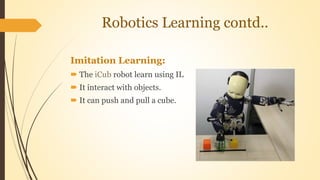
Imitation Learning:
 The iCub robot learn using IL
 It interact with objects.
 It can push and pull a cube.
Robotics Learning contd..
Imitation Learning:
 The tutor is teaching pull and push actions to the robot using
kinesthetic teaching.
Robotics Learning contd..
Reinforcement Learning:
 Supervised learning:
learning from data which are all labelled with the desired
outcome/action
 Reinforcement learning:
learning by trial and error. The agent interacts with the
environment and may receive reward or punishment
Robotics Learning contd..
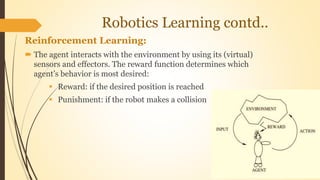
Reinforcement Learning:
 The agent interacts with the environment by using its (virtual)
sensors and effectors. The reward function determines which
agent’s behavior is most desired:
 Reward: if the desired position is reached
 Punishment: if the robot makes a collision
Robotics Learning contd..
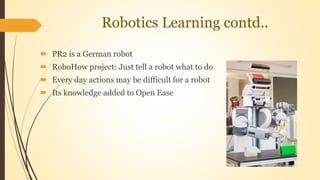
 PR2 is a German robot
 RoboHow project: Just tell a robot what to do
 Every day actions may be difficult for a robot
 Its knowledge added to Open Ease
Thanks!

Topics in robotics

  • 1.
    Topics in Robotics BushraJbawi Rawan Al-saman Samira Nizam Sundos Hammoud Noor Al-huda Isbel Haya Al-khatib
  • 2.
    CONTENTS Robot Control System RoboticsProgramming Languages Robotics Learning
  • 3.
    Robot Control System ClassificationBased on Control Systems: 1. Limited Sequence Control. 2. Playback with Point-to-Point Control. 3. Playback with Continuous Path Control. 4. Intelligent Control.
  • 4.
    Limited Sequence Control. an elementary control type.  Uses mechanical stops to set position.  used for simple motion cycles (pick-and-place operations).  Precision of such control system is less.
  • 5.
    Point-to-Point Control (PTP) The locations are recorded in the control memory.  records work cycle, as a sequence of points, then plays back the work cycle during program execution.  It can be moved in a small distance.  used for hole drilling, machine loading and unloading.
  • 6.
    Continuous Path System the robot can stop at any specified point along the controlled path  All the points along the path must be stored explicitly in the robot’s control memory.  greater storage capacity  Interpolation capability to execute paths
  • 7.
    Intelligent Control  Digitalcomputer as a controller.  Intelligent, work according to their environment.  Decision-making capability and ability to communicate with humans.  Responsiveness to advanced sensor inputs.  Advanced programming language to input the decision- making logic and other ‘intelligence' into the memory.
  • 8.
    Programming Languages Three ProgrammingMethods:  Manual teaching  Lead through teaching  Programming languages
  • 9.
    Programming Languages contd.. ManualTeaching:  Point to Point applications Lead Through Teaching:  Continuous Path Programming  Robot Simulator  Advantage is direct programming but also have disadvantages
  • 10.
    Programming Languages contd.. Disadvantages: Every motion is recorded and played back in the same manner. So unintentional motions also be played.  Impossible to achieve exact required velocity  Memory size is required to store the data.  Investment in a simulator is required.
  • 11.
    Programming Languages contd.. ProgrammingLanguages:  There are many programming languages such as :AL, VAL, AML, RPL.  They are Classified as: - First Generation Language - Second Generation Language - World modelling and task oriented object level language
  • 12.
    Programming Languages contd.. FirstGeneration Language:  Off-Line Programming used in combination with teach pendant.  VAL is an example of this kind.
  • 13.
    Programming Languages contd.. SecondGeneration Language:  AML,VAL II etc…  Structural Programming language performing complex tasks.  Apart from straight line interpolation performs complex motions.  Uses force, torque and other sensors.  Data processing, file management and keeping all records is done.
  • 14.
    Programming Languages contd.. Worldmodelling & task oriented object level language:  More advanced language is WORLD modelling.  Intelligence is required.
  • 15.
    Programming Languages contd.. Someof the Programming Languages:  ARL (Assembly Robot Language): The progress of micro-computers has made it possible to execute complicated tasks.  HARL (Hitachi Assembly Robot Language):  It is a commercial version of ARL  Suited for point-to-point assembly and handling tasks.  18 instructions.  Motion control data is programmed and after programming, location data used in the program is taught in order to make location information of motion statements.
  • 16.
    Programming Languages contd.. Someof the Programming Languages: AL (Arm Language): It is currently the language which has undergone the most important development. It first appeared in the course of original research at the Stanford University. VAL (Vic Arm Language): An interactive version of AL, known as VAL and its associated hardware have been adapted to all Animate robots which previously used an old from of point control. A new version of VAL called VAL II, is at present being tested.
  • 17.
    Programming Languages contd.. Someof the Programming Languages:  AML (A Manufacturing Language): It is a language represented by IBM with its robots and was introduced into the market in 1982. the Cartesian hydraulic robot RS-1 (or 7565) is produces by IBM and the 7535 electric robot from the Scara range is produced in Japan by Sankyo. IBM Automated Parts Assembly System (AUTO PASS) Language attempts to eliminate the need for issuing detailed instructions to the robot. The program automatically determines the grip points and motion paths from geometric database
  • 18.
    Programming Languages contd.. Someof the Programming Languages:  IRL (Intuitive Robot Language): - developed by Swiss Company Microbo - affiliated to the large watch-making companies, for its range of high precision assembly robots  LM (Language de Manipulation): ‐ developed in the IMAG robotics laboratory at the University of Gernable in 1979. - adopts most of the main concepts of AL. - it is used on a microcomputer (68000) .
  • 19.
    Programming Languages contd.. Someof the Programming Languages:  MCL: - developed within a framework that has projects. - resolve in a unified way all the problems associated with robot programming. - programming of flexible units, that is, of a set of machines served by one or more robots.  PLAW (Programming Language for Arc Welding): ‐ “intelligent” welding, that is which involves the use of sensors
  • 20.
    Programming Languages contd.. Someof the Programming Languages: ROL (Robot Language): ‐ new approach to the robotics market. ‐ designing a complete commercial system for computerized control adaptable to any robot. SIGLA (Sigma Language): - for use with an industrial robot. - influenced by numerical control languages, - allows control of several arms, with loops and tests on the sensor
  • 21.
    Programming Languages contd.. Other languages are intended to operate with artificial sensory input that enables the robot to act more independently - the Stanford Research Institute Robot Programming Language (RPL) includes capabilities for interpreting video signals, enabling the robot to visually identity parts
  • 22.
    Robotics Learning Definition: A multitudeMachine Learning approaches that have been adapted successfully to Robotics domain so that they allow learning in complex robot system like Helicopters
  • 23.
    Robotics Learning contd.. Classicalartificial intelligent based “old school” Generate rules and models manually Robot Learning Certain that it’s unlike to foresee all interesting real-world situations sufficiently accurate
  • 24.
    Robotics Learning contd.. Learninghas been successful in fields like : 1. Imitation Learning ((IM)) 2. Reinforcement Learning ((RL))
  • 25.
    Robotics Learning contd.. ImitationLearning:  Known as behavioral cloning.  Enables robots to learn and reproduce trajectory-based skills from a set of demonstrations through kinesthetic teaching.  Is utilized to teach primitive actions (i.e., pull and push) to the robot.  A key advantage : it can often learn a task successfully from few demonstrations.
  • 26.
    Robotics Learning contd.. ImitationLearning:  The iCub robot learn using IL  It interact with objects.  It can push and pull a cube.
  • 27.
    Robotics Learning contd.. ImitationLearning:  The tutor is teaching pull and push actions to the robot using kinesthetic teaching.
  • 28.
    Robotics Learning contd.. ReinforcementLearning:  Supervised learning: learning from data which are all labelled with the desired outcome/action  Reinforcement learning: learning by trial and error. The agent interacts with the environment and may receive reward or punishment
  • 29.
    Robotics Learning contd.. ReinforcementLearning:  The agent interacts with the environment by using its (virtual) sensors and effectors. The reward function determines which agent’s behavior is most desired:  Reward: if the desired position is reached  Punishment: if the robot makes a collision
  • 30.
    Robotics Learning contd.. PR2 is a German robot  RoboHow project: Just tell a robot what to do  Every day actions may be difficult for a robot  Its knowledge added to Open Ease
  • 31.