SHARAD INSTITUTE OF TECHNOLOGY,
COLLEGE OF ENGINEERING,
YADRAV- ICHALKARANJI (Kolhapur)
An ‘A’ Grade Institute Accredited by NAAC
NBA Accredited Programmes
Prepared by
Mr. Ashish A. Desai
Assistant Professor
Robot Programming
VAL-I
Generations of Robot
Programming Languages
• Following are the three major classes into
which robot languages can be broadly
grouped:
1 First Generation Language
2. Second Generation Language
First Generation Language:
The first generation languages use a combination of command statements and teach
pendant procedure for developing robot programs
• This type of language provides an off-line programming in combination with the
programming through the robot teach pendant. Sometime referred as ‘Motion
level’ language
• Its capability is limited in handling of sensory data and communication with other
components. The programming instructions can be used to define the motion
sequence of (MOVE), they have input/output capabilities (WAIT, SIGNAL) and they
can be used to write subroutines (BRANCH).
• Common limitation of first generation languages include inability to specify
complex the arithmetic computations for use during program execution, the
inability to make use complex sensors and sensor data and limited capacity to
communicate with other computers.
• First generation language are quite limited in their ability to communicate with
other computers. Example: VAL (Versatile Algorithmic Language)
2. Second Generation Language:
• The second generation language overcome many of the limitation of
the first generation language and add to their capabilities by
incorporating features that make the robot seem more intelligent
• These are structured programming languages performing complete
tasks.
• They can generate complex motions; can handle both analog and digital
signals besides the binary signals.
• These languages have the added advantage of better interfacing
facilities with other computers. Data processing, file management and
keeping all the records of events happening in the work cell can be
done more efficiently.
• Example: AML (A Manufacturing Language), RAIL (Robotic Automatix
Incorporated Language), RCL, VALII etc
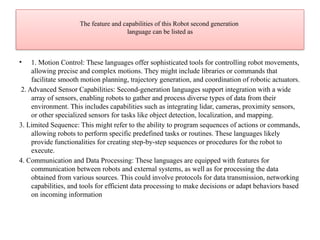
The feature and capabilities of this Robot second generation
language can be listed as
• 1. Motion Control: These languages offer sophisticated tools for controlling robot movements,
allowing precise and complex motions. They might include libraries or commands that
facilitate smooth motion planning, trajectory generation, and coordination of robotic actuators.
2. Advanced Sensor Capabilities: Second-generation languages support integration with a wide
array of sensors, enabling robots to gather and process diverse types of data from their
environment. This includes capabilities such as integrating lidar, cameras, proximity sensors,
or other specialized sensors for tasks like object detection, localization, and mapping.
3. Limited Sequence: This might refer to the ability to program sequences of actions or commands,
allowing robots to perform specific predefined tasks or routines. These languages likely
provide functionalities for creating step-by-step sequences or procedures for the robot to
execute.
4. Communication and Data Processing: These languages are equipped with features for
communication between robots and external systems, as well as for processing the data
obtained from various sources. This could involve protocols for data transmission, networking
capabilities, and tools for efficient data processing to make decisions or adapt behaviors based
on incoming information
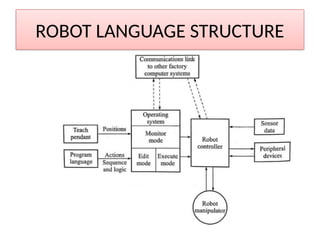
ROBOT LANGUAGE STRUCTURE
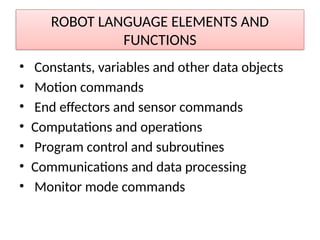
ROBOT LANGUAGE ELEMENTS AND
FUNCTIONS
• Constants, variables and other data objects
• Motion commands
• End effectors and sensor commands
• Computations and operations
• Program control and subroutines
• Communications and data processing
• Monitor mode commands
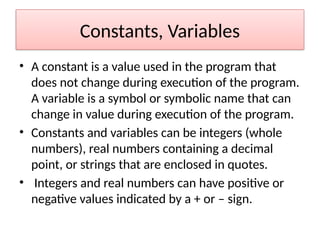
Constants, Variables
• A constant is a value used in the program that
does not change during execution of the program.
A variable is a symbol or symbolic name that can
change in value during execution of the program.
• Constants and variables can be integers (whole
numbers), real numbers containing a decimal
point, or strings that are enclosed in quotes.
• Integers and real numbers can have positive or
negative values indicated by a + or – sign.
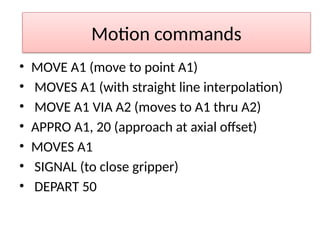
Motion commands
• MOVE A1 (move to point A1)
• MOVES A1 (with straight line interpolation)
• MOVE A1 VIA A2 (moves to A1 thru A2)
• APPRO A1, 20 (approach at axial offset)
• MOVES A1
• SIGNAL (to close gripper)
• DEPART 50
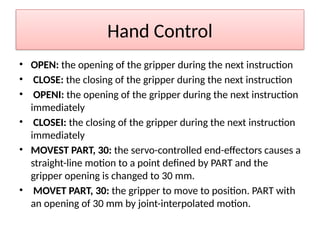
Hand Control
• OPEN: the opening of the gripper during the next instruction
• CLOSE: the closing of the gripper during the next instruction
• OPENI: the opening of the gripper during the next instruction
immediately
• CLOSEI: the closing of the gripper during the next instruction
immediately
• MOVEST PART, 30: the servo-controlled end-effectors causes a
straight-line motion to a point defined by PART and the
gripper opening is changed to 30 mm.
• MOVET PART, 30: the gripper to move to position. PART with
an opening of 30 mm by joint-interpolated motion.
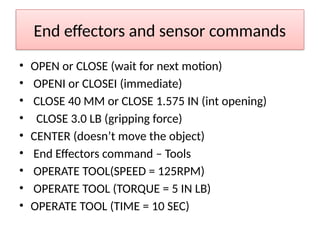
End effectors and sensor commands
• OPEN or CLOSE (wait for next motion)
• OPENI or CLOSEI (immediate)
• CLOSE 40 MM or CLOSE 1.575 IN (int opening)
• CLOSE 3.0 LB (gripping force)
• CENTER (doesn’t move the object)
• End Effectors command – Tools
• OPERATE TOOL(SPEED = 125RPM)
• OPERATE TOOL (TORQUE = 5 IN LB)
• OPERATE TOOL (TIME = 10 SEC)
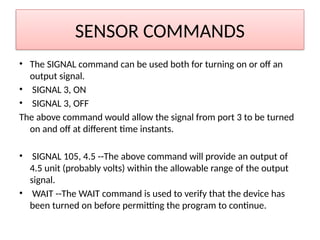
SENSOR COMMANDS
• The SIGNAL command can be used both for turning on or off an
output signal.
• SIGNAL 3, ON
• SIGNAL 3, OFF
The above command would allow the signal from port 3 to be turned
on and off at different time instants.
• SIGNAL 105, 4.5 --The above command will provide an output of
4.5 unit (probably volts) within the allowable range of the output
signal.
• WAIT --The WAIT command is used to verify that the device has
been turned on before permitting the program to continue.
Computations & Operations
• Used for arithmetic and logical operations.
The evaluation of an expression will be from
left to right with parenthesis used to indicate
that expression inside the parenthesis should
be evaluated first.
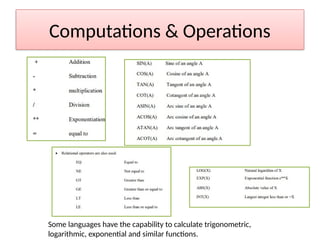
Some languages have the capability to calculate trigonometric,
logarithmic, exponential and similar functions.
Computations & Operations
Communications & Data Processing
• Refers to communication between the robot system and the operator
or the robot system and other computer based systems and their
peripherals (e.g., storage devices, printers).
• Communication between the robot system and the operator: allows
robot to request information, to indicate the source of a malfunction,
or to inform the operator about what it is presently doing.
• Common devices are CRT, plotters, buzzers and speech synthesizers.

• The common devices used by the operator to communicate with the
system are the teach pendant and the alphanumeric keyboard.
• Other possible devices include joysticks, light pens and speech
recognition systems.
THANK YOU

Robot Programmming VAL-I PART-I-Robot Language .pptx

  • 1.
    SHARAD INSTITUTE OFTECHNOLOGY, COLLEGE OF ENGINEERING, YADRAV- ICHALKARANJI (Kolhapur) An ‘A’ Grade Institute Accredited by NAAC NBA Accredited Programmes Prepared by Mr. Ashish A. Desai Assistant Professor Robot Programming VAL-I
  • 2.
    Generations of Robot ProgrammingLanguages • Following are the three major classes into which robot languages can be broadly grouped: 1 First Generation Language 2. Second Generation Language
  • 3.
    First Generation Language: Thefirst generation languages use a combination of command statements and teach pendant procedure for developing robot programs • This type of language provides an off-line programming in combination with the programming through the robot teach pendant. Sometime referred as ‘Motion level’ language • Its capability is limited in handling of sensory data and communication with other components. The programming instructions can be used to define the motion sequence of (MOVE), they have input/output capabilities (WAIT, SIGNAL) and they can be used to write subroutines (BRANCH). • Common limitation of first generation languages include inability to specify complex the arithmetic computations for use during program execution, the inability to make use complex sensors and sensor data and limited capacity to communicate with other computers. • First generation language are quite limited in their ability to communicate with other computers. Example: VAL (Versatile Algorithmic Language)
  • 4.
    2. Second GenerationLanguage: • The second generation language overcome many of the limitation of the first generation language and add to their capabilities by incorporating features that make the robot seem more intelligent • These are structured programming languages performing complete tasks. • They can generate complex motions; can handle both analog and digital signals besides the binary signals. • These languages have the added advantage of better interfacing facilities with other computers. Data processing, file management and keeping all the records of events happening in the work cell can be done more efficiently. • Example: AML (A Manufacturing Language), RAIL (Robotic Automatix Incorporated Language), RCL, VALII etc
  • 5.
    The feature andcapabilities of this Robot second generation language can be listed as • 1. Motion Control: These languages offer sophisticated tools for controlling robot movements, allowing precise and complex motions. They might include libraries or commands that facilitate smooth motion planning, trajectory generation, and coordination of robotic actuators. 2. Advanced Sensor Capabilities: Second-generation languages support integration with a wide array of sensors, enabling robots to gather and process diverse types of data from their environment. This includes capabilities such as integrating lidar, cameras, proximity sensors, or other specialized sensors for tasks like object detection, localization, and mapping. 3. Limited Sequence: This might refer to the ability to program sequences of actions or commands, allowing robots to perform specific predefined tasks or routines. These languages likely provide functionalities for creating step-by-step sequences or procedures for the robot to execute. 4. Communication and Data Processing: These languages are equipped with features for communication between robots and external systems, as well as for processing the data obtained from various sources. This could involve protocols for data transmission, networking capabilities, and tools for efficient data processing to make decisions or adapt behaviors based on incoming information
  • 6.
  • 7.
    ROBOT LANGUAGE ELEMENTSAND FUNCTIONS • Constants, variables and other data objects • Motion commands • End effectors and sensor commands • Computations and operations • Program control and subroutines • Communications and data processing • Monitor mode commands
  • 8.
    Constants, Variables • Aconstant is a value used in the program that does not change during execution of the program. A variable is a symbol or symbolic name that can change in value during execution of the program. • Constants and variables can be integers (whole numbers), real numbers containing a decimal point, or strings that are enclosed in quotes. • Integers and real numbers can have positive or negative values indicated by a + or – sign.
  • 9.
    Motion commands • MOVEA1 (move to point A1) • MOVES A1 (with straight line interpolation) • MOVE A1 VIA A2 (moves to A1 thru A2) • APPRO A1, 20 (approach at axial offset) • MOVES A1 • SIGNAL (to close gripper) • DEPART 50
  • 10.
    Hand Control • OPEN:the opening of the gripper during the next instruction • CLOSE: the closing of the gripper during the next instruction • OPENI: the opening of the gripper during the next instruction immediately • CLOSEI: the closing of the gripper during the next instruction immediately • MOVEST PART, 30: the servo-controlled end-effectors causes a straight-line motion to a point defined by PART and the gripper opening is changed to 30 mm. • MOVET PART, 30: the gripper to move to position. PART with an opening of 30 mm by joint-interpolated motion.
  • 11.
    End effectors andsensor commands • OPEN or CLOSE (wait for next motion) • OPENI or CLOSEI (immediate) • CLOSE 40 MM or CLOSE 1.575 IN (int opening) • CLOSE 3.0 LB (gripping force) • CENTER (doesn’t move the object) • End Effectors command – Tools • OPERATE TOOL(SPEED = 125RPM) • OPERATE TOOL (TORQUE = 5 IN LB) • OPERATE TOOL (TIME = 10 SEC)
  • 12.
    SENSOR COMMANDS • TheSIGNAL command can be used both for turning on or off an output signal. • SIGNAL 3, ON • SIGNAL 3, OFF The above command would allow the signal from port 3 to be turned on and off at different time instants. • SIGNAL 105, 4.5 --The above command will provide an output of 4.5 unit (probably volts) within the allowable range of the output signal. • WAIT --The WAIT command is used to verify that the device has been turned on before permitting the program to continue.
  • 13.
    Computations & Operations •Used for arithmetic and logical operations. The evaluation of an expression will be from left to right with parenthesis used to indicate that expression inside the parenthesis should be evaluated first.
  • 14.
    Some languages havethe capability to calculate trigonometric, logarithmic, exponential and similar functions. Computations & Operations
  • 15.
    Communications & DataProcessing • Refers to communication between the robot system and the operator or the robot system and other computer based systems and their peripherals (e.g., storage devices, printers). • Communication between the robot system and the operator: allows robot to request information, to indicate the source of a malfunction, or to inform the operator about what it is presently doing. • Common devices are CRT, plotters, buzzers and speech synthesizers.  • The common devices used by the operator to communicate with the system are the teach pendant and the alphanumeric keyboard. • Other possible devices include joysticks, light pens and speech recognition systems.
  • 16.

Editor's Notes