Got Ethics?
Got Ethics?   Civil Disobedience –
              Is the Government
              always right?
Models of Government/Church Interaction


 • Secularism – the state imposes irreligion on the state
 • Reconstructionism – a single religion imposes law upon the state
 • Jeffersonianism – a natural law serves as the foundation for law, but no
   one religion is ever established by the government

                                 www.confidentchristians.org
Secularism


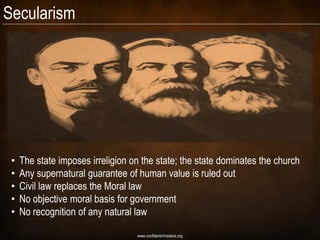
 •   The state imposes irreligion on the state; the state dominates the church
 •   Any supernatural guarantee of human value is ruled out
 •   Civil law replaces the Moral law
 •   No objective moral basis for government
 •   No recognition of any natural law

                                   www.confidentchristians.org
Secularism - Critiques


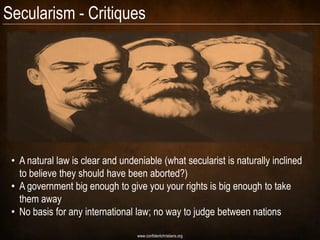
 • A natural law is clear and undeniable (what secularist is naturally inclined
   to believe they should have been aborted?)
 • A government big enough to give you your rights is big enough to take
   them away
 • No basis for any international law; no way to judge between nations

                                  www.confidentchristians.org
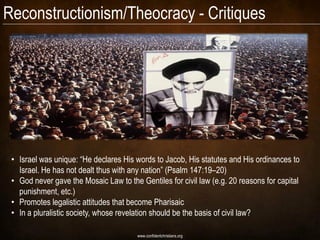
Reconstructionism/Theocracy


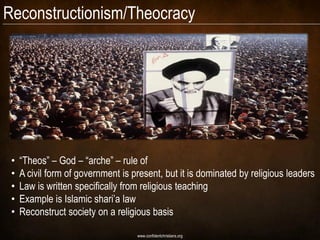
 •   “Theos” – God – “arche” – rule of
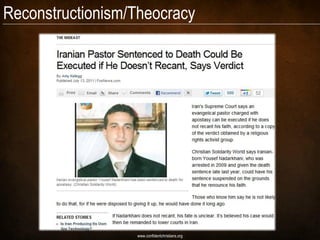
 •   A civil form of government is present, but it is dominated by religious leaders
 •   Law is written specifically from religious teaching
 •   Example is Islamic shari’a law
 •   Reconstruct society on a religious basis

                                    www.confidentchristians.org
Reconstructionism/Theocracy


                  www.confidentchristians.org
Reconstructionism/Theocracy - Critiques


 • Israel was unique: “He declares His words to Jacob, His statutes and His ordinances to
   Israel. He has not dealt thus with any nation” (Psalm 147:19–20)
 • God never gave the Mosaic Law to the Gentiles for civil law (e.g. 20 reasons for capital
   punishment, etc.)
 • Promotes legalistic attitudes that become Pharisaic
 • In a pluralistic society, whose revelation should be the basis of civil law?

                                        www.confidentchristians.org
Jeffersonianism


 • Affirms the natural law view and opposes denial of divine law
 • Allows freedom of religious adherence and worship
 • Affirms human dignity and rights as coming from the Creator
 • States that there is a natural law written on human hearts that should be
   followed (cf. Rom 2:14)
 • Did not begin with Christianity. Ancient Chinese, Hindi, Greek, and Roman
   writings showcase an unchanging Logos (reason, truth) that stands behind
   the flux of human experience
                                www.confidentchristians.org
“The law of Nature [teaches
   us that] being all equal and
independent, no one ought to
       harm another in his life,
               health, liberty or
possessions; for men [are] all
      the workmanship of one
omnipotent and infinitely wise
                         Maker.”
                  - John Locke
Jeffersonianism


 • “We hold these truths to be self-evident, that all men are created equal,
   that they are endowed by their Creator with certain unalienable Rights,
   that among these are Life, Liberty and the pursuit of Happiness.”
 • Nothing similar can be found in a statement made by any other nation:
   moral well being hinged on a creative act.
 • Moreover, the term “self-evident” communicates the concept of the moral
   law being undeniable, or objective (so does “truths” instead of “opinions”).
                                 www.confidentchristians.org
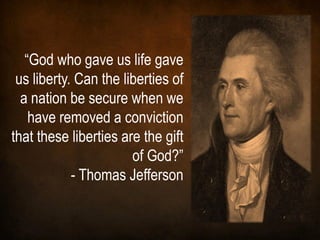
“God who gave us life gave
 us liberty. Can the liberties of
  a nation be secure when we
    have removed a conviction
that these liberties are the gift
                       of God?”
            - Thomas Jefferson
Jeffersonianism


 • Says natural law is the first principle governing human action just as the
   laws of logic are the first principles governing human thought
 • Believes in a divinely prescriptive “ought” vs. a descriptive “is”
 • C. S. Lewis shows the imprint of a divine, natural law is found in every
   culture in the Abolition of Man
 • Is necessary for international affairs/law
 • “You can’t legislate morality” ignores that all laws enforce someone’s
   morality. Further, it is making a moral proclamation
                                  www.confidentchristians.org
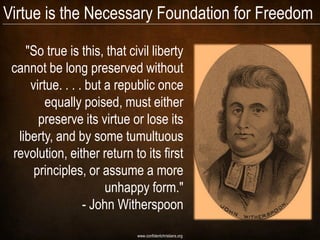
Virtue is the Necessary Foundation for Freedom

    "So true is this, that civil liberty
 cannot be long preserved without
     virtue. . . . but a republic once
         equally poised, must either
       preserve its virtue or lose its
  liberty, and by some tumultuous
 revolution, either return to its first
      principles, or assume a more
                       unhappy form."
                  - John Witherspoon
                             www.confidentchristians.org
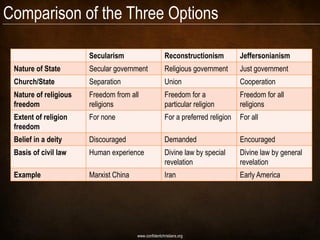
Comparison of the Three Options

                       Secularism                      Reconstructionism          Jeffersonianism
 Nature of State       Secular government              Religious government       Just government
 Church/State          Separation                      Union                      Cooperation
 Nature of religious   Freedom from all                Freedom for a              Freedom for all
 freedom               religions                       particular religion        religions
 Extent of religion    For none                        For a preferred religion   For all
 freedom
 Belief in a deity     Discouraged                     Demanded                   Encouraged
 Basis of civil law    Human experience                Divine law by special      Divine law by general
                                                       revelation                 revelation
 Example               Marxist China                   Iran                       Early America


                                       www.confidentchristians.org
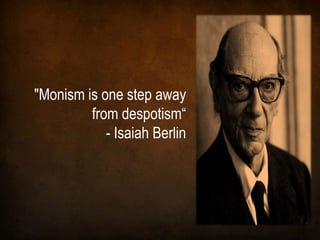
"Monism is one step away
         from despotism“
            - Isaiah Berlin
“And the Word became flesh, and dwelt among us,
and we saw His glory, glory as of the only begotten
          from the Father, full of grace and truth.”
                                        (John 1:14)
Civil Disobedience?


  Are we permitted to ever disobey the government?

                      www.confidentchristians.org
Models of Civil Disobedience


 • Anarchism – it is always right to disobey the government
 • Radical Patriotism – it is never right to disobey the government
 • Biblical Submissionism – it is sometimes right to disobey the government


                                www.confidentchristians.org
Radical Patriotism


 • God ordains every government: “Every person is to be in subjection to the governing
   authorities. For there is no authority except from God, and those which exist are established
   by God.” (Romans 13:1)
 • God expects obedience to every government: “Remind them to be subject to rulers, to
   authorities, to be obedient” (Titus 3:1)
 • Obedience is necessary, even to evil governments. Paul wrote Romans 13 while under the
   rule of Nero.
 • “Submit yourselves for the Lord’s sake to every human institution, whether to a king as the
   one in authority” (1 Peter 2:13)
                                       www.confidentchristians.org
Radical Patriotism – Critiques


 • God ordains governments, but not their evil
 • Much of the Old Testament has the prophets condemning evil governments
 • Obedience to a government is qualified:
     • “But Peter and John answered and said to them, “Whether it is right in the sight of God
       to give heed to you rather than to God, you be the judge”” (Acts 4:19)
     • The midwives disobeyed Pharaoh in Exodus 1 and were blessed by God for it
     • Daniel disobeyed the government and prayed to God
     • Daniel’s 3 companions disobeyed the government’s command of idolatry

                                      www.confidentchristians.org
Key Concept


  Christians can obey a government that permits evil,
            but not one that commands evil.
                       www.confidentchristians.org
Biblical Submissionism – Disobey when…


 •   The government commands evil
 •   The government compels evil actions
 •   The government negates freedom
 •   The government is religiously oppressive

                             www.confidentchristians.org
Biblical Submissionism – Examples


 • Refusal to murder babies – the Hebrew midwives refused to murder babies
   under the command of Pharaoh and were blessed by God because of it (cf. Ex.
   1:15-21)
 • Refusal to kill prophets – Obadiah hides 100 prophets from Jezebel who was
   murdering all of God’s prophets (cf. 1 Kings 18:4, 13-15)
 • Refusal to worship an idol – Daniel’s companions refused to worship
   Nebuchadnezzar’s gold statue (cf. Dan. 3)
                                  www.confidentchristians.org
Biblical Submissionism – Examples


 • Refusal to pray to a king and not God – Daniel is thrown into the lion’s den for
   refusing the king’s (and really those who were jealous of Daniel) request to pray
   to him and no other god (cf. Dan. 6)
 • Refusal to stop preaching the gospel – the apostles refused the leader’s
   requests to stop preaching about Christ (cf. Acts 4)
 • Refusal to worship the Antichrist – during the tribulation period, believers will
   disobey the law to worship the Antichrist (cf. Rev. 12:11)
                                    www.confidentchristians.org
Biblical Submissionism – Never Speak Up?
    “The commander ordered him [Paul] to be
      brought into the barracks, stating that he
  should be examined by scourging so that he
       might find out the reason why they were
 shouting against him that way. But when they
   stretched him out with thongs, Paul said to
       the centurion who was standing by, “Is it
      lawful for you to scourge a man who is a
                   Roman and uncondemned?”
                               (Acts 22:24–25)

 Christians can certainly invoke the protection
 afforded them under the government to avoid
       wrongful punishment when appropriate.


                                      www.confidentchristians.org
Revolutions – Ever Right?


    “We hold these truths to be self-evident, that all men are created equal, that they
 are endowed by their Creator with certain unalienable rights, that among these are
  life, liberty and the pursuit of happiness. That to secure these rights, governments
           are instituted among men, deriving their just powers from the consent of the
     governed. That whenever any form of government becomes destructive to these
           ends, it is the right of the people to alter or to abolish it, and to institute new
                                                                             government. . .”

                                        www.confidentchristians.org
Revolutions – Ever Right?


    “But when a long train of abuses and usurpations, pursuing invariably the same
  object evinces a design to reduce them under absolute despotism, it is their right,
   it is their duty, to throw off such government, and to provide new guards for their
  future security. Such has been the patient sufferance of these colonies; and such
           is now the necessity which constrains them to alter their former systems of
                                                                         government.”

                                    www.confidentchristians.org
Revolutions – Ever Right?
      “Now when Athaliah the mother of Ahaziah saw that her son was dead, she rose and destroyed all the royal
  offspring of the house of Judah. But Jehoshabeath the king’s daughter took Joash the son of Ahaziah, and stole
  him from among the king’s sons who were being put to death, and placed him and his nurse in the bedroom. So
  Jehoshabeath, the daughter of King Jehoram, the wife of Jehoiada the priest (for she was the sister of Ahaziah),
   hid him from Athaliah so that she would not put him to death. He was hidden with them in the house of God six
                                             years while Athaliah reigned over the land.” (2 Chronicles 22:10–12)

       “Now in the seventh year Jehoiada strengthened himself, and took captains of hundreds: Azariah the son of
 Jeroham, Ishmael the son of Johanan, Azariah the son of Obed, Maaseiah the son of Adaiah, and Elishaphat the
         son of Zichri, and they entered into a covenant with him. . . .He stationed all the people, each man with his
    weapon in his hand, from the right side of the house to the left side of the house, by the altar and by the house,
 around the king. Then they brought out the king’s son and put the crown on him, and gave him the testimony and
  made him king. And Jehoiada and his sons anointed him and said, “Long live the king!” When Athaliah heard the
 noise of the people running and praising the king, she came into the house of the Lord to the people. She looked,
  and behold, the king was standing by his pillar at the entrance, and the captains and the trumpeters were beside
      the king. And all the people of the land rejoiced and blew trumpets, the singers with their musical instruments
   leading the praise. Then Athaliah tore her clothes and said, “Treason! Treason!” Jehoiada the priest brought out
  the captains of hundreds who were appointed over the army and said to them, “Bring her out between the ranks;
        and whoever follows her, put to death with the sword.” For the priest said, “Let her not be put to death in the
       house of the Lord.” So they seized her, and when she arrived at the entrance of the Horse Gate of the king’s
                                                      house, they put her to death there.” (2 Chronicles 23:1, 10–15)


                                                  www.confidentchristians.org
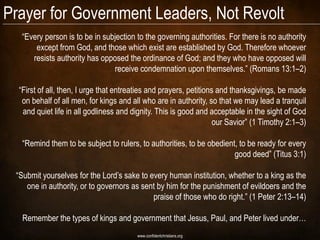
Prayer for Government Leaders, Not Revolt
   “Every person is to be in subjection to the governing authorities. For there is no authority
       except from God, and those which exist are established by God. Therefore whoever
      resists authority has opposed the ordinance of God; and they who have opposed will
                                receive condemnation upon themselves.” (Romans 13:1–2)

  “First of all, then, I urge that entreaties and prayers, petitions and thanksgivings, be made
   on behalf of all men, for kings and all who are in authority, so that we may lead a tranquil
   and quiet life in all godliness and dignity. This is good and acceptable in the sight of God
                                                                    our Savior” (1 Timothy 2:1–3)

   “Remind them to be subject to rulers, to authorities, to be obedient, to be ready for every
                                                                       good deed” (Titus 3:1)

 “Submit yourselves for the Lord’s sake to every human institution, whether to a king as the
    one in authority, or to governors as sent by him for the punishment of evildoers and the
                                            praise of those who do right.” (1 Peter 2:13–14)

   Remember the types of kings and government that Jesus, Paul, and Peter lived under…
                                         www.confidentchristians.org
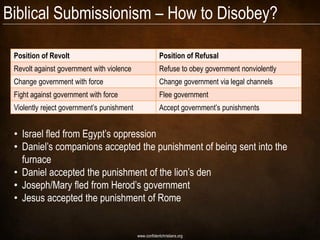
Biblical Submissionism – How to Disobey?

 Position of Revolt                                      Position of Refusal
 Revolt against government with violence                 Refuse to obey government nonviolently
 Change government with force                            Change government via legal channels
 Fight against government with force                     Flee government
 Violently reject government’s punishment                Accept government’s punishments


 • Israel fled from Egypt’s oppression
 • Daniel’s companions accepted the punishment of being sent into the
   furnace
 • Daniel accepted the punishment of the lion’s den
 • Joseph/Mary fled from Herod’s government
 • Jesus accepted the punishment of Rome


                                            www.confidentchristians.org
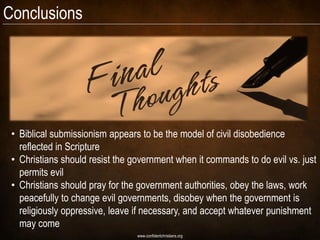
Conclusions


 • Biblical submissionism appears to be the model of civil disobedience
   reflected in Scripture
 • Christians should resist the government when it commands to do evil vs. just
   permits evil
 • Christians should pray for the government authorities, obey the laws, work
   peacefully to change evil governments, disobey when the government is
   religiously oppressive, leave if necessary, and accept whatever punishment
   may come
                                 www.confidentchristians.org
Got Ethics?   Civil Disobedience –
              Is the Government
              always right?

Got ethics - Civil Disobedience

  • 1.
  • 2.
    Got Ethics? Civil Disobedience – Is the Government always right?
  • 4.
    Models of Government/ChurchInteraction • Secularism – the state imposes irreligion on the state • Reconstructionism – a single religion imposes law upon the state • Jeffersonianism – a natural law serves as the foundation for law, but no one religion is ever established by the government www.confidentchristians.org
  • 5.
    Secularism • The state imposes irreligion on the state; the state dominates the church • Any supernatural guarantee of human value is ruled out • Civil law replaces the Moral law • No objective moral basis for government • No recognition of any natural law www.confidentchristians.org
  • 6.
    Secularism - Critiques • A natural law is clear and undeniable (what secularist is naturally inclined to believe they should have been aborted?) • A government big enough to give you your rights is big enough to take them away • No basis for any international law; no way to judge between nations www.confidentchristians.org
  • 7.
    Reconstructionism/Theocracy • “Theos” – God – “arche” – rule of • A civil form of government is present, but it is dominated by religious leaders • Law is written specifically from religious teaching • Example is Islamic shari’a law • Reconstruct society on a religious basis www.confidentchristians.org
  • 8.
    Reconstructionism/Theocracy www.confidentchristians.org
  • 9.
    Reconstructionism/Theocracy - Critiques • Israel was unique: “He declares His words to Jacob, His statutes and His ordinances to Israel. He has not dealt thus with any nation” (Psalm 147:19–20) • God never gave the Mosaic Law to the Gentiles for civil law (e.g. 20 reasons for capital punishment, etc.) • Promotes legalistic attitudes that become Pharisaic • In a pluralistic society, whose revelation should be the basis of civil law? www.confidentchristians.org
  • 10.
    Jeffersonianism • Affirmsthe natural law view and opposes denial of divine law • Allows freedom of religious adherence and worship • Affirms human dignity and rights as coming from the Creator • States that there is a natural law written on human hearts that should be followed (cf. Rom 2:14) • Did not begin with Christianity. Ancient Chinese, Hindi, Greek, and Roman writings showcase an unchanging Logos (reason, truth) that stands behind the flux of human experience www.confidentchristians.org
  • 11.
    “The law ofNature [teaches us that] being all equal and independent, no one ought to harm another in his life, health, liberty or possessions; for men [are] all the workmanship of one omnipotent and infinitely wise Maker.” - John Locke
  • 12.
    Jeffersonianism • “Wehold these truths to be self-evident, that all men are created equal, that they are endowed by their Creator with certain unalienable Rights, that among these are Life, Liberty and the pursuit of Happiness.” • Nothing similar can be found in a statement made by any other nation: moral well being hinged on a creative act. • Moreover, the term “self-evident” communicates the concept of the moral law being undeniable, or objective (so does “truths” instead of “opinions”). www.confidentchristians.org
  • 13.
    “God who gaveus life gave us liberty. Can the liberties of a nation be secure when we have removed a conviction that these liberties are the gift of God?” - Thomas Jefferson
  • 14.
    Jeffersonianism • Saysnatural law is the first principle governing human action just as the laws of logic are the first principles governing human thought • Believes in a divinely prescriptive “ought” vs. a descriptive “is” • C. S. Lewis shows the imprint of a divine, natural law is found in every culture in the Abolition of Man • Is necessary for international affairs/law • “You can’t legislate morality” ignores that all laws enforce someone’s morality. Further, it is making a moral proclamation www.confidentchristians.org
  • 15.
    Virtue is theNecessary Foundation for Freedom "So true is this, that civil liberty cannot be long preserved without virtue. . . . but a republic once equally poised, must either preserve its virtue or lose its liberty, and by some tumultuous revolution, either return to its first principles, or assume a more unhappy form." - John Witherspoon www.confidentchristians.org
  • 16.
    Comparison of theThree Options Secularism Reconstructionism Jeffersonianism Nature of State Secular government Religious government Just government Church/State Separation Union Cooperation Nature of religious Freedom from all Freedom for a Freedom for all freedom religions particular religion religions Extent of religion For none For a preferred religion For all freedom Belief in a deity Discouraged Demanded Encouraged Basis of civil law Human experience Divine law by special Divine law by general revelation revelation Example Marxist China Iran Early America www.confidentchristians.org
  • 17.
    "Monism is onestep away from despotism“ - Isaiah Berlin
  • 18.
    “And the Wordbecame flesh, and dwelt among us, and we saw His glory, glory as of the only begotten from the Father, full of grace and truth.” (John 1:14)
  • 19.
    Civil Disobedience? Are we permitted to ever disobey the government? www.confidentchristians.org
  • 20.
    Models of CivilDisobedience • Anarchism – it is always right to disobey the government • Radical Patriotism – it is never right to disobey the government • Biblical Submissionism – it is sometimes right to disobey the government www.confidentchristians.org
  • 21.
    Radical Patriotism •God ordains every government: “Every person is to be in subjection to the governing authorities. For there is no authority except from God, and those which exist are established by God.” (Romans 13:1) • God expects obedience to every government: “Remind them to be subject to rulers, to authorities, to be obedient” (Titus 3:1) • Obedience is necessary, even to evil governments. Paul wrote Romans 13 while under the rule of Nero. • “Submit yourselves for the Lord’s sake to every human institution, whether to a king as the one in authority” (1 Peter 2:13) www.confidentchristians.org
  • 22.
    Radical Patriotism –Critiques • God ordains governments, but not their evil • Much of the Old Testament has the prophets condemning evil governments • Obedience to a government is qualified: • “But Peter and John answered and said to them, “Whether it is right in the sight of God to give heed to you rather than to God, you be the judge”” (Acts 4:19) • The midwives disobeyed Pharaoh in Exodus 1 and were blessed by God for it • Daniel disobeyed the government and prayed to God • Daniel’s 3 companions disobeyed the government’s command of idolatry www.confidentchristians.org
  • 23.
    Key Concept Christians can obey a government that permits evil, but not one that commands evil. www.confidentchristians.org
  • 24.
    Biblical Submissionism –Disobey when… • The government commands evil • The government compels evil actions • The government negates freedom • The government is religiously oppressive www.confidentchristians.org
  • 25.
    Biblical Submissionism –Examples • Refusal to murder babies – the Hebrew midwives refused to murder babies under the command of Pharaoh and were blessed by God because of it (cf. Ex. 1:15-21) • Refusal to kill prophets – Obadiah hides 100 prophets from Jezebel who was murdering all of God’s prophets (cf. 1 Kings 18:4, 13-15) • Refusal to worship an idol – Daniel’s companions refused to worship Nebuchadnezzar’s gold statue (cf. Dan. 3) www.confidentchristians.org
  • 26.
    Biblical Submissionism –Examples • Refusal to pray to a king and not God – Daniel is thrown into the lion’s den for refusing the king’s (and really those who were jealous of Daniel) request to pray to him and no other god (cf. Dan. 6) • Refusal to stop preaching the gospel – the apostles refused the leader’s requests to stop preaching about Christ (cf. Acts 4) • Refusal to worship the Antichrist – during the tribulation period, believers will disobey the law to worship the Antichrist (cf. Rev. 12:11) www.confidentchristians.org
  • 27.
    Biblical Submissionism –Never Speak Up? “The commander ordered him [Paul] to be brought into the barracks, stating that he should be examined by scourging so that he might find out the reason why they were shouting against him that way. But when they stretched him out with thongs, Paul said to the centurion who was standing by, “Is it lawful for you to scourge a man who is a Roman and uncondemned?” (Acts 22:24–25) Christians can certainly invoke the protection afforded them under the government to avoid wrongful punishment when appropriate. www.confidentchristians.org
  • 28.
    Revolutions – EverRight? “We hold these truths to be self-evident, that all men are created equal, that they are endowed by their Creator with certain unalienable rights, that among these are life, liberty and the pursuit of happiness. That to secure these rights, governments are instituted among men, deriving their just powers from the consent of the governed. That whenever any form of government becomes destructive to these ends, it is the right of the people to alter or to abolish it, and to institute new government. . .” www.confidentchristians.org
  • 29.
    Revolutions – EverRight? “But when a long train of abuses and usurpations, pursuing invariably the same object evinces a design to reduce them under absolute despotism, it is their right, it is their duty, to throw off such government, and to provide new guards for their future security. Such has been the patient sufferance of these colonies; and such is now the necessity which constrains them to alter their former systems of government.” www.confidentchristians.org
  • 30.
    Revolutions – EverRight? “Now when Athaliah the mother of Ahaziah saw that her son was dead, she rose and destroyed all the royal offspring of the house of Judah. But Jehoshabeath the king’s daughter took Joash the son of Ahaziah, and stole him from among the king’s sons who were being put to death, and placed him and his nurse in the bedroom. So Jehoshabeath, the daughter of King Jehoram, the wife of Jehoiada the priest (for she was the sister of Ahaziah), hid him from Athaliah so that she would not put him to death. He was hidden with them in the house of God six years while Athaliah reigned over the land.” (2 Chronicles 22:10–12) “Now in the seventh year Jehoiada strengthened himself, and took captains of hundreds: Azariah the son of Jeroham, Ishmael the son of Johanan, Azariah the son of Obed, Maaseiah the son of Adaiah, and Elishaphat the son of Zichri, and they entered into a covenant with him. . . .He stationed all the people, each man with his weapon in his hand, from the right side of the house to the left side of the house, by the altar and by the house, around the king. Then they brought out the king’s son and put the crown on him, and gave him the testimony and made him king. And Jehoiada and his sons anointed him and said, “Long live the king!” When Athaliah heard the noise of the people running and praising the king, she came into the house of the Lord to the people. She looked, and behold, the king was standing by his pillar at the entrance, and the captains and the trumpeters were beside the king. And all the people of the land rejoiced and blew trumpets, the singers with their musical instruments leading the praise. Then Athaliah tore her clothes and said, “Treason! Treason!” Jehoiada the priest brought out the captains of hundreds who were appointed over the army and said to them, “Bring her out between the ranks; and whoever follows her, put to death with the sword.” For the priest said, “Let her not be put to death in the house of the Lord.” So they seized her, and when she arrived at the entrance of the Horse Gate of the king’s house, they put her to death there.” (2 Chronicles 23:1, 10–15) www.confidentchristians.org
  • 31.
    Prayer for GovernmentLeaders, Not Revolt “Every person is to be in subjection to the governing authorities. For there is no authority except from God, and those which exist are established by God. Therefore whoever resists authority has opposed the ordinance of God; and they who have opposed will receive condemnation upon themselves.” (Romans 13:1–2) “First of all, then, I urge that entreaties and prayers, petitions and thanksgivings, be made on behalf of all men, for kings and all who are in authority, so that we may lead a tranquil and quiet life in all godliness and dignity. This is good and acceptable in the sight of God our Savior” (1 Timothy 2:1–3) “Remind them to be subject to rulers, to authorities, to be obedient, to be ready for every good deed” (Titus 3:1) “Submit yourselves for the Lord’s sake to every human institution, whether to a king as the one in authority, or to governors as sent by him for the punishment of evildoers and the praise of those who do right.” (1 Peter 2:13–14) Remember the types of kings and government that Jesus, Paul, and Peter lived under… www.confidentchristians.org
  • 32.
    Biblical Submissionism –How to Disobey? Position of Revolt Position of Refusal Revolt against government with violence Refuse to obey government nonviolently Change government with force Change government via legal channels Fight against government with force Flee government Violently reject government’s punishment Accept government’s punishments • Israel fled from Egypt’s oppression • Daniel’s companions accepted the punishment of being sent into the furnace • Daniel accepted the punishment of the lion’s den • Joseph/Mary fled from Herod’s government • Jesus accepted the punishment of Rome www.confidentchristians.org
  • 33.
    Conclusions • Biblicalsubmissionism appears to be the model of civil disobedience reflected in Scripture • Christians should resist the government when it commands to do evil vs. just permits evil • Christians should pray for the government authorities, obey the laws, work peacefully to change evil governments, disobey when the government is religiously oppressive, leave if necessary, and accept whatever punishment may come www.confidentchristians.org
  • 34.
    Got Ethics? Civil Disobedience – Is the Government always right?