Project Life Cycle and
Project Management Organization
Dr. Huy Nguyen
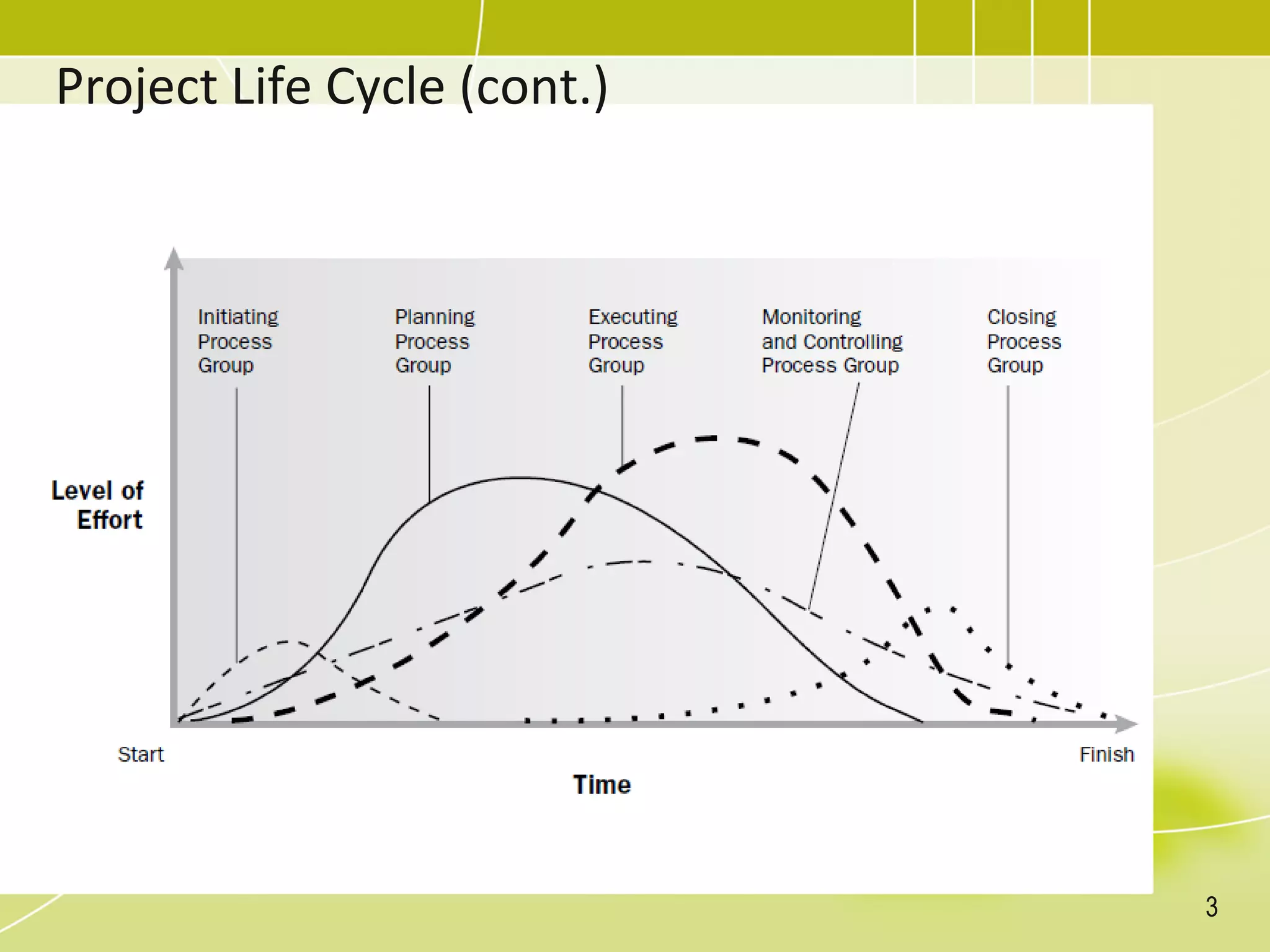
Project Life Cycle
• The project life cycle is the agglomeration of all phases in the project:
– All projects are divided into phases, and all projects, large or small, have
a similar life cycle structure: Starting the project, organizing and preparing,
carrying out the project work, and closing the project.
– At a minimum, project will have a beginning or initiation phase, an
intermediate phase or phases, and an ending phase.
• Each phase has a defined endpoint.
• Examples:
– Construction: Feasibility  Planning  Design  Production 
Turnover  Startup
– IT project: Requirement  Design  Program  Test  Implement
2
Project Life Cycle (cont.)
3
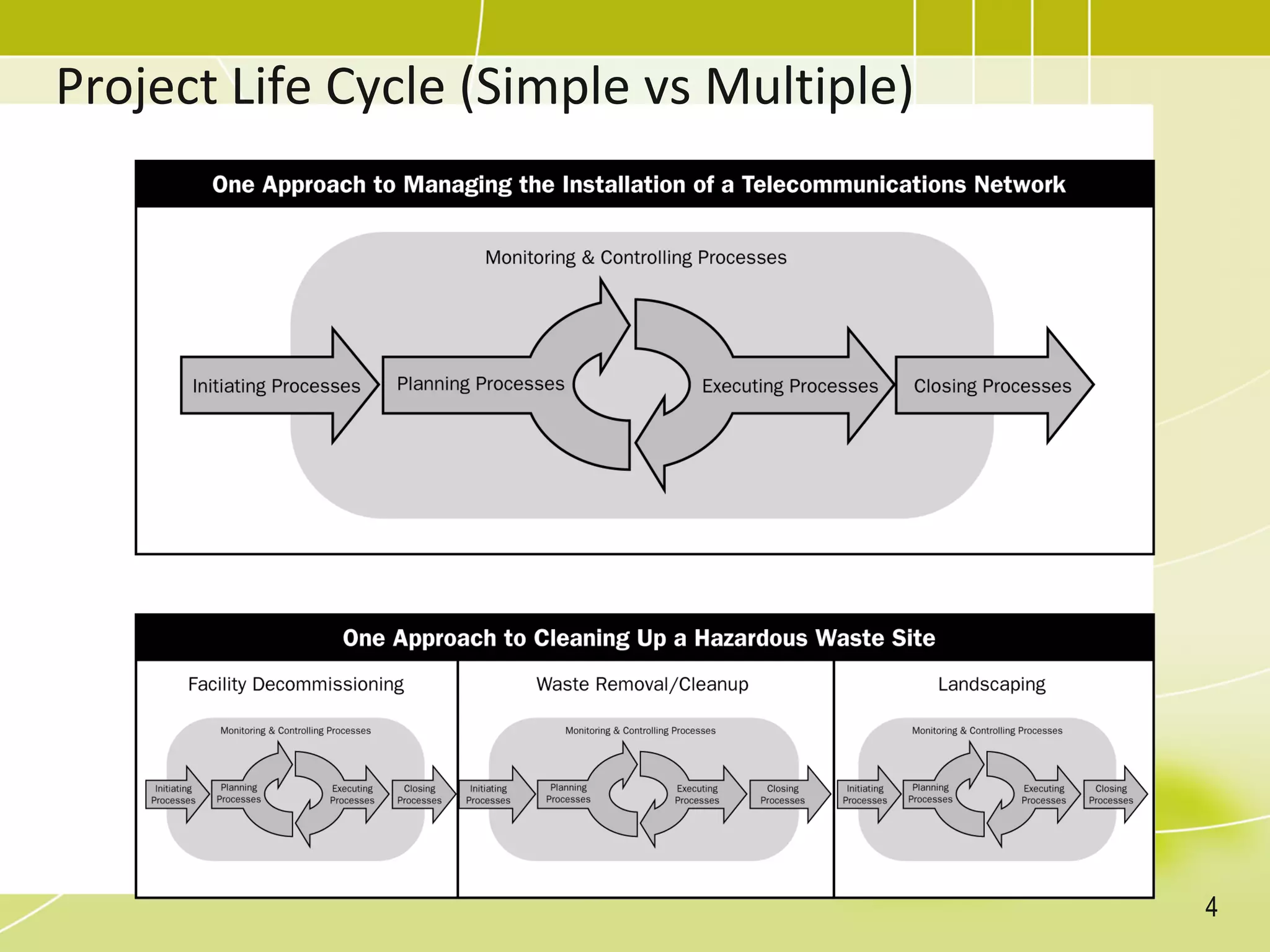
Project Life Cycle (Simple vs Multiple)
4
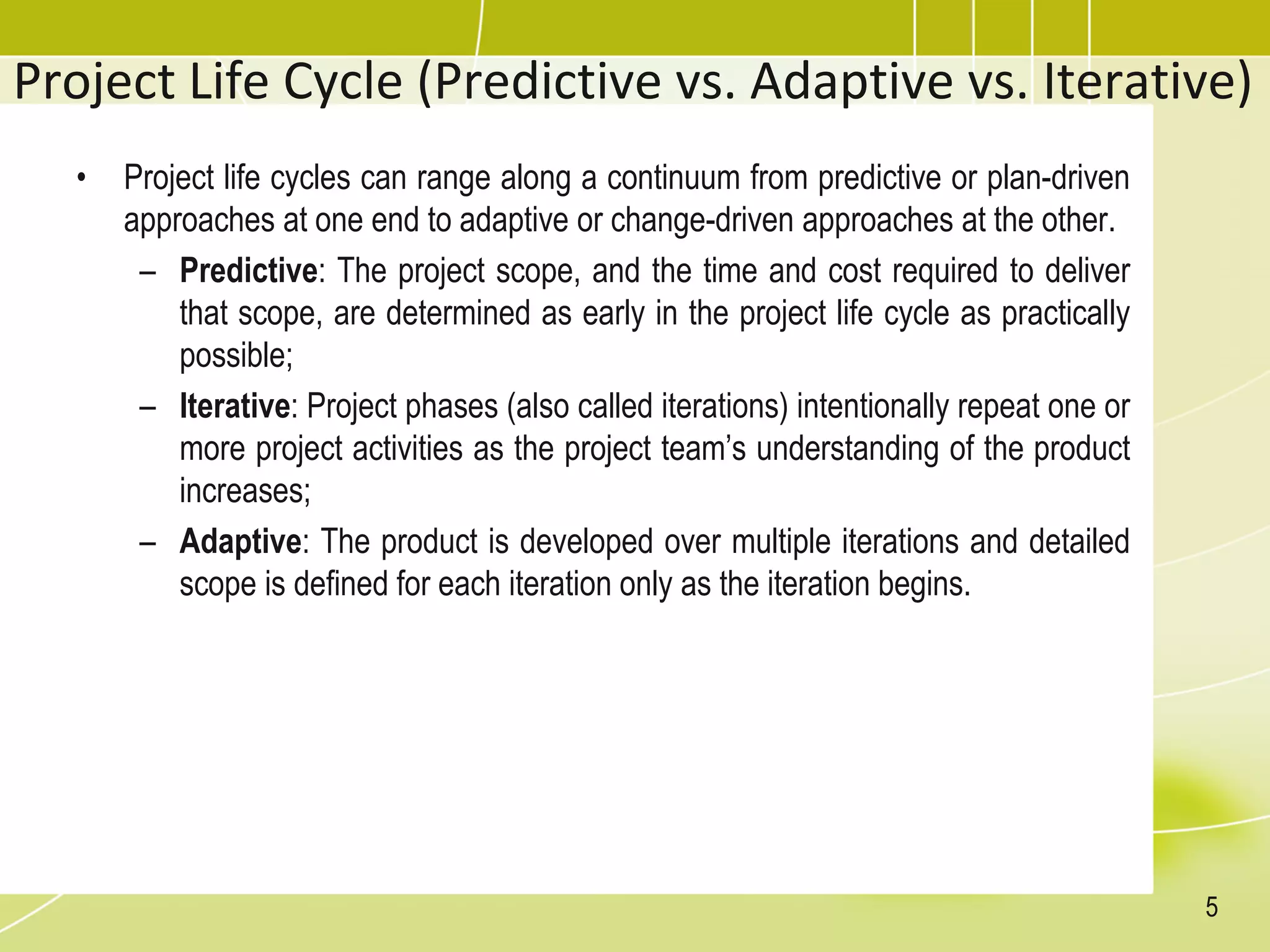
Project Life Cycle (Predictive vs. Adaptive vs. Iterative)
• Project life cycles can range along a continuum from predictive or plan-driven
approaches at one end to adaptive or change-driven approaches at the other.
– Predictive: The project scope, and the time and cost required to deliver
that scope, are determined as early in the project life cycle as practically
possible;
– Iterative: Project phases (also called iterations) intentionally repeat one or
more project activities as the project team’s understanding of the product
increases;
– Adaptive: The product is developed over multiple iterations and detailed
scope is defined for each iteration only as the iteration begins.
5
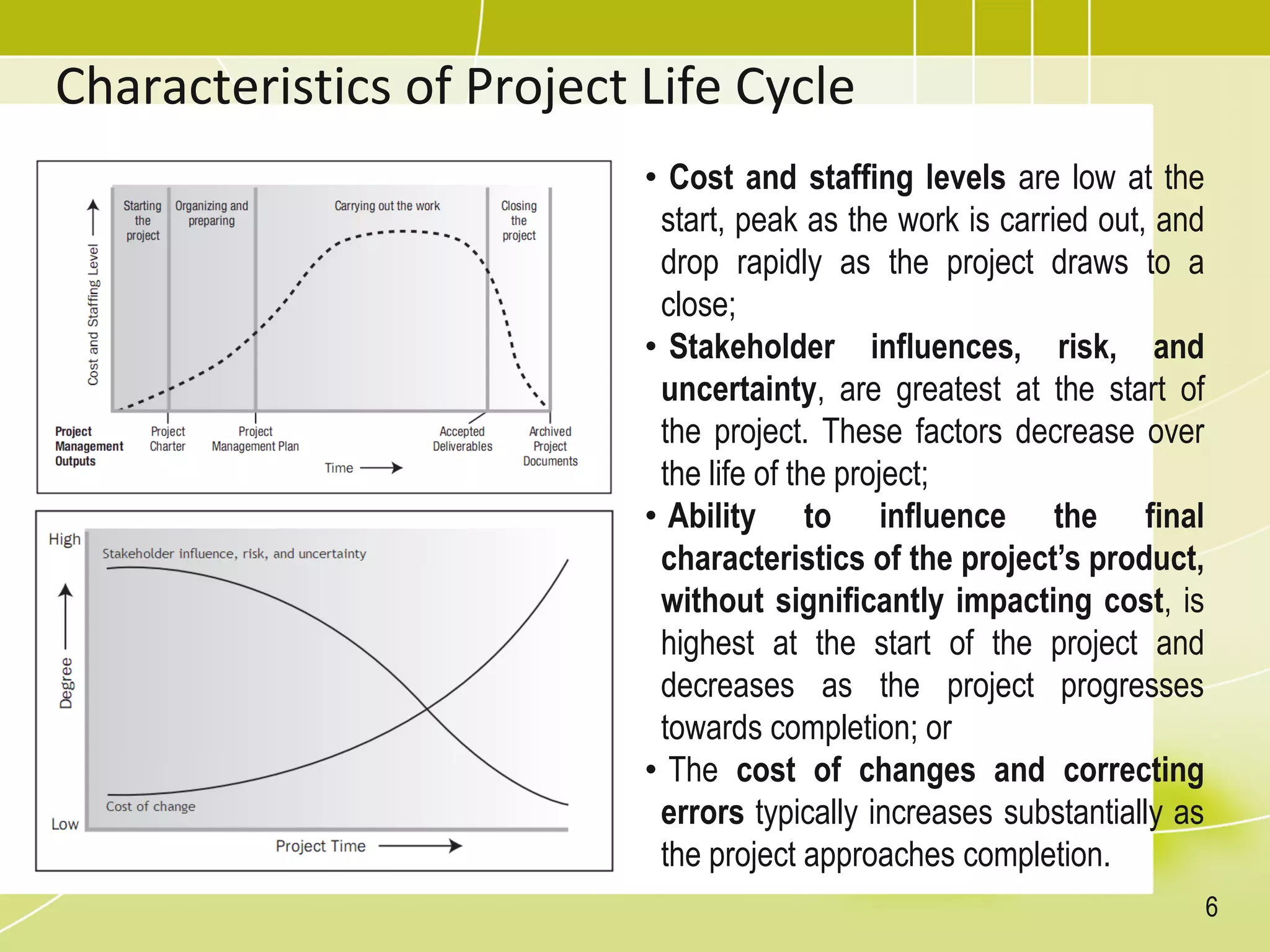
Characteristics of Project Life Cycle
• Cost and staffing levels are low at the
start, peak as the work is carried out, and
drop rapidly as the project draws to a
close;
• Stakeholder influences, risk, and
uncertainty, are greatest at the start of
the project. These factors decrease over
the life of the project;
• Ability to influence the final
characteristics of the project’s product,
without significantly impacting cost, is
highest at the start of the project and
decreases as the project progresses
towards completion; or
• The cost of changes and correcting
errors typically increases substantially as
the project approaches completion.
6
Project Phases and Project Life Cycle
• A project life cycle is a collection of project phases that defines:
– What work will be performed in each phase;
– What deliverables will be produced and when;
– Who is involved in each phase;
– How management will control and approve work produced in each phase.
• A deliverable is a product or service produced or provided as part of a project.
7
Handoffs between Project Phases
• Project phases evolve through the life cycle in a series of phases
sequences called handoffs, or technical transfers. The end of one phase
sequence typically marks the beginning of the next.
• The completion of one phase does not automatically signals the beginning
of the next phase.
8
Phase-to-Phase Relationships
• There are two basic types of phase-to-phase relationships:
– Sequential relationship: Where a phase can only start once the previous
phase is complete;
– Overlapping relationship: Where the phase starts prior to completion of
the previous one (fast tracking). Overlapping phase may increase risk and
can result in rework.
9
Organizational Influences
• Some organizational aspects that influence how project are performed:
– Culture and style (cultural norms);
– Organizational systems:
• Management elements,
• Governance frameworks, and
• Organizational structure types;
– Degree of project management maturity;
– Project management systems.
10
Organizational Culture and Style
• Organizational culture is shaped by the common experiences of members of
the organization and most organizations have developed unique cultures over
time by practice and common usage.
• Typical aspects of organizational culture:
– Shared visions, mission, values, beliefs, and expectations;
– Regulations, policies, methods, and procedures;
– Motivation and reward systems;
– Risk tolerance;
– View of leadership, hierarchy, and authority relationships;
– Code of conduct, work ethic, and work hours;
– Operating environments.
11
Organization as a System
• A system is a collection of various components that together can produce
results not obtainable by the individual components alone.
• A component is an identifiable element within the project or organization that
provides a particular function or group of related functions.
• The interaction of the various system components creates the organizational
culture and capabilities.
• There are several principles regarding systems:
– Systems are dynamic;
– Systems can be optimized;
– System components can be optimized;
– Systems and their components cannot be optimized at the same time, and
– Systems are nonlinear in responsiveness.
12
Governance Framework
• Governance refers to organizational or structural arrangements at all levels of
an organization designed to determine and influence the behavior of the
organization’s members.
• Governance is multidimensional and:
– Includes consideration of people, roles, structures, and policies; and
– Requires providing direction and oversight through data and feedback.
• Governance framework includes:
– Rules, policies, procedures, norms,
– Relationships, systems, and processes.
• This framework influences how:
– Objectives of the organization are set and achieved;
– Risk is monitored and assessed; and
– Performance is optimized.
13
Management Elements
• Management elements are the components that comprise the key functions or principles
of general management in the organization.
• The general management elements are allocated within the organization according to its
governance framework and the organizational structure type selected.
• The key functions or principles of management include but are not limited to:
– Division of work using specialized skills and availability to perform work;
– Authority given to perform work;
– Responsibility to perform work appropriately assigned based on such attributes as skill and
experience;
– Discipline of action; unity of command and direction;
– General goals of the organization take precedence over individual goals;
– Paid fairly for work performed; optimal use of resources;
– Clear communication channels;
– Right materials to the right person for the right job at the right time;
– Fair and equal treatment of people in the workplace;
– Clear security of work positions; safety of people in the workplace;
– Open contribution to planning and execution by each person; and optimal morale.
14
Types of Organizational Structures
• Factors to consider in selecting an organizational structure include but are not
limited to:
– Degree of alignment with organizational objectives;
– Specialization capabilities;
– Span of control, efficiency, and effectiveness;
– Clear path for escalation of decisions;
– Clear line and scope of authority;
– Delegation capabilities;
– Accountability assignment;
– Responsibility assignment;
– Adaptability of design;
– Simplicity of design;
– Efficiency of performance;
– Cost considerations;
– Physical locations; and
– Clear communication.
15
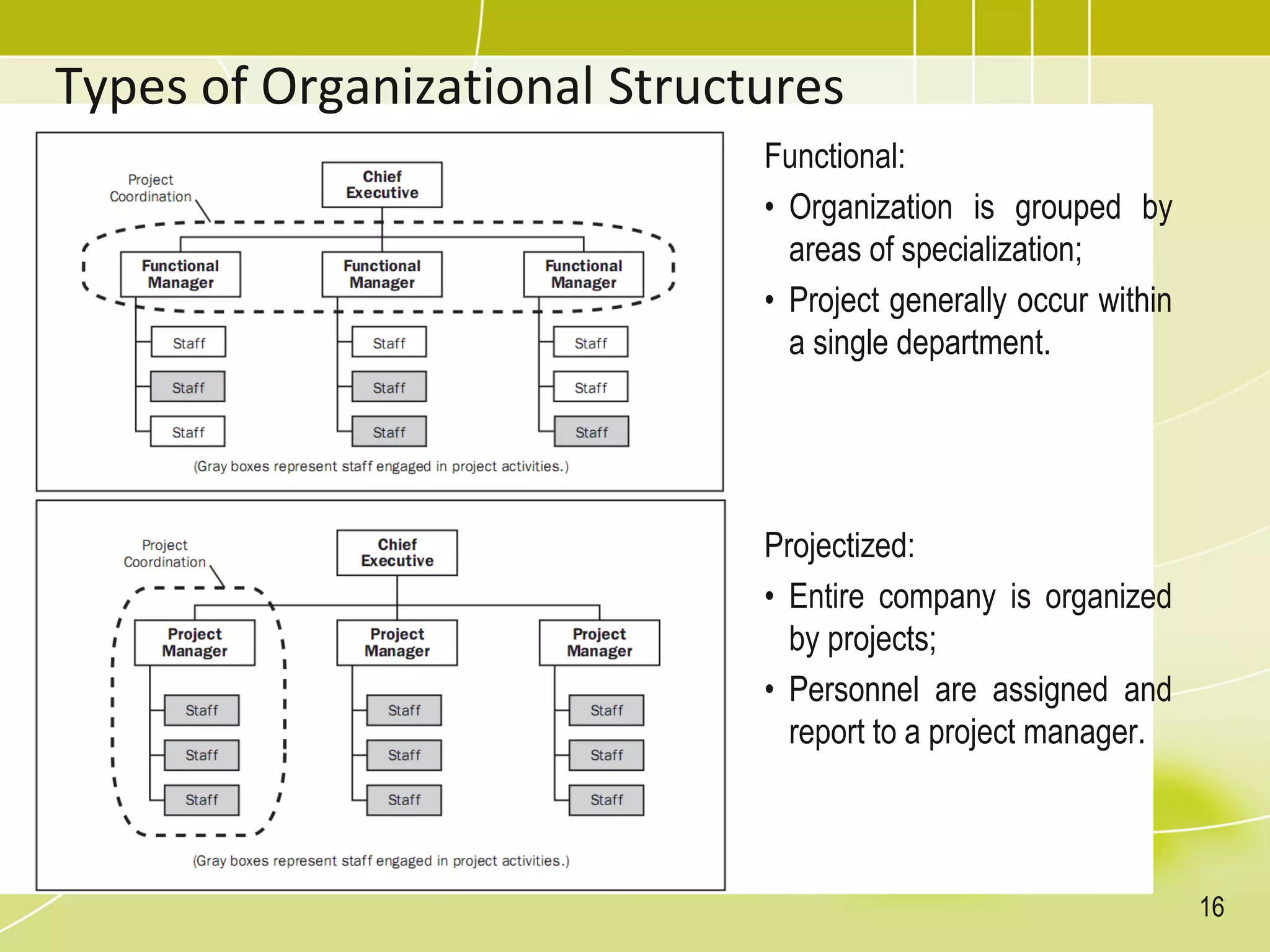
Types of Organizational Structures
Functional:
• Organization is grouped by
areas of specialization;
• Project generally occur within
a single department.
Projectized:
• Entire company is organized
by projects;
• Personnel are assigned and
report to a project manager.
16
Types of Organizational Structures (cont.)
Weak Matrix:
• Power rest with the
functional manager;
• Power of project
manager = coordinator
or expediter.
Balanced Matrix:
• Power is shared between
the project manager and
the functional manager.
17
Types of Organizational Structures (cont.)
Strong Matrix:
• Power rest with the
project manager.
Composite:
• A combination of the
above structures;
• Support different
strategic objectives.
18
Comparaison of Organizational Structures
19
Comparaison of Organizational Structures
Advantages Disadvantages
Functional
•Easier management of specialists;
•Team members report to only one
supervisor;
•Similar resources are centralized, as the
company is grouped by specialties;
•Clearly defined career paths in areas of
work specialization.
•People place more emphasis on their
functional specialty to the detriment of the
project;
•No career path in project management
•The project manager has little or no
authority.
Projectized
•Efficient project organization;
•Loyalty to the project;
•More effective communication than
functional.
•No “home” when project is completed;
•Lack of professionalism in disciplines;
•Duplication of facilities and job functions;
•Less efficient use of resources.
Matrix
•Highly visible project objectives;
•Improved project manager control over
resources;
•More support from functional area;
•Maximum utilization of scarce resources;
•Better coordination.
•Extra administration is required;
•More than one boss for project teams;
•More complex to monitor and control;
•Tougher problems with resource
allocation;
•Need extensive policies and procedures.
• Advantages and disadvantages of organizational structures on projects:
20
Thank You
Next topic:
Project Selection & Porfolio Management
21

Topic 2 - Project Life Cycle and Project Management Organization.pdf

  • 1.
    Project Life Cycleand Project Management Organization Dr. Huy Nguyen
  • 2.
    Project Life Cycle •The project life cycle is the agglomeration of all phases in the project: – All projects are divided into phases, and all projects, large or small, have a similar life cycle structure: Starting the project, organizing and preparing, carrying out the project work, and closing the project. – At a minimum, project will have a beginning or initiation phase, an intermediate phase or phases, and an ending phase. • Each phase has a defined endpoint. • Examples: – Construction: Feasibility  Planning  Design  Production  Turnover  Startup – IT project: Requirement  Design  Program  Test  Implement 2
  • 3.
  • 4.
    Project Life Cycle(Simple vs Multiple) 4
  • 5.
    Project Life Cycle(Predictive vs. Adaptive vs. Iterative) • Project life cycles can range along a continuum from predictive or plan-driven approaches at one end to adaptive or change-driven approaches at the other. – Predictive: The project scope, and the time and cost required to deliver that scope, are determined as early in the project life cycle as practically possible; – Iterative: Project phases (also called iterations) intentionally repeat one or more project activities as the project team’s understanding of the product increases; – Adaptive: The product is developed over multiple iterations and detailed scope is defined for each iteration only as the iteration begins. 5
  • 6.
    Characteristics of ProjectLife Cycle • Cost and staffing levels are low at the start, peak as the work is carried out, and drop rapidly as the project draws to a close; • Stakeholder influences, risk, and uncertainty, are greatest at the start of the project. These factors decrease over the life of the project; • Ability to influence the final characteristics of the project’s product, without significantly impacting cost, is highest at the start of the project and decreases as the project progresses towards completion; or • The cost of changes and correcting errors typically increases substantially as the project approaches completion. 6
  • 7.
    Project Phases andProject Life Cycle • A project life cycle is a collection of project phases that defines: – What work will be performed in each phase; – What deliverables will be produced and when; – Who is involved in each phase; – How management will control and approve work produced in each phase. • A deliverable is a product or service produced or provided as part of a project. 7
  • 8.
    Handoffs between ProjectPhases • Project phases evolve through the life cycle in a series of phases sequences called handoffs, or technical transfers. The end of one phase sequence typically marks the beginning of the next. • The completion of one phase does not automatically signals the beginning of the next phase. 8
  • 9.
    Phase-to-Phase Relationships • Thereare two basic types of phase-to-phase relationships: – Sequential relationship: Where a phase can only start once the previous phase is complete; – Overlapping relationship: Where the phase starts prior to completion of the previous one (fast tracking). Overlapping phase may increase risk and can result in rework. 9
  • 10.
    Organizational Influences • Someorganizational aspects that influence how project are performed: – Culture and style (cultural norms); – Organizational systems: • Management elements, • Governance frameworks, and • Organizational structure types; – Degree of project management maturity; – Project management systems. 10
  • 11.
    Organizational Culture andStyle • Organizational culture is shaped by the common experiences of members of the organization and most organizations have developed unique cultures over time by practice and common usage. • Typical aspects of organizational culture: – Shared visions, mission, values, beliefs, and expectations; – Regulations, policies, methods, and procedures; – Motivation and reward systems; – Risk tolerance; – View of leadership, hierarchy, and authority relationships; – Code of conduct, work ethic, and work hours; – Operating environments. 11
  • 12.
    Organization as aSystem • A system is a collection of various components that together can produce results not obtainable by the individual components alone. • A component is an identifiable element within the project or organization that provides a particular function or group of related functions. • The interaction of the various system components creates the organizational culture and capabilities. • There are several principles regarding systems: – Systems are dynamic; – Systems can be optimized; – System components can be optimized; – Systems and their components cannot be optimized at the same time, and – Systems are nonlinear in responsiveness. 12
  • 13.
    Governance Framework • Governancerefers to organizational or structural arrangements at all levels of an organization designed to determine and influence the behavior of the organization’s members. • Governance is multidimensional and: – Includes consideration of people, roles, structures, and policies; and – Requires providing direction and oversight through data and feedback. • Governance framework includes: – Rules, policies, procedures, norms, – Relationships, systems, and processes. • This framework influences how: – Objectives of the organization are set and achieved; – Risk is monitored and assessed; and – Performance is optimized. 13
  • 14.
    Management Elements • Managementelements are the components that comprise the key functions or principles of general management in the organization. • The general management elements are allocated within the organization according to its governance framework and the organizational structure type selected. • The key functions or principles of management include but are not limited to: – Division of work using specialized skills and availability to perform work; – Authority given to perform work; – Responsibility to perform work appropriately assigned based on such attributes as skill and experience; – Discipline of action; unity of command and direction; – General goals of the organization take precedence over individual goals; – Paid fairly for work performed; optimal use of resources; – Clear communication channels; – Right materials to the right person for the right job at the right time; – Fair and equal treatment of people in the workplace; – Clear security of work positions; safety of people in the workplace; – Open contribution to planning and execution by each person; and optimal morale. 14
  • 15.
    Types of OrganizationalStructures • Factors to consider in selecting an organizational structure include but are not limited to: – Degree of alignment with organizational objectives; – Specialization capabilities; – Span of control, efficiency, and effectiveness; – Clear path for escalation of decisions; – Clear line and scope of authority; – Delegation capabilities; – Accountability assignment; – Responsibility assignment; – Adaptability of design; – Simplicity of design; – Efficiency of performance; – Cost considerations; – Physical locations; and – Clear communication. 15
  • 16.
    Types of OrganizationalStructures Functional: • Organization is grouped by areas of specialization; • Project generally occur within a single department. Projectized: • Entire company is organized by projects; • Personnel are assigned and report to a project manager. 16
  • 17.
    Types of OrganizationalStructures (cont.) Weak Matrix: • Power rest with the functional manager; • Power of project manager = coordinator or expediter. Balanced Matrix: • Power is shared between the project manager and the functional manager. 17
  • 18.
    Types of OrganizationalStructures (cont.) Strong Matrix: • Power rest with the project manager. Composite: • A combination of the above structures; • Support different strategic objectives. 18
  • 19.
  • 20.
    Comparaison of OrganizationalStructures Advantages Disadvantages Functional •Easier management of specialists; •Team members report to only one supervisor; •Similar resources are centralized, as the company is grouped by specialties; •Clearly defined career paths in areas of work specialization. •People place more emphasis on their functional specialty to the detriment of the project; •No career path in project management •The project manager has little or no authority. Projectized •Efficient project organization; •Loyalty to the project; •More effective communication than functional. •No “home” when project is completed; •Lack of professionalism in disciplines; •Duplication of facilities and job functions; •Less efficient use of resources. Matrix •Highly visible project objectives; •Improved project manager control over resources; •More support from functional area; •Maximum utilization of scarce resources; •Better coordination. •Extra administration is required; •More than one boss for project teams; •More complex to monitor and control; •Tougher problems with resource allocation; •Need extensive policies and procedures. • Advantages and disadvantages of organizational structures on projects: 20
  • 21.
    Thank You Next topic: ProjectSelection & Porfolio Management 21