Developing Your Creative Skills Topic 1: General Methodology (I) Semester 2 (May – Aug 2010) Prepared by: Ms. Eunice Ooi
Definition of Learning To acquire knowledge of or skill in by study, instruction, or experience to learn french; to learn to ski   To become informed of or acquainted with; ascertain to learn the truth To memorize He learned the poem so he could recite it at the dinner   To gain (a habit, mannerism, etc.) by experience, exposure to example, or the like; acquire She learned patience from her father.
1. Purposeful Learning is an individual process 2. Result of experience The student can learn only from personal experiences A person's knowledge is a result of experience, and no two people have had identical experiences.  Even when observing the same event, two people react differently; they learn different things from it, according to the manner in which the situation affects their individual needs Previous experience conditions a person to respond to some things and to ignore others Four Characteristics of Learning
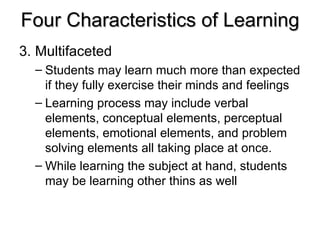
Four Characteristics of Learning 3.  Multifaceted Students may learn much more than expected if they fully exercise their minds and feelings Learning process may include verbal elements, conceptual elements, perceptual elements, emotional elements, and problem solving elements all taking place at once. While learning the subject at hand, students may be learning other thins as well
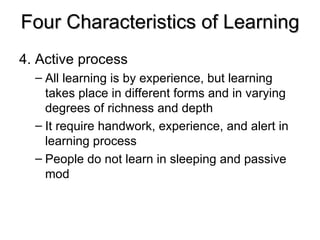
Four Characteristics of Learning 4. Active process All learning is by experience, but learning takes place in different forms and in varying degrees of richness and depth It require handwork, experience, and alert in learning process People do not learn in sleeping and passive mod
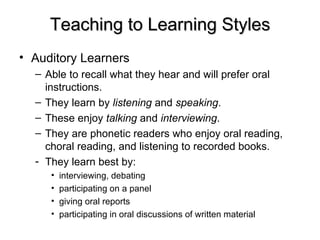
Teaching to Learning Styles Auditory Learners  Able to recall what they hear and will prefer oral instructions.  They learn by  listening  and  speaking . These enjoy  talking  and  interviewing .  They are phonetic readers who enjoy oral reading, choral reading, and listening to recorded books.  They learn best by: interviewing, debating  participating on a panel  giving oral reports  participating in oral discussions of written material
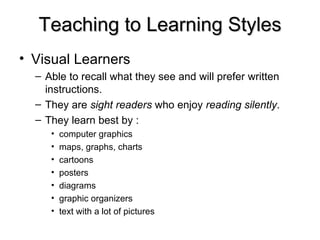
Teaching to Learning Styles Visual Learners   Able to recall what they see and will prefer written instructions. They are  sight readers  who enjoy  reading silently .  They learn best by : computer graphics  maps, graphs, charts  cartoons  posters  diagrams  graphic organizers  text with a lot of pictures
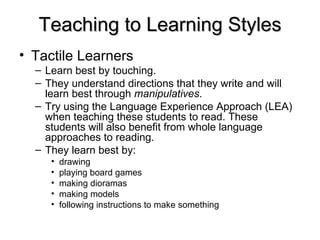
Teaching to Learning Styles Tactile Learners   Learn best by touching. They understand directions that they write and will learn best through  manipulatives .  Try using the Language Experience Approach (LEA) when teaching these students to read. These students will also benefit from whole language approaches to reading. They learn best by: drawing  playing board games  making dioramas  making models  following instructions to make something
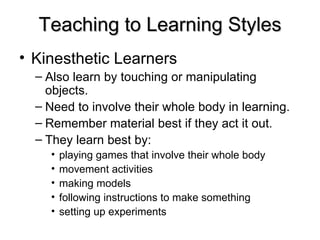
Teaching to Learning Styles Kinesthetic Learners   Also learn by touching or manipulating objects. Need to involve their whole body in learning.  Remember material best if they act it out. They learn best by: playing games that involve their whole body  movement activities  making models  following instructions to make something  setting up experiments
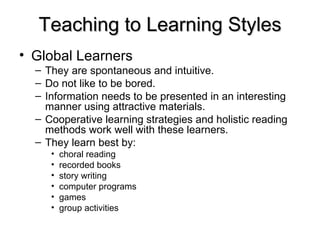
Teaching to Learning Styles Global Learners   They are spontaneous and intuitive. Do not like to be bored.  Information needs to be presented in an interesting manner using attractive materials. Cooperative learning strategies and holistic reading methods work well with these learners. They learn best by: choral reading  recorded books  story writing  computer programs  games  group activities
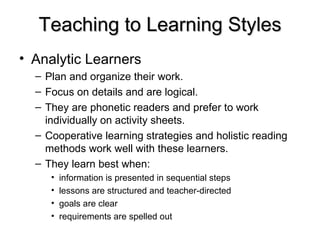
Teaching to Learning Styles Analytic Learners   Plan and organize their work. Focus on details and are logical.  They are phonetic readers and prefer to work individually on activity sheets. Cooperative learning strategies and holistic reading methods work well with these learners. They learn best when: information is presented in sequential steps  lessons are structured and teacher-directed  goals are clear  requirements are spelled out
Class Activities Give FIVE (5) examples of activities which will be benefiting students of EACH of the different learning styles.
Learning Style Inventory http://www.personal.psu.edu/bxb11/LSI/LSI.htm http://www.learning-styles-online.com/inventory/questions.asp

Topic 1

  • 1.
    Developing Your CreativeSkills Topic 1: General Methodology (I) Semester 2 (May – Aug 2010) Prepared by: Ms. Eunice Ooi
  • 2.
    Definition of LearningTo acquire knowledge of or skill in by study, instruction, or experience to learn french; to learn to ski To become informed of or acquainted with; ascertain to learn the truth To memorize He learned the poem so he could recite it at the dinner To gain (a habit, mannerism, etc.) by experience, exposure to example, or the like; acquire She learned patience from her father.
  • 3.
    1. Purposeful Learningis an individual process 2. Result of experience The student can learn only from personal experiences A person's knowledge is a result of experience, and no two people have had identical experiences. Even when observing the same event, two people react differently; they learn different things from it, according to the manner in which the situation affects their individual needs Previous experience conditions a person to respond to some things and to ignore others Four Characteristics of Learning
  • 4.
    Four Characteristics ofLearning 3. Multifaceted Students may learn much more than expected if they fully exercise their minds and feelings Learning process may include verbal elements, conceptual elements, perceptual elements, emotional elements, and problem solving elements all taking place at once. While learning the subject at hand, students may be learning other thins as well
  • 5.
    Four Characteristics ofLearning 4. Active process All learning is by experience, but learning takes place in different forms and in varying degrees of richness and depth It require handwork, experience, and alert in learning process People do not learn in sleeping and passive mod
  • 6.
    Teaching to LearningStyles Auditory Learners Able to recall what they hear and will prefer oral instructions. They learn by listening and speaking . These enjoy talking and interviewing . They are phonetic readers who enjoy oral reading, choral reading, and listening to recorded books. They learn best by: interviewing, debating participating on a panel giving oral reports participating in oral discussions of written material
  • 7.
    Teaching to LearningStyles Visual Learners Able to recall what they see and will prefer written instructions. They are sight readers who enjoy reading silently . They learn best by : computer graphics maps, graphs, charts cartoons posters diagrams graphic organizers text with a lot of pictures
  • 8.
    Teaching to LearningStyles Tactile Learners Learn best by touching. They understand directions that they write and will learn best through manipulatives . Try using the Language Experience Approach (LEA) when teaching these students to read. These students will also benefit from whole language approaches to reading. They learn best by: drawing playing board games making dioramas making models following instructions to make something
  • 9.
    Teaching to LearningStyles Kinesthetic Learners Also learn by touching or manipulating objects. Need to involve their whole body in learning. Remember material best if they act it out. They learn best by: playing games that involve their whole body movement activities making models following instructions to make something setting up experiments
  • 10.
    Teaching to LearningStyles Global Learners They are spontaneous and intuitive. Do not like to be bored. Information needs to be presented in an interesting manner using attractive materials. Cooperative learning strategies and holistic reading methods work well with these learners. They learn best by: choral reading recorded books story writing computer programs games group activities
  • 11.
    Teaching to LearningStyles Analytic Learners Plan and organize their work. Focus on details and are logical. They are phonetic readers and prefer to work individually on activity sheets. Cooperative learning strategies and holistic reading methods work well with these learners. They learn best when: information is presented in sequential steps lessons are structured and teacher-directed goals are clear requirements are spelled out
  • 12.
    Class Activities GiveFIVE (5) examples of activities which will be benefiting students of EACH of the different learning styles.
  • 13.
    Learning Style Inventoryhttp://www.personal.psu.edu/bxb11/LSI/LSI.htm http://www.learning-styles-online.com/inventory/questions.asp